


Nutrition knowledge (NK), which can be defined as the competence to understand healthy nutrition concepts, has become a topic worth of interest in recent research due to its relationship with individual food behaviour and eating habits. Dietary behaviour, and consequently dietary intake, may be the result of several factors, including NK, together with socioeconomic status and many others(Reference Shepherd and Elmadfa1). NK itself can be affected by many variables, such as demographic factors and level of education, and it has been recognised as an important determinant of food choices and dietary behaviours, for instance, being associated with a better food label use(Reference Miller and Cassady2). Data from cross-sectional studies obtained on large cohorts demonstrated that NK is able to modulate diet quality(Reference Beydoun and Wang3), and high NK scores have been associated with an increasing consumption of fruit and vegetables(Reference Spronk, Kullen and Burdon4). Moreover, NK has been shown to act as a mediator between the socioeconomic status of subjects and their diet quality(Reference Spronk, Kullen and Burdon4). Due to the growing interest in NK, several instruments have been developed to assess NK in different populations. Questionnaires are the most widely used instruments, although a high variability can be observed, with some questionnaires measuring general concepts(Reference Spronk, Kullen and Burdon4) and others focusing only on specific aspects, such as fibre(Reference Deniz and Alsaffar5). To obtain more precise and consistent results, NK must be measured through robust and validated questionnaires, better if created ad hoc for a specific target population(Reference Barbosa, Vasconcelos and Correia LO dos6,Reference Alsaffar7) . In Italy, a nine-two-item questionnaire on NK was elaborated, validated and administered in a sample of subjects >35 years enrolled within the Moli-sani project and finally used to evaluate its association with adherence to the Mediterranean diet and prevalence of obesity(Reference Bonaccio, Di Castelnuovo and Costanzo8). Other Italian questionnaires have been used to investigate NK in children and young adolescents(Reference Grosso, Mistretta and Turconi9) as well as general and sport NK in adolescents and young adults who practiced sports(Reference Calella, Iacullo and Valerio10). Conversely, to the best of our knowledge, there are no surveys of NK specifically validated for Italian university students.
Based on these premises, the aim of the present study was to validate an ad hoc questionnaire to assess NK in Italian university students.
Materials and methods
Development of the questionnaire item pool
According to the FAO guidelines(Reference Macías and Glasauer11), a questionnaire of ninety items was obtained starting from a pool of 150 questions, mainly based on an already validated questionnaire for the Italian adult population(Reference Bonaccio, Di Castelnuovo and Costanzo8) and mostly focusing on topics included in the latest Italian dietary guidelines(12). The final questionnaire was divided into five constructs and structured as follows: Construct 1 (experts’ recommendation) contained six questions focusing on frequencies of consumption of meals and food groups. Questions provided five possible options with a single correct answer and an answer, ‘I do not know’, to discourage missing data. Construct 2 (nutritional content of food) was composed of forty-nine questions on nutritional content of several foods. The first forty-five items offered three possible answers, ‘high content’, ‘low content’ and ‘I do not know’, while four or five possible choices with a single correct one and a possible ‘I do not know’ option were available for the last four questions. Construct 3 (health aspects of food and diet) included ten items focusing on the health aspects of food and diets. Possible answers for the questions were: ‘I agree’, ‘I disagree’ and ‘I do not know’. Construct 4 (relationship between diet and diseases) aimed at exploring the knowledge related to the relationship between diet and diseases through nineteen items. Two questions were multiple-choice items with five to six options, with only one correct choice and a ‘I do not know’ option, while the other seventeen were ‘yes’ or ‘no’ items with an additional ‘I do not know’ choice. Construct 5 (proper food choices) included six questions on proper food choices. For each item, five possible choices were available of which one was the correct option and another was the ‘I do not know’ alternative.
Additional participant information was added to the questionnaire to collect data useful to better describe and classify the population: age, gender and university course. The questionnaire is available as online Supplementary material.
Administration and validation of the nutrition knowledge questionnaire
Internal consistency and test–retest reliability were assessed to validate the questionnaire. The test–retest reliability was measured by administering the questionnaire to the same population under the same conditions on two different occasions. We assumed that a time interval of 3 weeks between the two administrations would be long enough to avoid recall bias and short enough to avoid changes in the studied attributes. In addition, construct validity was explored by comparing two groups of students with theoretically different NK levels due to their university background. The assigned scores were the followings: 1 point for correct answers, 0 point for each ‘I do not know’ answer or incorrect answers in order to calculate a total NK score (ranging from 0 to 90 points) and NK sub-scores for the five sections.
Participants
A suitable sample of participants was recruited among bachelor and master degree students attending the University of Parma, with either at least a nutrition class (nutrition background group) or not (non-nutrition background group). The sample was created using a cluster design with the class as basic unit of sampling to ensure the recruiting of a similar number of students with or without nutrition background. Students were eligible if they were between 19 and 30 years old. All volunteers gave their informed written consent to participate in the study, and they were assured of complete anonymity. Participants were encouraged to answer all the questions and to report any confusion and/or difficulties with the questionnaire.
Statistical analysis
The sample was representative of the target population (students attending the University of Parma). According to literature(Reference Parmenter and Wardle13), and considering the current total number of students at the University of Parma (n 24 555; www.unipr.it), the number of individuals involved in the validation study was estimated to be 130 (90 % level of confidence and 7 % marginal error).
For each construct of the questionnaire (experts’ recommendations; nutrient contents of food; health aspects of food and diets; relationship between diet and diseases; proper food choices), internal consistency was measured by computing the Cronbach’s α. According to classical test theory principles, the minimum requirement for internal consistency is recommended as 0·60(Reference Cronbach14,Reference De Vellis15) . In addition, Pearson’s correlation coefficient was computed as a measure of temporal stability (test–retest reliability) for each construct and each item. In addition, a two-sample Student’s t test was used to explore construct validity by searching for differences in NK scores between nutrition and non-nutrition background students at the first administration of the questionnaire (T0). Finally, participants’ characteristics based on their academic course were investigated using a two-sample Student’s t test for continuous variables and a Chi-square test for categorical variables. Statistical analyses were performed using the Statistical Package for Social Science (SPSS version 25.0; SPSS Inc.), and the significance was set at P < 0·05.
Results
Characteristics of subjects
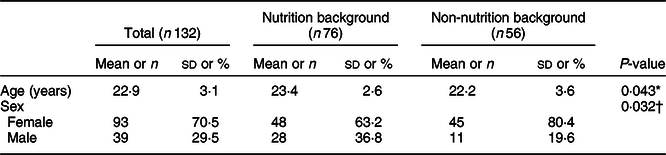
A total of 132 students attending the University of Parma were included in the final analysis. Mean age was 22·9 years, 29·5 % were males, and 57·6 % were students with an academic nutrition background (Table 1). These participants were significantly older (P = 0·043) and included more males compared to those without an academic nutrition background (χ 2 = 4·6, df = 1, P = 0·032).
Participants’ characteristics based on the total population and by academic background
* Two-sample t test with P < 0·05.
† Chi-square test with P < 0·05.
Validity and reliability of the questionnaire
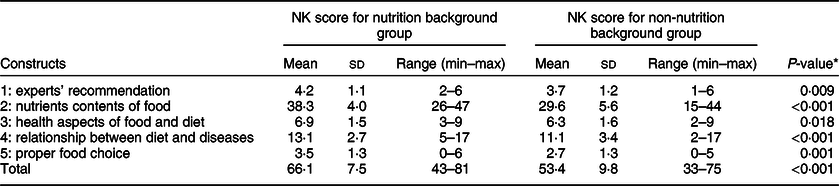
Regarding the construct validity, the overall score of the questionnaire was significantly higher in students with a nutrition background than in those from the non-nutrition background group (Table 2). A significant difference was also found for each group of questions, the score being higher in the nutrition background group for each questionnaire section (Table 2).
Validity at time 0 of categorised items by academic background
NK, nutrition knowledge.
* Two-sample t test with P < 0·05.
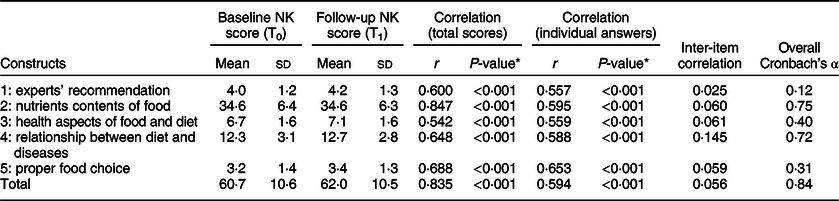
The reliability analysis (test–retest time stability) showed a high correlation of the total score (r = 0·835, P < 0·001) and a moderate correlation of all individual answers to each item (r = 0·594, P < 0·001; Table 3). When considering individual groups of items, only the total scores of construct 3 (health aspects of food and diet) had moderate time stability (r = 0·542, P < 0·001), while the other constructs showed good test–retest reliability.
Test–retest reliability and internal consistency
NK, nutrition knowledge.
* Pearson’s correlation test with P < 0·05.
Results for the overall internal consistency of the questionnaire were above the acceptable values (Cronbach’s α = 0·84); however, individual constructs revealed a weak internal consistency for construct 1 (experts’ recommendation), construct 3 (health aspects of food and diet) and construct 5 (proper food choices), while good results were found for construct 2 (nutritional content of food) and construct 4 (relationship between diet and diseases).
Discussion
The aim of the present study was to assess the validity and reliability of a self-administered NK questionnaire in Italian university students who attended either nutrition-related or other university courses at the University of Parma.
The questionnaire revealed a high overall internal consistency and reliability (Cronbach’s α > 0·8). This is in accordance with Cronbach’s scores usually ranging from 0·7 to 0·9 in other validated NK questionnaires(Reference Alsaffar7,Reference Grosso, Mistretta and Turconi9,Reference Bradette-Laplante, Carbonneau and Provencher16) , so a cut-off of 0·7 is usually considered adequate(Reference Trakman, Forsyth and Hoye17).
When considering single constructs, a good internal consistency was found only for construct 2 (nutritional content of food) and construct 4 (relationship between diet and diseases). It is worth considering that Cronbach’s α values are generally responsive to the number of items in the construct. With constructs having fewer than ten items (as we had for construct 1 (experts’ recommendation), construct 3 (health aspects of food and diet) and construct 5 (proper food choice)), it may be more appropriate to report the mean inter-item correlation, but inter-item correlations were also low, suggesting quite a weak relationship among the items. Including additional items to those constructs with few items may increase internal consistency, but it may also represent a barrier for self-administered compilation, leading to a lowering of attention of students in a university setting.
Nevertheless, we obtained an overall strong consistency, and the administration of our NK questionnaire was proved to be applicable. Our tool had good temporal stability considering both total correlations and individual answer correlations of the test–retest reliability (all r > 0·5). Moreover, our questionnaire showed a good ability to discriminate between people with potentially higher nutritional knowledge (nutrition background group) and those without it (non-nutrition background group), confirming a good validity of our tool.
Other questionnaires have been validated worldwide in student populations, showing good reliability and validity. A recent study assessed the validity and reliability of an NK questionnaire in over 250 Kuwaitian students categorised with or without academic background as health-related or nutrition training knowledge(Reference Alkaed, Ibrahim and Ismail18). Results showed an overall mean score significantly higher in students with a health background than in those from non-health disciplines. The academic background was also considered in another study in Turkey, aimed at validating an NK questionnaire on undergraduate students attending either nutrition and dietetics or engineering classes(Reference Alsaffar7). The study found a high overall internal and test–retest reliability. Other NK questionnaires were also validated and used in students from Turkey(Reference Deniz and Alsaffar5,Reference Özdoğan, Yardımcı and Özçelik19,Reference Ozgen20) , USA(Reference Ozgen20), China(Reference Sakamaki, Toyama and Amamoto21) and Australia(Reference Perlstein, McCoombe and Macfarlane22).
In Italy, NK questionnaires have been validated in children and adolescents(Reference Tallarini, Zabeo and Ferraretto23) as well as in adults(Reference Bonaccio, Di Castelnuovo and Costanzo8) – in some cases translating and/or adapting foreign versions of other questionnaires(Reference Tallarini, Zabeo and Ferraretto23,Reference Da Vico, Biffi and Agostini24) . Sometimes the questionnaires did not focus only on general NK but broadened the investigation to other topics such as sport NK(Reference Calella, Iacullo and Valerio10).
Despite that some NK questionnaires have been already used in Italy, to the best of our knowledge, this is the first questionnaire developed to measure general NK in Italian university students. This tool might be used to investigate the potential relationship between NK in this population group and dietary behaviour (e.g. food choices, dietary intake), as well as other lifestyle habits (e.g. physical activity, sleep hygiene, health literacy).
In conclusion, based on the results of the present study carried out on students attending the University of Parma, this NK questionnaire can be used as a reliable, valid and easy-to-use tool for assessing the NK of Italian university students, either with or without nutritional backgrounds.
Acknowledgements
Acknowledgements: The authors wish to thank all participants who were involved in the study and acknowledge Miss Alessia Carbonin and Mr. Adriano Masia for their precious help in collecting data. Financial support: This research received no specific grant from any funding agency, commercial or not-for-profit sectors. Conflict of interest: None. Authorship: A.R., D.M., G.G., M.L.B. and D.A. contributed to the design of the study; A.R., D.M., F.S. and D.A. carried out the study; A.R. and G.G. analysed the data; and all authors contributed to the writing of the article. Ethics of human subject participation: This study was conducted according to the guidelines laid down in the Declaration of Helsinki, and all procedures involving study participants were approved by the local Ethics Committee for Human Research (Comitato Etico dell’Area Vasta Emilia Nord, protocol number 47129/2018). Written informed consent was obtained from all subjects.
Supplementary material
For supplementary material accompanying this paper visit https://doi.org/10.1017/S1368980019004555.



