





The expressiveness of human hands
Humans have notably prehensile hands, with which they do many clever things.Footnote 1 These appendages at the end of the arms are used to wield weapons and tools. Hence, hands are in use daily. They can pack a mighty punch and/or be used for the most delicate of fingertip caresses. Furthermore, hands readily convey messages. A hand on heart is a token of truthfulness. For Christians, a hand on the Bible confirms a solemn oath. Taking the hand of another in marriage is a pledge of union. ‘Laying on hands’ ceremonially confers a blessing – or ordains a priest in office. Meanwhile, incorrigible humans can and do use their hands and fingers to convey rude and crude messages too.
One specific salutation, which is gaining international recognition, is the handshake. An individual approaches another, holds his or her gaze, extends an arm and clasps the other’s hand – after which the two pump their clasped hands up and down together – usually two or three times. (Generally, but not invariably, both parties use their right hands for this ritual.Footnote 2) At the moment of salutation, both parties are signalling concord, however fleeting.
Shaking hands thus constitutes a distinctive ritual. It remains true, of course, that there are various other forms of manual greetings. People clasp hands; touch their palms together; and/or bump fists. There are no limits to human ingenuity in styles of salutation.Footnote 3 That said, however, the respectful handshake retains a very specific role. It requires a degree of physical propinquity, without being overly intrusive.Footnote 4 Thus, handshaking offers a de facto compromise between salutations that entail close bodily contact (such as a great bear-hug)Footnote 5 and those that avoid any (such as a distant bow or curtsey).
Those familiar with greeting both friends and strangers by shaking hands undertake the ritual unselfconsciously. For them, it is part of their ‘embodied learning’, to borrow an apt term from the French social philosopher Maurice Merleau-Ponty.Footnote 6 Habits become engrained. And the point applies in reverse as well. Not only does muscle memory prompt people to behave in a specific way when greeting others, but the mind can influence behaviour too. It can help people to overcome their first instinctive recoil from certain forms of greeting, in times and places where customs are in flux.
Styles of salutations are historically not set in stone. Instead, they are responsive to wider changes, especially when societies are undergoing major transformations. Such was the case in mainland Britain in the period from 1700 to 1850. England/Wales and Lowland Scotland were developing collectively into a global hub of commerce, finance, colonial settlements and significant long-term industrial innovation.Footnote 7 Patterns of work and family life were adapting in parallel.Footnote 8 And such changes simultaneously encouraged growing numbers of Britons to share the friendly custom of shaking hands.
Handshaking sources and methodology
Sources for studying something as fleeting as people’s daily salutations need ultra-careful scrutiny.Footnote 9 Fragmentary but crucial references to inter-personal greetings can certainly be found. But these are usually casually scattered throughout letters and diaries, as well as within the texts of plays and novels, in paintings and satirical cartoons and, additionally, in legal documents and travellers’ accounts.
Because there is no single finite body of evidence, it takes considerable time to assemble and interpret a wide range of scattered source materials.Footnote 10 Furthermore, snippets of information about routine daily behaviour are sometimes ‘hiding in plain sight’. In other words, researchers need to remind themselves to study even very well-known sources with fresh eyes. Passing references can easily be missed.Footnote 11 In other words, sources should be closely scrutinized not only for their main import but for their minor details as well. (And researchers must also be prepared to cope with disappointment, as apparently promising sources can sometimes yield little of relevance.)
With time and patience, however, apposite evidence can be assembled, logged, cross-checked and classified.Footnote 12 It is then available for repeated exercises of sifting, mentally arranging, testing and rearranging. It is also useful to give interim presentations to colleagues. Fruitful seminar discussions often help to clarify and refine arguments.Footnote 13
Particularly when studying the intricacies of inter-personal dynamics, it is crucial to remain aware that there were (and are) many variations between people of different classes, religions, regions, ages, genders and ethnic/cultural traditions. One single example will thus not suffice for generalizing about (say) all eighteenth-century Britons.
Throughout, it also remains essential not to force the research findings to fit pre-set views. One well-known model of socio-economic transformation is termed ‘trickle-down theory’. It argues that major changes in consumption and behaviour are initiated by the ‘elite’ – and then ‘trickle down’ to the masses, via a process of emulation.Footnote 14 That possibility is certainly worth testing. Yet, it is equally worth checking whether, especially in pluralist urban societies, innovations may be generated from ‘below’ and then percolate ‘upwards’ and/or ‘sideways’. Here, the social spread of the handshake in Britain between c. 1700 and 1850 offers a relevant case-history.
Historic origins of handshaking
Before going into further detail, it is worth noting that the custom of shaking hands already had a long pre-history. No single date can be pinpointed for its first adoption. Humans from primordial times have clasped and touched other human hands. Instances are found in all cultures, in all eras.Footnote 15
In fact, the world’s oldest known image of a shared manual pledge dates from the ninth century BCE. An impressive bas-relief (now in a Baghdad museum) depicts an Assyrian king, with his outstretched palm lying across the outstretched palm of the Babylonian king.Footnote 16 They stand together, armed and in full regalia. Whether their touching hands were shaken lightly up and down remains unknown. Yet, they are pledging amity before their massed followers. And in the ancient world, there were other examples of similar displays. In classical Greece, the gesture was termed dexiosis or ‘joining the right hands’;Footnote 17 and it was also recorded among the Etruscans and Romans.
Over time, this manual pledge survived in Europe as a staple of international diplomacy (as it still survives today). The earliest users were usually high-ranking men (monarchs; ambassadors; generals). The shared manual pledge avoided any dispute over their relative status. One man was not required to bow or otherwise prostrate himself before the other. They stood as equals, at the moment of pledging. Hence, the utility of the gesture within the evolving diplomatic repertoire. It was not undertaken very frequently – so that it retained its special quality.
To be sure, things could and did go wrong. Jean Froissart’s fourteenth-century Chronicles reported a failed attempt at peace-making during the prolonged period of intermittent Anglo-French warfare. A leading general within a besieged caste was parleying with the rival general, who was waiting impatiently outside. The man within extended his right hand through an aperture in the castle door, to pledge good faith. But his assailant caught the hand and threatened to nail it to the door with a dagger, unless the besieged warrior threw out the castle keys and surrendered – which he did.Footnote 18
Making peace with deadly enemies was (and remains) a risky business, which one handshake could not invariably resolve. Upholding such a pledge was not a matter of law but of personal honour. And that was especially the case when the handshake was witnessed by others.
Mutually shaking hands accordingly survived as a known gesture of would-be reconciliation between fellow humans, on terms of equality (at least when making the compact). In terms of socio-biology, this behaviour indicates that humans can and do at times over-ride traditional expectations of hierarchy in order to act as egalitarian comrades – as do some (but far from all) other ape species.Footnote 19
Long before the eighteenth century, therefore, there was a conventional association of the handshake with a signal of amity between fellow humans. Even if not in constant use, the gesture fell within the known repertoire. So when William Shakespeare wrote As You Like It in the later 1590s, he allowed Touchstone to recount the reconciliation between two quarrelling citizens in the simplest of terms: ‘They shook hands and swore brothers.’Footnote 20
Shaking hands as a daily greeting
Manifestly, then, the handshake did not appear out of the blue. But there were many steps between being known in the cultural repertoire and coming into daily use, amongst all social classes. In the seventeenth century, shaking hands was certainly not a fashionable salutation. There is some evidence, however, that it was known amongst plebeian men. When meeting casually, they might slap one another’s backs but, when seeking a greater degree of formality, they would shake hands. That salutation was observed both in EnglandFootnote 21 and in Scotland. Indeed, a commentator there referred approvingly in 1607 to ‘the good olde Scottish shaking of the two right hands together’.Footnote 22
Many Britons in these years, however, followed the traditional conventions of polite society. These regulated greetings between people of different social status. Lower-ranked men bowed and removed their headgear in the presence of their ‘superiors’, who nodded graciously in acknowledgment, while lower-ranked women gave a deep curtsey to their social ‘betters’.Footnote 23 In Scotland, these customs were known to be current in fashionable society. So the egalitarian commentator in 1607 expressed his anxiety that young Scots, trying to be ‘polite’, were to be seen ‘bowing and scraping’.
Indeed, so strong were these traditional conventions (summarized briefly as ‘hat honour’) that they predominated in all the seventeenth- and eighteenth-century etiquette books. The handshake was not mentioned, even while daily behaviour was actually starting to change. Britain’s economic transformation was matched by a diversification of British society – especially in the growing towns. Whereas across mainland Britain in 1700, most people lived in small rural settlements with fewer than 2,500 inhabitants, by 1851 (as confirmed by the census) the majority lived in towns.Footnote 24 And some of the great urban areas had by the mid-nineteenth century become massive cities by any standards. Thus, metropolitan London in 1851 housed over 2.5 million people.
Whereas in small rural villages, it was still possible to make speedy assessments of mutual rankings – and thereupon to decide what salutation was required – things were very different within the bustling urban world. It was often hard, upon a first encounter, to tell who outranked whom.Footnote 25 Particularly among the expanding urban middle class, there was much status overlap. ‘The different Stations of Life so run into and mix with each other’, complained the dean of Gloucester, after travelling around England in the mid-1770s, ‘that it is hard to say where one ends and the other begins.’Footnote 26
Gradually, as Britain urbanized, the traditional hierarchical style of deep bowing and curtseying was becoming reserved for formal occasions, such as at court balls or smart assemblies. ‘Hat honour’ on a daily basis was becoming attenuated. Men no longer bowed deeply but instead gave a slight nod or a pull on their headgear. Equally, women were, over time, exchanging the deep curtsey for a quick ‘bob’ of the body, with an inclination of the head. (Significantly, too, in these years many Britons were adopting less formal salutations in their written correspondence.)Footnote 27
Thereupon, the hitherto obscure handshake began to emerge from the shadows. It did not replace the attenuated ‘hat honour’ but was generally used alongside it, as circumstances suggested (although for one determined group of convinced egalitarians the handshake became their sole form of greeting, as noted below). Increasingly, there were passing references to its adoption, not just between equals – but also between people of different status. The handshake manifestly did not abolish grand titles and wealth, any more than it ended poverty and deprivation. Yet, those shaking hands signalled that they were meeting as amicable fellow members of one community.
Two specific social networks gave impetus to the new custom of regular handshaking. One was composed of merchants and traders. They routinely shook hands to confirm a deal. Strictly, the gesture did not constitute a water-tight legal commitment.Footnote 28 Yet, it was seen as a public pledge – and those who reneged on a deal found that their reputations suffered. ‘For trust not him that hath once broken faith’, as Shakespeare’s Yorkist queen sapiently warned.Footnote 29 Being known as a ‘fair dealer’ was (and remains) a great commercial asset.
Using this signal, merchants throughout Europe were making agreements across potential barriers of class, religious affiliation and national boundaries. These traders were not all equal in wealth and status, yet they participated equally, when making deals. And they thereby helped to create the framework of mutual trust, which is necessary for successful trading systems (occasional rogue traders notwithstanding).Footnote 30
On that basis, merchants and traders began also to use the salutation as a friendly daily salutation between ‘good fellows’. Its adoption was most marked in the urban/commercializing regions of Western Europe, including especially Britain, the Dutch RepublicFootnote 31 and the trading cities of northern Germany, and on the Baltic Sea.
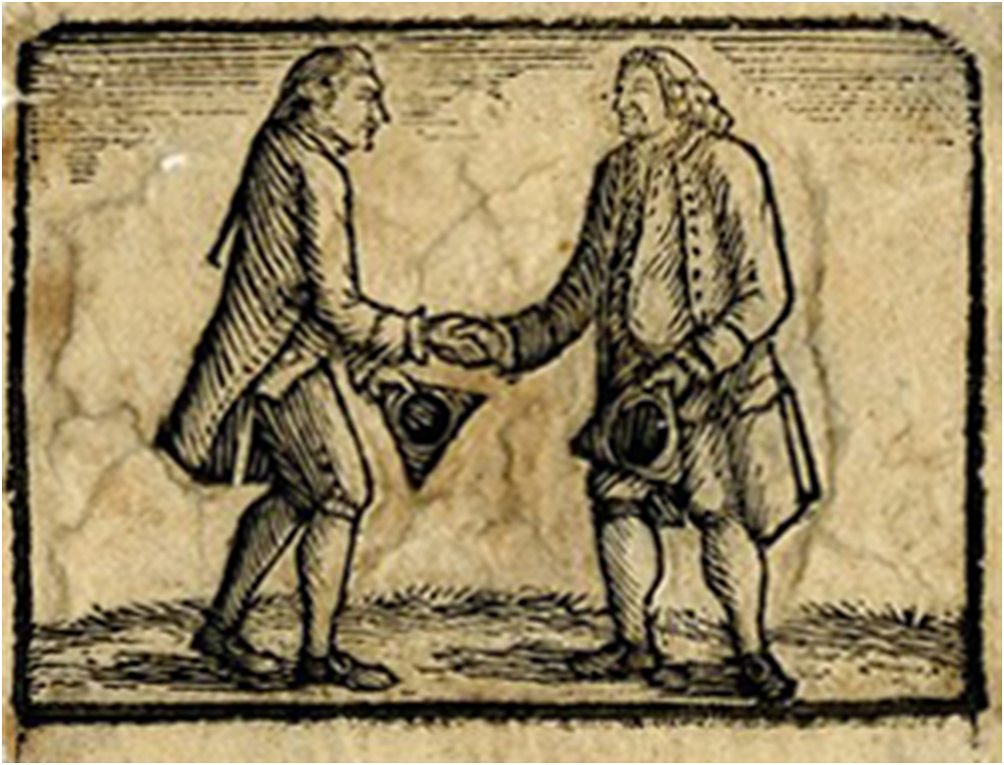
Interestingly, there were relatively few visual images of people actually shaking hands. Group portraits were often devised as formal compositions, which did not catch people’s fleeting interactions. Nonetheless, there were some exceptions. A depiction of a handshake appears in an engraved print by Thomas Bewick, which was designed in the mid-1770s for a children’s picture book (see Figure 1). It shows two well-dressed and obviously prosperous merchants. In their left hands, they hold their three-cornered hats (or ‘tricornes’), while their right hands unite in a handshake.Footnote 32 They may be confirming a deal. Or they may just have stopped to shake hands and chat. The scene is presented as utterly normal: merchants shake hands.
Engraving by Thomas Bewick, ‘Two Merchants Shaking Hands’ (c. 1776), in British Museum Prints & Drawings, no.: 1882,0311.3998.
Meanwhile, a second potent network also helped to give high visibility to the custom of handshaking in Britain. This group overlapped in its membership with the commercial community – but was much more ideologically driven. It was composed of members of the radical Protestant sect, known officially as the Society of Friends, but in common parlance as the Quakers. They had emerged in Britain in 1656, after the turmoil of the Civil War years.Footnote 33 They were always a relatively small minority group. Yet, particularly in the later seventeenth and early eighteenth centuries, their numbers were growing fast, before later stabilizing.Footnote 34
Quakers were conscious egalitarians. They dressed plainly, avoiding all outward show of rank and status.Footnote 35 They addressed others, high or low, with the familiar ‘thee’ and ‘thou’. When gathering for worship, they required no ministers. Instead, people were free to speak from the heart ‘as the spirit moved’ – or to sit together in holy silence. They sought authenticity, not dull habit. And they strove to follow St Paul’s advice to true Christians: ‘Be not conformed to this world.’Footnote 36
Accordingly, the Quakers utterly declined to bow or to curtsey to their social ‘betters’. Instead, all the ‘Friends’ – men and women alike – shook hands in their daily greetings, as well as at the end of their simple Meetings for worship. Initially, such behaviour caused shock and outrage. Quaker women in particular were seen as flouting long-standing hierarchical expectations about ‘proper’ female submission. Indeed, some Quaker men worried about that same point. Moreover, when the first Quaker women preachers stood up in public gatherings and boldly ‘bore witness’ to their Christian faith, there was considerable public consternation within the wider society.Footnote 37
But the rising Quaker tide began to overcome such doubts. And as this dynamic minority sect gained new recruits, especially among urban artisans and traders, so people began to become familiar with their egalitarian customs and manners. Over time, furthermore, numerous Quaker business leaders and bankers made good financially, adding to the economic clout of the sect.Footnote 38 In fact, their prosperity prompted some rumbling debates within their own circles. Some ‘rising’ Quaker families adopted more affluent lifestyles and apparel,Footnote 39 while others pertinaciously clung to their traditional simplicity.
Collectively, however, they all retained on principle the custom of handshaking, of which they were the most high-profile regular users. It was sometimes stated (erroneously) that the Quakers had actually invented this salutation.Footnote 40 They did not do that. The handshake has a very ancient history, as has been shown. Yet, the Quakers did confidently use this form of greeting with all comers – and greatly popularized its use.
British society was becoming subtly but distinctly Quaker-influenced – albeit not totally Quakerized. This religious community‘s adoption of the handshake and of plain clothing, especially for men, had great long-term impact, as did Quaker support for anti-slavery. (On the other hand, Quaker pacifism did not prevail – nor, generally, did the Quaker use of the familiar ‘thee’ and ‘thou’, although that usage persisted in some regional dialects.) In practice, there was much give and take. Yet, overall, Quakerism had impact. Moreover, given that, from the later seventeenth century onwards, many Quakers also emigrated to settle in Britain’s North American colonies, their custom of regular handshaking became known to their fellow colonists too.Footnote 41
Multiple factors were thus combining to enhance the adoption of the egalitarian handshake as a regular form of daily greeting. Urban/commercial expansion was one key framing factor, enhancing familiarity with the deal-making gesture. The conscious choice of a determinedly egalitarian religious minority was another, giving the salutation high visibility. And the quiet underlying tradition of the plebeian handshake also added its own bedrock of support. Britons living in an increasingly urbanized and pluralist society had also increasing options in styles of daily greetings.
The social diffusion of handshaking
Change, in this case, emphatically did not come from the top. Monarchs in this era did not shake hands. When on royal show, they maintained a physical distance from their ‘subjects’. What is more, the old religious ceremony of the ‘royal touch’, when monarchs laid their hands upon sufferers to cure them of scrofula (known as the ‘King’s Evil’), finally lapsed in Britain during the reign of Queen Anne.Footnote 42 Monarchs were distinctive figureheads of formality.
Etiquette books in the eighteenth century similarly confirmed the authority of traditional rituals. They taught men how to remove their hats and how to ‘make a leg’, pointing the toe towards the person being saluted, whilst bowing courteously. Women too were instructed in the art of the curtsey. As already noted, handshaking was not referenced.Footnote 43 Its diffusion thus took place informally – and initially under the social radar of high society.
Something very akin to a handshake was, however, visually represented to the general public as a commercial signal of mutual support. In 1696, the pioneering London Fire Insurance Company named itself the Hand-in-Hand. Its wall-mounted leaden fire-marks featured two outstretched hands clasped together, palm to palm, under a heraldic crown (see Figure 2).
Hand-in-Hand leaden fire-mark (1758), as issued to J. Bazeley, Middlesex sugar-refiner, in Museum of London collection, NN17449.
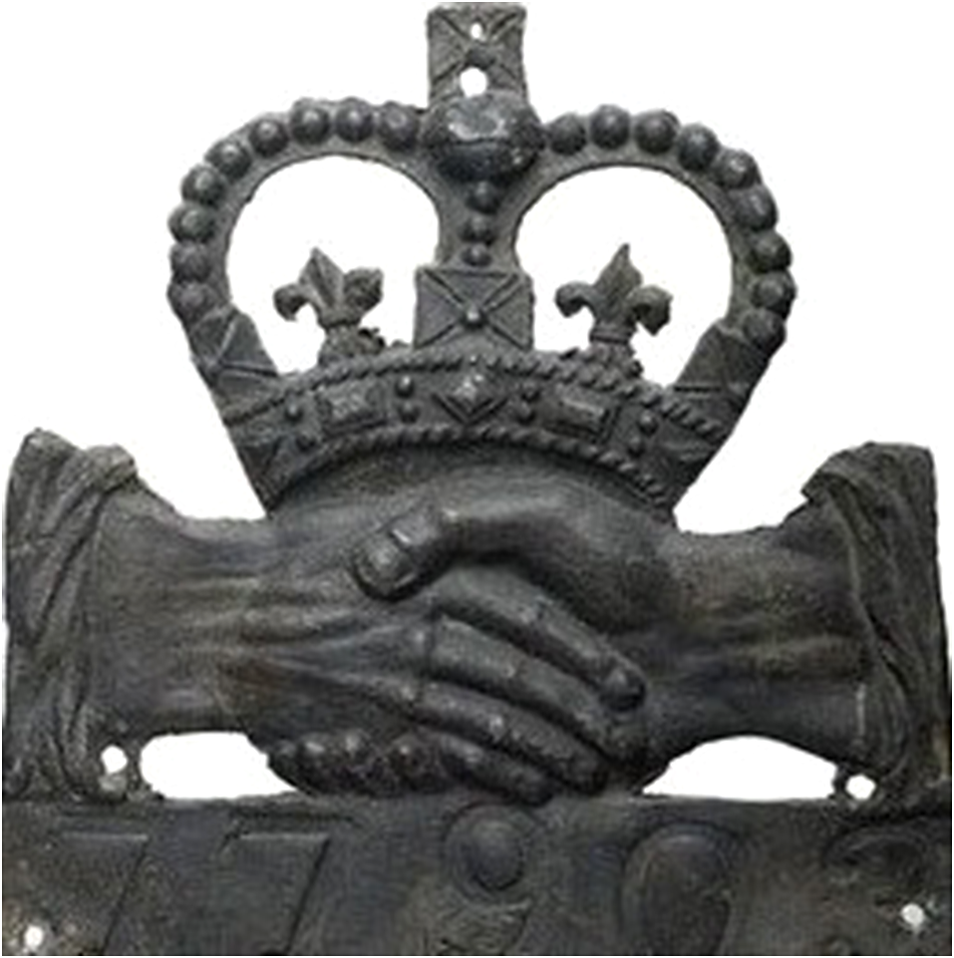
Prior to the advent of moving images, it is hard to tell precisely whether an image was intended to show a handshake, or simply a helping hand. Much depends on context. In this case, the message indicated solidarity between the insured members. Onlookers were also expected to understand the message. Hence, these leaden fire-marks were fixed prominently upon the walls of insured properties – some remaining visible to this dayFootnote 44 – reassuring the inhabitants that they had friends in event of disaster – and, incidentally, alerting fire-fighters that their efforts would not go unrewarded.
Clearly, too, this public fire-mark had impressed at least one social reporter sufficiently that in 1736 he referenced it in his tract on contemporary manners. He presented a fictional dialogue between two ‘low Fellows’ who meet by chance in town. One enquires: ‘How fares your best Body? Give me thy Bawdy Fist [dirty hand]’,Footnote 45 while another cries: ‘Damn ye, you dog, how dost do? Give me thy honest Paw, come gie’s [give us] it heartily.’ This exchange represented the plebeian handshake, not in criticism but as plausible reportage. Furthermore, to ensure that all readers fully appreciated the friendliness of their mutual salutation, the reporter described their action as ‘resembling the Arms of the Hand-in-Hand Fire Office’.Footnote 46
Such social reportage was part of the flourishing genre of poems, plays, novels, directories and hand-books which referenced the challenges of town life. In effect, they were unofficial guides to the arts of social negotiation. Citizens and strangers meeting in crowded towns had to make quick assessments of their fellow wayfarers. In 1716, John Gay’s sparkling poem on The Art of Walking the Streets of London recorded the constant need:Footnote 47
[to] remark each Walker’s diff’rent Face
And in their Look their various Bus’ness trace.
Assessing others at speed added to the zest and intensity of the urban experience.Footnote 48 After all, not all those encountered on the way were polite and well behaved. Some people were aggressive; others were negligently rude. Urban wayfarers thus had to be ready to cope with all eventualities. The witty Anglican clergyman-novelist, Laurence Sterne, agreed. In 1768, he wrote that mastering the ‘short hand’ art of quick comprehension was a vital urban skill. It would foster what Sterne termed the ‘progress of sociality’.Footnote 49
People of all social classes (other than the highest of the high who were insulated by traditional etiquette) were becoming accustomed to an unofficial process of social negotiation when first saluting strangers. Which greeting to choose? What did the other person expect? Would a given choice please or offend? And meetings were not always solemn. The English in the eighteenth century were not above teasing the Scots for their accents – and ridiculing strangers who seemed too ‘French’ for their dress and mannerisms.Footnote 50
Within this urbanizing world, men were the first to adopt the affable handshake. It did not derogate from their masculine dignity. Prints and paintings slowly began to incorporate images of two men, standing with their right hands clasped together. Thus, Johann Zoffany in 1769 depicted a group of gentlemen, sitting in revelry outdoors, with bottles of wine nearby. The landowner, however, stands to greet his nephew and designated heir. The two are shaking hands. The salutation does not dominate the painting. Yet, it conveys the message (as the painting’s title stated) that the soberly dressed young man is being welcomed as the landowner’s chosen heir, in preference to his dissolute older brother, who sits among the revellers.Footnote 51
Further examples of handshaking were recorded in satirical prints relating to the 1784 parliamentary election in the large Westminster constituency. The contest was hotly contested, attracting huge crowds who were either voting or cheering on (or jeering at) the rival candidates. One saucy print by William Dent included, as a detail, two London tradesmen who stand shaking hands and discussing the news.Footnote 52
Strikingly, too, another satirical print, this time by Thomas Rowlandson, depicts a cross-class handshake (see Figure 3). The candidate for the reforming Whigs was the portly Charles James Fox, dressed casually to downplay his wealthy background. On his knee sits the duchess of Devonshire, who is canvassing in person for her old friend. But Fox has swung his right arm round to shake hands with a potential voter. This man is clearly befuddled, his open mouth being filled with beer, poured by an assiduous Foxite supporter.Footnote 53
Detail from satirical cartoon by Thomas Rowlandson, Wit’s Last Stake: Or, the Cobbling Voters and Abject Canvassers (April 1784), from original in Metropolitan Museum of Arts, Elisha Whittelsey Collection (1959), accession no.: 59.533.62.
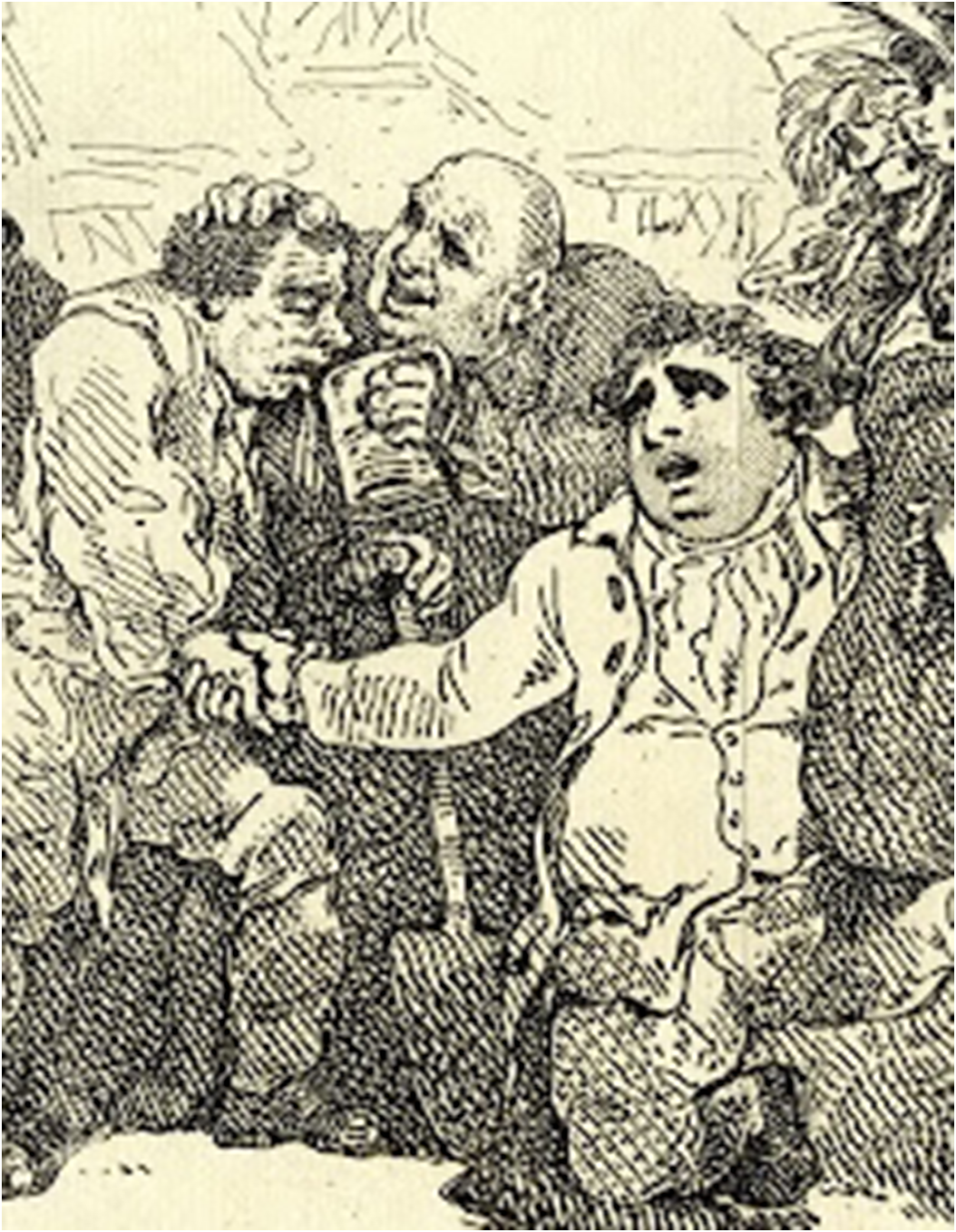
Needless to say, the satirist was exaggerating to enliven his caricature. But the cross-class handshake was not an invention. Fox, who presented himself successfully as the ‘Man of the People’, was ready to shake hands with all the artisan and shopkeeper voters in the Westminster constituency. In that way, prints and images of handshakes helped – quite unofficially – to ‘normalize’ the salutation.
Women, meanwhile, were slower to adopt this affable and egalitarian form of greeting. Yet, they too were making new social choices, in a changing world. One satirical account in 1732 accordingly censured the general ‘uppishness’ of British females. A fictional lady was described as striding in a masculine style, whistling, ordering her male companion to get her coffee (rather than herself serving him), taking the initiative in love affairs, carrying pistols, and shaking hands.Footnote 54
Accusations such as these were evidently rhetorical. Very far from all women behaved in those ways. Yet, the account implied that at least some females (and not just those who were principled Quakers) were shaking hands – even if at the cost of shocking cultural conservatives.
By the early nineteenth century, moreover, daily use of the handshake was spreading among middle- and upper-class society, including women. Commentators no longer expressed shock when they came across ladies deploying the salutation. As already noted, shaking hands did not replace the modified conventions of ‘hat honour’, which continued in use. Nevertheless, the handshake was becoming an intimate accompaniment.
Jane Austen, the ever sharp-eyed social observer, was a witness. In her novel Emma (1816), one dashing young gentleman Frank Churchill salutes the assembled company with his hat. However, when he is in private discussion with his confidential friend, Emma Woodhouse, the social leader of the locality, he announces his sudden departure – and their leave-taking takes the form of ‘a very friendly shake of the hand’.Footnote 55
Things can, however, go wrong in love as well as in war. In Austen’s Sense and Sensibility (1811), the impetuous Marianne Dashwood re-encounters her faithless lover in a crowded London party. He tries to avoid her. But she extends her hand, exclaiming ‘in a voice of the greatest emotion: “Good God! Willoughby, what is the meaning of this? Have you not received my letters? Will you not shake hands with me?”’Footnote 56 Under duress, he responds. Yet, he does little more than briefly touch her hand, before dropping it, looking confused. In effect, the faithless lover is administering a public snub.
Austen’s novel makes it clear that Marianne Dashwood’s family are concerned that she displays her raw emotions too openly. British good manners, after all, required then (as later) a modicum of self-restraint. Yet, the surrounding company did not swoon when a young lady invited a man to shake her hand. It was a perfectly possible gesture – even if, in this case, one that was unwelcome to him. As the repertoire of salutations was expanded, so women too began to use a mixture of both formal and more intimate gestures.
Elsewhere, too, Austen recorded one further variant. There are very few eighteenth-century references to two women shaking hands together (and no visual images of such a manoeuvre until well into the nineteenth century). Yet, in Emma, the novel’s high-status protagonist shakes hands to convey her acceptance of her ‘lowly’ female protégée. She is Harriet Smith, an ‘outsider’ in their village community (who is later revealed to be the illegitimate child of a local tradesman). And the unexpected salutation thrills Miss Smith who goes home rejoicing at the affability of Miss Dashwood who has ‘actually shaken her hand at last!’Footnote 57 The gesture was not socially unthinkable and it was certainly not a prelude to social revolution – but it was special enough to convey great personal meaning.
All that said, there remained notable regional and class variations. Handshaking was much more common in town societies than in country villages. And its use was more widespread in industrial regions, both urban and rural, than it was in purely agricultural districts. Similarly, handshaking was most common between men at all social levels and least common between working-class women. (Their styles of greeting are, however, only poorly documented.)
Added to those variations, there was one signal exception to prove the general rule. Most professional men in this period would readily shake hands with one another and with their clients. Nonetheless, one tight-knit group – the barristers at London’s Inns of Court – entirely avoided handshakes between one another (a tradition continued to this day).Footnote 58 For them, their professional trust needed no overt physical acknowledgment. Their abstinence was rather like a secret pledge – known to their fellow insiders.
Cross-class handshakes, meanwhile, were generally much less common than were companionable handshakes between more-or-less social equals. Dukes would not expect to share that salutation with dustmen. Yet, people at times overcame their initial hesitations about cross-class salutations – or had to make the effort. In a 1793 comedy, the aristocratic Lady Henrietta is told that she must acknowledge the law court’s bailiff. ‘What! Shake hands?’ she objects, disdainfully.Footnote 59 But she complies – and finds herself arrested for an unpaid gambling debt. Officialdom has trumped class privilege. (The play being a comedy, however, Lady Henrietta does not go to gaol.)
Overall, then, Britain’s socio-economic changes were being matched by cultural shifts in styles of salutation. In terms of bodily economy, the spread of the handshake had the effect of reducing the physical distance between people at the point of greeting. Yet, conventional British reserve (in public) was not suddenly abandoned. Instead, people at all social levels (excluding royalty) were able calmly to extend a hand in friendship, as and when appropriate. Precisely how many did so remains unquantified – but many more people shook hands in 1851 than would ever have contemplated the salutation in 1700. No surprise, then, to find that a positive emblem, adorning eighteenth-century friendship rings, was a pair of clasped hands.Footnote 60
Practical and symbolic meanings of handshaking
A substantial long-term change in British styles of greeting had both practical and symbolic meanings. One immediate practical point was that touching hands with a mix of friends and strangers signified that many people had a tolerable trust in general standards of physical cleanliness. In fact, eighteenth-century Britain’s fast-growing industrial production of soap was encouraging an expectation that both hands and clothing should be washed regularly. Bath-tubs for whole body immersion were becoming fashionable too.Footnote 61 One consequence was that the prevalence of body lice was on the retreat in this period – providing communal relief from a scourge that was rarely mentioned but much abhorred.Footnote 62
While therefore a few critics, like Fanny Trollope on her travels in the USA in 1832, found handshaking to be repulsively unhygienic,Footnote 63 growing numbers among her compatriots were relaxed enough not to worry in their day-to-day lives. It was true that there remained much upper-class suspicion about the dirtiness of the poor – who were named pithily in 1830 as ‘the Great Unwashed’.Footnote 64 Yet, plenty of ‘respectable’ workers also shared the cultural preference for cleanliness, aided by the growing availability in the nineteenth century of cheap and easily washable cotton clothing. (It should be stressed, however, that improving bodily hygiene was a predisposing factor – rather than the root cause – for the spread of handshaking in Britain.)
Another cultural association of handshaking was trust that the gesture was free from physical danger. Participants could see that the extended right hands were not holding offensive weapons. The salutation was not a literal exercise in vetting for weapons, since it did not constitute a full bodily search. Yet, freely shaking hands both indicated and further boosted societal trust.
Of course, there were still occasional local scares, as well as outright riots and popular disturbances.Footnote 65 However, Britain was experiencing in these years a long-term decline in random cases of inter-personal violence. Already by the mid-1750s, those high-ranking gentlemen, who traditionally wore swords in public, were increasingly reserving that custom for ceremonial occasions.Footnote 66 Instead, they carried sticks and umbrellas. And it was becoming rare too for ordinary citizens to carry weapons as they went about their daily business.Footnote 67 The expectation of social peace was thus another enabling factor in the spread of the handshake – though again not its root cause.Footnote 68
Specifically, too, the ritual of shaking hands was adopted as an unofficial form of control when gentlemanly duellists prepared to fight with swords – or, later, with pistols. Their mutual handshake constituted a pledge of fair play – and a promise to accept the outcome gracefully.Footnote 69 (It did not always work. Sometimes the protagonists and their seconds all ended up fighting confusedly together.) Eventually, the practice of duelling ceased in mid-nineteenth-century Britain – discouraged by the growing weight of public opposition to fighting potentially unto death.Footnote 70 Yet, the courteous sporting handshake, of course, survived.
Thus, plebeian bare-knuckle fighters in Britain also began their formal contests (as opposed to casual brawls) by shaking hands before witnesses. And, when in the later eighteenth century, pugilists began to wear boxing-gloves (mandatory under the 1867 Queensberry Rules), the gesture was updated into a ritualized mutual touching of gloves.Footnote 71 Again, the pledge was to fight fairly, according to the rules. Today, the sporting handshake is globally known. Cheating, meanwhile, has not disappeared. Yet, competitors, if found to be consciously flouting the rules, retain neither their sporting prizes nor their prestige. A pledge of personal honour has consequences.
Symbolically, therefore, the handshake carries a strong message of mutual trust. It was thus an attractive motif for Britain’s skilled workers, when they began, from the early eighteenth century onwards, to organize into trade unions (then commonly known as ‘combinations’). And many of their badges and banners displayed two hands clasped together in a handshake.Footnote 72
Thoughtful workers were, however, aware that the interests of one organized group of workers might potentially conflict with those of others. As a result, one resplendent banner, created by the Glasgow Cork-Cutters Society (founded 1810), was decorated not only with a central handshake but also with an explanatory motto. That stated, in firm but conciliatory words, that the Society was: ‘United to Support but Not Combined to Injure’.Footnote 73
Tensions between group solidarity and sectional special interests were certainly experienced in the case of one very different eighteenth-century organization with branches across Britain and Europe. Its members were known as Freemasons or simply Masons. Their ranks included some aristocrats and many well-to-do tradesmen. They met in Masonic clubs, dating in Britain from 1707 onwards, where they shared secret rituals (which remain officially secret to this day). Among their customs was (and is) a special handshake. And it not only bonded them together but also signalled to one another, via special hand placements, their status within Masonry.Footnote 74
Brother Masons were therefore required to set aside their rankings within the wider world and to recognize only their own hierarchy of office-holders. Their club was at once egalitarian – and internally hierarchical. The effect was to underline their mutual commitment. Indeed, Masons were expected to support one another in all circumstances – leading to accusations (in many countries as well as in Britain) of corrupt Masonic favouritism.Footnote 75
Affirming mutual solidarity also encouraged the custom of shaking hands between keen young political radicals in Britain in the 1790s. They did not invent any secret rituals but simply valued the pledge of egalitarian companionship. Hence, the youthful William Wordsworth shook hands with his fellow poet and intellectual ally, Samuel Taylor Coleridge. No bowing or hat-removal for them.
Yet, solidarity between fellow radicals was not always easy to sustain. People disagreed about the best strategies for achieving change. That unwelcome realization dawned on Wordsworth and Coleridge in the later 1790s. They fell out with their former friend, the poet and democratic campaigner, John Thelwall. Hence, in 1801, Coleridge glumly reported that: ‘So great is the chasm between us, that, so far from being able to shake hands across it [with Thelwall], we cannot even make our Words intelligible to each other.’Footnote 76 A simple gesture (or its absence) told a significant tale.
Political meanings also became attached, even more pointedly, to the symbolism of the handshake in North America. That salutation was already well known there, particularly through the influence of the Quakers. And as the Americans fought for independence from Britain after 1776, activists increasingly adopted the handshake as a republican symbol. There was no formal edict to enforce its usage. But the shift eventually became decisive. Thus, the ‘eternal shaking hands’ of the Americans was immediately noted by the visiting Fanny Trollope in 1832; and her anxiety about hygiene was triggered when constantly confronted by would-be handshaking American men. To her sensitive nostrils, they all reeked of tobacco and whiskey.Footnote 77
America’s new Republican handshake had, however, some de facto limitations. Its legally free citizens did not shake hands with the captive Africans who were set to work as slaves in the plantations. Later, it took much effort and bloodshed to end the system of slavery in the USA – and it is taking even longer to get all the descendants from these troubled times to share a mutual hand of friendship.Footnote 78
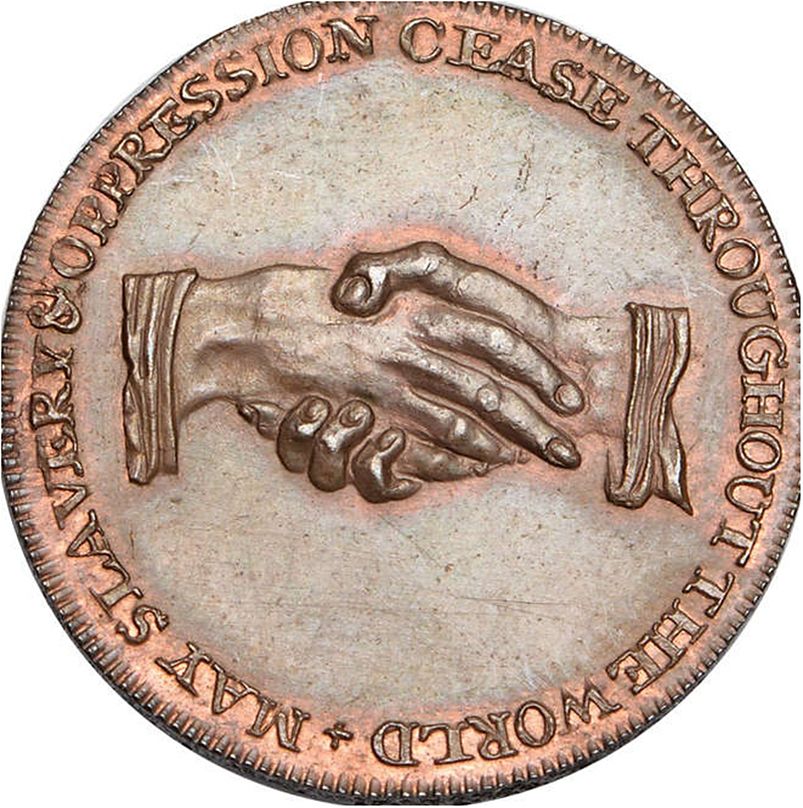
Images, meanwhile, retain the power to move. In the 1790s, the British campaigners against the trade in enslaved Africans planned their tactics carefully. One of their campaign tokens showed an African, kneeling in chains and holding up his hands pleadingly. He asked: ‘Am I not a Man and a Brother?’ And on the reverse of the token? Two hands locked in a cordial handshake (see Figure 4). What is more, the image was encircled by a resounding declaration: ‘MAY SLAVERY & OPPRESSION CEASE THROUGHOUT THE WORLD’. Not an easy thing to achieve, then or later. Yet, the two hands, linked in amity, appeal for global solidarity between all fellow humans.
Reverse of anti-slavery token (c. 1790): National Maritime Museum/Royal Museums Greenwich/Michael Graham-Stewart Slavery Collection ZBA2793.
Conclusions – handshaking viewed long
Pulling these strands together, it was clear that handshaking had become by 1850 established significantly but not universally within the British repertoire of greetings – and that handshake imagery had also gained powerful symbolic meanings. There was no sudden transition from (say) ‘medieval’ greetings to ‘modern’ ones (or from ‘early modern’ to ‘late modern’ either).Footnote 79 Instead, the custom of shaking hands spread gradually and partially, with variations among different social groups, in a long process of cultural adaptation – as often happens with changes in daily living. Old and new ways overlapped. And people picked and chose their daily greetings, as seemed appropriate.
Furthermore, it was manifest that the custom of handshaking was by no means launched ‘from the top’ and diffused to the masses by a process of social emulation. For a start, British society in the eighteenth and nineteenth centuries was not divided simply between a small ‘elite’, on the one hand, and a large, amorphous mass, on the other. And it cannot be assumed that people will automatically copy their ‘betters’. Some experiment and innovate. Others ignore trends (or cannot afford to copy them).
‘Trickle-down theories’, which are already subject to valid criticisms,Footnote 80 certainly do not apply to the adoption of the handshake in Britain. After all, the most famous advocates of routine handshaking with all, whether ‘high’ or ‘low; were the ‘middling-sort’ Quakers. They were acting upon egalitarian religious principle. In other words, innovations may come from those at the ‘foot’ of society and percolate upwards; or they may be adopted vigorously in the middle swathes, thereafter moving both upwards and downwards in a ‘fountain effect’.Footnote 81 In this case, the handshake in Britain had both a diplomatic and a plebeian parentage, before being adopted routinely by the commercial community and the Quakers. The effect was a total ‘churn’.
Distinctions of status did not by any means disappear. Yet, in Britain, as it cumulatively commercialized, urbanized and industrialized, traditional styles of salutation were being adapted into a less formalized style. (Ceremonial events still maintained the old rituals – which were appreciated all the more for their comparative rarity.) And the handshake provided new variety. It was a salutation that was readily shared between more-or-less social equals – and one that could also be used, more circumspectly, across class divisions.
During these years, much mainstream British political and economic thought reflected an emergent ‘possessive individualism’.Footnote 82 People were valued – and valued themselves – for their goods and wealth. Yet, there was, alongside that, a ‘co-operative individualism’, fuelled by egalitarian religious and political ideas.Footnote 83 It offered an alternative approach. It did not expect to find total equality in a highly unequal world. Yet, it expressed a sense of common citizenship among ‘the people’. Some went further too. Thus, the visionary poet and artist William Blake dreamed in 1804 that co-operation would lay the basis for social renewal. One day, humanity would together build a new Jerusalem: ‘Both heart in heart & hand in hand.’Footnote 84
Naturally, people did not usually think deeply about social philosophy when greeting others. But in Britain’s increasingly pluralist society, they now had options. Salutations thus gave scope for personal expression. Haughty individuals could administer a snub by refusing to take an outstretched hand. Those shaking hands could do so either firmly or laxly. Additionally, there were erotic possibilities. Shaking hands with a personable stranger of the opposite sex could arouse strange sensations – whether pleasurably ‘electric’ as recounted by Laurence SterneFootnote 85 or flustering, as imagined in Mrs Gaskell’s North and South (1854).Footnote 86 In sum, there was a process of social negotiation, as people quickly decided what greeting to use and also how to perform it.Footnote 87
Eventually, in an urbanizing and internationalizing world, the handshake began to acquire a global dimension. Britain’s globe-trotting citizens, as they traded, explored, fought, and established colonies world-wide, were early exporters of the handshake too. (Paradoxically enough, cross-cultural encounters often generate both fierce mutual conflict and long-term cultural interchanges.) And, with its multiple cultural roots in Scotland, England, Europe, the Middle East and North America, the handshake had many progenitors. Today, it is commonly deployed at international sporting events – as well as in international diplomacy and commerce. And, over time, younger generations in many countries may shake hands, whereas their elders do not.
Global uniformity, however, remains unlikely. Elements of diversity within human universality remain well entrenched. To take but one example, religious taboos in some branches of Islam forbid touching hands with non-family members of the opposite sex.Footnote 88 Furthermore, warnings are at times expressed on health grounds (shades of Fanny Trollope!). Many people avoided shaking hands during the Coronavirus pandemic at its peak in 2020–21.Footnote 89 There were confident pronouncements that the handshake was ‘dead’ – only to be followed by later analyses of why the handshake will not die.Footnote 90
No forms of salutation are immune to change. Humans remain inventive and adaptive. Yet, the egalitarian handshake – as a compromise between a close hug and a distant bow – is likely to retain its cross-cultural utility. It also has great symbolic resonance. That is unofficially marked today when people sing the world’s ‘most sung song’. Auld Lang Syne, written by Robert Burns in 1788, is popular at New Year (and many other) celebrations.Footnote 91 Few people understand all of Burns’ dialect words. Yet, his toast to universal friendship is hard to resist. People make a circle, cross arms, link hands, and together raise them up and down in a ritualized group handshake, as they sing:Footnote 92
Acknowledgments
With warm thanks for commentaries from friends, seminar participants and lecture audiences around the world; for expert help from the British Library Rare Book Room staff; and for specialist references from Kristín Bragadóttir, Hanna Filipova, David Harries, Stephen Hoare, Dzheni Madzharov, Henryk Pisarski, Miranda Reading, Anne Reyersbach and Amanda Vickery. Lastly, it is always good to get constructive criticism, so special thanks go to Urban History’s two anonymous reviewers; to my close friend and colleague Susan Whyman; and, last but never least, to my life-partner Tony Belton.


 Open access

