


Introduction
Today, a large proportion of patients survive cardiovascular disease (CVD) due to considerable improvements in treatment; however, CVD patients are at high risk of developing mental disorders, such as anxiety and depression [Reference de Jonge and Roest1–Reference Jorgensen, Wium-Andersen, Wium-Andersen, Jorgensen, Prescott and Maartensson5]. Health behavioral patterns and biological pathways including exogenous stressors and physiological stress response have been suggested to partly explain the relationship between CVD and depression [Reference Hare, Toukhsati, Johansson and Jaarsma2,Reference Grippo and Johnson6]. Yet, the linking mechanisms are still not established, and few studies have examined how psychosocial factors, including personality traits and negative emotions, may contribute to the risk of developing depression after CVD.
Mental vulnerability may explain the link between CVD and depression. Mental vulnerability—a tendency toward experiencing interpersonal problems and psychosomatic and mental symptoms—can be measured on different scales. The Danish mental vulnerability scale is a validated measure of long-term mental vulnerability and comparable with other international measures [Reference Eplov, Petersen, Jorgensen, Johansen, Birket-Smith and Lyngberg7,Reference Langner8]. The original scale was developed in the 1960s to assess mental fitness for Danish military service, but the current version has been shortened to include 12 items. The Danish mental vulnerability scale measures a symptom state and a personality trait component [Reference Eplov, Petersen, Jorgensen, Johansen, Birket-Smith and Lyngberg7] and the trait component may explain why mental vulnerability is a risk factor for developing a number of adverse health conditions including depression and ischemic heart disease [Reference Eplov, Petersen, Jorgensen, Johansen, Birket-Smith and Lyngberg7,Reference Ostergaard, Dalton, Bidstrup, Poulsen, Frederiksen and Eplov9–Reference Poulsen, Eplov, Hjorthoj, Eliasen, Skovbjerg and Dantoft16]. Accordingly, scores on the mental vulnerability scale have been found to correlate with the trait of neuroticism and type D personality [Reference Ostergaard, Dalton, Bidstrup, Poulsen, Frederiksen and Eplov9,Reference Eplov, Jorgensen, Birket-Smith, Petersen, Johansen and Mortensen10]. Thus, mental vulnerability could be an important confounder of the association between CVD and depression. It is, however, also likely that depression following CVD mainly occurs in patients who are mentally vulnerable because of greater susceptibility to stressful situations such as experiencing CVD. This latter explanation of mental vulnerability interacting with CVD on the risk of depression would be illustrated by differences in the associations between CVD and depression between individuals with low and high levels of mental vulnerability. So far, mental vulnerability has neither been investigated as a confounder nor as a modifier (interaction) of the relationship between CVD and depression.
In this study, we investigated whether mental vulnerability explained (confounded) or interacted with the effect of CVD for the risk of developing depression.
Material and Methods
Data source
We used pooled data from five cohorts from the Center for Clinical Research and Prevention; Monica I and III, Inter99, The Regional Health Survey 2006/2007 (Health2006), and the Danish Study of Functional Disorders (DanFunD) part 2 collected between 1983 and 2011. All the cohorts were based on random samples of the background population in the Copenhagen region, Denmark. The data collection included questionnaire data and physical examinations. The aims of the different cohorts were to monitor trends in CVD in different countries in Monica I & III, to evaluate the effect of lifestyle intervention on cardiovascular risk in Inter99, to study lifestyle-related chronic conditions in Health 2006, and to study functional disorders in the general population in DanFunD. Even though coronary heart disease and functional somatic disorder were the initial analytical focus of the data collections, many other health conditions have been investigated using data from these cohorts. All study participants provided written informed consent and the study protocols for data collections were approved by the Danish Data Protection Agency. Baseline participation rates ranged from 29 to 79% (see Figure A1 for further details) [Reference Osler, Linneberg, Glumer and Jorgensen17,Reference Dantoft, Ebstrup, Linneberg, Skovbjerg, Madsen and Mehlsen18]. We linked the survey data with the following six national registers: the Danish Civil Registration System, the Danish Income Register, the Population Education Register, the Danish National Patient Register, the Psychiatric Central Register, and the Danish National Prescription Register to obtain register-based information [Reference Lynge, Sandegaard and Rebolj19–Reference Mors, Perto and Mortensen24].
Figure A2 shows the selection of the final study population covering 19,856 Danish men and women. Strict selection criteria of no CVD prior to baseline and no depression six months prior to baseline were applied to ensure temporality between the exposure and the outcome.
Main variables
CVD was the main exposure. CVD was measured by in- and outpatient hospital diagnoses in the Danish National Patient Registry based on the 8th and 10th revision of the International Classification of Diseases (ICD8 and ICD10) codes covering ischemic heart disease (ICD8: 410–414 and ICD10: I20–25) and stroke (ICD8: 430–438 and ICD10: I60–69, G45).
Depression was the outcome. Depression was measured by in- and outpatient contacts with ICD8 and ICD10 codes (ICD8: 296.09, 296.29, 298.09 or 300.49, and ICD10: F32–33) in the Danish National Patient Registry and/or the Psychiatric Central Register and/or purchase of antidepressants registered by Anatomic Therapeutical Chemical (ATC) codes (N06A) in the Danish National Prescription Registry.
Figure A1 presents a timeline for ICD8, ICD10, and ATC codes used to obtain information on CVD and depression for each of the specific sub-cohorts.
Mental vulnerability was investigated as a potential confounding factor of the relationship between CVD and depression and/or whether it interacted with CVD for development of depression. Mental vulnerability was assessed by the Danish mental vulnerability scale obtained at baseline through questionnaire data from the surveys [Reference Osler, Linneberg, Glumer and Jorgensen17]. We applied the 12-item mental vulnerability subscale, which has a high correlation of 0.93 with the original 22-item mental vulnerability scale (see items in Table 1). The 12-item mental vulnerability scale was divided into three categories by low (0–2 points), moderate (3–4 points), and high (5–12 points). This categorization is based on previous studies of ischemic heart disease and depression [Reference Ostergaard, Dalton, Bidstrup, Poulsen, Frederiksen and Eplov9,Reference Eplov, Jorgensen, Birket-Smith, Petersen, Johansen and Mortensen10].
The 22-item questionnaire for the test of mental vulnerability [Reference Eplov, Petersen, Jorgensen, Johansen, Birket-Smith and Lyngberg7] with the questions included in the 12-item mental vulnerability subscale (used in this study) highlighted in bold

Covariates
Age (continuous variable) and gender (female as reference) were included from the Danish Civil Registration System. Educational level was included from the Population Education Register and categorized as basic education (7–9 grade of obligatory schooling), medium education (high school degree/vocational training) as reference, higher education (more than high school degree), and missing. Marital status was included from the Danish Civil Registration System and categorized as married (reference), unmarried, divorced, or widow/widower. Information on alcohol consumption (number of alcoholic drinks per day), smoking status categorized by never (reference), former or current smoker, and physical activity categorized by sedentary, light (reference), moderate, and hard exercise were obtained from baseline survey questionnaires. Body mass index (BMI) was identified from physical examination of height and weight at baseline and categorized as <21.5 equal to underweight, 21.5–25.0 equal to normal weight (reference), and >25 equal to overweight. Systolic blood pressure was based on physical examination and categorized in quintiles (first quintile as reference). Missing values for alcohol use, smoking status, physical activity, and BMI were imputed using multiple imputations based on age, gender, and marital status, which built on the assumption that these variables were missing completely at random. Type 1 and Type 2 diabetes mellitus were identified up to baseline by ICD8 and ICD10 codes (250; E10-E14) from the Danish National Patient register. Previous depression up to six months before baseline was defined by the previous described ICD8, ICD10, and ATC codes.
Statistical methods
Descriptive statistics of baseline characteristics for CVD and development of depression were conducted using means and standard deviation for continuous variables and frequencies with percentages for categorical variables.
We analyzed the associations between CVD and development of depression using an additive hazard model to estimate risk differences (additional cases) with 95% confidence intervals (CIs) [Reference Rod, Lange, Andersen, Marott and Diderichsen25], and the more commonly used multiplicative Cox proportional hazard (PH) model to estimate hazard ratios (HRs) with 95% CIs. Time from baseline was the underlying time scale in both models and CVD was included as a time-dependent variable. Individuals were followed from baseline and until development of depression, emigration, death, or end of follow-up (July 11, 2017). Model assumptions for the additive hazard model (time-constant hazard differences) and the Cox PH model (time-constant hazards ratios) were fulfilled.
The association between CVD and depression was analyzed in three models with different levels of adjustments; Model 1: unadjusted, Model 2: adjusted for potential confounders (age, sex, educational level, marital status, smoking status, alcohol consumption, physical activity, BMI, systolic blood pressure, diabetes mellitus, previous depression, and study cohorts), and Model 3: Model 2 with additional adjustment for the mental vulnerability scale. We calculated whether mental vulnerability explained the association between CVD and depression by comparing the adjusted regression models with and without adjustment for the mental vulnerability scale. We assessed the impact of adjustment for mental vulnerability both in the additive hazard model (A model) and in the Cox PH model (M model). The proportion of excess risk accounted for by including mental vulnerability (Model 3) in the covariate adjusted model (Model 2) was calculated using the formula (Amodel2 – Amodel3/Amodel2) for the additive model and the formula (Mmodel2 – Mmodel3)/(Mmodel2 – 1) for the multiplicative model [Reference Hafeman26].
Interaction between exposures for an outcome can be defined by departure from multiplicativity or additivity. Psychiatric and epidemiological literature encourage test of both additive and multiplicative interaction models [Reference Rod, Lange, Andersen, Marott and Diderichsen25,Reference VanderWeele27–Reference Kendler and Gardner29]. However, interaction on the additive scale is often thought of as more relevant to public health and clinical decision making because the additive scale shows absolute number of patients. In contrast, the multiplicative scale shows the relative risks, which may only translate into few individuals in absolute numbers. Thus, the results from the additive hazard analysis will be valued above the results from the Cox PH analysis in this study, but the results from the Cox PH model will be provided as this model is more widely used. To test whether the association between CVD and depression differed between individuals with low, moderate, and high mental vulnerability, global tests of interaction between CVD and mental vulnerability for development of depression were conducted. To illustrate the potential interaction between CVD and mental vulnerability, a joint exposure variable combining CVD and levels of mental vulnerability was analyzed with no CVD and low mental vulnerability as the reference group.
Supplementary analyses were performed for (a) depression defined by prescription medicine or hospitalization, respectively and (b) individuals without prior depression.
Statistical analyses were conducted in the statistical software packages Stata and R.
Results
In this study, 19,856 Danish men and women were followed for a total of 254,250.5 person-years. Baseline characteristics of individuals by mental vulnerability are shown in Table A1. Among the study population, 77% scored low (0-2), 15% scored moderate (3-4), while 8% had a high score (5+). Table 2 provides distribution of covariates and mental vulnerability for the study participants with and without CVD (main exposure) and depression (outcome), respectively. During follow-up, 15.3% were diagnosed with CVD and 18.1% were diagnosed with depression (Table 2).
Incident cardiovascular disease and depression during follow-up based on baseline characteristics for study population (N=19,856)
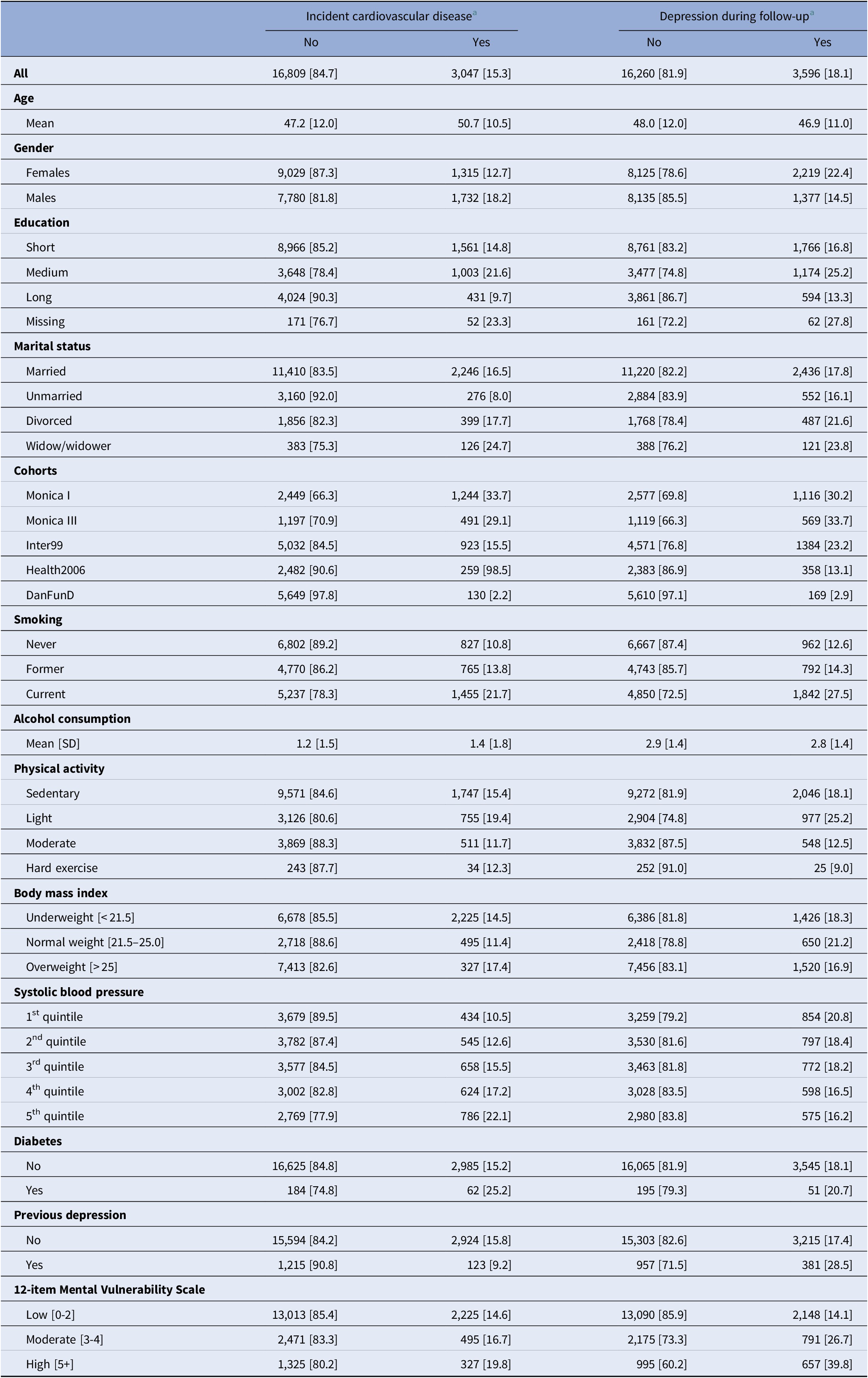
* The 620 individuals who reenter the study after recovery of depression before cardiovascular disease are not included in this table.
Individuals who were diagnosed with CVD were associated with 3.60 (95% CI: 3.30; 3.92) times higher risk of depression, which corresponded to 35.4 (95% CI: 31.7; 39.1) additional cases of depression per 1,000 person-years in the unadjusted analyses (Figure 1). After adjustment for age, sex, educational level, marital status, smoking, alcohol consumption, physical activity, BMI, systolic blood pressure, diabetes, prior depression, and study cohort, the risk estimate was attenuated with 6.2% in the additive model to 33.2 (95% CI: 29.5; 37.0) additional cases per 1,000 person-years (corresponding to a HR of 3.10 [95% CI: 2.82; 3.40]). Further adjustment for mental vulnerability explained 4.8% of the confounder adjusted association between CVD and depression in the additive hazard model. The fully adjusted risk estimate was 31.6 (95% CI: 27.8; 35.3) additional cases of depression per 1,000 person-years (corresponding to a HR of 2.82 [95% CI: 2.56; 3.10]).
Associations between onset of cardiovascular disease and depression during follow-up by three levels of adjustments: (1) unadjusted, (2) adjusted for (age, sex, educational level, marital status, smoking status, alcohol consumption, physical activity, body mass index, systolic blood pressure, diabetes, prior depression, and cohorts), and (3) additional adjustment for mental vulnerability (MV).

We explored whether mental vulnerability interacted with CVD for development of depression. Compared to individuals with no CVD and low mental vulnerability, both CVD and mental vulnerability separately and combined increased the risk estimates of developing depression (Figure 2). CVD combined with the highest level of mental vulnerability was associated with the highest risk estimate of 82.3 (95% CI: 62.9; 101.7) additional cases of depression per 1,000 person-years. Based on the individual effects of CVD (25.6 additional cases) and moderate mental vulnerability (10.1 additional cases), the expected joint effect on the additive scale is the sum of both exposures, thus, 35.7 additional cases per 1,000 person-years. However, the observed joint effect was 56.9 (95% CI: 45.1; 88.7) additional cases per 1,000 person-years. Similarly, the expected joint effect of CVD (25.6 additional cases) and high mental vulnerability (25.3 additional cases) would be 50.9 additional cases per 1,000 person-years, but the observed joint effect was 82.3 additional cases per 1,000 person-years. This expressed a synergistic interaction on the additive scale. Global tests of interactions were statistically significant (p value < 0.001). When we examined interaction on the multiplicative scale, the analysis yielded opposite results. The estimates from the Cox PH model showed antagonistic interactions on the multiplicative scale because the joint effects of CVD and higher levels of mental vulnerability were lower than the expected joint effects, that is products of the risk estimates. The antagonistic interaction was statistically significant (global test of interaction: p value < 0.001).
Adjusted associations between the combined variable of mental vulnerability (MV) and onset of cardiovascular disease for depression with one reference category of no mental vulnerability (MV) and no cardiovascular disease (CVD).

Supplementary analyses
The rate in the reference population influences the estimations from the additive hazard model and Cox PH model differently because absolute differences are calculated on the additive scale, whereas ratios are calculated on the multiplicative scale. Figure A3 illustrates the rate of depression per 1,000 person-years of follow-up by CVD in the total population and in strata of individuals with low, moderate, and high mental vulnerability. The rate of depression was greater among individuals with CVD in all strata of mental vulnerability: low (CVD: 38.3, no CVD: 9.6), moderate (CVD: 72.2, no CVD: 22.3), and high (CVD: 100.0, no CVD: 40.2). Notably, the rate of depression among both individuals with and without CVD increased from individuals with low, through moderate to high mental vulnerability.
The findings were similar in the supplementary analyses in which depression was defined by prescription of antidepressants or hospital diagnosis, respectively (Table A2). Yet, the estimates of hospital-based diagnoses of depression from the additive hazard model were markedly lower than those for antidepressant medication due to a much lower incidence. Finally, when the study population was restricted to individuals without prior depression, the results were similar albeit with slightly less pronounced point estimates (Table A3).
Discussion
In this cohort study of 19,856 Danish adults, there was a strong positive association between CVD and depression corresponding to 35.4 (95% CI: 31.7; 39.1) additional cases per 1,000 person-years. The relationship was only slightly attenuated after adjustment for confounders and mental vulnerability. We also found synergistic interaction between CVD and mental vulnerability in the additive hazard model where CVD seemed to cause 50.9 more cases of depression per 1,000 person-years than expected due to interaction between CVD and high mental vulnerability.
Our analyses confirm previous findings of a relationship between CVD and depression [Reference Hare, Toukhsati, Johansson and Jaarsma2–Reference Jorgensen, Wium-Andersen, Wium-Andersen, Jorgensen, Prescott and Maartensson5]. Mental vulnerability explained the same proportion of the relationship between CVD and depression as all other potential confounders combined including socio-demographic factors and health-related behaviors. The role of mental vulnerability may be explained by individuals who score higher on the mental vulnerability score are more susceptible to both conditions because they worry more and experience greater stress response when exposed to external stressors as previously suggested [Reference Ostergaard, Dalton, Bidstrup, Poulsen, Frederiksen and Eplov9,Reference Eplov, Jorgensen, Birket-Smith, Petersen, Johansen and Mortensen10]. However, it is important to highlight that neither all the other potential confounder combined nor mental vulnerability explained much of the relationship between CVD and depression. Thus, the mechanisms linking CVD and depression still need to be explored further.
Test of interaction indicated that by higher levels of mental vulnerability, more CVD patients developed depression when analyzed on the additive scale. The greater than additive interaction indicates that targeting interventions toward mentally vulnerable patients with CVD, for example, providing more resources for rehabilitation programs to these patients, could lead to a larger reduction in number of patients who develop depression. This additive interaction between CVD and higher levels of mental vulnerability on the risk of depression may be explained by an increased stress response after CVD in individuals who are more mentally vulnerable. This explanation is in line with findings from a previous Danish study in which acute coronary syndrome patients who were exposed to additional stressors and lack of coping resources, reflected by specific patient characteristics, were more susceptible to develop depression after the event [Reference Joergensen, Maartensson, Ibfelt, Joergensen, Wium-Andersen and Wium-Andersen3]. An American study has furthermore shown that exposure to adverse life events was associated with greater onset of depression among individual who scored high on neuroticism [Reference Kendler, Kuhn and Prescott30]; a personality trait which has also been shown to be partly related to mental vulnerability [Reference Eplov, Petersen, Jorgensen, Johansen, Birket-Smith and Lyngberg7]. A previous Danish study highlights that a detected association between mental vulnerability and depression could be partly explained by the mechanisms linking neuroticism and depression [Reference Ostergaard, Dalton, Bidstrup, Poulsen, Frederiksen and Eplov9].
The results from the two analytical models (additive hazard model and Cox PH model) conflict in the sense that the interaction results from the additive hazard model show that CVD patients, who are mentally vulnerable, are at an increased risk of developing depression on the additive scale. On the contrary, the interaction results from the Cox PH analysis show that it is protective for CVD patients to be mentally vulnerable in regard to subsequent depression risk on the multiplicative scale. The differences between the two analytical models can be explained by higher rates of depression among individuals without CVD (reference group) who have moderate and high mental vulnerability scores compared to the corresponding individuals with a low mental vulnerability score (Figure A3). As previously described, we believe that the results from the additive hazard model should be prioritized when we aim to identify whether more cases of depression can be treated or prevented by interventions focused on individuals who are exposed to both CVD and higher levels of mental vulnerability.
Strengths and limitations
A major strength is the large study population of 19,856 randomly selected Danish men and women, which facilitated enough power to conduct interaction analyses. As recommended in psychiatric and epidemiological literature [Reference Rod, Lange, Andersen, Marott and Diderichsen25,Reference VanderWeele27–Reference Kendler and Gardner29], interactions were investigated both on the additive and multiplicative scale in order to identify the greatest potential for intervention. This analytical approach was shown to be crucial in this study as the results differ between the additive and multiplicative models regarding identification of interactions. The analyses of CVD onset and depression onset ensured temporality between the exposure and the outcome. Access to extensive survey data linked with nation-wide register-based data enabled comprehensive adjustment of potential confounders including socio-demographic and behavioral factors. Information about CVD was obtained from the Danish National Patient Register that has a high quality with an acceptable coverage and validity except for unstable angina [Reference Joensen, Jensen, Overvad, Dethlefsen, Schmidt and Rasmussen31]. There is also a high agreement between register-based psychiatric diagnoses and research criteria for the depression diagnoses [Reference Kessing32]. Furthermore, CVD and depression were assessed through registers independent of the participants´ ability to answer a questionnaire, which limits information bias. However, we cannot rule out the possibility that some degree of random misclassification of CVD and depression may have underestimated the association.
Conclusion
Mental vulnerability explained a minor part of the relationship between CVD and depression risk. CVD caused more cases of depression among individuals who had a moderate or high mental vulnerability score than among individuals who had a low score. This suggests that healthcare professionals should be attentive to mentally vulnerable CVD patients who have the highest risk of developing depression.
Acknowledgments.
The authors would like to thank the participants in the study cohort and the team behind the cohort at the Research Centre for Prevention and Health, Capital Region of Denmark for their great work in collecting and assuring data of high quality. This study was a part of the Danish study of Functional Disorders (DanFunD) funded by The Lundbeck foundation (grant number R155-2013-14070) and TrygFonden (grant number 7-11-0213). The DanFunD scientific management group consists of Professor MD DMSC Torben Jørgensen (PI), Professor MD DMSc Per Fink and Senior consultant MD PhD Lene Falgaard Eplov.
Financial support.
This work was supported by a grant from the Lundbeck Foundation, the Danish Heart Foundation, Eva and Henry Frænkels Mindelegat, and the Independent Research Fund Denmark.
Conflict of interest.
The authors have no conflict of interest to declare.
Author Contribution.
All authors have approved the final article. T.S.H.J. had full access to all of the data in the study and takes responsibility for the integrity of the data and the accuracy of the data analyses. Study concept: T.S.H.J., M.K.W., and M.O. Study design: T.S.H.J., M.K.W., and M.O. Acquisition of data: M.K.W. and M.O. Statistical analysis: T.S.H.J. Interpretation of results: all authors. Drafting of the manuscript: T.S.H.J. Critical revision of the manuscript for important intellectual content: all authors.
Data availability statement.
Researchers need to apply Statistics Denmark to access the anonymized dataset used in this study. Only aggregated data, where no identification of persons is possible, that is minimum five observations in each cell, can be removed from the server containing the data accessed through Statistics Denmark. Thus, we cannot provide an anonymized copy of the dataset as individuals may be identified based on the information in the data for example birthday, sex, depression diagnosis, and so on. Access to the data through Statistics Denmark is only granted for authorized research and analysis environments of a more permanent nature with a chief researcher and several researchers/analysts. Foreign researchers affiliated to a Danish authorized environment can also get access. Authorization is granted by the Director General. Please find more information in the document “Access to micro data at Statistics Denmark_2014” on https://www.dst.dk/en/TilSalg/Forskningsservice
Ethical statement.
The authors assert that all procedures contributing to this work comply with the ethical standards of the relevant national and institutional committees on human experimentation and with the Helsinki Declaration of 1975, as revised in 2008. All procedures involving human subjects had ethical approval (CSU-FCFS-2017-002, I-Suite nr.:05295.r).
Appendix
Mental vulnerability score based on baseline characteristics of the study population

Associations between onset of CVD and onset of depression

Abbreviations: CVD, cardiovascular disease; MV, mental vulnerability.
Associations between onset of CVD and onset of depression excluding individuals with prior depression

Abbreviations: CVD, cardiovascular disease; MV, mental vulnerability.
Timeline for International Classification of Disease version 8 and 10 (ICD8 and ICD10) codes and Anatomic Therapeutical Chemical (ATC) codes to obtain information on cardiovascular disease and depression for the specific sub-cohorts’ baseline.

Flow chart of selection of study population. Footnote: 620 individuals included into the study again at the time of a cardiovascular disease (CVD) after depression.

Crude incidence rates (IR) and 95% confidence intervals (95% CI) of depression in strata of individuals with low, moderate, and high mental vulnerabilities.


 Open access


Comments
No Comments have been published for this article.