


1 Introduction
1.1 Prologue
Before we became consumers, we were humans. And still consumers are what they initially were – in the first place, consumers are humans, and people who consume or use products still employ deep-seated evolutionary and culturally shaped programs to assess, access and apply products. Although this might sound self-evident, 21st century design practice still treats psychology as an interesting add-on but not as the basis of consumers’ needs and requirements (Carbon Reference Carbon, Cash, Stanković and Štorga2016b ). ‘Psychology of Design’ (PoD)Footnote 1 provides a psychological basis with practical implications for designing products that fulfil these needs and requirements to create products that are efficiently and safely used, accepted and even loved.
1.2 The Psychological Turn
How does new design evolve, where do ideas for new design originate, what is the aim of design? Most people, including designers, will answer this quite reflexively: New design is based on good ideas, design is inspired by what people need, and the ultimate aim is to serve the people. This sounds like the, by now established, approach of human-centred design (HCD). It appears logical indeed that a human-centred approach may solve a lot of issues and difficulties faced by designers; it may, for instance, prevent the creation of products that are attractive but cannot be used adequately, of products that do not have a sustainable product life. But are not we mislead by this buzzword-concept HCD? – What does the HCD concept that positions the human in the ‘centre’ actually mean in everyday design practice? First of all, HCD is mostly applied and utilized by designers without basic knowledge of psychology – this is not self-evident (Don Norman, for instance, one of the great intellectual advocates and strategic developers of this important switch in design thinking, does indeed have a strong and multifaceted founded psychological background – but this is a clear outlier in the best sense of the words). Second, HCD is often pursued half-heartedly or, even worse, just in terms of an evaluative instrument at the end of the design development process (‘Dear psychologist, now as the product is ready for market, please assess [or even much worse: prove] its usability’). Psychology, however, has to be the basis of it all. There must be a downright psychological turn to establish human-centred design thinking from the beginning, based on sound and powerful psychological theory and empirical evidence. Such a psychological turn starts with understanding general but also domain-related and situation-specific needs and requirements of humans. It includes factoring in human cognitive and affective capacities in general and within given frames of applications, and finally, it involves addressing concrete usability as well as ergonomics concerns.
2 Framework for a psychological turn in design theory
The psychological turn is not just a commitment to involve some psychological insights but to fully implement and apply what we already know and will know in the future from psychology and other human-oriented sciences such as anthropology and cognitive sciences. This indicates that using psychological knowledge in design is not a totally new approach, because parts of this direction are already taught in design theory, some parts are even part of established design practice in some schools. However, psychology of design means much more than this, mainly the close and fundamental application of the latest psychological theories to the world of design. Consequently, this approach asks for a psychological foundation of design theory, application and practice.
2.1 Fundamental conceptual moves
The psychological turn consequently covers a series of fundamental conceptual moves which are typically not thought of when merely incorporating some small doses of psychological advises and rules of thumb. In the following, I will briefly describe these fundamental conceptual moves which we need to rigorously implement to enable a full psychological turn. I have selected these conceptual moves on the basis of my personal experiences with designers and technicians over the last two decades. The resulting list might not be exhaustive, but at least shows very important facets of what I understand as Psychology of Design (PoD) in terms of better understanding the user interacting with the designed object or product. It is important to note that some of these conceptual moves are already implicitly known or have already been initiated, but this list mainly aims to make them explicit. This should help to remember one or more of these important psychological insights when designing products for human users.
2.1.1 The object is dead, long live the subject
First of all, we have to overcome one powerful demon in our heads: the belief that a design item is mainly an object, meaning an entity with objective properties. Of course, design has to deal with entities, and of course, designers create concrete things. However, humans interact with or use such things. So, these things become a matter of subjective perception and individual construal defying constant, objective specifications. A smartphone might comprise an objective technological platform (CPU, display, sensory system, aluminium frame), but whether the material is considered as being of high quality, whether its aesthetic properties are experienced as sound and appealing, whether the design is labelled as aggressive, smooth or curvy, all this is very much in the eye of the beholder. As long as this sounds awkward, we have not made this fundamental conceptual move towards the subject yet. Think of #TheDress, an ordinary blue–black dress that was photographed and posted by a Tumblr user in 2015. The photo went viral as, despite clearly determined physical properties, it elicited remarkably distinct colour experiences in different beholders ranging from perceptions of a blue–black dress to perceptions of white and gold (Hesslinger & Carbon Reference Hesslinger and Carbon2016). This is only one instance exemplifying that, ultimately, perception and evaluation are active processes modulated by knowledge, expectation and hypothesis testing. What we think of as physical, objective reality is in fact perceived reality (Gregory Reference Gregory1970). For each individual, perceived reality, which is based on preceding complex and mostly unconscious neural processing, is the essential and only graspable reality (Carbon Reference Carbon, Schütz, Brand, Selg and Lautenbacher2015b ). Perception creates its own reality that guides us fast and effectively through the surrounding world that provides fuzzy and highly ambiguous information (Carbon Reference Carbon2014). Even such phenomena like statements of colour or form are strongly interpreted by cognitive pre-processing – as Newton already wisely noted, such ‘properties’ are actually not objective ones (Westfall Reference Westfall1962). The phenomenology of colour experience emerges from our neural circuits (Tanabe et al. Reference Tanabe, Sakai, Morito, Kochiyama and Sadato2011), the categorization of dangerous vs. non-dangerous forms is already processed long before we become aware of this by a brain structure in the limbic system called amygdala (Bar & Neta Reference Bar and Neta2007), and the interpretation whether something is attractive or not is decided long before we can find a good reason for it (Carbon et al. Reference Carbon, Faerber, Augustin, Mitterer and Hutzler2018). Essentially, all these experiences can fundamentally be modulated by context, expectation, knowledge – and by hypotheses about perception (Gregory Reference Gregory1980). This idea was originally introduced by German polymath Hermann von Helmholtz who proposed to regard visual perceptions as ‘unbewusste Schlüsse’ (von Helmholtz Reference von Helmholtz and Southcall1866, p. 430) (English: ‘unconscious inferences’, see Gregory Reference Gregory1997, p. 1121).
So, a conceptual move has to be taken to stress and understand the relevance of perception in terms of an active (although unconscious) hypothesis-driven process (von Helmholtz Reference von Helmholtz and Southcall1866; Gregory Reference Gregory1997). This process is so fast and efficient that we always refer to percepts that are massively processed, amplified and optimized representations of objective entities (Gregory Reference Gregory1970); we cannot grasp anything really ‘objective’.
2.1.2 Perception means prediction, prediction means error
Perception does not only entail processing of what is offered to us from the external world. To be really fast enough, the cognitive apparatus, implemented as the human brain, also generates predictions of what will happen next. This is essential to having action plans pre-defined, pre-pared and pre-activated. This also means that the world has to be mentally represented (Mumford Reference Mumford1992) and such mental models have to be updated, because the world is a highly dynamic, ever-changing habitat (Carbon Reference Carbon2011). The use of predictions, however, also involves failure – failure due to the dynamic qualities of the exterior, due to insufficient or inadequate models or incorrect applications of our models. The grand seigneur of perception Richard Gregory once developed the concept of ‘perception as hypothesis testing’ (Gregory Reference Gregory1980). Later on, psychological research has shaped the framework of ‘prediction coding’ where it is proposed that expectations are continuously optimized in a context-sensitive fashion to cope with the ongoing dynamics of the world (Friston Reference Friston2005). Understanding how our cognitive apparatus generates prediction, will allow us to better handle one of the great challenges of design: human error. Human error, as Norman (Reference Norman, Ronald, Jonathan, William and Saul1995) correctly stated, mostly arises via bad design and not due to malfunctioning cognitive systems. This source of erroneous behaviour is very much based on early principles of Gestalt psychology known as demand characteristics (Koffka Reference Koffka1935) tracing back to Lewin’s (Reference Lewin1926) idea of the Aufforderungscharakter Footnote 2 . This idea was re-vitalized, although not in its full range of qualities, by the theory of affordances established by Gibson (Reference Gibson, Shaw and Bransford1977). The theory of affordances was popularized and applied to the design context by Norman (Reference Norman1988). A further development is the ‘Affordance based design’ by Maier & Fadel (Reference Maier and Fadel2009) who proposed a new framework which does not focus on mere transformative, functional aspects but rather on non-transformative aspects of designs such as human interaction and aesthetics. Items that are poorly designed in terms of not factoring in human cognitive functioning provoke prediction errors that lead to inefficient or even erroneous usage with potential dangerous outcomes, or at least to unsatisfactory, non-hedonic or aversive experiences when taking the non-transformative aspects into account (Norman Reference Norman2002; Maier & Fadel Reference Maier and Fadel2009).
Thus, we need a conceptual move towards a better understanding of how design shapes predictions. This is very much based on early principles of Gestalt psychology known as demand characteristics (Koffka Reference Koffka1935) tracing back to Lewin’s (Reference Lewin1926) idea of the Aufforderungscharakter and later on translated, though not in its full range of qualities, in the theory of affordances by Gibson (Reference Gibson, Shaw and Bransford1977). Predictions are shaped unconsciously but impact quite consciously experienced actions.
2.1.3 Nothing is more constant than change
Frequently, we read of fundamental design principles in terms of fixed laws of aesthetics. This idea is appealing as it seemingly offers some kind of objective guidance. It is often propounded by referencing great architecture examples from the past, or paradigmatic design classics. On this basis, concrete aesthetic laws, such as the golden section, are propagated. Sometimes even general aesthetic preferences are suggested: For instance, curved design being preferred to angular design (shown for geometrical objects, Bar & Neta Reference Bar and Neta2006; shown for design objects, Westerman et al. Reference Westerman, Gardner, Sutherland, White, Jordan, Watts and Wells2012). Other research seems to head to much more abstract factors such as the overall product shape or the respective ‘Formensprache’ (language of forms, see Carbon Reference Carbon2010) which often play a crucial role as design innovation strategy (Berkowitz Reference Berkowitz1987). Empirical research on longer time perspectives, however, also indicates that such propositions are more or less myths (e.g., Plug Reference Plug1980; Carbon Reference Carbon2010) – at least when they are taken as anthropological constants of preferences. Why are approaches that praise eternal laws and static principles misleading in general? First of all, design is under continuous change because designers aim to innovate designs and consumers appreciate and adopt such innovations (Carbon Reference Carbon2015a ), even if they are of older age (Carbon & Schoormans Reference Carbon and Schoormans2012) which is erroneously often thought to be related to increased rigidity and the rejection of innovativeness. Second, due to such innovations and triggered by further developments such as technological progress, societal changes or given resources, the Zeitgeist, the spirit of the time, changes likewise. The Zeitgeist essentially shapes new opportunities and interpretations of design. Via the psychological mechanism of adaptation (Carbon Reference Carbon2011), this will also affect appreciation of a given design. If there are no innovative designs, people will stick to and further familiarize with the present designs. Even if these designs are sub-optimal in usage, function or aesthetic value, people will appreciate them just out of habit (see mere exposure effect which is then allegedly in action Jakesch & Carbon Reference Jakesch and Carbon2012; Hekkert, Thurgood & Whitfield Reference Hekkert, Thurgood and Whitfield2013).
We consequently have to take this conceptual move towards understanding the cognitive mechanisms related to change and the drivers and triggers of change. Zeitgeist does not only shape our physical world, but also our mental world. It affects our idea of what is adequate, what is suitable, what is desirable and pleasurable. Without taking this into account, we cannot adequately shape the future of design.
2.1.4 If you ask people about the future, they will talk about the world of today
If people are asked about the future, about future developments or the design of the future quite specifically, they tend to remain silent. If answering at all, they will try to extrapolate the present time with some ingredients of the latest innovations. Even if we confront them with concrete entities of possible future design, they are mostly clueless about how to respond – a central reason for this is the fact that ‘innovative design often breaks common visual habits’ (Carbon & Leder Reference Carbon and Leder2005, p. 587). Therefore, most people do not have a standard, or at least a sufficiently established, repertoire for evaluating the quality of innovative design entities. This causes a fall-back to an evaluative default mode which is oriented towards already known, familiar and established design concepts and everyday experiences (Cox & Cox Reference Cox and Cox2002; Carbon Reference Carbon2010) and will result in very conservative evaluation patterns and low preferences for innovative designs at first sight (Carbon Reference Carbon2015a ). Persons who are confronted with innovative material in real-world contexts where they have the opportunity and time for familiarization and elaboration, however, will not necessarily show such conservative evaluations (e.g., Carbon & Leder Reference Carbon and Leder2005). Single shot market research approaches thus gain a lot of data (due to stratification strategies potentially even representational data), indeed – yet, these data have no predictive power with regard to the important question of how people will assess a presented design in the future. Evaluation data for innovative products are thus often invalid and bear the risk of dramatic misjudgements of future market development in terms of underestimating the power and potential of innovations. To face this problem, market and consumer research has to implement familiarization with and elaboration of innovative material in their assessment strategies. In that sense, the to be evaluated material has to be integrated into the perceptual (e.g., visual, acoustical, haptic) habits of the sampled population before evaluations are captured. More valid measures can, for instance, be realized by employing a Repeated Evaluation Technique (RET, Carbon & Leder Reference Carbon and Leder2005) where people are forced to evaluate given material on several, pre-defined properties. This initiates an elaboration of the material and an integration into the visual habits. Validity can furthermore be extended by adding implicit measures such as associative data on the relationship between certain designs and perceived properties (see for an overview, Carbon Reference Carbon, Kapoula, Volle, Renoult and Andreatta2018). A tool for assessing this type of data is, for instance, the multidimensional IAT (md-IAT, Gattol, Saaksjarvi & Carbon Reference Gattol, Saaksjarvi and Carbon2011), which is particularly helpful for domains where people face factors of social desirability and thus tend to show explicit behaviour that differs from their true belief (Greenwald & Banaji Reference Greenwald and Banaji1995).
We have to initiate this conceptual move towards understanding how and on which grounds people assess design qualities. If we limit the scope of assessment to simple questions about design, particularly in terms of explicitly asking questions about highly innovative, future design, we will gain invalid assessments about future developments, acceptance and adoption. Therefore, we need to familiarize people with such designs in the first place to allow for an integration of the respective items into the persons’ perceptual habits, e.g. by employing the Repeated Evaluation Technique (RET, Carbon & Leder Reference Carbon and Leder2005). We also should test for core dimensions via implicit measures, e.g. by employing a multidimensional IAT (md-IAT, Gattol et al. Reference Gattol, Saaksjarvi and Carbon2011). Assessment will thus substantially gain predictive power.
2.1.5 Cognition without body is like voices without sound
Most scientific theories of design and most practical implementations address some cognitive factors, more recent approaches also explicitly address affective factors (Norman Reference Norman2004). The full range of a really embodied approach, however, that integrates the cognitive and affective perspective within a body perspective is hardly present (see for an overview and a historic view on embodied cognition, Krishna & Schwarz Reference Krishna and Schwarz2014). An individual’s needs and requirements have not simply been shaped by evolution via a long way of general principles but are concretely emerging from ‘soul and body’, more precisely: the soul in the body or soul from the body. It does not make sense to exclude body aspects and it does not make sense to separate psychological and somatic factors either. Embodied cognition (and emotion) accounts for the fact that we cannot abstract from our bodily aspects – we are bound to our body (Wilson & Foglia Reference Wilson, Foglia and Zalta2017). In this line, emotion is considered to be a self-regulatory process which helps us to adapt our behaviour (Kaschak et al. Reference Kaschak, Maner, Miller and Coyle2009). Embodied cognition has been established as an own promising field of research (Gallagher Reference Gallagher2005) that can explain why some designs must evidently fail – designs that ignore or do not take the embodied reality into account seriously enough. Errors of laterality or, more generally, direction (see Simon effect, Simon Reference Simon, Proctor and Reeve1990), mapping or assignment (see Stroop effect, MacLeod Reference MacLeod1991) and problems of products that ignore how something ‘feels’ can often be traced back to such a neglect of embodied aspects.
This fundamental conceptual move towards incorporating the body perspective is not just done by an independent view on somatic factors, e.g. in the field of ergonomics, it has to be fully comprehended that cognitions as well as emotions are shaped and triggered by bodily aspects.
2.1.6 Design without context liquidates meaning
Contexts provide frames of orientation and they trigger norms and expectations. Design is necessarily embedded in a specific context and is interacting with it and, thus, is interpreted within this context. The meaning and statement of design is substantially modulated by context. Actually, there is no meaning without context – is there anything such as absolute good design? A Barcelona chair by Mies van der Rohe might look admirable as such, but a second view makes clear, this particular chair is improbable for taking an extended seat, it is too spacious for using it in a tiny space and it does not fit in certain contexts where leather and steal seems not to be an adequate material, for instance for a club of vegans or a remote place in the jungle, respectively. Context also provides the frame for consistent aesthetics and for perceived quality. Context is often not just the physical surrounding, but psychological reality. Who will admire a luxurious car with a huge carbon footprint at a conference on renewable energies, who feels comfortable to wear an ultra-exclusive watch while serving poor people, and who wants Barbie-like designs when gender topics are seriously and consequently debated? The problem goes even further: as context creates meaning, the evaluation of design does not make sense without a specific context, without a concrete task. We need a clear (future) scenario for a given design to be able to assess its deeper qualities including usability and practicability. I call such evaluation procedures that are based on clear, pre-defined contexts ‘scenario-based testing’. Depending on the specific scenario that we frame, people come up with very different, sometimes contradicting evaluations (Jakesch et al. Reference Jakesch, Zachhuber, Leder, Spingler and Carbon2011).
This fundamental conceptual move towards the incorporation of psychological contexts has to be quite consequent; there is nothing such as a context-free quality. Every item is framed and conveys meaning only by the specific embedment in a concrete context – also known as contextualism or most adequately as multilevel contextualism as there are different levels of contexts to be considered (Capaldi & Proctor Reference Capaldi and Proctor1994).
2.1.7 Consumer products are like persons, persons with character and potential for identification
In today’s highly competitive markets, the functionality of a given product is often rapidly adopted by different companies via licensing or copying strategies. The acquisition speed is stunning, the distribution of technological advancement is widespread and thus consumer products must compete on different levels beyond function. Design has a key role here, indeed. It expresses something about the product, about the ideas or the lifestyle it represents. Product personality is a concept from consumer and market psychology which refers to personality characteristics that consumers perceive in or ascribe to a certain product. Like the personality of a human, the personality of a product might be defined in terms of traits that are typically assigned to this product and that remain constant across different settings and different times (see Briley & Tucker-Drob Reference Briley and Tucker-Drob2014). In that sense, a product’s personality enables consumers to predict how the product will ‘behave’ in different situations and usage scenarios – it makes the product more predictable and, in a way, more ‘reliable’. Besides, it also makes the product more lively by giving it the quality of companion that we can establish a kind of relationship with, a relationship based on compatibilities in the (alleged or desired) personalities of consumer and product (Chang Reference Chang2001). In liaison with brand personality (Aaker Reference Aaker1997), the consistent usage of features that indicate certain personalities helps to create long-term product personality which increases the probability of enduring loyalty to brand and product (Aaker Reference Aaker2002).
Product personality can be solidly measured by specific questionnaires – the development of respective product personality scales has been advanced and systematized in recent years (Mugge, Govers & Schoormans Reference Mugge, Govers and Schoormans2009), underlining the importance of this approach to strategically design products based on a strong psychological construct such as personality.
The transformation of products of functionality to products of personality calls for a conceptual move to understand how such a personality is created, what impact it has, how compatible different personalities are among each other and how the personality of a product can be changed strategically.
2.1.8 Affordances are task-dependent
The deeper understanding of affordances and their effectiveness play an essential role in creating useable, adequate and pleasurable designs. Gibson (Reference Gibson1966) originally coined the term affordances and developed it further in his Ecological approach to visual perception (Gibson Reference Gibson1979); later on Norman (Reference Norman1988) made the concept particularly applicable for design issues by exercising typical affordances needed in everyday design. Affordances in Norman’s view are dependent on the perceivers’ traits and states, especially their culture and prior knowledge modulate the affordance character of design properties as well as expectations. This also implies that different tasks change the requirements, needs and goals of an action, as do the affordances. This was already stated in 1926 by psychology of affordances pioneer Kurt Lewin, who was not acknowledged by Norman but who offers a rich psychological view on affordances: When peoples’ aims change, the affordances/demand characters (Aufforderungscharakter) will change as well (Lewin Reference Lewin1926). This important extension is worthwhile to note, as it makes clear that design and its respective affordances have to be tested in situ, not just quite abstractly in the lab as it is so often done in present practice.
This fundamental conceptual move towards the modulation of affordances has to cover the variability of affordances depending on certain factors such as culture, knowledge, experience and expectations, but also the potential change of affordances by task-related factors.
2.1.9 There is nothing better than analogies
Humans often learn by analogies (Gentner & Maravilla Reference Gentner, Maravilla, Ball and Thompson2018), humans like analogies, humans cannot really ignore analogies (Goode, Dahl & Moreau Reference Goode, Dahl and Moreau2010) – with one word: analogies play an essential role in perceiving, learning, adapting and using products (Mitchell Reference Mitchell1993) and analogies are based on associations which are also essential for the understanding and liking of the products (see already Fechner Reference Fechner1866; Ortlieb & Carbon Reference Ortlieb and Carbon2019). Norman (Reference Norman2013) often refers to the factor mapping in design considerations, but he never mentions the most relevant psychological principle which is in action here or which might be the basis of this important factor: that humans often refer to analogies in this respect. If we have learnt in the course of evolution that we can activate something by directly pushing it, e.g. to move an object or to compress it, then it is hard to resist this intuitive usage. If we really need buttons, then of course it is important to have a layout of buttons which fits or maps to the general scheme of the scene and intuition, for instance a downwards arrow as a button activating a downward movement. Benefitting from the full analogy is even better. This is one of the most important success factors of the smartphone revolution that introduced hand gestures which are now established in many other areas of design: Digital handling was designed by analogy to our earlier handling in the analogue world. We need to find and develop such analogies or metaphors – for instance, humans have been using garbage dumps for ages. By analogy to this usage, Apple designers smartly introduced the desktop metaphors for a wide group of users in 1984 with MacOs, allowing to move files that are not needed any longer to the garbage can (icon) on the desktop. Clearly, the analogy is still not perfect, but at least the nowadays established touchscreen capabilities of directly moving files and symbols on the screen with one’s fingers further decreases the gap between real-world and computer-world practice. Consequently, when analogies are applied, we have a powerful psychological tool in hands to assist users in learning the usage and functionality of products. It also helps to create products that consumers will use more intuitively, less erroneously and with a more pleasurable experience.
This fundamental conceptual move towards design that makes use of analogies needs systematic information on how humans use things intuitively, naturally, and most typically, especially in areas where a long-termed and successful usage history is already available. This application of analogies will especially help to transfer the usage practice from the analogue to the digital world.
2.1.10 Let the senses play together
Humans use multisensory channel processing and integrate all available signals to generate a coherent representation of entities. Multisensory integration (Stein & Meredith Reference Stein and Meredith1993), a psychological phenomenon already scientifically described in the 19th century (Urbantschitsch Reference Urbantschitsch1888), not only allows to develop a richer experience but also provides the opportunity to create redundancy which is needed to enable action even under very unfavourable sensation conditions (Carbon & Jakesch Reference Carbon and Jakesch2013). Thus, multisensory integration provides interesting opportunities for design such as improved usability and increased safety, and not to forget holistic product experience (Schifferstein & Spence Reference Schifferstein, Spence, Schifferstein and Hekkert2008). Richer product experience can help to deepen the emotional link to a product and the intuitive understanding of the functionality of a product. And as we know: Consumers often respond quite emotionally to products (Hirschman Reference Hirschman1983), they rely, especially nowadays (Carbon Reference Carbon2015a ), very much on aesthetical factors (Reimann et al. Reference Reimann, Zaichkowsky, Neuhaus, Bender and Weber2010), and on other factors such as context factors that are able to influence their emotional processing (e.g., the presence of artworks, Hagtvedt & Patrick Reference Hagtvedt and Patrick2008). In sum, this makes clear that any kind of deeper and more systematic understanding of what is going on when experiencing a product is welcome.
This fundamental conceptual move towards a multisensory view is very much devoted to go beyond the ‘visual empire’ (Carbon Reference Carbon2016a ) by integrating the other senses and thinking of the sum of these sensory inputs as an ideal way to assist the aesthetic experience and the natural way of handling the design of products.
2.1.11 Analysing the parts evidently kills the Gestalt
Designs represent holistic entities and although Gestalts consist of parts, the sum of these parts does not equal the final design – design is much more. There will be an essential delta between the sum of parts and the final design. Psychology terms this difference, the emergence of the parts that creates something qualitatively different, the Gestalt – and the Gestalt is more and different than the sum of the parts: ‘Multum non multa’ which means ‘not many things (multa), but much (multum)’ (Koffka Reference Koffka1935). Gestalt psychology was an eminent stream of research (Koffka Reference Koffka1935) that also influenced the domain of design, mainly through Rudolf Arnheim’s linkage of Gestalt perception and art (Arnheim Reference Arnheim1954). A Gestalt has a strong impact on human perceivers, actually we cannot escape a Gestalt: A Gestalt inherently signals unity and consistency, it automatically directs attention (Kimchi et al. Reference Kimchi, Yeshurun, Spehar and Pirkner2016) and creates aesthetic appeal in several modal domains (Muth & Carbon Reference Muth and Carbon2013; Muth et al. Reference Muth, Ebert, Markovic and Carbon2019). Nevertheless, the full power of Gestalt in design still has not been lifted yet, although perceived quality, an important asset of design, is mainly associated with coherence and thus Gestalt. Due to its very nature, Gestalt perception is only powerful and so only researchable when its holistic quality is perceivable: If you cut the Gestalt apart in its constituent parts, the parts lose their emergent power, so the Gestalt will evidently be killed. Makin (Reference Makin2017) calls this the ‘Gestalt Nightmare’ and Carbon (Reference Carbon2019) recommends to test Gestalts in their specific context and only as whole, integrative entities, so in their genuine quality.
This fundamental conceptual move towards a Gestalt view on design is most important to differentiate between coherent and non-coherent and between aesthetically pleasing and non-pleasing design and finally between successful and non-successful design in a holistic way.
2.2 Foundations of Psychology of Design (PoD)
Literature on design theory as well as design practice is filled with psychological advice and more and more, we also find the general view that users should be of high relevance, or even be the centre of considerations, when working on design issues – a recent bibliometric keyword analysis for the international DESIGN conference uncovered a series of relevant ‘topic clusters’ such as ‘cognitive’, ‘human factor’ or ‘user-centred design’ (Lei et al. Reference Lei, Faust, Rosen and Sherkat2018). Despite this trend towards psychologically relevant topics, we face a strongly fragmented consideration and application of psychological ingredients which do not constitute a coherent framework. This reduces the chance of creating psychologically convincing and sustainable designs. A comprehensive framework is missing and thus, a true and strong basis of psychological knowledge to be systematically applied to the research and practice of design. To be effective, the application of the psychological framework has to be consequent and self-evident from the beginning of any design process in the best sense of Norman’s Cycle of Human-centred design approach (Norman Reference Norman2013). The psychological turn that I suggest here, including its fundamental conceptual moves and the related psychological processes briefly outlined above, is summarized in Figure 1.
Illustration of facets that have to be considered for successfully initiating a psychological turn in design theory towards a framework for Psychology of Design (PoD). Most importantly, the human who is confronted with a designed product captures and interprets the outer world, so also the design, via (multisensory) perceptual processes which are strongly modulated by associations and analogies. These are formed and further shaped by several factors such as personality factors as well as social and general context that are, in turn, both influenced by Zeitgeist and thus potentially dynamic. So, the affordances provided by the designed product are not general, but they depend on person and context or situation. This also implies that the Gestalt which emerges from these affordances is beyond any part-based, analytical and objective description of the physical nature of the product.
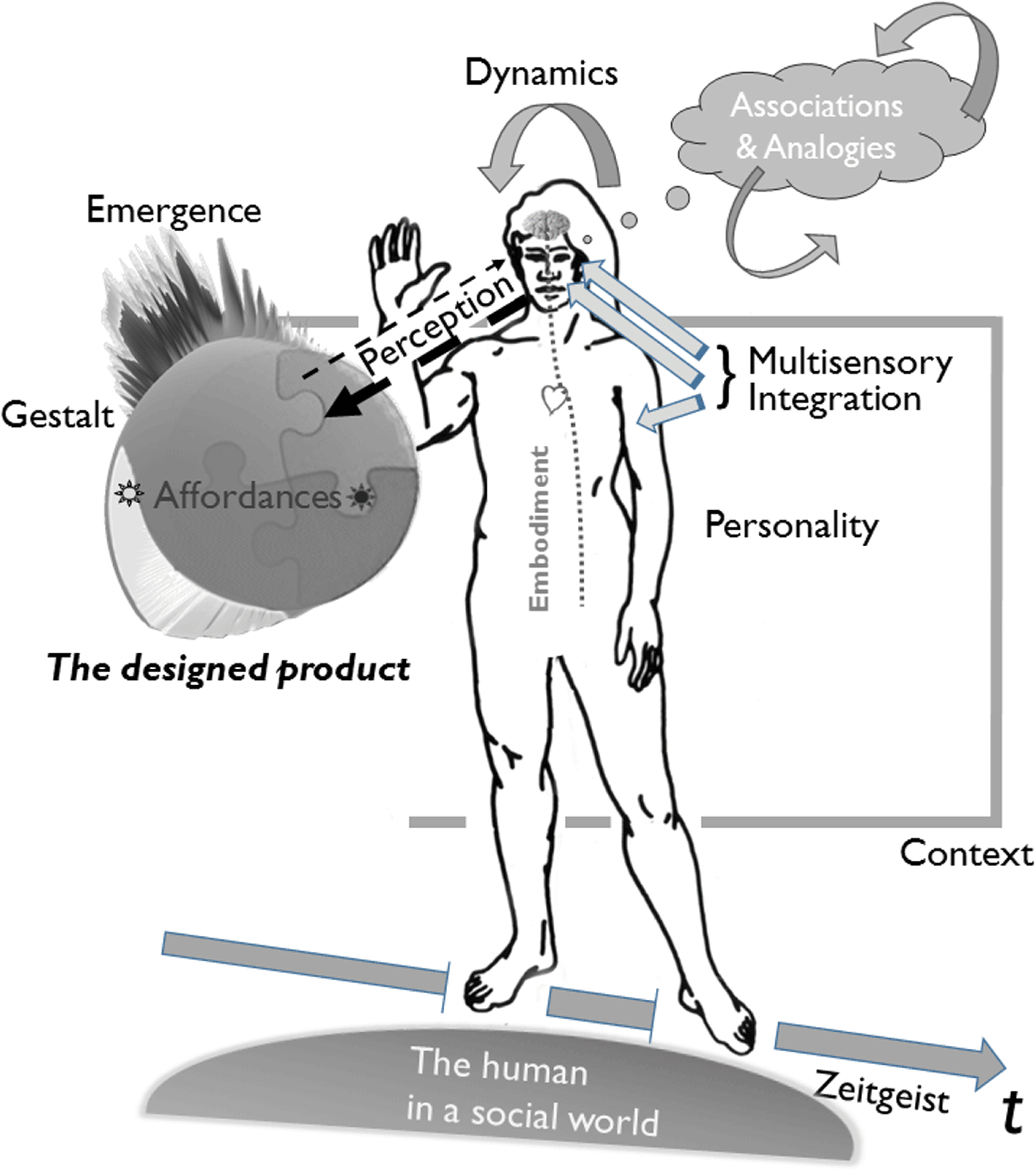
This framework should assist people working in the domain of design to understand the complex interplay between different psychological factors and how they interact with each other. One important role of this framework is that of a communication tool: It reminds of and informs about the variety of psychological phenomena which are in play when it comes to design. The framework can also act as a kind of tag list to not forget important psychological dimensions. Lastly, the framework is also applicable as a tool to audit the entire design process from the start of finding the adequate ideas for a new design item, for the question which qualities the design should have, to the evaluation of the design regarding usability and pleasurable experience of usage.
3 Action plan
Thirty years after Norman published his ground-breaking and still very readable book ‘The Design of Everyday Things’ (Norman Reference Norman1988) where he provoked the failure of design due to its neglect of the psychological processing, and where he offered very wise and concrete examples and a series of advises, we still face very similar problems with design: (a) Users sometimes do not understand how to use products, (b) they often fail when using them and (c) they do not enjoy using or perceiving them. To just name some examples: (a) A brand new washing machine might offer an impressive range of executable programs, yet dealing with the complexity of these programs is a challenge to many users so that the actual usage remains restricted and excludes many of the fancy functions – or, have you ever exhausted the potential of your washing machine? (b) The functionality of a modern stove is great, the efficiency superb and the precision of heat delivery striking, but have you noticed that frequently you just turn on the wrong burner as you confuse the knobs? (c) Touch screens in cars might be informative and visually pleasing and comfortable, but have you ever enjoyed interacting with such a screen without getting real haptic feedback that clearly indicates whether a certain function was executed or whether the system still waits for your input (see Breitschaft, Clarke & Carbon Reference Breitschaft, Clarke and Carbon2019)? When Norman published the most recent, in fact widely revised and expanded, edition of his magnum opus (Norman Reference Norman2013), he made clear that the fundamental design principles he propagated ‘are still as true and as important as when the first edition was written’ (p. xii) and further ‘Our technologies may change, but the fundamental principles of interaction are permanent’. Clearly the reason for this insightful summary is, users are still humans and humans are shaped by millions of years of evolution, so users will still follow biological and psychological programs and routines which are stronger and more persistent than mere instruction or information.
The reason why the claims and practical advises of so-called human-centred design approaches are still not satisfactorily followed are definitely not to be found in unclearness of writing, insufficient availability of texts or complexity or difficulty of applying these issues. Most of these publications were and still are bestsellers and the principles described there are praised, cited and referred to quite often – to illustrate this briefly: Although Donald Norman’s now classical book ‘The Design of Everyday Things’ (Norman Reference Norman2013) is currently listed among the 1,500 best-selling books at Amazon.com with rank  for many book categories (effective 27 June 2019), it is also observable that even the classical negative cases of design described in his first edition (Norman Reference Norman2013) are existing in even brand new products (e.g. the knob layout of electric stoves). One reason for this unsatisfactory situation of persisting design problems is ‘simply because [many products] have too many functions and controls’ (Norman Reference Norman2013, p. 3) and so design errors take place as a matter of base probability of error. What is missing, seemingly, is the consequential application of such principles from the beginning on, not only as a side aspect or an evaluation tool.
As long as we do not naturally and self-evidently take psychology as the basis and framework of design, as long as we are no ‘psychologists of design’, we will miss the essential points: to create products with and for humans. And behind every kind of design there are always humans: as designers, as consumers, as users – and even as design theorists: So evidently, without psychology we will not understand what is really going on in humans, why they want to use or avoid using a product, why they admire or hate products and why they fail to use some routines or feel pleasure or discomfort while using them.
So, what to start with in terms of an action plan? There are three essential steps towards a successful implementation of psychological theory and thinking in design science:
Step 1. ‘Sensitizing’: Understanding the full range of the statement that ‘consumers are always humans’ including the consequence that to understand the thinking of consumers and to predict the behaviour of humans we need a truly psychological approach as the solid basis.
Step 2. ‘Data without theory is blind’: The full power of psychological knowledge cannot be lifted by reading design-oriented applied psychology articles only, but by elaborating the basic theories of human psychology which constitute the pillars of psychological thinking.
Step 3. ‘Theory without data is void’: We need psychologically valid data on the experience of design to understand the thinking and behaviour of consumers which calls for the adaptation and consequent application of established research methods from psychology that are able to provide valid, especially ecologically valid measures via adequate experimental designs.
In sum, the present paper aims to stimulate the awareness of the need and the variety of needs to employ psychological views, theories and methods by extending any kind of human-centred approach towards a true holistic design framework which I term ‘Psychology of Design’ (PoD).
Acknowledgment
The author would like to thank Vera M. Heslinger for fruitful discussion about sustainability of design. Moreover, I would like to thank Dorian Marjanović at University of Zagreb for inspiring the topic of this paper two years ago.


 Open access

