




Introduction
In Canada, filing a tax and benefit return (also known simply as filing taxes) is an essential annual task. It is particularly important for lower-income Canadians because many financial benefits programs require participants to file a tax return before they can receive benefits. In Canada, 3.9% of older adults (age 65+) had incomes below the low-income cut-off (Employment and Social Development Canada, 2016), and this measure is likely an underestimateFootnote 1. Low-income older adults can particularly benefit from filing tax returns. While many older adults prepare and file tax returns independently, some older adults hire a professional tax preparer/accountant or seek assistance with this important task from family, friends, or volunteer tax services. A tax professional’s services may be prohibitively expensive, especially for lower-income older adults who need to file a tax return to receive financial benefits. For lower-income older adults, delegating their tax filing to a family member or friend may be an attractive option if they do not feel confident completing their own taxes (Dunphy et al., Reference Dunphy, Monk, Vines, Blythe and Olivier2014). We use the term close other to describe a family member or friend who provides various types of support to an older adult (Latulipe et al., Reference Latulipe, Dsouza and Cumbers2022). Sometimes close others help older adults by doing a task with them, at other times close others act as delegates or proxies (Nansen et al., Reference Nansen, Arnold, Carter, Wilken, Kennedy and Gibbs2015), performing tasks on behalf of an older adult (Latulipe et al., Reference Latulipe, Mazumder, Wilson, Talton, Bertoni, Quandt, Arcury and Miller2020). We call close others who do taxes for older adults ‘informal tax helpers’. In addition to informal tax helpers who are known to an older adult, lower-income older adults can also make use of the Canadian Volunteer Income Tax Program (CVITP), a program in which volunteers prepare and file taxes on behalf of those who are unable to do so themselves (Canada Revenue Agency, n.d.-e).
Many financial tasks, including filing taxes, are being moved online. Most organizations and businesses now provide tax slips in digital form only, with paper copies available on request or not at all. This shift makes filing taxes exclusively on paper more challenging, disproportionately affecting older adults, who are more likely than younger adults to prefer analog financial options (Mis et al., Reference Mis, Benge, Kamar, Webber and Woods2025). The Canada Revenue Agency (CRA) has also increasingly emphasized and encouraged digital processes and provides multiple online systems and services to support the online tax and benefits filing process (Canada Revenue Agency, n.d.-a, n.d.-c, n.d.-d). The increasing preference for technology-centric processes by the CRA and the digitization of tax-related paperwork by companies and organizations demonstrate strong expectations that people will prepare and file taxes electronically, but this can cause further barriers for older adults. Nimrod defines the term technostress as stress induced by Information and Communication Technology (ICT) use, and older adults may be more susceptible to technostress than younger adults (Nimrod, Reference Nimrod2018). In this context, older adults who choose not to use digital tax infrastructure are non-users of digital tax systems: people whose experience is shaped by technologies they do not use (Satchell & Dourish, Reference Satchell and Dourish2009). Such non-users must either file taxes on paper or have someone else use the technologies necessary to engage with the CRA’s digital tax infrastructure.
Older adults, even if they do not experience technostress, may have more difficulty navigating online systems than younger adults (Nimrod, Reference Nimrod2018). They may also resist adopting technology, not because they are unable to learn how to use it or are afraid of it, but because it undermines their values (Barros Pena, Clarke, et al., Reference Barros Pena, Clarke, Holmquist and Vines2021). According to Dunphy et al., having the option to delegate financial tasks that require digital systems can improve older adults’ well-being (Dunphy et al., Reference Dunphy, Monk, Vines, Blythe and Olivier2014), but this delegation must be supported by the system to be effective (Havens & Latulipe, Reference Havens and Latulipe2024; Latulipe et al., Reference Latulipe, Dsouza and Cumbers2022). When delegation is not explicitly supported by sociotechnical systems, older adults are forced to use informal delegation mechanisms such as password sharing (Havens & Latulipe, Reference Havens and Latulipe2024; Latulipe et al., Reference Latulipe, Mazumder, Wilson, Talton, Bertoni, Quandt, Arcury and Miller2020; Latulipe et al., Reference Latulipe, Dsouza and Cumbers2022). These informal delegation mechanisms do not adequately protect older adults from fraud, abuse, and privacy violations (Abood et al., Reference Abood, Kali and Zdenek2015; Havens & Latulipe, Reference Havens and Latulipe2024; Latulipe et al., Reference Latulipe, Mazumder, Wilson, Talton, Bertoni, Quandt, Arcury and Miller2020; Vines et al., Reference Vines, Blythe, Dunphy and Monk2011). They also reduce older adults’ independence in financial decision-making (Tilse et al., Reference Tilse, Wilson, Rosenman, Morrison and McCawley2011).
An effective formal delegation mechanism is needed to protect the safety, independence, and privacy of older adults when delegating their tax filing. The CRA provides the Represent a Client and Authorize a Representative mechanisms, designed to allow preparation and filing of tax and benefits forms to be delegated to professionals, tax clinic volunteers, or the family or friends of an individual acting as informal tax helpers (Canada Revenue Agency, n.d.-b). Our research aims to understand how older adults and the delegates who support them interact with the CRA’s digital tax infrastructure, including delegation mechanisms. To this end, we conducted an interview study with older adults, informal tax helpers, and CVITP formal tax volunteers. We asked older adults about whether and how they use CRA digital tax systems. If they delegate tax filing to others or serve as delegates for others, we asked how that process works. We asked CVITP formal tax volunteers about their use of CRA digital infrastructure and their experiences acting as tax filing delegates, especially for older adult clients.
This paper, which is the first study on older adults delegating taxes in Canada, makes the following contributions: first, we present a brief analysis of the CRA’s client-facing digital tax infrastructures for delegation from a workload, security and privacy perspective; second, we present results from our interview study investigating how the CRA’s delegation mechanisms work for older adults, informal tax helpers, and formal tax volunteers; and third, we present a discussion about how the CRA delegation support for older adults differs from other types of financial tasks and systems that older adults delegate to others.
Background and related work
Income tax filing in Canada
Canada’s tax system is based on the self-assessment principle (Brooks & Doob, Reference Brooks and Doob1989), meaning that each person files an income tax and benefit return every year to determine if they have underpaid or overpaid taxes. Many government-provided benefits are assessed and distributed based on an individual’s tax return. While filing taxes is not legally required unless an individual owes taxes, the CRA recommends that anyone with income or anyone who wishes to claim benefits file taxes because they may qualify for benefits, receive a refund, or both (Canada Revenue Agency, n.d.-g; Petit et al., Reference Petit, Tedds, Green and Kesselman2021). It is important to note that tax preparation and filing requirements vary by country; while the U.S. approach to taxation and tax filing is similar to Canada’s, a variety of countries around the world are known as ‘exact withholding’ countries, where low-income individuals and individuals with a single employer have exactly the right amount of tax withheld and transferred to the government and no tax filing is required (Laurin & Dahir, Reference Laurin and Dahir2022). In these cases, benefits owed (such as to retirees or older adults receiving income supplements) are also automatically applied.
Even though filing tax returns is required to receive many benefits in Canada, it is estimated that 10–12 per cent of Canadians do not file taxes (Robson & Schwartz, Reference Robson and Schwartz2020). Additionally, lower-income Canadians are less likely to file taxes than higher-income Canadians (Robson & Schwartz, Reference Robson and Schwartz2020). This non-filing problem reduces the effectiveness of benefits programs since many of Canada’s benefits programs rely on tax returns to determine eligibility (Petit et al., Reference Petit, Tedds, Green and Kesselman2021). In 2004, though more than 3 million Canadian older adults were eligible for the Guaranteed Income Supplement (GIS), many did not receive the GIS due to the obligation of filing tax returns (SEDI, 2004).
The Canadian Volunteer Income Tax Program (CVITP) is a partnership between the CRA and community organizations. The community organizations host free tax clinics for modest-income individuals, which ensures that individuals can receive the tax credits and benefits to which they are entitled (Canada Revenue Agency, n.d.-e). In 2023, CVITP tax clinics filed 758,540 returns across Canada, and the total value of benefits and credits distributed thanks to those returns was just over CAD$2 billion (Canada Revenue Agency, n.d.-f). The CRA provides CVITP volunteers with a tax software package called UFILE CVITP (UFILE, n.d.), which is a customized version of the commercially available UFILE Pro tax software.
Financial delegation by older adults
Financial delegation does not just happen once a year when older adults are filing taxes. Managing finances (paying bills, monitoring balances, transferring funds) is an ‘instrumental activity of daily living’ (Lawton et al., Reference Lawton, Brody and Médecin1969), but as older adults age, they may occasionally, and then more frequently, want or require assistance with these tasks. Latulipe et al. surveyed close others in Canada to discover how they help older adults with banking tasks (Latulipe et al., Reference Latulipe, Dsouza and Cumbers2022). They found that close others frequently use online banking services on behalf of older adults, and in follow-up work, Havens and Latulipe demonstrated that the formal delegation mechanisms provided by banks are not suitable for many use cases (Havens & Latulipe, Reference Havens and Latulipe2024). For example, joint accounts, which are often pushed by banks as the ‘right way’ to delegate financial tasks, legally assume shared ownership of the assets and allow a delegate to remove all funds with no recourse or institutional liability. Joint accounts can be problematic because it is difficult to revoke access from a delegate and because they make delegates responsible for what happens in those accounts, including debt or interest impacting credit ratings or taxes. Because these mechanisms may not be suitable and have high overhead costs of setup, older adults often resort to simply sharing online banking credentials (usernames and passwords) with close others to allow those close others to log in on their behalf to accomplish routine financial tasks, which also exposes the older adults to risks such as close others removing assets without authorization (Latulipe et al., Reference Latulipe, Dsouza and Cumbers2022). In their work, Havens and Latulipe outlined how older adults sharing passwords to financial accounts with close other delegates has multiple risks, beyond financial theft (Havens & Latulipe, Reference Havens and Latulipe2024). They note that password reuse is common (Das et al., Reference Das, Bonneau, Caesar, Borisov and Wang2014) and so older adults sharing banking passwords may inadvertently give a close other access to other online systems used by the older adult (including CRA systems). They also note that password sharing prevents financial institutions from tracking who made transactions. Finally, they highlight the lack of privacy: with password sharing, the delegate can view all the older adult’s accounts and past transactions. These issues demonstrate a need for better delegation mechanisms in Canadian banking that explicitly acknowledge that older adults are getting occasional help with financial tasks from their close others. What is unclear is whether similar privacy and security issues happen when older adults in Canada delegate tax preparation and filing to informal tax helpers or to formal tax volunteers.
Tilse et al. studied four aged-care facilities in Australia to find out how daily financial tasks were performed in the context of formal care (Tilse et al., Reference Tilse, Wilson, Rosenman, Morrison and McCawley2011). They found that staff were not willing to use informal access methods to perform banking tasks on behalf of older adults because of the risks of misconduct or the perception of possible misconduct. Their results demonstrate that when effective delegation mechanisms are not available, older adults (especially those without strong support networks) may be unable to access their own financial assets (Tilse et al., Reference Tilse, Wilson, Rosenman, Morrison and McCawley2011).
A study in the U.S. analysed how lower-income older adults in California access their financial benefits (Abood et al., Reference Abood, Kali and Zdenek2015). The government required them to use a digital direct-deposit system instead of providing cheques, but most participants did not understand it. As a result, they were forced to use representative payees to receive the benefits on their behalf, even though they did not necessarily trust the representatives to act properly and pass the benefits on to them. In this case, because the older adults did not have control over their financial delegation, the delegation system was not effective for distributing benefits to older adults.
Alternative financial delegation methods
There has been some exploration of what alternative financial delegation systems could look like. Barros Pena et al. explored the possibilities enabled by open bankingFootnote 2 in the U.K.to provide more informal financial delegation (Barros Pena, Kursar, et al., Reference Barros Pena, Kursar, Clarke, Alpin, Holkar and Vines2021). Their tool, aimed at those living with a mental health condition, reports transactions to a close other for oversight and increased support without sacrificing the account owner’s independence. Similarly, Havens and Latulipe developed an interactive prototype of online banking with proxy accounts to support financial propriety in older adults’ delegates (Havens & Latulipe, Reference Havens and Latulipe2024). They showed three important benefits of proxy accounts: attribution of actions, allowing better detection of misuse; increased security by removing the need for password sharing; and increased privacy, through granular limitations on what proxies can or cannot see and do in the older adult’s account (Havens & Latulipe, Reference Havens and Latulipe2024).
Financial abuse of older adults
Financial abuse is the most common form of abuse of older adults in Canada and can take many forms (Government of Canada, n.d.). We define financial abuse of older adults as repeated and/or serious financial misconduct perpetrated by a trusted close other who is supposed to be providing support to the older adult. This differs from financial fraud, which is perpetrated by strangers. Financial abuse requires a close other to have access to an older adult’s financial assets. Setterlund et al. propose that ‘routine access’ to an older adult’s financial accounts may enable acts of financial impropriety, often rationalized as compensation for caregiving and/or as familial financial entitlement (Setterlund et al., Reference Setterlund, Tilse, Wilson, McCawley and Rosenman2007). While financial abuse is most easily enabled through access to an older adult’s bank accounts, there has been little research into whether access to tax records and CRA accounts can also be an ‘attack vector’ that a close other delegate could use to misdirect tax refunds and/or benefits. A 2025 CBC news investigation did uncover CRA account hacking that involved using the authorized representative access mechanisms, suggesting that this issue warrants deeper exploration (Cashore et al., Reference Cashore, Uguen-Csenge and Kelley2025).
In summary, while there has been little previous work on how digital systems to support delegation of tax preparation and filing can and should work for older adults (or any other individuals who need assistance), there has been significant investigation into financial delegation by older adults for more common, daily financial tasks. Work from both the Canadian context and other countries shows that financial delegation by older adults is fraught with security and privacy issues, poses challenges for well-meaning close other delegates, and opens older adults up to the risk of financial misconduct. It is unclear whether the systems provided by the CRA for allowing older adults to delegate tax preparation and filing are commonly used, and if so, whether their use involves similar risks, which is the motivation behind our analysis of CRA digital infrastructure and our interview study with older adults, informal tax helpers, and formal tax volunteers.
CRA digital services
The CRA provides several digital services to individuals and mechanisms to delegate access to these services to others. This section provides an overview of CRA digital services aimed at individuals, followed by an analysis of how these systems may or may not support the security and privacy of older adults in Canada and impact the tax preparation workload for informal tax helpers and formal tax volunteers.
CRA my account
CRA My Account is the Canada Revenue Agency’s web-based client portal that allows individuals to access their tax forms, view notices of assessment (NOAs), track refunds and benefit payments, and receive secure email notifications, among other functions (Canada Revenue Agency, n.d.-a). This system provides both historical and current records of all tax-related information for an individual. CRA My Account exists for all clients (any individual who has filed taxes in Canada since the system was created), even if an individual user has never created a login or accessed the system. Individual users must create login credentials to access their CRA My Account, and in the past, this required requesting a login password from CRA, which was sent in a letter via Canada Post to the individual’s mailing address. Recently, this process changed, and individuals can now register to get login credentials using an email address.
Represent a client and authorize a representative
The Represent a Client service is a general-purpose delegation mechanism that is integrated with CRA My Account and is intended for use by tax professionals, tax clinic volunteers, and informal tax helpers (Canada Revenue Agency, n.d.-b). Representatives are required to have a RepID, a unique identifier that is tied to their personal CRA My Account (in the case of informal tax helpers) or to their tax business or CVITP organization (in the case of tax professionals or CVITP volunteers). The RepID enables formal tax volunteers and tax professionals to access previous income tax returns, notices of assessment, and current tax forms, which can then be used to prepare and file a new tax and benefit form on behalf of a client. Similarly, an informal tax helper assisting an older adult can register with CRA to create a RepID and then use the Represent a Client service to access the older adult’s tax records.
The Authorize a Representative interface is built into CRA My Account and allows a client to initiate or approve an authorization request, enabling them to give someone else access to their CRA My Account. When this mechanism is used, it gives the client more agency as they can choose the level of access that the delegate gets: Level 1 is read-only, and Level 2 allows some limited updating of information and some queries to be sent to CRA on behalf of the individual. Level 3 is only for legal representatives (those with an invoked power of attorney) and allows updating of information, including contact information, direct deposit accounts, and so forth. Level 3 access only applies to Trustee accounts, which are beyond the scope of this work.
NETFILE and EFILE
NETFILE and EFILE are integration services that enable electronic tax-filing through third-party software, meaning that individuals can file their taxes over the Internet and not have to mail paper tax returns to the CRA. The CRA prefers users to file their taxes electronically because digital tax information can be assessed with automated software much more efficiently than tax information entered on paper. Tax software companies work with the CRA to enable the necessary communication between CRA servers and their software, which is then certified by CRA (Canada Revenue Agency, n.d.-h). NETFILE is embedded in most tax software used by individual taxpayers in Canada and can also be used in delegated contexts. For example, an informal tax helper can use NETFILE-enabled software on behalf of an older adult. EFILE is equivalent to NETFILE, except that it is integrated into software used by tax professionals and the UFILE system used by CVITP volunteers.
Auto-fill my return
Auto-fill My Return is an integration between NETFILE-certified or EFILE-certified software and CRA My Account that automatically pulls information from all currently available tax forms in an individual’s CRA My Account and uses it to populate the individual’s current tax return (Canada Revenue Agency, n.d.-c). This works because businesses and organizations that pay individuals are required to submit annual records of payment (T4 slips, etc.) to the CRA, which are automatically associated with individual taxpayers through social insurance numbers or taxpayer identification numbers. This feature is available to individuals using NETFILE or EFILE-certified tax software, but it can also be used by informal tax helpers who have been authorized to access an older adult’s CRA My Account, making it faster to prepare their tax return.
SimpleFile
SimpleFile by Phone and SimpleFile Digital are systems that allow a small subset of low-income taxpayers to file taxes by telephone or online, without having to fill out any forms or do any calculations. These systems, which are invitation-only and targeted at low-income taxpayers with very simple returns, work by asking taxpayers a series of questions to confirm information that the CRA already has (Canada Revenue Agency, n.d.-f). We did not encounter any participants who had used these systems in our study.
Privacy and security analysis of CRA delegation mechanisms
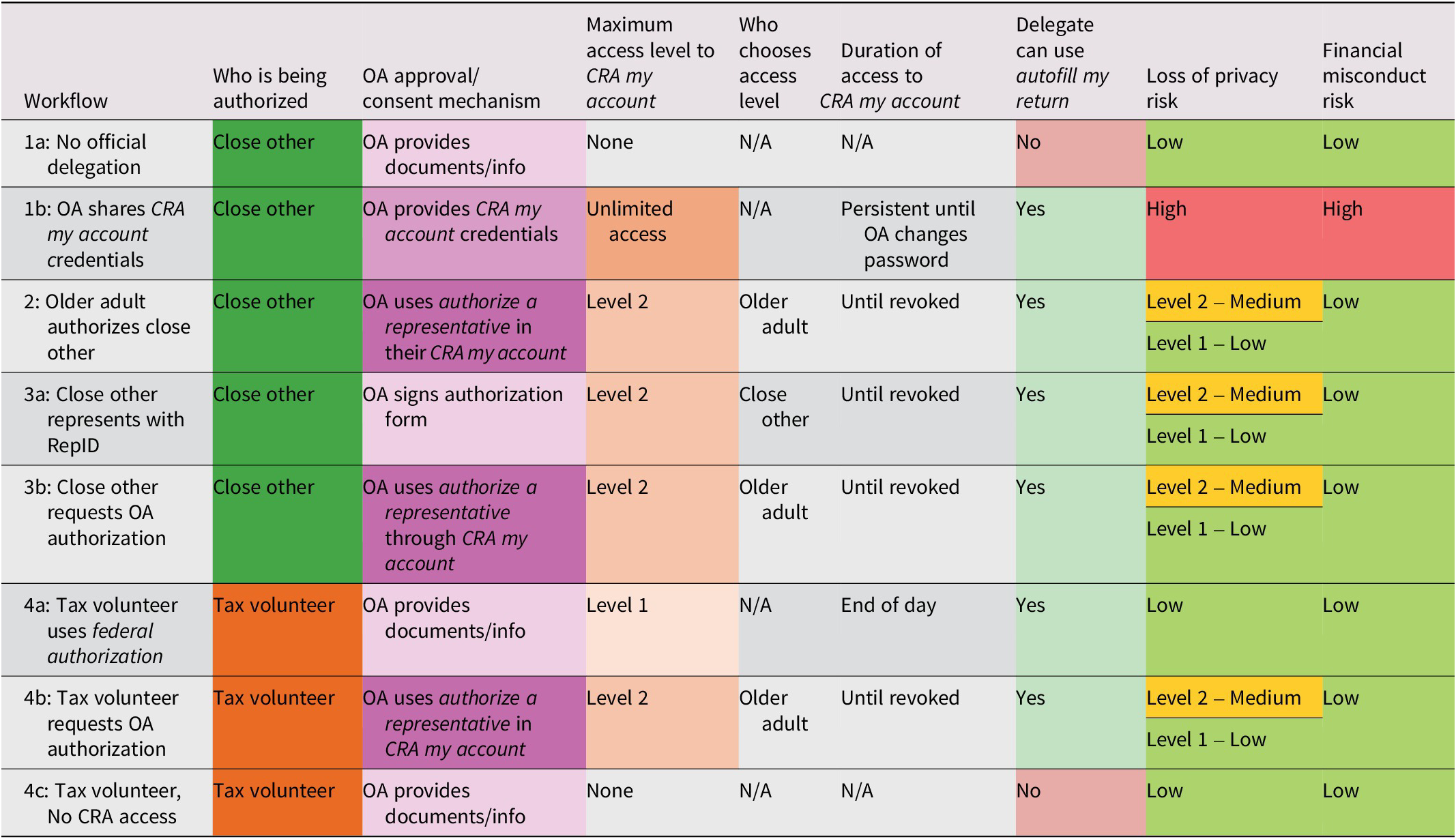
Unlike Canadian banking institutions, the CRA has provided explicit delegation mechanisms that are lightweight in the sense that they do not require the delegate to have power of attorney. Given that there are a variety of delegation mechanisms, we constructed diagrams to explicitly outline the various workflows of arranging delegation and then analysed the privacy and security risks and workload associated with each type of delegation (see Supplementary Appendix). Here we give brief descriptions of the workflows, followed by a table that highlights the findings of our analysis.
Workflow 1a – Informal Delegation: Older adult gives all tax slips to informal tax helper who uses tax software to file the older adult’s taxes, either through EFILE or by submitting a printed tax return and mailing it to CRA.
Workflow 1b – Credential Sharing: Older adult gives the informal tax helper their CRA My Account login credentials, and the informal tax helper uses this to access tax documents, use Autofill My Return, and file taxes.
Workflow 2 – Older Adult Authorizes Close Other: Older adult logs into CRA, goes to Authorize a Representative, and provides the RepID for the informal tax helper, choosing access level 1 or 2.
Workflow 3a – Informal Tax Helper Initiates Representation: Informal tax helper logs into Represent a Client, provides information, and uploads an authorization letter signed by the older adult to access the older adult’s CRA My Account.
Workflow 3b – Informal Tax Helper Requests Authorization: Informal tax helper logs into Represent a Client and sends an authorization request. Older adult logs in to My Account, approves the request, and selects an access level.
Workflow 4a – Formal Tax Volunteer Uses Federal Authorization: Formal tax volunteer submits information about the older adult using the UFILE Federal Authorization request, which gives 1 day access to the older adult’s CRA My Account.
Workflow 4b – Formal Tax Volunteer Requests Authorization: Formal tax volunteer logs into Represent a Client and sends an authorization request. Older adult logs in to My Account, approves, and selects access level.
Workflow 4c – Formal Tax Volunteer, No Access: If the older adult does not consent or there are issues accessing their CRA My Account, the older adult must provide documents for the formal tax volunteer to use to prepare the return.
Table 1 provides a summary of the privacy and financial misconduct risks associated with each delegation mechanism workflow. It also highlights that some access mechanisms require the older adult to log in and make direct use of CRA digital systems (third column in purple), which may be a barrier to those delegation workflows. The seventh column shows that delegates having authorized access to an older adult’s CRA My Account enable the use of Autofill My Return, lowering the workload for the delegate. The analysis of privacy and security risks in the last two columns loosely follows the Confidentiality, Integrity, and Availability (CIA) framework of Samonas and Coss (Reference Samonas and Coss2014).Footnote 3 Confidentiality risks in tax delegation relate to loss of privacy due to the delegate seeing all the information in the CRA My Account and/or on tax slips provided by the older adult. There is always some loss of privacy when tax filing delegation occurs. What we consider here is whether there is a risk for information disclosure beyond what is necessary for filing the current year tax forms. Integrity risks involve a delegate submitting false information as part of filing tax return and benefit forms, and is a low risk, regardless of the delegation mechanism (and is therefore not shown in the table). Availability risks in this situation relate to the risk of financial misconduct by a delegate redirecting refunds and benefits to themselves or others, rather than to the older adult. Due to access limitations provided by the CRA delegation mechanisms, the risk of financial misconduct is low except in the case where the older adult shares their CRA My Account login credentials with an informal tax helper. However, there are other ways that informal tax helpers can engage in misconduct through CRA systems.
Overview of tax delegation workflows when older adults (OA) delegate tax filing to others. The level of pink in the third column indicates how much effort the older adult has to expend to setup delegation, while the third-last column identifies the ease of filing for the delegate. Privacy and financial misconduct risks are identified in the last two columns
There is always some risk of financial misconduct because providing the information to complete taxes may give a delegate enough information to attempt to log in to the older adult’s CRA My Account. If the older adult has never accessed their CRA My Account, a delegate could use the tax information they have to set up unauthorized access, posing as the older adult. This could then allow them to misdirect funds through a change of address or direct deposit information. Another way that delegates can gain unauthorized access relates to third-party authentication. The CRA My Account and CRA Represent a Client systems both allow third-party authentication through major banks and credit unions. This means that individuals can log in to these CRA systems using their online banking credentials, so that authentication is done by the user’s bank or credit union rather than by CRA. This is a benefit in that users do not have to remember yet another set of login credentials; however, it is also a security risk: Latulipe et al. and Havens et al. have both shown that older adults routinely share their banking passwords with close others (Havens & Latulipe, Reference Havens and Latulipe2024; Latulipe et al., Reference Latulipe, Dsouza and Cumbers2022). This third-party authentication mechanism means that a close other who has an older adult’s banking credentials can also use those credentials to gain full access to the older adult’s CRA account which gives the ability to view all tax-related information and would allow them to modify direct deposit information and contact information for the older adult, enabling financial misconduct through the misdirection of benefit and refund monies.
Study methodology
To further investigate tax filing delegation by older adults in Canada, we conducted a study to investigate how older adults use CRA services online, with a specific focus on how volunteers and informal tax helpers support older adults in their use of the CRA’s services. Given the exploratory nature of the study, we chose to conduct semi-structured interviews with participants. This approach allowed participants to share stories and details they deemed relevant, while providing structure and topical focus. This study was approved by the University of Manitoba Ethics Review Board.
Recruitment
Our study involved three groups of participants: older adults, formal tax volunteers, and informal tax helpers. We required older adults to be 65 or older and to have filed taxes at least once in the last 5 years, with or without help, and regardless of the method of filing (paper or electronic). Formal tax volunteers were required to volunteer with a CVITP organization to file taxes on behalf of lower-income individuals. Informal tax helpers needed to be over 18, and help at least two other people (not including a spouse) with taxes. We recruited our older adult participants through ageing research newsletters, as well as from posters put up at community centres and libraries in Winnipeg. We also found several participants through the networks of the formal tax volunteers, who shared information about our study with older adult clients. Our formal tax volunteers were recruited through Community Financial Counselling Services (CFCS), a community organization in Winnipeg that provides CVITP services. Informal tax helpers were recruited through social media, posters, and newsletters.
Interviews
We conducted eight half-hour interviews with older adult participants (3 males, 5 females), seven full-hour interviews with formal tax volunteer participants (3 males, 4 females), and five half-hour interviews with informal tax helpers (1 male, 4 females). The interviews with formal tax volunteers were longer because we anticipated these individuals would have more information to share based on having completed many tax returns for older adult clients. Older adult participants and informal tax helpers were compensated CAD $15, and formal tax volunteer participants were compensated CAD $30 via the participant’s choice of e-Transfer or Tim Horton’s gift card.
Our semi-structured interview questions for older adults focused on the ways the participants had filed taxes in the past, whether on paper, digitally, or through a tax professional, CVITP volunteer, or a friend or family member acting as an informal tax helper. We asked for specific examples of difficulties the participants had encountered, and whether they had experience with CRA’s online services. If they were currently doing their taxes independently, we asked them to think about a time in the future when they might need to delegate taxes, and what a system that supported them in this task would look like. If they were getting help with, or having someone else do their taxes for them, we asked them about how this worked and about any challenges related to delegating this task.
Our questions for formal tax volunteers focused on issues and barriers they faced when filing taxes for older adult clients, as well as barriers older adults face when using the volunteers’ services. We asked how the volunteers used CRA-provided software, whether their clients used the CRA’s online services, and how effective they believed the provided services were for themselves and their clients. We also asked about differences between older adult clients and other clients, and about potential security or privacy risks to their clients or themselves. Our questions for informal tax volunteers were similar, though we did not require the informal tax helpers to only file taxes for older adults, so they were welcome to tell us about issues or challenges filing taxes for anyone in their network.
Analysis
We conducted a content analysis (Krippendorff, Reference Krippendorff2018) of the data because we were interested in taking a structured deductive approach to understand how older adults filed taxes, what delegation methods they use, and how both older adults and informal and formal tax delegates use CRA systems. Our deductive approach was driven by prior research in financial delegation by older adults, highlighting sociotechnical issues around agency, privacy, security, and the mechanisms built into the systems to provide delegated access. We did not seek to develop, new theory or understand social conceptions around taxation, but rather to understand how tax preparation is currently being handled by and for older adults in Canada, as framed by the prior research on financial delegation. We audio-recorded and transcribed the interviews, anonymizing them using numeric identifiers and giving each participant a pseudonym (e.g. OA1: John, TV3: Mary). We used content analysis to identify common themes and identify outliers in the participant responses (Krippendorff, Reference Krippendorff2018). To do this, we added participant responses to all questions to tables (one for older adult responses, one for informal tax helper responses, and one for formal tax volunteer responses) with columns for each question asked and rows for each participant. Two authors together used these response tables to aggregate and summarize responses and to identify responses that differed from the most common responses. We colour-coded responses according to the emotional valence of responses and highlighted particularly striking comments. We also used each participant’s answers to build an understanding of their context and attitudes surrounding taxes, the CRA, and financial delegation in general.
Results
Older adults
Table 2 presents a summary of how our eight older adult participants prepare and file taxes and shows that half of them file taxes independently using NETFILE-certified software, with one person getting some assistance from a relative.
Summary table of how older adult participants file taxes

The older adult participants were largely happy with their tax filing process, though some found it onerous or time-consuming. Five of these participants had filed taxes on paper at least once, but none of them had done so recently (Pierre, Melanie, Sara, Ethel, Marty). Three of the older adult participants filed taxes using tax software without assistance (Melanie, Sara, Marty), one filed taxes using software with help from a family member (Pierre), two delegated tax preparation to friends acting as informal tax helpers (Dot, Fiona) and the remaining two older adults (Bill, Ethel) used CVITP volunteers to file their taxes.
The three older adults who filed taxes completely independently were extremely comfortable with tax rules, tax software, and navigating CRA policies. One participant (Sara) mentioned that they had previously hired a tax professional, but caught errors in the tax professional’s work and have filed their own tax returns since. Another participant, Marty, switched from paper to digital tax software, but double-checked the work on paper for almost 20 years before trusting that the software would file correctly. These three participants showed no signs of discomfort or stress managing their own taxes, with two of them also helping friends and family file taxes.
The two older adult participants who had informal tax helpers prepare and file for them (Dot, Fiona) had never done their own taxes; they had always given them to a friend to do. It is interesting to note that for both these older adults, their informal tax helpers were friends, not family members. Dot and Fiona both expressed that they simply collected the forms that were mailed to them, put them into an envelope or box, and gave them to their informal tax helper friend, and then did not worry about their taxes after that. They expressed no concerns or challenges with this process. In both cases, their informal tax helper used software to file electronically, but these participants did not know what software was used. Fiona said:
I do not know. I’m not computer savvy with any of that. So I use the computer at the library where I can get a lot of help if I need it, and so I do not know. Basically, I’m probably computer illiterate. (Fiona).
Use of CRA online services
The three older adult participants who filed taxes independently were not familiar with the term NETFILE – but they did use NETFILE-enabled software to file taxes online. Marty tried to use CRA My Account to download tax forms, but had extensive difficulties gaining access to their account. They spoke to a CRA agent over the phone and reset their password, but the new password did not work, so they relied on collecting paper tax forms instead.
Use of delegation mechanisms
The two older adults who assisted others with taxes (Melanie, Marty) did so informally, without using the CRA’s Represent a Client mechanism. Instead, they sat down with the people they assisted and helped them file taxes using tax software. Marty was not aware that the CRA provided delegation mechanisms. Melanie used NETFILE-enabled software to help their granddaughter with taxes in person, but used the granddaughter’s paper tax slips rather than accessing them through CRA’s delegation mechanisms, explaining why they prefer to look at the slips on paper:
I guess I’m just old-fashioned enough that it’s easier for me to do that. I can do it electronically but it takes me a lot longer. I’m kind of more visual so I want to see it and if it’s in the computer it sort of disappears. (Melanie)
The older adults who rely on formal tax volunteers to get their taxes done (Bill, Ethel) either signed a release form if they met the formal tax volunteer in person or gave verbal permission over the phone. The older adults must provide some form of proof of identity, and this is usually in the form of providing information from specific lines of previous tax returns. Ethel explains the process from the perspective of a client:
[It’s] all on the computer, like he takes my, um, I don’t know if it’s my social insurance number or whatever but he has everything on his computer. It’s so easy nowadays that you know he just punches everything in and he can get information about me very easily. (Ethel)
Older adults did not refer to the Represent a Client service. From their perspective, they simply provided formal tax volunteers with information, and the formal tax volunteers could then access their tax forms.
Neither of the two older adults who delegated tax preparation to close others serving as informal tax helpers (Dot, Fiona) had ever logged in to their CRA My Accounts. When asked about whether they themselves had logged into or used a CRA My Account, Dot responded: ‘I just… I don’t see any purpose in using it’. Similarly, Fiona, who had described themselves as ‘computer illiterate’, had not logged in to their CRA account using a computer. This participant talked about having a CRA account connected to their social insurance number (though they used the American term of ‘social security number’), but used the phone to pay taxes when owing money:
No, I don’t have anything online. No, I do have an account, but that’s only to pay them in case I owe them money. I guess it’s it goes by your social social security number. Yeah, you give them that. that your 9 digit number, I think. yeah. And then I can phone it. I can phone in my payment like if I owe them money. (Fiona)
Neither Dot nor Fiona expressed any knowledge about the software services their friends used to file taxes for them. Fiona did note that although they worried about not receiving all of their T4 slips in the mail, their friend has assured them that they could access them online, indicating that the friend was accessing Fiona’s CRA My Account:
So you know, I’m concerned that I, that I’m not going to get them all [T4-slips]. But then this person tells me that whatever I don’t get, he can get online through, I don’t know, CRA or somewhere. You can always check whether it’s, whether I’ve got all the info or not, he said, he can get that info online. (Fiona)
Formal tax volunteers
Motivation and background
We asked CVITP, formal tax volunteers, why they chose to spend their time volunteering by doing taxes for other people. All seven of these participants were retired, although one had been volunteering pre-retirement (Bob). Most volunteers said that tax volunteering gives them a sense of fulfillment or purpose, and three mentioned boredom during retirement as a motivation for seeking out volunteering opportunities (Nathan, Ben, Betty). Most of the volunteers had previous experience working for the government, and all of them had administrative or related careers. However, none of the volunteers we interviewed were or had been accountants. Bob explained that previous experience working with taxes could actually hinder rather than help:
It sounds odd maybe, but I actually think it can be a deterrent. I find if people are conversant with tax situations, they either find their [CVITP clients’] returns too simple to be engaged by them or they sometimes lack patience with the clients. We often describe them as ‘simple returns with complicated lives’. Empathy is the number one. (Bob)
We found that ‘simple returns, complicated lives’ was a recurring theme throughout our interviews with formal tax volunteers. Perhaps due to the CVITP’s requirements that only people with lower income can use the tax filing service, the tax returns filed by volunteers were generally very simple, usually consisting of a small number of income sources and lacking investments and other complexities. However, volunteers reported that their clients frequently experienced difficulties filing taxes due to complicated life circumstances such as housing insecurity. Many clients had been non-filers for many years before coming to the CVITP and were often missing documents needed to file those past returns. However, because of access through Represent a Client, the volunteers were often able to get access to the client’s CRA My Account and obtain the forms necessary to complete the past returns.
Formal tax volunteers reported making extensive use of the CRA’s Represent a Client and Federal Authorization mechanisms to access their clients’ tax forms and file returns on their behalf. They worked with clients either in person or over the phone. When they use UFILE CVITP to file a Federal Authorization, they enter the client’s name, social insurance number, and a piece of information from the previous year’s tax return. The authorization is typically approved instantly. Once approved, the authorization grants the formal tax volunteer access to the client’s tax forms and previous tax returns until midnight of the day the authorization is approved. All formal tax volunteers reported using the AutoFill My Return mechanism, but also typically downloaded relevant tax forms to verify that everything looked correct prior to submitting the client’s return. The formal tax volunteer participants reported that this process can take as little as 20 to 30 minutes.
Volunteers had particularly positive comments about digital access to clients’ tax forms. During the COVID-19 pandemic, the CRA established a process for gaining consent from the client over the phone, allowing formal tax volunteers to access client tax forms without needing to meet in person to get signed consent. This process worked so well that it stayed in place after the pandemic was over. Volunteers we interviewed consistently used this process to digitally access forms and autofill client returns, even when clients came to see them in person with paper tax forms in hand. This process allowed them to file returns even when clients were missing crucial paperwork that would previously have prevented them from getting their tax return filed.
They might be missing something or like we still go through the process because I got to connect anyway. (Mary)
However, issues can arise that make the process more complicated. To ensure that clients get the highest possible refund and benefits, formal tax volunteers ask clients questions from a list that is distributed by the tax volunteering organization. This practice allows them to add benefits applications to the tax return, for example, the Canada Child Benefit or Disability Tax Credit, which can increase the amount of money clients receive. This process can take time, especially if more documentation is needed to qualify for a benefit. For example, sometimes formal tax volunteers would ask a client to get proof of disability from a doctor and return later to file taxes. The volunteers rely heavily on their access to previous tax returns to see which benefits clients might qualify for.
Volunteers reported encountering occasional issues with accessing a client’s CRA My Account. The most common reason for this, mentioned by all but one of the formal tax volunteer participants, is a mismatch in the client’s name. Betty explains:
If their name is, I mean, I guess John, or is it Jonathan, you know, you’ll try different spellings or if they have a middle name or if you have an initial in the middle name. So, we’ll play hit and miss, but sometimes you just can’t get it matched up. And so, you can’t get in to get off the starting block with the initial authorization. (Betty)
When the client’s name does not match the version stored by the CRA, volunteers must complete the forms using only the paperwork provided by the client. The volunteers have a special CVITP CRA phone line they can call, but volunteers report that the CRA phone line has become less useful. In previous years, the CRA help desk had greater freedom in helping volunteers find errors and gain access to clients’ accounts. However, there appears to have been a policy change in 2022, and now the CRA phone line representatives are more restricted.
We would be able to phone Revenue Canada on the EFile help desk and get that straightened out. Well, they stopped that two years ago. (Amy)
This change is because CRA representatives are no longer able to indicate which piece of information the client provided is incorrect. Ben explains how frustrating the process can be, and how they resort to filing paper tax returns when they are unable to provide the correct information to identify a client:
Sometimes I’ve got to contact CRA, they have a help desk. I call it the unhelpful desk, CRA calls it the help desk. And the reason is that there are so many restrictions as to what information they can give me based on my level of security. And sometimes I end up, I just say, ‘I’m sorry, we can’t do this. We’re going to file this on paper.’ So, we will make a paper file. We’ll let CRA figure it out once they get it. And those take a much longer time. (Ben)
Frustration with getting access to clients’ CRA My Account and the CRA’s ‘unhelpful desk’ is by far the most frequent complaint the formal tax volunteers had about the entire tax filing process. All seven formal tax volunteers we interviewed brought up the phone line, despite the fact that we did not ask specific questions about it.
Complaints aside, the volunteers’ process seems to be highly effective. Most formal tax volunteers reported that they file 300–500 tax returns per year, and Bob reported that they file 1500–2000 tax returns each year. Volunteers often catch clients up on their tax returns by filing up to 10 previous years’ tax returns in a single session. The process is efficient and well-optimized for the specific needs of formal tax volunteer organizations. Once they get access, volunteers do not report any usability issues with the Represent a Client portal, the CRA My Account, or with the UFILE tax filing software and the Autofill My Return system.
Challenges specific to older adult clients
Formal tax volunteers generally reported that older adults are easy clients to work with. This is because older adult clients are better at keeping track of essential paperwork, such as previous years’ returns and medical expense receipts, than their younger counterparts. Mary explains:
I really, I love doing the seniors. Here’s why, because, you know, seniors are organized, they got all their papers together, they keep all their tax stuff in one place. (Mary)
Older adults’ effective paperwork practices could be a reflection of developing good bookkeeping practices over their lifetimes, a form of expertise that younger taxpayers have not yet developed. These paperwork practices may also be related to tax-related stress. Mary and Bob mentioned that older adults are more stressed, nervous, or even intimidated by the government, which causes them to take more care in preparing for filing taxes.
Formal tax volunteers told us that, of the clientele they support, older adults tend to have more complex tax returns than younger adults. All volunteers mentioned medical expenses as an extra burden for older adults, and this information is not provided by Autofill My Return. Clients must keep receipts for all medical expenses so that they can be added to the tax return manually. Janet and Betty both mentioned that some older adults may be experiencing cognitive decline, which can impact their ability to provide accurate information to the formal tax volunteer. However, as long as the cognitive impairment is not severe, volunteers explained that they can work around this by accessing the client’s CRA My Account. This allows them to check information against returns in previous years, so that they can feel confident they are filing an accurate return on behalf of the older adult. If a client appears to have serious cognitive impairment, they are asked to return with a caregiver.
Informal tax helpers
Four of the informal tax helpers we interviewed mainly filed taxes for family members (Odette, Jen, Darren, Harini), though in two of these cases, also for a friend (Darren, Harini). Typically, they did this to help out people that they cared about. These four informal tax helpers had no official training in tax preparation or filing, nor a relevant professional background in accounting. One informal tax helper, Angie, was a university student training to be an accountant, and they did taxes for their boyfriend and another friend.
Two of our informal tax helper participants do taxes for older adults (Odette, Jen), and Darren has been handling estate taxes for their deceased father, who was an older adult. Odette does taxes for their elderly father, explaining that their father had only ever done taxes on paper:
My dad was getting elderly. and he did his taxes with a pencil on the form, forever and ever and ever. He was, I’m gonna say in his eighties already, and I said, Dad, I’ll just put it into TurboTax for you. You can sit with me and it took about 2 to 3 years for him to say, just do it, you know. (Odette)
All informal tax helper participants used tax software, and filed taxes electronically, but only Angie, the helper training to be an accountant, used the CRA’s provided delegation mechanisms when preparing taxes for others. Jen, Darren, and Harini all used the CRA login credentials of the persons they were helping and, in multiple cases, actually created the CRA accounts for those individuals, as the individuals they were helping had not yet created login credentials to access their CRA accounts. For example, Harini, who uses the WealthSimple software to do taxes for family members, described their process:
Let’s say the following year, they want to be able to do it [file their taxes] themselves. Um, so I like using like Wealthsimple or something simple like that, where like I could just give them the login and then if they wanted to do it on their own the following year, they could. Um, so usually like create a Wealthsimple account. But before that, we usually have to go through the whole like CRA account creation process, which can take a while. (Harini)
Odette told us that they file electronically directly on behalf of the people they help using TurboTax, creating separate TurboTax login credentials for each person they help. They then provide information for each person to allow TurboTax to connect to the CRA and pull in tax slips to complete the returns. Odette was under the impression that the only way they are officially allowed to file on behalf of others is through printing and mailing the return, but they use TurboTax and file electronically, pretending to be the person they are assisting, and not using the CRA’s RepID or Authorized Access mechanisms:
Yeah, [I file their taxes with] TurboTax. I’m pretty sure [pause] because it’s an electronic file, even though I’ve created usernames and passwords for them and everything. And they [the people being helped] know what they are [have been told their TurboTax login credentials], but they’re not gonna do it because they might make mistakes. And they’re 90 right? Of course you’re supposed to, I think the rule is, you’re supposed to print it off and mail it. I do not. (Odette)
Similarly, Jen describes using WealthSimple and logging into the CRA account for the individual they are helping from within the WealthSimple software to retrieve digital versions of their tax slips:
Um, I would log into their CRA my service account to retrieve their notice of assessment. And, um, also, uh, WealthSimple has like an integrated feature where you can log into the account and then it just pulls like all of the information. Um, I do have like the paper copies of the forms as well, but, um, I kind of use that process to double check and make sure that we have everything. (Jen)
Darren talked about how they are impersonating their sister when they file:
…this is my 1st year doing it, and it was very confusing about what was the right way to do things…that gets back to the tension of like, I’m responsible for this, … I basically filed her taxes like as if I was her, right, not as a representative. I don’t think that’s completely legal. I don’t think it’s completely illegal, right, like she was there the whole time. And like, there’s these weird gray areas, and like, there’s so many edge cases. (Darren)
None of these informal tax helpers were aware that CRA provided delegation accounts that they could use as non-professionals. Harini expressed a wish that such a mechanism could exist for them to access the CRA accounts of those they help, without using those individuals’ login credentials, as they want to be ‘honest with the system’ instead of having to impersonate and use the person’s phone to authenticate into their CRA account:
I know that, um, if you, like, go to an accountant or, like, an actual, like, authorized representative to do your forms, like, they can sort of put in, like, their representative ID and then it can, like, there’s an easy way for them to log in for you. And I wish there was something similar, but, like, maybe a little bit more informal. Like, I do still think there should be that accountability of, like, who filled this out. So maybe, like, the identifier there could be, like, I put in my SIN number or something, like, something that identifies me in their system. But I wish there was a way to give authorization more informally so that I, it wasn’t like, hey, give me your phone so I can log in for you and pretend that I’m you. I wish there was a way to be, like, more honest … just so that the system knows the difference between, like, you filed your own form and you got a family member to do it for you. Because I think right now there is a little bit of risk to the people who are asking me to do it. Because, like, there’s not that, like, you know, like, there’s not that, like, legality to protect them. Whereas, like, if an accountant was doing it, like, there’s sort of that protection. Like, I know that, like, I’m not malicious. I’m not going to try and do something wrong. Like, if something goes wrong, I’m going to help them, like, fix it. But, like, there is just a sense of, like, they have to put that level of trust in me. And I wish there was a way to, like, just be honest with the system. (Harini)
Similarly, Odette, as an older adult themselves who helps even older adults do taxes, expressed anxiety over the responsibility of doing everything right and a wish that the government would just do taxes automatically on behalf of older adults with simple situations:
Well, yeah, it’s time consuming. And I feel like if I mess up like I’m accountable, and I’m going to be bombarded with this, you know. Like, who do you trust like?…But I’m saying for everyday taxation, where you just have income, whether it’s pension, nothing complicated, right? We’re talking seniors and not all seniors; a lot of them still have investments in their rips and their TFSAs, and gosh knows what, and they don’t even understand that half the time, because it’s changing…And now with income tax, the more it evolves and the older the generations get, even mine, it’s gonna be harder. So who do you trust? The government knows everything. Why don’t they do the taxes for me? Send it to me to proof and go. (Odette)
Angie, the informal tax helper who trained as an accountant, served as a contrasting data point. Angie did use the CRA delegation mechanisms to create a RepID, and the two people she helped had authorized her as a representative (workflow 3b in Supplementary Appendix). Angie mentioned that the CRA’s portal had changed over the last few years, making it easy to do delegation work, because it recognized that she was a delegate when she logged in, allowing her to choose to access her own CRA account or to access the accounts for which she had been authorized as a representative.
Some informal tax helpers expressed concern about keeping up with figuring out tax rules and keeping up with changes in taxation. Odette found the CRA website overly complicated when they needed to look things up:
I think CRA needs to simplify their access. And you know their terminology and just user, just user, friendly, like. It’s horrible. I don’t know if you’ve ever gone on to the CRA site. It’s it’s not user friendly. It’s not like, you know, a little icon here, and this is your T slip, and this is your like, whatever it is. This is your little like you. I don’t know. It’s archaic. (Odette)
With respect to keeping up with changes, Darren said:
I’m not necessarily confident going into the future. What will happen? Right? So if tax laws change. And I’m busy, like, I’m not gonna keep up with tax law… what’s new, what are all the new tax things? I’m just some dude trying to find time to help a sister. (Darren)
Similarly, Harini expressed a wish for an easier way to be alerted about changes in tax policy, after experiencing an unexpected change that impacted the taxes of someone they were helping:
And I know that, like, obviously, whenever something changes, like, there’s news releases, sometimes it’s on, like, the CRA homepage. Um, but I, I wish that, like, on, like, the login page, um, that there was, like, specific alerts of, like, things that apply to everyone. (Harini)
Discussion
For many people, preparing and filing taxes is at best considered a neutral task, is typically considered an unpleasant chore, and at worst is considered a very difficult and cognitively draining task. However, the formal tax volunteers in our study reported enjoying the process of doing taxes for others and found it rewarding to be able to help others with this task. Given that the task of tax preparation is not intrinsically rewarding for most people, it may not make sense to try to push older adults to learn to do this particular task themselves, but rather focus on encouraging them to spend time on more intrinsically rewarding pastimes. For older adults who choose to delegate tax preparation, it is important that we ensure that the delegation mechanisms protect their financial security and minimize privacy intrusions. For older adults who already prefer doing their own taxes, this should be encouraged and supported, as it is the best way to ensure they are protected from financial abuse, and privacy and security risks. Overall, we found that tax filing delegation systems and tax filing technology in general do not pose a significant barrier to the older adults in our study, either because they are comfortable with the tax filing technologies or because they have found ways to get help or delegate tax work to others. However, given the lack of use of CRA’s delegation mechanisms by informal tax helpers in our sample, it appears that there are risks to older adults who delegate their taxes to close others.
Effectiveness of CRA delegation mechanisms
Our findings regarding the effectiveness of the CRA’s delegation mechanisms are more comprehensive and effective at enabling support while preserving privacy and security than delegation systems in banking. Research in personal financial delegation has suggested that financial delegation systems for older adults in Canada and elsewhere are ineffective or have major security and privacy flaws that make them not suitable for use (Havens & Latulipe, Reference Havens and Latulipe2024; Latulipe et al., Reference Latulipe, Dsouza and Cumbers2022; Tilse et al., Reference Tilse, Wilson, Rosenman, Morrison and McCawley2011). Our study results indicate that the CRA’s delegation mechanisms are lightweight and enable older adults to get help filing taxes without requiring them to interact with a digital system at all, if that is their preference. There is also flexibility, though, and the Authorize a Representative mechanism gives older adults the opportunity to exercise agency in explicitly setting CRA My Account access levels for delegates, though we did not encounter any older adults using this feature. The discrepancy between the lack of appropriate delegation methods in banking and our study results showing effective delegation mechanisms provided by CRA can likely be explained by three factors: 1. Lower risk of financial losses, 2. Well-structured access levels for delegates and 3. A history of tax delegation as a common practice. Compared to providing access to an older adult’s bank account, there is a much lower risk of financial impropriety when delegating tax work to an informal tax helper or volunteer. While the CRA delegation mechanisms give informal tax helpers and formal tax volunteers access to an older adult’s previous tax and benefit records, there is no storage of assets in CRA accounts. Additionally, tax returns typically do not contain information about how much money an individual has in savings or retirement accounts, though they may indicate how much money has been invested or withdrawn in a given year. Thus, there is a lower risk of privacy incursions. The access level that delegates have through Represent a Client/Authorize a Representative does not allow them to view or update direct deposit or contact information, so it would be impossible for a delegate to redirect benefits or refunds using the CRA’s delegation mechanisms. Finally, the delegation of taxes to accountants and tax services has a long history and is common even in contexts where there are no assistive needs; thus, the industry has developed multiple supports for this practice. Given their general effectiveness based on our analyses, the CRA’s delegation systems may be able to serve as a model for the banking industry on how to set up delegate access in ways that support older adults more effectively.
The relative ease of setup suggests that CRA delegation mechanisms should be used regularly in lieu of credential sharing. However, four out of five of the informal tax helpers that we interviewed did not know about or use these mechanisms, and three of them gained access to the CRA accounts of the people they help (including older adults) using those individuals’ CRA credentials. While we believe all of these informal tax helper participants are acting in good faith, this form of access does constitute a possible ‘attack vector’: an informal tax helper delegate who knows the CRA credentials of an older adult could log in as the older adult, update contact information, and redirect benefits and refunds elsewhere. This lack of use of officially provided delegation mechanisms echoes the results of Latulipe et al., who found that proxy patient portal accounts provided by U.S. hospitals to caregivers of patients were under-utilized in lieu of password sharing (Latulipe et al., Reference Latulipe, Mazumder, Wilson, Talton, Bertoni, Quandt, Arcury and Miller2020). These combined results suggest that delegation methods must be extremely easy to set up; otherwise, general users will default to password-sharing as the easiest option to support delegation.
Our results indicate that formal tax volunteers almost exclusively use the CRA’s Federal Authorizations, which provide only temporary Level 1 access to the older adult’s CRA My Account and prevent updating any critical information. However, more work is needed to understand how often older adults in Canada share their CRA My Account credentials with informal tax helpers when they delegate tax preparation. In our study, two of the older adult participants used a friend as an informal tax helper, and one other participant got help from a family member, but did not share their CRA login credentials. The two older adults (Dot, Fiona) who delegated to friends did not know how those tax helpers were accessing their CRA My Accounts, but neither had logged in to CRA to authorize access. This means that one of these informal tax helpers (possibly both) had created CRA My Account credentials on behalf of the participant and used them to access tax slips and file taxes.
Based on Vines et al.’s investigation of the financial lives of older adults in the U.K., we might expect older adults to be dissatisfied with digital tax delegation because it lacks materiality, a tactile connection with the process of filing taxes, and because they lose agency and control over the tax filing process (Vines et al., Reference Vines, Blythe, Dunphy and Monk2011). The formal tax volunteers in our study reported that a small number of older adults declined to consent to giving them CRA My Account access and only wanted the formal tax volunteers to use the paper documents they were providing. This demonstrates that older adults can retain agency and control by opting not to provide authorization, but it also demonstrates that most older adults are fine with sharing access to tax documents in their CRA My Account. Regarding materiality, our older adult participants did report that they prefer to collect paper tax forms rather than digital forms, which aligns with the findings of Vines et al. (Vines et al., Reference Vines, Blythe, Dunphy and Monk2011). However, perhaps because the common tax delegation workflow does not require older adults to use digital systems, we did not find evidence that a lack of materiality affects older adults’ desire to use tax delegation.
Several studies have found that privacy is a significant concern in financial delegation, and that privacy concerns are particularly relevant for older adults (Barros Pena, Kursar, et al., Reference Barros Pena, Kursar, Clarke, Alpin, Holkar and Vines2021). Based on this research, we might expect that the CRA’s delegation mechanisms, which give volunteers or informal tax helpers a view of all tax records and forms, would be considered a privacy violation. For example, if a person needs current-year taxes filed, they might only want a delegate to be able to access current-year forms, not all previous tax returns. However, we did not hear about these types of privacy concerns from our participants. This could be because formal tax volunteers are not members of older adults’ communities, so giving formal tax volunteers broader access may not constitute a privacy violation in the same way as giving broad access to an informal tax helper. Though we note that the two older adults who delegate tax filing to friends (Dot, Fiona) also had no privacy concerns about sharing tax information, and Fiona seemed unconcerned that their friend could access all of their tax information ‘somewhere online’.
Older adults’ use of analogue vs digital systems
Recent work in the U.S. has shown that older adults have more of a preference for analog financial systems than younger adults, though there is a high number of older adults preferring digital systems (Mis et al., Reference Mis, Benge, Kamar, Webber and Woods2025). Our results were somewhat in line with these findings, but we also found a few exceptions. We found that some older adult participants have migrated to digital services, like CRA My Account and NETFILE, but they did not fully replace the analogue equivalents of these services. They continued to collect paper copies of tax forms and even printed tax forms that were only available electronically for their own record-keeping. They also resisted the adoption of tools that might make tax filing simpler, such as Autofill My Return, preferring instead to manually enter information from their tax forms. The older adults’ critical usage of technology aligns with Barros Pena et al.’s framing of older adults as circumspect users of digital technology, with rich perspectives that are grounded in lived experiences (Barros Pena, Clarke, et al., Reference Barros Pena, Clarke, Holmquist and Vines2021).
Other older adult participants relied on formal tax volunteers to help them file their taxes. However, the CVITP formal tax volunteers who assisted them used the CRA’s digital systems on behalf of the older adults, including CRA My Account, Federal Authorizations, NETFILE, and AutoFill My Return. This indicates that the CRA’s delegation systems work in these cases: older adults who do not want to use digital systems can opt out and delegate these tasks to informal tax helpers or formal tax volunteers. The key feature that allows this is that older adults are not required to perform set-up tasks to use delegation, which can be a barrier to adoption, as shown in the proxy patient portal context (Latulipe et al., Reference Latulipe, Mazumder, Wilson, Talton, Bertoni, Quandt, Arcury and Miller2020). The fact that most of the informal tax helpers we interviewed did not leverage CRA’s secure and authorized delegation mechanisms suggests that the barrier is more related to a lack of knowledge on the part of the informal tax helpers, rather than a difficulty with the older adults (or others being helped) providing authorization. The CRA’s delegation mechanisms can allow older adults to continue to use analogue systems like collecting tax forms on paper, while their delegates can make use of digital systems to complete their tasks more efficiently. Our results show that these authorized delegation methods are unfortunately not being leveraged in some informal delegation situations. This suggests a need for a widespread public service announcement campaign by the CRA to inform the general public that they should be using the CRA’s delegation mechanisms if they are helping friends and family with tax preparation.
Promoting older adult agency and learning
Some might consider the best possible situation for older adults to be one in which they maintain their complete independence and do their taxes themselves, thus avoiding any privacy or security issues associated with delegating tax preparation and filing. Of the eight older adult participants in our study, four of them handled tax preparation independently using tax software and NETFILE, with one of these four getting some assistance on using a family member’s computer and tax software. Two of these four also help others with tax preparation. The fact that half of our sample of older adult participants can complete taxes using tax software contradicts common tropes of older adults being incapable of learning to use new technology. Prior research has shown that older adults can and will learn to use new technologies (Pang et al., Reference Pang, Collin Wang, McGrenere, Leung, Dai and Moffatt2021), even complex technologies, if given the right supports (Bhattacharjee et al., Reference Bhattacharjee, Baker and Waycott2020).
For the half of older adult participants in our study who delegate tax preparation, there appear to be multiple reasons: some have never done taxes themselves, and so the barrier is more likely that they lack tax preparation self-efficacy than technology self-efficacy. For some, the technology was a barrier, such as Fiona, who described herself as ‘computer illiterate’. For these older adults, learning to use tax software and to work with the CRA’s digital infrastructure may not provide enough reward to be intrinsically motivating. One of the challenges associated with preparing and filing taxes is that it only happens once a year. For many people, including many older adults, the cognitive burden of ‘figuring out how to fill out tax returns’ is both from a technological standpoint (‘How do I use this software’?) and from an accounting standpoint (‘What number am I supposed to enter in this box’?), quite heavy. If filing taxes were something people had to do weekly or monthly, it might be worthwhile learning how to do the task and learning how to use the associated digital infrastructure, but as a task that is only performed annually, it might not be perceived as a worthwhile way to spend time. For people who are not accustomed to tax preparation and filing, doing such a complex task with a complex piece of technology only once a year may not provide enough practice to gain skills and self-efficacy; older adults with mild cognitive impairment or memory issues may be even less likely to benefit from the learning that might occur once a year if they attempt to do their taxes themselves. Given these trade-offs, it seems likely that delegation of tax work by older adults is likely to continue and needs to be well supported. But there is also space for the development of alternative ways for older adults to complete their taxes independently, such as using an expanded and more capable version of the CRA’s existing SimpleFile program. Alternatively, having the government do taxes on behalf of older adults, especially those with simple situations, would free many older adults of a stressful chore.
Conclusion
This paper describes the first study investigating how tax infrastructure and tax delegation work for older adults in Canada. We contribute an analysis of the CRA’s digital tax infrastructure to investigate how well it supports older adults filing taxes either directly or through an informal tax helper or a formal tax volunteer. We also contributed results of a semi-structured interview study with older adults (n = 8), informal tax helpers (n = 5), and formal tax volunteers (n = 7), investigating how they use CRA digital services to file taxes and provide support for filing taxes. While previous work suggested that financial delegation systems are usually not sufficient for the needs of older adults and do not adequately support their delegates, we have shown that the CRA’s delegation systems can be effective for older adults who have their taxes done by formal tax volunteers and informal tax helpers. Our study also demonstrates that the services provided by CVITP programs are effective and valued by older adults using these services. Our analysis showed that when used, the CRA delegation mechanisms protect older adults’ security by allowing older adults to keep their CRA My Account credentials private, they prevent financial abuse by preventing delegates from changing contact and bank deposit information, and the Federal Authorization mechanism prevents privacy incursions by formal tax volunteers and professionals by limiting access to a single day. Finally, our results suggest that many informal tax helpers are unlikely to know about or use the CRA’s official delegation mechanisms, assuming such mechanisms are reserved for use by professional accountants and paid tax preparers. Thus, in most cases of informal delegation that we looked at, older adults either shared their CRA My Account credentials when delegating tax work to informal tax helpers or the informal tax helpers created CRA My Account credentials for them. This finding is not surprising, given the prevalence of this practice in banking delegation (Latulipe et al., Reference Latulipe, Dsouza and Cumbers2022), where close others either knew or had created the online banking credentials of older adults they supported. Given that the CRA has well-structured delegation mechanisms designed to protect the security and privacy of account holders while enabling assistance, we believe efforts should be made to widely advertise these mechanisms so that informal tax helpers can make use of them and so that older adults can get the help they need without putting themselves at risk of financial abuse and privacy and security violations.
Our study was exploratory in nature, and our results are based on the analysis of semi-structured qualitative interviews with a small sample of older adults, informal tax helpers, and formal tax volunteers, which restricts the generalization of the findings. It is challenging to recruit people to talk about financial issues, but we believe that, given the exploratory nature of our study, this sample size is adequate for highlighting important issues that need further research. Our formal tax volunteer recruitment was limited to one community organization, which might have reduced the diversity of formal tax volunteer voices and experiences. Further work is needed to confirm our findings and explore their broader applicability. Moreover, research is needed to investigate how often older adults delegate tax filing to informal tax helpers rather than to formal tax volunteers, which cannot be determined from our small sample size. Future work should endeavor to collect demographic data of older adults who delegate (such as immigrant status, rural vs urban status, and racial or ethnic minority status) to understand whether there are demographic dimensions that impact the practice of tax work delegation. Our work also has implications for designing systems to support financial delegation of more routine banking tasks, and future studies could analyse the CRA’s delegation tools for lessons that could be applied to other finance tasks.
Supplementary material
The supplementary material for this article can be found at http://doi.org/10.1017/S071498082510041X.


 Open access

