The Babylonian Map of the World: a damaged clay tablet, 122mm in height, displayed in the British Museum and provenanced to either ancient Sippar or Borsippa in modern Iraq. It is claimed to be the oldest known map of the world, as perceived by the Babylonians around the sixth century BCE and a few centuries before. The disc-shaped map and lines of Akkadian cuneiform situate Babylonia in relation to places and beings distant in both space and time. The double ring represents an ocean, labelled as the ‘bitter river’ and interpreted as the cosmic border between familiar places and exotic regions. Within lies ancient Mesopotamia, including a ‘great river’ (the Euphrates), straddled by the city of Babylon and surrounded by known places in partly correct geographical positions, including a mountainous area to the north-east, marshland and the river’s outflow to the south, as well as Assyria, Der and Susa (city states), Bit-Yakin and Habban (tribal territories) and Urartu (independent kingdom). Around the ring are eight triangles representing lands, each distanced by seven leagues, associated with legendary places and beings, including ruined cities and Sargon (king of Akkad, c. 2334‒2279 BCE) who established an empire extending far beyond Babylonia. Photograph: © The Trustees of the British Museum. Reproduced with permission.

A Roman bridgehead fort on the Danube Limes, re-excavated in 2024 and situated today in the Hainburger Au near Stopfenreuth, within the Carnuntum Archaeological Park in Lower Austria. The structure is thought to have been used strategically to monitor crossings of a tributary of the River Danube and the surrounding floodplain, for the purposes of both border defence and control of the Amber Road trade route that led from the Baltic to the Roman Empire. The well-preserved fort walls were built in two phases. The first phase dates to around 170/180 CE, when Emperor Marcus Aurelius had the Roman border reinforced against the Germanic tribes during the Marcomannic Wars. The second phase of construction, involving the refacing of the complex under Emperor Gallienus, dates to around 260 CE. In addition to the structural remains, sediment samples are being studied to chart the morphological dynamics of the River Danube. Photograph: © H. Wraunek, Province of Lower Austria. Reproduced with permission, and with thanks to Astrid Pircher, Österreiche Akademie der Wissenschaften.

Arguing over maps
 Being integral to our lives, maps are easily taken for granted. But for those of us who have argued over them in the car, off the beaten track or in a law court, we know maps―together with their makers and readers―can be both challenging and challenged. It is unsurprising, then, that scholars have sought to question and remake them. This includes archaeological theorists adding to critiques of Western mapping and power,Footnote 1 and landscape archaeologists experimenting with a range of digital technologies to move beyond traditional paper maps.Footnote 2 More recently, the discussion has extended to ethical concerns. For example, Anna Cohen and colleagues have raised questions over the collection, use and dissemination of high-resolution, airborne lidar (Light Detection and Ranging) data for tropical forest environments in the Americas and Southeast Asia.Footnote 3 Open publication of these data has inadvertently exposed hidden archaeological sites to greater risk of looting and ignore the profound connections between such places and local inhabitants, not all of whom want their land mapped out of fear of dispossession. Publishing ethics are also being debated in the context of heightened geopolitical tensions over the mapping and designation of territories and borders. For example, the (re)naming of two Gulfs on maps―the Gulf of Mexico/America and the Persian/Arabian Gulf―is currently the source of international, political and legal contestation.Footnote 4 So too are (re)drawings of the border between the Russian Federation and Ukraine. Academic journals generally seek to maintain a neutral stance but have been dragged into the fray by authors and readers over the issue of whether editorial teams should ask authors to make changes to maps and text referring to disputed territories, either by adhering to United Nations maps and terminology,Footnote 5 or by generally excluding modern political geography from maps. The latter is the practice in some archaeology journals, including Antiquity.
With these thorny issues in mind, below, I weigh up some of the pros and cons of maps for archaeologists, and present some examples of alternative archaeological mappings, before reflecting on the use of maps and their representations of water in this August issue of Antiquity. I then offer some concluding thoughts as to the future of maps in archaeology. My own map-reading has benefitted from discussion with Alexander Gramsch, Fabian Koenig and Paul Naylor, who kindly commented on a first draft of this text. I should add that the two photographs I have chosen as frontispieces are entirely relevant to my theme of maps, borders and water. The first is of a Babylonian clay tablet, claimed to be the oldest known map of the world (Frontispiece 1). The second is of a bridgehead fort on the Danubian limes―the fluid frontier of the Roman Empire associated with the River Danube (Frontispiece 2).
Thinking about maps and mapping
Although a ‘map’ can be defined, in its most abstract form, as a symbolic representation of spatial relationships between things, and ‘cartography’ as the study and practice of making and using maps, there is much more to maps than meets the eye.
Maps take many forms. Although mostly used to represent geographic territories, maps may depict any space, real or fictional, of any dimension. They can also either reveal changes over time or blur time-depth. They may be annotated, with labels and conventionalised symbols indicating a range of features and variables. They may be presented on different media (clay, paper, computer screens, etc.). Simple forms are constructed on flat surfaces, but they can also be displayed in other dimensions and superimposed. Their orientation does not necessarily have to be ‘North up’.Footnote 6 Maps come in different shapes, sizes and degrees of portability. They are also produced on different scales, sometimes with smaller inset maps, and increasingly with an interactive digital capacity to zoom in and out. They also vary in accuracy and may contain errors.
The practices of map-making and use are equally diverse. To create legible, and even aesthetically pleasing, maps, their designers make numerous technical and stylistic decisions. They select, simplify, standardise and often omit more information than they include, albeit governed by the key cartographic principle of generalisation. Indeed, maps have a long history of transformation and refinement. They are often compiled out of pre-existing ones, with or without acknowledgement. (A note in cuneiform on the reverse side of the Babylonian Map of the World states that it was copied from an earlier document, thought to have been composed some 300 years before.) Maps have been made and used by different cultures and groups, who bring them to life performatively for particular purposes in particular contexts. As Piraye Hacıgüzeller writes, “maps are re-created over and over again at each instance of interaction with them”.Footnote 7 They may help to document, navigate, order, explain and predict the physical world and extraterrestrial space, and also mental worlds. By demarcating territorial borders and administrative regions, they may also mediate the political appropriation and control of those areas, including their people and resources.
This general complexity of maps and cartography applies equally to present-day archaeological mapping. Scholars are appreciating anew the substantial investment in resources underlying the maps we produce: funding, specialist equipment to be used in the field and office, mathematically and technically skilled personnel, and more besides.Footnote 8 All this is reflected in manuals dedicated to archaeological surveying and mapping,Footnote 9 and in the large number of publications dedicated to evaluating (particularly in terms of (cost-)efficiency, speed and accuracy) different technologies used to investigate archaeological remains—from the air, on the ground and underwaterFootnote 10—and to process and present the resultant digital datasets, often accompanied by a confusing proliferation of acronyms and technical wizardry.
Maps as archaeological tools
Despite these technical and political entanglements, it is worth reminding ourselves that maps have been and remain essential tools of landscape-based archaeological research (including interpretation of spatial relationships) and heritage management. Without them, we―and the people we seek to communicate with―can become lost.
It is well established that mapping has been fundamental to the development of modern field and landscape archaeology around the world. In Britain, as Helen Wickstead has highlighted, O.G.S. Crawford played a key part in this process as Archaeology Officer of the Ordnance Survey, pioneer of aerial archaeology and founding Editor of Antiquity.Footnote 11 His sense of mission is captured by his exhortation, “We need maps―maps of everything, in every text-book (whatever its subject) and in every monograph and scientific paper―not mere diagrams inserted in the text and only two or three inches in size, but real, large-scale maps with colours”.Footnote 12 Successive generations of archaeologists have subsequently gone on to produce some great maps and mapmakers. Space constrains me to mention just a few examples. As an undergraduate, my archaeological imagination was informed by Andrew Sherratt’s (and James Lewthwaite’s) The Cambridge encyclopedia of archaeology, distinguished by numerous colourful maps illustrating global- and continental-scale human dynamics, including colonisations, agricultural origins, the emergence of cities and the growth of empires.Footnote 13 Equally impactful is the archaeological map of the vast medieval low density settlement landscape and water management network at Angkor, Cambodia, covering nearly 3000 km2.Footnote 14 Mapped using remote-sensing applications in conjunction with ground survey, this site has influenced thinking about the nature of urban settlements in Southeast Asia and the management of Greater Angkor as a cultural resource. Then there is the mapping of the spatial and temporal distribution of 36 422 archaeological sites in northern China from the Middle Neolithic to Late Bronze Age (c. 8000‒500 BCE).Footnote 15 Based on digitised and georeferenced regional data combined in a single database and on a comprehensive base map, then subjected to statistical analyses, this project has demonstrated long-term trends in habitation concentration and decrease. And what about the work of an ongoing international project comprised of archaeologists, historians, geographers, palaeoecologists and modellers, who are aggregating and synthesising archaeological and historical evidence to map and model pre-industrial human land use globally?Footnote 16
We all might appreciate the satisfaction (and occasional frustration) that maps afford in guiding us to valued archaeological remains, whether we are visiting them as experts or not, in the field or from an armchair. But the values of archaeological mapwork today extend well beyond such simple (but hopefully not bygone) pleasures. Archaeologists use maps of various kinds to document, visualise, analyse, model, predict and understand the spatial and temporal relations of archaeological research areas, sites and materials and their past and present environments. For example, Laura Perucchetti and colleagues have demonstrated how four different tools used to map, process and visualise the archaeometallurgical chemical composition dataset for Copper Age Iberia led to different, but complementary, conclusions regarding the use and circulation of metal.Footnote 17 We also employ maps to identify and fill gaps in our knowledge. Jason Hawkes and Anne Casile, for instance, use maps to present a cautionary overview of what is currently known, but also not known, in South Asian archaeology.Footnote 18 Similarly, Jacopo Cerasoni and colleagues’ high-resolution map of known Pleistocene archaeological sites and associated palaeoenvironments in Sub-Saharan West Africa highlights the potential of this under-researched region for human evolutionary studies.Footnote 19 Historical maps are often mined for data, which can help relocate or predict the location of archaeological remains in both rural and urban areas. Notably, Cameron Petrie and colleagues highlight the value of the Survey of India topographic map series.Footnote 20 Published from the early twentieth century, these maps document the location, height and area of thousands of elevated mounds, many now identified as the remains of ancient settlements, some at risk of damage or destruction by agriculture and urban growth. Maps are also used extensively in the (threat) management of archaeological sites and landscapes by both public-funded and commercial organisations. In the Netherlands, for example, maps and related digital datasets and applications lie at the heart of archaeological heritage management, helping to inform decision-making, predict the presence of archaeological remains (categorised by period, landscape zone, depth and degree of existing disturbance in agricultural and urban areas), and support both the national research agenda and independent mapwork.Footnote 21 Incorporating the knowledge and memories of local communities and Indigenous peoples, based on their long and intimate engagement with landscapes and heritage places, can also enrich archaeological maps, at the same time as helping empower those groups in (re)claiming and protecting vulnerable ancestral land.Footnote 22
Mistrusted maps
Used in these myriad ways, we continue to put our faith in maps, although we have been warned repeatedly to love them a little bit less. Indeed, maps have received extensive scholarly criticism since the 1990s―a field now labelled as ‘critical cartography’ and characterised by theoretical denouncement of the power of geographic knowledge plus promotion of new mapping practices.Footnote 23
This critique becomes particularly evident when looking back at the history of archaeological cartography, especially during the nineteenth and twentieth centuries when maps were used as technologies of appropriation, surveillance and commodification of land, populations and resources, for the advancement of colonialist, nationalist, militarist and capitalist interests. For example, Angèle Smith argues that the British Ordnance Survey mapping of Ireland in the nineteenth century was initially undertaken to inform the colonial taxation of Ireland, but that subsequently the maps, and the place names and ancient monuments they recorded, were used as tools of nationalist resistance that helped construct Irish senses of identity, place and heritage.Footnote 24 Such maps could also make the pre-colonial past and its ancient monuments seem timeless, including earthen-mound sites across eastern North America and the walled settlement of Great Zimbabwe, the dynamics of which are now being revealed by re-mapping projects.Footnote 25 Maps were also integral to the work of the infamous German nationalist archaeologist, Gustaf Kossinna, before and after the First World War, and to broader culture-historical archaeology. Informed by contemporary political discourse around the territory and borders of the (fairly recently unified) German nation state, Kossinna mapped archaeological artefacts dating from the Bronze Age to the fourth century CE deemed to be diagnostic of Germanic ethnic groups to chart the territorial origin and expansion of the Germanic peoples over the centuries, paying particular attention to their eastern borders in present-day Poland.Footnote 26
Visual culture studies have also criticised Western cartography. Despite the aspirations of their makers to produce factual and faithful representations, traditional scientific maps (and related aerial images) have been discredited as particular ‘ways of seeing’, based on Cartesian grids and triangulations, and on a visually biased, two-dimensional, detached, top-down, controlling and male gaze.Footnote 27 They have, moreover, been contrasted with Indigenous mapping and understandings of the world through lived experience. Dianne Scullin has extended this criticism to acoustic maps, designed to help archaeologists objectively document past soundscapes, but which also transform the invisible and ephemeral, embodied and lived, experience of sound into an isolated variable.Footnote 28
Maps can, then, oversimplify and freeze the complex and dynamic features they seek to represent. Fuzzy and porous boundaries can be marked by firm lines. Monica Smith has shown how cartographic representations of the territories of ancient states and empires, bounded by clean lines, give the impression of political entities with firm boundaries and integrated territories, which oversimplifies the complexities of early state growth, territorial control and resistance.Footnote 29 Smith therefore advocates for network models and maps to depict competition within and among growing polities. Distribution maps have also traditionally marked archaeological sites with dots. Robert Witcher argues that this is particularly inappropriate for representing densely occupied parts of the Roman countryside, where sites and associated artefacts were diverse and inter-connected, socially and economically.Footnote 30
As the product of the people who create them, maps are also critically acknowledged to reflect choices about what scale to use, what information to include or leave unmapped and what tools to use. Susan Cohen has argued that the development of the archaeology of the ancient Near East in the nineteenth and early twentieth centuries by European and American scholars, with their particular interest in uncovering the people and places of the Bible, led to the creation of historical atlas maps that presented to the public idealised Christian and Jewish views of the ancient landscape that erased many of the other peoples and places present in the past and still there today.Footnote 31 The downsides of not being mapped are underlined by the cemeteries of historically marginalised and oppressed groups in regions of the United States such as Texas. There, Ashley Lemke has documented how historic African and African American cemeteries were omitted from modern maps (arguably due to structural racism in organisations responsible for map making), resulting in their inadvertent damage and destruction during construction projects, only to be rediscovered on historic maps after the fact.Footnote 32
Alternative mappings
Heeding critical cartography’s calls for new mapping, practitioners, often in partnership with members of local communities, have been experimenting over the last two decades with old and new technologies and mindsets. Working under various banners (‘alternative’, ‘counter’, ‘post-representational’ and ‘deep’ mapping), their broadly shared goal has been to create and use maps, reflexively and collaboratively, to approximate the way in which distinctive landscapes are experienced and perceived by those who dwell in them.Footnote 33 This has increasingly involved academics sharing control, with local and Indigenous people mapping their own landscape interests.Footnote 34
Denis Byrne and Maria Nugent’s innovative approach to mapping and conserving Australian Aboriginal post-contact heritage in New South Wales through the lens of attachments of people and places remains a fascinating point of reference.Footnote 35 Working with Indigenous groups, they recorded not simply archival documents and ‘sites’ in the landscape, but also the memories, stories and emotions expressed orally by the Biripi and Worimi people whose living heritage continues to connect generations to their land.
A variety of archaeologists have since taken up the challenge to produce alternative mappings, using a variety of techniques. Building on Byrne and Nugent’s work, Jayden Thomas and Anne Ross have outlined an alternative map for the Gummingurru Aboriginal stone arrangement on the Darling Downs in Queensland, Australia. Using the Prezi web-based tool, they documented this complex in relation to the wider Jarowair cultural landscape of vibrant places, journeys, activities, performances and memories in a more contextual and fluid manner than that afforded by the traditional site map.Footnote 36 Sara De Nardi has co-produced a multi-sensory, experiential map of the Iron Age (seventh–fifth centuries BCE) Monte Altare site in northern Italy.Footnote 37 Working with members of the local community and having repeatedly undertaken walking visits to the hilltop site, they compiled a montage out of a topographic base-map, photographs (of artefacts and landmarks) and words (feelings, impressions, memories and associations) that conveys a sense of place and living heritage. Daniel Lee has facilitated a collaborative mapping project titled ‘Map Orkney North’.Footnote 38 This focused on the production of a ‘counter-map’ of Orkney published via blog posts, intended to challenge the official, authorised maps of archaeology and the Ordnance Survey. Local participants mapped their daily routines, journeys, heritage and archaeology (including a horse ride to the site of the General Burrough’s Clearances on Rousay) with hand-held GPS or smartphones, supplemented by sketch-maps, photographs, short text descriptions, sound and video. Sarah Kurnick and David Rogoff have also experimented by juxtaposing two radically different maps of the ancient Maya Punta Laguna archaeological site (dating to between c. 600 BCE and 1550 CE) in the Yucatan peninsula, Mexico.Footnote 39 One is a site map created using traditional archaeological conventions. The other is described as a graphic ‘visual cartographic history’, which has been shared with the local community. It is informed by Indigenous Maya ontologies, characterised by a relational understanding of space that combines landscape and history, incorporates idealised symbolic elements and depicts intercommunicating human and supernatural beings. (It reminds me of the Babylonian Map of the World.)
In this creative, and increasingly digital, cartographic context, some archaeologists have begun to question the widely adopted goal of paperless mapping in field archaeology. Piraye Hacıgüzeller, for example, calls for the retention of paper-based cartography alongside digital mapping, to capture the small environmental experiences and stories of people in the present and past.Footnote 40 This has been put into practice by James Flexner, who intentionally used a traditional telescopic alidade and plane table (instead of a total station and related digital tools) to survey the surface architecture of a nineteenth-century leprosarium at Kalawao, Moloka’i, Hawaii, with the aim of maintaining a more experiential approach to mapping and interpreting the everyday experiences of people living there.Footnote 41
Maps and water in Antiquity
Given this discourse about maps and mapping, I thought it would be interesting to evaluate the maps included in the research articles published in this issue of Antiquity, particularly regarding how they deal with water, which is essential for all forms of life (and even perceived to be alive itself)Footnote 42, regularly mapped as part of palaeogeographical studies of coastal and riverine changes, but complicated to represent from other perspectives. How, for example, could we design a map that captures the dynamic relations of people and place along the Danube Limes (Frontispiece 2)?
All the maps included in this issue of Antiquity are fundamentally useful components of their respective articles, but I must admit that most would not pass the test of ‘critical cartography’. The majority comprise conventional archaeological site location and distribution maps, presented on various scales to provide geographical, geological and archaeological contexts for study areas, sites and their spatial relations. Blanchard and colleagues’ article also usefully reproduces heatmaps that illustrate concentrations and scatters of megalithic monuments around Carnac in southern Brittany. In some cases, maps are replaced by annotated aerial photographs and satellite images, which―despite being less explanatory than traditional maps―can help bring unfamiliar sites and their landscapes to life for viewers. As for water, the association of archaeological sites with rivers, coastal areas and oceans is mentioned in the respective texts, but generally only in passing. And where human mobility and connectivity by boat is discussed, water is simply implied to be a frictionless medium. López and colleagues offer a slight exception, by briefly acknowledging the cultural significance of water flow as a factor contributing to the perceived sacredness of a mountain in the south-central Andes during the Inca period. In most of the maps, however, water loses out further, being delineated and shaded as featureless matter used to position and frame archaeological sites and study areas.
In contrast, the authors of three research articles have produced and used maps in more active ways, especially when it comes to relating rivers and seas to human behaviour. I consider their mapwork below, with the addition of some geographically related historical maps of places by rivers, chosen to reflect the aesthetic appeal and political power of maps.
The Shaṭṭ al-ʿArab river, formed by the confluence of the Tigris and Euphrates and emptying into the ‘Gulf’, takes centre-stage in the article by Peter Brown and colleagues. (It also features on the Babylonian Map of the World.) Their research confirms that this tidal freshwater river and a system of artificial canals and ridges covering most of its floodplain were used to irrigate an extensive area of agricultural land between the 630s and late ninth century CE. Their tailor-made digital maps (with sources of data and software disclosed transparently) perfectly complement and contribute to this research, helping to define the geographical and historical context of the archaeological study area, sampling sites, earthwork system and adjacent historic cities in southern Iraq, including Basra (Figure 1).
The significance of maritime, riverine, canal and portage routes and related sites to trade networks across Southeast Asia in the first millennium CE is highlighted by Andrew Harris and colleagues’ analysis of the distribution of silver coins bearing Rising Sun and Srivatsa motifs. Their large-scale maps of coin finds and die matches help to explain the article’s message about the vast scale and complexity of early trade networks, including along the Irrawaddy River and its tributaries (Figure 2).
The article that comes closest to answering critical cartography’s call for new ideas and forms of mapping, however, is that of Ben Jervis. In tracing pottery trade networks and understanding them as constitutive of the emergence of entrepreneurial commercial relations and economic development in medieval England, Jervis offers a thoughtful discussion of mapping as an analytical tool and makes effective use of diverse maps. These include a map-like network graph, plus distribution and heat maps, illustrating the complex supply network for pottery of different styles, and the relative density and diversity of commercial activity, in southern and midland England. The author even reflects on the limitations of such network representations. The significance of riverside places and waterways in facilitating the production and movement of ceramics is also given due consideration, including for Kingston upon Thames (Figure 3).
Concluding thoughts
Despite their problematic dots and lines, borders and baggage, we cannot abandon maps. As the examples from in and around Antiquity show, archaeological maps still serve a variety of important purposes, particularly in the study and management of landscapes, but also in the larger-scale mapping of flows of past people, goods and ideas, including via animate watercourses, and in expressing diverse ways of understanding the world. When constructed critically and creatively, maps remain a versatile tradition and tool that contribute actively to new research and publication, which in turn help us to value and conserve the places we inhabit.
Military mapping. Basra’s fortifications designed by the Portuguese at the end of the sixteenth century, depicted by Manuel Godinho de Erédia c. 1620 in Lyvro de plataforma das Fortalezas da Índia, p.93, held in the Biblioteca da Fortaleza de São Julião da Barra. Image: Hugo Refachinho. CC BY-SA 4.0. https://en.wikipedia.org/wiki/Basra#/media/File:Basra_in_a_drawing_by_the_Portuguese_late_16th_century_.png.

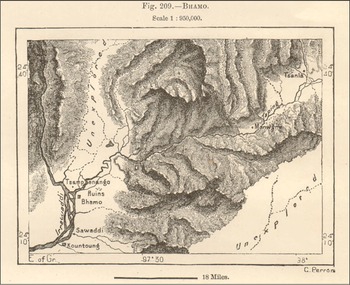
Timeless ruins and unexplored areas. Map of Bhamo by Charles Perron, published by Élisée Reclus in 1885 in The Universal Geography (Vol. 8. Translated by A.H. Keane. London: J.S. Virtue & Co Ltd, fig. 209, p.446), situated on the upper Irrawaddy River, today in Kachin State, northern Myanmar. It includes the ruins of Sampanago, dating back to the fifth century CE, which became the capital city of the ancient Shan outlier kingdom of Wanmaw.

Mapping flows and crossings. Extract of a 1761 map by John Rocque, engraved by Richard Parr, depicting Kingston upon Thames. CC BY-SA 4.0. https://en.wikipedia.org/wiki/File:Kingston_1761_Rocque.png.