


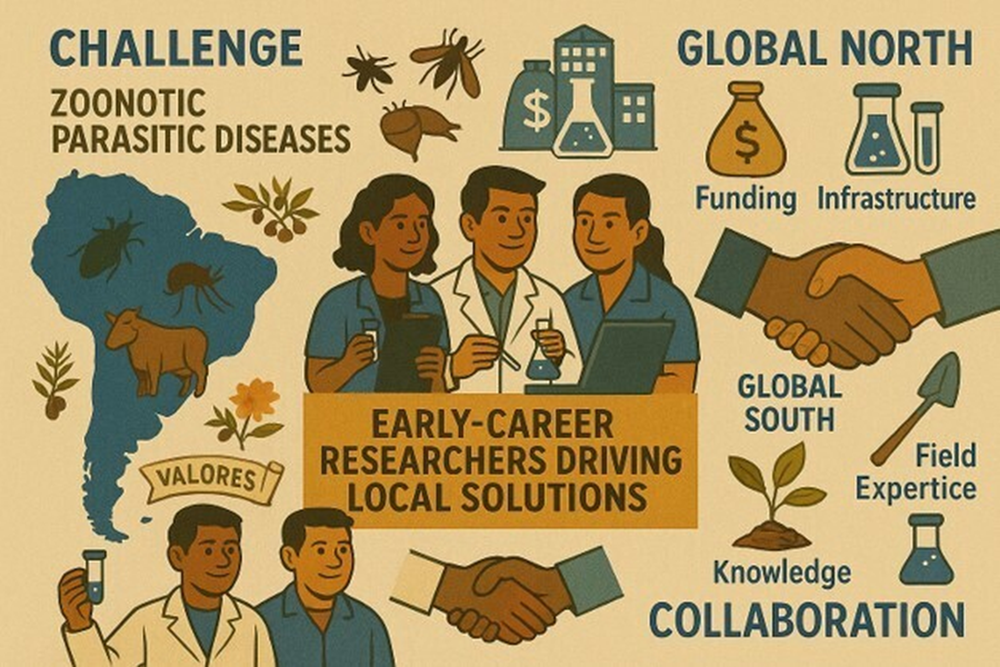



The enduring burden of zoonotic parasitic diseases in South America
Zoonotic parasitic diseases – those transmitted between animals and humans – pose a persistent and disproportionate health and economic burden across the Global South. More than 4 billion people worldwide are at risk of at least 1 parasitic infection, with the heaviest concentrations in regions marked by poverty, inadequate sanitation, unsafe water, weak healthcare systems and intense human–animal interaction (World Health Organization, 2012, 2023a). In South America, the burden of zoonotic parasitic diseases is both historical and evolving. Trypanosoma cruzi, the protozoan parasite that causes Chagas disease, remains endemic despite decades of control efforts (Cucunubá et al., Reference Cucunubá, Gutiérrez-Romero, Ramírez, Velásquez-Ortiz, Ceccarelli, Parra-Henao, Henao-Martínez, Rabinovich, Basáñez, Nouvellet and Abad-Franch2024). Plasmodium vivax, once considered to cause a mild malaria, continues to spread and cause significant morbidity and mortality across the Amazon basin (Russell et al., Reference Russell, Suwanarusk and Lek-Uthai2006). Similarly, Taenia solium–induced neurocysticercosis remains a leading cause of epilepsy in Andean communities of Ecuador (Cruz et al., Reference Cruz, Schantz, Cruz, Espinosa, Preux, Cruz, Benitez, Tsang, Fermoso and Dumas1999; Global Burden of Disease Collaborative Network, GBD, 2019; Centre for Disease Control and Prevention, CDC, 2022). New and emerging threats, such as zoonotic Plasmodium simium infections, are further challenging our understanding of parasite transmission and host dynamics (da Silva et al., Reference da Silva, Lourenço-de-oliveira, de Aguiar Barros, Brasil, Daniel-Ribeiro and de Fátima Ferreira da Cruz M2024).
Underreporting, limited access to diagnostics, environmental degradation, lack of sanitization, urbanization and political instability continue to undermine further achievements towards control and elimination of various neglected tropical diseases (NTDs) caused by parasites (Hotez et al., Reference Hotez, Bottazzi, Franco-Paredes, Ault and Periago2008; Recht et al. Reference Recht, Siqueira, Monteiro, Herrera, Herrera and Lacerda2017; Global Burden of Disease Collaborative Network, GBD, 2021). Soil-transmitted helminths (STH), schistosomiasis and toxoplasmosis persist across multiple South American nations – particularly Brazil, Bolivia and Colombia – where diagnostic capacity is limited and public health infrastructure remains underfunded (Pan American Health Organization, 2003, 2019; World Health Organization, 2012). It was estimated that in 2012 alone, nearly 50 million preschool and school-age children in Latin America and the Caribbean required treatment for STH (Servián et al., Reference Servián, Garimano and Santini2024). The burden of zoonotic parasitic infections is heaviest among children, rural populations and immunocompromised individuals (Torgerson and Macpherson, Reference Torgerson and Macpherson2011; Lv et al., Reference Lv, Chen, Cheng, Zhu, Chen, Zhou, Chen, Li, Deng, Guo, Li and Xu2024). In Bolivia, for example, Chagas disease affects 6.1% of the population, while Brazil faces an estimated 41.7 million STH cases and 1.5 million schistosomiasis cases, mostly concentrated in Minas Gerais and Bahia regions (Centre for Disease Control and Prevention, CDC, 2022; Pinazo et al., Reference Pinazo, Rojas-Cortez, Saravia, Garcia-Ruiloba, Ramos, Pinto Rocha, Ortiz, Castellon, Mendoza-Claure, Lozano, Torrico, Gascon and Platform2022; Silva et al., Reference Silva, Ferreira, Silva, Amorim, Domingues, Pinheiro, Bezerra, Heukelbach and AN2022). Other common parasitic zoonosis in the Global South include leishmaniasis (∼3.3 million disability-adjusted life years (DALYs)), toxoplasmosis (∼1 million DALYs) and cysticercosis (∼2.8 million DALYs) (Figure 1), where prevalences have been strongly associated with poverty, poor housing and co-endemicity in vulnerable areas (Hotez et al., Reference Hotez, Bottazzi, Franco-Paredes, Ault and Periago2008; Global Burden of Disease Collaborative Network, GBD, 2021; Dubey, Reference Dubey2021; Ta and Blond, Reference Ta and Blond2022; Dantas-Torres, Reference Dantas-Torres2024 ).
Qualitative burden of major zoonotic parasitic diseases in South America and global disability-adjusted life years (DALY) estimates (Torgerson and Macpherson, Reference Torgerson and Macpherson2011; Global Burden of Disease Collaborative Network, GBD, 2019; World Malaria Report (WHO, 2023a). Country-level burden scores derived from WHO soil-transmitted helminth (STH), schistosomiasis and Chagas disease profiles, and PAHO malaria/leishmaniasis surveillance.

Tackling this burden requires an integrated ‘One Health’ strategy that bridges human, animal and environmental health. Priorities include (1) Strengthening regional disease surveillance; (2) Expanding access to affordable and accurate diagnostics; (3) Supporting locally driven R&D efforts; and (4) Promoting health education at the community level. Moreover, long-term international funding and equitable research partnerships are essential to sustainably reduce the impact of these neglected diseases (UNESCO, 2015). Using such approaches, national control programmes and international collaboration have led to the elimination of onchocerciasis in the Americas and a 70% reduction in malaria and Chagas disease incidence in Latin American countries (Moncayo and Silveira, Reference Moncayo and Silveira2009; World Health Organization, 2024). In addition, Brazil, Colombia, Peru and Bolivia have significantly reduced malaria incidence in the last 20 years (Recht et al. Reference Recht, Siqueira, Monteiro, Herrera, Herrera and Lacerda2017). Brazil, for instance, has achieved an incredible 76.8% decrease in malaria cases between 2000 and 2014, which was accompanied by a reduced DALY rate from 42.5 in 1990 to 3.4 per 100,000 in 2017 (World Health Organization, 2023a). These are examples where investment in surveillance and health polices make control and elimination of NTDs attainable.
Building the future of parasitology: the role and challenges of early-career researchers in South America
The central role of early-career researchers
Early-career researchers (ECRs) – someone who is in the initial stages of their research career, i.e., 7–10 years of their last and highest degree, i.e., doctorate (Wellcome) – have an indispensable role in research and development of a country. They design and lead experiments, fieldwork and writing of articles, and often bring bold, interdisciplinary approaches to research fields such as parasitology (Krauss et al., Reference Krauss, Danús and Sales-Pardo2023). In South America, their work in developing new strategies for zoonotic diseases diagnostics, control, treatment and vaccine development is increasingly recognized as essential for both regional and global health. Additionally, their collaborations with international research teams provide valuable local insights into global parasitology research, an essential factor in studying parasites that cross borders and impact multiple regions. However, ECRs in South America face a distinct set of structural barriers that impede their permanence in science and impact. These challenges are summarized in Table 1, which outlines the most pressing systemic hurdles for ECRs working in the Global South.
Systemic challenges faced by South American ECRs

Sources: Docquier and Rapoport, Reference Docquier and Rapoport2012; SciDev.Net, 2021; OECD, 2017; Ciocca and Delgado, Reference Ciocca and Delgado2017; European Commission, 2021; Kwon, Reference Kwon2022; CAPES, 2023; FAPESP, 2024; National Institutes of Health, NIH, 2024.
This South American ECRs Special Issue in Zoonotic Diseases caused by Helminths and Protozoa was developed in response to the impact that zoonotic parasitic diseases have in the Global South and in the unique roles that local ECRs play to tackle them, especially when taking into account cultural and language barriers that are faced when working in such localities. Aware of the unique challenges researchers in this part of the world face in relation to funding, we aimed to support these ECRs by offering a platform to highlight their significant work. An Article Processing Charge (APC) charges waiver process was put in place by the publisher, Cambridge University Press & Assessment, to facilitate their publications in Parasitology, which is a gold open access journal. This Special Issue reunites 11 research papers that focus on some of the most important zoonotic parasitic diseases in the world, including malaria, leishmaniasis, toxoplasmosis and neurocysticercosis, and span from basic science including field epidemiology and diagnostics, to structural biology and vaccine development, showcasing not only scientific diversity but also the leadership emerging from within the region (Table 2).
List of the manuscripts included in this special issue

Funding inequities in NTD research
Globally, funding for NTDs research is limited. As part of the roadmap for 2021–2030, WHO estimates a need for USD 1.6 billion annually to meet elimination goals by 2030 (World Health Organization, 2020) and in 2023, during the Reaching the Last Mile Forum at the Conference of the Parties to the Convention (COP28) in Dubai, new endorsements to the Kigali Declaration mobilized USD 777 million towards NTDs elimination goals. Nevertheless, South America, home to more than 50 million people affected by NTDs, receives a disproportionately small share of global health R&D funding. In 2020, low- and middle-income countries (LMICs) received just 0.6% of noncommunicable disease grants, with similarly sparse NTD support (World Health Organization, 2023b). Brazil alone has invested over USD 230 million in NTD research from 2004 to 2020, but political-economic instability has affected significantly funding towards NTDs and overall research in the country (Melo et al., Reference Melo, Angulo-Tuesta, Silva, Santos, Uchimura and Obara2023). A data report available at G-FINDER data portal reveals a 6% decrease in NTDs global funding in 2020 in relation to 2019, a trend that is evidently continuing up to 2023 (DNDi, 2022). Unfortunately, the future does not look promising as the recent US federal budget proposals include a 40% cut to the National Institutes of Health (NIH) and calls for the elimination of the Fogarty International Centre, which plays a key role in building research capacity in LMICs (ASTMH, 2025). These cuts have already led to the suspension of new NIH grants to international partners, and halted programmes such as the USAID Malaria Vaccine Development initiative, potentially reversing hard-won gains in parasitic disease control and vaccine innovation (Dyer, Reference Dyer2025; Science Business, 2025; The Guardian, 2025). Major academic institutions have reported staffing reductions and project losses, highlighting the cascading effects of such funding decisions on global health equity and research advancement (Washington Post, 2025).
Despite the various constraints, South America contributes ∼4–5% of global scientific output (Table 3), led by Brazil (65% of regional production) (UNESCO, 2015; SCImago, 2023). Compared to Asia (∼33%), North America (∼25%) and Europe (∼35%), the region’s output highlights significant scientific contributions coming from the region. Importantly, it is expected that a great proportion of these publications (funding, work and or writing) are led by ECRs and by addressing the structural challenges faced by them these outputs can be improved. This requires not only recognition but also coordinated, long-term investment. In Table 4, the actionable priorities to build a more sustainable, equitable research ecosystem for parasitology in South America are outlined.

A call for action: building a sustainable research ecosystem in South America

Sources: Nakamura et al., Reference Nakamura, Soares, Pillar, Diniz-Filho and Duarte2023; Else, Reference Else2025.
Equitable collaboration as a catalyst for innovation
To offset structural limitations, international collaboration is not merely helpful but essential. North–South partnerships provide infrastructure, training and co-authorship opportunities, while South–South collaborations leverage shared disease burdens and cultural proximity (Sakurai, Reference Sakurai2015; McManus et al., Reference McManus, Neves, Finan, Pimentel, Pimentel and Schleicher2024) (Figure 2). Several international research consortia have demonstrated the transformative potential of equitable collaboration in South America. The NIH Fogarty Global Infectious Disease Program has built sustainable research capacity in Bolivia and Peru by training ECRs and strengthening local surveillance systems (Clark et al., Reference Clark, Verastegui, Tinajeros, Calderon, Colanzi and Gilman2020). DNDi-led consortia, working with partners like GlaxoSmithKline and the University of Dundee-UK, have advanced affordable treatments for Chagas disease and leishmaniasis, including paediatric and oral therapies (Drugs for Neglected Diseases Initiative, 2018). Similarly, the CONICET–GCRF network between Argentina and the UK has enhanced helminth drug discovery through joint research and capacity building (DevTracker summary, 2025). These initiatives, which hopefully will continue to exist, underscore how international partnerships grounded in shared leadership and mutual benefit can amplify regional expertise, drive innovation and deliver tangible public health outcomes. To be effective, such partnerships must engage local scientists, communities and policy stakeholders throughout the research life cycle. This ensures relevance, builds capacity and reinforces research sovereignty (Rodrigues, Reference Rodrigues2021).
Symbiosis of collaboration. Illustrates mutual contributions of Global North (technology, funds) and South (samples, fieldwork, endemic expertise).

Conclusion: towards an inclusive and equitable future in Parasitology
The research presented in this Special Issue exemplifies the resilience, creativity and scientific rigor of the Global South, particularly among ECRs. These studies collectively underscore that global health security hinges on inclusive, equitable and locally anchored research. In an era marked by zoonotic spillover, climate change and antimicrobial resistance, empowering ECRs in endemic regions is not merely a moral imperative but a strategic necessity. As the guest editor, I am proud to highlight the achievements of South American ECRs who, despite limited resources, are advancing parasitological science through innovation, determination and cross-disciplinary approaches. Their work speaks not only to personal commitment but also to a broader regional resilience that merits stronger institutional recognition and structural support. I invite readers to explore the contributions in this issue, connect with the authors and build collaborative networks that reflect the full scope of parasitology’s global diversity. By fostering more equitable research ecosystems, we can help ensure that the future of zoonotic disease research is as dynamic and inclusive as the environments and communities it aims to serve.
Data availability statement
Data supporting the findings of this manuscript are available in the cited bibliography.
Acknowledgements
I would like to thank all the authors of the manuscripts that contributed to this Special Issue and Cambridge University Press & Assessment Parasitology for the support throughout the process.
Financial support
CDMV is funded by Research Ireland (IRCLA/2022/3748).
Competing interests
None.
Ethical standards
Not applicable.


 Open access

