

In the last 10 years, most regions of Albania have been systematically explored by local and foreign teams under the aegis of the Institute of Archaeology in Tirana, successively led by Luan Përzhita (2013–2021), Belisa Muka (2021–2023), and Adem Bunguri (2024–present), and the Albanian Ministry of Economy, Culture and Innovation (former Ministry of Culture), the ultimate licencing agency for foreign collaborative projects. The Institute of Archaeology, founded in 1984 as an autonomous associate of the Academy of Sciences, was reformed in 2008 to become part of a new scientific centre/academy of Albanian studies, together with former institutes of history, ethnology, and popular culture. In 2024, it once again became part of the Academy of Sciences and continues its mission of encouraging and supporting archaeological research in the country. Its annual reports on archaeological research, excavations, and museum studies are regularly published in the periodicals Iliria and Candavia, covering prehistory to the Middle Ages. In addition, international scholarly meetings on Albanian archaeology have intensified and fostered discourse and collaboration among researchers (Tagliamonte Reference Tagliamonte2014; Përzhita et al. Reference Përzhita, Gjipali, Hoxha and Muka2014; Reference Përzhita, Gjipali, Hoxha and Muka2017; Lepore Reference Lepore2016; Lamboley, Përzhita and Skënderaj Reference Lamboley, Përzhita and Skënderaj2018). Albanian archaeological finds were also recently displayed in the exhibition ‘First kings of Europe’, held at the Field Museum of Chicago (https://www.fieldmuseum.org/first-kings-europe): 17 objects – bronze daggers, carnelian beads, terracotta figurines, swords, pendants, fibulae, helmets, two-handled drinking vessels (kantharoi) – from the tumuli of Shtoj, Mati, Çinamak, and Rehova, dated from about 4500 to 2400 BC (Gyucha and Parkinson Reference Gyucha and Parkinson2023).
New thematic publications, often focusing on specific aspects of the ancient culture of Albania, have revealed the wealth of archaeological material stemming from the region while offering the potential for a new appreciation of the local archaeology and history within a wider Mediterranean background. These cover the study of fortifications (Caliò, Gerogiannis and Kopsacheili Reference Caliò, Gerogiannis and Kopsacheili2020; Gerogiannis Reference Gerogiannis2021; Reference Gerogiannis2022), funerary practices (Lepore and Muka Reference Lepore and Muka2020), religion (De Maria and Mancini Reference De Maria and Mancini2018; Mancini Reference Mancini2022), architecture (Podini Reference Podini2014; Rinaldi Reference Rinaldi2020; Reference Rinaldi2021), Illyrian cities (Ceka Reference Ceka2020), and specific chronological phases – Roman (Shpuza Reference Shpuza2021); prehistory (Prendi and Bunguri Reference Prendi and Bunguri2018; Bodinaku Reference Bodinaku2019; Ruka Reference Ruka2023); early Christianity (Hoxha Reference Hoxha2021); Medieval monuments (Hoxha Reference Hoxha2023); and zones (Çipa Reference Çipa2016), or material culture, including Latin amphora seals (Lahi Reference Lahi2019). Since 2021, a new periodical, Revista Arkeologjike (RA), has been published by the Archaeological Directorate at the National Institute of Cultural Heritage, Ministry of Economy, Culture and Innovation. RA contains reports and studies of archaeological processes within the framework of preventive and rescue archaeology (surveys, excavations) and showcases the interventions of protection and preservation of cultural heritage taking place in the field.
This article, the first to appear in AR after Ols Lafe’s report of 2004–2005, aims to give an overview of the past 10 years of archaeological work in Albania organized by region from north to south (Map 7.1). It does not contain a comprehensive list of all finds and previous scholarship.
1. Shkodra; 2. Bushat; 3. Drivastum/Drisht; 4. Lezha; 5. Komani-Sarda; 6. Epidamnos/Dyrrachium; 7. The Artemision of Epidamnos-Dyrrhachium; 8. Zgërdhesh; 9. Apollonia of Illyria; 10. Byllis; 11. Lofkënd; 12. Dimal; 13. Sovjan; 14. Pogradec; 15. Orikos; 16. Himara; 17. Borsh; 18. Amantia; 19. Phoinike; 20. Butrint; 21. Dobra; 22. Çuka e Ajtoit; 23. Hadrianopolis; 24. Antigonea.

Shkodra county
Shkodra
Urban excavations in the modern city revealed important features of the topography and chronology of the ancient settlement over the longue durée (Dyczek and Shpuza Reference Dyczek and Shpuza2020). Parts of the so-called Cyclopean fortifications were identified in the upper city and dated to the late fourth or early third century BC, while the limited evidence preserved in the lower city points to a later date, with phases dating to the times of Constantine and Justinian. Extensive geophysical surveys also contributed to gradually uncovering the plan of the Hellenistic and Roman town. Roman structures, such as a first-century AD luxury house, richly decorated with coloured marble, wall paintings, and stucco, and heated by a hypocaust system, has been excavated. Roman necropoleis and inscribed funerary stelai have come to light in several locations (Dyczek Reference Dyczek2022). Important new data has also been collected for the Medieval and Ottoman history of the city. The city seems to have been much more than just a fortress, judging by the rich repertoire of table ware, luxury Venetian and later also Ottoman vessels. Finds from the seventeenth to eighteenth century include a hammam, Turkish houses, and an apothecary’s shop (Dyczek and Shpuza Reference Dyczek and Shpuza2014).
PASH
The PASH archaeological project (Projekti Arkeologjik i Shkodrës) combined intensive regional survey, systematic site-surface collection, targeted excavations, and environmental and material analysis in order to explore settlement patterns and interactions in and around the Shkodra plain, mainly in the prehistoric periods. Data were collected with the aim of understanding when, why, and from where social inequality and associated institutions came about and developed. This would ultimately clarify whether the transition from small and undefended Neolithic villages to the nucleated hillfort settlements of the Early Bronze Age, with mound burials and social ranking, had a role in the later formation of the well-known Illyrian tribes in the final Iron Age. Test excavations showed that the earliest permanent settlements in the area dated to the Late Neolithic, sometime after 5000 BC, and showed substantial Eneolithic phases (4500–3100 BC). On the other hand, settlement nucleation appeared to have occurred well before the late Early Bronze Age, with hillfort construction reaching its zenith during the Late Bronze Age and Iron Age. Therefore, a co-evolution of hillforts and social organization (with tumulus burials), which accelerated in the Late Bronze Age, fits the data better than the often-postulated import of social hierarchies from the outside (i.e. the Aegean), based on the presence of Mycenaean weapons and pottery in Middle Bronze Age and Late Bronze Age tumuli.
GIS analysis indicates that hillforts typically possessed clear lines of sight with each other and therefore may have operated collectively, as members of a settlement/defensive system, to allow communication and to monitor movement in and out of the mountains. The mortuary landscape similarly worked to integrate hillfort communities rather than separate them.
Transformative changes occurred in the region in the Early Iron Age, with the appearance of several new settlements and the construction of larger, complex sites. Early Iron Age graves were for the first time filled with grave goods, often weapons, marking a dramatic shift towards social hierarchy. The settlement system remained basically unchanged throughout the Iron Age, but the tumulus burial tradition was abandoned by the fifth century BC. Surprisingly, chemical and petrographic analysis of clays and pottery from hillforts and tumuli showed that there was almost no evidence for the acquisition of non-local pottery during prehistory and until the developed Iron Age. In this period, material culture testifies frequent contacts with the Greek world (Archaic and Classical pottery). A real settlement contraction appears in the third century BC, although the number of sites with Hellenistic pottery increased. This hiatus directly postdates the emergence of the first Illyrian kingdom, suggesting changes in the Illyrian socio-political organization (Galaty and Bejko Reference Galaty and Bejko2023).
Bushat
An Illyrian town, founded between the end of the fourth and beginning of the third centuries BC, at a time when the neighbouring urban centres at Shkodra and Lissos were thriving, was identified in recent years near the modern village of Bushat. Fieldwork and targeted excavations revealed the general triangular layout of its fortification circuit with gates and towers (Fig. 7.1), and, on the highest part of the hilltop, a stone platform, where Corinthian-type tiles suggest the presence of a significant building (Lemke, Shpuza and Wojciechowski Reference Lemke, Shpuza and Wojciechowski2021). A further rectangular structure, situated outside the walls at the foothills, and identified in the early 1990s as a Hellenistic fountain, has been recently re-examined and interpreted as a threshing floor. It consists of a flat surface, made of flagstones, with surrounding walls to prevent loose earth and small stones from mixing with the grain. It seems to have been in use from the end of the fourth to the first century BC. The permanent role of the structure, as well as its area of ca. 84 square metres, attests to the importance of agriculture in the town’s economy (Shpuza Reference Shpuza2019).
Bushat, aerial photo of the city gate protected by a tower. © M. Lemke/Albanian-Polish project at Bushat.

Drivastum/Drisht
Drisht, ancient Drivastum, is located northeast of the city of Shkodra, in the region of Postriba. The current remains consist of a Medieval citadel within a larger fortification circuit where numerous buildings, including churches, have been located, with finds from the thirteenth to the eighteenth centuries (Pushimaj Reference Pushimaj2016; Pushimaj Reference Pushimaj2019a). Recent archaeological research in the wider area of the Muzhila hill, west of the citadel, also attests to the continuity of use of the settlement from Late Antiquity to the Medieval period (Pushimaj Reference Pushimaj2018b). As a Medieval city, Drisht was engaged in an important trade system connecting several other centres, such as Venice, from the thirteenth to the sixteenth centuries (Pushimaj Reference Pushimaj2018a; Pushimaj Reference Pushimaj2019b).
The lower Drin valley: Lezha, Komani-Sarda
The study of the border region between the eastern and western Roman empires is the subject of a French–Albanian archaeological research programme based in southern Illyricum and focused on the dynamics of the forming and functioning of Medieval societies in the Balkan-Mediterranean world. The objective is to use an archaeological and anthropological approach (Nallbani Reference Nallbani2021) in order to analyse population (Nallbani and Gallien Reference Nallbani, Gallien, de Vingo, Marano and Pinar Gil2021; Nallbani et al. Reference Nallbani, Bonfand, Desideri and Metalla2023) and forms of settlement, production, and exchanges (Neri and Nallbani Reference Neri and Nallbani2021). The research focuses on the neighbouring sites of the lower Drin valley, Lezha on the coast (Gallien et al. Reference Gallien, Julien, Tota, Langlois, Gjuraj and Nallbani2014; Reference Gallien, Buchet, Julien, Metalla and Nallbani2016), and Komani (Nallbani et al. Reference Nallbani, Bonfand, Vatteoni and Metalla2019b) with the island fortress of Sarda (Shpuza and Nallbani Reference Shpuza and Nallbani2022) inland along the Drin.
At Lezha, excavations in and around the citadel have highlighted the use of the area as a funerary space associated with a settlement located beneath the later Medieval castle (Gallien et al. Reference Gallien, Julien, Tota, Langlois, Gjuraj and Nallbani2014; Reference Gallien, Buchet, Julien, Metalla and Nallbani2016). This extensive necropolis was used from the sixth to the eighth century AD, and perhaps even before, given the presence of some cremation burials. Two funerary churches were uncovered. One of the churches, containing high-status burials of the eighth to ninth centuries, was later enlarged and remained in use into the twelfth century. A second, smaller chapel held twelfth-century graves, although it was seemingly abandoned shortly thereafter.
At Komani, high above the course of the Black Drin River, work has centred on the Kodra Kalasë, where several churches, including an ‘episcopal zone’, were found to be connected with the extensive, early Medieval cemeteries known from earlier excavations (Nallbani, Gallien and Sokoli, Reference Nallbani, Gallien and Sokoli2019; Nallbani et al. Reference Nallbani, Bonfand, Desideri and Metalla2019a; Reference Nallbani, Bonfand, Vatteoni and Metalla2019b; Reference Nallbani, Bonfand, Desideri and Metalla2020a; Reference Nallbani, Bonfand, Desideri and Metalla2020b). A number of eighth– to tenth-century burials were identified, while the principal church building was probably modified within the twelfth to thirteenth centuries.
Lissus Naissus Road
Archaeological research on the fortification system controlling the road along the river Drin confirmed the existence of at least 51 forts datable between the fourth and the sixth century AD. Of these, 22 were built in the Black Drin basin, 19 in the White Drin, and 10 in the bifurcation of the two (Përzhita Reference Përzhita2023). They marked a route of paramount importance for the circulation of goods and cultures from the Adriatic coast to the Central Balkans.
Dürres county
Epidamnos/Dyrrachium
Dürres, ancient Epidamnos/Dyrrachium, was and is still Albania’s principal seaport. In the last decade, major urban excavations have clarified the topography and urban grid of the ancient city in relation to the main known buildings such as the Roman amphitheatre, the late Roman/Byzantine macellum (market place), and the late Classical lighthouse (Santoro and Moderato Reference Santoro, Moderato and Mastrocinque2017; Antonelli et al. Reference Antonelli, Metalla, Casolino, Moderato and Pallota2020), while geo-prospective techniques combined with analysis of archival data has further enhanced our understanding of monuments that are unlikely to be excavated in such a built-up urban environment (Malfitana et al. Reference Malfitana, Leucci, Fragalá, Masini, Scardozzi, Cacciaguerra, Santagati and Shehi2015). Targeted excavations uncovered several blocks of the ancient city with a sequence beginning in the fifth or fourth century BC (Frashëri Reference Frashëri2015), and significant structures of the Roman and later periods, with meticulously published pottery finds from the third/fourth to the seventh century AD (Shkodra-Rrugia Reference Shkodra-Rrugia2019; Reference Shkodra-Rrugia2021). Investigations at the harbour have also revealed the extent of Roman Imperial intervention, with the discovery of a large arched building (Beste et al. Reference Beste, Haensch, von Hesberg, Shehi and Tartari2015), and much of the later Medieval and Ottoman chronology (Shehi Reference Shehi2022). The extensive cemeteries have also received further attention (Përzhita and Zoto Reference Përzhita and Zoto2022). The growth of the city has made the exploration of the hinterland a great priority, as a new deep-water port was created by the Roman fortification at Porto Romano, and ribbon development occurred to the east and south (Forsén et al. Reference Forsén, Shkodra-Rrugia, Korhonen, Shehi, Ruka and Tikkala2018).
The Artemision of Epidamnos-Dyrrhachium
Since 2014 an Albanian–French team (University of Lille and EfA) has been engaged in the preparation of the publication of a large votive deposit dating from the Archaic to the Hellenistic periods, discovered in the hills northwest of the modern city of Dürres (Albania) in 1970. This consists of about 1.8 tonnes of figurative terracotta fragments with a majority of protomai (heads, probably the largest find of this kind in the Mediterranean world), about four tonnes of ceramic sherds, and more than 600 bronze coins, as well as some fragments of stone sculptures and bronze objects (Muller et al. Reference Muller, Tartari, Dufeu-Muller, Gjongecaj, Huysecom-Haxhi, Muka, Shehi, Tichit and Toçi2012; Muka, Muller and Tartari Reference Muka, Muller and Tartari2014). The project contributed to the identification of the sanctuary it belonged to as one of the very few Artemisia found in southern Illyria, on the basis of the terracotta iconography, votive inscriptions, and textual data. The repertoire of terracotta figurines is, in fact, dominated by feminine protomai and representations of Artemis. The ceramics similarly confirm the presence of painted or incised dedications to the goddess on vases, while others are engraved on stone or punched on bronze aspidiskoi (discs). It is likely that the Artemision is to be identified with the ‘Artemision near the city gates’ mentioned by Appian (II 60) in connection with an attack by Caesar against Dyrrhachium in 48 BC (Muka and Muller Reference Muka and Muller2021).
Zgërdhesh
The city of Zgërdhesh is one of the fortified settlements of strategic importance located in the hinterland of Dyrrachium (Maurer and Metalla Reference Maurer and Metalla2018; Reference Maurer and Metalla2021). Recent archaeological research has concentrated on the fortification system, where the south gate, and the area of the diateichisma, the transverse wall located on the way to the acropolis, were investigated. The latter revealed a very rich stratigraphy dating from the Hellenistic to the Medieval period, when a church was built on site. New important graves, explored in the necropolis area west of the entrance of the city, mostly belong to the already known late Roman cemetery and can be dated to the third and fourth centuries AD (Veseli Reference Veseli2017; Maurer, Metalla and Tota Reference Maurer, Metalla and Tota2020; Maurer and Metalla Reference Maurer and Metalla2022).
Fier county
Apollonia of Illyria
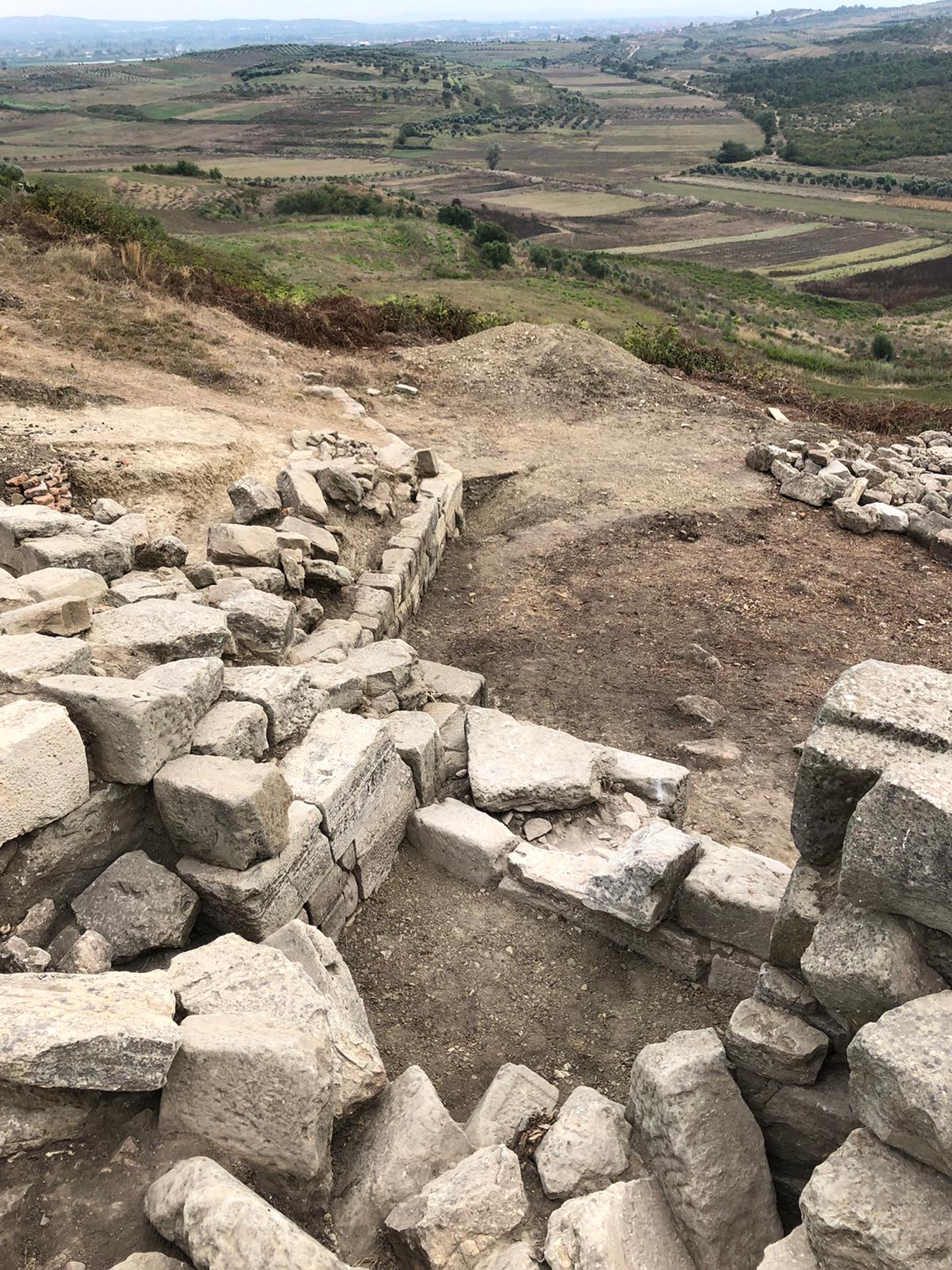
Apollonia was, and remains, one of the most explored archaeological sites in Albania. Several programmes have been undertaken with the aim to explore both the urban development and individual monuments of the site. Recent explorations include the continuation and extension of the excavations at the northeast gate (Fig. 7.2), a crucial articulation in the urban fabric (Muka and Verger Reference Muka and Verger2020), the study of the fortifications and defence system (Genis Reference Genis2020; Genis and Huille Reference Genis and Huille2021), the identification of areas used for crafts, the relation between public and private spaces, and the creation of reliable sequences of finds – Roman pottery, in particular (Barrière Reference Barrière2022). The study of individual monuments focused, in particular, on the theatre and the temple at Shtyllas. The reconstruction and history of the theatre (Von Hesberg Reference von Hesberg2014; Franz and Hinz Reference Franz and Hinz2014; Reference Franz and Hinz2015; Von Hesberg et al. Reference von Hesberg, Fiedler and Toçiet2018a; Reference von Hesberg, Lahi, Fiedler, Shkodra-Rrugia, Shehi and Döhner2018b) raised questions regarding the way the colony of Apollonia was founded and expanded, and its relation to the small late Archaic settlement at Babunja – probably ancient Arnisa – in the proximity of Apollonia (Fiedler, Döhner and Pánczél Reference Fiedler, Döhner and Pánczél2018; Döhner and Fiedler Reference Döhner and Fiedler2019; Fiedler et al. Reference Fiedler, Shehi, Pánczél and Döhner2019; Reference Fiedler, Lahi, Shehi, Pánczél, Velo and Döhner2021). The recent publication of the excavations undertaken in 2004–2006 at the Bonjakët site, in the plain west of the city, at a short distance from the modern village of Pojani, shed light on the extra-urban sanctuary at Bonjakët. Here, traces of religious activity from the Archaic period onwards – although the site takes its monumental form in the late Classical period – suggest the existence of a cult practiced already in the earliest days of the colony (Davis et al. Reference Davis, Pojani, Stocker and Dimo2022).
Apollonia excavations of the northeast gate. © Albanian–French project at Apollonia of Illyria.
Finally, the exploitation and use of bitumen in and around Apollonia, especially in connection with the perpetual flame associated to the Nymphaion and oracle of the city (Quantin Reference Quantin2016), was the object of targeted research combining historical, archaeological, and environmental data (Bernard-Mongin et al. Reference Bernard-Mongin, Clayer, de Rapper, Hoareau, Lenhardt, Lerin, Nallbani, Osswald, Puto, Quantin and Shpuza2019) with chemical analysis (Morris Reference Morris2014).
Byllis
Byllis is a well-preserved hilltop settlement, later Augustan colony and Justinianic fort, inhabited from the fourth century BC to the sixth century AD. Recent publications of earlier research present a review of the excavations of the Hellenistic and Roman ‘Prytaneion’ (Ceka Reference Ceka2018), the survey of the Hellenistic, Roman, and Late Antique phases of the city walls, and the history of some of its numerous basilicas (Muçaj et al. Reference Muçaj, Sodini, Chevalier and Raynaud2019). In this latter phase, ascribed to the architect of Justinian and dated to the early 550s, are flanking towers containing spolia from Hellenistic buildings, notably from the theatre and the stoa, and a smaller circuit suggesting a significant reduction of the town to approximately one-third of the original size. From the end of the fourth/beginning of the fifth century AD, at least two basilicas (A and C) were built in the old civic centre, and one (D) outside the north wall of the Late Antique fortifications. All were furnished with mosaic floors and inscriptions. In the later sixth century, the settlement was abandoned (Muçaj et al. Reference Muçaj, Sodini, Chevalier and Raynaud2019).
Lofkënd
The Lofkënd tumulus is one of the first tumuli systematically excavated in Albania (Fig. 7.3). Teardrop in shape, and erected in a highly prominent position, its construction mirrors that of many similar burial mounds known from elsewhere in Albania. The main earthen fill contained numerous fragments of daub and struck flakes, presumably brought from the settlement served by the tumulus. By 2005, some 61 burials had been excavated, the earliest dating from the tenth to the eighth centuries BC. The bodies were accompanied by grave goods, pottery vessels, and jewellery. The tumulus was reused at a much later date, in the seventeenth or eighteenth century AD, when further graves were inserted. Although the tumulus was completely excavated during the course of the project, its form was reconstituted in the landscape using the project’s land survey as a model (Papadopoulos et al. Reference Papadopoulos, Morris, Bejko and Schaepartz2014).
The excavated tumulus at Lofkënd. © John Papadopoulos/Cotsen Institute, UCLA.

Dimal
The Illyrian hilltop settlement at Dimal (Dimallon) is located in the region of Apollonia, about 30km inland from the Adriatic coast. The earliest human activity in the settlement dates back to the Iron Age. The city flourished between the fourth and the first centuries BC, possibly due to its strategic location, on the mountains overlooking the plain of Myzeqe, through which the branch of the Via Egnatia coming from Apollonia passed and continued to the south. Recent excavations shed light on two main urban phases: in the fourth/third centuries BC, the settlement was mostly contained within a heavily fortified acropolis; after the Roman annexation of 205 BC, the city expanded substantially, with a larger fortification circuit and the addition of several public buildings. The site was abandoned after a violent destruction towards the end of the first century BC, and only partially resettled in the fifth/sixth centuries AD. Archaeological excavations undertaken in different sectors intra muros, brought to light important public monuments (Heinzelmann and Muka Reference Heinzelmann and Muka2014), while extra-urban investigations revealed the presence of two different funerary areas (Muka and Heinzelmann Reference Muka and Heinzelmann2014; Reference Muka and Heinzelmann2016; Heinzelmann and Muka Reference Heinzelmann and Muka2015; Muka, Heinzelmann and Schröeder Reference Muka, Henzelmann and Schröeder2020).
Korça county
The southeastern corner of Albania continues to be a centre of prehistoric research, especially since the pioneering work of Frano Prendi and his colleagues at Maliq (Prendi and Bunguri Reference Prendi and Bunguri2018). The recent, though largely unpublished, finds of the lakeside settlements at Lin and Dunavec seems set to continue this trend. The core of the project is the execution and evaluation of underwater archaeological excavations, among others, in the sites Ploča, Mičov Grad in Northern Macedonia and Lin 3, in Albania (Fig. 7.4) at Lake Ohrid (https://exploproject.org/publications/).
The excavation of the prehistoric lake shore village of Lin 3 on Lake Ochrid. © Albanian–Swiss project Lin 3/Krist Anastasi.

The long running French–Albanian collaboration in the Korça area has focused on excavations and surveys covering several periods, from the Neolithic to the Iron Age, from new data on absolute chronology of the prehistory of Albania (Oberweiler, Touchais and Lera Reference Oberweiler, Touchais and Lera2014; Reference Oberweiler, Touchais and Lera2018), to the dynamics of settlement formation from prehistory to the Medieval period (Oberweiler, Touchais and Lera Reference Oberweiler, Touchais and Lera2019). The main activities comprise the excavations of the lacustrine sites of Sovjan (see below) and Kallamas in Prespa Lake (Lera, Touchais and Oberweiler Reference Lera, Touchais and Oberweiler2018; Oberweiler et al. Reference Oberweiler, Lera, Kurti, Touchais, Aslaksen, Blein, Elezi, Gori, Krapf, Maniatis and Wagner2020), as well as the archaeological survey on the hill altitude sites around Korça basin (Kurti and Oberweiler Reference Kurti and Oberweiler2020; Reference Kurti and Oberweiler2022) and the very recent excavations at Barçi (Kurti and Gardesein Reference Kurti and Gardesein2023).
Sovjan
The publication of the prehistoric lake-dwelling settlement at Sovjan (Maczkowski et al. Reference Maczkowski, Bolliger, Ballmer, Gori, Lera, Oberweiler, Szidat, Touchais and Hafner2021; Touchais, Lera and Oberweiler Reference Touchais, Lera and Oberweiler2024) marks 30 years of interdisciplinary scientific research that combines paleoenvironmental approaches with archaeological excavation and intensive field surveys. Several phases of human activity are documented at Sovjan – a sequence that covers nearly six millennia, from the Neolithic period to the first centuries of the Iron Age (Gori and Krapf Reference Gori and Krapf2015). This study demonstrates that the region had an ecosystem very favourable to the sedentarization of human communities, and has allowed for dating of such developments several centuries earlier than previously believed, to the beginning of the seventh millennium.
Pogradec
The Early Neolithic settlement at Vlusha, near Pogradec on Lake Ochrid, has been sampled in a couple of excavation seasons. The sequence was buried below substantial deposits of silt, a result of the changing shoreline of the lake. Two buildings of Early Neolithic date were investigated. A small structure, identified by the floor layer and post holes, overlays an earlier, much larger building which had been destroyed by fire (Andoni, Hasa and Gjipali Reference Andoni, Hasa and Gjipali2017; Andoni Reference Andoni2020).
Vlore county
Orikos
Yearly excavations and survey campaigns at Orikos, a city founded by the Euboeans around the mid-eighth century BC according to the literary tradition, demonstrated that the site was not occupied before the sixth century BC, and its main phases are Hellenistic, Late Roman, and Early Medieval (Shpuza and Çipa Reference Shpuza and Çipa2020). Hellenistic Orikos was a small city with a monumental centre consisting of an unusual theatre, built against the city walls and without stage building, connected to a possible agora south of it (Terrier, Shpuza and Consagra Reference Terrier, Shpuza and Consagra2021). To the late Hellenistic period dates another unusual building with square plan, no walls but 12 columns supporting a roof, defined as a monopteros by the excavators (Shpuza Reference Shpuza2014). Most of the monumental centre was abandoned following the civil wars in the later first century BC (Shpuza Reference Shpuza2021). Targeted research on the fortification walls and on the housing blocks adjacent to the theatre area showed that successive phases of habitation and rebuilding can be dated to the sixth century (with a destructive event in the eighth), and to the Early Middle Ages. The large ecclesiastical complex excavated on the top of the acropolis seems to follow a similar chronology (Terrier, Shpuza and Consagra Reference Terrier, Shpuza and Consagra2019; Reference Terrier, Shpuza and Consagra2020).
Amantia
Excavations at the fortified city of Amantia, known for its Hellenistic stadium and possible temple of Aphrodite, concentrated in the northeastern necropolis of the site and started as a rescue effort. A sizeable built-up tumulus with associated cist graves (Buzo Reference Buzo2017), in addition to the structural remains of a number of other tombs (Hobdari and Buzo Reference Hobdari and Buzo2018a; Reference Hobdari, Buzo, Lamboley, Përzhita and Skënderaj2018b), some of which monumental and barrel-vaulted (Buzo and Hobdari Reference Buzo and Hobdari2016), were found and date from the fourth to the first century BC period. They document both funerary rituals of inhumation and incineration and present funerary assemblages comparable to those recently published from the necropoleis of Phoinike. Further surveys and documentation campaigns also revealed the existence of a rock-cut sanctuary high-up on the hill (Buzo and Hobdari Reference Buzo and Hobdari2016).
Himara
A study of the fortification circuit of ancient Himara, located at the modern site of the same name, and of the architectural fragments reused and incorporated inside and outside the walls brought about a review of the dating evidence, and the attribution to the Hellenistic period of features traditionally interpreted as belonging to the Medieval castle (Çipa Reference Çipa2017). The site of a necropolis was also identified north of the modern village and subject to rescue excavations, after it had been damaged and looted by clandestine activities. A tumulus and several cist graves were discovered. Dated between the end of the Bronze Age and the beginning of the Iron Age, this discovery is of particular interest as it is the first necropolis of this kind and age identified along the Ionian coast (Çipa Reference Çipa2020).
Borsh tower
Stratigraphical investigations and surveys at the site of the ancient town of Borsh show that the hill began to be frequented and fortified in the Late Bronze Age, to be later re-fortified and expanded on the hillsides during the Hellenistic period. Habitation was organized in terraces that followed the contours of the hill (Çipa Reference Çipa2018). A necropolis and an isolated fortified building, believed to have had primarily residential function, were also explored (Çipa Reference Çipa2022).
Gjirokaster county
Hadrianopolis and the Drino valley
Recent excavations and surveys demonstrated that the site where Roman Hadrianopolis would be found acted as community/commercial hub for the valley of the Drino and its settlements from at least the beginning of the second century, when it replaced a pre-existing system of small, fortified villages placed on mid-slope, such as Jergucat, Paleospiti di Frashtan, Terihat, Libohova, etc. (Perna Reference Perna2022). Excavations further revealed the traces of a later Roman vicus, already monumentalized in the Flavian period, that developed in the Hadrianic period as a city with a large public area where, in addition to the known theatre, baths and other civic buildings were constructed (Perna Reference Perna2016). The city prospered until the fourth century, when a phenomenon of disaggregation and de-functionalization of urban spaces was accompanied by a reduction in the number and variety of ceramic imports. By the sixth century, the site was abandoned (Perna and Sforzini Reference Perna and Sforzini2018). Magnetic and GPR surveys beyond the main excavated centre revealed the existence of structures organized along two main different patterns, possibly due to the superposition of Roman buildings and Late Antiquity structures (Schettino et al. Reference Schettino, Pierantoni, Ghezzi, Tassi, Perna and Sforzini2017).
Antigonea
The Hellenistic city of Antigonea, the layout of which is known from previous Albanian and Greek excavations (Çondi Reference Çondi2017b), was the object of a high-resolution magnetic survey that supported the possibility that the theatre of the city is buried beneath the eastern slope along the southern side of the Jermë hill (Perna et al. Reference Perna, Schettino, Çondi, Pierantoni and Ghezzi2016). Excavations resumed in 2021 and concentrated in the agora of the city, with its surrounding buildings. They confirmed a date for the foundation of the city in the third century BC and the identification of the agora as a terraced, panoramic space surrounded by shops and public buildings (Perna and Veseli Reference Perna and Veseli2022).
Saranda county
Phoinike
The excavations carried out in Phoinike in the past 10 years focused on the western agora (nea agora), the eastern agora (archaia agora), and the southern necropolis. Epigraphic evidence indicating the urban character of the city from at least 360–330 BC (De Maria and Gjongecaj Reference De Maria and Gjongecaj2015) is paralleled by the discovery of various funerary structures of the middle of the fourth century BC, found in the southern necropolis, and characterized by the use of both inhumation and cremation (Lepore and Muka Reference Lepore and Muka2018). Recent archaeological finds confirm that the ‘great Phoinike’ described by Polybius (Hist. II 5.5; II 8.4; II 1–8) as a magnificently fortified and prosperous city should be dated to the third century BC (Gamberini 2016). It is, in fact, from the mid-third century BC that a new fortification circuit was constructed in order to defend the growing city, organized in terraces and provided with impressive public and private buildings (Lepore Reference Lepore2017). A theatre was built between the end of third and the beginning of the second century BC, and used until Roman times, having been substantially rebuilt in the early Imperial period. Its considerable size (maximum extension of the koilon (seating area): ca. 109m) makes it one of the largest theatres in Epirus (Villicich Reference Villicich2018). In the Hellenistic period, the archaia agora, serving the oldest part of the settlement, was equipped with a new monumental stoa in the Doric order (50m × 12m) on its east side. At the same time, in the area between the theatre and the western gate, originally extra-urban and only later incorporated into the settlement, a new agora was created, almost like a connecting point between the older and newer sectors of habitation (Lepore Reference Lepore2017; Rinaldi Reference Rinaldi2020). This new public area was organized into three terraces: the highest and least known, probably the seat of an important public building; the middle one and best known, with a buttressed building, a stoa with a monumental staircase, and a large open area; the lowest, and most recently excavated, where an important cluster of the Roman finds came to light, including a public building on substructures, a cryptoporticus, and a statue of Isis, possibly connected to the cult of the goddess in the city (Lepore and Muka Reference Lepore and Muka2023; Fig. 7.5). These finds demonstrate that, after 168 BC, when several cities of Epirus were destroyed by the Romans, Phoinike continued its urban development without apparent interruption, and archaeology bears witness to the renewed investment in public buildings (Lepore and Muka Reference Lepore and Muka2023). The vast majority of the building restorations identified so far in Phoinike can be attributed to the Trajanic-Hadrianic period: the theatre, the two-peristyle house, and the complex of buildings in the nea agora. Also, the recently discovered statue of Isis is chronologically placed in this phase (even though it is not yet possible to determine its functional location) and data from the southern necropolis confirm its use during the second century AD (Lepore and Muka Reference Lepore and Muka2023). The fact that the necropolis ceased being used at the beginning of the third century AD might be connected with the general crisis brought about by the Gothic incursions. Finally, the earthquakes of 346 and 358 AD might have determined the collapse of the structures of the Imperial period. In the sixth century AD, the interventions of Emperor Justinian mark a new phase of reconstruction for the city with the construction of new structures used throughout the Middle Ages, almost until the fifteenth century (Lepore and Muka Reference Lepore and Muka2023).
Phoinike sculpture of Isis from the Roman layers. © Albanian–Italian project at Phoinike.

Butrint
An ongoing series of collaborative projects have taken place at this UNESCO world heritage site in order to investigate the topography of the city and its hinterland. In recent years, there has also been a focus on legislative experimentation to create an autonomous heritage and research entity with its own administration as a national park (Hodges Reference Hodges2017). The site is divided into two: the historic site north of the Vivari Channel, and the suburban settlements to the south and east. Focus on the historic site in the last decade has resulted in the identification and examination of the agora and forum area of the ancient city (Hernandez Reference Hernandez2017a; Reference Hernandez2017b). The long sequence of activity and the evolution of public space and monuments from the settlement’s foundation to its abandonment in the Venetian and Ottoman eras have been identified as having considerable impact on our understanding of the morphology of the site (Hernandez Reference Hernandez2017a; Reference Hernandez2019). Topographic surveys of the Hellenistic walls and the sanctuary of Asclepius, in addition to focused excavations on the acropolis, similarly aim at exploring the site’s diachronic development (Aleotti, Gamberini and Mancini Reference Aleotti, Gamberini and Mancini2020; Giorgi Reference Giorgi2022). A study of the significant corpus of mosaics from the site has also brought together and contextualized results from the entire 96 years of investigating Butrint, providing important new information on the temple of Asclepius and the acropolis basilica (Reynaud and Islami Reference Reynaud and Islami2018). The rediscovery of a mosaic representing a coiled snake confirmed the attribution to Asclepius of the temple over the theatre, while the mosaics of the acropolis basilica contributed to the final dating of the building.
The environs of the historic site have also been the subject of major investigations. Prehistoric and Hellenistic sites have been investigated (Crowson Reference Crowson2020; Hernandez Reference Hernandez2020), and the complex sequence of later Roman suburb and Byzantine settlement on the south extensively explored (Greenslade Reference Greenslade2019; Reynolds Reference Reynolds2019; Gilkes et al. Reference Gilkes, Glass, Hysa, Parangoni and Reynolds2020), while the excavations of the Roman villa and paleochristian church at Diaporit demonstrate the reach of suburban development (Bowden and Përzhita Reference Bowden and Përzhita2020). The extensive cemeteries of the city on both sides of the Vivari Channel have been re-examined and reviewed (Gilkes Reference Gilkes2020) and underwater surveys led to the identification of the ancient harbour and Roman bridge of the city (Giorgi and Muka Reference Giorgi and Muka2023).
Dobra
Recent re-examination of the site at the foot of the hill of Dobra/Vagalat, located ca. 10km east of Butrint, and on the ancient road that led to the city of Phoinike, suggests the identification of a possible sanctuary with monumental sculptures and buildings (Fig. 7.6), active in the Hellenistic and early Roman period (Melfi and Martens Reference Melfi and Martens2020). At the same time, the multi-phase building complex (Hellenistic to Byzantine), on top of the same hill and investigated in previous excavations, has been the subject of recent review and publication (Çondi Reference Çondi2017a). The relation between the two sites is still unclear and will be the focus of further investigations.
The Hellenistic lower site and the upper and residential complex at Dobra. © Anna Blomley/Albanian–British project at Dobra.

Çuka e Ajtoit
Research at the fortified and little-accessible site of Çuka e Ajtoit, known from the nineteenth century, resumed in 2021 with the systematic documentation of the Hellenistic fortifications. Targeted new stratigraphical excavations focused on the so-called ‘Palace’, a monumental Hellenistic complex located outside the fortified area, and the late Byzantine church at the foot of the hill. The aim is that of providing a diachronic analysis of the settlement (Bogdani Reference Bogdani2022a; Reference Bogdani2022b; Bogdani and Meta Reference Bogdani and Meta2022).
Concluding remarks
Although the ancient regions included within the borders of modern Albania have been well known as a home of key development and major discoveries, their material record has remained for a long time haphazardly studied. Much of the research done in the region has, in fact, been fundamentally impacted by modern political and territorial divisions, from the aftermath of the Balkan Wars through to the fall of Communism. Following the many changes implemented in the course of the late 1990s and in the first decade of the 2000s (Lafe Reference Lafe2004), the country witnessed a complete renewal of its archaeological aims and practices under the leadership of the Institute of Archaeology at Tirana (Hodges Reference Hodges2015). Systematic studies and excavations of major urban centres and monuments, as well as publications of multiple types of materials and documents, have been regularly making their way into international academic discourse, situating Albanian sites and discoveries on the map of contemporary archaeological research. The last 10+ years have witnessed a further important development, where new approaches and methodologies have been successfully deployed and integrated with more traditional ones. Moving away from major cities and monuments, interdisciplinary and holistic studies of the landscape, its environment, and its settlements attempt to provide a deeper understanding of past communities, both urban and rural. Diachronic studies are also progressively abandoning the single focus on defined historical phases to embrace the longue dureé, often including neglected chronological periods. All-encompassing historical questions – touching upon the essential factors of identity and commonalities in social history, on developments and beliefs – are being put forward and addressed on the basis of new material evidence. Moreover, rescue excavations and cultural heritage projects are transforming the local perception of the country’s past. The rich array of current activities represents a very significant and promising platform on which to build a bright future, one that will benefit not only the academic community but the country as a whole, especially if these projects are systematically taken into consideration when drafting regional policy agendas.


 Open access

