

Introduction
This article presents a proposal for personalised learning itineraries in the field of Ancient History, designed specifically for neurodivergent university students, particularly those with autism spectrum disorder (ASD), attention deficit hyperactivity disorder (ADHD), or dyslexia. Drawing on the flipped classroom model (Noguera Fructuoso et al. Reference Noguera Fructuoso, Robalino and Ahmedi2023), the approach shifts the centre of gravity of learning to the students, who are asked to engage with historical content through autonomous preparation, artificial intelligence (AI)-supported tasks, and collaborative in-class activities.
The proposal includes 2 differentiated learning paths: 1 structured and linear, and 1 open and creative. Both incorporate digital tools and regulation strategies to support executive functioning and autonomy, such as visual organisers, planning checklists, and AI-assisted prompts. These design elements respond to evidence that neurodivergent learners benefit significantly from mediated and self-regulated learning scenarios (Jafarian et al. Reference Jafarian, Salah, Alsadoon, Patel, Alves and Prasad2021; Jung et al. Reference Jung, Park, Kim and Park2022). Recent European initiatives, such as the Erasmus+ Flexible Learning and Design (FLeD) project, have likewise highlighted the need to connect flipped classroom preparation with explicit strategies for self-regulation, time management, and equity perspectives (FLeD 2023). Their framework shows that flipped methodologies are most effective when students receive clear guidance on how to organise resources, identify key ideas, and manage preparation time. At the institutional level, this proposal also builds on a broader trajectory at Universitat Autònoma de Barcelona, where several innovation projects have focused on designing flipped learning environments. In particular, the Cooperative Flipped Learning (c-flip) project developed active and self-regulated learning sequences through digital infographics and structured scaffolds, demonstrating how technology-supported design can reduce cognitive overload and foster autonomy in diverse student populations (Noguera et al. Reference Noguera, Cussó, Fajardo, Martínez, Merino, Moore, Moschetti, Pagés, Pineda, Rodríguez, Sala and Sepúlveda2021). By situating our case study within this lineage, the model presented here is framed not as an isolated experiment but as part of an ongoing effort to integrate flipped methodologies with inclusive and flexible learning strategies.
Actually, in our implementations, we observed that some learners, especially those with ASD, benefited from highly structured instructions that could be followed sequentially. Meanwhile, others, particularly students with ADHD or some traits of it, expressed frustration when forced to follow rigid task formulations that did not align with their interests (connected to their hyperfocus or cognitive flexibility).
In this approach, students will be provided with primary source excerpts and a selection of academic readings relevant to each path. The activity involves:
-
• Reading and interpreting the source documents.
-
• Creating a historically inspired character.
-
• Generating AI responses using prompts.
-
• Comparing those responses with the provided sources.
-
• Writing a structured report that analyses historical accuracy, omission, and bias.
All students will be given access (via Moodle or dossier PDF) to:
-
• Selected translated primary texts (in Spanish and/or English).
-
• Short academic commentaries or excerpts.
-
• A reference list for further reading (Universitat Autònoma de Barcelona [UAB] Library).
This idea is crucial because students need solid reference material to compare against the information produced by AI. Also, to foster inclusive learning, the activity integrates 2 simple yet effective digital tools, such as Google Forms and Canva, which offer students the choice between a structured pathway and a more creative one. Both platforms are free, user-friendly, and accessible through any university account. The objective is not to introduce technology for its own sake, but to provide every student with an opportunity to approach the task in a way that aligns with their cognitive style, while still adhering to the same academic standards.
Indeed, Google Forms anchors the structured path. Each guiding question of the practice (the historical context, character profiles, AI prompts, or reflections, all explained later in this document) is transformed into a separate form item. Students answer step by step, one field at a time, rather than confronting a blank page. This reduces cognitive overload and ensures that preparation is digestible and sequential. Once completed, the form automatically generates a structured draft report that can be exported into Google Docs. For students with ASD or dyslexia, who may feel overwhelmed by long blocks of text or open-ended tasks, this scaffolding provides stability and a clear sense of progress. For instructors, it also guarantees that every student arrives with a minimum threshold of preparation, making in-class collaboration more equitable.
By contrast, Canva enables the creative path. Here, students are invited to work visually and multimodally, creating infographics, storyboards, or ‘character cards’ that capture their historical interpretations. A project might take the form of a timeline of Hatshepsut’s reign annotated with AI-generated commentary or a chart contrasting Livia’s portrayal in Tacitus with speculative AI dialogues. This option is especially suited for students with ADHD or those who think best through images, design, and creative experimentation. Instead of enforcing linearity, Canva legitimises alternative literacies, allowing students to enter the historical question through narrative, visual, or performative formats.
Both tools align with the same rubric: Students must contextualise sources, analyse evidence, design prompts, and provide critical reflection. What changes is the medium: structured written text in the case of Google Forms or visual/creative outputs in Canva. This ensures fairness: Assessment focuses on clarity, historical accuracy, and critical engagement, not on the format chosen. Instructors can also adapt their feedback accordingly. Google Forms submissions may receive written comments in the exported document, while Canva outputs might invite short audio notes or visual suggestions. In both cases, feedback remains targeted and accessible.
In sum, the integration of Google Forms and Canva demonstrates that inclusion does not require multiplying platforms or overwhelming students with options. Instead, it offers 2 complementary pathways (1 guided, 1 flexible) that balance structure with creativity. Structured learners gain stability and confidence through step-by-step scaffolds, while creative learners find validation in more open, multimodal outputs. Both converge on the same learning goals, making this design not only inclusive and neurodivergent-friendly but also manageable for instructors and fair in its academic standards.
Actually, each path translates the same inclusive philosophy into a different mode of engagement: The structured path uses Google Forms to provide stability and incremental preparation, while the creative path builds on Canva to legitimise experimentation and multimodal expression. What follows describes in detail how these options are organised, the kinds of characters and sources students will work with, and how deliverables remain aligned under shared academic standards.
Path details and assignment guidelines
Path 1. The structured path: life under the law: from Babylon to Rome
In this practice, 2 very different historical and legal contexts will be studied: Babylon under the reign of Hammurabi (1792 to 1750 BC) and Republican Rome during the Second Punic War (216 BC, in the context of the Battle of Cannae). This proposal is part of the Universitat Autònoma de Barcelona’s Teaching Innovation Project: ‘Veus oblidades a l’Antiguitat: Docència inclusiva i pensament crític en temps d’intel·ligència artificial’ [Forgotten Voices in Antiquity: Inclusive Teaching and Critical Thinking in Times of Artificial Intelligence] (academic year 2025/2026), and its main objective is the creation of 2 fictional characters. From these, students will have to critically reflect on the information generated by artificial intelligence (AI) and contrast it with data from primary and secondary sources (see, for example, Figure 1).
AI-generated illustration created by the author with ChatGPT-5 (28 August 2025), based on the prompt ‘create an illustration with Hammurabi creating his legal code’ (no copyright restrictions; created by the author for pedagogical purposes).

The exercise therefore has 2 dimensions: exploring how laws and social hierarchies conditioned the daily life of specific people and analysing how AI recreates or imagines these experiences through personalised learning paths. The Babylonian and Roman cases are particularly useful here: Hammurabi’s Code, one of the earliest attempts at codifying law, reveals how class, gender, and slavery were embedded in legal frameworks, while Republican Rome, especially during the crisis of the Second Punic War (218 to 201 BC), or in the aftermath of the Social War (91 to 87 BC). These examples show how citizenship, manumission, and gender status became tools for negotiating political tension and social order (Flower Reference Flower2010; Santangelo Reference Santangelo2014). In both contexts, law functioned not only as regulation but also as a mirror of social hierarchies and exclusions.
Objectives
The objectives of the structured path are the following:
-
• Understand how laws and political systems influence people’s real lives.
-
• Detect what appears and what does not appear in ancient sources (who has a voice and who is silenced).
-
• Learn to read AI with a critical spirit: to see when it reproduces modern stereotypes and when it omits essential aspects of the ancient world.
-
• Foster inclusive learning by allowing students to choose structured or creative paths according to their needs and preferences.
Character creation
Each student must create:
-
• One character in Babylon under Hammurabi (a garrison archer, a married woman, a foreign merchant from Elam, or a minor priestess).
-
• One character in Rome in 216 BC (a legionary on the battlefield, a recently widowed Roman woman, a patrician matron, or a Greek merchant residing in the city).
If adaptation is needed, please note:
-
• Structured learners (Path 1) may follow step-by-step templates with predefined questions, delivered through Google Forms. Each form question corresponds to a guiding question in the practice, allowing students to answer in small, manageable steps. The completed form generates a structured report that can be exported into a Google Doc.
-
• Creative learners (Path 2) may design alternative characters or add speculative elements, using Canva to create visual character cards, storyboards, or infographics.
-
• Students may choose to present character sketches in written, visual (storyboard/infographic), or audio form.
Materials provided
A number of materials are provided for the students, including:
-
• The Code of Hammurabi (translated fragments, especially laws related to gender, status, slavery, and punishments).
-
• Roman legal fragments (The Twelve Tables, legal formulas on citizenship, manumission, status of women/slaves).
-
• Simplified Latin–English or Latin–Spanish extracts.
-
• Selections from the Digest or fragments of Cicero on law and citizenship.
-
• Secondary readings.
-
• Specific lecture notes on the 2 periods.
Inclusive supports
The following inclusive supports are also integrated into this activity:
-
• Visual organisers (timelines, tables, flowcharts).
-
• Planning checklists with weekly tasks.
-
• Optional audio summaries of readings for dyslexic students.
-
• Pre-designed AI prompts for students who prefer guided exploration.
-
• Digital scaffolding:
-
○ Google Forms for step-by-step answers (structured path).
-
○ Canva templates for creative visual outputs (character cards, infographics, timelines).
-
The deliverable
Students must submit a critical report combining historical knowledge, character-based analysis, and a comparison between primary sources and AI-generated material.
The report must be written in Arial 12 point font, use 1.15 line spacing, and be at least 8 pages long (excluding the visual appendix). In addition, there is a partial submission (mid-semester).
In regard to adaptation, please note:
-
• Deliverables may include alternative formats (short podcast, infographic, storyboard, audio reflection).
-
• Submissions via Google Forms can be exported directly into Google Docs and submitted as text-based reports.
-
• Submissions via Canva may take the form of visual infographics, storyboards, or timelines, exported as PDF or image files.
-
• The same evaluation criteria apply to all formats: clarity, historical accuracy, and critical reflection.
Details and structure of the final report
Here, we will provide a breakdown of the intended structure of and the details required for the final report. Examples from the activity provided to the students are given below.
-
• Historical Contexts (1 page). Present the 2 periods and historical settings you are working with. Focus on how legal structures, imperial ambitions, or gender norms defined the world in which your characters lived. Guiding questions (minimum):
-
○ What kind of political system shaped their lives?
-
○ Were they subjects of the law or objects of suspicion, or were they invisible?
-
○ How does the life of the character reflect the broader political dynamics of their time?
-
Regarding adaptation, students may use Google Forms to complete step-by-step guiding questions, producing a structured written output. Alternatively, they may create visual timelines or concept maps in Canva instead of full text paragraphs.
-
• Character Profiles (1 page). Describe each character clearly with historical grounding. Include name, status, gender, occupation, and cultural origin. Also specify year and setting. Guiding questions (minimum):
-
○ Is your character visible in the sources (laws, texts, visual culture)?
-
○ What does their (in)visibility reveal about who was considered historically relevant?
-
○ Why did you choose this character, and what relevance do they have for exploring hierarchy, exclusion, or survival?
-
Regarding adaptation, a Google Forms template is provided for structured learners, ensuring all required details are filled in. Creative learners may use Canva to design a ‘character card’ or infographic.
-
• Exploratory Prompts and Narrative Experiments (2 pages). Describe 3 or more prompts/questions you used with AI for each character. These questions should explore their legal, emotional, or social situation from different angles. For each prompt is necessary to write the prompt text and to summarise or include a fragment of the AI’s response. Guiding questions (minimum):
-
○ What assumptions does AI make?
-
○ Does it reflect modern ideals or historical logic?
-
○ Does it reproduce clichés, distort reality, or freely invent?
-
Regarding adaptation, students who prefer clear guidance may use pre-designed prompts in Google Forms. Those who thrive with flexibility may use open-ended exploration and present results visually in Canva (for example, side-by-side infographic of the prompt versus source).
-
• Comparative Analysis of Sources (2 pages). Compare AI-generated material with the sources provided (or additional ones). Reflect on the following:
-
○ Is your character visible in these documents? If not, why?
-
○ What do these absences or distortions reveal about who mattered to ancient authors?
-
○ Which aspects of your character’s life are simplified, idealised, or ignored?
-
○ How does the AI narrative reinforce or challenge imperial, patriarchal, or class-based visions?
-
Regarding adaptation, students may submit this section as a traditional essay (Google Docs export from Forms), a comparative table, or a visual infographic in Canva.
-
• Final Reflection (2 pages). Conclude with a personal and critical reflection on the process:
-
○ How has the construction of these characters changed the way you read historical sources?
-
○ What silences or distortions have you noticed both in AI responses and in ancient texts?
-
○ In what ways has the use of creative tools such as AI helped you think more critically about history, and about which voices are remembered?
-
Regarding adaptation, students may choose to write their reflection, record it as an audio file, or create a storyboard in Canva.
Rubric
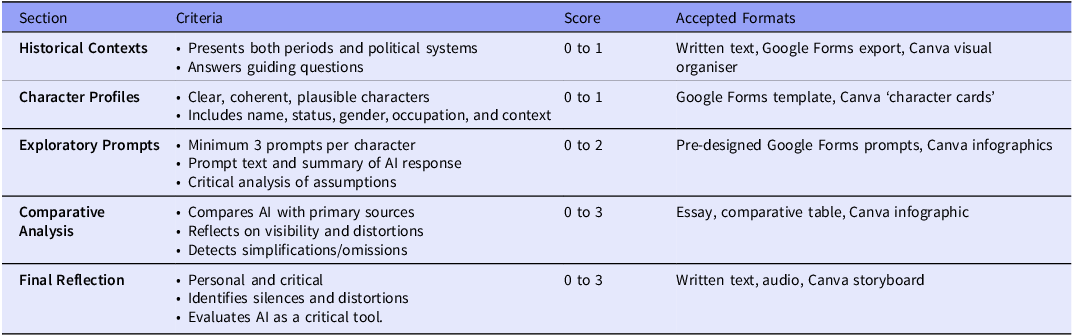
Table 1 presents an example of the rubric for this activity.
Example Rubric for the Structured Path

The same academic standards apply across all formats. Evaluation focuses on clarity, historical grounding, and critical engagement, not on the chosen medium.
Also, the idea is to have a partial deliverable (due mid-semester). This submission ensures that work begins early and feedback can be received before the final report. It is mandatory to proceed to the final version.
-
• Content (minimum 3 to 4 pages or equivalent):
-
○ Historical contexts (text via Google Forms or visual in Canva).
-
○ Character profiles (template-based via Google Forms or creative card via Canva).
-
○ At least one exploratory prompt per character (guided in Google Forms or open in Canva).
-
○ Initial critical comment.
-
Regarding adaptation, partial deliverables may be in Google Forms (structured), Canva visuals (creative), or mixed formats.
Path 2. The creative path: the price of perspective. Power, gender and voice in antiquity
This path gives students maximum freedom (or the sense of it) to explore how power, gender, and voice were represented in antiquity. Unlike the structured path, there is no fixed sequence of steps: Students are encouraged to build their project around what inspires them most. They may begin with a personal reflection, a speculative AI experiment, a fragment of a creative narrative, or even a visual design. The focus is not on following a predetermined order but on experimenting with perspectives and formats that bring hidden or marginalised voices into dialogue with dominant historical narratives.
The guiding principle here is that history is always mediated by perspective. Students are invited to test how narratives shift when retold from an official, hostile, or marginalised viewpoint, and to use AI not only as a provider of information but as a tool for creative disruption. What happens when Livia defends herself against Tacitus’s accusations? How does Hammurabi’s law sound when narrated by an enslaved child? How might Hatshepsut and Cleopatra debate legitimacy across centuries? These speculative experiments allow students to directly confront the biases and silences embedded in ancient sources. Figures such as Hatshepsut or Livia, preserved mostly through hostile or selective accounts, illustrate how ancient authors shaped narratives of legitimacy and decline that often discredited dissenting or marginal voices (Arena Reference Arena2011; Rosenblitt Reference Rosenblitt2019). Reimagining these perspectives helps students see that what survives in the canon is itself the product of political and rhetorical strategies (see, for example, Figure 2).
AI-generated illustration created by the author with ChatGPT-5 (28 August 2025), based on the prompt ‘create an illustration with Livia schemed in the shadows, manipulating succession’ (no copyright restrictions; created by the author for pedagogical purposes).

In this regard, Canva serves as the main support tool for this path. Instead of producing a linear essay, students can work visually and multimodally, through storyboards, infographics, or ‘character cards’. Canva templates make it possible to combine text, image, and AI-generated fragments into a single creative artefact. For instance, a student may design a ‘3-voice infographic’ showing the same event narrated by an emperor, a dissident, and a fictional witness, with AI responses inserted as dialogue bubbles. Others may build a visual diary, mixing short entries with AI-generated reconstructions and annotations from real sources. These hybrid outputs allow creative learners, especially those with ADHD or strengths in visual and narrative thinking, to explore history in ways that feel intuitive and motivating.
The flexibility of the creative path also validates oral and performative literacies. Students may produce a podcast or a short audio drama or even record themselves performing a speculative dialogue between historical characters. In these cases, Canva can still play a role by providing visual scripts, posters, or infographics that can accompany the oral work, as commented. By opening the range of possible media, the path acknowledges that not all historical learning happens through text alone.
In terms of outcomes, students are still expected to demonstrate 3 core elements:
-
1. Historical grounding, by referencing at least 2 real primary sources (Egyptian, Roman, or both).
-
2. AI experimentation, by integrating at least 3 prompts into their work, whether as voices in a dialogue, visual captions, or reflective commentary.
-
3. Critical reflection, by making explicit how perspective alters historical interpretation and what distortions emerge in both sources and AI outputs.
Ultimately, this path seeks to cultivate ownership and agency. Students decide the order of tasks, the tools they use, and the format of their final project. The emphasis is not on producing a polished essay but on testing ideas, challenging assumptions, and learning through iteration. Class sessions become workshops where these drafts (whether half-finished storyboards or speculative podcasts) are interrogated and refined collaboratively. In this way, the creative path channels freedom into critical engagement, showing that imagination and rigour are not opposites but rather complementary ways of doing history.
Objectives
The objectives of the creative path are the following:
-
• Experiment freely with historical voices and perspectives.
-
• Explore silences and distortions in both ancient texts and AI narratives.
-
• Develop alternative ways of ‘doing history’ through storytelling, design, or performance.
-
• Encourage ownership of the project: students decide the order, tools, and final format.
Character and perspective choice
Students may:
-
• Pick a well-known figure (Hatshepsut, Livia, Cicero, Cleopatra, Hannibal…).
-
• Or invent a completely fictional witness (a temple servant, a senator’s daughter, a mercenary, a slave boy, a ghost narrator).
Materials
A number of materials are provided for the students, including:
-
• A minimal set of required sources (one Egyptian, one Roman).
-
• After that, students are free to add any material (literary, visual, AI-generated, and even contemporary parallels).
Supports available
The following supports are integrated into this activity:
-
• Canva for creative outputs (cards, comics, posters).
-
• Audio/podcast tools for oral storytelling.
-
• Optional guiding prompts for those who want them, but this is not mandatory.
Deliverable
Students submit a creative dossier equivalent to 8 pages, but the form is open. Accepted formats include:
-
• Illustrated diary or fictional autobiography.
-
• Short podcast or radio play.
-
• Graphic novel pages or storyboard.
-
• Infographic series (‘power through 3 perspectives’).
-
• Hybrid essay mixing text, images, and scripts.
However, it is key that, whatever the format, the deliverable must include:
-
• Historical grounding (use of at least 2 real sources).
-
• AI experimentation (at least 3 prompts somewhere in the process).
-
• Critical reflection (how perspective changes history).
Details and structure – flexible framework
Unlike the structured path, sections are suggested, not mandatory. Students may reorder, combine, or transform them.
-
• Historical contexts: can be a timeline, a short video, a dialogue between 2 characters, or even marginal notes in a diary.
-
• Character profiles: optional as a separate section – may appear embedded in a story, monologue, or comic panel.
-
• Exploratory prompts: at least 3 prompts, but can be inserted as dialogue, AI ‘voices’ in a play, or captions in a visual.
-
• Comparative analysis: may be done as a debate, visual contrast, or meta-commentary within the creative piece.
-
• Final reflection: may be a formal essay (or simply an epilogue), a voice note, or an ‘author’s note’ at the end of the creative work.
Rubric
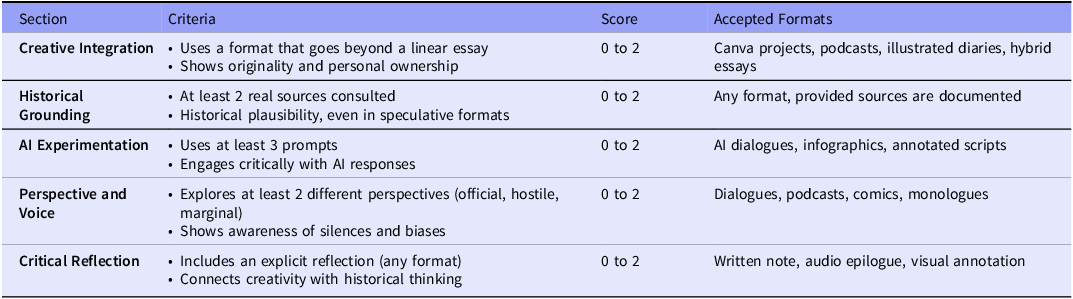
Table 2 presents an example of the rubric for this activity.
-
• Could be character drafts, storyboard panels, podcast script notes, or Canva mock-ups.
-
• Must include at least 1 AI prompt with response.
-
• Should signal which sources they intend to use.
Format is entirely free, as this stage is about testing ideas, not polish.
Example Rubric for the Creative Path

Assessment focuses on depth, creativity, and critical engagement, not on format. Also, the idea is to have a partial deliverable (due mid-semester). Students submit a creative sketch (around 3 to 4 pages or equivalent) with the following guidelines:
Reflection on the flipped approach
The design of the 2 learning paths emerges directly from the flipped classroom methodology. Preparation shifts outside the classroom so that in-class time is reserved for collaboration, dialogue, and experimentation. This move is not simply logistical: It clarifies why a more linear, guided pathway must coexist with a freer, exploratory one. Yet, the design does not eliminate the value of more traditional lectures. Throughout the semester, core sessions remain in which the instructor presents material, situates sources, and models critical questions. These lectures anchor the course while leaving space for in-class debates and AI-supported activities.
The structured path exemplifies what Jung et al. (Reference Jung, Park, Kim and Park2022) describe as the benefits of regulated learning in flipped contexts. Their study demonstrated that ‘flipped classroom with regulation guidance had a significant influence on students’ use of higher-order cognitive skills’ (145). Scaffolding through Google Forms, checklists, or templates is therefore not mere busywork but a pedagogical device that reduces cognitive overload and ensures students arrive in class with the factual and conceptual grounding required for deeper analysis. Similar findings were reported by the c-flip project at UAB, which showed that carefully designed learning sequences and visual organisers can balance structure with autonomy in flipped classrooms. Their use of infographics and modular activities demonstrated that scaffolding is most effective when it offers a clear progression of tasks without constraining students’ capacity for interpretation and creativity (Noguera et al. Reference Noguera, Cussó, Fajardo, Martínez, Merino, Moore, Moschetti, Pagés, Pineda, Rodríguez, Sala and Sepúlveda2021). Our model follows a similar logic: Google Forms and Canva function not simply as tools, but as vehicles to operationalise scaffolding in ways that support neurodivergent learners while maintaining academic rigour. When combined with lectures that provide core content and interpretive frameworks, these supports enable students to transition smoothly from acquisition to application. The FLeD project reached comparable conclusions, proposing 4 concrete actions to enhance prior preparation in flipped contexts: designing with a gender perspective, offering personalised learning pathways, providing explicit time management guidance, and giving clear instructions for identifying key ideas. These recommendations align closely with our approach, where scaffolding tools such as Google Forms serve precisely to structure preparation in incremental steps.
Seen in this way, the structured path does not replace lectures but reinforces them. Lectures establish the backbone of the course (introducing sources, key debates, and historical contexts) while the structured tasks ensure that students digest this information incrementally before entering the classroom. This sequencing helps students avoid the common pitfall of encountering primary sources or AI-generated material without sufficient preparation. Instead, they approach these tasks with clearer expectations and a stronger conceptual map.
Another advantage of scaffolding is that it levels the playing field. Students enter with different backgrounds, study habits, and levels of prior knowledge. Structured supports ensure that everyone reaches a minimum threshold of preparation before collaborative work begins. For some students, this may mean consolidating factual details, such as names, dates, or legal clauses. For others, it may involve clarifying conceptual distinctions. In both cases, scaffolds prevent gaps from widening and create a more equitable classroom environment where discussion can move beyond mere recall.
At the same time, scaffolding carries its own risks. If treated mechanically, it may encourage students to complete forms without engaging critically. We think here that the instructor’s role is crucial. It is necessary to ensure that scaffolds act as stepping stones, not cages. When this balance is maintained, scaffolding also fosters confidence. Students who might otherwise feel overwhelmed by abstract tasks such as ‘analyse the representation of women in Roman law’ can instead follow guided steps: summarise a legal clause, describe its implications, and only then attempt broader analysis. By the time they enter the classroom, they have already rehearsed the skills that will be further developed in discussion.
The creative path, by contrast, leans towards flexibility. Noguera Fructuoso et al. (Reference Noguera Fructuoso, Robalino and Ahmedi2023) argue that flipped classrooms are most effective when they sustain mediated and self-regulated learning (155–156). In this path, students may sketch a storyboard, record a podcast draft, or feed AI a speculative prompt. Outputs are rarely polished at this stage. That is intentional: Classroom time becomes a workshop where drafts are interrogated, compared with sources, and collectively refined. Lectures are not abandoned here either; instead, they provide the common ground from which students’ more experimental work can grow.
This flexibility is not a sign of looseness but a deliberate pedagogical choice. By allowing students to bring unfinished artefacts into class, the creative path foregrounds the learning process over the product. A half-complete storyboard, or an AI dialogue that still feels rough provides material for discussion, critique, and improvement. The emphasis shifts from producing ‘the right answer’ to testing ideas, challenging assumptions, and learning through iteration.
Lectures remain essential here, though they play a different role than in the structured path. Instead of acting primarily as scaffolds, they serve as a shared reference point. All students (whether they have drafted a podcast or designed an infographic) draw from the same conceptual foundation delivered in lectures. This ensures that creative experimentation does not drift into free invention disconnected from historical evidence. Instead, lectures provide the anchor that keeps speculative work accountable to disciplinary standards. Indeed, a further strength of the creative path is that it validates diverse talents and literacies. Some students think best in images, others in narrative, and others through dialogue. By inviting visual, oral, and multimodal outputs, the path acknowledges these differences and turns them into legitimate vehicles for academic exploration. This inclusivity is not only motivational; it also broadens the range of perspectives that enter the classroom discussion. When a graphic representation sits beside a close textual reading, the historical question becomes richer.
Of course, flexibility is not without risk. Creative tasks can drift into free play if not connected back to lectures and sources. The instructor’s role is to maintain this link, ensuring that creativity strengthens rather than weakens historical rigour. Done well, the creative path cultivates agency and ownership. Because students choose the format and direction of their pre-class work, they are more invested in the outcomes. Even when a draft is provisional, the fact that it is their creation gives them a stake in how it is discussed, critiqued, and refined.
A central innovation of this design is the integration of constant, low-stakes feedback, conceptualised as a motxilla d’aprenentatge (‘learning backpack’). The term was introduced by Professor Meritxell Ferrer (Universitat Pompeu Fabra) during the 1st International Online Congress on Innovation and Technology in Ancient History Education (8 May Reference Ferrer2025), where she emphasised the need to ‘learn with and from AI’ in ways that make student progress transparent. In practice, the motxilla takes the form of short, regular entries in which students record where they are, what has worked, and what remains unclear, literally carrying their learning process in a backpack that accompanies them throughout the semester. For instructors, this device functions as a real-time diagnostic tool, enabling them to identify difficulties early rather than discovering them only at the final assessment stage. It also connects directly to the midterm deliverable, ensuring that formative comments are concrete and actionable before the final submission. In this way, the motxilla d’aprenentatge translates Ferrer’s proposal into a practical feedback mechanism: Lightweight, continuous, and dialogical, it redefines evaluation not as a static judgment but as an evolving conversation between student and teacher. The broader discussion of this concept, together with other contributions from the congress, was published in the new journal AI & Antiquity, edited by the Center for the Innovation of Ancient Worlds (CIAW) in Volume 1, Issue 1 (Heredia Reference Heredia2025, 4–14). The CIAW’s mission is precisely to promote inclusion in the study and teaching of Antiquity, with a particular focus on neurodiversity.
Redistributing workload and redefining the instructor’s role
The dual-path design does not aim to add more weight to the instructor’s workload, but rather to rethink how that weight is distributed. What changes is not the amount of work but the way in which it is organised, shifting from late, heavy interventions to earlier and lighter forms of guidance. In this sense, the motxilla d’aprenentatge becomes crucial. These short, regular check-ins (sometimes no more than a tick, a brief note, or an audio comment) allow difficulties to surface early. Feedback is no longer a final verdict but rather a dialogue that accompanies students throughout the semester, preventing problems from accumulating.
Digital tools reinforce this redistribution. Google Forms transforms guiding questions into structured drafts, reducing the need for repetitive corrections on basic tasks. Canva, for its part, gives shape to more experimental artefacts, which arrive in class already framed within a template. For instructors, this means that preparation comes filtered through platforms that make student progress more transparent and manageable. Instead of navigating dozens of disconnected drafts, the teacher can monitor everything through a single folder or platform.
Assessment, too, becomes more equitable without becoming more complex. A unified rubric applies across all formats, whether the output is a written essay, a comparative table, or a storyboard. The diversity of formats is real, but the standards remain constant: clarity, historical grounding, and critical reflection. In this way, variety enriches without fragmenting, and the burden of evaluation is distributed rather than multiplied.
Lectures, meanwhile, retain their central place. They provide the backbone of the course, the shared map without which neither the structured nor the creative path could function. Structured learners take security from digestible scaffolds; creative learners draw inspiration to experiment with speculative dialogues, narratives, or visual representations. The instructor moves between both, reconciling answers or challenging assumptions, and in doing so sustains the coherence of the whole course.
What emerges is a redefined teaching role. Jafarian et al. (Reference Jafarian, Salah, Alsadoon, Patel, Alves and Prasad2021) have argued that facilitators in flipped contexts are not merely transmitters of content but mediators of co- and self-regulation. In our case, this means that lectures continue to anchor the syllabus, but workshops welcome unfinished or imperfect creations as legitimate starting points for collective inquiry. It is here that the instructor’s role becomes less about providing definitive answers and more about asking the right questions: Why does AI omit women’s voices? How does a scaffolded timeline reshape the reading of Hammurabi’s laws? These moments of provocation give new meaning to teaching.
The balance is delicate but achievable. Structured learners find stability in step-by-step scaffolds, while creative learners thrive on ambiguity and multimodality. Both styles are equally valid, and both remain tied to the common thread of lectures and readings, which prevent the classroom from fragmenting into isolated activities. For instructors, the load is not heavier but differently distributed: traditional lectures coexist with micro-feedback, and class discussions are enriched by pre-class preparation and AI interaction.
In the end, this is not merely a technical adjustment but a pedagogical reorientation. It preserves the rhythm of lectures and syllabus progression while opening new spaces for experimentation, feedback, and dialogue. Inclusivity becomes manageable because it is embedded in the very design of the course. And perhaps most importantly, it transforms the instructor into a facilitator, a designer, and a critical interlocutor – someone whose role is not diminished but expanded in scope precisely because inclusivity demands more than repetition: It demands imagination, rigour, and presence.
Concluding remarks
What we have presented here is a flipped learning model for neurodivergent students in Ancient History, the implications of which go well beyond this discipline. First, the structured and creative itineraries converge on the same central goal: to recover forgotten voices. Whether through step-by-step scaffolds or speculative narratives, students are encouraged to confront the silences of ancient sources and to imagine how power, gender, and marginality shaped lived experience.
Second, the practice demonstrates that artificial intelligence, when integrated critically, can serve not as a shortcut, but as a catalyst for higher-order learning. Just as the introduction of the calculator required mathematics education to shift towards deeper competences, so too does AI demand that we raise the level of historical inquiry. Students learn not to accept AI responses at face value but to interrogate their assumptions, omissions, and stereotypes, turning the tool into an object of analysis rather than an unquestioned authority.
Third, the dual-path design foregrounds neurodivergence as a pedagogical strength rather than a limitation. Structured scaffolds reduce anxiety for students with ASD or dyslexia, while open formats legitimise the creativity and hyperfocus often characteristic of students with ADHD. By making space for different cognitive profiles, the model shows that diversity can be the foundation of innovation, producing outputs that are both rigorous and imaginative.
Finally, this approach reframes inclusion as a matter of demanding more, not less. By supporting students with clear scaffolds or flexible creative outlets, the design empowers them to go beyond reproduction of content towards competency-based, critical engagement. Ancient History thus becomes a laboratory where forgotten voices are amplified, AI is treated as a partner to be questioned, and neurodivergent learners are given both freedom and responsibility. The result is not a lowering of standards but a collective raising of expectations, in line with the realities of a diverse twenty-first-century classroom. At the same time, the model connects with current historiography that highlights how Roman sources constructed decline, silenced dissent, and legitimised power structures (Arena Reference Arena2011). In this way, inclusive pedagogy and critical Ancient History reinforce one another.
Competing interests
The author declares none.



 Open access

