




Introduction
Plants have played a significant role in human subsistence economy and lifeways throughout the evolution of the hominin clade. It is, however, in parallel with the domestication of plants in the Near East during the ninth millennium BC, that we observe considerable behavioural, technological and social changes among human populations (Willcox et al. Reference Willcox, Fornite and Herveux2008; Abbo & Gopher Reference Abbo and Gopher2020). Despite the extensive body of research available on cereal and legume domestication in the Late Epipalaeolithic (Natufian) and Pre Pottery Neolithic (PPN) between c.12 000 and 9000 years cal BP (Asouti & Fuller Reference Asouti and Fuller2012), the nature and pace of this phenomenon are still poorly understood; the ways in which the introduction of domestic crops transformed dietary habits relating to the processing and consumption of wild plant foods have not been fully investigated. The PlAnT-Human Interactions in the Levantine Neolithic Investigated through Ground Stone Tool Use and Dental Calculus (PATH) project aims to explore these issues through the analysis of ground stone tools (GSTs) and ancient human dental calculus from archaeological contexts in Israel and Jordan ranging from the Late Epipalaeolithic Natufian to the PPNB covering a time frame of c. three millennia (Figure 1). The project is undertaking an innovative investigation of shifts in processing and consumption of plant foods before and during the Near Eastern Agricultural Revolution, focusing on the role of cereals and legumes within plant domestication.
The archaeological contexts included in the PATH project (figure by A. Zupancich).

Method
PATH introduces a novel approach to functional analysis of GSTs: the systematic application of confocal scanning microscopy and surface texture analysis (Evans & Donahue Reference Evans and Donahue2008; Ibáñez & Mazzucco Reference Ibáñez and Mazzucco2021; Pichon et al. Reference Pichon, Ibáñez-Estevez, Anderson, Douché and Coqueugniot2021). Although the significant potential of this approach has been demonstrated through its application to the study of micro polish on flaked stone tools (i.e. sickle blades), confocal microscopy has seldom been applied to GSTs (Paixão et al. Reference Paixão, Marreiros, Dubreuil, Gneisinger, Carver, Prévost and Zaidner2021). Integrating the assessment of macro and micro wear performed under optical light microscopes (Adams et al. Reference Adams, Delgado, Dubreuil, Hamon, Plisson, Risch, Sternke, Eigeland and Costa2009; Dubreuil & Savage Reference Dubreuil and Savage2014; Cristiani & Zupancich Reference Cristiani and Zupancich2020) with surface texture analysis allows robust and reproducible functional interpretations.
Evidence of plant processing is examined by combining qualitative and quantitative approaches to analysing use wear and residues on GSTs. Qualitative features of the traces will be investigated using low- and high-power optical microscopes to provide a thorough interpretation of both the gestures performed and of the plants processed (Adams et al. Reference Adams, Delgado, Dubreuil, Hamon, Plisson, Risch, Sternke, Eigeland and Costa2009; Cristiani & Zupancich Reference Cristiani and Zupancich2020). These data are coupled with surface texture analysis performed using a confocal scanning microscope, allowing quantitative discrimination of use wear based on 3D surface parameters (Ibáñez & Mazzucco Reference Ibáñez and Mazzucco2021).
Following standardised cleaning and processing protocols (Sabin & Fellow Yates Reference Sabin and Fellow Yates2020), plant micro remains, including starch granules, phytoliths and plant tissues, are extracted from dental calculus and analysed under a cross-polarised transmitted light microscope. A reliable interpretation of residues found on the archaeological GSTs and dental calculus is ensured through the use of an exhaustive reference collection of the main edible wild and domestic plant species available in the study area, collected during the project, including morphological and morphometric data for starch granules and phytoliths.
Preliminary results and future perspectives
Preliminary analysis of a selection of GSTs (n = 47) and dental calculus (n = 18) from Natufian and PPN contexts of the southern Levant provided the first set of key evidence concerning the exploitation of plant foods. In particular, analysis of active and passive tools from Eynan/Ain Mallaha (Natufian), Netiv Hagdud (PPNA) and Nahal Yarmuth 38 (PPNB) identified traces and residues associated with both legume and grain processing (Figures 2 & 3). Micro-plant structures identified in human dental calculus at these sites match the functional data obtained through analysis of the tools. Specifically, starch granules and micro-plant structures (i.e. seed coat cells) of species belonging to the Fabaceae family were identified, along with starch granules and phytoliths attributed to plant species of the Triticeae tribe.
Tools from Eynan/Ain Mallaha (a); Netiv Hagdud (b, c); and Nahal Yarmuth 38 (d) (figure by A. Zupancich).

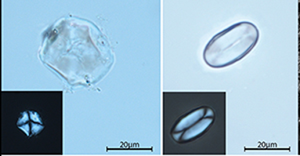
(a–d): Starch granules identified across the surfaces of ground stone tools; (e–h): microphotograph (optical microscope) of use wear on ground stone tools associated with plant processing (figure by A. Zupancich).

Interpretations relating to plant domestication and food preparation and consumption have been biased towards the use of cereals (Abbo et al. Reference Abbo, Saranga, Peleg, Kerem, Lev-Yadun and Gopher2009). Yet, by revealing the role played by legumes, our results support data from previous functional studies (Dubreuil Reference Dubreuil2004). These promising data provide a basis for additional controlled experiments on different wild and domestic species of legumes. The analysis will be further enriched by including additional Natufian and PPN archaeological assemblages from the southern Levant and beyond. By connecting different strands of bio-archaeological evidence with qualitative and quantitative approaches in use wear and residue analysis, we expect to reveal cultural and technological changes in human-plant interaction strategies among pre-agricultural and agricultural communities between the twelfth and ninth millennia BC in the Near East.
Acknowledgements
We thank Dr Hila May (Tel Aviv University) and Dr Yulia Makoviychuk (Tel Aviv University) for their cooperation in the sampling of dental calculus; Dr Fanny Bocquentin (CRCN – CNRS) and Dr François Valla (CNRS) for granting access to the archaeological materials.
Funding statement
The PATH project is funded by a Marie Skłodowska-Curie Individual Fellowship (Grant Agreement 101030754). Plant micro-residues were analysed in a facility funded within the framework of the ERC Starting Grant (HIDDEN FOODS ref. 639286). The Nahal Yarmuth 38 research is funded by The Israel Science Foundation (grant no. 210/20). The project PDC2021-121613-I00 is funded by MCIN/AEI/10.13039/501100011033 and the European Union ‘NextGeneration EU/ORTR’.


 Open access

