




Peach (Reference Peach1908) described the genus Tealliocaris and included six species: T. etheridgii (Peach Reference Peach1882, spelt T. etheridgei by Peach Reference Peach1908), T. formosa (Peach Reference Peach1882), T. loudonensis Peach Reference Peach1908, T. robusta Peach Reference Peach1908, T. tarrasiana Peach Reference Peach1908 and T. woodwardi (Etheridge Reference Etheridge1877). Peach (Reference Peach1908) inferred that the type species of his new genus was T. loudonensis within the section describing T. woodwardi (Peach Reference Peach1908; pp. 19–20). Brooks (Reference Brooks, Moore and Teichert1969) retained the type of Peach (Reference Peach1908) as T. loudonensis, but Schram's (Reference Schram1979) major work on British Carboniferous Malacostraca included T. ‘loudenensis’ (T. loudonensis of Peach Reference Peach1908) and T. tarrasiana as junior synonyms of T. woodwardi and included T. formosa and T. robusta as junior synonyms of Pseudotealliocaris etheridgei (Peach Reference Peach1882). Schram (Reference Schram1979) also designated a lectotype, but Briggs & Clarkson (Reference Briggs and Clarkson1985) used the original specimen described by Etheridge (Reference Etheridge1877) as the holotype after further elaborations by Etheridge (Reference Etheridge1879) where the specimen was first described as being the type of Anthrapalaemon? woodwardi. The designation of T. loudonensis as a junior synonym of T. woodwardi was also supported by Briggs & Clarkson (Reference Briggs and Clarkson1985) in their revision of Tealliocaris from Gullane. Clark restudied this material in 1989 (Clark Reference Clark1989) and published his findings on Tealliocaris in 2013, where he accepted T. loudonensis as the junior synonym of T. woodwardi. The species T. aff. loudonensis was also mentioned from Canada (Dewey & Fåhræus Reference Dewey and Fåhræus1982), as was T. woodwardi (Miller & Purdy Reference Miller and Purdy1998), although it was later shown that these belonged to the genus Schramocaris (Clark et al. Reference Clark, Miller and Ross2018). On describing a Devonian example of the genus Tealliocaris, Gueriau et al. (Reference Gueriau, Charbonnier and Clement2014) suggested that the type species of Tealliocaris should be T. loudonensis as Peach had originally inferred. However, as Anthrapalaemon? woodwardi Etheridge Reference Etheridge1877 was the first described species, despite Peach's inferences, T. loudonensis is here considered to be a junior synonym of T. woodwardi, which is the senior synonym.
When tealliocaridid crustaceans were first found near Great Doward in the Forest of Dean (England, UK), it was originally thought that they belonged to Pseudotealliocaris (see Jenkins Reference Jenkins2007). Since the genus Pseudotealliocaris was considered by Clark (Reference Clark2013) to be a junior synonym of Tealliocaris, it was natural to assume that they belonged to that genus instead. The broad, round carapace with rugose carinae was reminiscent of Pseudogalathea, so the crustacean from the Forest of Dean was therefore compared with both Tealliocaris and Pseudogalathea, but was found to be significantly different and thus placed in the new genus Schramocaris by Clark et al. (Reference Clark, Gillespie, Morris and Clayton2015).
Clark (Reference Clark2013) recognised three species of Tealliocaris from the Carboniferous of Scotland: T. etheridgii, T. robusta and T. woodwardi, thus taking T. robusta out of synonymy. Clark (Reference Clark2013) drew attention to the discrepancy in age between T. robusta from the Tournaisian of southern Scotland and T. robusta from the Pendleian of the Midland Valley of Scotland, but was unable to differentiate morphologically between them based on material available at that time. More material has now been collected from the Ballagan Formation of Tournaisian age at Willie's Hole, Chirnside near Duns (Scottish Borders, Fig. 1) in southern Scotland, which helps with identifying the genus and species based on diagnostic characters and a comparative landmark analysis of the carapace as carried out on the type of the genus by Clark et al. (Reference Clark, Gillespie, Morris and Clayton2015).
Map showing the location of Willie's Hole.

Similar material in the collections of the Natural History Museum (NHMUK), London, and National Museums Scotland (NMS), Edinburgh, included specimens from the cementstone of Visean age at Glencartholm, Langholm that were assumed to be a species of Tealliocaris. In a notebook held in the Object History Files (OHF) of the Hunterian (OHF:10.10; p. 60) one of the authors (N.D.L.C.) made the observation, while collecting fossil eumalacostracans at Glencartholm in 1985, that these specimens were very similar to T. robusta from Whiteadder and may represent a new species. These specimens, along with others in various institutions, were recently described as Schramocaris clarksoni Clark et al. Reference Clark, Miller and Ross2018.
1. Material and methods
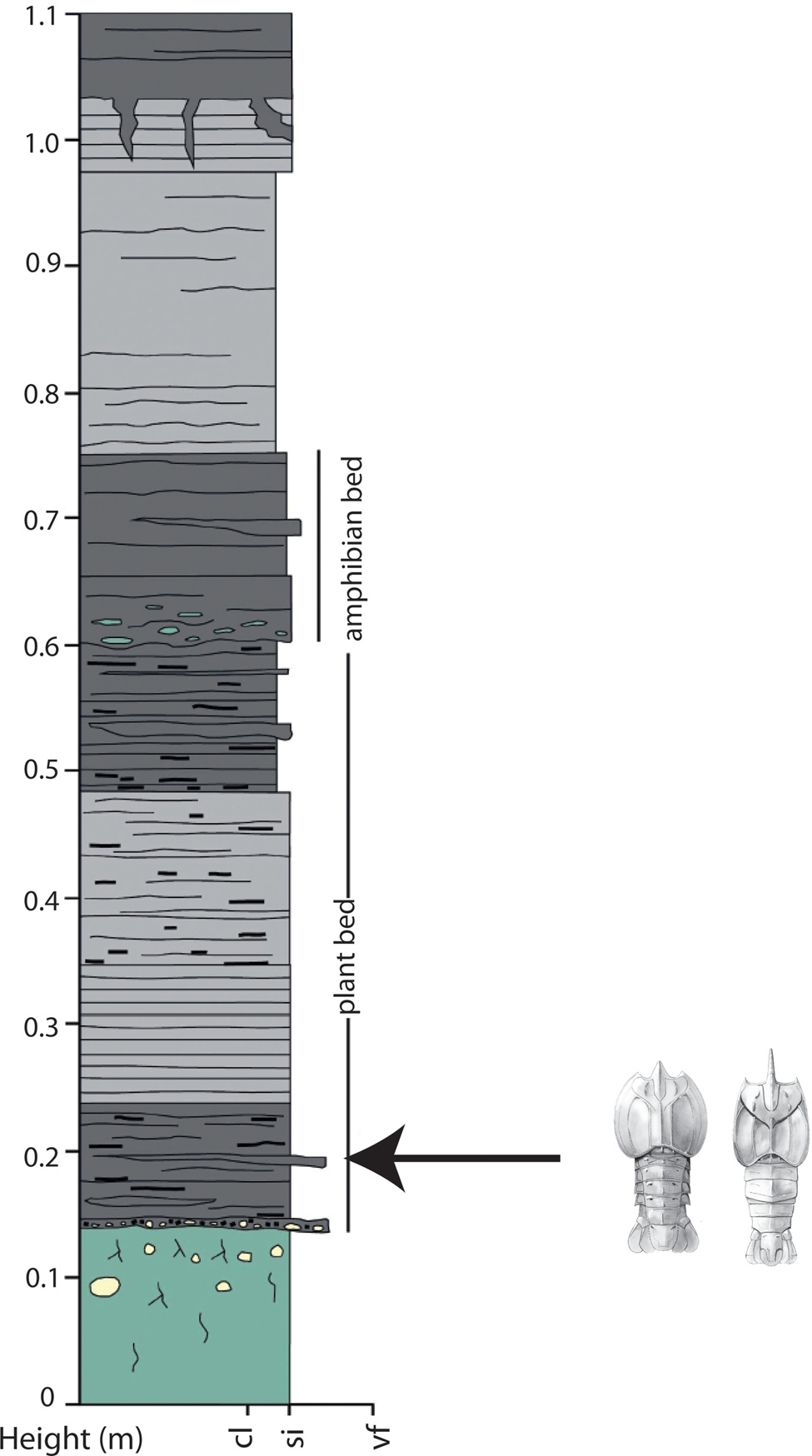
Peach (Reference Peach1908) originally recorded two species of Tealliocaris from the locality at Chirnside: T. robusta and ‘T. tarrasiana’. Peach (Reference Peach1908) also described ‘T. tarrasiana’ from the foot of the Tarras Water near Glencartholm, Langholm and the specimens are kept in the collections of the British Geological Survey. The locality at Chirnside was subsequently collected from and the sediments logged in detail in 2015 as part of the NERC funded TW:eed project (Fig. 2) and the material is held in the collections of National Museums Scotland in Edinburgh.
Sedimentary log at Willie's Hole with stratigraphical position of Schramocaris and Tealliocaris. After Bennett in Ross et al. (Reference Ross, Edgecombe, Clark, Bennett, Carriò, Contreras-Izquierdo and Crighton2018). Abbreviations: cl = clay; si = silt; vf = very fine sand.
Landmark analysis using a digital vernier calliper on scaled printed images was undertaken on this material and compared with other similar crustaceans (other species of Schramocaris, Tealliocaris and Pseudogalathea) previously analysed by Clark et al. (Reference Clark, Gillespie, Morris and Clayton2015, Reference Clark, Miller and Ross2018) using PAST, which was standardised using Procrustes fitting and analysed using the Gower similarity index for principal coordinate analysis (Hammer et al. Reference Hammer, Harper and Ryan2001).
2. Institutional abbreviations
GSE, British Geological Survey, Keyworth, UK; GLAHM, The Hunterian, University of Glasgow, Glasgow, UK; NMS, National Museums Scotland, Edinburgh, UK; NHMUK, Natural History Museum, London, UK; UCZM, Zoology Museum, Cambridge University, UK.
3. Systematic palaeontology
Subclass Eumalacostraca Grobben Reference Grobben1892 sensu Martin & Davis Reference Martin and Davis2001
Family Tealliocarididae Brooks Reference Brooks1962
Emended diagnosis. Slightly dorsoventrally flattened along entire body; telson square with narrower posterior medial extension to cover telson ‘flap’; V-shaped cervical groove that curves posteriorly to meet the medial carina of the carapace; first pleonic tergite with three ridges.
Composition. The list of genera currently included in the Tealliocarididae follows Taylor et al. (Reference Taylor, Yan-Bin and Schram1998) and Taylor (Reference Taylor1999) (although a revision of the genus Pseudotealliocaris is overdue in light of recent studies of Tealliocaris by Briggs & Clarkson Reference Briggs and Clarkson1985; Clark Reference Clark2013; and Gueriau et al. Reference Gueriau, Charbonnier and Clement2014):
Jerometichenoria Schram Reference Schram1978
Laevitealliocaris Yang et al. Reference Yang, Gueriau, Charbonnier, Ren and Béthoux2018
Pseudotealliocaris Brooks Reference Brooks1962
Schramocaris Clark et al. Reference Clark, Gillespie, Morris and Clayton2015
Tealliocaris Peach Reference Peach1908
Remarks. The original diagnosis by Brooks (Reference Brooks1962) states: ‘carapace without antero-lateral spines, and thoracic sternites with sternal processes’; however, the type species of Tealliocaris has anterolateral spines on the carapace and not all specimens have the thoracic sternites with sternal processes (Clark Reference Clark2013). This has therefore been removed from the diagnosis.
Schramocaris Clark et al. Reference Clark, Gillespie, Morris and Clayton2015
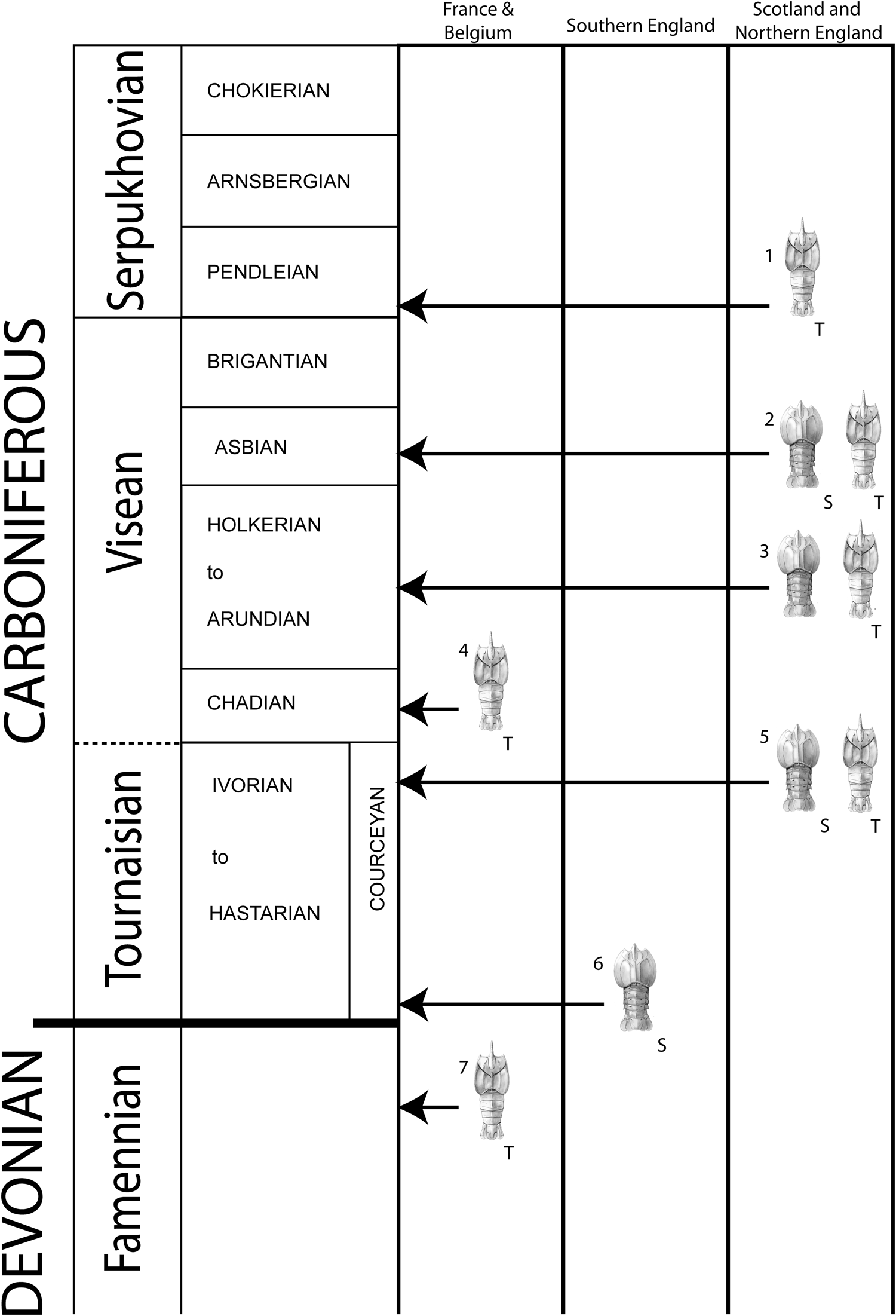
Type species. S. gilljonesorum Clark et al. Reference Clark, Gillespie, Morris and Clayton2015 from the Courceyan Avon Group of Great Doward in the Forest of Dean (Fig. 3). Holotype GLAHM 152432 figured by Clark et al. (Reference Clark, Gillespie, Morris and Clayton2015; fig. 3a).
Stratigraphic framework of the European Lower Carboniferous showing the occurrences of Schramocaris and Tealliocaris in Britain and the rest of Europe (Carpentier Reference Carpentier1913; Gueriau et al. Reference Gueriau, Charbonnier and Clement2014). (1) T. weegie sp. nov. at Bearsden, near Glasgow. (2) S. clarksoni and T. etheridgii at Glencartholm, Scottish Borders. (3) ?S. sp. and ‘T. loudonensis’ at Cheese Bay, East Lothian and Granton near Edinburgh. (4) ‘T. loudonensis’ at Eclaibes, near Lille, France. (5) S. robusta and T. briggsi sp. nov. at Chirnside, Scottish Borders and Chattlehope, Northumberland, England. (6) S. gilljonesorum from the Forest of Dean, Gloucestershire, England. (7) T. walloniensis from Strud, Belgium. (Carpentier Reference Carpentier1913; Clark Reference Clark2013; Gueriau et al. Reference Gueriau, Charbonnier and Clement2014; Clark et al. Reference Clark, Miller and Ross2018).
Emended diagnosis. First lateral carinae of the carapace about ¼ distance from medial carina to second lateral carinae; short rostrum; pleonic segments 3–5 of equal length; broad telson and tailfan.
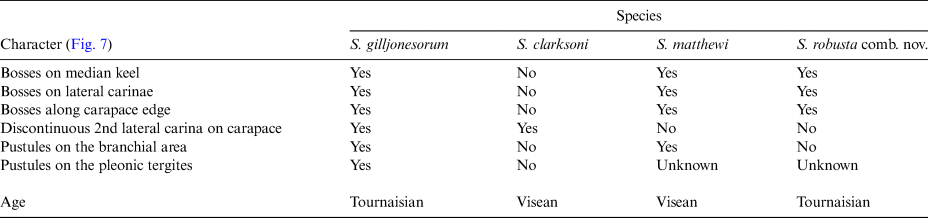
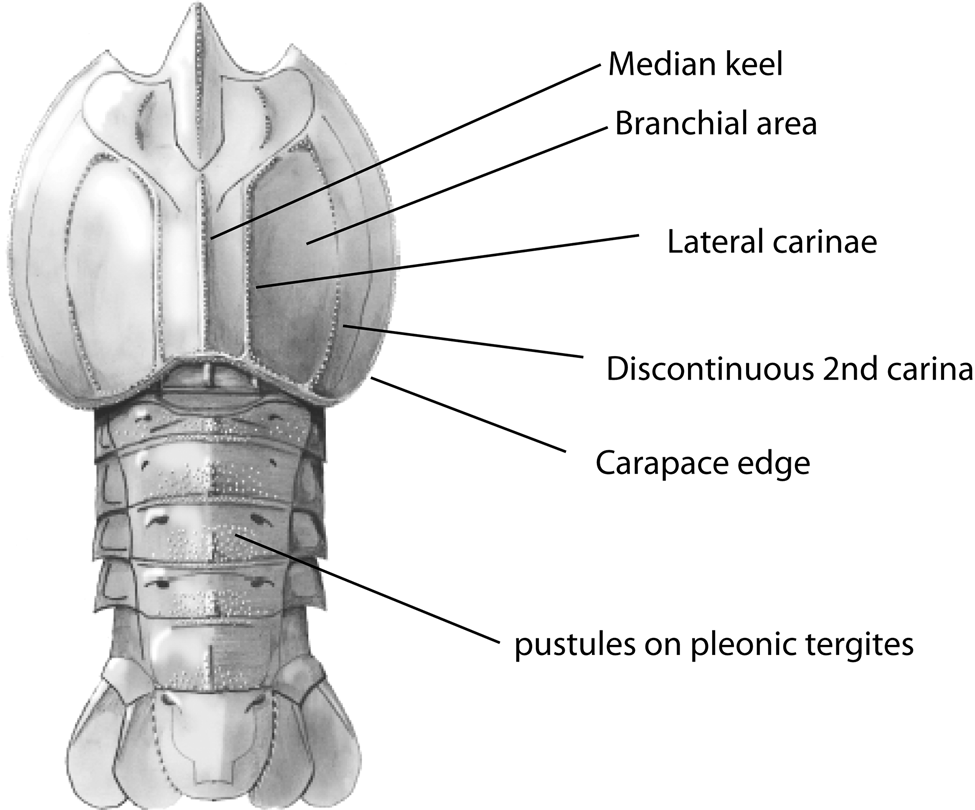
Remarks. The only major change from the original generic diagnosis is that the nature of the second lateral carinae, or ridges, varies between the different species of Schramocaris and they are here used as specific diagnostic characters (Table 1). The type species continues to have the diagnostic character of the longitudinal branchial carinae being rugose and the second lateral carinae being less distinct and, in some examples, reduces in relief across the branchial region.
Characteristics differentiating the species of Schramocaris based on Clark et al. (Reference Clark, Gillespie, Morris and Clayton2015, Reference Clark, Miller and Ross2018) and the current study.
Schramocaris robusta (Peach Reference Peach1908) comb. nov.
(Figs 4, 5)
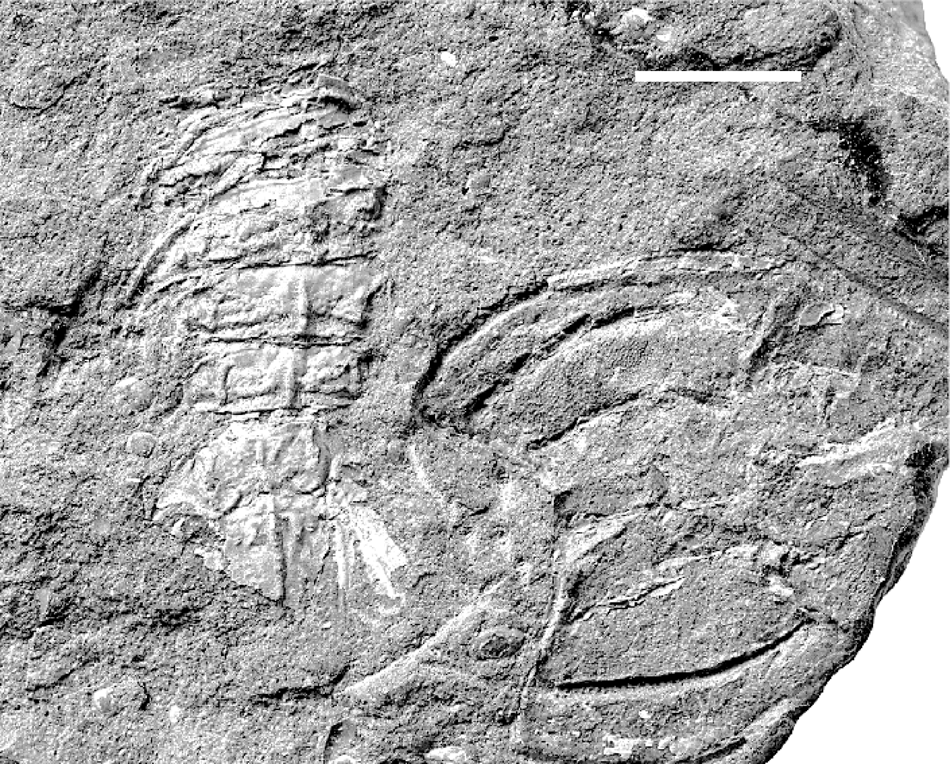
Lectotype. The specimen originally described by Peach (Reference Peach1908, pl. 3, Fig. 8) showing the carapace and tail identified as specimen ‘M.2739E’ is here chosen as the lectotype of this species. The specimen has since been given a new catalogue number as GSE 5942.
Lectotype of Schramocaris robusta comb. nov. (GSE 5942) from Willie's Hole, Chirnside. Scale bar = 5 mm.
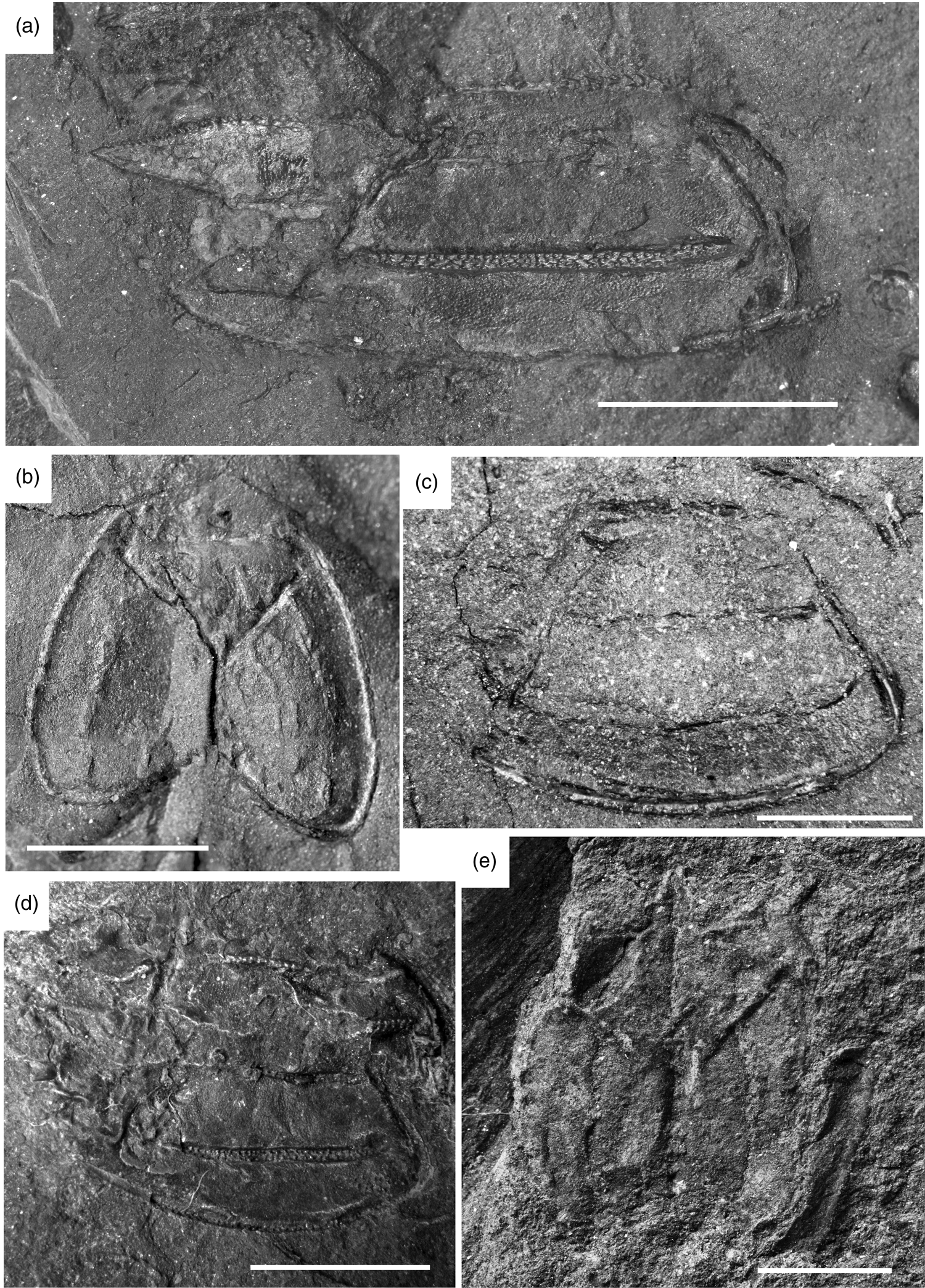
Schramocaris robusta from Willie's Hole, Chirnside. (a) NMS G.2015.32.824.1 showing carapace in lateral view with robust rugose lateral carinae and robust triangular rostrum with rugose keel. (b) NMS G.2015.32.61 dorsal view of the carapace with faint first lateral carinae and more robust second and outer lateral margins. (c) NMS G.2015.32.69 and (d) NMS G.2015.932.2 (paralectotype) carapaces in lateral view showing the rugose lateral carinae. (e) GSE 5941 dorsal external mould of the carapace showing rostrum and medial and first lateral carinae. Scale bars = 5 mm.
Type locality and formation. Willie's Hole on the Whiteadder Water east of Allanton Bridge. Ballagan Formation, dated to the lower CM miospore biozone of the Ivorian, Tournaisian (Butterworth & Butcher Reference Butterworth and Butcher1983; Waters et al. Reference Waters, Browne, Dean and Powell2007, Reference Waters, Somerville, Stephenson, Cleal, Long and Waters2011; Smithson et al. Reference Smithson, Wood, Marshall and Clack2012).
Paralectotypes. Illustrated by Peach (Reference Peach1908): GSE 5940 (pl. 3, Fig. 5); GSE 5941 (pl. 3, Fig. 6), from the same locality as the lectotype.
Additional material. Most of the new specimens examined are in the collections of the National Museum of Scotland and were collected by Stan P. Wood (prefixed G.2012.39) or as part of the TW:eed project from Willie's Hole (prefixed G.2015.32): NMS: G.2012.39.12, G.2012.39.270, G.2012.39.271, G.2012.39.272, G.2012.39.273, G.2015.32.61, G.2015.32.69, G.2015.32.75, G.2015.32.819, G.2015.32.822, G.2015.32.824, G.2015.32.829, G.2015.32.832, G.2015.32.833, G.2015.32.835, G.2015.32.836, G.2015.32.840, G.2015.32.856, G.2015.32.857, G.2015.32.858, G.2015.32.860, G.2015.32.915, as well as NMS G.1969.11 previously collected by S. M. Andrews.
Diagnosis. Lateral branchial carinae are robust and continue from the posterior of the carapace to the cervical groove. The second carina is equally rugose to the first with multiple offset bosses along its full length.
Description. The external mould of the posterior portion of the carapace and the cuticle of the pleon of this crustacean is well preserved in the lectotype. No pereiopods have been preserved. The carapace has two lateral carinae in the branchial area that are as robust as the median carina and ornamented with offset bosses along their lengths. The outer edge of the carapace is similarly ornamented. There are paired post-orbital carinae that are ornamented in a similar fashion to the branchial carinae. The rostral groove splits the median ridge anterior of the cervical groove which curves medially along the median carina.
Remarks. Only those specimens GSE 5940-5942 described by Peach (Reference Peach1908) as Tealliocaris robusta from Willie's Hole, Chirnside are here considered to be Schramocaris robusta. Peach's ‘T. robusta var.’ was subsumed into T. robusta after Pseudotealliocaris was synonymised with Tealliocaris (Clark Reference Clark2013). Despite the age difference and some differences in the morphological characteristics, Clark (Reference Clark2013) retained the name T. robusta for these specimens until a full assessment could be carried out based on new material from Chirnside which the excavations of 2015 provided. Peach's ‘T. robusta var.’ from the Namurian of the Glasgow area is now given the new species name of T. weegie (see below).
Although Tealliocaris and Schramocaris superficially look similar, they are quite distinct on the basis of the characters mentioned above as well as the shape of the carapace (Clark et al. Reference Clark, Gillespie, Morris and Clayton2015, Reference Clark, Miller and Ross2018). Similarly, shape analysis of the carapaces of specimens collected here for the TW:eed project, also using the techniques covered by Clark et al. (Reference Clark, Gillespie, Morris and Clayton2015, Reference Clark, Miller and Ross2018), indicate that Schramocaris robusta is similar to other species of Schramocaris and different from all species of Tealliocaris (Figs 6, 7).
Principal coordinate analysis showing the three Carboniferous genera Pseudogalathea, Tealliocaris and Schramocaris. The three species of Schramocaris show a general morphological similarity based on the 12 landmarks of the carapace as defined by Clark et al. (Reference Clark, Gillespie, Morris and Clayton2015) using PAST (Hammer et al. Reference Hammer, Harper and Ryan2001).

Generalised reconstruction of Schramocaris showing the position of the important diagnostic characters based on Clark et al. (Reference Clark, Gillespie, Morris and Clayton2015, Reference Clark, Miller and Ross2018).
The type specimens all show the multiple offset bosses on the carapace carinae that are typical for Schramocaris. Although the type specimens were illustrated by Peach (Reference Peach1908; pl. 3, Figs 5, 6, 8), this detail of the carapace carinae was not shown.
Tealliocaris Peach Reference Peach1908
Type species. Anthrapalaemon? woodwardi Etheridge Reference Etheridge1877, as designated by Schram (Reference Schram1979). Gueriau et al. (Reference Gueriau, Charbonnier and Clement2014) stated that T. loudonensis Peach Reference Peach1908 was the type species by original designation; however, although this species has an inferred designation as type species (see introduction), it is a junior synonym of T. woodwardi. A lectotype of T. woodwardi, GSE 5950, from Cheese Bay, East Lothian, was designated by Schram (Reference Schram1979); however, Briggs & Clarkson (Reference Briggs and Clarkson1985) considered a slab containing two specimens (GSE 5944) was the ‘holotype’, as it was the slab which was originally used by Etheridge (Reference Etheridge1877) to describe Anthrapalaemon? woodwardi. The specimen selected here from the slab (GSE 5944) as the lectotype is the part and counterpart of the laterally compressed specimen (Etheridge Reference Etheridge1879; Figs 1, 2; Briggs & Clarkson Reference Briggs and Clarkson1985; Fig. 2a, b (left-hand specimen)). The partial dorsal specimen on the same slab is here considered to be a paralectotype.
Tealliocaris briggsi sp. nov.
(Figs 8, 9)
Etymology. Named after Prof. Derek E. G. Briggs who collected material from this locality in the 1980s and contributed greatly to our understanding of Carboniferous Crustacea in Scotland. He was also the co-author of the first publication by the present co-author (A.J.R.) (Ross & Briggs Reference Ross, Briggs and Benton1993).
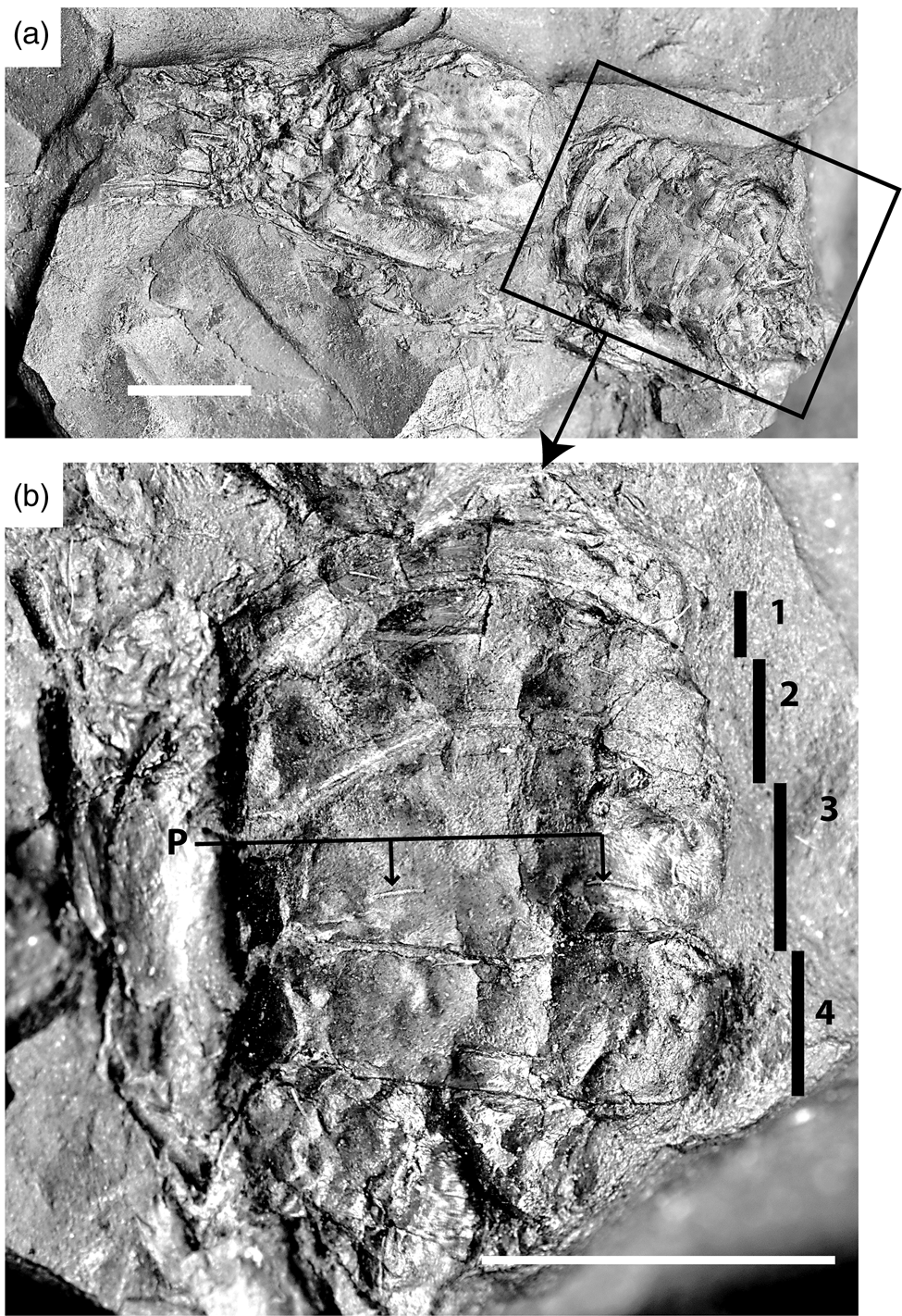
Tealliocaris briggsi sp. nov. from Willie's Hole. (a) Holotype: NMS G.2015.32.912, mostly complete specimen. (b) Detail of pleon showing sensory pores (P) and enlarged third pleonic somite (3) that are characteristic of the genus. Scale bars = 5 mm.
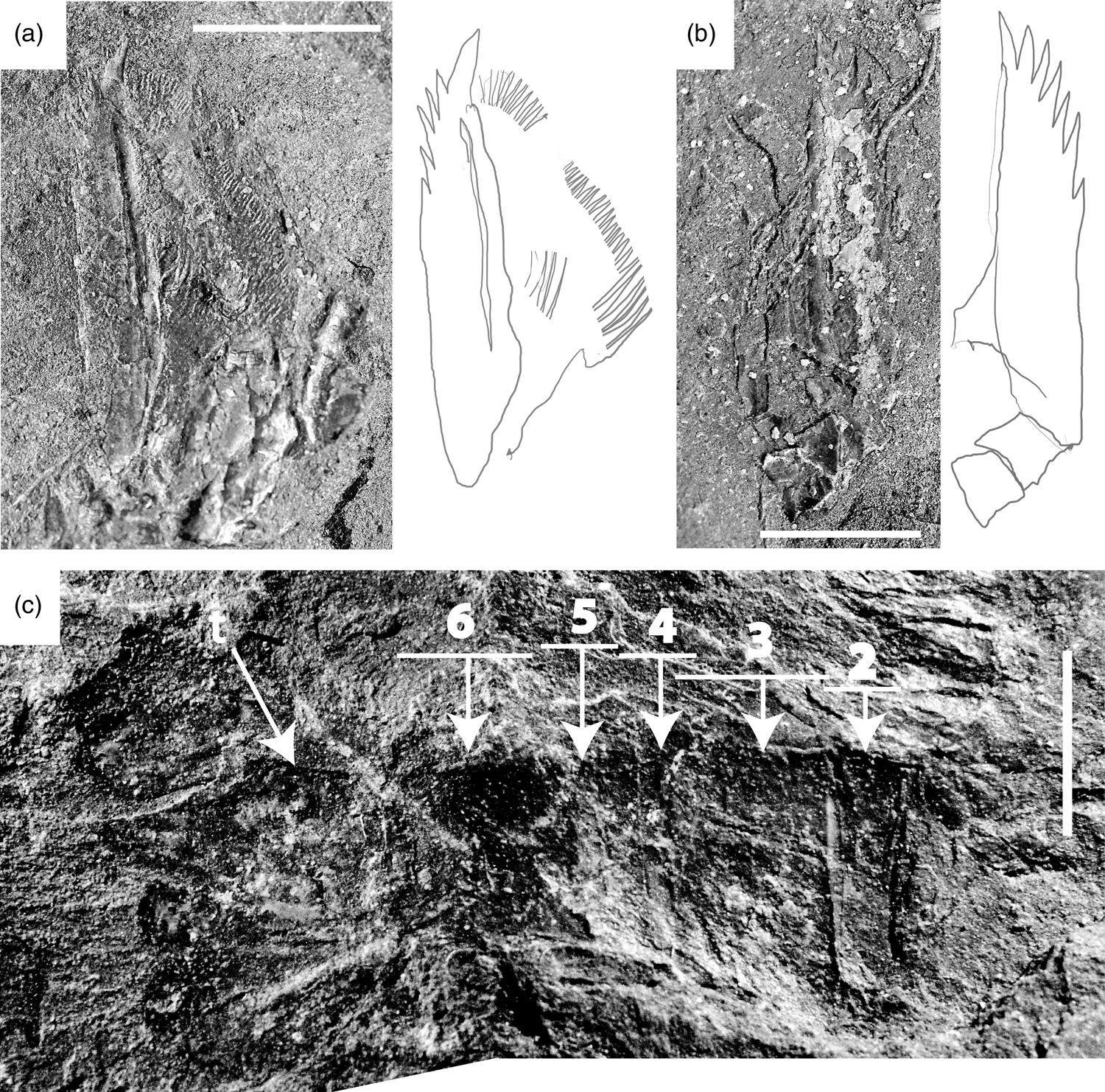
Tealliocaris briggsi sp. nov. from Willie's Hole. (a) Scaphocerites of paratypes NMS G.2015.32.66 and (b) NMS G.2015.32.823.2. (c) Pleon showing enlarged third tergite (3) characteristic of the genus (GSE 13042). Abbreviation: t = telson. Scale bars = 2 mm (a, b); 5 mm (c).
Holotype. NMS G.2015.32.912 (Fig. 8).
Type locality and horizon. Willie's Hole, Chirnside, Scottish Borders. Lower part of the ‘plant bed’, Ballagan Formation.
Paratypes. NMS G.2015.32.66, G.2015.32.823.2, as well as the specimen that Peach identified as ‘T. tarrasiana’ from Allanton, Berwickshire, GSE 13042 (‘m2049c’ – Peach's original number).
Additional material. NMS G.2015.32.76, G.2015.32.823.1, G.2015.32.825, G.2015.32.826, G.2015.32.827, G.2015.32.828, G.2015.32.830, G.2015.32.834, G.2015.32.841, G.2015.32.859, G.2015.32.861, G.2015.32.862, G.2015.32.911, G.2015.32.913, G.2015.32.914, G.2015.32.916.
Diagnosis. This species has a generally smooth carapace and lacks anterolateral spines. The scaphocerite has six or more denticles along the outer edge (Fig. 9a, b), the median keel of the carapace is weakly defined and the lateral carinae are absent (Fig. 8a), and the pleon has no median keel or transverse grooves on the tergites except the first but does have lateral sensory pores on the third to fifth tergites (Fig. 8b).
Remarks. Although a specimen of ‘T. tarrasiana’ from Allanton was mentioned by Peach, the specimen was not specifically identified nor illustrated. It is likely that the specimen that he referred to was GSE13042 (Fig. 9c) which is recorded as coming from this locality and being of that species. This specimen does not, however, have any of the diagnostic features that would distinguish it from ‘T. tarrasiana’ and therefore is not used here as the holotype. The holotype of T. briggsi was chosen from a more recent collection of material collected as part of the TW:eed Project (Bennet et al. Reference Bennett, Davies, Leng, Snelling, Millward, Kearsey, Marshall and Reeves2015, Reference Bennett, Howard, Davies, Kearsey, Millward, Brand, Browne, Reeves and Marshall2017).
Although ‘T. tarrasiana’ (excluding the specimen above) is no longer recognised and has been synonymised with T. woodwardi (Briggs & Clarkson Reference Briggs and Clarkson1985; Clark Reference Clark2013), it does exhibit characters that distinguish it from T. briggsi.
In the specimens of ‘T. tarrasiana’ described and illustrated by Peach (Reference Peach1908), there are features which distinguish them from the current species from Willie's Hole. The scaphocerite is incompletely preserved in most specimens from Willie's Hole, but where it can be seen it has at least six spines on the distal lateral edge. The specimens of this species described by Peach (Reference Peach1908) from the foot of the Tarras Water have three to four spines (GSE 10081).
The carapace lacks distinct lateral carinae posterior to the cervical groove in the specimens from Willie's Hole. In contrast, the specimens from Tarras Water all appear to have well-preserved carinae similar to those seen in ‘T. loudonensis’ from Gullane (see Briggs & Clarkson Reference Briggs and Clarkson1985; Fig. 3c; Clark Reference Clark2013; Fig. 5).
Peach (Reference Peach1908) noted that the only species that could be confused with ‘T. tarrasiana’ is ‘T. formosa’, which he considered to be a larger species. ‘T. formosa’ was first described by Peach in 1882 from a locality on the River Esk, 6.4 km south of the village of Langholm in the Scottish Borders. In general, Peach noted many characteristics that became known as common with the other species of Tealliocaris which he described in 1908. He noted that the carapace was quadrilateral with a slightly narrower anterior, the margins both anterior and posterior being concave and rounded posterior angles. Peach also noted there were two spines on the area anterior of the cervical groove and lateral to the rostrum – a feature also noted of other species by Clark (Reference Clark2013). There are several observations of Peach (Reference Peach1881) that have not been verified in any specimens since: these include the line of four to five spines from ‘a raised mound in front of the cervical groove’ (Peach Reference Peach1881, p. 83) to the median line of the rostrum and ‘the rostrum bears 2 lateral serrations’ (Peach Reference Peach1881, p. 84).
The abdomen of ‘T. formosa’ was described by Peach (Reference Peach1882) as being between 1.8 and 3 cm in length with the third pleonic tergite being larger than the first, second, fourth and fifth tergites (also noted in other species of Tealliocaris by Clark (Reference Clark2013)). Unfortunately, the one specimen of this species that Peach illustrated with a carapace is now lost (GSE m2508c) and the structure of the carapace cannot now be compared reliably with other specimens of Tealliocaris. The form that is found from Willie's Hole cannot, therefore, be assigned to ‘T. formosa’, which was synonymised with P. ‘etheridgei’ by Schram (Reference Schram1979) and included under T. etheridgii by Clark (Reference Clark2013).
The pleon of T. briggsi has no ridges other than the proximal part of the first pleomere and possibly a very shallow median ridge on the second pleomere. There also does not appear to be any obvious transverse grooves on the pleomeres that are apparent on all the different species of Tealliocaris described by Clark (Reference Clark2013).
Tealliocaris weegie sp. nov.
1908 Tealliocaris robusta var. Peach
(Figs 10–12)
Etymology. Named after the people of Greater Glasgow in the local dialect as pertaining to Glasgow.
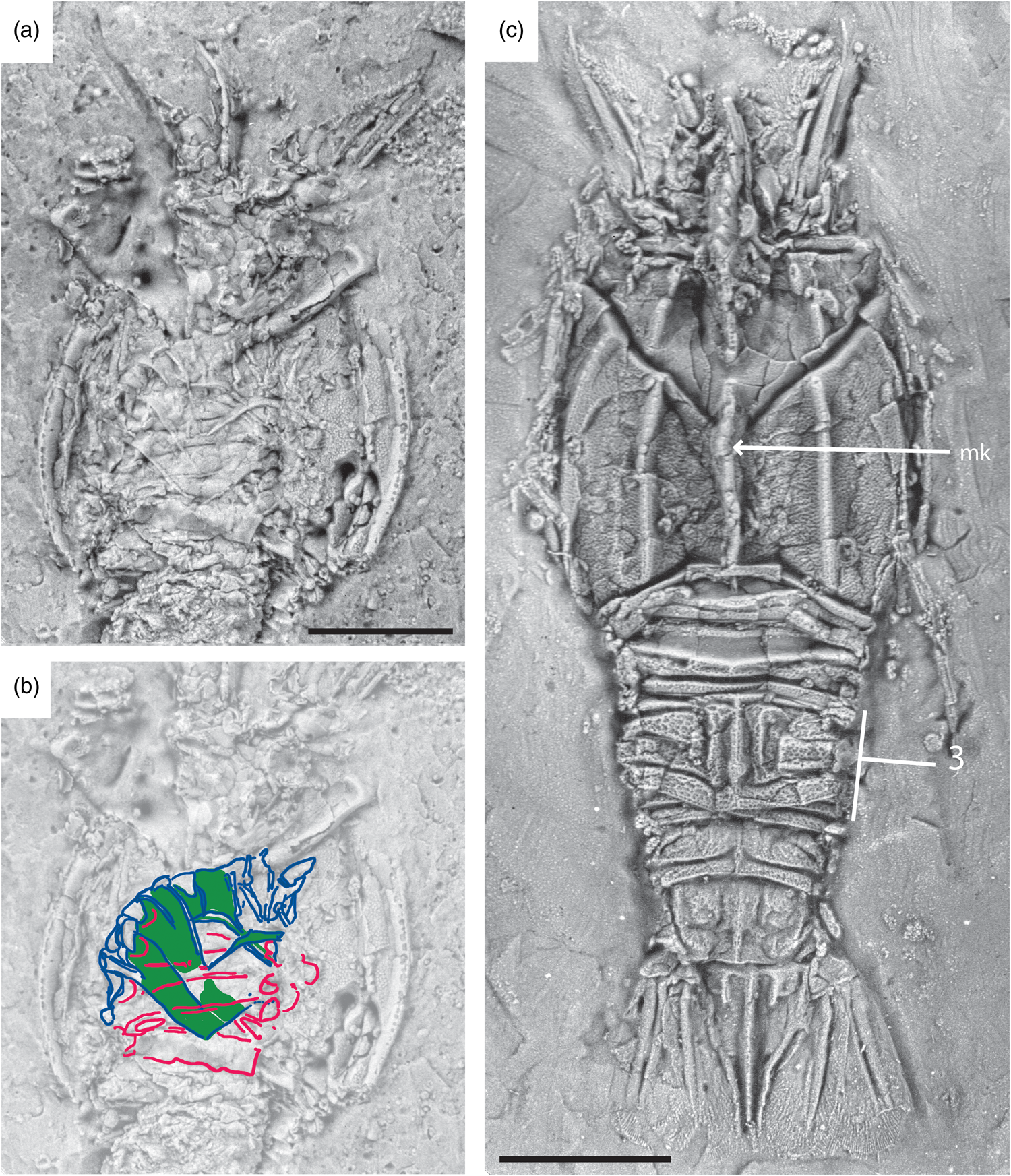
Tealliocaris weegie sp. nov. from Bearsden. (a and b) GLAHM A2407b (paratype) specimen with interpretative sketch of the ‘plates’ (green) at an angle to the thoracic sternites (red). (c) Holotype specimen UCZM I.9430 showing spinose median keel (mk) and third pleomere (3). Scale bars = 5 mm.
Holotype. UCZM I.9430 (Fig. 10c).
Type locality and horizon. Bearsden, Glasgow (UK grid reference: NS 530 732). Shales above the Top Hosie Limestone, Pendleian age.
Paratypes. GLAHM A2407, A2408 from Bearsden.
Additional material. Collected from localities around Glasgow in the Pendleian dark shales above the Top Hosie Limestone (Clark Reference Clark1989). These localities include Bearsden GLAHM: A2403, A2404, A2405, A2406, A2769, A21509; NMS G.1981.63.17; Peel Burn (UK grid reference: NS 519 727) GLAHM 114952, Red Cleugh Burn (UK grid reference: NS 655 784) GLAHM A21499; Hindog Glen (UK grid reference NS 279 511) GLAHM A21510 and East Kilbride (locality unknown) NMS G.1887.25.1033, G.1887.25.1034, G.1887.25.1035, G.1887.25.1036. Material from the East Kilbride locality was first described by Peach (Reference Peach1908).
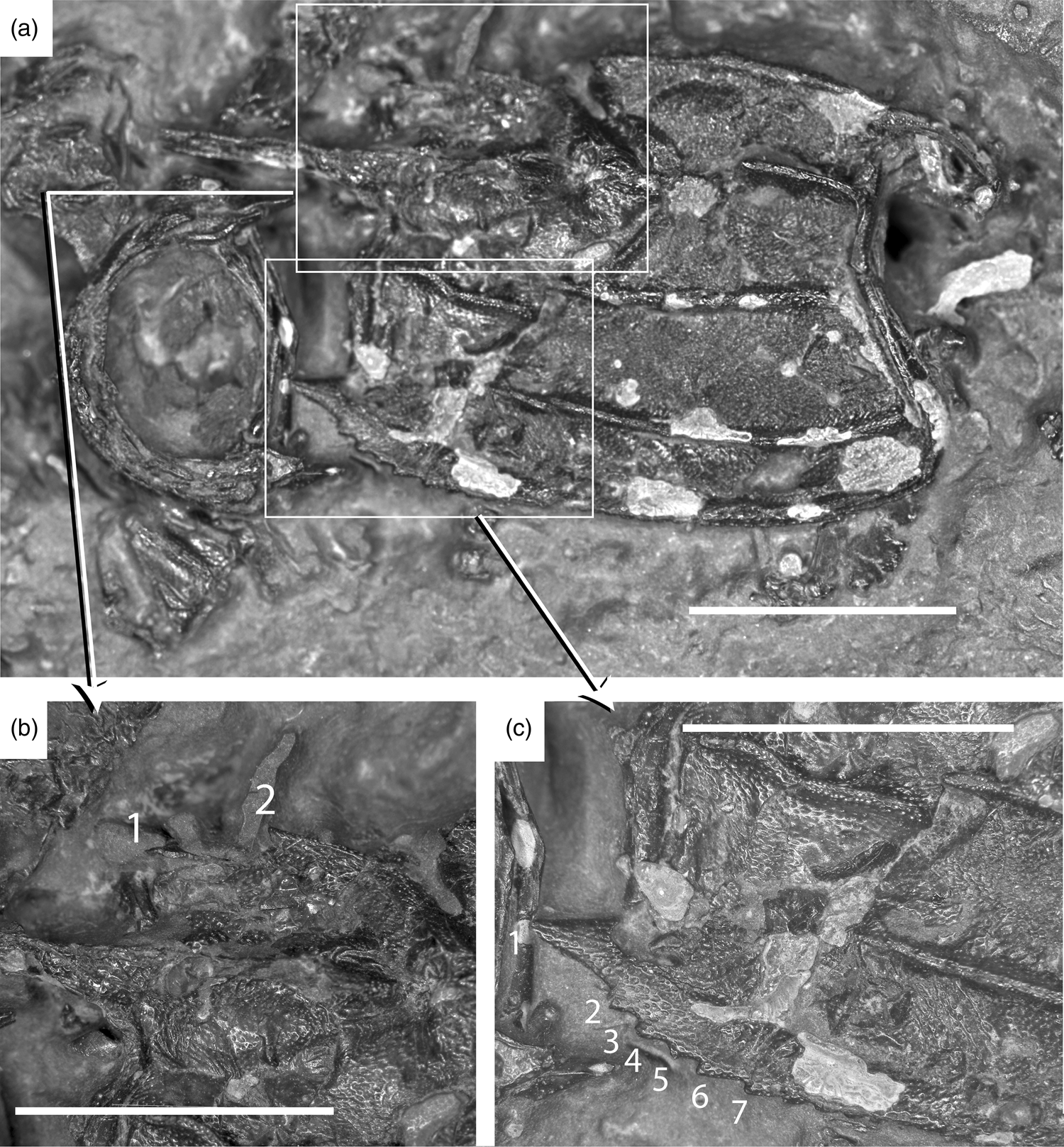
Diagnosis. Six or seven spines on the outer lateral margin of the scaphocerite (Fig. 10a, c), between six and nine spines on the anterolateral edge of the carapace (Fig. 11a, c), spinose median keel of the carapace (Fig. 10c), two transverse grooves on the tergite of the third pleomere (Fig. 10c).
(a) Tealliocaris weegie sp. nov. partial lateral view from Bearsden with details of (b) post-orbital carinae (which appear to terminate anteriorly as spines) and (c) anterolateral spines on the carapace (paratype GLAHM A2408). Scale bars = 5 mm.
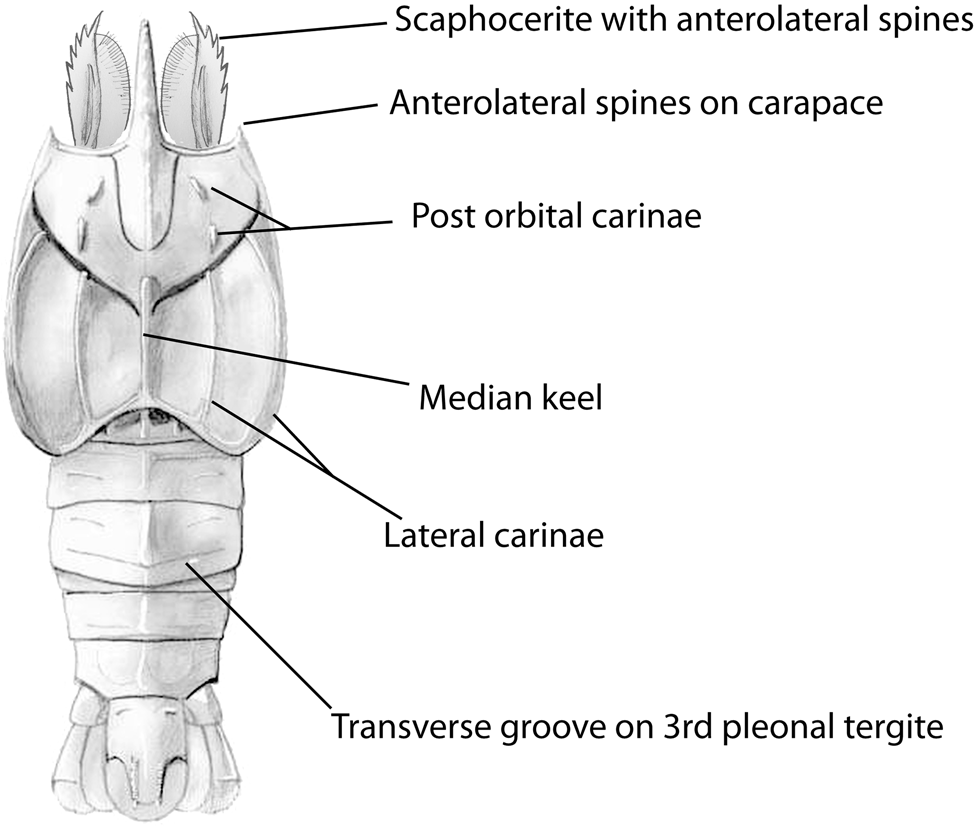
Generalised reconstruction of Tealliocaris showing the position of the important diagnostic characters based on Clark (Reference Clark2013) and Clark et al. (Reference Clark, Gillespie, Morris and Clayton2015).
Remarks. The description given in Clark (Reference Clark2013) was based mostly on the exceptionally well-preserved material used here to identify the new species T. weegie. There were only a few specimens known at that time from Willie's Hole including the lectotype specimen of Schramocaris robusta described herein (Clark Reference Clark2013; Fig. 15). The holotype of T. weegie is chosen as the best-preserved dorsal aspect from Bearsden collected by Stan P. Wood in 1982 (Clark Reference Clark1989; plate 5.2c; Reference Clark2013; plate 2, Fig. 3) (Fig. 10c).
The carapace has paired post-orbital carinae (which appear, in some specimens, to terminate anteriorly as spines) (Figs 10c, 11b) as well as about seven anterolateral spines (Fig. 11c). Six spines also occur on the mediodorsal ridge of the rostrum (Fig. 10c) with a ventral tubercle towards the distal end. The pitting on the surface of the cuticle of T. weegie is marked but represents the tegumental ducts also seen in other species of Tealliocaris after the removal of the fragile epicuticle. There are six to seven spines on the anterolateral margin of the scaphocerites (Fig. 10a, c). The anterior part of the first pleomere has three longitudinal ridges (Fig. 10c) in a similar manner to the other two species of Tealliocaris. On the pleon, the third tergite extends posterodorsally to cover most of the fourth tergite, and the second tergite expands laterally (Fig. 10c). Two lateral oval pores on the third tergite (Clark Reference Clark2013; plate 2, Fig. 2) and sometimes less well preserved on the second, are similar to those seen in the other two species of Tealliocaris. There are two paired pores on the posterior end of the median ridge on the fifth and sixth pleomeres (Fig. 10c). The telson has two lateral spines, a crenulated median ridge with posteriorly directed spines, and six spines on the posterolateral ridges (Fig. 10c).
The specimen used by Jones et al. (Reference Jones, Feldmann, Schram, Schweitzer and Maguire2016) to place Tealliocaris in the Peracarida (GLAHM A2407b) has a series of overlapping plates on the ventral surface of the thorax (Fig. 10a, b). These were suggested by Clark (Reference Clark2013) to be epipods, or gill structures, and by Jones et al. (Reference Jones, Feldmann, Schram, Schweitzer and Maguire2016) as the elements of ‘a distended marsupium’. However, on further examination of the specimen, the overlapping plates are rectangular and similar in structure to the sternites of Tealliocaris or the tergites of an overlying crustacean of a different genus (e.g., Crangopsis), rather than the marsupium (Fig. 10a, b). Another difference between the interpretation of structures of Tealliocaris between Clark (Reference Clark2013) and Jones et al. (Reference Jones, Feldmann, Schram, Schweitzer and Maguire2016) is whether there are lateral furcal lobes of the telson. This was clearly shown not to be the case by Clark (Reference Clark2013; Fig. 12). The other character used by Jones et al. (Reference Jones, Feldmann, Schram, Schweitzer and Maguire2016) to eliminate Tealliocaris from being a decapod crustacean was the lack of endophragmal elements, which they suggest are very fragile and may not preserve well. However, in Clark (Reference Clark2013; Fig. 6) it is possible that the structures associated with the phyllobranchiate gills may represent endophragmal elements, but this is still uncertain. There are only a few examples of Tealliocaris being preserved in full lateral aspect as the pleonic tergites are more often preserved dorso-ventrally, although the carapace is often found preserved laterally.
The first pleonic tergite is not as wide as the subsequent tergites and fits to the shape of the posterior carapace. This was assumed by Clark (Reference Clark2013) to indicate that the pleon was attached to the carapace, but the evidence is circumstantial and it is virtually impossible to state categorically whether a pleon is attached to the carapace, or not, in the fossil record. Due to the uncertainty of the interpretation of the various cuticular structures mentioned above, Tealliocaris is not here assigned to any higher taxon (Table 2).
Characteristics differentiating the species of Tealliocaris including the characters of specimens originally described by Peach (Reference Peach1908) as ‘T. formosa’ and ‘T. tarrasiana’, Clark (Reference Clark1989, Reference Clark2013), Gueriau et al. (Reference Gueriau, Charbonnier and Clement2014) and the current study (T. weegie and T. briggsi).

4. Distribution of Schramocaris and Tealliocaris
Schramocaris is found in what has been interpreted as a mud-dominated shelf deposit within the Avon Group of the Forest of Dean during the marine transgression of the earliest Carboniferous (Waters & Davies Reference Waters, Davies, Brenchley and Rawson2006; Clark et al. Reference Clark, Gillespie, Morris and Clayton2015). These new occurrences suggest that Schramocaris lived in shallow water delta-top lakes with an allochthonous silty coal with plant debris containing the caridoid crustaceans which is overlain by a marine incursion with lingulids at Willie's Hole (Briggs & Clarkson Reference Briggs and Clarkson1989; Cater et al. Reference Cater, Briggs and Clarkson1989) and marginal marine to fully marine at Glencartholm (Cater et al. Reference Cater, Briggs and Clarkson1989). The common theme is that of a marine influence suggesting that Schramocaris may be a marine crustacean, although this has been a difficult trait to define in Carboniferous eumalacostracan crustaceans due to a paucity of localities and poor preservation potential in anything other than the lowest energy environments. Other similar Carboniferous crustaceans, such as Pseudogalathea, also appear to live in the more marine environments, whereas Tealliocaris seems to prefer the lower salinities (Briggs & Clarkson Reference Briggs and Clarkson1985, Reference Briggs and Clarkson1989) although T. etheridgii is found associated with more brackish water or marine organisms at Glencartholm (Schram Reference Schram1979; Clark Reference Clark1989, Reference Clark2013).
Schramocaris appears to have moved northwards with the general marine transgression during the early part of the Tournaisian in southwest England into the middle Tournaisian of southern Scotland (Bennett et al. Reference Bennett, Davies, Leng, Snelling, Millward, Kearsey, Marshall and Reeves2015) and surviving into the Visean in marginal marine low energy environments of the Upper Border Group near Langholm. In the Forest of Dean, Schramocaris is found in a laminated magnesian calcite-rich shale indicative of a nearshore marine environment with periodic evidence of evaporation (Clark et al. Reference Clark, Gillespie, Morris and Clayton2015). The sediments at Glencartholm in which S. clarksoni is found are shallow water near shore marine cementstones with a high organic content and evidence of evaporation with pseudomorphs after gypsum and anhydrite (Cater et al. Reference Cater, Briggs and Clarkson1989; Clark et al. Reference Clark, Miller and Ross2018). Schramocaris robusta from Willie's Hole is found in soft micaceous shales with abundant plant remains (Cater et al. Reference Cater, Briggs and Clarkson1989) in an environment that has been interpreted as freshwater with short-lived marine incursions. Although the species have changed, it appears that Schramocaris as a genus has retained its original environmental tolerance to survive in nearshore low-energy marine conditions (Cater et al. Reference Cater, Briggs and Clarkson1989; Clark et al. Reference Clark, Miller and Ross2018). The variation in the ornamentation of the carinae and keel are the only means of distinguishing between these species, as the variation in the numbers of spines and grooves are in Tealliocaris (Clark Reference Clark2013). The general morphology based on a 12-point landmark analysis of the carapace is indistinguishable intraspecifically, although it is a useful tool for distinguishing between the different genera (Clark et al. Reference Clark, Gillespie, Morris and Clayton2015) as the morphological differences are not taken into account in these analyses. In the case of Schramocaris, however, it appears that the ornamentation is consistent within the different time zones in which the crustacean exists, suggesting that it is more likely an intraspecific rather than an ecophenotypic effect.
The close association of Schramocaris and Tealliocaris at Willie's Hole is unusual. The only other co-occurrence of these genera is at Glencartholm where S. clarksoni is found in the limey cementstone at the base of a 2 m-thick succession that includes T. etheridgii in the overlying calcareous shales, but they are not found together. At Willie's Hole they are found within the same centimetre-thick layer near the base of the plant bed (Fig. 2). This bed has yielded a variety of other fossils including millipedes, a scorpion, ostracods, spinicaudatans, fish (rhizodont and actinopterygian) scales and teeth, tetrapod bones and molluscs (Smithson et al. Reference Smithson, Wood, Marshall and Clack2012; Clack et al. Reference Clack, Bennett, Carpenter, Davies, Fraser, Kearsey, Marshall, Millward, Otoo, Reeves, Ross, Ruta, Smithson, Smithson and Walsh2016; Ross et al. Reference Ross, Edgecombe, Clark, Bennett, Carriò, Contreras-Izquierdo and Crighton2018; Smithson & Clack Reference Smithson and Clack2018; Ross Reference Ross2021). Schramocaris has not yet been found in rocks younger than Visean but Tealliocaris survived into the Pendleian – at least in shales around Glasgow in the UK.
5. Distribution of tealliocaridids
The earliest known tealliocaridids come from the Famenian (Devonian): T. walloniensis of Strud in Belgium (Gueriau et al. Reference Gueriau, Charbonnier and Clement2014) as well as T. palincsari from Jefferson County, Pennsylvania, USA (Schram Reference Schram1988; Jones et al. Reference Jones, Feldmann, Schram, Schweitzer and Maguire2016) and possibly from near Moscow, Russia (Schram Reference Schram1980). All these occurrences are from nearshore brackish environments and suggest that, even at this early stage, tealliocaridids were spreading extensively along the northern margins of the Rheic Ocean (Clark et al. Reference Clark, Miller and Ross2018; Yang et al. Reference Yang, Gueriau, Charbonnier, Ren and Béthoux2018). By the earliest Carboniferous, Schramocaris had spread from Gloucestershire, UK (S. gilljonesorum) into Scotland (S. robusta) and by the Visean is also found in North America (S. matthewi) and Scotland (S. clarksoni) (Clark et al. Reference Clark, Gillespie, Morris and Clayton2015; Clark et al. Reference Clark, Miller and Ross2018). In Scotland, France and North America, several species of Tealliocaris have been recognised from the Visean until the Pendleian (Peach Reference Peach1908; Carpentier Reference Carpentier1913; Copeland Reference Copeland1957; Brooks Reference Brooks1962; Schram Reference Schram1979; Dewey & Fåhræus Reference Dewey and Fåhræus1982; Briggs & Clarkson Reference Briggs and Clarkson1985; Schram Reference Schram1988; Clark Reference Clark2013; Jones et al. Reference Jones, Feldmann, Schram, Schweitzer and Maguire2016). Tealliocaridids were not, however, restricted to the northern margins of the Rheic Ocean, but have also been found in the Late Carboniferous of Ningxia, China across the Palaeotethys Ocean from Euramerica to the North China continental block (Laevitealliocaris xiaheyanensis) (Yang et al. Reference Yang, Gueriau, Charbonnier, Ren and Béthoux2018) and possibly to Gondwana (Turkish examples from Alan Yayla were seen in the Sam Morris collection at the Natural History Museum, London). The ecological environment tolerated by the tealliocaridids ranges from freshwater to marginal marine and includes hypersaline and brackish lagoonal which suggests that they were generalists and may help to explain their spatial range during the Devonian and Carboniferous (Patton & Coutts Reference Patton and Coutts1885; Dewey & Fåhræus Reference Dewey and Fåhræus1982; Briggs & Clarkson Reference Briggs and Clarkson1985; Hesselbo & Trewin Reference Hesselbo and Trewin1984; Cater Reference Cater1987; Cater et al. Reference Cater, Briggs and Clarkson1989; Clark Reference Clark1989, Reference Clark1990, Reference Clark1991; Briggs et al. Reference Briggs, Clark and Clarkson1991; Yang et al. Reference Yang, Gueriau, Charbonnier, Ren and Béthoux2018). Yang et al. (Reference Yang, Gueriau, Charbonnier, Ren and Béthoux2018) suggest that a prolonged pelagic stage may help to explain how the tealliocaridids were able to disperse across the Palaeozoic oceans and thrive in so many different environments. This was also used as supporting evidence that Tealliocaris is a decapod and not a peracarid as first proposed by Peach in 1882 (Clark Reference Clark2013; Yang et al. Reference Yang, Gueriau, Charbonnier, Ren and Béthoux2018), as extant peracarids lack a free-living larval stage and remain in their local environment (Yang et al. Reference Yang, Gueriau, Charbonnier, Ren and Béthoux2018). As suggested by Yang et al. (Reference Yang, Gueriau, Charbonnier, Ren and Béthoux2018), further discoveries of tealliocaridids along the margins of the Palaeotethys Ocean, in places such as Turkey and elsewhere, will help to reinforce the concept of a widely distributed crustacean with a prolonged pelagic stage. Although very small examples of Tealliocaris are known from the Gullane Shrimp-Bed from the Visean of Scotland, they are already in an adult form even at lengths of less than 2 mm (Briggs & Clarkson Reference Briggs and Clarkson1985; Clark Reference Clark2013), similar to the puerulus stage in the Achelata (Gurney Reference Gurney1942).
6. Acknowledgements
The authors thank the reviewers for their constructive comments. This paper is a contribution to the TW:eed Project (TetrapodWorld: early evolution and diversification: www.tetrapods.org) funded by the Natural Environment Research Council (NERC) Consortium Grant ‘The Mid-Palaeozoic biotic crisis: setting the trajectory of tetrapod evolution’, led by the late Professor Jenny Clack (University Museum of Zoology, Cambridge), including National Museums Scotland (NE/J020621/1). The first author (N.D.L.C.) was not funded by this grant.
7. Competing interests
The authors declare there are no competing interests.


 Open access

