





1. Introduction
Let ${\mathbb {T}}^2 = \mathbb {R}^2 / \mathbb {Z}^2$
be the two-dimensional torus being equipped with a
${\mathbb {T}}^2 = \mathbb {R}^2 / \mathbb {Z}^2$
be the two-dimensional torus being equipped with a $C^2$
-smooth global Liouville metric g, that is, having line element
$C^2$
-smooth global Liouville metric g, that is, having line element
 $$ \begin{align} d s^2 = (f_1(x^1) + f_2(x^2)) ((d x^1)^2 + (d x^2)^2), \end{align} $$
where $(x^1,x^2) \in {\mathbb {T}}^2$
are the standard periodic coordinates and
$(x^1,x^2) \in {\mathbb {T}}^2$
are the standard periodic coordinates and $f_1, f_2 \in C^2({\mathbb {T}})$
are positive Morse functions or positive constants and thus ‘non-degenerate’. (Recall that Morse functions on a manifold M are characterized by having no degenerate critical points. They form a dense and open set in
$f_1, f_2 \in C^2({\mathbb {T}})$
are positive Morse functions or positive constants and thus ‘non-degenerate’. (Recall that Morse functions on a manifold M are characterized by having no degenerate critical points. They form a dense and open set in $C^2(M)$
and are thus ‘generic’.) The corresponding geodesic flow (see §1.1) is well known to be integrable and a longstanding folklore conjecture says that Liouville metrics are the only integrable metrics on
$C^2(M)$
and are thus ‘generic’.) The corresponding geodesic flow (see §1.1) is well known to be integrable and a longstanding folklore conjecture says that Liouville metrics are the only integrable metrics on ${\mathbb {T}}^2$
. We emphasize that, in this context, integrability always allows for singularities in the foliation of the phase space of the naturally associated Hamiltonian system, which is made precise in Definition 1.2 below.
${\mathbb {T}}^2$
. We emphasize that, in this context, integrability always allows for singularities in the foliation of the phase space of the naturally associated Hamiltonian system, which is made precise in Definition 1.2 below.
Although the validity of the folklore conjecture appeared conceivable for a long time, there is strong indication for it being false in its very general form, as shown in [Reference Corsi and Kaloshin35]: here, the authors constructed a Hamiltonian counterexample which is locally integrable in a p-cone in the cotangent bundle. This means that, on a fixed energy level, there exists an analytic change of variables, transforming the Hamiltonian with non-Liouville potential to the standard form $(p_1^2 + p_2^2)/2$
but only for
$(p_1^2 + p_2^2)/2$
but only for $p_i$
in a certain cone in
$p_i$
in a certain cone in $\mathbb {R}^2$
(see also Theorem 3.8 below for a more precise statement). However, despite this delicate example, certain suitably weakened conjectures are still believed to be true, which is supported by a variety of partial results obtained in this direction, starting from classical ones by Dini [Reference Dini43], Darboux [Reference Darboux37], and Birkhoff [Reference Birkhoff22] and further developed in [Reference Babenko and Nekhoroshev11, Reference Kiyohara62, Reference Kolokoltsov64]. In particular, several works by Bialy, Mironov [Reference Bialy13, Reference Bialy and Mironov17–Reference Bialy and Mironov19], Denisova, Kozlov, Treshev [Reference Denisova and Kozlov39–Reference Denisova, Kozlov and Treshev42, Reference Kozlov and Treshev70], Mironov [Reference Mironov79], and others [Reference Agapov and Aleksandrov2, Reference Babenko and Nekhoroshev11, Reference Kolokoltsov64, Reference Taimanov87] strongly indicate the validity of the following (yet unproven) conjecture: Every polynomially integrable metric g on
$\mathbb {R}^2$
(see also Theorem 3.8 below for a more precise statement). However, despite this delicate example, certain suitably weakened conjectures are still believed to be true, which is supported by a variety of partial results obtained in this direction, starting from classical ones by Dini [Reference Dini43], Darboux [Reference Darboux37], and Birkhoff [Reference Birkhoff22] and further developed in [Reference Babenko and Nekhoroshev11, Reference Kiyohara62, Reference Kolokoltsov64]. In particular, several works by Bialy, Mironov [Reference Bialy13, Reference Bialy and Mironov17–Reference Bialy and Mironov19], Denisova, Kozlov, Treshev [Reference Denisova and Kozlov39–Reference Denisova, Kozlov and Treshev42, Reference Kozlov and Treshev70], Mironov [Reference Mironov79], and others [Reference Agapov and Aleksandrov2, Reference Babenko and Nekhoroshev11, Reference Kolokoltsov64, Reference Taimanov87] strongly indicate the validity of the following (yet unproven) conjecture: Every polynomially integrable metric g on ${\mathbb {T}}^2$
is of Liouville type. We refer to §3 for details. (See also [Reference Bolsinov, Matveev, Miranda and Tabachnikov24, Reference Burns and Matveev31] for recent surveys on open problems and questions concerning geodesics and integrability of finite-dimensional systems.)
${\mathbb {T}}^2$
is of Liouville type. We refer to §3 for details. (See also [Reference Bolsinov, Matveev, Miranda and Tabachnikov24, Reference Burns and Matveev31] for recent surveys on open problems and questions concerning geodesics and integrability of finite-dimensional systems.)
In this paper, we are concerned with a perturbative version of the folklore conjecture: Let $(g_\varepsilon )_{|\varepsilon | \le \varepsilon _0}$
for some small
$(g_\varepsilon )_{|\varepsilon | \le \varepsilon _0}$
for some small $\varepsilon _0> 0$
be a family of perturbations of
$\varepsilon _0> 0$
be a family of perturbations of $g \equiv g_0$
in the same conformal class (note that on the torus, there exist global isothermal coordinates [Reference Bolsinov and Fomenko26, Ch. 11]) having line-element
$g \equiv g_0$
in the same conformal class (note that on the torus, there exist global isothermal coordinates [Reference Bolsinov and Fomenko26, Ch. 11]) having line-element
 $$ \begin{align} d s^2_\varepsilon = (f_1(x^1) + f_2(x^2) + \varepsilon \unicode{x3bb}(x^1, x^2)) ((d x^1)^2 + (d x^2)^2), \end{align} $$
where $\unicode{x3bb} \in C^2({\mathbb {T}}^2)$
is assumed to be a Morse function (or constant) and have an absolutely convergent Fourier series. We will assume that the perturbed family
$\unicode{x3bb} \in C^2({\mathbb {T}}^2)$
is assumed to be a Morse function (or constant) and have an absolutely convergent Fourier series. We will assume that the perturbed family $g_\varepsilon $
remains integrable, meaning that within the foliation of the phase space for the unperturbed Liouville metric in equation (1.1), the deformation in equation (1.2) preserves sufficiently many rational invariant tori (see Assumption (P) below for a precise formulation of our requirement on the preservation of these tori). Then we obtain that
$g_\varepsilon $
remains integrable, meaning that within the foliation of the phase space for the unperturbed Liouville metric in equation (1.1), the deformation in equation (1.2) preserves sufficiently many rational invariant tori (see Assumption (P) below for a precise formulation of our requirement on the preservation of these tori). Then we obtain that $\unicode{x3bb} $
is necessarily separable in a sum of two single-valued functions, that is,
$\unicode{x3bb} $
is necessarily separable in a sum of two single-valued functions, that is,

for some $\unicode{x3bb} _1, \unicode{x3bb} _2 \in C^2({\mathbb {T}})$
. Therefore, our main results formulated (somewhat informally) below assert the following.
$\unicode{x3bb} _1, \unicode{x3bb} _2 \in C^2({\mathbb {T}})$
. Therefore, our main results formulated (somewhat informally) below assert the following.
The class of Liouville metrics is deformationally rigid under a fairly wide class of integrable conformal perturbations.
To the best of our knowledge, this is the first instance of a rigidity result for (not necessarily analytically) integrable dynamical systems allowing for singularities in the invariant foliation of the unperturbed system. The precise statements of our main results are given in Theorems 2.2, 2.3, and 2.4 in §2.
Main Results. Let g be a non-degenerate Liouville metric on ${\mathbb {T}}^2$
as in equation (1.1) and assume that the family
${\mathbb {T}}^2$
as in equation (1.1) and assume that the family $(g_\varepsilon )_{|\varepsilon | \le \varepsilon _0}$
of perturbations defined in equation (1.2) remains integrable. Then we have the following.
$(g_\varepsilon )_{|\varepsilon | \le \varepsilon _0}$
of perturbations defined in equation (1.2) remains integrable. Then we have the following.
-
(i) In the case where $f_1, f_2 \equiv \mathrm {const}.$
, then
$\unicode{x3bb} $
is separable.
$f_1, f_2 \equiv \mathrm {const}.$
, then
$\unicode{x3bb} $
is separable. -
(ii) In the case where
$f_1 \equiv \mathrm {const}.$
,
$\unicode{x3bb} $
is a trigonometric polynomial in
$x^2$
, and the relative difference
$\mu _2$
between
$f_2$
and its mean
$\int _{\mathbb {T}} f_2$
, that is,
$\mu _2 := \Vert f_2 - \int _{\mathbb {T}} f_2 \Vert _{C^0} / \int _{\mathbb {T}} f_2$
is small, then
$\unicode{x3bb} $
is separable.If, additionally,
$f_2$
is analytic, we have that
$\unicode{x3bb} $
is separable, irrespective of the size
$\mu _2$
of the fluctuations of
$f_2$
(but only for
$\mu _2$
outside of an exceptional (Lebesgue) null-set). -
(iii) In general, if
$\unicode{x3bb} $
is a trigonometric polynomial and the relative differences
$\mu _i$
,
$i=1,2$
, between the
$f_i$
and their means
$\int _{\mathbb {T}} f_i$
, that is, the
$\mu _i := \Vert f_i - \int _{\mathbb {T}} f_i \Vert _{C^0} / \int _{\mathbb {T}} f_i$
are small, then
$\unicode{x3bb} $
is separable.If, additionally,
$f_i$
is analytic (for one or both
$i = 1, 2$
), we have that
$\unicode{x3bb} $
is separable, irrespective of the size
$\mu _i$
of the fluctuations of
$f_i$
(outside of an exceptional null-set).


It is straightforward to generalize our results to higher dimensional tori ${\mathbb {T}}^d = \mathbb {R}^d / \mathbb {Z}^d$
. To ease notation and make the presentation clearer, we only mention it here and postpone a more detailed discussion to Appendix A.
${\mathbb {T}}^d = \mathbb {R}^d / \mathbb {Z}^d$
. To ease notation and make the presentation clearer, we only mention it here and postpone a more detailed discussion to Appendix A.
Remark 1.1. (Generalization to higher dimensions)
Analogously to equation (1.1), let ${\mathbb {T}}^d$
be equipped with a
${\mathbb {T}}^d$
be equipped with a $C^2$
-smooth global Liouville metric g having line element
$C^2$
-smooth global Liouville metric g having line element
 $$ \begin{align} d s^2 = (f_1(x^1) + \cdots + f_d(x^d)) ((d x^1)^2 + \cdots + (d x^d)^2), \end{align} $$
where $x = (x^1, \ldots , x^d) \in {\mathbb {T}}^d$
are standard periodic coordinates and
$x = (x^1, \ldots , x^d) \in {\mathbb {T}}^d$
are standard periodic coordinates and $f_i \in C^2 ({\mathbb {T}})$
for
$f_i \in C^2 ({\mathbb {T}})$
for $1 \le i \le d$
are positive Morse functions or constants. Again, it is easy to see that the geodesic flow is integrable. Just as in equation (1.2), we now perturb equation (1.3) in the same conformal class by some
$1 \le i \le d$
are positive Morse functions or constants. Again, it is easy to see that the geodesic flow is integrable. Just as in equation (1.2), we now perturb equation (1.3) in the same conformal class by some $\unicode{x3bb} \in C^2({\mathbb {T}}^d)$
having an absolutely convergent Fourier series.
$\unicode{x3bb} \in C^2({\mathbb {T}}^d)$
having an absolutely convergent Fourier series.
Under the assumption that the family of perturbed metrics $(g_\varepsilon )_{|\varepsilon | \le \varepsilon _0}$
remains integrable, we have the following (somewhat informal) rigidity result.
$(g_\varepsilon )_{|\varepsilon | \le \varepsilon _0}$
remains integrable, we have the following (somewhat informal) rigidity result.
Let $f_i \equiv \mathrm {const}.$
for the first
$f_i \equiv \mathrm {const}.$
for the first $0 \le d_{\mathrm {flat}} \le d$
indices, and
$0 \le d_{\mathrm {flat}} \le d$
indices, and $f_j$
be analytic for the last
$f_j$
be analytic for the last $0 \le d_{\mathrm {anlyt}} \le d - d_{\mathrm {flat}}$
indices. Then, if
$0 \le d_{\mathrm {anlyt}} \le d - d_{\mathrm {flat}}$
indices. Then, if $\unicode{x3bb} $
is a trigonometric polynomial in
$\unicode{x3bb} $
is a trigonometric polynomial in $x^k$
for
$x^k$
for $k \in \{d_{\mathrm {flat}} + 1, \ldots , d\}$
, and the relative differences between
$k \in \{d_{\mathrm {flat}} + 1, \ldots , d\}$
, and the relative differences between $f_{d_{\mathrm {flat}} + 1}, \ldots , f_{d - d_{\mathrm {anlyt}}}$
and their mean values are small, we have that
$f_{d_{\mathrm {flat}} + 1}, \ldots , f_{d - d_{\mathrm {anlyt}}}$
and their mean values are small, we have that $\unicode{x3bb} $
is separable, irrespective of size
$\unicode{x3bb} $
is separable, irrespective of size $\mu _j$
of the fluctuations of
$\mu _j$
of the fluctuations of $f_j$
(outside of a null-set).
$f_j$
(outside of a null-set).
This result unifies and generalizes the three separate statements given above. A precise formulation is given in Theorem A.1 in Appendix A.
The present paper is not the first study on rigidity of important integrable systems. In [Reference Avila, De Simoi and Kaloshin10, Reference Kaloshin and Sorrentino60], Avila, de Simoi, Kaloshin and Kaloshin, Sorrentino recently solved both, a deformative and a perturbative version of the famous Birkhoff conjecture concerning integrable billiards in two dimensions. In a nutshell, their result says that a strictly convex domain with integrable billiard dynamics sufficiently close to an ellipse is necessarily an ellipse. This can be viewed as an analogue of the perturbative version of the folklore conjecture formulated above [Reference Kaloshin and Sorrentino61]. More precisely, our main results concerning general $f_i \in C^2({\mathbb {T}})$
are similar—in spirit—to the deformational rigidity for ellipses of small eccentricity (cf.
$f_i \in C^2({\mathbb {T}})$
are similar—in spirit—to the deformational rigidity for ellipses of small eccentricity (cf. $f_1,f_2$
in equation (1.1) having small fluctuations), which has been shown first in [Reference Avila, De Simoi and Kaloshin10], later extended by Huang, Kaloshin, and Sorrentino [Reference Huang, Kaloshin and Sorrentino59] to a local notion of integrability, and finally significantly improved in [Reference Koval66]. The overall strategy pursued in [Reference Avila, De Simoi and Kaloshin10, Reference Huang, Kaloshin and Sorrentino59, Reference Kaloshin and Sorrentino60] also inspired the arguments employed in the present paper.
$f_1,f_2$
in equation (1.1) having small fluctuations), which has been shown first in [Reference Avila, De Simoi and Kaloshin10], later extended by Huang, Kaloshin, and Sorrentino [Reference Huang, Kaloshin and Sorrentino59] to a local notion of integrability, and finally significantly improved in [Reference Koval66]. The overall strategy pursued in [Reference Avila, De Simoi and Kaloshin10, Reference Huang, Kaloshin and Sorrentino59, Reference Kaloshin and Sorrentino60] also inspired the arguments employed in the present paper.
In a more recent work, Arnaud, Massetti, and Sorrentino [Reference Arnaud, Massetti and Sorrentino4] (replacing the earlier preprint [Reference Massetti and Sorrentino74]) studied the rigidity of integrable symplectic twist maps on the $2d$
-dimensional annulus
$2d$
-dimensional annulus ${\mathbb {T}}^d \times \mathbb {R}^d$
. More precisely, they consider one-parameter families
${\mathbb {T}}^d \times \mathbb {R}^d$
. More precisely, they consider one-parameter families $(f_\varepsilon )_{\varepsilon \in \mathbb {R}}$
of symplectic twist maps
$(f_\varepsilon )_{\varepsilon \in \mathbb {R}}$
of symplectic twist maps $f_\varepsilon (x,p) = f_0(x , p + \varepsilon \nabla G(x))$
and prove two main rigidity results. First, in the analytic category for
$f_\varepsilon (x,p) = f_0(x , p + \varepsilon \nabla G(x))$
and prove two main rigidity results. First, in the analytic category for $f_0$
and the perturbation G, if a single rational invariant Lagrangian graph of
$f_0$
and the perturbation G, if a single rational invariant Lagrangian graph of $f_\varepsilon $
exists for infinitely many values of
$f_\varepsilon $
exists for infinitely many values of $\varepsilon $
(e.g., an interval around zero), then G must necessarily be constant. Second, if
$\varepsilon $
(e.g., an interval around zero), then G must necessarily be constant. Second, if $f_0$
is analytic and completely integrable (that is, not plagued with singularities in the invariant foliation of the phase space, see [Reference Bialy and MacKay16, Reference Suris86]), G is of class
$f_0$
is analytic and completely integrable (that is, not plagued with singularities in the invariant foliation of the phase space, see [Reference Bialy and MacKay16, Reference Suris86]), G is of class $C^2$
, and sufficiently (infinitely) many rational invariant Lagrangian graphs of
$C^2$
, and sufficiently (infinitely) many rational invariant Lagrangian graphs of $f_\varepsilon $
persist for small
$f_\varepsilon $
persist for small $\varepsilon \neq 0$
, then G must necessarily be constant. Note that in this second result, the entire phase space is foliated by invariant tori, and the perturbation solely depends on the angle variables of the dynamical system. In this sense, Theorem 2.2 can—morally—be viewed as a special case of the second result in [Reference Arnaud, Massetti and Sorrentino4] (see also [Reference Massetti and Sorrentino74, Theorem 2]), but Theorems 2.3 and 2.4 generalize this statement to more general functional dependencies of the perturbation. Apart from this, our general results (that is, those not concerning analytic functions
$\varepsilon \neq 0$
, then G must necessarily be constant. Note that in this second result, the entire phase space is foliated by invariant tori, and the perturbation solely depends on the angle variables of the dynamical system. In this sense, Theorem 2.2 can—morally—be viewed as a special case of the second result in [Reference Arnaud, Massetti and Sorrentino4] (see also [Reference Massetti and Sorrentino74, Theorem 2]), but Theorems 2.3 and 2.4 generalize this statement to more general functional dependencies of the perturbation. Apart from this, our general results (that is, those not concerning analytic functions $f_i$
) do not require any regularity beyond the standard
$f_i$
) do not require any regularity beyond the standard $C^2$
.
$C^2$
.
As mentioned above, by assuming that the family of metrics $(g_\varepsilon )_{|\varepsilon | \le \varepsilon _0}$
remains integrable, we mean that, in particular, sufficiently many rational invariant tori in an isoenergy manifold of the Hamiltonians associated to the metric by the Maupertuis principle (see §1.2) are preserved. This will be made precise in Assumption (P) below. As we will show, the preservation of an
$(g_\varepsilon )_{|\varepsilon | \le \varepsilon _0}$
remains integrable, we mean that, in particular, sufficiently many rational invariant tori in an isoenergy manifold of the Hamiltonians associated to the metric by the Maupertuis principle (see §1.2) are preserved. This will be made precise in Assumption (P) below. As we will show, the preservation of an $(n,m)$
-rational invariant torus ‘annihilates’ the Fourier coefficients
$(n,m)$
-rational invariant torus ‘annihilates’ the Fourier coefficients $\unicode{x3bb} _{k_1, k_2}$
with indices
$\unicode{x3bb} _{k_1, k_2}$
with indices $(k_1, k_2) \in \{ (n,m)\}^{\perp }$
of
$(k_1, k_2) \in \{ (n,m)\}^{\perp }$
of

or of the corresponding perturbing mechanical potential, denoted by U later on. We already noted that, contrary to items (ii) and (iii), the unperturbed metric in our first result is guaranteed to be completely integrable. Moreover, the perturbation $\unicode{x3bb} $
depends solely on the angular but not the action coordinates of the unperturbed problem. Although the analog of this result for symplectic twist maps in this peculiar setting has already been shown in [Reference Arnaud, Massetti and Sorrentino4, Reference Massetti and Sorrentino74] by methods similar to ours, we reprove it by pursuing an only slightly different but original strategy, which is suitable for certain inevitable modifications for the proofs of the more general statements under items (ii) and (iii). These two cases (corresponding to surfaces of revolution and general Liouville metrics, see §3) build on perturbative estimates for (possibly infinitely many) systems of linear equations for the Fourier coefficients. These are obtained from the first-order term of an expansion in
$\unicode{x3bb} $
depends solely on the angular but not the action coordinates of the unperturbed problem. Although the analog of this result for symplectic twist maps in this peculiar setting has already been shown in [Reference Arnaud, Massetti and Sorrentino4, Reference Massetti and Sorrentino74] by methods similar to ours, we reprove it by pursuing an only slightly different but original strategy, which is suitable for certain inevitable modifications for the proofs of the more general statements under items (ii) and (iii). These two cases (corresponding to surfaces of revolution and general Liouville metrics, see §3) build on perturbative estimates for (possibly infinitely many) systems of linear equations for the Fourier coefficients. These are obtained from the first-order term of an expansion in $\varepsilon $
, somewhat similar to the (subharmonic) Melnikov potential in the Poincaré–Melnikov method [Reference Arnold, Kozlov and Neishtadt8, Reference Guckenheimer and Holmes55, Reference Treshev and Zubelevich91]. Establishing this expansion as well as proving that the resulting systems of linear equations are of full rank requires perturbative estimates on action-angle coordinates and certain basic objects from weak KAM theory [Reference Sorrentino85]. Finally, the extension of our results for analytic functions
$\varepsilon $
, somewhat similar to the (subharmonic) Melnikov potential in the Poincaré–Melnikov method [Reference Arnold, Kozlov and Neishtadt8, Reference Guckenheimer and Holmes55, Reference Treshev and Zubelevich91]. Establishing this expansion as well as proving that the resulting systems of linear equations are of full rank requires perturbative estimates on action-angle coordinates and certain basic objects from weak KAM theory [Reference Sorrentino85]. Finally, the extension of our results for analytic functions $f_i$
beyond the perturbative regime are proven by exploiting the analytic dependence of the linear system on the size
$f_i$
beyond the perturbative regime are proven by exploiting the analytic dependence of the linear system on the size $\mu _i$
of the fluctuations of
$\mu _i$
of the fluctuations of $f_i$
(see Appendix C).
$f_i$
(see Appendix C).
In the remainder of this introduction, we recall basic notions in geometry and dynamical systems, which are frequently used in this paper, and introduce the problem of classifying integrable metrics on Riemannian manifolds, in particular, the torus ${\mathbb {T}}^2$
, as formulated in Questions (Q1) and (Q2) below. In §2, we formulate our main results in Theorems 2.2, 2.3, and 2.4. In §3, we present related existing results and known partial answers on the classification problem for integrable metrics on the torus
${\mathbb {T}}^2$
, as formulated in Questions (Q1) and (Q2) below. In §2, we formulate our main results in Theorems 2.2, 2.3, and 2.4. In §3, we present related existing results and known partial answers on the classification problem for integrable metrics on the torus ${\mathbb {T}}^2$
(a few of which have already been mentioned above) to put our results into context. In §4, we give the proofs of our main results, and, finally, comment on possible generalizations, different approaches, and a list of open problems in §5. As already mentioned above, the precise formulation of our result for higher dimensions is given in Theorem A.1 in Appendix A. A fundamental perturbation theoretic lemma on action-angle coordinates, a concise study on important analyticity properties of these, and a brief overview of the relevant aspects of weak KAM theory are presented in three further appendices.
${\mathbb {T}}^2$
(a few of which have already been mentioned above) to put our results into context. In §4, we give the proofs of our main results, and, finally, comment on possible generalizations, different approaches, and a list of open problems in §5. As already mentioned above, the precise formulation of our result for higher dimensions is given in Theorem A.1 in Appendix A. A fundamental perturbation theoretic lemma on action-angle coordinates, a concise study on important analyticity properties of these, and a brief overview of the relevant aspects of weak KAM theory are presented in three further appendices.
An extended version of this paper containing more details and background can be found at arXiv: 2210.02961.
1.1. Geodesic flow and integrability
Let $(M,g)$
be a (compact)
$(M,g)$
be a (compact) $C^2$
-smooth n-dimensional connected Riemannian manifold without boundary equipped with the Riemannian metric
$C^2$
-smooth n-dimensional connected Riemannian manifold without boundary equipped with the Riemannian metric $g = (g_{ij}(x))_{ij}$
. Geodesics of the given metric g are defined as smooth parameterized curves
$g = (g_{ij}(x))_{ij}$
. Geodesics of the given metric g are defined as smooth parameterized curves $\gamma (t) = (x^1(t), \ldots , x^n(t))$
that are solutions to the system of differential equations
$\gamma (t) = (x^1(t), \ldots , x^n(t))$
that are solutions to the system of differential equations
 $$ \begin{align} \nabla_{\dot{\gamma}} \dot{\gamma} = 0, \end{align} $$
where $\dot {\gamma } = ({d \gamma }/{d t})$
denotes the velocity vector of the curve
$\dot {\gamma } = ({d \gamma }/{d t})$
denotes the velocity vector of the curve $\gamma $
, and
$\gamma $
, and $\nabla $
is the covariant derivative operator related to the Levi–Civita connection associated with the metric g.
$\nabla $
is the covariant derivative operator related to the Levi–Civita connection associated with the metric g.
It is well known that the geodesic equation in equation (1.4) can also be viewed as a Hamiltonian system on the cotangent bundle $T^*M$
, and the geodesics
$T^*M$
, and the geodesics $\gamma $
themselves can be regarded as projections of trajectories of the Hamiltonian system onto M. Therefore, let x and p be natural coordinates on the cotangent bundle
$\gamma $
themselves can be regarded as projections of trajectories of the Hamiltonian system onto M. Therefore, let x and p be natural coordinates on the cotangent bundle $T^*M$
and
$T^*M$
and $\omega = d x \wedge d p$
denote the standard symplectic structure. Then, the Hamiltonian function
$\omega = d x \wedge d p$
denote the standard symplectic structure. Then, the Hamiltonian function $H \in C^2(T^*M)$
is defined as
$H \in C^2(T^*M)$
is defined as
 $$ \begin{align} H(x,p) = \frac{1}{2} \sum_{ij} g^{ij}(x)p_ip_j = \frac{1}{2} \vert p \vert_g^2. \end{align} $$
A trajectory $(x(t),p(t))$
is an integral curve for the Hamiltonian vector field if and only if the following Hamiltonian system of differential equations (written in local coordinates) is satisfied:
$(x(t),p(t))$
is an integral curve for the Hamiltonian vector field if and only if the following Hamiltonian system of differential equations (written in local coordinates) is satisfied:
 $$ \begin{align} \begin{cases} \dot{p}_i =& - \dfrac{\partial H}{\partial x^i}, \\[5pt] \dot{x}^i =& \dfrac{\partial H}{\partial p_i}. \end{cases} \end{align} $$
In view of this connection to Hamiltonian dynamics, it is natural to ask for a classification of Riemannian manifolds $(M,g)$
, for which the geodesic equations in equation (1.4) can be solved explicitly. More precisely, we can formulate the following questions.
$(M,g)$
, for which the geodesic equations in equation (1.4) can be solved explicitly. More precisely, we can formulate the following questions.
-
(Q1) On which manifolds do there exist Riemannian metrics whose (co-)geodesic flow is integrable?
-
(Q2) Given such a manifold, how does one characterize the class of metrics with integrable geodesic flow?
Clearly, the answers and their complexity hinge on the notion of integrability for the Hamiltonian system (see §3). In this paper, we will be concerned with the standard notion, that is, Liouville integrability, which we recall for the readers convenience.
Definition 1.2. The geodesic flow on $(M,g)$
is called Liouville integrable if there exist n functions
$(M,g)$
is called Liouville integrable if there exist n functions $F_1,\ldots ,F_n \in C^2(T^*M)$
(called first integrals) that are:
$F_1,\ldots ,F_n \in C^2(T^*M)$
(called first integrals) that are:
-
(i) functionally independent on
$T^{\kern-0.1pt*}M$
, that is, the vector fields
$X_{F_1}\kern-0.3pt(x,\kern-0.3ptp)\kern-0.1pt, \ldots ,\kern-0.3pt X_{F_n}\kern-0.3pt(x\kern-0.3pt,\kern-0.3pt p\kern-0.5pt)$
are linear independent in
$T_{(x,p)}(T^*M)$
for all
$(x,p) \in \mathcal {M} \subset T^*M$
, where
$\mathcal {M}$
is some open and everywhere dense set of full measure (cf. the restriction to Morse functions); -
(ii) pairwise in involution, that is,
$$ \begin{align*} \{F_k,F_l\} := \omega(X_{F_k},X_{F_l}) = \sum_{i} \bigg(\frac{\partial F_k}{\partial x^i} \frac{\partial F_l}{\partial p_i} - \frac{\partial F_k}{\partial p_i} \frac{\partial F_l}{\partial x^i}\bigg) = 0. \end{align*} $$


Whenever the geodesic flow on $(M,g)$
is Liouville integrable, we call g an integrable metric on M. Moreover, we call the Hamiltonian system in equation (1.6) (or the corresponding Hamiltonian in equation (1.5) itself) integrable, whenever the associated metric g is integrable on M.
$(M,g)$
is Liouville integrable, we call g an integrable metric on M. Moreover, we call the Hamiltonian system in equation (1.6) (or the corresponding Hamiltonian in equation (1.5) itself) integrable, whenever the associated metric g is integrable on M.
Remark 1.3. Whenever the first integrals $F_1, \ldots , F_n$
can be chosen to be functions that are polynomially in the momentum variables, the metric is often called polynomially integrable or algebraically integrable. If we aim at indicating the order of the polynomial, we speak of linearly/quadratically/… integrable metrics.
$F_1, \ldots , F_n$
can be chosen to be functions that are polynomially in the momentum variables, the metric is often called polynomially integrable or algebraically integrable. If we aim at indicating the order of the polynomial, we speak of linearly/quadratically/… integrable metrics.
Remark 1.4. Note that since one can always choose $H=F_1$
as a first integral for the geodesic flow, the question of integrability for one-dimensional manifolds is completely answered. Therefore, the simplest manifolds, for which the answers to Questions (Q1) and (Q2) are non-trivial, are two-dimensional.
$H=F_1$
as a first integral for the geodesic flow, the question of integrability for one-dimensional manifolds is completely answered. Therefore, the simplest manifolds, for which the answers to Questions (Q1) and (Q2) are non-trivial, are two-dimensional.
In this work, we are mainly concerned with a characterization of integrable metrics in the sense of Question (Q2) for the two-dimensional torus ${\mathbb {T}}^2$
. In this case, the largest known class of such metrics g are so-called Liouville metrics, where the line element takes the form in equation (1.1) in appropriate global coordinates
${\mathbb {T}}^2$
. In this case, the largest known class of such metrics g are so-called Liouville metrics, where the line element takes the form in equation (1.1) in appropriate global coordinates $(x^1, x^2)$
, and where
$(x^1, x^2)$
, and where $f_1$
and
$f_1$
and $f_2$
are sufficiently regular positive periodic functions. See §3.2 for more details.
$f_2$
are sufficiently regular positive periodic functions. See §3.2 for more details.
1.2. Maupertuis principle
To approach Questions (Q1) and (Q2), we will use the Maupertuis principle (see, e.g., [Reference Bolsinov, Kozlov and Fomenko28]): for a compact Riemannian manifold, $(M,g)$
, let
$(M,g)$
, let
 $$ \begin{align} H(x,p) = \frac{1}{2}\sum_{ij} g^{ij}(x)p_ip_j - V(x) \end{align} $$
be a natural mechanical Hamiltonian function on $T^*M$
, where
$T^*M$
, where $V \in C^2(M)$
denotes some potential function. Moreover, let
$V \in C^2(M)$
denotes some potential function. Moreover, let $T_h = \{ H(x,p) = h\}$
be an isoenergy submanifold for some
$T_h = \{ H(x,p) = h\}$
be an isoenergy submanifold for some $h> - \min _x V(x)$
and note that
$h> - \min _x V(x)$
and note that $T_h$
is also an isoenergy submanifold for another system with Hamiltonian function
$T_h$
is also an isoenergy submanifold for another system with Hamiltonian function
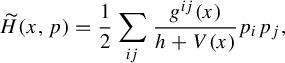 $$ \begin{align*} \widetilde{H}(x,p) = \frac{1}{2}\sum_{ij} \frac{g^{ij}(x)}{h+V(x)}p_ip_j, \end{align*} $$
that is, $T_h = \{\widetilde {H}(x,p) = 1\}$
. Now, the Maupertuis principle states that the integral curves for the Hamiltonian vector fields
$T_h = \{\widetilde {H}(x,p) = 1\}$
. Now, the Maupertuis principle states that the integral curves for the Hamiltonian vector fields $X_H$
and
$X_H$
and $X_{\widetilde {H}}$
on the fixed isoenergy submanifold
$X_{\widetilde {H}}$
on the fixed isoenergy submanifold $T_h$
coincide. Moreover, if there exists an additional first integral F for H on
$T_h$
coincide. Moreover, if there exists an additional first integral F for H on $T_h$
, then there also exists a first integral
$T_h$
, then there also exists a first integral $\tilde {F}$
for
$\tilde {F}$
for $\widetilde {H}$
on the whole of
$\widetilde {H}$
on the whole of $T^*M$
(except, potentially, at the zero section). Finally, note that the vector field
$T^*M$
(except, potentially, at the zero section). Finally, note that the vector field $X_{\widetilde {H}}$
gives rise to the geodesic flow of the Riemannian metric
$X_{\widetilde {H}}$
gives rise to the geodesic flow of the Riemannian metric $\widetilde {g}$
with
$\widetilde {g}$
with
 $$ \begin{align} \widetilde{g}_{ij}(x) = (h+V(x))g_{ij}(x), \end{align} $$
which is the correspondence between Hamiltonian systems and geodesic flows we will use.
2. Main results
The main results of this paper are rigidity results in the sense of Question (Q2) for classes of integrable metrics on the two-torus $\mathbb {T}^2 = \mathbb {R}^2 /\Gamma $
, initially equipped with the flat metric, and hence obtained by a Hamiltonian defined on
$\mathbb {T}^2 = \mathbb {R}^2 /\Gamma $
, initially equipped with the flat metric, and hence obtained by a Hamiltonian defined on $T^*{\mathbb {T}}^2$
by means of the Maupertuis principle. In general,
$T^*{\mathbb {T}}^2$
by means of the Maupertuis principle. In general, $\Gamma \subset \mathbb {R}^2$
is an arbitrary lattice, but we focus on the case
$\Gamma \subset \mathbb {R}^2$
is an arbitrary lattice, but we focus on the case $\Gamma = \mathbb {Z}^2$
here. We define the Hamiltonian function
$\Gamma = \mathbb {Z}^2$
here. We define the Hamiltonian function
 $$ \begin{align} H_0(x,p) = \frac{p_1^2}{2}+\frac{p_2^2}{2} - \mu_1\, V_1(x^1) - \mu_2 \, V_2(x^2) \end{align} $$
on $T^*\mathbb {T}^2$
, where
$T^*\mathbb {T}^2$
, where $\mu _i \in [0,\infty )$
are parameters, and
$\mu _i \in [0,\infty )$
are parameters, and $V_i \in C^2(\mathbb {T})$
with
$V_i \in C^2(\mathbb {T})$
with $V_i \ge 0$
and
$V_i \ge 0$
and $\Vert V_i \Vert _{C^0} \le \mathcal {C}_i$
are Morse functions (or constant). We may assume without loss of generality that
$\Vert V_i \Vert _{C^0} \le \mathcal {C}_i$
are Morse functions (or constant). We may assume without loss of generality that $\min _{x^i} V_i(x^i) = 0$
. This includes, e.g., the situation of two pendulums, that is,
$\min _{x^i} V_i(x^i) = 0$
. This includes, e.g., the situation of two pendulums, that is, $V_i(x^i) = 1- \cos (2\pi x^i)$
. The torus coordinates are denoted by
$V_i(x^i) = 1- \cos (2\pi x^i)$
. The torus coordinates are denoted by $x = (x^1,x^2) \in \mathbb {T}^2$
and the conjugate coordinate pairs are
$x = (x^1,x^2) \in \mathbb {T}^2$
and the conjugate coordinate pairs are $(x^1,p_1)$
and
$(x^1,p_1)$
and $(x^2,p_2)$
. By the Maupertuis principle, for fixed
$(x^2,p_2)$
. By the Maupertuis principle, for fixed $e>0$
, the Hamiltonian flow on the isoenergy manifold
$e>0$
, the Hamiltonian flow on the isoenergy manifold $T_{e} = \{H_0 = e \}$
coincides with the geodesic flow on
$T_{e} = \{H_0 = e \}$
coincides with the geodesic flow on $\mathbb {T}^2$
with the Liouville metric
$\mathbb {T}^2$
with the Liouville metric $g_{e}$
(see equation (1.1) and §3.2 for more details) having line element
$g_{e}$
(see equation (1.1) and §3.2 for more details) having line element
 $$ \begin{align*} d s^2_e = (e+\mu_1 \, V_1(x^1) +\mu_2 \, V_2(x^2)) ((d x^1)^2 + (d x^2)^2). \end{align*} $$
The system with the Hamiltonian function in equation (2.1) is clearly integrable in the sense of Definition 1.2, since an additional conserved quantity can easily be found as
 $$ \begin{align} F_1(x,p) = \frac{p_1^2}{2} - \mu_1 \, V_1(x^1). \end{align} $$
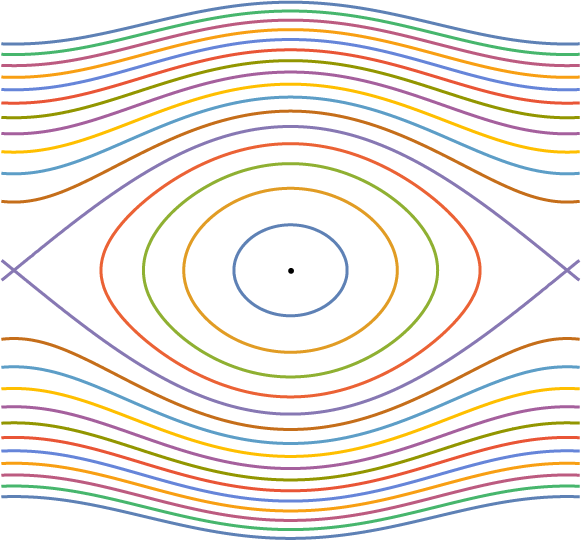
The Liouville foliation of $T_{e}$
has the following qualitative structure that is similar to the phase portrait of the pendulum. The common level surface
$T_{e}$
has the following qualitative structure that is similar to the phase portrait of the pendulum. The common level surface
 $$ \begin{align*} T_{(e,f)} = \{ H_0 = e, \ F_1 = f \} \end{align*} $$
differs in shape, depending on the values of e and f. Recall that $e>0$
and
$e>0$
and $V_i \ge 0$
. If (i)
$V_i \ge 0$
. If (i) $f\in (- \mu _1 \max _{x^1} V_1(x^1), 0)$
and
$f\in (- \mu _1 \max _{x^1} V_1(x^1), 0)$
and $e-f> 0$
,
$e-f> 0$
, $T_{(e,f)}$
is an annulus; if (ii)
$T_{(e,f)}$
is an annulus; if (ii) $f> 0$
and
$f> 0$
and $e-f>0$
,
$e-f>0$
, $T_{(e,f)}$
is a torus; if (iii)
$T_{(e,f)}$
is a torus; if (iii) $f> 0 $
and
$f> 0 $
and $e-f \in (- \mu _2 \max _{x^2} V_2(x^2), 0)$
,
$e-f \in (- \mu _2 \max _{x^2} V_2(x^2), 0)$
, $T_{(e,f)}$
is an annulus. Therefore, if
$T_{(e,f)}$
is an annulus. Therefore, if $V_1$
and
$V_1$
and $V_2$
are both non-constant, the foliation qualitatively exhibits a pendulum-like phase portrait (see Figure 1).
$V_2$
are both non-constant, the foliation qualitatively exhibits a pendulum-like phase portrait (see Figure 1).
Schematic picture of the Liouville foliation of the phase space $T^{*}{\mathbb {T}} \cong {\mathbb {T}} \times \mathbb {R}$
for the classical one-dimensional pendulum system described by the Hamiltonian function
$T^{*}{\mathbb {T}} \cong {\mathbb {T}} \times \mathbb {R}$
for the classical one-dimensional pendulum system described by the Hamiltonian function $H(x,p) = {p^2}/{2} - ( 1- \cos (2 \pi x)).$
The horizontal direction covers slightly more than one period of length one.
$H(x,p) = {p^2}/{2} - ( 1- \cos (2 \pi x)).$
The horizontal direction covers slightly more than one period of length one.
2.1. Definitions and assumptions
Our main results concern perturbations of the Hamiltonian function in equation (2.1) in the class of mechanical systems as
 $$ \begin{align} H_\varepsilon(x,p) = H_0(x,p) + \varepsilon U(x), \end{align} $$
where $\varepsilon \in \mathbb {R}$
and
$\varepsilon \in \mathbb {R}$
and $U \in C^2(\mathbb {T}^2)$
denotes a perturbing potential, which is assumed to be a Morse function (or a constant) and have an absolutely convergent Fourier series:
$U \in C^2(\mathbb {T}^2)$
denotes a perturbing potential, which is assumed to be a Morse function (or a constant) and have an absolutely convergent Fourier series:
 $$ \begin{align*} U(x) = \sum_{k_1 \in \mathbb{Z}} U_{k_1}(x^2) e^{i 2 \pi k_1 x^1 }= \sum_{(k_1,k_2) \in \mathbb{Z}^2} U_{k_1,k_2} e^{i 2\pi (k_1 x^1 + k_2 x^2)}. \end{align*} $$
(Note that in two dimensions, $C^2$
-regularity is not sufficient for ensuring an absolutely convergent Fourier series, although in one dimension it is). In the following, we introduce several subsets of
$C^2$
-regularity is not sufficient for ensuring an absolutely convergent Fourier series, although in one dimension it is). In the following, we introduce several subsets of $\mathbb {Z}^2$
in such a way that their definitions immediately carry over in arbitrary dimension
$\mathbb {Z}^2$
in such a way that their definitions immediately carry over in arbitrary dimension $d \in \mathbb {N}$
(see Remark 1.1). First, we define the spectrum of U, that is, the set of non-vanishing Fourier coefficients, as
$d \in \mathbb {N}$
(see Remark 1.1). First, we define the spectrum of U, that is, the set of non-vanishing Fourier coefficients, as
 $$ \begin{align} \mathcal{S}_U := \{ \boldsymbol{k} = (k_1, k_2) \in \mathbb{Z}^2 : U_{\boldsymbol{k}} \neq 0 \}, \end{align} $$
while the non-singular spectrum is denoted by
 $$ \begin{align} \mathcal{S}_{U,0} := \{ \boldsymbol{k} \in \mathcal{S}_U : \text{ there exists } i \neq j \ \text{such that}\ k_i \cdot k_j \neq 0 \}. \end{align} $$
Moreover, we define the coprime set of the orthogonal complement of $\mathcal {S}_U$
as well as its non-singular subset via
$\mathcal {S}_U$
as well as its non-singular subset via
 $$ \begin{align} \mathcal{B}(\mathcal{S}_U^\perp) := \{ \boldsymbol{b} \in \mathcal{S}_U^\perp : \boldsymbol{b} \ \mathrm{coprime} \} \quad \text{and} \quad \mathcal{B}_0(\mathcal{S}^\perp_U) := \bigg\{ \boldsymbol{b} \in \mathcal{B}(\mathcal{S}^\perp_U) : \prod_i b_i \neq 0 \bigg\}, \end{align} $$
respectively. Note that the orthogonal complement is taken within $\mathbb {Z}^2$
. For the proofs in §4 and the generalization in Appendix A, it is important to observe that for every
$\mathbb {Z}^2$
. For the proofs in §4 and the generalization in Appendix A, it is important to observe that for every $\boldsymbol {k} \in \mathcal {S}_{U,0}$
exists some
$\boldsymbol {k} \in \mathcal {S}_{U,0}$
exists some $\boldsymbol {b} \in \mathcal {B}_0(\mathcal {S}_U^\perp )$
such that
$\boldsymbol {b} \in \mathcal {B}_0(\mathcal {S}_U^\perp )$
such that $\boldsymbol {b} \cdot \boldsymbol {k} = 0$
.
$\boldsymbol {b} \cdot \boldsymbol {k} = 0$
.
Our main results will be formulated under the following assumptions.
Assumptions on the perturbed Hamiltonian function in equation (2.3)
Let $H_0 \in C^2(T^*{\mathbb {T}}^2)$
denote the Hamiltonian function from equation (2.1) with
$H_0 \in C^2(T^*{\mathbb {T}}^2)$
denote the Hamiltonian function from equation (2.1) with $\min V_i = 0$
,
$\min V_i = 0$
, $\Vert V_i \Vert _{C^0} \le \mathcal {C}_i$
and
$\Vert V_i \Vert _{C^0} \le \mathcal {C}_i$
and $\mu _i \in [0,\tilde {\mu }_i]$
for some
$\mu _i \in [0,\tilde {\mu }_i]$
for some $\tilde {\mu _i} \in [0,\infty )$
,
$\tilde {\mu _i} \in [0,\infty )$
, $i \in \{1,2\}$
, and U be a perturbing potential as in equation (2.3), which satisfies one of the following assumptions.
$i \in \{1,2\}$
, and U be a perturbing potential as in equation (2.3), which satisfies one of the following assumptions.
-
(A1) If
$\tilde {\mu }_1 = \tilde {\mu }_2 = 0$
, we have
$U \in C^2(\mathbb {T}^2)$
. -
(A2) If, without loss of generality,
$\tilde {\mu }_1 = 0$
and
$\tilde {\mu }_2> 0$
, we have
$U \in C^2(\mathbb {T}^2)$
and there exists
$d^{(2)} \ge 0$
such that (2.7)that is, U is a trigonometric polynomial in the second variable
$$ \begin{align} \mathcal{S}_U \subset \mathbb{Z} \times [-d^{(2)}, d^{(2)}] , \end{align} $$
$x^2$
.
-
(A3) If
$\tilde {\mu }_1, \tilde {\mu }_2> 0$
, we have
$U \in C^2(\mathbb {T}^2)$
and there exist
$d^{(1)}, d^{(2)}\ge 0$
such that (2.8)that is, U is a trigonometric polynomial.
$$ \begin{align} \mathcal{S}_U \subset [- d^{(1)}, d^{(1)}] \times [- d^{(2)}, d^{(2)}], \end{align} $$


We denote the minimum over all $d^{(i)}$
such that equation (2.7) (respectively equation (2.8)) holds as
$d^{(i)}$
such that equation (2.7) (respectively equation (2.8)) holds as $\deg _U^{(i)}$
and call it the i-degree of U. Whenever we refer to one of the Assumptions (A1), (A2), or (A3), we implicitly assume that
$\deg _U^{(i)}$
and call it the i-degree of U. Whenever we refer to one of the Assumptions (A1), (A2), or (A3), we implicitly assume that $H_0 \in C^2(T^*{\mathbb {T}}^2)$
is of the form in equation (2.1).
$H_0 \in C^2(T^*{\mathbb {T}}^2)$
is of the form in equation (2.1).
Note that the assumption on the spectrum in equation (2.4) of U is more restrictive when we include more general potentials $\mu _1 V_1$
and
$\mu _1 V_1$
and $\mu _2 V_2$
in the unperturbed Hamiltonian
$\mu _2 V_2$
in the unperturbed Hamiltonian $H_0$
in equation (2.1).
$H_0$
in equation (2.1).
The following basic proposition is fundamental for the precise formulation of our assumptions concerning preservation of integrability. It rephrases certain aspects of the standard Liouville–Arnold theorem [Reference Arnold7] in our concrete setting using standard notions from weak KAM theory (see Appendix D and its extension in the arXiv: 2210.02961 version of this article).
Proposition 2.1. (Liouville–Arnold theorem and weak KAM theory [Reference Sorrentino85])
Let $H_0 \in C^2(T^*{\mathbb {T}}^2)$
be the Hamiltonian function from equation (2.1).
$H_0 \in C^2(T^*{\mathbb {T}}^2)$
be the Hamiltonian function from equation (2.1).
-
(a) In the region of phase space, where
$f> 0$
as well as
$e - f> 0$
, each of the two connected components of a Liouville torus
$T_{(e, f)}$
(again denoted by
$T_{(e, f)}$
) is a Lipschitz (we will see in Appendix D that
$u_{\boldsymbol {c}} \in C^3({\mathbb {T}}^2)$
, so the regularity of
$T_{(e,f)}$
is in fact
$C^2$
) Lagrangian graph, that is, for a unique cohomology class
$$ \begin{align*} T_{(e, f)} = \{ (x, {\boldsymbol{c}} + \nabla_x u_{{\boldsymbol{c}}}) : x \in {\mathbb{T}}^2\} \end{align*} $$
${\boldsymbol {c}} \in H^1({\mathbb {T}}^2, \mathbb {R}) \cong \mathbb {R}^2$
with
$|c_i|> \sqrt {\mu _i} \mathfrak {c}(V_i)$
and
$u_{\boldsymbol {c}} \in C^{1,1}({\mathbb {T}}^2)$
so we may equivalently write
$T_{(e, f)} \equiv T_{\boldsymbol {c}}$
. Here,
$\mathfrak {c}(V_i):= \int _{0}^{1}\!\! \sqrt {2 \, V_i(x^i)}\,d x^i$
(see Appendix D) and
$C^{1,1}$
denotes the functions in
$C^1$
with Lipschitz derivative. The function
$u_{\boldsymbol {c}} \in C^{1,1}({\mathbb {T}}^2)$
is a classical solution of the Hamilton–Jacobi equation where the left-hand side is Mather’s
$$ \begin{align*} \alpha_{}({\boldsymbol{c}}) = H_0(x, {\boldsymbol{c}} + \nabla_x u_{ {\boldsymbol{c}}}(x)), \end{align*} $$
$\alpha $
-function (see Appendix D).
-
(b) The Hamiltonian flow on
$T_{\boldsymbol {c}}$
is conjugated to a rotation on
${\mathbb {T}}^2$
, that is, there exists a diffeomorphism
$\varphi : {\mathbb {T}}^2 \to T_{\boldsymbol {c}}$
such that
$\varphi ^{-1}\circ \Phi _t^{X_H} \circ \varphi = R_t^{\boldsymbol {\omega }}\ \text {for all } t \in \mathbb {R}$
, where
$R_t^{\boldsymbol {\omega }}: {\mathbb {T}}^2 \to {\mathbb {T}}^2, x \mapsto (x + \boldsymbol {\omega } t\ \mod \mathbb {Z}^2)$
for some rotation vector
$\boldsymbol {\omega } \in \mathbb {R}^2$
.


An invariant Liouville torus $T_{\boldsymbol {c}}$
is called irrational or non-resonant if
$T_{\boldsymbol {c}}$
is called irrational or non-resonant if ${{\boldsymbol {k}}} \cdot \boldsymbol {\omega } \neq 0$
for all
${{\boldsymbol {k}}} \cdot \boldsymbol {\omega } \neq 0$
for all  . If this is not the case, the invariant torus is rational or resonant. For two-dimensional manifolds (and if $\omega _2 \neq 0$
), this can be phrased as a distinction between
$\omega _2 \neq 0$
), this can be phrased as a distinction between $\omega _1/\omega _2 \notin \mathbb {Q}$
and
$\omega _1/\omega _2 \notin \mathbb {Q}$
and $\omega _1/\omega _2 \in \mathbb {Q}$
.
$\omega _1/\omega _2 \in \mathbb {Q}$
.
Assumptions on the preserved integrability of equation (2.3)
Let $H_0 \in C^2(T^*{\mathbb {T}}^2)$
denote the Hamiltonian function from equation (2.1) satisfying one of the Assumptions (A1)–(A3), and U a perturbing potential as in equation (2.3) such that the following statement concerning the perturbed Hamilton–Jacobi equation (HJE):
$H_0 \in C^2(T^*{\mathbb {T}}^2)$
denote the Hamiltonian function from equation (2.1) satisfying one of the Assumptions (A1)–(A3), and U a perturbing potential as in equation (2.3) such that the following statement concerning the perturbed Hamilton–Jacobi equation (HJE):
 $$ \begin{align} \alpha_{\varepsilon}({\boldsymbol{c}}) = H_\varepsilon(x, {\boldsymbol{c}} + \nabla_x u_{\varepsilon, {\boldsymbol{c}}}(x) ) \end{align} $$
as well as the preserved integrability of $H_\varepsilon $
is satisfied.
$H_\varepsilon $
is satisfied.
-
(P) There exists an energy
$e>0$
such that for every
$(n,m) \in \mathcal {B}_0(\mathcal {S}_U^\perp )$
(recall equation (2.6)) and
$\mu _i \in [0,\tilde {\mu }_i]$
,
$i \in \{1,2\}$
, there exists a sequence
$(\varepsilon _k)_{k \in \mathbb {N}}$
with
$\varepsilon _k \neq 0$
but
$\varepsilon _k \to 0$
such that we have the following.-
(i) The resonant torus from Proposition 2.1, characterized by
$\boldsymbol {c} \in H^1({\mathbb {T}}^2, \mathbb {R})$
with (2.10)in the isoenergy submanifold
$$ \begin{align} |c_i|> \sqrt{\mu_i}\, \mathfrak{c}(V_i) \end{align} $$
$T_e$
having rotation vector proportional to
$(n,m)$
, is preserved under the sequence of deformations
$(H_{\varepsilon _k})_{k \in \mathbb {N}}$
.
-
(ii) For
${\boldsymbol {c}} \in H^1({\mathbb {T}}^2, \mathbb {R})$
satisfying equation (2.10), Mather’s
$\alpha $
-function and a solution
$u_{\varepsilon ,{\boldsymbol {c}}}:{\mathbb {T}}^2 \to \mathbb {R}$
of the HJE in equation (2.9) can be expanded to first order in
$\varepsilon $
, that is, (2.11)where
$$ \begin{align} u_{\varepsilon, {\boldsymbol{c}}} = u_{{\boldsymbol{c}}}^{(0)} + \varepsilon u_{ {\boldsymbol{c}}}^{(1)} + \mathcal{O}_{\boldsymbol{c}}(\varepsilon^2)\quad \text{and} \quad \alpha_{\varepsilon} = \alpha^{(0)} + \varepsilon \alpha^{(1)} + \mathcal{O}(\varepsilon^2), \end{align} $$
$u_{{\boldsymbol {c}}}^{(0)} , u_{ {\boldsymbol {c}}}^{(1)} \in C^{1,1}({\mathbb {T}}^2)$
and
$O_{\boldsymbol {c}}(\varepsilon ^2)$
is understood in
$C^{1,1}$
-sense. (Having
$C^1$
-regularity here would be sufficient for our proofs in §4. However, we chose
$C^{1,1}$
-regularity for the formulation of Assumption (P) to be in agreement with the statement from Proposition 2.1(b). More precisely,
$C^{1,1}$
-regularity is kind of a compromise between the true
$C^3$
-regularity of
$u_{\boldsymbol {c}}$
and the required
$C^1$
-regularity of
$u_{\varepsilon , {\boldsymbol {c}}}$
. In addition,
$C^{1,1}$
is the optimal regularity for subsolutions of equation (2.9), which exist, even if the Hamiltonian
$H_\varepsilon $
is not integrable (see [Reference Bernard12, Reference Fathi and Siconolfi46]).)
-


We comment on the validity of assuming Assumption (P) in Remark D.1 in Appendix D. Moreover, we shall also discuss an alternative to equation (2.11) in Remark D.3. Finally, one can easily see from the proofs given in §4 that the condition on a fixed isoenergy manifold $\{ H_\varepsilon = e\}$
can be relaxed to having preservation of invariant tori in isoenergy manifolds characterized by energies
$\{ H_\varepsilon = e\}$
can be relaxed to having preservation of invariant tori in isoenergy manifolds characterized by energies $e \ge e_0$
for some fixed
$e \ge e_0$
for some fixed $e_0> 0$
.
$e_0> 0$
.
Note that the rational invariant tori are the most ‘fragile’ objects of an integrable system as the KAM theorem [Reference Arnold5, Reference Kolmogorov63, Reference Moser80] predicts that general (non-integrable) perturbations preserve only ‘sufficiently irrational’ (Diophantine) invariant tori.
2.2. Results
As mentioned above, our main results in Theorems 2.2, 2.3, and 2.4 concern rigidity of certain deformations of integrable metrics (in the sense of Question (Q2)), which, by means of the Maupertuis principle, correspond to perturbations of the form in equation (2.3). More precisely, under the assumptions formulated above, our results show that the perturbed Hamiltonian function in equation (2.3) has to be of the same general form as the unperturbed Hamiltonian function in equation (2.1). This means that the potential U is separable, that is, there exist $U_1,U_2 \in C^2({\mathbb {T}}^2)$
such that
$U_1,U_2 \in C^2({\mathbb {T}}^2)$
such that
 $$ \begin{align*} U(x) = U_1(x^1) + U_2(x^2). \end{align*} $$
Theorem 2.2. Let $H_\varepsilon $
from equation (2.3) satisfy Assumption (A1) and Assumption (P) for some energy
$H_\varepsilon $
from equation (2.3) satisfy Assumption (A1) and Assumption (P) for some energy $e> 0$
. Then U is separable in a sum of two single-valued functions.
$e> 0$
. Then U is separable in a sum of two single-valued functions.
Put briefly, in view of of the Maupertuis principle, this means that integrable deformations in the same conformal class of a flat metric are Liouville metrics. Now, Theorem 2.3 generalizes Theorem 2.2 to Hamiltonian functions which depend on one toral position variable via a mechanical potential.
Theorem 2.3. Let $H_\varepsilon $
from equation (2.3) satisfy Assumption (A2) and Assumption (P) for some energy
$H_\varepsilon $
from equation (2.3) satisfy Assumption (A2) and Assumption (P) for some energy $e> 0$
. Then the following hold.
$e> 0$
. Then the following hold.
-
(a) If
$\tilde {\mu }_2 = \tilde {\mu }_2(\mathcal {C}_2, \deg _U^{(2)}, e)>0$
is small enough (see Lemma 4.2), we have that U is separable in a sum of two single-valued functions. -
(b) If, additionally,
$V_2$
is analytic, then U is separable, irrespective of
$\tilde {\mu }_2> 0$
, but only for
$\mu _2 \in [0,\tilde {\mu }_2]$
outside of an exceptional null-set.


Therefore, by means of the Maupertuis principle, we infer that integrable deformations in the same conformal class of metrics realizing surfaces of revolution (see §3.2) are Liouville metrics. Finally, Theorem 2.4 generalizes the above results to Hamiltonian functions, which correspond to arbitrary Liouville metrics by means of the Maupertuis principle.
Theorem 2.4. Let $H_\varepsilon $
from equation (2.3) satisfy Assumption (A3) and Assumption (P) for some energy
$H_\varepsilon $
from equation (2.3) satisfy Assumption (A3) and Assumption (P) for some energy $e> 0$
. Then the following hold.
$e> 0$
. Then the following hold.
-
(a) If
$\tilde {\mu }_1 = \tilde {\mu }_1(\mathcal {C}_1, \deg _U^{(1)}, \deg _U^{(2)}, e)>0$
and
$\tilde {\mu }_2 = \tilde {\mu }_2(\mathcal {C}_2, \deg _U^{(1)}, \deg _U^{(2)}, e)>0$
are small enough (see Lemma 4.3), we have that U is separable in a sum of two single-valued functions. -
(b) If, additionally,
$V_2$
is analytic and
$\tilde {\mu }_1 = \tilde {\mu }_1(\mathcal {C}_2, \deg _U^{(1)}, \deg _U^{(2)},e)> 0$
is small enough, then U is separable, irrespective of
$\tilde {\mu }_2> 0$
, but only for
$\mu _2\in [0,\tilde {\mu }_2]$
outside of an exceptional one-dimensional null-set (depending on
$\mu _1 \in [0,\tilde {\mu }_1]$
). -
(c) If both
$V_i$
for
$i = 1, 2$
are analytic, then U is separable, irrespective of
$\tilde {\mu }_1, \tilde {\mu }_2> 0$
, but only for
$(\mu _1, \mu _2)\in [0,\tilde {\mu }_1] \times [0,\tilde {\mu }_2]$
outside of an exceptional two-dimensional null-set.


Our results formulated in Theorems 2.2, 2.3, and 2.4 can each be viewed as a verification of a special case of the following conjecture, saying that ‘(nice) integrable deformations of Liouville metrics are Liouville metrics’.
Conjecture. (Deformational rigidity of Liouville metrics)
Let g be a Liouville metric on ${\mathbb {T}}^2$
and let
${\mathbb {T}}^2$
and let $(g_t)_{t \in [0,1]}$
with
$(g_t)_{t \in [0,1]}$
with $g_0 = g$
be a deformation that preserves all rational invariant tori (except finitely many). Then
$g_0 = g$
be a deformation that preserves all rational invariant tori (except finitely many). Then $g_t$
is a Liouville metric for all
$g_t$
is a Liouville metric for all $t \in [0,1]$
.
$t \in [0,1]$
.
This conjecture is in strong analogy to the perturbative Birkhoff conjecture for integrable billiards, which is discussed in §3.4 below.
3. Literature review: integrable metrics on the torus
As pointed out in §1.1, integrability of metrics on one-dimensional manifolds is not questionable and the first non-trivial examples occur whenever M has dimension two. Recall from Definition 1.2 that integrability of metrics on two-dimensional manifolds requires the existence of only one additional first integral (beside the Hamiltonian).
3.1. Topological obstructions
The following theorem due to Kozlov [Reference Kozlov68, Reference Kozlov69] (see [Reference Bialy15] for a strengthened version of this result) categorizes two-dimensional compact manifolds regarding the possibility to endow them with an integrable metric (see Question (Q1)).
Theorem 3.1. (Kozlov [Reference Kozlov68, Reference Kozlov69])
Let M be a two-dimensional compact and real-analytic manifold that is endowed with a real-analytic Riemannian metric g. If the Euler characteristic $\chi _M$
of M is negative, then there exists no other non-trivial real-analytic first integral.
$\chi _M$
of M is negative, then there exists no other non-trivial real-analytic first integral.
A result similar to Theorem 3.1 holds for polynomially integrable geodesic flows.
Theorem 3.2. (Kolokoltsov [Reference Kolokoltsov64])
There exist no polynomially integrable geodesic flow on a closed two-dimensional Riemannian manifold M with negative Euler characteristic $\chi _M$
.
$\chi _M$
.
Recall that any two-dimensional compact manifold M can be represented either as the sphere with handles or the sphere with Möbius strips, in the orientable and non-orientable case, respectively. The Euler characteristic $\chi _M$
can be computed as
$\chi _M$
can be computed as
 $$ \begin{align*} \chi_M = 2-2g \quad \text{respectively}\ \chi_M = 2-m, \end{align*} $$
where g is the number of handles (the genus) and m is the number of Möbius strips. To have integrability, the above theorem imposes the condition $\chi _M\ge 0$
on M and we thus know that the number of handles is at most
$\chi _M\ge 0$
on M and we thus know that the number of handles is at most $1$
and the number of Möbius strips is not greater than
$1$
and the number of Möbius strips is not greater than $2$
. Therefore, any real-analytic two-dimensional compact Riemannian manifold
$2$
. Therefore, any real-analytic two-dimensional compact Riemannian manifold $(M,g)$
with real-analytic (or polynomial) additional integral is either the sphere
$(M,g)$
with real-analytic (or polynomial) additional integral is either the sphere $\mathbb {S}^2$
or the torus
$\mathbb {S}^2$
or the torus ${\mathbb {T}}^2$
(in the orientable case), or the projective plane
${\mathbb {T}}^2$
(in the orientable case), or the projective plane $\mathbb {R}\mathbb {P}^2$
or the Klein bottle
$\mathbb {R}\mathbb {P}^2$
or the Klein bottle $\mathbb {K}^2$
(in the non-orientable case). In [Reference Bolsinov and Taimanov29], Bolsinov and Taimanov give a striking example of a real-analytic Riemannian manifold of dimension three, whose geodesic flow has the peculiar property, and that it is smoothly (but not analytically) integrable although it has positive topological entropy [Reference Adler, Konheim and McAndrew1]. The problem of proving (non-)existence of smoothly (but not analytically) integrable geodesic flows on compact surfaces of genus
$\mathbb {K}^2$
(in the non-orientable case). In [Reference Bolsinov and Taimanov29], Bolsinov and Taimanov give a striking example of a real-analytic Riemannian manifold of dimension three, whose geodesic flow has the peculiar property, and that it is smoothly (but not analytically) integrable although it has positive topological entropy [Reference Adler, Konheim and McAndrew1]. The problem of proving (non-)existence of smoothly (but not analytically) integrable geodesic flows on compact surfaces of genus $g> 1$
is widely open (see [Reference Burns and Matveev31]).
$g> 1$
is widely open (see [Reference Burns and Matveev31]).
In this work, we focus on integrable metrics on the torus ${\mathbb {T}}^2$
and refer to works by Bolsinov, Fomenko, Matveev, Kolokoltsov, and others [Reference Bolsinov, Fomenko and Matveev27, Reference Fomenko and Matveev48, Reference Kolokoltsov64, Reference Matveev78, Reference Nguyen, Polyakova and Selivanova81] for studies on integrable metrics on the sphere, the projective plane, and the Klein bottle. See [Reference Bolsinov, Matveev, Miranda and Tabachnikov24, Reference Burns and Matveev31] for recent surveys on open problems, and questions concerning geodesics and integrability of finite-dimensional systems in general.
${\mathbb {T}}^2$
and refer to works by Bolsinov, Fomenko, Matveev, Kolokoltsov, and others [Reference Bolsinov, Fomenko and Matveev27, Reference Fomenko and Matveev48, Reference Kolokoltsov64, Reference Matveev78, Reference Nguyen, Polyakova and Selivanova81] for studies on integrable metrics on the sphere, the projective plane, and the Klein bottle. See [Reference Bolsinov, Matveev, Miranda and Tabachnikov24, Reference Burns and Matveev31] for recent surveys on open problems, and questions concerning geodesics and integrability of finite-dimensional systems in general.
3.2. Linearly and quadratically integrable metrics
The first non-trivial class of integrable metrics on the torus ${\mathbb {T}}^2$
is surfaces of revolution. Consider a two-dimensional surface
${\mathbb {T}}^2$
is surfaces of revolution. Consider a two-dimensional surface $M \subset \mathbb {R}^3$
given by the equation
$M \subset \mathbb {R}^3$
given by the equation $r = r(z)$
in standard cylindrical coordinates
$r = r(z)$
in standard cylindrical coordinates $(r, \varphi , z) \in (0,\infty ) \times [0,2\pi ) \times \mathbb {R}$
. As local coordinates on M, we take z and
$(r, \varphi , z) \in (0,\infty ) \times [0,2\pi ) \times \mathbb {R}$
. As local coordinates on M, we take z and $\varphi $
. In the case where
$\varphi $
. In the case where $r(z)$
is L-periodic and we identify
$r(z)$
is L-periodic and we identify $0$
and L, then M is diffeomorphic to the torus
$0$
and L, then M is diffeomorphic to the torus ${\mathbb {T}}^2$
and the Riemannian metric induced on M by the Euclidean metric on
${\mathbb {T}}^2$
and the Riemannian metric induced on M by the Euclidean metric on $\mathbb {R}^3$
has line element
$\mathbb {R}^3$
has line element
 $$ \begin{align} d s^2 = (1+r'(z)^2) d z^2 + r(z)^2 d \varphi^2. \end{align} $$
Since the corresponding Hamiltonian function in equation (1.5) is independent of $\varphi $
, its associated momentum variable
$\varphi $
, its associated momentum variable $p_\varphi $
is an additional first integral and thus the metric in equation (3.1) is integrable. Note that the additional first integral is linear in the momentum variables.
$p_\varphi $
is an additional first integral and thus the metric in equation (3.1) is integrable. Note that the additional first integral is linear in the momentum variables.
As discussed earlier, a Riemannian metric g on ${\mathbb {T}}^2$
is called a Liouville metric, whenever its line element can be written in the form in equation (1.1) in appropriate global coordinates
${\mathbb {T}}^2$
is called a Liouville metric, whenever its line element can be written in the form in equation (1.1) in appropriate global coordinates $(x^1, x^2)$
, and where
$(x^1, x^2)$
, and where $f_1$
and
$f_1$
and $f_2$
are smooth positive periodic functions. The corresponding Hamiltonian function in equation (1.5) is given by
$f_2$
are smooth positive periodic functions. The corresponding Hamiltonian function in equation (1.5) is given by
 $$ \begin{align*} H(x^1,x^2,p_1,p_2) = \frac{p_1^2 + p_1^2}{2 (f_1(x^1)+f_2(x^2))} \end{align*} $$
and an additional first integral can easily be obtained as
 $$ \begin{align*} F(x^1,x^2,p_1,p_2) = p_1^2 - f_1(x^1) H(x^1,x^2,p_1,p_2). \end{align*} $$
Therefore, clearly, also Liouville metrics are integrable. Note that the additional first integral F is quadratic in the momentum variables. It is not hard to see that a surface of revolution is just a particular case of a Liouville metric, where one can choose, e.g., $f_2 \equiv 0$
, by employing a simple change of variables.
$f_2 \equiv 0$
, by employing a simple change of variables.
The following proposition also provides the converse to the observation that surfaces of revolution and Liouville metrics admit additional first integrals which are linear and quadratic in the momenta, respectively. It collects several statements that have been proven in early works by Dini [Reference Dini43], Darboux [Reference Darboux37], and Birkhoff [Reference Birkhoff22], and were further developed by Babenko and Nekhoroshev [Reference Babenko and Nekhoroshev11], Kiyohara [Reference Kiyohara62], Kolokoltsov [Reference Kolokoltsov64], and others.
Proposition 3.3. (Linear and quadratic first integrals [Reference Babenko and Nekhoroshev11, Reference Birkhoff22, Reference Darboux37, Reference Dini43, Reference Kiyohara62, Reference Kolokoltsov64])
-
(a) Let the metric g on
$\mathbb {T}^2$
possess an additional first integral F that is linear in the momenta. Then there exist global periodic coordinates
$(x^1,x^2)$
on the torus such that the line element of g takes the form where f is some positive periodic function and
$$ \begin{align*} d s^2 = f(x^1) (a(d x^1)^2 + c \,d x^1\,d x^2 + b (d x^2)^2), \end{align*} $$
$a,b,c \in \mathbb {R}$
such that the quadratic form
$a\, (d x^1)^2 + c \, d x^1\, d x^2 + b\,(d x^2)^2$
is positive definite.
Conversely, any such metric on the torus
${\mathbb {T}}^2$
admits an additional first integral that is linear in the momentum variables.In case a linear in momenta F exists locally near a point
$q \in {\mathbb {T}}^2$
, then there exists local coordinates
$(x^1,x^2)$
near q such that the line element of g reads
$$ \begin{align*} d s^2 = f(x^1) ((d x^1 )^2+(d x^2)^2). \end{align*} $$
-
(b) A metric g on
${\mathbb {T}}^2$
possess an additional first integral F that is quadratic in the momenta if and only if there exists a finite-sheeted covering
$\pi :\widetilde {{\mathbb {T}}}^2\to {\mathbb {T}}^2$
by another torus, such that the lifted metric
$\widetilde {g} = \pi ^* g$
is globally Liouville, that is, there exist global periodic coordinates
$(x^1,x^2)$
on
$\widetilde {{\mathbb {T}}}^2$
and smooth positive periodic functions
$f_1$
and
$f_2$
such that the line element of
$\widetilde {g}$
takes the form in equation (1.1).There exist Riemannian metrics g on
${\mathbb {T}}^2$
which are not globally Liouville but have an additional first integral that is quadratic in the momentum variables.In case a quadratic in momenta F exists locally near a point
$q \in {\mathbb {T}}^2$
, then there exist local coordinates
$(x^1,x^2)$
near q such that the line element of g takes the form in equation (1.1).


This classical result completely characterizes the integrable metrics g on ${\mathbb {T}}^2$
that admit an additional first integral that is linear or quadratic in the momentum variables. Similar results hold for Riemannian metrics on general two-dimensional manifolds [Reference Bolsinov, Fomenko and Matveev27, Reference Fomenko and Matveev48, Reference Kolokoltsov64, Reference Nguyen, Polyakova and Selivanova81].
${\mathbb {T}}^2$
that admit an additional first integral that is linear or quadratic in the momentum variables. Similar results hold for Riemannian metrics on general two-dimensional manifolds [Reference Bolsinov, Fomenko and Matveev27, Reference Fomenko and Matveev48, Reference Kolokoltsov64, Reference Nguyen, Polyakova and Selivanova81].
3.3. Polynomially integrable metrics of higher degree
In the case of a sphere $\mathbb {S}^2$
, one can easily construct examples of metrics which admit an additional first integral that is cubic respectively quartic in the momentum variables. Using the Maupertuis principle, these can be obtained from the metrics constructed from Goryachev and Chaplygin [Reference Chaplygin33, Reference Goryachev54], and Kovaleskaya [Reference Kovalevskaya67] in the situation of the dynamics of a rigid body. Therefore, let
$\mathbb {S}^2$
, one can easily construct examples of metrics which admit an additional first integral that is cubic respectively quartic in the momentum variables. Using the Maupertuis principle, these can be obtained from the metrics constructed from Goryachev and Chaplygin [Reference Chaplygin33, Reference Goryachev54], and Kovaleskaya [Reference Kovalevskaya67] in the situation of the dynamics of a rigid body. Therefore, let $h>1$
be large enough (cf. equation (1.8)) and define the metrics
$h>1$
be large enough (cf. equation (1.8)) and define the metrics $g_3$
and
$g_3$
and $g_4$
on
$g_4$
on $\mathbb {R}^3$
via their respective line elements
$\mathbb {R}^3$
via their respective line elements
 $$ \begin{align*} d s^2_3 = \frac{h-x^1}{4} \, \frac{(d x^1)^2 + (d x^2)^2 + 4 (d x^3)^2}{(x^1)^2 + (x^2)^2 + (x^3)^2/4}, \quad d s^2_4 = \frac{h-x^1}{2} \, \frac{(d x^1)^2 + (d x^2)^2 + 2 (d x^3)^2}{(x^1)^2 + (x^2)^2 + (x^3)^2/2}. \end{align*} $$
By restriction of $g_3$
and
$g_3$
and $g_4$
to the unit sphere
$g_4$
to the unit sphere $\mathbb {S}^2 \subset \mathbb {R}^3$
, the resulting metrics admit an additional first integral that is cubic respectively quartic in the momentum variables. It was shown by Bolsinov, Fomenko, and Kozlov [Reference Bolsinov and Fomenko25, Reference Bolsinov, Kozlov and Fomenko28] that these cannot be reduced to first integrals that are polynomially in the momentum variables of a lower degree, that is, they are not linearly or quadratically integrable. Since all attempts to construct such examples for the case of the torus have failed so far, the following folklore conjecture emerged.
$\mathbb {S}^2 \subset \mathbb {R}^3$
, the resulting metrics admit an additional first integral that is cubic respectively quartic in the momentum variables. It was shown by Bolsinov, Fomenko, and Kozlov [Reference Bolsinov and Fomenko25, Reference Bolsinov, Kozlov and Fomenko28] that these cannot be reduced to first integrals that are polynomially in the momentum variables of a lower degree, that is, they are not linearly or quadratically integrable. Since all attempts to construct such examples for the case of the torus have failed so far, the following folklore conjecture emerged.
Folklore Conjecture. Liouville metrics are the only integrable metrics on ${\mathbb {T}}^2$
.
${\mathbb {T}}^2$
.
In this general form, there is strong indication for the conjecture being false, as to be shown below (see Theorem 3.8). We will, however, provide existing results, which indicate that a certain weaker version of this conjecture, also formulated below, is indeed true.
It was proven by Korn and Lichtenstein [Reference Korn65, Reference Lichtenstein71] that on every point on a two-dimensional Riemannian manifold $(M,g)$
, there exist locally isothermal coordinates, that is, locally, the line element takes the form
$(M,g)$
, there exist locally isothermal coordinates, that is, locally, the line element takes the form
 $$ \begin{align} d s^2 = \unicode{x3bb}(x^1,x^2) ((d x^1)^2 + (d x^2)^2), \end{align} $$
where $\unicode{x3bb} $
is some smooth positive function. In the case of a torus, it can be shown (by virtue of the uniformization theorem) that there exist global isothermal coordinates (not necessarily periodic), so the metric g is conformal equivalent to the Euclidean metric
$\unicode{x3bb} $
is some smooth positive function. In the case of a torus, it can be shown (by virtue of the uniformization theorem) that there exist global isothermal coordinates (not necessarily periodic), so the metric g is conformal equivalent to the Euclidean metric $g_{\mathrm {eucl}}$
. In particular, assuming that
$g_{\mathrm {eucl}}$
. In particular, assuming that $(x^1,x^2)$
are just the angular coordinates on the torus
$(x^1,x^2)$
are just the angular coordinates on the torus ${\mathbb {T}}^2$
and in the special case of
${\mathbb {T}}^2$
and in the special case of $\unicode{x3bb} $
being a trigonometric polynomial (this means that the spectrum
$\unicode{x3bb} $
being a trigonometric polynomial (this means that the spectrum $\mathcal {S}_\unicode{x3bb} $
defined in equation (2.4) is bounded), we have the following result due to Denisova and Kozlov.
$\mathcal {S}_\unicode{x3bb} $
defined in equation (2.4) is bounded), we have the following result due to Denisova and Kozlov.
Theorem 3.4. (Denisova and Kozlov [Reference Denisova and Kozlov39])
Let $\unicode{x3bb} $
from equation (3.2) be a trigonometric polynomial and assume that the geodesic flow on
$\unicode{x3bb} $
from equation (3.2) be a trigonometric polynomial and assume that the geodesic flow on ${\mathbb {T}}^2$
is polynomially integrable. Then there exists an additional polynomial first integral of degree at most two.
${\mathbb {T}}^2$
is polynomially integrable. Then there exists an additional polynomial first integral of degree at most two.
Note that by Weierstrass’s theorem, any conformal factor $\unicode{x3bb} $
can be approximated as closely as required by a trigonometric polynomial. However, in the case of a general conformal factor
$\unicode{x3bb} $
can be approximated as closely as required by a trigonometric polynomial. However, in the case of a general conformal factor $\unicode{x3bb} $
, there is the following theorem, again due to Denisova and Kozlov [Reference Denisova and Kozlov40].
$\unicode{x3bb} $
, there is the following theorem, again due to Denisova and Kozlov [Reference Denisova and Kozlov40].
Theorem 3.5. (Denisova and Kozlov [Reference Denisova and Kozlov40])
Assume that the geodesic flow on $({\mathbb {T}}^2, g)$
is polynomially integrable with first integral F of degree n such that:
$({\mathbb {T}}^2, g)$
is polynomially integrable with first integral F of degree n such that:
-
(a) if n is even, then F is an even function of
$p_1$
and
$p_2$
; -
(b) if n is odd, then F is an even function of
$p_1$
(or
$p_2$
) and an odd function of
$p_2$
(or
$p_1$
).


Then there exists an polynomial first integral of degree at most two.
In the following theorem, we collect several results from Bialy [Reference Bialy13], Denisova, Kozlov [Reference Denisova and Kozlov41] and Treshchev [Reference Denisova, Kozlov and Treshev42], Agapov and Aleksandrov [Reference Agapov and Aleksandrov2], and Mironov [Reference Mironov79].
Theorem 3.6. Let H be a natural mechanical Hamiltonian (see equation (1.7)) on the torus ${\mathbb {T}}^2$
equipped with the flat metric
${\mathbb {T}}^2$
equipped with the flat metric $g_{\mathrm {eucl}}$
. Assume that H is polynomially integrable of degree n. If
$g_{\mathrm {eucl}}$
. Assume that H is polynomially integrable of degree n. If $n = 3,4$
, there exists another polynomial first integral of degree at most two. Whenever H is a real-analytic Hamiltonian, this is also true for
$n = 3,4$
, there exists another polynomial first integral of degree at most two. Whenever H is a real-analytic Hamiltonian, this is also true for $n=5$
.
$n=5$
.
Kozlov and Treshchev [Reference Kozlov and Treshev70] considered the problem from yet another point of view. They investigated the case of a mechanical Hamiltonian
 $$ \begin{align*} H = \frac{1}{2} \sum_{ij} a_{ij} p_i p_j + V(x^1, \ldots , x^n), \end{align*} $$
where $A = (a_{ij})_{ij}$
is a positive definite matrix and V is a trigonometric polynomial of
$A = (a_{ij})_{ij}$
is a positive definite matrix and V is a trigonometric polynomial of $(x^1, \ldots , x^n) \in {\mathbb {T}}^n$
. On the one hand, they show that there exist n polynomial first integrals if and only if the spectrum
$(x^1, \ldots , x^n) \in {\mathbb {T}}^n$
. On the one hand, they show that there exist n polynomial first integrals if and only if the spectrum $\mathcal {S}_V$
of V is contained in
$\mathcal {S}_V$
of V is contained in $m \le n$
mutually orthogonal lines meeting at the origin. On the other hand, they showed that whenever there exist n polynomial integrals with independent forms of highest degree, then there exist n independent involutive polynomial first integrals of degree at most two. In the case where
$m \le n$
mutually orthogonal lines meeting at the origin. On the other hand, they showed that whenever there exist n polynomial integrals with independent forms of highest degree, then there exist n independent involutive polynomial first integrals of degree at most two. In the case where $a_{ij} = \delta _{i,j}$
(which can be achieved by diagonalization and scaling), Combot [Reference Combot34] improved the first result from the assumption of polynomial integrability to rational integrability, that is, the additional first integrals being rational functions of
$a_{ij} = \delta _{i,j}$
(which can be achieved by diagonalization and scaling), Combot [Reference Combot34] improved the first result from the assumption of polynomial integrability to rational integrability, that is, the additional first integrals being rational functions of $p_i$
and
$p_i$
and $e^{i 2 \pi x^i}$
. More recently [Reference Heil, Moroianu and Semmelmann57, Reference Sharafutdinov83, Reference Sharafutdinov84], the problem was rephrased in the language of Killing tensor fields on
$e^{i 2 \pi x^i}$
. More recently [Reference Heil, Moroianu and Semmelmann57, Reference Sharafutdinov83, Reference Sharafutdinov84], the problem was rephrased in the language of Killing tensor fields on ${\mathbb {T}}^2$
, where the order of an additional (polynomial) first integral is replaced by the rank of a Killing tensor field.
${\mathbb {T}}^2$
, where the order of an additional (polynomial) first integral is replaced by the rank of a Killing tensor field.
The results of Theorems 3.4, 3.5, and 3.6 support the validity of the following weaker version of the folklore conjecture formulated by Denisova and Kozlov [Reference Denisova and Kozlov39].
Conjecture. [Reference Denisova and Kozlov39]
If g is a metric on ${\mathbb {T}}^2$
that is polynomially integrable, then there exists an additional polynomial first integral of degree at most two.
${\mathbb {T}}^2$
that is polynomially integrable, then there exists an additional polynomial first integral of degree at most two.
By Proposition 3.3, this means that polynomially integrable metrics on ${\mathbb {T}}^2$
are Liouville metrics. However, beside the partial results given above, a proof of this conjecture is still open. The numerous attempts on proving it used methods of complex analysis [Reference Babenko and Nekhoroshev11, Reference Birkhoff22] and the theory of partial differential equations (PDEs) [Reference Bialy and Mironov17, Reference Bialy and Mironov19]. More precisely, it is shown by Kolokoltsov [Reference Kolokoltsov64] that there exists an additional first integral quadratic in the momenta if and only if there exists a holomorphic function
${\mathbb {T}}^2$
are Liouville metrics. However, beside the partial results given above, a proof of this conjecture is still open. The numerous attempts on proving it used methods of complex analysis [Reference Babenko and Nekhoroshev11, Reference Birkhoff22] and the theory of partial differential equations (PDEs) [Reference Bialy and Mironov17, Reference Bialy and Mironov19]. More precisely, it is shown by Kolokoltsov [Reference Kolokoltsov64] that there exists an additional first integral quadratic in the momenta if and only if there exists a holomorphic function $R(z) = R_1(z) +i R_2(z)$
, with real valued
$R(z) = R_1(z) +i R_2(z)$
, with real valued $R_1$
and
$R_1$
and $R_2$
, and
$R_2$
, and $z = x^1+i x^2$
, which solves
$z = x^1+i x^2$
, which solves
 $$ \begin{align} R_2 (\partial_{x^2}^2 \unicode{x3bb} - \partial_{x^1}^2 \unicode{x3bb}) + R_1 (\partial_{x^1} \partial_{x^2} \unicode{x3bb}) - 3 (\partial_{x^1} R_2)( \partial_{x^1} \unicode{x3bb}) +3 (\partial_{x^2} R_2) (\partial_{x^2} \unicode{x3bb}) + 2 (\partial_{x^2}^2 R_2) \unicode{x3bb} = 0, \end{align} $$
where $\unicode{x3bb} $
denotes the conformal factor from equation (3.2). Note that the second term in equation (3.3) disappears whenever
$\unicode{x3bb} $
denotes the conformal factor from equation (3.2). Note that the second term in equation (3.3) disappears whenever $\unicode{x3bb} $
is the conformal factor of a Liouville metric. In this situation, the linear PDE in equation (3.3) always has a holomorphic solution
$\unicode{x3bb} $
is the conformal factor of a Liouville metric. In this situation, the linear PDE in equation (3.3) always has a holomorphic solution $R = R_1+i R_2$
. The existence of first integrals of higher degree turns out to be equivalent to delicate questions about nonlinear PDEs of hydrodynamic type [Reference Bialy and Mironov17–Reference Bialy and Mironov19]. The PDE approach has also successfully been applied to generate new examples of integrable magnetic geodesic flows as analytic deformations of Liouville metrics on
$R = R_1+i R_2$
. The existence of first integrals of higher degree turns out to be equivalent to delicate questions about nonlinear PDEs of hydrodynamic type [Reference Bialy and Mironov17–Reference Bialy and Mironov19]. The PDE approach has also successfully been applied to generate new examples of integrable magnetic geodesic flows as analytic deformations of Liouville metrics on ${\mathbb {T}}^2$
without magnetic field (see [Reference Agapov, Bialy and Mironov3]). In fact, the examples from [Reference Agapov, Bialy and Mironov3] disprove the folklore conjecture when understood in the larger class of magnetic geodesic flows.
${\mathbb {T}}^2$
without magnetic field (see [Reference Agapov, Bialy and Mironov3]). In fact, the examples from [Reference Agapov, Bialy and Mironov3] disprove the folklore conjecture when understood in the larger class of magnetic geodesic flows.
However, even for the original folklore conjecture stated above, there is a result due to Corsi and Kaloshin [Reference Corsi and Kaloshin35], which indicates it being false in the following (considerably weaker) sense.
Theorem 3.8. (Corsi and Kaloshin [Reference Corsi and Kaloshin35])
There exists a real-analytic mechanical Hamiltonian
 $$ \begin{align*} H_\varepsilon(x^1,x^2,p_1,p_2) = \frac{p_1^2 + p_2^2}{2} + U(x^1,x^2;\varepsilon) \end{align*} $$
with a non-separable potential U and an analytic change of variables $\Phi $
such that
$\Phi $
such that $H_\varepsilon \circ \Phi = (p_1^2 + p_2^2)/2$
on the energy surface
$H_\varepsilon \circ \Phi = (p_1^2 + p_2^2)/2$
on the energy surface $\{ H_\varepsilon = 1/2 \}$
and
$\{ H_\varepsilon = 1/2 \}$
and $p \in \mathcal {P}$
, where
$p \in \mathcal {P}$
, where $\mathcal {P}$
denotes a certain cone in the action space. (The function U is called non-separable whenever it cannot be written as a sum of two single-valued functions.)
$\mathcal {P}$
denotes a certain cone in the action space. (The function U is called non-separable whenever it cannot be written as a sum of two single-valued functions.)
If one assumes that the whole phase space $T^*{\mathbb {T}}^2$
is foliated by two-dimensional invariant Liouville tori (which is often called
$T^*{\mathbb {T}}^2$
is foliated by two-dimensional invariant Liouville tori (which is often called $C^0$
-integrability or complete integrability), then it follows from Hopf conjecture [Reference Burago and Ivanov30, Reference Hopf58] that the associated metric must be flat. This notion of integrability is thus too strong for a meaningful characterization of integrable metrics on
$C^0$
-integrability or complete integrability), then it follows from Hopf conjecture [Reference Burago and Ivanov30, Reference Hopf58] that the associated metric must be flat. This notion of integrability is thus too strong for a meaningful characterization of integrable metrics on ${\mathbb {T}}^2$
. (Similar results have been shown for geodesic flows of more general Finsler metrics on
${\mathbb {T}}^2$
. (Similar results have been shown for geodesic flows of more general Finsler metrics on ${\mathbb {T}}^2$
preserving a sufficiently regular foliation of the phase space [Reference Gomes, Dias Carneiro and Ruggiero52, Reference Gomes and Ruggiero53].)
${\mathbb {T}}^2$
preserving a sufficiently regular foliation of the phase space [Reference Gomes, Dias Carneiro and Ruggiero52, Reference Gomes and Ruggiero53].)
3.4. Analogy to integrable billiards
The fundamental Question (Q2) of characterizing integrable metrics on the torus ${\mathbb {T}}^2$
can be thought of as an analogue of identifying the class of integrable billiards [Reference Kaloshin and Sorrentino61]. For billiards, integrability is understood in a similar way as for the geodesic flow (see Definition 1.2). More precisely, integrability is characterized either through the existence of an integral of motion (near the boundary of the billiard table) for the so-called billiard ball map, or the existence of a foliation of the phase space (globally or near the boundary), consisting of invariant curves. The classical Birkhoff conjecture [Reference Birkhoff23, Reference Poritsky82] states that the boundary of a strictly convex integrable billiard table is necessarily an ellipse. This corresponds to the folklore conjecture formulated above. Remarkably, while the Birkhoff conjecture is believed to be true, and there is strong evidence that this indeed the case [Reference Avila, De Simoi and Kaloshin10, Reference Bialy and Mironov20, Reference Glutsyuk49, Reference Kaloshin and Sorrentino60] (on the opposite side, Treshev constructed a non-elliptic billiard table which is formally integrable close to a two-periodic orbit [Reference Treshev88–Reference Treshev90]. This formal power series has recently been shown to be of Gervey class of order
${\mathbb {T}}^2$
can be thought of as an analogue of identifying the class of integrable billiards [Reference Kaloshin and Sorrentino61]. For billiards, integrability is understood in a similar way as for the geodesic flow (see Definition 1.2). More precisely, integrability is characterized either through the existence of an integral of motion (near the boundary of the billiard table) for the so-called billiard ball map, or the existence of a foliation of the phase space (globally or near the boundary), consisting of invariant curves. The classical Birkhoff conjecture [Reference Birkhoff23, Reference Poritsky82] states that the boundary of a strictly convex integrable billiard table is necessarily an ellipse. This corresponds to the folklore conjecture formulated above. Remarkably, while the Birkhoff conjecture is believed to be true, and there is strong evidence that this indeed the case [Reference Avila, De Simoi and Kaloshin10, Reference Bialy and Mironov20, Reference Glutsyuk49, Reference Kaloshin and Sorrentino60] (on the opposite side, Treshev constructed a non-elliptic billiard table which is formally integrable close to a two-periodic orbit [Reference Treshev88–Reference Treshev90]. This formal power series has recently been shown to be of Gervey class of order $\sigma> 9/4$
[Reference Wang and Zhang93]), the folklore conjecture in its general form was shown to be false by Theorem 3.8.
$\sigma> 9/4$
[Reference Wang and Zhang93]), the folklore conjecture in its general form was shown to be false by Theorem 3.8.
However, recall that if one assumes $C^0$
-integrability of a metric on
$C^0$
-integrability of a metric on ${\mathbb {T}}^2$
, the metric is actually flat [Reference Burago and Ivanov30, Reference Hopf58]. This corresponds to the following result from Bialy in the case of billiards.
${\mathbb {T}}^2$
, the metric is actually flat [Reference Burago and Ivanov30, Reference Hopf58]. This corresponds to the following result from Bialy in the case of billiards.
Theorem 3.9. (Bialy [Reference Bialy14])
If the phase space of the billiard ball map is completely foliated by continuous invariant curves which are all not null-homotopic, then the boundary of the billiard table is a circle.
Following a similar strategy leading to Theorem 3.9, Bialy and Mironov [Reference Bialy and Mironov21] proved the Birkhoff conjecture for centrally symmetric billiards, assuming only local $C^0$
-integrability, that is, the foliation of a suitable open proper subset of the phase space. In addition to this, the weakened version of the folklore conjecture (polynomial integrals can be reduced to integrals of degree at most two) corresponds to the so-called algebraic Birkhoff conjecture, which has recently been proven [Reference Bialy and Mironov20, Reference Glutsyuk49].
$C^0$
-integrability, that is, the foliation of a suitable open proper subset of the phase space. In addition to this, the weakened version of the folklore conjecture (polynomial integrals can be reduced to integrals of degree at most two) corresponds to the so-called algebraic Birkhoff conjecture, which has recently been proven [Reference Bialy and Mironov20, Reference Glutsyuk49].
The main results of this paper in Theorems 2.2, 2.3, and 2.4 prove special cases of our conjecture that integrable deformations of Liouville metrics which preserve all (but finitely many) rational invariant tori are again Liouville metrics. This is related to the following conjecture in the case of billiards.
Perturbative Birkhoff Conjecture. [Reference Kaloshin and Sorrentino61]
A smooth strictly convex domain that is sufficiently close to an ellipse and whose corresponding billiard ball map is integrable is necessarily an ellipse.
A first result in this direction was obtained by Delshams and Ramírez-Ros [Reference Delshams and Ramírez-Ros38]. More recently, Avila, De Simoi, and Kaloshin [Reference Avila, De Simoi and Kaloshin10] proved the conjecture for domains which are sufficiently close to a circle. The complete proof for domains sufficiently close to an ellipse of any eccentricity is given by Kaloshin and Sorrentino in [Reference Kaloshin and Sorrentino60]. Both works require the preservation of rational caustics (a curve $\Gamma $
is a caustic for the billiard in the domain
$\Gamma $
is a caustic for the billiard in the domain $\Omega $
if every time a trajectory is tangent to it, then it remains tangent after every reflection according to the billiard ball map), which can be thought of as an analogue for the preservation of rational invariant tori as a fundamental assumption of our main results from §2. The result in [Reference Avila, De Simoi and Kaloshin10] was later extended by Huang, Kaloshin, and Sorrentino [Reference Huang, Kaloshin and Sorrentino59] to the case of local integrability close to the boundary and finally significantly improved by Koval [Reference Koval66].
$\Omega $
if every time a trajectory is tangent to it, then it remains tangent after every reflection according to the billiard ball map), which can be thought of as an analogue for the preservation of rational invariant tori as a fundamental assumption of our main results from §2. The result in [Reference Avila, De Simoi and Kaloshin10] was later extended by Huang, Kaloshin, and Sorrentino [Reference Huang, Kaloshin and Sorrentino59] to the case of local integrability close to the boundary and finally significantly improved by Koval [Reference Koval66].
Finally, as shown by Vedyushkina and Fomenko [Reference Vedyushkina (Fokicheva) and Fomenko92], linearly and quadratically integrable geodesic flows on orientable two-dimensional Riemannian manifolds are Liouville equivalent to topological billiards, glued from planar billiards bounded by concentric circles and arcs of confocal quadrics, respectively.
4. Proofs
In this section, we prove our main result as formulated in Theorems 2.2, 2.3, and 2.4. All proofs will, in general, follow the same three-step strategy.
-
(i) Transform the unperturbed system
$H_0$
in action-angle coordinates. -
(ii) Derive a first-order harmonic equation (that is, concerning the Fourier coefficients) for the perturbation by Assumption (P).
-
(iii) Annihilate sufficiently many Fourier coefficients of the perturbing potential by proving a certain full-rank condition for a naturally associated linear system for each of the three theorems separately (cf. Lemmas 4.1, 4.2, and 4.3). Finally, for analytic potentials
$V_i$
, the extensions of our results beyond the perturbative regime are proven by exploiting the analytic dependence of the linear system on
$\mu _i$
(see Appendix C).


4.1. Proof of Theorem 2.2
The argument is divided into three steps.
Step (i). Fix an energy $e> 0$
. Since the Hamiltonian is already in action-angle coordinates, we simply change notation and write
$e> 0$
. Since the Hamiltonian is already in action-angle coordinates, we simply change notation and write $(x^i,p_i) = (\theta ^i,I_i)$
for
$(x^i,p_i) = (\theta ^i,I_i)$
for $i = 1,2$
as well as
$i = 1,2$
as well as $\theta = (\theta ^1, \theta ^2)$
and
$\theta = (\theta ^1, \theta ^2)$
and $I = (I_1,I_2)$
, such that the perturbed Hamiltonian function
$I = (I_1,I_2)$
, such that the perturbed Hamiltonian function $H_\varepsilon $
takes the form
$H_\varepsilon $
takes the form
 $$ \begin{align*} H_\varepsilon(\theta, I) = \frac{I_1^2}{2} + \frac{I_2^2}{2} + \varepsilon U(\theta). \end{align*} $$
Step (ii). By Assumption (P), for any $(n,m) \in \mathcal {B}_0(\mathcal {S}_U^\perp )$
(recall equation (2.6)), we can find (in the isoenergy manifold
$(n,m) \in \mathcal {B}_0(\mathcal {S}_U^\perp )$
(recall equation (2.6)), we can find (in the isoenergy manifold $T_{e_\varepsilon }$
with energy
$T_{e_\varepsilon }$
with energy $e = e_\varepsilon $
and
$e = e_\varepsilon $
and $\varepsilon = \varepsilon _k $
for some
$\varepsilon = \varepsilon _k $
for some $k \in \mathbb {N}$
) a rational invariant invariant Liouville torus with rotation vector
$k \in \mathbb {N}$
) a rational invariant invariant Liouville torus with rotation vector ${\boldsymbol {\omega }} = (\omega _1, \omega _2)$
which satisfies
${\boldsymbol {\omega }} = (\omega _1, \omega _2)$
which satisfies
 $$ \begin{align} \frac{\omega_1}{\omega_2} = \frac{n}{m} \in \mathbb{Q}. \end{align} $$
Moreover, we fix ${\boldsymbol {c}} \in H^1({\mathbb {T}}^2, \mathbb {R}) \cong \mathbb {R}^2$
to be given by
${\boldsymbol {c}} \in H^1({\mathbb {T}}^2, \mathbb {R}) \cong \mathbb {R}^2$
to be given by ${\boldsymbol {c}} = (\omega _1, \omega _2)$
. We make this choice to cancel the average over a trajectory in equation (4.3) of the first term on the right-hand side of equation (4.2) (cf. also equations (4.6)–(4.8) below).
${\boldsymbol {c}} = (\omega _1, \omega _2)$
. We make this choice to cancel the average over a trajectory in equation (4.3) of the first term on the right-hand side of equation (4.2) (cf. also equations (4.6)–(4.8) below).
Using Assumption (P) again, we can expand the Hamilton–Jacobi equation in equation (2.9) as
 $$ \begin{align*} \alpha_\varepsilon({\boldsymbol{c}}) &= H_\varepsilon(\theta, {\boldsymbol{c}} + \nabla u_{\varepsilon, {\boldsymbol{c}}}(\theta)) \\ &= \frac{\vert \partial_{\theta^1} u_{\varepsilon, {\boldsymbol{c}}}(\theta) + c_1\vert^2}{2} + \frac{\vert \partial_{\theta^2} u_{\varepsilon, {\boldsymbol{c}}}(\theta) + c_2\vert^2}{2} + \varepsilon U(\theta) \\ &= \frac{c_1^2}{2} + \frac{c_2^2}{2} + \langle {\boldsymbol{c}}, \nabla u_{\varepsilon, {\boldsymbol{c}}}(\theta) \rangle + \varepsilon U(\theta) + \frac{(\partial_{\theta^1} u_{\varepsilon, {\boldsymbol{c}}}(\theta) )^2}{2} + \frac{(\partial_{\theta^2} u_{\varepsilon, {\boldsymbol{c}}}(\theta))^2}{2}, \end{align*} $$
and it holds that
 $$ \begin{align*} u_{\varepsilon, {\boldsymbol{c}}} = u_{{\boldsymbol{c}}}^{(0)} + \varepsilon u_{{\boldsymbol{c}}}^{(1)} + \mathcal{O}_{\boldsymbol{c}}(\varepsilon^2) \end{align*} $$
with $u_{{\boldsymbol {c}}}^{(0)} = u_{0,{\boldsymbol {c}}}$
. Since
$u_{{\boldsymbol {c}}}^{(0)} = u_{0,{\boldsymbol {c}}}$
. Since $H_0(\theta ,I)$
is integrable (and written in action-angle coordinates), one can choose
$H_0(\theta ,I)$
is integrable (and written in action-angle coordinates), one can choose $u_{0,{\boldsymbol {c}}} \equiv 0$
. By equation (D.6) in Proposition D.2 (see also [Reference Gomes50]), we have
$u_{0,{\boldsymbol {c}}} \equiv 0$
. By equation (D.6) in Proposition D.2 (see also [Reference Gomes50]), we have $\alpha ^{(1)}({\boldsymbol {c}}) = [U]_0$
, where
$\alpha ^{(1)}({\boldsymbol {c}}) = [U]_0$
, where
 $$ \begin{align*} [U]_0 = \int_{{\mathbb{T}}^2} U(x^1, x^2)\,d x^1 \wedge dx^2. \end{align*} $$
Since the sequence $(\varepsilon _k)_{k \in \mathbb {N}}$
from Assumption (P) converges to zero, we compare coefficients and establish the first-order equation
$(\varepsilon _k)_{k \in \mathbb {N}}$
from Assumption (P) converges to zero, we compare coefficients and establish the first-order equation

Averaging equation (4.2) over the trajectory $\theta (t) = \theta _0 + {\boldsymbol {\omega }} t \in {\mathbb {T}}^2$
, with initial position
$\theta (t) = \theta _0 + {\boldsymbol {\omega }} t \in {\mathbb {T}}^2$
, with initial position $\theta _0 \in {\mathbb {T}}^2$
and where
$\theta _0 \in {\mathbb {T}}^2$
and where ${\boldsymbol {\omega }} = {\boldsymbol {c}}$
is chosen according to equation (4.1), such that the period
${\boldsymbol {\omega }} = {\boldsymbol {c}}$
is chosen according to equation (4.1), such that the period $T_{{\boldsymbol {\omega }}}$
satisfies
$T_{{\boldsymbol {\omega }}}$
satisfies $T_{\boldsymbol {\omega }} \cdot {\boldsymbol {\omega }} = (n,m)$
, we get
$T_{\boldsymbol {\omega }} \cdot {\boldsymbol {\omega }} = (n,m)$
, we get
 $$ \begin{align} [U]_0 = \frac{1}{T_{\boldsymbol{\omega}}} \int_{0}^{T_{\boldsymbol{\omega}}}\, \frac{d}{dt}u^{(1)}_{\varepsilon, {\boldsymbol{c}}}(\theta(t))\,dt + \frac{1}{T_{\boldsymbol{\omega}}} \int_{0}^{T_{\boldsymbol{\omega}}} U(\theta(t))\,dt. \end{align} $$
The first integral vanishes since $\theta (0) =\theta (T_{\boldsymbol {\omega }}) $
such that we are left with
$\theta (0) =\theta (T_{\boldsymbol {\omega }}) $
such that we are left with
 $$ \begin{align} \int_{0}^{1} (U(\theta_0^1 + n t,\theta_0^2 + m t) - [U]_0)\,dt = 0 \end{align} $$
for all $\theta _0 = (\theta _0^1, \theta _0^2) \in {\mathbb {T}}^2$
, which easily follows from equation (4.3) after a change of variables.
$\theta _0 = (\theta _0^1, \theta _0^2) \in {\mathbb {T}}^2$
, which easily follows from equation (4.3) after a change of variables.
Before continuing with the third and final step, we have two important observations. First, by replacing $U \to U - [U]_0$
, we can assume without loss of generality that
$U \to U - [U]_0$
, we can assume without loss of generality that $[U]_0 = 0$
. Second, we define the separable part,
$[U]_0 = 0$
. Second, we define the separable part, $U_{\mathrm {sep}}$
, of U as
$U_{\mathrm {sep}}$
, of U as

(recall the definition of the spectrum and the non-singular spectrum in equations (2.4) and (2.5)). Then, after a simple computation, we find that
 $$ \begin{align*} \int_{0}^{1} U_{\mathrm{sep}}(\theta_0^1 + nt, \theta_0^2 + m t)\,dt = [U_{\mathrm{sep}}]_0 \quad \text{for all } (\theta_0^1, \theta_0^2) \in {\mathbb{T}}^2 \end{align*} $$
holds generally (that is, independent of the first-order relation in equation (4.2)) by means of equation (D.6) in Proposition D.2 (see also Remark D.1). We can thus split off the separable part and assume that $\mathcal {S}_U = \mathcal {S}_{U,0}$
in the following. Hence, the third step consists of showing that
$\mathcal {S}_U = \mathcal {S}_{U,0}$
in the following. Hence, the third step consists of showing that ${\mathcal {S}_U = \mathcal {S}_{U,0} = \emptyset }$
.
${\mathcal {S}_U = \mathcal {S}_{U,0} = \emptyset }$
.
Step (iii). The goal of this final step is to establish the following lemma.
Lemma 4.1. Let $(n,m) \in \mathcal {B}_0(\mathcal {S}_U^\perp )$
as in equation (4.1) from Step (ii). Then
$(n,m) \in \mathcal {B}_0(\mathcal {S}_U^\perp )$
as in equation (4.1) from Step (ii). Then $U_{jm, -jn} = 0$
for all
$U_{jm, -jn} = 0$
for all  .
.
Since $(n,m) \in \mathcal {B}_0(\mathcal {S}_U^\perp )$
were arbitrary, this proves that
$(n,m) \in \mathcal {B}_0(\mathcal {S}_U^\perp )$
were arbitrary, this proves that
 $$ \begin{align*} \mathcal{S}_U \subset(\{ 0 \} \times \mathbb{Z}) \cup (\mathbb{Z} \times \{ 0 \}), \end{align*} $$
or equivalently $\mathcal {S}_{U,0} = \emptyset $
and we have shown Theorem 2.2. It remains to prove Lemma 4.1.
$\mathcal {S}_{U,0} = \emptyset $
and we have shown Theorem 2.2. It remains to prove Lemma 4.1.
Proof of Lemma 4.1
Starting from equation (4.4), we perform a Fourier decomposition to infer
 $$ \begin{align*} \sum_{ k_1, k_2 \neq 0} \bigg[U_{k_1, k_2} \int_{0}^{1} e^{i 2 \pi k_1 n t} e^{i 2 \pi k_2 m t}\,d t\bigg] {e}^{{i} 2 \pi k_1 \theta_0^1} {e}^{{i} 2 \pi k_1 \theta_0^2} = 0 \quad \text{for all } (\theta_0^1, \theta_0^2) \in {\mathbb{T}}^2, \end{align*} $$
which implies that
 $$ \begin{align*} U_{k_1, k_2} \cdot \delta_{k_1n+ k_2m, \, 0} = 0.\\[-34pt] \end{align*} $$
Applying Lemma 4.1 for every $(n,m) \in \mathcal {B}_0(\mathcal {S}_U^\perp )$
, we find that
$(n,m) \in \mathcal {B}_0(\mathcal {S}_U^\perp )$
, we find that $\mathcal {S}_{U,0} = \emptyset $
, which finishes the proof of Theorem 2.2.
$\mathcal {S}_{U,0} = \emptyset $
, which finishes the proof of Theorem 2.2.
4.2. Proof of Theorem 2.3
For notational simplicity, we write $\mu \equiv \mu _2> 0$
and
$\mu \equiv \mu _2> 0$
and $V \equiv V_2 \in C^2({\mathbb {T}})$
.
$V \equiv V_2 \in C^2({\mathbb {T}})$
.
Step (i). We fix an energy $e>0$
and consider the region of the phase space, where the subsystem in the second pair of coordinates is rotating, that is,
$e>0$
and consider the region of the phase space, where the subsystem in the second pair of coordinates is rotating, that is,
 $$ \begin{align*} \frac{p_2^2}{2} - \mu V(x^2) = e^{(2)}>0 \end{align*} $$
and for ${p_1^2}/{2} = e^{(1)}> 0$
, we have
${p_1^2}/{2} = e^{(1)}> 0$
, we have $e = e^{(1)} + e^{(2)}$
. In a neighborhood of each of the two Liouville tori characterized by
$e = e^{(1)} + e^{(2)}$
. In a neighborhood of each of the two Liouville tori characterized by $H_0 = e$
and
$H_0 = e$
and ${p_1^2}/{2} = e^{(1)}$
, we can find a change of variables
${p_1^2}/{2} = e^{(1)}$
, we can find a change of variables $(x^2,p_2) = \Phi ^{(2)}_\mu (\theta ^2,I_2)$
(and we denote
$(x^2,p_2) = \Phi ^{(2)}_\mu (\theta ^2,I_2)$
(and we denote $(x^1, p_1) = (\theta ^1, I_1)$
) such that the Hamiltonian function
$(x^1, p_1) = (\theta ^1, I_1)$
) such that the Hamiltonian function $H_0$
gets transformed in action-angle coordinates, that is,
$H_0$
gets transformed in action-angle coordinates, that is,
 $$ \begin{align*} H_0(\theta^1, I_1, \Phi^{(2)}_\mu(\theta^2,I_2)) = \frac{I_1^2}{2} + h^{(2)}_\mu(I_2) \end{align*} $$
for some smooth function $h^{(2)}_\mu $
agreeing with Mather’s
$h^{(2)}_\mu $
agreeing with Mather’s $\alpha $
-function for the one-dimensional subsystem described by the Hamiltonian
$\alpha $
-function for the one-dimensional subsystem described by the Hamiltonian ${p_2^2}/{2} - \mu V(x^2)$
(see Appendix D). The change in the order of the four arguments of
${p_2^2}/{2} - \mu V(x^2)$
(see Appendix D). The change in the order of the four arguments of $H_0$
should not lead to confusion. Now, the perturbed Hamiltonian takes the form
$H_0$
should not lead to confusion. Now, the perturbed Hamiltonian takes the form
 $$ \begin{align*} H_\varepsilon(\theta^1, I_1, \Phi^{(2)}_\mu(\theta^2,I_2)) = \frac{I_1^2}{2} + h^{(2)}_\mu(I_2) + \varepsilon U(\theta^1, x^2(\theta^2,I_2,\mu)), \end{align*} $$
where we write $x^2_\mu (\theta ^2,I_2)$
for the first component of
$x^2_\mu (\theta ^2,I_2)$
for the first component of $\Phi ^{(2)}_\mu (\theta ^2,I_2)$
.
$\Phi ^{(2)}_\mu (\theta ^2,I_2)$
.
Step (ii). Assume without loss of generality that the $2$
-degree
$2$
-degree ${\deg }^{(2)}_U$
of U is at least
${\deg }^{(2)}_U$
of U is at least $1$
(recall equation (2.7)), as otherwise, we had
$1$
(recall equation (2.7)), as otherwise, we had $U(x) = U_1(x^1)$
and Theorem 2.3 was proven. Then, for any
$U(x) = U_1(x^1)$
and Theorem 2.3 was proven. Then, for any $(n,m) \in \mathcal {B}_0(\mathcal {S}_U^\perp )$
, in particular with
$(n,m) \in \mathcal {B}_0(\mathcal {S}_U^\perp )$
, in particular with $| n| \le {\deg }_U^{(2)}$
, we can find (in the isoenergy manifold
$| n| \le {\deg }_U^{(2)}$
, we can find (in the isoenergy manifold $T_{e_\varepsilon }$
with energy
$T_{e_\varepsilon }$
with energy $ e= e_\varepsilon $
and
$ e= e_\varepsilon $
and $\varepsilon = \varepsilon _k$
for some
$\varepsilon = \varepsilon _k$
for some $k \in \mathbb {N}$
) a rational invariant Liouville torus with rotation vector
$k \in \mathbb {N}$
) a rational invariant Liouville torus with rotation vector $\boldsymbol {\omega } = (\omega _1, \omega _2)$
, which satisfies
$\boldsymbol {\omega } = (\omega _1, \omega _2)$
, which satisfies
 $$ \begin{align} \frac{\omega_1}{\omega_2} = \frac{n}{m} \in \mathbb{Q} \quad \text{and} \quad \boldsymbol{\omega} = (c_1, \nabla h^{(2)}_\mu(c_2)) \end{align} $$
for some $\boldsymbol {c} \in H^1({\mathbb {T}}^2, \mathbb {R}) \cong \mathbb {R}^2$
with
$\boldsymbol {c} \in H^1({\mathbb {T}}^2, \mathbb {R}) \cong \mathbb {R}^2$
with $c_1 = \omega _1$
(as around equation (4.1)) and
$c_1 = \omega _1$
(as around equation (4.1)) and $\vert c_2 \vert> \gamma + \sqrt {\mu } \mathfrak {c}(V)$
for some
$\vert c_2 \vert> \gamma + \sqrt {\mu } \mathfrak {c}(V)$
for some $\gamma = \gamma (e, {\deg }^{(2)}_U)> 0$
, which we fix now. This new parameter
$\gamma = \gamma (e, {\deg }^{(2)}_U)> 0$
, which we fix now. This new parameter $\gamma $
quantifies a safe distance (depending on the total energy
$\gamma $
quantifies a safe distance (depending on the total energy $e>0$
and the degree of the trigonometric polynomial) to the region, opposite to where (i) the change of variables
$e>0$
and the degree of the trigonometric polynomial) to the region, opposite to where (i) the change of variables $\Phi ^{(2)}_\mu $
has bounded derivative (cf. equation (4.7)) and (ii) the function
$\Phi ^{(2)}_\mu $
has bounded derivative (cf. equation (4.7)) and (ii) the function $h_\mu ^{(2)}$
is bounded from below (cf. equation (4.12)). In §4.3, we will have two such parameters,
$h_\mu ^{(2)}$
is bounded from below (cf. equation (4.12)). In §4.3, we will have two such parameters, $\gamma _1, \gamma _2$
, for both coordinates directions which get transformed by some
$\gamma _1, \gamma _2$
, for both coordinates directions which get transformed by some $\Phi $
.
$\Phi $
.
By Assumption (P), we have
 $$ \begin{align*} u_{\varepsilon, {\boldsymbol{c}}} = u_{{\boldsymbol{c}}}^{(0)} + \varepsilon u_{{\boldsymbol{c}}}^{(1)} + \mathcal{O}_{\boldsymbol{c}}(\varepsilon^2) \end{align*} $$
with $u_{{\boldsymbol {c}}}^{(0)} = u_{0,{\boldsymbol {c}}}$
and since
$u_{{\boldsymbol {c}}}^{(0)} = u_{0,{\boldsymbol {c}}}$
and since $H_0(\theta ,I)$
is integrable (and written in action-angle coordinates), one can choose
$H_0(\theta ,I)$
is integrable (and written in action-angle coordinates), one can choose $u_{0,{\boldsymbol {c}}} \equiv 0$
. Therefore, by Assumption (P) again, we expand the Hamilton Jacobi equation in equation (2.9) as
$u_{0,{\boldsymbol {c}}} \equiv 0$
. Therefore, by Assumption (P) again, we expand the Hamilton Jacobi equation in equation (2.9) as
 $$ \begin{align} \alpha_{\varepsilon}({\boldsymbol{c}}) &= H_\varepsilon(\theta, {\boldsymbol{c}} + \nabla u_{\varepsilon, {\boldsymbol{c}}}(\theta))\nonumber \\ & \nonumber= \frac{\vert \partial_{\theta^1} u_{\varepsilon, {\boldsymbol{c}}}(\theta) + c_1\vert^2}{2} + h_\mu^{(2)}(\partial_{\theta^2} u_{\varepsilon, {\boldsymbol{c}}}(\theta) + c_2)+ \varepsilon U(\theta^1,x^2_\mu(\theta^2, \partial_{\theta^2} u_{\varepsilon, {\boldsymbol{c}}}(\theta) + c_2)) \\ & \nonumber= \frac{c_1^2}{2} + h_\mu^{(2)}( c_2) + \varepsilon\langle (c_1, \nabla h_\mu^{(2)}( c_2)), \nabla u_{\varepsilon, {\boldsymbol{c}}}^{(1)}(\theta) \rangle + \varepsilon U(\theta^1, x^2_\mu(\theta^2, c_2)) \\ & \quad + \mathcal{O}( \Vert (\nabla^2 h_\mu^{(2)})\vert_{\{ \vert c_2 \vert> \gamma + \sqrt{\mu} \mathfrak{c}(V) \}} \Vert_{C^0} \varepsilon^2) + \mathcal{O} ( \Vert (\partial_{I_2} \Phi_\mu^{(2)})\vert_{\{ \vert c_2 \vert > \gamma + \sqrt{\mu} \mathfrak{c}(V) \}} \Vert_{C^0} \varepsilon^2). \end{align} $$
Since $|c_2|> \gamma + \sqrt {\mu } \mathfrak {c}(V)$
, both error terms are of the order
$|c_2|> \gamma + \sqrt {\mu } \mathfrak {c}(V)$
, both error terms are of the order $\mathcal {O}_\gamma (\varepsilon ^2)$
.
$\mathcal {O}_\gamma (\varepsilon ^2)$
.
Analogously to the proof of Theorem 2.2, we thus obtain the first-order equation
 $$ \begin{align} [U]_0 = \langle (c_1, \nabla h_\mu^{(2)}( c_2)), \nabla u_{\varepsilon, {\boldsymbol{c}}}^{(1)}(\theta) \rangle + U(\theta^1, x^2_\mu(\theta^2, c_2)), \end{align} $$
where the constant $\alpha ^{(1)} \equiv [U]_0$
is given in equation (D.6) in Proposition D.2 (see also [Reference Gomes50]). Just as in the proof of Theorem 2.2, after averaging equation (4.8) over the trajectory
$\alpha ^{(1)} \equiv [U]_0$
is given in equation (D.6) in Proposition D.2 (see also [Reference Gomes50]). Just as in the proof of Theorem 2.2, after averaging equation (4.8) over the trajectory $\theta (t) = \theta _0 + {\boldsymbol {\omega }} t \in {\mathbb {T}}^2$
, with initial position
$\theta (t) = \theta _0 + {\boldsymbol {\omega }} t \in {\mathbb {T}}^2$
, with initial position $\theta _0 \in {\mathbb {T}}^2$
and where
$\theta _0 \in {\mathbb {T}}^2$
and where ${\boldsymbol {\omega }}$
is chosen according to equation (4.6), such that the period
${\boldsymbol {\omega }}$
is chosen according to equation (4.6), such that the period $T_{{\boldsymbol {\omega }}}$
satisfies
$T_{{\boldsymbol {\omega }}}$
satisfies $T_{\boldsymbol {\omega }} \cdot {\boldsymbol {\omega }} = (n,m)$
, we find
$T_{\boldsymbol {\omega }} \cdot {\boldsymbol {\omega }} = (n,m)$
, we find
 $$ \begin{align} \int_{0}^{1} (U(\theta_0^1 +n t, x^2_\mu(\theta_0^2 + m t,c_2)) - [U]_0)\,{d} t = 0 \end{align} $$
for all $\theta _0 = (\theta _0^1, \theta _0^2) \in {\mathbb {T}}^2$
.
$\theta _0 = (\theta _0^1, \theta _0^2) \in {\mathbb {T}}^2$
.
Finally, analogously to §4.1, we may assume without loss of generality $[U]_0 = 0$
and observe that
$[U]_0 = 0$
and observe that
 $$ \begin{align*} \int_{0}^{1} U_{\mathrm{sep}}(\theta_0^1 + nt,x^2_\mu(\theta_0^2 + m t,c_2))\,dt = [U_{\mathrm{sep}}]_0 \quad \text{for all } (\theta_0^1, \theta_0^2) \in {\mathbb{T}}^2 \end{align*} $$
holds generally (that is, independent of the first-order relation in equation (4.8)) by a simple calculation based on equation (D.6) in Proposition D.2 (see also Remark D.1). We can thus split off the separable part $U_{\mathrm {sep}}$
of U defined in equation (4.5) and assume that
$U_{\mathrm {sep}}$
of U defined in equation (4.5) and assume that $\mathcal {S}_U = \mathcal {S}_{U,0}$
in the following. Hence, the third step consists of showing that
$\mathcal {S}_U = \mathcal {S}_{U,0}$
in the following. Hence, the third step consists of showing that $\mathcal {S}_U = \mathcal {S}_{U,0} = \emptyset $
.
$\mathcal {S}_U = \mathcal {S}_{U,0} = \emptyset $
.
Step (iii). We begin this final step with performing a Fourier decomposition in equation (4.9) such that we obtain
 $$ \begin{align*} \sum_{ k_1\neq 0}&\bigg[ \sum_{0 \neq |k_2| \le \deg_U^{(2)}} U_{k_1, k_2} \int_{0}^{1} {e}^{{i} 2 \pi k_1 n t} {e}^{{i} 2 \pi k_2 x_\mu^2(\theta_0^2 + mt, c_2)}\,d t \bigg] {e}^{{i} 2 \pi k_1 \theta_0^1} = 0\\ &\qquad\qquad\qquad\qquad\qquad\qquad\qquad\qquad\qquad\quad \text{for all } (\theta_0^1, \theta_0^2) \in {\mathbb{T}}^2, \end{align*} $$
which implies that $[\cdots ] = 0$
for every
$[\cdots ] = 0$
for every  and
and $\theta _0^2 \in {\mathbb {T}}$
.
$\theta _0^2 \in {\mathbb {T}}$
.
After having eliminated $\theta _0^1 \in {\mathbb {T}}$
, we now fix some
$\theta _0^1 \in {\mathbb {T}}$
, we now fix some  and consider the family of functions $(f^{(k_1, \mu )}_{k_2})_{0 \neq |k_2| \le \deg _U^{(2)}}$
in the Hilbert space
$(f^{(k_1, \mu )}_{k_2})_{0 \neq |k_2| \le \deg _U^{(2)}}$
in the Hilbert space $L^2({\mathbb {T}})$
, where
$L^2({\mathbb {T}})$
, where
 $$ \begin{align} f_{k_2}^{(k_1, \mu)}: {\mathbb{T}} \to \mathbb{C}, \quad \theta_0^2 \mapsto \sum_{\substack{(n,m) \in \mathcal{B}_0(\mathcal{S}^\perp_U) \\ \exists 0 \neq |\tilde{k}_2| \le \deg_U^{(2)} : k_1n+\tilde{k}_2m = 0}}\! \int_{0}^{1} e^{i 2 \pi k_1 n t} e^{i 2 \pi k_2 x_\mu^2(\theta_0^2 + mt, c_2)}\,dt. \end{align} $$
Note that the sum in equation (4.10) is finite by Assumption (A2) (more precisely, it ranges over at most $2 \cdot \deg _U^{(2)}$
elements from
$2 \cdot \deg _U^{(2)}$
elements from $\mathcal {B}_0(\mathcal {S}_U^\perp )$
) and we suppressed the dependence of
$\mathcal {B}_0(\mathcal {S}_U^\perp )$
) and we suppressed the dependence of $|c_2|> \gamma + \sqrt {\mu } \mathfrak {c}(V)$
on
$|c_2|> \gamma + \sqrt {\mu } \mathfrak {c}(V)$
on $(n,m) \in \mathcal {B}_0(\mathcal {S}_U^\perp )$
from the notation (recall equation (4.6)).
$(n,m) \in \mathcal {B}_0(\mathcal {S}_U^\perp )$
from the notation (recall equation (4.6)).
In this way, the problem of proving Theorem 2.3, that is, justifying $\mathcal {S}_{U,0} = \emptyset $
, reduces to a question about linear independence for the family of functions in equation (4.10) in the Hilbert space
$\mathcal {S}_{U,0} = \emptyset $
, reduces to a question about linear independence for the family of functions in equation (4.10) in the Hilbert space $L^2({\mathbb {T}})$
. Recall that the family
$L^2({\mathbb {T}})$
. Recall that the family $(f^{(k_1, \mu )}_{k_2})_{0 \neq |k_2| \le \deg _U^{(2)}}$
being linearly independent is equivalent to the Gram matrix
$(f^{(k_1, \mu )}_{k_2})_{0 \neq |k_2| \le \deg _U^{(2)}}$
being linearly independent is equivalent to the Gram matrix
 $$ \begin{align} G^{(k_1, \mu)} = (G_{k_2, k^{\prime}_2}^{(k_1, \mu)})_{0 \neq |k_2|, |k^{\prime}_2| \le \deg_U^{(2)}} \quad \text{with } G_{k_2, k^{\prime}_2}^{(k_1, \mu)}:= \langle f_{k_2}^{(k_1, \mu)}, f_{k^{\prime}_2}^{(k_1, \mu)} \rangle_{L^2({\mathbb{T}})} \end{align} $$
being of full rank, where $\langle g,h\rangle _{L^2({\mathbb {T}})}$
denotes the standard inner product of
$\langle g,h\rangle _{L^2({\mathbb {T}})}$
denotes the standard inner product of $g,h \in L^2({\mathbb {T}})$
.
$g,h \in L^2({\mathbb {T}})$
.
Lemma 4.2. There exists $\tilde {\mu } = \tilde {\mu }(\mathcal {C}_2, \deg _U^{(2)}, e)> 0$
such that for all
$\tilde {\mu } = \tilde {\mu }(\mathcal {C}_2, \deg _U^{(2)}, e)> 0$
such that for all $\mu \in [0, \tilde {\mu }]$
, the Gram matrix
$\mu \in [0, \tilde {\mu }]$
, the Gram matrix $G^{(k_1, \mu )}$
from equation (4.11) is of full rank.
$G^{(k_1, \mu )}$
from equation (4.11) is of full rank.
Proof. Using the version of Lemma B.1 for the inverse function, we find that
 $$ \begin{align} \Vert e^{i 2 \pi k_2 x^2_{\mu}( \, \cdot ,c_2)} - e^{i 2 \pi k_2 \, \cdot} \Vert_{C^0} = \mathcal{O}\bigg(\deg^{(2)}_U\frac{\mu \Vert V \Vert_{C^0}}{h_{\mu}(\gamma + \sqrt{\mu} \mathfrak{c}(V))}\bigg) =: \mathcal{O}(\mu) \end{align} $$
uniformly in $|k_2| \le \deg _U^{(2)}$
and
$|k_2| \le \deg _U^{(2)}$
and $(n,m) \in \mathcal {B}_0(\mathcal {S}_U^\perp )$
.
$(n,m) \in \mathcal {B}_0(\mathcal {S}_U^\perp )$
.
With a slight abuse of notation for the error term, the elements $G^{(k_1, \mu )}_{k_2, k^{\prime }_2}$
of the Gram matrix can thus be computed as
$G^{(k_1, \mu )}_{k_2, k^{\prime }_2}$
of the Gram matrix can thus be computed as
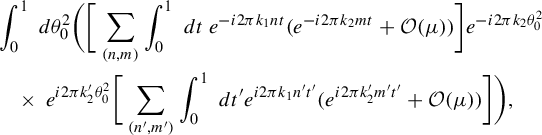 $$ \begin{align*} &\int_{0}^{1}\,d \theta_0^2 \bigg( \bigg[\sum_{(n,m)} \int_{0}^{1}\,dt \, e^{-i 2 \pi k_1 n t} ( e^{-i 2 \pi k_2 m t} + \mathcal{O}(\mu)) \bigg] e^{-i 2 \pi k_2 \theta_0^2} \bigg. \\ &\quad\bigg. \times \ e^{i 2 \pi k^{\prime}_2 \theta_0^2} \bigg[\sum_{(n',m')} \int_{0}^{1}\,d t'e^{i 2 \pi k_1 n' t'} ( e^{i 2 \pi k^{\prime}_2 m' t'} + \mathcal{O}(\mu) ) \bigg]\bigg), \end{align*} $$
where the summations over $(n,m)$
and
$(n,m)$
and $(n',m')$
are understood as in equation (4.10). Using that for every
$(n',m')$
are understood as in equation (4.10). Using that for every $(k_1, k_2) \in \mathcal {S}_{U,0}$
, there exist exactly two elements from
$(k_1, k_2) \in \mathcal {S}_{U,0}$
, there exist exactly two elements from $\mathcal {B}_0(\mathcal {S}_U^\perp )$
(differing by a sign), we can evaluate both brackets
$\mathcal {B}_0(\mathcal {S}_U^\perp )$
(differing by a sign), we can evaluate both brackets $[\cdots ]$
being equal to
$[\cdots ]$
being equal to $2 + \mathcal {O}(\deg _U^{(2)} \mu )$
.
$2 + \mathcal {O}(\deg _U^{(2)} \mu )$
.
From this, we conclude that
 $$ \begin{align*} G^{(k_1, \mu)}_{k_2, k^{\prime}_2}\!=\!\int_{0}^{1}\!\!\!\,d \theta_0^2 [2 + \mathcal{O}(\deg_U^{(2)} \mu)] e^{i 2 \pi (k^{\prime}_2-k_2) \theta_0^2} [2 + \mathcal{O}(\deg_U^{(2)} \mu)] = 4 \delta_{k_2, k^{\prime}_2} + \mathcal{O}(\deg_U^{(2)}\! \mu). \end{align*} $$
Therefore, going back to equation (4.12), we infer the existence of $\tilde {\mu } = \tilde {\mu }(\mathcal {C}_2, \deg _U^{(2)}, e)> 0$
such that for all
$\tilde {\mu } = \tilde {\mu }(\mathcal {C}_2, \deg _U^{(2)}, e)> 0$
such that for all $\mu \in [0, \tilde {\mu }]$
, the Gram matrix
$\mu \in [0, \tilde {\mu }]$
, the Gram matrix $G^{(k_1, \mu )}$
from equation (4.11) is of full rank.
$G^{(k_1, \mu )}$
from equation (4.11) is of full rank.
Since  was arbitrary and Lemma 4.2 is independent of $k_1$
, this concludes the proof of Theorem 2.3(a).
$k_1$
, this concludes the proof of Theorem 2.3(a).
For part (b), we note that $e^{i 2 \pi k_2 x_\mu ^2(\theta _0^2 + mt, c_2)} $
from equation (4.10) depends analytically on
$e^{i 2 \pi k_2 x_\mu ^2(\theta _0^2 + mt, c_2)} $
from equation (4.10) depends analytically on $\mu $
(see Appendix C). Therefore, the function
$\mu $
(see Appendix C). Therefore, the function $ \mu \mapsto G^{(k_1, \mu )}$
mapping to the Gram matrix in equation (4.11), for every fixed
$ \mu \mapsto G^{(k_1, \mu )}$
mapping to the Gram matrix in equation (4.11), for every fixed  , is also analytic. (Using joint continuity of $(u,\mu ) \mapsto e^{i 2 \pi k_2 x_\mu ^2(u, c_2)}$
, it is an elementary exercise to show that the integrals over t and
$(u,\mu ) \mapsto e^{i 2 \pi k_2 x_\mu ^2(u, c_2)}$
, it is an elementary exercise to show that the integrals over t and $\theta _0^2$
do not disturb the analyticity in
$\theta _0^2$
do not disturb the analyticity in $\mu $
.) This in turn implies that
$\mu $
.) This in turn implies that $\det (G^{(k_1, \mu )})$
is analytic in
$\det (G^{(k_1, \mu )})$
is analytic in $\mu $
and thus, since
$\mu $
and thus, since $\det (G^{(k_1, \mu )}) \neq 0$
for
$\det (G^{(k_1, \mu )}) \neq 0$
for $\mu \in (0,\tilde {\mu })$
(see Lemma 4.2), we find that the zero set
$\mu \in (0,\tilde {\mu })$
(see Lemma 4.2), we find that the zero set
 $$ \begin{align*} \mathcal{E}_0^{(k_1)} := \{ \mu \in (0,\infty) \mid \det(G^{(k_1, \mu)}) = 0 \} \subset (\tilde{\mu}, \infty) \end{align*} $$
of $\mu \mapsto \det (G^{(k_1, \mu )})$
is at most countable (finite in every compact subset), that is, in particular, a set of zero measure. Finally, setting
$\mu \mapsto \det (G^{(k_1, \mu )})$
is at most countable (finite in every compact subset), that is, in particular, a set of zero measure. Finally, setting
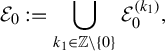
we constructed the exceptional null set, for which the conclusion $\mathcal {S}_{U,0} = \emptyset $
is not valid.
$\mathcal {S}_{U,0} = \emptyset $
is not valid.
This finishes the proof of Theorem 2.3(b).
4.3. Proof of Theorem 2.4
As above, the argument is divided into three steps.
Step (i). We fix an energy $e>0$
and consider the region of the phase space, where both one-dimensional subsystems are rotating, that is,
$e>0$
and consider the region of the phase space, where both one-dimensional subsystems are rotating, that is,
 $$ \begin{align*} \frac{p_1^2}{2} - \mu_1 V_1(x^1) = e^{(1)}>0\quad \text{and} \quad \frac{p_2^2}{2} - \mu_2 V_2(x^2) = e^{(2)}>0, \end{align*} $$
such that we have $e = e^{(1)} + e^{(2)}$
. In a neighborhood of each of the two Liouville tori characterized by
$e = e^{(1)} + e^{(2)}$
. In a neighborhood of each of the two Liouville tori characterized by $H_0 = e$
and
$H_0 = e$
and $({p_1^2}/{2}) - \mu _1 V_1(x^1)= e^{(1)}$
, we can find two changes of variables
$({p_1^2}/{2}) - \mu _1 V_1(x^1)= e^{(1)}$
, we can find two changes of variables $(x^1,p_1) = \Phi ^{(1)}_{\mu _1}(\theta ^1,I_1)$
and
$(x^1,p_1) = \Phi ^{(1)}_{\mu _1}(\theta ^1,I_1)$
and $(x^2,p_2) = \Phi ^{(2)}_{\mu _2}(\theta ^2,I_2)$
such that the Hamiltonian function
$(x^2,p_2) = \Phi ^{(2)}_{\mu _2}(\theta ^2,I_2)$
such that the Hamiltonian function $H_0$
gets transformed in action-angle coordinates, that is,
$H_0$
gets transformed in action-angle coordinates, that is,
 $$ \begin{align*} H_0(\Phi^{(1)}_{\mu_1}(\theta^1,I_1), \Phi^{(2)}_{\mu_2}(\theta^2,I_2)) = h^{(1)}_{\mu_1}(I_1) + h^{(2)}_{\mu_2}(I_2) \end{align*} $$
for some smooth functions $h^{(1)}_{\mu _1}$
and
$h^{(1)}_{\mu _1}$
and $h^{(2)}_{\mu _2}$
, which agree with Mather’s
$h^{(2)}_{\mu _2}$
, which agree with Mather’s $\alpha $
-functions for the one-dimensional subsystem described by the Hamiltonians
$\alpha $
-functions for the one-dimensional subsystem described by the Hamiltonians $({p_1^2}/{2}) - \mu _1 V(x^1)$
, respectively
$({p_1^2}/{2}) - \mu _1 V(x^1)$
, respectively $({p_2^2}/{2}) - \mu _2 V(x^2)$
(see Appendix D). As in the proof of Theorem 2.3, the change in the order of the four arguments of
$({p_2^2}/{2}) - \mu _2 V(x^2)$
(see Appendix D). As in the proof of Theorem 2.3, the change in the order of the four arguments of $H_0$
should not lead to confusion.
$H_0$
should not lead to confusion.
Now, the perturbed Hamiltonian takes the form
 $$ \begin{align*} H_\varepsilon(\Phi^{(1)}_{\mu_1}(\theta^1,I_1), \Phi^{(2)}_{\mu_2}(\theta^2,I_2)) = h^{(1)}_{\mu_1}(I_1)+ h^{(2)}_{\mu_2}(I_2) + \varepsilon U(x^1_{\mu_1}(\theta^1,I_1), x^2_{\mu_2}(\theta^2,I_2)), \end{align*} $$
where we write $x^i_{\mu _i}(\theta ^i,I_i)$
for the first component of
$x^i_{\mu _i}(\theta ^i,I_i)$
for the first component of $\Phi ^{(i)}_{\mu _i}(\theta ^i,I_i)$
,
$\Phi ^{(i)}_{\mu _i}(\theta ^i,I_i)$
, $i \in \{1,2\}$
.
$i \in \{1,2\}$
.
Step (ii). Analogously to the proof of Theorem 2.3, we assume without loss of generality that the $1$
- and
$1$
- and $2$
-degree
$2$
-degree ${\deg }^{(1)}_U$
and
${\deg }^{(1)}_U$
and ${\deg }^{(2)}_U$
of U are at least
${\deg }^{(2)}_U$
of U are at least $1$
(recall equation (2.8)), as otherwise, we had
$1$
(recall equation (2.8)), as otherwise, we had $U(x) = U_2(x^2)$
or
$U(x) = U_2(x^2)$
or $U(x) = U_1(x^1)$
and Theorem 2.4 was proven. Then, for any
$U(x) = U_1(x^1)$
and Theorem 2.4 was proven. Then, for any $(n,m) \in \mathcal {B}_0(\mathcal {S}_U^\perp )$
, in particular with
$(n,m) \in \mathcal {B}_0(\mathcal {S}_U^\perp )$
, in particular with $|m| \le {\deg }_U^{(1)}$
and
$|m| \le {\deg }_U^{(1)}$
and $|n| \le {\deg }_U^{(2)}$
, we can find (in the isoenergy manifold
$|n| \le {\deg }_U^{(2)}$
, we can find (in the isoenergy manifold $T_{e_\varepsilon }$
with energy
$T_{e_\varepsilon }$
with energy $ e= e_\varepsilon $
and
$ e= e_\varepsilon $
and $\varepsilon = \varepsilon _k$
for some
$\varepsilon = \varepsilon _k$
for some $k \in \mathbb {N}$
) a rational invariant Liouville torus with rotation vector
$k \in \mathbb {N}$
) a rational invariant Liouville torus with rotation vector $\boldsymbol {\omega } = (\omega _1, \omega _2)$
which satisfies
$\boldsymbol {\omega } = (\omega _1, \omega _2)$
which satisfies
 $$ \begin{align} \frac{\omega_1}{\omega_2} = \frac{n}{m} \in \mathbb{Q} \quad \text{and} \quad \boldsymbol{\omega} = (\nabla h^{(1)}_{\mu_1}(c_1), \nabla h^{(2)}_{\mu_2}(c_2)) \end{align} $$
for some $\boldsymbol {c} \in H^1({\mathbb {T}}^2, \mathbb {R}) \cong \mathbb {R}^2$
with
$\boldsymbol {c} \in H^1({\mathbb {T}}^2, \mathbb {R}) \cong \mathbb {R}^2$
with $\vert c_1 \vert> \gamma _1 + \sqrt {\mu _1} \mathfrak {c}(V_1)$
and
$\vert c_1 \vert> \gamma _1 + \sqrt {\mu _1} \mathfrak {c}(V_1)$
and $\vert c_2 \vert> \gamma _2 + \sqrt {\mu _2} \mathfrak {c}(V_2)$
for some
$\vert c_2 \vert> \gamma _2 + \sqrt {\mu _2} \mathfrak {c}(V_2)$
for some $\gamma _1 = \gamma _1(e, {\deg }^{(1)}_U)> 0$
, respectively
$\gamma _1 = \gamma _1(e, {\deg }^{(1)}_U)> 0$
, respectively $\gamma _2 = \gamma _2(e, {\deg }^{(2)}_U)> 0$
, which we fix now (see the paragraph below equation (4.6) for a discussion of the
$\gamma _2 = \gamma _2(e, {\deg }^{(2)}_U)> 0$
, which we fix now (see the paragraph below equation (4.6) for a discussion of the $\gamma $
parameters).
$\gamma $
parameters).
By Assumption (P), we have
 $$ \begin{align*} u_{\varepsilon, {\boldsymbol{c}}} = u_{{\boldsymbol{c}}}^{(0)} + \varepsilon u_{{\boldsymbol{c}}}^{(1)} + O_{\boldsymbol{c}}(\varepsilon^2) \end{align*} $$
with $u_{{\boldsymbol {c}}}^{(0)} = u_{0,{\boldsymbol {c}}}$
and since
$u_{{\boldsymbol {c}}}^{(0)} = u_{0,{\boldsymbol {c}}}$
and since $H_0(\theta ,I)$
is integrable (and written in action-angle coordinates), one can choose
$H_0(\theta ,I)$
is integrable (and written in action-angle coordinates), one can choose $u_{0,{\boldsymbol {c}}} \equiv 0$
. Therefore, by Assumption (P) again, we expand the Hamilton Jacobi in equation (2.9) as
$u_{0,{\boldsymbol {c}}} \equiv 0$
. Therefore, by Assumption (P) again, we expand the Hamilton Jacobi in equation (2.9) as
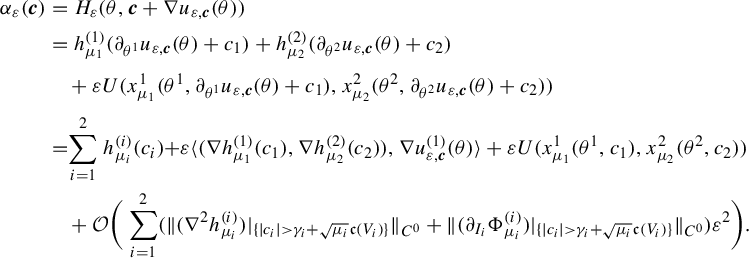 $$ \begin{align*} \alpha_{\varepsilon}({\boldsymbol{c}}) &= H_\varepsilon(\theta, {\boldsymbol{c}} + \nabla u_{\varepsilon, {\boldsymbol{c}}}(\theta) ) \\ &= h_{\mu_1}^{(1)}(\partial_{\theta^1} u_{\varepsilon, {\boldsymbol{c}}}(\theta) + c_1) + h_{\mu_2}^{(2)}(\partial_{\theta^2} u_{\varepsilon, {\boldsymbol{c}}}(\theta) + c_2) \\[1mm] & \quad + \varepsilon U(x^1_{\mu_1}(\theta^1, \partial_{\theta^1} u_{\varepsilon, {\boldsymbol{c}}}(\theta) + c_1),x^2_{\mu_2}(\theta^2, \partial_{\theta^2} u_{\varepsilon, {\boldsymbol{c}}}(\theta) + c_2)) \\[1mm] & =\! \sum_{i=1}^{2}h_{\mu_i}^{(i)}( c_i)\! +\! \varepsilon \langle (\nabla h_{\mu_1}^{(1)}( c_1), \nabla h_{\mu_2}^{(2)}( c_2)), \nabla u_{\varepsilon, {\boldsymbol{c}}}^{(1)}(\theta) \rangle + \varepsilon U(x^1_{\mu_1}(\theta^1, c_1), x^2_{\mu_2}(\theta^2, c_2)) \\ & \quad + \mathcal{O}\bigg( \sum_{i=1}^{2}(\Vert (\nabla^2 h_{\mu_i}^{(i)})\vert_{\{ \vert c_i \vert> \gamma_i + \sqrt{\mu_i} \mathfrak{c}(V_i) \}} \Vert_{C^0} + \Vert (\partial_{I_i} \Phi_{\mu_i}^{(i)})\vert_{\{ \vert c_i \vert > \gamma_i + \sqrt{\mu_i} \mathfrak{c}(V_i) \}} \Vert_{C^0} ) \varepsilon^2\bigg). \end{align*} $$
Since $|c_i|> \gamma _i + \sqrt {\mu _i} \mathfrak {c}(V_i)$
, the error term is of order
$|c_i|> \gamma _i + \sqrt {\mu _i} \mathfrak {c}(V_i)$
, the error term is of order $\mathcal {O}_{\gamma _i}(\varepsilon ^2)$
.
$\mathcal {O}_{\gamma _i}(\varepsilon ^2)$
.
Analogously to the proofs of Theorems 2.2 and 2.3, we thus obtain the first-order equation
 $$ \begin{align} [U]_0 = \langle (\nabla h_{\mu_1}^{(1)}( c_1), \nabla h_{\mu_2}^{(2)}( c_2)), \nabla u_{\varepsilon, {\boldsymbol{c}}}^{(1)}(\theta) \rangle + U(x^1_{\mu_1}(\theta^1, c_1), x^2_{\mu_2}(\theta^2, c_2)), \end{align} $$
where the constant $\alpha ^{(1)} \equiv [U]_0$
is again given by equation (D.6) in Proposition D.2 (see also [Reference Gomes50]). Just as in the proof of Theorems 2.2 and 2.3, after averaging equation (4.14) over the trajectory
$\alpha ^{(1)} \equiv [U]_0$
is again given by equation (D.6) in Proposition D.2 (see also [Reference Gomes50]). Just as in the proof of Theorems 2.2 and 2.3, after averaging equation (4.14) over the trajectory $\theta (t) = \theta _0 + {\boldsymbol {\omega }} t \in {\mathbb {T}}^2$
, with initial position
$\theta (t) = \theta _0 + {\boldsymbol {\omega }} t \in {\mathbb {T}}^2$
, with initial position $\theta _0 \in {\mathbb {T}}^2$
and where
$\theta _0 \in {\mathbb {T}}^2$
and where ${\boldsymbol {\omega }}$
is chosen according to equation (4.13) such that the period
${\boldsymbol {\omega }}$
is chosen according to equation (4.13) such that the period $T_{{\boldsymbol {\omega }}}$
satisfies
$T_{{\boldsymbol {\omega }}}$
satisfies $T_{\boldsymbol {\omega }} \cdot {\boldsymbol {\omega }} = (n,m)$
,
$T_{\boldsymbol {\omega }} \cdot {\boldsymbol {\omega }} = (n,m)$
,
 $$ \begin{align} \int_{0}^{1} (U(x^1_{\mu_1}(\theta_0^1 +n t, c_1), x^2_{\mu_2}(\theta_0^2 + m t,c_2)) - [U]_0)\,{d} t = 0 \end{align} $$
for all $\theta _0 = (\theta _0^1, \theta _0^2) \in {\mathbb {T}}^2$
.
$\theta _0 = (\theta _0^1, \theta _0^2) \in {\mathbb {T}}^2$
.
Finally, analogously to §§4.1 and 4.2, we may assume without loss of generality $[U]_0 = 0$
and observe that
$[U]_0 = 0$
and observe that
 $$ \begin{align*} \int_{0}^{1} U_{\mathrm{sep}}(x^1_{\mu_1}(\theta_0^1 +n t, c_1),\ x^2_{\mu_2}(\theta_0^2 + m t,c_2))\,dt = [U_{\mathrm{sep}}]_0 \quad \text{for all } (\theta_0^1, \theta_0^2) \in {\mathbb{T}}^2 \end{align*} $$
holds generally (that is, independent of the first-order relation in equation (4.14)) by a simple calculation based on equation (D.6) in Proposition D.2 (see also Remark D.1). We can thus split off the separable part $U_{\mathrm {sep}}$
of U defined in equation (4.5) and assume that
$U_{\mathrm {sep}}$
of U defined in equation (4.5) and assume that $\mathcal {S}_U = \mathcal {S}_{U,0}$
in the following. Hence, the third step consists of showing that
$\mathcal {S}_U = \mathcal {S}_{U,0}$
in the following. Hence, the third step consists of showing that $\mathcal {S}_U = \mathcal {S}_{U,0} = \emptyset $
.
$\mathcal {S}_U = \mathcal {S}_{U,0} = \emptyset $
.
Step (iii). We begin this final step with performing a Fourier decomposition in equation (4.15), such that we obtain
 $$ \begin{align*} \sum_{\substack{ 0 \neq |k_1| \le \deg_U^{(1)} \\ 0 \neq |k_2| \le \deg_U^{(2)}}} U_{k_1, k_2}\! \int_{0}^{1} e^{i 2 \pi k_1 x_{\mu_1}^1(\theta_0^1 + nt, c_1)} e^{i 2 \pi k_2 x_{\mu_2}^2(\theta_0^2 + mt, c_2)}\,dt = 0 \quad \text{for all } (\theta_0^1, \theta_0^2) \in {\mathbb{T}}^2. \end{align*} $$
Analogously to the proof of Theorem 2.3, we now consider the family of functions
 $$ \begin{align*} (f^{(\mu_1, \mu_2)}_{k_1, k_2})_{0 \neq |k_1| \le \deg_U^{(1)}, 0 \neq |k_2| \le \deg_U^{(2)}} \end{align*} $$
in the Hilbert space $L^2({\mathbb {T}}^2)$
, where
$L^2({\mathbb {T}}^2)$
, where
 $$ \begin{align} f_{k_1, k_2}^{(\mu_1, \mu_2)}: {\mathbb{T}}^2 \to \mathbb{C}, \quad (\theta_0^1, \theta_0^2) \mapsto \! \sum_{\substack{(n,m) \in \mathcal{B}_0(\mathcal{S}^\perp_U) }}\! \int_{0}^{1} e^{i 2 \pi k_1 x_{\mu_1}^1(\theta_0^1 + nt, c_1)} e^{i 2 \pi k_2 x_\mu^2(\theta_0^2 + mt, c_2)}\,dt. \end{align} $$
Note that the sum in equation (4.16) is finite by Assumption (A3) (more precisely, it ranges over the at most $(2 \deg _U^{(1)}) \cdot (2 \deg _U^{(2)}) $
elements from
$(2 \deg _U^{(1)}) \cdot (2 \deg _U^{(2)}) $
elements from $\mathcal {B}_0(\mathcal {S}_U^\perp )$
) and we suppressed the dependence of
$\mathcal {B}_0(\mathcal {S}_U^\perp )$
) and we suppressed the dependence of $|c_i|> \gamma _i + \sqrt {\mu _i} \mathfrak {c}(V_i)$
on
$|c_i|> \gamma _i + \sqrt {\mu _i} \mathfrak {c}(V_i)$
on $(n,m) \in \mathcal {B}_0(\mathcal {S}_U^\perp )$
from the notation (recall equation (4.13)).
$(n,m) \in \mathcal {B}_0(\mathcal {S}_U^\perp )$
from the notation (recall equation (4.13)).
In this way, the problem of proving Theorem 2.4, that is, justifying $\mathcal {S}_{U,0} = \emptyset $
, reduces to a question about linear independence for the family of functions in equation (4.16) in the Hilbert space
$\mathcal {S}_{U,0} = \emptyset $
, reduces to a question about linear independence for the family of functions in equation (4.16) in the Hilbert space $L^2({\mathbb {T}}^2)$
. Recall that the family
$L^2({\mathbb {T}}^2)$
. Recall that the family $(f^{( \mu )}_{k_1, k_2})_{(k_1, k_2)}$
being linearly independent is equivalent to the Gram matrix
$(f^{( \mu )}_{k_1, k_2})_{(k_1, k_2)}$
being linearly independent is equivalent to the Gram matrix $G^{( \mu )} $
with entries
$G^{( \mu )} $
with entries
 $$ \begin{align} G_{(k_1, k_2), (k^{\prime}_1, k^{\prime}_2)}^{(\mu_1, \mu_2)}:= \langle f_{k_1, k_2}^{( \mu_1, \mu_2)}, f_{k^{\prime}_1, k^{\prime}_2}^{(\mu_1, \mu_2)} \rangle_{L^2({\mathbb{T}}^2)} \quad \text{for } 0 \neq |k_i|, |k^{\prime}_i| \le \deg_U^{(i)}, \ i \in \{1,2\}, \end{align} $$
being of full rank, where $\langle g,h\rangle _{L^2({\mathbb {T}}^2)}$
denotes the standard inner product of
$\langle g,h\rangle _{L^2({\mathbb {T}}^2)}$
denotes the standard inner product of $g,h \in L^2({\mathbb {T}}^2)$
.
$g,h \in L^2({\mathbb {T}}^2)$
.
Lemma 4.3. There exist $\tilde {\mu }_i = \tilde {\mu }(\mathcal {C}_i,\deg _U^{(1)}, \deg _U^{(2)}, e)> 0$
such that for all
$\tilde {\mu }_i = \tilde {\mu }(\mathcal {C}_i,\deg _U^{(1)}, \deg _U^{(2)}, e)> 0$
such that for all $\mu _i \in [0, \tilde {\mu }_i]$
,
$\mu _i \in [0, \tilde {\mu }_i]$
, $i \in \{1,2\}$
, the Gram matrix
$i \in \{1,2\}$
, the Gram matrix $G^{(\mu _1, \mu _2)}$
from equation (4.17) is of full rank.
$G^{(\mu _1, \mu _2)}$
from equation (4.17) is of full rank.
Proof. Using the version of Lemma B.1 for the inverse function, we find that
 $$ \begin{align} \Vert e^{i 2 \pi k_i x^i_{\mu_i}( \, \cdot ,c_i)} - e^{i 2 \pi k_i \, \cdot} \Vert_{C^0} = \mathcal{O}\bigg(\deg^{(i)}_U\frac{\mu_i \Vert V_i \Vert_{C^0}}{h_{\mu_i}^{(i)}(\gamma_i + \sqrt{\mu_i} \mathfrak{c}(V_i))}\bigg) =: \mathcal{O}(\mu_i) \end{align} $$
uniformly in $|k_i| \le \deg _U^{(i)}$
and
$|k_i| \le \deg _U^{(i)}$
and $(n,m) \in \mathcal {B}_0(\mathcal {S}_U^\perp )$
.
$(n,m) \in \mathcal {B}_0(\mathcal {S}_U^\perp )$
.
Similarly to Lemma 4.2, with a slight abuse of notation for the error term, the elements $ G_{(k_1, k_2), (k^{\prime }_1, k^{\prime }_32)}^{(\mu _1, \mu _2)}$
of the Gram matrix can thus be computed as
$ G_{(k_1, k_2), (k^{\prime }_1, k^{\prime }_32)}^{(\mu _1, \mu _2)}$
of the Gram matrix can thus be computed as
 $$ \begin{align*} &\int_{0}^{1}\,d \theta_0^1 \int_{0}^{1}\,d \theta_0^2 \bigg( \bigg[\sum_{(n,m)} \int_{0}^{1}\,dt ( e^{-i 2 \pi k_1 n t} + \mathcal{O}(\mu_1)) ( e^{-i 2 \pi k_2 m t} + \mathcal{O}(\mu_2) ) \bigg] e^{-i 2 \pi k_1 \theta_0^1}e^{-i 2 \pi k_2 \theta_0^2} \\ &\quad \times \ e^{i 2 \pi k^{\prime}_1 \theta_0^1}e^{i 2 \pi k^{\prime}_2 \theta_0^2} \bigg[\sum_{(n',m')} \int_{0}^{1}\,d t' ( e^{i 2 \pi k^{\prime}_1 n' t'} + \mathcal{O}(\mu_1)) ( e^{i 2 \pi k^{\prime}_2 m' t'} + \mathcal{O}(\mu_2) ) \bigg]\bigg), \end{align*} $$
where the summations over $(n,m)$
and
$(n,m)$
and $(n',m')$
are understood as in equation (4.16). Using that for every
$(n',m')$
are understood as in equation (4.16). Using that for every $(k_1, k_2) \in \mathcal {S}_{U,0}$
, there exist exactly two elements from
$(k_1, k_2) \in \mathcal {S}_{U,0}$
, there exist exactly two elements from $\mathcal {B}_0(\mathcal {S}_U^\perp )$
(differing by a sign), we can evaluate both brackets
$\mathcal {B}_0(\mathcal {S}_U^\perp )$
(differing by a sign), we can evaluate both brackets $[\cdots ]$
being given by
$[\cdots ]$
being given by
 $$ \begin{align*} 2 + \mathcal{O}(\deg_U^{(1)} \deg_U^{(2)}\mu_1)+ \mathcal{O} (\deg_U^{(1)}\deg_U^{(2)} \mu_2) =: 2 + \mathcal{O}( \deg_U^{(1)} \deg_U^{(2)} (\mu_1 + \mu_2 )), \end{align*} $$
after absorption of the second-order error in the first-order ones.
From this, we conclude that
 $$ \begin{align*} G_{(k_1, k_2), (k^{\prime}_1, k^{\prime}_2)}^{(\mu_1, \mu_2)} &= \int_{0}^{1}\,d \theta_0^1 \int_{0}^{1}\,d \theta_0^2 ( [ 2 + \mathcal{O}(\deg_U^{(1)} \deg_U^{(2)} (\mu_1 + \mu_2 ))] e^{i 2 \pi (k^{\prime}_1-k_1)\theta_0^1} \\ &\quad \times \, e^{i 2 \pi (k^{\prime}_2-k_2) \theta_0^2} [ 2 + \mathcal{O}( \deg_U^{(1)} \deg_U^{(2)} (\mu_1 + \mu_2 ) ) ] ) \\ &=4 \delta_{k_1, k^{\prime}_1} \delta_{k_2, k^{\prime}_2}+\mathcal{O} ( \deg_U^{(1)} \deg_U^{(2)} (\mu_1 + \mu_2 )). \end{align*} $$
Therefore, going back to equation (4.18), we infer the existence of $\tilde {\mu }_i = \tilde {\mu }(\mathcal {C}_i,\deg _U^{(1)}, \deg _U^{(2)}, e)> 0$
,
$\tilde {\mu }_i = \tilde {\mu }(\mathcal {C}_i,\deg _U^{(1)}, \deg _U^{(2)}, e)> 0$
, $i \in \{1,2\}$
, such that for all
$i \in \{1,2\}$
, such that for all $\mu _i \in [0, \tilde {\mu }_i]$
, the Gram matrix
$\mu _i \in [0, \tilde {\mu }_i]$
, the Gram matrix $G^{(\mu _1, \mu _2)}$
from equation (4.17) is of full rank.
$G^{(\mu _1, \mu _2)}$
from equation (4.17) is of full rank.
This finishes the proof of Theorem 2.4(a). For part (b), similarly to the proof of Theorem 2.3(b), we observe that for every fixed $\mu _1 \in [0,\tilde {\mu }_1]$
, the function
$\mu _1 \in [0,\tilde {\mu }_1]$
, the function $\mu _2 \mapsto \det (G^{(\mu _1, \mu _2)})$
is analytic. Since
$\mu _2 \mapsto \det (G^{(\mu _1, \mu _2)})$
is analytic. Since $\det (G^{(\mu _1, \mu _2)}) \neq 0$
for
$\det (G^{(\mu _1, \mu _2)}) \neq 0$
for $\mu _2 \in (0,\tilde {\mu }_2)$
(see Lemma 4.3), we find that the zero set
$\mu _2 \in (0,\tilde {\mu }_2)$
(see Lemma 4.3), we find that the zero set
 $$ \begin{align*} \mathcal{E}_0^{(\mu_1)} := \{ \mu_2 \in (0,\infty) \mid \det(G^{(\mu_1, \mu_2)}) = 0 \} \subset (\tilde{\mu}_2, \infty) \end{align*} $$
of $\mu _2 \mapsto \det (G^{(\mu _1, \mu _2)})$
is at most countable (finite in every compact subset), that is, in particular, a (one-dimensional) set of zero measure.
$\mu _2 \mapsto \det (G^{(\mu _1, \mu _2)})$
is at most countable (finite in every compact subset), that is, in particular, a (one-dimensional) set of zero measure.
Finally, for part (c), we note that, similarly to the proof of Theorem 2.3(b) and by means of Hartogs’s theorem on separate analyticity [Reference Hartogs56] (a separately analytic function is jointly analytic), the function $(\mu _1, \mu _2) \mapsto \det (G^{(\mu _1, \mu _2)})$
is (jointly) analytic. Since
$(\mu _1, \mu _2) \mapsto \det (G^{(\mu _1, \mu _2)})$
is (jointly) analytic. Since $\det (G^{(\mu _1, \mu _2)}) \neq 0$
for
$\det (G^{(\mu _1, \mu _2)}) \neq 0$
for $(\mu _1, \mu _2) \in (0,\tilde {\mu }_1) \times (0,\tilde {\mu }_2)$
(see Lemma 4.3), we find that the zero set
$(\mu _1, \mu _2) \in (0,\tilde {\mu }_1) \times (0,\tilde {\mu }_2)$
(see Lemma 4.3), we find that the zero set
 $$ \begin{align*} \mathcal{E}_0 := \{ (\mu_1, \mu_2) \in (0,\infty)\times (0,\infty) \mid \det(G^{(\mu_1, \mu_2)}) = 0 \} \subset (\tilde{\mu}_1, \infty) \times (\tilde{\mu}_2, \infty) \end{align*} $$
of $(\mu _1, \mu _2) \mapsto \det (G^{(\mu _1, \mu _2)})$
is a (two-dimensional) set of zero measure.
$(\mu _1, \mu _2) \mapsto \det (G^{(\mu _1, \mu _2)})$
is a (two-dimensional) set of zero measure.
This concludes the proof of Theorem 2.4(c).
5. Concluding remarks and outlook
We have shown that integrable deformations of Liouville metrics on ${\mathbb {T}}^2$
are Liouville metrics—at least when more restrictive conditions on the unperturbed metric are balanced with more general conditions on the perturbation. Removing this balancing, that is, showing that arbitrary integrable deformations of arbitrary Liouville metrics remain of Liouville type, is an interesting problem for future investigations resolving the conjecture proposed at the end of §2. This would require stronger versions of Lemmas 4.2 and 4.3 in two senses.
${\mathbb {T}}^2$
are Liouville metrics—at least when more restrictive conditions on the unperturbed metric are balanced with more general conditions on the perturbation. Removing this balancing, that is, showing that arbitrary integrable deformations of arbitrary Liouville metrics remain of Liouville type, is an interesting problem for future investigations resolving the conjecture proposed at the end of §2. This would require stronger versions of Lemmas 4.2 and 4.3 in two senses.
-
(a) Allow for possibly infinitely many non-zero Fourier coefficients and refrain from restricting to trigonometric polynomials. A resolution of this issue has been found in the context of the perturbative Birkhoff conjecture [Reference Avila, De Simoi and Kaloshin10, Reference Kaloshin and Sorrentino60] concerning integrable billiards. Here, the authors studied the matrix of correlations between the standard basis
$(e^{i 2 \pi k x})_{k \in \mathbb {Z}}$
of
$L^2({\mathbb {T}})$
and certain deformed dynamical modes (given as some kind of Jacobi elliptic function, see Appendix C of the arXiv: 2210.02961 version of this article), corresponding to
$e^{i 2 \pi k_i x^i_{\mu _i}( \, \cdot ,c_i)}$
in Lemmas 4.2 and 4.3. Exponential estimates for the entries of this matrix (obtained from considering the maximal width of a strip of analyticity around the real axis for the dynamical modes) allowed to prove a suitable full-rank lemma, also for infinitely many coefficients. -
(b) Allow arbitrary
$\tilde {\mu _i}> 0$
and refrain from restricting to small ones. Also for this issue, a potential resolution might be found by analytically extending action-angle coordinates to the complex plane and exploiting their singularities away from the real axis. However, this requires the potentials
$V_i$
in the unperturbed Hamiltonian to be restrictions of holomorphic functions and, as such, way more special than generic
$V_i \in C^2({\mathbb {T}})$
.


Moreover, we note that in [Reference Kaloshin and Sorrentino60], the authors also outlined a potential strategy for proving the classical (non-perturbative) Birkhoff conjecture, which might possibly be adapted for proving a suitably weakened version of the folklore conjecture given in §3.
We end this section with a brief list of open problems being related to the main results of the present paper.
-
(i) As described above, it is an natural follow-up problem to extend our results to the situation where arbitrary integrable deformations of arbitrary Liouville metrics remain of Liouville type, that is, remove the restricting assumptions from Assumptions (A1)–(A3) and prove the conjecture formulated at the end of §2.
-
(ii) In particular, starting with (the time-independent version of) Arnold’s example [Reference Arnold6] for diffusion,
is it possible to deduce rigidity, similarly to Theorem 2.3, but without restricting to the perturbation being a trigonometric polynomial in
$$ \begin{align*} H_0(x,p) = \frac{p_1^2}{2} + \frac{p_2^2}{2} - \mu (1 - \cos(2 \pi x^2)), \end{align*} $$
$x^2$
and any smallness condition on
$\mu \in [0,1]$
? In this case, the full rank lemma might be obtained by proving non-degeneracy of certain infinite-dimensional matrices, which have Fourier coefficients of powers of Jacobi elliptic functions (see Appendix C of the arXiv: 2210.02961 version of this article) as their entries.
-
(iii) In view of the non-trivial examples of magnetic geodesic flows found in [Reference Agapov, Bialy and Mironov3] and the potential counterexample constructed in [Reference Corsi and Kaloshin35], it is a major task to completely settle the folklore conjecture mentioned in §§1 and 3, that is, clarify which part is only ‘folklore’ and which part is ‘real’.
-
(iv) In particular, the main result of [Reference Corsi and Kaloshin35], which we stated in Theorem 3.8, should be extended to show that the system is really integrable on an open set in the phase space and not only on an isoenergy manifold. Furthermore, it remains open, whether the PDEs underlying the examples in [Reference Agapov, Bialy and Mironov3] can be solved with zero magnetic fields or not and thus potentially disproves the folklore conjecture.
-
(v) For our main results, we assumed the preservation of rational invariant tori ‘outside the eye of the pendulum’ (cf. Figure 1). Can one obtain the same result, if only tori ‘inside the eye’ are preserved?
-
(vi) An alternative approach to the one chosen here could be to study perturbations of the additional first integral in equation (2.2), that is, write
$F_\varepsilon = F_0 + \varepsilon F_1 + \mathcal {O}(\varepsilon ^2)$
and use the vanishing of the Poisson bracket
$\{H_\varepsilon , F_\varepsilon \} = 0$
with
$H_\varepsilon = H_0 + \varepsilon U$
to obtain the first-order equation for the perturbing potential U.
$$ \begin{align*} \{H_0, F_1\} + \{U, F_0\} = 0 \end{align*} $$
-
(vii) Does there exist a Riemannian metric g on
${\mathbb {T}}^2$
such that its geodesic flow admits hyperbolic periodic orbits of at least three different homotopy types? If yes, does there exist a Liouville metric with this property? (These questions were suggested by Vadim Kaloshin.)


Acknowledgments
I am very grateful to Vadim Kaloshin for suggesting the topic, his guidance during this project, and many helpful comments on an earlier version of the manuscript. Moreover, I would like to thank Comlan Edmond Koudjinan and Volodymyr Riabov for interesting discussions. Partial financial support by the ERC Advanced Grant ‘RMTBeyond’ No. 101020331 is gratefully acknowledged. This project received funding from the European Research Council (ERC) ERC Grant No. 885707.
A Appendix. Generalization to higher dimensions
Our results from §2 immediately generalize to higher dimensions $d \ge 3$
. In this setting, we define the Hamiltonian function
$d \ge 3$
. In this setting, we define the Hamiltonian function
 $$ \begin{align} H_0(x,p) = \sum_{i=1}^{d}\bigg(\frac{p_i^2}{2} - \mu_i\, V_i(x^i) \bigg) \end{align} $$
on $T^*\mathbb {T}^d$
, where
$T^*\mathbb {T}^d$
, where $\mu _i \in [0,\infty )$
are parameters, and
$\mu _i \in [0,\infty )$
are parameters, and $V_i \in C^2(\mathbb {T})$
with
$V_i \in C^2(\mathbb {T})$
with $\Vert V_i \Vert \le \mathcal {C}_i$
,
$\Vert V_i \Vert \le \mathcal {C}_i$
, $V_i \ge 0$
are Morse functions (or constant). We may assume without loss of generality that
$V_i \ge 0$
are Morse functions (or constant). We may assume without loss of generality that $\min _{x^i} V_i(x^i) = 0$
. The system in equation (A.1) is clearly integrable, since additional first integrals can easily be found as
$\min _{x^i} V_i(x^i) = 0$
. The system in equation (A.1) is clearly integrable, since additional first integrals can easily be found as

Completely analogous to §2, we perturb the integrable system in equation (A.1) as $H_\varepsilon = H_0 + \varepsilon U$
with
$H_\varepsilon = H_0 + \varepsilon U$
with $\varepsilon \in \mathbb {R}$
by an additive potential
$\varepsilon \in \mathbb {R}$
by an additive potential $U \in C^2({\mathbb {T}}^d)$
, which we assume to have an absolutely convergent Fourier series.
$U \in C^2({\mathbb {T}}^d)$
, which we assume to have an absolutely convergent Fourier series.
Now, the analogs of the assumptions in §2 read as follows.
(1) Assumptions on the perturbed Hamiltonian function $H_\varepsilon $
. Let
$H_\varepsilon $
. Let $H_0 \in C^2(T^*{\mathbb {T}}^d)$
denote the Hamiltonian function from equation (A.1) with
$H_0 \in C^2(T^*{\mathbb {T}}^d)$
denote the Hamiltonian function from equation (A.1) with $\Vert V_i \Vert \le \mathcal {C}_i$
and
$\Vert V_i \Vert \le \mathcal {C}_i$
and $\mu _i \in [0,\tilde {\mu }_i]$
for some
$\mu _i \in [0,\tilde {\mu }_i]$
for some $\tilde {\mu _i} \in [0,\infty )$
,
$\tilde {\mu _i} \in [0,\infty )$
, $i \in \{1,\ldots ,d\}$
, and
$i \in \{1,\ldots ,d\}$
, and $U \in C^2({\mathbb {T}}^d)$
be a perturbing potential, which satisfies the following assumption.
$U \in C^2({\mathbb {T}}^d)$
be a perturbing potential, which satisfies the following assumption.
-
(A4) If
$\tilde {\mu }_i = 0$
for the first
$0 \le d_{\mathrm {flat}} \le d$
indices, there exist
$d^{(k)} \ge 0$
for such that (A.2)that is
$$ \begin{align} \mathcal{S}_U \subset \mathbb{Z}^{d_{\mathrm{flat}}} \times ( [-d^{(d_{\mathrm{flat}} + 1)}, d^{(d_{\mathrm{flat}} + 1)}] \times \cdots \times [-d^{(d)}, d^{(d)}]) \end{align} $$
$U \in C^2(\mathbb {T}^d)$
is a trigonometric polynomial in the last
$(d - d_{\mathrm {flat}})$
variables.


 such that


As in §2, we denote the minimum over all $d^{(i)}$
such that equation (A.2) holds as
$d^{(i)}$
such that equation (A.2) holds as $\deg _U^{(i)}$
and call it the i-degree of U.
$\deg _U^{(i)}$
and call it the i-degree of U.
Note that Proposition 2.1 immediately generalizes to higher dimensions, such that we can formulate the analog of Assumption (P) as follows.
(2) Assumptions on the preserved integrability of $H_\varepsilon $
. Let
$H_\varepsilon $
. Let $H_0 \in C^2(T^*{\mathbb {T}}^d)$
denote the Hamiltonian function from equation (A.1) satisfying Assumption (A4), and U a perturbing potential, such that the following statement concerning the perturbed Hamilton–Jacobi equation (HJE)
$H_0 \in C^2(T^*{\mathbb {T}}^d)$
denote the Hamiltonian function from equation (A.1) satisfying Assumption (A4), and U a perturbing potential, such that the following statement concerning the perturbed Hamilton–Jacobi equation (HJE)
 $$ \begin{align} \alpha_{\varepsilon}({\boldsymbol{c}}) = H_\varepsilon(x, {\boldsymbol{c}} + \nabla_x u_{\varepsilon, {\boldsymbol{c}}}(x) ) \end{align} $$
as well as the preserved integrability of $H_\varepsilon $
is satisfied.
$H_\varepsilon $
is satisfied.
-
(P′) There exists an energy
$e>0$
, such that for every
$\boldsymbol {b} \in \mathcal {B}_0(\mathcal {S}_U^\perp )$
(recall equation (2.6)) there exists a sequence
$(\varepsilon _k)_{k \in \mathbb {N}}$
with
$\varepsilon _k \neq 0$
but
$\varepsilon _k \to 0$
such that for any
$\mu _i \in [0,\tilde {\mu }_i]$
we have the following:-
(i) The
$\boldsymbol {b}$
-torus from (the analog of) Proposition 2.1 characterized by
$\boldsymbol {c} \in H^1({\mathbb {T}}^d, \mathbb {R}) \cong \mathbb {R}^d$
with (A.4)in the isoenergy submanifold
$$ \begin{align} |c_i|> \sqrt{\mu_i}\, \mathfrak{c}(V_i) \end{align} $$
$T_e$
is preserved under the sequence of deformations
$(H_{\varepsilon _k})_{k \in \mathbb {N}}$
, where
$\mathfrak {c}(V_i)$
is defined in equation (D.3).
-
(ii) For
${\boldsymbol {c}} \in H^1({\mathbb {T}}^d, \mathbb {R})$
satisfying equation (A.4), Mather’s
$\alpha $
-function and a solution
$u_{\varepsilon ,{\boldsymbol {c}}}:{\mathbb {T}}^d \to \mathbb {R}$
of the HJE in equation (A.3) can be expanded to first order in
$\varepsilon $
, that is,
$$ \begin{align*} u_{\varepsilon, {\boldsymbol{c}}} = u_{{\boldsymbol{c}}}^{(0)} + \varepsilon u_{ {\boldsymbol{c}}}^{(1)} + \mathcal{O}_{\boldsymbol{c}}(\varepsilon^2)\quad \text{and} \quad \alpha_{\varepsilon} = \alpha^{(0)} + \varepsilon \alpha^{(1)} + \mathcal{O}(\varepsilon^2), \end{align*} $$
where
$u_{{\boldsymbol {c}}}^{(0)} ,\, u_{ {\boldsymbol {c}}}^{(1)} \in C^{1,1}({\mathbb {T}}^d)$
and
$O_{\boldsymbol {c}}(\varepsilon ^2)$
is understood in
$C^{1,1}$
-sense.
-


We can now formulate our generalized main result.
Theorem A.1. Let $H_\varepsilon $
satisfy Assumption (A4) and Assumption (P
$H_\varepsilon $
satisfy Assumption (A4) and Assumption (P $'$
) for some energy
$'$
) for some energy $e> 0$
. If
$e> 0$
. If $V_j$
is analytic for
$V_j$
is analytic for  , where $0 \le d_{\mathrm {anlyt}} \le d - d_{\mathrm { flat}}$
, and
$0 \le d_{\mathrm {anlyt}} \le d - d_{\mathrm { flat}}$
, and $\tilde {\mu }_k = \tilde {\mu }_k(\mathcal {C}_k, \deg _U^{(d_{\mathrm {flat}}+1)},\ldots , \deg _U^{(d)}, e)> 0$
for
$\tilde {\mu }_k = \tilde {\mu }_k(\mathcal {C}_k, \deg _U^{(d_{\mathrm {flat}}+1)},\ldots , \deg _U^{(d)}, e)> 0$
for  are small enough, then U is separable, that is, there exist $U_1, \ldots , U_d \in C^2({\mathbb {T}})$
such that
$U_1, \ldots , U_d \in C^2({\mathbb {T}})$
such that
 $$ \begin{align*} U(x^1, \ldots , x^d) = U_1(x^1) + \cdots + U_d(x^d) \quad \text{for all } (x^1, \ldots , x^d) \in {\mathbb{T}}^d. \end{align*} $$
This is irrespective of $\tilde {\mu }_j> 0$
for
$\tilde {\mu }_j> 0$
for  , but only for
 $$ \begin{align*} (\mu_{d-d_{\mathrm{anlyt}}+1}, \ldots , \mu_d) \in [0, \tilde{\mu}_{d-d_{\mathrm{anlyt}}+1}] \times \cdots \times [0, \tilde{\mu}_{d}] \end{align*} $$
outside of an exceptional $d_{\mathrm {anlyt}}$
-dimensional null-set (depending on
$d_{\mathrm {anlyt}}$
-dimensional null-set (depending on $(\mu _{d_{\mathrm {flat}} + 1} , \ldots , \mu _{d-d_{\mathrm {anylt}}}) $
).
$(\mu _{d_{\mathrm {flat}} + 1} , \ldots , \mu _{d-d_{\mathrm {anylt}}}) $
).
B Appendix. Basic perturbation lemma
In this appendix, we state a basic perturbation lemma, which is instrumental in the continuity arguments required for the proofs of Lemmas 4.2 and 4.3. Its proof is given Appendix B of the arXiv: 2210.02961 version of this article.
Lemma B.1. Let $V \in C^1({\mathbb {T}})$
be a non-negative function with
$V \in C^1({\mathbb {T}})$
be a non-negative function with $\min V = 0$
,
$\min V = 0$
, $\mu \in [0, 1]$
, and define the Hamiltonian function
$\mu \in [0, 1]$
, and define the Hamiltonian function
 $$ \begin{align} H_\mu(p,x) = \frac{p^2}{2} - \mu V(x) \end{align} $$
on the cotangent bundle $T^*{\mathbb {T}}$
. In the neighborhood of a fixed energy
$T^*{\mathbb {T}}$
. In the neighborhood of a fixed energy $E> 0$
, we can find action-angle coordinates
$E> 0$
, we can find action-angle coordinates $(I, \theta )$
of equation (B.1) as
$(I, \theta )$
of equation (B.1) as
 $$ \begin{align} I = \pm \int_{0}^{1} \sqrt{2(E+ \mu V(x))}\,dx, \quad \theta = \pm \frac{\int_{0}^{x}\,({dx'}/{\sqrt{1+\mu V(x')/E}})}{\int_{0}^{1}\,({dx'}/{\sqrt{1+\mu V(x')/E}})}. \end{align} $$
Regarding $\theta = \theta (x)$
as a function on
$\theta = \theta (x)$
as a function on ${\mathbb {T}}$
, we have
${\mathbb {T}}$
, we have $\theta \in C^1({\mathbb {T}})$
and
$\theta \in C^1({\mathbb {T}})$
and
 $$ \begin{align} \Vert \theta \mp x \Vert_{C^1} = \mathcal{O}\bigg(\frac{\mu \Vert V \Vert_{C^0}}{E}\bigg)\quad \text{as } \mu \to 0. \end{align} $$
The same holds true if we regard $x = x(\theta )$
as a function on
$x = x(\theta )$
as a function on ${\mathbb {T}}$
.
${\mathbb {T}}$
.
C Appendix. Action-angle coordinates and analyticity
This appendix is concerned with analyticity properties of action-angle coordinates for one-dimensional Hamiltonian system
 $$ \begin{align} H_\mu(p,x) = \frac{p^2}{2} - \mu V(x) \end{align} $$
being defined on the cotangent bundle $T^*{\mathbb {T}}$
, where
$T^*{\mathbb {T}}$
, where $\mu $
is a positive parameter and
$\mu $
is a positive parameter and $V\ge 0$
an analytic function. Just as in Appendix B, in the neighborhood of a fixed energy
$V\ge 0$
an analytic function. Just as in Appendix B, in the neighborhood of a fixed energy $E> 0$
, we can find action-angle coordinates
$E> 0$
, we can find action-angle coordinates $(I, \theta )$
of equation (C.1) as given in equation (B.2). From now on, we shall restrict to the first sign choice in equation (B.2).
$(I, \theta )$
of equation (C.1) as given in equation (B.2). From now on, we shall restrict to the first sign choice in equation (B.2).
In our proofs of the analyticity cases in Theorems 2.3 and 2.4, we shall exploit the fact that the function
 $$ \begin{align} \theta: (x, \mu) \mapsto \frac{\int_{0}^{x}\,({dx'}/{\sqrt{1+\mu V(x')/E}})}{\int_{0}^{1}\,({dx'}/{\sqrt{1+\mu V(x')/E}})} \end{align} $$
is analytic in both variables. (Note that the further implicit dependence on $\mu $
via
$\mu $
via $E = E(I)$
is also analytic.) Now, for every fixed
$E = E(I)$
is also analytic.) Now, for every fixed $\mu> 0$
, the function
$\mu> 0$
, the function $x \mapsto \theta (x, \mu )$
is analytic and invertible, and we denote its analytic inverse by
$x \mapsto \theta (x, \mu )$
is analytic and invertible, and we denote its analytic inverse by $\theta \mapsto x_\mu (\theta )$
(cf. Step (i) in the proofs of Theorems 2.3 and 2.4). Moreover, most importantly, also the function
$\theta \mapsto x_\mu (\theta )$
(cf. Step (i) in the proofs of Theorems 2.3 and 2.4). Moreover, most importantly, also the function
 $$ \begin{align*} (\theta, \mu) \mapsto x_\mu(\theta) \end{align*} $$
is analytic in $\mu $
, as shown in the following simple lemma applied to
$\mu $
, as shown in the following simple lemma applied to $f(z,w) \equiv \theta (x, \mu )$
in equation (C.2). Its elementary proof, based on Hartogs’s theorem, is given in Appendix C of the arXiv: 2210.02961 version of this article.
$f(z,w) \equiv \theta (x, \mu )$
in equation (C.2). Its elementary proof, based on Hartogs’s theorem, is given in Appendix C of the arXiv: 2210.02961 version of this article.
Lemma C.1. Let $D_z, D_w \subset \mathbb {R}$
be open sets and
$D_z, D_w \subset \mathbb {R}$
be open sets and
 $$ \begin{align} f:D_z \times D_w \to \mathbb{R}, \quad (z,w) \mapsto f(z,w) \end{align} $$
an analytic function. Moreover, assume that the one-variable restriction $f(\cdot , w) : D_z \to \mathbb {R}$
is invertible and satisfies
$f(\cdot , w) : D_z \to \mathbb {R}$
is invertible and satisfies $f(D_z, w) = D$
for every fixed
$f(D_z, w) = D$
for every fixed $w \in D_w$
and some open
$w \in D_w$
and some open $D \subset \mathbb {R}$
, such that we can write its analytic inverse function as
$D \subset \mathbb {R}$
, such that we can write its analytic inverse function as
 $$ \begin{align*} f^{-1}(\cdot, w) : D \to D_z, \quad \zeta \mapsto f^{-1}(\zeta, w). \end{align*} $$
Then it holds that, with a slight abuse of notation, also
 $$ \begin{align*} f^{-1} : D \times D_w \to D_z, \quad (\zeta,w) \mapsto f^{-1}(\zeta, w) \end{align*} $$
is an analytic function.
We note that although $\theta $
from equation (C.2) is always analytic in
$\theta $
from equation (C.2) is always analytic in $\mu $
, the lower regularity in x for a general
$\mu $
, the lower regularity in x for a general $V \in C^2({\mathbb {T}})$
prevents the analyticity in
$V \in C^2({\mathbb {T}})$
prevents the analyticity in $\mu $
to carry over to the inverse function.
$\mu $
to carry over to the inverse function.
D Appendix. Weak KAM theory
In this appendix, we provide a brief overview on basic results of weak KAM theory and Aubry–Mather theory, which are relevant in the proofs of our main results. More details and background information can be found in extended version of this appendix in the arXiv: 2210.02961 version of this article or lecture notes from Sorrentino [Reference Sorrentino85], which build on seminal works from Mather [Reference Mather75–Reference Mather77], Aubry [Reference Aubry and Le Daeron9], Mañé [Reference Mañé73], Fathi [Reference Fathi44, Reference Fathi45], Siconolfi [Reference Fathi and Siconolfi46, Reference Fathi and Siconolfi47], Bernard [Reference Bernard12], and others [Reference Carneiro32, Reference Crandall and Lions36, Reference Lions, Papanicolaou and Varadhan72].
D.1 Aubry–Mather theory in one dimension
In the following, we briefly discuss Aubry–Mather theory for the one-dimensional example of a mechanical Hamiltonian on $M = {\mathbb {T}}$
. Note that the unperturbed Hamiltonian in equation (2.1) in the formulation of our main results is a sum of two such one-dimensional systems. Let
$M = {\mathbb {T}}$
. Note that the unperturbed Hamiltonian in equation (2.1) in the formulation of our main results is a sum of two such one-dimensional systems. Let $V \in C^2({\mathbb {T}})$
be a non-negative Morse function with
$V \in C^2({\mathbb {T}})$
be a non-negative Morse function with ${\min _{x \in {\mathbb {T}}} V(x) = 0}$
,
${\min _{x \in {\mathbb {T}}} V(x) = 0}$
, $\mu \in (0,1]$
, and consider the Hamiltonian
$\mu \in (0,1]$
, and consider the Hamiltonian
 $$ \begin{align} H: T^*{\mathbb{T}} \to \mathbb{R}, \ (x,p) \mapsto \frac{p^2}{2} - \mu V(x), \end{align} $$
whose corresponding Lagrangian can easily be obtained as $L(x,v) = {v^2}/{2} + \mu V(x)$
.
$L(x,v) = {v^2}/{2} + \mu V(x)$
.
We first note that the (co)tangent bundle and the (co)homology group of ${\mathbb {T}}$
are given by
${\mathbb {T}}$
are given by
 $$ \begin{align*} T{\mathbb{T}} \cong T^*{\mathbb{T}} \cong {\mathbb{T}} \times \mathbb{R} \quad \text{and} \quad H_1({\mathbb{T}}, \mathbb{R}) \cong H^1({\mathbb{T}},\mathbb{R}) \cong \mathbb{R}, \end{align*} $$
respectively. Next, we find the Mather set $\widetilde {\mathcal {M}}_c$
and Mather’s
$\widetilde {\mathcal {M}}_c$
and Mather’s $\alpha $
-function
$\alpha $
-function $\alpha (c)$
(the energy level of a Mather set) at cohomology
$\alpha (c)$
(the energy level of a Mather set) at cohomology $c \in \mathbb {R}$
to be given by
$c \in \mathbb {R}$
to be given by
 $$ \begin{align} \widetilde{\mathcal{M}}_c = \begin{cases} \{V = 0\} \times \{ 0 \} \hspace{1.5mm} &\text{if } |c| \le \sqrt{\mu} \mathfrak{c}(V),\\ \mathcal{P}_{E(|c|)}^{\mathrm{sgn}(c)} \hspace{1.5mm} &\text{if } |c|> \sqrt{\mu} \mathfrak{c}(V), \end{cases} \quad \alpha(c) = \begin{cases} 0 \hspace{1.5mm} &\text{if } |c| \le \sqrt{\mu} \mathfrak{c}(V),\\ E(|c|) \hspace{1.5mm} &\text{if } |c| > \sqrt{\mu} \mathfrak{c}(V), \end{cases} \end{align} $$
respectively, where $\mathrm {sgn}(c)$
denotes the sign of c. We now explain the various notation used in equation (D.2). For energy
$\mathrm {sgn}(c)$
denotes the sign of c. We now explain the various notation used in equation (D.2). For energy $E> 0$
, we denoted the two homotopically non-trivial periodic orbits contained in the energy level
$E> 0$
, we denoted the two homotopically non-trivial periodic orbits contained in the energy level $\{ H(x,p) = E \}$
by
$\{ H(x,p) = E \}$
by
 $$ \begin{align*} \mathcal{P}^\pm_E := \{ (x,p): p = \pm \sqrt{2(E + \mu V(x))}, x \in {\mathbb{T}}\}. \end{align*} $$
The cohomology class of the closed $1$
-form
$1$
-form $\eta _E^+ := \sqrt {2(E + \mu V(x))}\, d x$
corresponding to the orbit in
$\eta _E^+ := \sqrt {2(E + \mu V(x))}\, d x$
corresponding to the orbit in $\mathcal {P}^+_E$
is given by
$\mathcal {P}^+_E$
is given by $c^+(E) = [\eta _E^+] := \int _{0}^{1} \sqrt {2(E + \mu V(x))}\,dx$
. This function is continuous, strictly increasing for
$c^+(E) = [\eta _E^+] := \int _{0}^{1} \sqrt {2(E + \mu V(x))}\,dx$
. This function is continuous, strictly increasing for $E> 0$
and we have
$E> 0$
and we have
 $$ \begin{align} c^+(E) \longrightarrow \sqrt{\mu}\int_{0}^{1} \sqrt{2 V(x)}\,dx =: \sqrt{\mu} \, \mathfrak{c}(V)\quad \text{as } E \to 0. \end{align} $$
Therefore, this defines an invertible function $c^+:(0,\infty ) \to (\sqrt {\mu } \, \mathfrak {c}(V), \infty )$
, whose inverse we denote by
$c^+:(0,\infty ) \to (\sqrt {\mu } \, \mathfrak {c}(V), \infty )$
, whose inverse we denote by $E(c)$
.
$E(c)$
.
Remark D.1. Using equation (D.2) for the two independent dimensions of equation (2.1), we obtain Proposition 2.1(a). More precisely, this follows after realizing that $\alpha ({\boldsymbol {c}}) = \alpha _1(c_1) + \alpha _2(c_2)$
, where
$\alpha ({\boldsymbol {c}}) = \alpha _1(c_1) + \alpha _2(c_2)$
, where $\alpha _i$
is the
$\alpha _i$
is the $\alpha $
-function of the one-dimensional system with coordinates labeled by i, and taking
$\alpha $
-function of the one-dimensional system with coordinates labeled by i, and taking $u_{\boldsymbol {c}} \in C^3({\mathbb {T}}^2)$
with
$u_{\boldsymbol {c}} \in C^3({\mathbb {T}}^2)$
with $|c_i|> \sqrt {\mu _i} \mathfrak {c}(V_i)$
according to
$|c_i|> \sqrt {\mu _i} \mathfrak {c}(V_i)$
according to
 $$ \begin{align*} \nabla_x u_{\boldsymbol{c}}(x) = -{\boldsymbol{c}} \pm \left(\begin{matrix} \sqrt{2(\alpha_1(c_1) + \mu_1V_1(x^1))} \\ \sqrt{2(\alpha_2(c_2) + \mu_2 V_2(x^2))} \end{matrix}\right), \end{align*} $$
(recall $V_i \in C^2({\mathbb {T}})$
is a non-negative Morse function and
$V_i \in C^2({\mathbb {T}})$
is a non-negative Morse function and $\alpha _i(c_i)> 0$
) such that the Hamilton–Jacobi equation
$\alpha _i(c_i)> 0$
) such that the Hamilton–Jacobi equation
 $$ \begin{align*} \alpha_{}({\boldsymbol{c}}) = H_0(x, {\boldsymbol{c}} + \nabla_x u_{ {\boldsymbol{c}}}(x)) \end{align*} $$
is satisfied. Moreover, in the case where U as in equation (2.3) is actually separable, one can employ the explicit forms for $c^+(E)$
as the inverse of the
$c^+(E)$
as the inverse of the $\alpha $
-function and
$\alpha $
-function and $\nabla u_{\boldsymbol {c}}$
to prove the validity of Assumption (P), simply by using the same expansions leading to the proof of Lemma B.1. This means that separable systems satisfy Assumption (P), which shows consistency with our main results.
$\nabla u_{\boldsymbol {c}}$
to prove the validity of Assumption (P), simply by using the same expansions leading to the proof of Lemma B.1. This means that separable systems satisfy Assumption (P), which shows consistency with our main results.
D.2 Fathi’s weak KAM theory and perturbations
For concreteness, we specialize to $M = {\mathbb {T}}^2$
, in which case
$M = {\mathbb {T}}^2$
, in which case $H^1({\mathbb {T}}^2, \mathbb {R}) \cong T^*_x{\mathbb {T}}^2 \cong \mathbb {R}^2$
for every
$H^1({\mathbb {T}}^2, \mathbb {R}) \cong T^*_x{\mathbb {T}}^2 \cong \mathbb {R}^2$
for every $x \in {\mathbb {T}}^2$
, such that we can identify
$x \in {\mathbb {T}}^2$
, such that we can identify ${\boldsymbol {c}} \in H^1({\mathbb {T}}^2, \mathbb {R})$
with a closed
${\boldsymbol {c}} \in H^1({\mathbb {T}}^2, \mathbb {R})$
with a closed $1$
-form of cohomology class
$1$
-form of cohomology class ${\boldsymbol {c}}$
. The central object of investigation in Fathi’s weak KAM theory is the HJE
${\boldsymbol {c}}$
. The central object of investigation in Fathi’s weak KAM theory is the HJE
 $$ \begin{align} H(x, {\boldsymbol{c}} + \nabla_x u) = k, \quad k \in \mathbb{R}, \end{align} $$
where H is a Tonelli Hamiltonian on $T^*{\mathbb {T}}^2$
with associated Tonelli Lagrangian L.
$T^*{\mathbb {T}}^2$
with associated Tonelli Lagrangian L.
For classical solutions, that is, $C^1$
-functions
$C^1$
-functions $u:{\mathbb {T}}^2 \to \mathbb {R}$
solving equation (D.4), it is immediate to check that there is at most one value
$u:{\mathbb {T}}^2 \to \mathbb {R}$
solving equation (D.4), it is immediate to check that there is at most one value $k \in \mathbb {R}$
, for which such a
$k \in \mathbb {R}$
, for which such a $C^1$
-solution may exist. In fact, this value agrees with Mather’s
$C^1$
-solution may exist. In fact, this value agrees with Mather’s $\alpha $
-function mentioned above. The following proposition contains perturbative properties of weak KAM solutions
$\alpha $
-function mentioned above. The following proposition contains perturbative properties of weak KAM solutions $u_\varepsilon $
and Mather’s
$u_\varepsilon $
and Mather’s $\alpha $
-function
$\alpha $
-function $\alpha _\varepsilon $
for systems of the form
$\alpha _\varepsilon $
for systems of the form
 $$ \begin{align*} H_\varepsilon(x,p) = H_0(x,p) + \varepsilon H_1(x,p). \end{align*} $$
Proposition D.2. (Gomes [Reference Gomes50])
Let $H_0:T^*{\mathbb {T}}^2 \to \mathbb {R}$
be an integrable Tonelli Hamiltonian and
$H_0:T^*{\mathbb {T}}^2 \to \mathbb {R}$
be an integrable Tonelli Hamiltonian and $u^{(0)}$
a (classical)
$u^{(0)}$
a (classical) $C^1$
-solution of the HJE
$C^1$
-solution of the HJE $H_0(x, {\boldsymbol {c}} + \nabla _x u^{(0)}) = \alpha ^{(0)}({\boldsymbol {c}})$
. Moreover, let
$H_0(x, {\boldsymbol {c}} + \nabla _x u^{(0)}) = \alpha ^{(0)}({\boldsymbol {c}})$
. Moreover, let $\nu ^{(0)}$
denote the projection of a Mather measure with cohomology class
$\nu ^{(0)}$
denote the projection of a Mather measure with cohomology class ${\boldsymbol {c}}$
. Suppose there exists a function
${\boldsymbol {c}}$
. Suppose there exists a function $u^{(1)} \in C^1({\mathbb {T}}^2)$
and a number
$u^{(1)} \in C^1({\mathbb {T}}^2)$
and a number $\alpha ^{(1)}({\boldsymbol {c}})$
such that
$\alpha ^{(1)}({\boldsymbol {c}})$
such that
 $$ \begin{align} \alpha^{(1)}({\boldsymbol{c}}) = \langle (\nabla_p H_0)(x, {\boldsymbol{c}} + \nabla_x u^{(0)}), \nabla_x u^{(1)} \rangle + H_1(x, {\boldsymbol{c}} + \nabla_x u^{(0)}) \quad \text{for all } x \in {\mathbb{T}}^2. \end{align} $$
Then
 $$ \begin{align} \alpha^{(1)}({\boldsymbol{c}}) = \int_{{\mathbb{T}}^2} H_1(x, {\boldsymbol{c}} + \nabla_x u^{(0)}) \, d\nu^{(0)} \quad \text{and} \quad \alpha_\varepsilon({\boldsymbol{c}}) = \alpha^{(0)}({\boldsymbol{c}}) + \varepsilon \alpha^{(1)}({\boldsymbol{c}}) + \mathcal{O}_{\boldsymbol{c}}(\varepsilon^2). \end{align} $$
Remark D.3. By invoking Remark D.1, the above proposition provides a converse to equation (2.11) in Assumption (P). In fact, the transport-type equation in equation (D.5) for the unknown $u^{(1)}$
(with so far unspecified constant
$u^{(1)}$
(with so far unspecified constant $\alpha ^{(1)}({\boldsymbol {c}})$
) is exactly the first-order expansion obtained in equations (4.2), (4.8), and (4.14) in §4 and also fixes
$\alpha ^{(1)}({\boldsymbol {c}})$
) is exactly the first-order expansion obtained in equations (4.2), (4.8), and (4.14) in §4 and also fixes $\alpha ^{(1)}({\boldsymbol {c}})$
to be given by equation (D.6). Moreover, equation (D.5) coincides with the relation, which the correction term
$\alpha ^{(1)}({\boldsymbol {c}})$
to be given by equation (D.6). Moreover, equation (D.5) coincides with the relation, which the correction term $u^{(1)}$
of an approximate solution
$u^{(1)}$
of an approximate solution $\tilde {u}_\varepsilon = u^{(0)} + \varepsilon \, u^{(1)}$
to the HJE
$\tilde {u}_\varepsilon = u^{(0)} + \varepsilon \, u^{(1)}$
to the HJE
 $$ \begin{align*} H_\varepsilon(x, {\boldsymbol{c}} + \nabla_x u_\varepsilon) = k \end{align*} $$
of order one has to satisfy (see [Reference Gomes50]). The approximate solution $\tilde {u}_\varepsilon = u^{(0)} + \varepsilon \, u^{(1)}$
also coincides with the first-order truncation of the so-called Lindstedt series [Reference Arnold, Kozlov and Neishtadt8, Reference Gomes51], a not necessarily convergent perturbative expansion similar to those in KAM theory [Reference Arnold5, Reference Kolmogorov63, Reference Moser80] or the Poincaré–Melnikov method [Reference Arnold, Kozlov and Neishtadt8, Reference Guckenheimer and Holmes55, Reference Treshev and Zubelevich91]. Finally, it is interesting to note that if
$\tilde {u}_\varepsilon = u^{(0)} + \varepsilon \, u^{(1)}$
also coincides with the first-order truncation of the so-called Lindstedt series [Reference Arnold, Kozlov and Neishtadt8, Reference Gomes51], a not necessarily convergent perturbative expansion similar to those in KAM theory [Reference Arnold5, Reference Kolmogorov63, Reference Moser80] or the Poincaré–Melnikov method [Reference Arnold, Kozlov and Neishtadt8, Reference Guckenheimer and Holmes55, Reference Treshev and Zubelevich91]. Finally, it is interesting to note that if $H_1(x,p) = W(x)$
is independent of the p-variables, then
$H_1(x,p) = W(x)$
is independent of the p-variables, then $\alpha _\varepsilon ({\boldsymbol {c}})$
is a convex function of
$\alpha _\varepsilon ({\boldsymbol {c}})$
is a convex function of $\varepsilon $
and thus almost everywhere twice differentiable—yielding the expansion in equation (D.6) at every such point.
$\varepsilon $
and thus almost everywhere twice differentiable—yielding the expansion in equation (D.6) at every such point.


 Open access

