


I. Introduction
State-level “blue laws” have historically restricted the sale of alcohol on Sundays, reflecting religiously rooted norms that have been embedded in American legal systems since the colonial period (Dilloff, Reference Dilloff1980). While the original rationale for these laws emphasized moral order and Sabbath observance, their persistence into the modern regulatory landscape has shaped both consumer behavior and retail competition. Over the past two decades, many states have relaxed or repealed restrictions on Sunday alcohol sales, allowing wine and other alcoholic beverages to be sold in grocery and liquor stores on Sundays (Giles et al., Reference Giles, Hungerman and Oostrom2023). These policy shifts are often justified in terms of tax revenue gains and consumer convenience, but they also reconfigure the structure of local alcohol markets (Teupe, Reference Teupe2019). For small-scale wineries, which rely on weekend visitors and direct-to-consumer sales, the timing and scope of such deregulation may have had considerable economic consequences.
Despite growing interest in the economic and public health effects of alcohol deregulation, limited research has examined how changes to Sunday sales laws affect producers, particularly small wineries operating outside of national distribution systems. In a survey of Colorado craft breweries, Palardy et al. (Reference Palardy, Costanigro, Cannon, Thilmany, Berning, Bayham and Callaway2023) found that allowing beer sales in grocery stores had a disparate impact on breweries depending on size. Like micro- and nano-breweries, small wineries frequently rely on weekend tasting room traffic and local partnerships and face substantial barriers to securing shelf space in large retail outlets (Pesavento, Reference Pesavento2022). In states where Sunday retail bans were in place, small wineries may have benefited from a temporary reduction in off-premise competition. The removal of these restrictions then potentially redirected Sunday demand toward grocery and liquor stores, reducing foot traffic and shifting consumer purchases away from small producers. This paper examines whether the deregulation of Sunday sales contributed to declines in sales, employment, and survival among small wineries, and whether these effects varied systematically by firm size and market setting.
We rely on establishment-level panel data from the National Establishment Time Series (NETS) covering the period from 2000 to 2020 to examine the impact of Sunday alcohol sales deregulation on small-scale wineries. We exploit variation in the timing of Sunday alcohol sales deregulation across states and estimate event-study models that account for unobserved heterogeneity across establishments, common time shocks, and differential trends at the market level. Our results show that deregulation led to persistent and economically meaningful declines in small-scale winery performance across three key outcomes. On average, sales declined by 25.5%, employment fell by 7.8%, and the probability of establishment survival decreased by 5.2% in the years following reform. These effects are more pronounced in metropolitan counties, where competitive pressure from retail outlets is likely greater, and among the smallest wineries, which experienced sales and employment losses exceeding 29.9% and 11.8%, respectively. The evidence points to a structural disadvantage for small producers in adapting to liberalized market conditions, highlighting the unintended consequences of policy reforms that alter the timing and location of alcohol access without addressing asymmetries in retail market participation.
This paper contributes to the academic literature on the economic effects of alcohol policy, market regulations, and their effects on small firm dynamics in several ways. First, it extends prior work on blue laws and Sunday sales deregulation by shifting the focus from aggregate consumption and tax revenue to firm-level outcomes within a specific, economically important segment of the alcohol industry (see e.g., Connolly et al., Reference Connolly, Graziano, McDonnell and Steinbach2023; Middleton et al., Reference Middleton, Hahn, Kuzara, Elder, Brewer, Chattopadhyay, Fielding, Naimi, Toomey and Lawrence2010). While previous studies have primarily examined consumer behavior and public health implications, we provide new evidence on how regulatory reforms affect the performance of small producers operating under structural constraints. Second, our analysis highlights the role of retail channel access and geographic market structure in shaping firm responses to policy change, offering insights relevant to the broader literature on market liberalization, small business resilience, and regulatory heterogeneity (see e.g., Connolly et al., Reference Connolly, Graziano and Steinbach2024; Jiang et al., Reference Jiang, Ghosh, Steinbach and Cooksey Stowers2023; Malinovskaya et al., Reference Malinovskaya, Richards and Rickard2025). Finally, by exploiting spatial and temporal variation in deregulation, we show that narrowly scoped policy changes can produce persistent and uneven effects in markets where retail access remains unequally distributed. These patterns are consistent with the institutional features of the alcohol distribution system, where large wineries typically benefit from established wholesale networks, while small producers face limited retail exposure and stronger price competition (Santiago and Sykuta, Reference Santiago and Sykuta2016). This asymmetry highlights the redistributive character of deregulation in vertically constrained markets.
II. Methods and data
A. Methods
To estimate the impact of repealing Sunday blue laws on small-scale wineries, we implement a linear panel event-study design that accounts for dynamic treatment effects and staggered adoption, following recent best practices in causal inference (Freyaldenhoven et al., Reference Freyaldenhoven, Hansen, Pérez Pérez and Shapiro2021). Our empirical approach accounts for dynamic treatment effects and potential confounding factors using a set of high-dimensional fixed effects. Formally, our empirical specification is:
 \begin{equation}y_{it}^{\left( d \right)} = {\mu _i} + {\lambda _t} + {\phi _{st}} + \mathop \sum \limits_{k = - K}^K {\delta _k} \cdot 1\left( {{D_{it}} = k} \right) + {\varepsilon _{it}},\end{equation}
 where we denote the winery with  $i$, the market with $s$, and the year with $t$. The baseline model controls for the influence of unobserved factors, which could be correlated with the treatment variable through establishment ${\mu _i}$ and time fixed effects. The specification also accounts for changes in the market attractiveness by incorporating market-year ${\phi _{st}}{\text{ }}$ trends, where markets are defined as the metropolitan statistical area (MSA) in which a winery is located (U.S. Census Bureau, 2025); wineries not located in a MSA are characterized using state-specific trends. Our specification of the linear market trends follows earlier research on the impact of competitive entry in the retail grocery industry (e.g., Arcidiacono et al., Reference Arcidiacono, Ellickson, Mela and Singleton2020; Lopez et al., Reference Lopez, Marchesi and Steinbach2024).Footnote 1 The additive error term is denoted by ${\varepsilon _{it}}$, and the dependent variable is represented by $y_{it}^{\left( d \right)}$, where $d$ indexes the business performance dimensions of interest, which include the sales, employment, and survival of small wineries. We log-transformed sales and employment and used a linear estimator to identify the model parameters. Due to the presence of high-dimensional fixed effects, we employ a modified iteratively re-weighted least squares algorithm designed specifically to handle statistical separation and convergence issues (Correia et al., Reference Correia, Guimarães and Zylkin2020). Consistent with standard practice, we cluster the standard errors at the establishment level to account for residual correlation at the winery level over time (Cameron and Miller, Reference Cameron and Miller2015).
Rather than imposing a static treatment effect, we allow the effects of Sunday sales deregulation to vary before and after the Sunday sales policy change occurred, following Connolly et al. (Reference Connolly, Graziano, McDonnell and Steinbach2023). The term 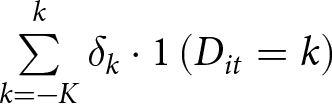 $\mathop \sum \limits_{k = - K}^k {\delta _k} \cdot 1\left( {{D_{it}} = k} \right)$ captures how winery outcomes evolve in the years before and after the repeal of Sunday blue laws. Each coefficient ${\delta _k}$ estimates the treatment effect $k{\text{ }}$ years relative to the reform year, allowing us to assess both pre-trends and the temporal progression of policy impacts. We center our analysis around the year the initial deregulation occurred, using an event-study window that spans 6 years before and after the policy shift. To ensure accuracy in estimating the longer-term treatment effects, we bin the endpoints of each event window. This approach enables us to test for the presence of pre-trends, which will confirm the validity of the parallel-trends assumption, and to determine whether treatment effects stabilize over time (see, for instance, Lopez et al., Reference Lopez, Marchesi and Steinbach2024). Key to this identification is the assumption that latent confounders are fully captured by establishment, year, and market-specific linear trends, thereby isolating variation between treated and untreated wineries over the studied period.
B. Data
We use establishment-level panel data from the NETS dataset, a longitudinal database developed by Walls & Associates based on Dun & Bradstreet records (Walls & Associates, 2025). NETS tracks detailed annual information on U.S. businesses, including employment, sales, location, and industry classification, from 1990 through 2021. Each establishment is assigned a persistent Data Universal Numbering System (DUNS) identifier, enabling us to track firm dynamics over time, regardless of relocation or changes in ownership. For our analysis, we identify wineries using the 2007 North American Industry Classification System (NAICS) code 312130 (Wineries), which includes establishments primarily engaged in: (1) growing grapes and manufacturing wine and brandies; (2) producing wine and brandies from off-site grapes or other fruits; and (3) blending wines and brandies. Establishments exclusively engaged in bottling wines produced elsewhere are excluded, as they fall under NAICS 424820 (Wine and Distilled Alcoholic Beverage Wholesalers).
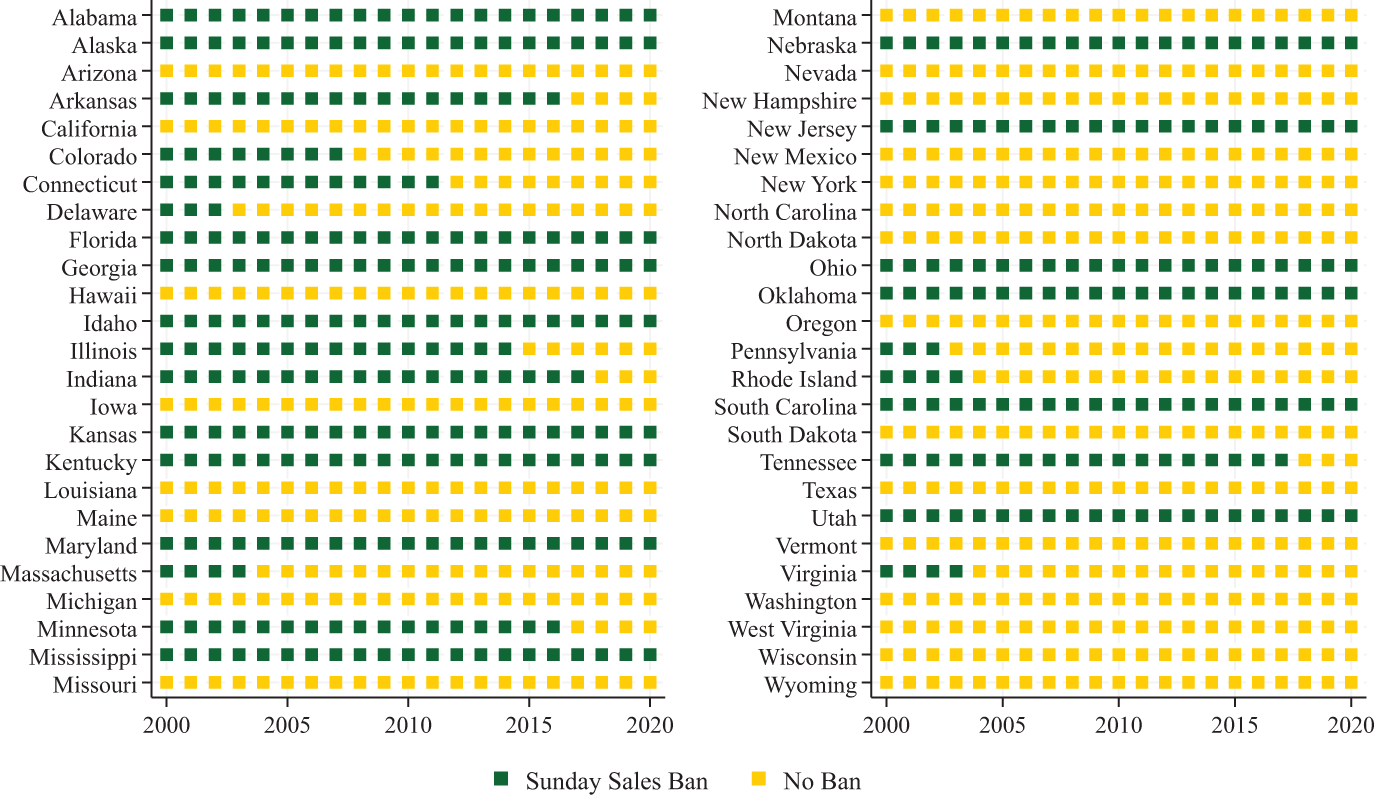
To capture cross-state variation in Sunday alcohol sales regulations, we compiled a panel dataset detailing the status and timing of policy changes at the state level between 2000 and 2020, which is the sample period for our statistical analysis. The primary source for this information is the Alcohol Policy Information System (National Institute on Alcohol Abuse and Alcoholism, 2025), supplemented by original data collection efforts based on legislative archives and state government sources. This process helped correct inconsistencies in APIS classifications and ensured more accurate coding of policy changes, particularly for states with local-option provisions or phased rollouts. States such as Colorado (2008), Connecticut (2012), Indiana (2018), and Minnesota (2017) implemented statewide repeals of Sunday sales bans during the study period, while others, like Pennsylvania (2003) and Tennessee (2018/19), adopted partial or phased reforms. We classify states as treated if they implemented a policy change during the observation window. Figure 1 shows the evolution of Sunday alcohol sales regulations over time, highlighting considerable geographic and temporal heterogeneity that underpins our identification strategy.
Timeline of Sunday alcohol sales ban status across U.S. States from 2000 to 2020.

To isolate small-scale wineries, we apply an employment-based cutoff of fewer than 50 employees, consistent with common definitions of small and medium-sized enterprises (SMEs) in agri-food research (Lorenzo et al., Reference Lorenzo, Rubio and Garcés2018).Footnote 2 Our final dataset comprises 14,612 wineries with one or more locations and 106,746 establishment-year observations before rectangularization, which aligns well with the about 17,000 bonded wineries reported by the Alcohol and Tobacco Tax and Trade Bureau (2025). To distinguish between metropolitan and non-metropolitan areas at the county level, we rely on the 2013 Rural-Urban Continuum Codes (U.S. Department of Agriculture, 2025). These codes offer a stable proxy for urbanization across the study period.Footnote 3 Although the NETS dataset does not provide a complete census of all wineries, it offers robust coverage of small and independent operations. Previous assessments confirm that NETS closely aligns with official business statistics and is suitable for longitudinal analyses of establishment survival patterns (Barnatchez et al., Reference Barnatchez, Crane and Decker2017). The descriptive statistics for the key outcomes are reported in Table 1.
Descriptive Statistics

Note. The table shows the descriptive statistics of the outcome variables. We calculated the mean, median, standard deviation (SD), minimum (Min.), maximum (Max.), and observation numbers (Obs.) for sales and employment if the business was open in a specific year and survival based on all sample years. The sales descriptive statistics are scaled in $1,000.
V. Results and discussion
A. Baseline estimates
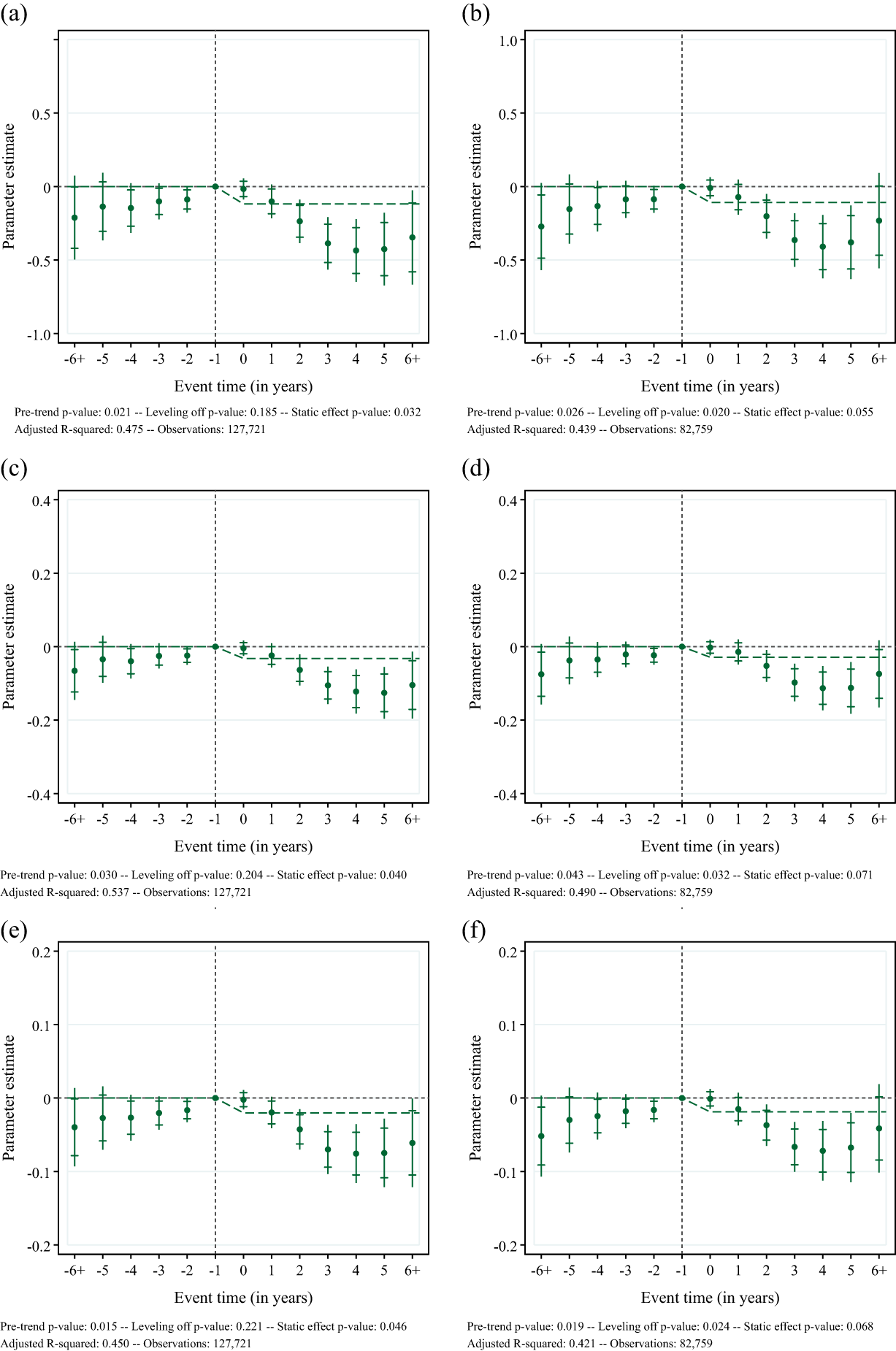
Figure 2 shows the estimated effects of Sunday alcohol sales deregulation on small winery business performance based on dynamic event-study models comparing both “never treated” and “always treated” states as control groups.Footnote 4 Each panel shows coefficients for relative event time, spanning 6 years before and after the first year of policy implementation. Static model estimates are overlaid as dashed lines, and sup-t confidence bands are presented as whiskers (Montiel Olea and Plagborg‐Møller, Reference Montiel Olea and Plagborg‐Møller2019). Across all three outcomes, we find sizable and sustained negative effects following deregulation. In the case of sales (Panels a and b), small wineries experienced average declines between 24.8% and 25.5%, depending on the control group. These dynamic effects are nearly three times as large as those from the static specification, which estimates a decline of 10.3% to 10.4%. For employment (Panels c and d), the estimated average post-reform decline ranges from 7.5% to 7.8%, while survival probabilities drop by 5.0% to 5.2% (Panels e and f). In all cases, the static model is likely to underestimate the magnitude of the impact.Footnote 5
Long-run effects of Sunday alcohol sales deregulation on small winery outcomes by control group specification. (a) Sales, never treated. (b) Sales, always treated. (c) Employment, never treated. (d) Employment, always treated. (e) Survival, never treated. (f) Survival, always treated.

These results are consistent with a demand reallocation mechanism. The repeal of Sunday sales restrictions increased consumer access to alcohol at supermarkets, liquor stores, and big-box retailers, reducing the incentive to visit small wineries for weekend purchases. Our results suggest that in many states, small producers previously benefited from the fact that retail sales were limited or prohibited on Sundays. It could be that this regulatory structure helped channel consumers toward tasting rooms and direct-to-consumer transactions during peak weekend periods. Once lifted, this constraint disappeared, and small wineries faced increased competition from larger producers already embedded in retail supply chains.
At the same time, the reforms did not lead to an increase in overall wine consumption. Consumers largely shifted the timing and location of purchases, rather than buying more in response to Sunday sales policy changes (Connolly et al., Reference Connolly, Graziano, McDonnell and Steinbach2023). As a result, small wineries lost a share of their existing customer base without gaining new market access in return. The ability to capture retail sales depends on distribution agreements, scale economies, and brand visibility; advantages that small wineries typically lack (Pesavento, Reference Pesavento2022). In that context, Sunday deregulation removed a structural advantage without offering a meaningful offset.
B. Differential impacts of deregulation in urban and rural wine markets
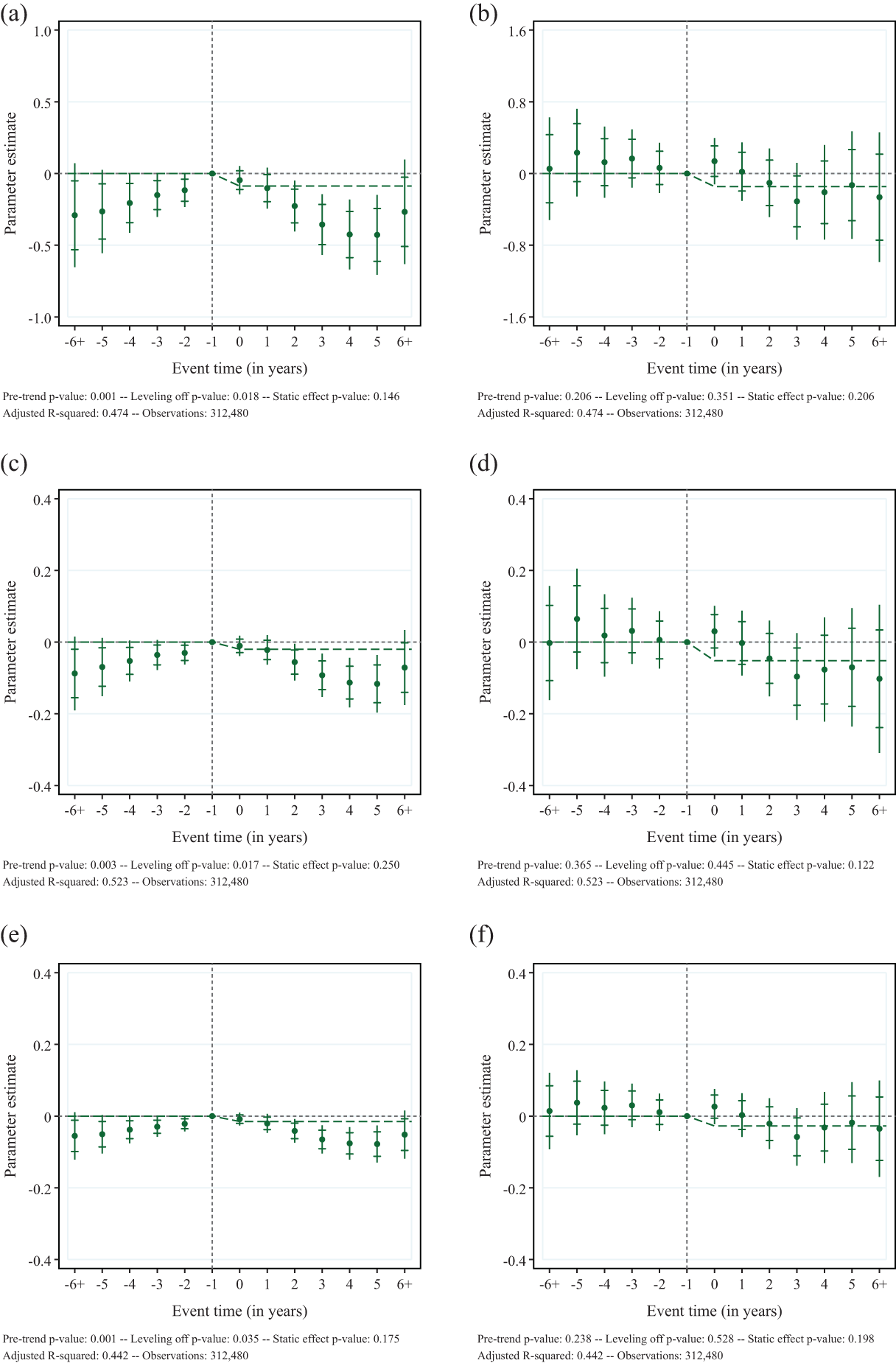
Figure 3 assesses heterogeneity in the effects of Sunday alcohol sales deregulation on small winery outcomes across metropolitan and non-metropolitan markets. The results indicate consistently adverse post-treatment effects in both settings, with more pronounced declines among wineries located in metropolitan counties. Sales fell by an average of 26.5% in metropolitan areas (Panel a), compared to a 13.6% decline in non-metropolitan areas (Panel b). Employment effects follow a similar pattern, with estimated declines of 7.7% and 5.7% in metropolitan and non-metropolitan counties, respectively (Panels c and d). For survival, the estimated reduction is 5.5% in metropolitan areas (Panel e) and 2.5% in non-metropolitan areas (Panel f). While the overall direction of effects is consistent, the magnitude of the decline is generally greater in metropolitan settings.
Long-run effects of Sunday alcohol sales deregulation on small winery outcomes in metropolitan and non-metropolitan markets. (a) Sales, metropolitan markets. (b) Sales, non-metropolitan markets. (c) Employment, metropolitan markets. (d) Employment, non-metropolitan markets. (e) Survival, metropolitan markets. (f) Survival, non-metropolitan markets.

These differences likely reflect variation in the competitive landscape and consumer behavior across geographic contexts. Wineries in metropolitan counties face more intense competition from chain retailers, grocery stores, and national wine brands that were well-positioned to capitalize on expanded Sunday retail access (Connolly et al., Reference Connolly, Graziano, McDonnell and Steinbach2023). The repeal of Sunday blue laws in these areas likely accelerated substitution away from direct-to-consumer channels, undercutting a critical revenue stream for small producers. In non-metropolitan counties, retail density is typically lower, and consumer relationships are more localized, which may have mitigated (but not eliminated) the adverse effects of deregulation.
C. Size-based variation in the effects of Sunday sales deregulation
To evaluate how the impact of Sunday alcohol sales deregulation varies with winery size, we disaggregate treatment effects by employment-based size quartiles. These groups were constructed using average pre-treatment employment to capture meaningful differences in operational scale within the small winery segment. Wineries in the first quartile typically represent the smallest producers, often family-run and operating with minimal staff. In contrast, those in the fourth quartile include more established firms that approach the 50-employee threshold. This classification enables us to investigate whether exposure to deregulation is influenced by organizational capacity and market access.
Table 2 shows that the adverse effects of deregulation are most severe among the smallest wineries. In the first quartile, sales declined by 29.9%, employment by 11.8%, and the probability of continued operation by 5.3%. The magnitude of these effects diminishes in higher quartiles, though it remains substantial across all size groups. Even in the fourth quartile, sales fell by 24.8% and survival probabilities dropped by over 5.9%. These patterns suggest that smaller wineries, which are more reliant on direct-to-consumer channels and less equipped to compete in retail settings, were particularly vulnerable to the competitive pressures introduced by the expansion of Sunday sales. Our results underscore that deregulation disproportionately disadvantaged the smallest producers, exacerbating structural imbalances within the wine industry.
Heterogeneous Effects of Sunday Sales Deregulation by Small Winery Size Quartile

Note. The table reports average post-treatment effects from event studies of Sunday alcohol sales deregulation on small-scale winery sales, employment, and survival by size quartile based on pre-treatment employment and including both “never treated” and “always treated” control groups. The outcomes are log sales, log employment, and an indicator for establishment survival. All models include establishment and year fixed effects and allow for linear market-specific trends. Standard errors, shown in parentheses, are clustered at the establishment level.
*** p < 0.01.
** p < 0.05.
* p < 0.10.
IX. Conclusion
This paper examined the impact of Sunday alcohol sales deregulation on the economic performance of small-scale wineries in the United States between 2000 and 2020. Exploiting cross-state variation in the timing of policy adoption within an event-study framework, we documented substantial and persistent declines in winery sales, employment, and survival following the repeal of Sunday blue laws. The adverse effects materialize gradually, with the largest reductions emerging 4–6 years after policy implementation. These findings suggest that deregulation altered the structure of market access in ways that disadvantaged smaller wine producers, despite the broader intention of expanding consumer choice.
Importantly, the effects are heterogeneous. The smallest wineries, which are those least vertically integrated and most reliant on weekend direct-to-consumer sales, experienced revenue losses exceeding 29.9% and substantial reductions in staffing. Establishments located in metropolitan counties also saw sharper contractions, likely due to the greater density of off-premises retail competition. Even among relatively larger small wineries, performance deteriorated after the reform. These patterns highlight the role of winery capacity, location, and access to retail channels in shaping the response to deregulation. Rather than leveling the playing field, Sunday sales reform has intensified preexisting market asymmetries by removing temporal protections without addressing structural barriers to retail participation.
The underlying mechanisms are likely rooted in the structure of wine distribution. Larger wineries typically maintain exclusive contracts with large distributors and retailers, giving them a more elastic supply response to expanded retail hours (Santiago and Sykuta, Reference Santiago and Sykuta2016). In contrast, small wineries depend heavily on tasting-room and weekend sales, and their limited integration in wholesale channels constrains their ability to compete once consumers gain greater access to off-premise outlets. Deregulation may also have induced modest downward pressure on retail prices, as increased temporal access expanded consumer choice and competition among retailers. This likely exacerbated displacement effects for small producers whose profit margins and local demand were already narrow. Thus, the causal interpretation is consistent with a distributional channel: deregulation favored scale and contract-based distribution networks over small, experience-oriented producers.
These findings challenge the prevailing notion that retail liberalization necessarily benefits all producers. In the context of a highly regulated and concentrated alcohol distribution system, reforms that increase temporal access to retail markets may primarily benefit large-scale intermediaries. For small wineries, deregulation without complementary policies, such as expanded direct-to-consumer shipping, shelf space mandates, and distribution reforms, has led to measurable economic displacement. These findings raise important questions about how retail deregulation should be designed to avoid reinforcing structural disadvantages. While previous research by Connolly et al. (Reference Connolly, Graziano, McDonnell and Steinbach2023) showed that the repeal of Sunday blue laws had small, short-term impacts on liquor stores, the dynamic shifts were different for smaller wineries, thus highlighting the disparate market structures faced by producer-distributors compared to distributors only. Future reforms should incorporate measures that expand market access for small producers, which could induce more inclusive growth in the wine industry.
Acknowledgements
We thank the anonymous reviewer for their constructive comments and editor Karl Storchmann for his guidance throughout the review process. We also appreciate the feedback from participants at the 17th Annual American Association of Wine Economists (AAWE) Conference in San Luis Obispo, California (June 18–22, 2025). All remaining errors are our own.
Funding statement
This work was supported by a data award from the College of Agriculture, Health, and Natural Resources at the University of Connecticut.
Competing interest
The authors declare none.



 Open access

