




Introduction
Modern society is awash with instruments that claim to measure various types of proficiency, competence, ability, literacy, knowledge, skills, and intelligence, to mention a few common labels. In the process of making them measurable, concepts such as these are reified into constructs that work as building blocks for disciplinary knowledge and as an evidence base for different types of practical action. Measured constructs are used in a vast range of real-world domains, including in decisions about people’s employment, migration, citizenship, and educational opportunities. Constructs are also entrenched in policy and media discourses, where they tend to untether from their specific measurement methods. Even so, their “measured” connotation gives them import as “things” with the capacity for certainty about what is or is not enough of something. Mixing this kind of numerical certainty with commerce, many measured constructs lead double lives as both scientific objects in research domains and products in assessment markets.
In this paper, I approach measured constructs as interacting, overlapping spheres of activity where focal concepts are worked on in different ways for different purposes and audiences (Knoch & Macqueen, Reference Knoch and Macqueen2020; Macqueen, Reference Macqueen, Haug, Mann and Knoch2022). I propose a heuristic framework for locating, articulating, and understanding the facets and workings of measured constructs as a basis for a multiperspectival, interdisciplinary research agenda. Drawing on ideas from complexity approaches (Larsen-Freeman, Reference Larsen-Freeman2012; van Geert & de Ruiter, Reference van Geert and de Ruiter2022), validity theory (Messick, Reference Messick and Linn1989), ethnography of infrastructure (Star, Reference Star1999), communities of practice (Wenger, Reference Wenger1998), and cultural–historical activity theory (Engeström, Reference Engeström1999), I trace the trajectories of two constructs, communicative competence and health literacy, that regularly intertwine in the “contact zones” of health care where community repertoires converge with institutional and medical registers (Canagarajah, Reference Canagarajah and May2014). Bringing these constructs into dialogue generates a critical interdisciplinary perspective that helps us see how these two big ideas, which have galvanized decades of research, theory, and practice, might be usefully co-developed and critically evaluated. By examining the interplay of reification and participation, we can better understand the nature of the things we measure and observe how experiences and practices constitute and contest our familiar disciplinary objects (Wenger, Reference Wenger1998).
My approach is a narrative inquiry, which “takes for granted that locating things in time is the way to think about them” (Clandinin & Connelly, Reference Clandinin and Connelly2000, p. 29). First, I discuss the important but elusive nature of “measurable” constructs in the applied social sciences, and I reconceptualize constructs as interrelated spheres of activity (building on Knoch & Macqueen, Reference Knoch and Macqueen2020; Macqueen, Reference Macqueen, Haug, Mann and Knoch2022). I use this heuristic model to examine activity at multiple timescales, starting with the historical origins of communicative competence and health literacy, then examining a single item in a test of health literacy. Moving on to the “real world” of the hospital ward, to which health literacy scores are assumed to apply, I consider health literacy in authentic doctor–patient interaction. Finally, I discuss the relationship between the different activities – what is operationalized in tests, what is wished for in policy, and what is evident in practice.
The multiple faces of measured constructs
The elusiveness of constructs
Although measured constructs are widely used in societal systems, including the massive apparatuses of education and health systems, the concept of a construct is ambiguous. Nearly 70 years ago, Loevinger’s observation that constructs “exist in the minds and magazines of psychologists” (Reference Loevinger1957, p. 642) pointed to their dual instantiations in researchers’ theoretical assumptions about what their instruments measure, and in discursive forms, such as instrument labels. In the decades since, there has been debate about which aspects of the measurement process should be the focus of validation research: instruments (e.g. tests), theoretical assumptions, intended inferences, appropriate uses, and consequences (Chapelle, Reference Chapelle2021). Each of these aspects is related to the slippery notion of a “construct”: whatever is assumed, theorized, claimed, intended, or actually elicited by an assessment. Such a range of activity makes it difficult to use the concept of a construct meaningfully. Assessments are ultimately a sociotechnical phenomenon; they merge technical and social activity (McNamara & Roever, Reference McNamara and Roever2006). Yet, we have no tools for seeing the range of this activity.
The ambiguity of constructs in the social sciences stems partly from the fact that they are not intrinsically measurable in the same way as physical properties such as length are (Michell, Reference Michell, Toomela and Valsiner2009). Thus, the very notion of a measurable construct is a transdisciplinary one, an analogy of “a measurable” derived from actual measurables in the physical sciences. The process of creating metaphorical measurability involves words (definitions, theorizations, interpretations, etc.) as much as numbers (scores, statistics). When ideas are firmed up into measured constructs, there is a hardening effect as they reify into disciplinary objects that are assumed to exist (Ianì, Reference Ianì2024). Over time, these disciplinary things become common sense, embedded in a system of beliefs about their measurability and their independence from other things – a “measurement praxis” (van Geert & de Ruiter, Reference van Geert and de Ruiter2022, pp. 193–197). Creating measurability in the social sciences involves identifying and defining what is to be measured, developing an infrastructure for making relevant behavior perceivable, then converting observations into scores that are assigned meanings, such as “at risk of low [construct label]” (Chalhoub-Deville & Deville, Reference Chalhoub-Deville, Deville and Hinkel2005). But, Spolsky challenges, “Are we really measuring something (language ability or proficiency) or is the construct we are working with simply an unjustifiable reification, an artifact of the statistics we use?” (Reference Spolsky1995, p. 11).
Spolsky’s question brings us to the problem of articulating what the “something” is. The ambiguity in this task has led some theorists avoid referring to constructs altogether. Kane (Reference Kane2012), for instance, is skeptical about the use of “construct language” (p. 67). In his view, “the word ‘construct’ has acquired so many meanings that it is no longer clear what it means, and in many cases talk about ‘constructs’ and ‘construct definitions’ masks the fact that what is being measured is not well defined” (Reference Kane2012, p. 67). In psychological discourse also, Slaney points to “conceptual ambiguity” surrounding the “ever-evasive ‘construct’ concept” (Slaney, Reference Slaney2017, p. 202). For her, the notion of a construct has become murky because “multiple senses of the concept are at play” (p. 203). However, as Fulcher (Reference Fulcher2010) points out “construct language” is both powerful and prevalent. The different meanings of constructs reflect different types of constructs, but they also reflect different communications about constructs (Chapelle, Reference Chapelle2021). The name of a test may indicate a construct but does not provide an adequate basis for validation research (Chapelle, Reference Chapelle2021, p. 54). Even if the idea of a construct, and construct labels, is avoided in validation research, there is always some kind of assumption about what causes score differences, and the outcome is a communication about something beyond the moment of measurement. So, what then, is a construct?
Constructs as spheres of activity
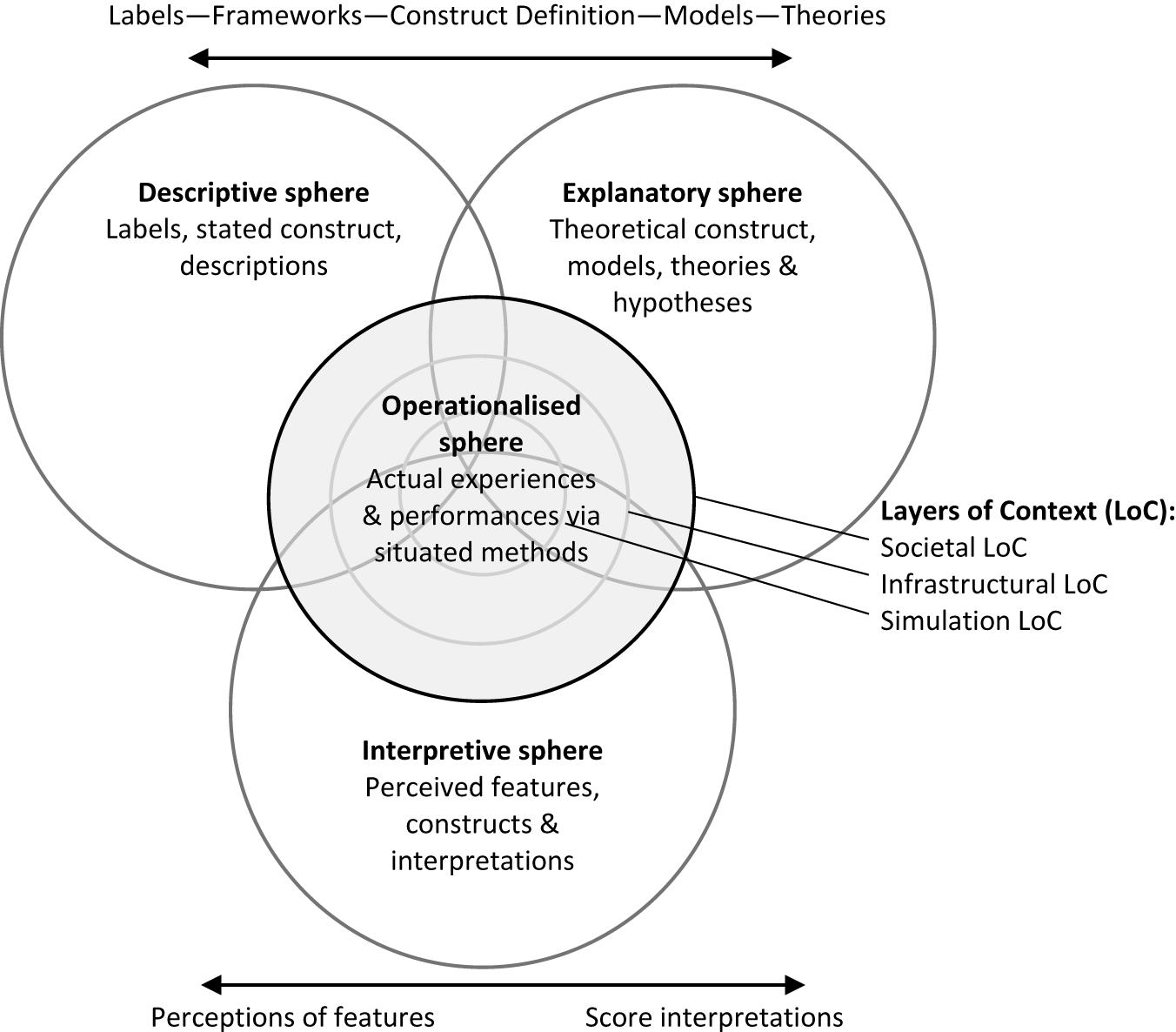
To address the challenge of the elusive construct, I will set out a proposal that expands and specifies different types of activity involved in the reification of measured constructs, depicted in Figure 1. A measured construct results from a dynamic amalgam of various activities involving artifacts, roles, relationships, rules, and values (Engeström, Reference Engeström2001). This activity can be categorized into descriptive, explanatory, interpretive, and operationalized spheres, as shown in Figure 1 (adapted from Knoch & Macqueen, Reference Knoch and Macqueen2020; Macqueen, Reference Macqueen, Haug, Mann and Knoch2022).
Construct spheres of activity.

Figure 1 Long description
The Venn diagram consists of four overlapping spheres labeled as descriptive, explanatory, operationalised and interpretive. The operationalised sphere is at the core of measurement activity, and so it is in the centre of the diagram, overapped by the other three intersecting spheres. The operationalised sphere encompasses actual test experiences and performances via situated methods. It contains three layers, called the societal, infrastructural and simulation layers of context. The three other spheres all intersect with each other and all layers of the operationalised construct sphere at the centre. The descriptive sphere includes labels, stated constructs and descriptions. The explanatory sphere contains theoretical constructs, models, theories and hypotheses. The interpretive sphere involves perceived features, perceived constructs and interpretations. A continuum above the descriptive and explanatory spheres indicates a progression of productive activity, from labels, frameworks and definitions in the descriptive sphere to models and theories in the theoretical sphere. Another arrow under the diagram shows a progression of receptive activity, from perceptions of features to score interpretations.
The top descriptive and explanatory spheres are largely discursive and productive. These are plotted in a continuum along the top of Figure 1, from construct labels such as “health literacy” to elaborated theories. Descriptive activity tends to be produced for score users, policymakers, and assessees, whereas the explanatory activity or theoretical work tends to be produced for technical specialists and researchers. Theories can be explicit, implicit, or even eschewed, but they are nonetheless present in the act of assessment as an assumed explanation for score variance (McNamara, Reference McNamara1996, p. 52). Interpretive activity comprises micro- and macro-levels that can be plotted on a receptive continuum (see bottom of Figure 1). The micro-level encompasses any aspect of the assessment process that involves perceiving, detecting, identifying, and/or interpreting aspects of the measured construct, including that done by machines. The macro-level encompasses understandings and interpretations of scores, decisions, uses, or actions based on the scores.
Operationalized activity is at the center of the model, where the measurement is enacted. The operationalized construct is what emerges in the moment of assessment in the form of responses and performances. It is not just the method (i.e., the assessment infrastructure), nor is it what is claimed or assumed to be measured (i.e. the stated or theoretical construct). Whether the focus is on an individual experience or a group performance, there are three interrelated contextual layers embedded in an operationalized construct: the societal, infrastructural, and simulation layers of context (drawing on Chalhoub-Deville, Reference Chalhoub-Deville and Lissitz2009; adapted from Knoch & Macqueen, Reference Knoch and Macqueen2020). The societal layer is embedded in the operationalized construct through, for example, the language of the test and ideologies represented in decisions about what to value in scores (e.g.., criteria). The societal layer is also evident in the existence of the test as an artifact and beliefs about the worth and objectivity of measurement Reference Broadfoot1996. The infrastructural layer is the built environment (e.g. tasks, instructions, scoring procedure) that elicits the observable behavior, and the simulation layer is the immediate context of the actual performance. Layers are inseparable in practice. Delineating them allows more specific and critical analysis of the sociotechnical qualities of constructs and their inherent values, rather than referring to “context” in a general sense.
While each sphere denotes a broad type of activity, they also intersect and layer on one another as in Figure 1, and as illustrated in the following sections. The spheres have synchronic relations and historical depth, which we will now explore in the origins of two foundational constructs in linguistics and health.
Descriptive-explanatory spheres
Common origins, different journeys
It was in the Anglophone, Western, rights-oriented social milieu of the mid-20th century, that communicative competence and health literacy were initially proposed. Although they germinated in linguistics and health sciences, respectively, their common ground was the societal responsibility to fulfill the rights of the child to education. While communicative competence was initially conceptualized as a disciplinary theory (Hymes, Reference Hymes, Pride and Holmes1972), health literacy arose in U.S. policy discourses connecting population health and education (Pinheiro, Reference Pinheiro2021).
At a conference on the language development of disadvantaged children, Dell Hymes outlined his theory proposing that the notion of communicative competence – the ability to use language appropriately in sociocultural contexts – better represents the human capacity to make meaning in diverse linguistic codes than Chomsky’s idea of competence as a set of idealized syntactic structures in a homogenous speech community (Hymes, Reference Hymes, Pride and Holmes1972). He focused on the need for a new theory on the “common problem of education … that the verbal abilities of children are assessed in settings which do not represent the true range of their competence” (Hymes, Reference Hymes, Fillmore, Kempler and Wang1979, p. 41). Thus, it was, in part, the potential for injustice through measurement that led to the notion of communicative competence.
Originally conceived in relation to first languages, the theory of communicative competence has been extensively modeled for additional language learners, mostly including the terms “competence” and “ability” in the labels, for the purposes of learning, teaching, and assessment (Bachman & Palmer, Reference Bachman and Palmer1996, Reference Bachman and Palmer2010; Canale, Reference Canale, Richards and Schmidt1983; Canale & Swain, Reference Canale and Swain1980). Across the models, a distinction is drawn between knowledge/competence of language (e.g. grammar, sociolinguistic appropriateness, vocabulary) and an ability to activate knowledge in actual use, where nonlanguage-specific aspects such as volition and affect come into play (McNamara, Reference McNamara1995). Successive theoretical modeling has contended with the nature of communicative knowledge, what the ability to activate it entails and how these two aspects interrelate (Bachman & Palmer, Reference Bachman and Palmer1996; McNamara, Reference McNamara1995).
In the case of health literacy, there was a perceived need for good health citizenship, in other words, greater population participation in staying healthy. Like the recognition of children’s linguistic repertoires in the development of communicative competence, health literacy was also framed as a responsibility of the education system, and it developed from a behavioral focus to an emphasis on attitudes, skills, and individual responsibility (Means, Reference Means1962). In an early use of the term, Simonds proposed that a “health literacy” standard be measured in U.S. schools at all grade levels, with funding and support ensuing for schools that do not meet the standard (Reference Simonds1974, p. 9). These initial formulations show the early traces of reification, as the construct is imagined into measurable form.
As the use and measurement of health literacy has grown, there has been an ongoing effort to take stock of definitions (Berkman et al., Reference Berkman, Davis and McCormack2010; Nutbeam, Reference Nutbeam2008; Peerson & Saunders, Reference Peerson and Saunders2009; Rudd, Reference Rudd2015; Sørensen et al., Reference Sørensen, Van den Broucke, Fullam, Doyle, Pelikan, Slonska and Brand2012). The summary definition below captures typical elements, including the will to be informed (motivation), the ability to be informed (knowledge, competences), and the use of health information as skills (access, understand, appraise, and apply) and health actions (make judgments and take decisions).
Health literacy is linked to literacy and entails people’s knowledge, motivation and competences to access, understand, appraise, and apply health information in order to make judgments and take decisions in everyday life concerning healthcare, disease prevention and health promotion to maintain or improve quality of life during the life course. (Sørensen et al., Reference Sørensen, Van den Broucke, Fullam, Doyle, Pelikan, Slonska and Brand2012, p. 3)
Given the breadth of this definition, any operationalization of the concept of health literacy as a measured construct is inevitably narrow (Baker, Reference Baker2006; Nutbeam, Reference Nutbeam2008). Yet, health literacy, broadly defined in this way, is now a common component of national and international health policies (Okan et al., Reference Okan, Bauer, Levin-Zamir, Pinheiro and Sørensen2019).
In the mainly hypothetico-deductive mode of health science inquiry, health literacy is generally viewed as a stable phenomenon that travels across contexts with its “validated instruments.” Whereas language test researchers have tended to see validity as related to the interpretation or use of test scores of particular populations health literacy researchers often lament the absence of a “gold standard” instrument that can capture health literacy equally across populations and contexts. In this vein, it is rarely questioned that health literacy tests repeatedly return lower health literacy scores in older populations (Chesser et al., Reference Chesser, Keene Woods, Smothers and Rogers2016) and in populations with language backgrounds other than dominant language of health care (Ugas et al., Reference Ugas, Mackinnon, Amadasun, Escamilla, Gill, Guiliani, Fazelzad, Martin, Samoil and Papadakos2023). Instead, health literacy research has tended to view language as a monolingual vehicle for health information and has accepted the apparent loss of health literacy in older age, despite its theoretical relevance to quality of life during the life course (Sørensen et al., Reference Sørensen, Van den Broucke, Fullam, Doyle, Pelikan, Slonska and Brand2012).
The emphasis on personal responsibility has remained a significant part of the health literacy story, maturing into construct clusters with self-management and empowerment, and featuring in health discourses of both social justice (individual rights, societal responsibility) and productivity (individual responsibility, societal economic efficiency) (e.g., McDaid, Reference McDaid2016; OECD, 2023).
Intraindividual abilities, interindividual use
As can be seen in the origins and definitions, both theoretical constructs arose with an emphasis on social action and participation. Subsequent theoretical activity on both constructs has encompassed knowledge and the ability to use it in actual communicative situations. The question of how to model interactional performance has given rise to several theoretical constructs derived from communicative competence, for example, “interactional competence” (e.g. Young, Reference Young2000) and “performative competence” (Canagarajah, Reference Canagarajah and May2014). In health literacy theory too, many have drawn attention to aspects of the context (interlocutor, institution, system, condition) as an obvious determinant in the ability to access, understand, and act on health information (Baker, Reference Baker2006; Paasche-Orlow & Wolf, Reference Paasche-Orlow and Wolf2007; Rudd, Reference Rudd2015; van der Heide et al., Reference van der Heide, Poureslami, Mitic, Shum, Rootman and FitzGerald2018), and subtypes of health literacy that emphasize communication and context have been proposed, for example, “health-related oral literacy” (Baker, Reference Baker2006) and “interactive health literacy” (Nutbeam, Reference Nutbeam2000).
More than just another variable, it has been proposed that health literacy is a “dynamic construct that emerges from the interaction between patients/citizens and health-care systems, organizations and professionals” (van der Heide et al., Reference van der Heide, Poureslami, Mitic, Shum, Rootman and FitzGerald2018, p. 134). Researchers taking a social practice perspective center the situatedness of health literacy as a shared expertise, including language expertise, which “resides in the patient’s social network” (Hunter & Franken, Reference Hunter and Franken2012; Papen, Reference Papen2009, p. 27). These socially oriented theoretical developments pose a challenge for conventional intraindividual testing practices in the operationalized sphere of activity. For example, the Rapid Estimate of Adult Literacy in Medicine test, involves reading single words aloud with correctness determined according to “dictionary pronunciation.” This activity offers little information about how someone might understand medication side effects and may be biased against speakers who do not produce the scorer’s perception of dictionary pronunciation (Elder et al., Reference Elder, Barber, Staples, Osborne, Clerehan and Buchbinder2012). To explore the operationalized sphere, we will now move to the interior of one health literacy test.
Operationalized-interpretive spheres
One score, multiple layers, many meanings
The operationalized sphere of activity is the core of a measured construct. It emerges in a complex interaction with the test context, which is envisaged as three layers: societal, infrastructural, and simulation (Figure 1). In this section, I apply these to a widely used health literacy test, the “Newest Vital Sign” test (Weiss et al., Reference Weiss, Mays, Martz, Castro, DeWalt, Pignone, Mockbee and Hale2005). I then turn to the interpretive sphere of activity in and beyond the test experience.
The assessee is Karl, a 79-year-old man who migrated to Australia at the age of 50. A native speaker of German, Karl describes his English ability as “OK” – he would not normally want any language support in medical consultations in English unless it was about something particularly difficult, when he would take his wife. His highest level of education was secondary school.
Karl has been invited to do the test as part of a study on the development of health literacy and self-management of heart failure (Karimi et al., Reference Karimi, De Toni, Abhayaratna, Askelin, Currie, Edge, Etherton-beer, Fewster, Goncharov, Jijo, Macqueen, Mckay, Raine, Rashidi, Rouen, Saunders, Schulz, Tecson and Slade2025). The stated construct of the test is “health literacy” defined by the assessment provider as “the understanding and application of words (prose), numbers (numeracy), and forms, etc. (document)” (Pfizer Inc., 2011, p. 1). The name, construct label, and definition all form part of the descriptive sphere. They bear traces of their historical origins described in the previous section.
In the operationalized sphere, these descriptions are activated through the instrument and all its procedures – the infrastructural layer of context. The Newest Vital Sign test comprises six questions, delivered orally, about an English ice cream nutrition label. In the following excerpt, Karl answers the second of these questions. English translations of Karl’s German utterances are provided in italics.

In this excerpt, we enter the simulation layer of context, where Karl, in his hospital bed with a recent diagnosis of heart failure, engages with the researcher, the test items, and nutrition label. In Karl’s response, we glimpse the operationalized construct: the complex interplay of instrument, actors, circumstances, attitudes, social understandings, knowledge, and abilities that emerge in the moment of testing.
Although he is unwell, Karl is a consummate entertainer, and the test is “administered” amidst small narratives, humor, and chat in English. After responding to questions about his background for which he is the authority, he acquiescently moved into performing the role of test taker, with its face-threatening sociolinguistic rules premised on identifying a lack of authority in a health domain. The construct definition for the test does not encompass communication beyond word-level understanding, but Karl’s ability to communicate in contextually-appropriate, rule-governed ways, that is, his communicative competence, is also activated in the test. He recognized the shift in roles (from authority to assessee) and played along with what, outside a test frame, might seem a bizarre set of questions (Harding et al., Reference Harding, Macqueen, Pill, Kanwit and Solon2023; Milroy & Milroy, Reference Milroy and Milroy2012).
Besides responding appropriately in the context, Karl has understood a complex interrogative structure (“If …, how much …?”), which implicitly references compliant health behavior (“allowed to eat”). He then draws on his multilingual repertoire for quiet calculations but recognizes that his “on record” response must be in English. Karl’s participation in the test-taking frame and all it entails is an example of activity at the intersection of the interpretive sphere, which includes perceiving what he thinks is explicitly and implicitly required by the task and the operationalized sphere which includes acting on those perceptions in some way.
Beyond Karl’s perceptions in this moment of engagement lie other interpretive sphere activities, carried out by the test provider, the researcher, clinicians, and national and international policymakers. According to the scoring guide, Karl’s score is to be interpreted as a “high likelihood of limited literacy” (Pfizer Inc., 2011, p. 6). Further interpretive activity comes in the form of how clinicians can adjust communication for someone designated in this category: “Based on the number of correct answers, health care providers can assess the patient’s health literacy level and adjust the way they communicate to ensure patient understanding” (Pfizer Inc., 2011, p. 2). This interpretation resonates with policy documents in the societal context that advise health professionals that they should educate patients in ways that are “appropriate to their level of health literacy” (Atherton et al., Reference Atherton, Sindone, De Pasquale, Driscoll, MacDonald, Hopper, Kistler, Briffa, Wong and Abhayaratna2018, p. 1131). These clinical guidelines, in turn, resonate with population health policies that emphasize the economic imperative for health literacy with links to disease prevention and productivity (OECD, 2023, p. 175). Although these policies are not necessarily referring to the operationalized construct of the Newest Vital Sign test, in policy discourse, the construct label “health literacy” signals an observable, measurable, and interpretable reification and may draw on research that uses operationalized constructs like this one.
The test provider’s desired interpretation of importance, even criticality, of the construct is underscored by the name of the test Newest Vital Sign, and this interpretation is reinforced through the recommendation that results are recorded in patient records “near other vital sign measures” (Pfizer Inc., 2011, p. 3). Even though the stated construct (descriptive sphere) for this test is not “language,” the fact that the test is delivered in orally delivered written English is a sign of the values in the societal layer of context, including the converging ideologies of standard languages and scientific objectivity (Milroy & Milroy, Reference Milroy and Milroy2012, p. 145; Shohamy, Reference Shohamy2001). A belief in the existence, importance, and measurability of health literacy as an attribute of an individual is also inherent in the activity. In these ways, the beliefs, values, and power relationships of society are not only present in how the assessment is understood or used, or what consequences occur, but are embedded in what is operationalized (Messick, Reference Messick1980; Shohamy, Reference Shohamy2001).
Originally funded and freely distributed by the Pfizer pharmaceutical company, the copyright for this test was sold to IQVIA Inc., an international corporation that provides research services to the “life sciences industry” in 2023 (Weiss, Reference Weiss2024). The test is housed in their “clinical outcome assessments marketplace” for the disease indication of “health literacy,” and it is available in English and Spanish (IQVIA, 2025). IQVIA describes this library of assessments for licensing as “more than just a repository of assessments – it’s a trusted resource for high-quality data that drives meaningful patient-centered research” (IQVIA, 2024). Production discourses such as these also feed into interpretive activities. In particular, discourses of trust are common marketing methods for assessment products. Whether or not trust is warranted, such discourses enhance the perceived value of score interpretations for score users selecting between assessment products (Macqueen et al., Reference Macqueen, Pill and Knoch2021).
Participation
Now we have seen the inner workings of the test, let us now return to the matter of participation, which was an impetus for the development of both constructs. This concerns how well the construct relates to its applicable domain, where the construct of “health literacy” is present in policies and assumed to be enacted in practices. Here, the macro end of interpretive activity comes into play (see Figure 1). A highly relevant practice is shared or participative decision-making, a cornerstone of patient-centered care that is embedded in policies in many health systems across the world. Shared decision-making is a best-practice communicative procedure in which “the provider shares expertise about the patient’s condition and about the risks, benefits, and consequences of available treatment options, and the patient shares information about his/her goals, values, and preferences for treatment” (McAllister, Reference McAllister, Elwyn, Edwards and Thompson2016, p. 324). “Low” health literacy, indicated by Karl’s score, is considered a barrier to this kind of participation (Protheroe et al., Reference Protheroe, Nutbeam and Rowlands2009).
Health literacy and communicative competence in the wild
Let’s visit Karl as he talks to a doctor on the ward round to explore how communicative competence and health literacy might cohabit in the target domain of the test (i.e. the real-world situation to which a test score interpretation is extrapolated). The following three “gout medication” episodes occur in a 17-minute bedside consultation carried out in English as a lingua franca about aspects of the diagnostic process, treatment, and lifestyle changes. Dr Lee is concerned about Karl’s recurring gout and is recommending medications, pending test results. In each episode, there is a statement by the doctor indicating her intention to prescribe gout medications (underlined), followed by a brief negotiation, initiated by Karl, about the purpose of the drug (bolded).
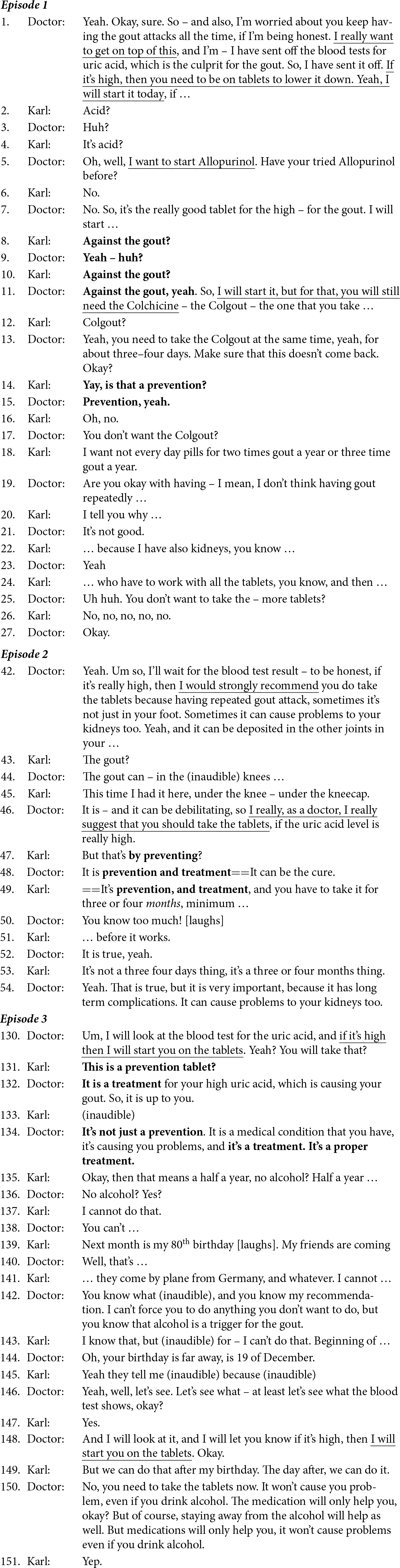
Over the course of these three episodes, it emerges that, for Karl, the risk of gout is overweighed by the risk of damage to his kidneys, the long period of taking a drug before it works, and the inability to drink on his upcoming 80th birthday. Karl appears to want to distinguish between taking the medications for “treatment” or for “prevention” as a part of his decision-making. Possibly, he thinks that taking medication for “prevention” alone is not worth the risk. Dr Lee advocates authoritatively for using the medication (see underlined transcript). In her morphosyntactic choices and statements of intention, she places herself at the center of the decision. She reiterates “I will start [the drug] …” five times and explains “I really want to get on top of this” (line 1) and “as a doctor, I really suggest that you should take the tablets” (line 46). However, despite these seemingly non-collaborative, oppositional stances, the whole interaction was warm, open, and highly participative. Karl was demonstrably able to express his views, and Dr Lee, although forceful about her position on the decision outcome, was also clear about the ultimate responsibility (“it’s up to you” line 132).
In the first episode, Dr Lee confirms the medication is for “prevention” (line 15). In Karl’s next initiation, she appears to pick up on the problematic “treatment/prevention” distinction and explains “It is prevention and treatment==It can be the cure” (line 48). In the third episode, perhaps sensing that this meaning distinction will be the basis for his decision, she becomes more emphatic about “treatment,” reiterating that the drug is “treatment” rather than “prevention” point four times, culminating in “It’s a proper treatment” (line 134). Here, we see that both parties have identified a “locus of trouble” to work on (van Compernolle, Reference van Compernolle2010, p. 72). Being alert to unshared or unclear meanings in this way may be one instantiation of health-literacy-in-interaction.
The interaction constitutes a number of aspects of the definition of health literacy above. Karl appeared to understand information about his medication and its effects (the doctor even observed: “You know too much!” line 50). He appraised the elicited information (“I want not every day pills for two times gout a year or three time gout a year.” line 18) and clearly articulated his reasoning (“I tell you why … because I have also kidneys, you know … who have to work with all the tablets” lines 20, 22, 24), and his goals, values, and preferences (“I cannot do that. … Next month is my 80th birthday … My friends are coming” lines 137, 139). Contrary to his score on the screening test, there is little to suggest that his health literacy is inadequate. Therefore, there appears to be incongruence between the operationalized construct, the score interpretation, and evidence of Karl’s health literacy (as it is defined above) in participative decision-making.
Discussion
Challenges to reified constructs
Although we can identify aspects of the defined “health literacy” in the interaction between Karl and Dr Lee, it is impossible to separate these actions from the communication that mediates them. The mutual understanding that was achieved in these recurring episodes was co-constructed through agentive meaning-making by both parties: Dr Lee’s repeated stance on the need for gout medications in concert with Karl’s repeated questions about the medication purpose evolved as they worked on understanding each other’s understandings or “common ground” (Clark, Reference Clark1996). In this iterative process, they negotiated the decision (whether to start new medication), the medication purpose (for treatment or prevention), and their disparate views of causes of possible kidney harm (medication or gout). Both parties had to provide and understand new information throughout the unfolding interaction, for example, Dr Lee learning that Karl has an important life event coming up and Karl learning that he can start the medication anyway.
People, artifacts, and processes all play a role in the evolving knowledge construction, that is, “doing health literacy” (Nikolaidou & Bellander, Reference Nikolaidou and Bellander2020, p. 2). We might ask – is there any such thing as a measurable, individual “health literacy”? Perhaps, instead, there is engaging in health through “ecosystems of signal ensembles” in different sense channels (Barrett, Reference Barrett2022, p. 894)? Returning to Spolsky’s challenge of the “unjustified reification”; might health literacy be nothing more than “a reification of basic abilities” (Reeve & Basalik, Reference Reeve and Basalik2014, p. 100)? If so, there is a great need for interdisciplinarity through theories that offer insight on what it means to mediate one’s health care through communication.
While there are challenges for the operationalization of health literacy, the interaction between Karl and Dr Lee challenges the construct of communicative competence too. Unmitigated disagreements and hierarchical statements of authority occur throughout the interaction, against expectations of many English-speaking communities (Hüttner, Reference Hüttner2014) and contrary to the collaborative model assumed in shared decision-making. There is also unconventional morphosyntax as both people mobilize their “semiotic and register-specific resources” to meet the complex contextual demands of medication decision-making (Hall, Reference Hall2018, p. 31). Hall refers to this mobilizing of resources as “interactional repertoires” rather than “competence” to distinguish contextualized practices from the notion of an underlying, stable ability denoted by the “competence” label (Reference Hall2018). Thus, a label shift in the descriptive sphere may be used to anchor changes in the theoretical sphere.
Reimagining health-literacy-in-interaction
A repertoire perspective could bring health literacy operationalizations closer to the language use patterns that are relevant to health information seeking and health communication (Knoch & Macqueen, Reference Knoch and Macqueen2020; Macqueen, Reference Macqueen, Chapelle and Kremmel2025). Health-care spaces are indisputably “contact zones” where care may be practised using a lingua franca, as between Karl and Dr Lee, or in various configurations of language codes (Canagarajah, Reference Canagarajah and May2014; Tweedie & Johnson, Reference Tweedie and Johnson2019). Moreover, health literacy is understood as an “everywhere” construct, activated whenever people seek information and make health choices. Therefore, judging it only through a single language may underestimate the abilities of minority populations accessing information in other languages. What if Karl had answered correctly in German? Does this demonstrate his health literacy even though it falls outside the standardized answer key? For Karl, as for many older people, it may have been many decades since last doing a test, and even then, literacy and numeracy are more likely to have been tested in written form, and perhaps in a different language. Thus, both older age and language may be sources of bias inherent in the test infrastructure via societal and disciplinary assumptions about consistent measurability across populations. Harding and McNamara point out that English as a lingua franca destabilizes the native speaker as the main model for acceptability and appropriateness, forcing us to “reconsider the nature of language proficiency itself, and to recognise the important role played by accommodation and interactional communicative strategies” (Reference Harding, McNamara, Jenkins, Baker and Dewey2017, p. 570). The strategic, iterative reworking of the gout medication decision by Karl and Dr Lee is evidence of such interactive phenomena.
Juxtaposing the operationalized construct (Newest Vital Sign test activity), with actual instantiation of “shared decision-making” policies in the interpretative sphere, and insights deriving from the theory of communicative competence in the explanatory sphere, a useful reimagining of health-literacy-in-interaction becomes possible. An orientation to the interactional repertoires of health care, and the dynamic nature of knowledge co-construction in health decision-making could progress all areas of activity. For example, more useful assessment infrastructures could be dynamic, socio-interactional designs which (1) emphasize “future-in-the-making” learning over static skills and (2) recognize the role of language and other symbolic means as mediators of meaningful engagement with health (Lantolf & Poehner, Reference Lantolf and Poehner2004, p. 53).
Dynamic congruence between spheres
Making a shared decision depends critically on the ability to use a shared linguistic repertoire (Paredes et al., Reference Paredes, Idrees, Beal, Chen, Cerier, Okunrintemi, Olsen, Sun, Cloyd and Pawlik2018) and an understanding of the Western cultural norms and values that this approach embodies, including individual autonomy (Dolan et al., Reference Dolan, Li and Trevena2019). Even though the capacity to communicate is considered a primary ingredient in mobilizing health literacy for shared decision-making (Ousseine et al., Reference Ousseine, Durand, Bouhnik, Ben’smith and Mancini2019), communication is under-represented in operationalized constructs, as we saw in the Newest Vital Sign test. This reveals an incongruence between what the label “health literacy” means in the different spheres.
Ideally, there should be a kind of dynamic congruence between different types of construct activity, where key activities in each sphere are aligned and logical. This means that what is operationalized should be strongly representative of what is claimed to be measured (descriptive sphere) and theorized to explain score variance (explanatory sphere). The interpretation via any scores or categorizations for any intended actions (interpretive sphere) should be well justified by theory and evidenced through research. Although dynamic congruence between key activities in the spheres reflects the established principles of “construct validity” (Cronbach & Meehl, Reference Cronbach and Meehl1955; Messick, Reference Messick and Linn1989; Peak, Reference Peak, Festinger and Katz1953), the purpose of a spheres of activity approach is not to validate particular uses or interpretations of measured constructs. For this, we are well equipped with tools (e.g. Bachman & Palmer, Reference Bachman and Palmer2010; Chapelle, Reference Chapelle2021; Kane, Reference Kane2013; Mislevy, Reference Mislevy2018). Rather, it encourages researchers, practitioners, and policymakers to recognize construct use as a dynamic, multilayered activity despite the tendency for constructs to appear as stable, isolable, measurable things. Congruence is a methodological ideal, but it does not detect or prevent injustice. This requires critical inquiry across spheres of activity.
A spheres of activity approach enables a more expansive agenda for understanding and evaluating measured construct activity in and between academic domains, their applicable worlds, and more general discourse. It creates an analytic rubric for critically examining the historical, cultural, discursive, sociotechnical, and ethical aspects of construct activity and draws multiple perspectives, methodologies, objects, and timescales into the scope of inquiry.
Acknowledgments
I am grateful to Karl and Dr Lee (pseudonyms) for their willingness to share their expertise and experience through participating in the study. I wish to acknowledge the work of two multidisciplinary teams in the development of this article. The data were drawn from a project funded by the Ramsay Hospital Research Foundation (No. 2021/TCG/0111) titled “Improving communication to enhance health literacy and self-management of heart failure.” Ethics approval was granted by the Australian Capital Territory Health (2023.ETH.00007) and Edith Cowan University (023-04314-SAUNDERS) Human Research Ethics Committees. Additionally, the work was supported by a National Health and Medical Research Council grant (No. 2032743) titled “Enhancing safe telehealth for all in high risk consultations: A multiperspective, mixed-methods study.”

 Open access

