





Introduction
Cover crops can play a significant role in managing soil fertility in organic vegetable production systems through the decomposition of their biomass and the release of nutrients (Robačer et al., Reference Robačer, Canali, Kristensen, Bavec, Mlakar, Jakop and Bavec2016; Scavo et al., Reference Scavo, Fontanazza, Restuccia, Pesce, Abbate and Mauromicale2022). In vegetable production systems, cover crop species are typically annual legumes and grasses, which can be seeded either as pure stands or in mixtures. Grasses can efficiently scavenge soil mineral nitrogen (N), while legume cover crops enhance soil fertility through biological N fixation (Thorup-Kristensen, Reference Thorup-Kristensen2001). Previous studies have shown that legume species generally have low carbon-to-nitrogen (C:N) ratios, leading to rapid decomposition of their residues (Halde and Entz, Reference Halde and Entz2016). As a result, cover crops can be a valuable source of N and help reduce fertilizer application rates for the subsequent crop (Muramoto et al., Reference Muramoto, Smith, Shennan, Klonsky, Leap, Ruiz and Gliessman2011; Ackroyd et al., Reference Ackroyd, Cavigelli, Spargo, Davis, Garst and Mirsky2019), especially since most vegetable crops require large quantities of fertilizers (Congreves and Van Eerd, Reference Congreves and Van Eerd2015).
In organic systems, cover crops are usually mowed and incorporated into the soil through disking before planting vegetables (Hefner et al., Reference Hefner, Gebremikael, Canali, Sans Serra, Petersen, Sorensen, De Neve, Labouriau and Kristensen2020). Tillage offers benefits such as loosening the soil, reducing surface compaction, improving soil aeration, and stimulating the mineralization of soil organic matter (Triplett and Dick, Reference Triplett and Dick2008). However, soil tillage can also negatively impact soil structure (Magdoff and van Es, Reference Magdoff and van Es2021). An increasing number of small-scale farmers are adopting the use of cover crops combined with reduced tillage methods, known as rotational cover crop-based no-till systems. A common strategy for terminating cover crops without tillage is using a roller-crimper, a tractor-mounted tool with a water-filled steel drum and blades (Ashford and Reeves, Reference Ashford and Reeves2003). This method of crimping the plant stems allows them to dry out while keeping the roots and soil relatively undisturbed (Parr et al., Reference Parr, Grossman, Reberg-Horton, Brinton and Crozier2014). Previous studies have shown that using roller-crimped cover crops can often lead to lower vegetable crop yields compared to mowed and tilled methods due to higher weed densities and soil-related factors, such as N availability. This has been observed in the production of broccoli (Brassica oleracea var. italica) (Jokela and Nair, Reference Jokela and Nair2016), tomato ( Solanum lycopersicum L.) (Leavitt et al., Reference Leavitt, Sheaffer, Wyse and Allan2011; Robb et al., Reference Robb, Zehnder, Kloot, Bridges and Park2019), cabbage (Brassica oleracea var. capitata) (Pieper, Brown and Amador, Reference Pieper, Brown and Amador2015; Hefner et al., Reference Hefner, Gebremikael, Canali, Sans Serra, Petersen, Sorensen, De Neve, Labouriau and Kristensen2020), zucchini (Cucurbita pepo L.), and bell peppers (Capsicum annuum L.) (Leavitt et al., Reference Leavitt, Sheaffer, Wyse and Allan2011). Cover crop residues left on the soil surface take longer to mineralize than if incorporated, thereby reducing or delaying the N availability for the subsequent crop (Radicetti et al., Reference Radicetti, Mancinelli, Moscetti and Campiglia2016). Liebman et al. (Reference Liebman, Grossman, Brown, Wells, Reberg-Horton and Shi2018) found that soil mineral N increased rapidly after incorporating legume cover crops into the soil. It was observed that soil mineral N content was greater for up to 12–16 weeks after legume termination by disking compared to roller-crimping (Jani et al., Reference Jani, Grossman, Smyth and Hu2015). Additionally, using multi-species mixtures makes it more difficult to achieve the optimal termination stage for each crop (Lounsbury et al., Reference Lounsbury, Warren, Wolfe and Smith2020). Cover crop regrowth after roller-crimping is typically linked to the timing of termination (Luna, Mitchell and Shrestha, Reference Luna, Mitchell and Shrestha2012). As noted by Halde et al. (Reference Halde, Gagné, Charles and Lawley2017), even with a pure stand, a second pass of the roller-crimper is often necessary to control plant regrowth. Regarding this complexity, it is essential to test roller-crimping under different conditions, such as climate, soil, and cover crop species.
Tarping may prevent the regrowth of cover crops often observed in roller-crimping systems (Lounsbury et al., Reference Lounsbury, Warren, Wolfe and Smith2020). Recently, tarping has gained popularity as a no-till management practice across small-scale farms in Quebec, Canada. This technique involves covering mowed or roller-crimped cover crops with silage tarps—reusable opaque polyethylene sheeting that is black on one side and white on the other—for a period ranging from days to weeks (Kubalek et al., Reference Kubalek, Granatstein, Collins and Miles2022). Farmers position the black side of the tarp facing up to block sunlight, capture solar radiation, warm the soil, and retain moisture, all of which help suppress weeds and cover crops. Tarping has been shown to effectively terminate cereal rye ( Secale cereale L.)-hairy vetch (Vicia villosa Roth) in New Hampshire, USA, by potentially stimulating microbial activity (Lounsbury et al., Reference Lounsbury, Warren, Wolfe and Smith2020). Additionally, tarping was found to increase soil mineral N availability compared to treatment without tarps (Rylander et al., Reference Rylander, Rangarajan, Maher, Hutton, Rowley, McGrath and Sexton2020), thereby contributing to maintaining crop yields.
Research on no-till termination methods in vegetable production has primarily focused on fall-seeded cover crops, with spring-seeded mixtures still being relatively unexplored (Wauters et al., Reference Wauters, Grossman, Pfeiffer and Cala2021). In Quebec, small-scale organic farmers often plant fast-growing annual cover crops in spring before late-planted vegetable crops that are typically harvested in the fall. These short-duration cover crops can benefit subsequent vegetable crops by covering the soil that would otherwise be left bare during the spring or summer, suppressing weeds (Kumar, Brainard and Bellinder, Reference Kumar, Brainard and Bellinder2009), and supplying N in the case of legumes or scavenging N with others (Creamer and Baldwin, Reference Creamer and Baldwin2000; Büchi et al., Reference Büchi, Gebhard, Liebisch, Sinaj, Ramseier and Charles2015; O’Connell et al., Reference O’Connell, Shi, Grossman, Hoyt, Fager and Creamer2015). However, short-duration cover crops face challenges as they require adequate time to establish, grow, and generate sufficient biomass. For these spring-seeded cover crops, rapid and vigorous growth is essential (Wauters et al., Reference Wauters, Grossman, Pfeiffer and Cala2021) to produce enough biomass and reach the appropriate development stage for termination. Greater cover crop biomass production can increase N accumulation in the cover crop, soil organic matter, and the effectiveness of weed control (Mirsky et al., Reference Mirsky, Ryan, Curran, Teasdale, Maul, Spargo, Moyer, Grantham, Weber, Way and Camargo2012; Blanco-Canqui, Reference Blanco-Canqui2022). Büchi et al. (Reference Büchi, Gebhard, Liebisch, Sinaj, Ramseier and Charles2015), in Switzerland, found that 3 months after seeding late-summer cover crops, the aboveground biomass of field peas ( Pisum sativum L.), faba beans (Vicia fava L.), and oats ( Avena sativa L.) ranged from 4.46 to 5.52 Mg DM ha−1, 6.27 to 7.45 Mg DM ha−1, and 3.60 to 4.82 Mg DM ha−1, respectively. In northern Montana, USA, the aboveground biomass of field peas reached between 2.66 and 3.85 Mg DM ha−1 at the first flower stage, that is, 57–66 days after seeding during a summer fallow (Miller et al., Reference Miller, Jones, Zabinski, Tallman, Housman, D’Agati and Holmes2023). Ruis et al. (Reference Ruis, Blanco-Canqui, Creech, Koehler-Cole, Elmore and Francis2019) noted that in temperate regions within vegetable cropping systems, spring-seeded cover crops produced between 5.7 and 8.1 Mg DM ha−1, depending on the termination date and with high variability between cold and humid climates.
The main objective of this research project was to evaluate the short-term effects of different spring-seeded cover crop termination methods and organic fertilization rates on subsequent organic vegetable crop yields and soil mineral N in a small-scale production system. We hypothesized that no-till treatments would result in lower N uptake and yields of broccoli and beetroot than tillage treatments with or without cover crops, regardless of fertilization rates.
Materials and methods
Site description
A 2-year field experiment was conducted in the same field in 2022 and 2023 at the Laval University Agronomic Research Station in Saint-Augustin-de-Desmaures, QC, Canada (46°43′N;71°30′W) on a clay loam (40.4% clay, 35.2% sand) associated with the soil series Joly and classified as a Ferra Gleysol (Soil Classification Working Group, 1998). Soil sampling (0–10 cm) performed in May 2022 showed a pH of 6.0, Mehlich-III extractable P and K concentrations of 32 mg kg−1, and 125 mg kg−1, respectively, and a C concentration of 15 g kg−1 (Brière et al., Reference Brière, Gravel, Maillard, Angers, Hogue and Halde2026). The mean annual temperature and precipitation were 5.9 °C and 951 mm in 2022 and 6.9 °C and 1,137 mm in 2023 (Fig. 1). The year before initiating this experiment, the site was cropped to cereal rye followed by buckwheat (Fagopyrum esculentum Moench). Oats were then seeded in late summer 2021 and incorporated by disking in the fall. No fertilizers or herbicides have been applied to the field in 2020 and 2021, although it had been managed conventionally for many years before this study. The field study was initiated in spring 2022 and managed organically according to the Canadian Organic Standards for the duration of the experiments (CGSB, 2021).
Mean monthly air temperature and total precipitation in 2022 and 2023 compared with historical data (1991–2020). Temperature and precipitation were retrieved from a weather station located near the experimental site. When precipitation data were unavailable, data were obtained from the Environment Canada weather station at Jean Lesage Airport, located approximately 10 km away from the experimental site (Environment and Climate Change Canada, 2024).

Figure 1. Long description
The top panel is a line graph with the y axis labeled air temperature in degrees Celsius, ranging from minus 20 to 20. The x axis lists months from January to December. Three lines represent 2022 in light gray, 2023 in medium gray, and 1991 to 2020 in black. All lines show a similar trend, starting near minus 15 in January, rising to a peak near 20 in July, then declining back to minus 15 by December. The bottom panel is a grouped bar chart with the y axis labeled precipitation in millimeters, ranging from 0 to 200. Each month has three bars: light gray for 2022, medium gray for 2023, and black for 1991 to 2020. Precipitation is highest in July for all years, with 2022 showing the tallest bar. Other months show variable but generally lower precipitation, with some months like February and December having higher values in 2022 compared to the other years. The legend at the right identifies the color coding for each year.
Experimental design
In both years (2022–2023), a spring-seeded cover crop mixture was terminated in mid-summer, and then a vegetable crop (broccoli in 2022 and beetroot in 2023) was planted and fertilized at three different rates. The experimental design was a split-plot randomized complete block design with four blocks. Cover crop termination methods were ascribed to the main plots of 4.5 m × 15.0 m. They consisted of roller-crimping (ROLL), flail mowing and tarping (TARP), flail mowing and disking incorporation (DISK), and a fallow control without cover crops (CTRL). Regarding tarping, as reported by Kubalek et al. (Reference Kubalek, Granatstein, Collins and Miles2022), cover crops can be roller-crimped or mowed before applying tarps. For our study, we chose flail mowing, which ensures close contact between the tarp and the soil. Organic fertilization rates of vegetables, based on N, included 0% N, 50% N, and 100% N of the recommended rates for the region (CRAAQ, 2010; Landry et al., Reference Landry, Joseph, Houde, Forest-Drolet and Grenier2022) and were randomly ascribed to subplots of 4.5 m × 5.0 m.
Cover crop establishment and termination
In the spring of 2022 and 2023, the field was tilled to a 15-cm soil depth with a spring tine cultivator (Kongskilde, Sorø, Denmark) prior to cover crop seeding (Supplementary Table S1). Cover crop species were seeded with a Wintersteiger plot seeder (Wintersteiger Inc., Ried, Austria) with 0.16-m spacing to a total of 27 rows per experimental unit. On 10 May 2022, a mixture of oats and field peas was seeded in a 50:50 ratio at seeding rates of 80 kg ha−1 each. In 2023, to optimize biomass production, we selected a mixture of leguminous species capable of reaching the flowering stage over a short-growing period. This choice was also intended to prevent oat regrowth, particularly under roller-crimping. The cover crop mixture consisted of field peas and faba beans, which were seeded on 8 May at seeding rates of 80 kg ha−1 each. Field peas and faba beans were inoculated prior to seeding using Cell-Tech rhizobium inoculant (Rhizobium leguminosarum biovar viceae, Novozymes BioAg, Milwaukee, USA).
Cover crops were terminated 52 days and 58 days after seeding, with a varying number of passes among termination methods, in 2022 and 2023, respectively. Briefly, in the ROLL treatment, cover crops were terminated with two passes of a 2.43 m-wide rear-mounted roller-crimper (I & J Manufacturing, Gap, USA) with the tractor driven in reverse to avoid driving on the cover crops before rolling them. The roller-crimper had a diameter of 0.40 m, and blades on the drum were spaced 0.20 m apart. Roller-crimping was repeated twice after 1 week, in 2022 and once in 2023, to improve termination efficiency. Additional termination attempts were carried out 2 and 3 weeks after transplanting broccoli, using a foot-crimper between broccoli rows. On 28 August 2022, oat plants that had survived were clipped off with scissors to the mulch level. In 2023, foot-crimping was also performed on 12 July 2023 to terminate surviving field peas and faba beans since the wet field conditions between 5 and 12 July did not permit a fourth pass of the roller-crimper. In the TARP treatment, 5-mil (0.13 mm) polyethylene film tarps (Dubois Agrinovation, Saint-Rémi, Canada) were applied and held in place with sandbags immediately after cover crops were mowed with a 2.30 m-wide flail mower set to cut at 5–10 cm above the soil surface (Alamo, Seguin, USA). Tarps were removed 9 and 8 days after their application in 2022 and 2023, respectively, when cover crop plants appeared to be terminated. In the DISK treatment, cover crops were terminated with a flail mower and then incorporated into the soil to a 12-cm soil depth with two passes of a 2.31 m-wide disk harrow (Case International, Racine, USA). Disking was repeated once after a week in 2022. In the CTRL treatment, managed as a fallow system without cover crops, disking was performed to a 12-cm soil depth on 1 July and 8 July 2022 and on 22 June and 5 July 2023. After the last disking in the DISK and CTRL treatments, a single pass of the spring tine cultivator was performed each year before transplanting vegetable crops.
Vegetable production
Organic greenhouse-grown ‘Imperial’ broccoli transplants were planted in the field by hand at the 3–4 leaf stage on 11 July 2022, which was 10 days after cover crops were first terminated. Each experimental unit consisted of four rows of broccoli, with a spacing of 0.75 m between rows and 0.42 m between plants. Broccoli plants were sprayed with a Safer Brand Insect Killing Soap (Woodstream Corp., Lititz, USA) at 18.0 ml l−1 water to control aphids before covering each row with insect nets (Proteknet, 25 g, Dubois Agrinovation, Saint-Rémi, Canada). Nets were installed on 188 cm long hoops and held in place with sandbags, covering all experimental units from the transplantation to the harvest of broccoli.
Fertilization rates were planned according to soil analysis to meet Quebec’s N recommendation of 190 kg N ha−1 for broccoli (CRAAQ, 2010). At the time of transplanting broccoli, pelletized composted poultry manure (4–3-2, Giroux’s Poultry Farm, Chazy, USA) was broadcast on the soil surface without incorporation in all fertilized subplots. An efficiency coefficient of 0.80, commonly used by organic vegetable growers in Quebec, was applied to calculate the amount of pelletized composted poultry manure based on N (Landry et al., Reference Landry, Marchand-Roy, Mainguy and Paradis2019). Therefore, 1 800 kg ha−1 (60 kg N ha−1, 24 kg P ha−1, 30 kg K ha−1) and 3 600 kg ha−1 (120 kg N ha−1, 48 kg P ha−1, 60 kg K ha−1) were applied in the 50% N and 100% N fertilization rate treatments, respectively. For the blood meal (12–0-0, Eco+, Sainte-Julie, Canada), an efficiency coefficient of 1.00 was used to calculate the amount for application, assuming that all N would be available to the crop. Blood meal was manually applied 4 weeks after the pelletized composted poultry manure in 5 cm-wide bands on each side of broccoli rows, without incorporation into the soil. The rates of application were 35 kg N ha−1 (50% N) and 70 kg N ha−1 (100% N). Broccoli plants were irrigated once using a garden hose after transplanting on 11 July. No further irrigation was provided in 2022, as the amount and frequency of precipitation were sufficient for crop growth (Fig. 1).
On 15 July 2023, 10 days after cover crops were first terminated, four rows per experimental unit of organic greenhouse-grown ‘Red Ace’ beetroot transplants were planted by hand at the 4–5 leaf stage. Beetroots were spaced 0.35 m apart between rows and 0.08 m between plants. Fertilization rates were also planned based on soil analysis and the specific N recommendation for beetroot production (Landry et al., Reference Landry, Joseph, Houde, Forest-Drolet and Grenier2022). Therefore, at beetroot transplanting, the 50% N and 100% N fertilization rate treatments received 750 kg ha−1 (25 kg N ha−1, 10 kg P ha−1, 12 kg K ha−1) and 1500 kg ha−1 (50 kg N ha−1, 20 kg P ha−1, 24 kg K ha−1) of pelletized composted poultry manure on the soil surface, respectively. Four weeks later, blood meal was applied manually in 5 cm-wide bands on each side of the beetroot rows, without incorporation into the soil, at rates of 15 kg N ha−1 and 30 kg N ha−1, in the 50% N and 100% N rate fertilization treatments, respectively. No irrigation was performed in 2023. Additionally, prior to transplanting vegetable crops, in both years, boron (B) ETIDOT-67 fertilizer (21% B, Eti Maden, Ankara, Turkey) was soil-applied in all experimental units, regardless of the fertilization rate treatment, at a rate of 1 kg B ha−1 to meet crop requirements (CRAAQ, 2010).
During broccoli and beetroot growth, inter- and intra-row weed control was manually performed through hoeing and hand weeding in all experimental units on 1 August and 28 August 2022 and on 31 July 2023. In no-till treatments (ROLL and TARP), weeding was limited to the removal by hand of aboveground weed biomass to avoid soil surface disturbance.
Plant measurements and analysis
The phenological stage of cover crops was evaluated using the BBCH scale (Biologische Bundesanstalt, Bundessortenamt und Chemische Industrie) immediately prior to their termination on 1 July 2022 and on 3 July 2023 (Meier, Reference Meier2018). Cover crop and weed aboveground biomass were then clipped at the soil level using two 0.50 m × 0.54 m quadrats within each experimental unit, avoiding future crop harvest areas. Quadrats covered three cover crop rows and their respective inter-rows, as suggested by Brennan (Reference Brennan2023). Plant biomass was sorted into individual cover crop species and weeds and dried in a forced-air oven at 55 °C to a constant weight. Cover crop (sorted into individual species) and weed biomass samples were weighed separately after drying and then pooled into a composite sample. Composite samples were ground using a Wiley Mill (Model 4, Thomas Scientific, Swedesboro, USA) to pass through a 1-mm screen. Concentrations of N were determined by combustion using a CN analyzer (Model CN828, LECO Corp., Saint-Joseph, USA). Nitrogen content (kg N ha−1) was determined by multiplying N concentration by dry biomass.
Soil cover by weeds (%, by visual assessment) was measured once each year, 7 weeks after vegetables were transplanted from four 0.25 m × 0.25 m quadrats in each experimental unit. Broccoli heads were hand-harvested thrice weekly from 2 September to 5 October 2022 for a total of 12 harvests. During each harvest, heads were cut to a length of 17 cm. Measurements were taken from 12 plants within each experimental unit, excluding plants at the row ends. Harvested broccoli was sorted as marketable or non-marketable. Heads considered non-marketable were either clearly immature or not fully mature, or exhibited defects such as irregular shape or discoloration. Total yield included all harvested broccoli heads (marketable and non-marketable). Beetroots were harvested on 9 September 2023 from a length of 1.60 m at the center of each of the four rows. Beetroots were lifted by hand from the soil, leaves were cut off, and soil was removed from the roots. All harvested beetroots were considered marketable, as no defects were observed at harvest. Mean total yield was measured from 20 beetroots in each experimental unit.
Four additional plants were randomly collected within each experimental unit to measure the total aboveground dry biomass of broccoli (heads, leaves, and stems) and the total dry biomass of beetroot (roots and leaves). Plants were dried at 55 °C in a forced-air oven and weighed. Plants within each experimental unit were combined into a composite sample, ground to 1 mm, and processed to quantify N concentration as previously described. Nitrogen content in the plant and yield (harvestable part) was determined by multiplying N concentration by dry biomass.
Soil sampling and analysis for mineral nitrogen
Soil mineral N content was measured by collecting soil samples from each experimental unit at 10 sampling dates over the two growing seasons (five times each year). Samples were collected each year on the following dates: at the time of cover crop seeding, cover crop termination, vegetable transplanting, 4 weeks after transplanting, and during the harvest of broccoli (which took place at mid-harvest) and beetroot (Supplementary Table S1). Two cores per experimental unit were taken at depths of 0–10 cm and 10–30 cm with a hand-driven Dutch soil auger (7-cm diameter) and composited to obtain one soil sample per layer and per experimental unit. The soil samples were hand-homogenized by depth and air-dried for approximately 2 weeks. Dried soil samples were ground and passed through a 2-mm sieve. Nitrate (NO3-N) and ammonium (NH4-N) were extracted from soils with a 2 M KCl solution at a soil-to-solution ratio of 1:5 (5 g/25 mL). The soil extracts were centrifuged and analyzed by colorimetry using an AA3 HR Autoanalyzer (Seal Analytical, Southampton, UK). Soil mineral N (NO3-N + NH4-N) content was calculated from soil mineral N concentrations and soil bulk density for each soil depth. Soil bulk density was previously determined at 0–10 and 10–30 cm for each experimental unit during vegetable harvest in September of each year using the core (186 cm3 volume cylinder) method (Hao et al., Reference Hao, Ball, Culley, Carter, Parkin, Carter and Gregorich2008).
Statistical analysis
Data were subjected to an analysis of variance using the MIXED procedure in SAS (SAS version 9.4, SAS Institute Inc., Cary, USA). Plant data were analyzed by year, as the cover crop and vegetable crop species varied between years. Soil mineral N content was analyzed for all 10 sampling dates that occurred over the two growing seasons. The termination method, fertilization rate, and their interactions were considered as fixed effects, while blocks and their interactions with termination methods were considered as random effects. For soil mineral N content (0–30 cm depth), the model also included sampling dates as a fixed effect, and differences between sampling dates were analyzed using the REPEATED statement, in which sampling date was the repeated factor, and the covariance structure was unstructured. Data normality was assessed using the Shapiro–Wilk test, while homogeneity of variance was verified visually by examining the graphic distribution of residuals. Soil mineral N data were logarithmically transformed to meet assumptions of homogeneity of variance and normal distribution of residuals. Pairwise comparisons were made using Tukey’s HSD test with appropriate degrees of freedom at α = 0.05 when significant treatment effects were found. No statistical analyses were performed on the phenological stage of individual cover crop species.
Results
Cover crop and weed aboveground biomass at termination
In 2022, oats and field peas were terminated 52 days after seeding, both at the stem elongation phenological stage. As expected, in 2022, cover crop aboveground biomass at termination was similar among treatments (ROLL, TARP, and DISK; Table 1). Total cover crop biomass averaged 2.9 Mg DM ha−1, comprising approximately 52% oats and 48% field peas. Prior to termination, weed biomass was greater in the CTRL treatment than in the three other treatments with cover crops. The C:N of the total aboveground biomass was lower in the CTRL treatment, where only weeds were present (Table 1). The N content in total biomass was similar among treatments with cover crops (ROLL, TARP, and DISK), which was greater than in the CTRL treatment due to differences in total aboveground biomass (Table 1).
Mean weeds, spring-seeded cover crop species, total aboveground dry biomass, total nitrogen (N) content, and carbon-to-nitrogen (C:N) ratio in total aboveground biomass as affected by the termination method and fertilization rate in 2022 and 2023

Table 1. Long description
The table is organized with treatments listed vertically and data for 2022 on the left, 2023 on the right. For 2022, columns are oats, field peas, weeds, total biomass, total biomass nitrogen content, and total biomass carbon to nitrogen ratio. For 2023, columns are field peas, faba beans, weeds, total biomass, total biomass nitrogen content, and total biomass carbon to nitrogen ratio. Under ‘Termination method’, ROLL shows 2022 values: oats 1386.8, field peas 1283.8, weeds 8.0b, total 2678.6a, nitrogen 67.5a, C:N 16.4a; 2023: field peas 1769.9, faba beans 321.2, weeds 299.3a, total 2390.4a, nitrogen 84.1a, C:N 11.2a. TARP: 2022 oats 1527.9, field peas 1465.2, weeds 6.5b, total 2999.6a, nitrogen 79.1a, C:N 15.7a; 2023 field peas 1953.8, faba beans 383.8, weeds 174.3b, total 2511.9a, nitrogen 88.3a, C:N 11.4a. DISK: 2022 oats 1579.6, field peas 1372.9, weeds 20.7b, total 2973.1a, nitrogen 82.2a, C:N 14.8a; 2023 field peas 2129.0, faba beans 466.0, weeds 100.4b, total 2695.3a, nitrogen 95.7a, C:N 11.1a. CTRL: 2022 oats and field peas not applicable, weeds 209.4a, total 209.4b, nitrogen 8.5b, C:N 8.6b; 2023 field peas and faba beans not applicable, weeds 146.9b, total 146.9b, nitrogen 5.3b, C:N 9.0b. S E M values are provided for each measurement. Under ‘Fertilization rate’, 0 percent N: 2022 oats 1557.5, field peas 1428.5, weeds 39.6, total 2279.1, nitrogen 62.2, C:N 13.6; 2023 field peas 1876.6, faba beans 329.5, weeds 156.2, total 1810.7b, nitrogen 64.0b, C:N 10.6. 50 percent N: 2022 oats 1489.0, field peas 1317.8, weeds 66.8, total 2171.9, nitrogen 56.5, C:N 14.2; 2023 field peas 1874.0, faba beans 412.2, weeds 184.5, total 1899.1ab, nitrogen 67.0b, C:N 10.7. 100 percent N: 2022 oats 1447.8, field peas 1375.6, weeds 77.0, total 2194.6, nitrogen 59.3, C:N 13.8; 2023 field peas 2102.1, faba beans 429.2, weeds 199.9, total 2098.4a, nitrogen 74.0a, C:N 10.6. S E M values are listed for each measurement. The final section lists P values for termination method, fertilization rate, and their interaction for each variable, with significant differences indicated by P less than 0.05. Means with different letters within columns differ significantly.
Note: The fertilization rates are presented to show the variability within the experimental design, as the fertilizers had not been applied when cover crops were sampled in 2022. Total aboveground biomass represents the sum of the aboveground biomass of cover crop species and weeds on a dry matter (DM) basis. Termination methods: roller-crimped, ROLL; flail-mowed and tarped, TARP; flail-mowed and disked, DISK; and fallow control without cover crops, CTRL.
SEM, standard error of the means. Means followed by different letters within each column and factor differ significantly at P < 0.05 (Tukey’s HSD).
In 2023, field peas and faba beans were terminated (58 days after seeding) at the phenological stage of the emergence of the inflorescence. Cover crop biomass was also similar among ROLL, TARP, and DISK treatments (Table 1). The aboveground biomass of cover crops (mean of 2.3 Mg DM ha−1) consisted of approximately 83% field peas and 17% faba beans. Weed biomass at cover crop termination was more prominent in the ROLL treatment than in the other three treatments, regardless of the fertilization rate (Table 1). The N content of the total biomass was influenced by the fertilization rate. It was significantly greater in the treatment with 100% N compared to the other two fertilization treatments (Table 1). Additionally, the C:N ratio of the total aboveground biomass was lower in the CTRL treatment than in the other treatments that included cover crops.
Soil cover by weeds during vegetable production
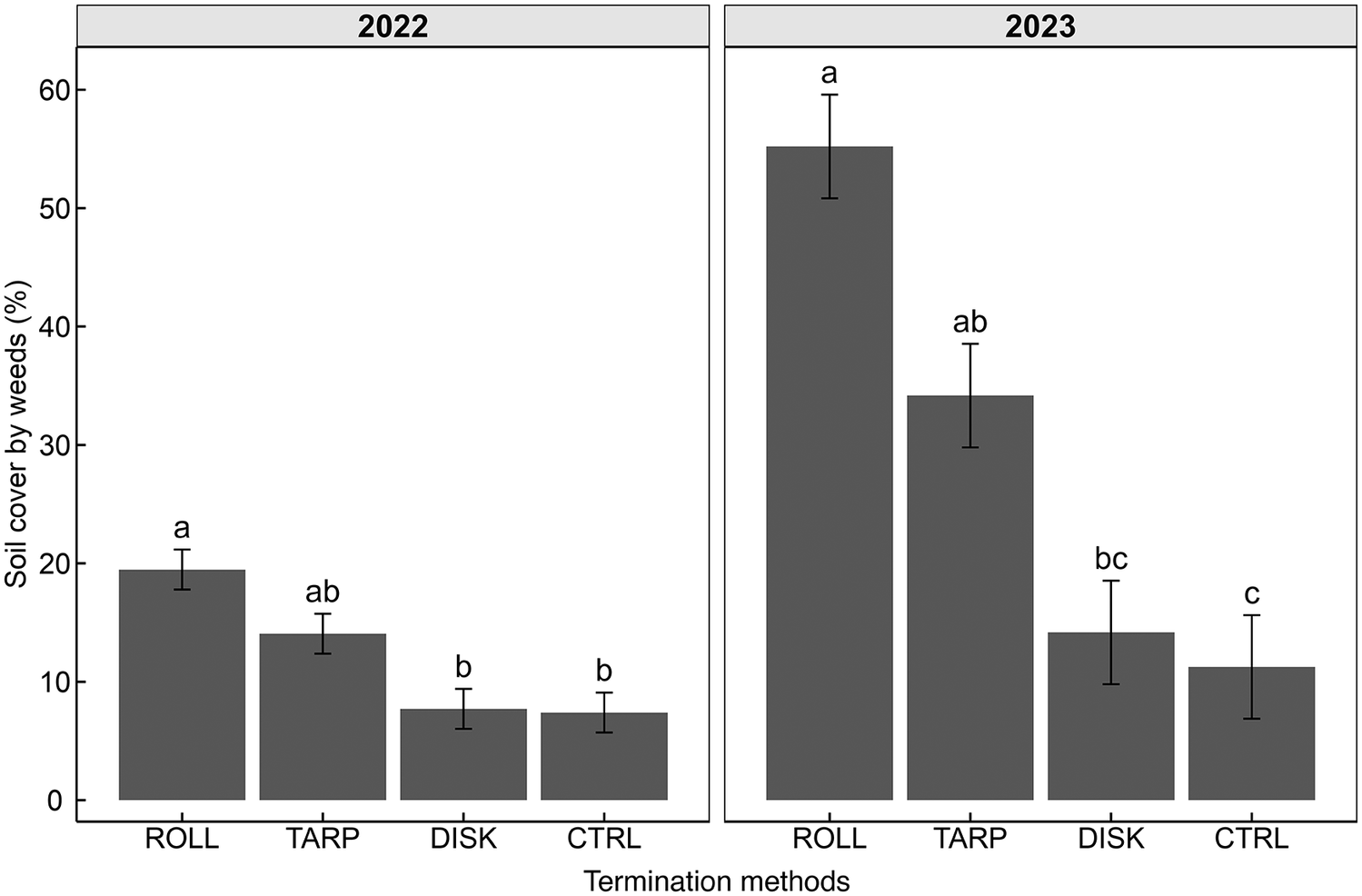
On 28 August 2022, 7 weeks after broccoli was transplanted, soil cover by weeds was greater in the ROLL treatment (19.5%) compared to the DISK and CTRL treatments (means of 7.7% and 7.4%) (Fig. 2). Weed cover in the TARP treatment (14.1%) did not differ significantly from that of the other treatments. The following year, during beetroot production (31 July 2023), soil cover by weeds was lower in the CTRL treatment compared to both no-till treatments (ROLL and TARP), while no significant differences were observed between the TARP and DISK treatments. Soil cover by weeds was nearly four to five times greater under roller-crimping compared to the DISK and CTRL treatments (Fig. 2). The main weed species observed in these two treatments was yellow fieldcress (Rorippa sylvestris [L.] Besser). No significant effect of fertilization rates on soil cover by weeds was observed in either year.
Main effect of termination methods on soil cover by weeds 7 weeks after transplanting broccoli in 2022 (28 August) and beetroot in 2023 (31 July). Termination methods: roller-crimped, ROLL; flail-mowed and tarped, TARP; flail-mowed and disked, DISK; and fallow control without cover crops, CTRL. Means with different letters within each year differ significantly at P < 0.05 (Tukey’s HSD). Error bars represent standard errors of means.

Figure 2. Long description
The graph consists of two vertical panels. The left panel is labeled 2022 and the right panel is labeled 2023. Both panels share the y axis labeled soil cover by weeds percent, ranging from 0 to 60. The x axis in both panels lists four termination methods from left to right ROLL, TARP, DISK, CTRL. In 2022, ROLL shows about 20 percent weed cover with the letter a, TARP about 14 percent with ab, DISK and CTRL both about 10 percent with b. In 2023, ROLL is highest at about 55 percent with a, TARP about 35 percent with ab, DISK about 15 percent with bc, and CTRL about 12 percent with c. Error bars indicate standard errors. Different letters above bars indicate significant differences within each year.
Vegetable yields and nitrogen uptake
In both years, yields of broccoli and beetroot were the lowest in the ROLL treatment (Table 2). In 2022, the proportion of non-marketable broccoli yield was also greater in the ROLL treatment compared to the other three treatments. That year, the total yield was 49% greater with the incorporation of cover crops through disking compared to the ROLL treatment and 17% greater compared to the TARP treatment (Table 2). In the CTRL treatment, marketable and total yields were not affected by the absence of cover crops, regardless of the fertilization rate, which resulted in similar broccoli yields to those of the TARP and DISK treatments. In 2023, beetroot yields were greater in the DISK (56%), TARP (45%), and CTRL (49%) treatments compared to the ROLL treatment (Table 2).
Marketable yield and total yield of broccoli (2022), total yield of beetroot (2023), and nitrogen (N) content in total biomass of broccoli and beetroot as affected by the termination method and fertilization rate

Table 2. Long description
The table is organized with columns for broccoli (marketable yield, total yield, total yield nitrogen content, total plant nitrogen content) and beetroot (total yield, total yield nitrogen content, total plant nitrogen content). Units are Mg per hectare for yield and kg nitrogen per hectare for nitrogen content. The first section lists termination methods: ROLL, TARP, DISK, CTRL. For broccoli, ROLL yields are lowest (marketable 4.0b, total 5.0b Mg per hectare), while DISK and CTRL are highest (marketable 9.7a and 9.4a, total 9.8a and 9.5a). Nitrogen content follows a similar trend, with ROLL lowest (12.5c, 80.6b) and DISK highest (25.8a, 155.6a). For beetroot, ROLL is lowest (15.0b Mg per hectare), DISK highest (34.2a). Nitrogen content is lowest for ROLL (46.9b, 69.5b) and highest for DISK (114.9a, 166.9a). TARP is intermediate. The next section shows fertilization rates: 0 percent N, 50 percent N, 100 percent N. For both crops, all yield and nitrogen values increase with higher fertilization, with 100 percent N highest (broccoli marketable 9.9a, beetroot total 33.4a). Standard errors are listed for each value. The final section provides P-values for effects of termination method, fertilization rate, and their interaction. Both main effects are highly significant (P less than 0.001), while interactions are not significant. Different letters indicate significant differences within columns by Tukey’s H S D test.
Note: Yield was determined from 12 broccoli and 20 beetroot plants per experimental unit, and total dry biomass, and N content of yield and total biomass were determined from 4 broccoli and 4 beetroot plants per experimental unit. Total biomass represents the sum of the biomass of leaves, stems, and heads (broccoli) and leaves and roots (beetroot) on a dry matter basis. Termination methods: roller-crimped, ROLL; flail-mowed and tarped, TARP; flail-mowed and disked, DISK; and fallow control without cover crops, CTRL.
SEM, standard error of the means. Means followed by different letters within each column and factor differ significantly at P < 0.05 (Tukey’s HSD).
The fertilization rate also had a strong effect on yields, resulting in a 15% decrease in the total yield of broccoli in the 50% N rate treatment compared to the 100% N rate treatment (Table 2). As anticipated, the treatment without fertilization resulted in the lowest yields, with total yields that were 32% lower than the 50% N treatment and 42% lower than the 100% N treatment. The greatest beetroot yield was also observed with the 100% N rate, while the unfertilized treatment and the 50% N treatment produced yields that were 45% and 17% lower, respectively (Table 2).
The N content in broccoli yield and total biomass was lower under roller-crimping compared to the TARP, DISK, and CTRL treatments, regardless of the fertilization rate (Table 2). Similarly, in 2023, beetroot N uptake was reduced in the ROLL treatment relative to the DISK and CTRL treatments (Table 2). The fertilization rate influenced the N content of the yield and total biomass of both vegetable crops. However, for beetroot, no significant difference was observed between the 100% N and 50% N treatments.
Soil mineral nitrogen over the two growing seasons
Across all termination methods, fertilization rates, and sampling dates, over 65% of soil mineral N in the 0–30 cm soil layer was in the form of NO3-N, with the remaining as NH4-N. Soil mineral N content (NO3-N + NH4-N) was influenced by a three-way interaction between the termination method, fertilization rate, and sampling date (Supplementary Table S2 and Fig. 3). As expected, soil mineral N content showed only slight variations across all treatments in the springs 2022 and 2023 (Fig. 3a,f). Significant differences among treatments were observed at the time of cover crop termination in early July of both years, with the greatest soil mineral N content found in the CTRL treatment without cover crops, particularly in 2022 (Fig. 3b,g). In the three treatments with cover crops, soil mineral N content decreased from early May (means of 40.6 kg N ha−1) to July 2022 (means of 29.0 kg N ha−1), while it remained constant in 2023 with means of 36.7 kg N ha−1 and 41.1 kg N ha−1 in early May and July, respectively.
Three-way interaction effect between the termination method, fertilization rate, and sampling date on soil mineral nitrogen (NO3-N + NH4-N) content at 0–30 cm soil depth during both growing seasons: (a) oats and field peas seeding, (b) oats and field peas termination, (c) broccoli transplanting, (d) four weeks after broccoli transplanting, (e) broccoli harvest, (f) field peas and faba beans seeding, (g) field peas and faba beans termination, (h) beetroot transplanting, (i) four weeks after beetroot transplanting, and (j) beetroot harvest. Soil mineral nitrogen at 0–10 cm (gray) and 10–30 cm (dark gray). Termination methods: roller-crimped, ROLL; flail-mowed and tarped, TARP; flail-mowed and disked, DISK; and fallow control without cover crops, CTRL. Means with different letters within each sampling date differ significantly at P < 0.05 (Tukey’s HSD). Error bars represent standard errors of means.

Figure 3. Long description
The top panel is a line graph with the x-axis labeled with months from Jan to Dec and the y-axis labeled air temperature in degrees Celsius, ranging from minus 20 to 20. Three lines represent 2022 (light gray), 2023 (medium gray), and 1991 to 2020 (black). All lines show a similar pattern: lowest temperatures in Jan, rising steadily to a peak in July, then declining to December. The 2022 and 2023 lines closely follow the historical average, with minor deviations. The bottom panel is a grouped bar chart with the same x-axis (months) and the y-axis labeled precipitation in millimeters, ranging from 0 to 200. Each month displays three bars: 2022 (light gray), 2023 (medium gray), and 1991 to 2020 (black). Precipitation varies more between years, with July 2023 showing the highest value, exceeding 200 millimeters, while other months show smaller differences. The legend at the right identifies the colors for each year or period.
In 2022, when the broccoli crop was transplanted, soil mineral N content was generally lower under roller-crimping compared to the DISK and CTRL treatments (Fig. 3c). The incorporation of cover crops (DISK) led to the greatest content of soil mineral N, reaching 93.6 kg N ha−1, compared to both no-till treatments at the full fertilization rate 4 weeks after transplanting broccoli (Fig. 3d). At broccoli harvest in September 2022, the CTRL treatment had 36% more soil mineral N than the TARP treatment at the 100% N fertilization rate (Fig. 3e). However, no differences were observed at lower fertilization rates.
By the time of transplanting beetroot in July 2023, the greatest soil mineral N content was observed under the tarping treatment, while the CTRL treatment had the lowest values, particularly at 100% N fertilization rate (Fig. 3h). Additionally, in the TARP treatment, soil mineral N content was greater at the time the tarps were removed compared to the content measured 8 days earlier when the tarps were applied (P = 0.001). In early August, 4 weeks after transplanting, soil mineral N content remained lower in the CTRL treatment than in the TARP treatment at the 50% and 0% N fertilization rates (Fig. 3i). By September 2023, soil mineral N content was notably low across all termination methods, regardless of fertilization rates, with little differences observed between treatments (Fig. 3j).
Discussion
Cover crop species biomass production and their influence on soil mineral nitrogen at termination
Cover crops were successfully established in both years of the field experiment. While there is no direct comparison for spring-seeded cover crop species in the region where this study was conducted, the biomass production of cover crops was lower than that of pure stand oats, which produced up to 3.81 Mg DM ha−1 when grown for 52 to 59 days in Nebraska, USA (Koehler-Cole et al., Reference Koehler-Cole, Proctor, Elmore and Wedin2021). Pure stand field peas grown for 57–66 days in the northern Great Plains of Montana produced biomass ranging from 2.66 to 3.85 Mg DM ha−1 (Miller et al., Reference Miller, Jones, Zabinski, Tallman, Housman, D’Agati and Holmes2023). The contribution of oats to aboveground biomass production was equivalent to that of field peas. In contrast, in the second year, faba beans took longer to establish than field peas, resulting in a cover crop mixture that was predominantly composed of field peas by the time of its termination, 58 days after seeding. Faba beans were the least productive among the spring-seeded cover crop species and had a small contribution to cover crop biomass. The lower aboveground biomass of faba beans may also be attributed to their structure, characterized by robust and erect stems (Mínguez and Rubiales, Reference Mínguez, Rubiales, Sadras and Calderini2021), as well as the rapid germination and growth of field peas. Field peas are known to be a key species driving plant biomass production in pea-based cover crop mixtures (Freund et al., Reference Freund, Mariotte, Santonja, Buttler and Jeangros2021). Similarly, Lavergne et al. (Reference Lavergne, Vanasse, Thivierge and Halde2021) found that field peas were always the dominant species within mixtures of 2, 6, and 12 cover crop species tested at the same research station as the present study.
In the three treatments with cover crops, soil mineral N content decreased from early May to early July 2022, coinciding with the growth of oats and field peas. Non-legume cover crop species can significantly reduce the amount of mineral N in the soil. Hefner et al. (Reference Hefner, Gebremikael, Canali, Sans Serra, Petersen, Sorensen, De Neve, Labouriau and Kristensen2020) found that legume-cereal mixtures took up more soil mineral N than pure legumes at a depth of 0–25 cm when comparing fall-seeded cover crop composition mixtures. In line with these results, soil mineral N content remained relatively unchanged during the growth of faba beans and field peas in 2023. In both years of our study, where no cover crop was grown (CTRL treatment), soil mineral N content was broadly the greatest at cover crop termination, as there were no plants to take up N, in accordance with other studies (Coombs et al., Reference Coombs, Lauzon, Deen and Van Eerd2017; Chahal and Van Eerd, Reference Chahal and Van Eerd2019).
The legacy effect of organic fertilizers on subsequent cover crop growth
In early July 2023, the aboveground biomass of cover crops and weeds, along with their N contents, was influenced by the fertilization rate. A 28-day incubation study conducted under aerobic conditions revealed that adding blood meal to the soil resulted in a significant and immediate increase in soil mineral N (Cayuela, Sinicco and Mondini, Reference Cayuela, Sinicco and Mondini2009). Blood meal has a high N concentration, which is likely to be available for crops within the first year of application, considering that total plant-available N may be around 90% for blood meal (Cassity-Duffey et al., Reference Cassity-Duffey, Cabrera, Gaskin, Franklin, Kissel and Saha2020). In contrast, pelletized poultry litter releases N more gradually with plant-available N of 42%–50% of the applied N, as reported by Hadas et al. (Reference Hadas, Bar-Yosef, Davidov and Sofer1983). These findings suggest that the greater biomass observed under the 100% N fertilization rate was likely driven by a legacy effect of both fertilizers applied in 2022, as pelletized composted poultry manure and blood meal were applied in early July and early August, respectively, about 8 and 4 weeks before the first broccoli harvest. This timing may have resulted in residual N remaining in the soil.
Incorporating broccoli residues into the soil by disking in September 2022 may also have contributed to the fertilization effect, considering that the N content of broccoli biomass was greater in the 100% N treatment compared to the other two fertilization rates. Indeed, broccoli plants can accumulate large quantities of N in their aboveground biomass with optimal N fertilizer inputs, consequently leaving substantial N as crop residues after harvest (Bakker, Swanton and McKeown, Reference Bakker, Swanton and McKeown2009; Congreves et al., Reference Congreves, Voroney, O’Halloran and Van Eerd2013; Congreves, Voroney and Van Eerd, Reference Congreves, Voroney and Van Eerd2014). As a result, more N may have been available for the cover crops, which is evidenced by the slightly greater content of soil mineral N in most termination treatments at the 100% N rate compared to the unfertilized treatment in early May 2023.
Tarping as a tool to facilitate no-till termination of cover crops
Flail mowing and tarping (TARP) significantly increased the total yields of broccoli and beetroot by 38% and 44%, respectively, compared to roller-crimping, despite similar weed cover during vegetable production. This suggests that yield differences between the ROLL and TARP treatments were likely related to soil factors (e.g., nitrogen availability) rather than weed competition (Maher et al., Reference Maher, Rangarajan, Caldwell, Ho, Hutton and Ginakes2024). The decomposition of cover crops was greater under tarps, especially with the mixture of field peas and faba beans. Indeed, in 2023, when the tarps were removed after only 8 days of application, soil mineral N content was up to twice as great in the tarp treatment fully fertilized (100% N) than in the other termination treatments. Rylander et al. (Reference Rylander, Rangarajan, Maher, Hutton, Rowley, McGrath and Sexton2020) found that using black tarps to terminate oats resulted in greater soil NO3-N concentration compared to a treatment without tarps. The increase in soil mineral N could be associated with the protective effect of tarps against rainfall. Between 5 and 13 July 2023, a total of 132 mm of rain was recorded near the experimental site, representing more than half of the total rainfall for the entire month of July. Since NO3-N is highly soluble and prone to leaching, tarps might have allowed its retention in soil (Romic et al., Reference Romic, Romic, Borosic and Poljak2003; Sintim et al., Reference Sintim, Bandopadhyay, English, Bary, Liquet, González, DeBruyn, Schaeffer, Miles and Flury2021). Additionally, soil temperature and moisture beneath the tarps may have favored the decomposition of cover crops, leading to the release of mineral N into the soil (Varco et al., Reference Varco, Frye, Smith and MacKown1993; Singh et al., Reference Singh, Dhakal, Yang, Kaur, Williard, Schoonover and Sadeghpour2020). However, this could not be confirmed in our study, as soil temperature and moisture were not evaluated. In New-Hampshire, USA, Lounsbury et al. (Reference Lounsbury, Warren, Wolfe and Smith2020) found that using black tarps for 2–5 weeks in combination with roller-crimping to terminate a mixture of cereal rye-hairy vetch increased mean cabbage head weight by 58% compared to roller-crimping alone, likely due to N mineralization. Cerritos-García et al. (Reference Cerritos-García, Meyers, Bilenky, Langenhoven and Ingwell2025) also reported that tarping improved the efficacy of roller-crimping for terminating cowpea ( Vigna unguiculata L.). In our study, tarps were removed after only 8–9 days, as cover crop plants appeared to be terminated, and to also ensure sufficient time for vegetables to reach harvest maturity. The aboveground cover crop biomass in the TARP treatment ranged from 2.5 to 3.0 Mg DM ha−1, which was more than twice as low as the biomass reported by Lounsbury et al. (Reference Lounsbury, Warren, Wolfe and Smith2020) in their experiment. This low biomass, along with the practice of flail mowing before tarping and the warm air temperatures during tarping in early July (average of 19.3°C), probably contributed to a greater decomposition of residues in our study. Smaller particles of cover crop residues produced by flail mowing may decompose faster than larger ones due to their increased surface area and greater dispersion in the soil, creating a more favorable environment for microbial decomposition (Kumar and Goh, Reference Kumar and Goh2000). Accordingly, Eivazi et al. (Reference Eivazi, Pinero, Dolan-Timpe and Doggett2024) reported greater potentially mineralizable N following flail mowing compared to roller-crimping.
Agronomic benefits of incorporating cover crops by disking
During the 2-year experiment, incorporating cover crops through flail mowing and disking (DISK) resulted in greater yields than the ROLL treatment, although yields, particularly for broccoli, were still lower than those reported in previous studies (Thériault, Stewart and Seguin, Reference Thériault, Stewart and Seguin2009; Jokela and Nair, Reference Jokela and Nair2016). The mineralization of cover crops is generally faster when residues are incorporated into the soil rather than left on the soil surface (Jahanzad et al., Reference Jahanzad, Barker, Hashemi, Eaton, Sadeghpour and Weis2016). Incorporating mowed cover crops improves the contact between the soil and crop residues (Hoyle and Murphy, Reference Hoyle and Murphy2011), leading to a more consistent supply of soil mineral N. This improved contact likely contributed to better synchronicity between N release from cover crops and broccoli N uptake in comparison to no-till treatments, even though reduced N uptake in the TARP treatment did not affect yields.
Interestingly, in 2023, from mid-July, when transplanting took place, until 4 weeks later, soil mineral N content was even greater in the tarping treatment compared to the disking treatment. However, this did not lead to greater beetroot N uptake, as no significant differences were observed between the TARP and DISK treatments. As reported by Smith and Sharpley (Reference Smith and Sharpley1990), residue placement (incorporated into the soil versus left on the soil surface) might not be as important a factor for legume cover crops as it is for non-legume cover crops in terms of N supply for the subsequent crop.
The importance of phenological stages of cover crop species under roller-crimping
In 2022, roller-crimping was performed four times over a 10-day period at the stem elongation phenological stage (oats, BBCH 34; field peas, BBCH 39), but this was not sufficient to prevent the regrowth of oats during broccoli growth. Termination was performed at a phenological stage that was too early, resulting in low effectiveness of the roller-crimper. According to Miller, Lanier and Brandt (Reference Miller, Lanier and Brandt2001), oats may need 750 growing degree days (GDD) for flowering. However, in our study, oats had only cumulated 686 GDD (Tbase = 5 °C) by the time of termination. The efficacy of the roller-crimper increases significantly at the anthesis stage compared to the early growth stages (Ashford and Reeves, Reference Ashford and Reeves2003; Mirsky et al., Reference Mirsky, Curran, Mortensen, Ryan and Shumway2009; Luna, Mitchell and Shrestha, Reference Luna, Mitchell and Shrestha2012; Keene et al., Reference Keene, Curran, Wallace, Ryan, Mirsky, VanGessel and Barbercheck2017; Sondag et al., Reference Sondag, Gaudin, Mitchell and Pittelkow2025). Terminating a grass such as cereal rye at 50%–75% anthesis may require only one or two passes of the roller-crimper for successful termination (Halde et al., Reference Halde, Gagné, Charles and Lawley2017). In contrast, roller-crimping during earlier phenological stages often leads to regrowth of the cover crop. Shirtliffe and Johnson (Reference Shirtliffe and Johnson2012) concluded that field peas and faba beans might be well-suited species for roller-crimping as they are less dependent on phenological stages for effective termination. Their study found that a single pass of the roller-crimper was sufficient to terminate field peas at the early flower stage (BBCH 61) without significant regrowth. However, our results showed that even four passes of the roller-crimper before the flowering stage (BBCH 39) could not prevent the regrowth of field peas. In contrast, the following year, at the early flower stages (BBCH 59–60), field peas and faba beans were successfully terminated by roller-crimper. This indicates that the phenological stage at the time of termination is still an important factor to consider for legume species. It is possible that the optimal phenological stage, particularly for oats, would have been achieved if cover crops had been allowed to grow for several additional days and roller-crimping had been performed later (Mischler et al., Reference Mischler, Duiker, Curran and Wilson2010; Carr et al., Reference Carr, Anderson, Lawley, Miller and Zwinger2012; Wayman et al., Reference Wayman, Cogger, Benedict, Burke, Collins and Bary2015). For example, in Maryland, USA, spring-seeded oats reached the heading stage (BBCH 51) after 78 days of growth (Vollmer et al., Reference Vollmer, Joseph, Leslie, Hooks and Besançon2024). However, we chose to standardize the termination date of cover crops to allow even biomass production among treatments and ensure that vegetable crops were transplanted on the same date in all experimental units.
Poor nitrogen synchronicity and weed control under roller-crimping
In our study, the N uptake in broccoli was reduced under roller-crimping in comparison to the other treatments, indicating a strong connection between plant N uptake and yields. These results support the hypothesis that no-till terminations would reduce vegetable N uptake and yields relative to tillage treatments (DISK and CTRL), although yields were not negatively affected under tarping. In 2022, the low yield of broccoli was attributed to the regrowth of cover crops not killed by the roller-crimper, and particularly to the potential N uptake of remaining oats during broccoli growth (Madden et al., Reference Madden, Mitchell, Lanini, Cahn, Herrero, Park, Temple and Van Horn2004). Furthermore, our results suggest that the low yield of broccoli was not caused by soil N immobilization, as the mean C:N ratio of cover crops was relatively low (Trinsoutrot et al., Reference Trinsoutrot, Recous, Bentz, Linères, Chèneby and Nicolardot2000; Li et al., Reference Li, Sørensen, Li and Olesen2020). Instead, it was associated with slower mineralization and N release from cover crops under roller-crimping (Mochizuki et al., Reference Mochizuki, Rangarajan, Bellinder, Van Es and Björkman2008; Hefner et al., Reference Hefner, Gebremikael, Canali, Sans Serra, Petersen, Sorensen, De Neve, Labouriau and Kristensen2020) because the cover crops, particularly oats, were still living. Additionally, most cover crop residues left on the soil surface were not directly in contact with soil microorganisms, reducing their decomposition rate (Jahanzad et al., Reference Jahanzad, Barker, Hashemi, Eaton, Sadeghpour and Weis2016; Radicetti et al., Reference Radicetti, Mancinelli, Moscetti and Campiglia2016; Radicetti et al., Reference Radicetti, Campiglia, Marucci and Mancinelli2017).
Even when using a pure legume cover crop mixture, roller-crimping reduced N uptake in the beetroot crop, as indicated by the lower N content in beetroot biomass compared to the DISK and CTRL treatments. Beetroot productivity was also affected by weeds. The ROLL treatment, in particular, did become weedy following broccoli production in 2022. Consequently, weeds were well established by the following spring (Maher et al., Reference Maher, Rangarajan, Caldwell, Ho, Hutton and Ginakes2024), as reflected by the greater weed biomass measured in the cover crops in July 2023. Weed presence in the ROLL treatment at the end of the 2022 growing season likely contributed to greater weed pressure during beetroot production. Although weeding was performed during both growing seasons to reduce differences in weed pressure among treatments (Voye, Burrows and Lang, Reference Voye, Burrows and Lang2025), and beetroot was transplanted rather than direct-seeded, thereby avoiding the first 4 weeks after germination, which represent the most critical period for weed competition (Kavaliauskaitė and Bobinas, Reference Kavaliauskaitė and Bobinas2006), weed interference in no-till treatments, especially under roller-crimping, may still be attributable to reduced weeding efficiency. In these treatments, only aboveground weeds were removed to minimize soil disturbance. Weed management under roller-crimping can be challenging and labor intensive (Robb et al., Reference Robb, Zehnder, Kloot, Bridges and Park2019), which could be overcome with greater cover crop biomass. However, in our study, the spring-seeded cover crops were grown for a short period, resulting in low biomass production that was insufficient for effective weed suppression through roller-crimping. Weed control using roller-crimped mulch depends on achieving high cover crop biomass (Mohler and Teasdale, Reference Mohler and Teasdale1993). According to Mirsky et al. (Reference Mirsky, Ryan, Curran, Teasdale, Maul, Spargo, Moyer, Grantham, Weber, Way and Camargo2012), a minimum biomass of 8 Mg DM ha−1 is required for adequate weed suppression, while Halde, Gulden and Entz (Reference Halde, Gulden and Entz2014) found that cover crop mulches with biomass ranging from 6.0 to 7.6 Mg DM ha−1 provided good weed control in southern Manitoba. These values are substantially greater than the 2.3–2.9 Mg DM ha−1 biomass produced by the spring-seeded cover crops in our study.
Fertilization rates and vegetable yields
In our study, spring-seeded cover crops did not allow for a reduction in fertilization rates without negatively affecting broccoli and beetroot yields. Even when legumes such as field peas and faba beans were included, the N supplied by the cover crops was insufficient to meet the high N demand of both vegetable crops. In 2023, legume cover crops increased soil mineral N compared with the CTRL treatment without cover crops at beetroot transplanting, but this effect was observed only at the full fertilization rate (100% N). Thus, cover crops were unable to compensate for reduced fertilizer inputs. The N concentration in cover crop biomass could be sufficiently high, with means of 2.6% in 2022 and 3.5% in 2023, to supply N for the subsequent crop (data not shown). However, significant N accumulation in cover crops depends not only on the N concentration but also on the high biomass production of those cover crops (Stein et al., Reference Stein, Hartung, Perkons, Möller and Zikeli2023). In our study, the short growing period of less than 2 months (686 GDD) prevented the cover crop species from producing significant biomass. This may explain why cover crops have had little effect on broccoli and beetroot yields compared to the CTRL treatment under lower fertilization rates. This is further supported by the lack of termination method × fertilization rate interactions. Similarly, Schellenberg, Morse and Welbaum (Reference Schellenberg, Morse and Welbaum2009) reported that N contained in cover crops did not affect yields of the subsequent broccoli crop even at lower fertilization rates of 0 and 56 kg N ha−1. Although reducing the fertilization rate impacted the yields, it is important to note that the decrease in total yield of broccoli and beetroot (15–17%) was still slightly less than the 50% reduction in fertilizers applied. The amount and timing of mineralization of organic fertilizers might be greater following their application in July to warm, moist soil (de Jesus et al., Reference de Jesus, Cassity-Duffey, Dutta, da Silva and Coolong2024). This indicates that there may be potential to slightly reduce the fertilization rate for summer-transplanted vegetable crops, but further research is necessary to explore this possibility.
Conclusions
In our study, the rate of fertilization was not the primary factor affecting N uptake of broccoli and beetroot; rather, the method of cover crop termination had a more significant impact. Compared to the TARP, DISK, and CTRL treatments, roller-crimping negatively affected vegetable crop yields and their N uptake across both years of the experiment, even with a mixture of legume-legume cover crops, due to the timing of N release and its availability to crops. Delaying the termination of spring-seeded cover crops through roller-crimping could ensure that they reach the appropriate phenological stage; however, it is essential to allow sufficient time for the subsequent vegetable crop to grow and reach harvest maturity. Our study demonstrates that silage tarps can effectively terminate cover crops without tillage, even when applied for a short period of less than 2 weeks, and help address challenges associated with roller-crimping. Compared to no-till treatments, the incorporation of cover crops by disking provided N that better matched vegetable crop uptake, especially for broccoli, which helped produce good yields in both years, but might negatively impact soil structure over time. Overall, regardless of the termination method used, fertilizers applied at the 100% N rate resulted in the greatest yields of broccoli and beetroot.
Long-term use of spring-seeded cover crops, combined with reduced fertilizer inputs, may offer additional benefits that were not measured in this study. Conducting an economic analysis could help determine whether reducing fertilizer inputs while using spring-seeded cover crops is profitable for organic vegetable growers, despite the lower yields observed in this study. Future research should also be conducted on contrasting soil textures, and further examine N cycling in organic vegetable production systems by testing a broader range of spring-seeded cover crop mixtures and a wider set of fertilization rates (e.g., 0% N, 25% N, 50% N, 75% N, 100% N, 125% N, and 150% N). This would allow for a comprehensive evaluation of their effects on soil mineral N and vegetable crop responses. Additionally, studying soil organic N dynamics instead of focusing only on soil mineral N could provide more insight into N cycling in these production systems.
Supplementary material
The supplementary material for this article can be found at http://doi.org/10.1017/S174217052610043X.
Acknowledgments
The authors thank Samuel Gagné, Francis Gagnon, Émile Trifiro-Riendeau, Tristan McDermott, Pierre Rysman, Flore Beausoleil, Mathilde Juneau, and Séléna Devillier for their assistance during field and laboratory work. They also express gratitude to Annie Brégard for providing advice on statistical analysis and comments on an earlier draft of the manuscript, and to Denis La France and Jonathan Roy for their technical agronomic support. Appreciation is extended to Richard Hogue and Marie-Élise Samson for their scientific advice. The authors declare no use of artificial intelligence (AI) tools.
Author contributions
Conceptualization: M.B., C.H.; Data curation: M.B.; Formal analysis: M.B., V.G., É.M., C.H.; Funding acquisition: M.B., V.G., É.M., C.H.; Investigation: M.B.; Methodology: M.B., C.H.; Resources: C.H.; Supervision: V.G., C.H.; Validation: V.G., É.M., C.H.; Visualization: M.B.; Writing—original draft: M.B.; Writing—review and editing: M.B., V.G., É.M., C.H.
Funding statement
This project was carried out with financial support from the Innov’Action program from the Ministry of Agriculture, Fisheries, and Food of Quebec (Grant No. IA121697). The first author also acknowledges the Natural Sciences and Engineering Research Council of Canada (NSERC) for its financial support during his Master’s degree.
Competing interests
The authors declare none.




 Open access

