




Introduction
“After all, work is an activity that takes up at least one third of the global population’s time on earth; it therefore needs to be understood and appreciated in the broadest possible context.”Footnote 1 The Story of Work, as told by Jan Lucassen – from the birth of mankind to the present day – is an important story. Through work, people contribute to economic development and growth; for individuals and households, work is important for subsistence, but it also determines one’s position, status, and identity. To truly understand and appreciate work in the broadest possible context, we should look at it in all its forms, and consider how it was organized and under what labour relations men, women, and children performed their work. In 2007, the International Institute of Social History (IISH) launched the Global Collaboratory on the History of Labour Relations project, with two main objectives. First, to provide statistical insights into the global distribution of all types of labour in five historical cross sections: 1500, 1650, 1800, 1900 (also 1950 for some parts of the world, including Africa), and 2000. Second, to explain the changes in labour relations worldwide we are currently seeing. Lucassen’s Story of Work is based on the global development of labour relations from the hunter-gatherers to the present day. It shows that, long before 1500, people started to work for the market. It also reveals how this process was characterized by combinations of labour relations both within societies, households, and individual lives. These labour relations were characterized by power and social relations: within societies, different degrees of vertical subordination – from slavery to wage labour – could be combined with independent production, and this could take place within the household and outside the household under various forms of horizontal cooperation.Footnote 2
To map these labour relations, the Collaboratory uses the broad definition of work provided by sociologists Chris and Charles Tilly: “Work includes any human effort adding use value to goods and services”.Footnote 3 This definition can be used regardless of whether the work activities are paid or unpaid, free or unfree, performed for oneself, the household, or the community, the polity, or the market. Furthermore, labour relations are defined in relation to for whom or with whom one works and under what rules.Footnote 4 These rules (implicit or explicit, written or unwritten) determine the type of work, the type and amount of remuneration, working hours, the degree of physical and psychological strain, and the associated degree of freedom and autonomy.Footnote 5
It is not self-evident how these conditions and relations should be studied historically and from the macro-perspective that is part of the Collaboratory approach. Labour relations vary from one individual to another, even within the same family or social group; one and the same individual can be involved in several labour relations simultaneously; and labour relations can change over the life course. There are no historical sources that capture these realities in a simple and exhaustive way. Detailed case studies are therefore necessary. In this study, researchers from the Collaboratory project and the Gender and Work project (GaW) have joined forces to create such a case study, which combines the micro-history approach and the more conceptual, quantitative labour relations approach. Based on intense discussions of how to interpret the information in the main source (the Tabellverket, a Swedish pre-1860 form of population statistics with some information on occupations), the Collaboratory members coded the source according to the project’s taxonomy of labour relations (more on this below). This part of the exercise can be described as a form of translation from historical source to theoretical concepts. The Gender and Work members then provided additional evidence of work activities that the main source fails to capture. This part of the exercise can be described as both translation and complementation of data. The result is a much more encompassing and richer picture of the labour relations within the selected community, one that acknowledges both women’s work and multiple employments. In a broader perspective, the case study contributes to our understanding of the larger development described by Lucassen, namely, the gradual increase of commodified labour in the world.
The Problem
The problem this article proposes to address is determining what labour relations a certain urban population were involved in in Sweden in 1820. There is no single source that provides a perfect answer to the question. Instead, several different sources have to be combined. Here, the Tabellverket is combined with observations made in, primarily, local court records.
The way in which labour relations are studied in the Global Collaboratory of Work presupposes a focus on larger groups of people, requiring sources that ideally describe whole populations. Since the ambition of this study is precisely to provide a case study for the Global Collaboratory project, a source had to be found that captures the entire population. The following section explains why the Tabellverket was selected for this purpose. The next section discusses how the preliminary picture based on the Tabellverket can be complemented by systematically adding information from court records analysed in the Gender and Work project, primarily about women’s work. This information captures both what people did and, to some extent, what labour relations they were involved in. Subsequently, all information is collated to estimate the labour relations in the whole population in the selected town. Finally, general methodological lessons and empirical findings are discussed. It is the explicit goal of the Collaboratory to include aspects of power. This theme will be addressed in the Conclusion.
The place under discussion is Västerås, a mid-sized town in central Sweden with around 3,000 inhabitants in 1820. The sex ratio was skewed – 1,374 men to 1,735 women, including childrenFootnote 6 – and the share of female-headed households was remarkably high, nearly forty per cent.Footnote 7 The town is situated on Lake Mälaren, on which iron was transported to Stockholm and grain and other consumer goods were taken back to the town (see Figure 1 in the article by Jonas Lindström and Maria Ågren in this special section). Västerås was thus a trade and transport hub, providing income-earning opportunities for local people and migrants, many of whom were women. As regional capital and episcopal seat, Västerås was home to a county governor and a bishop, making it a centre of both state and church administration, and, in this sense, actually a small city. The town had a semi-rural character with many small gardens and plots of land. The surplus of females, the commercial character, and the strong state presence are all important features of the town.
Tabellverket 1820: The Backbone of the Analysis
The Tabellverket is a form of population statistics established in Sweden in 1749 and based on data collected by the clergy. It is not a census in the proper sense of the term, but the extensive literature on censuses is still relevant to our understanding of this source.Footnote 8 As early as 1686, a law required the establishment of parish registers in the country. One important purpose was to enable the clergy to monitor the Christian beliefs, literacy, and moral behaviour of their parishioners. The registers were also used to keep track of the population. The state used them for tax purposes and to recruit soldiers. From the mid-eighteenth century, the state authorities felt the need for national population statistics and expected the clergy to provide these statistics based on their parish registers. They were required to enter the data on pre-printed forms and send them to a state body called the Tabellverket, later renamed the Kungliga Kommissionen över tabellverket, in Stockholm. These forms were then converted into provincial and national statistics. The term Tabellverket is now used for the actual statistical forms that were completed between 1749 and 1859, although not every year.Footnote 9
For the period under discussion in this article, the Tabellverket has a number of qualities that make it interesting from a Global Collaboratory perspective. First, we can be reasonably certain that it covers the whole permanently settled population in a given place. From 1805, the Swedish clergy were exhorted to calibrate their own data on parishioners with data collected within the fiscal administration. This two-pronged policy was launched to make the statistics as comprehensive as possible and increases their usefulness for historians. Second, the Tabellverket offered a preprinted list of occupations from which the clergymen could choose; for cities and towns, the list included 204 different occupations.Footnote 10 Third, the tables from 1805 onwards use the distinction “occupational position” (yrkesposition), distinguishing between, for instance, master and servant. While it is sometimes unclear whether the main categories into which people were placed should be understood as occupations proper or as social estates (see Table 1 and Figure 1), the fact that occupational position is noted makes the Tabellverket from 1805 onwards useful for mapping labour relations.Footnote 11 At the same time, and as noted in previous research, the Tabellverket neglects the importance of multiple employments from 1805 onwards, and throughout its years of existence it consistently underreports women’s paid and unpaid work.Footnote 12 These shortcomings are exactly what justifies the inclusion of data from other sources, such as court records.
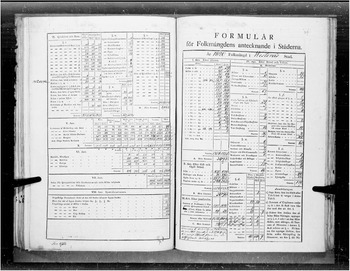
Table IV in Tabellverket.

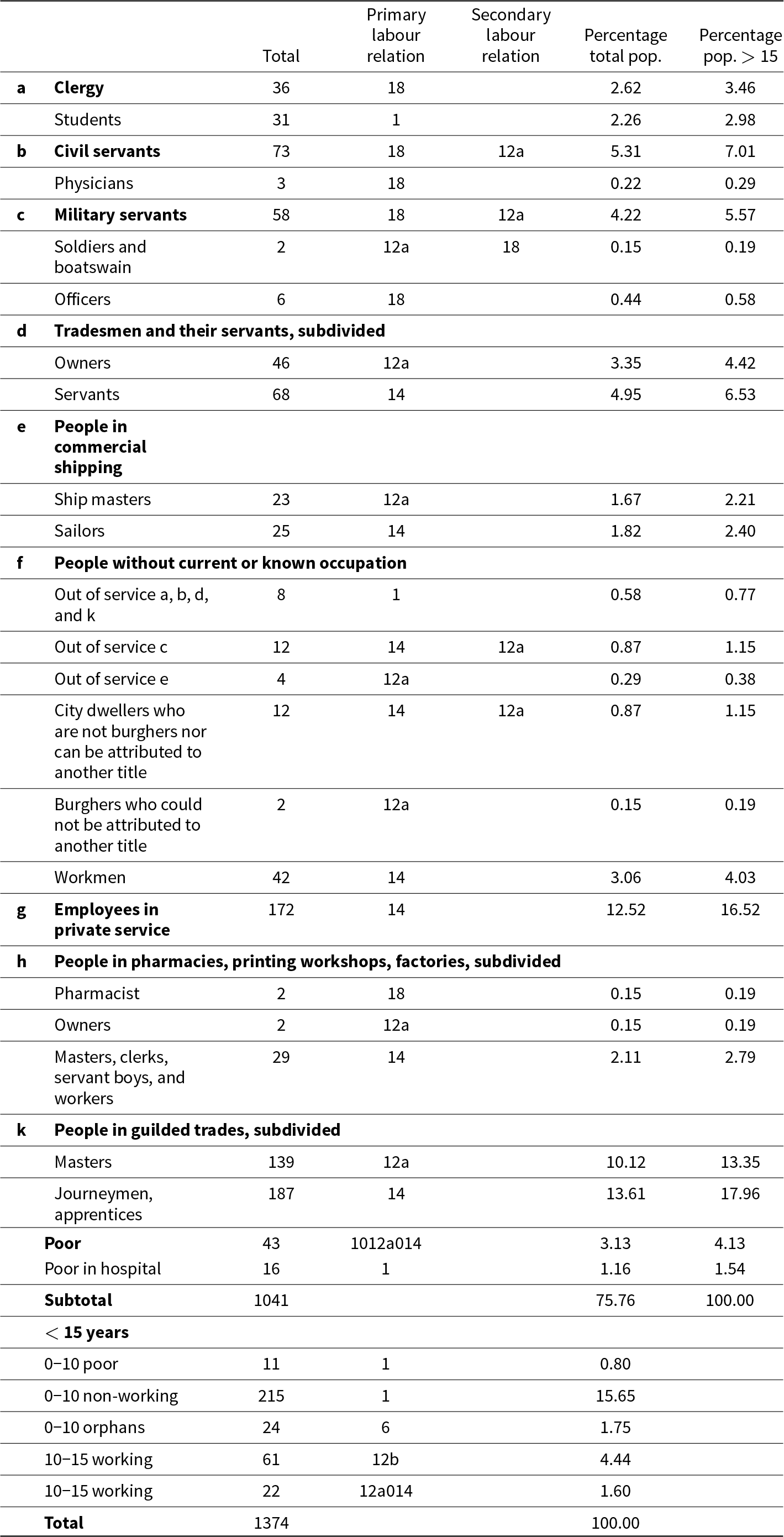
Labour relations of men in Västerås, 1820.

*Labour relation 1 represents non-working people; 6 reciprocal household servants: these were subordinate non-kin (men, women, and children) who contributed to the maintenance of self-sufficient households; 12a self-employed leading producers;12b self-employed kin producers; 14 wage earners for the market; and 18 wage earners. Sometimes no guesstimations could be made based on the available information. In that case, either/or categories were defined, indicated by using multiple labour relations separated by a 0. For example, the poor could either be non-working 1 or be self-employed or work for wages: 1012a014.
**NB: The Tabellverket does not have categories i and j.
Source: Based on calculations on Formulär för Folkmängdens antecknande i Städerna. Folkmängd i Westerås Stad. År 1820. Available at: http://rystad.ddb.umu.se:8080/Tabellverket/Tabverk; last accessed 20 May 2025.
The Tabellverket is one of few possible sources for establishing the size and composition of the whole population in Västerås in 1820.Footnote 13 The catechetical records were not summarized annually but kept continuously for a number of years. Consequently, information about the town’s inhabitants in 1820 is mixed with information relating to the whole period 1816 to 1827. These were years when many people moved in and out of the town; for instance, around 150 maids moved to the town in 1818, around 125 came in 1819, and another 111 in 1820. In the same period, many moved out.Footnote 14 Apparently, the clergyman in charge of the records did not manage or bother to calculate the net effect of these migratory movements in the catechetical register. Instead, he saved his energy for completing the Tabellverket forms.
The Tabellverket includes several tables and sub-tables for 1820.Footnote 15 Of particular interest in this context is Table IV, which groups the population into nine broad categories according to “estate and circumstances” . In some of these categories, it is particularly clear that attention was paid to occupational position or line of command: for tradesmen, the table makes a distinction between owners and servants; for people in guilded trades, masters are distinguished from journeymen and apprentices; and for the “military servants”, officers are distinguished from soldiers and boatswains (see Table 1). In these cases, the labour relations are offered to us as the clergyman saw them, as it were. In other cases, it is harder to translate the Tabellverket categories directly into the Collaboratory categories.
Moreover, the Tabellverket of 1820 consciously ignores the fact that both men and women could be involved in many different work activities and different labour relations. Prior to 1805, its forms were designed in a way that allowed the clergy to double-register people with two “jobs”, but for the sake of simplicity this option was eliminated. This means, however, that we can safely conclude that multiple employments were still relevant in 1820 – the fact that the forms do not acknowledge them is the effect of an administrative reform, not a shift towards greater specialization in working life. Other sources – both records of parliamentary debates (see more below) and court records – confirm this conclusion. Consequently, the following analysis takes multiple employments seriously and, when there is convincing evidence, adds secondary (and sometimes even tertiary) labour relations for each category in Table IV of the Tabellverket.Footnote 16 A major advantage of the Collaboratory method is precisely its acknowledgement of the fact that people could be involved in several labour relations at the same time, and that shifts in combinations of labour relations can be mapped.
Complementing the Tabellverket Data with Court Record Information about Women’s Work
To produce better estimates of women’s economic contributions and their labour relations in Västerås in 1820, data collected using the verb-oriented method within the Gender and Work project have been consulted. This project understands “work” in approximately the same way as the Collaboratory project, i.e. it includes both paid and unpaid work, but the focus is on work activities rather than labour relations. In brief, each observation consists of two parts: a description of a sustenance activity, usually in the form of a verb phrase, and a description of a person who, according to the source, carried out the activity in question. Most observations were made in local court records, but some other source types were also used. These local courts had a broad remit and handled both criminal and civil cases as well as some administrative matters. In contrast to the rural local courts, the urban ones convened frequently and were easily accessible. This increases the likelihood that many forms of work will be mentioned, either because the court explicitly asked about people’s work or because work was mentioned incidentally. Moreover, the courts were not socially exclusive; in fact, a wide spectrum of social groups turn up in the records. For the period 1800 to 1840, the local courts of Västerås yielded a total of 982 observations of work activities, or twenty-four “spot observations” per year.
Making these data useful for the present study involves two challenges: identifying in which occupational group in the Tabellverket the empirical observation of the GaW project should be placed, and translating the observation to a category within the Collaboratory taxonomy of labour relations (see Appendix 1 for its theoretical background and set up). Unlike the 1880 census, used as a backbone for the analysis of women’s work by Lindström and Ågren,Footnote 17 form IV in the Tabellverket for 1820 does not include any names of those registered. When we read that twenty-three shipmasters, forty-six tradesmen, and two pharmacists were active in Västerås in 1820 (Table 1 and Figure 1), we have no idea to which people the clergyman was referring. If the catechetical records had been summarized and completed every year, they would have been of help, but, as already explained, this is not an option. This means that when we find information about specific men and women in other sources, we cannot identify them in the Tabellverket with certainty. This is a major difference between the 1880 and the 1820 data.
We are, however, justified in assuming that a woman who turns up in another source and is described there as “living in Västerås in or around 1820” is representative of other women belonging to the same social group. If that other source provides information about her or her husband’s social status and/or occupation, we can draw reasonably certain conclusions about the broad category into which the clergyman put these women when he compiled Table IV. For instance, we know from other sources (church records) that Elise Esselin and Louise Bredberg, who definitely lived in the town in 1824, were both married to non-commissioned officers (Västerås Domkyrkoförsamlings kyrkoarkiv, Husförhörslängder 1824, mantalslängder 1820). In the records of the lower municipal court of Västerås for 1824, we learn that Louise Bredberg and Elise Esselin were both actively engaged in the clothing trade (and had fallen out with each other over this trade).Footnote 18 By combining this information from the GaW project with information from church records, we now have reason to assume that those who were labelled “wives of lower military servants” in the Tabellverket in 1820 could be active in the clothing trade.
In the same way, we can link Hedvig Falk and Johanna Steinmüller both to a category in Table IV and to an economic activity. We know that Hedvig lived in Västerås in the 1810s and 1820s, that at the latter date she was married to a master painter, and that it is safe to conclude that the clergyman put her among wives to men in “guilded trades”. We have one observation of Hedvig earning income as a landlady, and even if this observation is from 1811 it is likely that she was engaged in the same economic activity in 1820. Johanna Steinmüller lived in Västerås at least between 1820 and 1824 (possibly longer) and was the widow of a cobbler journeyman. We do not know if the clergyman categorized her as a wife of a man in a guilded trade or if he assigned her to the general category widows, but we do have one observation of Johanna being engaged in the clothing trade. Consequently, we have reason to assume that those who were or had been “wives of men in guilded trades” could be active as landladies and in the clothing trade.
Moreover, there is much more evidence in court records and other sources that women in early nineteenth-century Västerås were engaged in activities classified as “food and accommodation” in the GaW project. Even if we cannot link them all to specific fields in Table IV, these observations nevertheless strengthen the conclusion that such activities were commonly undertaken. For instance, eighteen married or previously married women rented out rooms in one of Västerås’s three quarters in 1811. Some of these women had husbands who belonged to the clergy or the civil service, while other husbands were employees or workmen. The social difference between a clergyman’s widow and a workman’s widow evidently did not prevent them from renting out rooms; instead, the difference manifested itself in the choice of tenants, who tended to belong to the same social stratum as their landladies.Footnote 19 Thus, we have reason to assume that, regardless of social status, most women could and did rent out rooms and provide the additional services that were customary, like serving food and doing laundry. Because of its status as a commercial hub, Västerås saw a steady stream of temporary and permanent guests, and there was clearly a demand for women’s work. In the past, demand has been shown to be essential for women’s income-earning opportunities.Footnote 20
These examples show what previous scholarship has surmised, namely, that the Tabellverket misrepresents the work by women, especially currently or previously married women.Footnote 21 The examples also align with much recent research from other parts of early nineteenth-century Europe, which show women being active in trade (not least in items of textiles) and in the provision of food and accommodation.Footnote 22 But how do we draw conclusions about labour relations from data that focuses on what people did to support themselves, not on the conditions under which they worked? In many cases, it is the context rather than the verb phrase that provides the answer. It is clear from how the court and the witnesses described Elise Esselin and Louise Bredberg that they were “self-employed leading producers” (category 12a), and the same was true of the many landladies (who also declared their income to the tax authorities). Likewise, when activities such as cleaning or doing laundry turn up in the court records, it is often clear from the case that this was commercialized work, carried out as a form of self-employment.Footnote 23
So-called reproductive work for the household is rarely mentioned in court records – or any sources for that matter. In the literature, it has often been attributed to married women. Results from the GaW project show that women worked more in or near their own homes than men did, and that cooking, cleaning, and bed-making – when mentioned at all – was more often associated with women. Therefore, we are justified in assuming that a share of women’s time was devoted to these kinds of activities.Footnote 24 Estimating the size of this share is more difficult, and it is a topic currently much discussed in historical research.Footnote 25 This is a key question, to which we will return in the following analysis.
Estimating Labour Relations
The Tabellverket for Västerås in 1820 includes several tables and sub-tables.Footnote 26 One (Table II) lists the population according to gender, age, and marital status, while another (Table IV) lists the population according to “estate and circumstances”. The broad categories of Table IV seem to be based partly on the socio-political estates (e.g. the clergy, burghers working in guilded trades) and partly on the social reality of a growing group of people who did not belong to any of these estates. Within these categories, the parish priest attributed occupations to the majority of men and single women, picking them from the above list of 204 different pre-printed occupations.Footnote 27 This article is based mainly on Table IV and includes 1,374 men and 1,735 women.Footnote 28
The social position of women was listed in a sub-table of Table IV entitled “women and children”. This included not only the social position of wives and widows based on the position of their husbands (or deceased husbands in the case of widows), but also the occupations of married, widowed, and single women living without a husband, as well as women listed in various groups of poor people.
Table II in the Tabellverket distinguishes between single men and women over 15 and young people under 15 (called omyndige, or underage children). In principle, young people between 0 and 15 were not liable for tax, which was the main reason for the importance of the age 15. To determine the age at which children typically started working, we consulted the GaW dataset, which contains many examples of children between the ages of 10 and 15 doing both unpaid and paid work. In 1824, for example, a gardener took one of his sons to the market square in Västerås to guard the cart and its load while the father was away. The son was under 11. Children could also be sent to work at an even younger age. In 1866, for instance, a girl told the Västerås town court that she had left her parents’ home at the age of 7 to become a shepherd “in the house of strangers”.Footnote 29 To be on the safe side, we use 10 as a cut-off point for entering the working age. Table IV, which lists the status and occupations of inhabitants, does not mention age. Therefore we took the data from Table IV as a starting point and for each category of young people aged 10 to 15 living with one or two parents we assessed the possibility of their working or not (for our considerations, see Appendix 2).
In the following section, each occupation and, where a clear occupation is lacking, each social group in the Tabellverket is manually assigned one or up to three labour relations based on examples found in the GaW dataset. The Collaboratory taxonomy does not define “primary labour relation” in terms of a strict percentage of time, and historical sources seldom tell us much about time-use. Thus, “primary” means “most important”. It should be noted that this method leads to a higher estimate of women’s work activities than the Tabellverket suggests, simply because the GaW data only includes positive evidence of work. In other words, women may gain additional labour relations through our exercise but they can never lose them.
In Table 1, which follows the order of Table IV in the Tabellverket, we have assigned labour relations to all men. We explain below which type of labour relation we applied to which social status/occupation. For this, we have subdivided the long list of occupations into larger, more generic descriptions of the categories. The categorization of labour relation is based on the Collaboratory’s methods and assumptions, supplemented and corrected by insights from the verb-oriented method and examples from the GaW dataset. For a detailed explanation of our considerations, see Appendix 2.
Of the men, the largest proportion (24 per cent of all men, 31 per cent of adult men) worked in the guilded trades, which included shoemakers, tailors, and carpenters. They were followed by men working in private service (such as gardeners, servants, and coachmen), who comprised almost 13 per cent of all men and 17 per cent of adult men, and by the clergy and civil and military servants, who together accounted for about 13 per cent of all men and 17 per cent of all adult men (excluding the students from this category since they were not supposed to work). Workmen comprised some 3 per cent of all men and 4 per cent of all adult men, while some 20 per cent of the men of all ages and 5 per cent of all adult men did not work, according to the Tabellverket. While these figures seem reasonable for a town like Västerås as a centre of trade, transport, and of state and church administration, the number of men working in trades seems very low, some 8 per cent of all men and 11 per cent of all adult men. However, as we shall see, many men worked in trade on the side and trade was also very much a female activity.
Applying labour relations to men in the occupations listed above may seem straightforward, especially since various categories were divided between owners and masters on the one hand and servants and journeymen on the other. In general, men working as masters in the guilded trades were allocated labour relation 12a (self-employed leading producers working for the market), whereas their journeymen were allocated labour relation 14 (wage earners for the market) – the same goes for tradesmen and their servants, as well as masters and sailors in commercial shipping. Men working for the polity (the clergy, civil servants, military servants) were allocated labour relation 18 (wage earners for non-market institutions), while the workmen and employees in private service were all considered wage earners for the market (labour relation 14). However, when these labour relations were tested against GaW findings, in some cases these attributions became less straightforward. Especially where multiple work activities, multiple employments, and by-employments are concerned, the Tabellverket provides too little guidance to correctly interpret labour relations. Examples from the GaW dataset tell us that many of the lower civil servants had businesses on the side, such as customs officers who sold alcohol and other products or worked extra as butchers.Footnote 30 We also find an example of a mantalskommissarie (tax commissioner) who earned extra money by renting out rooms, and a stadsfiskal (town constable) who excused his temporary absence from the civil service by referring to harvest work. The last case illustrates the blurred boundaries between urban and rural society, which is one of several reasons for the prevalence of by-employment.Footnote 31 With the exception of physicians, for whom no ancillary activities have so far been identified, all civil servants were allocated 12a (self-employed leading producers) as a secondary labour relation.
We may wonder how representative the examples from the GaW dataset are. Did all civil servants have other work activities alongside their main job? How much time did they spend on their work as civil servants and how much on their ancillary activities? To these last two questions, neither the Tabellverket nor the GaW dataset provides answers. The literature on this topic helps us make our guesstimations. From 1809 onwards, the introduction of a modern, uniform salary system for civil servants was a hotly debated topic in the Swedish parliament. In a 1822 report, a departmental committee declared that poor pay forced civil servants who did not have private fortunes to either look for other posts and public offices or gain their livelihood through private business affairs.Footnote 32 This was certainly not a new problem and it was limited not only to civil servants; military servants, too, were paid wages too low to live on. The state – their employer – even counted on this extra income as wages were too low to survive.Footnote 33 In peacetime, soldiers and boatswains in this group spent most of their time not working as military servants and could have had small trades on the side. They were therefore allocated labour relation 12a as primary labour relation and 18 as secondary labour relation. Like physicians, more senior officers probably did not have a business on the side, so they were allocated labour relation 18.
Even if we do not know exactly which civil servants did or did not engage in trade or other self-employed activities in addition to their work for the state, or how many hours they spent on them, the existence and frequency of this combination is important for understanding the composition of the household income of people working for the state. It also shows the gender division of labour within these households and the functioning of the Swedish state as an employer, and thus the social and power relations within households and society.
Labour Relations of Women
For most adult men in regular employment, we assumed that their main occupation during the year was captured by the Tabellverket. We have used the GaW data, supplemented by findings from secondary literature, to attribute labour relations to the – often non-formal – work activities they performed in addition to their main occupation. Much more work needs to be done to attain a better picture of women’s work activities and their labour relations.
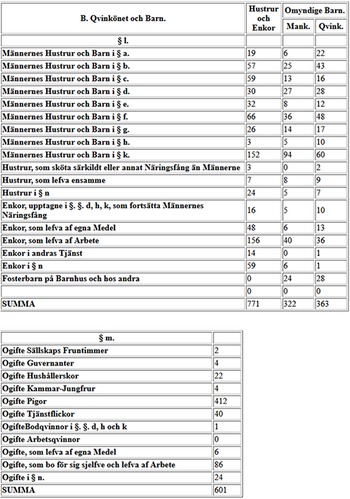
The information in the Tabellverket is organized by household. Family members are usually placed in the same social category as the head of the household even though, as we shall see, this may not have reflected reality. In Part B of Table IV, married women are classified according to the social position or occupation of their husbands and listed with reference to their husbands’ categories, for example: “Männernes Hustrur i § a”, meaning wives and widows of men in category a (i.e. the clergy).Footnote 34 In the same row, their underage children, both male and female, are listed (Figure 2). We assumed that, in most cases, the underage people refer to those under the age of fifteen, although there was no strict age limit between underage and adult. It is noticeable that many families had more daughters than sons living at home with their parents, probably reflecting the fact that sons generally had more opportunities elsewhere than daughters. Sons of senior civil servants and clergymen went to university and sons of craftsmen could become apprentices.
Part of the digitized Table II inTabellverket Västerås, 1820.
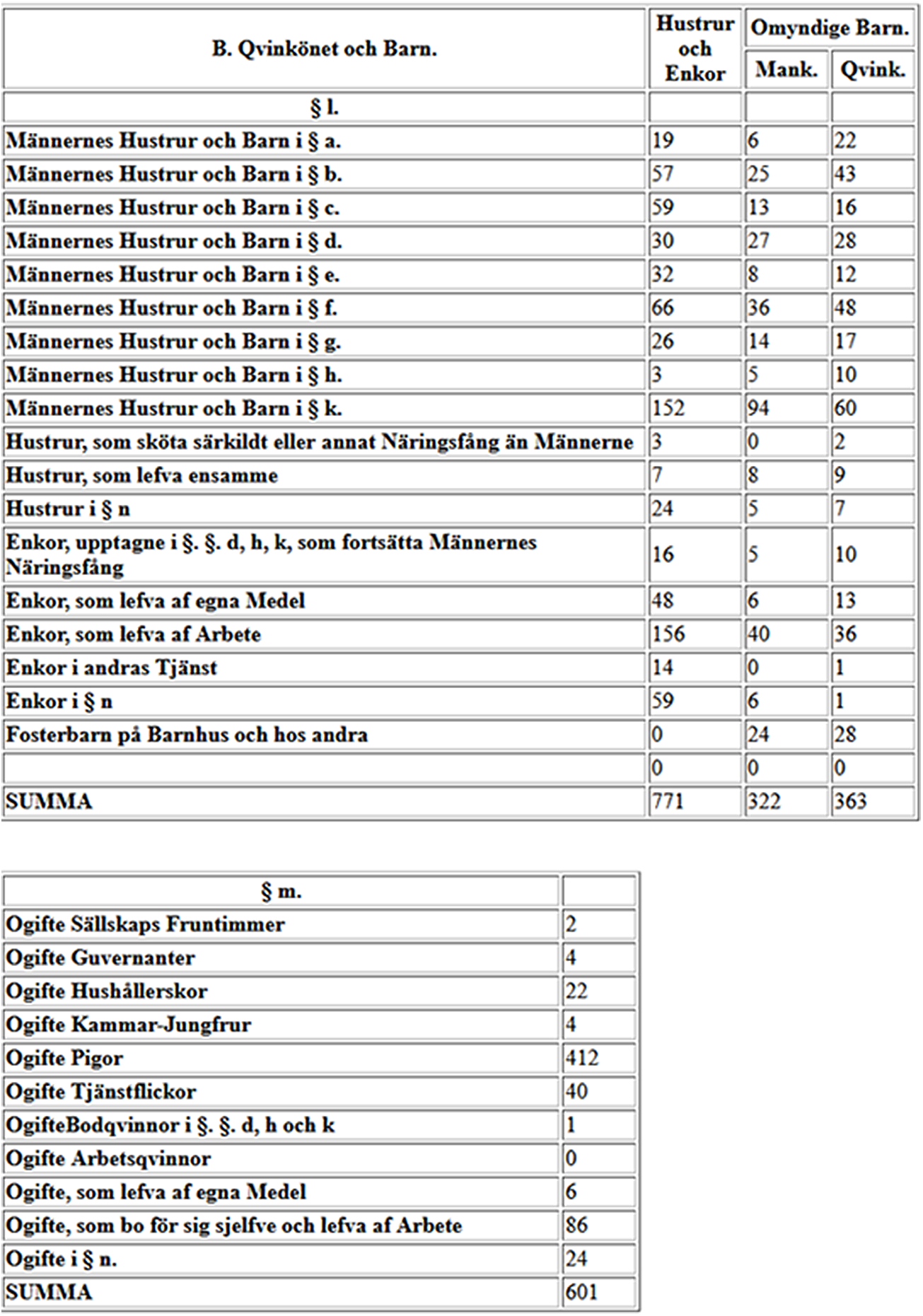
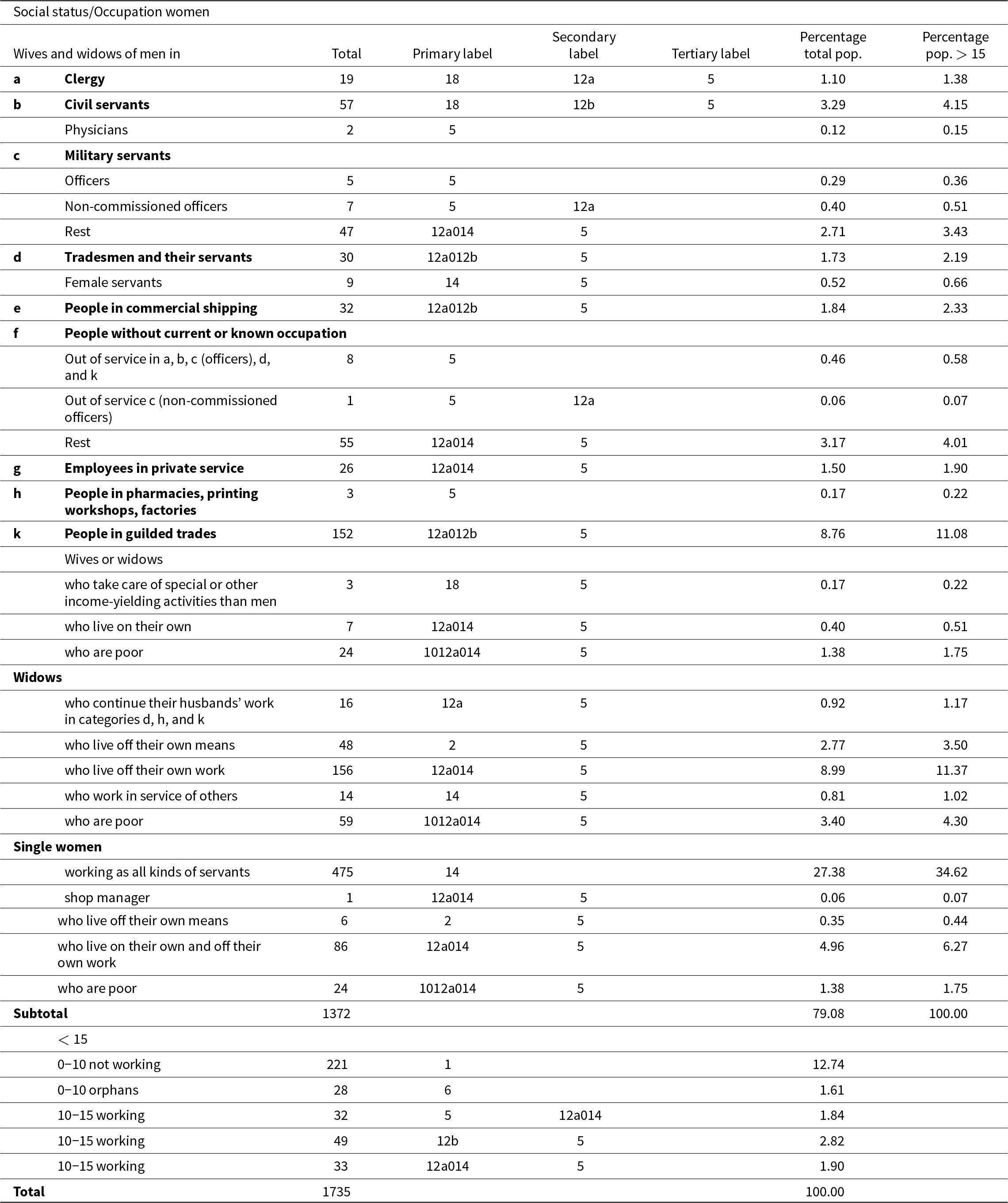
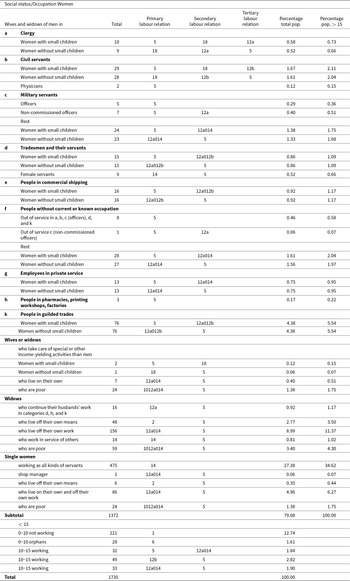
The largest group of women with their own social status/occupation in the Tabellverket (27 per cent of all women, 35 per cent of adult women) is single servants of all kinds (companion ladies, governesses, housekeepers, servants employed in wealthier households, maids, and servant girls), followed by widows living off the income from their own work (almost 9 per cent of all women, 11 per cent of adult women). Unfortunately, this work is not specified in the Tabellverket. Because widows in the GaW dataset perform all forms of work activities, this data does not give us any precise indication of their work either. In Appendix 3, we explain the basis for our estimates of labour relations. Single women and widows are typically the groups of women that were better represented in censuses as they may have had independent economic activities, and in the Tabellverket some 37 per cent of all women had an independent occupation or social status, and even more for adult women.Footnote 35 Single servants and widows are followed by the wives of men in guilded trades (almost 9 per cent of all women). Single women who lived off the income from their own work comprise almost 5 per cent, while the wives of the military form some 3 per cent, in both cases of all women. For these two groups, too, it was hard to assign labour relations. We explain our considerations in Appendix 3. The same goes for the wives of men in the “rest category” of people without current or known occupation (some 3 per cent of all women). Many of these women could carry out their work activities as either self-employed leading producer or as wage worker. The wives of civil servants account for some 3 per cent of the total number of women, just like the widows who lived off their own means. Wives of tradesmen account for less than 2 percent of all women, a suspiciously low percentage. Some 13 per cent of the women did not work, according to the Tabellverket.
As with the men, we assigned labour relations to the women in the Tabellverket, again based on the Collaboratory method complemented with findings and examples from the GaW project and the literature. Estimating which labour relation was the primary one for women was difficult. On the one hand, both GaW data and previous scholarship suggest that women did more housework for their families than men did.Footnote 36 Consequently, labour relation 5 (kin non-producers, who contributed to the maintenance of the household by performing reproductive work for the household, i.e. especially child-rearing, cooking, cleaning, and other household chores) has been assigned to all women except female servants, but to no man. It is also reasonable to assume that the care of small children was more often left to women than to men.Footnote 37 On the other hand, in the GaW dataset, married or widowed women in Västerås are observed in 13 out of 16 categories of work (Table 7), and they are particularly prominent in food and accommodation, trade, and commercialized housework – activities that they carried out as self-employed. It is hard to believe they could have carried out all these tasks had they been completely submerged in reproductive work for their own households. An illuminating example is Louise Bredberg, the wife of a non-commissioned officer and herself active in the cloth trade. She represented herself at court on several occasions, except once when her husband stood in for her because one of their children was unwell. This tells us that, under normal circumstances, this mother of three small children (two, four, and six in 1824) was able to take care of her own business, unhindered by parental duties and not legally eclipsed by her husband.Footnote 38
Moreover, we have to consider that female servants were widely and cheaply available. As already mentioned, more than one hundred female servants moved into Västerås every year around 1820, and servants were the largest occupational group among women according to the Tabellverket. This means that there was probably a division of labour among women, with unmarried servant girls doing more housework and their mistresses doing less. We know, for instance, that Louise Bredberg and her husband employed a female servant.Footnote 39 It is evident that while women did more housework for the family than men did, it is unlikely that this work completely dominated their work repertoires, especially if they were married/widowed and had no small children. We have calculated two different scenarios, suggesting an upper and a lower limit for women’s involvement in the labour market in Västerås. The lower limit (Table 3) assumes that fifty per cent of all women who were linked to a man in Table IV (that is, subgroups a to k) had small children who affected their opportunities to work. For these women, labour relation 5 is set as the primary one. The upper limit (Table 2) assumes that the care of small children did not strongly impact these women’s time use. For them, labour relation 5 is not set as the primary one. The two scenarios suggest a range for women’s labour relations.
Labour relations of women in Västerås 1820: Upper limit.
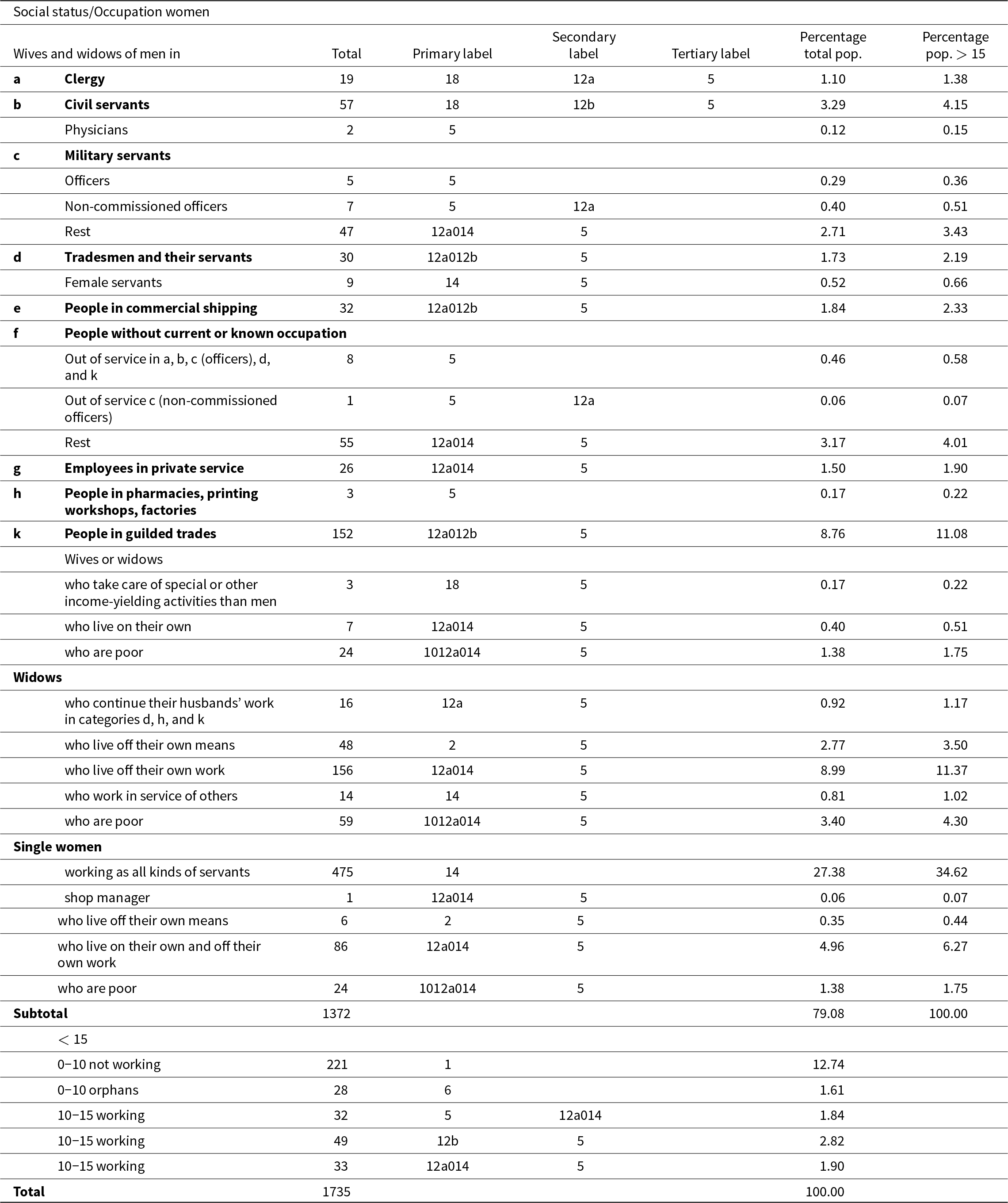
*Labour relation 1 represents non-working people; 5 household kin non-producers who performed reproductive tasks; 6 reciprocal household servants: these were subordinate non-kin (men, women, and children) contributing to the maintenance of self-sufficient households; 12a self-employed leading producers; 12b self-employed kin producers; 14 wage earners for the market; and 18 wage earners for non-market institutions. Sometimes no guesstimations could be made based on the available information. In that case, either/or categories were defined, indicated by using multiple labour relations separated by a 0. For example, the poor could either be non-working 1 or be self-employed or work for wages: 1012a014.
Source: Based on calculations on Formulär för Folkmängdens antecknande i Städerna. Folkmängd i Westerås Stad. År 1820. Available at: http://rystad.ddb.umu.se:8080/Tabellverket/Tabverk; last accessed 20 May 2025.
Labour relations of women in Västerås 1820: Lower limit.
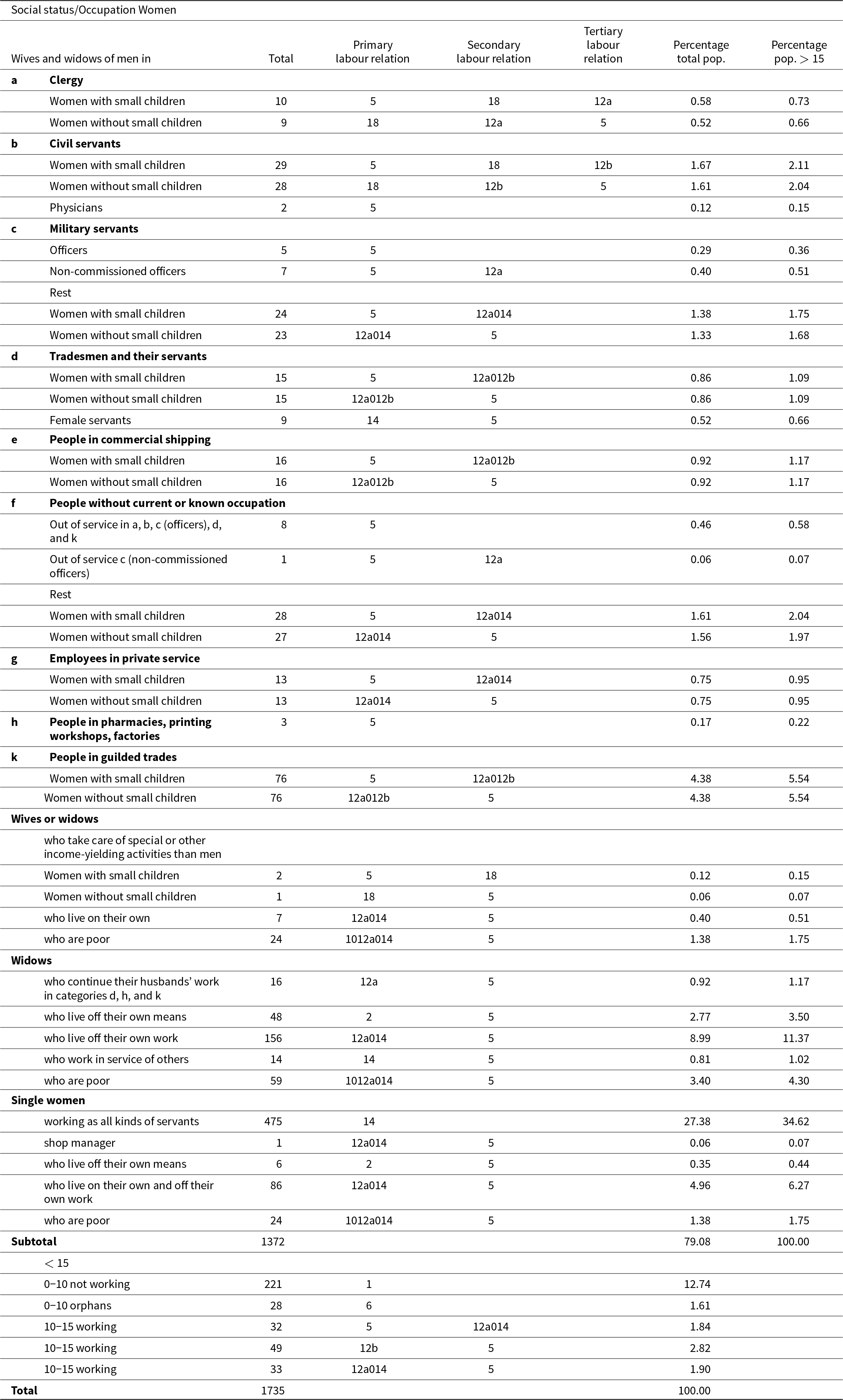
*Labour relation 1 represents non-working people; 5 household kin non-producers, who performed reproductive tasks; 6 reciprocal household servants: these were subordinate non-kin (men, women, and children) contributing to the maintenance of self-sufficient households; 12a self-employed leading producers; 12b self-employed kin producers; 14 wage earners for the market; and 18 wage earners for non-market institutions. Sometimes no guesstimations could be made based on the available information. In that case, either/or categories were defined, indicated by using multiple labour relations separated by a 0. For example, the poor could either be non-working 1 or be self-employed or work for wages: 1012a014.
Source: Based on calculations on Formulär för Folkmängdens antecknande i Städerna. Folkmängd i Westerås Stad. År 1820. Available at: http://rystad.ddb.umu.se:8080/Tabellverket/Tabverk; last accessed 20 May 2025.
Servants and widows who worked in service are all assigned labour relation 14 (wage earners). The wives and widows of the men in guilded trades all have 12a (self-employed leading producer) or 12b (self-employed kin producer) as their first labour relation and 5 as their second. We assumed that most of them worked in their husbands’ workshop or at home, but still for their spouse’s trade, an assumption based on studies of other urban populations. Ariadne Schmidt and Elise van Nederveen Meerkerk described this co-assisting labour for various occupations in several towns in the Dutch Republic.Footnote 40 As we do in this article, they also give male household heads in the guild occupations the labour relation self-employed (12a). They estimate that at least half of the married men in this group were helped by their wives in the production and/or sale of their products, and consider this a conservative estimate (this would be labour relation 12b).Footnote 41 For the Dutch proto-industrial textile town of Tilburg, the 1810 census lists the occupation of all household members, not just the heads. Married women with no listed occupation had husbands working as innkeepers (100 per cent unrecorded wives), in trade (97 per cent), in food production (94 per cent), in agriculture (86 per cent), and as various highly skilled artisans (varying from 86 to 97 per cent). Wives who had a recorded occupation (40 per cent of the total number) were married to wool combers (4 per cent unrecorded wives), spinners (11 per cent), carders (16.7 per cent), or weavers (32 per cent). Obviously, in this textile town wives of textile workers often had their own officially recorded paid occupations (often with labour relation 12a), while those married to skilled artisans, traders, innkeepers, and farmers often assisted their husbands without having their work recorded in the census.Footnote 42 That it was inconceivable to contemporaries that wives of men in most of these professions were not working at all (i.e. assisting their husbands) is shown by the decision of the mid-nineteenth-century British General Register Office to count the wives of farmers, innkeepers, publicans, and lodging-house keepers, shopkeepers, shoemakers, and butchers as economically active by dint of their husbands’ work.Footnote 43
In Västerås, the wives of men in guilded trades may have co-produced or sold their husbands’ goods, or both. However, we also find these women running their own businesses in trade and we meet women working in trades whose husbands worked in other categories. An example in this category is Elsa Catharina Brunelia, who was active in the 1770s. She was married to a pin maker (Johan Burgmeister) and was known in Västerås as a person who assessed the value of property used as pawn to obtain credit. In this way, she facilitated credit transactions and her services were most likely remunerated.Footnote 44 Another example is the wife of a butcher’s journeyman who, in 1807, was granted a licence to run a pub.Footnote 45 There is a list of trade licences from Västerås in 1830 with many examples of wives and widows of carpenters, glassmakers, hairdressers, millers, carters, watchmakers, etc.Footnote 46 The GaW dataset contains data on the wives of two glaziers, a shoemaker, a tradesman, a customs officer, and an unspecified burgher, who were all involved in Bikrögerij (tavern-keeping), and the wife of a potter was involved in the meat trade (in the 1760s). For this reason, they have all been allocated the either/or labour relation self-employed leading or kin producer (12a012b). That married women, partners of men in the guilded trades but also in other occupations, cooperated with their partners but also had their own occupations and income was a common situation in early modern London, various towns in the Dutch Republic, and in Stockholm, as Amy Louise Erickson, Danielle van den Heuvel, Elise van Nederveen Meerkerk, and Sofia Ling have shown.Footnote 47
Wives of civil servants, in many cases, will also have worked alongside their husbands. To take just one example of a co-working wife from the GaW dataset: in 1810, the wife of the customs inspector was described as being actively involved in his work, i.e. receiving confiscated goods.Footnote 48 Similar examples can be found for the nearby town of Örebro.Footnote 49 From research on towns in the early modern Dutch Republic, we know that for some public offices held nominally by the husbands, town councils expected couples to carry out the work together. Sometimes, they even required both spouses to swear an oath, because they carried out the work together and both had responsibilities.Footnote 50 The wives and widows of civil servants in the Tabellverket data therefore have labour relation 18 (wage earners for non-market institutions), even though their work was not remunerated separately. This does not mean that they had an independent economic position based on this work, but it does show what the social relationships within the household were and how the organization of work for the state relied on this unpaid work by married women. As many of these officials had a business on the side, such as selling alcohol, their wives will also have been involved in these trades. They are therefore assigned three labour relations, though we might even add a fourth, mindful of the above-mentioned custom officer’s wife who was involved in tavern-keeping. Another example of a working wife of a civil servant is Lovisa Malmberg, the wife of customs official Malmberg from Södertälje, who applied for permission to become a midwife in 1826.Footnote 51 In this case, her own paid employment meant she was assigned labour relation 18, as midwives were civil servants, according to the catechetical records in Västerås Domkyrkoförsamling.Footnote 52
We applied more or less the same rule to the wives of the clergy (forming one per cent of the female population). Several sources indicate that these women would have worked with their husbands in the care of the religious community. Solveig Widén discusses the expectations people had of clergymen’s wives.Footnote 53 Because women were supposedly better at comforting and consoling, clergymen’s wives were expected to play a special role in pastoral and medical care. They were also expected to assist their husbands in supervising the agricultural work that was regularly done at the vicarage. In addition, vicarages were often places where travellers stopped and stayed overnight, creating a lot of domestic work for the wives, including conversing with the guests. Wives of clergymen were increasingly also expected to have some book-learning. Kekke Stadin concludes that, because of the demands and limitations on what a Lutheran clergyman could do, the active participation of women was essential. The fact that Bishop Jesper Svedberg found it necessary to emphasize that a wife’s help could not include the formal office (such as preaching) shows that the wives of clergymen had a wide scope of activities.Footnote 54 As this cooperation was undoubtedly also expected of the wives of the Västerås clergy, it makes sense to assign them to labour relation 18, even though they were not remunerated for their work, with the same considerations as those for the wives of civil servants. Clergy widows could either remarry or start their own business, as did the dean’s widow Charlotta Östling, who in 1869 was granted permission to sell malted beverages and bread in Västerås.Footnote 55
Wives of tradesmen and their servants accounted for just less than two per cent of the female population. Since tradeswomen are not listed explicitly in the Tabellverket and were overlooked in official parish registers, their number should and can be adjusted based on the GaW data, even taking the Tabellverket’s own logic into account. For the category of male tradesmen and their servants – which includes shopkeepers and innkeepers – the Tabellverket distinguishes between heads of households and their servants who were not members of the family. This implies that it was common for family members to work in the business as an unregistered workforce. For the wives of the tradesmen, we assumed that in most cases they would have worked in the same enterprise as their husbands. Many examples from the GaW dataset illustrate this practice. In 1760, for example, the wife of a linen merchant spoke at court on behalf of her husband, when he was unable to attend. This shows that women married to tradesmen and merchants could be knowledgeable about the business.Footnote 56 They could also have their own business, like the above-mentioned wife of a tradesman who was active in tavern-keeping.
We do not know exactly which wives and widows had their own trades or worked along with their husbands for the clergy, the state, the local government, or in guilded trades. Even so, the existence and frequency of the cases of cooperation and independent work is important for understanding the composition of the household income of people, as well as the gendered division of labour within these households. It also helps us understand how social and power relations within the household and society were determined by employers such as the state and the clergy.
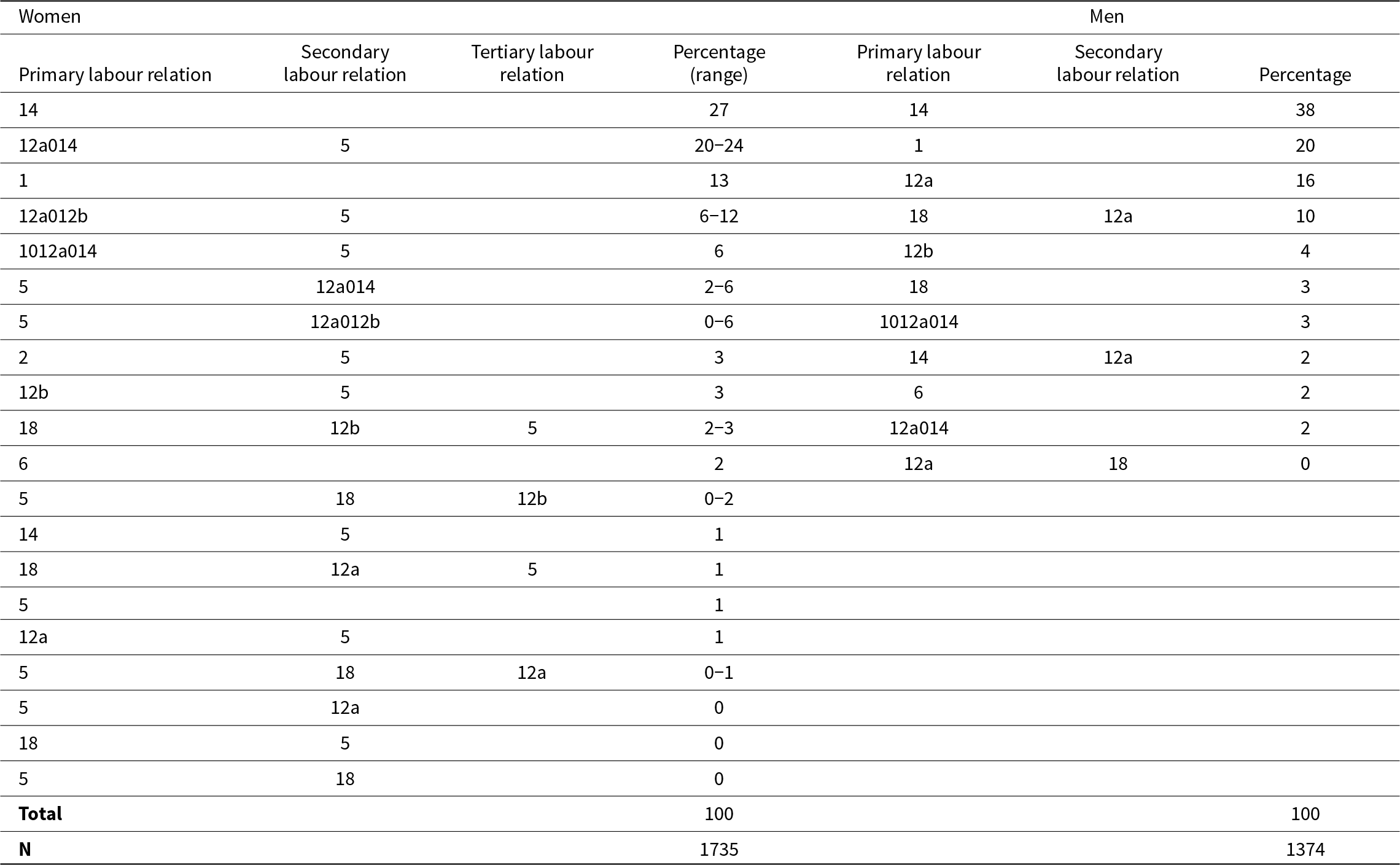
Comparing the results of labour relations for women and men of all ages (Table 4), we see that wage earning for the market (labour relation 14) was the most common labour relation for both genders: 27 per cent for women and 38 per cent for men. Most of the women with wage earners 14 as primary labour relation are single women, often servants. The next largest primary labour relation category for women (20 to 24 per cent) is the either self-employed or wage earner category (labour relation 12a or 14). In this category, we find 71 per cent married or widowed women and 29 per cent single women. A larger proportion of men than women were not working (labour relation 1 and 2): 20 per cent against 16 per cent. This can be explained partly by the boys who were at school or university and the men who were explicitly mentioned as “out of service”. For women, there is no category “retired”, but for them there is the category “living off their own means” (labour relation 2). This can also be explained by demographic factors: up to the age group 15–20, there were more boys than girls in Västerås according to the demographic data in the Tabellverket.
Labour relations of all women and men (including those under 15).
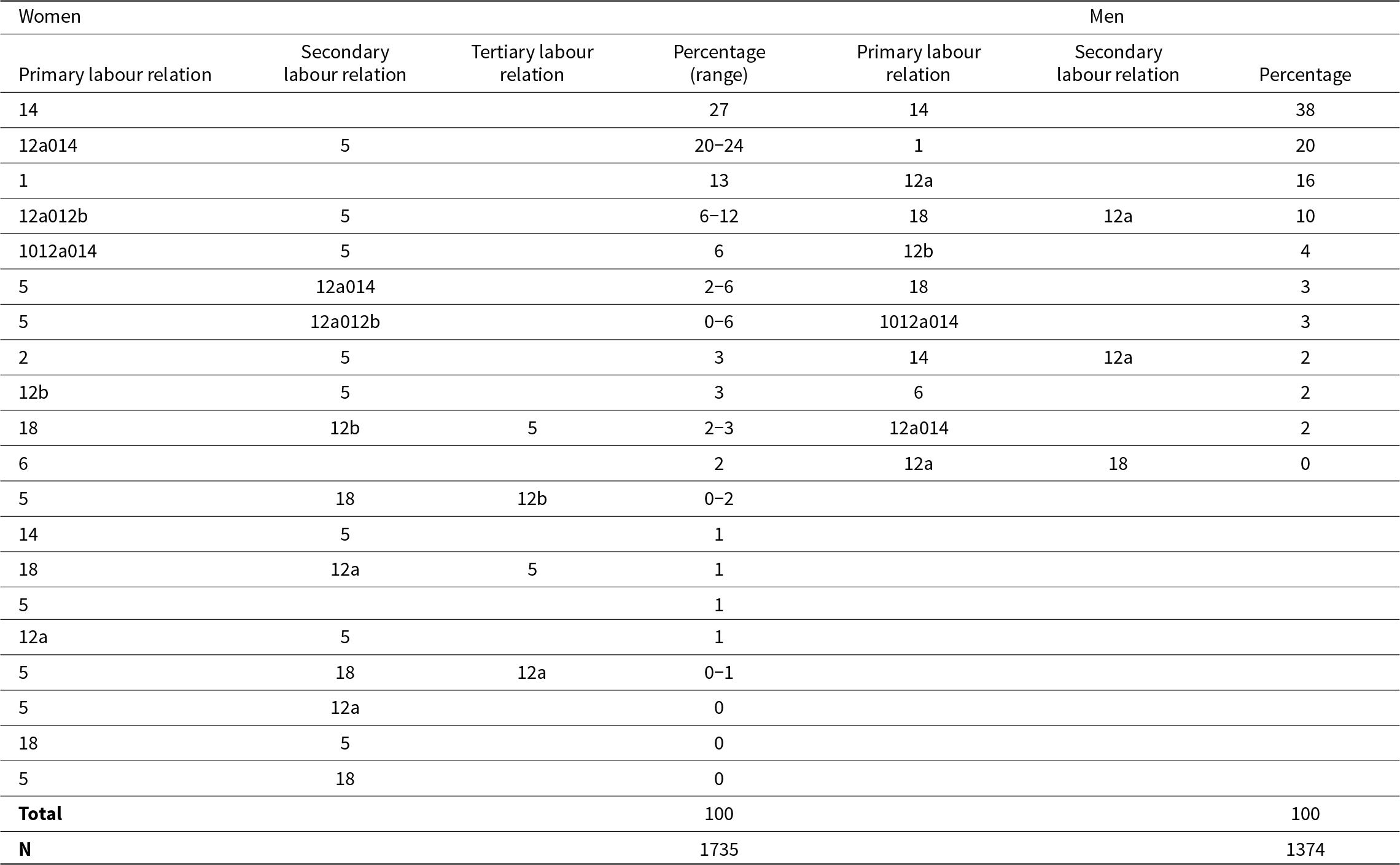
*Labour relation 1 represents non-working people; 5 household kin non-producers, who performed reproductive tasks; 6 reciprocal household servants: these were subordinate non-kin (men, women, and children) contributing to the maintenance of self-sufficient households; 12a self-employed leading producers;12b self-employed kin producers; 14 wage earners for the market; and 18 wage earners for non-market institutions. Sometimes no guesstimations could be made based on the available information. In that case, either/or categories were defined, indicated by using multiple labour relations separated by a 0. For example, both women and men could either be working as self-employed leading producer or as wage worker: 12a014.
A larger proportion of men than women were unambiguously self-employed (12a or 12b): 20 per cent against 16 per cent. If we lump together all of those who primarily performed wage work for the state (18), either in combination with self-employment (12a or 12b) or working for the household (5), men were in the majority, with 13 per cent compared to 3 to 8 per cent of women.
Looking only at the population aged 15 and above (Table 5), 87 per cent of all women had a primary labour relation that was commodified if we use the upper limit, and 72 per cent if we use the lower limit. For men, the share is 91 per cent. We also tested the implausible assumption that all married women had labour relation 5 as their primary relation; the total effect is that the share in commodified work dropped to 55 per cent. The reason for this modest decline is, of course, that a very large share of all women above 15 were either unmarried or widowed (Table 6). Of the total number of women 40–42 per cent are wage workers, 25–28 per cent wage workers or self-employed, and 9–17 per cent self-employed. Of the adult men, 70 per cent are wage workers and 21 per cent self-employed. As already mentioned, these percentages do not reflect the proportion of time that women and men spent on these work activities as none of the sources provides any information on this.
Labour relations of women and men over 15.
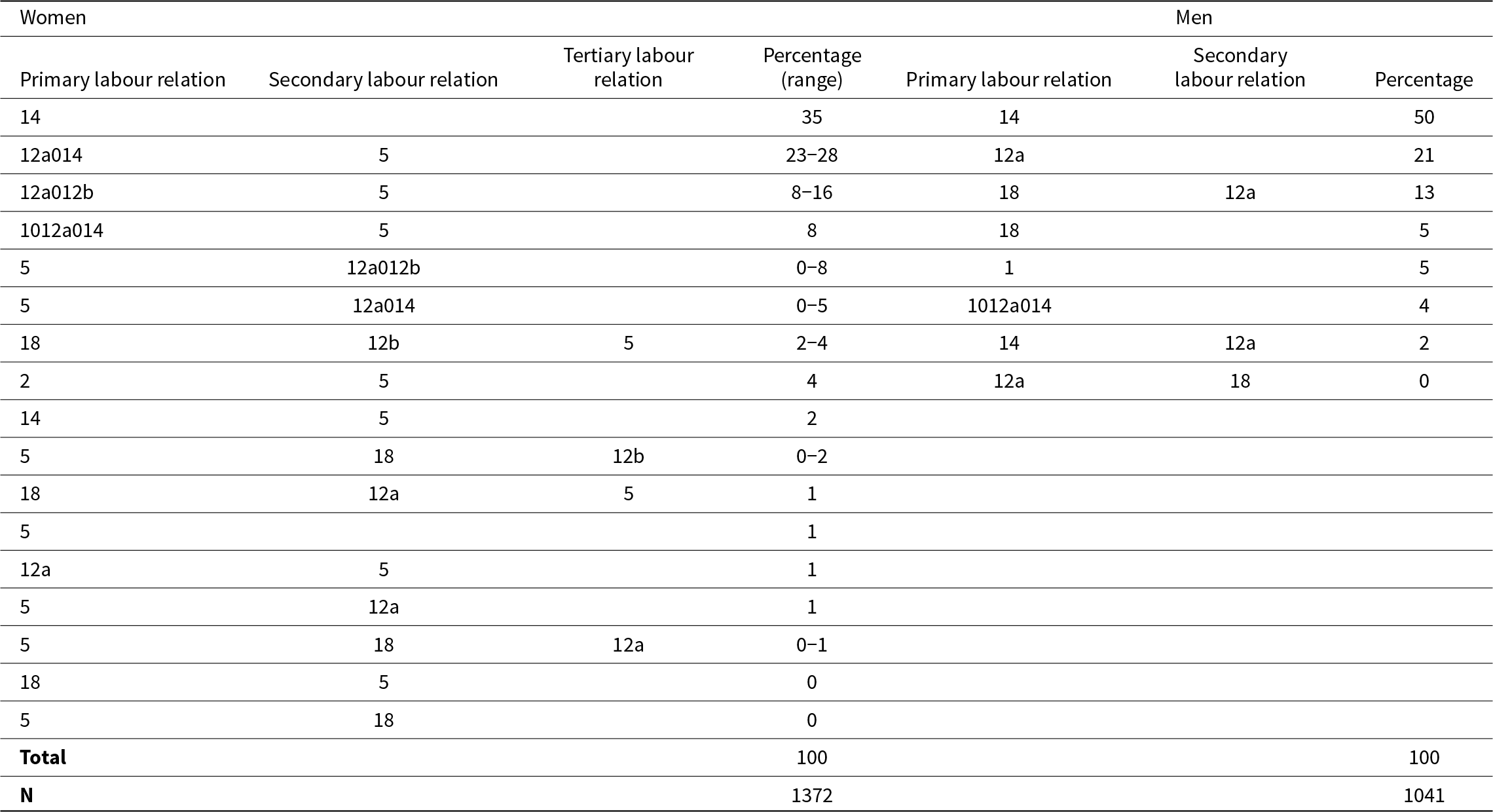
*Labour relation 1 represents non-working people; 5 household kin non-producers, who performed reproductive tasks; 6 reciprocal household servants: these were subordinate non-kin (men, women, and children) contributing to the maintenance of self-sufficient households; 12a self-employed leading producers;12b self-employed kin producers; 14 wage earners for the market; and 18 wage earners for non-market institutions. Sometimes no guesstimations could be made based on the available information. In that case, either/or categories were defined, indicated by using multiple labour relations separated by a 0. For example, both women and men could either be working as self-employed leading producer or as wage worker: 12a014.
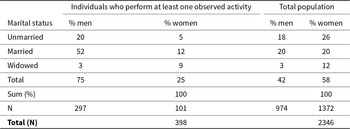
Individuals in activity dataset by gender and marital status, 1800–1840 [based on court records from Västerås], compared with proportion of the total population (age 15 and over) in Västerås, 1820.
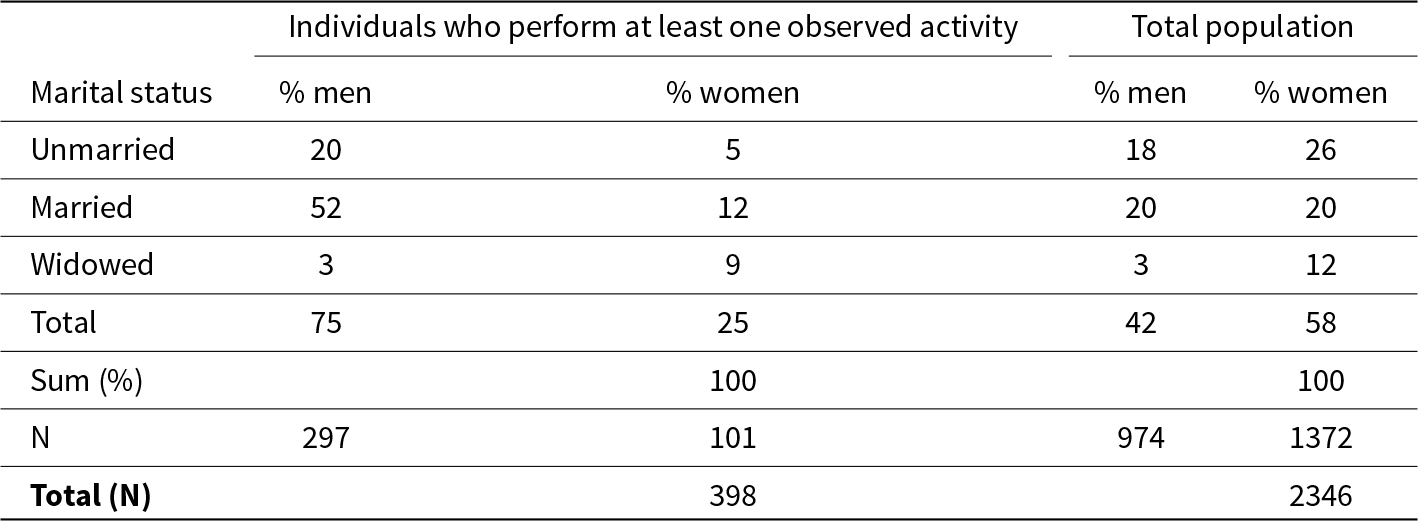
Comment: The table comprises individuals who performed work activities. People with unknown marital status (26 women and 177 men) are not included.
*NB: There is a discrepancy between the total number of men in Table II and Table IV of the Tabellverket. In the calculation of labour relations we base ourselves on Table IV; for the adult population by gender and marital status we used Table II.
Source: GaW database; Västerås (Västmanland), accisrättens protokoll och handlingar 1800–1840; Västerås (Västmanland), kämnärsrättens protokoll 1800–1840; Västerås (Västmanland), rådhusrättens protokoll 1800–1840; Tabellverket på nätet, Västerås 1820.
We do not know exactly which women did or did not engage in trade or other self-employed activities, in addition to their work within their households and alongside their husbands, and we do not know how many hours they spent on different activities. Yet, the existence and frequency of these combinations is important for understanding the composition of the household income. It also shows the gender division of labour within these households and thus the social and power relations within households and society. The advantages and disadvantages of both methods, the representativeness of the data, and the added value of combining the two approaches are discussed in the next section.
Advantages and Disadvantages of Each Method and Benefits of Combining Them
We must now consider what each method can and cannot do, and what the combination of the two brings. The Collaboratory method can make reasoned estimates of labour relations for the whole population based on a census or census-like source – in this case, the Tabellverket – combined with additional sources and case studies. We have no empirical evidence that the details of this interpretation are correct, but we do know that we have not missed any people in our analysis. When there are empirical observations, the GaW method can say accurately who did what work and in which context. It shows that women were active in almost all forms of work (see Table 7). Combined with the findings of the Collaboratory, we are able to correlate the GaW observations with labour relations and generalize for the whole population with the help of the Tabellverket. The results are interesting: the majority of women in Västerås produced goods and services for the market for at least part of the time. Is this interpretation representative for Västerås and is it representative for the whole of Sweden? For instance, were all wives of civil servants self-employed and work for the market, or only some of them?Footnote 57
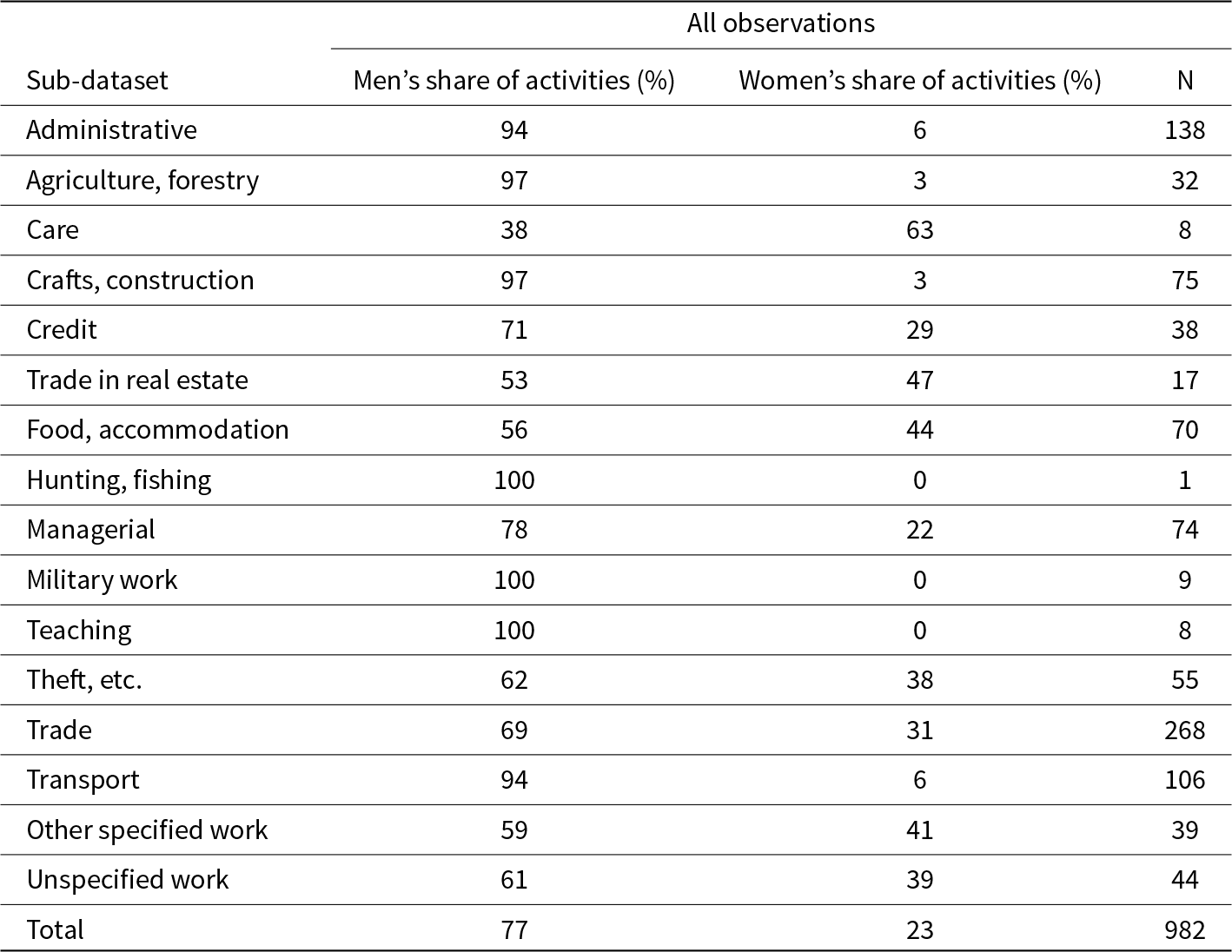
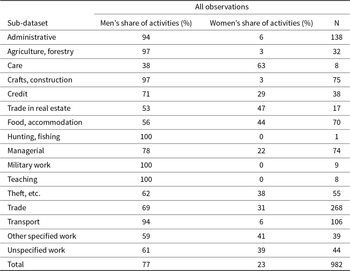
Women’s and men’s shares of activities in sixteen types of work, Västerås, 1800–1840, percentage of activities.
Source: GaW database; Västerås (Västmanland), accisrättens protokoll och handlingar 1800–1840; Västerås (Västmanland), kämnärsrättens protokoll 1800–1840; Västerås (Västmanland), rådhusrättens protokoll 1800–1840.
What we do know is for which part of the population we have observations of work activities (see Table 6), and we know in which of the sixteen types of work the GaW project distinguishes they were active (see Table 7). Looking at individuals with at least one work activity in the GaW dataset compared with the proportions of the total population (aged 15 and over) in Västerås, we see that women made up 58 per cent of the total population aged 15 years and over but constituted “only” 25 per cent of all individuals with at least one work activity in GaW.
Thus, women’s work is underrepresented in the GaW dataset too, compared with the population as a whole. However, the GaW data is useful for correcting the drastic under-representation of married women in the Tabellverket’s occupational data, where married women make up no more than 1 per cent of all women with a declared occupation. Here, the GaW data cover 12 per cent (to be compared with 20 per cent in the population as a whole). GaW therefore provides more nuanced information on the work of married women. This is one reason why the combination of the GaW method and the Collaboratory method provides new insight into women’s work and their social and power position in households, businesses, and the economy as a whole. So, we know what part of the population we have information about in GaW. We also know how activities are distributed between men and women.
Looking at proportions of women’s and men’s activities in the sixteen types of work defined by the GaW project, we find that women carried out 29 per cent of all credit activities, 47 per cent of all trade in real estate activities, 44 per cent of all food and accommodation activities, and 31 per cent of all general trade activities. Women also carried out 38 per cent of theft activities. Interestingly, 38 per cent of care activities were carried out by men. If we compare the above table with the Tabellverket data on occupations, we could argue that women carried out a significant proportion of the trade activities that are largely hidden in the Tabellverket. This supports our interpretation of labour relations: many women will have provided services to the market at least some of the time, either as self-employed traders or entrepreneurs in catering or accommodation, or as wage workers.
Table 7 shows not only which work activities of men and women were found in the court records, but also which activities are missing from this source. The court records used in the GaW project emphasize activities related to transactions (e.g. trade) and interactions (e.g. transport, care work) rather than production.Footnote 58 This means that textiles and garment production, sectors in which women have traditionally been employed, often as wage workers, are underreported. The Tabellverket mentions in total 33 tailors (10 masters, 12 journeymen, and 11 apprentices). In addition, simpler garments may have been made at home, but women undoubtedly offered their services to make clothes for others and there must have been needlewomen or dressmakers in Västerås, even though they are not mentioned in this source nor in the GaW work observations.
This is also the conclusion of Lotta Vikström. She combined information from the Swedish parish registers for the town of Sundsvall during the period 1860–1893 with data on women’s work from local newspapers, trade directories, and business registers. She was able to link 203 individual women who appeared in both sources, and for the majority of these women the parish registers did not record their work, or did so incorrectly. For many of them, starting a business or engaging in petty trade was a strategy for survival, according to Vikström. These women commodified their domestic skills by cooking and sewing for others. One of them was Märta Westerstrand, a thirty-five-year-old mother of two illegitimate children who was a maid (piga) according to the parish register. She advertised in the local newspaper that customers could bring her a piece of cloth and she was skilled at sewing (clothes) on her machine.Footnote 59 Charlotte Grönhagen is an example of a woman married to a craftsman, in this case to a tinsmith, and she was listed in the parish registers as having no occupation. She advertised in the local newspaper that she sold women’s clothing.Footnote 60 Of the 203 women, forty were listed as artisans in the local newspapers, trade directories, and business registers, including many seamstresses, hairdressers, and bakers. Only nine of them were listed in the parish registers.Footnote 61 These findings in an additional set of sources are yet another reason not to underestimate the number of women who produced goods or services for the market, either as self-employed manufacturers or as wage workers. Kirsi Vainio-Korhonen has found similar patterns for Swedish Turku (Åbo) around 1800: while the guilds retained control of the production of refined and expensive garments, urban women produced and sold simple clothing to the less wealthy inhabitants of the town.Footnote 62
In order to check the validity of our interpretation of labour relations, we must not only internally check on the representativeness of the people, work activities, and labour relations we have counted in the sources, but also check our interpretation against the demographic, economic, and social context. At the beginning of the nineteenth century, Västerås had a considerable surplus of unmarried and previously married women, most of whom had to work to support themselves.Footnote 63 Västerås was a trading town; despite this, few men worked in trade (according to the Tabellverket). There must have been many more people working in trade and other services than this source reports, and it is plausible that a large proportion of these people were women. The GaW data confirm this conclusion. As in Turku, many women were involved in the production of and trade in clothing, and perhaps also of yarn and cloth. Even though we do not find these women described as a group of workers in the Tabellverket or in the GaW data, their undeniable presence in the urban economy must be considered when assigning labour relations. Very likely, many of these unmarried or previously married women were also involved in providing care work for payment, reducing the need for married women to spend a significant share of their work effort on such work.
Recently, Sara Horrell, Jane Humphries, and Jacob Weisdorf used impressive data on wages of men, women, and children, and on standards of living of households, to show how, from the mid-1600s, the gradual transformation of the English economy coincided with improved welfare. Throughout these centuries, it was rare for men’s work alone to sustain the family at a respectable level; the earnings of women and children were necessary.Footnote 64 In Sweden, many households needed the economic contributions of women and children to survive, not least in the early nineteenth century. In cities and towns like Västerås, many people lived in dire conditions during this period. Iréne Artæus provides examples of female mistresses who were too poor to pay their maid servants a wage. In these cases, the maid title may not even have signified a labour relation; the “employment arrangement” was instead a survival strategy, based on the fact that two women living together had better chances of surviving than one.Footnote 65 Still, many women moved into this town in the hope of making a living as it had things to offer: strong connections to the Stockholm market and to the iron-producing district, a local market for housing, food, domestic services, consumer goods like clothing, and – for some – access to gardens and small plots of land. Apparently, many households in Västerås needed the income of women and children to survive. Comparisons can help us test the likelihood of the results of our interpretation of labour relations.
In the Dutch province of Zeeland between 1816 and 1870, seventy per cent of all brides had an occupational designation on their marriage certificate.Footnote 66 Ineke Maas and Marco van Leeuwen found more brides with occupational titles in rural than in urban areas. Many of the women were domestic servants and labourers (with no further description but probably agricultural labourers). The number of women with occupations in Zeeland was probably high because real wages were relatively low and many women worked out of poverty, Maas and van Leeuwen surmise.Footnote 67 Corinne Boter shows that in the Netherlands, in the period 1820–1829, just over fifty per cent of all women declared an occupation at the time of their marriage. Whereas Maas and Van Leeuwen signal differences between rural and urban areas, Boter finds large regional differences looking at industrial developments. In Enschede, where there was a large textile industry, seventy per cent of all brides declared an occupation during this period, in the city of Maastricht, known for its pottery and glass industries, the figure was around sixty per cent, while in Odoorn, which was mainly dependent on peat production, around forty-five per cent of brides declared an occupation.Footnote 68 Poverty was widespread in the peat regions and seasonal unemployment could be high. When there was enough work on offer, women were active in the labour market, Boter concludes.Footnote 69 Nevertheless, the demand for female labour in the textile industry led to a higher percentage of brides with an occupation listed in Enschede, so that, in some cases, poverty alone was not the only reason for a high percentage of brides with a job.
Of course, an occupation at the time of marriage says nothing about a woman’s occupation after marriage. But it is significant that the number of working women on marriage certificates is higher than in the census.Footnote 70 We assume that the brides self-declared their occupation, so it seems to matter whether women could self-declare their occupation or source of income, as Vikström also concludes in her case study.Footnote 71 This also points to one of the advantages of combining the GaW method with the Collaboratory method: women in legal sources often self-report their work activities, both paid and unpaid, which allows for the application of proper labour relations.
If combining the Collaboratory and GaW methods triangulated with a census leads to plausible results, the major advantage is that we gain insight into more work activities of women and children and also the labour relations under which they performed them. In this way, we can also obtain better data on social and power relations in households, on the shop floor, and in the economy as a whole, and we have a package of methods that allows for comparisons over time and space.
Conclusions
The combination of the Collaboratory method and the verb-oriented method leads to new empirical results regarding the work of women and men for the market and for their own households in the town of Västerås around 1820. Like many other studies, this article highlights the importance of trade as a source of income for the household and points out how poorly censuses and census-like sources capture tertiary sector work and, as a consequence, women’s work. The article also emphasizes the importance of including by-employment for categories of employees where one would not immediately expect sidelines, such as civil servants. A third empirical result is that there must have been a strong division of work among women, a division that resulted from high numbers of unmarried women who needed to support themselves. This suggests that much care work was commercialized and explains how socially reproductive work was taken care of in this town. These results indicate power relations between women: while some married women had considerable economic agency, others earned their living in more subordinate positions.
The combination of methods also produces new methodological insights and ideas for future research. Clearly, it is an advantage that the Collaboratory takes the whole population as its point of departure, not only the part for which there are explicit occupational data. Another advantage is the foundational idea that people can be, and often are, in several labour relations at the same time. This makes it easier to observe combinations and spot shifts in combinations of labour relations, shifts that may be indicative of profound processes of change. It is also an advantage that the GaW method tries to capture all forms of work, including even the most minute tasks, and that it relies on source types that are available for long swathes of time. A remaining challenge consists in accurately estimating the quantitative importance of housework and childcare for men and women, both because such work tends to be under-reported in historical sources and because such work could either be carried out for oneself or be substituted by services bought from others, both servants and female micro-entrepreneurs. In order to address these challenges, this article has proposed a way of assessing the possible range of women’s labour relations.
The example of Louise Bredberg shows that a rudimentary triangulation between court cases, the Västerås church records, and the Tabellverket is possible, making it plausible that her labour relations can be used as a proxy for the labour relations of other women in her category, i.e. wives of non-commissioned officers. We know that Louise was actively involved in the clothing trade as a self-employed leading producer, which shows that she and her husband formed a two-breadwinner household. In fact, we even know (from the court case registered in the GaW database) that her husband, too, was engaged in the clothing trade, as was their female servant. The husband’s occupational title was “sergeant”, but his role was to play the oboe as a military musician.Footnote 72 Often, the wage of such lower state officials was inadequate, and it is therefore far from surprising that he assisted his wife in her trade, just as many wives assisted their husbands in theirs. Consequently, Louise’s husband was as knowledgeable about their business as she and was able to represent her in court when their child was ill. In other cases, Louise represented herself in court. This speaks volumes about spousal cooperation and social relations within the household. The case demonstrates how an ordinary married woman was able to combine unpaid work for the household with her income-generating work in the clothing trade, but it also lays bare power relations determined by work: the mistress was a self-employed trading women while her wage-earning servant was instructed to take care of the children. Finally, this example informs us about the power relations between the state (and the local government) and its wage-earning employees. These institutions had to tolerate their employees’ sidelines because they did not pay them enough.
The results of the combined methods are promising and valuable, especially given the difficulties in capturing married women’s work. The strength of this combined method will hopefully be demonstrated by further research that follows these case studies over time, and compares them with other case studies that include rural and more industrialized areas.
Supplementary material
The supplementary material for this article can be found at https://doi.org/10.1017/S0020859025100552.



 Open access

