



The USA is currently facing two paradoxical food and nutrition challenges: obesity and food insecurity. Nearly 12 % of the population was food insecure in 2017, while 39·8 % of American adults were considered obese in 2015–2016(Reference Coleman-Jensen, Rabbitt and Gregory1,Reference Hales, Carroll and Fryar2) . As the nation’s largest food safety net programme, The Supplemental Nutrition Assistance Program (SNAP) provides food assistance to over 20 million low-income households(3). In providing assistance, SNAP aims to directly address the two major food and nutrition challenges faced by the USA; stated programme goals include minimising food insecurity and improving diet quality among low-income households(4).
A vast set of literature examines whether SNAP effectively reduces food insecurity, improves diet quality and, in turn, reduces obesity. The most quantitatively rigorous studies consistently find that SNAP participation reduces food insecurity(Reference Gundersen, Kreider and Pepper5–Reference Yen, Andrews and Chen11). The literature largely concludes that SNAP participants’ diet quality is equally low or lower than that of non-participants; however, there is evidence that SNAP participation leads to modest improvements in whole fruit, Na and saturated fat intake(Reference Andreyeva, Tripp and Schwartz12,Reference Gregory, Ver Ploeg and Andrews13) . Findings on obesity are mixed. While many studies find SNAP increases the probability of obesity among women(Reference Baum14–Reference Zagorsky and Smith17), two studies that allow for participation misclassification find SNAP either has no effect or decreases the incidence of obesity(Reference Gundersen, Bartfield, Gundersen and Smeeding18,Reference Almada, McCarthy and Tchernis19) . Despite these improvements, food insecurity and obesity rates remain high, with an estimated 50 and 38·5 % of SNAP participants classified as food insecure and obese, respectively(Reference Coleman-Jensen, Rabbitt and Gregory1,Reference Almada, McCarthy and Tchernis19) .
National food insecurity and obesity concerns among low-income households have, in part, prompted legislation seeking to add additional purchase restrictions to SNAP. Currently, SNAP benefits can be used to purchase any food item with the exception of hot foods, prepared foods, alcohol, vitamins and meal supplements(20). Since 2000, at least twenty-three states have proposed legislation to restrict the purchase of additional items under SNAP(Reference Leschewski and Weatherspon21). The majority of proposed restrictions aimed to prohibit the purchase of food and beverages with low nutritional quality, including sugar-sweetened beverages (SSB) and snack foods. Other legislation more broadly proposed to restrict the purchase of all unhealthy foods, as well as luxury foods(Reference Leschewski and Weatherspon21–24).
Quantitative analyses of proposed SNAP purchase restrictions ability to alter participants’ food expenditures are limited. Leschewski and Weatherspon(Reference Leschewski and Weatherspon21) and Klerman et al.(Reference Klerman, Collins and Olsho25) conclude that SSB and snack food restrictions are unlikely to impact food expenditures on the restricted items given that the majority of SNAP participants are infra-marginal, that is, their food expenditures exceed their SNAP benefit allotment. In contrast, Lusk and Weaver(Reference Lusk and Weaver26), Harnack et al.(Reference Harnack, Oakes and Elbel27) and Cuffey et al.(Reference Cuffey, Beatty and Harnack28) find that SNAP restrictions on SSB and/or snack foods would reduce restricted item expenditures and consumption among participants. Despite being infra-marginal, purchase restrictions may alter participant food purchases if they spend cash differently than SNAP, the restriction increases the stigma of using SNAP and/or the restriction acts as a signal to avoid purchasing the restricted items(Reference Lusk and Weaver26,29–Reference Chrisinger31) .
With relatively few analyses in the literature and conflicting findings, the effect of proposed SNAP purchase restrictions on participant food expenditures remains unclear. One approach to analysing the impact of SNAP purchase restrictions not yet employed in the literature is to examine SNAP participants’ expenditures on current SNAP-restricted foods, that is, hot foods, prepared foods, alcohol, vitamins and meal supplements. To the authors’ knowledge, no study to date has analysed current SNAP-restricted food expenditures by household SNAP participation status. In a related study, Todd and Ver Ploeg(Reference Todd and Ver Ploeg32) examine a single restricted item, alcohol, concluding that purchase restrictions may have little effect given similar alcohol consumption levels among SNAP participants and low-income non-participants.
The objective of this study is to compare SNAP participants’ current SNAP-restricted food expenditures with those of income-eligible non-participants. This analysis will collectively consider expenditures on the following SNAP-restricted foods: (1) hot foods, (2) prepared foods, (3) alcohol and (4) vitamins and meal supplements. Results from this study will provide insight to policymakers from which they can infer the impact of similar proposed SNAP purchase restrictions on SSB, snack foods and luxury foods.
Methods
Study sample
The primary data set used in this analysis was the United States Department of Agriculture’s (USDA) National Household Food Acquisition and Purchase Survey (FoodAPS)(33). Conducted between April 2012 and January 2013, FoodAPS is a nationally representative survey of 4826 households’ food purchases and acquisitions. FoodAPS was ideally suited for this analysis, in that it consisted of a large, representative sample of SNAP participants and income-eligible non-participants. Each household participating in FoodAPS completed 1-week food purchase and acquisition diaries. Detailed item-level data were provided for all food purchases, including item descriptions and expenditures. Initial and exit surveys were also conducted to collect a broad set of socio-demographic measures for each household.
This study’s sample was limited to SNAP eligible households, that is, SNAP participants and income-eligible non-participants. To minimise measurement error, SNAP participants were identified as households in the data set who both (1) indicated participating in SNAP and (2) were administratively verified as participating in SNAP by the USDA. Administrative verification confirmed SNAP participation for 1316 of the 1581 households self-reporting SNAP participation; the remaining 265 households were removed from the sample. Income-eligible non-participants were identified as households with gross monthly income <185 % of the federal poverty line that did not report current participation in SNAP. Note that a gross income limit of 185 % of the federal poverty line was used, as opposed to 130 %, to account for the expansion of broad-based categorical eligibility under the American Recovery and Reinvestment Act of 2009 and monthly income volatility(Reference Ver Ploeg, Mancino and Todd34). In total, the final study sample consisted of 2513 SNAP eligible households, of which 1316 were SNAP participants and 1197 were income-eligible non-participants.
Measuring current Supplemental Nutrition Assistance Program-restricted expenditures
Within FoodAPS, all food purchases were categorised as either food at home (FAH) or food away from home (FAFH). The survey defined FAH as food and drinks brought into the home and used to prepare meals, while FAFH was defined as food and drinks obtained and consumed away from home and prepared foods that are brought home(35). This analysis considered both FAH and FAFH expenditures made at food stores to measure current SNAP-restricted expenditures. Use of both FAH and FAFH expenditures was appropriate, given that prepared and hot foods were primarily classified as FAFH in FoodAPS, while alcohol and vitamins and meal supplements were classified as FAH. Note that restaurants and other eating places were excluded from this analysis as SNAP policy typically prohibits the use of SNAP benefits to purchase any food or drink items at these retailers.
USDA researchers further categorised all FoodAPS food purchases using the Economic Research Service’s food group classification system(36). Consisting of eighty-two food groups, this study used this classification system to identify and measure household expenditures on each of the categories of current SNAP-restricted foods. Alcohol and vitamin and meal supplement expenditures were measured by summing household expenditures on food groups 70 305 ‘alcohol’ and 70 601 ‘vitamins and meal supplements’, respectively. Hot food and hot prepared food expenditures were calculated based on food group 60 101 ‘ready-to-eat prepared meals’. Within this group, items fitting the USDA’s definition of hot foods and hot prepared foods were identified on a case-by-case basis using food item descriptions provided in FoodAPS(37). Note that this analysis did not consider expenditures on cold prepared foods, defined as foods that were made or prepared by the retailer on the premises of the firm, were sold cold and required no additional preparation(37). Using FoodAPS, it was not possible to ascertain whether cold prepared items were prepared onsite by the retailer or elsewhere. A measure of total current SNAP-restricted food expenditures was then obtained by summing household expenditures on hot foods, hot prepared foods, alcohol and vitamins and meal supplements.
Statistical analysis
Statistical analyses were conducted using Stata version 15.1 in 2019. Following the analytical approach employed by Todd and Ver Ploeg(Reference Todd and Ver Ploeg32), this analysis used a combination of bivariate and multivariable analyses to examine current SNAP-restricted food expenditures. To account for the complex survey design of FoodAPS, sampling weights were applied in all analyses and the Jackknife Repeated Replication method was used in all variance calculations(35).
Descriptive statistics, weighted means (standard errors), were calculated to characterise sample households’ current SNAP-restricted food purchases, as well as socio-demographic characteristics. Welch’s t tests with unequal variances were used to compare whether (1) the share of households who purchase current SNAP-restricted foods, (2) average household current SNAP-restricted food expenditures and (3) socio-demographic characteristics were significantly (P < 0·05) different among SNAP participants and income-eligible non-participants.
Multivariable regression analysis was then employed to analyse whether current SNAP-restricted food purchases varied with SNAP participation after controlling for socio-demographic factors. A common empirical issue when using cross-sectional survey data, such as FoodAPS, to analyse household expenditures on disaggregate goods is the presence of zero expenditures. In the case of this analysis, over 73 % of sample households did not purchase a current SNAP-restricted food item. Failure to account for zero expenditures can result in biased and inconsistent regression estimates. This analysis estimated a lognormal double-hurdle model, which addressed zero expenditures by modelling a two-step decision process. In the first step, or participation decision, a probit regression was estimated to examine whether SNAP participation was associated with the probability that a household purchased a current SNAP-restricted food item. Given purchase, the second step, or expenditure decision, estimated an ordinary least squares regression to analyse the association between SNAP participation and household expenditures on current SNAP-restricted foods. The two-step nature of this model was beneficial in that it allowed for separate processes to determine a household’s purchase and expenditure decisions for current SNAP-restricted foods.
It is possible that unobservable factors impacted both a households’ decision to participate in SNAP and their expenditures on current SNAP-restricted foods. Known as endogeneity, this issue had the potential to bias double-hurdle model estimates. This analysis used an instrumental variables approach to account for potential endogeneity. Following past studies, state-level SNAP policy variables obtained from the USDA’s SNAP Policy Database were used as instruments for SNAP participation(Reference Gregory, Ver Ploeg and Andrews13,Reference Almada, McCarthy and Tchernis19,38,Reference Rigdon, Berkowitz and Seligman39) . Described in Table 1, these variables capture state-level differences in the application process, eligibility criteria and outreach spending for SNAP. To be valid instruments, these policy variables must explain significant variation in household SNAP participation, but not be correlated with households’ current SNAP-restricted food expenditures, except through SNAP participation.
Instrumental variables for Supplemental Nutrition Assistance Program (SNAP) participation

BBCE, broad-based categorical eligibility; DV, dummy variable; CAP, Combined Application Project; SSI, Supplemental Security Income.
Covariates
It is well established in the literature that socio-demographic characteristics affect household food purchase behaviours(Reference Volpe and Okrent40–Reference Saksena, Okrent and Anekwe43). Socio-demographic characteristics were thus included as covariates in the multivariable regression analysis of current SNAP-restricted food purchases and expenditures. In addition to SNAP participation, household-level covariates included income, age composition (the number of household members aged 0–4, 5–17, 18–59 and 60+ years), location (rural or urban), region (Northeast, Midwest, West or South) and food access (distance to nearest superstore and vehicle ownership). Additional covariates characterising the primary survey respondent included race/ethnicity (non-Hispanic white, non-Hispanic black, non-Hispanic other or Hispanic), highest level of educational attainment (high school or less, some college or bachelor’s degree or higher), gender (male or female) and marital status (married or unmarried).
Results
Bivariate analysis
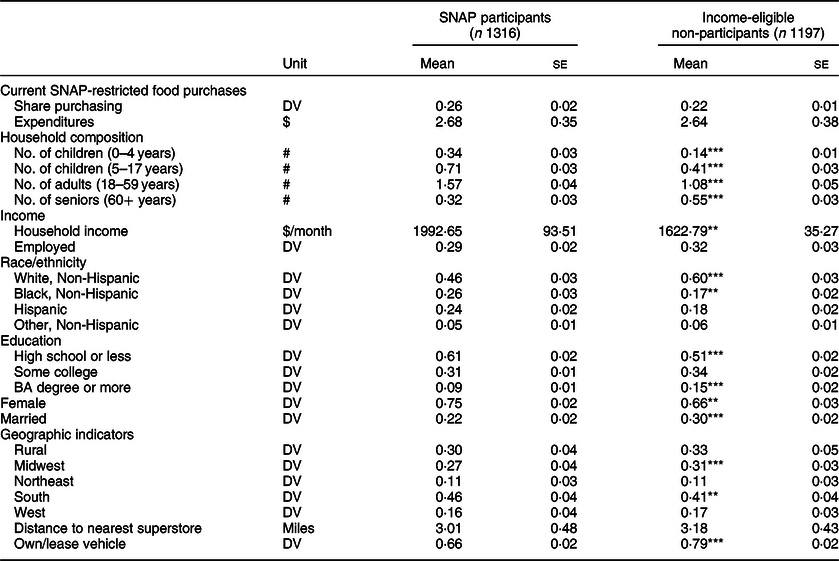
Table 2 reports descriptive statistics for household current SNAP-restricted food purchases and socio-demographic characteristics by SNAP participation status. The descriptive statistics indicate that a greater share of SNAP participants purchased a current SNAP-restricted food item during the survey period than did income-eligible non-participants. In total, 26 % of SNAP participants and 22 % of income-eligible non-participants purchased at least one current SNAP-restricted food item. However, Welch’s t test results indicate that this difference was not statistically significant at the 5 % level (P < 0·05). Average household expenditures on current SNAP-restricted items were nearly identical among SNAP participants and income-eligible non-participants at $2·68 and $2·64, respectively.
Descriptive statistics by household Supplemental Nutrition Assistance Program (SNAP) participation status (n 2513)†
DV, dummy variable; #, number; BA, Bachelor’s.
† Means are weighted. Jackknife Repeated Replication method used to estimate standard errors.
*, ** and *** indicate significance at the 0·05, 0·01 and 0·001 level, respectively.
T test results indicate significant (at least P < 0·05) variation in the socio-demographic characteristics of SNAP participants and income-eligible non-participants. Relative to income-eligible non-participants, SNAP households were less likely to have a primary survey respondent that was male, college educated, married or non-Hispanic white, to own or lease a vehicle and to live in the Midwest. In contrast, SNAP households had higher average monthly incomes, were composed of a larger number of children and adults and were more likely to live in the South than income-eligible non-participants.
Multivariable analysis
Double-hurdle model estimates of the association between SNAP participation and current SNAP-restricted food purchases and expenditures are reported in Table 3. Unlike results from the bivariate analysis, these multivariable estimates were controlled for observed and unobserved household heterogeneity that had the potential to impact household current SNAP-restricted food purchases. Specifically, control variables were included to account for variation in socio-demographic characteristics, while an instrumental variables approach was employed to account for potential unobserved differences among sample households (i.e. endogeneity).
Double-hurdle model (instrumental variable (IV)) estimates of Supplemental Nutrition Assistance Program (SNAP) participation on current SNAP-restricted food purchases and expenditures†‡

OLS, ordinary least squares.
† Model controls for household age composition, household income, employment status, race/ethnicity, education level, gender, marital status, location, region, vehicle ownership and store access. Parameter estimates for all covariates are available in the online Supplementary material, online Supplemental Table S1.
‡ Estimates are weighted. Jackknife Repeated Replication method used to estimate standard errors.
*, ** and *** indicate significance at the 0·05, 0·01 and 0·001 level, respectively.
Control function estimates of the association between SNAP participation and the SNAP policy instrumental variables are presented in online Supplemental Table S1 in the online supplementary material. Results indicate that two instruments, broad-based categorical eligibility and outreach expenditures (outreach), are significantly (at least P < 0·05) associated with SNAP participation. While there is no test for strong instruments in non-linear double-hurdle models, this significance provides evidence that broad-based categorical eligibility and outreach are strong instruments for SNAP participation(Reference Wooldridge44).
Within Table 3, estimated coefficients and 95 % CI are provided for each step (the participation decision and the expenditure decision) of the lognormal double-hurdle model. Similar to the bivariate analysis, the double-hurdle model estimates for the participation decision indicate that SNAP participants were no more likely to purchase current SNAP-restricted foods than income-eligible non-participants. However, several socio-demographic control variables, including the number of adults in the household, education level, gender, region and vehicle ownership, were significantly (P < 0·05) associated with the probability of purchasing current SNAP-restricted foods; see online Supplemental Table S2 in the online supplementary material for model estimates for all covariates. Note that the instrumental variable residuals coefficient was not statistically significant (P < 0·05) in either step of the model, suggesting that SNAP participation was exogenous in this analysis. Thus, variation in the probability of a low-income household purchasing current SNAP-restricted foods appears to have been the result of observed household heterogeneity, as opposed to participation in SNAP.
Results from the second step of the double-hurdle model, the expenditure decision, were also similar to those obtained through the bivariate analysis. Given the purchase of current SNAP-restricted foods, SNAP participant and income-eligible non-participant households had similar expenditures on current SNAP-restricted foods. Few socio-demographic controls were significant (P < 0·05), indicating that given purchase, low-income households expenditures on current SNAP-restricted expenditures are similar across socio-demographic groups. Collectively, results from both steps of the double-hurdle model suggest that current SNAP-restricted food purchases were similar among low-income households, irrespective of SNAP participation status.
Discussion
National concerns over food insecurity and obesity have prompted legislation seeking to further restrict SNAP food purchases. While the majority of SNAP participants have the ability to cover their expenditures on proposed restricted foods with cash, whether they would choose to do so given the implementation of a purchase restriction is uncertain. Results from the existing literature are mixed, with some studies finding that proposed SNAP purchase restrictions would reduce restricted item expenditures, while others conclude they would have no meaningful impact(Reference Leschewski and Weatherspon21,Reference Klerman, Collins and Olsho25–Reference Cuffey, Beatty and Harnack28) . The objective of this study was to provide further insight on the potential impact of proposed SNAP purchase restrictions by comparing SNAP participant and income-eligible non-participants’ expenditures on current SNAP-restricted foods.
Results from this analysis suggest that existing SNAP purchase restrictions are not associated with participants’ food expenditures. Both bivariate and multivariable results indicated that the probability of purchasing and household expenditures on current SNAP-restricted foods was similar among SNAP participants and income-eligible non-participants.
Collectively, results provide further empirical evidence that proposed SNAP purchase restrictions on individual food items are unlikely to have a meaningful effect on SNAP participants’ food expenditures. While study findings are directly applicable to current SNAP purchase restrictions on hot foods, prepared foods, alcohol, vitamins and meal supplements, it is reasonable to infer that SNAP participants would respond similarly if proposed SNAP restrictions on other food categories were implemented. SSB, the primary target of proposed SNAP purchase restriction legislation, are similar in nature to current SNAP-restricted foods. As with current SNAP-restricted foods, SSB comprise a small share (<6 %) of SNAP household food purchases, are high in nutrients to avoid (sugar, sodium and/or saturated fats) and are potentially habit forming(Reference Leschewski and Weatherspon21,Reference Franckle, Moran and Hou45–Reference Schulte, Avena and Gearhardt49) . Further, both current SNAP-restricted foods and SSB are normal goods, implying that their demand would respond similarly to changes in food expenditures that could be prompted by a SNAP purchase restriction(Reference Okrent and Alston50,Reference Okrent and Kumcu51) .
While providing insight on proposed SNAP purchase restrictions on individual food categories, it is important to note that results from this analysis should not be used to evaluate legislation that more broadly seeks to restrict the purchase of all unhealthy foods using SNAP benefits. With unhealthy foods comprising the majority (66 %) of SNAP household food expenditures, prior studies indicate that purchase restrictions on all unhealthy food would require that the average SNAP household alter their food purchases(Reference Leschewski and Weatherspon21,Reference Klerman, Collins and Olsho25) .
Overall, results from this study suggest that proposed SNAP purchase restrictions on individual food items may not have the intended effect of altering programme participants’ food expenditures. Alternative or complementary policy approaches to improving food security and dietary quality among SNAP participants currently being explored include healthy food purchase incentives, healthy food access initiatives, broader SNAP purchase restrictions and nutrition education initiatives.
Limitations
While this study provides additional insight on the potential impact of SNAP purchase restrictions through the use of an alternative analytical approach, it is not without limitations. An analytical limitation of this study is that it does not individually examine expenditures on each category of current SNAP-restricted foods, that is, hot foods, prepared foods, alcohol and vitamins and meal supplements. To ensure a sufficient sample size, this study instead chose to collectively analyse expenditures on all current SNAP-restricted food categories. Future research is needed to determine whether variation in SNAP participant and income-eligible non-participants’ current SNAP-restricted food expenditures is heterogeneous across individual SNAP-restricted food categories.
Limitations of the FoodAPS data set are explored and described in detail in prior studies(Reference Kirlin and Denbaly52,Reference Wilde and Ismail53) . Two limitations of particular relevance for this study are FoodAPS’ cross-sectional nature and its reliance on self-reported food purchase and acquisition data. As a cross-sectional data set, FoodAPS limited this study to examining the association, as opposed to causal relationship, between SNAP purchase restrictions and current SNAP-restricted food expenditures. Further, nearly two-fifths of food items within FoodAPS were identified based solely on self-reported item descriptions, which are subject to reporting bias(Reference Kirlin and Denbaly52). Within this analysis, current SNAP-restricted food expenditures were calculated based on these self-reported item descriptions and were thus subject to measurement error.
Conclusions
This study found no association between SNAP participation and the purchase of current SNAP restricted foods, that is, hot foods, prepared foods, alcohol and vitamins and meal supplements. Results provide further empirical evidence that similar, proposed SNAP purchase restrictions on SSB, snack foods and luxury foods are unlikely to have a meaningful effect on SNAP household food purchases.
Acknowledgements
Acknowledgements: The authors would like to thank Myoung-Jin Keay (South Dakota State University) and Timothy Park (USDA-ERS) for their input and assistance with this project. Any opinions, findings, recommendations or conclusions are those of the authors and do not necessarily reflect the views of the Economic Research Service, U.S. Department of Agriculture. Financial support: This work was supported by USDA-NIFA Hatch Project 1014886. Conflicts of interest: None. Authorship: A. L. formulated the research question and designed the study. Both authors conducted the data analysis and drafted the article. Ethics of human subject participation: N/A.
Supplementary material
For supplementary material accompanying this paper visit https://doi.org/10.1017/S1368980020000749



