


Public health professionals are increasingly focusing attention on health inequalities across society. Summarising the findings of the Commission on the Social Determinants of Health, Marmot et al. ( Reference Marmot, Friel and Bell 1 ) argue that ‘if systematic differences in health for different groups are avoidable by reasonable action, their existence is, quite simply, unfair’. Pointing to the importance of socio-economic factors in determining such differences Marmot et al. ( Reference Marmot, Friel and Bell 1 ) argue that ‘the structural determinants and conditions of daily life … cause much of the health inequity between and within countries’. In this paper, we focus on the inequalities that arise through people's dietary choices. We discuss the rationale for intervention to address these inequalities from both public health and economic perspectives. We illustrate the issues that arise when adopting these perspectives by analysing one possible intervention to improve dietary choices, namely a tax on saturated fat in food. In doing so, we highlight the need for a differentiated approach that focuses on the underlying reasons for poor dietary choices as opposed to making a marginal change in the diets of all.
Inequalities in diet and health
Differences in diet between socio-demographic groups are well rehearsed. In particular, while the Low Income Diet and Nutrition Survey( 2 ) finds that although the overall dietary patterns of low-income individuals tend to be very similar to the general population, there are certain aspects of the low-income diet that are less healthy. In general, individuals on low incomes are less likely to consume wholemeal bread and vegetables, but are more likely to consume fat spreads and oils, non-diet soft drinks, pizza, processed meats and table sugar. Within the low-income group, older children (aged 11–18 years) appeared to have worse diets than younger children (aged 2–10 years) or adults as they consume less fruit and consume more energy-dense foods including burgers, kebabs, meat pies, pastries and chips. Additionally, the Low Income Diet and Nutrition Survey low-income sample had a higher mean intake and percentage of food energy composed of non-milk extract sugars, which was higher in all age groups compared to the general population( 2 ).
Nutritional inequality has also been demonstrated in a number of studies. For example, Mishra et al. ( Reference Mishra, Prynne and Paul 3 ) find that individuals associated with the manual labour class consume significantly lower amounts of food and nutrients associated with improved health (fibre, wholemeal and fruits). In addition, they find that upward social mobility that is moving out of the manual class into the non-manual class is associated with an improvement in dietary decisions. Prynne et al. ( Reference Prynne, Paul and Mishra 4 ) find similar nutrient inequalities according to occupational social class and geographic region. The authors find stark socio-economic disparities in the consumption of fruit and vegetables and vitamin C intakes. They also find prominent regional disparities in nutrient intakes, with North England and Scotland consuming the worst diets, which demonstrates the influence of local cultural norms on dietary decisions.
Inequalities in nutritional and economic status translate into inequalities in obesity. For example, comparing data from the Health Survey for England 1996( 5 ) with data from the Health Survey for England 2006( 6 ) indicates a greater increase in obesity among low-income households compared to higher-income households. Howe et al. ( Reference Howe, Tilling and Galobardes 7 ) find that children of more educated mothers have lower BMI and lower incidence of obesity. The authors also find that socio-economic differences in BMI do not begin to present themselves until children are about 4 years of age, emphasising that interventions designed to prevent inequalities in obesity ought to begin in preschool years. Another study concluded that socio-economic disparities in neighbourhood environments contribute to inequalities in overweight and obesity, particularly in women( Reference Stafford, Brunner, Head and Ross 8 ).
There is also evidence to suggest that the patterns in diet-related inequality are worsening. For example, Wardle and Boniface( Reference Wardle and Boniface 9 ) find that in England in the decade from 1993 to 2003, the upper part of the BMI distribution experienced significant BMI increases and the middle portion intermediate increases, while the lower tail remained largely unchanged. Indeed, the right-hand tail of the distribution has become larger; the rise in the proportion of obese people has risen much more sharply than the rise in average weight: median BMI among adults increased from 24·6 to 26·3 kg/m2 (or by 8·9%), whereas at the 95% tail of the distribution it rose from 33·9 to 39·6 kg/m2 (or by 16·8%). This suggests that those who, for one reason or another, are susceptible to obesity (genes, environment, or personality) have become much more obese over time, but the majority have not been much affected.
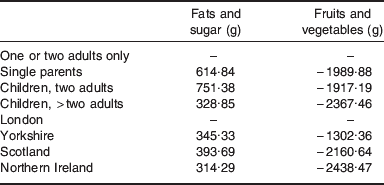
Tiffin and Arnoult( Reference Tiffin and Arnoult 10 ) estimate a demand model to disentangle the impacts of socio-demographic and economic variables on key components of a healthy diet. The sample of results presented in Table 1 show the additional grams per capita that are consumed relative to a baseline that is a one or two adult only family in the case of household composition and London in the case of region. Results in Table 1 support the view that there are substantial differences in diet between different demographic groups. In particular, we see that the presence of children in a household brings about a substantial reduction in consumption of fruit and vegetables. We also see a clear regional effect that can be characterised by broadly showing that diets get worse as we move north and west in the UK.
Impacts of socio-demographics on 2-week per-capita consumption (adapted from Tiffin and Arnoult( Reference Rose 12 ))
Population strategies for prevention
In his hugely influential work, Rose( Reference Rose 11 – Reference Rose, Khaw and Marmot 13 ) argues that strategies that are targeted at high risk individuals within a population are inadequate in preventing disease that is attributable to a widespread cause. Chronic disease as a consequence of consuming a bad diet clearly falls into this category and it is therefore worth considering the implications of Rose's work for diet and health policy. The medical arguments offered by Rose in favour of the population approach to prevention are as follows: firstly that there is considerable variation of disease rates between populations suggests that there is a great deal of scope for success in pursuing the strategy; secondly that many of the behaviours that influence population health (Rose highlights the case of eating) are likely to be socially conditioned and therefore attempts at influencing high-risk individuals apart from the population are likely to fail; thirdly, a small shift in the distributions can have a substantial effect on the number of individuals falling into the vulnerable tail of the distribution; and finally that because of the numbers of individuals involved a large number of cases of disease occur among those close to the middle of the distribution. From a sociological perspective, Rose argues for the population strategy since the risk distribution for a collection of individuals is likely to shift as a whole because of the coherent nature of society. Finally, the moral argument for the population approach is that the deviant tail of ‘troublemakers’ belongs to the parent distribution of which moderate consumers are also a part. Therefore, while it might be convenient for the moderate consumer to exonerate themselves of responsibility for bad diets, this is based on a false assumption since the problem diets do not arise independent of the consumption patterns elsewhere in society.
Rose also argues that while the population strategy in part works on the proximal causes of disease (e.g. the infectious agents and dietary deficiencies), it must also confront the ‘more potent’ underlying influences that he refers to as the ‘causes of causes’. It is comparatively easy to identify the medical reasons why particular diets lead to chronic disease. Identifying the reasons why individuals choose to eat this type of diet is much more complex and, as Rose notes, is the subject of social, economic and political research.
Frohlich and Potvin( Reference Frohlich and Potvin 14 ) argue that a potential shortcoming of the Rose approach of population-based prevention arises when the impacts of the measures on health inequality are taken into account. Thus, when a population-based measure has differential impacts across different parts of the distribution of risk exposure, a population-based measure can act to increase health inequalities. They argue in favour of an approach that identifies vulnerable populations with socially defined groups that have different underlying mechanisms to their distributions of risk exposure. They contrast vulnerable populations with populations at risk( Reference Lalonde 15 ), arguing that the former are defined using shared social characteristics while the latter are ‘characterised by a homogeneously high level of exposure to a single risk factor’. The Frohlich and Potvin( Reference Frohlich and Potvin 14 ) approach clearly appeals to the Rose notion of ‘causes of causes’ and invites the question as to what is the appropriate population for intervention. If within a group of individuals there are discrete sub-populations which have fundamentally different behaviours, it may be that the characteristics of effective intervention differ between these groups.
Walls et al. ( Reference Walls, Peeters, Proietto and McNeil 16 ) present a critique of the predominant approach to public health campaigns targeting obesity which is to adopt community based and/or social marketing campaigns. Two particular reasons for questioning such an approach are offered. The first is that they often rely on an individual adopting a pattern of behaviour which is different from that of their peer group and the second is that by emphasising the desirability of a normal body weight, the public health benefit of this is overstated and the associated negative connotations of ‘abnormal’ body weight have an adverse psychological impact on individuals in this category. Walls et al. ( Reference Walls, Peeters, Proietto and McNeil 16 ) advocate a ‘regulatory’ approach as the alternative, citing the examples of tobacco control, seat belt legislation and nineteenth century ‘sanitary reform’ as successful policies of this sort. Friel et al. ( Reference Friel, Chopra and Satcher 17 ) highlight the fact that the obesity epidemic is unequally distributed between and within countries and link this to a number of features of society including labour market conditions and the quality of the built environment which are themselves unequally distributed in society. As a result, Friel et al. ( Reference Friel, Chopra and Satcher 17 ) argue that addressing the fundamental inequalities in society ‘aiming to ensure an equitable distribution of ample and nutritious global and national food supplies; built environments that lend themselves to easy access and uptake of healthier options by all; and living and working conditions that produce more equal material and psychosocial resources between and within social groups is the route to addressing the obesity epidemic’. Seen through the lens of Rose, the Friel et al. ( Reference Friel, Chopra and Satcher 17 ) analysis makes a case for the existence of social inequality to be seen as a ‘cause of causes’ of the obesity epidemic. This raises the question as to whether it is inequality per se or the existence of social deprivation which is of concern. If so, then directly addressing the problem of poor dietary choice might be deemed less important than adopting measures that tackle social deprivation.
Economics
The economic argument for a policy intervention is based on the existence of a market failure. At one level the existence of a market failure in questions related to health is beyond doubt. Health is not a traded good and there is no market. While health is not traded, some goods that contribute to health are traded. Some goods are tangible, tobacco, alcohol and food for example, others are less so, for example some of the things which contribute to a ‘lifestyle choice’ such as leisure activities and even career choices. There is a substantial literature to suggest that choices made by individuals in this regard may be sub-optimal both for the individual and for society as a whole. In economics, the explanation for market failures of this sort is that the individual decision maker fails to fully appreciate the costs of their actions. In general, economists view decision makers as being largely motivated by self-interest and they therefore fail to take into account costs that are borne by others as a result of their actions. Thus, when an individual decides that they are going to consume energy dense food, they do not (fully) take into account the costs that will be borne by others in caring for them should they develop chronic illness as a result of these actions. There is also an array of explanations for why an individual may not fully recognise the costs of their decisions for their own welfare and therefore their decisions will also be sub-optimal at an individual level. These explanations include high rates of time preference as well as time inconsistent preferences, like hyperbolic discounting for example (see Tiffin et al. ( Reference Tiffin, Traill and Mortimer 18 )).
More specifically, time preference is the rate at which an individual is willing to trade current benefit (consumption or utility) for future benefit. A person with a higher rate of time preference is impatient, lacks self-control and desires instant gratification. Such an individual discounts the future more heavily than a person with a lower rate of time preference and prefers consumption now rather than later. An individual's current decision regarding food consumption is influenced by time preferences since feelings of instant gratification from consumption are balanced against desires to act patiently and limit consumption in order to gain future health benefits. Since healthy eating and weight control usually requires a trade-off between current consumption for future health, time preferences influence decisions regarding food consumption and physical activity. Individuals with a high rate of time preference are more likely to have higher energy intake levels and lower investment levels in exercise and physical activity and so are more apt to be overweight or obese.
Hyperbolic discounting is a specific form of time preference that occurs when individuals tend to discount the short-run at a higher rate than the long-run. Individuals characterised by hyperbolic discounting are more impatient regarding immediate future decisions compared to more distant future decisions. For example, a hyperbolic discounter may prefer two candy bars 101 d from now than one candy bar 100 d from now, but prefer however one candy bar today than two candy bars tomorrow. Such choices reflect time inconsistency, which often arise in choices surrounding diet and health. Hyperbolic discounters will tend to overeat and be less healthy. Recent studies suggest that hyperbolic discounting is an important factor associated with increasing weight and obesity( Reference Scharff 19 , Reference Ikeda, Kang and Ohtake 20 ).
The importance of time preferences, and time inconsistent preferences especially, in determining health outcomes is underscored when health marketing campaigns are considered. Many health education campaigns are intended to promote healthier lifestyles through better individual choices. For example, the ‘Five-A-Day’ campaign is aimed at influencing increased levels of fruit and vegetable consumption. Such campaigns are of little use if individuals are aware of the future consequences of their decisions and are characterised by high rates of time preferences or hyperbolic discounting; they have made the decision to sacrifice future health for present benefit.
Market failure that is the result of the failure of an individual to fully appreciate the full costs of their actions is one of the justifications for intervening in a market through taxation. In such cases, the tax should be set at a level to internalise the unaccounted for external cost (Costs that are not taken into account by a decision maker as they determine an action are referred to as external costs.). The other justification is redistribution. In welfare economics, all individuals are not equal. In particular, poor individuals are assumed to have a higher marginal value of wealth than those who are rich. Thus, in crude terms, transferring wealth from the rich to the poor is justified because it leads to a net increase in society's well being. This differential approach to society's valuation of individual well being can also be applied to diet and health. In this context, society would be expected to place a higher weight on the health of a particularly unhealthy individual in comparison with someone who is only moderately unhealthy when computing the overall disutility that arises from disease incidence. By extension, the same can be said to apply to the agents that cause disease, diet for example: society places a higher weight on the diets of those who are eating particularly unhealthily. This presents an important contrast with Rose's view where improvements in the health of moderately unhealthy individuals are just as worthy as the same improvement of a very unhealthy person. An evaluation based on welfare economics would value the improvement in the health of the unhealthy individual more highly than that of the healthy person.
Fat taxes and thin subsidies
The use of fat taxes (on unhealthy food) and thin subsidies (on healthy food) are increasingly advocated as instruments in policies aimed at improving the healthiness of diets. Here, we discuss the likely effectiveness of such a policy in delivering positive outcomes in the context of the preceding discussion regarding the desirability of tackling the health inequalities. We investigate a policy that increases the price of fatty foods by 1% for every percent of saturated fats they contain; for instance, milk that contains 1·72% of saturated fats will see its price increasing by 1·72% (The saturated fat contents were obtained from data supplied in the Family Food module of the Expenditure and Food Survey.). We put a ceiling on the price increase of 15%. To offset this tax burden and to encourage consumption of fruit and vegetables, a subsidy on fruit and vegetables is introduced, so as to exactly cancel the costs of the fat tax paid by consumers. Table 2 presents the tax rates applied to the different food groups in our models, based on nutrient conversion tables available from the Expenditure and Food Survey dataset.
Fiscal food policy price changes

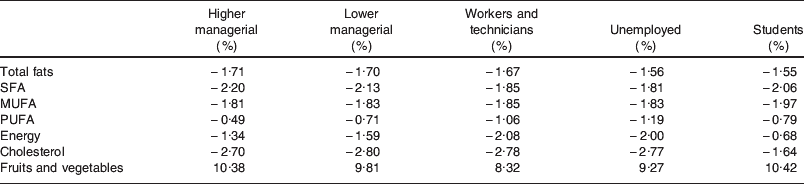
We have analysed the impacts of a fiscal food policy on nutrient intakes (for details, see Tiffin and Arnoult( Reference Tiffin and Arnoult 21 )). Results are presented in Table 3, where it is seen that firstly the policy induces only a small change in intakes and secondly that there is little difference in the changes across different social groups. The policy will therefore have limited impact on the inequalities that exist between different socio-economic groups in terms of their nutrient intakes.
Impacts of a fiscal food policy on selected nutrients across socio-economic groups
Turning to the redistributive role of taxes discussed earlier, food expenditure represents a declining proportion of total expenditure as household incomes increase. Any tax on food therefore has a regressive redistributive impact, that is, it results in wealth being transferred from the poor to the rich. As a result, if social deprivation is fundamental to inequalities in health, a fat tax may actually exacerbate the problem. Here, we investigate whether applying differential taxation to induce a shift towards a healthier diet worsens this redistributive impact. The distributional characteristic of a good (d i ) measures the degree a good is concentrated in households that are deemed to be socially deserving:

where β
h
is the marginal change in household h's well being that is the result of transferring £1 to them and  is the arithmetic average of the weights over all households. Likewise, q
h
i
is the consumption of good i by household h and Q
i
is aggregate consumption across all households. The measure is unit free, given the normalisation of the individual household social weight (β
h
) by the overall average social weight (). The higher the value of d
i
the greater the concentration of that particular good in socially deserving households.
is the arithmetic average of the weights over all households. Likewise, q
h
i
is the consumption of good i by household h and Q
i
is aggregate consumption across all households. The measure is unit free, given the normalisation of the individual household social weight (β
h
) by the overall average social weight (). The higher the value of d
i
the greater the concentration of that particular good in socially deserving households.
Figure 1 plots the distributional characteristic for goods subject to a tax against the respective tax rates. It can be seen that the association is not strong and we therefore conclude that there is no evidence to suggest that a tax applied at this level of aggregation will fall disproportionately on the socially deserving. A tax that is based on the saturated fat content of the food does not appear to have any worse impact on the distribution of wealth in society than a uniform tax applied to all food. It is worth noting that the distributional characteristic of the fruit and vegetable categories are towards the lower end of the range of distributional characteristics (fresh fruit and vegetables 0·71, frozen fruit and vegetables 0·74 and tinned and process fruit and vegetables 0·75) and therefore combining a fat tax with a subsidy on fruit and vegetable consumption worsens the redistributive impact of the policy.
Distributional characteristics of goods subject to a fat tax plotted against respective tax rates.

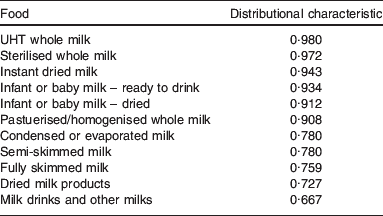
This conclusion changes somewhat when we consider the application of a tax at a more disaggregated level, an approach that is likely to find favour as it will be more effective in promoting a positive change in diet. Table 4 reports the distributional characteristics for a range of dairy products. It is apparent that the commodities that will be subject to the highest tax rates (e.g. whole milk) are concentrated in the socially deserving households, while those that will be lightly taxed tend to be consumed by the socially undeserving. As a result a tax imposed at this level will be more regressive than one that is applied uniformly to all food.
Dairy disaggregated distributional characteristics
We now consider the impact of the policy on health (see Tiffin and Arnoult( Reference Tiffin and Arnoult 21 )). In so doing, we draw on the welfare economics-based argument presented above to weight the health of individuals who consume very unhealthy diets more highly than that of individuals who eat healthily. We do this by drawing on the epidemiological literature to use a logistic function to relate the nutrient intake of an individual to their risk of being affected by disease. We use this to compute an estimate of population risk which measures the average odds of the population being affected by a condition relative to the case where the whole population conforms to dietary guidelines for the food or nutrient in question (Recommended nutrient intakes are sourced from Department of Health guidelines(22).). We compare the population risk before and after the policy to measure its effectiveness.
Results are presented in Table 5 where it is seen that the impacts of the tax on relative risk are small. The reason for this is that the marginal change in diet that results from price changes is insufficient to move those who have extremely bad diets to the extent that would be required to remove the substantial risk that eating such a diet brings to one's health.
Impacts on health measured using estimates of the population risk of disease
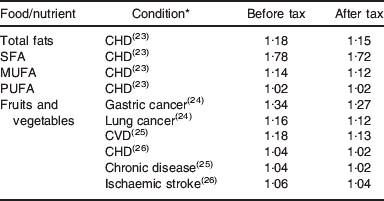
* The source of the relative risk estimates used to compute the population risk estimates for each health condition are indicated by the reference citation.
Discussion and conclusion
The existing literature demonstrates that poor nutrition and diet-related chronic diseases such as obesity follow a socio-economic gradient, with worse diets and a greater prevalence of obesity among the poor and less educated. This inequality is of particular concern in the light of increased recognition that tackling health inequality is a key challenge for public health policy in the twenty-first century. We have argued that the importance of this challenge is well justified when applying the principles of welfare economics in which changes in the health of the most unhealthy are given a higher weight than those of the more healthy.
By contrast, epidemiology in the shape of Rose's population-based measures to improve health appears not to distinguish between individuals in determining how to intervene. The imposition of a fat tax (and thin subsidy) would appear to be a perfect example of the application of this approach. Diet is identified as a cause of chronic disease and steps are taken to move the whole of the distribution of food intakes in a favourable direction. Seen in the light of heightened concern for the distribution of health in the population the tax is seen to be less effective. The change in diet that results is marginal and the worst diets (as well as the best) remain almost unchanged. This is at odds with the welfare economics-based desire to focus attention on achieving the largest impact on those with the poorest diets. Furthermore, a tax on food will also have a proportionately larger impact on the poorer segments of society which will worsen as the tax becomes increasingly targeted on the specific elements of the diet which are unhealthy. The subsidy on fruits and vegetables worsens further the redistributive impact rather than helping it. Thus, a fiscally based intervention to address poor diets will contribute to a worsening of economic inequality and does little to address health inequality and may even worsen it if there is a link between the two.
The discussion of fiscally based instruments highlights an apparent tension that exists between a population-based approach that is designed to achieve an overall improvement in health and the desire to reduce health inequality. This perhaps reflects an interpretation of Rose's arguments for population-based approaches which is too narrow, however. It fails to recognise that poor diets are a component of a more complex array of factors that contribute to chronic disease and that inequalities in health are closely entwined within the problems of socio-economic inequality. For example, Rose argues that ‘in a similar way that the 19c reforms dramatically improved public health one may suppose that measures to improve national nutrition and to lessen socioeconomic inequalities would bring corresponding benefits to the nations health’ and that ‘understanding the underlying causes … (in) the association between socio-economic deprivation and an unhealthy lifestyle is complex’.
Dietary inequality should be seen as a component of the problem of overall health inequality and the latter should be the primary focus of public health policy. We advocate an approach that is akin to Frohlich and Potvin( Reference Frohlich and Potvin 14 ) in identifying sub-populations which are the target for public health interventions. These should be defined not in terms of their socio-demographic characteristics, however, but in terms of a shared propensity to adopt unhealthy patterns of behaviour: poor diets are a component of social deprivation rather than a symptom of it. Such an approach is likely to be more successful in tackling the inequalities that lie at the heart of public concern over dietary health and focus attention on the reasons why choices are bad as opposed to merely effecting a marginal improvement across all diets.
Acknowledgements
The authors declare that we have no conflicts of interest. This research was supported by the Economic and Social Research Council under the Rural Economy and Land Use Program and by the Medical Research Council under the National Prevention Research Initiative. Both authors contributed equally to the concept, estimation, analysis and writing of the paper. Both have seen and approved the final version.



