

Abbreviations
-
acc. = accusative
-
C = any consonant
-
dat. = dative
-
d. = dual
-
f. = feminine
-
gen. = genitive
-
H = hand (identifying a scribe)
-
instr. = instrumental
-
KN = Knossos
-
loc. = locative
-
m. = masculine
-
n. = neuter
-
nom. = nominative
-
pl. = plural
-
PY = Pylos
-
R = /r/ or /l/
-
s. = singular
-
TI = Tiryns
-
V = any vowel
1. Introduction
The Linear B writing system, used to write administrative documents on clay tablets in Late Bronze Age Greece (c. 1400–1200 BCE), shows a high degree of consistency across the various palatial and administrative sites at which it is attested. The similarity in the repertoire of signs, orthographic rules, language and document formatting practices at sites across Crete and the central and southern Greek mainland, and over a period of c. 200 years, demonstrates clearly that the writers of these texts were trained in a shared set of conventions of writing and record-keeping.Footnote 1 However, the variation which does exist within the Linear B texts – not only between different sites, but within documents from the same site, and even within the work of individual writers – provides key evidence for the ways in which the writing system developed and was employed within the Mycenaean administrative systems, as well as for the development of the Mycenaean Greek language.Footnote 2 This paper focuses on one particular aspect of writing practices, namely orthographic conventions. The Linear B texts display a remarkable orthographic consistency in many respects, despite the complexity of the conventions in use for the representation of Mycenaean Greek with this writing system; nonetheless, in certain contexts orthographic variation is both permitted and frequent. Analysing the ways in which this variation appears in the work of individual Mycenaean scribes can shed light on both the method(s) of training by which they learned to write and the decisions they made in the course of creating their documents.Footnote 3
The site of Pylos, located in south-western mainland Greece, was chosen for this study because the vast majority of its c. 1,000 tablets are securely associated with the site's final destruction early in the twelfth century BCE;Footnote 4 because Linear B tablets were not long-term documents, but were generally kept for no more than a year as part of the palace's yearly administrative cycle, these texts all belong to a period shortly before the palace's destruction.Footnote 5 They represent the work of at least thirty writers, who have been identified chiefly through palaeographic analysis of their handwriting, although features such as subject matter, document formatting, orthography and language also play a role.Footnote 6 The Pylos tablets therefore offer the chance to study the writing practices of a single, contemporaneous community of writers, who are likely to have frequently interacted in the course of their work.
2. Scribal training
No Linear B documents describe the work or training of their writers, and no certain ‘school’ or practice texts are attested.Footnote 7 We therefore have only indirect evidence for how Mycenaean scribes learned to write and to keep administrative records, from the features we can observe on their documents. The division of the Pylian scribes into three palaeographic ‘classes’, based on the similarities of their handwriting to three ‘major’ scribes (H1, H21 and H41), has long been viewed as evidence for three traditions of scribal training at this site, originating from three different teachers;Footnote 8 recently, however, the validity of this division has been challenged,Footnote 9 and two new studies of the Pylos tablets eliminate the ‘class’ as a palaeographic classification.Footnote 10 Similarly, it has been argued by Yves Duhoux, on the basis of an analysis of spelling variation at Pylos, that two different orthographic traditions can be identified at this site: focusing on five ‘major’ scribes, Duhoux argued that their levels of shared orthographic choices in cases where variation was possible divided them into two ‘orthographic communities’ (H1, H2, and H21 vs. H41 and H43).Footnote 11 In this article, I revisit the issue of Mycenaean orthographic training by analysing the orthographic variation (or consistency) found between writers and within individuals’ work, while taking into account their widely varying levels of attestation of written sequences in which such variation is possible, in order to determine the level of significance which can be attached to a given scribe's use or lack of use of (a) particular orthographic option(s).Footnote 12 I demonstrate that, despite the consistency shown by writers of Linear B in following the majority of its orthographic conventions, variation is entirely usual in certain circumstances, and that this points to a single orthographic tradition in which writers are taught multiple orthographic options for use in those circumstances.Footnote 13 I also investigate the extent to which non-phonemic factors may have influenced the use of different spellings, and demonstrate that, although some possible individual or group preferences can be seen in the spelling of particular lexemes and morphological features, on the whole the patterns of orthographic variation suggest a system in which writers were taught the spelling(s) of phonemic sequences rather than of lexemes.
3. Scribal attributions at Pylos
At time of writing, two new studies of the Pylos tablets have recently proposed changes – in different ways – to the scribal attributions previously in use (those of SP), presented respectively in PTT 2 and in LSP;Footnote 14 a third new edition, PT 3, largely follows PTT 2 but with some modifications, mostly in line with LSP. All of these largely retain the same attributions to SP's main scribes (H1–H4, H6, H11–H15, H21–H26, H31–H34, H41–H45), although LSP renumbers these by adding 600 (so that H601 = H1) and merges the original H615 with H614, H633 with H623, and H619 with H634;Footnote 15 there are also differences of opinion over the attribution of small numbers of tablets to many of these scribes, as well as over the existence of newly identified scribes. In this article, I use the SP/PTT 2/PT 3 numbering, since this is more consistent, and thus more easily comparable, with other previous publications. Unless otherwise mentioned, all of these editions, along with LSP, agree on the scribal attribution of all tablets discussed in this article;Footnote 16 in order to proceed on as firm a basis as possible, tablets and scribes over whose attribution or existence there is significant disagreement are excluded from the analysis, and therefore do not appear in the figures or lists of examples.Footnote 17 (Disputed attributions which would be of particular significance to my argument, such as LSP's proposed merger of certain scribes, will be discussed when relevant). Similarly, unless otherwise noted, readings of texts follow those presented in PTT 2 throughout.Footnote 18
4. The Linear B syllabary and orthographic conventions
The phonographic component of the Linear B writing system consists of eighty-seven syllabic signs (Table 1), each representing an open syllable (a vowel, or one or more consonants followed by a vowel: e.g. a, me, dwo); there are also c. 150 ideograms – signs which represent items or commodities being recorded, e.g. mul ‘woman’, ole ‘oil’ – which, since the focus of this article is orthography, will not be further discussed here.
The Linear B syllabary. Phonemic values of extra signs whose transcriptions are not transparent are given in brackets (R = /r/ or /l/). The Linear B font is ‘Alphabetum’, created by Juan-José Marcos (http://guindo.pntic.mec.es/~jmag0042/alphaeng.html).

Many Mycenaean Greek phonemes are not differentiated in the ‘core’ syllabary, which contains signs representing pure vowels and consonant–vowel syllables (the ‘extra’ signs will be discussed below). The series of signs transcribed r- in fact represent both /r/ and /l/; there is no series for /h/; and with the exception of the d-series (/d/), voiceless, aspirated and voiced stops are not distinguished graphically (so that k-series signs have the values /k/, /kh/ and /g/; p- = /p/, /ph/, /b/;Footnote 19 q- = /kw/, /kwh/, /gw/; t- = /t/, /th/). The j- and w-series represent both the phonemes /y/ and /w/,Footnote 20 and the non-phonemic glides [y] and [w] arising between /i/ or /u/ and a following vowel. In addition, Mycenaean Greek has many consonant clusters and word-final consonants which cannot be straightforwardly written with a syllabary whose signs represent only open syllables; as seen in the word ti-ri-po /tripos/ ‘tripod’, such consonants must either be omitted (‘partial spelling’, as in -po for /-pos/, which is standard for word-final single consonants) or written with a CV sign containing a ‘dummy’ vowel (‘plene spelling’, as in ti-ri- for /tri-/). A complex set of conventions governs the use of plene or partial spelling, which depends on the nature of the consonant cluster being represented. Clusters whose first element is a stop are represented in full, as in ti-ri- for /tr-/, while clusters of a non-stop followed by a stop are represented partially (e.g. wo-do-we /wordowen/ ‘rose-scented’, n. nom.-acc. s.), as are geminates (e.g. o-pe-ro-sa /ophellonsa/ ‘owing’, f. nom. s.). The spelling of clusters of two non-stops varies in a way which cannot easily be summarised or accounted for by their phonetic properties: for instance, the clusters /sm/ and /sw/ are represented in full (e.g. do-so-mo /dosmos/ ‘religious contribution’; a-si-wi-ja /Aswia/, toponym), but /s/ plus a stop is not (e.g. ta-to-mo /stathmos/ ‘pen (for animals)’). What is important here is not the precise details of all these spelling conventions, nor the possible underlying reason(s) for this complex system,Footnote 21 but the consistency with which they are applied. There is no significant orthographic difference in this respect between documents from different Mycenaean sites or between individual writers, and relatively few exceptional spellings can be identified,Footnote 22 showing clearly that writers at all of these sites were trained in a shared set of highly consistent orthographic conventions.Footnote 23 Variation involving these core signs is widely found in only two circumstances: in the spelling of the cluster /wy/ as either wi-jV (with the dummy vowel i arising from the following semivowel /y/) or u-jV (with u representing /w/), and in the representation of clusters whose second element is /w/, in which case the variation is not between partial and plene spelling but between two different forms of the latter. The man's name /Widwohios/, for instance, is spelt both wi-do-wo-i-jo (with the dummy vowel taken from the following /o/, as is usual in plene spelling) or wi-du-wo-i-jo (with u as the dummy vowel based on the following /w/).
Additionally, however, the same name may be spelt with one of the ‘extra’ signs, dwo, used to represent this consonant cluster in place of the core plene spelling: wi-dwo-i-jo. The existence of these fourteen ‘extra’ signs (Table 1) and their alternation with signs from the core syllabary account for most of the systematic orthographic variation present in the Linear B texts. As well as ‘complex’ signs replacing a plene spelling with two core signs, as in the case of dwo ~ do-wo/du-wo or pte ~ pe-te, other extra signs (the ‘doublets’) supply specific phonemic values which are not differentiated by the core syllabary: e.g. a2 represents /ha/, otherwise written only with the core sign a; pu2 represents /phu/, aspiration being otherwise unmarked.Footnote 24 In principle, each of these extra signs may therefore alternate with one or more equivalent core spellings. Such variation is well known,Footnote 25 and indeed has often been key to identifying the values of these extra signs in the first place;Footnote 26 in this article, however, I investigate in greater depth the extent to which this orthographic variation exists within the Pylian community of writers and in the work of individual scribes, the details of how and where this variation occurs, and the implications of scribes’ orthographic practices for our understanding of how they learned to write in Linear B. I discuss in turn instances in which the spelling of particular sequences is highly consistent despite the possibility of variation, indicating the existence of, at least, strong collective preferences, if not actual orthographic conventions, relating to the representation of these sequences (section 5); cases in which there is some degree of variation but collective or individual preferences still appear to exist (section 6); and cases in which variation between two or three different orthographic options is entirely usual, both collectively and individually (section 7). I then analyse the levels of consistency or variation seen in scribes’ spelling of particular lexical items and morphological elements (section 8), before concluding with a discussion of the way in which Linear B spelling may have been taught at Pylos (section 9).Footnote 27
5. Orthographic consistency: au, a3, pte
In some cases, clear overall preferences for one particular spelling are visible even where the writing system in principle allows for variation. The diphthong /au/, for instance, which is always written out in full as (C)a-u when following a consonant (e.g. na-u-do-mo /naudomoi/ ‘ship-builders’),Footnote 28 could in principle be written either a-u- or with the extra sign au in word-initial position. In practice, however, the latter is the only one found (as in, for example, the man's name au-ke-wa /Augēwās/).Footnote 29 This is the case not only at Pylos (where twenty-six to twenty-eight examples of au are known, written by least six different scribes: H2, H12, H21, H22, H32, H41), but across the entire Linear B corpus.Footnote 30 The use of au to represent initial /au-/ thus appears to be as consistent an orthographic convention as those described above for the use of plene or partial spelling.
Diphthongs in -i are, unlike those in -u, not usually represented in full: /oi/, for instance, is usually written only as o, and the sequence o-i normally represents /o(i)hi/ (e.g. in the o-stem dative plural ending). There are some exceptions to this at Knossos and Mycenae in word-medial position: e.g. ko-to-i-na ~ ko-to-na /ktoina/ ‘plot of land’.Footnote 31 This spelling is not, however, apparently used at Pylos, where all securely interpretable examples of medial (C)V-i represent /Vhi/: e.g. po-si-da-i-jo-de /Posidāhion-de/ ‘to the sanctuary of Poseidon’; te-i-ja /thehiai/ ‘divine’ (f. dat. s.); wi-dwo-i-jo /Widwohios/ (man's name).Footnote 32 The use of the extra sign a3 to represent /ai/ when this is not preceded by a consonant (i.e., usually in word-initial position) similarly appears nearly completely consistent at this site, where a3 is used at least fifty-one times by eleven different scribes (H1, H2, H11, H14, H21, H32, H34, H41, H42, H43, H45). The only certain examples of initial /ai-/ spelt in a different way are in the term a-ja-me-no/-na /aiaimenos, -a/ ‘inlaid’,Footnote 33 where the use of j- to indicate the glide between the /i/ and the following vowel seems to have made it redundant to use a3 to mark the diphthong,Footnote 34 although of course further examples may exist which are not currently securely identifiable. The only direct alternation between a3 and a is found in the terms referring to the two ‘provinces’ of the Pylian territory, known as the ‘Hither Province’ and ‘Further Province’: de-we-ro-a3-ko-ra-i-ja /Dewero-aigalahia/ ‘the area this side of Mt Aigaleon’ ~ pe-ra-a-ko-ra-i-jo /Perā-aigalahion/ ‘the area on the far side of Mt Aigaleon’.Footnote 35 The latter is also spelt pe-ra3-ko-ra-i-ja and pe-ra-ko-ra-i-ja /Perāigalahia/;Footnote 36 the one clear exception to the otherwise apparently consistent use of a3 therefore shows a writer putting more emphasis on the boundary between the two elements of the compound/collocation than on the representation of the diphthong.Footnote 37
The complex sign pte is attested thirty-three to thirty-four times at Pylos in the work of at least eight different scribes (H1, H3, H6, H13, H15,Footnote 38 H31, H32, H43), several of whom have multiple examples: H43 has written the term ra-pte(-re) /raptēr(es)/ ‘leather-worker(s)’ twelve times, and H3 has at least five instances of the same term,Footnote 39 while H32 has eight examples of di-pte-ra /diphthera(i)/ ‘hide(s)’.Footnote 40 By contrast, the only term at Pylos in which the sequence pe-te might represent /pte/ is the man's name a-pe-te-u (H2),Footnote 41 for which suggested interpretations include /Apteus/, /Arpeteus/ and /Ampeteus/.Footnote 42 If the first of these interpretations is correct, then it might be noteworthy that this is written by a scribe who is not attested as using pte; however, since this is a personal name, its interpretation is evidently not secure, and the other suggestions in which pe-te represents /pete/ are equally likely. Either way, unless chances of attestation are responsible for the loss of many more examples of pe-te = /pte/, there seems to be at least a strong preference for the use of the extra sign over its core equivalent, and potentially even a site-specific orthographic convention to this effect, in contrast to the variation at Knossos between pte-re-wa and pe-te-re-wa /ptelewās/ ‘made of elm’.Footnote 43
6. Orthographic preferences, with some variation: pu2, a2, /wy/
In other cases, the preference for one orthographic option, although still present, is less strong: for instance, in the use of the extra sign pu2 to represent /phu/ (e.g. pu2-te-re /phutēres/ ‘planters’),Footnote 44 as opposed to the core sign pu (= /pu/, /phu/, and perhaps /bu/?: n. 19). Nine or ten scribes have used pu2 (H1, H2, H3, H4, H6?, H15,Footnote 45 H23, H24, H25, H43); of these, the only scribes with more than one example of this sign, H1 and H2, have used it at least eight and seven times, respectively. There are, however, at least three certain or very probable examples of /phu/ being written with pu: the ethnic adjective a-pu-ka (H21), in which the value of pu is guaranteed by its alternation with the spelling a-pu2-ka(-ne) (H1),Footnote 46 and the man's name pu-ti-ja (H15, H22), which similarly alternates with pu2-ti-ja (H1, H2).Footnote 47 H22 may have a second instance of pu = /phu/, if the equation of the two men's names pu[ ]-a2-ko (H22) ~ pu2-ṣị-ja-ko (H2) is accepted,Footnote 48 while H2 has two suggested examples in the men's names pa-pu-so (/Pamphusos/?) and pu-te-u (/Phuteus/ or /Putheus/?), although such etymological interpretations of names are of course not secure. It is likely that there are further examples of pu = /phu/ in obscure terms which cannot currently be identified, and that the apparent strength of some writers’ preference for pu2 may at least partially be the result of skewed data; but even if this apparent preference is a true reflection of Pylian orthographic practices, variation is still permitted and, at least for some scribes, normal. In fact, H15 – the only scribe who has certainly used both spellings – has done so in adjacent words in the entry pu-ti-ja, a-pu2-we ‘pu-ti-ja (name), at a-pu2-we (toponym)’.Footnote 49
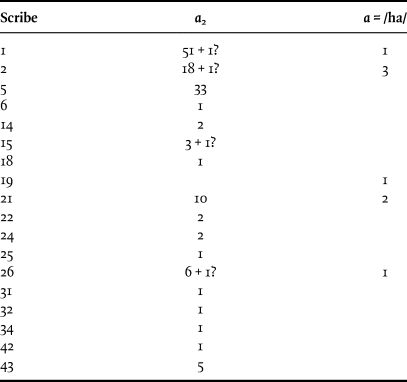
a2, representing /ha/, shows a similar pattern of use to pu2. This sign is attested 154 to 157 times at Pylos, written by at least sixteen to seventeen scribes: H1, H2, H5 (LSP: H652; SP: S733-Cii), H6, H14, H15 (merged with H14 by LSP/PT 3), H18 (LSP: H657; SP: S1217-Cii), H21, H22, H24, H25, H26, H31, H32, H34, H42 and H43. Again, although there are many possible examples of /ha/ being written with its alternative spelling, the core sign a, relatively few of them are securely identifiable, due to uncertainties over their etymological interpretation or a lack of context to confirm possible spelling alternations. For the purposes of this analysis, I have restricted the list of examples of a = /ha/ to the few whose etymology or spelling alternations make them secure or highly probable:
• tu-we-a /thuweha/ ‘perfumes’ (H1)Footnote 50
• we-a-re-ja /wehaleya/ ~ we-a2-re-jo /wehaleyos/ ‘decorated with crystal’ (f./m. nom. s., both H2)Footnote 51
• ka-ra-a-pi /k(a)rahapphi/ ‘with heads’ and se-re-mo-ka-ra-a-pi /seirēmo-k(a)rahapphi/ ‘with the heads of sirens(?)’ (both H2)Footnote 52
• we-a-re-pe /wehaleiphes/ (H19) ~ we-ja-re-pe /weyaleiphes/ (H2, H18), adjective describing perfumed oilFootnote 53
• a-ne-u-te ~ a2-ne-u-te (toponym: both H21)Footnote 54
• we-]j̣ẹ-ke-a ~ we-je-ke-a2 (n. nom.-acc. pl. s-stem adjective describing wheels: both H26)Footnote 55
Even with this highly restricted list, Table 2 shows that almost all of these are written by scribes who have also used a2; the exception, H19, is not likely to be significant since only three tablets are attributed to this scribe (and if the merger of this hand with H634 is accepted, then this hand has in fact used both spellings). Moreover, of the seven scribes with more than one or two examples of a2, four also have identifiable examples of a = /ha/; three of these have spelt the same word with both a2 and a (H2 we-a-re-ja ~ we-a2-re-jo, H21 a-ne-u-te ~ a2-ne-u-te, H26 we-]j̣ẹ-ke-a ~ we-je-ke-a2), while H1 has written the s-stem neuter nominative–accusative plural ending /-ha/ with both a (tu-we-a) and a2 (a-ke-a2 /angeha/ ‘jars’).Footnote 56 The most significant counter-example is H5, who has thirty-three attestations of a2 and no identifiable examples of a = /ha/. It is worth noting that all of this scribe's examples of a2 are in the two neuter plural adjectives me-zo-a2 /medzoha/ ‘larger’ and me-u-jo-a2 /meiwyoha/ ‘smaller’, used throughout the Sh-series of tablets listing armour, a highly formulaic series of texts which are the only ones attributed to this scribe; such a formulaic context involving the frequent repetition of these two adjectives, presumably within a relatively short period of time, might well particularly encourage consistency in spelling. H15's three to four examples of a2 (or up to six if LSP's merger of this scribe with H14 is accepted)Footnote 57 and H43's five examplesFootnote 58 are more varied across a series of personal and place names and appellatives, but these numbers are not high enough to necessarily represent a significant preference for this spelling. Overall, then, the pattern by which scribes with larger numbers of examples of /ha/ mostly show some variation in the spelling of this sequence implies that this variation is entirely usual, and would be expected to appear in the work of other scribes if examples of a = /ha/ could more easily be securely identified. The frequency of attestation of this sequence in any given scribe's work is, naturally, a combination of the number of tablets attributed to them (H1, H2 and H21 are amongst the scribes with the largest numbers of surviving tablets), the types of documents the scribe worked on (H5 and H26 both frequently use neuter plural s-stem adjectives in their records of armour and wheels), random chances of survival, and equally random chances of whether a word's context or the existence of a spelling alternation allows its phonemic interpretation. It is, therefore, entirely probable that a much higher degree of variation is hidden by the difficulty of identifying secure examples of a representing /ha/.
Representations of /ha/. In this and all following tables a question mark indicates that either the reading of a sign or its scribal attribution is uncertain.

A rather different pattern appears in the spelling of the sequence /wy/ as either wi-j- or u-j-.Footnote 59 This cluster mainly appears in two groups of words: forms of the comparative adjective /meiwy-/ ‘smaller’,Footnote 60 and words formed from the root /Diw-/ ‘Zeus’: di-u-jo ~ di-wi-jo(-de) /Diwyon(-de)/ ‘(to) the sanctuary of Zeus’;Footnote 61 di-wi-je-u/-we /Diwyeus, -ewei/, ‘priest of Zeus’ (nom./dat.);Footnote 62 di-wi-ja-ẉọ /Diwyāwōn/ (man's name);Footnote 63 di-u-ja ~ di-wi-ja /Diwya/ (feminine theonym);Footnote 64 di-u-ja-jo /Diwyaioi/ ‘at the sanctuary of Diwya’.Footnote 65 Although both spellings are attested in each of these groups, and frequently in the same terms, individual scribes appear in this case to be consistent in their spelling:Footnote 66 most notably, H1 has seventeen examples of the wi-j- spelling (in di-wi-je-u/-we, di-wi-ja-wo and di-wi-ja), while H5 has eleven of the u-j- spelling (in me-u-jo-a2: cf. this scribe's consistency in the use of a2, as discussed above); H2 has three of wi-j- (me-wi-jo) and may have also used u-j-, if the interpretation of po-ro-u-jo as /Plowyos/ or /Prōwyos/ (man's name) is correct.Footnote 67 Given this uncertainty, and the fact that there are no attestations of a single scribe writing both /meiwyo-/ and terms derived from /Diw-/, it is unclear whether the consistency seen in at least H1 and H5 represents these writers’ individual preferences for the spelling of /wy/, within the context of overall variation in the representation of this cluster, or preferences for the spelling of particular lexemes or lexical stems (see further section 8).
7. Regular orthographic variation: ra3, /CwV/, /RRV/
As discussed above, scribes at Pylos are generally consistent in their representation of diphthongs in -i; the exception is in the spelling of /Rai/ sequences, spelt with either the extra sign ra3 or the core sign ra (or, when followed by another vowel, the sequence ra-jV, where j- denotes the glide between the i and the following vowel). Again, instances of ra = /Rai/ can be hard to identify, but the following secure or probable examples can be identified based on spelling alternations, etymology and/or morphology:
• a-pi-e-ra /Amphihērai/?, woman's name, probably dat. (H12)Footnote 68
• au-to-*34-ta-ra, woman's name, probably dat. (H2)Footnote 69
• di-pte-ra /diphtherai/ ‘hides’, f. nom. pl. ~ di-pte-ra3 (H32)Footnote 70
• do-e-ra /dohelai/ ‘slaves’, f. nom. pl. (H42)Footnote 71
• e-ru-ta-ra /eruthrai/ ‘red’, f. nom. pl. (H31, H32)Footnote 72
• ke-sa-da-ra /Kessandrai/, woman's name, dat. (case certain in H3, probable in H1, H14 and H21)Footnote 73
• ki-ma-ra /Kimarai/?, a-stem f. nom. pl. ethnic adjective or title (H4)Footnote 74
• o-ka-ra: a-stem m. nom. pl. noun referring to soldiers (~ o-ka-ra3: both H1)Footnote 75
• pe-ra-ko-ra-i-ja /Perāigolahia/, the ‘Hither Province’ (H7)Footnote 76
Table 3 shows that, of the eleven scribes who have certainly or probably used ra for /Rai/, five (H1, H2, H4, H21 and H31) have also used the sign ra3;Footnote 77 many have also used ra-jV for /RaiyV/, but this appears to be a consistent practice like that of using a-jV for /aiyV/, never *a3-jV (section 5). Those who have used only one of these spellings mostly have just one or two examples; the exceptions are H18 (LSP: H657; SP: S1217-Cii), who has five examples of the word /elaiwon/ ‘olive oil’ spelt e-ra3-wo,Footnote 78 and H32, who has written the word ‘hides’ /diphtherai/ as di-pte-ra up to six times, and the word /eruthrai/ ‘red’ as e-ru-ta-ra once (see above). In both cases, this seems to indicate a personal spelling preference, at least in these particular words; contrast the practice of H31, who has not only used both spellings but has done so in two consecutive words in agreement with each other: di-pte-ra3 e-ru-ta-ra /diphtherai eruthrai/ ‘red hides’.Footnote 79
Representations of /Rai/

We have seen above that clusters of a consonant followed by /w/ can be written in up to three different ways: in plene spelling using a dummy vowel taken from the following vowel (CV-wV); in plene spelling using the dummy vowel u (Cu-wV); or using one of the extra signs with a CwV structure (dwe, dwo, nwa, two; twe is not found at Pylos). It is therefore necessary to look in this case not only at variation between spellings with the extra signs or plene spellings, but also between the two different versions of the latter, including for /CwV/ sequences which do not have corresponding extra signs. Table 4 shows the spellings of all identifiable examples of /CwV/ sequences by scribe.Footnote 80 In many cases, the same /CwV/ sequence is attested with all possible spellings: /dwo/ appears as do-wo, du-wo and dwo; /t(h)wo/ as to-wo, tu-wo and two; /kwe/ as ke-we and ku-we; /nwo/ as no-wo and nu-wo; /dwa/ perhaps as both da-wa and du-wa; and /kwo/ perhaps as both ko-wo and ku-wo. Others show a lesser degree of variation: /dwe/ appears only as de-we and dwe, never *du-we; /nwa/ as nu-wa and nwa but never *na-wa; and /swi/ only as si-wi, never *su-wi. If this is not due to chance, then in these cases scribes may have avoided certain spellings; however, for the sequences with three orthographic options, this does not translate into consistency but only into the use of two possible orthographies instead of three. There is also no consistency between these three sequences as to which option is apparently avoided (the CV-wV option is not attested in the case of /nwa/, but in the other two cases it is the Cu-wV option that does not appear). Moreover, disregarding the following vowels, it can be seen that there is similarly no overall consistency or apparent strong preference for a particular spelling of any given /Cw/ cluster: /dw/, /tw/ and /nw/ are all spelt with both of the possible plene spellings as well as the relevant extra signs, while /kw/ (for which no extra sign is available) is spelt with both kV-wV and ku-wV. /sw/ is only spelt with sV-wV, but as this is the least commonly attested of any of these /Cw/ clusters (three to six examples), this can be plausibly attributed to chances of attestation or identification. It is therefore clear that there is no overall orthographic preference in the representation of these sequences.
Representations of /CwV/ sequences, with the number of examples of each spelling given in brackets

Similarly, looking at individual scribes’ usages shows that they frequently use multiple spellings, even for the same /CwV/ sequence:Footnote 81 H1 uses all three options for /dwo/;Footnote 82 H2 uses ku-we and ke-we for /kwe/, both in the same word, pa-ra-ku-we/pa-ra-ke-we;Footnote 83 H32 likewise uses both nu-wa and nwa in the term pe-ru-si-nu-wa/pe-ru-si-nwa-o;Footnote 84 and H41 uses both du-wo and dwo for /dwo/ in different forms of the numeral ‘two’.Footnote 85 Less certain examples include H1's, H2's and H3's possible uses of two different spellings for /nwo/, involving terms whose interpretations and/or readings are uncertain,Footnote 86 and H26's possible use of both dwe and de-we for /dwe/ (both in the same adjective /termid-went-/).Footnote 87
Moreover, even scribes who appear to be consistent in their usage of one spelling for a particular /CwV/ sequence do not show any overall consistency. For instance, H21 has consistently used tu-wo for /t(h)wo/ (five examples in two different terms, o-tu-wo-we and a2-pa-tu-wo-te),Footnote 88 but has otherwise used either CV-wV spellings (de-we, ko-wo; do-wo?, no-wo?, si-wi?) or in one case an extra sign (nwa).Footnote 89 The only scribes who could be said to be at all consistent on the basis of the available data have very few examples: H23, for instance, has used an extra sign when available (nwa) and otherwise only CV-wV spellings (ko-wo, si-wi?), but this is based on only three examples.Footnote 90 H43 has only used extra signs (two four times, all in the man's name o-two-we-o; nwa once),Footnote 91 and – as the only scribe known to have used two – may even have been the creator of this sign (H1 has spelt the same name with to-wo, including on the verso of the same tablet as H43's o-two-we-o).Footnote 92 However, with no other instances of /Cw/ by this scribe, it is difficult to say whether this is evidence for a strong overall preference for the use of extra signs. Given the small numbers involved and the patterns of variation seen in other scribes – not only those with larger numbers of examples, but also others with very few examples who nonetheless show variation, such as H32 – it seems most likely that these are illusions of consistency created by the chances of attestation and interpretation.
The situation is more complicated with the signs ra2 and ro2.Footnote 93 Spelling alternations with the plene spellings ri-ja and ri-jo show that when the Linear B writing system was created these signs represented the /RyV/ sequences /rya/, /lya/ and /ryo/, /lyo/, respectively: e.g. me-re-ti-ra2 ~ me-re-ti-ri-ja */meletryai/ ‘women who grind flour’.Footnote 94 However, a sound change subsequently took place in Mycenaean Greek by which /Ry/ became /RR/, so that me-re-ti-ra2 ~ me-re-ti-ri-ja would actually have been /melet(i)rrai/ when all of the extant tablets were written (with ra2 now representing /RRa(i)/, and ri-ja functioning as a conservative spelling for this sequence).Footnote 95 This sound change is demonstrated by the use of ra2 in the term a-ke-ra2-te, interpreted from context as /agerrantes/ ‘gathering’ < */agersantes/ (cf. Attic ἀγείραντες), showing that at this point the outcome of both */rs/ and */ry/ was /rr/.Footnote 96 Hence, ra2 and ro2 alternate not only with ri-ja and ri-jo, but also, since geminate consonants are not usually distinguished by the script, with the single core signs ra and ro (e.g. the man's name ta-ra2-to ~ ta-ra-to, shown by context to refer to the same landholder),Footnote 97 as well as – for the sequence /RRai/ – with ra3 (e.g. ze-pu2-ra3 /Dzephurrai/ < */Dzephuriai/ ‘women from Zephuria (Halikarnassos?)’.Footnote 98 There are therefore in principle three different ways of spelling /RRo/ and four of /RRa/.Footnote 99
Table 5 shows examples of ra2/ro2 and identifiable instances of ri-ja/ri-jo, ra3 and ra/ro representing /RRa/ and /RRo/: this includes those which directly alternate with ra2 and ro2 as well as those which can be identified etymologically and/or by comparison with other alternations. The latter includes all instances of ri-ja and ri-jo appearing word-finally in nouns and adjectives formed in /-Rios, -Ria/, since the use of ra2 and ro2 in this context (e.g. me-re-ti-ra2, above; po-pu-ro2 /porphurrō/ < /porphuriō/ ‘purple’)Footnote 100 shows that these had undergone a process of yodisation (/RiV/ > /RyV/) and thus also been subject to the change of /Ry/ > /RR/.Footnote 101 Examples of ri-ja, ri-jo, ra and ro whose interpretation is very uncertain are not included; there may well therefore be more instances of each of these spellings of /RRV/ than are able to be identified.
Representations of /RRV/

As can be seen, the vast majority of scribes with more than one identifiable example of /RRV/ have used at least two, if not all three, different types of spellings (the ri-jV plene spelling, the extra rV2 signs and the spellings with ra, ro or ra3 – these last three are grouped together as rV(3) since they all treat the geminate in the same way). The two scribes with the largest number of examples, H1 and H21, have each used every possible spelling for /RRa/ and /RRo/ apart from ra – which, given this level of variation, is probably due to chances of attestation and/or identification.Footnote 102 H2 may, perhaps, prefer not to use the rV(3) spellings, since their single example of this type of spelling is an erased example of ro which has been replaced with ro2,Footnote 103 but they have still used both the ri-jV and rV2 spellings;Footnote 104 equally, the decision in one instance to replace a core spelling with an extra sign does not necessarily mean the former was always considered incorrect by the writer.Footnote 105 The remaining scribes with five or more examples of /RRV/ have all used at least two different types of spelling (H23, both ra2 and ra;Footnote 106 H41 and H43, both rV2 and rV(3), perhaps also ri-jV)Footnote 107 with the sole exception of H24, who has six instances of the rV2 spelling only. Although this could indicate an individual preference for the use of these extra signs, note that this is, of course, the most reliably identified of the three types of spelling, and these six examples are in just two terms: tu-ro2/TU+RO2 /turros/ ‘cheese’,Footnote 108 and the man's name e-ke-ra2-wo.Footnote 109 It is therefore doubtful whether this is strong enough evidence for a preference on the part of this scribe for the use of rV2 spellings in general. The only other scribe who appears from the attested data to be consistent is H12, with a single example each of ri-ja and ri-jo,Footnote 110 and this is certainly not enough evidence to be significant, especially considering that at least three other scribes with similarly small numbers of examples have used multiple spellings (H4, H6, H22; probably also H15).Footnote 111 With the potential exception of occasional individual preferences (such as H2's possible avoidance of using rV(3)-type spellings), individual variation in the spelling of /RRV/ sequences seems to be as acceptable and normal as that in the presentation of /CwV/ sequences.
8. Are there lexical and morphological influences on orthographic practices?
It is clear, as discussed in section 4, that the Mycenaean scribes’ orthographic training included learning the correct way(s) to represent particular phonemic sequences; it has also been argued that they must have similarly been taught the (single) correct spellings of individual words – at least of vocabulary items, with personal and place names being less likely to be included in lists of spellings to be learned and therefore potentially more subject to individual variation.Footnote 112 Scribes could in principle have also been taught that particular morphological features had one correct spelling. Examining the words and morphemes which appear multiple times in the dataset for this study shows, however, that the situation is considerably more complicated than this picture of scribes learning lists of correct spellings implies.
In some cases, the available data does suggest that scribes may have individually or collectively preferred a particular spelling for a given lexeme, even when there is widespread variation in the representation of the relevant phonemic sequence overall (i.e. for the sequences discussed in section 7). For instance, although /nwa/ may be spelt both nwa and nu-wa, the former is consistently found in the ethnic adjective ti-nwa-si-j-/ti-nwa-ti-j- across seven examples written by at least five scribes,Footnote 113 despite the variation between the assibilated and unassibilated forms of this word;Footnote 114 the toponym e-ri-no-wo(-to, -te), probably formed in /-n-wont-/, is similarly never spelt with *nu-wo (up to five examples by four scribes).Footnote 115 Terms deriving from the verbal root /ophell-/ ‘owe’ (< */opheln-/) are consistently spelt with ro rather than ro2 (nine examples by three scribes, including six by H1);Footnote 116 conversely, /turros/ ‘cheese’ is always spelt with ro2 (five to seven times, by at least two scribes),Footnote 117 as is the man's name ko-tu-ro2 /Kotullōn/? (four to five times, by three scribes).Footnote 118 In other examples of repeated consistent spelling, the term is attested in only a single scribe's work, so it is not clear whether this is an overall preference or only that of the writer in question: e.g. H2 has consistently spelt the adjective /perusinwon/ ‘last year's’ as pe-ru-si-nu-wo (three to five examples),Footnote 119 while the toponym a2-pa-tu-wo-te (formed in /-t(h)-wont-/) appears with this spelling four times in H21.Footnote 120 Note that this group of consistently spelt terms includes words of all kinds – personal and place names as well as vocabulary items.
In other cases, individual scribes appear to have a preference for the spelling of a particular word which is nonetheless spelt differently by other writers: see, for example, the discussion in section 6 of scribes’ preferences for the spelling of /wy/ with wi-j- or u-j-, which could in fact be a preference for particular representations of the word /meiwyo-/ ‘smaller’ and of words built to the root /Diw-/ ‘Zeus’. The man's name /Orthwōwēs/ (gen. /-wehos/, dat. /-wehi/) is spelt four times as o-two-we-o by H43, but (probably) twice as o-to-wo-<we->o by H1, including on the same tablet as H43.Footnote 121 As mentioned in section 7, the word ‘olive oil’ /elaiwon/ is also written five times as e-ra3-wo by H18 (although the alternative spelling e-ra-wo appears on a tablet attributed to this scribe by LSP and PT 3).Footnote 122
Terms which appear in different spellings by different scribes, but with only one or two examples, could likewise reflect individual writers’ preferences; equally, however, these writers may also have used alternative spellings in documents which are not preserved. Examples we have already seen include the names wi-dwo-i-jo ~ wi-do-wo-i-jo ~ wi-du-wo-i-jo (each spelling appearing only once by any given scribe: H1, H22 and H2; n. 32) and pu2-ti-ja ~ pu-ti-ja (likewise: H1 and H2; H15 and H22; n. 47), and the toponym pe-ra3-ko-ra-i-ja ~ pe-ra-ko-ra-i-ja ~ pe-ra-a-ko-ra-i-ja (the first spelling appears twice in H1, the second and third once each in H7 and on On 300.8 respectively; nn. 35 and 37). Moreover, we have also frequently seen instances of a single writer spelling the same word in two different ways: o-ka-ra3 ~ o-ka-ra (H1; n. 75); ta-ra2-to ~ ta-ra-to (H41; n. 97);Footnote 123 pa-ra-ke-we ~ pa-ra-ku-we (H2; n. 83); pe-ru-si-nu-wa ~ pe-ru-si-nwa (H32; n. 84); and perhaps te-mi-dwe- ~ te-mi-de-we- (H26?; n. 87). Most strikingly, the name of one of the highest-status individuals recorded at Pylos – perhaps even the wanax (‘king’) – is variously spelt e-ke-ra2-wo-, e]-ḳẹ-ra2-u-na, e-ke-ra-<wo->ne and ]ẹ-ke-ri-ja-wo, with the last two spellings probably being used by the same scribe.Footnote 124 Note that this category, again, includes both vocabulary items and names. Although individual writers or the whole community of Pylian scribes may therefore have had preferred spellings for particular lexemes in some cases, there is no clear pattern overall suggesting that this was consistently or even most commonly the case, and certainly not that writers were routinely taught a single ‘correct’ spelling for specific words of any kind. It has been argued that the spelling variation in the name e-ke-ra2-wo (et al.) ‘indicate[s] that no consensus had yet been reached within the palatial bureaucracy about how to spell the name of one of the most, if not the most, important individuals within the community’, reflecting his relatively recent acquisition of this status;Footnote 125 but the evidence of similar variation in other words suggests that the scribal community of Pylos would never have required, or even necessarily desired, such a consensus.
The situation is similarly complex when it comes to considering the possibility of preferred spellings for particular morphological features. The clearest possible example of this is in the use of ra3, which frequently appears in a-stem nominative plurals (such as di-pte-ra3 /diphtherai/ ‘hides’, ku-te-ra3 /Kuthērrai/ ‘women from Kythera’),Footnote 126 but is never found in dative singulars (for examples of these spelt with -ra see section 7) – a distribution that may reflect a deliberate choice to use this sign to distinguish (albeit in restricted contexts) between these two case-forms.Footnote 127 Some scribes appear to have an individual preference for the spelling of the feminine agent suffix /-t(i)rra/: H21 has five examples of ra2 in feminine plural agent nouns, and H23 has six;Footnote 128 H1, on the other hand, has used both spellings.Footnote 129 Note, however, that these are always spelt with either the plene spelling -ri-ja or with ra2: for example, the term denoting ‘decorators of textiles’ appears as a-ke-ti-ri-ja ~ a-ke-ti-ra2 in the nominative (/askēt(i)rrai/), a-ke-ti-ra2-o in the genitive /askēt(i)rrāhōn/ and a-ke-ti-ri-ja-i in the dative /askēt(i)rraihi/: see section 7).Footnote 130 Perhaps the historical spellings were more likely to be retained in this context as they more clearly represent the agent suffix, whereas in the spelling of other feminine plural nouns in /-RRai/ with -ra3 or -ra (as in di-pte-ra3/-ra and ku-te-ra3) the emphasis, if any, is on marking the plural ending rather than the stem formation.
The morphological features which could potentially be relevant to the use of the CwV signs vs Cu-wV and CV-wV are the presence or absence of morpheme boundaries within the sequences in question, and/or the use of particular suffixes such as the productive adjectival suffixes /-went-/ and /-wont-/. The latter has been argued to be a factor contributing to the invention of those CwV signs which were new creations in Linear B,Footnote 131 and there are a small number of possible examples of morphological features, including the presence of morpheme boundaries, affecting spelling.Footnote 132 However, there is no clear pattern for the use of particular spellings for these suffixes: terms containing both /-went-/ and /-wont-/ are attested with multiple spellings (e.g. te-mi-dwe-ta ~ te-mi-de-we-te /termid-went-/: n. 87; a2-pa-tu-wo-te, toponym in /-t(h)-wont-/, vs ne-do-wo-ta-de /Ned-wonta-de/ ‘to Nedwōn’).Footnote 133 The perfect participle suffix /-wos, -woh-/ is found with all three possible spellings, as seen in the name wi-du-wo-i-jo ~ wi-do-wo-i-jo ~ wi-dwo-i-jo /Wid-woh-ios/ (the only other example of this suffix is te-tu-ko-wo-a2 /tetukh-woh-a/ ‘finished’).Footnote 134 Similarly, all three spellings are found both where the /CwV/ sequence crosses a morpheme boundary and where it does not. Of the seven different lemmata in which the CwV signs appear, four involve a morpheme boundary within the /CwV/ sequence (two adjectives, te-mi-dwe-ta /termid-went-a/ and pe-ru-si-nwa-o /perusinw-āhōn/, and two names, wi-dwo-i-jo /Wid-woh-ios/ and o-two-we-o /Orthw-ōwehos/) while three do not (dwo /dṷo/ ‘two’,Footnote 135 the name e-nwa-ri-jo Footnote 136 and the ethnic adjective ti-nwa-si-j-/ti-j-). Alternative spellings for several of these have already been noted (wi-du-wo-i-jo/wi-do-wo-i-jo, ti-mi-de-we-te, o-to-wo-<we->o/o-to-wo-we-i/o-tu-wo-we, du-wo-u-pi); as can be seen here and in the other examples above, there is similarly no clear pattern in the use of the Cu-wV and CV-wV plene spellings in these contexts. The synchronic transparency of these suffixes and morpheme boundaries may have varied – it seems possible, though not certain, that the formation of vocabulary words containing productive suffixes such as /termid-went-/ could have been morphologically transparent to a Mycenaean writer, but highly unlikely that this would have been the case with a name such as /Widwohios/ – but no different orthographic treatment of words along these lines can be observed. Overall, with a few exceptions (the apparent choice to use word-final ra3 only to mark nominative plural forms; possible individual preferences for particular spellings of the feminine agent noun suffix), scribes seem to have made their own – varying – choices in spelling these morphological features just as they did for the spelling of complete lexemes.
9. Conclusions: learning to spell in Linear B
Despite the overall consistency of most Linear B spelling conventions, the results of this study show a complex picture in situations where the writing system in principle allows for two or more different spellings. In such cases, it is rare for only one option to occur in practice – the only possible examples of this at Pylos are the exclusive use of au (not a-u-) for word-initial /au/, the almost entirely consistent use of a3 for initial /ai/, the restriction of medial V-i sequences to the representation of /Vhi/ rather than /Vi/, and the (exclusive?) use of pte rather than pe-te. In all other cases, variation between and/or within the work of different scribes is entirely normal: even where there appears to be an individual or collective preference for a particular spelling, some variation still occurs (as seen with the use of a2/a, pu2/pu and wi-j-/u-j-), while in others there is constant variation between two or even three options (as seen for ra3 and the CwV and RRV signs). The high level of variation in these cases may lead us to question how far scribes’ apparent individual or collective preferences in other cases are a real phenomenon and how far they are due to the nature of the writing system: it is inevitable that examples of (for instance) /ha/ spelt with a or of /pte/ spelt pe-te will be harder to securely identify than examples which are unambiguously represented by a2 or pte. If anything, then, the true level of variation is likely to be higher than the data presented here has shown; it is possible that the orthographic practices presented as ‘consistent’ in section 5 should really be seen as (strong) preferences with some variation, while those presented in section 6 as showing a strong preference for the use of extra signs over their core alternatives might in reality be closer to the level of variation seen in section 7.
However, even assuming that the relatively restricted securely identifiable evidence used in this study is representative of the real situation, some forms of orthographic variation can be seen to be fundamental components of the Linear B writing system as a whole, and must therefore have been learned as such. Note that there is no clear correlation between the origins of the extra signs – some of which were inherited from Linear A, while others were new creations in Linear B – and the level of variation shown in their use: both inherited signs (au, pu2, nwa, ra2) and newly created ones (a3, ro2, ra3 and the remaining CwV signs; the status of pte is debated) are found at all three levels of variation.Footnote 137 The level of flexibility present in the spelling of particular sequences is therefore not simply a product of the incorporation of extra signs into the writing system at different points in its development, and variation cannot be attributed to newer signs being less fully established as orthographic options. Nor is there evidence to posit separate orthographic traditions in the training of different groups of scribes, as identified by Duhoux (Reference Duhoux1986). The only case where there is no certain example of individual variation, despite the existence of overall variation, is that of /wy/, spelt wi-j- by some scribes and u-j- by others, and, as said above, this could be ascribed to preferences for the spelling of the (relatively few) lexemes in which this cluster appears rather than for the spelling of the sequence per se; equally, chances of attestation and/or interpretation may have played a part. In the majority of types of spelling variation, the consideration of not just the attested spelling(s) in any individual scribe's work, but also of their overall number of identifiable examples of the relevant phonemic sequences, demonstrates clearly that the latter is the main determining factor in whether writers appear to have been consistent in their spelling: scribes with higher numbers of relevant examples almost always show variation, and apparent consistency is nearly always the result of a relatively low number of (identifiable) examples.
All of this therefore points not to separate orthographic traditions used in teaching different groups of writers but to a single tradition, learned by all writers at Pylos, which included certain acceptable and normal forms of orthographic variation (of course, this does not necessarily mean teaching by a single individual). At the time of writing of the Pylos tablets, trainee scribes must have learned that, for instance, /dwe/ could be spelt as any of de-we, du-we or dwe, or that /ha/ could be spelt as a2 or a. Within any community of practice, however, learning may take place through interaction with other members of the community as much as through formal teaching.Footnote 138 Some form of teaching, however this is envisioned,Footnote 139 must certainly have occurred in order to convey the basic orthographic conventions of the writing system; however, situations in which communal preferences can be seen despite the existence of some variation seem less likely to be due to this kind of instruction. Rather, individual preferences for (e.g.) the representation of /ha/ by a2 rather than a could have converged to form a communal preference, which could then be passed on to learners interacting with (texts written by) more experienced writers, without the existence of such a preference ever necessarily being formally taught. The general favouring of the less ambiguous/more precise extra sign in these cases is potentially indicative of the writers’ mindsets: they would aim for clarity for the sake of future readers (themselves or others) in many cases, but would not always feel it necessary since contextual cues and a knowledge of the palatial administrative system would in most cases be perfectly adequate for a Mycenaean reader to read a core spelling correctly. However, the fact that such a mindset does not seem to have applied in the cases of the complex signs or of ra3 again leads to a question of how far this apparent preference for some of the extra signs may be merely a result of the relative difficulty of identifying their core alternatives. This difficulty likewise leaves it ultimately unclear whether cases such as that of pte vs pe-te, with the apparently (almost) exclusive use of a single spelling, represent an orthographic convention that was taught as such, or a communal preference that developed and was transmitted through interactions with other writers and their work in the way suggested above.
Finally, although there is some evidence – particularly from the representation of diphthongs – to suggest that the spelling of certain case-endings was a feature of writers’ training, by and large the orthographic tradition clearly focused on the spelling(s) of phonemic sequences rather than that of specific lexemes or morphological features. Instances of particular words being consistently spelt in the same way by individual or multiple scribes are not so frequent or widespread as to be necessarily due to this having being taught as the only correct spelling; if not due to chances of attestation, they are again likely to be the result of the development of individual or communal preferences in the course of scribes’ work and interactions with each other.Footnote 140 Largely, however, the evidence of widespread variation – even within the same word in the work of a single writer, sometimes on the same tablet – implies that writers generally applied their knowledge of the Linear B orthographic conventions for phonemic representation to words as they wrote them, rather than accessing a mental lexicon of correct spellings. The question of how to spell a particular word could therefore be approached differently at different times, depending not just on the writer's training but also on the word's context, the potential desire to emphasise a particular feature of the word (such as a case-ending) or a whole variety of other, now unreconstructable, aspects of the writer's mindset at that particular time. Occasionally, we can see the process of decision-making as writers changed their minds (as in H2's replacement of ⟦ro⟧ with ro2: section 7), while similar decisions can also be seen in occasional deviations from standard spellings under the influence of other factors such as analogy or morphology (nn. 80 and 132), and in cases where two different orthographic conventions come into conflict (n. 23).
Further work on other aspects of Pylian writing practices will be needed to establish how this single orthographic tradition, which required consistency in phonemic representation in many cases but permitted variation in others, compares with scribes’ training in other practices – in particular, that of palaeography, given the ongoing debate over whether the scribes of Pylos can be divided into ‘classes’ representing separate training groups (as recent work has suggested may equally not be the case: section 2). However, this analysis of orthographic variation has shown that writers generally made on-the-spot choices as to the best spelling to use in the context of the particular text they were writing, influenced by their training in the writing system's conventions, by the practices of other members of their community, and by a wide variety of other orthographic, linguistic and administrative factors. It thus adds to the growing picture of these writers’ practices in and attitudes towards their writing: whether in the context of orthography or in other aspects of their writing practices – such as creating new signs,Footnote 141 formatting and editing their own or others’ documents,Footnote 142 developing new and individual administrative techniquesFootnote 143 or representing varying aspects of their spoken languageFootnote 144 – the Mycenaean scribes were practical, flexible writers, employing a range of strategies for the optimum presentation of their administrative documents, and making full use of rather than being constrained by the conventions by which they had learned to use the Linear B writing system.



 Open access

