


Introduction
Habitat loss and degradation are having devastating impacts on biodiversity and ecosystem services, and consequently on human societies, creating an urgent need for ecosystem restoration. For example, over half a million terrestrial species have insufficient habitat for long-term survival, and are therefore on a trajectory to extinction unless more of their habitat is restored (Brondizio et al., Reference Brondizio, Settele, Diaz and Ngo2019). Nearly 75% of the world’s total land area has been degraded or transformed (FAO, 2024), and this degradation is directly impacting the livelihoods of 3.2 billion people (Scholes et al., Reference Scholes, Montanarella, Brainich, Barger, ten Brink and Cantele2018). Marine ecosystems are also severely affected, undergoing species declines, ocean acidification and large-scale pollution, including an estimated 1.1–4.9 million tonnes of plastic in the ocean surface layer (Eriksen et al., Reference Eriksen, Cowger, Erdle, Coffin, Villarrubia-Gómez and Moore2023), and thus marine restoration is also needed (Sheaves et al., Reference Sheaves, Mattone, Connolly, Hernandez, Nagelkerken and Murray2021). The degradation of ecosystems further escalates the threats from climate change and may even exacerbate it, with some forested areas already tipped from being carbon sinks to carbon sources (Gatti et al., Reference Gatti, Basso, Miller, Gloor, Gatti Domingues and Cassol2021).
Protected areas have long been the principal tool to address threats to biodiversity. Although their coverage has expanded to 17.6% of terrestrial and inland waters and 8.4% of marine and coastal areas (UNEP-WCMC & IUCN, 2024), the security of many areas remains in doubt. During 2006–2016 an estimated average of 1.1 million km2 of land and sea were removed annually from the global protected-area estate (Lewis et al., Reference Lewis, MacSharry, Juffe-Bignoli, Harris, Burrows and Kingston2019) and many areas have only low levels of effectiveness (Leverington et al., Reference Leverington, Lemos Costa, Pavese, Lisle and Hockings2010) or are located in suboptimal sites (Watson et al., Reference Watson, Jones, Fuller, DiMarco, Segan and Butchart2016). Restoration is therefore a necessary part of any strategy to increase the coverage and effectiveness of protected and conserved areas (i.e. the six IUCN categories of protected areas, other effective area-based conservation measures and areas managed by Indigenous People and/or local communities). This is both because some ecosystems do not have enough habitat in good condition to create a viable protected area network (Mappin et al., Reference Mappin, Chauvenet, Adams, Di Marco, Beyer and Venter2019) and because in some instances protected areas are too degraded to fulfil their objectives (Leberger et al., Reference Leberger, Rosa, Guerra, Wolf and Pereira2020). Furthermore, it has been estimated that only 9.7% of the terrestrial area under protection is structurally connected through intact landscapes (Ward et al., Reference Ward, Saura, Williams, Ramírez-Delgado, Arafeh-Dalmau and Allan2020) and a survey of 746 marine protected areas found only 11% considered connectivity (Balbar & Metaxas, Reference Balbar and Metaxas2019); reconnecting isolated habitats will also often require restoration.
Although protected areas and restoration are complementary strategies in natural resource governance and management, and frequently overlap in space and time, there has been a tendency to think of them in isolation. Concerns that restoration may somehow justify degradation have slowed acceptance of restoration by the conservation community. Perhaps for this reason the two strategies have remained largely separate, and expertise and methods rarely shared. A recent workshop on this topic at the 11th World Conference on Ecological Restoration of the Society for Ecological Restoration, facilitated by author SM, highlighted a number of differences between protected and conserved areas and restoration; for example, they tend to monitor different things, and there is often legal enforcement around protected and conserved areas but not for restoration. It is only since the late 20th century that restoration became recognized as a central contribution to biodiversity conservation. Yet, Indigenous practices for managing natural resources have long included notions of restoration (e.g. Fairhead & Leach, Reference Fairhead and Leach1996; Lake et al., Reference Lake, Parrotta, Giardina, Davidson-Hunt, Uprety, Mansourian and Parrotta2018; Reyes-García et al., Reference Reyes-García, Fernández-Llamazares, McElwee, Molnár, Öllerer and Wilson2019).
Here we describe the key interlinkages between both strategies, building on the work of a restoration task force set up within the World Commission on Protected Areas, an expert commission of IUCN, specifically to examine, strengthen and support efforts that combine these two approaches to nature conservation. Our purpose is to improve the ability of conservation decision-makers and practitioners to integrate protected and conserved areas and restoration as complementary strategies to achieve broader conservation objectives.
Defining protected and conserved areas, and ecosystem restoration
Protected and conserved areas are geographically defined areas that prioritize nature conservation and can be managed under a number of different approaches, delineated into six management categories by IUCN, ranging from strict reserves to broader landscape approaches that factor in various kinds of permanent settlements and sustainable use so long as these do not undermine conservation objectives. Protected areas can be managed by the state, private bodies of various kinds, Indigenous Peoples, local communities or through a range of shared governance models (Dudley, Reference Dudley2008). Other effective area-based conservation measures (also known as conserved areas) are recognized as providing effective biodiversity conservation despite this not necessarily or usually being a primary management objective, and can include a wide range of management approaches such as Indigenous and traditional territories, company lands, and even military training grounds. Target 3 of the Kunming–Montreal Global Biodiversity Framework states that 30% of terrestrial and marine habitats be ‘…effectively conserved and managed through ecologically representative, well-connected and equitably governed systems of protected areas and other effective area-based conservation measures, recognizing Indigenous and traditional territories, where applicable’ by 2030.
Restoration as an umbrella term can be understood as referring to interventions that set an ecosystem on a path to recovery. The Society for Ecological Restoration defines ecological restoration as ‘the process of assisting the recovery of an ecosystem that has been degraded, damaged, or destroyed’ (Gann et al., Reference Gann, McDonald, Walder, Aronson, Nelson and Jonson2019). In the forestry realm, the term ‘forest landscape restoration’ was defined as ‘a planned process that aims to regain ecological integrity and enhance human wellbeing in deforested or degraded landscapes’, thus clearly including both an ecological and a human dimension (Mansourian et al., Reference Mansourian, Berrahmouni, Blaser, Dudley, Maginnis and Mumba2021). After the UN General Assembly adopted the UN Decade on Ecosystem Restoration (UN resolution 73/284) in March 2019, the term ‘ecosystem restoration’ (rather than ‘ecological restoration’) became more widespread and it is also the term employed by the Convention on Biological Diversity (CBD) under the second target of the Global Biodiversity Framework. The UN Decade defines ecosystem restoration as: ‘The process of halting and reversing degradation, resulting in improved ecosystem services and recovered biodiversity. Ecosystem restoration encompasses a wide continuum of practices, depending on local conditions and societal choice’ (UNEP, 2021). These practices include, amongst others, assisted natural regeneration, agroforestry, tree planting, coral seeding, transplantation of eelgrass, and removal of disturbances such as invasive alien species. This continuum of actions has also been defined as ranging from reducing pressures to remediation and removing sources of degradation, as well as to rehabilitation and ecological restoration (Leadley et al., Reference Leadley, Archer, Bendandi, Cavender-Bares, Davalos and DeClerck2022). We use the general term restoration here as an umbrella term to refer to improvements in ecosystems so they can better deliver ecosystem services, including biodiversity conservation.
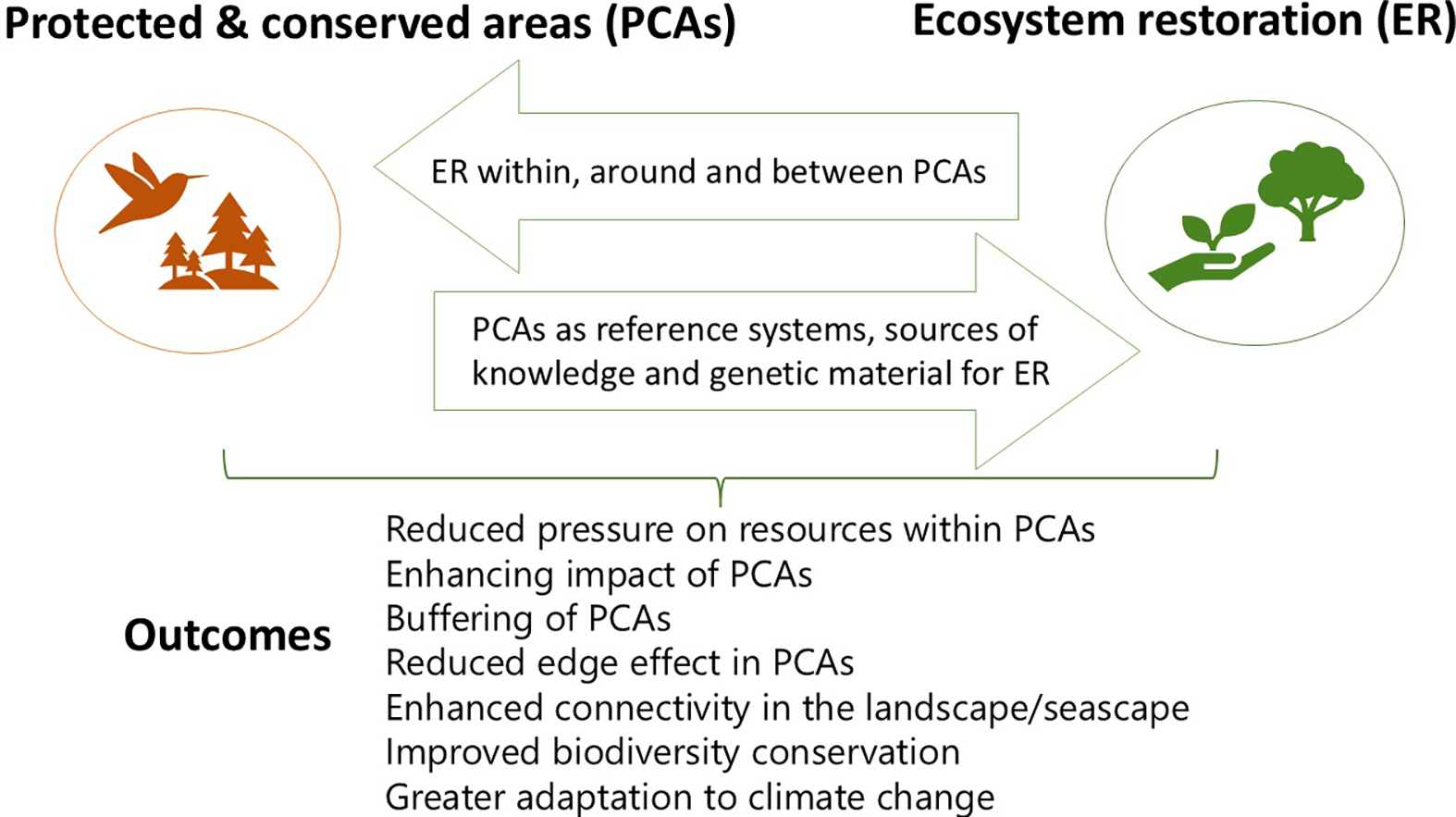
Combining protected and conserved areas and restoration can lead to several positive outcomes for conservation (see Fig. 1 and the following sections).
A conceptual framework linking ecosystem restoration (ER) and protected and conserved areas (PCAs). Their combination can lead to positive outcomes for conservation.
How do protected and conserved areas support restoration?
The biodiversity values present in protected and conserved areas (e.g. species assemblages or the presence of keystone species) may serve as inspiration to define objectives for restoration (Keenleyside et al., Reference Keenleyside, Dudley, Cairns, Hall and Stolton2012). Protected and conserved areas can act as reference landscapes and seascapes for restoration, laboratories for restoration, sources of restoration material, vehicles for passive restoration and sites for targeted restoration. They contribute to framing the core ecological priorities for an ecosystem and, as such, data from these areas may help to define approaches, objectives and specific sites for restoration. In this way, protected and conserved areas may act as reference ecosystems for setting restoration objectives, and contribute species to broadscale conservation objectives. Within landscapes/seascapes that include protected and conserved areas, objectives for restoration can be aligned to those of the areas themselves.
Knowledge gained from protected areas may contribute significantly to restoration. This knowledge may be about species (e.g. which species are native or threatened), species’ interactions, pressures on biodiversity, or the behaviour of different species in the face of mounting threats such as climate change. This knowledge may be from western science, traditional and local ecological knowledge or all of these, and mechanisms are needed to combine and explore these complementary knowledge systems (Bartlett et al, Reference Bartlett, Marshall and Marshall2012; Reyes-García et al., Reference Reyes-García, Fernández-Llamazares, Aumeeruddy-Thomas, Benyei, Bussmann and Diamond2022). Knowledge gained through protected area management may thus provide important insights for restoration practitioners. For example, long-term studies in Serengeti National Park, Tanzania, in this case by local and international ecologists, provided insights into wildlife management that have been applied widely in sub-Saharan Africa (Sinclair & Norton-Griffiths, Reference Sinclair and Norton-Griffiths1979; Sinclair & Arcese, Reference Sinclair and Arcese1995).
By providing a controlled environment, protected areas can themselves be tools for passive restoration; this is frequently the case with marine protected areas, where spillover from these areas helps boost artisanal fisheries (Kerwath et al., Reference Kerwath, Winker, Götz and Attwood2013). Similarly on land, in Costa Rica, protection enhanced the likelihood of forest regeneration by 13.2% from 1960 to 1997 for IUCN protected area categories I, II and IV, and up to 24.4% for IUCN category VI (Andam et al., Reference Andam, Ferraro and Hanauer2013). The presence of seed dispersers in protected areas facilitates restoration. For example, in New Caledonia, 53% of the seeds are dispersed by animals, with the flying fox Pteropus sp. and forest pigeon Ducula sp. playing a significant role, but both being threatened by illegal hunting (Ititiaty et al., Reference Ititiaty, Brescia, Bordez, Gensous, McCoy and Fogliani2020). Securing healthy wildlife populations is necessary, rather than seeking their mere survival, because of their critical role in seed dispersal, nutrient pathways, soil health and other ecosystem services (Roman, Reference Roman2023).
Protected areas are also a source of genetic material for restoration in the wider environment. Whereas nurseries are costly and generally maintain few species, source material obtained directly from ecosystems is more likely to be native, locally adapted, genetically diverse and resilient. For example, in Brazil, native seed collector networks have been established by various Indigenous communities, most famously the Xingu Indigenous Peoples in the state of Acre (Padovezi et al., Reference Padovezi, Adams, Chazdon, Mendonça, Secco and Campos-Filho2024). Similarly, in Europe, efforts are being made to restore native oysters following a collapse as a result of overexploitation, pollution and the introduction of non-native species (Pogoda et al., Reference Pogoda, Brown, Hancock, Preston, Pouvreau and Kamermans2019).
Protected and conserved areas also function as places that can provide restoration opportunities that have a better chance of success than they do in the wider landscape or seascape. For example, restoration of ponds and small waterbodies will be only of limited success unless the surrounding area is free of pollutants such as biocides or excess nutrients (Biggs & Williams, Reference Biggs and Williams2024); restoration or creation within a reserve is therefore likely to result in greater biodiversity. Restoration of the alga Cystoseira in the Mediterranean was found to have better chance of success if attempted in marine protected areas (Gianni et al., Reference Gianni, Bartolini, Airoldi, Ballesteros, Francour and Guidetti2013). Experiments in restoration in a relatively supportive environment may prove a useful first step to understand key processes and determine the best restoration approach, before upscaling.
How does restoration support protected and conserved areas?
Restoration adds value within and around protected and conserved areas by improving their habitat, expanding their size, reducing pressures and connecting these areas in the broader landscape or seascape. A proportion of protected and conserved areas require restoration as a result of prior degradation, degradation after designation or recognition, or climate and other environmental changes (Li et al., Reference Li, Fang, Watson, Sun, Qi and Wang2024). Degradation may have occurred before a protected area was established or through illegal activity or ineffective management after designation; whatever the cause, if needed, restoration within a protected area should be a priority. Restoration can directly contribute to the biodiversity conservation objectives of protected areas; for example, restoring 15% of converted lands in priority areas could prevent 60% of anticipated extinctions (Strassburg et al., Reference Strassburg, Iribarrem, Beyer, Cordeiro, Crouzeilles and Jakovac2020).
Spatial objectives for restoration may be determined by protected and conserved areas. For example, where protected area objectives are threatened by an edge effect (whereby there is insufficient distance from the edge to the core of the protected area, leading to exposure to disturbance), a restoration priority may be to reduce this edge effect. In other cases, restoration may be to buffer a protected area from surrounding pressures. For example, in Madagascar’s Fandriana Marolambo landscape, WWF and its partners prioritized restoration around the Marolambo National Park, to increase management effectiveness within the Park (Mansourian et al., Reference Mansourian, Razafimahatratra and Vallauri2018).
Only 9.7% of terrestrial protected areas are considered structurally connected (Ward et al., Reference Ward, Saura, Williams, Ramírez-Delgado, Arafeh-Dalmau and Allan2020). Strategies for restoring large areas factor protected and conserved areas as key core targets within the landscape. Similarly, the importance of restoring connectivity between marine protected areas is increasingly recognized (Gardner et al., Reference Gardner, Lausche, Pittman and Metaxas2024).
The issue of the siting of protected and conserved areas is complex. Previously, many protected areas were located in places that were remote or unlikely to be of interest to developers. Yet, to achieve their intended objectives, protected and conserved areas need to be in places with significant biodiversity requiring protection, focusing particularly on ecological representativeness, and on rare and threatened species (Arneth et al., Reference Arneth, Leadley, Claudet, Coll, Rondinini and Rounsevell2023). The importance of appropriate siting is even more acute with climate change (Redford & Dudley, Reference Redford and Dudley2024). As ranges of both faunal and floral species are expected to shift, the reasons for establishing protected and conserved areas may be affected. Restoration can directly contribute to the shift or expansion of protected and conserved areas. For example, forecasts anticipate the range of marsupial species in Brazil shifting towards the south-east, thereby requiring restoration to expand the habitat of the target species (Janishevski et al., Reference Janishevski, Santamaria, Gidda, Cooper and Brancalion2015). Active restoration may be needed where climatic conditions alter an ecosystem’s ability to function.
In the wider landscape, a combination of protection and restoration enhances connectivity for wildlife to move, migrate and reproduce. Connectivity of viable habitats reduces the risks presented by climate change by buffering areas and improving the health of key habitats. Restoration across the landscape may provide critical stepping stones for this connectivity. In the context of climate change, securing ecological connectivity is increasingly being prioritized (Maxwell et al., Reference Maxwell, Cazalis, Dudley, Hoffmann, Rodrigues and Stolton2020). For example, in Brazil, protection of the Endangered black lion tamarin Leontopithecus chrysopygus required extending its habitat beyond Morro do Diabo State Park. Collaboration with neighbouring farmers has led to restoration of the wider landscape through agroforestry systems and natural regeneration, expanding habitat for this primate and also contributing to the livelihoods of local communities (Chazdon et al., Reference Chazdon, Cullen, Padua and Padua2020). Approaches to rewilding value this complementarity in the landscape whereby protected areas are essential to harbour populations of target species (e.g. the grey wolf Canis lupus in Yellowstone National Park) that may spread in a wider, restored landscape (Carver et al., Reference Carver, Convery, Hawkins, Beyers, Eagle and Kun2021).
Aligning protection and restoration
We encourage enhanced alignment between protection and restoration strategies, policies and implementation. Enhancing linkages between these two approaches makes economic, ecological, political and social sense.
Economic
Linking protection and restoration is cost effective (e.g. Mu et al., Reference Mu, Guo, Li, Li, Bai and Linke2022). It makes sense for governments to invest in a comprehensive conservation package that facilitates the complementary activities of conserving important biodiversity areas and restoring in and around them to add value to conservation efforts. Furthermore, the combination of the two strategies increases the chances of providing ecosystem services by expanding the quality and/or quantity of ecosystems (Benayas et al., Reference Benayas, Newton, Diaz and Bullock2009).
Ecological
There are overarching benefits to biodiversity from linking protection and restoration (e.g. ensuring that restoration is, when necessary, addressed adequately in protected area management plans). The effectiveness of protected areas remains a concern (e.g. Li et al., Reference Li, Fang, Watson, Sun, Qi and Wang2024), and ongoing pressures will only contribute to threatening the effectiveness of protected and conserved areas. Protected and conserved areas that have high-quality habitat are more likely to achieve their objectives. Prioritizing restoration in and around protected and conserved areas is thus a coherent strategy to achieve multiple biodiversity benefits; for example, with restored sites acting as stepping stones between protected areas (Heino & Koljonen, Reference Heino and Koljonen2022).
Political
Both protection and restoration are central to the CBD (particularly through the Global Biodiversity Framework), the UN Framework Convention on Climate Change and the UN Convention to Combat Desertification (Aronson & Alexander, Reference Aronson and Alexander2013). Furthermore, the majority of governments have made various voluntary commitments under other processes such as the African Forest Landscape Restoration Initiative, Initiative 20x20, the Bonn Challenge, the Freshwater Challenge, the High Ambition Coalition that supported the 30x30 target of the Global Biodiversity Framework, the Land Degradation Neutrality target of the UN Convention to Combat Desertification, and others (Stanturf & Mansourian, Reference Stanturf and Mansourian2020). Bringing restoration and protection in closer alignment will help to achieve more comprehensive approaches to the management of natural resources and subsequent delivery of ecosystem services. Furthermore, the first Global Biodiversity Framework target on spatial planning emphasizes these spatial connections. Large-scale planning is needed to identify areas for protection, sustainable use and restoration, to optimize economies of scale and to ensure these align in a way that maximizes the chances for biodiversity to thrive and the provision of other ecosystem services (Adams, Reference Adams2024; Agardy et al., Reference Agardy, Hancock, Birch and McLeod2025).
Social
For those cultures around the globe that have not lost their connections to nature, the value of restoring and conserving forests, mangroves, rivers and lakes is self-evident. Indigenous Peoples attach significant value to their natural environment and as such have a vested interest in restoring functional ecological spaces (Reyes-García et al., Reference Reyes-García, Fernández-Llamazares, McElwee, Molnár, Öllerer and Wilson2019). Ecosystems are a source of food, livelihoods, inspiration and traditions, and thus deserve to be conserved and restored. Restoring nature and culture go hand in hand. Recognizing, emphasizing and strengthening the social and cultural links in approaches to biodiversity conservation that include both protected areas and restoration will achieve broader benefits aligned with the UN Sustainable Development Goals. Restoration, the idea of bringing nature back, also engages different actors than does protection, thus widening the pool of those actively engaged in conservation.
Recommendations
The objectives of area-based conservation and restoration need to be better aligned. In formal policy terms this means integration of Targets 2 and 3 of the Global Biodiversity Framework. In the recent EU Nature Restoration Law there is explicit mention of the need for alignment, with the text noting ‘Where a Member State includes conservation measures necessary to contribute to the objectives of this Regulation in its national restoration plan and those conservation measures require the submission of joint recommendations, the Member State concerned should engage in consultation (…) with a view to promoting the coherence between different policies on conservation of marine ecosystems.’ We make six specific recommendations:
-
(1) Align plans across protection and restoration. These could be plans at any level, such as nationally (e.g. National Biodiversity Strategies and Action Plans under the CBD, and restoration strategies under the Bonn Challenge) or locally, with different interventions carried out by different actors on a given territory. They could also be plans across administrative scales, such as between national and local authorities. In all cases, awareness of the cross-linkages between protection and restoration is required, to secure such joint planning.
-
(2) Include restoration in protected area management plans whenever needed. Although this already occurs in some cases, it should be more systematic.
-
(3) Include both protection and restoration in spatial planning, and support the design of restoration priorities in the context of wider spatial planning units (e.g. landscapes) in relation to key areas such as protected and conserved areas, with the aim of increasing ecological connectivity. This is a key factor in Global Biodiversity Framework Target 1 on spatial planning. Currently, separate guidelines, journals, standards, communities of practice and conferences reinforce this divide between restoration and protection practice.
-
(4) Establish joint task forces, projects, programmes and strategies between protected area and restoration specialists; for example, within the various expert commissions of IUCN.
-
(5) Ensure the active inclusion of local stakeholders and rightsholders in all of the above. Conservation occurs in a social–ecological system, and mutual benefits for people and nature are essential for the sustainability of both protected areas and restoration interventions. Indigenous Peoples and local communities in particular need to be involved at every stage of the processes of protection and restoration, and should ideally be the originators of such efforts, if plans are to have a realistic chance of being sustainable in the long term.
-
(6) Align objectives for protection and restoration so they can make significant contributions to the delivery of critical ecosystem services, including food security, water quality, disaster risk reduction and climate adaptation, among others. Objectives for protection and restoration should therefore more explicitly align with, and add value to, these broader objectives to achieve significant impacts.
Conclusion
Area-based conservation and restoration are important tools in the move towards sustainable environmental management. Although they have often been treated as separate strategies, we argue they are in fact mutually supportive and need to be far more closely integrated than is often the case. The management of ecosystems requires a range of interventions working jointly, but western scientific methodologies have led restoration and protected area specialists to work in parallel rather than together. We contend that the two approaches, when combined comprehensively, can secure greater impacts for biodiversity conservation and sustainable development.
Author contributions
Conceptualization: SM; outline: SM, ND; first draft; SM; writing, revision: SM, ND.
Acknowledgements
We thank Madhu Rao for input to an earlier draft. This work received no specific grant from any funding agency, or commercial or not-for-profit sectors.
Competing interests
None.
Ethical standards
This research abided by the Oryx guidelines on ethical standards.
Data availability
No new data were generated.


 Open access

