









1 Introduction
How “much” of a closed d-dimensional manifold is seen by the homotopy types of its configuration spaces? There are several ways to make this question precise, and to some of them partial answers have been given [Reference LevittLev95, Reference Aouina and KleinAK04, Reference Longoni and SalvatoreLS05, Reference Arone and SzymikAS22, Reference Knudsen and KupersKK24a, Reference Krannich and KupersKK24b]. In this work we answer an instance of this question in the case of exotic spheres.
To explain the result, we write
$\mathscr {M}\mathrm {fd}_d$
 for the
$\infty $
for the
$\infty $
 -category with smooth d-dimensional manifolds M as objects and spaces of smooth embeddings
$\mathrm {Emb}(M,N)$
-category with smooth d-dimensional manifolds M as objects and spaces of smooth embeddings
$\mathrm {Emb}(M,N)$
 as morphisms. This has a full subcategory
$\mathscr {D}\mathrm {isc}_d\subseteq \mathscr {M}\mathrm {fd}_d$
as morphisms. This has a full subcategory
$\mathscr {D}\mathrm {isc}_d\subseteq \mathscr {M}\mathrm {fd}_d$
 spanned by the manifolds
$S \times \mathbf {R}^d$
spanned by the manifolds
$S \times \mathbf {R}^d$
 for finite sets S. To a smooth d-manifold M, we can associate a presheaf
$E_M$
for finite sets S. To a smooth d-manifold M, we can associate a presheaf
$E_M$
 on
$\mathscr {D}\mathrm {isc}_d$
on
$\mathscr {D}\mathrm {isc}_d$
 with values in the
$\infty $
with values in the
$\infty $
 -category of spaces
$\mathscr {S}$
-category of spaces
$\mathscr {S}$
 , given by

and this construction extends – via postcomposition – to a functor out of
$\mathscr {M}\mathrm {fd}_d$


with values in the
$\infty $
 -category
$\mathrm {PSh}(\mathscr {D}\mathrm {isc}_d){:=} \mathrm {Fun}(\mathscr {D}\mathrm {isc}_d^{\mathrm {op}},\mathscr {S})$
-category
$\mathrm {PSh}(\mathscr {D}\mathrm {isc}_d){:=} \mathrm {Fun}(\mathscr {D}\mathrm {isc}_d^{\mathrm {op}},\mathscr {S})$
 of presheaves. The individual values of the presheaf
$E_M$
of presheaves. The individual values of the presheaf
$E_M$
 at objects
$\smash {S \times \mathbf {R}^d}$
at objects
$\smash {S \times \mathbf {R}^d}$
 are equivalent to the framed configuration spaces,

so
$E_M\in \mathrm {PSh}(\mathscr {D}\mathrm {isc}_d)$
 encodes, roughly speaking, the homotopy types of all framed configuration spaces in M together with natural maps between them (e.g., the value of
$E_M$
encodes, roughly speaking, the homotopy types of all framed configuration spaces in M together with natural maps between them (e.g., the value of
$E_M$
 at
$(\iota \times \mathrm {id}_{\mathbf {R}^d})\colon S\times \mathbf {R}^d\hookrightarrow S'\times \mathbf {R}^d$
at
$(\iota \times \mathrm {id}_{\mathbf {R}^d})\colon S\times \mathbf {R}^d\hookrightarrow S'\times \mathbf {R}^d$
 for an injection
$\iota \colon S\hookrightarrow S'$
for an injection
$\iota \colon S\hookrightarrow S'$
 corresponds under (2) to forgetting some of the points). The equivalence class of the presheaf
$E_M\in \mathrm {PSh}(\mathscr {D}\mathrm {isc}_d)$
corresponds under (2) to forgetting some of the points). The equivalence class of the presheaf
$E_M\in \mathrm {PSh}(\mathscr {D}\mathrm {isc}_d)$
 is a diffeomorphism-invariant of M from which many other invariants can be extracted, including the factorisation homology of M with coefficients in any
$\mathrm {BO}(d)$
is a diffeomorphism-invariant of M from which many other invariants can be extracted, including the factorisation homology of M with coefficients in any
$\mathrm {BO}(d)$
 -framed
$E_d$
-framed
$E_d$
 -algebra [Reference SalvatoreSal01, Reference Ayala and FrancisAF15a, Reference LurieLur17] or the embedding calculus tower for spaces of embeddings into or out of M [Reference WeissWei99, Reference Boavida de Brito and WeissBdBW13a]. In fact, for
$d\ge 5$
-algebra [Reference SalvatoreSal01, Reference Ayala and FrancisAF15a, Reference LurieLur17] or the embedding calculus tower for spaces of embeddings into or out of M [Reference WeissWei99, Reference Boavida de Brito and WeissBdBW13a]. In fact, for
$d\ge 5$
 , there is still no known example of two closed nondiffeomorphic d-manifolds M and N such that
$E_M$
, there is still no known example of two closed nondiffeomorphic d-manifolds M and N such that
$E_M$
 and
$E_N$
and
$E_N$
 are equivalent in
$\mathrm {PSh}(\mathscr {D}\mathrm {isc}_d)$
are equivalent in
$\mathrm {PSh}(\mathscr {D}\mathrm {isc}_d)$
 Footnote
1
.
Footnote
1
.
There are several variants of the presheaf
$E_M$
 one can consider, for example, one for topological manifolds M based on a variant of the
$\infty $
one can consider, for example, one for topological manifolds M based on a variant of the
$\infty $
 -category
$\smash {\mathscr {D}\mathrm {isc}_{d}}$
-category
$\smash {\mathscr {D}\mathrm {isc}_{d}}$
 involving topological embeddings, or one for manifolds M equipped with a tangential structure: for instance, if M comes equipped with an orientation one can consider the analogue
$\smash {\mathscr {D}\mathrm {isc}^{+}_{d}}$
involving topological embeddings, or one for manifolds M equipped with a tangential structure: for instance, if M comes equipped with an orientation one can consider the analogue
$\smash {\mathscr {D}\mathrm {isc}^{+}_{d}}$
 of
$\smash {\mathscr {D}\mathrm {isc}_{d}}$
of
$\smash {\mathscr {D}\mathrm {isc}_{d}}$
 where one restricts to orientation-preserving embeddings, and the presheaf
$\smash {E_M\in \mathrm {PSh}(\mathscr {D}\mathrm {isc}^{+}_{d})}$
where one restricts to orientation-preserving embeddings, and the presheaf
$\smash {E_M\in \mathrm {PSh}(\mathscr {D}\mathrm {isc}^{+}_{d})}$
 defined as in (1) but using spaces of orientation-preserving embeddings. As another variant, instead of considering presheaves on the full
$\infty $
defined as in (1) but using spaces of orientation-preserving embeddings. As another variant, instead of considering presheaves on the full
$\infty $
 -category
$\mathscr {D}\mathrm {isc}_d$
-category
$\mathscr {D}\mathrm {isc}_d$
 , one may for fixed
$k\ge 1$
, one may for fixed
$k\ge 1$
 restrict to the full subcategory
$\mathscr {D}\mathrm {isc}_{d,\le k}\subseteq \mathscr {D}\mathrm {isc}_d$
restrict to the full subcategory
$\mathscr {D}\mathrm {isc}_{d,\le k}\subseteq \mathscr {D}\mathrm {isc}_d$
 spanned by
$S\times \mathbf {R}^d$
spanned by
$S\times \mathbf {R}^d$
 for
$|S| \leq k$
for
$|S| \leq k$
 and consider the presheaf
$E_M\in \mathrm {PSh}(\mathscr {D}\mathrm {isc}_{d,\le k})$
and consider the presheaf
$E_M\in \mathrm {PSh}(\mathscr {D}\mathrm {isc}_{d,\le k})$
 obtained from
$E_M$
obtained from
$E_M$
 by restriction; this is called the k-truncated
$\mathscr {D}\mathrm {isc}$
by restriction; this is called the k-truncated
$\mathscr {D}\mathrm {isc}$
 -presheaf of M. In terms of diagrams of framed configuration spaces, passing to the truncated setting amounts to imposing an upper bound on the number of points.
The main result
In this work, we study the question of which homotopy d-spheres can be distinguished by their truncated
$\mathscr {D}\mathrm {isc}^{+}$
 -presheaves. Recall that a homotopy d-sphere is a closed smooth d-manifold
$\Sigma $
-presheaves. Recall that a homotopy d-sphere is a closed smooth d-manifold
$\Sigma $
 that is homotopy equivalent to a standard d-sphere, and thus – by the solution to the topological Poincaré conjecture – also homeomorphic to it. To state our main result, we write
$M\sharp N$
that is homotopy equivalent to a standard d-sphere, and thus – by the solution to the topological Poincaré conjecture – also homeomorphic to it. To state our main result, we write
$M\sharp N$
 for the connected sum of two oriented d-manifolds M and N, and
$\overline {M}$
for the connected sum of two oriented d-manifolds M and N, and
$\overline {M}$
 for M equipped with the opposite orientation.
Theorem A. For oriented homotopy d-spheres
$\Sigma _0$
 and
$\Sigma _1$
and
$\Sigma _1$
 with
$d\not \equiv 1\ (\mathrm {mod}\ 4)$
with
$d\not \equiv 1\ (\mathrm {mod}\ 4)$
 and
$1< k < \infty $
and
$1< k < \infty $
 , we have
$E_{\Sigma _0} \simeq E_{\Sigma _1}$
, we have
$E_{\Sigma _0} \simeq E_{\Sigma _1}$
 in
$\mathrm {PSh}(\mathscr {D}\mathrm {isc}^{+}_{d,\leq k})$
in
$\mathrm {PSh}(\mathscr {D}\mathrm {isc}^{+}_{d,\leq k})$
 if and only if
$\Sigma _0 \sharp \overline {\Sigma }_1$
if and only if
$\Sigma _0 \sharp \overline {\Sigma }_1$
 bounds a compact parallelisable manifold.
Remark.
-
1. Theorem A answers [Reference Knudsen and KupersKK24a, Question 5.5] in many cases and its proof also yields a partial answer to Question 5.6 of loc.cit.
-
2. The question of which homotopy d-spheres bound a compact parallelisable manifold has been studied extensively in the past and features in Kervaire–Milnor’s classification of homotopy spheres [Reference Kervaire and MilnorKM63]. For example, from the latter one can deduce that there are $16256$
 oriented homotopy
$15$
-spheres up to orientation-preserving diffeomorphism, of which precisely half bound compact parallelisable manifolds. By Theorem A, this implies that also precisely half of them have the property that they can be distinguished from the standard
$15$
-sphere by their k-truncated
$\mathscr {D}\mathrm {isc}^{+}$
-presheaf for any
$1<k<\infty $
.
oriented homotopy
$15$
-spheres up to orientation-preserving diffeomorphism, of which precisely half bound compact parallelisable manifolds. By Theorem A, this implies that also precisely half of them have the property that they can be distinguished from the standard
$15$
-sphere by their k-truncated
$\mathscr {D}\mathrm {isc}^{+}$
-presheaf for any
$1<k<\infty $
. -
3. For d-manifolds M and N, the mapping spaces $\mathrm {Map}_{\mathrm {PSh}(\mathsf {Disc}_d,\le k)}(E_M,E_N)$
are equivalent to the kth stage
$T_k\mathrm {Emb}(M,N)$
in the embedding calculus tower [Reference Boavida de Brito and WeissBdBW13b]. From this point of view, Theorem A answers the question which homotopy d-spheres can be detected through the finite stages of the embedding calculus tower if
$d\not \equiv 1\ (\mathrm {mod}\ 4)$
.





On the assumptions
We comment on the assumptions on d and k in Theorem A:
The case
$k=1$

Two oriented d-manifolds M and N have equivalent k-truncated
$\mathscr {D}\mathrm {isc}^{+}$
 -presheaves for
$k=1$
-presheaves for
$k=1$
 if and only if there is a tangential homotopy equivalence between them, that is, a homotopy equivalence
$\varphi \colon M\rightarrow N$
if and only if there is a tangential homotopy equivalence between them, that is, a homotopy equivalence
$\varphi \colon M\rightarrow N$
 covered by an orientation-preserving fibrewise isomorphism of the tangent bundles [Reference Krannich and KupersKK26, Proposition 5.10]. Since it is known that any two oriented homotopy d-spheres
$\Sigma _0$
covered by an orientation-preserving fibrewise isomorphism of the tangent bundles [Reference Krannich and KupersKK26, Proposition 5.10]. Since it is known that any two oriented homotopy d-spheres
$\Sigma _0$
 and
$\Sigma _1$
and
$\Sigma _1$
 are tangentially homotopy equivalent (see, e.g., [Reference Ray and PedersenRP80, Lemma 1.1]), one gets that
$E_{\Sigma _0}\simeq E_{\Sigma _1}$
are tangentially homotopy equivalent (see, e.g., [Reference Ray and PedersenRP80, Lemma 1.1]), one gets that
$E_{\Sigma _0}\simeq E_{\Sigma _1}$
 in
$\mathrm {PSh}(\mathscr {D}\mathrm {isc}^{+}_{d,\leq k})$
in
$\mathrm {PSh}(\mathscr {D}\mathrm {isc}^{+}_{d,\leq k})$
 for
$k=1$
for
$k=1$
 and all
$\Sigma _0$
and all
$\Sigma _0$
 and
$\Sigma _1$
and
$\Sigma _1$
 .
.
Remark. As any homotopy equivalence between homotopy spheres is homotopic to a homeomorphism, one can even choose a tangential homotopy equivalence
$\varphi \colon \Sigma _0\rightarrow \Sigma _1$
 that is a homeomorphism. The latter induces homotopy equivalences
$F_S^{\mathrm {fr}}(\Sigma _0)\simeq F_S^{\mathrm {fr}}(\Sigma _1)$
that is a homeomorphism. The latter induces homotopy equivalences
$F_S^{\mathrm {fr}}(\Sigma _0)\simeq F_S^{\mathrm {fr}}(\Sigma _1)$
 between all framed configuration spaces, so in view of (2), this shows that the truncated
$\mathscr {D}\mathrm {isc}$
between all framed configuration spaces, so in view of (2), this shows that the truncated
$\mathscr {D}\mathrm {isc}$
 -presheaves
$E_{\Sigma _0}$
-presheaves
$E_{\Sigma _0}$
 and
$E_{\Sigma _1}$
and
$E_{\Sigma _1}$
 can never be distinguished by considering any of their individual values.
The case
$d\equiv 1\ (\mathrm {mod}\ 4)$

Our proof of the “only if” direction in Theorem A also goes through in the excluded dimensions
$d \equiv 1 \ (\mathrm {mod}\ 4)$
 (see Section 2.2). The “if” direction, however (i.e., whether
$\smash {E_{\Sigma _0}\simeq E_{\Sigma _1}}$
(see Section 2.2). The “if” direction, however (i.e., whether
$\smash {E_{\Sigma _0}\simeq E_{\Sigma _1}}$
 if
$\smash {\Sigma _0\sharp \overline {\Sigma _1}}$
if
$\smash {\Sigma _0\sharp \overline {\Sigma _1}}$
 bounds a compact parallelisable manifold), does not. By the solution of the Kervaire invariant one problem, it is known that for
$d=2^\ell -3$
bounds a compact parallelisable manifold), does not. By the solution of the Kervaire invariant one problem, it is known that for
$d=2^\ell -3$
 with
$\ell \le 7$
with
$\ell \le 7$
 , only the standard sphere bounds a compact parallelisable manifold, so there is nothing to show, but in all other dimensions
$d\equiv 1\ (\mathrm {mod}\ 4)$
, only the standard sphere bounds a compact parallelisable manifold, so there is nothing to show, but in all other dimensions
$d\equiv 1\ (\mathrm {mod}\ 4)$
 , there is a single nontrivial oriented homotopy sphere that bounds a compact parallelisable manifold, called the Kervaire sphere. This leads us to ask:
Question 1.1. For which
$m\ge 2$
 and
$2\le k< \infty $
and
$2\le k< \infty $
 is there an equivalence
$E_{\Sigma _{K}}\simeq E_{S^{4m+1}}$
is there an equivalence
$E_{\Sigma _{K}}\simeq E_{S^{4m+1}}$
 in
$\mathrm {PSh}(\mathscr {D}\mathrm {isc}^{+}_{d,\le k})$
in
$\mathrm {PSh}(\mathscr {D}\mathrm {isc}^{+}_{d,\le k})$
 where
$\Sigma _{K}$
where
$\Sigma _{K}$
 is the
$(4m+1)$
is the
$(4m+1)$
 -dimensional Kervaire sphere?
The case
$k=\infty $

In the excluded case
$k=\infty $
 , the “only if” direction of Theorem A follows from the case
$1<k<\infty $
, the “only if” direction of Theorem A follows from the case
$1<k<\infty $
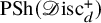
 , since an equivalence of nontruncated presheaves induces by restriction one of all their truncations. However, the “if”-direction does not follow: similarly to how there are nonequivalent spaces whose finite Postnikov truncations are all equivalent [Reference AdamsAda57], there may be nonequivalent presheaves X and Y in
$\mathrm {PSh}(\mathscr {D}\mathrm {isc}^{+}_d)$
, since an equivalence of nontruncated presheaves induces by restriction one of all their truncations. However, the “if”-direction does not follow: similarly to how there are nonequivalent spaces whose finite Postnikov truncations are all equivalent [Reference AdamsAda57], there may be nonequivalent presheaves X and Y in
$\mathrm {PSh}(\mathscr {D}\mathrm {isc}^{+}_d)$
 that are equivalent in
$\smash {\mathrm {PSh}(\mathscr {D}\mathrm {isc}_{d,\le k}^{+})}$
that are equivalent in
$\smash {\mathrm {PSh}(\mathscr {D}\mathrm {isc}_{d,\le k}^{+})}$
 for all
$k<\infty $
for all
$k<\infty $
 . Theorem A thus leaves open the question for which homotopy d-spheres
$\Sigma _0$
. Theorem A thus leaves open the question for which homotopy d-spheres
$\Sigma _0$
 and
$\Sigma _1$
and
$\Sigma _1$
 such that the connected sum
$\Sigma _0\sharp \overline {\Sigma }_1$
such that the connected sum
$\Sigma _0\sharp \overline {\Sigma }_1$
 bounds a compact parallelisable manifold there exists an equivalence
$E_{\Sigma _0}\simeq E_{\Sigma _1}\in \mathrm {PSh}(\mathscr {D}\mathrm {isc}^{+}_{d})$
bounds a compact parallelisable manifold there exists an equivalence
$E_{\Sigma _0}\simeq E_{\Sigma _1}\in \mathrm {PSh}(\mathscr {D}\mathrm {isc}^{+}_{d})$
 , without truncation. In particular, we ask:
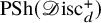
Question 1.2. For which oriented homotopy spheres
$\Sigma $
 that bound a compact parallelisable manifold does there exist an equivalence
$E_{\Sigma }\simeq E_{S^{d}}$
that bound a compact parallelisable manifold does there exist an equivalence
$E_{\Sigma }\simeq E_{S^{d}}$
 in
$\mathrm {PSh}(\mathscr {D}\mathrm {isc}^{+}_{d})$
in
$\mathrm {PSh}(\mathscr {D}\mathrm {isc}^{+}_{d})$
 ?
?
Ingredients in the proof
The proof of Theorem A involves three ingredients that could be of independent interest:
-
1. A description of $\mathscr {D}\mathrm {isc}$
-presheaves of manifolds that are decomposed into two codimension
$0$
submanifolds that intersect in their common boundary (see Theorem 3.2). -
2. A proof that the Atiyah duality equivalence $D(\Sigma _+^\infty M)\simeq {\mathrm {Th}}(-TM)$
for closed d-manifolds is natural in equivalences of
$\mathscr {D}\mathrm {isc}$
-presheaves (see Theorem 2.6 and Section 4), based on a variant of a construction due to Naef–Safranov [Reference Naef and SafronovNS24, Section 4.2] (see Remark 4.7). This also suggests a relation between algebraic L-theory and the
$\mathscr {D}\mathrm {isc}$
-structure spaces as introduced in [Reference Krannich and KupersKK24b] (see Section 2.3). -
3. A computation of the finite residual (the intersection of all finite-index normal subgroups) of the group of isotopy classes of orientation-preserving diffeomorphisms of the iterated connected sums $\sharp ^g(S^{2m+1}\times S^{2m+1})$
(see Theorem 2.3 and Section 5).






2
$\mathscr {D}\mathrm {isc}$
-presheaves of exotic spheres

In this section, we prove Theorem A (or rather a strengthening of it) assuming three ingredients (Theorems 2.2, 2.3, and 2.6) which are established in the subsequent three sections.
Convention. We work in the setting of
$\infty $
 -categories throughout, so a “category” is always an
$\infty $
-categories throughout, so a “category” is always an
$\infty $
 -category. Unless mentioned otherwise, manifolds and embeddings are always assumed to be smooth. Given a homotopy d-sphere
$\Sigma $
-category. Unless mentioned otherwise, manifolds and embeddings are always assumed to be smooth. Given a homotopy d-sphere
$\Sigma $
 , we write
$\Sigma \in \mathrm {bP}_{d+1}$
, we write
$\Sigma \in \mathrm {bP}_{d+1}$
 if
$\Sigma $
if
$\Sigma $
 bounds a compact parallelisable
$(d+1)$
bounds a compact parallelisable
$(d+1)$
 -manifold. To treat the categories
$\mathscr {D}\mathrm {isc}_{d,\le k}$
-manifold. To treat the categories
$\mathscr {D}\mathrm {isc}_{d,\le k}$
 and
$\mathscr {D}\mathrm {isc}_d$
and
$\mathscr {D}\mathrm {isc}_d$
 from the introduction on the same footing, we write
$\mathscr {D}\mathrm {isc}_{d,\le \infty }:= \mathscr {D}\mathrm {isc}_d$
from the introduction on the same footing, we write
$\mathscr {D}\mathrm {isc}_{d,\le \infty }:= \mathscr {D}\mathrm {isc}_d$
 (similarly for the oriented variant).
2.1
$\mathscr {D}\mathrm {isc}$
-presheaves of
$\mathrm {bP}$
-spheres


The “if” direction of Theorem A follows from the following more general result by specialising to
$M=S^d$
 :
:
Theorem 2.1. For a connected oriented d-manifold M with
$d\not \equiv 1\ (\mathrm {mod}\ 4)$
 and two oriented homotopy d-spheres
$\Sigma _0,\Sigma _1$
and two oriented homotopy d-spheres
$\Sigma _0,\Sigma _1$
 with
$\Sigma _0\sharp \overline {\Sigma _1}\in \mathrm {bP}_{d+1}$
with
$\Sigma _0\sharp \overline {\Sigma _1}\in \mathrm {bP}_{d+1}$
 , there is for all
$k<\infty $
, there is for all
$k<\infty $
 an equivalence

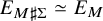
In particular, for all
$\Sigma \in \mathrm {bP}_{d+1}$
 , we have
$E_{M\sharp \Sigma }\simeq E_M$
, we have
$E_{M\sharp \Sigma }\simeq E_M$
 in
$\mathrm {PSh}(\mathscr {D}\mathrm {isc}^{+}_{d,\le k})$
in
$\mathrm {PSh}(\mathscr {D}\mathrm {isc}^{+}_{d,\le k})$
 whenever
$1\le k<\infty $
whenever
$1\le k<\infty $
 .
.
The proof of Theorem 2.1 has two main ingredients – one homotopy-theoretic and one group-theoretic. The homotopy-theoretic one – which we prove in Section 3 – is the following criterion to show that two manifolds obtained by gluing together the same pair of manifolds along different diffeomorphisms of their boundaries have equivalent
$\mathscr {D}\mathrm {isc}$
 -presheaves:
Theorem 2.2. Fix d-manifolds
$M_0$
 and
$M_1$
and
$M_1$
 and two diffeomorphisms
$\varphi _0,\varphi _1\colon \partial M_0\rightarrow \partial M_1$
and two diffeomorphisms
$\varphi _0,\varphi _1\colon \partial M_0\rightarrow \partial M_1$
 between their boundaries. If for some fixed
$1\le k\le \infty $
between their boundaries. If for some fixed
$1\le k\le \infty $
 we have

then there is an equivalence

Moreover, the analogous statement holds when
$M_0$
 and
$M_1$
and
$M_1$
 are oriented, the
$\varphi _i$
are oriented, the
$\varphi _i$
 are orientation-reversing, and
$\mathscr {D}\mathrm {isc}_{d-1,\le k}$
are orientation-reversing, and
$\mathscr {D}\mathrm {isc}_{d-1,\le k}$
 and
$\mathscr {D}\mathrm {isc}_{d,\le k}$
and
$\mathscr {D}\mathrm {isc}_{d,\le k}$
 are replaced by
$\mathscr {D}\mathrm {isc}^{+}_{d-1,\le k}$
are replaced by
$\mathscr {D}\mathrm {isc}^{+}_{d-1,\le k}$
 and
$\mathscr {D}\mathrm {isc}^{+}_{d,\le k}$
and
$\mathscr {D}\mathrm {isc}^{+}_{d,\le k}$
 .
.
The second ingredient in the proof of Theorem 2.1 is related to a certain group-theoretic difference between mapping class groups of manifolds and the analogue in the context of
$\mathscr {D}\mathrm {isc}$
 -presheaves, which was discovered in [Reference MezherMez24]. To explain this, recall that a discrete group G is residually finite if its finite residual

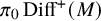
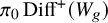
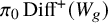
vanishes. It was observed in [Reference Krannich and Randal-WilliamsKRW20] that there are 2-connected closed high-dimensional manifolds M for which the group
$\pi _0\,{\mathrm {Diff}}^{+}(M)$
 of isotopy classes of orientation-preserving diffeomorphisms is not residually finite (more specifically this was shown for the iterated connected sums
$W_g{:=} \sharp ^g (S^n\times S^n)$
of isotopy classes of orientation-preserving diffeomorphisms is not residually finite (more specifically this was shown for the iterated connected sums
$W_g{:=} \sharp ^g (S^n\times S^n)$
 for certain values of g and n). On the contrary, the analogous group
$\pi _0 \,\mathrm {Aut}_{\mathrm {PSh}(\mathscr {D}\mathrm {isc}_{d,\le k})}(E_M)$
for certain values of g and n). On the contrary, the analogous group
$\pi _0 \,\mathrm {Aut}_{\mathrm {PSh}(\mathscr {D}\mathrm {isc}_{d,\le k})}(E_M)$
 for the truncated
$\mathscr {D}\mathrm {isc}$
for the truncated
$\mathscr {D}\mathrm {isc}$
 -presheaf of M is residually finite for any
$k<\infty $
-presheaf of M is residually finite for any
$k<\infty $
 , as shown in [Reference MezherMez24]. The proof of Theorem 2.2 will exploit this difference, based on an extension of the result from [Reference Krannich and Randal-WilliamsKRW20] which we explain now. Recall that by Cerf’s “pseudoisotopy-implies-isotopy” theorem and Smale’s h-cobordism theorem, extending diffeomorphisms of
$D^{d-1}$
, as shown in [Reference MezherMez24]. The proof of Theorem 2.2 will exploit this difference, based on an extension of the result from [Reference Krannich and Randal-WilliamsKRW20] which we explain now. Recall that by Cerf’s “pseudoisotopy-implies-isotopy” theorem and Smale’s h-cobordism theorem, extending diffeomorphisms of
$D^{d-1}$
 along the inclusion of a hemisphere
$D^{d-1}\subset S^{d-1}$
along the inclusion of a hemisphere
$D^{d-1}\subset S^{d-1}$
 via the identity, and gluing two copies of
$D^d$
via the identity, and gluing two copies of
$D^d$
 together along a diffeomorphism of
$S^{d-1}$
together along a diffeomorphism of
$S^{d-1}$
 , yields for
$d\ge 6$
, yields for
$d\ge 6$
 isomorphisms of abelian groups

Here
$\pi _0\,{\mathrm {Diff}}_\partial (D^{d-1})$
 is the group of isotopy classes of diffeomorphisms of a closed
$(d-1)$
is the group of isotopy classes of diffeomorphisms of a closed
$(d-1)$
 -disc that pointwise fix the boundary and
$\Theta _d$
-disc that pointwise fix the boundary and
$\Theta _d$
 is Kervaire–Milnor’s group of oriented homotopy d-spheres [Reference Kervaire and MilnorKM63]. For an oriented
$(d-1)$
is Kervaire–Milnor’s group of oriented homotopy d-spheres [Reference Kervaire and MilnorKM63]. For an oriented
$(d-1)$
 -manifold M with an embedded codimension
$0$
-manifold M with an embedded codimension
$0$
 disc
$D^{d-1}\subset M$
disc
$D^{d-1}\subset M$
 compatible with the orientation, we write

for the morphism given by extending diffeomorphisms along
$D^{d-1}\subset M$
 by the identity. In these terms, the extension of the result of [Reference Krannich and Randal-WilliamsKRW20] which we prove in Section 5 is:
Theorem 2.3. For
$n\ge 3$
 odd and
$g\ge 0$
odd and
$g\ge 0$
 , setting
$W_g{:=} \sharp ^g (S^n\times S^n)$
, setting
$W_g{:=} \sharp ^g (S^n\times S^n)$
 , we have

Remark 2.4.
-
1. The morphism $\mathrm {ext}_{W_g}$
turns out to be injective (see Section 5.1 (b)), so in the first case of Theorem 2.3 we have
$\mathrm {fr}(\pi _0\,{\mathrm {Diff}}^{+}(W_g))\cong \mathrm {bP}_{2n+2}$
. -
2. It was shown in [Reference MezherMez24, Theorem C] that there is an inclusion
$$\begin{align*}\smash{\mathrm{fr}(\pi_0\,{\mathrm{Diff}}^+(M))\subset \mathrm{im}\big(\Theta_{d}\overset{({3})}{\cong} \pi_0\,{\mathrm{Diff}}_\partial(D^{d-1})\xrightarrow{\mathrm{ext}_{M}}\pi_0\,{\mathrm{Diff}}^+(M)\big)}\end{align*}$$for any closed smooth $2$
-connected manifold M of dimension
$d-1\ge 6$
.
-
3. Under the assumptions of Theorem 2.3, the mapping class group $\pi _0\,{\mathrm {Diff}}^{+}(W_g)$
has a complete algebraic description in terms of the integral symplectic group
$\mathrm {Sp}_{2g}(\mathbf {Z})$
, by the main results of [Reference KrannichKra20] which build on work of Kreck [Reference KreckKre79]. The proof of Theorem 2.3 uses this algebraic description to explicitly compute the finite residual. In the excluded case n even, a similarly complete description of the mapping class group
$\pi _0\,{\mathrm {Diff}}^{+}(W_g)$
has not yet been established.





Assuming the two ingredients Theorems 2.2 and 2.3, we finish the proof of Theorem 2.1:
Proof of Theorem 2.1
Throughout, we implicitly use the topological Poincaré conjecture to identify the topological manifold underlying a homotopy sphere with the standard sphere.
We first assume
$d\le 6$
 . For
$d\le 3$
. For
$d\le 3$
 or
$d=5,6$
or
$d=5,6$
 , there is nothing to show since there are no nontrivial homotopy spheres. For
$d=4$
, there is nothing to show since there are no nontrivial homotopy spheres. For
$d=4$
 there may be, but we show that
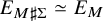
$E_{M\sharp \Sigma }\simeq E_M$
there may be, but we show that
$E_{M\sharp \Sigma }\simeq E_M$
 in
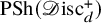
$\mathrm {PSh}(\mathscr {D}\mathrm {isc}^{+}_d)$
in
$\mathrm {PSh}(\mathscr {D}\mathrm {isc}^{+}_d)$
 for all oriented homotopy d-spheres
$\Sigma $
for all oriented homotopy d-spheres
$\Sigma $
 (and hence also in
$\mathrm {PSh}(\mathscr {D}\mathrm {isc}^{+}_{d,\leq k})$
(and hence also in
$\mathrm {PSh}(\mathscr {D}\mathrm {isc}^{+}_{d,\leq k})$
 for any k, by restriction). This is closely related to [Reference Knudsen and KupersKK24a, Theorem B]. By smoothing theory for embedding calculus [Reference Krannich and KupersKK26, Theorem 5.21 (ii)], it suffices to show that the two lifts of the topological tangent bundle
$M\rightarrow \mathrm {BSTop}(4)$
for any k, by restriction). This is closely related to [Reference Knudsen and KupersKK24a, Theorem B]. By smoothing theory for embedding calculus [Reference Krannich and KupersKK26, Theorem 5.21 (ii)], it suffices to show that the two lifts of the topological tangent bundle
$M\rightarrow \mathrm {BSTop}(4)$
 along
$\mathrm {BSO}(4)\rightarrow \mathrm {BSTop}(4)$
along
$\mathrm {BSO}(4)\rightarrow \mathrm {BSTop}(4)$
 induced by the smooth structure of M and of
$M\sharp \Sigma $
induced by the smooth structure of M and of
$M\sharp \Sigma $
 are homotopic as lifts. For that it is enough to show that the two lifts of
$D^4\rightarrow \mathrm {BSTop}(4)$
are homotopic as lifts. For that it is enough to show that the two lifts of
$D^4\rightarrow \mathrm {BSTop}(4)$
 induced by the smooth structure of
$D^4$
induced by the smooth structure of
$D^4$
 and of
$D^4\sharp \Sigma $
and of
$D^4\sharp \Sigma $
 are homotopic as lifts, relative to the given lift on
$\partial D^4$
are homotopic as lifts, relative to the given lift on
$\partial D^4$
 induced by the standard smooth structure. But the obstruction for the existence of such a homotopy of lifts lies in
$\pi _4(\mathrm {Top}(4)/\mathrm {O}(4))$
induced by the standard smooth structure. But the obstruction for the existence of such a homotopy of lifts lies in
$\pi _4(\mathrm {Top}(4)/\mathrm {O}(4))$
 and this group vanishes, since
$\pi _4(\mathrm {Top}(4)/\mathrm {O}(4))\cong \pi _4(\mathrm {Top}/\mathrm {O})$
and this group vanishes, since
$\pi _4(\mathrm {Top}(4)/\mathrm {O}(4))\cong \pi _4(\mathrm {Top}/\mathrm {O})$
 by [Reference Freedman and QuinnFQ90, Theorem 8.7A] and
$\pi _4(\mathrm {Top}/\mathrm {O})$
by [Reference Freedman and QuinnFQ90, Theorem 8.7A] and
$\pi _4(\mathrm {Top}/\mathrm {O})$
 vanishes by [Reference Kirby and SiebenmannKS77, V.5.0 (5)].
Constructing
$M \# \Sigma $
 by modifying the gluing diffeomorphism in a splitting
$M=M_0\cup _PM_1$
by modifying the gluing diffeomorphism in a splitting
$M=M_0\cup _PM_1$
 along a codimension zero submanifold P.

Figure 1 Long description
Top left panel shows a rounded rectangle split by a green curve labeled P, with M zero on the left and M one on the right. Top right panel shows the same regions separated, with a green arrow labeled i d sub P pointing right and an isomorphism symbol above the arrow. Bottom left panel shows the same split, but with a dashed circle labeled Sigma intersecting the green curve. Bottom right panel shows the separated regions again, with a green arrow labeled e x t sub P open parenthesis t w open parenthesis Sigma close parenthesis close parenthesis pointing right and an isomorphism symbol above. The sequence of panels illustrates the process of modifying the gluing diffeomorphism by introducing a twist along Sigma within P.
Turning to the case
$d\ge 7$
 , we begin with a general observation: Given a decomposition
$M=M_0\cup M_1$
, we begin with a general observation: Given a decomposition
$M=M_0\cup M_1$
 of an oriented d-manifold M into two codimension
$0$
of an oriented d-manifold M into two codimension
$0$
 submanifolds
$M_0,M_1\subset N$
submanifolds
$M_0,M_1\subset N$
 that intersect in their common boundary
$P{:=} \partial M_0=\partial M_1$
that intersect in their common boundary
$P{:=} \partial M_0=\partial M_1$
 , then for any embedded disc
$D^{d-1}\subset P$
, then for any embedded disc
$D^{d-1}\subset P$
 compatible with the orientation, there is an orientation-preserving diffeomorphism
$M\sharp \Sigma \cong M_0\cup _{\mathrm {ext}_P(\mathrm {tw}(\Sigma ))}M_1$
compatible with the orientation, there is an orientation-preserving diffeomorphism
$M\sharp \Sigma \cong M_0\cup _{\mathrm {ext}_P(\mathrm {tw}(\Sigma ))}M_1$
 where
$\mathrm {tw} \colon \Theta _d \to \pi _0\,{\mathrm {Diff}}_\partial (D^{d-1})$
where
$\mathrm {tw} \colon \Theta _d \to \pi _0\,{\mathrm {Diff}}_\partial (D^{d-1})$
 is the inverse of the isomorphism from (3) (see Fig. 1). Combining this with Theorem 2.2, when given oriented homotopy d-spheres
$\Sigma _0$
is the inverse of the isomorphism from (3) (see Fig. 1). Combining this with Theorem 2.2, when given oriented homotopy d-spheres
$\Sigma _0$
 and
$\Sigma _1\in \Theta _d$
and
$\Sigma _1\in \Theta _d$
 , to show
$E_{M\sharp \Sigma _0}\simeq E_{M\sharp \Sigma _1}$
, to show
$E_{M\sharp \Sigma _0}\simeq E_{M\sharp \Sigma _1}$
 in
$\mathrm {PSh}(\mathscr {D}\mathrm {isc}_{d,\le k}^{+})$
in
$\mathrm {PSh}(\mathscr {D}\mathrm {isc}_{d,\le k}^{+})$
 for some fixed
$1\le k\le \infty $
for some fixed
$1\le k\le \infty $
 it suffices to show that
$\smash {\mathrm {tw}(\Sigma _0\sharp \overline {\Sigma _1})=\mathrm {tw}(\Sigma _0)\circ \mathrm {tw}(\Sigma _1)^{-1}}$
it suffices to show that
$\smash {\mathrm {tw}(\Sigma _0\sharp \overline {\Sigma _1})=\mathrm {tw}(\Sigma _0)\circ \mathrm {tw}(\Sigma _1)^{-1}}$
 lies in the kernel of the composition of
$\mathrm {ext}_P$
lies in the kernel of the composition of
$\mathrm {ext}_P$
 with the morphism
$\smash {E\colon \pi _0\,{\mathrm {Diff}}^{+}(P)\rightarrow \pi _0\,\mathrm {Aut}_{\mathrm {PSh}(\mathscr {D}\mathrm {isc}^{+}_{d-1,\le k})}(E_{P})}$
with the morphism
$\smash {E\colon \pi _0\,{\mathrm {Diff}}^{+}(P)\rightarrow \pi _0\,\mathrm {Aut}_{\mathrm {PSh}(\mathscr {D}\mathrm {isc}^{+}_{d-1,\le k})}(E_{P})}$
 . Since
$\mathrm {bP}_{d+1}=0$
. Since
$\mathrm {bP}_{d+1}=0$
 for d even by [Reference Kervaire and MilnorKM63, Theorem 5.1, Lemma 2.3] and we assumed
$d\not \equiv 1\ (\mathrm {mod}\ 4)$
for d even by [Reference Kervaire and MilnorKM63, Theorem 5.1, Lemma 2.3] and we assumed
$d\not \equiv 1\ (\mathrm {mod}\ 4)$
 , this shows that in order to prove Theorem 2.1, it suffices to find for
$d=2n+1$
, this shows that in order to prove Theorem 2.1, it suffices to find for
$d=2n+1$
 with
$n\ge 3$
with
$n\ge 3$
 odd a decomposition
$M=M_0\cup M_1$
odd a decomposition
$M=M_0\cup M_1$
 as above, such that the following composition is trivial for
$1\le k<\infty $
as above, such that the following composition is trivial for
$1\le k<\infty $
 :
:

The decomposition we use is the following: for any fixed
$g\ge 0$
 , choose an embedding of the iterated boundary connected sum
$V_g{:=} \natural ^g D^{n+1}\times S^n$
, choose an embedding of the iterated boundary connected sum
$V_g{:=} \natural ^g D^{n+1}\times S^n$
 into M (such an embedding exists since
$V_g$
into M (such an embedding exists since
$V_g$
 embeds into a closed disc
$D^{2n+1}$
embeds into a closed disc
$D^{2n+1}$
 which in turn embeds into any nonempty manifold), set
$M_0$
which in turn embeds into any nonempty manifold), set
$M_0$
 to be the image of the embedding and
$M_1$
to be the image of the embedding and
$M_1$
 to be the closure of its complement. The submanifolds
$M_0$
to be the closure of its complement. The submanifolds
$M_0$
 and
$M_1$
and
$M_1$
 intersect in their common boundary which is diffeomorphic to
$W_{g}= \partial (V_g)=\sharp ^g S^n \times S^n$
intersect in their common boundary which is diffeomorphic to
$W_{g}= \partial (V_g)=\sharp ^g S^n \times S^n$
 . It thus suffices to show that (4) is trivial for
$P=W_g$
. It thus suffices to show that (4) is trivial for
$P=W_g$
 for some value of
$g\ge 0$
for some value of
$g\ge 0$
 . This is true for any
$g\ge 2$
. This is true for any
$g\ge 2$
 , since the composition
$\mathrm {bP}_{2n+2}\rightarrow \pi _0\,{\mathrm {Diff}}^{+}(W_g)$
, since the composition
$\mathrm {bP}_{2n+2}\rightarrow \pi _0\,{\mathrm {Diff}}^{+}(W_g)$
 lands in the finite residual of
$\pi _0\,{\mathrm {Diff}}^{+}(W_g)$
lands in the finite residual of
$\pi _0\,{\mathrm {Diff}}^{+}(W_g)$
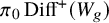 by Theorem 2.3 (it is in fact equal to it, but we will not need this), so as finite residuals are preserved by group homomorphisms, the image of the composition (4) is for
$g\ge 2$
by Theorem 2.3 (it is in fact equal to it, but we will not need this), so as finite residuals are preserved by group homomorphisms, the image of the composition (4) is for
$g\ge 2$
 contained in the finite residual of
$\smash {\pi _0\,\mathrm {Aut}_{\mathrm {PSh}(\mathscr {D}\mathrm {isc}^{+}_{d,\le k})}(E_{W_g})}$
contained in the finite residual of
$\smash {\pi _0\,\mathrm {Aut}_{\mathrm {PSh}(\mathscr {D}\mathrm {isc}^{+}_{d,\le k})}(E_{W_g})}$
 . But the latter finite residual is trivial by [Reference MezherMez24, Theorem 3.16], so the claim follows.
2.2
$\mathscr {D}\mathrm {isc}$
-presheaves of
$\mathrm {coker}(J)$
-spheres


We now turn to the “only if” direction of Theorem A. In dimensions
$d\le 6$
 any homotopy d-sphere bounds a compact parallelisable manifold (combine [Reference Kervaire and MilnorKM63, p. 504] with [Reference KervaireKer69, Theorem 3]), so there is nothing to show. In dimensions
$d\ge 7$
any homotopy d-sphere bounds a compact parallelisable manifold (combine [Reference Kervaire and MilnorKM63, p. 504] with [Reference KervaireKer69, Theorem 3]), so there is nothing to show. In dimensions
$d\ge 7$
 , we use that by Kervaire–Milnor’s exact sequence [Reference Kervaire and MilnorKM63], the condition
$\Sigma _0\sharp \overline {\Sigma }_1\in \mathrm {bP}_{d+1}$
, we use that by Kervaire–Milnor’s exact sequence [Reference Kervaire and MilnorKM63], the condition
$\Sigma _0\sharp \overline {\Sigma }_1\in \mathrm {bP}_{d+1}$
 in Theorem A is equivalent to
$\Sigma _0$
in Theorem A is equivalent to
$\Sigma _0$
 and
$\Sigma _1$
and
$\Sigma _1$
 having the same image under the morphism
$\Theta _d\rightarrow \mathrm {coker}(J)_d$
having the same image under the morphism
$\Theta _d\rightarrow \mathrm {coker}(J)_d$
 from loc.cit., so the “only if” direction of Theorem A follows from:
Theorem 2.5. For oriented homotopy d-spheres
$\Sigma _0$
 and
$\Sigma _1$
and
$\Sigma _1$
 whose associated oriented
$2$
whose associated oriented
$2$
 -truncated
$\mathscr {D}\mathrm {isc}$
-truncated
$\mathscr {D}\mathrm {isc}$
 -presheaves
$E_{\Sigma _0}, E_{\Sigma _1}\in \mathrm {PSh}(\mathscr {D}\mathrm {isc}_{d,\le 2}^{+})$
-presheaves
$E_{\Sigma _0}, E_{\Sigma _1}\in \mathrm {PSh}(\mathscr {D}\mathrm {isc}_{d,\le 2}^{+})$
 are equivalent, we have

In particular, if
$[\Sigma ]\neq 0\in \mathrm {coker}(J)_d$
 , then
$E_{\Sigma }\not \simeq E_{S^d}$
, then
$E_{\Sigma }\not \simeq E_{S^d}$
 in
$\mathrm {PSh}(\mathscr {D}\mathrm {isc}_{d,\le 2}^{+})$
in
$\mathrm {PSh}(\mathscr {D}\mathrm {isc}_{d,\le 2}^{+})$
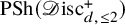 .
.
The main ingredient for the proof of Theorem 2.5 says, informally speaking, that the Atiyah duality equivalence for manifolds can be made natural in equivalences of
$2$
 -truncated
$\mathscr {D}\mathrm {isc}$
-truncated
$\mathscr {D}\mathrm {isc}$
 -presheaves. To explain the precise statement, recall that a k-truncated
$\mathscr {D}\mathrm {isc}$
-presheaves. To explain the precise statement, recall that a k-truncated
$\mathscr {D}\mathrm {isc}$
 -presheaf
$X\in \mathrm {PSh}(\mathscr {D}\mathrm {isc}_{d,\le k})$
-presheaf
$X\in \mathrm {PSh}(\mathscr {D}\mathrm {isc}_{d,\le k})$
 has for
$k\ge 1$
has for
$k\ge 1$
 an underlying space, given by the orbits

of the action of
$\smash {{\mathrm {Diff}}(\mathbf {R}^d)\simeq \mathrm {Aut}_{\mathrm {PSh}(\mathscr {D}\mathrm {isc}_{d,\le k})}(\mathbf {R}^d)\simeq \mathrm {O}(d)}$
 on
$X(\mathbf {R}^d)$
on
$X(\mathbf {R}^d)$
 by functoriality, and this space comes with a d-dimensional vector bundle
$\xi _X$
by functoriality, and this space comes with a d-dimensional vector bundle
$\xi _X$
 over it, classified by the map

If
$X\simeq E_M$
 for a smooth d-manifold M, then
$|X|\simeq M$
for a smooth d-manifold M, then
$|X|\simeq M$
 and
$\xi _X$
and
$\xi _X$
 models the tangent bundle
$TM$
models the tangent bundle
$TM$
 (see [Reference Krannich and KupersKK26, Proposition 5.10]). If M is a closed manifold, then the Pontryagin–Thom collapse map induced by the choice of an embedding
$M\subset \mathbf {R}^{d+k}$
(see [Reference Krannich and KupersKK26, Proposition 5.10]). If M is a closed manifold, then the Pontryagin–Thom collapse map induced by the choice of an embedding
$M\subset \mathbf {R}^{d+k}$
 for
$k\gg 0$
for
$k\gg 0$
 gives a map
$\mathbf {S} \to {\mathrm {Th}}(-TM)$
gives a map
$\mathbf {S} \to {\mathrm {Th}}(-TM)$
 from the sphere spectrum to the Thom spectrum of the stable normal bundle of M, called the stable collapse map, which is natural in diffeomorphisms. In Section 4 we will show that it is even natural in equivalences of
$2$
from the sphere spectrum to the Thom spectrum of the stable normal bundle of M, called the stable collapse map, which is natural in diffeomorphisms. In Section 4 we will show that it is even natural in equivalences of
$2$
 -truncated presheaves, in the sense of the following theorem. In the statement and henceforth, we write
${\mathrm {map}}(-,-)$
-truncated presheaves, in the sense of the following theorem. In the statement and henceforth, we write
${\mathrm {map}}(-,-)$
 for mapping spectra and
$D(-) := {\mathrm {map}}(-,\mathbf {S})$
for mapping spectra and
$D(-) := {\mathrm {map}}(-,\mathbf {S})$
 for Spanier–Whitehead duals.
Theorem 2.6. To any
$2$
 -truncated presheaf
$X \in \mathrm {PSh}(\mathscr {D}\mathrm {isc}_{d,\leq 2})$
-truncated presheaf
$X \in \mathrm {PSh}(\mathscr {D}\mathrm {isc}_{d,\leq 2})$
 , one can associate a zig-zag of maps of spectra which is natural in equivalences in
$\mathrm {PSh}(\mathscr {D}\mathrm {isc}_{d,\leq 2})$
, one can associate a zig-zag of maps of spectra which is natural in equivalences in
$\mathrm {PSh}(\mathscr {D}\mathrm {isc}_{d,\leq 2})$
 ,
,

and has the property that if
$X=E_M$
 for a closed smooth d-manifold M, then the wrong-way map is an equivalence and the map
$\mathbf {S}\rightarrow {\mathrm {Th}}(-TM)$
for a closed smooth d-manifold M, then the wrong-way map is an equivalence and the map
$\mathbf {S}\rightarrow {\mathrm {Th}}(-TM)$
 resulting from choosing an inverse is equivalent to the stable collapse map of M.
Remark 2.7. Some remarks on Theorem 2.6:
-
1. The construction in the proof Theorem 2.6 is closely related to work of Naef–Safronov (c.f. [Reference Naef and SafronovNS24, Section 4.2], and Remark 4.7 below). There is an alternative construction based on constructing collapse maps for $\mathscr {D}\mathrm {isc}$
-presheaves, inspired by [Reference Krannich and KupersKK25, Section 4]. -
2. The first map in (6) is induced by the unique map $\lvert X\rvert \rightarrow \ast $
, so considering only the right two maps in (6), Theorem 2.6 can be interpreted as saying that the Atiyah duality equivalence
$D(\Sigma _+^\infty M) \simeq {\mathrm {Th}}(-TM)$
can be recovered from the
$2$
-truncated presheaf
$E_M$
associated to M, naturally in equivalences of presheaves. -
3. A variant of Theorem 2.6 holds in the setting of topological manifolds (see Remark 4.8).
-
4. Theorem 2.6 suggests the following notion: a k-truncated presheaf $X \in \mathrm {PSh}(\mathscr {D}\mathrm {isc}_{d,\leq k})$
for
$2\le k\le \infty $
is closed if (a)
$\lvert X\rvert $
lies in the full subcategory
$\mathscr {S}^\omega \subset \mathscr {S}$
of compact objects in the
$\infty $
-category of spaces, (b) the wrong way map in (6) is an equivalence, (c) and the resulting map
$c_X\colon \mathbf {S}\rightarrow {\mathrm {Th}}(-\xi _X)$
exhibits
$-\xi _X$
as the dualising spectrum of
$\lvert X\rvert $
(in the sense of e.g., [Reference LandLan22, p. 227]). In particular, in this case the underlying space
$\lvert X\rvert $
is a d-dimensional Poincaré duality space (see p. 228-220 loc.cit.).











Assuming Theorem 2.6, we prove Theorem 2.5 on
$\mathscr {D}\mathrm {isc}$
 -presheaves of
$\mathrm {coker}(J)$
-presheaves of
$\mathrm {coker}(J)$
 -spheres:
Proof of Theorem 2.5
We first recall the definition of the element
$[\Sigma ]\in \mathrm {coker}(J)_d$
 associated to an oriented homotopy d-sphere (cf. [Reference Kervaire and MilnorKM63, Section 4]): Given an oriented homotopy d-sphere
$\Sigma $
associated to an oriented homotopy d-sphere (cf. [Reference Kervaire and MilnorKM63, Section 4]): Given an oriented homotopy d-sphere
$\Sigma $
 , consider its stable collapse map
$\mathbf {S}\rightarrow {\mathrm {Th}}(-T\Sigma )$
, consider its stable collapse map
$\mathbf {S}\rightarrow {\mathrm {Th}}(-T\Sigma )$
 . Choosing a stable framing of
$\Sigma $
. Choosing a stable framing of
$\Sigma $
 gives an equivalence
${\mathrm {Th}}(-T\Sigma )\simeq \mathbf {S}^{-d}$
gives an equivalence
${\mathrm {Th}}(-T\Sigma )\simeq \mathbf {S}^{-d}$
 , so the stable collapse map gives an element in
$\pi _0(\mathbf {S}^{-d})\cong \pi _d(\mathbf {S})$
, so the stable collapse map gives an element in
$\pi _0(\mathbf {S}^{-d})\cong \pi _d(\mathbf {S})$
 . Its image in
$\mathrm {coker}(J)_d$
. Its image in
$\mathrm {coker}(J)_d$
 turns out to be independent of the choice of stable framing as long as the latter is chosen to be compatible with the given orientation of
$\Sigma $
turns out to be independent of the choice of stable framing as long as the latter is chosen to be compatible with the given orientation of
$\Sigma $
 ; this defines the homomorphism
$\Theta _d\rightarrow \mathrm {coker}(J)_d$
; this defines the homomorphism
$\Theta _d\rightarrow \mathrm {coker}(J)_d$
 . In particular, we see that the class
$[\Sigma ]\in \mathrm {coker}(J)_d$
. In particular, we see that the class
$[\Sigma ]\in \mathrm {coker}(J)_d$
 depends only on (a) a classifier of the stable oriented tangent bundle
$T\Sigma \colon \Sigma \rightarrow \mathrm {BSO}$
depends only on (a) a classifier of the stable oriented tangent bundle
$T\Sigma \colon \Sigma \rightarrow \mathrm {BSO}$
 and (b) the homotopy class of the stable collapse map
$\mathbf {S}\rightarrow {\mathrm {Th}}(-T\Sigma )$
and (b) the homotopy class of the stable collapse map
$\mathbf {S}\rightarrow {\mathrm {Th}}(-T\Sigma )$
 . By the discussion above, in particular Theorem 2.6, both of these can be recovered from the equivalence class of the
$2$
. By the discussion above, in particular Theorem 2.6, both of these can be recovered from the equivalence class of the
$2$
 -truncated presheaf
$E_\Sigma \in \mathrm {PSh}(\mathscr {D}\mathrm {isc}^{+}_{d,\le 2})$
-truncated presheaf
$E_\Sigma \in \mathrm {PSh}(\mathscr {D}\mathrm {isc}^{+}_{d,\le 2})$
 , so the claim follows.
2.3 Digression:
$\mathscr {D}\mathrm {isc}$
-structure spaces and L-theory

Theorem 2.6 allows one to relate the
$\mathscr {D}\mathrm {isc}$
 -structure spaces from [Reference Krannich and KupersKK24b] to algebraic L-theory. We intend to take up this direction in future work, but briefly sketch how this goes:
We write
$\smash {\mathscr {P}\mathrm {oinc}^\simeq _d}$
 for the
$\infty $
for the
$\infty $
 -groupoid of d-dimensional Poincaré spaces (in the sense of e.g., [Reference LandLan22, p. 228-220]; this is a full subgroupoid of the core of the full subcategory
$\mathscr {S}^\omega $
-groupoid of d-dimensional Poincaré spaces (in the sense of e.g., [Reference LandLan22, p. 228-220]; this is a full subgroupoid of the core of the full subcategory
$\mathscr {S}^\omega $
 of compact objects in the
$\infty $
of compact objects in the
$\infty $
 -category
$\mathscr {S}$
-category
$\mathscr {S}$
 of spaces) and
$\mathscr {P}\mathrm {oinc}^{\nu ,\simeq }_d$
of spaces) and
$\mathscr {P}\mathrm {oinc}^{\nu ,\simeq }_d$
 for the
$\infty $
for the
$\infty $
 -groupoid of d-dimensional Poincaré spaces together with a stable vector bundle refinement of its Spivak fibration (this can be constructed as a full subgroupoid of the core of the pullback of the composition
$\smash {\mathscr {S}^{\omega }_{/\mathbf {Z}\times \mathrm {BO}}\rightarrow \mathscr {S}^{\omega }_{/\mathrm {Sp}^\simeq }\rightarrow \mathrm {Sp}}$
-groupoid of d-dimensional Poincaré spaces together with a stable vector bundle refinement of its Spivak fibration (this can be constructed as a full subgroupoid of the core of the pullback of the composition
$\smash {\mathscr {S}^{\omega }_{/\mathbf {Z}\times \mathrm {BO}}\rightarrow \mathscr {S}^{\omega }_{/\mathrm {Sp}^\simeq }\rightarrow \mathrm {Sp}}$
 whose second functor is induced by taking colimits in the category
$\mathrm {Sp}$
whose second functor is induced by taking colimits in the category
$\mathrm {Sp}$
 of spectra, along
$\mathrm {Sp}_{\mathbf {S}/}\rightarrow \mathrm {Sp}$
of spectra, along
$\mathrm {Sp}_{\mathbf {S}/}\rightarrow \mathrm {Sp}$
 ). In these terms Theorem 2.6 yields a lift
$\smash {\lvert -\rvert ^\nu \colon \mathrm {PSh}^{\mathrm {cl}}(\mathscr {D}\mathrm {isc}_{d})^\simeq \rightarrow \mathscr {P}\mathrm {oinc}^{\nu ,\simeq }_d}$
). In these terms Theorem 2.6 yields a lift
$\smash {\lvert -\rvert ^\nu \colon \mathrm {PSh}^{\mathrm {cl}}(\mathscr {D}\mathrm {isc}_{d})^\simeq \rightarrow \mathscr {P}\mathrm {oinc}^{\nu ,\simeq }_d}$
 of the functor
$\smash {\lvert -\rvert \colon \mathrm {PSh}^{\mathrm {cl}}(\mathscr {D}\mathrm {isc}_{d})^\simeq \rightarrow \mathscr {P}\mathrm {oinc}_d^\simeq }$
of the functor
$\smash {\lvert -\rvert \colon \mathrm {PSh}^{\mathrm {cl}}(\mathscr {D}\mathrm {isc}_{d})^\simeq \rightarrow \mathscr {P}\mathrm {oinc}_d^\simeq }$
 , where
$\smash {\mathrm {PSh}^{\mathrm {cl}}(\mathscr {D}\mathrm {isc}_{d})\subset \mathrm {PSh}(\mathscr {D}\mathrm {isc}_{d})}$
, where
$\smash {\mathrm {PSh}^{\mathrm {cl}}(\mathscr {D}\mathrm {isc}_{d})\subset \mathrm {PSh}(\mathscr {D}\mathrm {isc}_{d})}$
 is the full subcategory of closed presheaves as in Remark 2.7 4. Moreover, with some effort, one ought to be able to construct a commutative square

where
$\smash {\mathscr {M}\mathrm {fd}^{\mathrm {cl},\cong }_d}$
 (respectively
$\smash {\widetilde {\mathscr {M}\mathrm {fd}}^{\mathrm {cl},\cong }_d}$
(respectively
$\smash {\widetilde {\mathscr {M}\mathrm {fd}}^{\mathrm {cl},\cong }_d}$
 ) is the
$\infty $
) is the
$\infty $
 -groupoid of closed d-dimensional smooth manifolds and spaces of diffeomorphisms (respectively block-diffeomorphisms) between them. The map
$\nu $
-groupoid of closed d-dimensional smooth manifolds and spaces of diffeomorphisms (respectively block-diffeomorphisms) between them. The map
$\nu $
 is induced by taking stable normal bundles and constructed such that it agrees after taking fibres over
$\mathscr {P}\mathrm {oinc}_d^\simeq $
is induced by taking stable normal bundles and constructed such that it agrees after taking fibres over
$\mathscr {P}\mathrm {oinc}_d^\simeq $
 with the normal invariant map in surgery theory. The fibre of the top map at
$E_M$
with the normal invariant map in surgery theory. The fibre of the top map at
$E_M$
 for
$\smash {M\in \mathscr {M}\mathrm {fd}^{\mathrm {cl},\cong }_d}$
for
$\smash {M\in \mathscr {M}\mathrm {fd}^{\mathrm {cl},\cong }_d}$
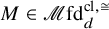 is by definition the
$\mathscr {D}\mathrm {isc}$
is by definition the
$\mathscr {D}\mathrm {isc}$
 -structure space
$\smash {S^{\mathscr {D}\mathrm {isc}}(M)}$
-structure space
$\smash {S^{\mathscr {D}\mathrm {isc}}(M)}$
 as introduced in [Reference Krannich and KupersKK24b], so taking horizontal fibres yields a map

Moreover, if
$d\ge 5$
 , then by surgery theory, the collection of the components
$(N, \nu (M)\simeq \nu (N))$
, then by surgery theory, the collection of the components
$(N, \nu (M)\simeq \nu (N))$
 of the target whose underlying homotopy equivalence
$M\simeq N$
of the target whose underlying homotopy equivalence
$M\simeq N$
 is simple (with the finiteness structure on M and N induced from their manifold structures), is equivalent to the loop space of the quadratic L-theory space
$L^q(M)$
is simple (with the finiteness structure on M and N induced from their manifold structures), is equivalent to the loop space of the quadratic L-theory space
$L^q(M)$
 of M, so writing
$S^{\mathscr {D}\mathrm {isc}}(M)^s\subset S^{\mathscr {D}\mathrm {isc}}(M)$
of M, so writing
$S^{\mathscr {D}\mathrm {isc}}(M)^s\subset S^{\mathscr {D}\mathrm {isc}}(M)$
 for the components of
$(N,E_M\simeq E_N)$
for the components of
$(N,E_M\simeq E_N)$
 whose underlying homotopy equivalence
$M\simeq N$
whose underlying homotopy equivalence
$M\simeq N$
 is simple (note that we have
$S^{\mathscr {D}\mathrm {isc}}(M)=S^{\mathscr {D}\mathrm {isc}}(M)^s$
is simple (note that we have
$S^{\mathscr {D}\mathrm {isc}}(M)=S^{\mathscr {D}\mathrm {isc}}(M)^s$
 if M is simply connected, or more generally – by [Reference Naef and SafronovNS24, Corollary C] – if the Dennis trace
$\mathrm {Wh}(\pi _1(M))\rightarrow H_1(LM,M)$
if M is simply connected, or more generally – by [Reference Naef and SafronovNS24, Corollary C] – if the Dennis trace
$\mathrm {Wh}(\pi _1(M))\rightarrow H_1(LM,M)$
 is injective), one obtains a map of the form

As a result of [Reference Krannich and KupersKK24b, Theorem A], the source of this map depends up to equivalence only on the tangential
$2$
 -type of M, and by the
$\pi \text {-}\pi $
-type of M, and by the
$\pi \text {-}\pi $
 -theorem the same holds for the target (in fact it only depends on the
$1$
-theorem the same holds for the target (in fact it only depends on the
$1$
 -truncation of M and the first Stiefel–Whitney class). It seems conceivable that the map (8) also only depends on the tangential
$2$
-truncation of M and the first Stiefel–Whitney class). It seems conceivable that the map (8) also only depends on the tangential
$2$
 -type of M.
3 Gluing
$\mathscr {D}\mathrm {isc}$
-presheaves

This section serves to establish the first of the three ingredients assumed in Section 2: Theorem 2.2 on the dependence of
$\mathscr {D}\mathrm {isc}$
 -presheaves of glued manifolds on the gluing diffeomorphism. We will deduce this from a general gluing-result for presheaves.
Remark. Throughout this section, we assume familiarity with
$\infty $
 -analogues of standard concepts in category theory, as developed in [Reference LurieLur09, Reference LurieLur17]. In particular Kan extensions (see [Reference LurieLur09, Section 4.3]) and Beck–Chevalley conditions (also called adjointability conditions; see [Reference LurieLur17, 4.7.4.13-4.7.4.15]) will play a key role.
3.1 Gluing
$\mathscr {D}\mathrm {isc}$
-presheaves

3.1.1 Manifolds with boundary
Write
$\smash {\mathscr {M}\mathrm {fd}^\partial _d}$
 for the
$\infty $
for the
$\infty $
 -category whose objects are d-manifolds M (potentially noncompact and with boundary) and whose morphisms are spaces
$\mathrm {Emb}^\partial (M,N)$
-category whose objects are d-manifolds M (potentially noncompact and with boundary) and whose morphisms are spaces
$\mathrm {Emb}^\partial (M,N)$
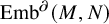 of embeddings
$e\colon M\hookrightarrow N$
of embeddings
$e\colon M\hookrightarrow N$
 with
$e^{-1}(\partial N)=\partial M$
with
$e^{-1}(\partial N)=\partial M$
 (see Remark 3.5 for a precise construction of
$\smash {\mathscr {M}\mathrm {fd}^\partial _d}$
(see Remark 3.5 for a precise construction of
$\smash {\mathscr {M}\mathrm {fd}^\partial _d}$
 ). It contains as a full subcategory the category
$\mathscr {M}\mathrm {fd}_d$
). It contains as a full subcategory the category
$\mathscr {M}\mathrm {fd}_d$
 of d-manifolds without boundary and embeddings between them. Taking boundaries yields a functor
$\smash {\partial \colon \mathscr {M}\mathrm {fd}^\partial _{d}\rightarrow \mathscr {M}\mathrm {fd}_{d-1}}$
of d-manifolds without boundary and embeddings between them. Taking boundaries yields a functor
$\smash {\partial \colon \mathscr {M}\mathrm {fd}^\partial _{d}\rightarrow \mathscr {M}\mathrm {fd}_{d-1}}$
 which has a fully faithful left adjoint
$\smash {\kappa \colon \mathscr {M}\mathrm {fd}_{d-1}\rightarrow \mathscr {M}\mathrm {fd}^\partial _{d}}$
which has a fully faithful left adjoint
$\smash {\kappa \colon \mathscr {M}\mathrm {fd}_{d-1}\rightarrow \mathscr {M}\mathrm {fd}^\partial _{d}}$
 given by taking products with
$[0,\infty )$
given by taking products with
$[0,\infty )$
 , that is, it sends
$P\in \mathscr {M}\mathrm {fd}_{d-1}$
, that is, it sends
$P\in \mathscr {M}\mathrm {fd}_{d-1}$
 to
$P\times [0,\infty )$
to
$P\times [0,\infty )$
 . The reason that these functors are adjoint is that the restriction map
$\mathrm {Emb}^\partial (P\times [0,\infty ),M)\rightarrow \mathrm {Emb}(P,\partial M)$
. The reason that these functors are adjoint is that the restriction map
$\mathrm {Emb}^\partial (P\times [0,\infty ),M)\rightarrow \mathrm {Emb}(P,\partial M)$
 is an equivalence for all
$P\in \mathscr {M}\mathrm {fd}_{d-1}$
is an equivalence for all
$P\in \mathscr {M}\mathrm {fd}_{d-1}$
 and
$M\in \mathscr {M}\mathrm {fd}^\partial _d$
and
$M\in \mathscr {M}\mathrm {fd}^\partial _d$
 , as its fibres are equivalent to spaces of collars, which are contractible. Note that the unit of this adjunction
$\mathrm {id}\rightarrow \partial \kappa $
, as its fibres are equivalent to spaces of collars, which are contractible. Note that the unit of this adjunction
$\mathrm {id}\rightarrow \partial \kappa $
 is an equivalence, as
$P=\partial (P\times [0,\infty ))$
is an equivalence, as
$P=\partial (P\times [0,\infty ))$
 . Since
$\partial $
. Since
$\partial $
 is right adjoint to
$\kappa $
is right adjoint to
$\kappa $
 , the left Kan extension
$\smash {\partial _!\colon \mathrm {PSh}(\mathscr {M}\mathrm {fd}^\partial _d)\rightarrow \mathrm {PSh}(\mathscr {M}\mathrm {fd}^\partial _{d-1})}$
, the left Kan extension
$\smash {\partial _!\colon \mathrm {PSh}(\mathscr {M}\mathrm {fd}^\partial _d)\rightarrow \mathrm {PSh}(\mathscr {M}\mathrm {fd}^\partial _{d-1})}$
 is right adjoint to
$\kappa _!$
is right adjoint to
$\kappa _!$
 (the fact that passing to left Kan extensions preserves adjoints follows by observing that it preserves the triangle identities that characterise adjunctions), so since restriction is also left adjoint to left Kan extension, we get an equivalence
$\partial _!\simeq \kappa ^{\ast }$
(the fact that passing to left Kan extensions preserves adjoints follows by observing that it preserves the triangle identities that characterise adjunctions), so since restriction is also left adjoint to left Kan extension, we get an equivalence
$\partial _!\simeq \kappa ^{\ast }$
 of functors
$\mathrm {PSh}(\mathscr {M}\mathrm {fd}^\partial _d)\rightarrow \mathrm {PSh}(\mathscr {M}\mathrm {fd}_{d-1})$
of functors
$\mathrm {PSh}(\mathscr {M}\mathrm {fd}^\partial _d)\rightarrow \mathrm {PSh}(\mathscr {M}\mathrm {fd}_{d-1})$
 .
.
3.1.2
$\mathscr {D}\mathrm {isc}$
-subcategories

Writing
$\mathbf {H}^d{:=} [0,\infty )\times \mathbf {R}^{d-1}$
 for the d-dimensional halfspace, we consider the nested sequence of full subcategories of
$\mathscr {M}\mathrm {fd}^\partial _d$
for the d-dimensional halfspace, we consider the nested sequence of full subcategories of
$\mathscr {M}\mathrm {fd}^\partial _d$


where
$\smash {\mathscr {D}\mathrm {isc}_{d,\le k}^\partial \subset \mathscr {M}\mathrm {fd}^\partial _d}$
 is the full subcategory on those manifolds that are diffeomorphic to
$S\times \mathbf {R}^d\sqcup T\times \mathbf {H}^{d-1}$
is the full subcategory on those manifolds that are diffeomorphic to
$S\times \mathbf {R}^d\sqcup T\times \mathbf {H}^{d-1}$
 for finite sets S and T with
$\lvert S\rvert +\lvert T\rvert \le k$
for finite sets S and T with
$\lvert S\rvert +\lvert T\rvert \le k$
 . Note that intersecting (9) with
$\smash {\mathscr {M}\mathrm {fd}_d\subset \mathscr {M}\mathrm {fd}^\partial _d}$
. Note that intersecting (9) with
$\smash {\mathscr {M}\mathrm {fd}_d\subset \mathscr {M}\mathrm {fd}^\partial _d}$
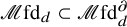 yields the nested sequence of full subcategories
$\smash {\mathscr {D}\mathrm {isc}_{d,\le \bullet }\subset \mathscr {M}\mathrm {fd}_d}$
yields the nested sequence of full subcategories
$\smash {\mathscr {D}\mathrm {isc}_{d,\le \bullet }\subset \mathscr {M}\mathrm {fd}_d}$
 on manifolds diffeomorphic to
$S\times \mathbf {R}^d$
on manifolds diffeomorphic to
$S\times \mathbf {R}^d$
 with
$|S|\le \bullet $
with
$|S|\le \bullet $
 , as in the introduction. The functor
$\kappa $
, as in the introduction. The functor
$\kappa $
 preserves these subcategories and gives a map of nested sequences
$\kappa \colon \mathscr {D}\mathrm {isc}_{d-1,\le \bullet }\rightarrow \mathscr {D}\mathrm {isc}^\partial _{d,\le \bullet }$
preserves these subcategories and gives a map of nested sequences
$\kappa \colon \mathscr {D}\mathrm {isc}_{d-1,\le \bullet }\rightarrow \mathscr {D}\mathrm {isc}^\partial _{d,\le \bullet }$
 , and thus a map of towers (in the sense of [Reference Krannich and KupersKK26, Section 1.2]) of categories
$\smash {\kappa ^{\ast }\colon \mathrm {PSh}(\mathscr {D}\mathrm {isc}^\partial _{d,\le \bullet })\rightarrow \mathrm {PSh}(\mathscr {D}\mathrm {isc}_{d-1,\le \bullet })}$
, and thus a map of towers (in the sense of [Reference Krannich and KupersKK26, Section 1.2]) of categories
$\smash {\kappa ^{\ast }\colon \mathrm {PSh}(\mathscr {D}\mathrm {isc}^\partial _{d,\le \bullet })\rightarrow \mathrm {PSh}(\mathscr {D}\mathrm {isc}_{d-1,\le \bullet })}$
 by restriction. The adjunction
$\kappa \vdash \partial $
by restriction. The adjunction
$\kappa \vdash \partial $
 from Section 3.1.1 restricts to adjunctions of the form
$\smash {\kappa \colon \mathscr {D}\mathrm {isc}_{d-1,\le k} \rightleftarrows \mathscr {D}\mathrm {isc}^\partial _{d,\le k}\colon \partial }$
from Section 3.1.1 restricts to adjunctions of the form
$\smash {\kappa \colon \mathscr {D}\mathrm {isc}_{d-1,\le k} \rightleftarrows \mathscr {D}\mathrm {isc}^\partial _{d,\le k}\colon \partial }$
 for all k, so as above we obtain
$\partial _!\simeq \kappa ^{\ast }$
for all k, so as above we obtain
$\partial _!\simeq \kappa ^{\ast }$
 as functors
$\mathrm {PSh}(\mathscr {D}\mathrm {isc}^\partial _{d,\le k})\rightarrow \mathrm {PSh}(\mathscr {D}\mathrm {isc}_{d-1,\le k})$
as functors
$\mathrm {PSh}(\mathscr {D}\mathrm {isc}^\partial _{d,\le k})\rightarrow \mathrm {PSh}(\mathscr {D}\mathrm {isc}_{d-1,\le k})$
 . Writing
$\smash {\iota ^\partial \colon \mathscr {D}\mathrm {isc}_{d,\le \bullet }^\partial \hookrightarrow \mathscr {M}\mathrm {fd}^\partial _d}$
. Writing
$\smash {\iota ^\partial \colon \mathscr {D}\mathrm {isc}_{d,\le \bullet }^\partial \hookrightarrow \mathscr {M}\mathrm {fd}^\partial _d}$
 and
$\smash {\iota \colon \mathscr {D}\mathrm {isc}_{d-1,\le \bullet }\hookrightarrow \mathscr {M}\mathrm {fd}_{d-1}}$
and
$\smash {\iota \colon \mathscr {D}\mathrm {isc}_{d-1,\le \bullet }\hookrightarrow \mathscr {M}\mathrm {fd}_{d-1}}$
 for the respective inclusions, this implies that the square

of towers of categories commutes in that the Beck–Chevalley transformation
$\partial _! (\iota ^\partial )^{\ast }\rightarrow \iota ^{\ast }\partial _!$
 is an equivalence. We denote by

the tower of restricted Yoneda embeddings.
3.1.3 Gluing manifolds and
$\mathscr {D}\mathrm {isc}$
-presheaves

Writing

for the pullback of
$\partial \colon \mathscr {M}\mathrm {fd}_d^\partial \rightarrow \mathscr {M}\mathrm {fd}_{d-1} $
 along itself, naturality of the Yoneda embedding yields a functor

to the pullback of the left vertical functor in (10) along itself.
Remark 3.1. An object in
$\mathscr {M}\mathrm {fd}_d^{{\shortparallel }}$
 is given by a triple
$(M_0,M_1,\varphi )$
is given by a triple
$(M_0,M_1,\varphi )$
 where the
$M_i$
where the
$M_i$
 are d-manifolds and
$\varphi \colon \partial M_0\rightarrow \partial M_1$
are d-manifolds and
$\varphi \colon \partial M_0\rightarrow \partial M_1$
 is a diffeomorphism between their boundaries. The spaces of morphisms in
$\mathscr {M}\mathrm {fd}_d^{{\shortparallel }}$
is a diffeomorphism between their boundaries. The spaces of morphisms in
$\mathscr {M}\mathrm {fd}_d^{{\shortparallel }}$
 are given by the pullback of embedding spaces
$\mathrm {Emb}^\partial (M_0,N_0)\times _{\mathrm {Emb}(\partial M_0,\partial N_1)}\mathrm {Emb}^{\partial }(M_1,N_1)$
are given by the pullback of embedding spaces
$\mathrm {Emb}^\partial (M_0,N_0)\times _{\mathrm {Emb}(\partial M_0,\partial N_1)}\mathrm {Emb}^{\partial }(M_1,N_1)$
 . Note that given a d-manifold W without boundary with a decomposition
$W=W_0\cup W_1$
. Note that given a d-manifold W without boundary with a decomposition
$W=W_0\cup W_1$
 into two codimension
$0$
into two codimension
$0$
 submanifolds that intersect in their common boundary
$P{:=} \partial _0W=\partial _1W$
submanifolds that intersect in their common boundary
$P{:=} \partial _0W=\partial _1W$
 , we obtain an object
$(W_0,W_1,\mathrm {id}_P)$
, we obtain an object
$(W_0,W_1,\mathrm {id}_P)$
 , and it turns out that any object
$(M_0,M_1,\varphi )$
, and it turns out that any object
$(M_0,M_1,\varphi )$
 is equivalent to one of this form, by considering the glued manifold
$W=M_0\cup _{\varphi } M_1$
is equivalent to one of this form, by considering the glued manifold
$W=M_0\cup _{\varphi } M_1$
 .
.
We now consider the functor

given by the post composition of (11) with the functor
$\mathrm {PSh}(\mathscr {M}\mathrm {fd}_d^\partial )\times _{\mathrm {PSh}(\mathscr {M}\mathrm {fd}_{d-1})}\mathrm {PSh}(\mathscr {M}\mathrm {fd}_d^\partial )\rightarrow \mathrm {PSh}(\mathscr {D}\mathrm {isc}_{d,\le \bullet }^\partial )\times _{\mathrm {PSh}(\mathscr {D}\mathrm {isc}_{d-1,\le \bullet })}\mathrm {PSh}(\mathscr {D}\mathrm {isc}_{d,\le \bullet }^\partial )$
 induced by the commutative square (10). In arity
$1\le k\le \infty $
induced by the commutative square (10). In arity
$1\le k\le \infty $
 , the functor (12) sends a triple
$(M_0,M_1,\varphi )$
, the functor (12) sends a triple
$(M_0,M_1,\varphi )$
 as in Remark 3.1 to the triple consisting of the presheaves
$E^\partial _{M}$
as in Remark 3.1 to the triple consisting of the presheaves
$E^\partial _{M}$
 and
$E^\partial _{N})$
and
$E^\partial _{N})$
 in
$\smash {\mathrm {PSh}(\mathscr {D}\mathrm {isc}^{\partial }_{d,\le k})}$
in
$\smash {\mathrm {PSh}(\mathscr {D}\mathrm {isc}^{\partial }_{d,\le k})}$
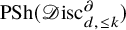 , together with the equivalence
$\partial _!(E^\partial _{M})\simeq E_{\partial M}\simeq E_{\partial N}\simeq \partial _!(E^\partial _{N})$
, together with the equivalence
$\partial _!(E^\partial _{M})\simeq E_{\partial M}\simeq E_{\partial N}\simeq \partial _!(E^\partial _{N})$
 in
$\smash {\mathrm {PSh}(\mathscr {D}\mathrm {isc}_{d-1,\le k})}$
in
$\smash {\mathrm {PSh}(\mathscr {D}\mathrm {isc}_{d-1,\le k})}$
 induced by the diffeomorphism
$\partial M\cong \partial N$
induced by the diffeomorphism
$\partial M\cong \partial N$
 and (10). The goal of the remainder of this section is to prove that the latter data
$(E^\partial _{M},E^\partial _{N},E_{\partial M}\simeq E_{\partial N})$
and (10). The goal of the remainder of this section is to prove that the latter data
$(E^\partial _{M},E^\partial _{N},E_{\partial M}\simeq E_{\partial N})$
 is sufficient to reconstruct the presheaf
$E_{M\cup _\partial N}\in \mathrm {PSh}(\mathscr {D}\mathrm {isc}_{d,\le k})$
is sufficient to reconstruct the presheaf
$E_{M\cup _\partial N}\in \mathrm {PSh}(\mathscr {D}\mathrm {isc}_{d,\le k})$
 of the glued manifold. More concretely, gluing manifolds along their boundary yields a functor
$\smash {\gamma \colon \mathscr {M}\mathrm {fd}_d^{{\shortparallel }}\rightarrow \mathscr {M}\mathrm {fd}}$
of the glued manifold. More concretely, gluing manifolds along their boundary yields a functor
$\smash {\gamma \colon \mathscr {M}\mathrm {fd}_d^{{\shortparallel }}\rightarrow \mathscr {M}\mathrm {fd}}$
 (see Remark 3.5) which features in the following theorem:
Theorem 3.2. There exists a commutative square of towers of categories

for some functor of towers
$\smash {\gamma ^{\mathscr {D}\mathrm {isc}}}$
 with the indicated source and target.
Remark 3.3 (Variants of Theorem 3.2)
-
1. There is a variant of Theorem 3.2 for topological manifolds, by replacing all categories of (smooth) manifolds and (smooth) embeddings between them by the corresponding categories of topological manifolds and topological embeddings between them. The proof is the same as in the smooth setting.
-
2. There is also a variant of Theorem 3.2 for manifolds with tangential structures with respect to a map $\theta \colon B\rightarrow \mathrm {BO}(d)$
from some space B: Given a map
$\theta \colon B\rightarrow \mathrm {BO}(d)$
from a space B, there are variants
$\mathscr {M}\mathrm {fd}_d^{\theta ,\partial }$
and
$\mathscr {M}\mathrm {fd}_{d-1}^{\theta }$
of
$\mathscr {M}\mathrm {fd}_d^{\partial }$
and
$\mathscr {M}\mathrm {fd}_{d-1}$
where the manifolds M of dimension d or
$d-1$
are additionally equipped with a
$\theta $
-structure, that is, a bundle map
$TM\rightarrow \theta ^{\ast }\gamma _d$
in the d-dimensional case or
$TM\oplus \varepsilon \rightarrow \theta ^{\ast }\gamma _d$
in the
$(d-1)$
-dimensional case; here
$\gamma _d$
denotes the universal d-dimensional bundle. The functor
$\partial $
has two lifts to a functor
$\smash {\partial \colon \mathscr {M}\mathrm {fd}_d^{\theta ,\partial }\rightarrow \mathscr {M}\mathrm {fd}_{d-1}^{\partial }}$
, induced by restricting a
$\theta $
-structure along the inclusion
$T(\partial M)\oplus \varepsilon \rightarrow TM$
using either an inwards or an outwards pointing vector field. Forming the pullback
$\smash {\mathscr {M}\mathrm {fd}_d^{\theta ,{\shortparallel }}:= \mathscr {M}\mathrm {fd}^{\theta ,\partial }_d\times _{\mathscr {M}\mathrm {fd}^{\theta }_{d-1}}\mathscr {M}\mathrm {fd}^{\theta ,\partial }_d}$
with respect to the two different lifts of
$\partial $
, there is a lift of the gluing functor
$\gamma $
to a functor
$\mathscr {M}\mathrm {fd}^{\theta ,{\shortparallel }}_d\rightarrow \mathscr {M}\mathrm {fd}^\theta _d$
, and this functor fits into a diagram as in Theorem 3.2 if one replaces
$\smash {\mathscr {D}\mathrm {isc}^{\partial }_{d,\le \bullet }}$
and
$\smash {\mathscr {D}\mathrm {isc}_{d-1,\le \bullet }}$
by
$\smash {\mathscr {D}\mathrm {isc}^{\theta ,\partial }_{d,\le \bullet }{:=} \mathscr {D}\mathrm {isc}^{\partial }_{d,\le \bullet }\times _{\mathscr {D}\mathrm {isc}^{\partial }_{d}}\mathscr {M}\mathrm {fd}_d^{\theta ,\partial }}$
and
$\smash {\mathscr {D}\mathrm {isc}^{\theta }_{d-1,\le \bullet }{:=} \mathscr {D}\mathrm {isc}_{d-1,\le \bullet }\times _{\mathscr {D}\mathrm {isc}_{d-1}}\mathscr {M}\mathrm {fd}_{d-1}^{\theta }}$
. The topological version alluded to in 1 can be generalised analogously to include
$\theta $
-structures with respect to a map
$\theta \colon B\rightarrow \mathrm {BTop}(d)$
. These versions with tangential structure can be established by adapting the proof of Theorem 3.2.


















Remark 3.4. There is a similar commutative square of towers

where (a)
$\mathrm {LMod}(-)$
 ,
$\mathrm {RMod}(-)$
,
$\mathrm {RMod}(-)$
 ,
$\mathrm {AAlg}(-)$
,
$\mathrm {AAlg}(-)$
 are the categories of pairs of an associative algebra and a left-module over it, pairs of an associative algebra and a right-module over it, and associative algebras, respectively, in a symmetric monoidal category, (b) the symmetric monoidal structure on
$\mathrm {PSh}(\mathscr {D}\mathrm {isc}_{d,\le k})$
are the categories of pairs of an associative algebra and a left-module over it, pairs of an associative algebra and a right-module over it, and associative algebras, respectively, in a symmetric monoidal category, (b) the symmetric monoidal structure on
$\mathrm {PSh}(\mathscr {D}\mathrm {isc}_{d,\le k})$
 is a localisation of the Day convolution structure induced from the symmetric monoidal structure on
$\mathscr {D}\mathrm {isc}_d$
is a localisation of the Day convolution structure induced from the symmetric monoidal structure on
$\mathscr {D}\mathrm {isc}_d$
 by disjoint union, and (c)
$\otimes $
by disjoint union, and (c)
$\otimes $
 denotes the relative tensor product of modules. This square can be extracted from [Reference Krannich and KupersKK26, Theorem 5.3] (in the nontruncated case
$k=\infty $
denotes the relative tensor product of modules. This square can be extracted from [Reference Krannich and KupersKK26, Theorem 5.3] (in the nontruncated case
$k=\infty $
 , it is also an instance of what is known as
$\otimes $
, it is also an instance of what is known as
$\otimes $
 -excision in the theory of factorisation homology; see [Reference FrancisFra13, Proposition 3.24] and [Reference Ayala and FrancisAF15b, Lemma 3.18]). It implies a version of Theorem 2.2 where the condition

is replaced by

However, this is not sufficient for the proof of Theorem 2.1, since the result from [Reference MezherMez24] the proof relies on – namely that
$\pi _0\,\mathrm {Aut}_{\mathrm {PSh}(\mathscr {D}\mathrm {isc}_{d-1,\le k})}(E_M)$
 is residually finite for
$k<\infty $
is residually finite for
$k<\infty $
 and many manifolds M – is not available for
$\pi _0\,\mathrm {Aut}_{\mathrm {AAlg}(\mathrm {PSh}(\mathscr {D}\mathrm {isc}_{d-1,\le k}))}(E_{M\times \mathbf {R}})$
and many manifolds M – is not available for
$\pi _0\,\mathrm {Aut}_{\mathrm {AAlg}(\mathrm {PSh}(\mathscr {D}\mathrm {isc}_{d-1,\le k}))}(E_{M\times \mathbf {R}})$
 . To circumvent this, it would be sufficient to know that the map of towers
$\mathscr {M}\mathrm {fd}_{d-1}\rightarrow \mathrm {AAlg}(\mathrm {PSh}(\mathscr {D}\mathrm {isc}_{d,\le \bullet }))$
. To circumvent this, it would be sufficient to know that the map of towers
$\mathscr {M}\mathrm {fd}_{d-1}\rightarrow \mathrm {AAlg}(\mathrm {PSh}(\mathscr {D}\mathrm {isc}_{d,\le \bullet }))$
 participating in (13) factors over the map of towers
$E\colon \mathscr {M}\mathrm {fd}_{d-1}\rightarrow \mathrm {PSh}(\mathscr {D}\mathrm {isc}_{d-1,\le \bullet })$
participating in (13) factors over the map of towers
$E\colon \mathscr {M}\mathrm {fd}_{d-1}\rightarrow \mathrm {PSh}(\mathscr {D}\mathrm {isc}_{d-1,\le \bullet })$
 . This can be shown to be indeed the case, but it is not immediate. We decided against pursuing this route in this work when we discovered the construction of the square in Theorem 3.2 which does not rely on
$\otimes $
. This can be shown to be indeed the case, but it is not immediate. We decided against pursuing this route in this work when we discovered the construction of the square in Theorem 3.2 which does not rely on
$\otimes $
 -excision, avoids algebras, modules, and tensor products, and thus might be of independent interest.
Remark 3.5 (Point-set models)
Above we only gave informal definitions of the categories
$\smash {\mathscr {M}\mathrm {fd}_d^{\partial }}$
 and
$\mathscr {M}\mathrm {fd}_{d-1}$
and
$\mathscr {M}\mathrm {fd}_{d-1}$
 in that we only described their objects and spaces of morphisms, and we also only informally specified the functors
$\smash {\partial \colon \mathscr {M}\mathrm {fd}_d^{\partial }\rightarrow \mathscr {M}\mathrm {fd}_{d-1}}$
in that we only described their objects and spaces of morphisms, and we also only informally specified the functors
$\smash {\partial \colon \mathscr {M}\mathrm {fd}_d^{\partial }\rightarrow \mathscr {M}\mathrm {fd}_{d-1}}$
 and
$\smash {\gamma \colon \mathscr {M}\mathrm {fd}_d^{\partial }\times _{ \mathscr {M}\mathrm {fd}_{d-1}}\mathscr {M}\mathrm {fd}_d^{\partial }\rightarrow \mathscr {M}\mathrm {fd}_d}$
and
$\smash {\gamma \colon \mathscr {M}\mathrm {fd}_d^{\partial }\times _{ \mathscr {M}\mathrm {fd}_{d-1}}\mathscr {M}\mathrm {fd}_d^{\partial }\rightarrow \mathscr {M}\mathrm {fd}_d}$
 (all other constructions, however, were formally obtained from these). There are many options for how to construct these categories and functors, one is by defining them explicitly on the level of Kan-enriched categories and taking coherent nerves, another is to extract them from the constructions that were already carried out in [Reference Krannich and KupersKK24b, Section 3]. We explain the latter:
Recall (e.g., from [Reference Krannich and KupersKK26, Section 1.1]) that a double category
$\mathscr {M}$
 is a category-object in
$\mathscr {C}\mathrm {at}_\infty $
is a category-object in
$\mathscr {C}\mathrm {at}_\infty $
 , that is, a simplicial object
$\smash {\mathscr {M}\in \mathrm {Fun}(\Delta ^{\mathrm {op}},\mathscr {C}\mathrm {at}_\infty )}$
, that is, a simplicial object
$\smash {\mathscr {M}\in \mathrm {Fun}(\Delta ^{\mathrm {op}},\mathscr {C}\mathrm {at}_\infty )}$
 in categories that satisfies the Segal condition. It has a category of objects
${\mathrm {ob}}(\mathscr {M}):= \mathscr {M}_{[0]}$
in categories that satisfies the Segal condition. It has a category of objects
${\mathrm {ob}}(\mathscr {M}):= \mathscr {M}_{[0]}$
 and for
$c,d\in {\mathrm {ob}}(\mathscr {M})$
and for
$c,d\in {\mathrm {ob}}(\mathscr {M})$
 a category of morphisms
$\mathscr {M}_{c,d}:= \{c\}\times _{\mathscr {M}_{[0]} }\mathscr {M}_{[1]}\times _{\mathscr {M}_{[0]}} \{d\}$
a category of morphisms
$\mathscr {M}_{c,d}:= \{c\}\times _{\mathscr {M}_{[0]} }\mathscr {M}_{[1]}\times _{\mathscr {M}_{[0]}} \{d\}$
 where the pullback is taken over the source and target functors induced by
$0,1\colon [0]\rightarrow [1]$
where the pullback is taken over the source and target functors induced by
$0,1\colon [0]\rightarrow [1]$
 . Letting source or target vary, we write
$\mathscr {M}_{c,-}:= \{c\}\times _{\mathscr {M}_{[0]} }\mathscr {M}_{[1]}$
. Letting source or target vary, we write
$\mathscr {M}_{c,-}:= \{c\}\times _{\mathscr {M}_{[0]} }\mathscr {M}_{[1]}$
 and
$\mathscr {M}_{-,d}\colon \mathscr {M}_{[1]}\times _{\mathscr {M}_{[0]}} \{d\}$
and
$\mathscr {M}_{-,d}\colon \mathscr {M}_{[1]}\times _{\mathscr {M}_{[0]}} \{d\}$
 , and these come with functors
$t\colon \mathscr {M}_{c,-}\rightarrow {\mathrm {ob}}(\mathscr {M})$
, and these come with functors
$t\colon \mathscr {M}_{c,-}\rightarrow {\mathrm {ob}}(\mathscr {M})$
 and
$s\colon \mathscr {M}_{-,d}\rightarrow {\mathrm {ob}}(\mathscr {M})$
and
$s\colon \mathscr {M}_{-,d}\rightarrow {\mathrm {ob}}(\mathscr {M})$
 by taking targets or sources, respectively. We have a composition functor

where the first equivalence uses the Segal condition. The opposite
$\mathscr {M}^{\mathrm {op}}$
 of a double category
$\mathscr {M}$
of a double category
$\mathscr {M}$
 is the double category obtained by precomposing the simplicial object
$\mathscr {M}$
is the double category obtained by precomposing the simplicial object
$\mathscr {M}$
 with the functor
$\mathrm {op}\colon \Delta \rightarrow \Delta $
with the functor
$\mathrm {op}\colon \Delta \rightarrow \Delta $
 with
$\mathrm {op}([n])=[n]$
with
$\mathrm {op}([n])=[n]$
 and
$\mathrm {op}(\alpha \colon [m]\rightarrow [n])(i)=n-\alpha (m-i))$
and
$\mathrm {op}(\alpha \colon [m]\rightarrow [n])(i)=n-\alpha (m-i))$
 . Note that one has
${\mathrm {ob}}(\mathscr {M})={\mathrm {ob}}(\mathscr {M}^{\mathrm {op}})$
. Note that one has
${\mathrm {ob}}(\mathscr {M})={\mathrm {ob}}(\mathscr {M}^{\mathrm {op}})$
 and
$\mathscr {M}^{\mathrm {op}}_{c,d}=\mathscr {M}_{d,c}$
and
$\mathscr {M}^{\mathrm {op}}_{c,d}=\mathscr {M}_{d,c}$
 .
.
In [Reference Krannich and KupersKK24b, Section 3, Steps ① and ⑤], we constructed a double category
$\mathrm {nc}\mathscr {B}\mathrm {ord}_d$
 of (possibly noncompact)
$(d-1)$
of (possibly noncompact)
$(d-1)$
 -manifolds and bordisms between them. It comes with an anti-involution
$(-)^{\mathrm {rev}}\colon \mathrm {nc}\mathscr {B}\mathrm {ord}_d\rightarrow (\mathrm {nc}\mathscr {B}\mathrm {ord}_d)^{\mathrm {op}}$
-manifolds and bordisms between them. It comes with an anti-involution
$(-)^{\mathrm {rev}}\colon \mathrm {nc}\mathscr {B}\mathrm {ord}_d\rightarrow (\mathrm {nc}\mathscr {B}\mathrm {ord}_d)^{\mathrm {op}}$
 given by “reversing bordisms”, which is – in the language of Section 3 Steps ① loc.cit. – induced by sending a
$[p]$
given by “reversing bordisms”, which is – in the language of Section 3 Steps ① loc.cit. – induced by sending a
$[p]$
 -walled d-manifold
$(W\subset \mathbf {R}\times \mathbf {R}^\infty , \mu \colon [p]\rightarrow \mathbf {R})$
-walled d-manifold
$(W\subset \mathbf {R}\times \mathbf {R}^\infty , \mu \colon [p]\rightarrow \mathbf {R})$
 to
$((-1\times _{\mathrm {id}_{\mathbf {R}^\infty }})(W),((-1)\circ \mu \circ (i\mapsto p-i))\colon [p]\rightarrow \mathbf {R})$
to
$((-1\times _{\mathrm {id}_{\mathbf {R}^\infty }})(W),((-1)\circ \mu \circ (i\mapsto p-i))\colon [p]\rightarrow \mathbf {R})$
 . Moreover, there is an equivalence
$(\mathrm {nc}\mathscr {B}\mathrm {ord}_{d})_{\varnothing ,\varnothing }\simeq {\mathrm {ob}}(\mathrm {nc}\mathscr {B}\mathrm {ord}_{d+1})$
. Moreover, there is an equivalence
$(\mathrm {nc}\mathscr {B}\mathrm {ord}_{d})_{\varnothing ,\varnothing }\simeq {\mathrm {ob}}(\mathrm {nc}\mathscr {B}\mathrm {ord}_{d+1})$
 induced by sending a
$[1]$
induced by sending a
$[1]$
 -walled d-manifold
$(W\subset \mathbf {R}\times \mathbf {R}^\infty , \mu \colon [1]\rightarrow \mathbf {R})$
-walled d-manifold
$(W\subset \mathbf {R}\times \mathbf {R}^\infty , \mu \colon [1]\rightarrow \mathbf {R})$
 to
$(\mathbf {R}\times W|_{[\mu (0),\mu (1)]}, 0\colon [0]\rightarrow \mathbf {R})$
to
$(\mathbf {R}\times W|_{[\mu (0),\mu (1)]}, 0\colon [0]\rightarrow \mathbf {R})$
 . We set

The functor
$\partial \colon \mathscr {M}\mathrm {fd}_{d}^\partial \rightarrow \mathscr {M}\mathrm {fd}_{d-1}$
 is defined as
$t\colon (\mathrm {nc}\mathscr {B}\mathrm {ord}_d)_{\varnothing ,-}\rightarrow {\mathrm {ob}}(\mathrm {nc}\mathscr {B}\mathrm {ord}_d)$
is defined as
$t\colon (\mathrm {nc}\mathscr {B}\mathrm {ord}_d)_{\varnothing ,-}\rightarrow {\mathrm {ob}}(\mathrm {nc}\mathscr {B}\mathrm {ord}_d)$
 and the functor
$\smash {\gamma \colon \mathscr {M}\mathrm {fd}_d^{\shortparallel }=\mathscr {M}\mathrm {fd}_d^{\partial }\times _{ \mathscr {M}\mathrm {fd}_{d-1}}\mathscr {M}\mathrm {fd}_d^{\partial }\rightarrow \mathscr {M}\mathrm {fd}_d}$
and the functor
$\smash {\gamma \colon \mathscr {M}\mathrm {fd}_d^{\shortparallel }=\mathscr {M}\mathrm {fd}_d^{\partial }\times _{ \mathscr {M}\mathrm {fd}_{d-1}}\mathscr {M}\mathrm {fd}_d^{\partial }\rightarrow \mathscr {M}\mathrm {fd}_d}$
 is given by the composition of the equivalence
$\smash {(\mathrm {nc}\mathscr {B}\mathrm {ord}_d)_{\varnothing ,-}\times _{{\mathrm {ob}}(\mathrm {nc}\mathscr {B}\mathrm {ord}_d)}(\mathrm {nc}\mathscr {B}\mathrm {ord}_d)_{\varnothing ,-}\simeq (\mathrm {nc}\mathscr {B}\mathrm {ord}_d)_{\varnothing ,-}\times _{{\mathrm {ob}}(\mathrm {nc}\mathscr {B}\mathrm {ord}_d)}(\mathrm {nc}\mathscr {B}\mathrm {ord}_d)_{-,\varnothing }}$
is given by the composition of the equivalence
$\smash {(\mathrm {nc}\mathscr {B}\mathrm {ord}_d)_{\varnothing ,-}\times _{{\mathrm {ob}}(\mathrm {nc}\mathscr {B}\mathrm {ord}_d)}(\mathrm {nc}\mathscr {B}\mathrm {ord}_d)_{\varnothing ,-}\simeq (\mathrm {nc}\mathscr {B}\mathrm {ord}_d)_{\varnothing ,-}\times _{{\mathrm {ob}}(\mathrm {nc}\mathscr {B}\mathrm {ord}_d)}(\mathrm {nc}\mathscr {B}\mathrm {ord}_d)_{-,\varnothing }}$
 which is induced by the anti-involution
$(-)^{\mathrm {rev}}$
which is induced by the anti-involution
$(-)^{\mathrm {rev}}$
 in the second argument, with the composition functor
$\smash {(\mathrm {nc}\mathscr {B}\mathrm {ord}_d)_{\varnothing ,-}\times _{{\mathrm {ob}}(\mathrm {nc}\mathscr {B}\mathrm {ord}_d)}(\mathrm {nc}\mathscr {B}\mathrm {ord}_d)_{-,\varnothing }\rightarrow (\mathrm {nc}\mathscr {B}\mathrm {ord}_d)_{\varnothing ,\varnothing }\simeq {\mathrm {ob}}(\mathrm {nc}\mathscr {B}\mathrm {ord}_{d+1})=\mathscr {M}\mathrm {fd}_d}$
in the second argument, with the composition functor
$\smash {(\mathrm {nc}\mathscr {B}\mathrm {ord}_d)_{\varnothing ,-}\times _{{\mathrm {ob}}(\mathrm {nc}\mathscr {B}\mathrm {ord}_d)}(\mathrm {nc}\mathscr {B}\mathrm {ord}_d)_{-,\varnothing }\rightarrow (\mathrm {nc}\mathscr {B}\mathrm {ord}_d)_{\varnothing ,\varnothing }\simeq {\mathrm {ob}}(\mathrm {nc}\mathscr {B}\mathrm {ord}_{d+1})=\mathscr {M}\mathrm {fd}_d}$
 .
.
3.2 Some category theory
The proof of Theorem 3.2 relies on the following lemma:
Lemma 3.6. Fix categories
$\mathscr {D}_{01},\mathscr {D}_0,\mathscr {D}_1$
 and fully faithful functors
$\kappa _i\colon \mathscr {D}_{01}\hookrightarrow \mathscr {D}_i$
and fully faithful functors
$\kappa _i\colon \mathscr {D}_{01}\hookrightarrow \mathscr {D}_i$
 for
$i=0,1$
for
$i=0,1$
 that admit right adjoints
$\partial _i\colon \mathscr {D}_i\rightarrow \mathscr {D}_{01}$
that admit right adjoints
$\partial _i\colon \mathscr {D}_i\rightarrow \mathscr {D}_{01}$
 .
.
-
1. The natural functor $\iota \colon \mathscr {D}_0\cup _{\mathscr {D}_{01}}\mathscr {D}_1\rightarrow \mathscr {D}_0\times _{\mathscr {D}_{01}}\mathscr {D}_1$
from the pushout of the
$\kappa _i$
to the pullback of the
$\partial _i$
, is fully faithful. -
2. The value at an object $(d_0,d_1)\in \mathscr {D}_0\times _{\mathscr {D}_{01}}\mathscr {D}_1$
of the unit
$X\rightarrow \iota _{\ast }\iota ^{\ast }X$
of the adjunction
$\iota ^{\ast }\colon \mathrm {PSh}(\mathscr {D}_0\times _{\mathscr {D}_{01}}\mathscr {D}_1)\rightleftarrows \mathrm {PSh}(\mathscr {D}_0\cup _{\mathscr {D}_{01}}\mathscr {D}_1)\colon \iota _{\ast }$
between restriction and right Kan extension is naturally equivalent to the map from the top left-corner in the square to the pullback of the remaining entries. Here the maps $\epsilon _i$
are the counits of
$\kappa _i\vdash \partial _i$
.
-
3. For full subcategories $\mathscr {D}_{01}'\subset \mathscr {D}_{01}$
and
$\mathscr {D}_{i}'\subset \mathscr {D}_{i}$
for
$i=0,1$
to which the functors
$\kappa _i$
and
$\partial _i$
restrict, the diagram of categories of presheaves commutes, that is, the Beck–Chevalley transformation $\mathrm {inc}^{\ast }\iota _{\ast }\rightarrow \iota _{\ast }'\mathrm {inc}^{\ast }$
is an equivalence.
-
4. In the situation of 3, the unit $\mathrm {id}\rightarrow \iota ^{\prime }_{\ast }(\iota ')^{\ast }$
is an equivalence on the essential image of the restricted Yoneda embedding
$(\mathrm {inc}^{\ast } \circ y)\colon \mathscr {D}_{0}\times _{\mathscr {D}_{01}}\mathscr {D}_1\rightarrow \mathrm {PSh}(\mathscr {D}^{\prime }_{0}\times _{\mathscr {D}^{\prime }_{01}}\mathscr {D}^{\prime }_1)$
.










Proof. We begin with a few preliminary observations:
-
(a) Using the adjunctions $\kappa _i\vdash \partial _i$
and that mapping spaces in pullbacks of categories are given by the pullbacks of mapping spaces, one sees that the two projections
$\mathscr {D}_0\times _{\mathscr {D}_{01}}\mathscr {D}_1\rightarrow \mathscr {D}_i$
induce for
$d_i,d_i'\in \mathscr {D}_i$
equivalences $$ \begin{align*}\mathrm{Map}_{\mathscr{D}_0\times_{\mathscr{D}_{01}}\mathscr{D}_1}((d_0,\kappa_1\partial_0(d_0)),(d_0',d_1'))&\overset{\simeq}\longrightarrow \mathrm{Map}_{\mathscr{D}_0}(d_0,d_0'), \\[-0.1cm] \mathrm{Map}_{\mathscr{D}_0\times_{\mathscr{D}_{01}}\mathscr{D}_1}((\kappa_0\partial_1(d_1),d_1),(d_0',d_1'))&\overset{\simeq}\longrightarrow \mathrm{Map}_{\mathscr{D}_1}(d_1,d_1').\end{align*} $$
-
(b) The functor $\iota $
in 1 is induced by the two functors
$(\mathrm {id},\kappa _1\partial _0)\colon \mathscr {D}_0\rightarrow \mathscr {D}_0\times _{\mathscr {D}_{01}}\mathscr {D}_1$
and
$(\kappa _0\partial _1,\mathrm {id})\colon \mathscr {D}_1\rightarrow \mathscr {D}_0\times _{\mathscr {D}_{01}}\mathscr {D}_1$
which are both fully faithful as a result of (a), and agree on
$\mathscr {D}_{01}$
since
$\partial _1 \kappa _1 \simeq \mathrm {id} \simeq \partial _0\kappa _0$
as the
$\kappa _i$
were assumed to be fully faithful. -
(c) Since fully faithful functors are preserved by taking pushouts [Reference Haine, Ramzi and SteinebrunnerHRS25, Theorem 0.1], the inclusion functors $\mathscr {D}_i\rightarrow \mathscr {D}_0\cup _{\mathscr {D}_{01}}\mathscr {D}_1$
are fully faithful for
$i=0,1$
.











Combining (b) with (c) and observing that
$\mathscr {D}_i \to \mathscr {D}_0 \cup _{\mathscr {D}_{01}} \mathscr {D}_1$
 for
$i=0,1$
for
$i=0,1$
 are jointly essentially surjective, to show the claim in 1 it suffices to show that for
$d_i\in \mathscr {D}_i$
are jointly essentially surjective, to show the claim in 1 it suffices to show that for
$d_i\in \mathscr {D}_i$
 , the functor induces an equivalence on the mapping space from
$d_0$
, the functor induces an equivalence on the mapping space from
$d_0$
 to
$d_1$
to
$d_1$
 and on that from
$d_1$
and on that from
$d_1$
 to
$d_0$
to
$d_0$
 . By symmetry, it suffices to check the former. By Theorem 0.1 loc.cit., the map

induced by the inclusions of
$\mathscr {D}_0,\mathscr {D}_1,\mathscr {D}_{01}$
 into
$\mathscr {D}_0\cup _{\mathscr {D}_{01}}\mathscr {D}_1$
into
$\mathscr {D}_0\cup _{\mathscr {D}_{01}}\mathscr {D}_1$
 is an equivalence (for the equivalence in (14), see Remark 3.4 loc.cit.). Here
$\lvert -\rvert \colon \mathscr {C}\mathrm {at}_\infty \rightarrow \mathscr {S}$
is an equivalence (for the equivalence in (14), see Remark 3.4 loc.cit.). Here
$\lvert -\rvert \colon \mathscr {C}\mathrm {at}_\infty \rightarrow \mathscr {S}$
 denotes the left adjoint to the inclusion
$\mathscr {S}\subset \mathscr {C}\mathrm {at}_\infty $
denotes the left adjoint to the inclusion
$\mathscr {S}\subset \mathscr {C}\mathrm {at}_\infty $
 , and
$(-)_{(-)/}$
, and
$(-)_{(-)/}$
 and
$(-)_{/(-)}$
and
$(-)_{/(-)}$
 indicate under- and overcategories. Now consider the commutative diagram of pullbacks of categories

We claim that the bottom left horizontal map is the inclusion of a terminal object. To show this, we fix an object
$(c_{01},f\colon \kappa _1(c_{01})\rightarrow d_1)\in \mathscr {D}_{01}\times _{\mathscr {D}_1}(\mathscr {D}_1)_{/d_1}$
 and consider the commutative diagram of mapping spaces

Both squares are pullbacks, by the description of mapping spaces in pullbacks and overcategories as pullbacks and fibres, respectively. Hence the outer square is also a pullback. But the bottom composition is an equivalence by the adjunction
$\kappa _1\vdash \partial _1$
 , hence the top composition is an equivalence as well, so the top-left corner is contractible which confirms that
$(\partial _1(d_1),\epsilon _1)$
, hence the top composition is an equivalence as well, so the top-left corner is contractible which confirms that
$(\partial _1(d_1),\epsilon _1)$
 is a terminal object. Now note that the rightmost vertical map in (15) is a cocartesian fibration (it classifies the functor
$\mathrm {Map}_{\mathscr {D}_0}(d_0,-)$
is a terminal object. Now note that the rightmost vertical map in (15) is a cocartesian fibration (it classifies the functor
$\mathrm {Map}_{\mathscr {D}_0}(d_0,-)$
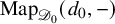 ), so as cocartesian fibrations are closed under pullback [Reference LurieLur09, 2.4.2.3],
$\mathrm {pr}_2$
), so as cocartesian fibrations are closed under pullback [Reference LurieLur09, 2.4.2.3],
$\mathrm {pr}_2$
 in (15) is a cocartesian fibration as well and is thus by 4.1.2.15 loc.cit.smooth in the sense of 4.1.2.9 loc.cit.. Since we saw that the bottom left horizontal map is the inclusion of a terminal object and therefore cofinal, it follows from 4.1.2.10 loc.cit. that the upper left horizontal map in (15) is also cofinal and thus an equivalence after applying
$\lvert -\rvert $
in (15) is a cocartesian fibration as well and is thus by 4.1.2.15 loc.cit.smooth in the sense of 4.1.2.9 loc.cit.. Since we saw that the bottom left horizontal map is the inclusion of a terminal object and therefore cofinal, it follows from 4.1.2.10 loc.cit. that the upper left horizontal map in (15) is also cofinal and thus an equivalence after applying
$\lvert -\rvert $
 by 4.1.1.3 (3) loc.cit.. Combining this with (14), we conclude that the composition

induced by the inclusion
$\mathscr {D}_0\rightarrow \mathscr {D}_0\cup _{\mathscr {D}_{01}}\mathscr {D}_1$
 and postcompostion with the counit
$\kappa _1\partial _1(d_1)\rightarrow d_1$
and postcompostion with the counit
$\kappa _1\partial _1(d_1)\rightarrow d_1$
 , is an equivalence. This implies the claim in 1, since postcomposition of this composition with the map induced by
$\iota $
, is an equivalence. This implies the claim in 1, since postcomposition of this composition with the map induced by
$\iota $
 is equivalent to the identity on
${\mathrm {Map}_{\mathscr {D}_0}(d_0,\kappa _0\partial _1(d_1))}$
is equivalent to the identity on
${\mathrm {Map}_{\mathscr {D}_0}(d_0,\kappa _0\partial _1(d_1))}$
 as a result of (b).
We now turn to proving 2. By the limit-formula for right Kan extensions [Reference LurieLur09, 4.3.2.13], the unit map in the claim is naturally equivalent to the map
$X(d_0,d_1)\rightarrow \lim _{(\iota (d)\rightarrow (d_0,d_1))}X(\iota (d))$
 where the limit is over
$\smash {(\mathscr {D}_0\cup _{\mathscr {D}_{01}}\mathscr {D}_1)_{/(d_0,d_1)}{:=} (\mathscr {D}_0\cup _{\mathscr {D}_{01}}\mathscr {D}_1)\times _{(\mathscr {D}_0\times _{\mathscr {D}_{01}}\mathscr {D}_1)}(\mathscr {D}_0\times _{\mathscr {D}_{01}}\mathscr {D}_1)_{/(d_0,d_1)}}$
where the limit is over
$\smash {(\mathscr {D}_0\cup _{\mathscr {D}_{01}}\mathscr {D}_1)_{/(d_0,d_1)}{:=} (\mathscr {D}_0\cup _{\mathscr {D}_{01}}\mathscr {D}_1)\times _{(\mathscr {D}_0\times _{\mathscr {D}_{01}}\mathscr {D}_1)}(\mathscr {D}_0\times _{\mathscr {D}_{01}}\mathscr {D}_1)_{/(d_0,d_1)}}$
 . The latter category is the value of at
$\iota \colon \mathscr {D}_0\cup _{\mathscr {D}_{01}}\mathscr {D}_1\rightarrow \mathscr {D}_0\times _{\mathscr {D}_{01}}\mathscr {D}_1$
. The latter category is the value of at
$\iota \colon \mathscr {D}_0\cup _{\mathscr {D}_{01}}\mathscr {D}_1\rightarrow \mathscr {D}_0\times _{\mathscr {D}_{01}}\mathscr {D}_1$
 of the functor

which is given by taking pullback along the forgetful functor
$\pi \colon (\mathscr {D}_0\times _{\mathscr {D}_{01}}\mathscr {D}_1)_{/(d_0,d_1)}\rightarrow \mathscr {D}_0\times _{\mathscr {D}_{01}}\mathscr {D}_1$
 . Since the latter forgetful functor is a cartesian fibration (it classifies the functor
$\smash {\mathrm {Map}_{\mathscr {D}_0\times _{\mathscr {D}_{01}}\mathscr {D}_1}(-,(d_0,d_1))}$
. Since the latter forgetful functor is a cartesian fibration (it classifies the functor
$\smash {\mathrm {Map}_{\mathscr {D}_0\times _{\mathscr {D}_{01}}\mathscr {D}_1}(-,(d_0,d_1))}$
 ), the pullback functor (16) is a left adjoint by [Reference Ayala and FrancisAF20, Definition 1.1.6 and Lemma 3.2.1], so it preserves colimits. As colimits in overcategories are computed in the underlying categories, this implies that the commutative square

of fully faithful inclusions is again a pushout. Therefore the limit
$\lim _{(\iota (d)\rightarrow (d_0,d_1))}X(\iota (d))$
 is the pullback of the limits of the restriction of the diagram to the full subcategories in (17). The latter all have terminal objects induced by the units of the
$(\kappa _i\dashv \partial _i)$
is the pullback of the limits of the restriction of the diagram to the full subcategories in (17). The latter all have terminal objects induced by the units of the
$(\kappa _i\dashv \partial _i)$
 -adjunction:
$(\epsilon _0,\mathrm {id})\colon (\kappa _0\partial _0(d_0),d_1)\rightarrow (d_0,d_1)$
-adjunction:
$(\epsilon _0,\mathrm {id})\colon (\kappa _0\partial _0(d_0),d_1)\rightarrow (d_0,d_1)$
 is terminal in
$(\mathscr {D}_1)_{/(d_0,d_1)}$
is terminal in
$(\mathscr {D}_1)_{/(d_0,d_1)}$
 ,
$(\mathrm {id},\epsilon _1)\colon (d_0,d_1)\rightarrow (d_0,\kappa _1\partial _1(d_1)$
,
$(\mathrm {id},\epsilon _1)\colon (d_0,d_1)\rightarrow (d_0,\kappa _1\partial _1(d_1)$
 is terminal in
$(\mathscr {D}_0)_{/(d_0,d_1)}$
is terminal in
$(\mathscr {D}_0)_{/(d_0,d_1)}$
 , and
$(\epsilon _0,\epsilon _1)\colon (d_0,d_1)\rightarrow (\kappa _0\partial _0(d_0),\kappa _1\partial _1(d_1))$
, and
$(\epsilon _0,\epsilon _1)\colon (d_0,d_1)\rightarrow (\kappa _0\partial _0(d_0),\kappa _1\partial _1(d_1))$
 is terminal in
$(\mathscr {D}_0)_{/(d_0,d_1)}$
is terminal in
$(\mathscr {D}_0)_{/(d_0,d_1)}$
 . Using that limits over categories with terminal objects are given by the value at that terminal object, the claim 2 follows.
We prove 3 more generally as stated: assume we have maps of adjunctions (maps of bicartesian fibrations over
$\Delta ^1$
 [Reference LurieLur17, 4.7.4], e.g., obtained by restricting an adjunction to full subcategories as in 2)

where the
$\kappa _i$
 and
$\kappa ^{\prime }_i$
and
$\kappa ^{\prime }_i$
 are fully faithful. In addition to commutativity of the four squares obtained from (18) by forgetting the
$\kappa _i$
are fully faithful. In addition to commutativity of the four squares obtained from (18) by forgetting the
$\kappa _i$
 and
$\kappa _i'$
and
$\kappa _i'$
 or the
$\partial _i$
or the
$\partial _i$
 and
$\partial _i'$
and
$\partial _i'$
 , maps of adjunctions give compatibilities between the unit transformations, which yields a map of commutative diagrams

This yields an equivalence
$\iota \phi _\sqcup \simeq \phi _\times \iota '$
 where
$\phi _\sqcup $
where
$\phi _\sqcup $
 and
$\phi _\times $
and
$\phi _\times $
 are the induced functors between the pushouts of the top rows or the pullbacks of the bottom rows, respectively. The more general version of 3 we show is that the diagram

commutes, that is, the Beck–Chevalley transformation
$\phi _\times ^{\ast }\iota _{\ast }\rightarrow \iota ^{\prime }_{\ast }\phi _\sqcup ^{\ast }$
 is an equivalence. It suffices to prove this after precomposition with
$\iota ^{\ast }$
is an equivalence. It suffices to prove this after precomposition with
$\iota ^{\ast }$
 since the latter is essentially surjective as a result of 1. Then the transformation has the form
$\phi _\times ^{\ast }\iota _{\ast }\iota ^{\ast }\rightarrow \iota ^{\prime }_{\ast }\phi _\sqcup ^{\ast }\iota ^{\ast }\simeq \iota ^{\prime }_{\ast }(\iota ')^{\ast }\phi _\times $
since the latter is essentially surjective as a result of 1. Then the transformation has the form
$\phi _\times ^{\ast }\iota _{\ast }\iota ^{\ast }\rightarrow \iota ^{\prime }_{\ast }\phi _\sqcup ^{\ast }\iota ^{\ast }\simeq \iota ^{\prime }_{\ast }(\iota ')^{\ast }\phi _\times $
 and the claim that it is an equivalence follows from the description of
$\iota ^{\prime }_{\ast }(\iota ')^{\ast }$
and the claim that it is an equivalence follows from the description of
$\iota ^{\prime }_{\ast }(\iota ')^{\ast }$
 and
$\iota _{\ast }\iota ^{\ast }$
and
$\iota _{\ast }\iota ^{\ast }$
 from 2.
Finally, 4 follows by combining 2, observation (a), and the fact that mapping spaces in pullbacks of categories are the pullbacks of the mapping spaces.
3.3 Proof of Theorem 3.2
Equipped with Lemma 3.6, we now move towards the proof of Theorem 3.2. Setting
$\smash {\mathscr {D}\mathrm {isc}^{\shortparallel }_d:= \mathscr {D}\mathrm {isc}^\partial _d\times _{\mathscr {D}\mathrm {isc}_{d-1}}\mathscr {D}\mathrm {isc}^\partial _d}$
 , the gluing functor
$\smash {\gamma \colon \mathscr {M}\mathrm {fd}_d^{\shortparallel }\rightarrow \mathscr {M}\mathrm {fd}_{d}}$
, the gluing functor
$\smash {\gamma \colon \mathscr {M}\mathrm {fd}_d^{\shortparallel }\rightarrow \mathscr {M}\mathrm {fd}_{d}}$
 from Section 3.1.3 restricts to
$\smash {\gamma \colon \mathscr {D}\mathrm {isc}^{\shortparallel }_d\rightarrow \mathscr {D}\mathrm {isc}_d}$
from Section 3.1.3 restricts to
$\smash {\gamma \colon \mathscr {D}\mathrm {isc}^{\shortparallel }_d\rightarrow \mathscr {D}\mathrm {isc}_d}$
 , so writing
$\smash {\mathscr {D}\mathrm {isc}^{\shortparallel }_{d,\le \bullet }:= \gamma ^{-1}(\mathscr {D}\mathrm {isc}_{d,\le \bullet })}$
, so writing
$\smash {\mathscr {D}\mathrm {isc}^{\shortparallel }_{d,\le \bullet }:= \gamma ^{-1}(\mathscr {D}\mathrm {isc}_{d,\le \bullet })}$
 , we get a map
$\smash {\gamma \colon \mathscr {D}\mathrm {isc}^{\shortparallel }_{d,\le \bullet }\rightarrow \mathscr {D}\mathrm {isc}_{d,\le \bullet }}$
, we get a map
$\smash {\gamma \colon \mathscr {D}\mathrm {isc}^{\shortparallel }_{d,\le \bullet }\rightarrow \mathscr {D}\mathrm {isc}_{d,\le \bullet }}$
 of towers. There is also a commutative square of towers

which induces a map of towers
$j\colon \mathscr {D}\mathrm {isc}^{\ell r}_{d,\le \bullet }\rightarrow \mathscr {D}\mathrm {isc}^{\shortparallel }_{d,\le \bullet }$
 out of the tower of levelwise pushouts of categories
$\smash {\mathscr {D}\mathrm {isc}^{\ell r}_{d,\le \bullet }:= \mathscr {D}\mathrm {isc}_{d,\le \bullet }^\partial \cup _{\mathscr {D}\mathrm {isc}_{d-1,\le \bullet }}\mathscr {D}\mathrm {isc}_{d,\le \bullet }^\partial }$
out of the tower of levelwise pushouts of categories
$\smash {\mathscr {D}\mathrm {isc}^{\ell r}_{d,\le \bullet }:= \mathscr {D}\mathrm {isc}_{d,\le \bullet }^\partial \cup _{\mathscr {D}\mathrm {isc}_{d-1,\le \bullet }}\mathscr {D}\mathrm {isc}_{d,\le \bullet }^\partial }$
 . As further preparation for the proof of Theorem 3.2, we will show that left Kan extension along
$\gamma $
. As further preparation for the proof of Theorem 3.2, we will show that left Kan extension along
$\gamma $
 and right Kan extension along j interact well with restriction along the inclusions between the
$\mathscr {D}\mathrm {isc}$
and right Kan extension along j interact well with restriction along the inclusions between the
$\mathscr {D}\mathrm {isc}$
 -subcategories:
Lemma 3.7. The following diagrams commute for
$1\le k\le l\le \infty $


that is, the Beck–Chevalley transformations
$\gamma _!\mathrm {inc}^{\ast }\rightarrow \mathrm {inc}^{\ast }\gamma _!$
 and
$\mathrm {inc}^{\ast }j_{\ast }\rightarrow j_{\ast }\mathrm {inc}^{\ast }$
and
$\mathrm {inc}^{\ast }j_{\ast }\rightarrow j_{\ast }\mathrm {inc}^{\ast }$
 are equivalences.
Proof. The claim regarding the first square follows from the same argument as for [Reference Krannich and KupersKK26, Lemma 4.4] by replacing the role of
$\mathrm {Env}(\mathscr {O})$
 and
$\mathrm {Env}(\mathscr {P})$
and
$\mathrm {Env}(\mathscr {P})$
 in loc.cit.by the categories
$\mathscr {D}\mathrm {isc}_{d}^{{\shortparallel }}$
in loc.cit.by the categories
$\mathscr {D}\mathrm {isc}_{d}^{{\shortparallel }}$
 and
$\mathscr {D}\mathrm {isc}_{d}$
and
$\mathscr {D}\mathrm {isc}_{d}$
 respectively and using that any embedding between manifolds factors uniquely as the composition of an embedding which is surjective on path-components with an inclusion of path-components. Regarding the second square, we first recall that
$\smash {\mathscr {D}\mathrm {isc}^{{\shortparallel }}_{d,\le n}}$
respectively and using that any embedding between manifolds factors uniquely as the composition of an embedding which is surjective on path-components with an inclusion of path-components. Regarding the second square, we first recall that
$\smash {\mathscr {D}\mathrm {isc}^{{\shortparallel }}_{d,\le n}}$
 was defined as a full subcategory of
$\smash {\mathscr {D}\mathrm {isc}^{{\shortparallel }}_{d}=\mathscr {D}\mathrm {isc}^\partial _d\times _{\mathscr {D}\mathrm {isc}_{d-1}}\mathscr {D}\mathrm {isc}^\partial _d}$
was defined as a full subcategory of
$\smash {\mathscr {D}\mathrm {isc}^{{\shortparallel }}_{d}=\mathscr {D}\mathrm {isc}^\partial _d\times _{\mathscr {D}\mathrm {isc}_{d-1}}\mathscr {D}\mathrm {isc}^\partial _d}$
 , namely the preimage of
$\mathscr {D}\mathrm {isc}_{d,\le n}$
, namely the preimage of
$\mathscr {D}\mathrm {isc}_{d,\le n}$
 under
$\gamma $
under
$\gamma $
 . This is contained in the full subcategory
$\smash {\mathscr {D}\mathrm {isc}^\partial _{d,\le n}\times _{\mathscr {D}\mathrm {isc}_{d-1,\le n}}\mathscr {D}\mathrm {isc}^\partial _{d,\le n}\subset \mathscr {D}\mathrm {isc}^{{\shortparallel }}_{d}}$
. This is contained in the full subcategory
$\smash {\mathscr {D}\mathrm {isc}^\partial _{d,\le n}\times _{\mathscr {D}\mathrm {isc}_{d-1,\le n}}\mathscr {D}\mathrm {isc}^\partial _{d,\le n}\subset \mathscr {D}\mathrm {isc}^{{\shortparallel }}_{d}}$
 , but is smaller. However, as right Kan extension along a fully faithful functor is fully faithful, it suffices to prove commutativity of the second square when replacing
$\mathscr {D}\mathrm {isc}^{{\shortparallel }}_{d,\le n}$
, but is smaller. However, as right Kan extension along a fully faithful functor is fully faithful, it suffices to prove commutativity of the second square when replacing
$\mathscr {D}\mathrm {isc}^{{\shortparallel }}_{d,\le n}$
 with
$\smash {\mathscr {D}\mathrm {isc}^\partial _{d,\le n}\times _{\mathscr {D}\mathrm {isc}_{d-1,\le n}}\mathscr {D}\mathrm {isc}^\partial _{d,\le n}}$
with
$\smash {\mathscr {D}\mathrm {isc}^\partial _{d,\le n}\times _{\mathscr {D}\mathrm {isc}_{d-1,\le n}}\mathscr {D}\mathrm {isc}^\partial _{d,\le n}}$
 for
$n=k$
for
$n=k$
 and l respectively, and then the claim becomes an instance of Lemma 3.6 3.
As a result of Lemma 3.7, we have maps of towers

Now consider the following (potentially noncommutative) diagram of towers of categories

The bottom row agrees by definition with the bottom map in the claim of Theorem 3.2. Moreover, recalling the definition of the top map
$E^{{\shortparallel }}$
 in Theorem 3.2 and using that
$\mathrm {PSh}(-)\colon \mathscr {C}\mathrm {at}^{\mathrm {op}}\rightarrow \mathscr {C}\mathrm {at}$
in Theorem 3.2 and using that
$\mathrm {PSh}(-)\colon \mathscr {C}\mathrm {at}^{\mathrm {op}}\rightarrow \mathscr {C}\mathrm {at}$
 sends pushouts to pullbacks, one sees that the top row in (21) agrees with
$E^{{\shortparallel }}$
sends pushouts to pullbacks, one sees that the top row in (21) agrees with
$E^{{\shortparallel }}$
 , so setting
$\gamma ^{\mathscr {D}\mathrm {isc}}:= \gamma _!j_{\ast }$
, so setting
$\gamma ^{\mathscr {D}\mathrm {isc}}:= \gamma _!j_{\ast }$
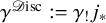 in order to prove Theorem 3.2 it suffices to show that the outer two compositions
$\mathscr {M}\mathrm {fd}_d^{\shortparallel }\rightarrow \mathrm {PSh}(\mathscr {D}\mathrm {isc}_{d,\le \bullet })$
in order to prove Theorem 3.2 it suffices to show that the outer two compositions
$\mathscr {M}\mathrm {fd}_d^{\shortparallel }\rightarrow \mathrm {PSh}(\mathscr {D}\mathrm {isc}_{d,\le \bullet })$
 are equivalent as maps of towers. The two ingredients for this are:
Lemma 3.8. The unit
$\mathrm {id}\rightarrow j_{\ast }j^{\ast }$
 is an equivalence on the essential image of
$(\iota ^{\shortparallel })^{\ast } \circ y$
is an equivalence on the essential image of
$(\iota ^{\shortparallel })^{\ast } \circ y$
 .
.
Proof. By an application of the triangle identities for adjunctions, one sees that it suffices to show the claim after replacing the tower
$\mathscr {D}\mathrm {isc}^{{\shortparallel }}_{d,\le \bullet }$
 by the tower
$\smash {\mathscr {D}\mathrm {isc}^\partial _{d,\le \bullet }\times _{\mathscr {D}\mathrm {isc}_{d-1,\le \bullet }}\mathscr {D}\mathrm {isc}^\partial _{d,\le \bullet }}$
by the tower
$\smash {\mathscr {D}\mathrm {isc}^\partial _{d,\le \bullet }\times _{\mathscr {D}\mathrm {isc}_{d-1,\le \bullet }}\mathscr {D}\mathrm {isc}^\partial _{d,\le \bullet }}$
 in which case it is an instance of Lemma 3.6 4.
Lemma 3.9. The second square in (21) commutes, that is, the Beck–Chevalley transformation
$\gamma _!(\iota ^{\shortparallel })^{\ast }\rightarrow \iota ^{\ast }\gamma _!$
 is an equivalence.
Proof. Since we have already seen in (20) that
$\gamma _!$
 is a map of towers, it suffices to prove the statement for
$\bullet =\infty $
is a map of towers, it suffices to prove the statement for
$\bullet =\infty $
 . Both sides of the Beck–Chevalley transformation
$\delta \colon \gamma _!(\iota ^{{\shortparallel }})^{\ast }\rightarrow \iota ^{\ast }\gamma _!$
. Both sides of the Beck–Chevalley transformation
$\delta \colon \gamma _!(\iota ^{{\shortparallel }})^{\ast }\rightarrow \iota ^{\ast }\gamma _!$
 commute with colimits, so since presheaf-categories are generated under colimits by representables, it suffices in view of Remark 3.1 to show that for each d-manifold M with no boundary and codimension
$0$
commute with colimits, so since presheaf-categories are generated under colimits by representables, it suffices in view of Remark 3.1 to show that for each d-manifold M with no boundary and codimension
$0$
 submanifolds
$M_\ell ,M_r\subset M$
submanifolds
$M_\ell ,M_r\subset M$
 that intersect in their common boundary
$P{:=} \partial M_{\ell }=\partial M_r$
that intersect in their common boundary
$P{:=} \partial M_{\ell }=\partial M_r$
 , the transformation
$\delta $
, the transformation
$\delta $
 is an equivalence on
${\mathrm {Map}_{\mathscr {M}\mathrm {fd}_d^{\shortparallel }}(-,M^{\shortparallel })\in \mathrm {PSh}(\mathscr {M}\mathrm {fd}_d^{\shortparallel })}$
is an equivalence on
${\mathrm {Map}_{\mathscr {M}\mathrm {fd}_d^{\shortparallel }}(-,M^{\shortparallel })\in \mathrm {PSh}(\mathscr {M}\mathrm {fd}_d^{\shortparallel })}$
 for
$M^{\shortparallel }{:=} (M_\ell ,M_r,\mathrm {id})\in \mathscr {M}\mathrm {fd}_d^{\shortparallel }$
for
$M^{\shortparallel }{:=} (M_\ell ,M_r,\mathrm {id})\in \mathscr {M}\mathrm {fd}_d^{\shortparallel }$
 . To do so, we consider the poset
$\mathscr {O}^{{\shortparallel }}_{\infty }(M)$
. To do so, we consider the poset
$\mathscr {O}^{{\shortparallel }}_{\infty }(M)$
 of open subsets
$O\subset M$
of open subsets
$O\subset M$
 such that the manifolds with boundary
$O\cap M_\ell $
such that the manifolds with boundary
$O\cap M_\ell $
 and
$O\cap M_r$
and
$O\cap M_r$
 are both contained in
$\mathscr {D}\mathrm {isc}^\partial _d$
are both contained in
$\mathscr {D}\mathrm {isc}^\partial _d$
 . Inclusion gives a functor
$\mathscr {O}^{{\shortparallel }}_{\infty }(M)\rightarrow (\mathscr {M}\mathrm {fd}^{{\shortparallel }}_d)_{/M^{\shortparallel }}$
. Inclusion gives a functor
$\mathscr {O}^{{\shortparallel }}_{\infty }(M)\rightarrow (\mathscr {M}\mathrm {fd}^{{\shortparallel }}_d)_{/M^{\shortparallel }}$
 that sends
$O\in \mathscr {O}^{{\shortparallel }}_{\infty }(M)$
that sends
$O\in \mathscr {O}^{{\shortparallel }}_{\infty }(M)$
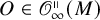 to
$O^{{\shortparallel }}{:=} (O\cap M_\ell ,O\cap M_r,\mathrm {id}_{O\cap P})\subset M^{\shortparallel }$
to
$O^{{\shortparallel }}{:=} (O\cap M_\ell ,O\cap M_r,\mathrm {id}_{O\cap P})\subset M^{\shortparallel }$
 . Now consider the commutative square in
$\mathrm {PSh}(\mathscr {D}\mathrm {isc}_d)$
. Now consider the commutative square in
$\mathrm {PSh}(\mathscr {D}\mathrm {isc}_d)$


We will show that ①-③ are equivalences, which implies that ④ is one as well, so the claim will follow. To do this, we repeatedly use the facts that restriction and left Kan extension preserve colimits and that left Kan extension preserves representables. From these facts, together with the observation that
$\smash {O^{\shortparallel }\in \mathscr {D}\mathrm {isc}_d^{\shortparallel }}$
 , one sees that ① is equivalent to the identity on
$\smash {\mathrm {colim}_{O\in \mathscr {O}_\infty ^{\shortparallel }(M)}\mathrm {Map}_{\mathscr {D}\mathrm {isc}_d}(-,O)}$
, one sees that ① is equivalent to the identity on
$\smash {\mathrm {colim}_{O\in \mathscr {O}_\infty ^{\shortparallel }(M)}\mathrm {Map}_{\mathscr {D}\mathrm {isc}_d}(-,O)}$
 , so in particular an equivalence. Using the above facts again, the map ③ is equivalent to the map
$\smash {\mathrm {colim}_{O\in \mathscr {O}^{\shortparallel }_\infty (M)}\mathrm {Map}_{\mathscr {M}\mathrm {fd}_d}(\iota (-),O)\rightarrow \mathrm {Map}_{\mathscr {M}\mathrm {fd}_d}(\iota (-),M)}$
, so in particular an equivalence. Using the above facts again, the map ③ is equivalent to the map
$\smash {\mathrm {colim}_{O\in \mathscr {O}^{\shortparallel }_\infty (M)}\mathrm {Map}_{\mathscr {M}\mathrm {fd}_d}(\iota (-),O)\rightarrow \mathrm {Map}_{\mathscr {M}\mathrm {fd}_d}(\iota (-),M)}$
 . Since
$\smash {\{O\}_{O\in \mathscr {O}_{\infty }^{{\shortparallel }}(M)}}$
. Since
$\smash {\{O\}_{O\in \mathscr {O}_{\infty }^{{\shortparallel }}(M)}}$
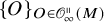 is a complete Weiss
$\infty $
is a complete Weiss
$\infty $
 -cover of M in the sense of [Reference Knudsen and KupersKK24a, Definition 6.3], the proof of Lemma 6.4 loc.cit. shows that this map is indeed an equivalence. Since it will be relevant later, recall that the key step in the proof of this result in loc.cit. is an application of [Reference Dugger and IsaksenDI04, Proposition 4.6 (c)] to the open cover
$\{F_n(O)\}_{O\in \mathscr {O}_{\infty }^{{\shortparallel }}(M)}$
-cover of M in the sense of [Reference Knudsen and KupersKK24a, Definition 6.3], the proof of Lemma 6.4 loc.cit. shows that this map is indeed an equivalence. Since it will be relevant later, recall that the key step in the proof of this result in loc.cit. is an application of [Reference Dugger and IsaksenDI04, Proposition 4.6 (c)] to the open cover
$\{F_n(O)\}_{O\in \mathscr {O}_{\infty }^{{\shortparallel }}(M)}$
 of the space
$F_n(M)$
of the space
$F_n(M)$
 of ordered configurations of n points in M, for
$n\ge 0$
of ordered configurations of n points in M, for
$n\ge 0$
 , using that this is a complete cover in the sense of Definition 4.5 loc.cit.. We will now show by a similar argument that the map
$\smash {\mathrm {colim}_{O\in \mathscr {O}^{\shortparallel }_\infty (M)}\mathrm {Map}_{\mathscr {M}\mathrm {fd}^{\shortparallel }_d}(\iota ^{\shortparallel }(-),O^{\shortparallel })\rightarrow \mathrm {Map}_{\mathscr {M}\mathrm {fd}^{\shortparallel }_d}(\iota ^{\shortparallel }(-),M^{\shortparallel })}$
, using that this is a complete cover in the sense of Definition 4.5 loc.cit.. We will now show by a similar argument that the map
$\smash {\mathrm {colim}_{O\in \mathscr {O}^{\shortparallel }_\infty (M)}\mathrm {Map}_{\mathscr {M}\mathrm {fd}^{\shortparallel }_d}(\iota ^{\shortparallel }(-),O^{\shortparallel })\rightarrow \mathrm {Map}_{\mathscr {M}\mathrm {fd}^{\shortparallel }_d}(\iota ^{\shortparallel }(-),M^{\shortparallel })}$
 is an equivalence, which will imply that
$\gamma _!(-)$
is an equivalence, which will imply that
$\gamma _!(-)$
 of it – which is precisely ② – is an equivalence as well, so the claim will follow. Adapting the argument in the proof of [Reference Knudsen and KupersKK24a, Lemma 6.4] to this map reduces the claim to showing that for
$r,s,t\ge 0$
of it – which is precisely ② – is an equivalence as well, so the claim will follow. Adapting the argument in the proof of [Reference Knudsen and KupersKK24a, Lemma 6.4] to this map reduces the claim to showing that for
$r,s,t\ge 0$
 the open cover
$\smash {\{F_{r,s,t}(O)\}_{O\in \mathscr {O}_{\infty }^{{\shortparallel }}(M)}}$
the open cover
$\smash {\{F_{r,s,t}(O)\}_{O\in \mathscr {O}_{\infty }^{{\shortparallel }}(M)}}$
 of the space
$F_{r,s,t}(M)$
of the space
$F_{r,s,t}(M)$
 of ordered configurations of
$r+s+t$
of ordered configurations of
$r+s+t$
 points in M where the first r points lie in
$\mathrm {int}(M_\ell )$
points in M where the first r points lie in
$\mathrm {int}(M_\ell )$
 , the second s points in P, and the final t points in
$\mathrm {int}(M_r)$
, the second s points in P, and the final t points in
$\mathrm {int}(M_r)$
 , is a complete cover. But we have
$F_{r,s,t}(O)=F_{r+s+t}(O)\cap F_{r,s,t}(M)$
, is a complete cover. But we have
$F_{r,s,t}(O)=F_{r+s+t}(O)\cap F_{r,s,t}(M)$
 , so the claim follows from the corresponding fact for
$\{F_{r+s+t}(O)\}_{O\in \mathscr {O}_{\infty }^{{\shortparallel }}(M)}$
, so the claim follows from the corresponding fact for
$\{F_{r+s+t}(O)\}_{O\in \mathscr {O}_{\infty }^{{\shortparallel }}(M)}$
 we have already used above by observing that complete covers are preserved by taking intersections with a fixed subspace.
We end the section by finishing the proof of Theorem 3.2 and deducing Theorem 2.2.
Proof of Theorem 3.2
By the discussion above the diagram (21), it suffices to show that the outermost two compositions in it agree. As a result of Lemma 3.8, it suffices to show that the two leftmost squares in the diagram commute. For the second square, this is Lemma 3.9 and for the first square it is an instance of the naturality of the Yoneda embedding.
Proof of Theorem 2.2
For manifolds
$M_i$
 and diffeomorphism
$\varphi _i$
and diffeomorphism
$\varphi _i$
 as in the statement, we have that
$E_{M_0\cup _{\varphi _i}M_1}$
as in the statement, we have that
$E_{M_0\cup _{\varphi _i}M_1}$
 in
$\mathrm {PSh}(\mathscr {D}\mathrm {isc}_{d,\le k})$
in
$\mathrm {PSh}(\mathscr {D}\mathrm {isc}_{d,\le k})$
 for
$i=0,1$
for
$i=0,1$
 are the values of
$(M_0,M_1,\varphi _i)\in \mathscr {M}\mathrm {fd}_d^{{\shortparallel }}$
are the values of
$(M_0,M_1,\varphi _i)\in \mathscr {M}\mathrm {fd}_d^{{\shortparallel }}$
 under the counterclockwise composition in the square of Theorem 3.2 for
$\bullet =k$
under the counterclockwise composition in the square of Theorem 3.2 for
$\bullet =k$
 , so by commutativity they are also the values under the clockwise composition. But the assumption implies that their images
$(E^\partial _{M_0},E^\partial _{M_0},E_{\varphi _i})$
, so by commutativity they are also the values under the clockwise composition. But the assumption implies that their images
$(E^\partial _{M_0},E^\partial _{M_0},E_{\varphi _i})$
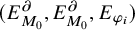 under the top horizontal map
$E^{\shortparallel }$
under the top horizontal map
$E^{\shortparallel }$
 agree, so the claim follows. The addendum follows in the same way, using a variant of Theorem 3.2 for oriented manifolds which is proved in the same way as the nonoriented version (This is also a special case of the version for general tangential structures as alluded to in Remark 3.3 1).
4 Stable collapse maps of
$\mathscr {D}\mathrm {isc}$
-presheaves

In this section we establish another one of the three ingredients that we assumed in Section 2, namely Theorem 2.6 regarding the naturality of Atiyah duality in equivalences of
$2$
 -truncated presheaves. We adopt the notation from Section 2.2.
Remark (Idea of proof)
Informally speaking, Theorem 2.6 says that the stable collapse map
$\mathbf {S}\rightarrow {\mathrm {Th}}(-TM)$
 of a closed d-manifold M can be extracted from the associated
$2$
of a closed d-manifold M can be extracted from the associated
$2$
 -truncated
$\mathscr {D}\mathrm {isc}$
-truncated
$\mathscr {D}\mathrm {isc}$
 -presheaf
$E_M$
-presheaf
$E_M$
 , so the idea of the proof is to find a suitable construction of the stable collapse map for manifolds which can be imitated for
$2$
, so the idea of the proof is to find a suitable construction of the stable collapse map for manifolds which can be imitated for
$2$
 -truncated
$\mathscr {D}\mathrm {isc}$
-truncated
$\mathscr {D}\mathrm {isc}$
 -presheaves. One way to construct the stable collapse map
$\mathbf {S}\rightarrow {\mathrm {Th}}(-TM)$
-presheaves. One way to construct the stable collapse map
$\mathbf {S}\rightarrow {\mathrm {Th}}(-TM)$
 for a closed d-manifold M is to choose an embedding
$M\subset \mathbf {R}^N$
for a closed d-manifold M is to choose an embedding
$M\subset \mathbf {R}^N$
 for
$N\gg 0$
for
$N\gg 0$
 and use the Pontryagin–Thom construction, but this way appears to not easily be replicated for
$\mathscr {D}\mathrm {isc}$
and use the Pontryagin–Thom construction, but this way appears to not easily be replicated for
$\mathscr {D}\mathrm {isc}$
 -presheaves. There is, however, another way to construct the stable collapse map which does not require the choice of an embedding in
$\mathbf {R}^N$
-presheaves. There is, however, another way to construct the stable collapse map which does not require the choice of an embedding in
$\mathbf {R}^N$
 , namely by using a Poincaré embedding structure on the diagonal
$\Delta \colon M\hookrightarrow M\times M$
, namely by using a Poincaré embedding structure on the diagonal
$\Delta \colon M\hookrightarrow M\times M$
 (see Example 4.3 below). The proof of Theorem 2.6 is basically to show that this other way can be mimicked for
$\mathscr {D}\mathrm {isc}$
(see Example 4.3 below). The proof of Theorem 2.6 is basically to show that this other way can be mimicked for
$\mathscr {D}\mathrm {isc}$
 -presheaves: we first explain that this construction of the stable collapse map is a special case of a general construction using parametrised spectra whose input is a commutative square in spaces with left vertical map a spherical fibration
$\pi \colon S(\xi )\rightarrow B$
-presheaves: we first explain that this construction of the stable collapse map is a special case of a general construction using parametrised spectra whose input is a commutative square in spaces with left vertical map a spherical fibration
$\pi \colon S(\xi )\rightarrow B$
 associated to a vector bundle
$\xi $
associated to a vector bundle
$\xi $
 and with the bottom horizontal map being the diagonal of B, and whose output gives a zig-zag of spectra between
$\mathbf {S}$
and with the bottom horizontal map being the diagonal of B, and whose output gives a zig-zag of spectra between
$\mathbf {S}$
 and
${\mathrm {Th}}(-\xi )$
and
${\mathrm {Th}}(-\xi )$
 (see Constructions 4.1 and 4.2). We will then see, firstly, that this recovers the stable collapse map
$\mathbf {S}\rightarrow {\mathrm {Th}}(-TM)$
(see Constructions 4.1 and 4.2). We will then see, firstly, that this recovers the stable collapse map
$\mathbf {S}\rightarrow {\mathrm {Th}}(-TM)$
 if one inputs the square underlying the Poincaré embedding structure of the diagonal of a closed d-manifold M (see Example 4.3), secondly, that there is a square associated to any presheaf
$X\in \mathrm {PSh}(\mathscr {D}\mathrm {isc}_{d,\le 2})$
if one inputs the square underlying the Poincaré embedding structure of the diagonal of a closed d-manifold M (see Example 4.3), secondly, that there is a square associated to any presheaf
$X\in \mathrm {PSh}(\mathscr {D}\mathrm {isc}_{d,\le 2})$
 (see Example 4.4) to which one can apply the construction, and, thirdly, that these squares agree in the case
$X=E_M$
(see Example 4.4) to which one can apply the construction, and, thirdly, that these squares agree in the case
$X=E_M$
 (see Lemma 4.5). This will then show that the zig-zag of spectra obtained in this manner from the square associated to
$X\in \mathrm {PSh}(\mathscr {D}\mathrm {isc}_{d,\le 2})$
(see Lemma 4.5). This will then show that the zig-zag of spectra obtained in this manner from the square associated to
$X\in \mathrm {PSh}(\mathscr {D}\mathrm {isc}_{d,\le 2})$
 has the properties claimed in Theorem 2.6.
4.1 Proof of Theorem 2.6
We begin by fixing some notation:
-
(a) For a space B, we write $\mathscr {S}_{/B}$
,
$(\mathscr {S}_{/B})_{\ast }$
, and
$\mathrm {Sp}_B$
for the
$\infty $
-categories of spaces over B, retractive spaces over B (spaces over B equipped with a section), and parametrised spectra over B, respectively. By straightening, they are equivalent to the functor categories
$\mathrm {Fun}(B,\mathscr {S})$
,
$\mathrm {Fun}(B,\mathscr {S}_{\ast })$
, and
$\mathrm {Fun}(B,\mathrm {Sp})$
, respectively. -
(b) We denote various fibrewise constructions in $\mathscr {S}_{/B}$
,
$(\mathscr {S}_{/B})_{\ast }$
, and
$\mathrm {Sp}_B$
by adding a B-subscript. For instance,
$\Sigma ^\infty _B (-)\colon (\mathscr {S}_{/B})_{\ast }\rightarrow \mathrm {Sp}_B$
denotes taking fibrewise suspension spectrum,
$(-)_{+,B}\colon \mathscr {S}_{/B}\rightarrow (\mathscr {S}_{/B})_{\ast }$
fibrewise adding a disjoint basepoint,
$(-)\otimes _B(-)\colon \mathrm {Sp}_B\times \mathrm {Sp}_B\rightarrow \mathrm {Sp}_B$
fibrewise tensor product,
${\mathrm {map}}_B(-,-)\colon \mathrm {Sp}_B^{\mathrm {op}}\times \mathrm {Sp}_B\rightarrow \mathrm {Sp}_B$
fibrewise mapping spectra, and
$D_B(-)={\mathrm {map}}_B(-,\mathbf {S}_B)\colon \mathrm {Sp}_B^{\mathrm {op}}\rightarrow \mathrm {Sp}_B$
fibrewise Spanier–Whitehead dual given by taking fibrewise mapping spectra into the constant parametrised spectrum
$\mathbf {S}_B$
with fibre
$\mathbf {S}$
. -
(c) For a map of spaces $f\colon B\rightarrow C$
, the restriction functor
$f^{\ast }\colon \mathrm {Sp}_C\rightarrow \mathrm {Sp}_B$
has a left adjoint
$f_!\colon \mathrm {Sp}_B\rightarrow \mathrm {Sp}_C$
, given by left Kan extension under straightening. In particular, for the constant map
$f=p\colon B\rightarrow \ast $
the adjoint
$p_!\colon \mathrm {Sp}_B\rightarrow \mathrm {Sp}_{\ast }=\mathrm {Sp}$
is given by taking colimits. -
(d) For a map $\varphi \colon V\rightarrow W$
in
$\mathscr {S}_{/B}$
, we denote the pushout in
$\mathscr {S}$
of
$V\rightarrow W$
along
$V\rightarrow B$
as
$\smash {C_B(\varphi )}$
and think of it as a relative mapping cone. Note that
$C_B(\varphi )$
comes with canonical maps to and from B, which turn it into a retractive space. This construction is natural in that a commutative square in
$\mathscr {S}_{/B}$
(22)induces a map $C_B(\varphi ')\rightarrow C_B(\varphi )$
in
$(\mathscr {S}_{/B})_{\ast }$
. For
$V'=\varnothing $
and
$W'=W$
this in particular gives a map
$W_{+,B}\rightarrow C_B(\varphi )$
in
$(\mathscr {S}_{/B})_{\ast }$
. An important class of examples for us is when
$\varphi $
is the projection
$S(\xi )\rightarrow B$
of the
$(d-1)$
-dimensional spherical fibration of a d-dimensional vector bundle
$\xi $
over B given by removing the
$0$
-section. In this case,
$C_B(\varphi )\rightarrow B$
agrees with the retractive space given as the d-dimensional spherical fibration obtained from
$\xi $
by fibrewise one-point compactification, or equivalently obtained from
$S(\xi )$
by fibrewise cone. Then
$\smash {\Sigma ^\infty _BC_B(\varphi )}$
is the usual parametrised spectrum with fibres
$\mathbf {S}^d$
associated to a d-dimensional vector bundle
$\xi $
, so
$\smash {p_!(\Sigma ^\infty _BC_B(\varphi ))\simeq {\mathrm {Th}}(\xi )}$
is its Thom-spectrum.

























Construction 4.1. Given a space B, we view
$B\times B$
 as a space over B via the projection to the first coordinate. Under the straightening equivalence, this corresponds to the constant functor
$\mathrm {const}_B\in \mathrm {Fun}(B,\mathscr {S})$
as a space over B via the projection to the first coordinate. Under the straightening equivalence, this corresponds to the constant functor
$\mathrm {const}_B\in \mathrm {Fun}(B,\mathscr {S})$
 , so the result
$\Sigma ^\infty _B((B\times B)_{+,B})\in \mathrm {Sp}_B$
, so the result
$\Sigma ^\infty _B((B\times B)_{+,B})\in \mathrm {Sp}_B$
 of adding a fibrewise disjoint basepoint and then taking fibrewise suspension spectra corresponds to the constant functor
$\mathrm {const}_{\Sigma _+^\infty B}\in \mathrm {Fun}(B,\mathrm {Sp})$
of adding a fibrewise disjoint basepoint and then taking fibrewise suspension spectra corresponds to the constant functor
$\mathrm {const}_{\Sigma _+^\infty B}\in \mathrm {Fun}(B,\mathrm {Sp})$
 . The latter is also the straightening of
$p^{\ast }(\Sigma _+^\infty B)\in \mathrm {Sp}_B$
. The latter is also the straightening of
$p^{\ast }(\Sigma _+^\infty B)\in \mathrm {Sp}_B$
 where
$p\colon B\rightarrow \ast $
where
$p\colon B\rightarrow \ast $
 is the constant map, so we have a canonical equivalence
$p^{\ast }(\Sigma ^\infty _+B)\simeq \Sigma ^\infty _B ((B\times B)_{+,B})$
is the constant map, so we have a canonical equivalence
$p^{\ast }(\Sigma ^\infty _+B)\simeq \Sigma ^\infty _B ((B\times B)_{+,B})$
 . Now given
$V\in \mathscr {S}_{/B}$
. Now given
$V\in \mathscr {S}_{/B}$
 and a map
$\varphi \colon V\rightarrow B\times B$
and a map
$\varphi \colon V\rightarrow B\times B$
 in
$\mathscr {S}_{/B}$
in
$\mathscr {S}_{/B}$
 , we may apply
$\Sigma ^\infty _B(-)$
, we may apply
$\Sigma ^\infty _B(-)$
 to the map
$(B\times B)_{+,B}\rightarrow C_B(\varphi )$
to the map
$(B\times B)_{+,B}\rightarrow C_B(\varphi )$
 from (d) to arrive at a map
$p^{\ast }(\Sigma ^\infty _+B)\simeq \Sigma ^\infty _B ((B\times B)_{+,B})\rightarrow \Sigma ^\infty _BC_B(\varphi )$
from (d) to arrive at a map
$p^{\ast }(\Sigma ^\infty _+B)\simeq \Sigma ^\infty _B ((B\times B)_{+,B})\rightarrow \Sigma ^\infty _BC_B(\varphi )$
 . Combining this with the fibrewise evaluation map
$D_B(\Sigma ^\infty _BC_B(\varphi ))\otimes _B \Sigma ^\infty _BC_B(\varphi ) \rightarrow p^{\ast }(\mathbf {S})$
. Combining this with the fibrewise evaluation map
$D_B(\Sigma ^\infty _BC_B(\varphi ))\otimes _B \Sigma ^\infty _BC_B(\varphi ) \rightarrow p^{\ast }(\mathbf {S})$
 , we obtain a map
$D_B(\Sigma ^\infty _BC_B(\varphi ))\otimes _B p^{\ast }(\Sigma ^\infty _+B)\rightarrow p^{\ast }(\mathbf {S})$
, we obtain a map
$D_B(\Sigma ^\infty _BC_B(\varphi ))\otimes _B p^{\ast }(\Sigma ^\infty _+B)\rightarrow p^{\ast }(\mathbf {S})$
 which yields using the tensor-hom adjunction a map
$D_B(\Sigma ^\infty _BC_B(\varphi ))\rightarrow {\mathrm {map}}_B(p^{\ast }(\Sigma ^\infty _+B), p^{\ast }(\mathbf {S}))\simeq p^{\ast }{\mathrm {map}}(\Sigma ^\infty _+B, \mathbf {S})=p^{\ast }D(\Sigma ^\infty _+B)$
which yields using the tensor-hom adjunction a map
$D_B(\Sigma ^\infty _BC_B(\varphi ))\rightarrow {\mathrm {map}}_B(p^{\ast }(\Sigma ^\infty _+B), p^{\ast }(\mathbf {S}))\simeq p^{\ast }{\mathrm {map}}(\Sigma ^\infty _+B, \mathbf {S})=p^{\ast }D(\Sigma ^\infty _+B)$
 which in turn yields via the
$(p_!\dashv p^{\ast })$
which in turn yields via the
$(p_!\dashv p^{\ast })$
 -adjunction a map of spectra of the form

Construction 4.2. Suppose we are given a d-dimensional vector bundle
$\xi \colon B\rightarrow \mathrm {BO}(d)$
 over a space B and a commutative square in
$\mathscr {S}$
over a space B and a commutative square in
$\mathscr {S}$
 of the form

where
$S(\xi )$
 is the
$(d-1)$
is the
$(d-1)$
 -dimensional spherical fibration induced by
$\xi $
-dimensional spherical fibration induced by
$\xi $
 , the bottom horizontal map is the diagonal, and i is any map. Viewing this square as a square in
$\mathscr {S}_{/B}$
, the bottom horizontal map is the diagonal, and i is any map. Viewing this square as a square in
$\mathscr {S}_{/B}$
 via the projection of
$B\times B$
via the projection of
$B\times B$
 onto the first coordinate, the naturality in (d) yields a map
$C_B(S(\xi ))\rightarrow C_B(i)$
onto the first coordinate, the naturality in (d) yields a map
$C_B(S(\xi ))\rightarrow C_B(i)$
 and thus by applying
$p_!D_B(\Sigma _B^\infty (-))$
and thus by applying
$p_!D_B(\Sigma _B^\infty (-))$
 a map
$p_!D_B(\Sigma _B^\infty C_B(i))\rightarrow p_!D_B(\Sigma _B^\infty C_B(S(\xi )))\simeq {\mathrm {Th}}(-\xi )$
a map
$p_!D_B(\Sigma _B^\infty C_B(i))\rightarrow p_!D_B(\Sigma _B^\infty C_B(S(\xi )))\simeq {\mathrm {Th}}(-\xi )$
 (see (d) for the final equivalence). This features in a natural zig-zag of spectra

where the first map results from applying
$D(\Sigma _+^\infty (-))$
 to the map
$p\colon B\rightarrow \ast $
to the map
$p\colon B\rightarrow \ast $
 , the second map is an instance of (23), and the final map is the one we just described.
Example 4.3. For us, the most important example of a square as in (24) is the square in
$\mathscr {S}$


where
$B=M$
 is a d-manifold,
$\xi =TM$
is a d-manifold,
$\xi =TM$
 is its tangent bundle and
$i\colon C\rightarrow B\times B$
is its tangent bundle and
$i\colon C\rightarrow B\times B$
 is the inclusion
$M\times M\backslash \Delta \subset M\times M$
is the inclusion
$M\times M\backslash \Delta \subset M\times M$
 of the complement of the diagonal. This square arises as follows: writing
$0_M\subset TM$
of the complement of the diagonal. This square arises as follows: writing
$0_M\subset TM$
 for the
$0$
for the
$0$
 -section, a choice of tubular neighbourhood of the diagonal
$M\subset M\times M$
-section, a choice of tubular neighbourhood of the diagonal
$M\subset M\times M$
 yields an embedding of manifold pairs
$(TM,TM\backslash 0_M)\hookrightarrow (M\times M,M\times M\backslash \Delta )$
yields an embedding of manifold pairs
$(TM,TM\backslash 0_M)\hookrightarrow (M\times M,M\times M\backslash \Delta )$
 from which one obtains (26) by combining the equivalence of pairs of spaces
$(D(M),S(TM))\simeq (TM,TM\backslash 0_M)$
from which one obtains (26) by combining the equivalence of pairs of spaces
$(D(M),S(TM))\simeq (TM,TM\backslash 0_M)$
 induced by the inclusion together with the equivalence
$D(TM)\simeq M$
induced by the inclusion together with the equivalence
$D(TM)\simeq M$
 given by the projection.
If M is a closed manifold, then the wrong-way map in the instance of the zig-zag (25) associated to (26) turns out to be an equivalence (see, e.g., [Reference Ando, Blumberg and GepnerABG18, Proposition 4.12]) and the map
$\mathbf {S}\rightarrow {\mathrm {Th}}(-TM)$
 resulting from choosing an inverse is equivalent to the stable collapse map (see, e.g., Section 4.3 loc.cit. or [Reference Naef and SafronovNS24, Section 4.2] for explanations of this).
Example 4.4. Any k-truncated presheaf
$X\in \mathrm {PSh}(\mathscr {D}\mathrm {isc}_{d,\le k})$
 for
$k\ge 2$
for
$k\ge 2$
 also yields an example of a square as in (24): using the notation
$\vert X\rvert $
also yields an example of a square as in (24): using the notation
$\vert X\rvert $
 and
$\xi _X$
and
$\xi _X$
 from Section 2.2 and writing
$\mathrm {Emb}(-,-)$
from Section 2.2 and writing
$\mathrm {Emb}(-,-)$
 and
${\mathrm {Diff}}(-)$
and
${\mathrm {Diff}}(-)$
 for the mapping and automorphism spaces in
$\mathscr {D}\mathrm {isc}_{d,\leq k}$
for the mapping and automorphism spaces in
$\mathscr {D}\mathrm {isc}_{d,\leq k}$
 , we have a square

obtained as follows: the map
$\mathrm {Emb}(\mathbf {R}^d\sqcup \mathbf {R}^d,\mathbf {R}^d)\rightarrow \mathrm {Emb}(\mathbf {R}^d,\mathbf {R}^d)^{\times 2}$
 given by precomposition with the inclusions, and the functoriality of X, yields a map of pairs

from which one obtains (27) by using
$\mathrm {Emb}(\mathbf {R}^d,\mathbf {R}^d)/{\mathrm {Diff}}(\mathbf {R}^d)\simeq \ast $
 ,
$\lvert X\rvert =*\times _{{\mathrm {Diff}}(\mathbf {R}^d)}X(\mathbf {R}^d)$
,
$\lvert X\rvert =*\times _{{\mathrm {Diff}}(\mathbf {R}^d)}X(\mathbf {R}^d)$
 together with the
$\mathrm {GL}_d(\mathbf {R})$
together with the
$\mathrm {GL}_d(\mathbf {R})$
 -equivariant equivalence
$\smash {\mathrm {Emb}(\mathbf {R}^d\sqcup \mathbf {R}^d,\mathbf {R}^d)/{\mathrm {Diff}}(\mathbf {R}^d)^{\times 2} \simeq \mathbf {R}^d\backslash \{0\}}$
-equivariant equivalence
$\smash {\mathrm {Emb}(\mathbf {R}^d\sqcup \mathbf {R}^d,\mathbf {R}^d)/{\mathrm {Diff}}(\mathbf {R}^d)^{\times 2} \simeq \mathbf {R}^d\backslash \{0\}}$
 to identify the source in (28) with the pair
$(S(\xi _X),\vert X\rvert )$
to identify the source in (28) with the pair
$(S(\xi _X),\vert X\rvert )$
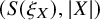 given by the projection.
The two examples Examples 4.3 and 4.4 turn out to be closely related:
Lemma 4.5. For a smooth d-manifold M, there is an equivalence of squares between (26) and (27) for
$X=E_M$
 . More specifically, there is an equivalence of spherical fibrations
$S(TM)\simeq S(\xi _{E_M})$
. More specifically, there is an equivalence of spherical fibrations
$S(TM)\simeq S(\xi _{E_M})$
 such that the resulting equivalences between the left vertical and bottom horizontal maps in (26) and (27) can be lifted to an equivalence of squares.
Proof. To see this, one first uses that evaluation at the centre induces an equivalence between the map of pairs (28) for
$X=E_M=\mathrm {Emb}(-,M)$
 and the map of pairs

induced by composition of embeddings. It thus suffices to construct an equivalence of pairs

such that its postcomposition with (29) agrees with the map
$(TM,TM\backslash 0_M)\rightarrow (M\times M,M\times M\backslash \Delta )$
 used in Example 4.3 (involving the choice of a tubular neighbourhood). By the uniqueness of tubular neighbourhoods, we may assume that the tubular neighbourhood
$TM\hookrightarrow M\times M$
used in Example 4.3 (involving the choice of a tubular neighbourhood). By the uniqueness of tubular neighbourhoods, we may assume that the tubular neighbourhood
$TM\hookrightarrow M\times M$
 involved is on the first coordinate given by the projection and on the second coordinate given by a smooth retraction
$e\colon TM\rightarrow M$
involved is on the first coordinate given by the projection and on the second coordinate given by a smooth retraction
$e\colon TM\rightarrow M$
 of the
$0$
of the
$0$
 -section that is an embedding when restricted to each individual tangent space (to obtain e, fix a Riemannian metric and define e to first fibrewise scale vectors to be shorter than the injectivity radius and then apply the exponential map; see, e.g., [Reference Bröcker and JänichBJ82, Section 12]). Such a map e yields an
$\mathrm {GL}_d(\mathbf {R})$
-section that is an embedding when restricted to each individual tangent space (to obtain e, fix a Riemannian metric and define e to first fibrewise scale vectors to be shorter than the injectivity radius and then apply the exponential map; see, e.g., [Reference Bröcker and JänichBJ82, Section 12]). Such a map e yields an
$\mathrm {GL}_d(\mathbf {R})$
 -equivariant equivalence
$\smash {\mathrm {Fr}(TM)\xrightarrow {\simeq } \mathrm {Emb}(\mathbf {R}^d,M)}$
-equivariant equivalence
$\smash {\mathrm {Fr}(TM)\xrightarrow {\simeq } \mathrm {Emb}(\mathbf {R}^d,M)}$
 out of the frame bundle, which together with the
$\mathrm {O}(d)$
out of the frame bundle, which together with the
$\mathrm {O}(d)$
 -equivariant equivalence of pairs
$\smash {(\mathbf {R}^d,\mathbf {R}^{d}\backslash \{0\})\xrightarrow {\simeq } (\mathrm {Emb}(*,\mathbf {R}^d)^{\times 2},\mathrm {Emb}(*\sqcup *,\mathbf {R}^d))}$
-equivariant equivalence of pairs
$\smash {(\mathbf {R}^d,\mathbf {R}^{d}\backslash \{0\})\xrightarrow {\simeq } (\mathrm {Emb}(*,\mathbf {R}^d)^{\times 2},\mathrm {Emb}(*\sqcup *,\mathbf {R}^d))}$
 given by
$\mathbf {R}^d\ni x\mapsto (0,x)\in \mathrm {Emb}(*,\mathbf {R}^d)^{\times 2}$
given by
$\mathbf {R}^d\ni x\mapsto (0,x)\in \mathrm {Emb}(*,\mathbf {R}^d)^{\times 2}$
 yields an equivalence of pairs of the form

Going through the construction, the precomposition of this equivalence with the standard identification of its source with
$(TM,TM\backslash 0_M)$
 has the desired properties.
Remark 4.6. Lemma 4.5 is closely related to a previous result by Prigge [Reference PriggePri20, Theorem 7.1.8]. We briefly outline the relation between the two: If M is a closed manifold, then the square (26) is a pushout and yields a Poincaré embedding structure on the diagonal of M. By Lemma 4.5, the square (28) yields for
$X=E_M$
 also a Poincaré embedding structure on the diagonal of
$|X|$
also a Poincaré embedding structure on the diagonal of
$|X|$
 . Since the latter square is natural in X, this implies that for any map from a space Z to
$B\mathrm {Aut}_{\mathrm {PSh}(\mathscr {D}\mathrm {isc}_{d,\le 2})}(E_M)$
. Since the latter square is natural in X, this implies that for any map from a space Z to
$B\mathrm {Aut}_{\mathrm {PSh}(\mathscr {D}\mathrm {isc}_{d,\le 2})}(E_M)$
 , the associated fibration over Z with fibre
$|E_M|\simeq M$
, the associated fibration over Z with fibre
$|E_M|\simeq M$
 admits a fibrewise Poincaré embedding structure of its fibrewise diagonal. This recovers Theorem 7.1.8 loc.cit..
Theorem 2.6 now follows by merely putting things together:
Proof of Theorem 2.6
Specialising (25) to Example 4.4 yields a natural zig-zag

as in the claim. The asserted property of it in the case
$X=E_M$
 follows by combining Lemma 4.5 with the discussion at the end of Example 4.3.
4.2 Further remarks
We end this section with some remarks on the proof of Theorem 2.6.
Remark 4.7 (Work of Naef–Safronov)
The proof of Theorem 2.6 is closely related to work of Naef and Safronov [Reference Naef and SafronovNS24]. They explain in Section 4.2 loc.cit. how the square (26) for a closed smooth manifold M can be used to show that the constant parametrised spectrum
$\mathbf {S}_M$
 over M is relatively dualisable in the sense of Definition 1.16 loc.cit. with dual
$\Sigma ^\infty _M S(-TM)$
over M is relatively dualisable in the sense of Definition 1.16 loc.cit. with dual
$\Sigma ^\infty _M S(-TM)$
 . Our construction above uses the square to construct the copairing – in their notation
$\eta $
. Our construction above uses the square to construct the copairing – in their notation
$\eta $
 – while they in Proposition 4.13 loc.cit. use it to construct the pairing – in their notation
$\mathrm {PT}_\Delta $
– while they in Proposition 4.13 loc.cit. use it to construct the pairing – in their notation
$\mathrm {PT}_\Delta $
 . These contain essentially the same information (see Remark 1.3 loc.cit.).
Remark 4.8 (Topological collapse maps)
Theorem 2.6 also holds in the topological setting, that is, for
$\mathscr {D}\mathrm {isc}_d$
 replaced by the analogous category
$\smash {\mathscr {D}\mathrm {isc}^t_d}$
replaced by the analogous category
$\smash {\mathscr {D}\mathrm {isc}^t_d}$
 involving topological embeddings, M being a closed topological d-manifolds M, and
$\xi _X$
involving topological embeddings, M being a closed topological d-manifolds M, and
$\xi _X$
 being an
$\mathbf {R}^d$
being an
$\mathbf {R}^d$
 -bundle (a fibre bundle with fibre
$\mathbf {R}^d$
-bundle (a fibre bundle with fibre
$\mathbf {R}^d$
 ) instead of a vector bundle, from which one obtains a spherical fibration by removing a section. In fact, the version Theorem 2.6 for smooth manifolds can be deduced from that for topological ones by left Kan extending along the forgetful functor
$\mathscr {D}\mathrm {isc}^t_{d,\le 2}\rightarrow \mathscr {D}\mathrm {isc}_{d,\le 2}$
) instead of a vector bundle, from which one obtains a spherical fibration by removing a section. In fact, the version Theorem 2.6 for smooth manifolds can be deduced from that for topological ones by left Kan extending along the forgetful functor
$\mathscr {D}\mathrm {isc}^t_{d,\le 2}\rightarrow \mathscr {D}\mathrm {isc}_{d,\le 2}$
 .
.
We briefly explain how to obtain the claimed extension of Theorem 2.6 to the topological setting: Construction 4.2 goes through verbatim for
$\mathbf {R}^d$
 -bundles. In Example 4.3 one replaces
$TM$
-bundles. In Example 4.3 one replaces
$TM$
 by the topological tangent bundle
$T^tM$
by the topological tangent bundle
$T^tM$
 , obtained by using Kister’s theorem to choose [Reference KisterKis64] a normal
$\mathbf {R}^d$
, obtained by using Kister’s theorem to choose [Reference KisterKis64] a normal
$\mathbf {R}^d$
 -bundle inside the normal microbundle of the diagonal
$M \subset M \times M$
-bundle inside the normal microbundle of the diagonal
$M \subset M \times M$
 ; this yields a tubular neighbourhood with the property used in Lemma 4.5 by construction. With this choice, the proof of Lemma 4.5 goes through with minor changes. Finally, the reference [Reference Ando, Blumberg and GepnerABG18, Proposition 4.12] we cite in Example 4.3 concerns smooth manifolds, but the proof can be extended to the topological setting:
One picks a locally flat embedding
$M \subset \mathbf {R}^{d+k}$
 with a normal
$\mathbf {R}^k$
with a normal
$\mathbf {R}^k$
 -bundle
$\nu _M$
-bundle
$\nu _M$
 for
$k \gg 0$
for
$k \gg 0$
 [Reference HirschHir66, Theorem (B)], which is unique up to isotopy after further stabilisations by Theorem (C) loc.cit.. The Pontryagin–Thom construction applied to
$M \subseteq \mathbf {R}^{d+k}$
[Reference HirschHir66, Theorem (B)], which is unique up to isotopy after further stabilisations by Theorem (C) loc.cit.. The Pontryagin–Thom construction applied to
$M \subseteq \mathbf {R}^{d+k}$
 with normal bundle
$\nu _M$
with normal bundle
$\nu _M$
 gives a pointed map
$S^{d+k} \to {\mathrm {Th}}(\nu _M)$
gives a pointed map
$S^{d+k} \to {\mathrm {Th}}(\nu _M)$
 , which yields the stable collapse map
$\mathbf {S} \to {\mathrm {Th}}(-TM)$
, which yields the stable collapse map
$\mathbf {S} \to {\mathrm {Th}}(-TM)$
 . Performing the Pontryagin–Thom construction to both the inclusion
$M \times M \subset \mathbf {R}^{d+k} \times M$
. Performing the Pontryagin–Thom construction to both the inclusion
$M \times M \subset \mathbf {R}^{d+k} \times M$
 with normal bundle
$\nu _M,$
with normal bundle
$\nu _M,$
 as well as its precomposition with the diagonal inclusion gives a map
${\mathrm {Th}}(\nu _M) \wedge M_+ \to S^{d+k} \wedge M_+$
as well as its precomposition with the diagonal inclusion gives a map
${\mathrm {Th}}(\nu _M) \wedge M_+ \to S^{d+k} \wedge M_+$
 . Postcomposing with the projection to
$S^{d+k}$
. Postcomposing with the projection to
$S^{d+k}$
 yields a pairing
${\mathrm {Th}}(-T^tM) \otimes \Sigma ^\infty M_+ \to \mathbf {S}$
yields a pairing
${\mathrm {Th}}(-T^tM) \otimes \Sigma ^\infty M_+ \to \mathbf {S}$
 , which is the evaluation map that exhibits
${\mathrm {Th}}(-T^t M)$
, which is the evaluation map that exhibits
${\mathrm {Th}}(-T^t M)$
 as the Spanier–Whitehead dual of
$\Sigma ^\infty M_+$
as the Spanier–Whitehead dual of
$\Sigma ^\infty M_+$
 . Using this, the proof of [Reference Ando, Blumberg and GepnerABG18, Proposition 4.12] goes through and shows that the wrong-way map in (25) is in the case of Example 4.3 an equivalence and that the constructed map
$\mathbf {S} \to {\mathrm {Th}}(-T^tM)$
. Using this, the proof of [Reference Ando, Blumberg and GepnerABG18, Proposition 4.12] goes through and shows that the wrong-way map in (25) is in the case of Example 4.3 an equivalence and that the constructed map
$\mathbf {S} \to {\mathrm {Th}}(-T^tM)$
 agrees with the stable collapse map.
5 Finite residuals of mapping class groups
In this section we establish the remaining ingredient that we assumed in Section 2 and we have not proved yet, namely Theorem 2.3 regarding the finite residual of the group

of isotopy classes of orientation-preserving diffeomorphisms (we omit the dependence on n in the notation) of the g-fold connected sum
$W_g{:=} \sharp ^g(S^n\times S^n)$
 for
$n\ge 3$
for
$n\ge 3$
 odd. The main input for this is an algebraic description of these mapping class groups which was established in [Reference KrannichKra20]. We will also use the following properties of finite residuals
$\mathrm {fr}(G)$
odd. The main input for this is an algebraic description of these mapping class groups which was established in [Reference KrannichKra20]. We will also use the following properties of finite residuals
$\mathrm {fr}(G)$
 of discrete groups G (see Section 2.1 for the definition):
Lemma 5.1.
-
1. For a group homomorphism $\varphi \colon E\rightarrow E'$
, we have
$\mathrm {fr}(E)\subseteq \varphi ^{-1}(\mathrm {fr}(E'))$
. -
2. For a monomorphism of groups $\varphi \colon E\hookrightarrow E'$
such that its image
$\varphi (E)\le E'$
has finite index, we have
$\mathrm {fr}(E)=\varphi ^{-1}(\mathrm {fr}(E'))$
. -
3. The following classes of groups are residually finite:
-
(a) finitely generated abelian groups,
-
(b) $\mathrm {GL}_n(\mathbf {Z})$
for
$n\ge 1$
, -
(c) subgroups of residually finite groups,
-
(d) semidirect products $\Gamma \rtimes \Lambda $
with
$\Gamma $
and
$\Lambda $
residually finite and
$\Gamma $
finitely generated.
-
-
4. Fix a group G with finite abelianisation and $\mathrm {fr}(G)=0$
, a finitely generated free abelian group A, and two central extensions of G of the form, $$\begin{align*}\smash{0\longrightarrow A\overset{\iota_i}{\longrightarrow} E_i\longrightarrow G\longrightarrow 0\quad\text{for }i=0,1},\end{align*}$$such that their extension classes in $\mathrm {H}^2(G;A)$
agree in
$\mathrm {Hom}(\mathrm {H}_2(G),A)$
. Then the finite residuals of
$E_0$
and
$E_1$
agree in the sense that $$\begin{align*}\smash{\mathrm{fr}(E_i)\subset \iota_i(A)\quad\text{for }i=0,1\quad\text{and}\quad \iota_0^{-1}(\mathrm{fr}(E_0))=\iota_1^{-1}(\mathrm{fr}(E_1)).}\end{align*}$$
-
5. Fix a group G with finitely generated abelianisation and $\mathrm {fr}(G)=0$
, a finitely generated abelian group A, and a central extension
$0\rightarrow A\rightarrow E\rightarrow G\rightarrow 0$
whose extension class in
$\mathrm {H}^2(G;A)$
is trivial in
$\mathrm {Hom}(\mathrm {H}_2(G),A)$
. Then the finite residual
$\mathrm {fr}(E)$
is trivial.














Proof. Item 1 follows directly from the definition of the finite residual. To show 2, it suffices by 1 to show the inclusion
$\varphi ^{-1}(\mathrm {fr}(E'))\subset \mathrm {fr}(E)$
 , that is, that for all
$x\in \varphi ^{-1}(\mathrm {fr}(E'))$
, that is, that for all
$x\in \varphi ^{-1}(\mathrm {fr}(E'))$
 and finite index normal subgroups
$H\trianglelefteq E$
and finite index normal subgroups
$H\trianglelefteq E$
 , we have
$x\in H$
, we have
$x\in H$
 . Since
$\varphi (E)\le E'$
. Since
$\varphi (E)\le E'$
 and
$H\trianglelefteq E$
and
$H\trianglelefteq E$
 have finite index,
$\varphi (H)\le E'$
have finite index,
$\varphi (H)\le E'$
 has finite index as well, so we can choose a finite index normal subgroup
$\overline {H}\trianglelefteq E'$
has finite index as well, so we can choose a finite index normal subgroup
$\overline {H}\trianglelefteq E'$
 with
$\overline {H}\le \varphi (H)$
with
$\overline {H}\le \varphi (H)$
 . Since
$\varphi (x)\in \mathrm {fr}(E')\le \overline {H}$
. Since
$\varphi (x)\in \mathrm {fr}(E')\le \overline {H}$
 , we conclude that
$\varphi (x)\in \varphi (H)$
, we conclude that
$\varphi (x)\in \varphi (H)$
 , so we indeed have
$x\in H$
, so we indeed have
$x\in H$
 since
$\varphi $
since
$\varphi $
 is injective. For 3, see, for example, [Reference WilkesWil24, Proposition 3.1.3, 3.1.4, 3.1.6, 3.5 (ii) on p. 153]. The claim
$\mathrm {fr}(E_i)\subset \iota _i(A)$
is injective. For 3, see, for example, [Reference WilkesWil24, Proposition 3.1.3, 3.1.4, 3.1.6, 3.5 (ii) on p. 153]. The claim
$\mathrm {fr}(E_i)\subset \iota _i(A)$
 in 4 follows from
$\mathrm {fr}(G)=1$
in 4 follows from
$\mathrm {fr}(G)=1$
 and 1 applied to
$E_i \to G$
and 1 applied to
$E_i \to G$
 , so we are left to show
$\iota _0^{-1}(\mathrm {fr}(E_0))=\iota _1^{-1}(\mathrm {fr}(E_1))$
, so we are left to show
$\iota _0^{-1}(\mathrm {fr}(E_0))=\iota _1^{-1}(\mathrm {fr}(E_1))$
 . To do so, we write k for the (finite) order of
$\mathrm {H}_1(G)$
. To do so, we write k for the (finite) order of
$\mathrm {H}_1(G)$
 and
$\lambda _i\in \mathrm {H}^2(G;A)$
and
$\lambda _i\in \mathrm {H}^2(G;A)$
 for the extension class of
$E_i$
for the extension class of
$E_i$
 . From the assumption that the
$\lambda _i$
. From the assumption that the
$\lambda _i$
 agree in
$\mathrm {Hom}(\mathrm {H}_2(G),A)$
agree in
$\mathrm {Hom}(\mathrm {H}_2(G),A)$
 together with the naturality of the universal coefficient theorem and the fact that multiplication by k annihilates
$\mathrm {Ext}(\mathrm {H}_1(G),A)$
together with the naturality of the universal coefficient theorem and the fact that multiplication by k annihilates
$\mathrm {Ext}(\mathrm {H}_1(G),A)$
 since it annihilates
$\mathrm {H}_1(G)$
since it annihilates
$\mathrm {H}_1(G)$
 , we conclude
$k\cdot \lambda _0=k\cdot \lambda _1\in \mathrm {H}^2(G;A)$
, we conclude
$k\cdot \lambda _0=k\cdot \lambda _1\in \mathrm {H}^2(G;A)$
 . The latter implies that there is a commutative diagram of groups with exact rows of the form

whose middle row is by definition the central extension classified by
$k\cdot \lambda _0=k\cdot \lambda _1$
 . Since A is finitely generated free abelian, the leftmost vertical morphisms are monomorphisms and their images have finite index, so the same holds for the middle vertical morphisms. From 2 applied to
$\varphi _i$
. Since A is finitely generated free abelian, the leftmost vertical morphisms are monomorphisms and their images have finite index, so the same holds for the middle vertical morphisms. From 2 applied to
$\varphi _i$
 we thus get
$\mathrm {fr}(E_i)=\varphi _i^{-1}(\mathrm {fr}(\bar {E}))$
we thus get
$\mathrm {fr}(E_i)=\varphi _i^{-1}(\mathrm {fr}(\bar {E}))$
 and thus
$\iota _i^{-1}(\mathrm {fr}(E_i))=\iota _i^{-1}(\varphi _i^{-1}(\mathrm {fr}(\bar {E})))$
and thus
$\iota _i^{-1}(\mathrm {fr}(E_i))=\iota _i^{-1}(\varphi _i^{-1}(\mathrm {fr}(\bar {E})))$
 for
$i=0,1$
for
$i=0,1$
 . But
$\varphi _i\circ \iota _i=\bar {\iota }\circ (k\cdot (-))$
. But
$\varphi _i\circ \iota _i=\bar {\iota }\circ (k\cdot (-))$
 does not depend on i, so
$\iota _0^{-1}(\mathrm {fr}(E_0))=\iota _1^{-1}(\mathrm {fr}(E_1))$
does not depend on i, so
$\iota _0^{-1}(\mathrm {fr}(E_0))=\iota _1^{-1}(\mathrm {fr}(E_1))$
 as claimed.
To show 5, note that the assumption that the extension class vanishes in
$\mathrm {Hom}(\mathrm {H}_2(G),A)$
 is – by the universal coefficient theorem – equivalent to the class being in the image of the canonical map
$\mathrm {Ext}^1(\mathrm {H}_1(G),A)\rightarrow \mathrm {H}^2(G;A)$
is – by the universal coefficient theorem – equivalent to the class being in the image of the canonical map
$\mathrm {Ext}^1(\mathrm {H}_1(G),A)\rightarrow \mathrm {H}^2(G;A)$
 . Under the equivalence between
$\mathrm {H}^2(G;A)$
. Under the equivalence between
$\mathrm {H}^2(G;A)$
 and isomorphism classes of central extensions of G by A, this says that the extension
$\smash {0\rightarrow A\rightarrow E\rightarrow G\rightarrow 0}$
and isomorphism classes of central extensions of G by A, this says that the extension
$\smash {0\rightarrow A\rightarrow E\rightarrow G\rightarrow 0}$
 (classified by the class in
$\mathrm {H}^2(G;A)$
(classified by the class in
$\mathrm {H}^2(G;A)$
 ) is pulled back from an extension of abelian groups of the form
$\smash {0\rightarrow A\rightarrow E'\rightarrow \mathrm {H}_1(G)\rightarrow 0}$
) is pulled back from an extension of abelian groups of the form
$\smash {0\rightarrow A\rightarrow E'\rightarrow \mathrm {H}_1(G)\rightarrow 0}$
 (classified by a class in
$\mathrm {Ext}^1(\mathrm {H}_1(G),A)$
(classified by a class in
$\mathrm {Ext}^1(\mathrm {H}_1(G),A)$
 ) along the abelianisation morphism
$G\rightarrow \mathrm {H}_1(G)$
) along the abelianisation morphism
$G\rightarrow \mathrm {H}_1(G)$
 . In particular, we have a monomorphism
$E\hookrightarrow E'\times G$
. In particular, we have a monomorphism
$E\hookrightarrow E'\times G$
 . Since A and
$\mathrm {H}_1(G)$
. Since A and
$\mathrm {H}_1(G)$
 are finitely generated abelian by assumption, the same holds for
$E'$
are finitely generated abelian by assumption, the same holds for
$E'$
 , so
$E'$
, so
$E'$
 is residually finite by the first part of 3. Since G is also residually finite, the product
$E'\times G$
is residually finite by the first part of 3. Since G is also residually finite, the product
$E'\times G$
 is too (using the final part of 3), so
$\mathrm {fr}(E'\times G)=1$
is too (using the final part of 3), so
$\mathrm {fr}(E'\times G)=1$
 . The claim then follows from an application of 1 to the monomorphism
$E\hookrightarrow E'\times G$
. The claim then follows from an application of 1 to the monomorphism
$E\hookrightarrow E'\times G$
 .
.
Before turning to the computation of the finite residual
$\mathrm {fr}(\Gamma _g)$
 , we will discuss another preparatory lemma. It involves the signature class
$\sigma \in \mathrm {H}^2(\mathrm {Sp}_{2g}(\mathbf {Z});\mathbf {Z})$
, we will discuss another preparatory lemma. It involves the signature class
$\sigma \in \mathrm {H}^2(\mathrm {Sp}_{2g}(\mathbf {Z});\mathbf {Z})$
 (sometimes also denoted
$\mathrm {sgn}$
(sometimes also denoted
$\mathrm {sgn}$
 ) which is a second cohomology class of the symplectic group over the integers, constructed in terms of signatures of certain symmetric bilinear forms that one can associate to a bundle of symplectic forms over surfaces (see, e.g., [Reference Krannich and Randal-WilliamsKRW20, p. 471] for a definition for
$g\ge 3$
) which is a second cohomology class of the symplectic group over the integers, constructed in terms of signatures of certain symmetric bilinear forms that one can associate to a bundle of symplectic forms over surfaces (see, e.g., [Reference Krannich and Randal-WilliamsKRW20, p. 471] for a definition for
$g\ge 3$
 ; for
$g\le 2$
; for
$g\le 2$
 the class is defined via pullback along the inclusions
$\mathrm {Sp}_{2g}(\mathbf {Z})\le \mathrm {Sp}_{2g'}(\mathbf {Z}) $
the class is defined via pullback along the inclusions
$\mathrm {Sp}_{2g}(\mathbf {Z})\le \mathrm {Sp}_{2g'}(\mathbf {Z}) $
 for
$g\le g'$
for
$g\le g'$
 ).
).
Lemma 5.2. Fix
$g\ge 2$
 , a subgroup
$\Lambda \le \mathrm {Sp}_{2g}(\mathbf {Z})$
, a subgroup
$\Lambda \le \mathrm {Sp}_{2g}(\mathbf {Z})$
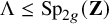 , and a cohomology class
$\lambda \in \mathrm {H}^2(\Lambda ;\mathbf {Z})$
, and a cohomology class
$\lambda \in \mathrm {H}^2(\Lambda ;\mathbf {Z})$
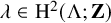 such that the following conditions are satisfied:
-
1. $\Lambda \le \mathrm {Sp}_{2g}(\mathbf {Z})$
has finite index. -
2. The abelianisation of $\Lambda $
is finite. -
3. The class $8\cdot \lambda \in \mathrm {H}^2(\Lambda ;\mathbf {Z})$
and the pullback of the signature class
$\sigma \in \mathrm {H}^2(\mathrm {Sp}_{2g}(\mathbf {Z});\mathbf {Z})$
have the same image in
$\mathrm {Hom}(\mathrm {H}_2(\Lambda ;\mathbf {Z}),\mathbf {Z})$
.





Then the extension
$\smash {0\rightarrow \mathbf {Z}\overset {\iota }{\rightarrow }E(\lambda )\rightarrow \Lambda \rightarrow 0}$
 classified by
$\lambda $
classified by
$\lambda $
 satisfies
$\mathrm {fr}(E(\lambda ))=\iota (\mathbf {Z})$
satisfies
$\mathrm {fr}(E(\lambda ))=\iota (\mathbf {Z})$
 .
.
Proof. Consider the maps of extensions

where the left-hand diagram arises from pushing out the top extension along
$8\cdot (-)\colon \mathbf {Z}\hookrightarrow \mathbf {Z}$
 and the right-hand diagram arises from pulling back the bottom extension classified by the signature class along the inclusion
$\Lambda \le \mathrm {Sp}_{2g}(\mathbf {Z})$
and the right-hand diagram arises from pulling back the bottom extension classified by the signature class along the inclusion
$\Lambda \le \mathrm {Sp}_{2g}(\mathbf {Z})$
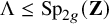 . By the discussion in [Reference Krannich and Randal-WilliamsKRW20, p. 472], we have
${\mathrm {fr}(E(\sigma ))=\iota _{\sigma }(8\cdot \mathbf {Z})}$
. By the discussion in [Reference Krannich and Randal-WilliamsKRW20, p. 472], we have
${\mathrm {fr}(E(\sigma ))=\iota _{\sigma }(8\cdot \mathbf {Z})}$
 . Applying Lemma 5.1 2 to
$\beta $
. Applying Lemma 5.1 2 to
$\beta $
 using assumption 1 yields
$\smash {\mathrm {fr}(E(\sigma '))=\beta ^{-1}(\iota _{\sigma }(8\cdot \mathbf {Z}))=\iota _{\sigma '}(8\cdot \mathbf {Z})}$
using assumption 1 yields
$\smash {\mathrm {fr}(E(\sigma '))=\beta ^{-1}(\iota _{\sigma }(8\cdot \mathbf {Z}))=\iota _{\sigma '}(8\cdot \mathbf {Z})}$
 . Moreover, combining assumptions 2 and 3 with the fact that
$\mathrm {fr}(\Lambda )=1$
. Moreover, combining assumptions 2 and 3 with the fact that
$\mathrm {fr}(\Lambda )=1$
 by Lemma 5.1 3, we may apply Lemma 5.1 4 to
$E(8\cdot \lambda )$
by Lemma 5.1 3, we may apply Lemma 5.1 4 to
$E(8\cdot \lambda )$
 and
$E(\sigma ')$
and
$E(\sigma ')$
 to conclude
$\smash {\iota _{8\cdot \lambda }^{-1}(\mathrm {fr}(E(8\cdot \lambda )))=\iota _{\sigma '}^{-1}(\mathrm {fr}(E(\sigma ')))=8\cdot \mathbf {Z}}$
to conclude
$\smash {\iota _{8\cdot \lambda }^{-1}(\mathrm {fr}(E(8\cdot \lambda )))=\iota _{\sigma '}^{-1}(\mathrm {fr}(E(\sigma ')))=8\cdot \mathbf {Z}}$
 and
$\smash {\mathrm {fr}(E(8\cdot \lambda ))\subset \iota _{8\cdot \lambda }(\mathbf {Z})}$
and
$\smash {\mathrm {fr}(E(8\cdot \lambda ))\subset \iota _{8\cdot \lambda }(\mathbf {Z})}$
 , so we conclude the equality
$\smash {\mathrm {fr}(E(8\cdot \lambda ))=\iota _{8\cdot \lambda }(8\cdot \mathbf {Z})}$
, so we conclude the equality
$\smash {\mathrm {fr}(E(8\cdot \lambda ))=\iota _{8\cdot \lambda }(8\cdot \mathbf {Z})}$
 . Finally, from an application of Lemma 5.1 2 to
$\alpha $
. Finally, from an application of Lemma 5.1 2 to
$\alpha $
 , we get
$\smash {\mathrm {fr}(E(\lambda ))=\alpha ^{-1}(\iota _{8\cdot \lambda }(8\cdot \mathbf {Z}))=\iota _\lambda (\mathbf {Z})}$
, we get
$\smash {\mathrm {fr}(E(\lambda ))=\alpha ^{-1}(\iota _{8\cdot \lambda }(8\cdot \mathbf {Z}))=\iota _\lambda (\mathbf {Z})}$
 as claimed.
5.1 Proof of Theorem 2.3
We fix
$g\ge 0$
 and an odd integer
$n\ge 3$
and an odd integer
$n\ge 3$
 throughout and adopt the notation from [Reference KrannichKra20, Section 1]. In particular:
-
(a) $G_g\le \mathrm {Sp}_{2g}(\mathbf {Z})$
denotes the image of the morphism
$p\colon \Gamma _{g}\rightarrow \mathrm {Sp}_{2g}(\mathbf {Z})$
given by the action on
$\smash {\mathrm {H}_{n}(W_{g};\mathbf {Z})\cong \mathbf {Z}^{2g}}$
. The latter isomorphism involves the choice of a hyperbolic basis with respect to the intersection form on
$\mathrm {H}_{n}(W_{g,1};\mathbf {Z})$
, which we fix once and for all. For
$n=3,7$
, we have
$G_g=\mathrm {Sp}_{2g}(\mathbf {Z})$
and for
$n\neq 3,7$
the subgroup
$G_g\le \mathrm {Sp}_{2g}(\mathbf {Z})$
has finite index and agrees with a certain subgroup
$\smash {G_g=\mathrm {Sp}_{2g}^q(\mathbf {Z})\le \mathrm {Sp}_{2g}(\mathbf {Z})}$
whose definition involves a quadratic refinement (see, e.g., Section 1.2 loc.cit.). -
(b) Fixing an embedded codimension $0$
disc
$D^{2n}\subset W_g$
, the groups
$\Gamma _{g,1}{:=} \pi _0({\mathrm {Diff}}_\partial (W_{g,1}))$
and
$\Gamma _{g,{\unicode{x00BD}}}{:=} \pi _0({\mathrm {Diff}}_{{\unicode{x00BD}}\partial }(W_{g,1}))$
are the groups of isotopy classes of diffeomorphisms of
$W_{g,1}{:=} (\sharp ^g(S^n\times S^n))\backslash \mathrm {int}(D^{2n})$
that fix pointwise a neighbourhood of the boundary or a fixed embedded codimension
$0$
disc in the boundary, respectively. We need a few facts on these groups: Firstly, the morphism
$\Gamma _{g,1}\rightarrow \Gamma _g$
induced by extending diffeomorphisms along
$W_{g,1}\subset W_g$
by the identity is an isomorphism (see Lemma 1.1 loc.cit.). Secondly, the forgetful morphism
$\Gamma _{g,1}\rightarrow \Gamma _{g,{\unicode{x00BD}}}$
is surjective and its kernel can be identified with
$\Theta _{2n+1}$
via the morphism
$\Theta _{2n+1}\cong \pi _0({\mathrm {Diff}}_\partial (D^{2n}))\rightarrow \Gamma _{g,1}$
induced by extending diffeomorphisms of a disc
$D^{2n}\subset \mathrm {int}(W_{g,1})$
by the identity (see (1.6) loc.cit.). Thirdly, the morphism
$p\colon \Gamma _{g,1}\rightarrow G_g$
factors over
$\Gamma _{g,{\unicode{x00BD}}}$
(see (1.7) loc.cit.). -
(c) Fixing a stable framing F of $W_{g,1}$
, acting on F yields a morphism
$(s_F,p)\colon \Gamma _{g,{\unicode{x00BD}}}\rightarrow (\mathbf {Z}^{2g}\otimes \pi _n(\mathrm {SO}))\rtimes G_g$
(see p. 81 loc.cit.). By combining Equation (2.2) loc.cit. with Lemma 2.1 loc.cit., this morphism is an isomorphism for
$n\neq 3,7$
, and is for
$n= 3,7$
a monomorphism onto a subgroup of finite index. In particular,
$\Gamma _{g,{\unicode{x00BD}}}$
is isomorphic to a subgroup of
$(\mathbf {Z}^{2g}\otimes \pi _n(\mathrm {SO}))\rtimes G_g\le (\mathbf {Z}^{2g}\otimes \pi _n(\mathrm {SO}))\rtimes \mathrm {GL}_{2g}(\mathbf {Z})$
, so
$\mathrm {fr}(\Gamma _{g,{\unicode{x00BD}}})=1$
as a result of Lemma 5.1 3.
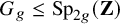


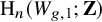

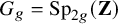






















The main ingredient in the proof of Theorem 2.3 is the identification from loc.cit. of the extension of groups resulting from (b) of the form

This identification involves two morphisms

defined in Sections 3.4-3.5 loc.cit., which enjoy the following properties:
-
1. When pulled back along $\smash {\mathrm {Sp}_{2g}^q(\mathbf {Z})\le \mathrm {Sp}_{2g}(\mathbf {Z})}$
, the first morphism becomes divisible by
$8$
and there is a preferred lift of the resulting morphism
$\sigma /8\colon \mathrm {H}_2(\mathrm {Sp}_{2g}^q(\mathbf {Z});\mathbf {Z})\rightarrow \mathbf {Z}$
to a cohomology class (see Definition 3.17 (i) loc.cit.) (33) $$ \begin{align}\smash{\textstyle{\frac{\sigma}{8}\in \mathrm{H}^2(\mathrm{Sp}_{2g}^q(\mathbf{Z});\mathbf{Z})}}.\end{align} $$
-
2. When pulled back along the inclusion $\mathbf {Z}^{2g}\rtimes \mathrm {Sp}_{2g}^q(\mathbf {Z})\longrightarrow \mathbf {Z}^{2g}\rtimes \mathrm {Sp}_{2g}(\mathbf {Z})$
, the second morphism becomes divisible by
$2$
and there is a preferred lift of the resulting morphism
$\chi ^2/2\colon \mathrm {H}_2(\mathbf {Z}^{2g}\rtimes \mathrm {Sp}_{2g}^q(\mathbf {Z});\mathbf {Z})\rightarrow \mathbf {Z}$
to a class (see Definition 3.20 (i) loc.cit.) (34) $$ \begin{align}\smash{\textstyle{\frac{\chi^2}{2}\in \mathrm{H}^2(\mathbf{Z}^{2g}\rtimes\mathrm{Sp}_{2g}^q(\mathbf{Z});\mathbf{Z})}.}\end{align} $$
-
3. When pulled back along the inclusion $(s_F,p)\colon \Gamma _{g,{\unicode{x00BD}}}\hookrightarrow \mathbf {Z}^{2g}\rtimes \mathrm {Sp}_{2g}(\mathbf {Z})$
, the morphism
$\chi ^2-\sigma \colon \mathrm {H}_2(\mathbf {Z}^{2g}\rtimes \mathrm {Sp}_{2g}(\mathbf {Z});\mathbf {Z})\rightarrow \mathbf {Z}$
becomes for
$n=3,7$
divisible by
$8$
and there is a preferred lift to the resulting morphism
$(\chi ^2-\sigma )/8\colon \mathrm {H}_2(\Gamma _{g,{\unicode{x00BD}}};\mathbf {Z})\rightarrow \mathbf {Z}$
to a class $$\begin{align*}\smash{\textstyle{\frac{\chi^2-\sigma}{8}\in \mathrm{H}^2(\Gamma_{g,{\unicode{x00BD}}};\mathbf{Z})}}.\end{align*}$$
-
4. The morphism $\sigma $
is induced by the same-named signature class
$\sigma \in \mathrm {H}^2(\mathrm {Sp}_{2g}(\mathbf {Z});\mathbf {Z})$
featuring in Lemma 5.2 above. For
$g=1$
, the morphism
$\sigma \colon \mathrm {H}_2(\mathrm {Sp}_{2g}(\mathbf {Z});\mathbf {Z})\rightarrow \mathbf {Z}$
is trivial (see Lemma 3.15 loc.cit.) and the lift (33) vanishes too (see Lemma 3.21 loc.cit.).

















In addition to the properties 1–4, we will use the following of the morphism
$\chi ^2$
 :
:
Lemma 5.3. Writing
$(k,\mathrm {id})\colon \mathbf {Z}^{2g}\rtimes \mathrm {Sp}_{2g}(\mathbf {Z})\rightarrow \mathbf {Z}^{2g}\rtimes \mathrm {Sp}_{2g}(\mathbf {Z})$
 for the morphism given by multiplication in
$\mathbf {Z}^{2g}$
for the morphism given by multiplication in
$\mathbf {Z}^{2g}$
 with a fixed integer
$k\in \mathbf {Z}$
with a fixed integer
$k\in \mathbf {Z}$
 , the following relations hold:
-
1. $\chi ^{2}\circ (k,\mathrm {id})_{\ast } =k^2\cdot \chi ^2\in \mathrm {Hom}(\mathrm {H}_2(\mathbf {Z}^{2g}\rtimes \mathrm {Sp}_{2g}(\mathbf {Z});\mathbf {Z}),\mathbf {Z})$
and -
2. $(k,\mathrm {id})^{\ast }\frac {\chi ^2}{2}=k^2\cdot \frac {\chi ^2}{2}\in \mathrm {H}^2(\mathbf {Z}^{2g}\rtimes \mathrm {Sp}_{2g}^q(\mathbf {Z});\mathbf {Z}).$


In particular, the relation 1 implies for
$k=0$
 that the precomposition
$\chi ^2\circ \mathrm {inc}_{\ast }\colon \mathrm {H}_2(\mathrm {Sp}_{2g}(\mathbf {Z});\mathbf {Z})\rightarrow \mathbf {Z}$
that the precomposition
$\chi ^2\circ \mathrm {inc}_{\ast }\colon \mathrm {H}_2(\mathrm {Sp}_{2g}(\mathbf {Z});\mathbf {Z})\rightarrow \mathbf {Z}$
 of
$\chi ^2$
of
$\chi ^2$
 with the map induced by the inclusion
$\smash {\mathrm {inc}\colon \mathrm {Sp}_{2g}(\mathbf {Z})\hookrightarrow \mathbf {Z}^{2g}\rtimes \mathrm {Sp}_{2g}(\mathbf {Z})}$
with the map induced by the inclusion
$\smash {\mathrm {inc}\colon \mathrm {Sp}_{2g}(\mathbf {Z})\hookrightarrow \mathbf {Z}^{2g}\rtimes \mathrm {Sp}_{2g}(\mathbf {Z})}$
 vanishes.
Proof. We start by recalling the definition of the morphism
$\smash {\chi ^2\colon \mathrm {H}_2(\mathbf {Z}^{2g}\rtimes \mathrm {Sp}_{2g}(\mathbf {Z});\mathbf {Z})\rightarrow \mathbf {Z}}$
 from [Reference KrannichKra20, Section 3.5]. Any cohomology class in
$\mathrm {H}_2(\mathbf {Z}^{2g}\rtimes \mathrm {Sp}_{2g}(\mathbf {Z});\mathbf {Z})$
from [Reference KrannichKra20, Section 3.5]. Any cohomology class in
$\mathrm {H}_2(\mathbf {Z}^{2g}\rtimes \mathrm {Sp}_{2g}(\mathbf {Z});\mathbf {Z})$
 can be represented by a continuous map
$\smash {f\colon S\rightarrow B(\mathbf {Z}^{2g}\rtimes \mathrm {Sp}_{2g}(\mathbf {Z}))}$
can be represented by a continuous map
$\smash {f\colon S\rightarrow B(\mathbf {Z}^{2g}\rtimes \mathrm {Sp}_{2g}(\mathbf {Z}))}$
 from an oriented closed connected surface S. The composition
$\smash {f_2{:=} (B(\mathrm {pr}_2)\circ f)\colon S\rightarrow \mathrm {BSp}_{2g}(\mathbf {Z})}$
from an oriented closed connected surface S. The composition
$\smash {f_2{:=} (B(\mathrm {pr}_2)\circ f)\colon S\rightarrow \mathrm {BSp}_{2g}(\mathbf {Z})}$
 gives rise to a symmetric bilinear form
$\smash {\langle -,-\rangle _{f_2}\colon \mathrm {H}^1(S;f_2^{\ast }\mathbf {Z}^{2g})^{\otimes 2}\rightarrow \mathbf {Z}}$
gives rise to a symmetric bilinear form
$\smash {\langle -,-\rangle _{f_2}\colon \mathrm {H}^1(S;f_2^{\ast }\mathbf {Z}^{2g})^{\otimes 2}\rightarrow \mathbf {Z}}$
 (see Section 3.4 loc.cit.) and
$f_1{:=} \smash {(\mathrm {pr}_1\circ \pi _1(f))\colon \pi _1(S)\rightarrow \mathbf {Z}^{2g}}$
(see Section 3.4 loc.cit.) and
$f_1{:=} \smash {(\mathrm {pr}_1\circ \pi _1(f))\colon \pi _1(S)\rightarrow \mathbf {Z}^{2g}}$
 defines a
$1$
defines a
$1$
 -cocycle, so a class
$\smash {[f_1]\in \mathrm {H}^1(S;f_2^{\ast }\mathbf {Z}^{2g})}$
-cocycle, so a class
$\smash {[f_1]\in \mathrm {H}^1(S;f_2^{\ast }\mathbf {Z}^{2g})}$
 . In these terms, the morphism
$\chi ^2\colon \mathrm {H}_2(\mathbf {Z}^{2g}\rtimes \mathrm {Sp}_{2g}(\mathbf {Z});\mathbf {Z})\rightarrow \mathbf {Z}$
. In these terms, the morphism
$\chi ^2\colon \mathrm {H}_2(\mathbf {Z}^{2g}\rtimes \mathrm {Sp}_{2g}(\mathbf {Z});\mathbf {Z})\rightarrow \mathbf {Z}$
 is defined to send a class represented by
$\smash {f\colon S\rightarrow B(\mathbf {Z}^{2g}\rtimes \mathrm {Sp}_{2g}(\mathbf {Z}))}$
is defined to send a class represented by
$\smash {f\colon S\rightarrow B(\mathbf {Z}^{2g}\rtimes \mathrm {Sp}_{2g}(\mathbf {Z}))}$
 to
$\smash {\langle [f_1],[f_1]\rangle _{f_2}\in \mathbf {Z}}$
to
$\smash {\langle [f_1],[f_1]\rangle _{f_2}\in \mathbf {Z}}$
 (see Section 3.5 loc.cit.). Using this, we compute

for any class
$\smash {[f\colon S\rightarrow B(\mathbf {Z}^{2g}\rtimes \mathrm {Sp}_{2g}(\mathbf {Z}))]\in \mathrm {H}^2(\mathbf {Z}^{2g}\rtimes \mathrm {Sp}_{2g}(\mathbf {Z});\mathbf {Z})}$
 . Here the first equality holds by the definition of
$\chi ^2$
. Here the first equality holds by the definition of
$\chi ^2$
 as just recalled, the second equality holds by observing that
$(B(k,\mathrm {id})\circ f)_2=f_2$
as just recalled, the second equality holds by observing that
$(B(k,\mathrm {id})\circ f)_2=f_2$
 since
$\mathrm {pr}_2\circ (k,\mathrm {id})=\mathrm {pr}_2$
since
$\mathrm {pr}_2\circ (k,\mathrm {id})=\mathrm {pr}_2$
 , and the third equality holds since
$(B(k,\mathrm {id})\circ f)_1=\mathrm {pr}_1\circ \pi _1(B(k,\mathrm {id})\circ f)=\mathrm {pr}_1\circ (k,\mathrm {id})\circ \pi _1(f)=(k\cdot -)\circ \mathrm {pr}_1\circ \pi _1(f)=k\cdot f_1$
, and the third equality holds since
$(B(k,\mathrm {id})\circ f)_1=\mathrm {pr}_1\circ \pi _1(B(k,\mathrm {id})\circ f)=\mathrm {pr}_1\circ (k,\mathrm {id})\circ \pi _1(f)=(k\cdot -)\circ \mathrm {pr}_1\circ \pi _1(f)=k\cdot f_1$
 . Since
$\langle -,-\rangle _{f_2}$
. Since
$\langle -,-\rangle _{f_2}$
 is bilinear, we have
$\chi ^2((k,\mathrm {id})_{\ast }([f]))=\langle k\cdot [f_1],k\cdot [f_1]\rangle _{f_2}=k^2\cdot \langle [f_1],[f_1]\rangle _{f_2}=k^2\cdot \chi ^2([f])$
is bilinear, we have
$\chi ^2((k,\mathrm {id})_{\ast }([f]))=\langle k\cdot [f_1],k\cdot [f_1]\rangle _{f_2}=k^2\cdot \langle [f_1],[f_1]\rangle _{f_2}=k^2\cdot \chi ^2([f])$
 , which proves the relation in 1. To establish the relation 2, we first recall from Definition 3.20 (i) loc.cit. the lift of the morphism
$\smash {(\chi ^2\circ \mathrm {inc}_{\ast })/2\in \mathrm {Hom}(\mathrm {H}_2(\mathbf {Z}^{2g}\rtimes \mathrm {Sp}_{2g}^q(\mathbf {Z});\mathbf {Z}),\mathbf {Z})}$
, which proves the relation in 1. To establish the relation 2, we first recall from Definition 3.20 (i) loc.cit. the lift of the morphism
$\smash {(\chi ^2\circ \mathrm {inc}_{\ast })/2\in \mathrm {Hom}(\mathrm {H}_2(\mathbf {Z}^{2g}\rtimes \mathrm {Sp}_{2g}^q(\mathbf {Z});\mathbf {Z}),\mathbf {Z})}$
 to a cohomology class
$\smash {\frac {\chi ^2}{2}\in \mathrm {H}^2(\mathbf {Z}^{2g}\rtimes \mathrm {Sp}_{2g}^q(\mathbf {Z});\mathbf {Z})}$
to a cohomology class
$\smash {\frac {\chi ^2}{2}\in \mathrm {H}^2(\mathbf {Z}^{2g}\rtimes \mathrm {Sp}_{2g}^q(\mathbf {Z});\mathbf {Z})}$
 . For
$g\ge 3$
. For
$g\ge 3$
 , there is a certain morphism
$\smash {a\colon \mathbf {Z}/4\mathbf {Z}\rightarrow \mathrm {Sp}_{2g}^q(\mathbf {Z})\le \mathbf {Z}^{2g}\rtimes \mathrm {Sp}_{2g}^q(\mathbf {Z})}$
, there is a certain morphism
$\smash {a\colon \mathbf {Z}/4\mathbf {Z}\rightarrow \mathrm {Sp}_{2g}^q(\mathbf {Z})\le \mathbf {Z}^{2g}\rtimes \mathrm {Sp}_{2g}^q(\mathbf {Z})}$
 defined in Section 3.4 loc.cit.which features in a splitting of the form (see p.81 loc.cit.)

where h is the map from the universal coefficient theorem. For
$g\ge 3$
 , the lift
$\smash {\frac {\chi ^2}{2}}$
, the lift
$\smash {\frac {\chi ^2}{2}}$
 is defined as the inverse of
$(0,\chi ^2/2)$
is defined as the inverse of
$(0,\chi ^2/2)$
 under this isomorphism, and for
$g\le 2$
under this isomorphism, and for
$g\le 2$
 it is defined by pulling back
$\smash {\frac {\chi ^2}{2}}$
it is defined by pulling back
$\smash {\frac {\chi ^2}{2}}$
 along the inclusion
$\mathbf {Z}^{2g}\rtimes \mathrm {Sp}_{2g}^q(\mathbf {Z})\le \mathbf {Z}^{2g'}\rtimes \mathrm {Sp}_{2g'}^q(\mathbf {Z})$
along the inclusion
$\mathbf {Z}^{2g}\rtimes \mathrm {Sp}_{2g}^q(\mathbf {Z})\le \mathbf {Z}^{2g'}\rtimes \mathrm {Sp}_{2g'}^q(\mathbf {Z})$
 for
$g'\gg 0$
for
$g'\gg 0$
 . Since
$\smash {a\colon \mathbf {Z}/4\rightarrow \mathbf {Z}^{2g}\rtimes \mathrm {Sp}_{2g}^q(\mathbf {Z})}$
. Since
$\smash {a\colon \mathbf {Z}/4\rightarrow \mathbf {Z}^{2g}\rtimes \mathrm {Sp}_{2g}^q(\mathbf {Z})}$
 factors through the inclusion
$\smash {\mathrm {Sp}_{2g}(\mathbf {Z})\le \mathbf {Z}^{2g}\rtimes \mathrm {Sp}_{2g}(\mathbf {Z})}$
factors through the inclusion
$\smash {\mathrm {Sp}_{2g}(\mathbf {Z})\le \mathbf {Z}^{2g}\rtimes \mathrm {Sp}_{2g}(\mathbf {Z})}$
 , it commutes with the morphism
$\smash {(k,\mathrm {id})\colon \mathbf {Z}^{2g}\rtimes \mathrm {Sp}_{2g}(\mathbf {Z})\rightarrow \mathbf {Z}^{2g}\rtimes \mathrm {Sp}_{2g}(\mathbf {Z})}$
, it commutes with the morphism
$\smash {(k,\mathrm {id})\colon \mathbf {Z}^{2g}\rtimes \mathrm {Sp}_{2g}(\mathbf {Z})\rightarrow \mathbf {Z}^{2g}\rtimes \mathrm {Sp}_{2g}(\mathbf {Z})}$
 , so the induced map is with respect to the splitting (35) given by the identity on the first summand and by precomposition with
$(k,id)_{\ast }$
, so the induced map is with respect to the splitting (35) given by the identity on the first summand and by precomposition with
$(k,id)_{\ast }$
 on the second. Hence, since
$\chi ^2\circ (k,\mathrm {id})_{\ast }=k^2$
on the second. Hence, since
$\chi ^2\circ (k,\mathrm {id})_{\ast }=k^2$
 by the first relation 1, we can deduce the claimed relation
$\smash {(k,\mathrm {id})^{\ast }\frac {\chi ^2}{2}=k^2\cdot \frac {\chi ^2}{2}}$
by the first relation 1, we can deduce the claimed relation
$\smash {(k,\mathrm {id})^{\ast }\frac {\chi ^2}{2}=k^2\cdot \frac {\chi ^2}{2}}$
 .
.
The identification of the extension (31) in [Reference KrannichKra20] that we will rely on also involves two exotic spheres
$\Sigma _P,\Sigma _Q\in \Theta _{2n+1}$
 , which are defined in Section 3.2.1 loc.cit.. All we need to know about them is that
$\Sigma _P$
, which are defined in Section 3.2.1 loc.cit.. All we need to know about them is that
$\Sigma _P$
 generates the subgroup
$\mathrm {bP}_{2n+2}\le \Theta _{2n+1}$
generates the subgroup
$\mathrm {bP}_{2n+2}\le \Theta _{2n+1}$
 . In terms of the pullbacks of the cohomology classes in 1-3 above to
$\Gamma _{g,{\unicode{x00BD}}}$
. In terms of the pullbacks of the cohomology classes in 1-3 above to
$\Gamma _{g,{\unicode{x00BD}}}$
 and the two exotic spheres, the extension (31) is classified by the class (see Theorem 3.22 and Lemma 3.4 loc.cit.)

We now turn to the proof of Theorem 2.3, which is divided into four sub-claims. We write

and write
$0\rightarrow \Theta _{2n+1}\rightarrow E(\mu \cdot \Sigma _P)\rightarrow \Gamma _{g,{\unicode{x00BD}}}\rightarrow 0$
 for the extension classified by
$\mu \cdot \Sigma _P$
for the extension classified by
$\mu \cdot \Sigma _P$
 .
.
Claim ①. We have
$\mathrm {fr}(\Gamma _{g,1})\cap \Theta _{2n+1}=\mathrm {fr}(E(\mu \cdot \Sigma _P))\cap \Theta _{2n+1}$
 .
.
Proof. For
$n\equiv 1(4)$
 or
$n=3,7$
or
$n=3,7$
 , we have
$\Gamma _{g,1}=E(\mu \cdot \Sigma _P)$
, we have
$\Gamma _{g,1}=E(\mu \cdot \Sigma _P)$
 by (36), so there is nothing to show. We thus assume
$n\equiv 3(4)$
by (36), so there is nothing to show. We thus assume
$n\equiv 3(4)$
 and
$n\neq 3,7$
and
$n\neq 3,7$
 . Fixing an isomorphism
$\pi _n(\mathrm {O})\cong \mathbf {Z}$
. Fixing an isomorphism
$\pi _n(\mathrm {O})\cong \mathbf {Z}$
 , we define a self-monomorphism
$\kappa \colon \Gamma _{g,{\unicode{x00BD}}}\hookrightarrow \Gamma _{g,{\unicode{x00BD}}}$
, we define a self-monomorphism
$\kappa \colon \Gamma _{g,{\unicode{x00BD}}}\hookrightarrow \Gamma _{g,{\unicode{x00BD}}}$
 by the following commutative square whose horizontal arrows are isomorphisms by (c) and whose left vertical map is induced by multiplication by k in
$\mathbf {Z}^{2g}$
by the following commutative square whose horizontal arrows are isomorphisms by (c) and whose left vertical map is induced by multiplication by k in
$\mathbf {Z}^{2g}$
 for some fixed number
$k\neq 0$
for some fixed number
$k\neq 0$


We now consider the map of extensions

obtained by pulling back the extension (31) along
$\kappa $
 . From Lemma 5.1 2, we obtain
$\mathrm {fr}(\Gamma _{g,1})\cap \Theta _{2n+1}=\mathrm {fr}(\kappa ^{\ast }\Gamma _{g,1})\cap \Theta _{2n+1}$
. From Lemma 5.1 2, we obtain
$\mathrm {fr}(\Gamma _{g,1})\cap \Theta _{2n+1}=\mathrm {fr}(\kappa ^{\ast }\Gamma _{g,1})\cap \Theta _{2n+1}$
 , so it suffices to show that there exists
$k\neq 0$
, so it suffices to show that there exists
$k\neq 0$
 such that the top extension in (38) is classified by
$\mu =\frac {\sigma }{8}\cdot \Sigma _P$
such that the top extension in (38) is classified by
$\mu =\frac {\sigma }{8}\cdot \Sigma _P$
 . Since the bottom extension is classified by
$\smash {\frac {\sigma }{8}+\frac {\chi ^2}{2}\in \mathrm {H}^2(\Gamma _{g,{\unicode{x00BD}}};\Theta _{2n+1})}$
. Since the bottom extension is classified by
$\smash {\frac {\sigma }{8}+\frac {\chi ^2}{2}\in \mathrm {H}^2(\Gamma _{g,{\unicode{x00BD}}};\Theta _{2n+1})}$
 by (36), this is equivalent to showing that

Since the endomorphism
$(k,\mathrm {id})$
 in (37) commutes with the projection to
$\smash {\mathrm {Sp}_{2g}^q(\mathbf {Z})}$
in (37) commutes with the projection to
$\smash {\mathrm {Sp}_{2g}^q(\mathbf {Z})}$
 , the same applies to
$\kappa $
, the same applies to
$\kappa $
 in (37), so as
$\smash {\frac {\sigma }{8}}\in \mathrm {H}^2(\Gamma _{g,{\unicode{x00BD}}};\Theta _{2n+1})$
in (37), so as
$\smash {\frac {\sigma }{8}}\in \mathrm {H}^2(\Gamma _{g,{\unicode{x00BD}}};\Theta _{2n+1})$
 is pulled back along
$p\colon \Gamma _{g,{\unicode{x00BD}}} \rightarrow \mathrm {Sp}_{2g}^q(\mathbf {Z})$
is pulled back along
$p\colon \Gamma _{g,{\unicode{x00BD}}} \rightarrow \mathrm {Sp}_{2g}^q(\mathbf {Z})$
 , this implies that
$\smash {\kappa ^{\ast }(\frac {\sigma }{8})=\frac {\sigma }{8}}$
, this implies that
$\smash {\kappa ^{\ast }(\frac {\sigma }{8})=\frac {\sigma }{8}}$
 , so it remains to show that
$\smash {\kappa ^{\ast }(\frac {\chi ^2}{2})\cdot \Sigma _Q=0}$
, so it remains to show that
$\smash {\kappa ^{\ast }(\frac {\chi ^2}{2})\cdot \Sigma _Q=0}$
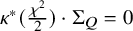 in
$\mathrm {H}^2(\Gamma _{g,{\unicode{x00BD}}};\Theta _{2n+1})$
in
$\mathrm {H}^2(\Gamma _{g,{\unicode{x00BD}}};\Theta _{2n+1})$
 for some
$k\neq 0$
for some
$k\neq 0$
 . Since the class
$\smash {\frac {\chi ^2}{2}}$
. Since the class
$\smash {\frac {\chi ^2}{2}}$
 is pulled back along the isomorphism
$(s_F,p)$
is pulled back along the isomorphism
$(s_F,p)$
 in (37), it suffices to show that
$\smash {(k,\mathrm {id})^{\ast }(\frac {\chi ^2}{2})\cdot \Sigma _Q=0}$
in (37), it suffices to show that
$\smash {(k,\mathrm {id})^{\ast }(\frac {\chi ^2}{2})\cdot \Sigma _Q=0}$
 in
$\mathrm {H}^2(\mathbf {Z}^{2g}\rtimes \mathrm {Sp}^q_{2g}(\mathbf {Z});\Theta _{2n+1})$
in
$\mathrm {H}^2(\mathbf {Z}^{2g}\rtimes \mathrm {Sp}^q_{2g}(\mathbf {Z});\Theta _{2n+1})$
 . But in view of Lemma 5.3, we have
$\smash {(k,\mathrm {id})^{\ast }(\frac {\chi ^2}{2})=k^2\cdot \frac {\chi ^2}{2}}$
. But in view of Lemma 5.3, we have
$\smash {(k,\mathrm {id})^{\ast }(\frac {\chi ^2}{2})=k^2\cdot \frac {\chi ^2}{2}}$
 , so if we choose k to be any multiple of the order of
$\Sigma _Q$
, so if we choose k to be any multiple of the order of
$\Sigma _Q$
 in
$\Theta _{2n+1}$
in
$\Theta _{2n+1}$
 , then we can conclude that
$\smash {(k,\mathrm {id})^{\ast }(\frac {\chi ^2}{2})\cdot \Sigma _Q= \frac {\chi ^2}{2}\cdot k^2\cdot \Sigma _Q=0}$
, then we can conclude that
$\smash {(k,\mathrm {id})^{\ast }(\frac {\chi ^2}{2})\cdot \Sigma _Q= \frac {\chi ^2}{2}\cdot k^2\cdot \Sigma _Q=0}$
 holds as claimed.
Claim ②. We have
$\mathrm {fr}(\Gamma _{g,1})\subset \mathrm {bP}_{2n+2}$
 .
.
Proof. Since
$\mathrm {fr}(\Gamma _{g,{\unicode{x00BD}}})=1$
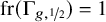 by (c), we have
$\mathrm {fr}(\Gamma _{g,1})\subset \Theta _{2n+1}$
by (c), we have
$\mathrm {fr}(\Gamma _{g,1})\subset \Theta _{2n+1}$
 by applying Lemma 5.1 1 to the morphism
$\Gamma _{g,1}\rightarrow \Gamma _{g,{\unicode{x00BD}}}$
by applying Lemma 5.1 1 to the morphism
$\Gamma _{g,1}\rightarrow \Gamma _{g,{\unicode{x00BD}}}$
 in (31) with kernel
$\Theta _{2n+1}$
in (31) with kernel
$\Theta _{2n+1}$
 . In particular, we have
$\mathrm {fr}(\Gamma _{g,1})=\mathrm {fr}(\Gamma _{g,1})\cap \Theta _{2n+1}$
. In particular, we have
$\mathrm {fr}(\Gamma _{g,1})=\mathrm {fr}(\Gamma _{g,1})\cap \Theta _{2n+1}$
 , so together with Claim ①, we get
$\mathrm {fr}(\Gamma _{g,1})=\mathrm {fr}(E(\mu \cdot \Sigma _P))\cap \Theta _{2n+1}$
, so together with Claim ①, we get
$\mathrm {fr}(\Gamma _{g,1})=\mathrm {fr}(E(\mu \cdot \Sigma _P))\cap \Theta _{2n+1}$
 . Now consider the map of central extensions

where the bottom extension is obtained from the top extension by taking quotients by the subgroup
$\mathrm {bP}_{2n+2}\le \Theta _{2n+1}$
 . This extension is classified by the image of
$\mu \cdot \Sigma _P$
. This extension is classified by the image of
$\mu \cdot \Sigma _P$
 under the morphism
$\mathrm {H}^2(\Gamma _{g,{\unicode{x00BD}}};\Theta _{2n+1})\rightarrow \mathrm {H}^2(\Gamma _{g,{\unicode{x00BD}}};\Theta _{2n+1}/\mathrm {bP}_{2n+2})$
under the morphism
$\mathrm {H}^2(\Gamma _{g,{\unicode{x00BD}}};\Theta _{2n+1})\rightarrow \mathrm {H}^2(\Gamma _{g,{\unicode{x00BD}}};\Theta _{2n+1}/\mathrm {bP}_{2n+2})$
 induced by the quotient map
$\Theta _{2n+1}\rightarrow \Theta _{2n+1}/\mathrm {bP}_{2n+2}$
induced by the quotient map
$\Theta _{2n+1}\rightarrow \Theta _{2n+1}/\mathrm {bP}_{2n+2}$
 . Since
$\Sigma _P$
. Since
$\Sigma _P$
 is contained in
$\mathrm {bP}_{2n+2}$
is contained in
$\mathrm {bP}_{2n+2}$
 , this image is trivial, so it follows that
$E(\mu \cdot \Sigma _P)/\mathrm {bP}_{2n+2}\cong \Theta _{2n+1}\times \Gamma _{g,{\unicode{x00BD}}}$
, this image is trivial, so it follows that
$E(\mu \cdot \Sigma _P)/\mathrm {bP}_{2n+2}\cong \Theta _{2n+1}\times \Gamma _{g,{\unicode{x00BD}}}$
 . Thus, since
$\mathrm {fr}(\Gamma _{g,1})=1$
. Thus, since
$\mathrm {fr}(\Gamma _{g,1})=1$
 , we deduce from Lemma 5.1 3 that
$\mathrm {fr}(E(\mu \cdot \Sigma _P)/\mathrm {bP}_{2n+2})=1$
, we deduce from Lemma 5.1 3 that
$\mathrm {fr}(E(\mu \cdot \Sigma _P)/\mathrm {bP}_{2n+2})=1$
 , so applying Lemma 5.1 1 to
$E(\mu \cdot \Sigma _P)\rightarrow E(\mu \cdot \Sigma _P)/\mathrm {bP}_{2n+2}$
, so applying Lemma 5.1 1 to
$E(\mu \cdot \Sigma _P)\rightarrow E(\mu \cdot \Sigma _P)/\mathrm {bP}_{2n+2}$
 we conclude that
$\mathrm {fr}(\mu \cdot \Sigma _P)\subset \mathrm {bP}_{2n+2}$
we conclude that
$\mathrm {fr}(\mu \cdot \Sigma _P)\subset \mathrm {bP}_{2n+2}$
 . Combining this with the first part of the argument, we arrive at the claim
$\mathrm {fr}(\Gamma _{g,1})=\mathrm {fr}(E(\mu \cdot \Sigma _P))\cap \Theta _{2n+1}\subset \mathrm {bP}_{2n+2}$
. Combining this with the first part of the argument, we arrive at the claim
$\mathrm {fr}(\Gamma _{g,1})=\mathrm {fr}(E(\mu \cdot \Sigma _P))\cap \Theta _{2n+1}\subset \mathrm {bP}_{2n+2}$
 .
.
Claim ③. For
$g\le 1$
 , we have
$\mathrm {fr}(\Gamma _{g,1})=1$
, we have
$\mathrm {fr}(\Gamma _{g,1})=1$
 .
.
Proof. For
$g=0$
 we have
$\Gamma _{g,1}=\pi _0{\mathrm {Diff}}_\partial (D^{2n})\cong \Theta _{2n+1}$
we have
$\Gamma _{g,1}=\pi _0{\mathrm {Diff}}_\partial (D^{2n})\cong \Theta _{2n+1}$
 , so since
$\Theta _{2n+1}$
, so since
$\Theta _{2n+1}$
 is a finite abelian group, we have
$\mathrm {fr}(\Gamma _{g,1})=1$
is a finite abelian group, we have
$\mathrm {fr}(\Gamma _{g,1})=1$
 by Lemma 5.1 3, as claimed. In the case
$g=1$
by Lemma 5.1 3, as claimed. In the case
$g=1$
 and
$n\neq 3,7$
and
$n\neq 3,7$
 , we use that
$\smash {\frac {\sigma }{8}}$
, we use that
$\smash {\frac {\sigma }{8}}$
 is trivial for
$g=1$
is trivial for
$g=1$
 (see 4), which implies
$\smash {E(\frac {\sigma }{8}\cdot \Sigma _P)\cong \Gamma _{g,{\unicode{x00BD}}}\times \Theta _{2n+1}}$
(see 4), which implies
$\smash {E(\frac {\sigma }{8}\cdot \Sigma _P)\cong \Gamma _{g,{\unicode{x00BD}}}\times \Theta _{2n+1}}$
 and thus
$\mathrm {fr}(E(\frac {\sigma }{8}\cdot \Sigma _P))=1$
and thus
$\mathrm {fr}(E(\frac {\sigma }{8}\cdot \Sigma _P))=1$
 by Lemma 5.1 3 and the fact from (c) that
$\mathrm {fr}(\Gamma _{g,{\unicode{x00BD}}})=1$
by Lemma 5.1 3 and the fact from (c) that
$\mathrm {fr}(\Gamma _{g,{\unicode{x00BD}}})=1$
 . Combining this with Claim ①, we obtain
$\mathrm {fr}(\Gamma _{g,1})\cap \Theta _{2n+1}=1$
. Combining this with Claim ①, we obtain
$\mathrm {fr}(\Gamma _{g,1})\cap \Theta _{2n+1}=1$
 . But since
$\mathrm {fr}(\Gamma _{g,1})\subset \Theta _{2n+1}$
. But since
$\mathrm {fr}(\Gamma _{g,1})\subset \Theta _{2n+1}$
 by Claim ②, we arrive at the claim
$\mathrm {fr}(\Gamma _{g})=1$
by Claim ②, we arrive at the claim
$\mathrm {fr}(\Gamma _{g})=1$
 . In the remaining case
$n=3,7$
. In the remaining case
$n=3,7$
 and
$g=1$
and
$g=1$
 , we first consider the map of extensions from [Reference KrannichKra20, Equation (2.2)] which involves the monomorphism
$(s_F,p)$
, we first consider the map of extensions from [Reference KrannichKra20, Equation (2.2)] which involves the monomorphism
$(s_F,p)$
 from (c)

By Lemma 2.1, the image of the monomorphism
$\mathrm {im}(\pi _n(\mathrm {SO}(n)\rightarrow \pi _n(\mathrm {SO}(n+1)))\hookrightarrow \pi _n(\mathrm {SO})\cong \mathbf {Z}$
 has index
$2$
has index
$2$
 . By Theorem 2.2, the upper extension is trivial, so we can conclude that there is an isomorphism
$\smash {\Gamma _{g,{\unicode{x00BD}}}\cong \mathbf {Z}^{2g}\rtimes \mathrm {Sp}_{2g}(\mathbf {Z})}$
. By Theorem 2.2, the upper extension is trivial, so we can conclude that there is an isomorphism
$\smash {\Gamma _{g,{\unicode{x00BD}}}\cong \mathbf {Z}^{2g}\rtimes \mathrm {Sp}_{2g}(\mathbf {Z})}$
 with respect to which the monomorphism
$\smash {(s_F,p)\colon \Gamma _{g,{\unicode{x00BD}}}\hookrightarrow \mathbf {Z}^{2g}\rtimes \mathrm {Sp}_{2g}(\mathbf {Z})}$
with respect to which the monomorphism
$\smash {(s_F,p)\colon \Gamma _{g,{\unicode{x00BD}}}\hookrightarrow \mathbf {Z}^{2g}\rtimes \mathrm {Sp}_{2g}(\mathbf {Z})}$
 from (c) is given by
$\smash {(2,\mathrm {id})\colon \mathbf {Z}^{2g}\rtimes \mathrm {Sp}_{2g}(\mathbf {Z})\hookrightarrow \mathbf {Z}^{2g}\rtimes \mathrm {Sp}_{2g}(\mathbf {Z})}$
from (c) is given by
$\smash {(2,\mathrm {id})\colon \mathbf {Z}^{2g}\rtimes \mathrm {Sp}_{2g}(\mathbf {Z})\hookrightarrow \mathbf {Z}^{2g}\rtimes \mathrm {Sp}_{2g}(\mathbf {Z})}$
 . We can now define a self-monomorphism
$\kappa \colon \Gamma _{g,{\unicode{x00BD}}}\hookrightarrow \Gamma _{g,{\unicode{x00BD}}}$
. We can now define a self-monomorphism
$\kappa \colon \Gamma _{g,{\unicode{x00BD}}}\hookrightarrow \Gamma _{g,{\unicode{x00BD}}}$
 for any fixed number
$k\neq 0$
for any fixed number
$k\neq 0$
 similar to (37), but using the above isomorphism
$\smash {\Gamma _{g,{\unicode{x00BD}}}\cong \mathbf {Z}^{2g}\rtimes \mathrm {Sp}_{2g}(\mathbf {Z})}$
similar to (37), but using the above isomorphism
$\smash {\Gamma _{g,{\unicode{x00BD}}}\cong \mathbf {Z}^{2g}\rtimes \mathrm {Sp}_{2g}(\mathbf {Z})}$
 instead of
$(s_F,p)$
instead of
$(s_F,p)$
 . Arguing as in the proof of Claim ① we have
$\smash {\mathrm {fr}(\Gamma _{g,1})\cap \Theta _{2n+1}=\mathrm {fr}(\kappa ^{\ast }\Gamma _{g,1})\cap \Theta _{2n+1}}$
. Arguing as in the proof of Claim ① we have
$\smash {\mathrm {fr}(\Gamma _{g,1})\cap \Theta _{2n+1}=\mathrm {fr}(\kappa ^{\ast }\Gamma _{g,1})\cap \Theta _{2n+1}}$
 which together with Claim ② yields
$\mathrm {fr}(\Gamma _{g,1})=\mathrm {fr}(\kappa ^{\ast }\Gamma _{g,1})\cap \Theta _{2n+1}$
which together with Claim ② yields
$\mathrm {fr}(\Gamma _{g,1})=\mathrm {fr}(\kappa ^{\ast }\Gamma _{g,1})\cap \Theta _{2n+1}$
 , so it would suffice to show
$\mathrm {fr}(\kappa ^{\ast }\Gamma _{g,1})=1$
, so it would suffice to show
$\mathrm {fr}(\kappa ^{\ast }\Gamma _{g,1})=1$
 . This follows from an application of Lemma 5.1 5 to the central extension
$\smash {0\rightarrow \Theta _{2n+1}\rightarrow \kappa ^{\ast }\Gamma _{g,1}\rightarrow \Gamma _{g,1{\unicode{x00BD}}}\rightarrow 0}$
. This follows from an application of Lemma 5.1 5 to the central extension
$\smash {0\rightarrow \Theta _{2n+1}\rightarrow \kappa ^{\ast }\Gamma _{g,1}\rightarrow \Gamma _{g,1{\unicode{x00BD}}}\rightarrow 0}$
 once we verify the three assumptions that (I)
$\Gamma _{g,1{\unicode{x00BD}}}$
once we verify the three assumptions that (I)
$\Gamma _{g,1{\unicode{x00BD}}}$
 has finitely generated abelianisation, (II)
$\mathrm {fr}(\Gamma _{g,1{\unicode{x00BD}}})=1$
has finitely generated abelianisation, (II)
$\mathrm {fr}(\Gamma _{g,1{\unicode{x00BD}}})=1$
 , and (III) the cohomology class
$\smash {\kappa ^{\ast }(-\frac {\chi ^2-\sigma }{8})\cdot \Sigma _P\in \mathrm {H}^2(\Gamma _{g,1{\unicode{x00BD}}};\Theta _{2n+1})}$
, and (III) the cohomology class
$\smash {\kappa ^{\ast }(-\frac {\chi ^2-\sigma }{8})\cdot \Sigma _P\in \mathrm {H}^2(\Gamma _{g,1{\unicode{x00BD}}};\Theta _{2n+1})}$
 which classifies this extension by (36) has trivial image in
$\mathrm {Hom}(\mathrm {H}_2(\Gamma _{g,1{\unicode{x00BD}}}),\Theta _{2n+1})$
which classifies this extension by (36) has trivial image in
$\mathrm {Hom}(\mathrm {H}_2(\Gamma _{g,1{\unicode{x00BD}}}),\Theta _{2n+1})$
 for some choice of
$k\neq 0$
for some choice of
$k\neq 0$
 . Condition (I) holds since
$\Gamma _{g,1{\unicode{x00BD}}}$
. Condition (I) holds since
$\Gamma _{g,1{\unicode{x00BD}}}$
 is itself finitely generated, because we saw above that it is isomorphic to
$\mathbf {Z}^{2g}\rtimes \mathrm {Sp}_{2g}(\mathbf {Z})$
is itself finitely generated, because we saw above that it is isomorphic to
$\mathbf {Z}^{2g}\rtimes \mathrm {Sp}_{2g}(\mathbf {Z})$
 . Condition (II) holds by (c). This leaves us with checking condition (III) for which it suffices to show that
$ \smash {\kappa ^{\ast }(-\frac {\chi ^2-\sigma }{8})}$
. Condition (II) holds by (c). This leaves us with checking condition (III) for which it suffices to show that
$ \smash {\kappa ^{\ast }(-\frac {\chi ^2-\sigma }{8})}$
 maps under the canonical morphism
$h\colon \mathrm {H}^2(\Gamma _{g,1{\unicode{x00BD}}});\mathbf {Z})\rightarrow \mathrm {Hom}\mathrm {H}_2(\Gamma _{g,1{\unicode{x00BD}}}),\mathbf {Z})$
maps under the canonical morphism
$h\colon \mathrm {H}^2(\Gamma _{g,1{\unicode{x00BD}}});\mathbf {Z})\rightarrow \mathrm {Hom}\mathrm {H}_2(\Gamma _{g,1{\unicode{x00BD}}}),\mathbf {Z})$
 to
$\smash {-k^2\cdot (\chi ^2-\sigma )/8\circ (s_F,p)_{\ast }}$
to
$\smash {-k^2\cdot (\chi ^2-\sigma )/8\circ (s_F,p)_{\ast }}$
 , since then
$\smash {\kappa ^{\ast }(-\frac {\chi ^2-\sigma }{8})\cdot \Sigma _P}$
, since then
$\smash {\kappa ^{\ast }(-\frac {\chi ^2-\sigma }{8})\cdot \Sigma _P}$
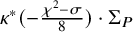 maps to
$-k^2\cdot \Sigma _P\cdot ((\chi ^2-\sigma )/8\circ (s_F,p)_{\ast })$
maps to
$-k^2\cdot \Sigma _P\cdot ((\chi ^2-\sigma )/8\circ (s_F,p)_{\ast })$
 in
$\mathrm {Hom}(\mathrm {H}_2(\Gamma _{g,1{\unicode{x00BD}}}),\Theta _{2n+1})$
in
$\mathrm {Hom}(\mathrm {H}_2(\Gamma _{g,1{\unicode{x00BD}}}),\Theta _{2n+1})$
 which is trivial if we choose
$k\neq 0$
which is trivial if we choose
$k\neq 0$
 to divide the order of
$\Sigma _P$
to divide the order of
$\Sigma _P$
 . To show this remaining identity
$h( \smash {\kappa ^{\ast }(-\frac {\chi ^2-\sigma }{8})})=\smash {-k^2\cdot (\chi ^2-\sigma )/8\circ (s_F,p)_{\ast }}$
. To show this remaining identity
$h( \smash {\kappa ^{\ast }(-\frac {\chi ^2-\sigma }{8})})=\smash {-k^2\cdot (\chi ^2-\sigma )/8\circ (s_F,p)_{\ast }}$
 , we compute

where the first equality follows from 3 and the second equality holds since
$(s_F,p)\circ \kappa =(k,\mathrm {id})\circ (s_F,p)$
 by definition of
$\kappa $
by definition of
$\kappa $
 . We then compute further

using the final part of 4 for the first equality and Lemma 5.3 for the second. In total we obtain
$8\cdot h( \smash {\kappa ^{\ast }(-\frac {\chi ^2-\sigma }{8})})=-k^2\cdot \chi ^2\circ (s_F,p)$
 in
$\mathrm {Hom}(\mathrm {H}_2(\Gamma _{g,1{\unicode{x00BD}}}),\mathbf {Z})$
in
$\mathrm {Hom}(\mathrm {H}_2(\Gamma _{g,1{\unicode{x00BD}}}),\mathbf {Z})$
 , so the claimed identity follows by dividing this equality by
$8$
, so the claimed identity follows by dividing this equality by
$8$
 .
.
Claim ④. For
$g\ge 2$
 , we have
$\mathrm {bP}_{2n+2}\subset \mathrm {fr}(\Gamma _{g,1})$
, we have
$\mathrm {bP}_{2n+2}\subset \mathrm {fr}(\Gamma _{g,1})$
 , and thus
$\mathrm {bP}_{2n+2}=\mathrm {fr}(\Gamma _{g,1})$
, and thus
$\mathrm {bP}_{2n+2}=\mathrm {fr}(\Gamma _{g,1})$
 by Claim ②.
Proof. We first form the pullback involving the monomorphism
$(s_F,p)$
 from (c)

and consider the diagram of horizontal of extensions

obtained from the front bottom row classified by
$\mu \in \mathrm {H}^{2}(\Gamma _{g,{\unicode{x00BD}}};\mathbf {Z})$
 by pulling it back along the inclusion
$\iota _F$
by pulling it back along the inclusion
$\iota _F$
 to obtain the front part of the diagram, and then pushing out along
$\Sigma _P\colon \mathbf {Z}\rightarrow \Theta _{2n+1}$
to obtain the front part of the diagram, and then pushing out along
$\Sigma _P\colon \mathbf {Z}\rightarrow \Theta _{2n+1}$
 to obtain the back part. In a moment, we will show that
$\smash {\mathrm {fr}(E(\iota _F^{\ast }\mu ))=\mathbf {Z}}$
to obtain the back part. In a moment, we will show that
$\smash {\mathrm {fr}(E(\iota _F^{\ast }\mu ))=\mathbf {Z}}$
 . Assuming this for now, the proof concludes as follows: Applying Lemma 5.1 1 to the map
$E(\iota _F^{\ast }\mu )\rightarrow E(\mu \cdot \Sigma _P)$
. Assuming this for now, the proof concludes as follows: Applying Lemma 5.1 1 to the map
$E(\iota _F^{\ast }\mu )\rightarrow E(\mu \cdot \Sigma _P)$
 , we deduce
$\langle \Sigma _P\rangle \subset \mathrm {fr}(E(\mu \cdot \Sigma _P))$
, we deduce
$\langle \Sigma _P\rangle \subset \mathrm {fr}(E(\mu \cdot \Sigma _P))$
 , so since
$\mathrm {bP}_{2n+2}=\langle \Sigma _P\rangle $
, so since
$\mathrm {bP}_{2n+2}=\langle \Sigma _P\rangle $
 , we obtain
$\mathrm {bP}_{2n+2}\subset \mathrm {fr}(E(\mu \cdot \Sigma _P))$
, we obtain
$\mathrm {bP}_{2n+2}\subset \mathrm {fr}(E(\mu \cdot \Sigma _P))$
 which combined with Claim ① implies
$\mathrm {bP}_{2n+2}\subset \mathrm {fr}(\Gamma _{g,1})$
which combined with Claim ① implies
$\mathrm {bP}_{2n+2}\subset \mathrm {fr}(\Gamma _{g,1})$
 as claimed. We are thus left to show that
$\smash {\mathrm {fr}(E(\iota _F^{\ast }\mu ))=\mathbf {Z}}$
as claimed. We are thus left to show that
$\smash {\mathrm {fr}(E(\iota _F^{\ast }\mu ))=\mathbf {Z}}$
 which we do by verifying the assumptions of Lemma 5.2 for the class
$\smash {\iota _F^{\ast }\mu \in \mathrm {H}^{2}(\Gamma _{g,{\unicode{x00BD}}}^F;\mathbf {Z})}$
which we do by verifying the assumptions of Lemma 5.2 for the class
$\smash {\iota _F^{\ast }\mu \in \mathrm {H}^{2}(\Gamma _{g,{\unicode{x00BD}}}^F;\mathbf {Z})}$
 , viewing
$\smash {\Gamma _{g,{\unicode{x00BD}}}^F}$
, viewing
$\smash {\Gamma _{g,{\unicode{x00BD}}}^F}$
 as a subgroup of
$\smash {\mathrm {Sp}_{2g}(\mathbf {Z})}$
as a subgroup of
$\smash {\mathrm {Sp}_{2g}(\mathbf {Z})}$
 via the inclusion
$p_F$
via the inclusion
$p_F$
 in (40). Since the index of the image of
$p_F$
in (40). Since the index of the image of
$p_F$
 is the index of the image of
$(s_F,p)$
is the index of the image of
$(s_F,p)$
 in (40) which is finite by Item (c), the first condition in Lemma 5.2 holds for
$\iota _F^{\ast }\mu $
in (40) which is finite by Item (c), the first condition in Lemma 5.2 holds for
$\iota _F^{\ast }\mu $
 . To show the second condition, that is, that the abelianisation
$\smash {\mathrm {H}_1(\Gamma _{g,{\unicode{x00BD}}}^F)}$
. To show the second condition, that is, that the abelianisation
$\smash {\mathrm {H}_1(\Gamma _{g,{\unicode{x00BD}}}^F)}$
 is finite, note that since the right vertical inclusion in (40) is a split injection, the same applies for the left vertical inclusion, so
$\smash {\mathrm {H}_1(\Gamma _{g,{\unicode{x00BD}}}^F)}$
is finite, note that since the right vertical inclusion in (40) is a split injection, the same applies for the left vertical inclusion, so
$\smash {\mathrm {H}_1(\Gamma _{g,{\unicode{x00BD}}}^F)}$
 is a summand of
$\smash {\mathrm {H}_1(\Gamma _{g,{\unicode{x00BD}}})}$
is a summand of
$\smash {\mathrm {H}_1(\Gamma _{g,{\unicode{x00BD}}})}$
 and thus it suffices to prove that
$\smash {\mathrm {H}_1(\Gamma _{g,{\unicode{x00BD}}})}$
and thus it suffices to prove that
$\smash {\mathrm {H}_1(\Gamma _{g,{\unicode{x00BD}}})}$
 is finite. This holds by a combination of Corollary 2.4 and Table 2 in loc.cit., using the assumption that
$g\ge 2$
is finite. This holds by a combination of Corollary 2.4 and Table 2 in loc.cit., using the assumption that
$g\ge 2$
 . This leaves us with establishing the third condition in Lemma 5.2 for the class
$\iota _F^{\ast }\mu $
. This leaves us with establishing the third condition in Lemma 5.2 for the class
$\iota _F^{\ast }\mu $
 , that is, that we have
$8\cdot \mu \circ (\iota _F)_{\ast }=\sigma \circ (p_F)_{\ast }$
, that is, that we have
$8\cdot \mu \circ (\iota _F)_{\ast }=\sigma \circ (p_F)_{\ast }$
 in
$\mathrm {Hom}(\mathrm {H}_2(\Gamma _{g,{\unicode{x00BD}}}^F),\mathbf {Z})$
in
$\mathrm {Hom}(\mathrm {H}_2(\Gamma _{g,{\unicode{x00BD}}}^F),\mathbf {Z})$
 . From the definition of
$\mu $
. From the definition of
$\mu $
 and commutativity of (40), we see that the left-hand side of the claimed equation is given by the composition

where the final arrow is
$\smash { \sigma \circ (\mathrm {pr}_2)_{\ast }}$
 if
$n\neq 3,7$
if
$n\neq 3,7$
 and
$\smash {-\chi ^2+(\sigma \circ (\mathrm {pr}_2)_{\ast })}$
and
$\smash {-\chi ^2+(\sigma \circ (\mathrm {pr}_2)_{\ast })}$
 if
$n=3,7$
if
$n=3,7$
 . As
$\smash {\chi ^2\circ \mathrm {inc}_{\ast }}$
. As
$\smash {\chi ^2\circ \mathrm {inc}_{\ast }}$
 vanishes by Lemma 5.3, we have
$8\cdot \mu \circ (\iota _F)_{\ast }=\sigma \circ (\mathrm {pr}_2)_{\ast }\circ \mathrm {inc}_{\ast }\circ (p_F)_{\ast }$
vanishes by Lemma 5.3, we have
$8\cdot \mu \circ (\iota _F)_{\ast }=\sigma \circ (\mathrm {pr}_2)_{\ast }\circ \mathrm {inc}_{\ast }\circ (p_F)_{\ast }$
 in both cases. But since
$\smash {\mathrm {pr}_2\circ \mathrm {inc}=\mathrm {id}_{\mathrm {Sp}_{2g}(\mathbf {Z})}}$
in both cases. But since
$\smash {\mathrm {pr}_2\circ \mathrm {inc}=\mathrm {id}_{\mathrm {Sp}_{2g}(\mathbf {Z})}}$
 , this implies
$8\cdot \mu \circ (\iota _F)_{\ast }=\sigma \circ (p_F)_{\ast }$
, this implies
$8\cdot \mu \circ (\iota _F)_{\ast }=\sigma \circ (p_F)_{\ast }$
 as claimed.
Acknowledgements
FM would like to thank Søren Galatius for the many helpful discussions regarding this work. AK and MK would like to thank Oscar Randal-Williams for useful conversations.
Competing interests
The authors have no competing interests to declare.
Financial support
MK and FM acknowledge funding from the European Union through an ERC grant (MaFC, 101221003). AK acknowledges the support of the Natural Sciences and Engineering Research Council of Canada (NSERC) [funding reference number 512156 and 512250]. FM is supported by the Danish National Research Foundation through the Copenhagen Center for Geometry and Topology (DNRF151).


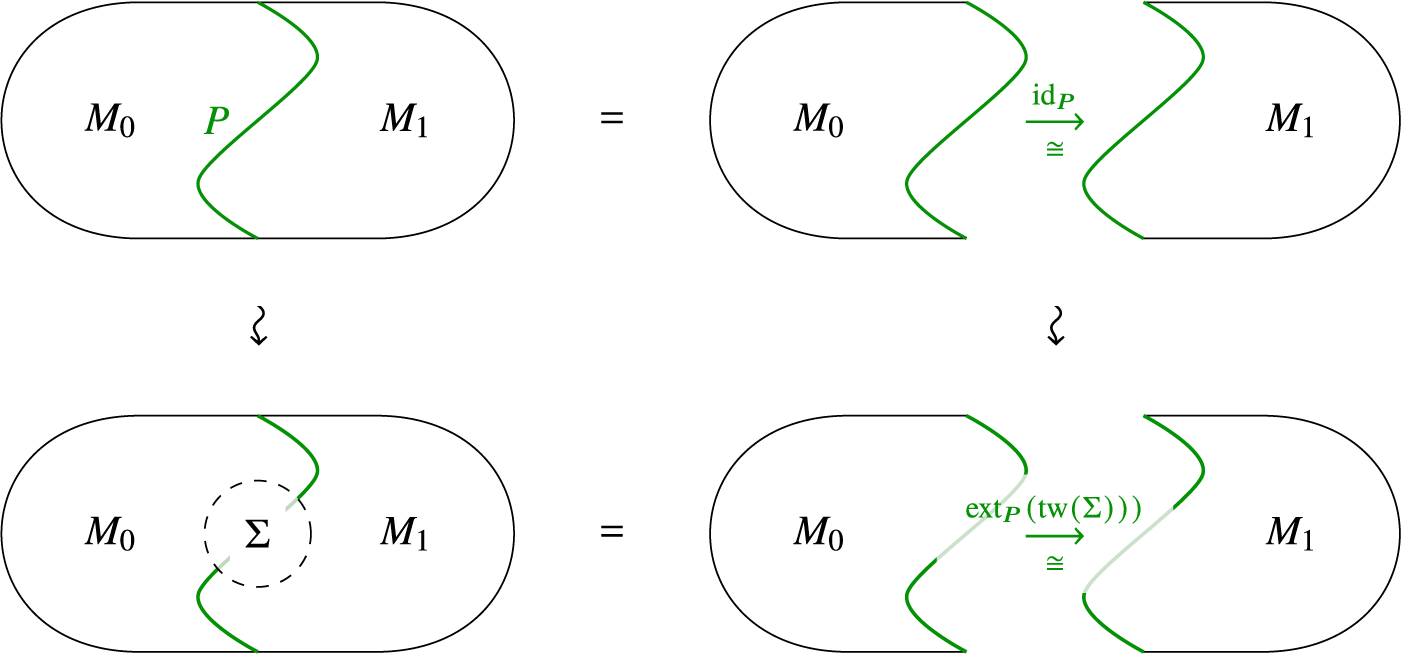


 Open access

