

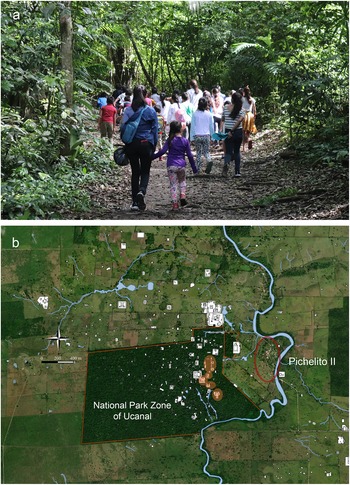
When the kids from the local village of Pichelito II, Guatemala, came to visit our excavations at the Maya site of Ucanal (Figures 1, 2), I asked them: What is this place called? I was thinking that the kids might shout out, “Ucanal” (the Mopan Maya name of the site recognized by the Institute of Archaeology and History in Guatemala), even though I was secretly wishing that they would yell out “K’anwitznal” (Yellow Hill Place), the Classic period Maya name for the city and its environs. Instead, a little girl about six years old shouted out, “El monte!” (“the forest” in Spanish). Although this was not the answer I was expecting, it highlights the importance of thinking about ruins as part of a living forest and the tangled engagement of local peoples and their landscapes.
Map of the Maya area with the archaeological site of Ucanal, the contemporary village of Pichelito II, and selected archaeological sites mentioned in the text.

Forest ruins of Ucanal, Petén, Guatemala: (a) Pichelito primary school students visiting the archaeological site with Proyecto Arqueológico Ucanal project members (photo by Laurianne Gauthier); (b) satellite photo of the Ucanal National Park managed by the Instituto Nacional de Arqueología e Historia de Guatemala showing part of the Late to Terminal Classic urban site core of the K’anwitznal capital (superimposed white buildings) and the zones of Postclassic ceramic concentrations (orange circles). (Color online)

As such, I examine here archaeological cases of ruins—the past in the past—as part of k’ax, a living landscape of wilderness, shade, darkness, snakes, and animate forest beings . . . el monte. Although the forest has always been, upon first glance, a passive backdrop to modern Western Romantic encounters with Maya ruins (Houston Reference Houston2021; Stephens Reference Stephens1841), few archaeological studies consider the living forest as part of ancient Maya experiences of ruins. Instead the focus has largely been on exposures of stone rubble, cut limestone blocks, and broken, displaced monuments (Manahan Reference Manahan2004; Martin Reference Martin, Colas, Delvendahl and Schubart2000; Mixter Reference Mixter2019; O’Neil Reference O’Neil2012; Stanton and Magnoni Reference Stanton and Magnoni2008). In this article, I review different ways archaeologists have considered ruins in precolumbian Maya contexts and showcase examples from recent excavations of the archaeological site of Ucanal, Petén, Guatemala, as well as other examples in the Maya area and beyond.
Understandings of Maya ruins in the precolumbian period, however, are most productively explored in consideration with Indigenous Maya ontologies and cosmologies, elucidated in part through Classic period inscriptions, ethnographies, and oral narratives. They underscore that ruins are not only generative elements in effective change but are affective places inhabited by malevolent, fickle, and dangerous animate forces that may harm and trick. This more sinister, dark, and loathsome side moves to the fore when ruins are examined not just as ancient, seemingly abandoned buildings in the landscape but as forest ruins that teem with different forms of living beings. These Indigenous perspectives can be put in dialogue with posthumanist perspectives that recognize the agency of objects, multispecies histories, and the vitality of landscapes. In these diverse cases, I find that ruins were part of the “working out” of moral communities; that is, the recognition—even if fleeting or perfunctory—of responsibilities, entanglements, and care beyond the self (Csordas Reference Csordas2013).
Affective Ruins and Uncanny Engagements
Ruins from many places in the world have often been associated with the sensate experiences of haunting and the uncanny (Dawdy Reference Dawdy2016; Moshenska Reference Moshenska2006; Rich Reference Rich2021). In fact, Gabriel Moshenska (Reference Moshenska2006), drawing on Freud’s notion of unheimlich, or “uncanny,” argued that in the minds of the general public, archaeology is an uncanny practice as it exposes what is buried and what seemingly should remain hidden. It brings dead people and places into the world of the living. The uncanniness of archaeology is nourished, he argued, through the public’s alienation from the actual practices of excavation, analysis, and their direct engagement with artifacts and ancient buildings, a commentary on who has access to heritage. In turn, Jamie Arjona (Reference Arjona2016), in her analysis of historic documents and archaeological investigations of a historic farmstead at the edge of Emerald Mound, Illinois, found that seemingly unoccupied Mississippian earthen mounds registered uncanny affects of an Indigenous presence among the White settlers who colonized the US Southeast and Midwest in the nineteenth century. In drawing from queer theory, she argued that such affects operated in “an array of nonnormative intimacies” that queered linear chronotopes and a sense of the settlers’ own legitimacy of occupation in their Western expansion into Native American lands (Arjona Reference Arjona2016:193).
In turn, Hilary Leathem (Reference Leathem2019) drew on the posthumanist scholarship of Bruno Latour (Reference Latour2005) and Alfred Gell (Reference Gell1998) to make sense of the experiences of spooked possession caused by the ruins of Mitla, Oaxaca, and experienced by local communities living near the site. She argued that the distributed agency of the ruins was nurtured by the conception of them as being created by nonhuman beings from mythic times and as a state of continuous becoming. These experiences of possession by the ruins, however, emerged at a particular moment, the exact same time in which Mexican government institutions were enforcing further regulations to dispossess locals from the archaeological site. As she asserted, “Possessing the ruins [by the government] does not silence the stones; it is the incredible efficacy of a preservationist agenda gone awry that severs or obscures affective attachments, dispossessing the ruins of Mitla and the Mitleños of the ruins.” In this sense, these cases of affective and unsettling engagements with ruins are tied up in a shifting sense of moral communities, an element also (Leathem Reference Leathem2019:106) at play in Maya forest-ruins as seen in the following text.
Living with Maya Ruins During the Precolumbian Period
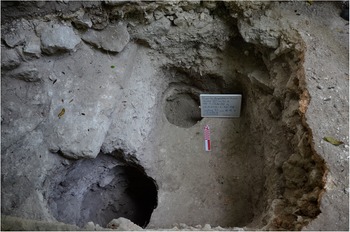
Ruins were both a regular part of ancient Maya peoples’ everyday lives and more punctuated engagements as part of pilgrimages, ceremonial processions, and ritual events. To be sure, however, some ruins were also purposely avoided and hidden. Maya residential and ceremonial building campaigns often consisted of the layering of building foundations, one over the other in successive cake layers whereby the older building was covered and hidden by newer buildings. These earlier buildings and features were remembered and sometimes revisited in precise locations to retrieve cached or buried items, as may have been the case at Ucanal’s Structure J-1 in Group J, in which Late Classic residents excavated holes in earlier buildings (Cruz Gómez and Garrido Reference Carlos, Garrido, Halperin and Garrido2016; Figure 3) and in Ucanal’s Group 141 (Cotom and Miller-Wolf Reference Cotom, Miller-Wolf, Halperin and Garrido2016) in which late Terminal Classic residents excavated holes into the painted benches of their residences dating to the early Terminal Classic period before sealing them up with a later phase of construction in the late Terminal Classic period. These practices are documented elsewhere, such as in residences at Copan, Honduras (see also Hendon Reference Hendon2010:119–121) or in a public ceremonial building containing multiple burials at Chan, Belize (Novotny Reference Novotny2013), where the social memory of buried items in the landscape were multigenerational.
Two cylindrical holes excavated by Late Classic inhabitants at the site into earlier Late Classic period architecture in Structure J-6, Group J, Ucanal (UCA01A-1-10-28). The Late Classic phases were later buried by Terminal Classic phase construction (photo by Carlos Cruz Gómez, PAU). (Color online)

In some cases, a considerable effort was made to bury previous buildings—that is, to destroy the power, history, and animacy of some buildings and to avoid their emergent potential to become a ruin. For example, Ucanal’s Ballcourt #1 was built at the very beginning of the Terminal Classic period around 800–830 CE (Halperin Reference Halperin2021a). Its construction fill was comprised of cut stone blocks from an earlier building that likely dated to the Late Classic period. The enormous scale of the cut stone blocks used as fill suggests that the earlier monumental building’s history was wiped from the city’s urban landscape.
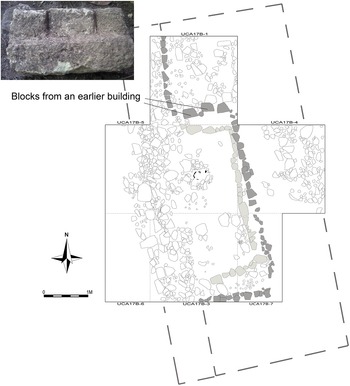
Blocks from older buildings were also integrated into residential compounds. For example, at Ucanal’s Group 167, two sculpted cut-stone blocks from an unknown elite building were infixed into the façade of a commoner residence and visible on a quotidian basis (Figure 4; Cano Estrada Reference Cano Estrada, Halperin and Garrido2019). One possibility is that these types of additions were like little seeds, ensouling and animating the buildings with pieces of history and animating forces. Such a process is known as k’ex in various Maya languages, denoting the process of making something new out of the old, reincarnations of ancestors into new generations, and the transfer of life through exchange (Carlsen and Prechtel Reference Carlsen and Prechtel1991:27–28).
Non-elite residential architecture from Group 167 showing the Terminal Classic addition of sculpted stone blocks to “C”-shaped Structure 167-2. The two sculpted stones derive from a previous unknown elite or monumental building (plan drawing and photo by Miguel Cano Estrada, PAU).

At the same time, some entire buildings were left in ruins, never rebuilt again despite the fact that such buildings may have been surrounded by newer constructions in stone and painted plaster (Halperin Reference Halperin2014a). At Ucanal, one possibility for such ruins is Ballcourt #2 in Group M, which was built in the Late Classic period but never refurbished. Yet surrounding the ballcourt was later Terminal Classic (ca. 830–1000 CE) construction (Laporte and Mejía Reference Laporte and Mejía2002:16–18), indicating that the ballcourt may have fallen into ruin or was recognized as ancient.
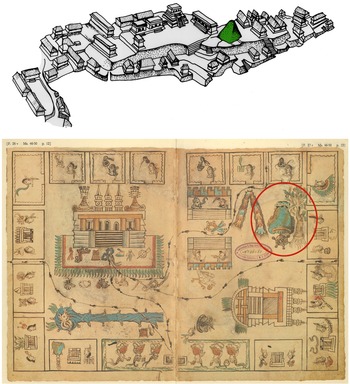
Elsewhere in the southern Maya Lowlands, temple pyramids were left as ruins left to accumulate vegetated growth, a process that occurs quickly in the semitropical lowlands without regular cleaning and use. For example at the site of San Bartolo, Late Preclassic (ca. 300 BCE–300 CE) vegetated ruins appear to have been a part of the Late Classic city (Davies Reference Davies2012:12–15; Runggaldier Reference Runggaldier2009), and at Topoxté, Late Classic vegetated ruins were a part of the Late Postclassic urban landscape with an abandoned temple pyramid situated next to the site’s most prominent Late Postclassic ceremonial architecture (Wurster Reference Wurster2000; Figure 5a). In Central Mexico, this phenomenon is most evident at the city of Cholula, a famous pilgrimage destination and market center. The Great Pyramid, known to locales as Tlachihualtepetl (man-made mountain), was abandoned sometime during the Early Postclassic period, around the same time in which the pyramid of Quetzalcoatl became the new focus of the city’s ceremonial activity (McCafferty Reference McCafferty1996, Reference McCafferty, Koontz, Reese-Taylor and Headrick2001, Reference McCafferty, Kowalski and Kristan-Graham2007). Although the Great Pyramid did not undergo any major constructions during the Late Postclassic period, it was recognized as a place built by ancestors and mythical giant-like beings. And despite its overgrown, vegetated state in the Late Postclassic and contact periods, the Great Pyramid continued to serve as a ritual locus within the city (Figure 5b).
Vegetated mountain ruins in urban landscapes: (top) reconstruction drawing of Late Postclassic Topoxté, Guatemala, showing Structure A (green) as left in ruin; drawing by author after Blick von Westen in Wurster Reference Wurster2000); (bottom) view of the city of Cholula, Mexico, with the Great Pyramid as mountain (Tlachihualtepetl) marked with a red circle; Historia Tolteca Chichimeca, mid-sixteenth century (Kirchhoff et al. Reference Kirchhoff, Lina and uis1976). (Color online)

Paleobotanical studies support the idea that ancient Maya cities were, in fact, green cities—leaving space for patches of vegetation and cultivated gardens among the urban landscape, zones that would attract insects and birds (Graham Reference Graham1999; Isendahl and Smith Reference Isendahl and Smith2012). Environmental DNA analyses of sediments reveal that Classic period inhabitants of the city of Tikal permitted or encouraged the growth of both large and understory tropical forest trees around the city’s urban reservoirs, even during the height of its occupation in the Late Classic period (ca. 600–830 CE; Lentz et al. Reference Lentz, Hamilton, Dunning, Tepe, Scarborough, Meyers, Grazioso and Weiss2021). Patches of not only gardens but also vegetated ruins may have been more common in ancient Maya cities than previously acknowledged.
Unlike the vegetated ruins dotting urban landscapes, however, ancient Maya ruins were also fully integrated into wilderness realms along the edges or further away from settlement zones. For example, many Classic period cities whose civic-ceremonial buildings were no longer refurbished in the Postclassic period were, nonetheless, frequently visited in their forest-ruined states (Brown Reference Brown2011; Stanton and Magnoni Reference Stanton and Magnoni2008), and the site of Ucanal was no exception. While the Postclassic occupation of Ucanal is difficult to characterize because almost all excavated groups have yielded some Early Postclassic ceramic sherds in small amounts, little evidence of major Postclassic architectural projects have been documented at the site thus far (Halperin et al. Reference Halperin, Flynn-Arajdal, Wolf and Freiwald2021; Laporte and Mejía Reference Laporte and Mejía2002). As such, plaster plaza floors and buildings would have been covered over in vegetation even if small zones of the site were clearly occupied. The largest concentrations of Postclassic ceramics are found on elite and ceremonial buildings in the site core, such as in Groups A, J, K, and D, and include large quantities of incense burners (Figure 2b; López López Reference López, Fernanda, Halperin and Garrido2020; Salas et al. Reference Salas, Estrada, Perea, Fuentes, Halperin and Garrido2023). On Structure K-1 in Group K, for example, three small Postclassic cobble pavements were placed down in an east-west orientation on top of what was previously a long rectangular Terminal Classic public building orientated 34° east of north with only the eastern one containing high concentrations of incense burners (Halperin and Gauthier Reference Halperin, Gauthier, Halperin and Ramos2025). The localized style of the incense burners suggests that those conducting rituals on these ancient buildings, in what would have been a vegetated landscape, were local inhabitants living nearby even if such residential settlements or buildings are currently unknown (Figure 6). The pervasiveness of these ritual deposits throughout the site underscores the potentially affective and stirring nature of the forest ruins of the earlier capital city of K’anwitznal as they continued to “participate” in the lives of Postclassic Mopan Maya peoples from the region. But what types of stirring engagements might these forest ruins have imposed on later peoples?
Postclassic effigy incense burners from Ucanal: (a) Patojo Modelado, V. Sin Nombre found at the base of Structure K-2 in Group K; UCA20B-14-2-2092 (b) Pau Modelado found on Structure J-2 in elite residential-administrative Group J, UCA1B-9-1-1255&1248&1258 (photos by Christina Halperin, PAU). (Color online)

Dark Forest Ruins
In both precolumbian and more recent times, forest mountain caves have long been associated with primordial emergence and the origin place of the first ancestral peoples on earth, the first substance goods, and other life-sustaining elements, such as water and basic foodstuffs (Schele Reference Schele and Houston1998; Schele and Guernsey Reference Schele, Guernsey, Koontz, Reese-Taylor and Headrick2001; Stone Reference Stone1995; Taube Reference Taube2004; Taube et al. Reference Taube, Saturno, Stuart and Hurst2010). The precolumbian Mesoamerican concept of Flower Mountain, a celestial solar paradise associated with abundance and primordial origins, was a mountain of wilderness with not just sprouting trees, flowers, and vegetation but also a place teaming with wild animals, jaguars, birds, and snakes (Taube et al. Reference Taube, Saturno, Stuart and Hurst2010). Among contemporary Maya peoples, wilderness landscape, k’ax or k’aax, however, was never a “natural forest” in the Western sense of the term. It was part of an enchained transformation between kol, cleared agricultural plots, hubche’, a mix of grasses, shrubs, and secondary growth trees, and k’ax, forested landscape with mature trees, medicinal plants, wild game, and herbs (Brown Reference Brown2007; Ford Reference Ford, Hutson and Traci2020; Rosado-May and Poot Cahun Reference Rosado-May and Cahun2020). The transformation between these states follows the perspective of k’exoj, regeneration or generational continuity of life through transferal and transformation, a concept of change that is more enchained than cyclical and one that is thought to be deeply rooted in antiquity (Carlsen and Prechtel Reference Carlsen and Prechtel1991; Gillespie Reference Gillespie2021:117–118; Taube Reference Taube, Gomez-Pompa, Allen, Fedick and Jimenez-Osornio2003).
Despite the association of mountain caves as primordial places of abundance, ethnographic, colonial, and Classic period evidence suggest that such wilderness landscapes and forest ruins were also rife with dark and sinister animate forces with the potential to harm (Armstrong-Fumero Reference Armstrong-Fumero2014; Lois and Vapnarsky Reference Lois and Vapnarsky2010:89–119; Taube Reference Taube, Gomez-Pompa, Allen, Fedick and Jimenez-Osornio2003). Such conceptions are particularly vivid in ethnographic accounts and folktales. For the contemporary Yucatec Maya, for example, the bush is inhabited by an alux or aluxob (plural), short-bearded goblin-like beings a foot high. In general, the alux (also arux or uyumil k’aax, or guradians of the forest in Itzaj Maya) are the feared protagonists of many a folktale, causing illnesses through evil winds. Not only are they associated with the deep forest but they take up residence in ancient ruins and can be found in ancient pottery idols and incense burners.
This is what makes the low mounds, that are so evidently of artificial construction, uncanny and dangerous places. It is best to avoid the sleeping alux or to destroy them. A man in Chan Kom dug a hole behind the wall that ran around his house lot. There in the ground he found an alux lying—”even including his dishes—he was the color of clay.” Quickly the man threw stones on top of him and covered the place with dirt, lest he should do some harm. Any other man in Chan Kom would have done the same [Redfield and Rojas Reference Redfield and Villa Rojas1934:120].
But if treated with reverence and offerings of corn gruel, the alux could ensure that one’s milpa (fields) always stayed green and help bring good fortune (Jong Reference Jong1999:269–270). Because the alux and other forest beings are tricksters, they are the subject of much joking and laughter, but underneath this laughter can be fear, especially if the forest is not treated with respect (Lois and Vapnarsky Reference Lois and Vapnarsky2010:90). It is said among the Itza Maya settlement of San José that the guardians of the forest have recently been scared off by tourists and too much noise from television and other electronics (Lois and Vapnarsky Reference Lois and Vapnarsky2010:90).
Other dangerous beings of the forest for contemporary Yucatec and Mopan Maya peoples include witches that take animal form, huge animal monsters, and the x-tabai, a beautiful young woman with long hair who seduces young men into the bush before choking them to death. She targets drunk men and thus plays an agentive role in reprimanding improper behavior. The x-tabai can transform herself into certain high canopy trees associated with k’ax, such as the ceiba and the kulinche, or cashew tree. She can also transform herself into certain snakes, such as the chay-i-can, reinforcing her ties to the deep forest (Lois and Vapnarsky Reference Lois and Vapnarsky2010:98–99; Redfield and Rojas Reference Redfield and Villa Rojas1934:121–122; Thompson Reference Thompson1930:110).
Among the Chol Maya, the xibajob are witches and feared supernatural beings of various manifestations who live out in the forests (Hopkins et al. Reference Hopkins, Josserand and Guzmán2016:115–127, 172–175; Josserand et al. Reference Josserand, Hopkins, Auscencio Cruz Guzmán and Price2003). Xibaj is a bald human-like figure who commands a party of skeletons and personified animals, including talking owls and foxes. In various versions of the Messenger tale, a man travels to deliver a message but must take refuge overnight in an abandoned house in the middle of the forest. A series of xibajob, however, also visit the abandoned house while the messenger is trying to sleep in the rafters. They sit down to a meal of human corpse and invite the messenger to eat. Eventually the messenger escapes the abandoned house but is chased by the xibaj.
The morals stressed in these stories are that you should carry out your responsibilities in a timely manner, you shouldn’t spend the night outside of human habitations, and you shouldn’t eat forbidden foods. If you do, you will pay with your life and/or soul, giving back a body for the one you consumed [Josserand et al. Reference Josserand, Hopkins, Auscencio Cruz Guzmán and Price2003:10].
In addition to these dark forest spirits are the Earth Owners and Masters of the Animals who dwell in caves and in the forest, presiding over these wilderness realms. They include the Yum K’ax among the Yucatecan and Mopan Maya (Brown Reference Brown2007:96; Thompson Reference Thompson1930:108), Don Juan or the Earth Owner among the Chol Maya (Hopkins et al. Reference Hopkins, Josserand and Guzmán2016; Josserand et al. Reference Josserand, Hopkins, Auscencio Cruz Guzmán and Price2003), the K’änänk’ax (the Forest Keeper) and U Yum’il Bäk (Master of the Animals) among the Lacandon Maya (Balsanelli Reference Balsanelli2021:74; Boremanse Reference Boremanse1998), rajawal (manifesting in moutains, snakes, and sometimes people) among Kaqchikel Maya communities (Cap et al. Reference Cap, Ixmukane, Quiroa, Tocón, Arroyo, Salinas and Álvarez2017), and Witz among the Jakaltek Maya (manifesting in mountains, ladino men, priests, and blond men; Montejo Reference Montejo2021:125–143). Because animals and other nonhuman entities possess a soul, the taking of them during the hunt must be in accordance with a social contract of reciprocal relations with these forest and animal owners. Humans may take only what is needed but must return the bones of animals to the forest and must provide offerings to the forest spirits. If these relationships are neglected, humans are punished.
Similarly, Lilia Cap, Ixmukane Choy, Fredy Quira, and Eddy Tocón (Reference Cap, Ixmukane, Quiroa, Tocón, Arroyo, Salinas and Álvarez2017) underscore that rajawal (Earth owners and protective forest forces) mediate relations between humans and other animate entities including mountains and archaeological objects or objetos antiguos. A central component of these relationships is that humans must treat them with respect through the continued recognition of sacred and traditional histories, the following of community norms, and a reciprocity of care. In the case of objetos antiguos, these caring relations may include setting aside ceramic sherds and worked stones found in one’s milpa field and burying them together in a small hole, placing objetos antiguos in special areas of the household patio, or even painting and bathing sculpted stone pieces.
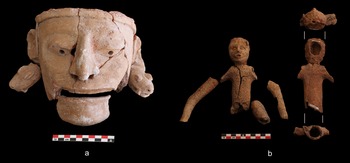
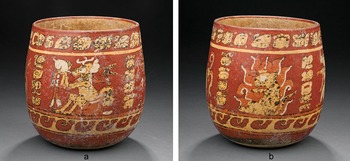
Scholars have long associated the dark forest beings from ethnographic accounts with Classic period way or wahy figures and other supernatural beings, although many precolumbian Maya deities in general were also highly ambivalent beings (Beliaev Reference Beliaev2004; Grube and Nahm Reference Grube, Nahm and Kerr1994; Houston and Stuart Reference Houston and Stuart1989; Stuart Reference Stuart, Coltman and Pohl2021; Taube Reference Taube, Gomez-Pompa, Allen, Fedick and Jimenez-Osornio2003). Depicted primarily on painted polychrome vessel scenes and the subjects of ceramic figurines (Figures 7, 8), they invoked the chaotic realm of darkness, dream worlds, diseases, the Underworld, and death. In painted depictions, their bodies were marked with ak’bal (pronounced ak’ab, meaning “darkness”) signs, and they were depicted holding wooden dishes of eyeballs and severed hands or with necklaces of eyeballs. The Classic and Postclassic deity of the hunt, Wuk Zip, was associated with these dark wahy figures. He had to venture out into the forest and was often depicted either in skeletonized form (Figure 7a) or with necklaces of eyeballs. As Taube (Reference Taube, Gomez-Pompa, Allen, Fedick and Jimenez-Osornio2003:476) states, “Simply put, the Classic Maya way demons are forest spirits.”
Two views of the same early Late Classic Maya bowl of the red-slipped background style of El Zotz (pa chan) depicting (a) a wahy figure of the death-god hunter and (b) a fire-cat (k’ahk hix) wahy figure of K’anwitznal (Montreal Museum of Fine Arts, 2010.434; image used with permission). (Color online)

Late and Terminal Classic ceramic figurine heads of various informal spiritual beings from household contexts: (a) Motul de San José (MSJ17B-14-2-2a); (b) Motul de San José (MSJ36F-2-2-3d); (c) Ceibal (MUNAE1292); (d) Motul de San José (MSJ46A-5-1-1a); (e) Ucanal (UCFC-092) (drawings by Luis F. Luin, photos by Christina Halperin). (Color online)

New epigraphic readings on the wahy glyph suggest that these spiritual forces were frightening spooks and animal hybrids that were personifications of diseases and death (Helmke and Nielsen Reference Helmke and Nielsen2009; Stuart Reference Stuart, Coltman and Pohl2021). For example, while the youthful comely Maya wind god summoned rain bearing winds with his fragrant, flowery music (Taube Reference Taube, Fields and Zamudio-Taylor2000), a wind-sky wahy recorded on a Classic period bowl from the Museo Popol Vuh could bring hurricanes and violent destruction (Dunning and Houston Reference Dunning, Houston, Isendahl and Persson2011:62). Thus, these were beings to be feared as much as revered.
Classic period wahy beings may have been part of collective or institutional identities and places because they were sometimes labeled with emblem glyphs (royal titles) (Stuart Reference Stuart, Coltman and Pohl2021:192–193), such as the k’ahk hix or fire-cat wahy figure from K’anwitznal (Figure 7b). The affective engagements with wahy figures, however, were not just a royal elite prerogative as these figures were commonly featured as the subjects of ceramic figurines that littered common peoples households throughout the Late and Terminal Classic periods (Halperin Reference Halperin2014b, Reference Halperin2021b; Taube Reference Taube, Hanks and Rice1989) (Figure 8). As such, they were part of a broader public discourse that fostered an engagement with dark trickster figures in the lives of children and adults, royal and nonroyal, urban and rural peoples alike.
Discussion
Although previous studies of ancient Mesoamerican ruins have underscored the ways in which ancient peoples harnessed the memory and power of ruins to embolden their political reigns, to generate connections to deep primordial pasts of ancestors and deities and to generate their worlds anew (Hamann Reference Hamann2002; Stanton and Magnoni Reference Stanton and Magnoni2008), the dark and sinister forces of forest ruins also remind us of the limits of such human capacities and the unruliness of animating forces that impinge on human sensibilities. Rather than being at opposing ends—generative forces that humans can tap into and dark forces beyond human control—Maya ontologies suggest these were not mutually exclusive (Armstrong-Fumero Reference Armstrong-Fumero2014; Matul Morales Reference Matul Morales2023:128–139; Zamora Corona Reference Zamora Corona2020). For example, the diphrastic kenning of Classic to contact period texts, ch’ab ak’baal or chab akab’, meaning “genesis darkness,” denoted “metaphysical efficacy” and was the essence of reproductive powers (Knowlton Reference Knowlton2010:26–31). It was evoked by humans through fire-entering rituals and the giving of sacrifices, but it was also the very essence of blood, bodies, and things through which ritual was efficacious and through which reciprocity between humans and other-than-humans (gods, spirits, souls, ancestors, mountains, corn, etc.) were enacted. Similarly, Classic and Postclassic deities had the capacity to both embody darkness and instill fear and be venerated and generative. For example, while the deity, Chak Chel (Goddess O), wore the black skirt of darkness with eyeballs and crossbones and had the capacity to destroy and take away life, she was also a midwife figure and held generative powers related to spinning, reproduction, and healing (Taube Reference Taube1992:99–105; Vail Reference Vail2019).
As mentioned earlier, ruins the world over had and have the potential for producing the uncanny. It is though the consideration of embodied and socially situated experiences, however, that such affective entanglements are best understood. Perhaps in contrast with Mississippian earthen mounds, medieval architecture, shipwrecks, and even ruins in the arid highlands of Mexico, Maya ruins (both past and present) are often strongly associated with the living forest of plants, animals, and their animating essences. For precolumbian Maya peoples, such forest ruins were not only places in the landscape “out there,” beyond human settlement. Arguably they were also a part of urban settings whereby forest ruins were juxtaposed with and sat alongside the tidiness of stuccoed plazas, painted temples, and house lots regularly swept of dirt and debris, creating green cities of mixed temporalities (Graham Reference Graham1999; Halperin Reference Halperin2014a). These relationships were dynamic as forest ruins could also be bisected by the building of long-distance causeways, as was the case during the Late Classic period in northern Yucatán; could be created anew as Spanish colonial officials forced communities into congregaciones, leaving older settlements abandoned; and could be endangered with contemporary land management strategies of conservation and exploitation, to name only a few (Devine Reference Devine2018; Hutson and Welch Reference Hutson and Welch2021).
Nonetheless, the dark and uncanny elements of Maya ruins, at least as far as we can tell from contemporary accounts, share with others around the world the process of entangling their human visitors into the making of moral communities. As Arjona (Reference Arjona2016) argues, Mississippian earthen mounds unsettled the seemingly unproblematic hegemonies of settler colonial projects in the nineteenth century. Dawdy (Reference Dawdy2016:78–79, 150–154), in her study of the patina of dilapidated New Orleans houses, found that old buildings could, at times, bring forth the melancholy and fear of earlier traumas, such as the trauma of slavery, poverty, and historical pain—repressions never fully healed. For various Maya peoples, forest ruins can be reminders of the proper ways of relating to, respecting, and heeding to the ever-shifting realm of living landscapes (Cap et al. Reference Cap, Ixmukane, Quiroa, Tocón, Arroyo, Salinas and Álvarez2017; Montejo Reference Montejo2021). These are not the functionalist moral communities of the Durkheimian sort (Reference Durkheim1965), in which the solidarity of a society is achieved through collective rituals and common action between humans.
Rather, the moral communities of Maya ruins may be more in line with the moral multispecies communities of the sort imagined by Donna Haraway and others (Haraway Reference Haraway2016; Tsing et al. Reference Tsing, Mathews and Bubandt2019) in which respectful engagements with all sorts of entities (humans and other-than-humans) are imperative for cohabitation (Ajb’ee Jiménez and Chok Reference Ajb’ee Jiménez and Chok2011; Matul Morales Reference Matul Morales2020, Reference Matul Morales2023). Today both forest ruins and smalls-scale milpero (farming) households in Petén, Guatemala, are increasingly encroached upon by the construction of new cattle pastures and shifting land regulations enacted by wealthy elites, tourism, and narco-trafficking organizations seeking to launder money through cattle (Devine Reference Devine2018; Devine et al. Reference Devine, Wrathall, Currit, Tellman and Langarica2020). Community members of Pichelito II living alongside the national park boundary of the site of Ucanal are acutely aware of the value of forested spaces as each passing year seems to get hotter and hotter, and both humans and nonhumans seek refuge in its shade among its moisture-holding vegetation rooted in an uneven topography of ancient mounds (Halperin et al. Reference Halperin, Freiwald, Figueroa and LeMoine2024). We may indeed be well served to “stay with the trouble,” as Haraway (Reference Haraway2016) advises, which might be read here as continuing to be deferential to the dangers and forces of forest ruins.
Acknowledgments
I would like to thank the organizers of the special section, Roberto Rosado-Ramirez and Art Joyce, for the invitation to participate in their stimulating session on ruins at the Society for American Archaeology annual meeting. I would like to also thank Stephen Houston for his aid in the glyphic identification of the figures in Figure 7. Research at the archaeological site of Ucanal would not be possible without the support and participation of the community of Pichelito, of our colleagues from Barrio Nuevo San José, project laboratory staff headed by Miriam Salas Pol (https://www.ucanal-archaeology.com), and project co-director, Carmen Ramos Hernandez. The Ucanal Archaeology Project is grateful to the Departmento de Monumentos Prehistoricos y Coloniales from the Ministerio de Culture y Deportes in Guatemala for their support and permission to work at Ucanal. I am also grateful to Scott Hudson and two anonymous reviewers for their thoughtful comments.
Funding Statement
Research by the Proyecto Arquólogico Ucanal was funded by grants from the Social Science and Humanities Research Council of Canada (SSHRC/CRSH), the Gerda Henkel Foundation, the National Geographic Society Waitt Foundation, Fonds de Recherche du Québec—Société et Culture (FRQSC), and University of Montréal International.
Data Availability Statement
All field reports and publications by the Proyecto Arquólogico Ucanal are posted on the trilingual website https://es.ucanal-archaeology.com/. Digital data by the project are held at the Mesoamerican archaeology laboratory at the University of Montréal and the Instituto de Antropología e Historia IDAEH in Guatemala. All artifacts are under the purview of IDAEH in Guatemala.
Competing Interests
The author declares none.



 Open access

