


Introduction
Attitudes are defined as favourable or unfavourable dispositions towards an action (Dickman et al., Reference Dickman, Marchini, Manfredo, Macdonald and Willis2013), and perceptions refer to how we interpret our surroundings and thus provide meaning to our environment (Bowditch et al., Reference Bowditch, Buono and Stewart2007), both of which are the sum of many factors and ultimately affect people's tolerance of wildlife. Assessing public attitudes and perceptions helps acquire knowledge about issues related to human–wildlife coexistence, and should be used to establish long-term conservation strategies for large carnivores (Conforti & Azevedo, Reference Conforti and Azevedo2003; Davenport et al., Reference Davenport, Nielsen and Mangun2010). Attitudes of stakeholder groups are especially important to consider, as they can significantly affect policy, thus making the foundations of carnivore management as social and political as they are scientific (Smith et al., Reference Smith, Nielsen and Hellgren2014). In areas where human-related mortality is a threat to carnivore populations, identifying which socio-economic factors influence attitudes and perceptions is critical in targeting appropriate resolutions to negative human–wildlife interactions, whether they involve community-based education initiatives, rancher outreach, or improvement of policies.
Hostility towards carnivores or, conversely, the appreciation of and receptivity to their conservation, can be determined by individual-level factors such as age, gender, wealth and education, or by societal- and cultural-level factors such as collective experiences, social norms, and folklore and religion (Dickman et al., Reference Dickman, Marchini, Manfredo, Macdonald and Willis2013). In Brazil, perceptions of jaguars were found to differ between riverside communities, where negative perceptions were related to concern for people's safety, and ranching and rural communities, where negative perceptions were related to economic losses associated with jaguar attacks on cattle (Porfirio et al., Reference Porfirio, Sarmento, Leal and Fonseca2016). In addition, younger respondents with a higher level of education tended to have more positive perceptions of jaguars. Although respondents viewed jaguars as being dangerous, they did not support the eradication of jaguars in their natural habitat, which the authors attributed to the anthropocentric value of protecting jaguars for future generations (Porfirio et al., Reference Porfirio, Sarmento, Leal and Fonseca2016). Case studies such as this illustrate the complexities of human–carnivore coexistence, such that relationships between communities and predators are not always obvious or predictable; for example, negative perceptions of jaguars do not always translate into their killing (Delibes-Mateos, Reference Delibes-Mateos2014), and likewise, positive perceptions of jaguars are not always synonymous with their protection.
In Panama, cattle ranches bordering National Parks facilitate contact between cattle and large carnivores, specifically jaguars (Moreno et al., Reference Moreno, Bustamante, Mendéz-Carvajal, Moreno and Medellin2016). Throughout their range, jaguar populations are threatened by human-caused habitat loss, depletion of prey, and retaliatory killing in response to livestock predation (de la Torre et al., Reference de la Torre, González-Maya, Zarza, Ceballos and Medellín2017). During 1989–2014 a minimum of 230 jaguars were killed by people in Panama, with 96% killed in retaliation for livestock predation (Moreno et al., Reference Moreno, Meyer, Olmos, Hoogesteijn and Hoogesteijn2015). There have been several reports of predation issues and retaliatory killings of jaguars on ranches near the Panama Canal (Moreno & Olmos, Reference Moreno and Olmos2008; Carrión de Samudio & Samudio, Reference Carrión de Samudio and Samudio2012; Brossard & Pritz, Reference Brossard and Pritz2013). Jaguars are categorized as Endangered in Panama (MINAM, 2016; de la Torre et al., Reference de la Torre, González-Maya, Zarza, Ceballos and Medellín2017), with a potentially Critically Endangered subpopulation in Cerro Hoya National Park in the Azuero Peninsula (Fort et al., Reference Fort, Nielsen, Donoso, Samudio and Duran2014; Moreno et al., Reference Moreno, Meyer, Olmos, Hoogesteijn and Hoogesteijn2015, Reference Moreno, Bustamante, Mendéz-Carvajal, Moreno and Medellin2016; Fort, Reference Fort2016). As human activity is the main threat to jaguars, it is important to understand how people perceive and interact with this species, and to what degree they value the protected areas critical to its survival. However, aside from the surveys mentioned above, no studies have assessed how demographic and socio-economic factors in particular affect tolerance of jaguars and the conservation of National Parks among rural Panamanians.
Our objective was to measure local attitudes and perceptions as an indicator of tolerance towards jaguars and National Park conservation in Cerro Hoya National Park and an area bordering Darién National Park. We assessed how perceptions and attitudes were affected by individual-level factors, including demographic and socio-economic factors, and previous experiences with jaguars (i.e. predation history). We expected men and younger people to be more tolerant of jaguars and their conservation (Zinn & Pierce, Reference Zinn and Pierce2002; Kleiven et al., Reference Kleiven, Bjerke and Kaltenborn2004; Campbell & Alvarado, Reference Campbell and Alvarado2011), and a higher level of education to positively affect tolerance of jaguars (Kleiven et al., Reference Kleiven, Bjerke and Kaltenborn2004) and attitudes towards National Park conservation (Infield, Reference Infield1988; Fiallo & Jacobson, Reference Fiallo and Jacobson1995). We used land and cattle as a proxy for relative wealth and predicted that respondents with larger farms and more cattle would have more positive perceptions of and attitudes towards jaguars (Zimmermann et al., Reference Zimmermann, Walpole and Leader-Williams2005). In addition, we expected more depredation events and monetary losses in Darién National Park than Cerro Hoya National Park because it has more suitable habitat and probably higher densities of jaguars (Fort, Reference Fort2016).
Study area
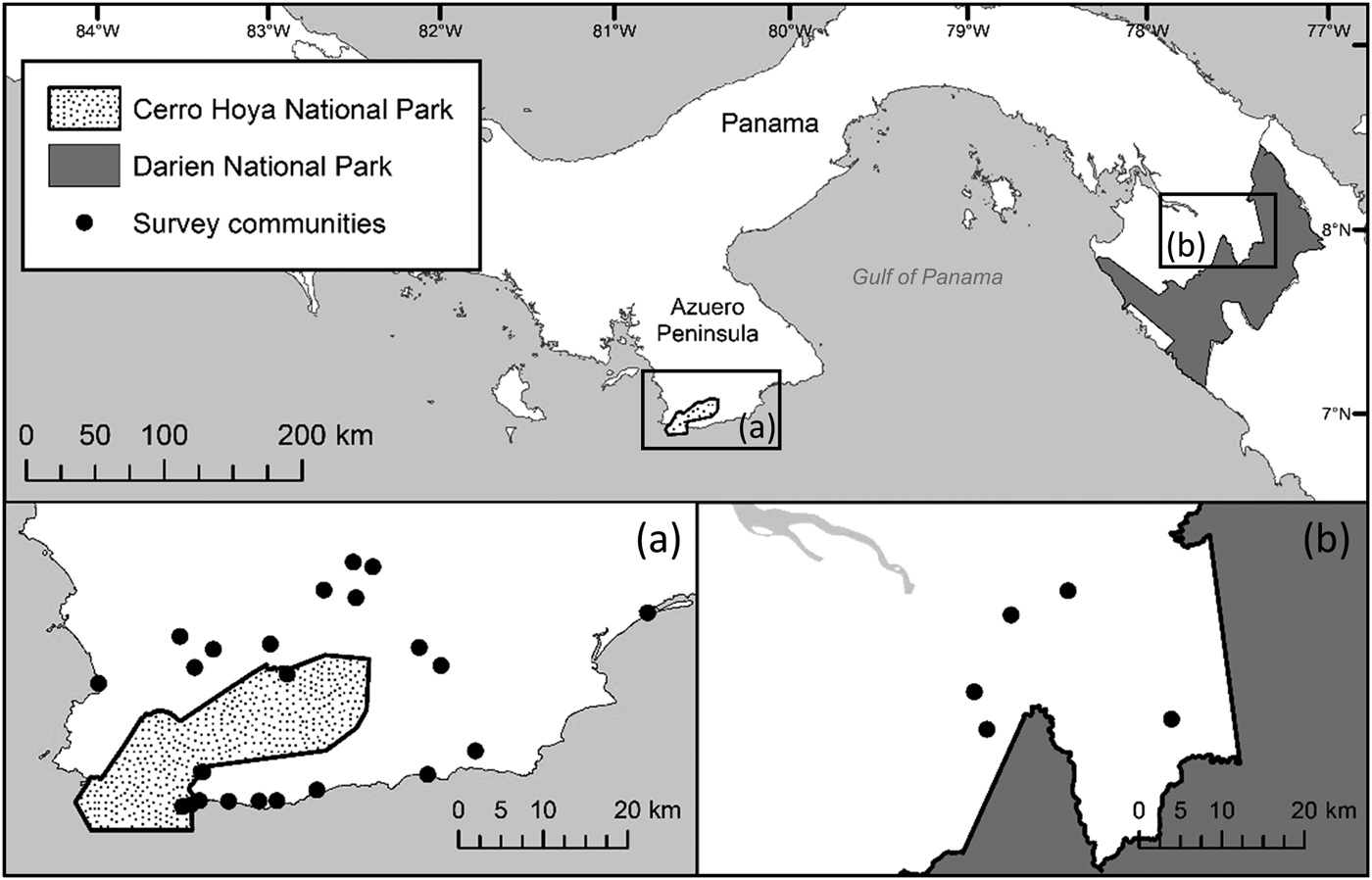
Cerro Hoya National Park (325 km2) is an isolated remnant of tropical rainforest habitat in the south-west of the Azuero Peninsula, between Veraguas and Los Santos provinces (Fig. 1). There are c. 25 villages and 2,000 inhabitants in the Park, dependent upon crop production, domestic animals (swine and poultry) and cattle ranching (MINAM, 2004). Bordering Colombia, in eastern Panama, Darién National Park (5,790 km2) is a large tract of continuous rainforest habitat and is the country's most extensive National Park. Communities surrounding the Park are dependent upon logging, fishing and livestock, especially cattle (ANCON, 2010).
Communities in and around (a) Cerro Hoya National Park and (b) Darién National Park, Panama, surveyed during 2014–2015 to investigate their attitudes towards jaguars Panthera onca and National Park conservation.
Methods
Data collection
During 2014–2015 we conducted 139 semi-structured, oral interviews with local residents in both study areas to assess their perceptions and attitudes regarding jaguars (Conforti & Azevedo, Reference Conforti and Azevedo2003; Zimmermann et al., Reference Zimmermann, Walpole and Leader-Williams2005; Campbell & Alvarado, Reference Campbell and Alvarado2011). Eighty-five interviews were conducted in 23 rural communities around Cerro Hoya National Park and 54 interviews were conducted in five rural communities around Darién National Park (Fig. 1). We surveyed residents most likely to be affected by large carnivores, including landowners and cattle ranchers living in or close to the Parks. Only one adult (≥ 18 years) per household was chosen to be interviewed. Survey methods, questions and interviewers were approved by the Human Subjects Committee at Southern Illinois University (protocol #13435) before interviews were conducted.
Survey questionnaire
We developed a structured questionnaire in Spanish, adapted from Zimmermann et al. (Reference Zimmermann, Walpole and Leader-Williams2005) and other previously published research on large carnivores (Conforti & Azevedo, Reference Conforti and Azevedo2003; Campbell & Alvarado, Reference Campbell and Alvarado2011; Smith et al., Reference Smith, Nielsen and Hellgren2014). The questionnaire (Supplementary Material) consisted of 32 questions covering three primary subject areas: (1) demographic and behavioural characteristics, (2) knowledge and experience of jaguars, and (3) attitudes towards the jaguar and National Park management. Initially, all respondents were asked to identify jaguars, pumas Puma concolor and ocelots Leopardus pardalis from photographs, to assess if they could correctly distinguish among the three species. Questions 1–7 assessed the respondents’ socio-economic status, questions 8–12 assessed their impacts on the Park, and questions 13–15 assessed their personal experience with jaguars. The question regarding personal encounters with jaguars was excluded from the analysis if the respondent could not correctly identify a jaguar from the photographs.
Questions 16–25 assessed respondents’ perceptions and attitudes regarding jaguars and questions 26–30 assessed their perceptions of their closest National Park, and attitudes towards its management, based on a 5-point Likert scale (1, Strongly disagree; 2, Disagree; 3, Don't know/No opinion; 4, Agree; 5, Strongly agree). Question 31 addressed other wildlife species that were potential threats to their livestock and domestic animals.
Data analysis
Survey data were analysed using R v. 3.2 (α = 0.05 throughout; R Development Core Team, 2016). We used independent sample t-tests to compare responses between men and women for each survey question. A one-way analysis of variance (ANOVA) was used to compare responses among three or more groups (age, education history, size of ranch, number of cattle) for each survey question. Age was divided into three classes (18–39, 40–59 and ≥ 60 years); level of education into five classes (no education, 1st–4th grade (ages 6−9), 5th–8th grade (ages 10−13), some high school–high school graduate, some college–college graduate); size of ranch into three classes (small, < 50; medium, 50–75; and large, > 75 ha), and number of cattle into three classes (no animals, 1–50 animals, and > 50 animals). To assess substantive differences in responses to Likert-scale questions, we considered responses to be significantly different if P ≤ 0.05 and mean scores were ≥ 0.5 points apart (Chavez et al., Reference Chavez, Gese and Krannich2005). Tukey's post-hoc test for pairwise comparisons was used when ANOVA results were significant. We did not pool responses from the two sites for analysis because of observed differences in several demographic variables in addition to strong cultural and socio-economic differences between Latino residents around Cerro Hoya National Park and a mixture of Latino and indigenous Embera–Wounaan communities around Darién National Park (ANCON, 2010; INEC, 2010).
Results
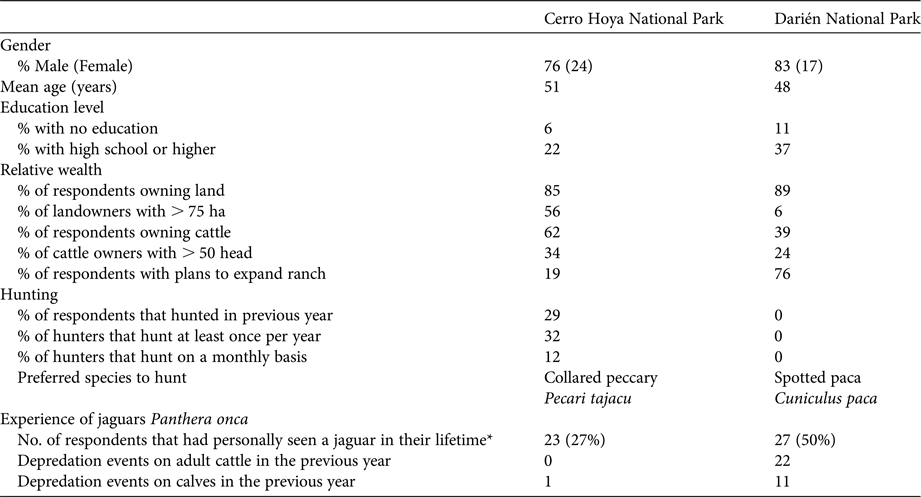
In both study areas, respondents were aged 22–91 years and the majority of respondents were male (Table 1). In Darién there was a higher percentage of respondents without an education, and a higher percentage with a higher education, than in Cerro Hoya. A greater proportion of respondents in Cerro Hoya owned larger farms and more cattle than in Darién. More respondents in Darién planned to expand their ranch, compared to Cerro Hoya. Nearly a third of respondents in Cerro Hoya admitted to hunting within the Park boundary in the previous year, with 12% of those hunting on a monthly basis. The collared peccary Pecari tajacu was their most preferred prey. No respondents admitted to hunting within Darién National Park in the previous year, but those that hunted in the past preferred the spotted paca Cuniculus paca.
Summary of demographic characteristics of survey respondents in Cerro Hoya (n = 85) and Darién National Parks (n = 54) in Panama (Fig. 1). Surveys were conducted during 2014–2015.
* Only respondents that correctly identified photographs of felids were included.
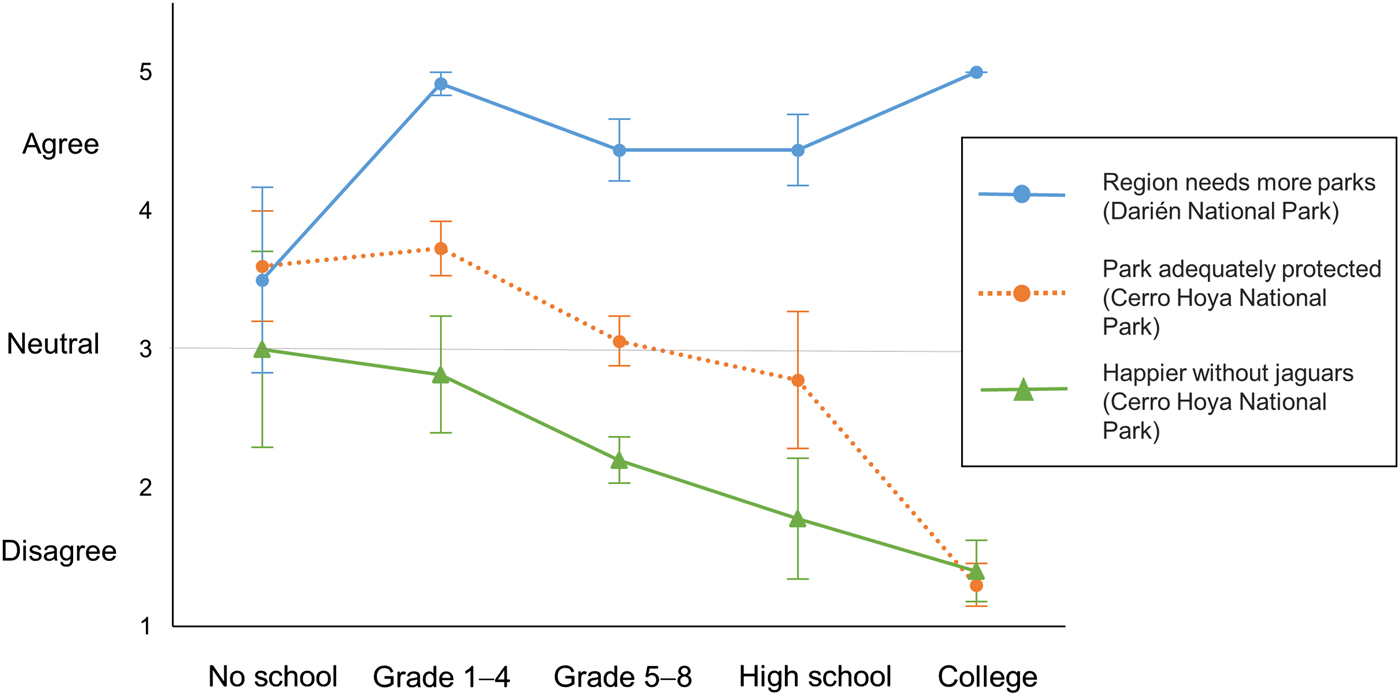
In both study areas almost all respondents believed that the nature and wildlife of their park was a national treasure and most were in favour of the construction of a road to the park boundary (Table 2). The majority of respondents in Cerro Hoya (71%) were worried about the future of the Park and half (51%) believed it was adequately protected; respondents with a higher education (mean Likert score = 1.30 ± SD 0.48) were less likely (F
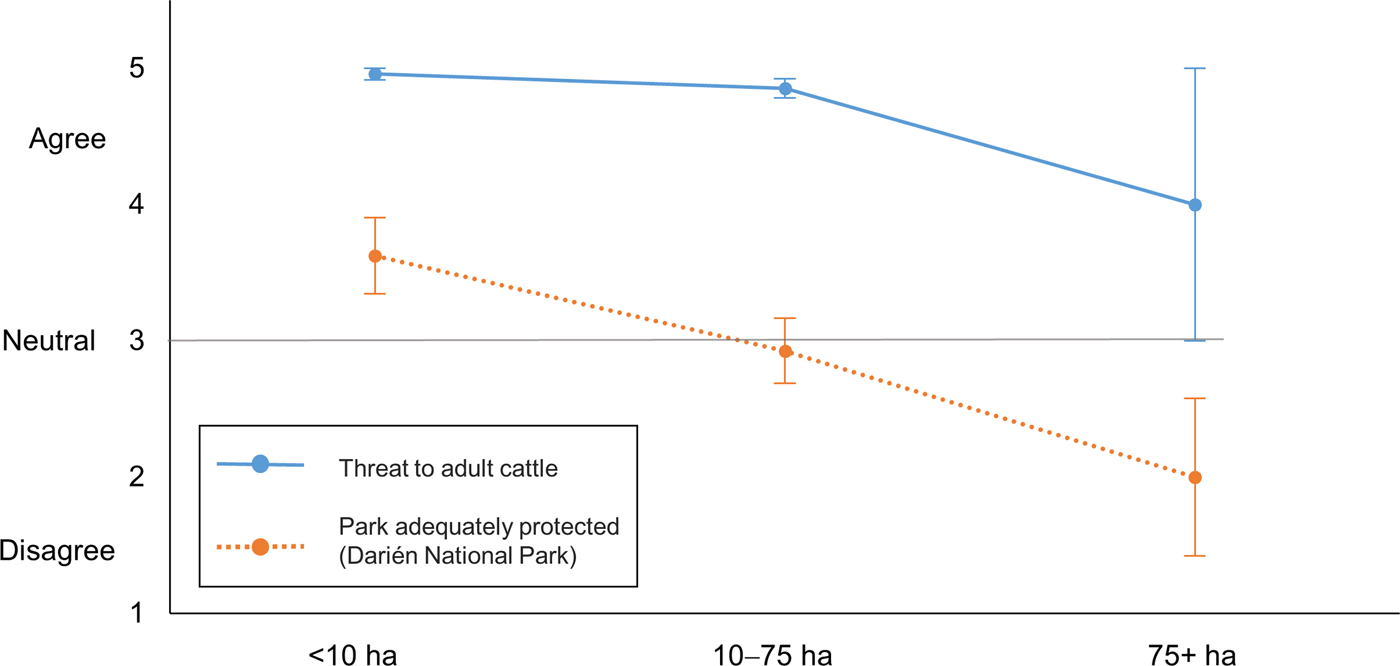
4,80 = 6.96, P < 0.001) to agree that the Park was adequately protected (Fig. 2). In Darién, half (54%) of respondents were unsure or had no opinion as to whether they were worried about the future of the Park, whereas 35% of respondents believed the Park was adequately protected; this belief decreased (F
2,51 = 3.18, P = 0.049) as the amount of land owned increased (Fig. 3). In both study areas most respondents believed that more National Parks and wildlife refuges were needed, with a significant positive increase in mean score (F
4,49 = 2.66, P = 0.043) between respondents that had no education ( $\bar X$
= 3.50 ± SD 1.64) and those that had reached 1st–4th grade (4.92 ± SD 0.29; Fig. 2) in Darién.
$\bar X$
= 3.50 ± SD 1.64) and those that had reached 1st–4th grade (4.92 ± SD 0.29; Fig. 2) in Darién.
Mean Likert response scores (1 = strongly disagree, 5 = strongly agree), with standard error bars, to knowledge and belief statements regarding jaguars and conservation of National Parks, according to level of education of respondents in communities in and around Cerro Hoya and Darién National Parks, Panama (Fig. 1), in surveys conducted during 2014–2015. Only significant results are shown.
Mean Likert response score (1 = strongly disagree, 5 = strongly agree), with standard error bars, to knowledge and belief statements regarding jaguars and conservation of National Parks, according to levels of land ownership among respondents in communities in and around Darién National Park, Panama (Fig. 1), during 2014–2015. Only significant results are shown.
Mean Likert response score (1 = strongly disagree, 5 = strongly agree) to knowledge and belief statements regarding jaguars and the conservation of Cerro Hoya (n = 85) and Darién National Parks (n = 54) in Panama (Fig. 1), from a survey conducted during 2014–2015. The statements are adapted from Zimmermann et al. (Reference Zimmermann, Walpole and Leader-Williams2005).

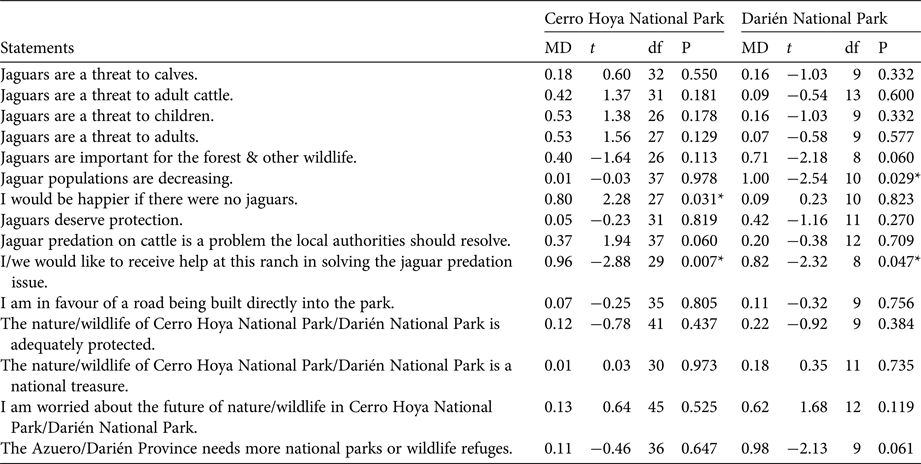
A higher proportion of respondents in Darién had personally seen a jaguar in their lifetime compared to Cerro Hoya (Table 1). Six respondents in Darién reported 33 depredation events involving cattle and calves, whereas only one depredation event (involving a calf) was reported in Cerro Hoya. Reported losses for Darién averaged 1.7 cattle per household, constituting 3.6% of total stockholdings. Most respondents in Cerro Hoya disagreed, and almost all respondents in Darién agreed, that jaguars were a risk to both cattle and humans (Table 2). Despite the high level of perceived risk among respondents in Darién, most respondents in both study areas understood the vital role jaguars played in their ecosystem. In Cerro Hoya, women were more likely to agree than men (t 27 = 2.28, P = 0.031; Table 3) that they would be happier without jaguars in the area. Furthermore, the number of respondents in Cerro Hoya that agreed they would be happier without jaguars decreased (F 4,80 = 2.67, P = 0.038) as level of education increased (Fig. 2). In contrast, most respondents in Darién (76%) agreed they would be happier without the presence of jaguars.
Mean difference (MD) in Likert response scores (1 = strongly disagree, 5 = strongly agree) between female and male respondents to knowledge and belief statements regarding jaguars and conservation in Cerro Hoya and Darién National Parks in Panama (Fig. 1), in surveys conducted during 2014–2015. Statements are adapted from Zimmermann et al. (Reference Zimmermann, Walpole and Leader-Williams2005).
* Values were considered significant if P ≤ 0.05 and differences in mean scores (MD) were ≥ 0.5 points apart.
In both study areas similar proportions of respondents agreed that jaguar populations were decreasing, with men more likely to agree than women in Darién (t 10 = –2.54, P = 0.029; Table 3). Most respondents in Cerro Hoya (88%) believed jaguars deserved protection, compared to 31% of respondents in Darién. Most respondents in Cerro Hoya (87%) believed local authorities should be working to resolve issues of jaguar predation in the area, whereas opinion was divided in Darién (40% agreed and 46% disagreed). Almost all respondents in Darién (91%) indicated they would be open to receiving help on their ranch to mitigate jaguar–human conflict, whereas opinion was divided in Cerro Hoya (58% agreed and 41% disagreed). However, men in both areas were more open than women to receiving help on their ranches to mitigate jaguar–human conflict (Cerro Hoya: t 29 = –2.88, P = 0.007; Darién: t 8 = –2.32, P = 0.047; Table 3).
Number of cattle and ranch size affected the perceptions and attitudes of respondents in Darién regarding the potential risk posed by jaguars. Belief that jaguars deserve protection decreased (F
2,51 = 3.28, P = 0.050) between respondents that owned 1–50 head of cattle ( $\bar X$
= 4.18 ± SD 0.98) and those that owned > 50 head (
$\bar X$
= 4.18 ± SD 0.98) and those that owned > 50 head ( $\bar X$
= 3.0 ± SD 0.00). Respondents that owned the most land (> 76 ha;
$\bar X$
= 3.0 ± SD 0.00). Respondents that owned the most land (> 76 ha; $\bar X$
= 4.0 ± SD 1.73) were less likely to agree (F
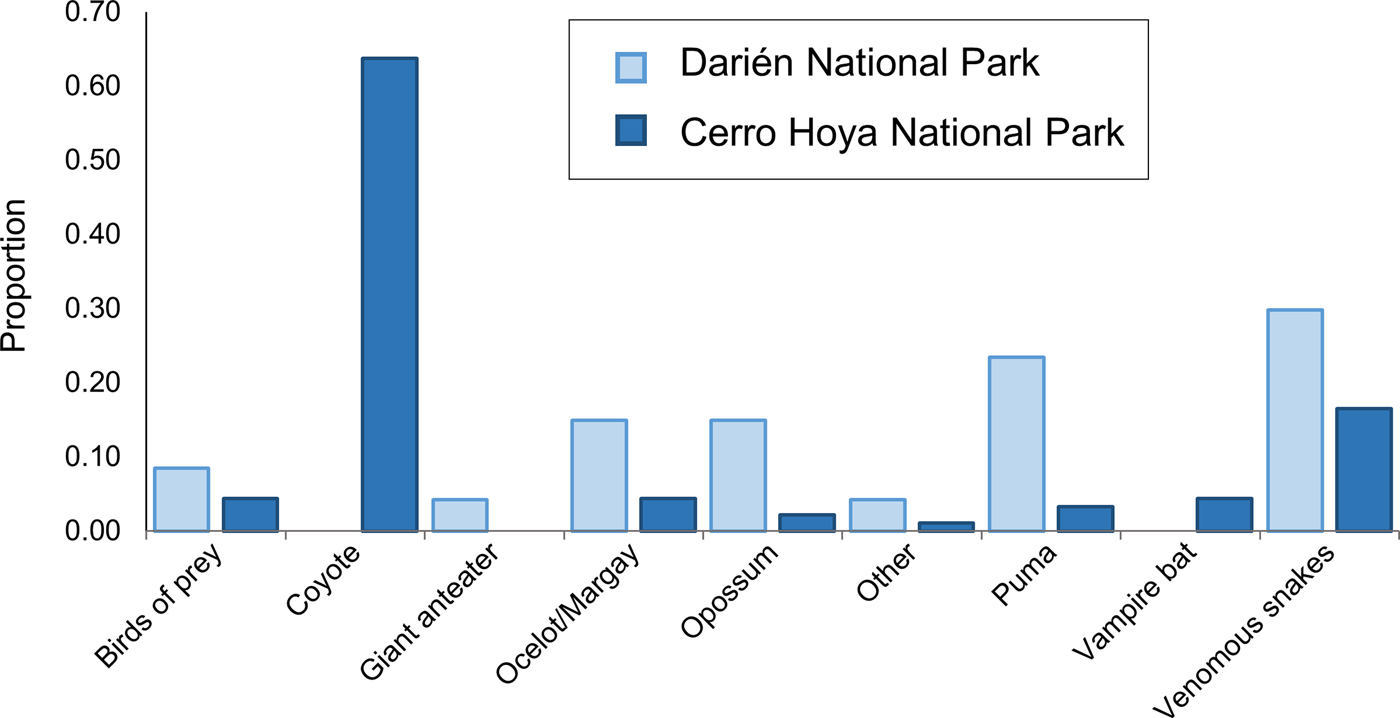
2,51 = 6.03, P < 0.010) that jaguars were a threat to cattle (Fig. 3). Number of cattle and ranch size did not appear to influence tolerance of jaguars, or attitudes towards the conservation of Cerro Hoya National Park. Age was the only factor that did not influence tolerance of jaguars or attitudes towards park conservation in either study area. Furthermore, when asked if there were any other animals other than jaguars that posed a threat to their livestock, the most common answers in Cerro Hoya were coyotes Canis latrans (68%) and venomous snakes (18%), and in Darién venomous snakes (26%) and pumas (20%; Fig. 4).
$\bar X$
= 4.0 ± SD 1.73) were less likely to agree (F
2,51 = 6.03, P < 0.010) that jaguars were a threat to cattle (Fig. 3). Number of cattle and ranch size did not appear to influence tolerance of jaguars, or attitudes towards the conservation of Cerro Hoya National Park. Age was the only factor that did not influence tolerance of jaguars or attitudes towards park conservation in either study area. Furthermore, when asked if there were any other animals other than jaguars that posed a threat to their livestock, the most common answers in Cerro Hoya were coyotes Canis latrans (68%) and venomous snakes (18%), and in Darién venomous snakes (26%) and pumas (20%; Fig. 4).
Proportion of respondents that reported various wildlife species (apart from jaguars) as potential threats to their domestic animals in communities in and around Cerro Hoya and Darién National Parks, Panama (Fig. 1), during 2014–2015.
Discussion
Our findings indicate there is more human–jaguar conflict in Darién National Park than Cerro Hoya National Park, including direct impacts on people's livelihoods (livestock losses) and direct personal experience (seeing a jaguar). More respondents in Darién had personally seen a jaguar than in Cerro Hoya, and within the previous year 33 depredation events were reported in Darién, compared to only one in Cerro Hoya. It is likely that communities in Darién experienced more issues relating to human–jaguar coexistence because they border much larger, contiguous tracts of forest (i.e. suitable habitat for jaguars; Rabinowitz & Zeller, Reference Rabinowitz and Zeller2010) compared to the isolated, fragmented forests of Cerro Hoya (Fort, Reference Fort2016). Furthermore, the probability of detection of jaguars was higher in Darién (Fort, Reference Fort2016), probably indicating a higher density of jaguars and therefore a higher probability of human–jaguar interaction.
Levels of jaguar predation on livestock in Darién are similar to those in other communities in Panama and Costa Rica that are located in areas of suitable habitat for jaguars. In Portobello National Park in northern Panama, Moreno & Olmos (Reference Moreno and Olmos2008) recorded 309 depredated domestic animals (cattle, horses, sheep and dogs) during 1989–2001, and 22 jaguars were killed by cattle owners during that time. According to a survey in Alto Chagres National Park, Panama, wild felids killed 170 domestic animals during 1985–2008 (Carrión de Samudio & Samudio, Reference Carrión de Samudio and Samudio2012). In Costa Rica a survey conducted among 50 ranching communities during 2007–2009 recorded 81 attacks on livestock by jaguars or pumas (Amit et al., Reference Amit, Gordillo-Chávez and Bone2013). The percentage of cattle lost to jaguar predation in Darién (c. 3–4%) is similar to that reported in other studies of large felids (Oli et al., Reference Oli, Taylor and Rogers1994; Patterson et al., Reference Patterson, Kasiki, Selempo and Kays2004; Zimmermann et al., Reference Zimmermann, Walpole and Leader-Williams2005), whereas the level recorded in Cerro Hoya is low.
We used ranch size and number of cattle as a surrogate for relative wealth, as income is positively correlated with positive perceptions of and attitudes towards carnivores (Williams et al., Reference Williams, Ericsson and Heberlein2002; Dickman et al., Reference Dickman, Marchini, Manfredo, Macdonald and Willis2013). In Darién, landowners with larger farms were less likely to agree that jaguars were a threat to their cattle, and more likely to criticize park management. The positive correlation between ranch size and positive perceptions of jaguars could be explained by more affluence providing a financial buffer against livestock losses (Dickman et al., Reference Dickman, Marchini, Manfredo, Macdonald and Willis2013). However, contrary to our expectation, we found that cattle owners with > 50 cattle in Darién were less likely to favour the protection of jaguars. One possible explanation for the incongruity between perceptions of landowners and those of cattle owners is that perceptions may be influenced by the source of income rather than the income itself, and how vulnerable that source would be to threats posed by potentially increasing jaguar populations in the area as a result of protection (Dar et al., Reference Dar, Minhas, Zaman and Linkie2009; Dickman et al., Reference Dickman, Marchini, Manfredo, Macdonald and Willis2013). In Darién more land was not necessarily synonymous with more cattle; 89% of respondents owned land but only 39% owned cattle, with 27 respondents owning land (range 2–70 ha) without cattle. The percentage was greater in Cerro Hoya (85% of respondents owned land and 62% owned cattle). Although most respondents in Darién perceived jaguars as being a threat to people and cattle in general, ranchers reliant upon revenue from cattle may value jaguar protection less because they have more to lose, whereas landowners without cattle may view jaguar protection more positively because they would not suffer economic losses resulting from livestock predation. We recommend researchers consider using income and income source instead of only ranch size and number of cattle in future surveys in Panama.
Gender appeared to influence perceptions and attitudes in both study areas. In Darién men were more open than women to receiving help on their farms to mitigate impacts from jaguars, and more likely to agree that jaguar populations were decreasing. With more men working outdoors on cattle ranches and crop farms (92.9% men vs 7.1% women; INEC, 2010) in Darién Province, they are more likely to be managing farming and cattle operations and more likely have a better understanding of the trends in local wildlife populations. In Cerro Hoya women were more likely than men to agree they would be happier without jaguars, which supports our prediction that women would be less tolerant towards jaguars, and confirms results of previous research (Zinn & Pierce, Reference Zinn and Pierce2002; Kleiven et al., Reference Kleiven, Bjerke and Kaltenborn2004; Campbell & Alvarado, Reference Campbell and Alvarado2011). As women in Cerro Hoya traditionally work in the home (child care and housekeeping), their fear may arise from their protective role as the main caregivers (Zinn & Pierce, Reference Zinn and Pierce2002), or from our finding that men may have a better understanding of jaguars because they work in closer proximity to them. Nevertheless, although women in general are more fearful of wild animals than men, they are not necessarily more supportive of their killing (Dickman et al., Reference Dickman, Marchini, Manfredo, Macdonald and Willis2013). In Lithuania 73% of women perceived local large carnivores as dangerous, compared to 44% of men, but only 11.5% of women were in favour of reducing carnivore populations, compared to 16.6% of men (Balčiauskiene & Balčiauskas, Reference Balčiauskiene and Balčiauskas2001). In the case of Lithuania and in Cerro Hoya, women's perceptions of jaguars may be linked to cultural expectations and social norms (Dickman et al., Reference Dickman, Marchini, Manfredo, Macdonald and Willis2013).
Education level among respondents in Cerro Hoya had a positive influence on tolerance of jaguars and tended to be associated with increased skepticism that the Park was adequately protected. In Darién, the level of education influenced respondents’ receptivity to new parks and wildlife refuges but did not affect their tolerance of jaguars. Our findings in Cerro Hoya support our prediction that the more knowledgeable respondents were about carnivores, the more positively they perceived them (Ericsson & Heberlein, Reference Ericsson and Heberlein2003; Caruso & Pérez, Reference Caruso and Pérez2013). In both study areas, education level positively affected attitudes towards conservation of local natural resources, which is supported by previous studies (Infield, Reference Infield1988; Fiallo & Jacobson, Reference Fiallo and Jacobson1995). Education level may not have affected perceptions of jaguars among respondents in Darién if their values regarding wildlife were established early in life, as these types of values tend to be resilient to change (Bruskotter et al., Reference Bruskotter, Schmidt and Teel2007; Dickman et al., Reference Dickman, Marchini, Manfredo, Macdonald and Willis2013), as discussed below.
Overall, respondents from both study areas had positive perceptions of their respective National Parks, and positive attitudes towards their conservation; however, tolerance of jaguars differed significantly between the study areas. In Darién there was a high perception of risk associated with jaguar attacks on people and cattle, and a low level of acceptance of jaguar presence or their protection. This did not seem to stem from lack of knowledge, as respondents understood the important role jaguars play in their ecosystems, and that their populations are decreasing. In contrast, respondents in Cerro Hoya did not perceive jaguars as a threat to people or cattle, were knowledgeable about jaguar ecology and the species’ current status, and were tolerant of jaguar presence and protection.
These differences in tolerance are probably attributable to unequal human–jaguar impacts between study areas, and their consequent influence on cultural and societal views; communities in Darién suffer more livestock losses and come into contact with jaguars more often than communities in Cerro Hoya. Over time, such experiences heighten perceptions of risk associated with jaguar presence, perpetuated by the collective experiences of peers, elders, friends, family and local media (Dickman et al., Reference Dickman, Marchini, Manfredo, Macdonald and Willis2013). In contrast, as predation by jaguars is low in Cerro Hoya and the Park's jaguar population is probably small (Fort et al., Reference Fort, Nielsen, Donoso, Samudio and Duran2014; Fort, Reference Fort2016), cultural perceptions of these carnivores may be shifting in a positive direction. Although differences in religion and culture between study areas should not be discounted, we did not assess specific religious and cultural orientations for each respondent. Further investigation is needed to accurately measure these effects on attitudes and perceptions.
Respondents in both study areas shared the perception that their respective National Parks and their resident wildlife were national treasures. These views may be a product of a common social identity (Dickman et al., Reference Dickman, Marchini, Manfredo, Macdonald and Willis2013) among rural Panamanians who tend to depend on the natural resources of neighbouring protected areas and thus have a sense of pride and appreciation of these resources. Similar societal-level influences have been reported for the Iberá Natural Reserve of Corrientes, Argentina, where jaguars have been extirpated. Caruso & Pérez (Reference Caruso and Pérez2013) found widespread support among rural Corrientinos for the reintroduction of jaguars, which was not affected by age, gender or location, and was affected only slightly by education level and occupation. The authors proposed that attitudes towards jaguar reintroduction were shaped by social identity, as rural Corrientinos view jaguars as a powerful metaphor for their own independent and guerrero (warrior-like) culture.
There were no hunting activities reported in Darién, whereas almost one third of respondents in Cerro Hoya admitted to hunting within the Park limits in the previous year. It is unlikely that no hunting activities occurred in Darién; rather, respondents may have been inhibited to report the truth. In Darién it is not uncommon to see jaguar and ocelot pelts in people's homes, and local people frequently admit to hunting during informal conversations (RM, Yaguará Panamá, pers. comm.). Findings from near Alto Chagres National Park, Panama (Brossard & Pritz, Reference Brossard and Pritz2013), in which 47% of respondents admitted to being regular hunters, with a high frequency of hunting (50% hunting on a monthly basis), are probably a more accurate portrayal of the hunting situation in Panama. Killing of jaguars in Brazilian protected areas is also underreported, and reporting rates were inversely related to the level of restriction on human use (Carvalho & Morato, Reference Carvalho and Morato2013). Although we did not measure level of restriction in Cerro Hoya or Darién National Parks, respondents in Darién may have felt inhibited because of a more frequent presence of environmental officials than in Cerro Hoya, which has not received the same level of protection from government agencies as other National Parks in Panama.
Pumas were the second most commonly reported threat to livestock (after venomous snakes) in Darién, but only 3% of respondents reported them as being a threat in Cerro Hoya, where communities and ranches are less frequently located near suitable habitat for pumas. The majority of respondents in Cerro Hoya reported coyotes as being a major threat to livestock, whereas there were no reports of such a threat in Darién. Although the distribution of coyotes in Panama is not known precisely, it has expanded as far east as Darién Province (Méndez-Carvajal & Moreno, Reference Méndez-Carvajal and Moreno2014) and as far south as the Azuero Peninsula (Fort, Reference Fort2016), with a significant impact on people reported from Los Santos Province (Bermúdez & González, Reference Bermúdez and González2013). This relatively recent and rapid expansion of coyotes into the Azuero Peninsula could have implications for livestock owners, in addition to introducing novel predation pressures on native prey species that are already isolated and heavily poached.
Conservation implications
Moreno et al. (Reference Moreno, Meyer, Olmos, Hoogesteijn and Hoogesteijn2015) predicted that if environmental, social, law enforcement and education conditions in Panama do not change, the killing of jaguars may continue to increase. Furthermore, as 57 respondents from our study plan to expand their ranches in the future, jaguars and their prey are likely to continue losing critical habitat. Our recommendations are pertinent to the findings and suggestions of the National Jaguar Action Plan (MINAM, 2011) and Moreno et al. (Reference Moreno, Meyer, Olmos, Hoogesteijn and Hoogesteijn2015, Reference Moreno, Bustamante, Mendéz-Carvajal, Moreno and Medellin2016). Given the appreciation of Panama's National Parks expressed by respondents in both our study areas, environmental education programmes (Zimmermann et al., Reference Zimmermann, Walpole and Leader-Williams2005; Foster, Reference Foster2008; Li et al., Reference Li, Jiang, Li, Tang, Li and Luo2015) should focus on connecting the importance of jaguars to their vital role in maintaining healthy ecosystems within these Parks. In areas where livelihoods have been most affected by livestock losses, and therefore collective experiences over time may negatively influence community perceptions of jaguars, students should be educated at an early age about the importance of carnivores.
Workshops providing training on techniques to mitigate jaguar predation should be initiated by the government or NGOs, and should be tailored to the needs of specific stakeholder groups (Soto-Shoender & Main, Reference Soto-Shoender and Main2013) and incorporate educational materials designed for people with poor literacy skills (Zimmermann et al., Reference Zimmermann, Walpole and Leader-Williams2005; Quigley et al., Reference Quigley, Hoogesteijn, Hoogesteijn, Foster, Payan and Corrales2015; Peña-Mondragón et al., Reference Peña-Mondragón, Castillo, Hoogesteijn and Martínez-Meyer2017). Given that our results suggest losses as a result of jaguar predation may be influential in shaping attitudes, economic incentives focusing on improving livestock husbandry practices should be offered in areas where communities suffer the most from the impacts of jaguars on livestock (MINAM, 2011), such as in Darién. The low level of jaguar predation on livestock in Cerro Hoya, despite its isolation and deforestation, may be an indication of low and decreasing jaguar occupancy in the Park (Fort et al., Reference Fort, Nielsen, Donoso, Samudio and Duran2014, Fort, Reference Fort2016). Priorities of wildlife conservation programmes in Panamá should be focused on subpopulations of potentially threatened jaguar populations and the communities nearby, such as those in Cerro Hoya (de la Torre et al., Reference de la Torre, González-Maya, Zarza, Ceballos and Medellín2017).
Acknowledgements
This research was funded by Panthera, the McIntire-Stennis Cooperative Forestry Research Program, and GEMAS/Fondo Darién, with additional support from Fundación Natura, and the Department of Forestry and Cooperative Wildlife Research Laboratory at Southern Illinois University. We are grateful to Peace Corps–Panamá and the Azuero Earth Project for providing logistical support and guidance. We also thank the Ministerio de Ambiente (Scientific Permit SE/A-15-15) and Human Subjects Committee at Southern Illinois University (Protocol #13435) for approval and permits to conduct this research. We are grateful to N. Correa, F. Santamaria, T. Delosrios, E. von Gal, R. Metzel, I. Aust, J. Clay, M. Vega, A. Moreno, J. Wierenga, J. Whelan, Z. Niedzwiecki, E. Sanchez, A. Artavia, J. Ortega, E. Brown, A. Paz, J. Pacheco, T. Contreras, M. Pacheco and the guides of Pijibasal Embera Town for support during field work, and we thank two anonymous reviewers for their insightful input and suggestions.
Author contributions
JLF designed the study, conducted the fieldwork in Cerro Hoya National Park, analysed the data and wrote the article. CKN supervised the study and advised at all levels of design and data analysis, in addition to helping write and revise the article. ADC advised on certain aspects of the study and provided revisions. RM conducted fieldwork in Darién National Park and provided revisions for the article. NFVM conducted fieldwork in Darién National Park and provided revisions for the article.
Biographical sketches
Jessica Fort’s research interests lie in wildlife conservation and management, in addition to human dimensions of wildlife, particularly in Central America. Clayton Nielsen’s research interests include wildlife ecology and management in a variety of landscapes, with a strong focus on habitat and populations, and human dimensions of wildlife. Andrew Carver’s research interests lie in biodiversity conservation, land-use planning and decision making, and environmental policy and forest economics. Ricardo Moreno’s research interests include wildlife ecology and conservation in Panama, and he is currently working to implement the first wild felid conservation programme in Panama. Ninon Meyer’s research interests include biodiversity assessment and the ecology of large mammals, with a focus on white-lipped peccaries and Baird's tapirs in Panama and Mexico.



