




1. Introduction
In this paper, we investigate two putative cases of intervocalic devoicing (henceforth IVD), an unnatural process whereby a voiced consonant becomes voiceless between vowels in a daughter language. The majority of work on unnatural processes that target feature voice focus on final (de)voicing (Yu Reference Yu2004, Kiparsky Reference Kiparsky2006, Reference Kiparsky and Good2008, Blevins et al. Reference Blevins, Egurtzegi and Ullrich2020) or postnasal (de)voicing (Hyman Reference Hyman, Hume and Johnson2001, Coetzee & Pretorius Reference Coetzee and Pretorius2010, Beguš Reference Beguš2019). Intervocalic devoicing has received substantially less attention in previous literature.
More specifically, we focus on two case studies of intervocalic devoicing in Berawan and Kiput. In dialects of Berawan, some instances of intervocalic k can be constructed to Pre-Berawan *b and *g. In Kiput, some instances of intervocalic k, c͡ç, and f can be reconstructed to Pre-Kiput *g, *ɟ͡ʝ (*j), and *v (*w), respectively. Thus, both languages seem to show the unnatural IVD.
To account for the patterns seen in Berawan and Kiput, we detail a historical development of intervocalic devoicing in the two languages. We demonstrate that IVD operates not as a single unnatural sound change, but results from a sequence of three natural changes. We build on Beguš’s (Reference Beguš2018, Reference Beguš2019, Reference Beguš2022) model of historical change and propose that intervocalic devoicing arises from the blurring process, which involves the following three steps: (i) ‘[a] set of segments enters complementary distribution,’ (ii) ‘[a] sound change occurs that operates on the changed/unchanged subset of those segments,’ and finally (iii) ‘[a]nother sound change occurs that blurs the original complementary distribution’ (Beguš Reference Beguš2018: 108, Beguš Reference Beguš2019: 735). (Thus, while we use the descriptive term intervocalic devoicing to refer to a set of empirical facts throughout the paper, we ultimately argue that intervocalic devoicing is never a single sound change.)
Our account successfully captures previously intractable aspects of the data set, providing strong support for a model where unnatural-looking diachronic developments (and their phonologizations) result from sequences of phonetically natural changes.
2. Intervocalic Devoicing as Unnatural
Following Beguš (Reference Beguš2018, Reference Beguš2019), we define an unnatural process as a process that operates against a universal phonetic tendency. Natural phonetic tendencies are (i) phonetically grounded in the mechanics of speech production or perception, (ii) cross-linguistically common, and (iii) can result in common phonological processes (Beguš Reference Beguš2019: 691). The definition of a natural phonetic tendency is restated in (1). The definition of an unnatural phonological process is restated in (2).


Intervocalic devoicing operates against the pressure to voice intervocalic consonants. Intervocalic voicing is a passive tendency that is typologically very common and has a clear phonetic motivation. Thus, intervocalic devoicing fulfills all criteria to qualify as an unnatural process under our definition.
Intervocalic voicing is well attested – the survey in Kaplan (Reference Kaplan2010), Gurevich (Reference Gurevich2004) shows that 26 of 153 (or 17%) languages surveyed feature intervocalic voicing as a synchronic alternation. Intervocalic voicing is also well attested as a sound change: the survey in Kümmel (Reference Kümmel2007) reports over 15 languages with intervocalic voicing as a sound change. In fact, voicing is the most common form of intervocalic stop lenition, followed by spirantization, approximantization, and others which are less common (Kaplan Reference Kaplan2010).
Moreover, there exists a clear articulatory phonetic motivation for intervocalic voicing. The difference in subglottal and supraglottal pressure is greatest in the intervocalic position and is considerably smaller in the initial or final position. Westbury & Keating (Reference Westbury and Keating1986) argue that voiced stops will be preferred in the intervocalic position and dispreferred initially or finally because a pressure difference is crucial for voicing. Intervocalically, voiced stops are articulatorily easier to produce than their voiceless counterparts; any neutralization in the direction opposite from the expected one would result in ‘added articulatory cost’ (Westbury & Keating Reference Westbury and Keating1986: 153).
Kaplan (Reference Kaplan2010) also argues in favor of a perceptual motivation for intervocalic voicing. Invoking Steriade’s (Reference Steriade2001) P-map, Kaplan (Reference Kaplan2010) claims that intervocalic voicing is the most common type of lenition (more common than spirantization and approximantization) precisely because perceptual differences between voiced and voiceless stops intervocalically are the smallest (i.e. smaller than perceptual differences between intervocalic voiceless stops and voiceless fricatives). Speakers then choose the minimal perceptual difference to repair the phonotactic restriction against intervocalic voiceless stops. Finally, intervocalic voicing is a passive phonetic tendency – stops feature more voicing into closure intervocalically compared to other positions (Docherty Reference Docherty1992, Davidson Reference Davidson2016; and literature therein).
In sum, intervocalic voicing has all the characteristics of a universal phonetic tendency. Intervocalic devoicing directly defies this tendency. Thus, according to our definitions (1–2), intervocalic devoicing is an unnatural phonological process.
3. Berawan
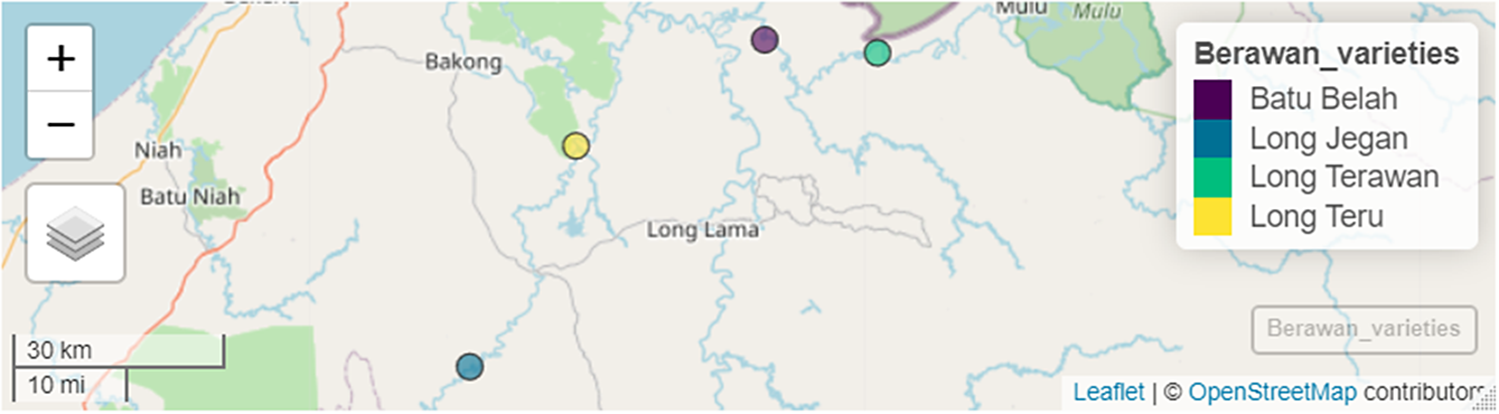
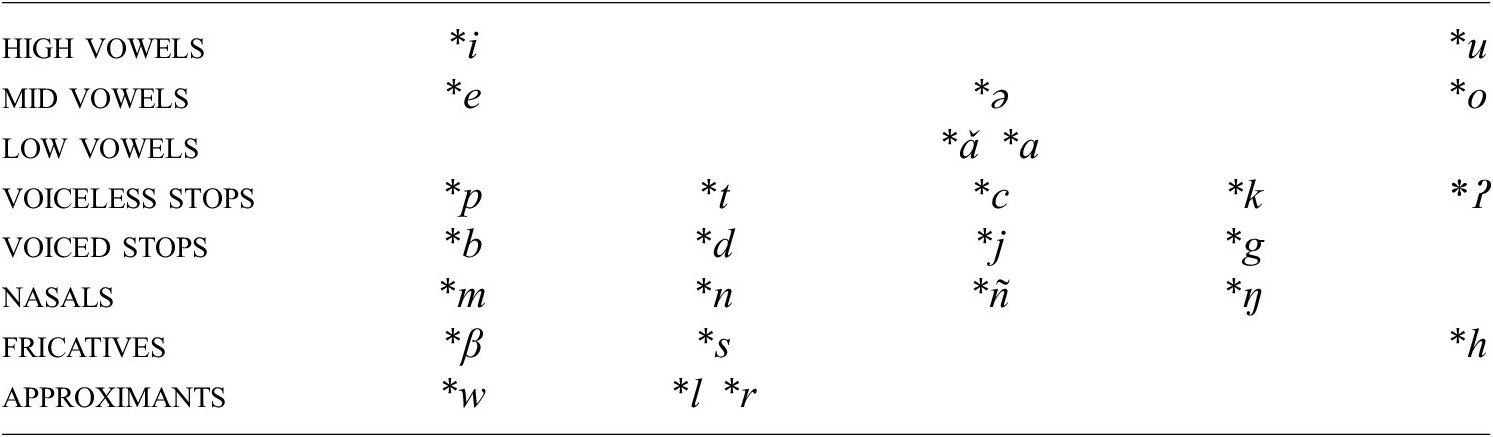
The Berawan dialects are a group of closely related dialects that belong to the Berawan-Lower Baram group of North Sarawakan languages of the Malayo-Polynesian (Austronesian) language family (Blust Reference Blust1992). Blust (Reference Blust1992) identifies four dialects of the Berawan dialect group: Long Terawan (LTn), Batu Belah (BB), Long Teru (LTu), and Long Jegan (LJ). They are spoken by approximately 3,600 speakers around the Tutoh and Tinjar tributaries of the Baram River (Lewis et al. Reference Lewis, Simons and Fennig2015, Blust Reference Blust1992), as shown in Figure 1.Footnote 1 The phonemic inventory of Proto-Berawan (without geminates) is given in Table 1.
Map of the Berawan varieties.
Proto-Berawan phonemic inventory (based on Burkhardt Reference Burkhardt2014: 130, 160, 174)
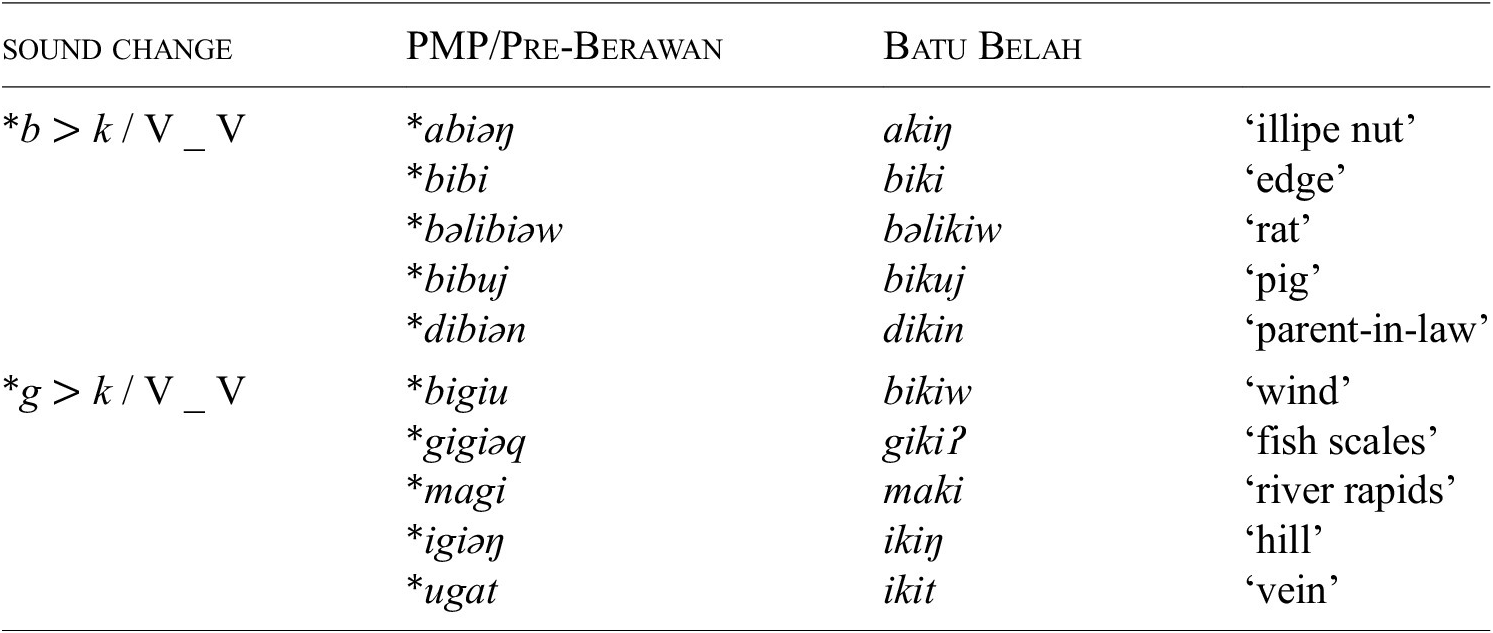
According to the description in Burkhardt (Reference Burkhardt2014), the Berawan dialects feature two series of stops: voiced and voiceless, both unaspirated. Blust (Reference Blust2013) and Burkhardt (Reference Burkhardt2014) report that an unnatural sound change, the intervocalic devoicing, took place in Berawan: Pre-Berawan *g and *b between vowels both devoice (and velarize) to k in Berawan. Alveolar stops do not devoice but undergo intervocalic lenition to r (Burkhardt Reference Burkhardt2014: 249).Footnote 2
The list in Table 2 offers an illustration of intervocalic devoicing but is far from exhaustive. In fact, IVD in Berawan is well-documented and almost exceptionless. A comprehensive study of Berawan dialects in Burkhardt (Reference Burkhardt2014) includes between 425 and 466 vocabulary items for each of the four languages and Pre-Berawan reconstructions for each cognate (489 in total). Based on our counts, *b or *g appears intervocalically in 36 of these reconstructed words, and in all 36 cases, the Berawan dialects show a voiceless stop, the regular reflex of *b and *g in intervocalic position. (Long Terawan then undergoes further changes that do not interact with our analysis; see Burkhardt Reference Burkhardt2014.)
Examples of intervocalic devoicing in Berawan (data from Blust Reference Blust2013, Burkhardt Reference Burkhardt2014)
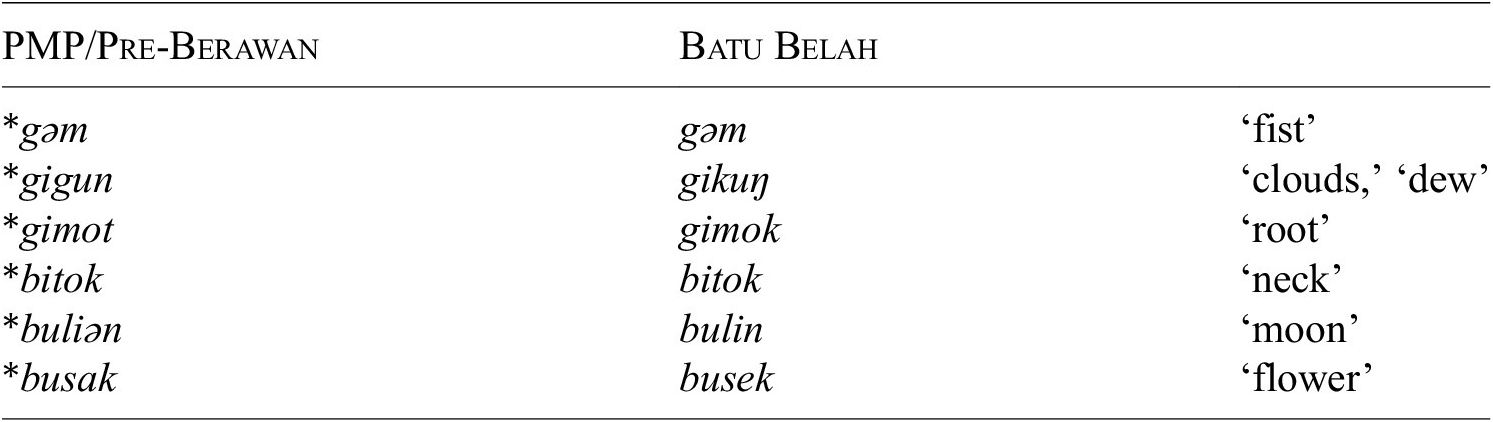
In contrast to the intervocalic position, *b and *g remain unchanged in the initial position. There are 46 reconstructed words with initial *b in Pre-Berawan. In all but one word, the initial *b remains unchanged.Footnote 3 A similar distribution holds for the velar voiced stop in the initial position as well: *g is reconstructed in 12 lexical items of Pre-Berawan, and in all of them, voicing is retained (there is only one case of sporadic devoicing in Long Terawan). Table 3 lists some examples of initial voiced stops in Pre-Berawan and Berawan.
Initial voiced stops (data from Blust Reference Blust2013, Burkhardt Reference Burkhardt2014)
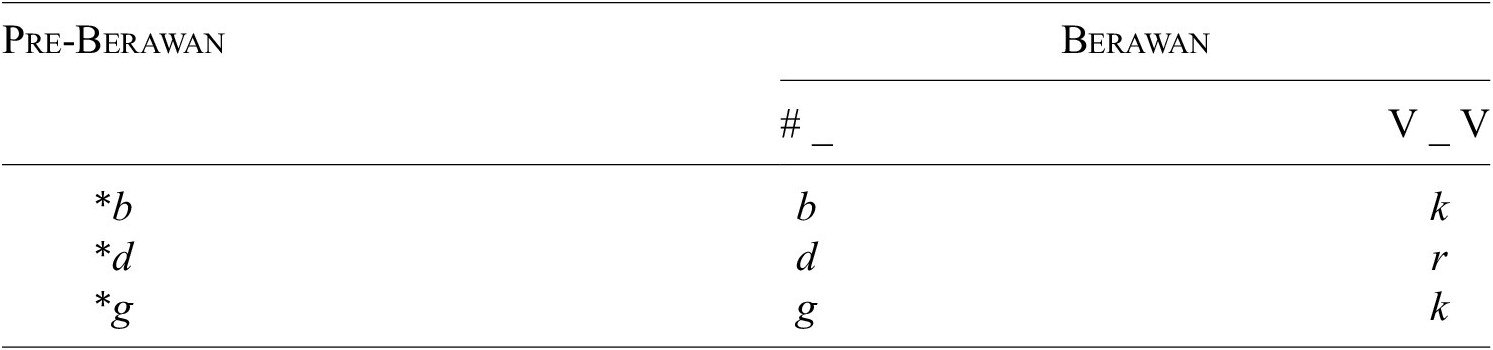
A peculiar fact about the diachronic development of Berawan is that, while velar and bilabial stops undergo devoicing, alveolars undergo lenition in the same word-internal position. Pre-Berawan voiced alveolar stop *d remains a voiced stop initially but develops to r word-internally. The summary of the developments is given in Table 4.Footnote 4
Summary of developments in Berawan
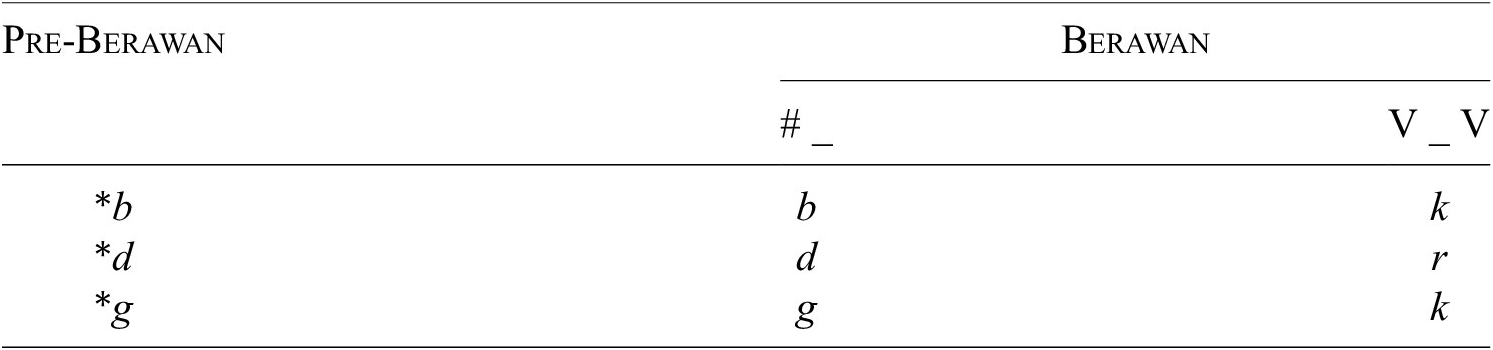
The simplest interpretation of the Berawan developments is an unnatural sound change of intervocalic devoicing (Blust Reference Blust1992, Reference Blust2005). In Section 5, we will summarize previous accounts and review evidence in favor of the hypothesis that a single unnatural sound change is responsible for each of the unnatural trends presented. In Section 6, we will point to intriguing aspects of historical development that are not accounted for under previous diachronic explanations and present our novel account of the historical data.
4. Kiput
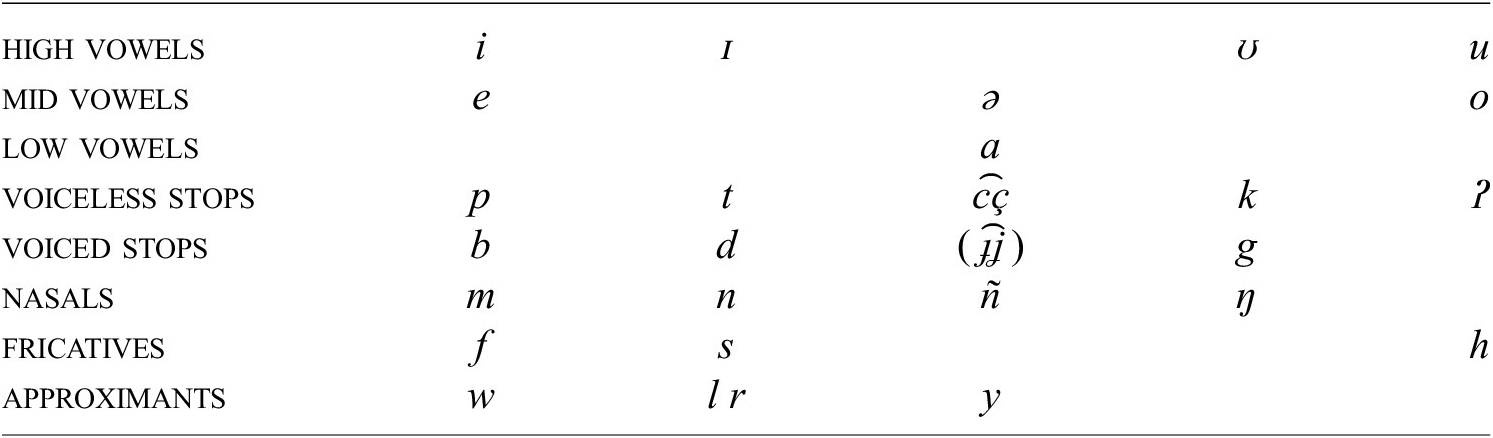
Kiput is a Malayo-Polynesian and, more specifically, North Sarawakan, Berawan-Lower Baram language of the Austronesian family, spoken by approximately 450 speakers in northern Sarawak in Borneo, Malaysia (Blust Reference Blust2002). The language’s current phonemic inventory is given in Table 5. Kiput features several peculiar developments which have been extensively discussed in Blust (Reference Blust2002). This section focuses on the most unusual of these developments – the intervocalic devoicing, detailed in Blust (Reference Blust2002, Reference Blust2005, Reference Blust2013).
Kiput phonemic inventory (based on Blust Reference Blust2002: 385)
Blust (Reference Blust2002) establishes that the Pre-Kiput voiced velar stop *g, palatal affricate *ɟ͡ʝ, and labiodental fricative *v devoiced to Kiput k, c͡ç, and f, respectively, in intervocalic position. Word-initial obstruents remain voiced. Word-final stops devoice by final devoicing; clusters are not allowed. Obstruents do not appear in other positions (Blust Reference Blust2002).
All three consonants that devoice (*g, *ɟ͡ʝ, *v) have transparent origins in Proto-North-Sarawakan (PNS; the direct predecessor of Pre-Kiput). Pre-Kiput *g goes back to a PNS voiced velar stop *g, whereas Pre-Kiput *ɟ͡ʝ and *v have various different sources in PNS. Pre-Kiput *ɟ͡ʝ continues PNS *ɟ͡ʝ or goes back to a PNS glide *j that is both phonemic and also automatic in hiatus sequences where the first vowel is high and front. By the same token, *v goes back to *w, which can be either phonemic or automatic in hiatus sequences where the first vowel is high and back (Blust Reference Blust2002).
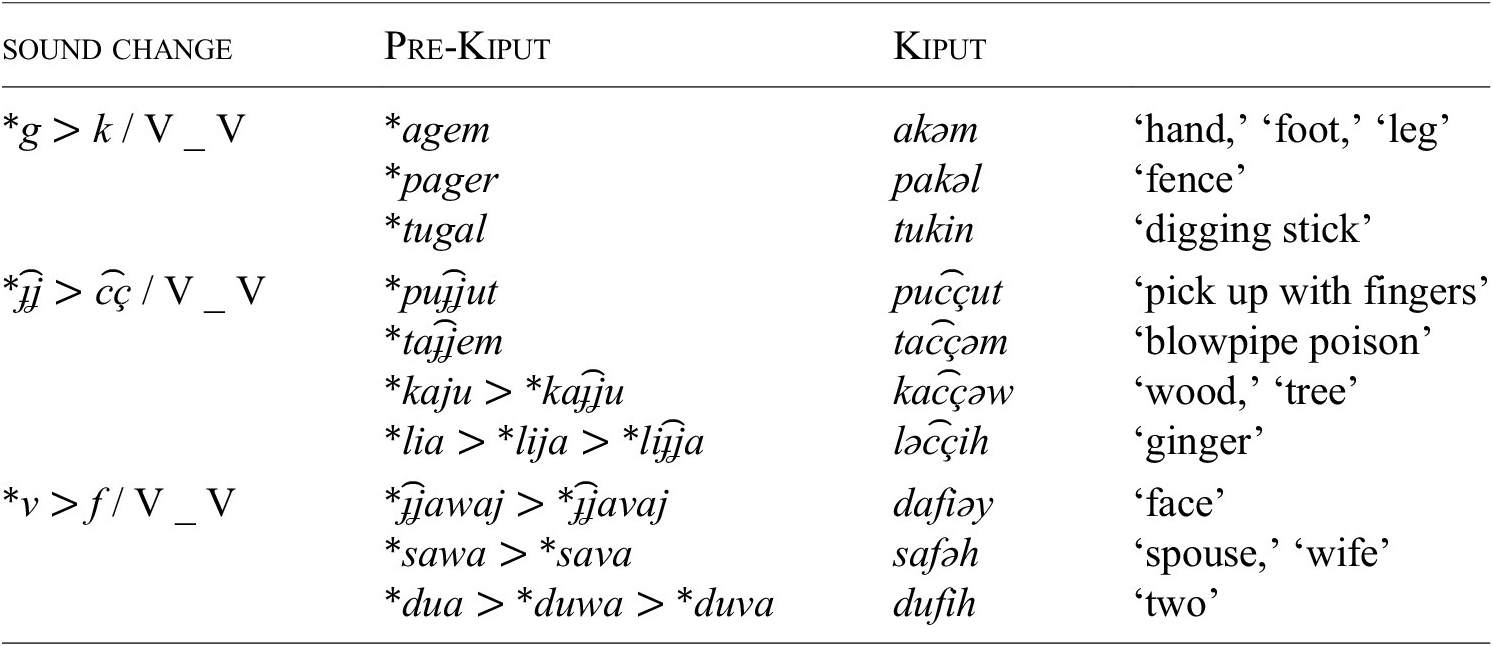
Table 6 provides examples of intervocalic devoicing in Kiput. For the voiced velar stop series, the list is exhaustive: of 307 items on the vocabulary list with reconstructions in Blust (Reference Blust2002), four lexical items have intervocalic *g in PNS. In three cases, devoicing occurs. The fourth case is an exception to this rule: PNS *tegeʀaŋ yields Kiput tәgәriә. For the developments *ɟ͡ʝ > c͡ç / V _ V and *v > f / V _ V, the table lists only a subset of all cases from the list. There are altogether 19 and nine cases of devoicing of *ɟ͡ʝ and *v, respectively, in the same 307-word vocabulary list.
Examples of intervocalic devoicing from Kiput (data from Blust Reference Blust2002, Reference Blust2005)
As mentioned above, the obstruents *g and *ɟ͡ʝ remain voiced word-initially. There are seven lexical items with Proto-North-Sarawakan initial *g in the 307-word Kiput vocabulary list. The voiced velar stop *g remains voiced in all but one lexical item: Kiput ketaan for PNS *guta-an ‘able to endure pain’ (Blust Reference Blust2002: 411). The palatal affricate likewise remains voiced word-initially but also loses its frication and develops to a voiced stop d. This occurs in three of four cases, for example, *ɟ͡ʝawaj > dafiәj. In one word, the affricate retains its frication: PNS *ɟ͡ʝauq yields Kiput ɟ͡ʝәu ʔ.Footnote 5 The voiced labial fricative *v does not appear word-initially. The data presented here (from Blust Reference Blust2002) thus confirms his claim that devoicing occurs exclusively intervocalically. Devoicing targets only the velar stop, palatal affricate, and labial fricative: voiced labial and alveolar stops remain voiced in all positions. The developments are summarized in Table 7.
Summary of developments in Kiput (data from Blust Reference Blust2002, Reference Blust2005)
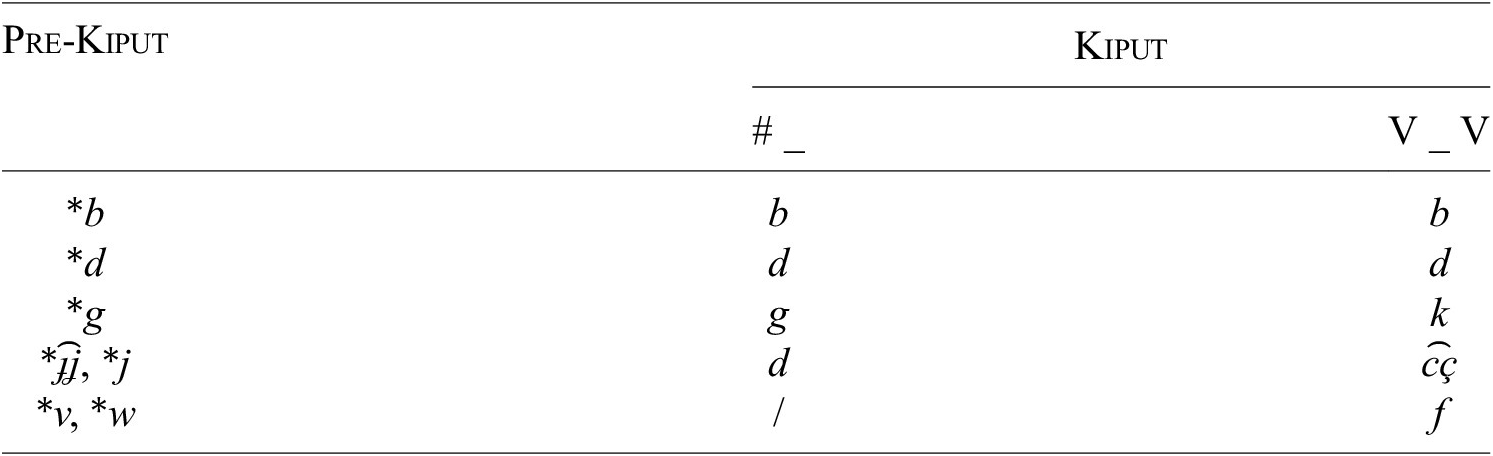
Devoicing sometimes also operates in loanwords. Blust (Reference Blust2002) provides a list of 130 loanwords, mostly from Malay. In three cases, a borrowed voiced velar stops devoices (e.g. sigup > sikup), while it remains voiced in the remaining four (e.g. bagi > bagi ʔ). The voiced palatal affricate devoices in three loanwords (e.g. piɟ͡ʝit > pic͡çit) and remains voiced in six (e.g. raɟ͡ʝin > raɟ͡ʝɪn).
To sum up, the above data suggest that unnatural intervocalic devoicing was a development from Pre-Kiput to Kiput. Blust (Reference Blust2005) goes a step further and claims that intervocalic devoicing had to occur as a single sound change. In Section 6, we challenge this claim.
5. Previous Accounts
The most elaborate historical treatment of the alleged unnatural sound changes in Berawan and Kiput is given by Blust (Reference Blust2005). Blust’s (Reference Blust2005) central claim is that unnatural sound changes do, in fact, exist. He specifically rejects the possibility that intervocalic devoicing could be anything but a single sound change: ‘intervocalic devoicing affected a single feature value. There is thus no possibility of considering a concatenation of natural changes which cumulatively produced an unnatural result’ (p. 243). According to Blust (Reference Blust2005), the Berawan data directly attest to the existence of unnatural sound changes precisely because the unnatural intervocalic devoicing had to operate as a single sound change.
The most common strategy for explaining unnatural sound changes involves invoking Ohala’s (Reference Ohala and Jones1993) hypercorrection. Blust (Reference Blust2005) proposes that hypercorrection is the mechanism responsible for dissimilation which resulted in Berawan’s intervocalic devoicing. Because the opposite process of intervocalic voicing is common, ‘the listener assumes wrongly that an assimilation has taken place and mentally “undoes” it’ (Blust Reference Blust2005: 243).
Blust (Reference Blust2005) acknowledges the problems that such an explanation brings. First, [±voice] is, according to Ohala (Reference Ohala and Jones1993), a feature less commonly prone to dissimilation (Blust Reference Blust2005: 244). In addition, the dissimilation by hypercorrection hypothesis fails to explain why devoicing operates only on a subset of places of articulation (e.g. alveolars undergo lenition instead of voicing). Blust (Reference Blust2005) also discusses other proposals which invoke dissimilation as perceptual enhancement or claim intervocalic devoicing is phonetically motivated. All proposals face similar problems: they fail to account for asymmetries in voicing across different places of articulation. Due to the problems that all current proposals of intervocalic devoicing face, Blust (Reference Blust2005) leaves open the question of how exactly the unnatural sound change arose.
Blust’s (Reference Blust2005) argument against the possibility that multiple sound changes operated in the prehistory is also problematic. The fact that the sound change targets only one feature value is not, in itself, evidence that excludes the possibility of multiple sound changes operating in combination. In fact, in the next section, we present evidence in favor of the opposite view – that one single sound change could not have operated in the history of Berawan dialects.
6. A New Account
In this section, we propose a new and unified treatment of historical developments leading to the unnatural intervocalic devoicing in the Berawan dialects (Section 3) and Kiput (Section 4). We argue that apparent cases of a single sound change operating in an unnatural direction are better explained as a combination of three natural sound changes (the so-called blurring process, Beguš Reference Beguš2019). We demonstrate that our approach automatically derives several unusual aspects of the data, whereas Blust’s (Reference Blust2005) unnatural sound change hypothesis fails to do so.
Our new proposal builds on a model for explaining unnatural processes presented in Beguš (Reference Beguš2019). The model was developed on the basis of postnasal devoicing, an unnatural process that is reported as a sound change in 13 languages (Beguš Reference Beguš2019) and as a synchronic productive alternation in at least two (Coetzee & Pretorius Reference Coetzee and Pretorius2010, Hyman Reference Hyman, Hume and Johnson2001, Sirk Reference Sirk1983). Beguš (Reference Beguš2019) argues that all 13 cases show either direct or strong indirect evidence that a combination of three natural sound changes occurred, together giving rise to a synchronically unnatural result. Central to Beguš’s (Reference Beguš2019) model is a schema for explaining the sound changes needed for an unnatural process to arise, dubbed the blurring process.
Just as with postnasal devoicing, it may appear on the surface that intervocalic devoicing operates as a single unnatural sound change. This, in fact, has been claimed for Berawan and Kiput (Blust Reference Blust2005). We take a difference stance. Using the blurring process model, we argue that the seemingly unnatural sound changes in Berawan and Kiput arise from a combination of three natural sound changes and point to the advantages that this explanation has over alternative single-sound change approaches.
6.1. The Blurring Process
First, let us assume that a single sound change is a change in one feature in a given environment and is always natural, that is, it operates in the direction of universal phonetic tendencies. Furthermore, let us assume that A > B / X is one such natural sound change. Its opposite (B > A / X) is then, by definition, unnatural, as it operates against a universal phonetic tendency. The question addressed in this section will be: how can an unnatural development B > A / X arise?
To account for intervocalic devoicing, we adopt Beguš’s (Reference Beguš2019) blurring process model, which proposes that unnatural phenomena result from a combination of a minimum of three sound changes.Footnote 6 A single sound change, by definition, cannot produce an unnatural process. Two sound changes in combination can produce an unmotivated process, but not an unnatural one (Wang Reference Wang1968 refers to the process that gives rise to unmotivated processes as telescoping.) For unnatural processes to arise, at least three sound changes need to operate. The three sound changes needed for an unnatural development B > A / X to arise are schematized in (3). (For a full argument motivating the requirement for at least three steps, see Beguš Reference Beguš2019, Reference Beguš2020, Reference Beguš2022.)

Two scenarios (i.e. two combinations of three sound changes) have been identified by Beguš (Reference Beguš2019) to produce the unnatural B > A / X. They have been termed the blurring cycle (4a) and the blurring chain (4b), respectively.

Postnasal devoicing in the 13 reported cases results from a blurring cycle. Voiced stops first undergo complementary distribution: they develop into voiced fricatives except postnasally. Then, the second sound change occurs – unconditioned devoicing of voiced stops. Because at this point stops surface only postnasally, the apparent result is postnasal devoicing. Finally, the last sound change occurs that blurs the initial complementary distribution: voiced fricatives occlude to stops.
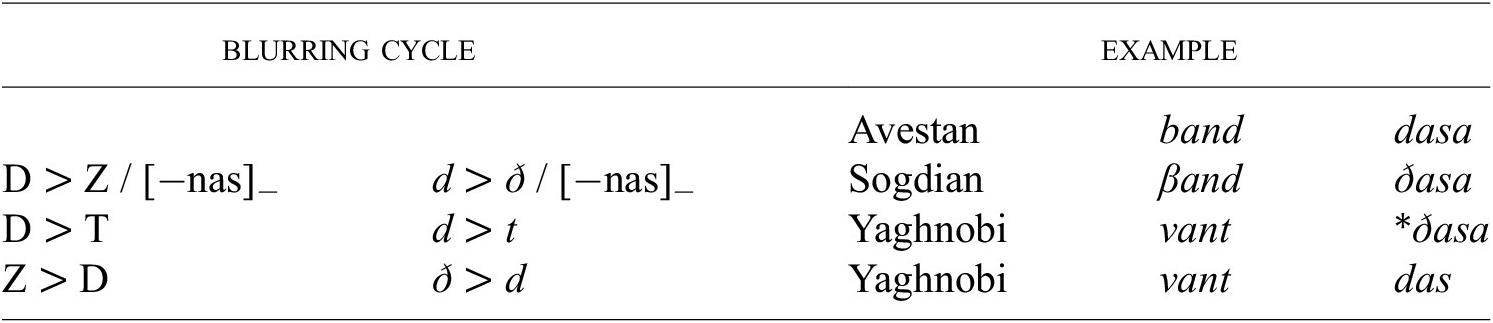
This development is confirmed by several direct and indirect pieces of evidence. One of the languages in which postnasal devoicing operates as a sound change is Yaghnobi. Yaghnobi presents direct diachronic evidence in favor of the blurring cycle analysis as all stages of the development are historically attested (see Xromov Reference Xromov1972, Reference Xromov1987). The development is summarized in Table 8. The sound changes of the blurring cycle operating from Avestan and Sogdian (ancestors) to Yaghnobi that result in apparent postnasal devoicing are all directly attested in historical records.
Development of coronals from Avestan to Yaghnobi (Beguš Reference Beguš2019; data from Novák Reference Novák2010)
In the rest of the paper, we argue that intervocalic devoicing in Berawan and Kiput is the result of the other type of blurring process described in Beguš (Reference Beguš2019): the blurring chain (4b). In the blurring chain, a set of segments enters complementary distribution. Then, the changed segments undergo further change. Finally, the same set undergoes a third change. The result of the last change would give rise to the appearance of an unnatural sound change, where the chain collapsed into a single sound change. We argue that the application of the blurring chain model to Berawan explains several unusual aspects of the data set that the proposals discussed in Section 5 cannot account for.
6.2. Blurring in Berawan
Stage 1 in a blurring chain is the development of a complementary distribution (3i). The material presented in Section 3 provides several pieces of indirect evidence in support of the claim that stops in the three languages entered complementary distribution at some stage of development. The development of Pre-Berawan voiced stops is repeated in Table 9.
Summary of developments in Berawan
An intriguing aspect of the Berawan development is that while the labial and velar series undergo intervocalic devoicing (which is a case of fortition), the alveolar series of stops undergoes intervocalic lenition. Lenition of alveolars in intervocalic position suggests an earlier stage with complementary distribution (3i). Pre-Berawan *d develops to r intervocalically and remains a voiced stop d initially. This trajectory was possibly gradual via the fricativization of d, that is, *d > *ð > r (which is a common sound change, cf. Kümmel Reference Kümmel2007: 60, 79). Alternatively, the rhotacism of *d might have proceeded without the interstage of fricativization. Instead, it could have involved a step of tapping lenition (as in North American English), followed by fortition to trilling, that is, *d > *ɾ > r. The change of trilling would parallel the final step of fortition we propose for other places of articulation. Our account is compatible with either subscenario. In either case, the voiced alveolar stop developed intervocalically into r, which means that at some point in the development, *d was in complementary distribution.
Based on the development of the alveolars, we reconstruct that such complementary distribution underlies the other two series of stops as well – that is, Pre-Berawan first undergoes intervocalic lenition in all series of stops, not just alveolars. More specifically, we propose that Pre-Berawan voiced stops undergo intervocalic fricativization, which is a common and phonetically motivated (Kaplan Reference Kaplan2010, Kirchner Reference Kirchner2001) – that is, natural – development.Footnote 7 As already mentioned, the alveolar series preserves this initial stage of complementary distribution in today’s system: intervocalically, *d surfaces as r and does not undergo devoicing; word-initially, d is preserved as a voiced stop. Stage 1 of the development is illustrated in Table 10.
Stage 1 in the development of Berawan

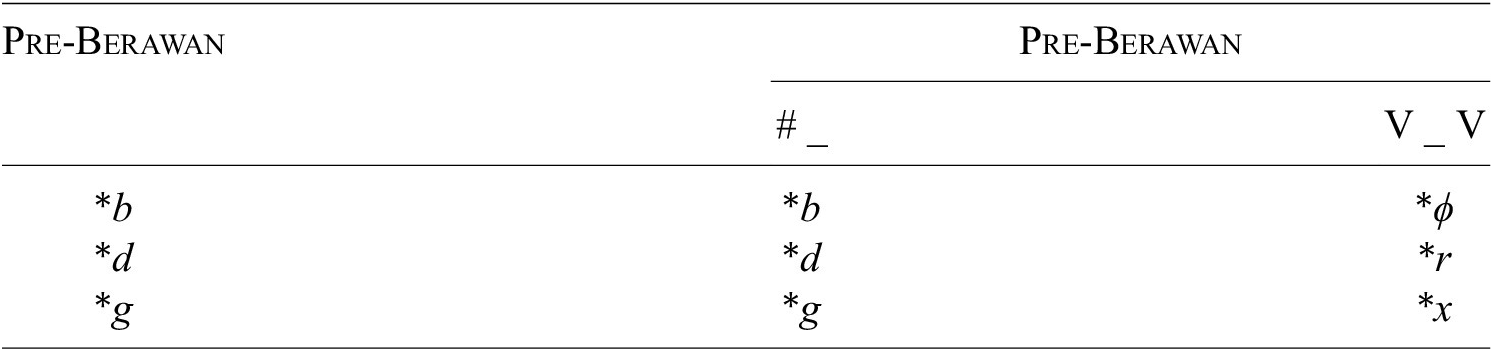
We propose that at the stage of complementary distribution in Pre-Berawan, another sound change occurred that targeted the changed subset of segments (3ii): unconditioned devoicing of voiced fricatives. Voicing in fricatives is highly dispreferred and articulatorily difficult to maintain – requirements for voicing and for frication are diametrically opposed, which is the source of articulatory dispreference: ‘one condition requires oral pressure to be as low as possible, the other to be as high as possible’ (Ohala Reference Ohala and Brown2006: 688; see also Ohala Reference Ohala and MacNeilage1983, Reference Ohala1997b, Smith Reference Smith1997).
Several cases of unconditioned fricative devoicing have been reported, including ð > θ; z̺ > s̺; ʒ > ʃ in Aragonese, Castilian, and Andalusian Spanish, z̺ > s̺; ʒ > ʃ in Galician, z > s in Apitxat and Ribagorça Catalan, v > f; ʝ > ç; ɣ > x in Southern Jutlandic, v > v̊ (> f); z > z̊ (> s); ʁ > ʁ̊ (> χ) in Modern Dutch, and v̊ > f; z̊ > s in Palatine, South Franconian, East Franconian, North Alemannic, and Swabian German (Kümmel Reference Kümmel2007: 139). Thus, unconditioned devoicing of fricatives is a motivated, well-attested, and natural sound change.Footnote 8 Because voiced fricatives at this stage appear only intervocalically, the result is apparent intervocalic devoicing. Stage 2 is given in Table 11.
Stage 2 in the development of Berawan
The blurring chain hypothesis has several advantages. First, recall that intervocalic *d develops to (*ð/*ɾ) > r. The approximant (*ɾ >) r escapes fricative devoicing, and the original complementary distribution in the alveolar series is preserved. The asymmetry between labials and velars, on the one hand, and the alveolars, on the other, is expected under the blurring chain approach but hard to explain under other accounts (cf. Section 5).
Second, the labial stop series in Berawan underwent not only devoicing but also a change of place of articulation. This change of place of articulation is easier to motivate under the blurring chain approach than under other approaches. The sound change ϕ > x (or β > ɣ, if it took place prior to devoicing) is more common than p > k or b > g. In fact, the only two cases of unconditioned change in place of articulation from labial to velar in the survey of consonantal sound changes in Kümmel (Reference Kümmel2007: 222) involve precisely fricatives; none are reported to involve stops. Outside of Kümmel (Reference Kümmel2007), labial–velar fricative mergers in Uralic, Germanic, Celtic, Romance, and Slavic have been discussed by Hickey (Reference Hickey1984). Hickey (Reference Hickey1984) attributes the shifts between f and x to the acoustic similarity of the two sounds (p. 345). Rao & Shaw (Reference Rao and Shaw2021) report that mergers between labial and velar fricatives (in both directions, i.e. *f > x as well as *x > f) are common in many varieties of Chinese, including those spoken in Southwestern China (212 out of 374 varieties spoken in Hunan, Hubei, Sichuan, and Yunnan, according to He Reference He2004).
In addition, the sound change ϕ > x (or β > ɣ) may be grounded in the phonetic similarity of labial and velar fricatives. Miller & Nicely (Reference Miller and Nicely1955) and Alwan et al. (Reference Alwan, Jiang and Chen2011) show that non-strident fricatives are more perceptually confusable than strident fricatives. Redford & Diehl’s (Reference Redford and Diehl1999) data suggest that the non-strident f and θ are more confusable than their corresponding stops p and t. In Southwestern Chinese (discussed above), the labial fricative f shows a wide range of spectral variation, including a low center of gravity characteristic of the velar x (Rao & Shaw Reference Rao and Shaw2021). As such, while we are not aware of empirical studies that directly compare the confusability of ϕ/β with x/ɣ, on the one hand, and p/b with k/g, on the other, the extant evidence suggests that non-strident fricatives are more confusable than stops.
Third, the change in place of articulation that operated in Pre-Berawan reveals another crucial piece of evidence in favor of the blurring chain approach: if we assume that intervocalic devoicing operated as a single sound change, we run into an ordering paradox. In this hypothetical scenario, there are two logically possible chronological orders of intervocalic devoicing and the change of place of articulation: either one precedes the other or vice versa. The two alternative chronologies are illustrated in Table 12.
Two possible relative chronologies with intervocalic devoicing as a single sound change

If devoicing happened first, we would expect the original p from Pre-Berawan voiceless *p to change its place of articulation as well. This does not happen: Pre-Berawan *apuj yields apoj, not ×akuj, in all four dialects. If the change in place of articulation happened first, we would expect it to operate in the word-initial position as well. This does not happen – Pre-Berawan *bibi yields biki, not ×giki. The only possibility to chronologically order the two sound changes and derive the Berawan data with a single-sound-change approach is to limit the already unusual sound change – change of place of articulation in stops (b > g) – to an even more unusual environment – the intervocalic position. This would be highly unexpected: stops are perceptually better cued internally than initially, where formant transitions into closure are lacking. For example, in the survey of consonantal sound changes in Kümmel (Reference Kümmel2007), there are no cases reported of a change of intervocalic b > g.
In fact, precisely the change of place of articulation that targets only intervocalic *b, while initial *b remains unchanged, strongly suggests that the two were at some point distinct sounds and that the sound changes of intervocalic devoicing and change of place of articulation operated on one of the two sounds in complementary distribution.
Finally, the last sound change of the blurring chain (3iii) that operated in Pre-Berawan was the occlusion of the velar voiceless fricative *x > k. Occlusion of fricatives is a natural sound change as well, although not as unidirectional as the other two in the blurring chain. Kümmel (Reference Kümmel2007) reports an unconditioned x > k in Montenegrin Serbo-Croatian, x > k h in Greek-Bovesian, and a possible *x > k in Proto-Baltic. Key (Reference Key1968) reports an unconditioned change of Proto-Tacanan *x > Cavineña k. Li (Reference Li1977: 207–214) reports Proto-Tai *x > k h in a number of Tai languages. The sound change is also phonetically motivated: fricatives require more articulatory precision than stops (Ladefoged & Maddieson Reference Ladefoged and Maddieson1996: 137). The occlusion of fricatives can be motivated as reducing this articulatory precision, that is, the laxing of articulatory targets.
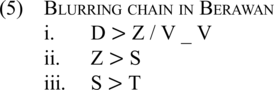
The sound change *x > k blurs the original complementary distribution, and the result is intervocalic devoicing, as it is attested in Berawan today. The blurring chain in Berawan that results in D > T / V _ V is summarized in (5).
The reconstructed trajectory can be illustrated with a lexical item that includes both an initial and an intervocalic stop: Berawan bikuj ‘pig’ from Proto-Austronesian *babuj (6).Footnote 9

In sum, there exist several advantages of the blurring chain explanation in Berawan. First, the lenition of the alveolar series of stops automatically follows from the new analysis: it reveals an earlier stage of complementary distribution. Likewise, the change in place of articulation becomes well-motivated, and consequently, we solve the chronology problem summarized in Table 12. Finally, all the sound changes we posited are natural and well-motivated.
6.2.1. Addressing Blust (Reference Blust2023)
The blurring process explanation we put forth here for Berawan’s intervocalic devoiced has been disputed by Blust (Reference Blust2023). Here, we briefly address Blust’s (Reference Blust2023) main qualm.
Blust (Reference Blust2023) challenges the proposal that the Pre-Berawan *b developed into k through the intermediate stage of the voiced bilabial fricative *β by pointing out that Proto-Berawan had a bilabial fricative which came from automatic transition glides after *u, but did not develop into k. If *b had had the intermediate stage of *β, and *β later developed into k, then – reasons Blust (Reference Blust2023) – we predict that, for example, ‘Malayan sun bear’ in Batu Belah and Long Jegan should have developed in ×kukiŋ, as opposed to the attested kuβiŋ. The data used by Blust (Reference Blust2023) to motivate his counterargument are given in Table 13.
Reflexes of Proto-Berawan *β (from Blust Reference Blust2023 and Burkhardt Reference Burkhardt2014: 166)
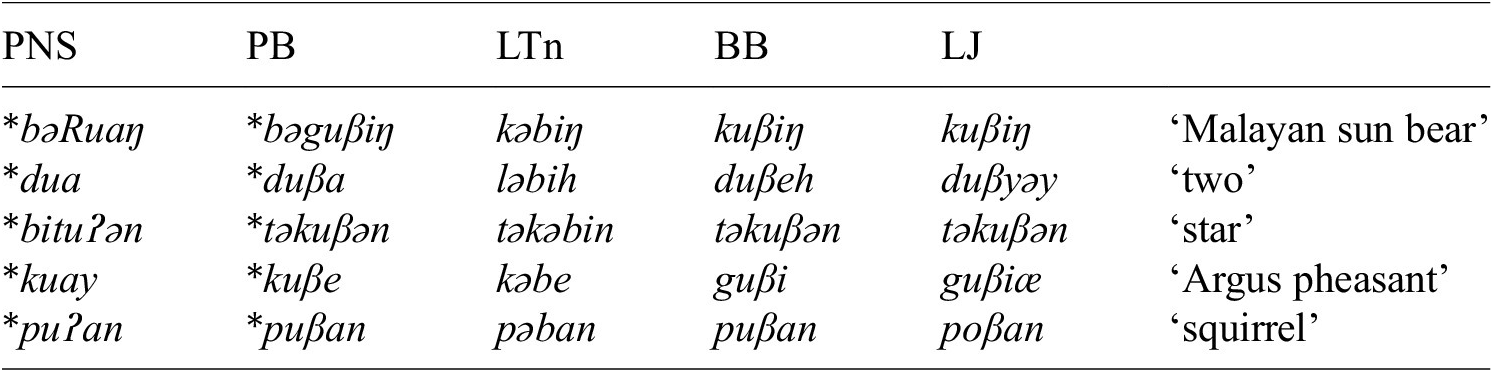
We observe, however, that the fortified glide need not have been a bilabial fricative at the time of the second stage of the proposed blurring process yet. This is to say, we propose to reconstruct that Proto-Berawan maintained the hiatus at the time when the second sound change in the blurring process occurred (we reconstruct *bәguiŋ, *dua, *tәkuәn, *kue, and *puan for Proto-Berawan as opposed to Blust’s (Reference Blust2023) ×*bәguβiŋ, ×*duβa, ×*tәkuβәn, ×*kuβe, and ×*puβan). The original glide *w undergoes no changes in the daughter languages. The plausibility of our chronology is strengthened by the diversity of the ‘fortified glide’s’ reflexes in the daughter languages, whereas the reflexes of IVD are uniform across the languages.
At the same time, we note that the change of *β > b in Long Terawan suggests that the Berawan dialects are prone to fricative occlusion. The evidence lends further support to the third stage of the blurring chain we posit. In brief, Blust’s (Reference Blust2023) counterargument is easily dispelled, and the data he invokes provide additional evidence for the operation of the blurring process.
6.3. Blurring in Kiput
Let us now turn to Kiput, where intervocalic devoicing – we argue – also resulted from a blurring chain. As in the Berawan dialects, Kiput’s distributional facts clearly point to a stage with complementary distribution (stage 1 of the blurring chain). Sounds targeted by IVD in Kiput are summarized in Table 14.
Devoiced sounds in Kiput (data from Blust Reference Blust2002, Reference Blust2005)
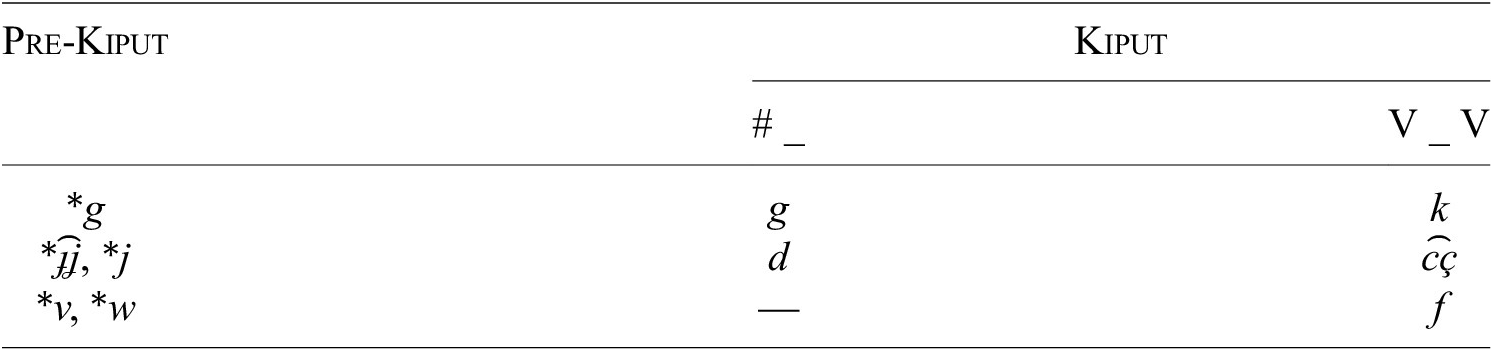
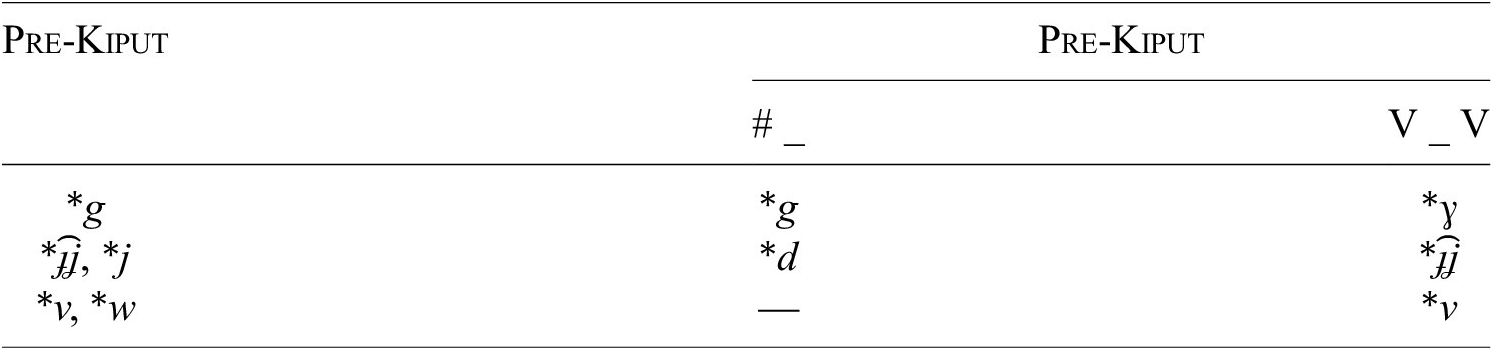
Note that, while *ɟ͡ʝ devoices intervocalically, it also changes in the initial position: the affricate *ɟ͡ʝ loses its frication and develops into d. In other words, *ɟ͡ʝ in Kiput enters into complementary distribution. At stage 1, *ɟ͡ʝ surfaces as d initially and remains *ɟ͡ʝ intervocalically. We reconstruct that, like in Berawan, the velar stop enters a similar complementary distribution (3i) – it surfaces as a voiced fricative intervocalically and remains a stop initially. The voiced fricative v surfaces only intervocalically. Stage 1 is summarized in Table 15.
Stage 1 in the development of Kiput
At this point, we can posit that the second sound change of the blurring chain took place (3ii) – voiced fricatives and affricates devoiced unconditionally. Fricative and affricate devoicing is a well-motivated natural sound change (Section 6.2). The voiced palatal affricate devoices to c͡ç, while the voiced labiodental fricative *v devoices to f, and the voiced velar fricative *ɣ to *x. Stage 2 is summarized in Table 16.
Stage 2 in the development of Kiput

That fricatives indeed devoice in Kiput is confirmed precisely by the attested development *v > f. While *x further develops to k via occlusion (just like in Berawan, 3iii), f is still preserved as a fricative and directly shows that devoicing of fricatives operated in Pre-Kiput. Because affricates and fricatives only surface intervocalically, the blurring chain results in an apparent intervocalic devoicing.
In sum, we account for the development of the Kiput intervocalic devoicing by proposing a series of natural changes, which begins with a set of sounds entering a complementary distribution (word-initially, *ɟ͡ʝ develops to d), goes through fricative devoicing (including the attested *v > f), and ends up with a blurring of the original complementary distribution. Thus, the proposed sequence of sound changes is not only natural but motivated by the data.
7. Discussion and Conclusions
In conclusion, we presented two case studies of putative intervocalic devoicing in Berawan dialects and Kiput. The Pre-Berawan sounds *g and *b between vowels both devoice (and velarize) to k in Berawan. Alveolar stops do not devoice but instead undergo intervocalic lenition to r. The Pre-Kiput *g, *ɟ͡ʝ, and *v devoice intervocalically to k, c͡ç, and f. Footnote 10
To account for the development of intervocalic devoicing in both languages, we invoked Beguš’s (Reference Beguš2019) blurring process model that reduces unnatural processes to a series of independently motivated, phonetically grounded, and natural sound changes. In both languages, intervocalic devoicing instantiates the blurring chain. First, voiced stops fricativize intervocalically. Second, the newly arisen voiced fricatives devoice unconditionally. Third and last, the voiced fricatives unconditionally occlude. The three changes give the false appearance of unnatural intervocalic devoicing.
The existence of unnatural developments (and their phonologizations) has far-reaching consequences, as it bears on open questions in linguistic diachrony and phonological theory, including: (i) what is the right theory of sound change; (ii) how does sound change operate (Beguš Reference Beguš2022); and (iii) to what degree is phonology influenced by phonetics (Hayes Reference Hayes, Darnell and Moravscik1999). More specifically, our results bear on one of the most heated debates in phonology: Is phonological typology primarily influenced by cognitive (analytic bias) or historical (channel bias) factors (Moreton Reference Moreton2008)?Footnote 11 If a single sound change could operate against a phonetic tendency, then an explanation for the relative infrequency of unnatural patterns would need to lie with synchronic grammar. If, on the other hand, unnatural developments can only arise via a combination of a specific set of sound changes, their rarity may then be simply due to the compounded low probability of a sequence of specific changes (Beguš Reference Beguš2020). Despite their infrequency, unmotivated and unnatural developments do exist (e.g. Coetzee & Pretorius Reference Coetzee and Pretorius2010, Hyman Reference Hyman, Hume and Johnson2001, Beguš et al. Reference Beguš, Nazarov, Björklund and Baldoceda2022, Dąbkowski Reference Dąbkowski and Farrell2023, Beguš Reference Beguš2020, Reference Beguš2022, Dąbkowski & Beguš Reference Dąbkowski and Beguš2024, Merrill Reference Merrill2023, Blevins et al. Reference Blevins, Egurtzegi and Ullrich2020). They are rare – we maintain – because their diachronic precursors are specific (Beguš Reference Beguš2019).
Our account of intervocalic devoicing supports the conservative view that sound change is always phonetically or phonologically motivated (for an argument in favor of unnatural sound changes, see Blust Reference Blust2005, Reference Blust2023). Moreover, we show that natural sound changes may conspire to produce unmotivated or unnatural developments. Our findings are consistent with the evolutionary phonology program, which accounts for phonological alternations as phonologizations of articulatorily or perceptually motivated sound changes (Hyman Reference Hyman and Juilland1976, Ohala Reference Ohala, Masek, Hendrick and Miller1981, Reference Ohala and MacNeilage1983, Blevins Reference Blevins2004, Reference Blevins2007, Reference Blevins and Good2008, Reference Blevins, Honeybone and Salmons2013, Blevins et al. Reference Blevins, Egurtzegi and Ullrich2020). More specifically, the complex diachrony of intervocalic devoicing provides evidence for the blurring process framework, which holds that unnatural developments require a specific combination of at least three sound changes (Beguš Reference Beguš2018, Reference Beguš2019, Reference Beguš2022, Reference Beguš2020, Beguš et al. Reference Beguš, Nazarov, Björklund and Baldoceda2022, Dąbkowski & Beguš Reference Dąbkowski and Beguš2024).
Acknowledgments
Our research has been partly funded by the Georgia Lee Fellowship in the Society of Hellman Fellows to Gašper Beguš.
Competing interests
The authors have no competing interests to declare.


 Open access

