

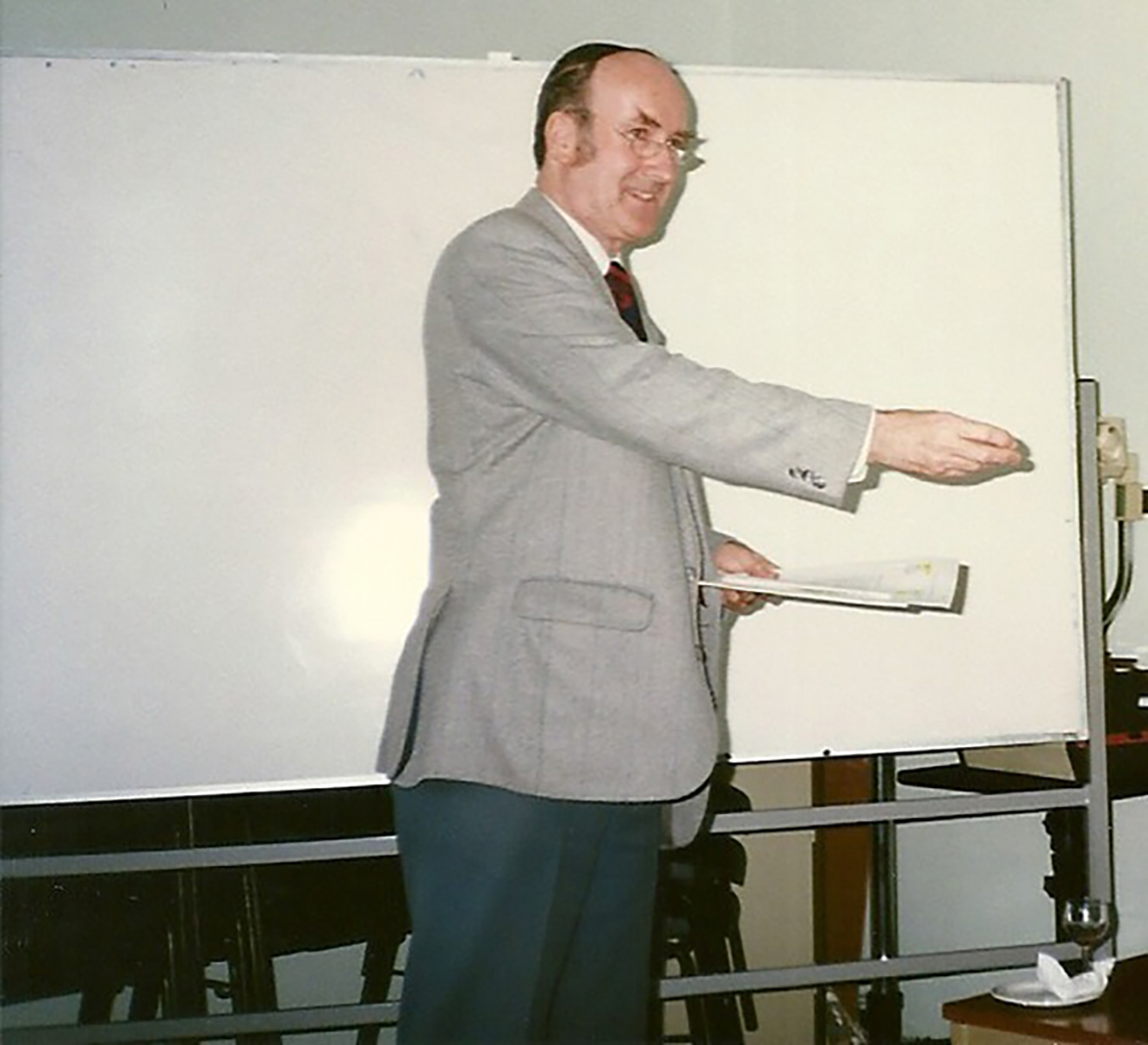
Alan Millard giving a talk in 1996. Photo courtesy of Miss Patricia Winker, Museum Registrar, Garstang Museum
Alan Millard epitomized the rounded, ‘holistic’ scholar, bringing together expertise in Semitic languages, archaeology, biblical studies, and a deep desire to communicate the fruits of his research to as broad a public as possible, and never allowing himself to become a narrow specialist.
Alan was born in Harrow, Middlesex on 1 December, 1937. Already as a schoolboy he became fascinated with British archaeology and ancient coins. As a member of the Merchant Taylors’ School Archaeological Society, in 1952-5 he excavated The Manor of the More in Rickmansworth, Hertfordshire, a large medieval palace owned by Cardinal Wolsey and Henry VIII, publishing the results together with Martin Biddle and Lawrence Barfield in an impressively detailed archaeological report in The Archaeological Journal in 1959. His strong Christian faith and his father’s friendship with the Assyriologist Donald J. Wiseman led him to biblical archaeology and eventually to Oxford, where he studied Semitic Languages at Magdalen College under Sir Godfrey Driver, graduating in 1959.
After Oxford he travelled around the Middle East for a year on a scholarship, spending time in Iraq and Petra in Jordan (where he briefly assisted Crystal-M. Bennett in her first season of excavations at the Iron Age site of Umm al-Biyara in 1960). From 1961-3 he was Assistant Keeper in the Department of Western Asiatic Antiquities at the British Museum. While there, he published Aramaic inscriptions from Sir Max Mallowan’s excavations at Nimrud, and, most famously, rediscovered tablets that formed part of the Babylonian story of the flood, the Atrahasis epic; these tablets had remained forgotten and unrecognised in a drawer for several decades. Atrahasis was the subject of his MPhil at SOAS under D.J. Wiseman in 1966, and in 1970, together with Wilfred G. Lambert, he published the definitive scholarly edition and translation of the epic.
From 1964 to 1970 he was the librarian at Tyndale House, the library for biblical research in Cambridge. In 1970 he joined the University of Liverpool as Rankin Lecturer in Hebrew and Semitic Languages (1970-1976), succeeding William Martin. He progressed to Senior Lecturer (1976-1985), Reader (1985-1992), and in 1992 was awarded a personal chair. He retired in 2003. During his time in Liverpool, he participated in archaeological excavations in Iraq and Syria, his final ones as epigrapher at Peter Parr’s excavations at Tell Nebi Mend, ancient Qadesh on the Orontes, scene of Ramesses II’s famous battle against the Hittites.
Among other honours and activities, he was elected a Fellow of the Society of Antiquaries in 1971, and a Fellow of the Institute for Advanced Study at the Hebrew University of Jerusalem in 1984, spending six months there as part of a study group on ‘Biblical Israel in the Light of Historical and Archaeological Research’. From 2001-2005 he served as Vice-Chair of the British School of Archaeology in Iraq (now the British Institute for the Study of Iraq). For many years he was on the editorial board of the Palestine Exploration Quarterly and an active member of the Society for Old Testament Study. He also served as one of the translators of the New International Version of the Bible.
Alan’s greatest scholarly impact was in the primary publication of Aramaic and Hebrew inscriptions and in the Akkadian of the Neo-Assyrian empire. His monographs La statue de Tell Fekherye et son inscription bilingue assyro-araméenne (1982, with Ali Abou-Assaf and Pierre Bordreuil) and The Eponyms of the Assyrian Empire 910-612 B.C. (1994) are standard, definitive texts. He contributed comments about fitters’ marks, mostly letters of the Phoenician alphabet, to the series of volumes on the Nimrud ivories by Georgina Herrmann, and a chapter on the inscribed material in the final report on the excavations at Busayra in Jordan by Piotr Bienkowski (2002). A thread that ran through his career was an intense interest in the uses of writing and questions of literacy in the ancient Near East and in relation to the Bible. He was also always keen to point out the role of accident in archaeological discoveries: unusually, in his own Festschrift (Writing and Ancient Near Eastern Society, 2005), he contributed a paper on this topic that was important to him, concluding that texts (and other artefacts) found on a site do not necessarily relate to the whole period of life of the building/town, and that the presence of quantities of texts from one century and few from the previous century is no measure of growth in scribal activity.
While at Liverpool, he regularly organized extremely popular day schools, and wrote many readable and authoritative books aimed at a wider public on aspects of the ancient Near East and biblical archaeology: Discoveries from Bible Times (1985), Discoveries from the Time of Jesus (1990), Reading and Writing in the Time of Jesus (2000), and The British Museum Dictionary of the Ancient Near East (2000, with Piotr Bienkowski).
Alan had tremendous impact as a teacher, mentor and colleague, both in his academic duties and as a member of faith communities on and off campus. He cared deeply for the well-being of his students (and their families), even long after they had graduated, he and his wife welcoming them to their home. He hosted the Liverpool University Staff Christian Fellowship weekly in his office to discuss a passage from the Bible, carefully preparing the programme for each term and organizing different staff members to lead. Alan could be elusive when it came to university administration. When it was time for him to retire, he was reluctant to move his books out of his office, so the departmental secretary rang his wife, Margaret, who said “Leave it to me” and came in to supervise his packing.
As a scholar, Alan was careful, considered, objective and wide-ranging, and always urged his students to be cautious in their arguments. It is fair to say that he did not have much time for theoretical approaches to archaeology. Despite his strong commitment to evangelical Christianity and membership of the Plymouth Brethren, and his belief that core elements of the older books of the Hebrew Bible were historical, he never allowed this to influence his scholarly work, which was punctilious. In person, he was modest, formal and serious, but immensely generous, kind and supportive, happily giving away books and articles to students. His reserved personality meant that, even many years after the writer ceased to be his student and had become a colleague and co-author, it still felt appropriate to address him as ‘Professor Millard’, until one day he said “I really think it’s time you called me Alan”.
Alan Millard died in Leamington Spa on 6 June, 2024, aged 86. He was predeceased by Margaret (née Sibley), his wife of nearly 55 years, and survived by their children Clare, Stephen and Jonathan.

 Open access

