



To provide nutrition education and dietary guidance to healthy individuals, many countries develop dietary guidelines for their population, focusing mainly on curbing the increasing rates of chronic diseases( 1 ). In general, dietary guidelines are the basis for nutrition policies and are an attempt to define the quality of a diet, usually combining general guidance on what food items should be included in a healthy diet with the necessary supply of nutrients. The epidemic of obesity has necessitated the development of strategies on how to decrease total energy intake, but clear messages on how to combine a healthy diet with low energy intake remain unavailable( 1 ). As a result, the guidelines in Brazil( 2 ) as well as in developed countries such as the United States( 3 ), Canada( 4 ) and UK( 5 ) lack clear indications on how to reduce energy intake.
Identifying the food groups that could be major contributors to excessive energy intake at the population level may help to generate dietary recommendations on reducing energy intake. Given that the condition of overweight and obesity has reached epidemic proportions in many countries, such recommendations are important. Studies identifying food sources of energy, such as the 2003–6 National Health and Nutrition Examination Survey( Reference O'neal, Keast and Fulgoni 6 ), or comparing between different countries in major contributors of energy( Reference Bezerra, Goldman and Souza 7 ), have only ranked the foods based on 1-d measurements of food intake. In these ranked analysis, major contributors may simply reflect items consumed on a daily basis, such as rice. To overcome this methodological constraint, in the present study, we compared days with and without the consumption of specific food groups in the same individuals. To the best of our knowledge, this is the first analysis using this more effective way of identifying major food group contributors of energy intake. In addition, we estimate these groups using a large population-based nationwide survey.
Methods
Sample
The source of dietary data for the present study was the Brazilian National Dietary Survey, the dietary component of the Household Budget Survey, collected in 2008–9. This is the first and most recent nationwide dietary intake dataset available in Brazil.
The Household Budget Survey was conducted by the Brazilian Office of Geography and Statistics (Instituto Brasileiro de Geografia e Estatistica) and was designed to be representative of all Brazilian households. About 56 000 households were selected from a master sample of household surveys. The master sample includes a set of 12 800 primary sample units, which were selected by a two-stage sample technique to be used in national household sample surveys. In the first stage, primary sample units were selected according to the number of households, and in the second stage the households were selected by simple random sampling. The primary sample units were stratified according to geographic and economic levels and a random sample of 4696 primary sample units was selected for the Household Budget Survey, allowing assessment of energy intake according to different geographic locations (urban/rural, five Brazilian geographic areas) and economic levels.
The National Dietary Survey was designed to gather information on food consumption in 30 % of the households randomly selected from the 2008–9 Household Budget Survey, with a non-response rate of 19 %. This cross-sectional analysis included all respondents over 10 years of age with dietary records in the selected households (n 34 003).
The research protocol of the present study was reviewed and approved by the Ethics Committee of the Institute of Social Medicine at the Rio de Janeiro State University (CAAE 0011.0.259.000-11) in accordance with the Brazilian law no. 5534, which complies with the Helsinki Declaration.
Measurement of dietary intake
Food records were collected during two non-consecutive days for all individuals aged 10 years and older. The respondents received a booklet with instructions on how to record food intake, which included figures of tableware and other household measures (silverware, plates, glasses, and cups and industrial containers, such as cans and bottles). The records comprised information on foods, culinary preparations and beverages consumed as well as amount, time and place of intake. All records were reviewed by interviewers who probed for commonly forgotten foods, how foods were prepared (e.g. raw, cooked and roasted) and the amount consumed. The interviewers double-checked with the respondents any records with less than five items per d or periods greater than 3 h without any intake. Reported food amounts were transformed to grams or millilitres, and energy intake was estimated using a food composition table based on the Brazilian Table of Food Composition and the Nutrient Data System for Research software, version 2008. A total of 1103 respondents provided only 1 d of food record; therefore, the final analysis of differences between days with and without consumption was conducted among the remaining 32 900 participants.
Food grouping
Dietary intake data collected in the survey were coded into more than 2000 food items. For these analyses, food items representing markers of unhealthy eating based on the Brazilian guidelines( 2 ): cakes, cookies and desserts; sugar-sweetened beverages; soft drinks; processed meats; and savoury snacks were grouped, as well as those considered markers of healthy eating: vegetables, beans, milk and fruit. Meat, white breads and cheese were also grouped. Other food groups, such as whole-wheat bread, brown rice, and nuts, are included in the guidelines, but were not analysed because few people reported them.
Statistical analysis
Mean energy intake according to the consumption of selected food groups in 1 d, 2 d or none of the days of the two non-consecutive days of food records was calculated to characterise the diet of the study population. The main analysis was performed on the mean energy intake only in individuals who reported consuming the selected food group in one of the 2 d, by comparing the same individual the day with and the day without the specific food intake. This paired analysis accounted for all possible confounding factors, such as age, physical activity, sex and obesity status.
Statistical analysis were conducted using SAS, release 9.1.3 (2003, SAS Institute, Inc.), taking into account the sample design effect. To adjust for differential probabilities of selection and non-response, appropriate weighting factors were applied, allowing inference to the Brazilian population aged 10 years and more. Analysis was preliminarily stratified for sex, but because there were no sex differences, data are shown for the overall population.
Results
The Brazilian National Dietary Survey was conducted on 34 003 respondents aged 10 years or older. In this population, 52 % were women and 79 % were adults ( ≥ 20 years of age), while adolescents (10–19 years old) represented 21 % of the population. In addition, 49 % of the adults were overweight (BMI ≥ 25 kg/m2), and 20 % of adolescents were classified as overweight, according to the WHO cut-off for BMI-for-age (z-scores >+1 sd)( Reference de Onis, Onyango and Borghi 8 ).
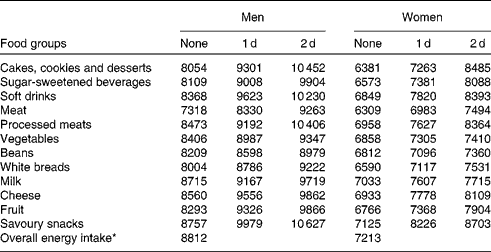
In total, energy and mean energy intakes according to food group intake reported in 1 d, 2 d or none of the days of the two non-consecutive days of food records are shown in Table 1. In all food groups, energy intake increased according to the number of days with consumption of the specific food, with all trends being statistically significant (P-values < 0·001). Men and women reporting 2 d without intake of meat showed the lowest mean energy intake, whereas those reporting 2 d with intake of savoury snacks showed the highest energy intake. Men reporting savoury snacks in 2 d had an energy intake of 10 627 kJ (2540 kcal), which is 20·6 % higher than the mean energy intake for all men. For women, this value was 8702 kJ (2080 kcal), which also corresponds to 20·6 % greater than the mean energy intake for all women.
Weighted and age-adjusted mean energy intake (in kJ) according to food group intake reported in 1 d, 2 d or none of the days of the two non-consecutive days of food records (the 2008–9 Brazilian National Dietary Survey)
* Average energy intake of the population.
In an additional analysis, we compared values between individuals reporting intake of a food group in 2 d (last column in Table 1), considering those individuals as usual consumers of the reported food group.
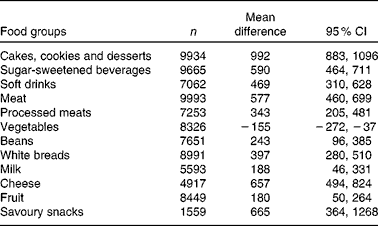
All comparisons of energy intake according to food groups were age-adjusted; however, other confounders may contribute to these differences in cross-sectional studies. Therefore, we conducted an innovative analysis comparing days with and without the food group intake in each individual, allowing a more direct comparison of the impact of the intake of specific foods on the overall energy intake (Table 2). This comparison more clearly indicates the major contributors to energy intake. Cakes, cookies and other desserts were associated with a difference in energy intake of 992 kJ (237 kcal), which represents an increase of 12 % in the overall mean energy intake of about 8000 kJ (approximately 1900 kcal). Savoury snacks were the second most important contributor with 665 kJ (159 kcal). The only group for which intake was related to a decrease in energy intake was the vegetable group, which does not include potatoes or other roots (Table 2). A similar analysis stratified by sex showed similar results; most of the difference between days with and without the food group intake showed the same magnitude as contributor to energy intake, with values greater among men. For example, the contribution to energy intake for cakes and sweets was 1129 kJ (270 kcal) among men and 874 kJ (209 kcal) among women, with an overall value of 991 kJ (237 kcal) (data not shown).
Sample size of participants with and without the intake of food groups, mean difference in total energy intake (in kJ) between day with and without food group consumption and 95 % CI of the difference (the 2008–9 Brazilian National Dietary Survey) (Number of participants, mean difference values and 95 % confidence intervals)
Discussion
Identification of food sources of energy and nutrients in representative samples of the population is a necessary step to define feasible and appropriate dietary recommendations. In addition, the identification of major sources of energy is particularly needed to help with public health efforts to curb the obesity epidemic. Our analysis contributes to this topic, suggesting a new method to define food sources of energy and nutrients.
The usual method of identification of food sources of energy intake( Reference O'neal, Keast and Fulgoni 6 , Reference Bezerra, Goldman and Souza 7 , Reference Sette, Le Donne and Piccinelli 9 ) calculates the percentage of energy intake from specific food groups, which does not directly translate into dietary recommendations because food choice may be related to sex, obesity status and socioeconomic factors( Reference Boek, Bianco-Simeral and Chan 10 – Reference Araujo, Verly Junior and Junger 12 ). We compared this traditional method with an innovative one, which identified the greatest contributors of energy intake according to energy intake as measured by the difference between days with and without the intake of a specific food group. Our novel method of comparing differences in the same person does not require adjustment for other factors associated with food choice. The presented results indicated that, except for savoury snacks, which was the greatest contributor to energy intake using both methods, all other food groups were highly influenced by sex in the traditional method. Our new method requires food records from at least 2 d. This approach has been done in most studies since at least 2 d is also necessary for estimating usual nutrient and food intake.
The presented results showed that vegetables may play an important role in the public health effort to reduce energy intake, whereas meat and cheese, although important sources of nutrients, are major contributors to energy intake. As expected, SSB, soft drinks, savoury snacks, cakes, cookies and desserts were major contributors of energy intake, supporting their role as markers of unhealthy eating, as shown in the Brazilian guidelines as items to be reduced or avoided( 2 ).
In accordance with our findings, the effect of cheap industrialised items such as cakes, cookies and savoury snacks on energy intake has been discussed by other authors, who have indicated an important role of industrialised items in the obesity epidemic( Reference Monteiro, Levy and Claro 13 , Reference Moubarac, Martins and Claro 14 ). Enhancement of flavours associated with low costs promotes over-consumption( Reference Monteiro, Levy and Claro 13 ). Moreover, these items are usually consumed between meals as snacks, which has been positively associated with weight gain( Reference Bes-Rastrollo, Sanchez-Villegas and Basterra-Gortari 15 ). Not only SSB, but also 100 % fruit juice is associated with weight gain in a pooled analysis of three large cohorts in the United States( Reference Mozaffarian, Hao and Rimm 16 ). A school intervention study in Brazil also showed significant addition of sugar in all kinds of beverages( Reference Sichieri, Paula Trotte and de Souza 17 ).
The strengths of the present study include its very large population-based sample of Brazil, covering all regions and different socioeconomic levels of the country. One limitation of the study is that the results are known to under-estimate energy intake in 17 % of participants and that this under-estimation is greater among women than among men( Reference Lopes, Ferrioli and Pfrimer 18 ). These findings are consistent with those of other studies using 24-h recall or dietary records in Brazil( Reference Scagliusi, Ferriolli and Pfrimer 19 ) and elsewhere( Reference Poslusna, Ruprich and de Vries 20 ). Under-reporting on specific food groups is possible; however, the impact of this possible bias is unknown in our analysis. Since women tend to under-report more than men( Reference Scagliusi, Ferriolli and Pfrimer 19 ), our analysis combining men and women may have minimised this possible bias, and the intra-individual comparisons also minimise the role of differential under-reporting.
The advantage of the present analysis is the simplicity of comparing food intake between days with and without certain foods to identify important food markers of inadequate dietary patterns, which could be useful for population monitoring and nutrition education.
Acknowledgements
The survey was funding by the Ministry of Health of Brazil (agreement no. 4652/2005; grant no. 25000.202044/2005-16). I. N. B., A. d. M. S. and M. C. A. received a fellowship from the Brazilian Federal Agency for the Improvement of Higher Education (CAPES) – process no. 6748-10-4, 454411-0 and 17263/12-3, respectively.
The authors' contributions are as follows: R. S., E. M. Y. and R. A. P. coordinated the research and study design, data management, statistical analysis, interpretation and writing of the manuscript; I. N. B. involved in managing the data, supervising the data collection and defining the portion sizes and in the writing of the manuscript; M. C. A. contributed to data management and definition of nutrient composition database and to the writing of the manuscript; A. d. M. S. contributed to data management, food grouping and manuscript writing. All the authors contributed to the writing of the manuscript and approved the final version of the manuscript.
None of the authors has conflicts of interest.



