




Non-technical Summary
Ceriantharia are tube-dwelling Cnidaria related to corals and anemones, found today in marine waters worldwide. We document the first fossilized tubes of ceriantharids, from Eocene to Oligocene (about 40 to 23 million years old) sediments in Washington State, USA.
Introduction
The Ceriantharia Perrier, Reference Perrier1893, is an order of mostly sessile, tube-dwelling Cnidaria, commonly known as ‘tube anemones’. They have a worldwide distribution from the tropics to the Arctic and Antarctica, and from shallow-marine reefs to the deep sea (Stampar et al., Reference Stampar, Reimer, Maronna, Lopes, Ceriello, Santos, Acuña and Morandini2020). Ceriantharid tubes are made of discharged, interwoven cnidae called ptychocysts, which are unique to Ceriantharia (Mariscal et al., Reference Mariscal, Conklin and Bigger1977; Stampar et al., Reference Stampar, Beneti, Acuña and Morandini2015). Because ptychocysts are sticky, the tubes often incorporate sediment particles (Stampar et al., Reference Stampar, Beneti, Acuña and Morandini2015), and they are used as attachment substrates by a diversity of marine invertebrates (Ceriello et al., Reference Ceriello, Lopes, Reimer, Bakken, Fukuda, Cunha and Stampar2020).
The phylogenetic relationships of Ceriantharia to other Cnidaria have been a matter of debate. Current molecular phylogenetic studies place them in a basal position within the Hexacorallia, as sister taxon to all other hexacorals (McFadden et al., Reference McFadden, Quattrini, Brugler, Cowman, Dueñas, Kitahara, Paz-García, Reimer and Rodríguez2021; DeBiasse et al., Reference DeBiasse, Buckenmeyer, Macrander, Babonis and Bentlage2022). This basal position suggests an ancient origin of the group and indeed, the split from other hexacorals has been placed well before the Cambrian explosion of life in a time-calibrated molecular phylogenetic tree (McFadden et al., Reference McFadden, Quattrini, Brugler, Cowman, Dueñas, Kitahara, Paz-García, Reimer and Rodríguez2021). However, although a number of Cambrian fossils have been interpreted as jellyfish (Cartwright et al., Reference Cartwright, Halgedahl, Hendricks, Jarrard, Marques, Collins and Lieberman2007; Han et al., Reference Han, Hu, Cartwright, Zhao, Ou, Kubota, Wang and Yang2016), anemones (Hou et al., Reference Hou, Stanley, Zhao and Ma2005; Han et al., Reference Han, Kubota, Uchida, Stanley, Yao, Shu, Li and Yasui2010), and anemone-like medusozoans (Zhao et al., Reference Zhao, Parry, Vinther, Dunn, Li, Wei, Hou and Cong2023), to the best of our knowledge the Ceriantharia have no fossil record (Molodtsova et al., Reference Molodtsova, Griffiths and Acuña2011). Similarities between the Ediacaran Kuibisia glabra Hahn and Pflug, Reference Hahn and Pflug1985, and extant Ceriantharia were discussed but no direct relationship was implied (Hahn and Pflug, Reference Hahn and Pflug1985). Kuibisia glabra was later subject to various re-interpretations (Grazhdankin and Seilacher, Reference Grazhdankin and Seilacher2005; Ivantsov et al., Reference Ivantsov, Narbonne, Trusler, Greentree and Vickers-Rich2016).
Material
Here we report three tubular fossils from late Eocene and Oligocene strata in western Washington State, USA, which, based on their surface structure and lack of tapering or segmentation, are interpreted as fossilized tubes of Ceriantharia. One specimen is from strata mapped as Makah Formation by Tabor and Cady (Reference Tabor and Cady1978), found in a float concretion, from the beach approximately 1,700 m west of the mouth of Whiskey Creek, Clallam County, Washington (coordinates: 48.1555°N, 123.7979°W). Fossils are rare but include mollusks (Kiel et al., Reference Kiel, Amano and Goedert2023), a deep-water crab (Feldman, Reference Feldman1989; Tucker, Reference Tucker1998), an isopod (Wieder and Feldmann, Reference Wieder and Feldmann1989, their loc. 8), a penguin-like bird (Goedert and Cornish, Reference Goedert, Cornish, Zhou and Zhang2002; Mayr and Goedert, Reference Mayr and Goedert2022), and a conifer (Crabtree and Miller, Reference Crabtree and Miller1989). A small crinoid has also been found in these outcrops (Franzén-Bengtson and Oji, Reference Franzén-Bengtson and Oji2025). The age of this part of the Makah Formation is likely late Eocene (Kiel et al., Reference Kiel, Amano and Goedert2023, p. 299). The specimen described herein is housed in the paleontological collections of the Swedish Museum of Natural History (NRM) in Stockholm, Sweden, as Cn 76105.
The second specimen is from the middle to late Eocene Hoko River Formation (as mapped by Snavely et al., Reference Snavely, MacLeod and Niem1993) and is housed at the Burke Museum in Seattle, Washington, USA, as UWBMIP 106332 (UWBMIP loc. B6689) from a conglomerate lens exposed on the east side of logging road, NE ¼, Sec. 36, T.32N., R.14W., Clallam County, Washington (coordinates 48.2338°N, 124.4389°W). The conglomerate contains a few reworked concretions, some of which contained fossil crabs, and a sandstone clast preserved a large fossil limpet and some barnacle plates. Similar conglomerates within the Hoko River Formation farther to the northwest have produced numerous fossils (e.g., Squires, Reference Squires1988; Tucker, Reference Tucker1998). As noted by Garvie et al. (Reference Garvie, Goedert and Janssen2020), the fossils from the Hoko River Formation conglomerate lenses are derived from diverse paleoenvironments and may differ significantly in age from the enclosing strata.
The third specimen (UWBMIP 117997) was found in a fine-grained, float concretion on a gravel bar along the Canyon River, south side of the Olympic Peninsula, adjacent to a small exposure of the upper part of the Lincoln Creek Formation (UWBMIP loc. B6749; coordinates 47.2615°N, 123.5306°W), Grays Harbor County, Washington. Wieder and Feldmann (Reference Wieder and Feldmann1989) described deep-water isopods from this locality (their loc. 9), which Rau (Reference Rau1966) mistakenly mapped as Astoria Formation (Thompson, Reference Thompson1978; JLG, pers. observation, 2024), which resulted in the incorrect assumption that the isopods were early or middle Miocene in age instead of late Oligocene. The assemblage of foraminiferans indicates that deposition occurred at depths of approximately 200 to possibly as much as 760 m (Rau, Reference Rau1966). The age of the upper part of the Lincoln Creek Formation on Canyon River is late Oligocene (Prothero and Armentrout, Reference Prothero and Armentrout1985).
A specimen of the extant ceriantharid Cerianthus membranaceus (Gmelin, Reference Gmelin and Gmelin1791), collected at Napoli, Italy, from the Mediterranean Sea, was used for comparison (NRM Zoology collection, No. 137355). The specimen is about 200 mm long, and about 37 mm wide just below the crown.
Repositories and institutional abbreviations
UWBMIP, University of Washington, Burke Museum of Natural History and Culture (Invertebrate Paleontology), Seattle, USA; NRM, Swedish Museum of Natural History, Stockholm, Sweden.
Description
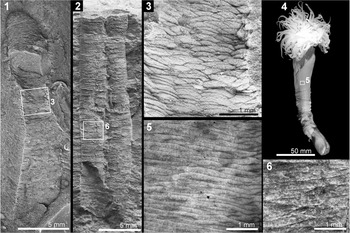
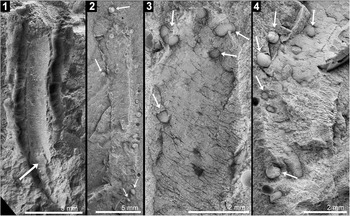
Specimen NRM Cn 76105 consists of two parts, one is 19.3 mm long and 4 mm wide, the other is 26.5 mm long and 4 mm wide; both parts are fragmentary and neither part shows an obvious opening or closure at either end (Figs. 1.1, 2.2). The tube surface is blueish gray, with pyrite granules that are finely dispersed or concentrated in random areas on the surface. The tubes have an oval or elongate-oval cross section (Fig. 1.1), with the interior filled either with the same gray matrix as the embedding concretion, or a mixture of sparite and pyrite, with the pyrite sometimes forming a lining just underneath the surface, or being concentrated in the center of the tube, or just being randomly distributed. The tube surface shows a ‘knitted pattern’ composed of elongate wrinkles with elongate-pointed ends on both sides, arranged perpendicular to the tube axis (Fig. 1.3). The tubes are associated with benthic foraminiferans along their length, some of which are embedded in the tube itself (Fig. 2.2–2.4). The foraminiferans are probably Pullenia bulloides (d’Orbigny, Reference d’Orbigny1846), a species abundant in late Eocene to Oligocene deep-water deposits (Rau, Reference Rau1964; Miller and Katz, Reference Miller and Katz1987).
Eocene ceriantharian tubes from the Makah and Hoko River formations in Washington State, USA, and extant ceriantharid from the Mediterranean Sea near Napoli, Italy. (1) Overview of a ceriantharid tube fragment from the late Eocene Makah Formation (NRM Cn 76105). (2) Overview of the tube fragment from the middle to late Eocene Hoko River Formation (UWBMIP 106332). (3) Close-up on the surface structure showing the ‘knitted pattern’ (NRM Cn 76105). (4, 5) Cerianthus membranaceus (NRM Zool. coll. No. 137355); view of the whole specimen, photographed in alcohol (4), and close-up on its surface structure (5). (6) Close-up of the surface structure of the middle to late Eocene tube from the Hoko River Formation (UWBMIP 106332).

Eocene and Oligocene ceriantharian tubes from the Makah and Lincoln Creek formations in Washington State, USA. (1) Overview of part of the tube from the late Oligocene Lincoln Creek Formation (UWBMIP 117997); arrow indicates partially folded and collapsed area. (2–4) Ceriantharid tube fragments from the late Eocene Makah Formation (NRM Cn 76105) with associated benthic foraminiferans (probably Pullenia bulloides; marked by arrows); overview of specimen with foraminiferans along the outside of the tube (2), and close-ups of areas of the fossil tubes with benthic foraminiferans embedded in the tube (3, 4).

Specimen UWBMIP 106332 is preserved in a small concretion, 25 mm long and 6 mm wide, and is open at both ends without any evidence of tapering (Fig. 1.2). Its surface shows an overlapping, fibrous knitted pattern (Fig. 1.6). The tube may have been slightly more rigid than the other tubes because it shows some axial folds from compaction of the sediment (Fig. 2.2).
Specimen UWBMIP 117997 is more elongate, preserved mostly in three dimensions, and appears to be a single tube that was about 2.5 mm in diameter and more than 60 mm long originally (Fig. 2.1). The surface is not as well preserved as surfaces in the other two specimens but seems to have had a similar texture. The tube is partly folded and collapsed in one place, indicating that it was flexible. It is open at both ends and does not taper.
The wrinkled surface structure of the Eocene and Oligocene tubes resembles that of the extant Cerianthus membranaceus (Fig. 1.4, 1.5). The detail on the surface structure of the extant specimen was taken about 10 mm above the transparent–whitish tube and 40 mm below the crown. Furthermore, some extant ceriantharids incorporate particles including tests of foraminiferans in their tubes (e.g., Stampar et al., Reference Stampar, Beneti, Acuña and Morandini2015, fig. 2B). The benthic foraminiferans embedded in the fossil tube are thus consistent with this feature of some extant ceriantharids.
Discussion and conclusion
Due to the similarity of the surface structure of the extant ceriantharid Cerianthus membranaceus with the surface structure of the fossil tubes from Washington (Fig. 1.3, 1.5, 1.6), we interpret them as the tubes of ancient ceriantharids. This makes them, to the best of our knowledge, the first fossils of Ceriantharia, although Frey (Reference Frey1970) had postulated that anemone burrows could possibly produce distinctive fossils. A putative fossil ceriantharid was reported from the Ordovician of Québec, Canada, in an unpublished master’s thesis (Alghaled, Reference Alghaled2019). These flattened carbonaceous fossils consist of a tubular ‘body’ and a ‘tentacle crown’, about 6 mm wide and 37 mm long, and do indeed resemble anemones. However, a full understanding of these fossils requires further work. Herringshaw et al. (Reference Herringshaw, Thomas and Smith2007) interpreted the Paleozoic cornulitids (small, solitary, and often encrusting calcitic tubes) as solitary, aseptate members of the stem-Zoantharia, and hence phylogenetically close to Ceriantharia.
The fossil tubes from Washington bear some resemblance to the Paleozoic trace fossil Oikobesalon Thomas and Smith, Reference Thomas and Smith1998, which was introduced for the older synonym Trachyderma Phillips, Reference Phillips, Phillips and Salter1848 (Thomas and Smith, Reference Thomas and Smith1998). Oikobesalon represents tubular fossils with an organic, or at least originally organic, tube wall with a similar knitted surface pattern, (described as ‘transverse fusiform bands’ in the diagnosis by Thomas and Smith, Reference Thomas and Smith1998) as the fossils documented here. Those fusiform bands are notably broader in Oikobesalon (0.5–2 mm) compared to at most 0.1 mm in the fossils from Washington and the extant Cerianthus membranaceus. The most distinct difference are the branched extensions of organic material that extend outward into the sediment from the Oikobesalon tubes, a feature not seen in the ceriantharid tubes documented here.
Because the tubes from Washington do not taper and lack segmentation, they differ greatly from tubes, found in rocks of similar age in Oregon, that were attributed to pogonophorans (Adegoke, Reference Adegoke1967). Pogonophorans are today considered part of the polychaete annelid family Siboglinidae (Rouse, Reference Rouse2001). The tubes of serpulids, certain cirratulids and sabellids, and the linings of tubes of the wood-boring bivalve Teredo, differ by being calcified (Grave, Reference Grave1928; Vinn and Mutvei, Reference Vinn and Mutvei2009; Vinn, Reference Vinn2021). Some sabellids incorporate or even build their tubes of foraminiferan tests (Vinn et al., Reference Vinn, Zatoń and Tovar-Hernández2018). In an example from the Miocene Monterey Formation in California, the tests were agglutinated in a preferred orientation, resulting in a rhomboid pattern somewhat reminiscent of the knitted pattern documented here, but the individual rhombs were much larger than in the fossils from Washington (Finger et al., Reference Finger, Flenniken and Lipps2008, pl. 4, figs. 1–3). The organic tubes of chaetopterids typically show fine, longitudinal ridges or wrinkles (Kiel and Dando, Reference Kiel and Dando2009) rather than wrinkles perpendicular to the tube length, as in the fossils from Washington.
In a tabulation of the first appearances of orders of marine invertebrates since the Mesozoic, Jablonski and Bottjer (Reference Jablonski and Bottjer1991) showed that first appearances of clades with low fossilization potential have a rather random distribution throughout the geologic record. When added to this compilation, the ceriantharian tubes reported here would be the third youngest invertebrate order, which indeed seems unlikely given the basal position of Ceriantharia among the Hexacorallia (McFadden et al., Reference McFadden, Quattrini, Brugler, Cowman, Dueñas, Kitahara, Paz-García, Reimer and Rodríguez2021; DeBiasse et al., Reference DeBiasse, Buckenmeyer, Macrander, Babonis and Bentlage2022). The tube-forming ptychocysts are a character unique to Ceriantharia (Mariscal et al., Reference Mariscal, Conklin and Bigger1977; Reft and Daly, Reference Reft and Daly2012). However, this does not necessarily imply that the present-day ceriantharian mode of tube construction originated immediately after the split of Ceriantharia from the remaining hexacorals. Anthozoan cnidarians are known to have repeatedly lost and re-established their modes of hard-part formation (Oliver, Reference Oliver1996; Stanley, Reference Stanley2003; Medina et al., Reference Medina, Collins, Takaoka, Kuehl and Boore2006; Drake et al., Reference Drake, Mass, Stolarski, Von Euw, van de Schootbrugge and Falkowski2020). The strong similarity between extant ceriantharids and the Paleogene tubes documented here suggests that the present-day mode of ceriantharid tube formation using ptychocysts was established at latest by the middle Eocene.
Stampar et al. (Reference Stampar, Beneti, Acuña and Morandini2015) reported that members of the extant ceriantharian family Ceriantharidae built relatively solid tubes, embedding rather little foreign material, when compared to the tubes of the other ceriantharian families Arachnactidae and Botrucnidiferidae. Thus, the Eocene tubes documented here could have been formed by members of the family Ceriantharidae, considering that only a few foraminiferans were incorporated in the tube walls, and that the tubes are preserved at all. However, using molecular data, Forero Mejia et al. (Reference Forero Mejia, Molodtsova, Östman, Bavestrello and Rouse2020) found Cerianthidae and Botrucnidiferidae polyphyletic and only Arachnactidae monophyletic. Thus, it remains uncertain whether tube type is characteristic for individual clades within the order Ceriantharia.
The Eocene and Oligocene ceriantharid tubes reported here are rather inconspicuous fossils that may easily be overlooked, mistaken as trace fossils, or be ignored. We hope our findings encourage field paleontologists to carefully inspect older fine-grained sedimentary rocks for similar structures, as low-energy, deep-water conditions might be particularly conducive for the preservation of ceriantharid tubes. However, given that ceriantharids live in a wide range of habitats (Stampar et al., Reference Stampar, Reimer, Maronna, Lopes, Ceriello, Santos, Acuña and Morandini2020), concretions from any marine environment might be worth investigating.
Acknowledgments
We thank A. Fedosov and M. Forshage (NRM, Stockholm) for help with selecting and photographing the extant ceriantharid, H. Coxall (Stockholm University) for help identifying foraminiferans, M.A. Rich (UWBM, Seattle) for producing the photographs of UWBM specimens, R.C. Eng (UWBM, Seattle) for specimen numbers and arranging for the use of photographic equipment at UWBM, Green Diamond Resources for permission to access localities on their timberlands, and M. Golliet (Shelton, Washington office) for providing the permit for this access. O. Vinn (Tartu, Estonia) and L. Herringshaw (UK) are thanked for their constructive reviews.
Competing interests
The authors declare no competing interests.

 Open access

