

Introduction: Tracing Transhistories of Infrastructural Determinism
Blagoustroistvo is an untranslatable compound noun with archaic roots, consisting of blago (a blessing or something good) and ustroistvo (constructing or arranging). In the context of this paper, it refers to something along the lines of public works, urban improvement, or beautification. It appears to have been introduced into the Russian language in the eighteenth century and it has taken on myriad meanings since then. In what follows, we provide an analysis of the ideologies, aesthetics, and practices of blagoustroistvo in two discrete historical periods: the decade or so following the Bolshevik Revolution in 1917, and the long second decade of the twenty-first century, the 2010s, and early 2020s.
In Moscow in both the 1920s and 2010s blagoustroistvo seemed to be everywhere: in newspapers, magazines, and other media; in lectures, museum exhibits, and everyday conversations; and within the real space of the city. In both periods, its many meanings and appearances, uses and reuses, came together in a particularly revealing way and as a pervasive and crucial means for executing and communicating the ideology of the state. What this article seeks to lay bare is the particular parallels and continuities of such practices of improvement and prettification and their role in social, cultural, and aesthetic restructuring. Both periods also saw norms of blagoustroistvo directly implicated in aggressive processes of dispossession and repossession of wealth and centrifugal expansion and conquest. Now and then, blagoustroistvo has been a device deployed in the service of distinct but commensurable processes of contiguous colonization and, at the same time, of irredentist expansion and war, marking a continuity from the outspokenly expansionist and imperialist policies and practices of Tsarist Russia. Tracing such continuities through the granular lens of urban infrastructure presents a challenge to historiographies of the Soviet and post-Soviet periods that emphasize ruptures rather than survivals or mutations. That said, there are important differences and nuances in how these processes played out in distinct times.
Our first section analyses blagoustroistvo from a historical standpoint and on the basis of journal articles, books, and the discourse around public works in the 1920s, as traced by Lähteenmäki. The second section is ethnographic and grounded in participant observation, interview data, and published materials Murawski gathered during his fieldwork from 2017–2021. Our interdisciplinary analysis was prompted by the unexpectedly strong resonances and parallels we encountered in the rhetorics around urban renewal during both periods, and as we considered them in the face of Moscow’s latest reconstruction project that was unfolding before our eyes. Consequently, both sections focus on Moscow, which after it was remade the capital in 1918 acted as the model for the rest of the country. However, we also draw on parallels from elsewhere in order to evidence the transhistorical dependent relationship between center and periphery consolidated in the political geometry of Soviet and Russian statehoods.
We approach this physical phenomenon unfolding in real space as a complex process, practice, ideology, and regime. Because of its multivalent quality, our respective methodologies, historical and anthropological, overlap. Both sections encompass close readings of political texts and newspaper reports as much as artistic, literary, and poetic depictions of the city. We critically read texts and images made in different registers—from analytical to ironic—and demonstrate through them a shared and pervasive fascination with the aesthetics and materiality of urban public improvements. Through our reading of these texts and utterances, we trace the aesthetic, spatial, and social attitudes and ideologies that they reveal. Both sections incorporate, though to an uneven degree, observations concerning the aesthetic and formal qualities of the built environment, and both are informed by an ethnographic sensibility attuned to the quotidian and the mundane. This methodological bricolage exposes commonalities as well as incommensurabilities between the work of ethnography and history. It allows us to traverse a long period of time while we seek out general dynamics and problematics of the relationships between architecture, infrastructure, ideology, and power.
Our analysis identifies a remarkable degree of resonance between the ideologies, aesthetic, and material practices, and meanings and mechanisms of blagoustroistvo, during these two very different periods. The post-revolutionary 1920s and the late-Putinist 2010s are historical moments during which two new political-economic-aesthetic regimes were sufficiently consolidated to exert their infrastructural presence on the shape of the city: the post-revolutionary Bolshevik invertive project of remaking the capital in the image of the proletariat, and the late Putin-era revertive project of authoritarian capitalist modernization. In both historical moments, we argue, blagoustroistvo functioned as an instrument of class and identity formation-by-design: the proletarianization and the gentrification of public space, respectively. In both periods, it also was an important tool for reshaping and expanding the central state’s sphere of influence. Even if other Soviet decades saw infrastructural projects larger in scale than those of the 1920s, we contend that the core dynamics through which they acted as part of the state and its politics emerged immediately after the revolution. Analysis of the two periods demonstrates a pervasive belief in the right and power of the central state apparatus to control and shape its subjects, and in the deterministic role of the rearrangement of urban public space as a crucial symbolic and material infrastructure for this social engineering imperative. In this way, our analysis illuminates the dynamics of power in Russia with its centrifugal, and corresponding centripetal, expansionist and colonizing tendencies.
A Working Typology of Blagoustroistvo
Throughout the text, we identify and elucidate a number of preoccupations prominent in the blagoustroistvo ideologies of both epochs. The following enumeration of common themes does not exhaustively catalogue the ways in which blagoustroistvo took effect but serves to illuminate its rhetorics and mechanics. First metaphors of electricity are used for ideological processes unfolding in space, in particular the use of the verb “to charge” (zariazhat’) to refer to the ideological transformation of society. Second, we find an emphasis on the deterministic psychological and physiological transformation or “engineering” of human beings that blagoustroistvo is alleged to trigger. Third, the use of tropes taken from a normalized or “vernacularized” form of Marxism-Leninism to promote blagoustroistvo’s transformative effects. Fourth, the clear identification of a sovereign figurehead, on whose benevolent initiative blagoustroistvo is undertaken (in our cases primarily Lenin, Stalin, and Putin and/or Sergey Sobyanin). Fifth, the use of before-and-after images to underscore the extent of the aesthetic and infrastructural transformation blagoustroistvo has brought about. A sixth preoccupation is with what we call faktura: the endowment of street surfaces and their material qualities with elaborate layers of ideological meaning. Seventh, we find a proliferation in the everyday cityscape of blagoustroistvo’s material components—paving stones, scaffolding, and other temporary edifices, or the so-called falshfasady—and the infusion of these mundane infrastructural items with rich semiotic and poetic content. Eighth, there is an emphasis on the centrifugal diffusion of blagoustroistvo from flagship central terrains (such as Moscow’s Tverskaya Street in the 1920s and 2010s, Gorky Park in the 1930s and 2010s, and Zaryadye Park in the 2010s) to the city’s outer peripheries and the vast territories beyond. Finally, in both epochs blagoustroistvo regimes are invested in reconfiguring or consolidating the proprietorial, class, and, especially in the 2010s and 2020s, the ethnonational transformation of society.
Each of these preoccupations are manifest in the continuities and differences between the blagoustroistvo regimes of the 1920s and the 2010s, yet they are most marked in the latter. Social transformation in the 1920s referred, at least in rhetoric, to the inversion of class hierarchies and the reconstruction of the city on behalf of the newly elevated proletariat. Blagoustroistvo, inherently linked to the eradication and violent dispossession of private property, acted as a means to create and ascribe shared class identities.Footnote 1 In the 2010s, however, blagoustroistvo became, even on the level of its aesthetic and material faktura, a project of the reversion of class categories that had been eroded or reconfigured beyond recognition, if not erased, during the Soviet decades. It became integral to elite-formation processes and to the remaking of Moscow in the image of the propertied (or property-commodifying) middle classes, and to assuring their comfort and appeasement.Footnote 2
The core element of continuity we wish to stress here is that the socially deterministic mechanisms and expectations which the project of blagoustroistvo is made to carry, and all the violence and coercion such a deterministic governmentality implies, have not abated in the post-Soviet incarnation of the process. The longue-durée complex of ideological and aesthetic representations and explications of blagoustroistvo, which we marshal in this paper, allows us to put blagoustroistvo forward as a voluminous, eloquent, and illustrative concept for understanding the shifting ideologies of Soviet and post-Soviet infrastructural modernity. It lets us bring nuance to the understanding of various registers of infrastructural and architectural determinism and expansionism. Blagoustroistvo, we will show, expresses with a special clarity the curious ideological fusion of Marxist-Leninist and Pavlovian psychological determinism with which discussions of architecture and infrastructure became imbued during the Soviet years. That same synthesis survived the fall of the Soviet regime and remains prominent in present-day conversations about the social role of architecture and infrastructure. This remarkably adaptable notion of blagoustroistvo—quasi-Marxian and quasi-Pavlovian but today instilled with the new cod-science of “smart cities” and artificial intelligence—constitutes a hybrid ideological apparatus of “infrastructural determinism,” which survives from but has mutated since the early Soviet era. The blagoustroistvo of Moscow shows how the new is inevitably built as an index of, and is (path-)dependent upon, what was before. The imperial cobbles omnipresent in urban centers form a lingering presence that must be countered, while the asphalt that replaced them itself comes to signify an unwanted past.
The sub-sections into which both halves of the main text are divided refer to and foreground the four categories of comparison outlined above and present a diverse taxonomy, or typologies, of rhetorical, ideological, and material practices of blagoustroistvo as they appear in our material and as various registers of reductivism and determinism become visible in them. These categories are “Electricity,” “Inversion/Reversion/Expansion,” “Faktura,” and “Taking Affect.”
The term blagoustroistvo is rooted in Christian and early modern ideas about human improvement or betterment but buttressed during the twentieth century with particularly explicit ideological and pseudo-scientific undergirding. Its concept and practice provide a concise conceptual dial with which to measure and trace the contortions, incarnations, and mutations of infrastructural determinism through time. Again, our analysis focuses on the 1920s and 2010s, two periods during which blagoustroistvo was prioritized by respective municipal and national governments that carried it out intensely and invested it with audacious social and political ambition. Yet we also take a longer view. The roots of the idea of blagoustroistvo date to the Catherine period. By paying heed to the concept’s survivals and alterations over time we bring to the surface new interpretations of not merely Soviet and post-Soviet (high) modernity but also the history of Russia’s state modernity from the Enlightenment onward. Our approach also highlights the pervasive, cyclical mechanisms of war, imperialism, and control implicated in blagoustroistvo. In tracing the winding but navigable paths trodden by this rich and turgid term, we label it and corollary concepts in Russian throughout. This vernacular-centric move continues in the vein of Catriona Kelly and David Shepherd’s work on key words in Russian culture, as well as John Law and Annemarie Mol’s recent theorization of the perils and potentials of thinking with “other words.”Footnote 3
The Births of Blagoustroistvo
Blagoustroistvo could literally be translated as “building” or “arranging” something “good” or “well,” or, more grandiosely (and more spiritually), the “construction” or “arrangement” of “blessings.” It appears to have first come into consistent usage around the 1760s, with its roots in Enlightenment ideas that swept the country’s intelligentsia under the rule of Catherine II. It has since that time occupied a changing but particular place in Russian vocabulary to describe the relationship between the state and its subjects (with fluctuating but distinct spatial connotations). The 1781 Russian edition of Erich Weissman’s German-Latin lexicon gives blagostroistvo as the translation of German politen and Latin politia, res publica, instituta civilia, but as a translation of the German economist Johann Justi’s concept polizey (administration), its definition also referred to the upkeep of common space, infrastructure, and the state’s projects of construction.Footnote 4 In the 1830s, it was codified into law as “state blagoustroistvo” (gosudarstvennoe), encompassing statutes relating to crediting and industrial operations as well as buildings, fire regulations, cities, and villages.Footnote 5 It continued to signify questions related to state administration but its connection to space and land was also cemented. The standard Russian dictionary by Vladimir Dal’ (1863–1866) describes blagoustroistvo simply as “bringing in a good order, a pleasant organization,” which could refer to the state as well as an urban reality.Footnote 6
In the last decade of the 1890s, the term retained its legal sense but was increasingly used in the titles of books and articles describing urban planning and infrastructure, from parks to sewage facilities, and their effects on people’s welfare.Footnote 7 Commissions for the blagoustroistvo of Moscow and St. Petersburg were established under the modernizing premiership of Pyotr Stolypin in 1910–1913, while the term became endowed with a new significance attached to the garden city movement. The key work of the time, Vladimir Semenov’s 1912 Blagoustroistvo Gorodov (Blagoustroistvo of cities), became a sort of a “bible of blagoustroistvo” and is still recommended as essential reading for city planners by the Moscow municipality’s architectural advisory council.Footnote 8 During the twentieth century the term increasingly referred to the construction and management of public works. The standard Ozhegov dictionary, first published in 1949 and still widely used, defines a verb derived from blagoustroistvo (blagoustroit’) as “to equip, make good and comfortable,” and specifies a relation to the urban sphere.Footnote 9
Section I
Inventing Soviet Blagoustroistvo
After the October Revolution questions of public space and the relationship between the state and the people were thrown into flux. The Bolsheviks proclaimed a dictatorship of the working class and Lenin’s “Decree on Land,” one of his first actions in office, declared the abolition of private land ownership.Footnote 10 One challenge the fledging Bolshevik dictatorship faced was to make the transformation of property relations, new economic principles, and social hierarchies seen, felt, and understood. It was necessary to mark and facilitate a new kind of presence to demonstrate that the land now belonged to those previously dispossessed, and that those formerly pushed to the fringes were destined now to occupy the center. The new state confronted the task of creating a material reality that would make the working classes feel and know their newly elevated role, render the city theirs, and bring the revolution’s ambitions to life. Moreover, this project became a means to define and address those groups of people in whose name the revolution had been made as much as to construct a shared class identity for them. It became a way to invent, ascribe, and affirm class, to “make workers Soviet,” to use Lewis H. Siegelbaum and Ronald Grigor Suny’s catchphrase, by creating, as if for them, a space with particular aesthetic and material qualities.Footnote 11
The many ways this was achieved in urban centers varied from directly implementing housing requisitions and installing new bodies of government into the old palaces, to performative means such as revolutionary festivals that drew large crowds to the centers and covered old buildings with temporary decorations and edifices. Old imperial insignia were scrapped, obsolete statues toppled, and new kinds of monuments to revolutionary heroes, as well as posters, flags, and propaganda stands were scattered around the city. Often the symbolic intermingled with the actual and the myths of the revolution merged with its realities; festivities evoked the revolution’s motive forces of the strike and demonstration, churches were turned into workers’ clubs, and important buildings were converted; for example, Moscow’s House of Nobles—the city headquarters of the Russian aristocracy—was made the House of Unions. Crucially, such changes were not merely executed behind closed doors but were broadcast by flags and banners hung on facades and reproduced in the media, rendering the space of the city as well as its image anew.Footnote 12 Some of these strategies were more successful than others, and all were marked by conflicting interests. The process of dispossession and redistribution of urban housing was often violent, chaotic, and confused, and it was implicated in profiteering and opportunism.Footnote 13
The reconstruction of public space was intended to give workers a sense of belonging, a sense of direction, and a new kind of affinity with a city whose material, morphological, and aesthetic (if not political) realities were, in fact, still imperialist-bourgeois ones. Here, many of the state’s methods built on the idea of the collective, summoning the idea of the strike and demonstration as expressions of the power of the masses, but also as defining moments of revolution and the class identities related to it.Footnote 14 The reconstruction of the urban realm in the name of the once-seditious masses became a project to define the proletariat as a group by creating for them a shared space. “Their” old Moscow became “our” Moscow (Nasha Moskva), as Lenin reportedly referred to the capital city after the revolution.Footnote 15 In this process both the city and the “we” were mutually affected. In this context, blagoustroistvo emerged as an omnipresent and universal material practice with the capacity to express, execute, and mark this transformation.
In the Soviet period, blagoustroistvo continued to connote the core idea of public works, although it was also applied more generally to broader questions of how to organize aspects of life ranging from housing to health care.Footnote 16 In 1920 the state’s highest executive authority, the Sovnarkom, issued a decree outlining the structures and tasks of local government. It enumerated blagoustroistvo as consisting of “planning, cleaning of pavements and bridges, embankments, gardens, squares, monuments, carrying out works and repairing the streets, et cetera.”Footnote 17 As before, Western cities were often seen as exemplary, but blagoustroistvo’s public character was seen as something particularly proper to the Soviet state.
In a 1926 book based on a series of lectures delivered in 1922 and 1923, the historian and founding director of the museum of the city of Moscow, Petr Sytin, argued that a key symptom of capitalism’s shortcomings was a lack of blagoustroistvo. In outlining the city’s history and its present conditions, Sytin argued that because blagoustroistvo was “clearly unprofitable” its different forms constituted one of “two fields in which private capital cannot be relied on” (the other being monopoly enterprises).Footnote 18 He thus positioned blagoustroistvo as the state undertaking that socialism was uniquely equipped to carry out—it was the essence of socialist (as opposed to capitalist) city management. In another lecture, Sytin hammered home the foundational point that now, in socialist Moscow, since “all land has become the property of the city,” there existed “the possibility of a complete redevelopment of streets, squares, and entire districts.”Footnote 19 He said this included redeveloping the city’s markets, that had previously “served as an eternal accumulation of dirt both in the city center (Okhotnyi Riad, Trubnyi, etc.) and on its fringes.” He also listed other “heroic efforts to improve the blagoustroistvo of the fringes,” emphasized their neglect by the pre-revolutionary administration, and signaled a new quality of state interest in the periphery. Now, he proclaimed, the city’s suburbs were being connected to the center via tram lines, sewage systems, and water supplies. Further, “many gardens, parks, and other green spaces that previously belonged to individual owners and were used by them only for themselves” now had become open “to the entire population, and especially children, for play and recreation.”Footnote 20
Electricity: Recharging the Masses
Although blagoustroistvo functioned as an infrastructural tool for building socialism and a socialist reality, it was also powerfully infused with symbolism, and its infrastructural and symbolic aspects were inseparable. Even simple buildings like public toilets played a double role. They were built as infrastructure to facilitate the new presence of the masses in the city centers. At the same time, placed in central places, such as those the engineer F. Gauze in 1928 proposed be installed in the Kremlin Wall or the pediment of St. Basil’s Cathedral, they transcended public hygiene and became important signs and symbols that flagged a new proletarian presence and remade the city’s old monuments and spaces.Footnote 21 Similar meanings were attributed to improvements in infrastructure and public works, and some sites acquired distinctive symbolic force. Take, for example, Moscow’s Sukharev Market, which was so infamous for its black market hustlers that Lenin employed it in his speeches as a metaphor for “petty proprietorship” and even the very “basis of capitalism” (“basis” used here in the Marxian sense of material infrastructure).Footnote 22 Such language made clear that the redevelopment of such spaces transcended the amelioration of welfare or hygiene and instead they became essential components of the new state’s politics, instruments and means to execute and propagate both the infrastructural and symbolic transformations of state and society. Moreover, they lay bare how the idea of material infrastructure was related to the broader understanding of infrastructure as an expression of superstructure—the socioeconomic basis of society. Projects of blagoustroistvo and reconstruction, such as Konstantin Melnikov’s famous redesign of the Sukharev Market, were guided and charged by such meanings as they sought to materially articulate the new system.
The Square of Soviets, now Tverskaya Square in central Moscow, serves as an archetypal terrain upon which the many forms of Soviet blagoustroistvo condense. The Moscow Soviet that after the revolution evolved into the city’s administrative body took over the former governor general’s palace adjacent to the square for its headquarters in 1917, and flags, signs, and posters became permanent features of its façade. An equestrian statue of General Skobolev erected just a few years before was replaced by a monument to the Soviet constitution, designed in 1918 by Dmitrii Osipov and Nikolai Andreev. The police headquarters at the square’s other end was torn down and replaced with an open gatehouse pavilion, until, following Lenin’s death in 1924, it became the site for the Lenin Institute. All such projects—on the levels of temporary decorations, architecture, urban morphology, and monumental art—both symbolically and through spatial and formal means signaled the recharging of urban space.
In 1928, party leader Nikolai Bukharin utilized language of electricity to describe the power that monuments should exert over their surroundings. If art finds the right language and form, he claimed, “significant masses of people will be ‘charged’ (zariazhaiutsia) and ‘tune’ (nastraivaiutsia) toward the revolution.”Footnote 23 This is what the monument on the square of Soviets can be seen to aim for (as, indeed, can Gauze’s public toilets), enacting formal means to charge and re-tune its surroundings. In a similar way, replacing the old police building with a new open pavilion was a strong gesture that retuned the space to the people. The subsequent building of the Lenin Institute charged the space of the square with what after 1924 became a ubiquitous feature of Soviet urban space: symbols of and dedications to Lenin, now seen to stand for Leninism. Footnote 24 The non-monumental (literally infrastructural) forms of blagoustroistvo played no smaller role, and worked similarly to charge and re-tune the space of the square. The replacing of imperial cobblestones with new asphalt was illustrated as a triumph of public works and a significant achievement of the new order (see figure 1).Footnote 25
“Paving Works on The Square of Soviets.” The replacement of cobbles with asphalt illustrated as a triumph in the journal Stroitel’stvo Moskvy in 1924. “Blagoustroistvo Gor. Moskvy,” Stroitel’stvo Moskvy 1 (1924): 19–22, 15.

The use of the vocabulary of electricity was not limited to depictions of new objects and structures endowed with a capacity to recharge and reengineer. In political and infrastructural visions, such as Lenin’s GOELRO plan to electrify the entire country and his famous speech “Communism Is Soviet Power + Electrification of the Whole Country,” electricity and current became the foundational constituents of the new society.Footnote 26 Meanwhile, in theoretical terms specific to artistic and architectural visions (such as the constructivist idea of the “social condenser”), electrical metaphors were used to imbue artistic form and spatial programming with the capacity to forge new socialist subjects.Footnote 27 New objects of art and architecture, together with new technologies and materials, were all seen as core instruments for building the new society and shaping its new subjects, inventing and reforming their shared (class) consciousnesses with a capacity to “charge” and “tune” the reality around them. As an extension of those objects in urban space, as well as through its own material and technical qualities, blagoustroistvo-as-process was endowed with similar electrical power.
Inversion/Reversion/Expansion: Red Beams of Blagoustroistvo
As Petr Sytin conveyed, blagoustroistvo was not only a phenomenon of the center, but also played a role in manifesting and rehearsing the revolution’s double act of inversive and expansive promises. The new asphalt, monuments, and toilets underscored and facilitated the movement of the workers from the periphery to the center, but blagoustroistvo also served as an instrument to spread the matter of the center outward to the periphery. It acted as a means of marking territory. As a centrally distributed common good, it heralded Sovietization as well as the means of spatially distributing Soviet power. This expansionist aspect of blagoustroistvo worked both materially and rhetorically and played an important role in consolidating the centrally governed Soviet state that was formed out of ethnonationally diverse regions of the former Russian Empire and desired to further expand its borders into Europe and in Central Asia.
In his memoirs, the revolutionary Alexander Arosev described the importance of the Square of Soviets, once again employing electrical metaphors: “From this square, the red beams extended their rays along the streets and alleyways to the farthest ends of Moscow.”Footnote 28 Blagoustroistvo is the material form of these rays that delivered such promises of revolution to the city’s suburbs, a process closely followed and reported on by media. One article, among many similar ones in newspapers and journals dedicated to the urban sphere, describes the newly paved streets in the town of Podolsk: “Here, say the workers, for years we trampled on dirt, like kneading dough.” Podolsk’s newly rebuilt park, the article continues, “previously served as a place for hooligans. Now: it has become the beloved place of rest for laborers.”Footnote 29 The text details the means deployed to reach this end, from the introduction of electricity to the paving of new alleyways and the planting of green spaces and the construction of a reading room, stage, and sports facilities. At once centripetal and centrifugal, such projects of infrastructure spread the progress of the center toward the fringes as a distinct, inversive act of redistributing and re-evaluating spatial hierarchies. While derivative of the center, the diffusion of blagoustroistvo also established a new relationship of dependency. This duality of progress-as-violence, or de-centralisation or centrifugal colonisation, was the basic characteristic of early Soviet infrastructural projects. The ideological transformation they were tasked with enacting inherently necessitated the cleansing not only of class, but also of ethnic, cultural and religious constellations inherited from the pre-revolutionary past.Footnote 30
This dynamic relationship between center and periphery—characterized by the duality of inversion/expansion and progress/violence—was typical of the early Soviet society far beyond Moscow. But, especially in the early Soviet period, there was a substantial attempt to re-establish hierarchies and tip the balance away from the center. Regional centers such as Tashkent and Kharkiv were remodeled in the image of Moscow, but the process of developing them often took place through dialogue between central authorities and local actors.Footnote 31 In the 1920s, at least, the latter often had more impact on the material environments created. The same dynamic was manifest in provincial and peripheral representations of blagoustroistvo. Footnote 32 As in Podolsk, electricity, parks, and new alleyways proclaimed the new inverted social order, one that often necessitated the violent removal of not only class enemies, and their material trappings such as old monuments, but also agrarian livelihoods and ethnic differences.
Faktura: Power of the Pavement
The granting of special meanings to pavements in the Square of Soviets and Podolsk are not isolated cases, but closely related to the idea of the street and the square as spaces where the revolution took place, in both myth and reality, spaces where, as Trotsky worded it, the “oppressed classes make history.”Footnote 33 Further, the newly paved roads that extended outward from cities facilitated a new dynamism in the center-periphery relationship. Streets, squares, and roads and their material qualities became important in redefining city and country. In Vladimir Mayakovsky’s long-format poem Vladimir Il’ich, written in 1924 after the leader’s death, Moscow’s streets bow to him: “Here every cobble / knew Lenin / in person,” stomps the poem’s rhythm.Footnote 34 The very material of the street is described as being affected by the new society, with Lenin as its signifier reflected in them. But, as Mayakovsky indicates in another poem, the roads themselves want even more: a complete material transformation. This is spelled out in his 1922 poem “150,000,000,” a number that according to its opening lines “is the name of the craftsmen of this poem” printed “by rotary footsteps / on the cobblestone paper of squares.”Footnote 35 The poem describes people, cars, and locomotives gathering for a demonstration and endows roads with their own voice: “Listen, what do the roads say? / What do they say?” and the roads reply: “Suffocated by dust and gusts” and “many unpaved and rickety miles / tired of loitering convicts,” now “we want to be covered with asphalt.”Footnote 36
Asphalt was also seen as a key material agent for the capital’s transformation. Writing in 1922, Mikhail Bulgakov provided a lively testimony of this in his story, “God of Renovations” (Bog Remont), a new god that, he writes, appeared in the city in 1922.Footnote 37 In this (ironic) description of the city’s transformation, asphalt acts as a mirror and marker of the new reality, emerging from all the ruin, humdrum, and chaos that characterized the early Soviet urban space. He concludes his story: “In the autumn, watching the asphalt cauldrons sparkling with hellfire in the streets, I shivered with joyful anticipation.” This was a sign of no less than “Renaissance.”Footnote 38 In these literary depictions, and in the Soviet reality of reconstruction, improved road surfaces, especially with asphalt, became the sign and material reality—the superstructure and infrastructure—of the revolutionary modernity they facilitated. They took on a special faktura that, through their material qualities and transformative repaving, linked them to the idea of the masses and to building a new socialist society.Footnote 39
The aura of such faktura, and the attendant politicization of city pavements, were not all poetry and symbolism. A professor of psychology, Ivan D’iakov, in a 1925 article on municipal upkeep addressed blagoustroistvo in relation to the consuming nature of urban life. He directly connected the energy of the soul (dukhovaia energiia), physical energy consumption, and the new reality of blagoustroistvo, specifically the paving of streets and squares. D’iakov drew on theories of “NOT” (nauchnaia organizatsiia truda), Taylorist-influenced notions of the scientific organization of labor permeated with ideas of biomechanics. D’iakov suggested that asphalt-paved streets greatly improved everyday life by reducing redundant energy consumption. In his theory, asphalt was superior to other kinds of pavement because “only tarmac paving kept in perfect conditions on streets and sidewalks allows the fluctuation of the height of the feet on average at less than 4 cm,” compared to up to 10 centimeters with cobblestone paving. Therefore, he surmised, paving improvements would result in huge leaps of productivity.Footnote 40
In a second article, D’iakov directly linked the replanning and repaving of streets and other public works of blagoustroistvo with the reflexive conditioning theory developed by the physiologist Ivan Pavlov, and he proffered planning informed by contemporary psychology and theories of NOT as the key to standardizing urban life at large.Footnote 41 Remarkably, such thinking on NOT, “collective reflexes,” and the urban sphere was not merely expressed as opinions in journals, but embedded in process of design and construction on the level of the governance of space. From 1926 to 1929, D’iakov ran a special laboratory of psychotechnology within the Moscow department of public works, which researched a range of topics on psychotechnics and the urban sphere.Footnote 42 Psychophysical experiments on perception were also conducted within architecture schools as part of research on architectural form, and they were deeply rooted in the architectural culture.Footnote 43
Taking Affect: Marxist-Pavlovian Determinism
The Soviet politics and meanings of blagoustroistvo were reinforced by a belief in the ability of lived environments to shape the subjects within them. This “deterministic” conviction derived from a key Marxist-materialist principle, that it is material reality that molds consciousness. This was echoed in the general rhetorics of “building socialism,” where the metaphor of physical construction was often used to describe the political project. Marx’s principle of “being determines consciousness” (bytie opredeliaet soznanie in Russian) was part of the discourses on art, architecture, and culture from the early 1920s onward. The phrase itself was often employed in arguing for a shift in focus toward the real space of the city, and in various arguments about architectural form. Used as a catchphrase and meme, at times ironically or mockingly, it consistently referred to the same set of core principles.Footnote 44 Such usage reveals the concept’s embeddedness and ubiquity in the public discourse. It is also echoed in Lenin’s calls to move from “convincing” toward “administration,” and from “politics” to “action” and “achievements,” and similar rhetorics common during the early years of Bolshevik rule.Footnote 45 Even when not directly quoted, the principle was obliquely present in many debates pertaining to blagoustroistvo. This is illustrated by a 1931 article by I. Voblyi that called for a rethinking of Moscow’s public spaces.Footnote 46 It petitioned for more resources for blagoustroistvo, and advocated for new designs to make the city’s “outer appearance match its content,” pointing to, “the role of monumental redesign of cities as a sphere of fighting for life and empowerment (blagopoluchie) of your class, as a sphere of impact on the psyche of the enslaved masses in order to establish their supremacy (gospodstvo).”Footnote 47 Voblyi evoked both “content” and “outer appearance” to assert that infrastructure works to both “convince” and administer the people. He also connected questions of hygiene and physical improvement to empowerment and positioned the “impact on psyche” between the two. This was an important argument and aspect of the discourse around blagoustroistvo and its capacity to “charge” people with class consciousness and “re-tune” individuals to collectively oriented class formations.
Physical reality was seen to shape the new revolutionary consciousness in many ways, and blagoustroistvo, as the universal material tool for shaping that reality, acted as a critical mediator between the material basis of socialist society and its subjects, and was imbued with deterministic transformative and instrumental capabilities to shape both physical reality and consciousness. Crucially, and more conservatively, blagoustroistvo was also viewed as a tool the state used to guide, direct, and gain total control over its subjects. This was an inheritance from imperial ideologies and governmental habits that sat cozily alongside Bolshevik transformative ambitions and it endures in altered but recognizable forms today. A similar mutating continuity can be detected in the way blagoustroistvo acted as an instrument of spatio-political expansion. There was a deliberate attempt to rethink the spatial hierarchies of the state and, typical of the early Soviet period, constant negotiation between central administration and local praxis. Projects of blagoustroistvo and their representations became sites to undo the old imperialist system, at times violently. And yet, such practices of blagoustroistvo testify to the survival and persistence of imperialist, expansionist tendencies, which came to dominate in the decades of accelerating centralization and verticalization of Soviet power that followed.
Mutations of Blagoustroistvo
During later Soviet periods, the importance of blagoustroistvo increased. The reconstruction of Moscow’s squares and spaces in the 1920s pales next to the transformation project set into motion by the new city plan of 1935 and the huge building projects of the Khrushchev era, but many key mechanics and meanings remained the same.Footnote 48 From the early 1930s onward, the centralization of urban planning combined with the reintroduction of internal passports made the political instrumentalization of blagoustroistvo more effective. As argued by Johanna Conterio, small projects such as parks were increasingly conceived as sites of surveillance, while the blagoustroistvo of the systems of kolkhozy and GULAG were employed in reorganizing the entire country and its workforce.Footnote 49 With such developments, blagoustroistvo increasingly became a means of internal control and colonization.
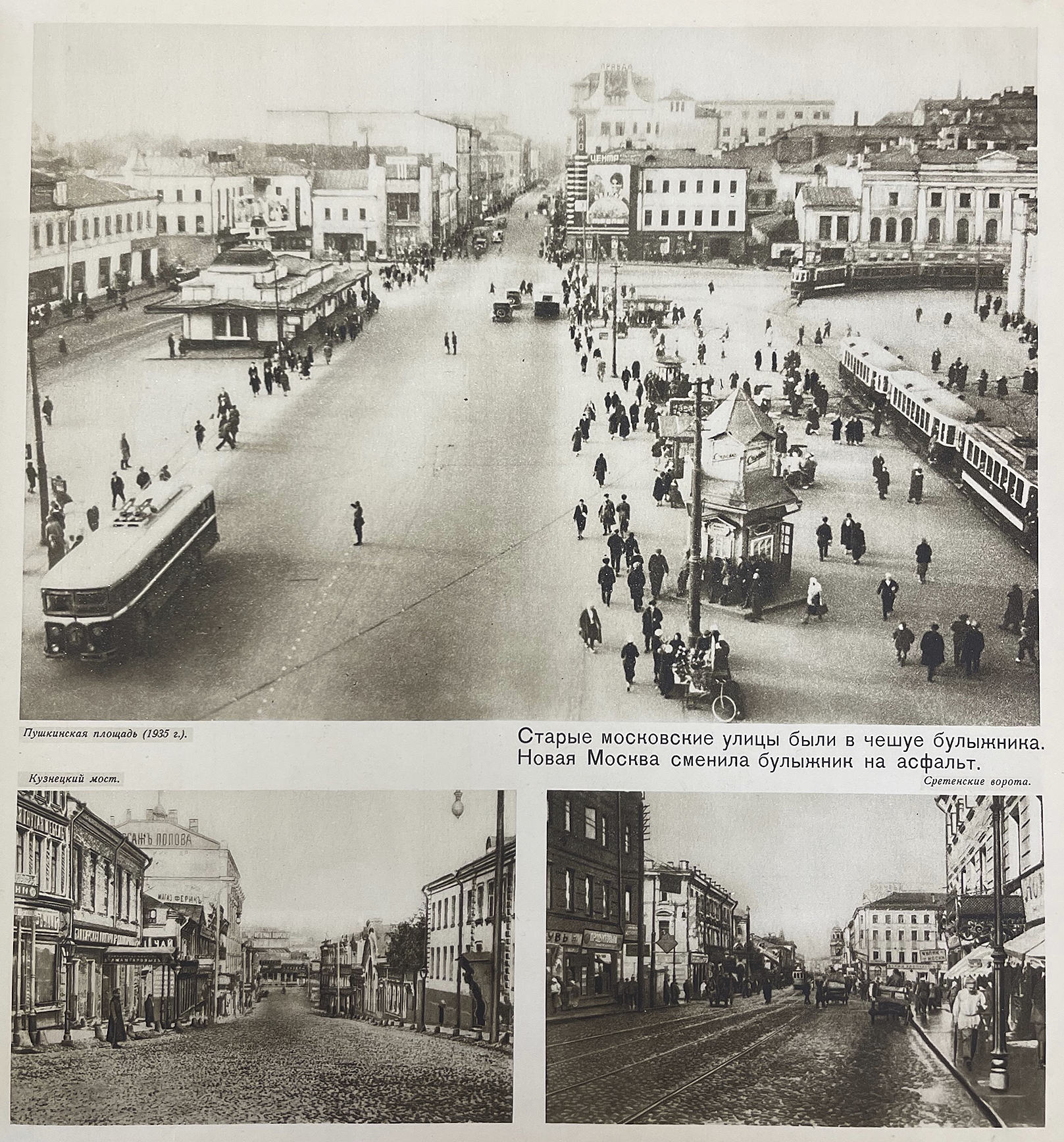
In Moscow itself, the 1935 plan, drawn up under Vladimir Semenov, author of the aforementioned 1912 “blagoustroistvo bible,” accelerated many of these mechanisms. Blagoustroistvo now became a project of total reconstruction supercharged with the new politics of Stalinism. The jubilant publications documenting the plan amplify and extend all the tropes and visual tools associated with blagoustroistvo. The official 1936 book of the plan displays on its cover a photograph of Stalin together with a plaster relief of Lenin hovering above a map of Moscow indicating, through the dialectics of montage, an urban transformation charged by the two figures.Footnote 50 One of the many “before-and-after” images of another celebratory publication, Moskva Rekonstruiruetsia (Moscow reconstructs), designed by the avant-garde duo Liubov Popova and Aleksandr Rodchenko, showcases how the “old Moscow streets were covered with cobbles. The New Moscow replaced the cobbles with asphalt” (see figure 2).Footnote 51
“Old Moscow streets were covered with cobblestones. New Moscow changed the cobbles into asphalt.” Before-and-after image from Moskva Rekonstruiruetsia (Moscow: Institut izobrazitel’noi statistiki sovetskogo stroitel’stva i khoziaistva tsunkhu gosplana sssr, 1938), n.p.
During and after the 1930s such projects became part of the backbone of the Soviet system. The first edition of the Soviet Encyclopedia published over the 1920s and 1930s covers blagoustroistvo in a short, technical subsection within the article “city.” The second, published in the 1950s, dedicates to it an article that runs across several spreads, boasts rich illustrations, and opens by proclaiming that the task of blagoustroistvo expresses “the tireless concern of the Bolshevik Party and the socialist state to improve the welfare of the people” (see figure 3).Footnote 52 During post-Stalinist decades, projects and imagery of urban improvement remained central to Soviet rhetoric and iconography, with Moscow as its model. These were the myths and dynamics of space and power that post-Soviet society inherited and had to navigate. In Moscow, the first two post-Soviet decades brought a period of so-called “wild capitalism” under the charismatic and authoritarian mayor Yuri Luzhkov. Still, even if aesthetic preferences quickly changed, the economy and bureaucracy of Soviet city-building remained an unwavering presence. Beyond the aesthetics, the staunch rhetorics and ideologies of blagoustroistvo can also be detected in municipal practices during Luzhkov’s time, and especially during the reign of his successor, Sergey Sobyanin.
Collage of the entry for “Blagoustroistvo,” in Bol’shaia Sovetskaia Entsiklopediia (The great Soviet dictionary) 2d ed., 51 vols. (Moscow: Bol’shaia Sovetskaia Entsiklopediia, 1950), vol. 5: 279–86. Image courtesy of authors, collage by Nene Tsuboi.

Section II
Introduction: The Blagoustroistvo Regime, 2009–2022
Since the early 2010s, Russia has been in the grip of one of the most ambitious blagoustroistvo campaigns in its modern history, and Moscow, as usual, has been its epicenter. During this time, the capital has been filled with a proliferation of blagoustroistvo debris, the chief elements of which are the falshfasad—the canvas screen behind which blagoustroistvo’s messy reality is hidden—along with the migrant gastarbeiters on whose toil it depends; and plitka—the paving stone, whose ceaseless laying and relaying throughout the last decade has both infuriated and captivated Muscovites.Footnote 53
In terms of scale, zeal, and extravagance, Moscow in the second decade of this century underwent arguably the most important transformation of its center since Stalin’s time. In fact, comparisons to Stalin’s 1935 plan for Moscow’s reconstruction are openly invoked by the municipality itself. In 2018, it distributed a limited-edition anniversary album titled Moskva Razvivaetsia (Moscow develops) to several hundred hand-picked members of the city’s elite (photos of it were shared with us by an acquaintance).Footnote 54 The new book was sent in a padded leather container accompanied by a new reprint of Rodchenko and Popova’s 1938 album Moskva Rekonstruiruetsia (Moscow reconstructs). The obvious implication was that Sobyanin’s 2010s blagoustroistvo campaign was a direct continuation of the project begun by Stalin’s 1935 General Plan. The 2018 book featured photographs of the new, post-blagoustroistvo widened pavements of today’s Tverskaya in an equivalent position to pictures of the 1930s widening of Ulitsa Gorkogo (now Tverskaya) from Rodchenko and Popova’s album. The new volume explicitly compares the two projects and also draws a parallel between their commissioners. Hammering the point home, the frontispiece of the 2018 book features an airbrushed photograph of S. S. Sobyanin, its placement on the page and the subject’s comportment mimicking Rodchenko and Popova’s 1938 I. V. Stalin mugshot (see figure 4).
I. V. Stalin in the 2018 re-issue of Moskva Rekonstruiruetsya (Moscow: Institut izobrazitel’noi statistiki sovetskogo stroitel’stva i khoziaistva tsunkhu gosplana sssr, 2018[1938]); and S. Sobyanin in 2018’s Moskva Razvivaetsia (Proekt Moskva: Gradostroitel’naia Letopis’ Stolitsy XX–XXI Vekov (Moscow: Institut Genplana Moskvy, 2018), authors’ photo.

Sobyanin’s self-fashioning as blagoustroistvo dictator is grounded in the ambition of his project. As geographer Natalia Zubarevich points out, in 2016 and 2017 Moscow spent previously unheard-of amounts of money just on blagoustroistvo, over 15 percent of the municipal budget.Footnote 55 This was triple the average annual amount spent during the reign of Yuri Luzhkov, Moscow’s mayor between 1992 and 2010, and sixteen to seventeen times more, in real terms, than any other Russian city or region spent at the time. The manner in which blagoustroistvo, and its chief material artefacts plitka and falshfasad, so deeply permeated the physical, aesthetic, imaginative, and affective lives of the city’s residents during the 2010s was, we argue, symptomatic of and instrumental for the current wave of blagoustroistvo’s breathtaking scale and scope.
Via the work of specialized urban consultancies (most significantly Strelka Consulting Bureau) and federal grant programs, this blagoustroistvo drive is currently being exported from ur sites, like Tverskaya, Moscow’s Garden Ring, and its Gorky and Zaryadye parks, in a “centrifugal” or “neocolonial” fashion to hundreds of municipalities and regions throughout Russia, and beyond.Footnote 56 Meanwhile, the politicians, innovators, architects, designers, and businesspeople who conceived or drove the process of Moscow’s transformation talk openly about it as a deterministic project of social engineering, using language redolent of the Soviet 1920s and 1930s. Moscow’s makeover is not just about making the city pretty, improving traffic flows, and making money for developers, construction firms, and urban consultancies. As in the 1860s, 1910s, and 1920s, it is about creating, from above, a new, better, classier—or, in the preferred adjective of today’s cognitive techno-determinism, “smarter”—type of Muscovite. It is about forging a model of urban aesthetics, government, and subjectivity that can be imposed, coercively or otherwise, on the country’s provinces and peripheries, and even its neighbors.
When did this new wave of blagoustroistvo begin? Most periodizations date its inception at around 2010, amid the modernization drive embarked on by Dmitry Medvedev during his stint as Russia’s President. There were several possible actors and factors in its initiation. One was the 2009 founding of the Strelka Institute for Media, Architecture, and Design by entrepreneur and journalist Ilya Tsentsiper, oligarch Alexander Mamut, and Dutch architect Rem Koolhaas. Initially an education and research institute, by 2013 it had spawned a powerful consultancy offshoot called KB Strelka. Another factor was Moscow’s perceived need for an aesthetic and infrastructural makeover following Medvedev’s 2010 sacking of longtime Mayor Yuri Luzhkov—associated with the bombastic “Luzhkov style” of architecture—and his replacement with still-reigning technocrat Sergey Sobyanin. Finally, it is alleged that the 2011–2012 Bolotnaya Square protests were an influence since they led Moscow and Federal authorities to believe that they needed to embark on a grandiose project to placate the capital’s restless bourgeoisie.
In subsequent years—notwithstanding the return of Vladimir Putin to the Presidency and Russia’s irredentist/conservative turn following the 2014 Crimean annexation—the process of blagoustroistvo mushroomed and intensified, its momentum boosted by preparations for the 2018 World Cup in Russia, and a string of Federal grants, loans, and incentive programs. Correspondingly, organizations like KB Strelka grew significantly. Strelka itself, by far the most important implementer of blagoustroistvo in Russia today, grew from around a dozen employees in 2013 to over 350 by 2018. Today, Putin regularly refers to the importance of blagoustroistvo in public speeches, and in 2018, under the heading of “comfortable environment for life” (komfortnaia sreda dlia zhizni), blagoustroistvo was elevated to stratospheric levels of political prominence, being named one of the Russian Federation’s three official national priority projects for 2019–2024 (alongside human capital, and economic growth).Footnote 57
Inversion/Reversion/Expansion: Excluding Marginal Elements
The unrelenting ubiquity of blagoustroistvo is a symptom not merely of the sweeping scale of Moscow’s makeover but also a profound political-economic and proprietorial transformation underway in the city. Bolshevik blagoustroistvo was part and parcel of a post-revolutionary de-privatization of property that sought systematically to invert reigning hierarchies of class and ownership, center and periphery, and initially it found some success in doing so. The post-2010s blagoustroistvo regime has the opposite intention: it is an index of and mechanism for reconstituting hierarchy and inequality through the terrain of the city and amplifying the power of the center.
Today’s loud rhetoric about decentralizing by distributing blagoustroistvo throughout the Moscow suburbs and the Russian regions is contradicted by centripetal reality. The blagoustroistvo projects of KB Strelka are, by any measure, overwhelmingly focused on the center of Moscow rather than its peripheries, and in 2018 the consulting bureau found itself in a media storm after its chief economist penned a tone-deaf op-ed in the financial broadsheet Kommersant bemoaning the allegedly “slow pace” of the gentrification of Russian cities, and Moscow in particular. “The fact is that a classic capitalist model of urban development does not allow for a situation in which pensioners and people on below-average incomes can live in the center of the city.”Footnote 58 As if to dispel any doubt as to whether Moscow’s alleged immunity to gentrification was being lamented or celebrated, the urban economist continued: “Gentrification is always beneficial for the city. The process ensures the growth of property prices and consequently the growth in the volume of taxes collected and of revenues in the city treasury. City boroughs become more peaceful as marginal elements (marginalnye elementy) are excluded.”
Whereas the current reconsolidation of hierarchy was preceded by the Luzhkov-era re-privatizations and elite-formation processes, their dynamics were volatile, unpredictable, and hyper-centralized around the person of the then-mayor (and his wife, property developer Elena Baturina). Today, the processes are at once stabler and more capillary. While property arrangements remain “fuzzy,” and therefore liable to manipulation by the powerful and well-connected,Footnote 59 a fairly stable coalition of elite interests is steadily coalescing around the blagoustroistvo regime. Blagoustroistvo, of course, is not a story of just elite formation, but also one of dispossessing the poor from the city’s center and the mass exploitation of the migrant laborers responsible for its materialization. Further, it is increasingly clear—as the work of scholars and investigative journalists has shown—that it is one of the core processes through which the restitution of property to a steadily-consolidating late-Putinist elite is enabled and implemented.Footnote 60 If Bolshevik blagoustroistvo was tangibly linked to an invertive process of de-privatization, Sobyaninist blagoustroistvo is palpably connected to a restorative or revertive process of gradual but steady re-privatization.
Finally, blagoustroistvo is about remaking the city in the image and for the comfort of the middle classes: not merely for those who benefit financially from the blagoustroistvo regime itself, but also for its users: those middle-class city dwellers (propertied but non-elite) who may otherwise be tempted to spill out onto the streets and engage in seditious activities. Blagoustroistvo, then, caters to those to whom the city does not actually belong, but who are sufficiently propertied to avail themselves of its services. According to onetime dissident architecture critic and now KB Strelka chief ideologue Grigory Revzin, thanks to Tverskaya’s new wide pavements, its commercial offerings are slowly becoming more “democratic”; it no longer accommodates only the “luxurious boutiques” which (in the urbanist’s imagination at least) dominated the street during the 1990s.Footnote 61 After the fashion of the Soviet 1920s and 1930s, representations of such changes continue to feature, and place much rhetorical emphasis on, before-and-after images that emphasize blagoustroistvo’s transformative power (see figure 5).
Screenshot of before-and-after sliding image of the Krasnye Vorota metro station, from https://media.strelka-kb.com/before-after. Image courtesy of KB Strelka.

Most disturbingly, the colonial dimension of blagoustroistvo—long noted by critics to refer to the Moscow-centric nature of its centrifugal diffusion through the Russian regions—is today being highlighted by Russia’s apparent eagerness to spread the blagoustroistvo model of development to the Ukrainian territories occupied following the invasions of 2014 and 2022. Geographers Daniela Zupan, Vera Smirnova, and Amanda Zadorian have dissected the Moscow-centric “stolichnaya praktika” (capital practice) of Putin-era urbanism. They note that Russia’s current Deputy Prime Minister and Minister of Construction Marat Khusnullin—from 2011 to 2020 the Deputy Mayor of Moscow and municipal Minister of Construction—has placed a disproportionate emphasis on blagoustroistvo and infrastructure projects in the temporarily occupied Ukrainian Autonomous Republic of Crimea.Footnote 62 In 2022, following Russia’s full-scale invasion of Ukraine, Khusnullin has brazenly referred to the need to formulate a plan for the “reconstruction and blagoustroistvo” of Mariupol and other occupied, decimated, and depopulated territories. He has gone so far as to advocate replacing the ruins of Mariupol’s Azovstal steel plant with a post-industrial park on the model of Moscow’s Zaryadye Park.Footnote 63
Inversion/Reversion/Expansion: Recolonizing Russia
Most explicitly excluded from the “luxurious” new city of blagoustroistvo are the migrant laborers, or gastarbeiters, from central Asia, the Caucasus republics, and the Urals, and other parts of the post-Soviet space, including Ukraine and Moldova. As Murawski details elsewhere,Footnote 64 the gastarbeitery are not only excluded, but are literally hidden from view by the many kilometers of falshfasady, the distinctively designed tarpaulin banners stuck to barrier fences to mask the gritty reality of construction work from ordinary Muscovites, the users of the city of blagoustroistvo.
However, the sites from which the gastarbeitery hail are not unplugged from the geography of the blagoustroistvo regime. The terrain of blagoustroistvo—of which Moscow and its flagship sites, such as Zaryadye and Gorky parks, lie at the very center—is gradually being spread across the entirety of the Russian landmass. Vastly uneven budgetary realities notwithstanding,Footnote 65 central Moscow sites such as Zaryadye are aggressively promoted as the ultimate benchmark against which blagoustroistvo projects ought to judge themselves. As Director of Marielgrazhdanproekt told Murawski, the regional government-owned institute that almost monopolizes urban planning and design projects in the remote, low-income Republic of Mari-El in central Russia: “As part of our preparations for an application for KGS [Komfortnaya Gorodskaya Sreda, a federal grant program for blagoustroistvo], we traveled to Moscow … in order to visit Zaryadye Park. We were encouraged to make this visit by the administrators of the program, by the center.”
Urban activist Svyatoslav Murunov writes that this centripetal model of blagoustroistvo, which seeks to remake Russia in the image of Zaryadye, operates according to a model that can be described as “colonization 2.0.”Footnote 66 The present regime, which might be called a “re-colonial” one, is much more vividly colonial, Murunov says, than was the Soviet model of center-periphery interaction. At least in the Soviet Union, colonization “often had broader public (gosudarstvennoe) aims and values bundled in with it,” so that, in effect, “colonization Soviet-style had a mass of contradictory and unintended effects” even if, “at its core, it did constitute a form of colonization.” Today, however, we are witnessing the full-on “return of the imperial thinking in Russia … the construction of a rigid vertical [configuration of power].” On the level of urban planning and blagoustroistvo, Murunov sees the symbolic and actual agent of colonization 2.0 to be KB Strelka, which is often believed to have preferential access to blagoustroistvo consultancy and project management tenders. “And of course,” Murunov told Murawski, “it is clear that as soon as Strelka is included in this process, it will mean the copying of the Moscow approach.” He characterized Strelka’s modus operandi as behaving “like colonizers … ‘now we will conduct blagoustroistvo on you [vot my vas blagoustroim]!’”
Murunov’s characterization of Strelka’s method of operation is uncannily presaged in the tone of a response by Grigory Revzin—during a Moscow public debate in December 2017 organized as part of this article’s fieldwork—to a panelist’s invocation of the “internally colonial” character of Strelka’s operations in the Russian provinces. We will leave Revzin’s words—delivered in a defensive, sarcastic register—without comment for now, but they clearly take on a dark significance in light of Russia’s 2022 full-scale invasion of Ukraine:
Since you mention KB Strelka … yes, of course, we are terrible, a veritable General Staff of the colonial armies … which are at this moment conquering Russia, it is us, we are crushing all the cities, exploiting them toward blagoustroistvo…. And, in effect, there are 1,112 cities in Russia now and we are doing half of them…. I work here like Goebbels, like the ideologist of this colonial process … and, of course, I am terribly worried by this prospect of [impending] colonialism, but I would like to continue moving in this direction.Footnote 67
Faktura: The Politics of Plitka
The class character of blagoustroistvo, and the process of revertive re-privatization it entails, manifests itself most directly on the material level through the fetishization of granite plitka and the denigration of asphalt. The reverse mirroring of the latter’s 1920s glorification by the psychologist D’iakov and the poet Mayakovsky is stark. This is mirrored also in 2010s Moscow’s flagship blagoustroistvo program Moya Ulitsa (My street), named as if in explicit contradistinction to Lenin’s collectivist Nasha Moskva (Our Moscow) of the 1920s. In a much-quoted, 2016 manifesto-like article on blagoustroistvo, Revzin presents the virtues of plitka’s superiority over asphalt in terms diametrically opposed to the Bolshevik lauding of the progressive and proletarian virtues of asphalt: “Instead of asphalt pavements, there ought to be stone surfaces, podiums for an urban [fashion] parade … at street level, there ought to be a park atmosphere … instead of walls, there should be mirrors, shop windows, and advertisements, so that people can constantly but unobtrusively delight in themselves from the side.”Footnote 68
In an infamous 2016 Facebook post titled “Putin v Kazhdoy Plitke” (Putin in every plitka), Revzin, speaking once more in a tone that now seems uncannily and cynically prescient, castigated those who insisted on ascribing some sort of demonic political power to plitka. A consensus had formed, Revzin claimed,
of hatred towards blagoustroistvo. Intelligent city dwellers sensitive to the fate of Russia look at plitki, and in every one they do not see granite and a segment of pavement—no, they see roubles stolen by a bloody regime, trampled democratic ideals, and the tears of Ukraine…. Our plitka has taken on the characteristics of an innovative psychotechnological material. In every plitka, there is Putin, and he draws life power out through the legs of thinking and feeling pedestrians. Sobyanin lays down the plitka, in order to make us weaker with every step.
Revzin’s sarcastic protestations were the subject of a direct refutation in artist and architect Anna Shevchenko’s installation Putin in Every Plitka, executed for a July 2018 exhibition at Moscow’s Museum of Architecture (co-curated by Murawski) (see figure 6).Footnote 69 She stenciled images based on disembodied details of several iconic bodily comportments adopted by Putin (crucifix-emblazoned muscular torso; muscular arm fishing out classical amphora spontaneously discovered off the coast of Ukraine’s temporarily occupied Crimean Peninsula; trickster wink) onto original hexagonal plitki from Zaryadye Park. Laid on the floor of the museum, only some 100 meters from the Kremlin wall, her Putinized plitki elicited a mixture of terror and delight from exhibition audiences. Revzin’s protestations are disingenuous, Shevchenko’s work suggests. A singular and indivisible Putin may not literally inhabit every one of Moscow’s plitki, but they are necessarily marked by an identifiable, if dismembered and mediated, sovereign presence. There is some Putin in every plitka.
“Putin in Every Plitka,” installation by Anna Shevchenko, from the exhibition “Portal Zaryadye,” Shchusev State Museum of Architecture, Moscow, July–August 2018. Image courtesy of Olga Alexeyenko.

Taking Affect: Determinism and Social Engineering Recharged
There clearly is politics in every plitka, then, but what is their political effect? The official line, according to Strelka and ideological fellow travelers of blagoustroistvo, is that public space-focused projects constitute machines for the top-down engineering of “freedom” (svoboda). These include Moya Ulitsa, the ongoing reconstruction of Gorky Park that began in 2011, and the re-paving of Tverskaya, the Garden Ring, and other prominent Moscow public spaces.Footnote 70 Among all of blagoustroistvo’s flagship projects, the Kremlin-abutting Zaryadye Park, designed by New York architects Diller, Scofidio + Renfro, is arguably the most grandiose. At another public debate devoted to Zaryadye, the geographer Olga Vendina posed a question: “Is it, in fact, possible to realize a democratic program of urban development through authoritarian means?” She answered in the affirmative: “Here [in Zaryadye], an artificial environment is created, which emphasizes and enables freedom. And when this kind of space of freedom appears adjacent to the sacred spaces of power and secrecy, then this can only mean one thing—the desacralization of power.” This kind of desacralization, Vendina claimed, “works on the formation of citizens’ consciousness … in the spirit of social engineering, when through the organization of space … it is possible to mold people’s behavior, mold people’s imaginations.”
Zaryadye Park, and public space in general under the blagoustroistvo regime, is presented here as an architectural tool for engineering people’s freedom, by decree from above. Similar statements abound in pronouncements of active players in Moscow and Russia’s blagoustroistvo regimes. Moscow Chief Architect Sergey Kuznetsov wrote along these lines in 2016, in reference to the restoration of the Stalin-era exhibition ground VDNKh in Moscow’s northern suburbs to a pristine version of its high Stalinist incarnation, and the expulsion from that space of petty businessmen, shopkeepers, and barbecuing Muscovites: “I have a lot of sympathy for the idea that architecture as a field of professional activity is … first and foremost, an instrument for shaping the environment and managing life.”Footnote 71
Sobyaninist blagoustroistvo possesses a deterministic character that is unmistakably and curiously reminiscent of the social engineering mission of Bolshevik blagoustroistvo, but in an inverted direction. As Murawski has shown elsewhere, building on the work of Anna Kruglova, a kind of “vernacular” or “everyday” Marxist speech (and ideology) survives and flourishes in discussions about architecture and infrastructure in post-Soviet Russia;Footnote 72 so much so that the Russian translation of Karl Marx’s phrase “being determines consciousness” (bytie opredelaet soznanie) is still cited repeatedly and almost unthinkingly in everyday conversations.Footnote 73 The socialist trope used as a meme and catchphrase in the early Soviet context has become an automated part of the vocabulary and understanding of the material environment (the infrastructure) and its relationship to the political, aesthetic, and subjective (or superstructural) dimensions of everyday existence.
Electricity: Discharging the People
In the condition of the blagoustroistvo regime, however, this deterministic language has more than merely Marxist colorations. The name of Zaryadye Park is taken from old trading district of Moscow which, until the 1930s, occupied the site (za riad’ami, or “behind the trading rows”), and can be interpreted as a pun on the Russian word for appliance charger (zariadka) or the verb “to charge” (zariazhat’). In reference to the Zaryadye, its then-Director Pavel Trehleb told Murawski that he saw his, and the park’s, main task to be to “charge people with positive energy, emotions … which allow you to live to be joyful.” Here, Trehleb distantly but directly echoes the Bolshevik-era pronouncements on the need to charge (zariazhat’) people with revolutionary energy.
Trehleb elaborated further, explicating how this act of charging carries an explicitly social function, even a patriotic one. The “positive energy” emanating from the park allows people to “change their attitude toward the city and country;” it impacts on “people’s emotional state, on their social adaptability. Even if you have financial problems at home, or family or other life problems, nevertheless you have [in the park] a source of energy, a place to charge yourself, you go there to suffuse yourself with useful energy.” Trehleb’s words lay bare the sarcastic smoke-screening device of Revzin’s (non-)political plitki: Zaryadye really is conceived by its administrators as a site for the “drawing out of life power” through the limbs of its users, for their depoliticization-through-joy, for their political discharging.
The park-visiting experience, for Trehleb, consists of a series of unique pathways, which have been “programmed into” the park and allow park users to “experience a series of awesome emotions in an average time of just two–three hours!” This complexity and intensity are necessary, he claims, because “for the brain it is very important that you find yourself constantly within some sort of external impulses which constantly nourish our emotional system.” Trehleb describes the park’s program as a “new ideology.” Zaryadye is, in fact, “not a park”; it is a “discrete ideological complex,” “an enormous cultural hub which incorporates a park-landscape element.”
Revzin espouses similar theories regarding the “unconscious” functioning of plitka versus asphalt: “City dwellers … behave in an unconscious way, like animals. They don’t like slithers of asphalt in the midst of traffic jams … and intuitively migrate away from such places;… To walk, they need fresh air, and they react in an automatic way to this, like a flock of sheep react to fresh grass.”Footnote 74 Again, Revzin politicizes (or rather, depoliticizes) his narrative: “Those warriors against the evil regime, who say that asphalt is no worse than plitka … will never have any impact on people’s behavior.”
Conclusion: Smart Marx-Lenin Cities in the Age of Culture Z
The implementers and ideologues of Moscow’s blagoustroistvo regime, with their unabashed (but nevertheless utterly depoliticized) talk of top-down “social engineering,” “managing life,” “determination of consciousness,” “charging people with energy,” “external impulses,” “new ideologies,” “subconsciousness,” and “emotional systems,” communicate in a loosey-goosey cocktail of reductivist and deterministic registers that encompass Marxism-Leninism, cybernetics, novyi-chelovekism, reflex physiology, and pop psychoanalysis.Footnote 75
How is it that all of these determinisms survive and flourish in blagoustroistvo-era Moscow in such an uncamouflaged, unadulterated form? In the rest of the world, high modern notions of architectural and environmental determinism were, at least on the surface, put to rest in the 1960s and 1970s. Why do they co-exist in post-Soviet Moscow with other seemingly obsolete late twentieth-century reductivist, deterministic ideologies, among them, as the pronouncements of Trehleb and others display, a positively valorized conception of ideology itself? One reason lies, again, in the survival in everyday speech of long-inculcated Marxist-Leninist understandings of social reality. Further, as historians of psychology and science have shown, reductive understandings of Pavlovian psychology and Marxist-Leninist materialism largely developed in tandem throughout Soviet history, and even during the late Soviet period the ossified vocabularies spawned by this “Stalinist marriage of Pavlov and Marx” continued to exert a strong influence on popular scientific language.Footnote 76
We can speculate that this ossified materialist Pavlovianism was well-suited to merge and mutate on the terrain of the Russian twenty-first century, with ideas about “smart cities,” artificial intelligence, and other globally resurgent forms of cognitive techno-determinism. These ideas were already codified in the distinct field of operations, grouped under the concept of blagoustroistvo, where state administration meets the administration of people in and through alterations of public space. Since the emergence of the word in the Russian vocabulary this had constituted the interdisciplinary core of its meaning, and since the early Soviet period notions of determinism and the physical environment have been imbued with capabilities of shaping not only people’s behavior but also their (class) consciousness. Since the 1920s, blagoustroistvo has offered the state not only a mediational field between itself and its people, but also an active instrument for shaping people’s lives, opinions, productivity, and class consciousness. Soviet blagoustroistvo was charged with the new concepts of Marxism-Leninism and “collective reflexes” and implemented by central municipal operations and departments. Today, under the 2010s blagoustroistvo regime, these established, surviving deterministic ideas have been recharged with new technologies and technological imaginations.
As science and technology scholars have observed over the past decade, neo-cybernetic and neo-cognitivist notions of technological, cognitive, and spatial determinism have been globally resurgent in the age of artificial intelligence, Elon Musk, artificial intelligence, and other constantly deferred fetishes and fantasies. These neo-determinisms combine an inflated sense of their own radical novelty with retro rhetorics, aesthetics, and arguably ethics. Even the conflation of Pavlovianism and Nazi-Communist “totalitarianism”—which as Danielle Carr has shown served as a foundational block for the defeat of behaviorism in the United States in the 1950s—is now in question.Footnote 77 Mechanistic understandings of behaviorism are, it is alleged, making a comeback via the rejuvenated discipline and business of neuroscience.Footnote 78
Euro-American architectural historians, sociologists, and architects and urbanists themselves have argued that architectural or environmental determinism—the positively valorized idea that human beings and human relations can be molded or engineered through space and infrastructure design—“died” or became obsolete along with architectural modernism during the 1960s or 1970s. Blagoustroistvo, however, shows that determinism is alive and prospering in post-Soviet Russia.Footnote 79 That said, this type of environmental determinism—married to techno-deterministic, messianic, irredentist notions of Russian exceptionalism, and embodied in the Putin-era ideology of blagoustroistvo—is not a static, fossilized Soviet concept. It is, rather, a dynamic idea that in recent years has been laced with enthusiastically imported and re-adapted concepts concerning the relationship between society and technology. In the blagoustroistvo terrain of post-Soviet Russia, what might be termed, following Kimberley Zarecor, high modern (or still-socialist) “infrastructural thinking” survived unabated much longer than in the West; it was only systematically discredited following the USSR’s fall in 1991.Footnote 80 The ideological cocktail of blagoustroistvo, then, allows us to witness and document today’s global deterministic resurgences and mutations in sharp relief.
Russia’s current imperialist-irredentist awakening, and its turn to an openly fascist, avowedly genocidal ideology and political aesthetic, however, sees infrastructural determinism scaling-up and morphing into altogether more dangerous mutations. If we place the current conjuncture in historical perspective we can see that, within the long history of urban infrastructure’s mobilization as a means of expansion and control, resistant moments have occurred during which infrastructural practices have been questioned and center-periphery hierarchies restructured. We hope that the current decade will not afford Russian technocrats and ideologues opportunities to implement and re-engineer the ideologies, affects, and technologies of the blagoustroistvo regime and impose them on the temporarily occupied cities, towns, and ecosystems of Ukraine. We urge our colleagues to militate against such an eventuality by every means possible, whether through scholarship, fundraising, education, or otherwise.
Acknowledgments
This paper was first presented at a workshop on the history of welfare states organised in January 2020 at Oxford University by Alessandro Iandolo and Kasia Jeżowska. Other versions were presented at the interdisciplinary research seminar at the School of Slavonic and East European Studies in May 2021, and at the Institute for the History and Theory of Architecture, ETH Zurich, in May 2020. Special thanks for their feedback and input are due to Nikolay Erofeev, Jakub Beneš, Diane Koenker, Anne White, Rachel Morley, Olga Voronina, and Danielle Carr. Thanks are also due to the CSSH Editors, the journal’s anonymous reviewers, and CSSH Managing Editor David Akin. Our late colleague and friend Philippa Hetherington asked challenging questions about our framing of blagoustroistvo at the Oxford workshop and on many occasions thereafter. It is to the memory of her life, scholarship, and critical eye, tragically cut short by metastatic breast cancer in November 2022, that this paper is dedicated.


 Open access

