


When the Equal Educational Opportunities Act was signed into law in 1974, it extended the protected categories of “race, color, sex, or national origin” to require schools to address language barriers that impeded equal access to education.Footnote 1 Although the EEOA’s notion of language rights originally concerned the question of bilingual education for students who spoke languages other than English, it later provided the key legal reference for the decision in Martin Luther King Junior Elementary School Children v. Ann Arbor School District Board, a 1979 federal court case. This case was led by four Black families in Michigan whose children had been referred to special education testing and programming in Ann Arbor schools. Teachers had perceived students’ speech as evidence that they were “slow” learners rather than being a matter of English-language variation. In their complaint, the families asserted the school board failed “to take appropriate action to overcome a language barrier arising from the children’s black English dialect.”Footnote 2 The plaintiffs at Martin Luther King Junior Elementary School wanted “teachers to account for their dialect” when teaching specific students how to read.Footnote 3 Judge Charles W. Joiner sided with the plaintiff children, noting that teacher responses to the children’s dialect created a barrier that impeded their reading progress. The ruling established Black English (understood as dialect) as protected by the same equity-granting principles as bilingual education. Alongside linguistic and educational experts, the court noted that Black English was a language system with rules in grammar and pronunciation, and not an indication of cultural deficiency.Footnote 4 The case represented one of the first applications of the EEOA that considered linguistic barriers in terms of different varieties of English, laying the legal foundation for future demands for specialized programs supporting speakers of Black English.
In this paper, we draw on this landmark application of the EEOA as a catalyst to reconsider long-standing debates in Canada about the relationship between language, race, and culture. Primarily in response to tensions between English- and French-speaking Canada that posed an existential threat to the Canadian state, but also in the face of rising Indigenous advocacy for political self-determination and governance, as well as rapid growth in the country’s racial and cultural diversity, the federal government exerted enormous political energy in the 1960s to refashion a modern Canadian national identity.Footnote 5 Official bilingualism in English and French was articulated as federal law in 1969 and followed by a multiculturalism policy in 1971 to form what Prime Minister Pierre Trudeau dubbed “multiculturalism within a bilingual framework.”Footnote 6 Although Canada would be the first country in the world to adopt an official policy on multiculturalism, its earliest foundations in bilingualism and biculturalism left fundamental notions about racial (and cultural) belonging intact.Footnote 7 Consequently, the articulation of language rights during this era, adopted through the framework of federal multiculturalism, reflected broader linguistic and racial hierarchies that often went ignored under the umbrella of cultural diversity.Footnote 8 The result was a series of conflicts across Canadian provinces, with schools serving as key sites for challenging the racial logics embedded in multiculturalism within a bilingual framework.Footnote 9 As with the Martin Luther King Junior Elementary School Children v. Ann Arbor School District Board case, Black parents and advocates in Canada forced a review of Black linguistic knowledge and cultural experience as a necessary part of debates and discussions around language rights within the country.
Although bilingualism and multiculturalism stood as federal policies in Canada, their failure to guarantee full linguistic and racial inclusion in schools animated local movements of parents, students, and other community members demanding greater linguistic and racial inclusion in schools. This paper focuses on such movements in Toronto, Ontario, between 1970 and 1987.Footnote 10 As the largest city in Canada and the capital of the province of Ontario, an exploration of Toronto offers a unique lens through which to consider the historical context, political pressures, and grassroots activism that facilitated a series of reforms concerning linguistic and racial inclusion. As scholars Jane Gaskell, Laura-Lee Kearns, and Katina Pollock contend, educational reform in the city was grounded in “‘bottom up’ grassroots politics” entrenched in social change.Footnote 11 This paper examines two instances of these grassroots politics, namely activism on behalf of heritage-language education and Black cultural-heritage programs. Our analysis reveals key instances in which temporary forms of solidarity emerged between heritage-language and Black activism, as well as contradictory trajectories in this activism that undermined what Roseann Liu and Savannah Shange have theorized as “thick solidarity.”Footnote 12 In this paper, we argue that absences of thick solidarity ultimately weakened efforts by heritage-language and Black activists alike to reorganize schools in ways that were more linguistically and racially just. Before expanding on these arguments, we briefly introduce contextual details about heritage-language and Black cultural-heritage programs in Toronto in the 1970s and 1980s.
Three years after EEOA was instituted in the United States, the Ontario Ministry of Education announced the creation of the Heritage Languages Program (HLP) on June 15, 1977. Defining heritage language as all languages other than the official languages of English and French, the program allowed for the provision of language classes “after school, on a non-school day or, where enrolments justify, the five hour-school day is extended by 30 minutes.”Footnote 13 Initiated under the rubric of Continuing Education, heritage-language classes were not part of the formal curriculum.Footnote 14 Nevertheless, the Ministry believed that through heritage-language programs, students would build their confidence and sense of belonging in Ontario schools.Footnote 15 The HLP stood as one of five provincial policies supporting heritage-language education that emerged in Alberta, Saskatchewan, Manitoba, Ontario and Quebec between 1971 and 1979.Footnote 16
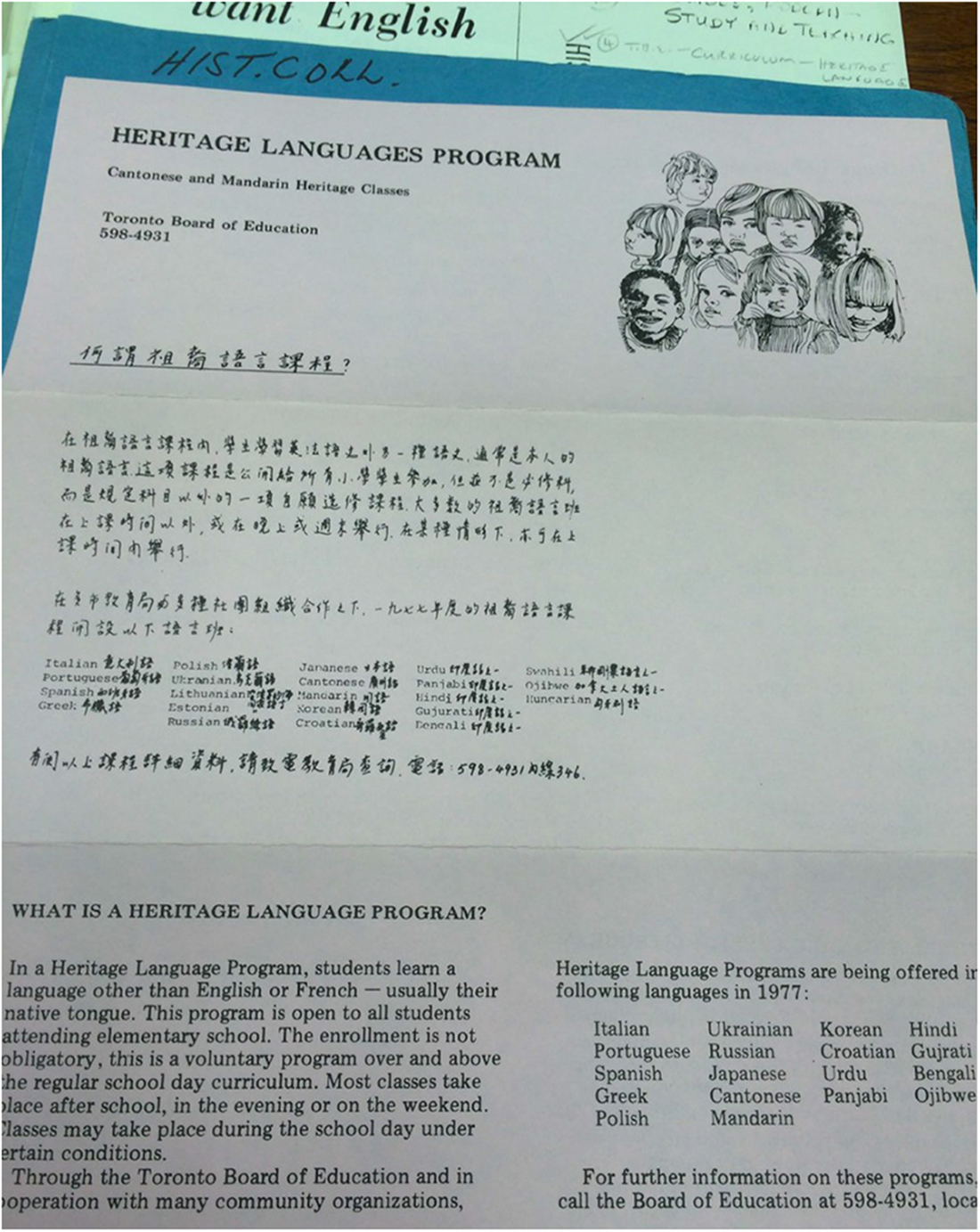
The HLP was just one of a series of policies and school programs that the city implemented in response to urban change, poverty, non-White immigration, religious diversity, and shifting educational philosophies regarding child-centered learning.Footnote 17 However, it was taken up with much greater enthusiasm than the Ministry of Education had expected. For example, the Toronto Board of Education moved quickly in the summer of 1977 to approve five pilot programs in Greek, Korean, Polish, Punjabi, and Ukrainian that would enroll 2,300 students. The fast pace of implementation was possible in part because many minoritized language communities already ran heritage-language programs.Footnote 18 These private programs were sponsored by community organizations or places of worship, with some supported by the government of the “home” country.Footnote 19 By mid-September 1977, the Board received applications for programs whose total enrollment was almost ten thousand students, amounting to 10 percent of its student population at the time.Footnote 20 By September 1979, the HLP would fund programs across the province in forty-four languages, including Cayuga, Cree, Mohawk, and Ojibway, and would enroll over seventy-six thousand students, with the majority in metropolitan Toronto schools.Footnote 21 Figure 1 features a flyer from that year for programs in Cantonese and Mandarin. By the 1990s, Ontario boasted heritage-language instruction in over sixty-two languages; approximately 50 percent of its programming was in Italian, Portuguese, and Cantonese.Footnote 22
Flyer from the Toronto Board of Education announcing the Heritage Languages Program and classes in Cantonese and Mandarin, 1977. (Source: TBE-Curriculum-Heritage Languages, vertical files, Toronto District School Board Archives.)
Alongside the emergence of the HLP, Black parents and community activists led multiple initiatives starting in the late 1960s to combat pervasive anti-Black racism in Toronto-area schools. As we detail below, these initiatives included community-based youth programs centered on Black culture and history, each with varying foci that reflected the multiple—and at times competing—political perspectives within the Black community in Toronto. We note that within the limited scholarship on the HLP, Black activism has often been subsumed under discourses focusing on ethno-cultural diversity and the country’s Jewish, Italian, Portuguese, Greek, and Ukrainian populations, whose numbers were demographically larger than Canada’s Black populations, which included Canadian-born, Caribbean and continental-born Africans.Footnote 23 As a result, Black students, parents, trustees, and community liaisons have only sporadically appeared in the literature on language instruction within Toronto schools and provincial educational programming more broadly. However, as this paper asserts, Black parents and community members offered critical interventions and contributions to language programming of the era and forced an expansion of HLP’s initial goals and intended audience.
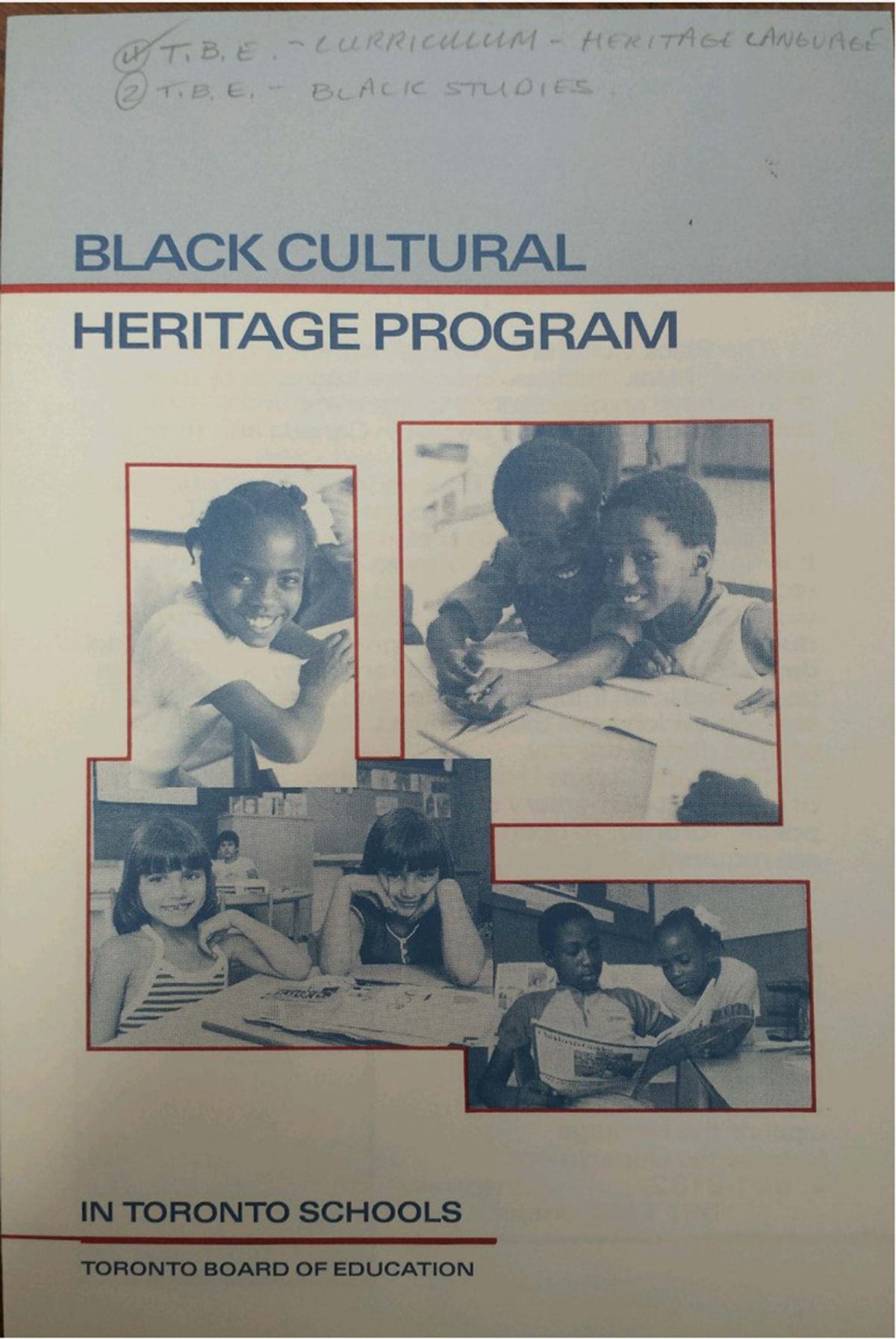
In Ontario, the Black population was higher than the national average, with 47.9 percent of all Black Canadians residing in Toronto.Footnote 24 A large Canadian-born Black population had resided in Toronto for several generations, but by the 1960s Caribbean immigration to Canada had more than doubled, leading to a noteworthy shift in the presence of Caribbean-born students in Canadian schools.Footnote 25 As the HLP was taken up across Ontario, Black parents and community members seized this opportunity to advocate for the creation of Black Cultural Heritage programs by integrating the few community-based programs already in place, similar to the incorporation of community-run heritage-language programs via the HLP (Figure 2 presents an undated brochure adversiting the Black Cultural Heritage Program).Footnote 26 However, as the Ministry of Education in Ontario shaped the structures of HLP programming, it enforced a narrow definition of the relationship between language, race, and culture, refusing “permission to include under the Heritage Languages Program West Indian children ‘whose language is one of the two official languages but whose cultural heritage is unique.’”Footnote 27
Cover page of an undated brochure from the Toronto Board of Education advertising the Black Cultural Heritage Program. (Source: TBE-Curriculum-Heritage Languages, vertical files, Toronto District School Board Archives.)
This initial exclusion of Black Cultural Heritage programs from HLP funding touched off a decade of debate over the boundaries of school programming premised on linguistic and racial inclusion. These debates posed a direct challenge to the logic of multiculturalism within a bilingual framework as the cornerstone of modern Canadian national identity: Whose languages and cultures could be included in Ontario schools? To what end? Who got to decide? In this paper, we explore the terms of this conflict by tracing the development of two different trajectories in community activism for linguistic and racial inclusion in Toronto schools. The first led to increased attention on language-specific programming in Ontario schools. Efforts in Toronto schools in the late 1960s and 1970s to study and implement linguistically and culturally sustaining programming intersected with emergent national discourses regarding official bilingualism and multiculturalism, as well as ongoing Cold War politics and concerns over foreign meddling, to produce demands for language programs specifically as one possible solution to the contradictions of Canadian official bilingualism, which we discuss in greater detail in the next section. The second trajectory introduced radical theorizing on the relationship between Black languages and cultures that refused a separation of one from the other. Black parents and community activists drew on their own lived experiences with racism (and those of their children and/or students), as well as the collective experiences of Black communities across North America and the Caribbean at a high point of Black liberation movements, to demand Black- and Afro-centric curriculum specifically to address structural racism in Canadian schools.
Specifically focusing on Black students, whose linguistic heritage cannot be separated from their cultural experience, we argue that “multiculturalism within a bilingual framework” as taken up by Toronto schools was inadequate. As Black parents, community activists, and some trustees worked to address paradoxes in school programming to move closer to a culturally relevant heritage-language program, these approaches led to a series of contestations. Perhaps as a result of the limitations of the HLP’s programming, which served as a supplement to instruction in Ontario classrooms rather than being integrated into the curriculum, we contend that these divergences around language and culture reveal broader systemic erasures that often ignored deep-rooted biases about Black life in Canada, exposing the unequal nature of multiculturalism in the country. Yet, despite the contradictions within school programming of the era, advocacy launched as a result of both trajectories offered an expansion of the original parameters of the HLP to consider embedded notions of anti-Black racism in school structures, and to reconsider the program’s distinctions between culture and language. Ultimately, these contestations over language and heritage offer an opening by which to understand the ways in which Black and other minoritized communities inserted themselves as a necessary part of building a “modern” Canadian nation.
Building a modern and diverse Canada: The historical roots of heritage-language programming
Minority language instruction in Canadian schools emerged in the nineteenth century as the nation-state sought to Canadianize settler families through educational instruction. These programs often varied regionally and assumed that language learning was a way to transition (some) students into speaking one of the nation’s two dominant languages. Scholars note that multilingual public schooling extended into regions including the Northwest Territories, Manitoba, Alberta, Saskatchewan, and British Columbia as early as the 1870s.Footnote 28 In these regions, “public schooling was a racially ranked linguistic status hierarchy. That hierarchy favoured White settlers over others, even if it still did not treat non-British White settlers as the equals of their Anglo-Saxon counterparts.”Footnote 29 This gave space for some European settlers (Ukrainian, Germans, Mennonites, and others) to successfully merge into Canadian Whiteness, while other racialized groups, including Chinese and Japanese speakers, were excluded and could not use public schools to preserve their languages. In particular, these programs stood in contrast to the growing “federal Indian residential schools that tried to stamp out Indigenous languages and cultures.”Footnote 30 Consequently, initiatives supporting minority and heritage-language instruction were sporadic and unevenly implemented across Canadian schools at the turn of the twentieth century, although the goals of such instruction were fundamentally rooted in a desire to Canadianize (and at times whiten) immigrant children.Footnote 31 By the 1960s, national debates about citizenship and diversity had not abandoned the agenda to Canadianize newcomer children, they did, however, open up the definition of Canadian to consider ethno-cultural diversity.Footnote 32 Bearing this in mind, heritage-language programming in Ontario was greatly influenced by interpretations of and debates about federal policies on official bilingualism and multiculturalism resulting from the Royal Commission on Bilingual and Biculturalism (hereafter, the B&B Commission).
When the B&B Commission was created in 1963, the Canadian federal government was responding to the widespread social, political, and economic reforms of Quebec’s Quiet Revolution.Footnote 33 As concerns over Quebec’s growing nationalism took center stage, so too did demands for the recognition and preservation of the linguistic and cultural heritage of French Canada. The B&B Commission sought to address these concerns by creating a series of recommendations and policies that would support language choice within schools, specifically extending French-language schooling across Canada; it also facilitated the expansion of discussions regarding educational inequalities on the basis of language and culture.Footnote 34 At the same time, as scholar Eve Haque contends, the B&B Commission’s strategy created processes of racial exclusion by constructing platforms of language and culture that reinforced White-settler hegemony, particularly those of Canada’s two “founding races.” Ultimately, the Commission helped the federal government to create a national policy based on “multiculturalism within a bilingual framework” and served as the foundation for the development of Canada’s multiculturalism policy, first introduced in 1971 and then codified as an act of Parliament in 1988.Footnote 35
A central priority of the Commission was to situate language as a fundamental element in the nation-building process, creating narrow definitions of multiculturalism and integration to allow for the limited inclusion of ethnic groups. For example, in the section of the final report, titled The Cultural Contribution of the Other Ethnic Groups, the Commission argued that “since those of British and French ethnic origin are the main groups in Canada, it is appropriate that the British and French cultures dominate in public schools. But public schools can also provide an instrument for safeguarding the contribution of other cultures.”Footnote 36 The recognition of non-British and non-French cultural groups remained contingent on whether there was sufficient interest in maintaining specific languages and cultures within the school system and on their ability to remain within the boundaries of bilingualism and biculturalism, leaving support for two official languages entrenched in Canadian society. According to Haque, this effectively created a “racialized hierarchy of belonging and citizenship rights” that left racialized groups “out of place within the national boundaries of the Canadian White-settler nation, and its modality of inclusion must be regulated through the policy of multiculturalism.”Footnote 37 From its earliest constructions, the place of language within notions of bilingualism and biculturalism was meant to protect and strengthen the place of English and French languages while accommodating the political mobilization of some ethnic groups.Footnote 38 As a result, the idea of multiculturalism emerging from these reforms was an afterthought meant to “gain ethnic group support for (or at least neutralize ethnic group opposition to) what the government perceived as the real issue: namely, defusing Quebec separatism.”Footnote 39 By the time multiculturalism was adopted as federal policy in 1971, the nation had undergone its own rights revolution leading to sweeping changes with regard to therapeutic abortions, limited decriminalization of sexual relations between adults of the same gender, and expanded human rights language around gender and religious discrimination. Together with these changes, multiculturalism represented the liberal and progressive notions of the era, although its foundation in the B&B Commission meant that the initiatives that emerged from the policy were not fully equipped to deal with issues of racism that emerged from the nation’s increasingly politically mobilized and active newcomer populations, many of whom were Black.
Contradictory logics in language and culture: Increasing demands for language programming
As noted above, official bilingualism elevated two White-settler languages, English and French, while simultaneously excluding formal language rights for Indigenous peoples and what the B&B Commission referred to as “other ethnic groups.” As Haque notes, the B&B Commission justified this differentiated approach by applying contradictory logics to the relationship between language and culture. For Anglophone and Francophone communities, the Commission insisted it was impossible to separate language from culture. The two worked together to form the basis of a Canadian national identity, but one that was also universal in nature. Anyone—including Indigenous peoples and immigrants—could belong to a modern Canada by learning to speak and act like Anglophones or Francophones.Footnote 40 For Indigenous peoples and immigrant communities, by contrast, the Commission used various discursive strategies to deny demands for language rights of their own. However, sustaining Indigenous and “other ethnic” cultures became possible (in part by drawing on applied-linguistic research) and expedient (for appeasing Indigenous and immigrant groups), insofar as their respective cultures were isolated from language and frozen in time.Footnote 41 The conceptual, and then political separation of language from culture thus underwrote a conceptual, then political subordination of Indigenous and “other ethnic” languages to English and French. This contradictory logic animated growing demands from Indigenous peoples and immigrant communities in the 1970s and ’80s for specific federal and provincial support for language-education programs. Some of these demands were formulated as a solution to the contradictions of multiculturalism within a bilingual framework, while others sought to win specific language rights for Indigenous and immigrant communities. However, because not all minoritized groups were united or powerful enough to lobby for educational programs in the same ways, language programs did not reach every group equally.
In addition to these limitations, language-oriented demands were also shaped by international relations during this period. For example, Ukrainian communities constituted one of the largest and best organized “other ethnic groups” to intervene in the B&B Commission; they would go on to be one of the main political actors driving heritage-language policy at the provincial level in the 1970s and ’80s, as well. This was partly a matter of demographics: Canada has long been home to the largest Ukrainian diaspora in the world. Equally important was the Cold War realpolitik that dominated this era.Footnote 42 Ukrainian communities in Canada were especially invested in sustaining their language because of expanding Russification campaigns in the Soviet Union, which included replacing Ukrainian with Russian as the medium of instruction in schools and universities. As the largest community outside the Soviet Union, Ukrainian-Canadians argued they had a special responsibility to ensure their language survived here because it faced an existential threat there. In the context of Cold War competition, it was easier for Canadian governments, especially in the Prairie provinces, to accede to these demands as an anti-Communist strategy.Footnote 43 As we will see, the Ukrainian community in Toronto, while much smaller than other Ukrainian communities in Western Canada, would be central to a major debate over magnet schools for language programs in the Toronto school district in the early 1980s.
International relations influenced local demands for language programming in different ways as well. The Italian government, for example, had long been invested in maintaining contact with its major emigrant populations around the world. Yet, this contact was not always welcome. In Toronto in the early 1970s, the Italian government directly supported classes in Italian language and culture for some five thousand students in the city’s publicly funded Catholic schools.Footnote 44 However, the Catholic school board had no control over hiring teachers; they were certified teachers from Italy whose salaries were paid for by the Italian government, using curriculum provided by that government.Footnote 45 This direct intervention not only provoked general concerns over “foreign meddling” in Canadian schools, but a significant portion of Italian-descent Canadians objected as well.Footnote 46 Many came from families who were part of the resistance to Mussolini and were afraid those political traditions might infiltrate Italian communities in Canada. These individuals thought of themselves as Canadians first and individuals of Italian descent second. For them, Italian-language programs were essential to demonstrate the individual and social benefits of multilingualism in a modern, progressive, and inclusive Canada. However, this was possible only by establishing locally funded programs and cutting ties with the Italian government.Footnote 47
The final dynamic animating a trajectory to language-specific program reforms in the 1970s pertained to the Toronto Board of Education itself. For over a decade, the Board engaged in extensive experimentation with, formal study of, and public deliberation over the relationship between language, culture, and race in the school system. This process began in 1970 with the Board’s first demographic survey of the school district’s students, designed to address the question, “Do a disproportionate number of the children of the poor people and immigrants go to special classes?”Footnote 48 The data reported in this survey provided overwhelming evidence of systemic bias against these groups of students. Further, in the early 1970s, the Board agreed to various community requests to pilot what it called “bilingual-bicultural programs” in Cantonese, Italian, and Greek.Footnote 49 In each case, these were short-lived initiatives that focused more on culturally sustaining activities rather than promoting bilingualism or biliteracy.Footnote 50 Both the 1970 survey and these early experiments significantly expanded ideological and implementational space for future Board deliberations over the relationship between language, race, and culture.Footnote 51
The Board organized these public conversations through three task forces: the Work Group on Multicultural Programs (1974-1976); the Sub-committee on Race Relations (1978-1979); and the Work Group on Third Language Instruction (1980-1982). As part of the consultation process, each task force held public meetings, at which individuals and organizations could submit written briefs and provide oral deputations. Especially during the inquiry on third-language instruction, hundreds of people attended these meetings, described in breathless newspaper headlines such as “Language Battle Ready to Explode,” “Voices Raised in Anger against Foreign Tongues,” and “Heritage Class Foes Accused of Race Bias.”Footnote 52 These task forces also reviewed research across Canada and internationally, engaged researchers (in particular, Professor Jim Cummins at the Ontario Institute for Studies in Education), and even traveled to the United States to meet with New York City Public Schools staff responsible for bilingual-education programs.
As Mayo Kawaguchi argues, the primary reference point for each of these task forces was not multiculturalism within a bilingual framework at the federal level, but rather the Board’s recent experiences with “extra-Anglo Canadian populations.”Footnote 53 To be sure, these task forces were only possible because of federal policies for official bilingualism and multiculturalism, discussed earlier, and the contradictions they entailed. However, as Kawaguchi demonstrates, the various publications each task force issued built on findings and recommendations from earlier ones, often critiquing Board efforts to respond to newcomer students. In this way, an argument emerged in the late 1970s that previous Board interventions focused too much on the cultural mismatch between the school system and its students. In response, the inquiries began to highlight the specific role that language maintenance played in student success and well-being. Indeed, it is no coincidence that the last of these task forces was called the Work Group on Third Language Instruction, with an explicit mandate to establish a single, comprehensive language policy to guide Toronto schools.
These task forces indicate the extent to which the Toronto school board reflected on and responded to community members’ and educators’ significant demands through measures such as creating the Heritage Languages Program, establishing instruction in English as a second language and as a second dialect, increasing resources for teachers, and creating liaison committees between minoritized communities and Board staff.Footnote 54 Moreover, each of these task forces paid specific attention to the educational experiences and outcomes of Black students, in no small part due to the organized and vocal participation of Black youth, parents, and community members in the consultation process. At the same time, the contradictions of the in/separability of language from culture discussed earlier did not account for Black populations, whose proficiency in English and French and connection to the British Commonwealth should have given them access to the modern Canadian national identity that multiculturalism within a bilingual framework promised. Instead, an assumption of Whiteness (however implicit) underlay definitions of Anglophone and Francophone communities, thereby excluding Black newcomers from accessing the linguistic and cultural markings of Canada in the same ways. The specificity of anti-Black racism meant that the experiences and conceptions of “language” and “culture” were considerably different for Black Canadians, leading to a distinct trajectory in demands from Black youth, parents, and community members for change in Toronto schools.
Black activism and the push for heritage programming
The linguistic focus of provincial programming during this period heavily prioritized European migrants, who were larger in number, effectively marginalizing Black populations in Canada whose disengagement in schools could not be remedied through such language programs. Black parents, teachers, and community organizations had long created community-based programs and positioned educational activism as a central component of their advocacy for Black students. Scholar Lauri Johnson argues that Black parents, teachers, and professional groups utilized a series of leadership practices, created cultural capital though Black networks, leveraged research to indicate racial discrepancies within schools, and created Black-focused curriculum to combat inequities in Toronto schools.Footnote 55 Although some of these strategies were also pursued by other racial and ethnic immigrant populations, this style of mobilization was part of a long historical trajectory within Black communities across Canada that also reflected the changing demography of Toronto’s local context. For example, in the 1973 school year alone, immigration from the Caribbean had increased by 176 percent, and from Africa had increased by 233 percent.Footnote 56 As a result of this mobilization, a series of Black education programs and organizations emerged in Ontario during this period, with a large number of them established in Toronto, including the Black Education Project (BEP), the Black Liaison Committee, the African Canadian Heritage Program, and others.Footnote 57 Several of these programs, created to address absences within Canadian school curricula, started as education strategies external to the school district; but as momentum for the HLP gained traction across Toronto schools, Black activists, parents, and students sought to merge these initiatives with heritage-language programming.
The BEP, for example, was created in 1969 both as an after-hours tutoring program to help Black students and as part of a strategy to combat discrimination in Toronto schools.Footnote 58 The BEP emphasized pan-Africanist notions of collective unity across diasporic communities and sought to combat the mistreatment of young Black children in schools. The organization’s specific mandate also considered the cultural and recreational needs of Black communities in the city and supported Black parents navigating Ontario school systems. The BEP’s co-founder, Marlene Green, would eventually serve as a school-community liaison for the Toronto Board of Education in 1979 and help to write the Board’s first report on race relations in the education system. Green was one of many Black advocates and educators who emphasized a more expansive understanding of the culturally based challenges facing Black students in Ontario schools. Shortly after the creation of the BEP, the Black Heritage Association opened a Saturday school at Thorncliffe Park in 1970 to combat the streaming of Black children, specifically those from the Caribbean, into vocational and special education programs in Toronto schools. The Black Heritage Program operated as a separate Saturday school teaching Black Studies to students in order to “offset the disadvantages of the complete absence of representative Black Culture” in the Ontario school curriculum.Footnote 59 Although the Black Heritage Program functioned predominantly as a community-run project, Black educators and activists connected to the project leveraged these programs to advocate for better material support and institutional access for Black community groups.Footnote 60
This advocacy work ultimately led to the creation of the Black Liaison Committee. Comprising Black parents, community activists, and educators, the Black Liaison Committee was established to discuss the education of Black students in the city, bridging the gap between Toronto school board officials and community members. In 1977 the Committee was formally recognized by the Toronto school board.Footnote 61 As we discuss below, the Black Liaison Committee helped to change the initial stance of the Ministry of Education in Ontario and successfully advocated for the incorporation of heritage-focused programming (including Black Canadian history courses) into the Ontario curriculum. It also helped to bring the Black Heritage Program under the umbrella of the Heritage Languages Program in 1979. Embedded within the work of the Black Liaison Committee and other programs like it was an understanding that one way to address the inclusion of Black children in schools was to build relations with the community, counter Eurocentric curriculum, and advance cultural practices and knowledge of Black communities.
Language was one aspect of this mobilization. The legacy of British colonialism, combined with Canadian foreign policy initiatives of the era, meant that most newcomers to Canada from the Caribbean spoke a standard variety of English (although one that differed from dominant Canadian English), as well as an English-lexified creole (although creoles tied to other colonial languages were also present).Footnote 62 Similar to the experience of Black children at Martin Luther King Elementary School, teachers and other staff in Toronto schools often construed the language practices of Black youth as deficient, leading to a disproportionate number of referrals to ESL or special education programs.Footnote 63 These language-based forms of streaming did not go uncontested. For example, in a meeting in which the Work Group on Multicultural Programs consulted with high school students who were members of the Soul Club at Oakwood Collegiate Institute in February 1975, “students observed that Canadian teachers tend to ascribe the slow, soft speech of the more recent black student immigrant from the West Indies as evidence of ‘stupidity.’”Footnote 64 Students not only objected to these negative attitudes but turned them on their head.Footnote 65 They insisted that Canadian English is “inferior to the British school English which many high school students learn in the West Indies.” They further argued that it was “Canadians, including teachers, [who] speak far too quickly and distort the language… . [The students] made it clear that the language of secondary schools in the West Indies is a formal language as opposed to island dialects, whereas in Canada, the vernacular appears to dominate, even in schools.”Footnote 66 The Work Group’s response indicated that the group misunderstood, or simply disregarded, the main message students in the Soul Club had articulated. In its final report, the only attention speakers of English as a second dialect received was in a recommendation to create “booster,” or upgrading, programs, to redress “Educational Opportunity Deficiencies” in mathematics, reading and writing.Footnote 67
However, a focus on language alone would not be enough. Black parents, students, educators, and community members did not distinguish language and culture from their anti-racism advocacy work within the Toronto school board, in large part because they could not. That is, the dominant political framework in Canada for linguistic and cultural inclusion did not account for the experiences of Black communities. The initial exclusion in August 1977 of Black Cultural Heritage programs from provincial HLP funding, discussed in the introduction to the article, was just another indication that “multiculturalism within a bilingual framework” would not be viable for realizing systemic change for Black youth at school. Black students, parents, and organizations therefore mobilized in the Toronto school district and beyond, urging the district to reconsider its approach to heritage language, increasing pressure for systemic change, and articulating new perspectives on the linguistic and cultural heritage of Black people in Canada and their place within a multicultural society.
As one prominent example, the Co-ordinating Committee on Black Education and Culture, led at the time by Fran Endicott, met several times with Bette Stephenson, then minister of education, and her staff in 1978 and 1979 to advocate for including programs focused on Black language and culture as part of HLP funding. After the second meeting, Endicott wrote to the minister, suggesting that she and her staff were still confused about the kind of program they were proposing. “In brief,” Endicott wrote,
we are not requesting a programme based on any one language, dialect, creole, or patois. We propose to look at our cultural heritage through language and the variety of linguistic forms which comprise language… . We are therefore requesting that the Ministry’s directive governing the Heritage Language Programme be amended to include a statement which allows for the exploration of heritage through the study of language.Footnote 68
Consistent with HLP policy, which allowed for children of any background to study a given language, Endicott stressed that what the Committee was proposing “would be beneficial not only for Black children but for other children as well.”Footnote 69
Accompanying Endicott’s letter was a nine-page proposal from the Co-ordinating Committee for the creation of a Language Heritage Program that aimed “to promote a positive self-esteem among Black children in Ontario” and “to help children break down racial barriers by being able to identify and recognize experiences which are common to Black and other groups in Canada.” Articulating a vision different from that of extant Black Cultural Heritage programs, this proposal was based on “an understanding of the role of Black people in the development of the western world through the linguistic expressions of that role.”Footnote 70 This perspective was premised on the linguistic diversity inherent across Black communities in Canada. Their proposal noted,
While we all might have come from Africa originally, we did not all do so directly… . Our languages very much reflect this diversity of origin, as it reflects also a collective experience of oppression and resistance and survival, whether through the creole, dialects or patois of the West Indies, the some 800 languages of Africa, or the more “standard” English of Black Canadian[s].Footnote 71
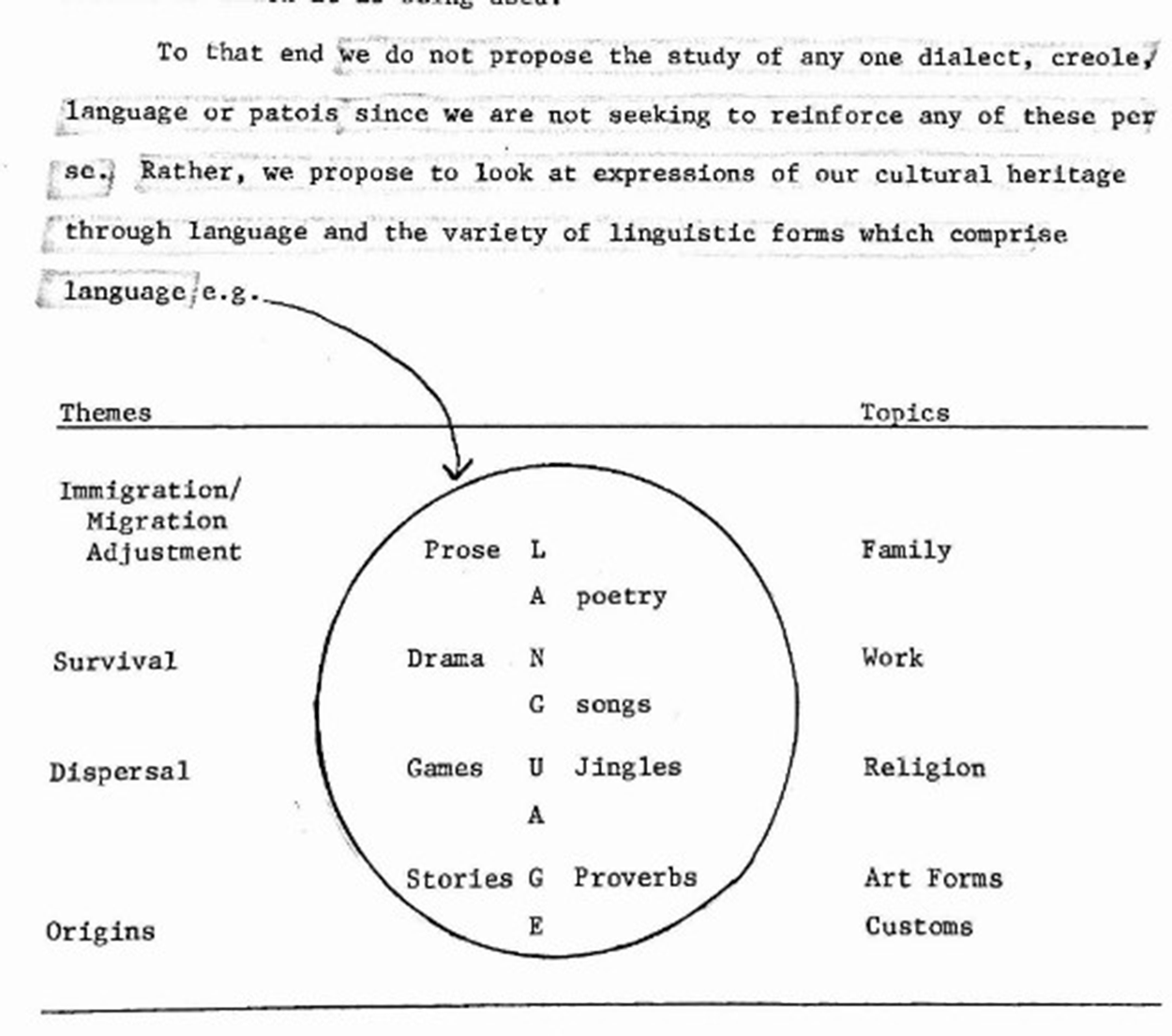
The Co-ordinating Committee thus imagined a new program to study “expressions of our cultural heritage through language and the variety of linguistic forms which comprise language,” by combining genre-based analysis (of prose, drama, poetry, proverbs, songs) that addressed themes common to Black Canadians (migration/adjustment, survival, dispersal origins) in specific domains of Black life (family, work, religion, art); these domains of study are visualized in a figure from the Committee’s proposal (see Figure 3).Footnote 72 The Committee insisted its proposed program should receive the same “official sanction” that the HLP received. Formal status would not only support Black youth in acquiring standard Canadian English but also serve a more meaningful purpose. “A language programme which explains their heritage, links it, and gives validity to their present existence will ease considerably the trauma of [that] acquisition,” the Committee argued.Footnote 73
Themes and topics of a Language Heritage program proposed by the Co-ordinating Committee on Black Education and Culture, June 12, 1979. (Source: RG 2-303-Elementary Branch operational files, Black Community, B120199, Archives of Ontario, Toronto, Ontario.)
The Committee’s proposal is just one example of the kind of radical theorizing that refused to work within existing policies—in this case, those of the HLP. Instead, proposals like this one were animated by a political trajectory that considered language, race, and culture in a unified way to redefine the boundaries of education programs premised on linguistic and racial inclusion.
The HLP reaches its crisis point
By the early 1980s, conflicts over the HLP and its implementation in the Toronto Board of Education had reached a crisis. As noted above, the third and final Board task force of this era, the Work Group on Third Language Instruction (1980-1982), was mandated to develop a comprehensive language policy to govern the various forms of language education in Toronto schools. Yet the issue of heritage languages, specifically whether and how to integrate them into the regular school day, would come to dominate the task force’s deliberations.Footnote 74 Similarly, these questions would consume the Toronto Teachers Federation, the union representing elementary school teachers, resulting in a grievance against the Board that would take over three years to resolve and a months-long work-to-rule boycott the union led in 1984.Footnote 75
Although supporters of heritage languages and supporters of Black cultural heritage programs each faced similar challenges to realizing the programs for which they advocated, the trajectories detailed above complicated efforts to collaborate or to forge any enduring solidarity to reach their respective goals. In this section of the paper, we contrast two specific events from the early 1980s to illustrate how the potential for collaboration was hindered: (1) a public consultation on June 24, 1981, one of many led by the Work Group on Third Language Instruction; and (2) the mass resignation of parents and community activists on February 21, 1984, to protest both the Toronto school board and the teachers’ union during the union-led boycott underway at the time.
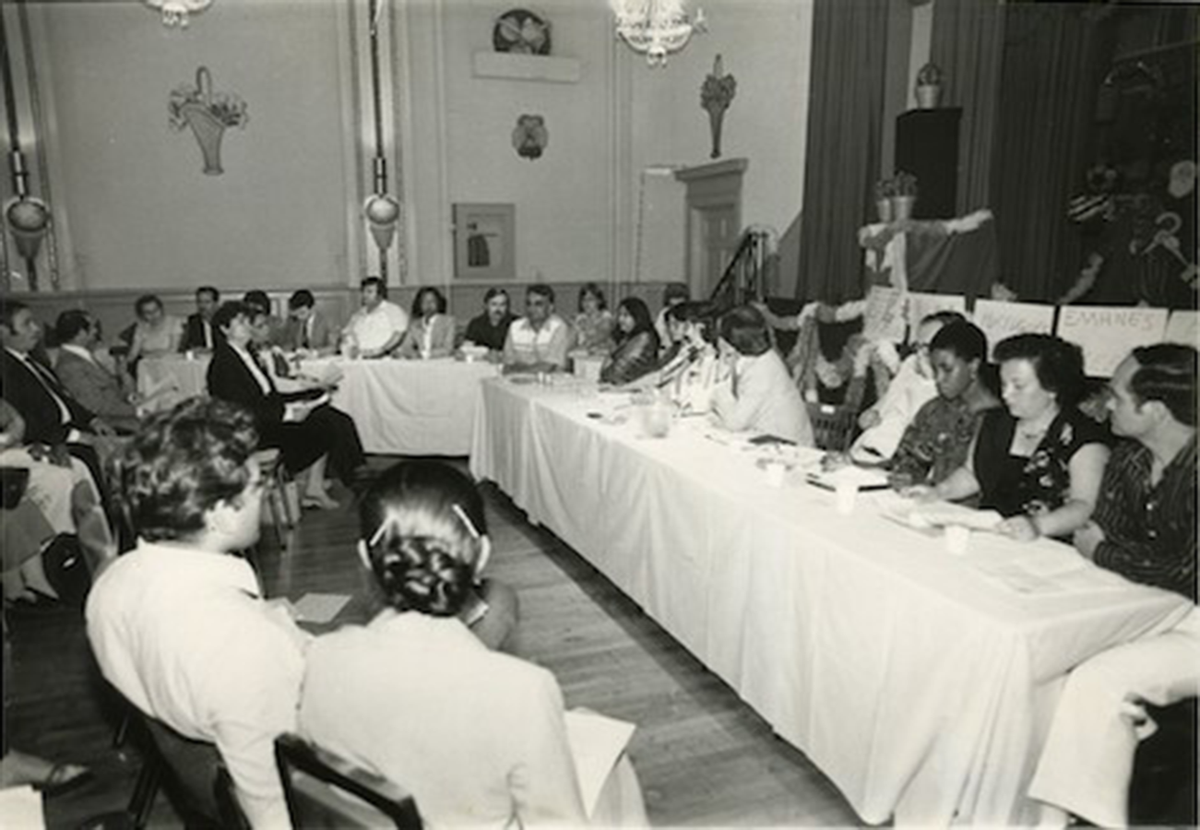
The public consultation took place at the First Portuguese Canadian Club (see Figure 4). Present were Alberto di Giovanni and other members of the Heritage Language Advisory Committee (HLAC), which the Board had established as a liaison body between various heritage-language communities and the central administration, similar to the Black Liaison Committee discussed above. HLAC members comprised about a quarter of the total members of the Work Group on Third Language Instruction, indicating the political weight heritage-language advocates had acquired by this point. Also present was Dr. Ouida Wright, one of the few Black administrators on the Board and superintendent for English as a Second Language and Second Dialect programs. The meeting was organized to hear the deputation of members of the Black Parents’ Organization (hereafter, the Organization), led that evening by its vice-Chair, Keren Brathwaite.
Picture of meeting between the Work Group on Third Language Instruction and the Joint Ad Hoc Committee of Concerned Communities for Third Language/Culture Programs, June 24, 1981. Di Giovanni and Wright are seated in the middle of the table in the background of the photo, along with the other members of the Heritage Languages Advisory Committee. Keren Brathwaite is seated to at the table to the right, along with other members of the Joint Ad Hoc Committee. (Source: Historical Picture Collections, TBE-Curriculum-Heritage Languages, Pic. #1, Toronto District School Board Archives.)
The minutes of this hour-long meeting indicate that Brathwaite opened by reading the Organization’s written brief to the Work Group. Her comments touched on the central topics the Black community had been challenging school leaders to address for some time: racist curriculum; the prevalence of racist language used by school district staff and students; the lack of Black teachers, staff, and administrators; the streaming of Black youth into vocational and special education programs; a lack of teaching resources for Black Cultural Heritage programs; and the need to integrate these cultural programs into the regular school day.Footnote 76
The discussion that followed Brathwaite’s deputation reflects a conflict between the two advocacy trajectories we described above. One way the discussion reflected this conflict was in how little of the conversation addressed the substance of the comments Brathwaite had just made. Instead, Work Group members repeatedly asked Brathwaite and parents in the Organization what the Black community thought about “the concept of magnet schools and alternate schools.”Footnote 77 The Ukrainian and Armenian communities in Toronto had been advocating for magnet schools for several years by this point. As the name suggests, magnet schools would enroll students from across the city, not just from a single neighborhood, and integrate instruction in a minoritized community’s language and culture throughout the curriculum. In fact, the creation of the Work Group on Third Language Instruction was partly a response to the proposals made by Ukrainian and Armenian advocates.
Brathwaite’s answers to their questions were clear: “We want our children to be included with the regular system. This would be better for their future chances in relation to society.”Footnote 78 Brathwaite made a direct comparison between magnet schools and the “example of segregated schools in the United States,” describing the experiences of “ghettoization, less funding, [and a] lower standard of teaching. What we want is to see that our kids get [an] adequate and well-rounded education.”Footnote 79 Despite the clarity of Brathwaite’s answers, di Giovanni, Dr. Wright, and other Work Group members returned to this topic throughout the meeting. Brathwaite responded each time by referencing the Black community’s “long experience with segregated schools.” The minutes recorded Brathwaite at her most emphatic: “Black parents want their children to be part of the regular school system. Their aim is to have Black history taught as a regular school subject. Supporting a separate school would not achieve this.” The amount of time spent on this topic and the fact that it had little to do with the substance of Brathwaite’s deputation, reflect an impasse stemming from the competing political objectives that Work Group members and Brathwaite’s organization were pursuing that evening.
The second way the discussion reflected the conflict between the two trajectories appeared in the midst of these questions about magnet schools, when Brathwaite changed the topic by posing a question to the Work Group. She asked, “Does the mandate of the Task Force recognize language, not culture?” to which an unidentified Work Group member responded, “Yes.” Brathwaite replied: “Language is a part of culture. How can you separate them?” Another Work Group member replied that the Board must work “within the perimeter [sic]” of the HLP, which limits programs to Continuing Education and a focus on language.Footnote 80 Another Work Group member attempted to side with the Organization and the arguments Brathwaite was making. The minutes noted, “She offered an opinion that language prejudices can be similar to racial prejudices. She reaffirmed that there was no valid reason to divide language and culture.”
This comparison between racial and linguistic prejudice did not go over well. The minutes paraphrase a response from one parent from the Organization as follows:
Culture and language have not been brought together. There is more emphasis on the language issue. Questions whether the Board really understands, wonder what the Board policy really is. Feels that Black Heritage Program is receiving token funding only, that the actual funding policy is not clear. The respondent also made the point that, in her opinion, race discrimination and language discrimination cannot be equated… . The Black Heritage Program should be taught in regular school to all students, not only Black students. The Heritage Language Program itself appears to be vague. Funding is not sufficient. Racism is still prevalent. Black language has been stripped from the Black community historically.Footnote 81
This exchange between the Black Parents’ Organization and Work Group members indicates that even if heritage-language advocates and Black parents shared a common interest in making Toronto schools more linguistically, culturally, and racially inclusive, they continued to have considerably different understandings of “language,” “race,” and “culture” and the relationship among them.
The second event we address relates to this Work Group’s final report, issued in 1982. Its most consequential recommendation was to increase the number of elementary schools with heritage-language programs during the school day (known as “integrated-day programs”), not after school or on weekends. To achieve integration, the school day schedule would have to be extended by thirty minutes. In March 1983, the Board implemented a new policy to govern the process schools would have to follow when considering integrated-day programs. If a sufficient number of parents requested daytime classes, the school would inform all parents of the request, organize public meetings to address parent questions, and then hold a vote. (The newspaper headlines cited earlier refer to these very meetings, an indication of how controversial the question of daytime heritage-language classes had become.) A simple majority was sufficient to trigger daytime heritage-language classes. This new policy specified that teachers were not allowed to intervene in this deliberative process, regardless of whether they favored or opposed implementing daytime heritage-language classes. Thus, parents had the final say.
For the union, the policy went two steps too far. Not only did it mean that some teachers would be working longer hours for the same pay as their colleagues in schools without daytime heritage-language classes, but the policy also stifled teacher input and gave parents control over the school day schedule. In April 1983, just days after the Board implemented the new policy, the union filed a grievance against it. It would take over three years to resolve the grievance, which the union ultimately lost. By January 1984, with the grievance unresolved and more elementary schools contemplating daytime heritage-language classes, the union initiated a work-to-rule boycott, which meant that teachers would no longer lead after-school activities such as sports, arts, homework support, and so on.Footnote 82
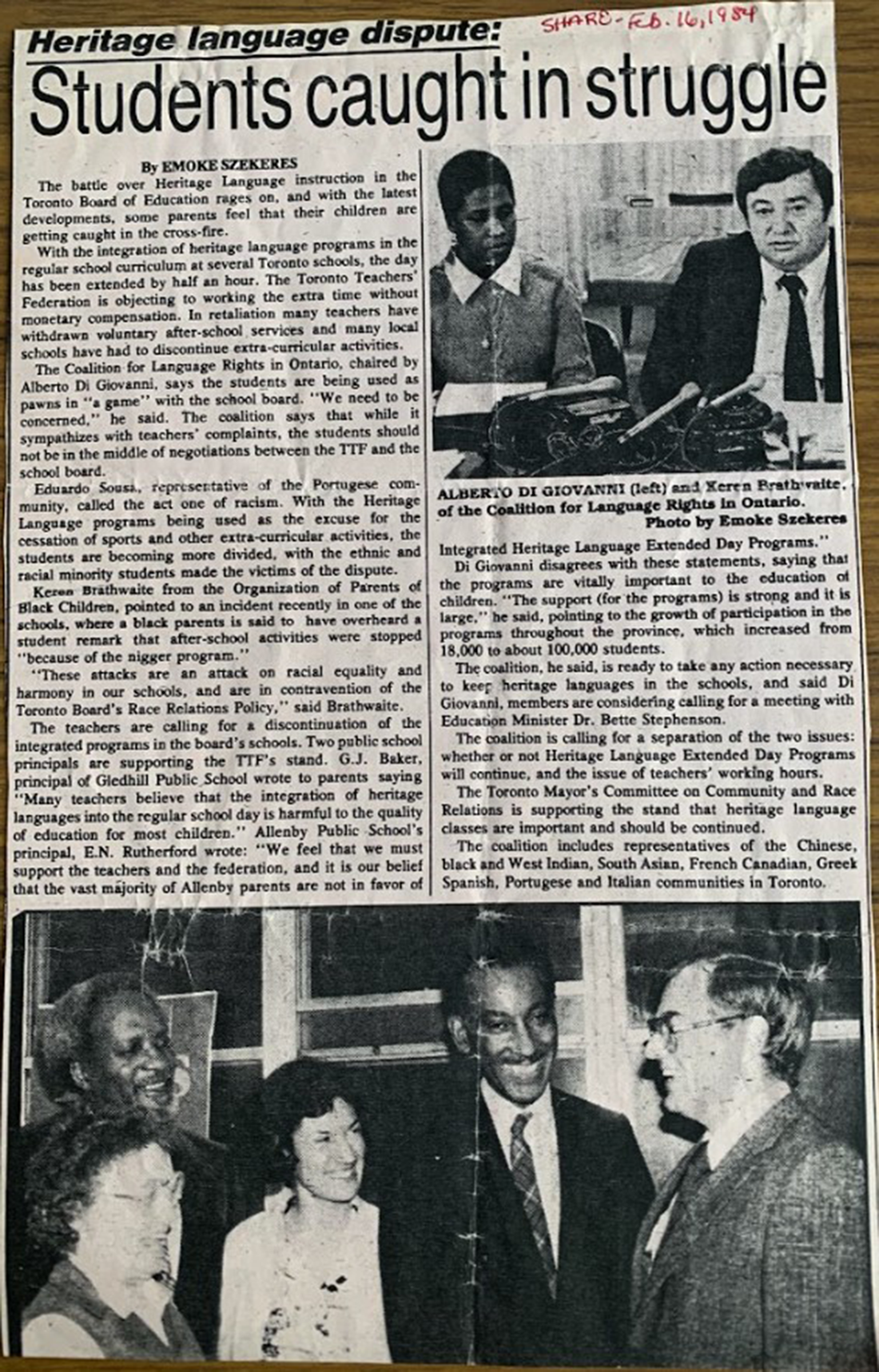
The union insisted its opposition was only to daytime classes and the Board’s policy regarding them. However, Bale has argued elsewhere that the union opposed heritage-language education per se, leading many parents to denounce the union’s actions as being motivated by racism.Footnote 83 For example, on February 16, 1984, Alberto di Giovanni and Keren Brathwaite joined other members of the ad hoc Coalition for Language Rights in Ontario in a press conference about the union boycott and the ensuing withdrawal of after-school activities (see Figure 5). Di Giovanni argued that students were being used as pawns in a “game” between the union and the Board. Eduardo Sousa, a Portuguese parent leader, called the union boycott an act of racism fueling division among students, with “ethnic and minority students” receiving the blame for the cessation in after-school activities. Brathwaite referred to a recent incident “where a black parent is said to have overheard a student remark that after-school activities were stopped ‘because of the n***** program.’ These attacks are an attack on racial equality and harmony in our schools, and are in contravention of the Toronto Board’s Race Relations policy.”Footnote 84
“Heritage Language Dispute: Students Caught in Struggle.” Pictured in this newspaper article are Keren Brathwaite and Alberto di Giovanni in the top-right corner, as well as other members of the Coalition for Language Rights in the picture at the bottom. (Source: Share, Feb. 16, 1984, Alberto di Giovanni personal papers, Toronto, Ontario.)
As this conflict came to head, the Board offered a compromise on February 21, 1984 that required an “enriched majority” of parents voting in favor of daytime HL classes, although it never specified the exact percentage this supermajority must reach.Footnote 85 That same day, the entire membership of the Heritage Languages Advisory Committee (which included di Giovanni and Sousa) resigned in protest of the Board’s proposed compromise and of the union’s ongoing boycott. As trustee Tony Silipo noted, “Parents clearly walked out in frustration, feeling that their role had been subverted.”Footnote 86
Conclusion: Rethinking contested solidarities
The programs and debates generated by local advocacy and parental concerns over student engagement in Ontario schools led to some of the most progressive forms of language and cultural programming in this era. However, they also reflected critical gaps in language programs that were short-lived, fragmented, and limited in institutional support and commitment. Rooted in these limitations was the erasure of race in the definitions of culture and language. While Black parents, students, and community activists tried to flesh out the language of racial inclusion within the context of heritage-language programming, they were often constrained by the boundaries of multiculturalism within a bilingual framework. Instead, there needed to be a clearer movement toward embedding anti-racist practice in educational programming rather than letting it exist merely as an addendum to schools’ Eurocentric curricula.
To this end, we draw on Roseann Liu and Savannah Shange’s notion of thick solidarity. These scholars leverage their personal and scholarly experiences with anti-racist praxis to theorize “a kind of solidarity that mobilizes empathy in ways that do not gloss over difference, but rather pushes into the specificity, irreducibility, and incommensurability of racialized experiences.”Footnote 87 Such incommensurability need not preclude the ability to work and act in coalition. However, it does require political humility and sharpness. They argue, “Thick solidarity layers interpersonal empathy with historical analysis, political acumen, and a willingness to be led by those most directly impacted. It is a thickness that can withstand the tension of critique, the pulling back and forth between that which we owe and that which we share.”Footnote 88 The authors counterpose their conceptualization to “thin notions of solidarity,” referring to the furtive, fragile, and more fragmented experiences of coalition more typical of social justice movements.Footnote 89
The histories of heritage-language and Black community activism analyzed in this paper reflect these different forms of solidarity. As we have argued, policies such as the HLP challenged the racialized and contradictory logics of multiculturalism within a bilingual framework. These policies provided an important vehicle for heritage-language communities to make new demands for linguistic inclusion where official bilingualism had excluded them. However, as Haque has demonstrated, because language is a central discursive terrain on which racial hierarchies are organized in Canada, demands for heritage-language programs and similar linguistic accommodations were met with explicitly racist backlash, which in this case took the form of teacher-union resistance and the Toronto Board of Education’s concessions to it. As the press conference organized by the Coalition for Language Rights in Ontario and the mass resignation of the Heritage Language Advisory Committee demonstrate, heritage-language and Black activists were able to leverage long-standing relationships to act quickly and decisively in response to racist backlash. Important as this united stance was, it was at best temporary and reactive, what Liu and Shange might call a thin form of solidarity.
By contrast, the June 1981 public consultation between the Work Group for Third Language Instruction and the Black Parents’ Organization suggested that thick solidarity was harder to generate or sustain. The minutes from that meeting indicate that Brathwaite and her colleagues expressed their positions on magnet schools and the relationship between language and culture extremely clearly. Nevertheless, Work Group members—especially those representing heritage-language communities—struggled to hear, let alone fully understand, their arguments. The political trajectory leading to demands for more robust language education collided with another political trajectory premised on the inseparability of language and culture in educational responses to racism. The collision alone need not have resulted in an impasse; however, heritage-language advocates seemed unable to recognize or empathize with the different personal and historical experiences that animated each trajectory in the first place.
While Ontario schools today are even more linguistically and racially diverse than they were in the 1970s and ’80s, their educational landscape looks all too familiar to the one portrayed in this article. Heritage-language programs, now falling under the umbrella of what is called the International and Indigenous Languages Elementary Program, remain outside the formal school curriculum and on the margins of school life. Newer parent advocacy groups such as the Parents of Black Children must still advocate for more equitable experiences and outcomes for Black youth, as Black students continue to be streamed into vocational and special education programs, referred to English as a Second Language programs, and subjected to racist school policies and curriculum.Footnote 90 Perhaps, what a review of this historical moment offers us is a mechanism by which to understand what is possible when we integrate notions of thick solidarity to envision an expansion of curricula that does not create dichotomous categories of heritage and language, but rather reflects the collective experiences of oppression and resistance by a diverse range of populations in Canada.
Funké Aladejebi is an associate professor at the University of Toronto. She is the author of Schooling the System: A History of Black Women Teachers (McGill-Queen’s University Press, 2021) and coeditor of Unsettling the Great White North: Black Canadian History (University of Toronto Press, 2022). Her work explores the histories of Black Canadian and African Diasporic communities in the twentieth century.
Jeff Bale is a full professor at the University of Toronto and serves as vice president of university and external affairs for the University of Toronto Faculty Association. He is coauthor of Centering Multilingual Learners and Countering Raciolinguistic Ideologies in Teacher Education (Multilingual Matters, 2023)
Disclosure Statement
The authors have reported no competing interests.


 Open access

