





1 Introduction
Prepositions have traditionally been regarded as a closed class of words (Huddleston Reference Huddleston1984: 121). However, this view has been challenged by functionalists, particularly with the resurgence of grammaticalization studies over the last few decades. König & Kortmann (Reference König, Kortmann and Rauh1991: 109) and Kortmann & König (Reference Kortmann and König1992: 671) hold that ‘preposition is by no means a closed word class but admits new additions and in fact constantly changes’. In English, new prepositions appear to have originated in all major word classes (Kortmann & König Reference Kortmann and König1992). One such category is deverbal prepositions, which Aarts (Reference Aarts2011: 79) describes as ‘transitive prepositions that take the same form as -ing participles or -ed participles’. These prepositions, as Quirk et al. (Reference Quirk, Greenbaum, Leech and Svartvik1985: 667) state, occupy a marginal position since they possess the form of verbal participles, which behave in many ways like prepositions. The list of deverbal prepositions includes, but is not limited to, words such as barring, concerning, considering, following, given and regarding.
The boundary between verbal participle and preposition is blurred (cf. Quirk et al. Reference Quirk, Greenbaum, Leech and Svartvik1985; Kortmann & König Reference Kortmann and König1992; Huddleston & Pullum et al. Reference Huddleston and Pullum2002; Aarts Reference Aarts2011; Skiba Reference Skiba2021). Specifically, a deverbal preposition has been defined as either a ‘prepositional participle’ (e.g. Poutsma Reference Poutsma1926: 711) or a ‘participial preposition’ (e.g. Skiba Reference Skiba2021). According to Hopper (Reference Hopper, Traugott and Heine1991: 31), a verbal participle needs to fulfill the syntactic constraint of coreference, meaning that the subject of the matrix clause and the controller of the participle should be identical. If the two subjects are not coreferential with each other or if the matrix clause lacks a subject altogether, this would result in the participle being ‘dangling’ (cf. Quirk et al. Reference Quirk, Greenbaum, Leech and Svartvik1985; Hayase Reference Hayase, Panther and Radden2011) and should instead be considered as a prepositional use. This research focuses on one typical member of deverbal prepositions, namely considering, which has evolved from a verbal participle to a well-accepted preposition. It has been agreed upon by several linguists (e.g. Quirk et al. Reference Quirk, Greenbaum, Leech and Svartvik1985; Huddleston & Pullum et al. Reference Huddleston and Pullum2002) that considering may be categorized as either a participle, as in (1a–c), or a preposition, as in (2a–c). According to the Oxford English Dictionary (OED, last accessed March 2023), cases where considering is used as a subordinating conjunction, as in (2b), or adverbially with elliptical complements, as in (2c), are also listed under the preposition entry. Given that a clear distinction between prepositions and conjunctions can be cumbersome, and the latter are sometimes considered to be sentential prepositions (e.g. Emonds Reference Emonds1976; Huddleston Reference Huddleston1984: 340; Kortmann & König Reference Kortmann and König1992; Huddleston & Pullum et al. Reference Huddleston and Pullum2002: 600), we incorporate conjunctional cases into our analysis as well.


Category shift is at the heart of grammaticalization studies. As noted by Hopper (Reference Hopper, Traugott and Heine1991: 30–1), the two types of uses presented in examples (1) and (2) correspond to lower and higher degrees of grammaticalization, respectively. The process by which verbal participles lose their primary categoriality is known as ‘decategorialization’, a key parameter of grammaticalization (Narrog & Heine Reference Narrog and Heine2021). Specifically, as participial considering grammaticalizes, it loses its lexical autonomy because it no longer holds the syntactic control relationship. Kortmann (Reference Kortmann1991: 52) observed that -ing forms, when functioning as prepositions, no longer require an explicit controller. Drawing on Kortmann’s perspective, the prepositional uses of considering in example (2a–c) act as ‘free adjuncts’, which can be omitted without affecting the grammaticality of the sentence. They provide adverbial information that modifies the proposition made in the matrix clause (Kortmann Reference Kortmann1991: 166–7); for instance, in (2a), considering your age suggests that the speaker or writer (hereinafter SP/W) takes the age of the addressee or hearer (AD/R) as a basis for evaluating their judgment. This interpretation, oriented towards the SP/W within the discourse, denotes a certain degree of subjectivity.
While previous studies have identified the formal distinctions between the participial and prepositional uses of considering (see Hopper Reference Hopper, Traugott and Heine1991; Kortmann Reference Kortmann1991; König & Kortmann Reference König, Kortmann and Rauh1991; Kortmann & König Reference Kortmann and König1992; Skiba Reference Skiba2021), the extent to which these two uses differ in terms of subjectivity remains unclear. Furthermore, the diachronic processes through which considering has become more subjectified have not been thoroughly examined. This article addresses these gaps by describing a multivariate analysis carried out to answer the following research questions:
-
(i) In addition to grammaticalization, does subjectification play a role in the category shift of considering? If so, which subjectivity-indicating contextual features significantly distinguish its prepositional use from its participial use?
-
(ii) How have these contextual features changed over the past 200 years? Do they generally indicate a trend toward increasing subjectivity, or are there distinct patterns among different contextual features?
The remainder of this article is structured as follows. Section 2 lays the theoretical foundation by outlining a constructional account of subjectification. Section 3 details the data collection process and explains the three statistical methods utilized in this research. Section 4 presents our results, starting with the identification of contextual features in corpus data that significantly distinguish between participial and prepositional considering using two machine-learning techniques. These contextual features, along with the historical periods during which they occur, are then visualized in a two-dimensional plot to illustrate its overall subjectification in regard to the two categories. Section 5 discusses the results and explores their theoretical implications. Finally, section 6 concludes by summarizing the main findings and suggesting further directions.
2 Theoretical background
In this section we first outline the key concepts of subjectivity and subjectification, and then discuss how a constructionist perspective (Traugott Reference Traugott2022, Reference Traugott2024) may offer better insights for understanding the subjectification involved in the category shift process.
Subjectivity is ambient in language use. Broadly speaking, subjectivity is understood as the degree to which ‘a particular element or construction requires reference to the SP/W for its interpretation’ (De Smet & Verstraete Reference De Smet and Verstraete2006; Traugott Reference Traugott, Lehmann and Malkiel1982, Reference Traugott, Davidse, Vandelanotte and Cuyckens2010, Reference Traugott2022) and subjectification can be regarded as its diachronic counterpart, viz. the ‘increase in the degree to which SP/Ws base meanings in and orient them toward their own perspective’ (Traugott Reference Traugott2022: 197). Two fundamental approaches to subjectivity and subjectification can be distinguished (cf. De Smet & Verstraete Reference De Smet and Verstraete2006; López-Couso Reference López-Couso, Jucker and Taavitsainen2010): the cognitive account by Langacker (Reference Langacker and Haiman1985), and the semantic-pragmatic account by Traugott (Reference Traugott, Lehmann and Malkiel1982, Reference Traugott, Davidse, Vandelanotte and Cuyckens2010, Reference Traugott, Kytö and Pahta2016). These two approaches highlight different aspects of subjectivity. Particularly, Langacker’s definition is primarily concerned with cognitive construal, which emphasizes the contrast between onstage, profiled and explicit conceptualizer, and offstage, unprofiled and implicit conceptualizer. Traugott (Reference Traugott2022, Reference Traugott2024), however, defines subjectivity in terms of the SP/W’s choice of expression. She focuses on how subjectification is a diachronic concept that is identifiable in overt constructional expressions. The present study adopts the Traugottian perspective, which is conducive to a usage-based investigation and which enables a diachronic corpus study that identifies micro-changes with regard to subjectification.
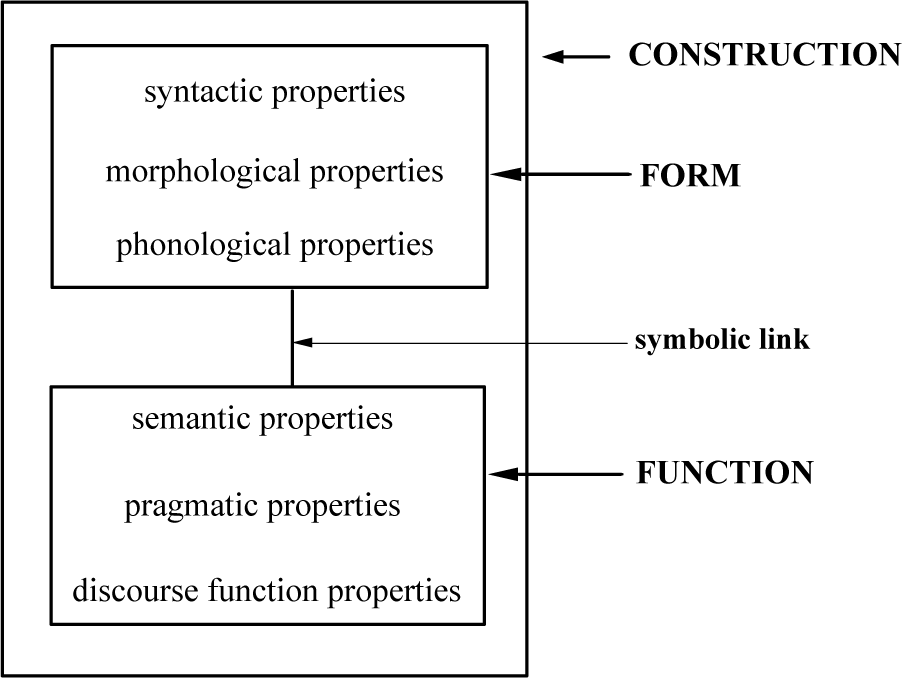
In her recent work on discourse markers, Traugott (Reference Traugott2022, Reference Traugott2024) has proposed a constructional model of subjectification. A central tenet shared by most constructionist approaches is that ‘all linguistic knowledge is captured in terms of constructions’, i.e. pairings of form and functions (Goldberg Reference Goldberg1995, Reference Goldberg2006). Figure 1 illustrates the model proposed by Croft (Reference Croft2001) for representing the form and function of a specific construction, which has also been adopted in Traugott’s framework.
The symbolic structure of a construction (Croft Reference Croft2001: 18)

As proposed by Croft (Reference Croft2001: 18), the form of a construction consists of at least three properties, namely syntactic, morphological and phonological properties. Function, on the other hand, includes semantic, pragmatic and discourse properties. This model, which integrates various linguistic facets of a construction within a single unit, offers a comprehensive framework for understanding the subjectification process. Specifically, Traugott & Trousdale (Reference Traugott and Trousdale2013) initially used the term ‘constructional changes’ to refer to change-types affecting either the formal or functional components of a construction. However, this term proved problematic because ‘changes in one dimension often coincide with changes in another’ (Traugott Reference Traugott2022: 46). To address this issue, Traugott (Reference Traugott2022: 51, 2024: 15) introduced the term ‘constructional shifts’, defining these as ‘shifts in contextual uses prior to and following constructionalization’.
As can be discerned from this definition, this refinement foregrounds the importance of context. Since ‘most changes occur due to the contexts in which an expression is used’ (Traugott Reference Traugott and Romero-Trillo2023: 49), the concept of constructional shift applies to subjectification as well. Traugott (Reference Traugott, Kytö and Pahta2016: 389) notes that subjectification is highly dependent on linguistic context, and ‘all potential examples must be evaluated within their textual contexts’. For instance, when a phrase that expresses spatial meaning, such as by the way, is used in the topicalized initial position of a sentence, as in By the way, I learned a new word in school today, it no longer refers to spatial sense ‘alongside the route’ but instead signals the SP/W’s perspective on the relationship between different discourse segments. Adopting a constructionist framework, the present study views subjectification as ‘a diachronic process whereby linguistic units gain subjective meanings through increased use in contexts that display greater subjectivity’ (Traugott Reference Traugott2022, Reference Traugott2024).
In addition, common wisdom still suggests that subjectification is a unidirectional process, whereby meanings transition from representing external realities to reflecting the SP/W’s perspective (Traugott & Dasher Reference Traugott and Dasher2002). However, it has been argued that this assumption of unidirectionality may oversimplify the complexities inherent in the subjectification process (cf. Smirnova Reference Smirnova2012; Narrog Reference Narrog2015; Nuyts Reference Nuyts2024). For instance, Adamson (Reference Adamson, Fischer, Rosenbach and Stein2000) introduces the concept of ‘desubjectification’, describing a developmental trajectory from a characterizer (e.g. a criminal tyrant) to a classifier (e.g. criminal law), with the latter being less speaker-oriented and, therefore, less subjective. Similarly, Kranich (Reference Kranich and Stathi2010) observes desubjectification in the secondary grammaticalization of English tense markers, suggesting that shifts in meaning can move toward more objective expressions. These findings highlight the variability in the developmental trajectories of subjectivity indicators. To better account for this complexity, a multivariate approach that examines a range of contextual features could offer a more comprehensive understanding of subjectification. Such an approach would allow for the analysis of interactions among different linguistic factors, offering a nuanced perspective that goes beyond the notion of simple unidirectionality.
Given the relatively few quantitative studies that analyze subjectification from the perspective of contextual shifts, it remains unclear whether subjectification is more prominent in some contextual features than in others. Furthermore, it has yet to be determined whether subjectification play a role in the category shift of deverbal prepositions. To address these gaps, multivariate statistical modeling is useful for evaluating the relative importance of each contextual feature and for closely examining the degree of subjectification. Specifically, in this study we initially investigate whether it is possible to anchor the two uses of considering in context, examining a set of subjectivity indicators, namely syntactic, semantic and pragmatic contextual features that signal subjectivity. Subsequently we analyze the changes in these distinguishing contextual features, providing a close-up examination of the subjectification process of considering.
3 Data and methodology
3.1 Corpus and data collection
The present study utilizes the offline version of the Corpus of Historical American English (COHA; Davies Reference Davies2021 release) as its source of data. COHA is an extensive and balanced compilation of text material that contains over 475 million words. The texts are derived from a diverse collection of over 100,000 texts and cover a period of twenty consecutive decades from 1820 to 2019.
Note that the offline COHA was not distributed to us in full due to copyright restrictions. In the corpus we received, ten words in every 200 were replaced by @ symbols, and therefore the corpus had to be preprocessed before use. We used the NLTK (Bird & Loper Reference Bird and Edward2004) toolkit in Python to remove every sentence containing the @ symbol, defining these as noise in the data and ensuring that all the remaining sentences were complete. In total approximately 20 percent of the original data were removed during this process, resulting in a cleaned version of the corpus containing over 372 million words. Despite this reduction, the removals were made in a regular and discriminating manner so the remaining corpus was still large enough and should not raise any concerns for our study regarding data quality.
Based on the processed corpus, a straightforward Python script was used to extract all sentences containing the search word ‘considering’. In all, 10,736 concordance lines were retrieved and manually checked to exclude all false positives. We filtered out cases where considering was used as the present continuous form, as in (3), in the gerund form acting as subject and object of a sentence, as in (4), and as complements of another preposition, as in (5). These cases were considered irrelevant for the intended analysis as they are unlikely to turn into prepositions.

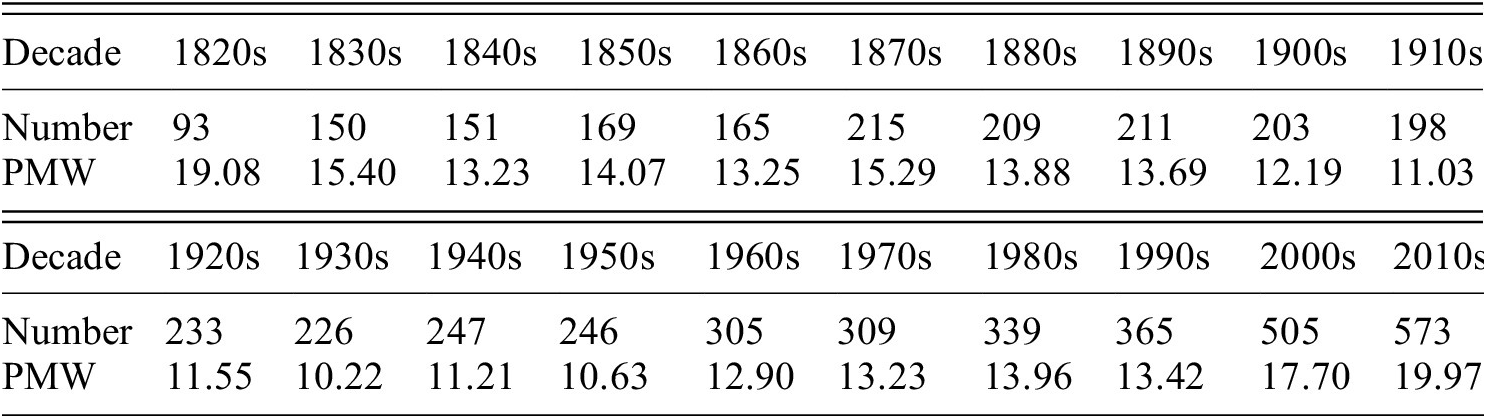
In all, 5,112 suitable instances of considering were retrieved from COHA; table 1 shows both the raw and normalized token frequencies (per million words, abbreviated to PMW hereinafter).
Token frequency of considering in COHA

According to Gries & Hilpert (Reference Gries, Hilpert, Nevalainen and Traugott2012: 136), because merely dividing linguistic data into equidistant time periods can be misleading, it is often essential to group historical data into distinct stages in order to make useful observations about changes over time. In this situation, it would be advantageous to apply a usage-based technique that can identify different sequential periods based on the structures found within the data itself, i.e. a bottom-up approach. Consequently, we used the frequency data as the foundation for dividing the data into periods.
3.2 Data periodization
To compensate the diachronic analysis in our research, we applied the variability-based neighbor clustering (VNC) method to periodize our collected data (Gries & Hilpert Reference Gries and Hilpert2008, Reference Gries, Hilpert, Nevalainen and Traugott2012). This approach divides the dataset in a manner that accurately reflects the studied phenomenon, instead of relying on predefined subperiods. The decades and normalized frequencies in table 1 were used as the input information into the R (R Core Team 2023) software.
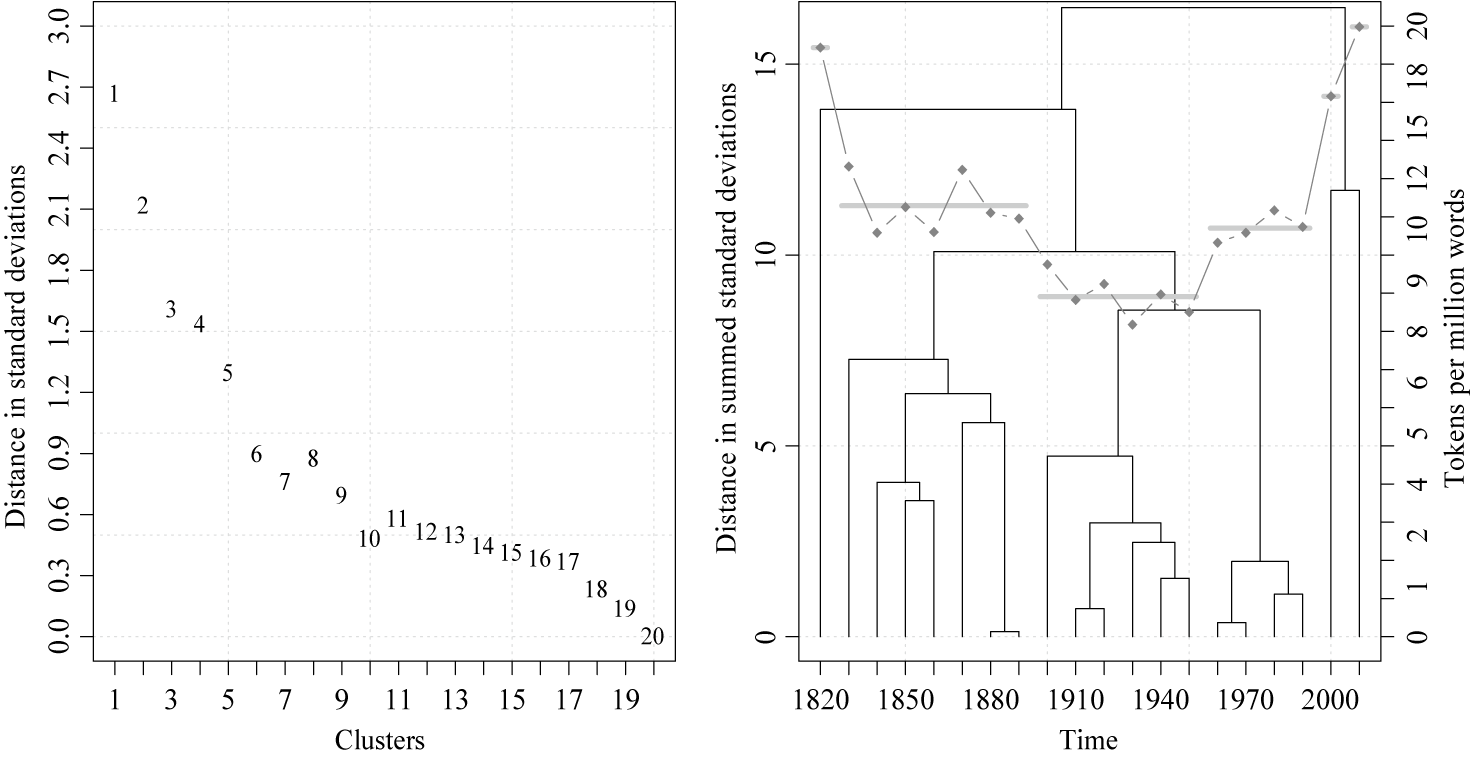
According to Gries & Hilpert (Reference Gries, Hilpert, Nevalainen and Traugott2012), standard deviation is crucial for determining the number of clusters due to its effectiveness in measuring similarity and identifying homogeneous periods. Specifically, standard deviation is a robust measure of dispersion, reflecting how similar or different the data points are within each potential cluster. For historical linguistic studies, the goal is to merge adjacent time periods that are most similar to each other. The VNC algorithm iteratively merges the two neighboring periods with the smallest standard deviation. This ensures that each newly formed cluster is as homogeneous as possible. This process continues until all data points are merged, producing a dendrogram that visually represents these clusters. Additionally, a scree plot is used to determine the optimal number of clusters. Our resulting dendrogram and scree plot are illustrated in figure 2.
Periods identified through VNC

While it is plausible to designate historical periods by drawing a horizontal line at any level within a dendrogram and identifying the intersecting vertical lines, it has been suggested that a balanced approach should be adopted. As Gries & Hilpert (Reference Gries, Hilpert, Nevalainen and Traugott2012: 139–40) highlight, the optimal solution involves ‘striking a balance between maximizing the differences between distinct periods and minimizing the number of clusters required for satisfactory classification’. In addition, Hilpert (Reference Hilpert2013: 37) points out that ‘the closer the numbers get to the x-axis, the more information is accounted for’. Examining the scree plot on the left, we see there is a significant downward slide from the one-cluster solution to the six-cluster solution, but after that point the change in distance in standard deviation becomes relatively small. Therefore, we determined that the six-cluster solution was the most suitable because it is close to where the curve is steepest while also maintaining a relatively small number of clusters.
Consequently, the diachronic change in string frequency can be partitioned into six periods, as illustrated in table 2.
The frequency of considering constructions in each period

The string frequencies of the six periods demonstrate an overall decreasing–increasing pattern, in which the normalized frequency decreases steadily by half in the first three periods covering the fourteen decades from the 1820s to the 1950s. Then, the frequencies of the following three periods bounce back quickly to exceed the starting level in the six decades from the 1960s to the 2010s. Through this data periodization we obtained a clearer picture of the frequency change of considering in general. The annotations of the output were based on subsamples from each period, following the data periodization. In cases where the number of tokens was distributed unevenly, downsampling was applied to ensure consistency across all periods. This involved retrieving a random selection of 300 tokens for each period, except for the first period in which we included all 93 tokens since the data was limited. In total, 1,593 out of 5,112 tokens were sampled and then manually annotated for a set of contextual variables, including those that had already been coded in corpus, i.e. Genre and Periods.
3.3 Data annotation
Subjectification is a gradient phenomenon that typically develops gradually over micro-changes (Torres Cacoullos & Schwenter Reference Torres Cacoullos and Schwenter2005; Traugott Reference Traugott, Kytö and Pahta2016). Before we specify the annotation scheme for the contextual features, a fundamental issue that needs to be addressed is the operationalization of subjectification. As highlighted by Traugott (Reference Traugott, Davidse, Vandelanotte and Cuyckens2010: 58), previous research has proposed several frameworks for the operationalization of subjectification, but ‘different frameworks may employ distinct criteria for defining variables’. What appears as ‘an indicator of a subjective use in one construction may not necessarily apply to another’ (Nuyts Reference Nuyts2012: 55), necessitating specific criteria for each construction under investigation. This is further emphasized by Traugott (Reference Traugott2022: 202), who states that ‘how exactly to operationalize the degree of subjectivity independently of specific constructions has yet to be established’.
Based on Traugott’s observation, the operationalization of subjectification in this study is motivated by a dual consideration. First, it draws upon existing literature to ensure a comprehensive understanding of subjectivity and subjectification. Most of the variables chosen for the present study were inspired by previous work (mainly Scheibman Reference Scheibman2002; Aaron & Torres Cacoullos Reference Aaron and Cacoullos2005; Torres Cacoullos & Schwenter Reference Torres Cacoullos and Schwenter2005; Traugott Reference Traugott, Davidse, Vandelanotte and Cuyckens2010, Reference Traugott, Kytö and Pahta2016, Reference Traugott2024; Visconti Reference Visconti2013; Levshina & Degand Reference Levshina and Degand2017). Second, it takes into account the characteristics of the deverbal preposition considering per se, thereby applying certain modifications to the criteria adopted by previous studies. The motivation for the inclusion and annotation of the contextual features is specified below.
First, given that ‘shifts in the referent of the subject may influence the development of subjective meanings’ (Traugott Reference Traugott, Davidse, Vandelanotte and Cuyckens2010: 58), this study coded three subject-related contextual features, namely Animacy, Pronominality and Person. Specifically, Animacy was coded in two categories: ‘animate’ by collapsing ‘human’ and ‘animal’ into a single category, and ‘inanimate’ by collapsing ‘concrete/nonconcrete inanimate’, ‘time’ and ‘location’. As regards Pronominality, we distinguished between ‘pronoun’ (all possible pronouns, e.g. I, you, they, this, that, it) and ‘non-pronoun’ (including nominalizations that are not pronouns, e.g. the meeting, New York). We also annotated the Person (i.e. first, second or third person) of the subject. If the sentence lacked a subject entirely, it was coded as ‘no subject’ (abbreviated to ‘ns’) with respect to these three variables.
Traugott (Reference Traugott2024: 5) observes that in actual daily communication ‘SP/Ws often remain implicit in their utterances’, which means that the SP/Ws do not typically lexicalize themselves as the first-person syntactic subjects I or we in their utterances. Besides, as noted by Traugott (Reference Traugott, Davidse, Vandelanotte and Cuyckens2010: 58), ‘subjectification may be most apparent precisely where there is no overt subject in the sentence’, e.g. Not smart, considering what we’re facing today. In this study we adhere to Scheibman (Reference Scheibman2002: 37) and Traugott (Reference Traugott, Davidse, Vandelanotte and Cuyckens2010: 58) by defining third-person singular copular constructions with it, this and that subjects or when there is no overt subject as indicating subjective use, as they may be relevant factors in the expression of speaker evaluation. The sentences below in (6a–c), taken from the dataset, illustrate the three subject-related usage features.

Next, as emphasized by Traugott (Reference Traugott, Kytö and Pahta2016: 379), ‘subjectification must be seen not only as meaning change, but also as potentially linked to change in form’. We coded for a syntactic contextual feature, specifically whether considering is positioned at the left periphery (LefPer) of a sentence. This is based on the observation that ‘subjectified elements tend to be placed at the periphery of a constituent or clause’ (Traugott Reference Traugott, Davidse, Vandelanotte and Cuyckens2010: 41), and their usages in initial position can ‘correlate with the subjectification of their meaning’ (Traugott Reference Traugott, Davidse, Vandelanotte and Cuyckens2010: 60). Additionally, given that ‘initial uses are often dedicated to marking discourse relations’ (Degand & Crible Reference Degand, Crible, Van Olmen and Šinkūnienė2021: 19), we examined whether considering was located at the beginning of a sentence. The coding scheme for this feature was straightforward; examples are provided in (7a–c).

Finally, three meaning-related contextual features were coded, namely Contextual Polarity (ConPol, whether evaluative meanings are expressed by the SP/W, e.g. positive, negative or neutral), the presence of Degree Modifiers (DegMod, whether the sentence contains an amplifier or downtoner, e.g. extremely, nearly) and the presence of Modal Auxiliaries (ModAux, whether the sentence contains a modal auxiliary).
In terms of Contextual Polarity, previous studies have argued that expressions that appear in more emotionally charged contexts tend to be more subjective (see Hunston Reference Hunston2011; Visconti Reference Visconti2013; Glynn & Sjölin Reference Glynn and Sjölin2014; Traugott Reference Traugott, Davidse, Vandelanotte and Cuyckens2010, Reference Traugott, Kytö and Pahta2016; Levshina & Degand Reference Levshina and Degand2017). As highlighted by Visconti (Reference Visconti2013), subjectification involves the transformation of linguistic items from mere compositional elements of propositions into operators that bind an individual to an evaluation. Inspired by previous corpus works on subjectivity (e.g. Hunston Reference Hunston2011: 53–5; Glynn & Sjölin Reference Glynn and Sjölin2014; Levshina & Degand Reference Levshina and Degand2017), the variable ConPol was coded with the help of a sentiment analysis tool, TextBlobFootnote 2 in Python 3.12. A primary focus in sentiment analysis involves differentiating between subjective and objective sentences within naturally occurring text. In using TextBlob, ‘words are tagged per sense’ (Sarkar Reference Sarkar2019: 576) and a stopword list in the NLTK (Bird & Loper Reference Bird and Edward2004) package was applied in the coding process. The results returned a sentence-level sentiment classification via a polarity score: a positive score denotes a positive evaluation, a negative score denotes a negative evaluation and a score of zero denotes a neutral context. Sentences classified as positive or negative are deemed more subjective compared to those with neutral scores. After an initial run of coding, a manual verification process was undertaken to ensure the accuracy of the results.
Likewise, Degree Modifier has been considered in previous studies as an indicator of evaluative subjectivity (Traugott Reference Traugott, Davidse, Vandelanotte and Cuyckens2010, Reference Traugott, Kytö and Pahta2016; Visconti Reference Visconti2013). For instance, describing an entity or event as very important conveys a degree of emphasis that is subjective in nature. In this study, 17 common degree modifiersFootnote 3 were examined, including both amplifiers (e.g. extremely, highly, incredibly) and downtoners (e.g. almost, nearly, relatively). These were chosen on the basis of the list given by Quirk et al. (Reference Quirk, Greenbaum, Leech and Svartvik1985: 445). The process of annotation was straightforward: sentences containing any of these modifiers were marked ‘yes’, and sentences without such modifiers were marked ‘no’. Sentences identified as containing degree modifiers were thus considered to exhibit subjective usage.
Furthermore, prior research has highlighted the significance of modality as a key indicator of subjectivity in discourse (e.g. Traugott & Dasher Reference Traugott and Dasher2002; Traugott Reference Traugott, Kytö and Pahta2016; Levshina & Degand Reference Levshina and Degand2017). Coates (Reference Coates1983) points out that epistemic modals such as must, may and could do not primarily describe the world as it is. Instead, they reflect the SP/W’s personal speculation. Similarly, Palmer (Reference Palmer1990) argues that the subjective nature of modality allows SP/Ws to express their attitudes towards the factuality of statements, ranging from definite affirmations to tentative suggestions. Therefore, modal auxiliaries (ModAux) like must, may and could are strong indicators that index speaker orientation (Traugott & Dasher Reference Traugott and Dasher2002).
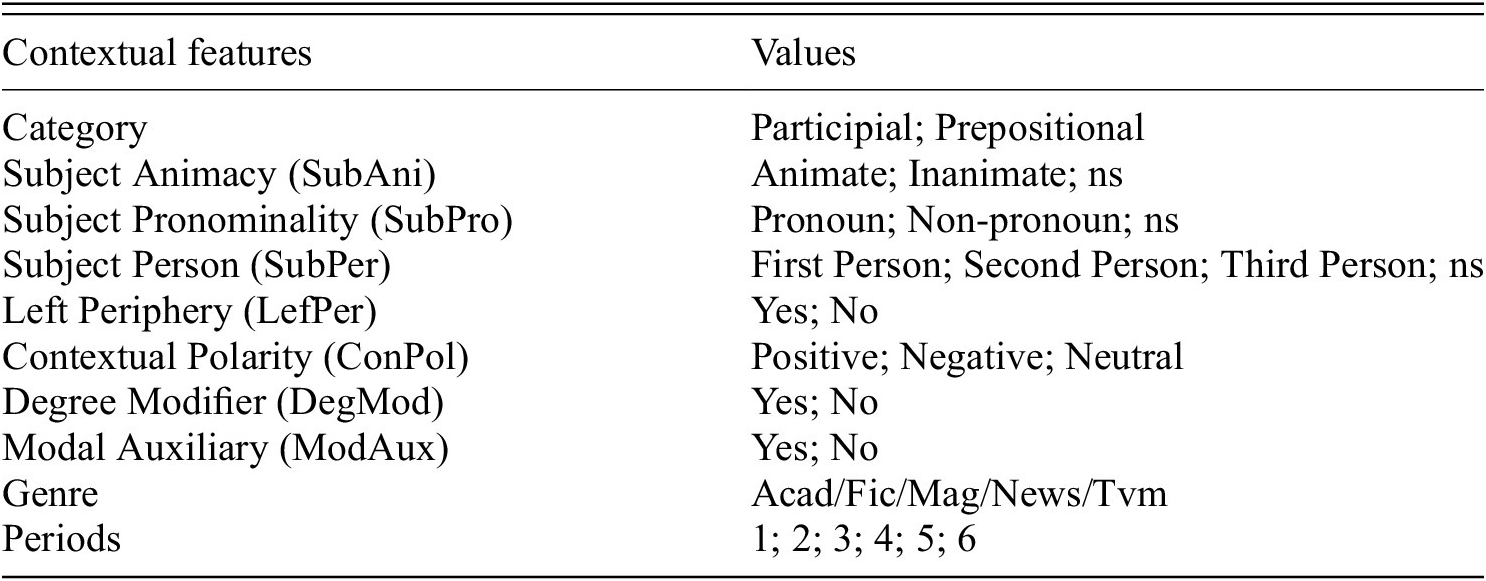
To operationalize modality in the variable context, we adopted the broader binary classification framework proposed by Huddleston & Pullum et al. (Reference Huddleston and Pullum2002: 173). In this framework, the classification is examined through the presence or absence of modal auxiliaries. An unmodalized proposition lacks modal auxiliaries and conveys a factual or descriptive state (e.g. She wrote it herself). In contrast, a modalized proposition contains modal auxiliaries and presents the statement as inferred or opinion-based (e.g. She must have written it herself). In this study, nine modal auxiliaries listed in Quirk et al. (Reference Quirk, Greenbaum, Leech and Svartvik1985) were examined, namely can, could, may, might, must, shall, should, will, would and ought to. Sentences containing these modal auxiliaries were considered to exhibit subjective usage. Examples of these three variables, EvaSem, DegMod and ModAux, are shown in (8a–c), and table 3 provides a comprehensive overview of all the variable levels annotated.

Predictor variables and their levels

3.4 Statistical analysis
Given that subjectification is accompanied by a subset of micro-changes (Traugott Reference Traugott, Stein and Wright1995, Reference Traugott, Kytö and Pahta2016), we adopt a multivariate variationist approach in our study. This approach captures recurrent patterns of linguistic elements through their frequencies and reveals the SP/W’s choices in context that are largely inaccessible to introspection (Aaron & Torres Cacoullos Reference Aaron and Cacoullos2005; Shao et al. Reference Shao, Cai and Trousdale2019). It enables a systematic analysis of how considering transitions from expressing less subjectivized meanings to more subjectivized ones.
The first step was to identify the subjectivity indicators that significantly differentiate participial and prepositional considering. To achieve this, two complementary corpus methods were employed: Conditional Reference Tree (CIT) and Conditional Random Forest (CRF).
Specifically, the purpose of CIT is to permit the accurate classification of linguistic data based on a set of predictor variables. It is a machine-learning method that serves as an excellent alternative when a regression model is not reliable due to multicollinearity issues (Levshina Reference Levshina2015, Reference Levshina, Paquot and Gries2020). The tree structure is determined through recursive binary splitting, which involves the following three steps: (i) conducting significance tests for the relationship between the response variable and each explanatory variable and selecting the most significant explanatory variable based on the p-value; (ii) performing binary splitting on the selected explanatory variable to divide the data into two groups; and (iii) repeating steps (i) and (ii) for each group of data until no further significant splits are possible (Levshina Reference Levshina, Paquot and Gries2020: 612).
Complementary to CIT, CRF is a high-precision non-parametric classifier that weighs the conditional importance of the predictors by training within a forest of classification trees built on a randomly sampled dataset (Szmrecsanyi et al. Reference Szmrecsanyi, Grafmiller, Heller and Röthlisberger2016). Particularly, using the cforest() function in the {party} package (Hothorn et al. Reference Hothorn, Kurt and Achim2006), each classification tree in the forest is fitted for a subset of the data by randomly sampling observations and predictors. The varimp() function weighs the importance of every variable in the CRF model by combining results from multiple trees. As a result, the model is highly accurate and resilient to multicollinearity and data overfitting (Szmrecsanyi et al. Reference Szmrecsanyi, Grafmiller, Heller and Röthlisberger2016: 114). A scree plot can be given in which the values of unimportant or irrelevant variables are distributed around zero, either positively or negatively (Levshina Reference Levshina, Paquot and Gries2020).
Then, to scrutinize the diachronic changes in the contextual features, we applied a multivariate exploratory method named Multiple Correspondence Analysis (MCA) to visualize frequency-based associations between various variables in an intuitive manner. As explained by Glynn (Reference Glynn, Glynn and Robinson2014: 443), correspondence analysis is a method for exploring categorical data that aims to reduce the number of dimensions in a multivariate dataset to two or three dimensions. To be specific, the frequencies of co-occurrence are converted to relative distances that take the form of a Euclidean cloud within a two-dimensional plot. In this way, we could also get a glimpse of how the subjectification of considering might have occurred in a gradual manner from a usage-based perspective.
4 Results
As highlighted by Traugott (Reference Traugott, Kytö and Pahta2016: 389), an analysis of subjectification ‘must be sensitive to micro-differences both synchronically and diachronically’. Therefore, this section begins by presenting the results of our CIT and CRF analyses, which aim to distinguish two gradient categories of considering based on their contextual features. This is followed by the MCA analysis, examining these contextual features across different time periods to illustrate the gradual nature of the subjectification process.
4.1 Gradience: disentangling participial and prepositional considering in context
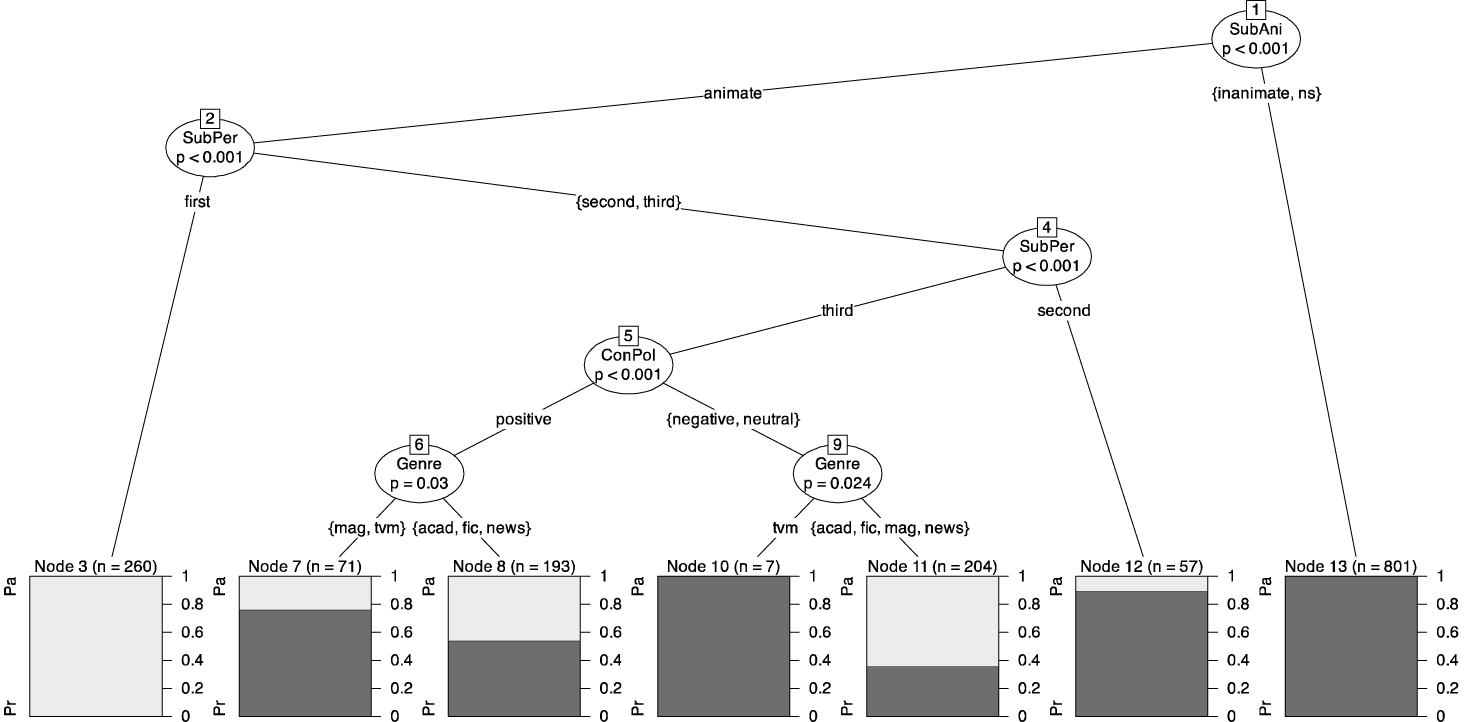
Based on the annotated data, we found that among the total of 1,593 instances, there were 1,080 tokens of prepositional constructs (67.80 percent) and 513 tokens of participial constructs (32.20 percent), indicating that considering has become rather grammaticalized over the past 200 years. In the CIT analysis the distribution of the two categories of considering was the dependent variable. The contextual features annotated were the predictor variables. Following Levshina (Reference Levshina2015, Reference Levshina, Paquot and Gries2020), in generating the classification tree we set the parameters as default ‘controls = ctree_control (teststat = ‘quad’, testtype = ‘Bonferroni’, mincriterion = 0.95, minbucket = 7)’. Using these parameters, a resulting tree was returned as shown in figure 3.
Conditional Inference Tree of the two variants

The first thing to note in figure 3 is that the tree does not include all the predictors for the classification task in question. Each predictor’s significance level is indicated by its p-value. The bars at the bottom of the tree represent the proportions of the two categories, which for expository reasons are labeled ‘Pa(rticipial)’, and ‘Pr(epositional)’ respectively.
The tree has six levels and multiple correlating branches. The predictor Subject Animacy (SubAni) indicates the strongest association to the response, which tells us that the actual category of considering in a sentence can be best predicted when we know whether or not the subject is animate. In instances where the subject is inanimate, or absent, the category of considering invariably becomes prepositional (as the proportion of participial constructs is 0 in this case). Moving to the second level, Subject Person (SubPer) plays a significant role. The presence of a first-person subject generally correlates with the usage of participial forms of considering. Further divisions may be observed based on Contextual Polarity (ConPol). The asymmetrical distribution within this node suggests that the semantics of considering are more closely associated with a positive evaluation. At the final node Genre comes into play, suggesting that prepositional considering is more common in informal texts such as television scripts and magazines.
Next, it is important to report the degree to which the tree conforms to the data. In classification tasks a prevalent criterion for assessing performance is accuracy, which quantifies the proportion of correctly predicted outcomes relative to the total number of observations (Levshina Reference Levshina, Paquot and Gries2020: 632). Using the table() function, the returned result was 0.88 which indicates an excellent 88 percent accuracy level. Another significant measure for binary response variables is the C-index, which in this case was 0.96. According to Levshina (Reference Levshina, Paquot and Gries2020: 633), the C-index ranges from 0.5, indicating no discrimination between outcomes, to 1, representing perfect discrimination. Therefore, we can conclude that the classification tree performs well in discriminating the two categories.
That being said, using a single tree can lead to problematic results. As pointed out by Strobl et al. (Reference Strobl, Boulesteix, Kneib, Augustin and Zeileis2008), even a slight adjustment in the parameter settings can impact the number of levels and nodes contained in the tree, which is not desirable. Hence, it is advisable to be careful with interpretation. An effective way to remedy this is to build not just one classification tree, but a forest of trees that agree on the same pattern with random subsets of the data. Therefore, we utilized CRF to calculate conditional variable importance scores and analyze the partial effects of relevant predictors.
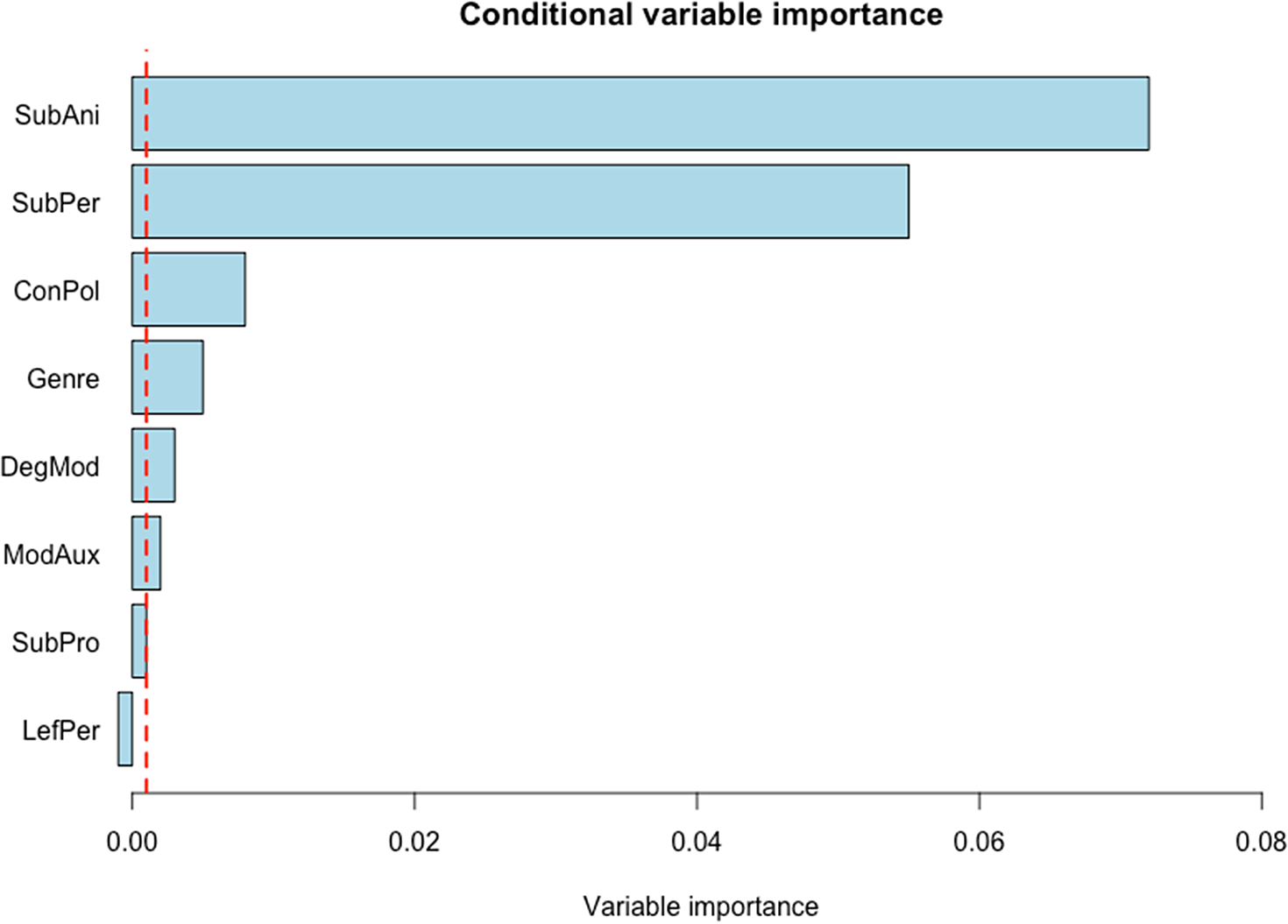
For the present study we set a couple of hyperparameters before growing the forest. Specifically, we set the ntree index to 2,000 as recommended by Strobl et al. (Reference Strobl, Boulesteix, Kneib, Augustin and Zeileis2008), who suggest that when there are many predictor variables it is necessary to use a large number of trees to give each variable sufficient opportunities to appear in multiple trees. Additionally, we set mtry, which determines the number of predictors randomly selected for each tree, to three, based on Levshina’s (Reference Levshina, Paquot and Gries2020: 634) recommendation to use the square root of the total number of predictors. Based on the resulting model, we can now target the significant predictors and visualize their relative variable importance. Figure 4 shows a bar chart with a vertical line to separate significant scores from non-significant ones to demonstrate the result.
Variable importance plot for all predictors estimated from CRF

The results should be interpreted as a relative ranking of significant variables, rather than as absolute values (Levshina Reference Levshina, Paquot and Gries2020: 636). The CRF result generally supports and confirms the CIT analysis with four identical predictors. However, there is a difference in that the predictors DegMod and ModAux are considered significant in the CRF model. In the scree plot we can observe that the most important predictor is SubAni, followed by SubPer, EvaPol, Genre, DegMod and ModAux. Interestingly, SubPro and LefPer do not significantly discriminate the two categories. Unlike the regression model, the CRF model does not provide coefficients that indicate the direction of association for specific predictor values. To illustrate the relationships between the various values of significant predictors and the response variable, partial dependence plots were used (Levshina Reference Levshina, Paquot and Gries2020: 638).
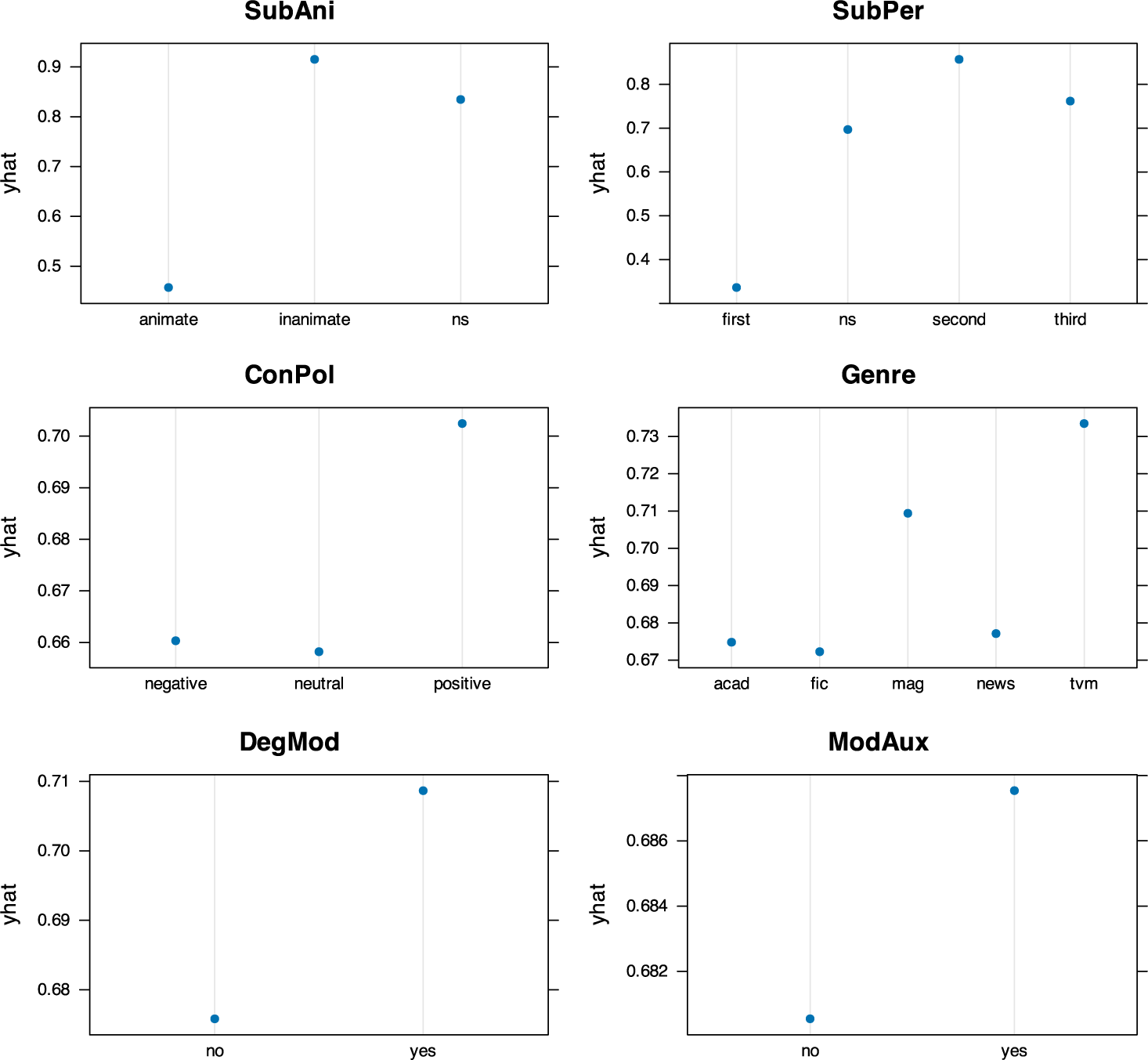
As shown in figure 5, the ‘yhat’ value on the vertical axis represents the ‘average predicted probability’ of the prepositional use of considering for each value of the significant predictor (Levshina Reference Levshina, Paquot and Gries2020: 639). The results show that prepositional considering is more likely to co-occur with inanimate subjects, third-person subjects, or when there is no subject at all. It also tends to co-occur with degree modifiers, modal auxiliaries, and emotionally charged words in positive contexts, particularly within the genre of informal texts such as television scripts. These preferences indicate that the use of the prepositional considering is more likely to modify positive evaluations in informal situations. Additionally, the high probability of third-person or inanimate subjects suggests a distance between the evaluator, i.e. the SP/W and the person or entity being evaluated.
Partial dependence plots of the significant predictors identified in CRF

Then, following Levshina (Reference Levshina, Paquot and Gries2020: 636–8), we use the OOB (out of bag) accuracy and OOB C-index in the predict() function to evaluate how well the model discriminates between participial and prepositional considering. In our case the OOB accuracy is 0.87, which indicates an 87 percent accuracy level, and the OOB C-index is 0.96. Consequently, the CRF model performs well in discriminating the two categories.
4.2 Gradualness: changes in the contextual features of considering
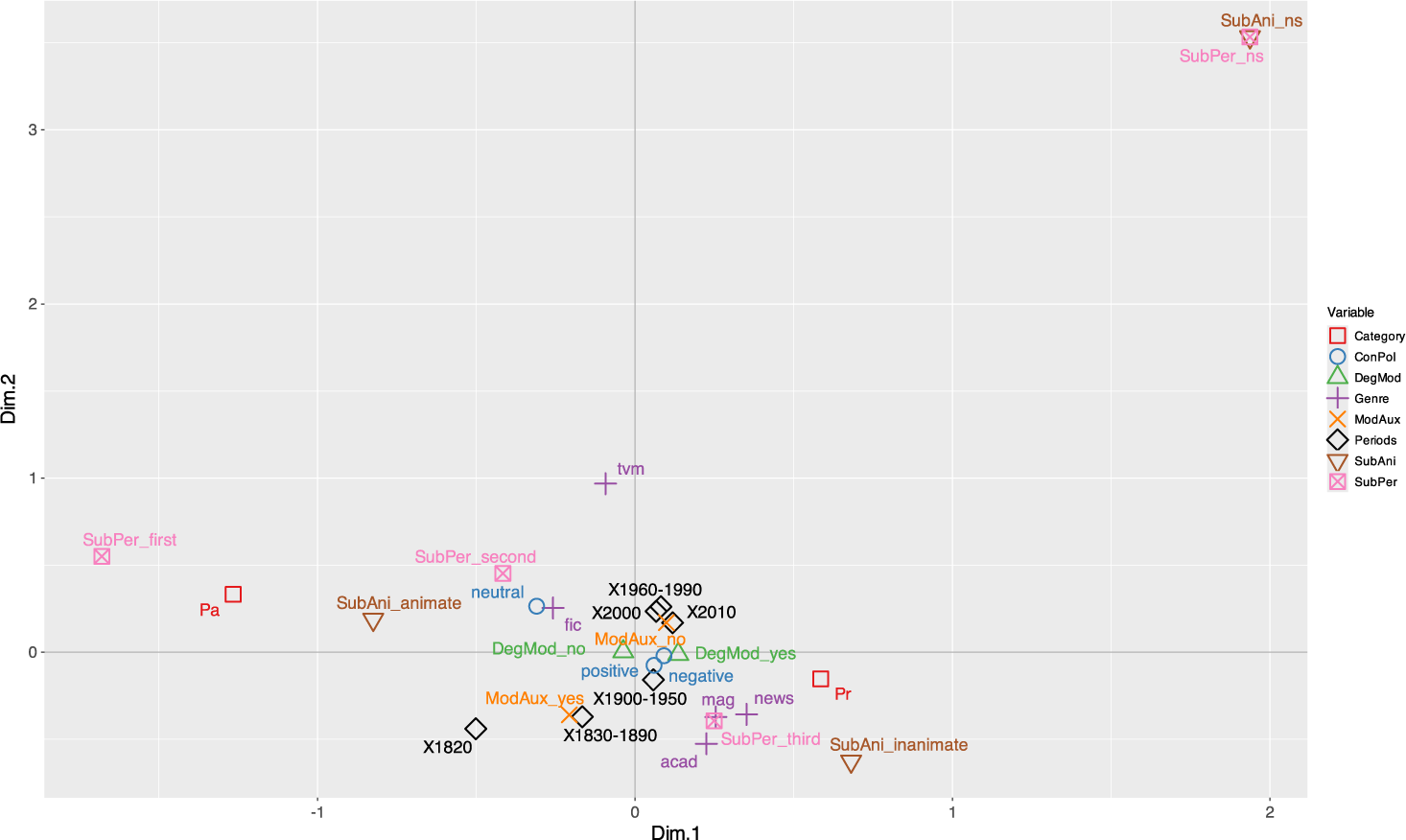
According to the results of our CIT and CRT analyses, SubAni, SubPer, EvaPol, Genre, DegMod and ModAux are the significant contextual features distinguishing the two categories of considering. Therefore, when conducting MCA we particularly focus on the relative distances of these contextual features with respect to the two categories. In order to observe the fine-grained change of considering, temporal variables, namely the six periods (shown as six black diamond dots), are incorporated into the same plot. For the close-up analysis of micro-changes, the MCA result is displayed in figure 6. The mjca() function was employed to report the model fit for MCA (Greenacre Reference Greenacre2017). This result shows that the first two dimensions account for 63.6 per cent of the variance (38.5 per cent for dimension 1 and 25.1 per cent for dimension 2). Subsequent dimensions (starting from dimension 3, which only explains 3.0 per cent) contribute minimally to the model.
Multiple correspondence analysis plot of the two variants

In figure 6, each contextual feature is represented by a different shape and color respectively. The dots represent different values of contextual features, which are grouped together if they represent similar profiles. From a horizontal perspective, this plot can be divided into two major parts: values related to the verbal participle on the left (centered around the label ‘Pa’), and those related to the prepositional construction on the right (centered around the label ‘Pr’). Note that there are two ‘ns’ spots in the upper-right corner of the plot. These dots represent instances where sentences lack an overt subject. We identified 85 such cases in our dataset. Since ‘subjectification may be most apparent precisely in the absence of an overt subject’, and given the context of these instances – as illustrated in examples (9), (10) and (11), which primarily demonstrate their use in sentences expressing evaluation – we consider these instances to be indicative of a relatively high degree of subjectivity.

The focus of this section is on the diachronic change in the use of considering, so special attention should be paid to the variable Periods. By examining the six black diamond dots in chronological order (i.e. the 1820s, 1830s–90s, 1900s–50s and onwards), we can discern a clear transition from left to right, with a slight upward trend. This supports the observation made by existing literature that over the past 200 years considering has gradually transitioned from a verb to a preposition. Additionally, the upward trend suggests that the subject of the matrix clause has increasingly been omitted, signifying that considering has gradually lost its syntactic control over the subject of the matrix clause (Kortmann Reference Kortmann1991). Interestingly, the last three periods are closely clustered together, suggesting that considering remained relatively stable during this time frame. In contrast, the first three periods exhibit significant changes, which suggests that considering underwent a significant change within this time frame.
Furthermore, most of the contextual features exhibit a process of subjectification. For instance, a transition from a first-person subject to a second- or third-person subject, or to no subject at all, indicates that considering is increasingly being used for the speech act of evaluation towards a person, situation or other entity. This suggests that when presenting an evaluative argument, the SP/W may intentionally downplay their presence in the utterance to avoid making their evaluative statement appear excessively opinionated. This tendency is particularly pronounced in the context of considering, as evidenced by the positioning of the ‘positive’ and ‘negative’ spots closer to the ‘Person_second’ and ‘Person_third’ spots on the MCA plot, rather than ‘Person_first’. Other contextual changes include shifting from a neutral context to a positive or negative context, the absence of degree modifiers, and usage in academic texts to use in television scripts.
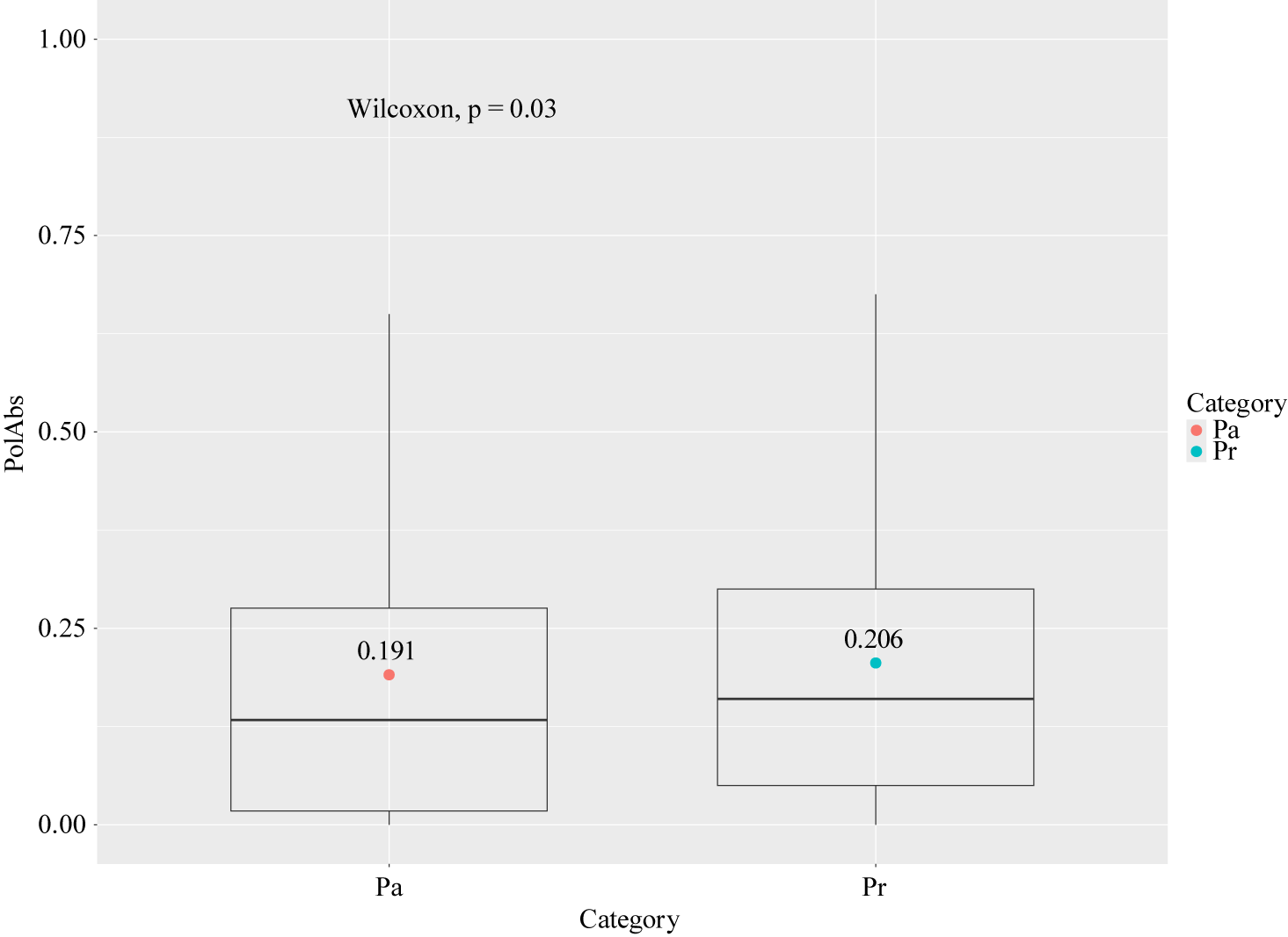
Although the correspondence analysis has provided insights into how these contextual features have changed over time, the transitions are not drastic. In order to complement our observation that the context of considering has become more emotionally charged as it has transitioned into a preposition, we conducted a confirmatory comparison between the mean absolute values of the polarity scores of sentences containing participial considering and prepositional considering. The result shows that sentences containing prepositional considering are significantly more emotionally charged compared to those containing participial considering, as evidenced by a Wilcoxon test (p < 0.05). The results of this analysis are shown in figure 7.
Boxplot of the mean absolute polarity scores

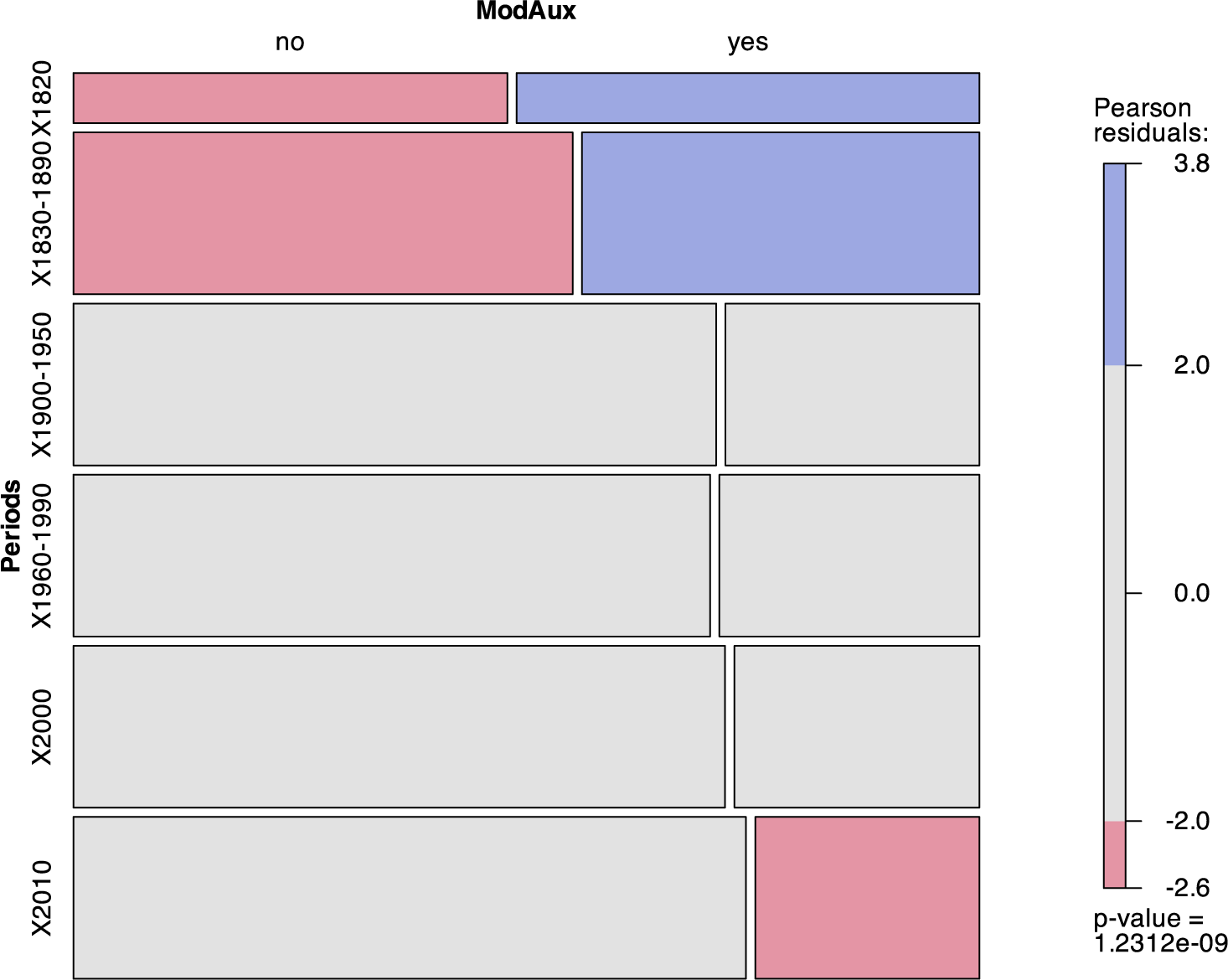
Interestingly, there is a noticeable shift in the variable ModAux from ‘yes’ to ‘no’, indicating a decline in the use of modal auxiliaries in context. A mosaic plot with residual-based shading, generated using the {vcd} package in R (Meyer et al. Reference Meyer, Zeileis and Hornik2006), was employed to visually illustrate this trend. Unlike correspondence analysis, this is a confirmatory modeling technique that determines which associations or dissociations are statistically significant (Meyer et al. Reference Meyer, Zeileis and Hornik2006; Krawczak & Glynn Reference Krawczak and Glynn2019). In figure 8 the plot represents two dimensions of the data: Periods and ModAux. Blue blocks represent a significant association, while red blocks denote a significant disassociation (Meyer et al. Reference Meyer, Zeileis and Hornik2006; Krawczak & Glynn Reference Krawczak and Glynn2019: 22). Therefore, the first two time periods show a significant association with the presence of modal auxiliaries in context, whereas in the last period there is a significant disassociation. This confirms our observation, as indicated by the MCA, that the use of considering has become less modal-sensitive over the past 200 years.
Association model of Periods and ModAux presented in a mosaic plot

5 Discussion
Based on the analyses presented above, there appears to be a significant difference between participial considering and prepositional considering with regard to subjectivity. However, not all the subjectivity indicators discussed in section 3 apply in distinguishing these two categories.
Additionally, two divergent trends with regard to subjectivity have been identified within the category shift of considering. The first trend reflects an increase in evaluative subjectivity, characterized by the increasing occurrence of considering in more emotionally charged sentences, coupled with a more frequent use of degree modifiers in context. This shift aligns with Traugott’s (1989: 34) Tendency I of subjectification, which describes a transition ‘from meanings based in the external described situation to meanings based in the internal (evaluative/perceptual) described situation’. Examples of this trend are illustrated in example (12a–c), where the sentences express evaluations toward a person or situation. They are both subjective and embedded within a societal value system.

The increasing occurrence of considering in emotionally charged sentences suggests an enhancement of the ‘hedge’ function, aligning with Verhagen’s (Reference Verhagen2005: 105) observation that the SP/W typically ‘adopts a certain degree of responsibility for the validity of the information he or she utters’. In presenting an evaluative statement, the SP/W may use the ‘considering X’ construction to moderate the argumentative strength of their statement, thereby preventing it from appearing excessively opinionated. This finding also aligns with Hayase’s (Reference Hayase, Coussé and von Mengden2014: 139) observation that the ‘considering X’ construction provides a context in which the target should be evaluated. Consequently, the ‘considering X’ construction in evaluative context can be interpreted as a mitigator, indicating that the SP/W’s evaluation applies approximately or to some extent (Hayase Reference Hayase, Coussé and von Mengden2014).
The other trend is that considering has become less sensitive to modal auxiliaries, as evidenced by a notable decline in their usage in context. Examples demonstrating the presence of modal auxiliaries are illustrated in (13a–c).

In these examples the ‘considering X’ construction is used by the SP/W to frame expressions of possibility and necessity. The notable decline in such usage suggests that the subjective meaning associated with modality has become less prevalent in the use of considering over the past 200 years. However, since the contextual features ConPol and DegMod rank higher than ModAux in the CRF analysis, and because considering has become more entrenched in evaluative utterances, its overall development can still be viewed as a shift toward speaker-orientation, i.e. becoming more subjectified.
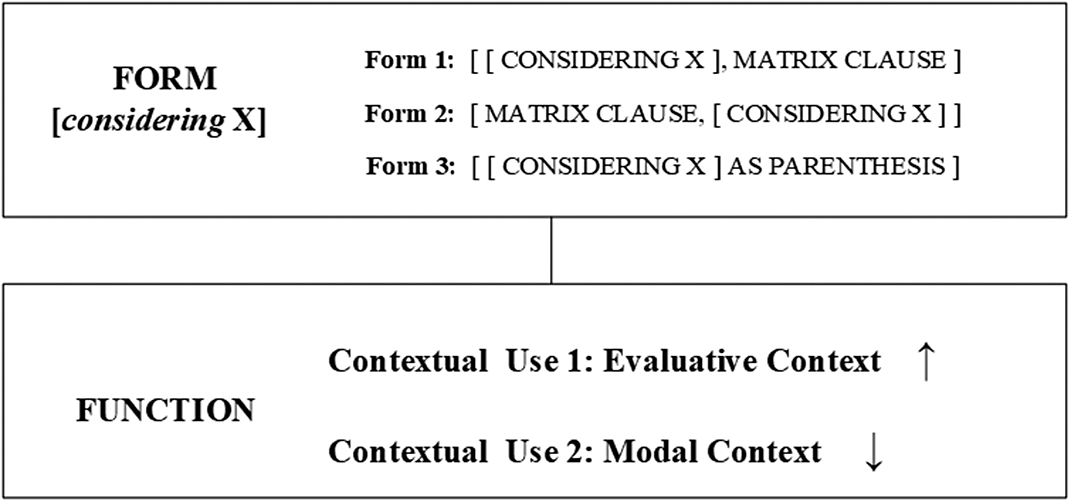
Thus far, we have addressed the two research questions outlined in section 1. As discussed in section 2, the functional pole of a construction comprises three properties: semantic, pragmatic and discourse functions (Croft Reference Croft2001: 18). The two divergent trends we have observed plausibly correspond to constructional shifts in two distinct pragmatic or discourse functions within a single constructional unit. Drawing on Traugott’s (Reference Traugott2024: 15) concept that ‘constructional shifts are shifts in contextual uses’, figure 9 illustrates the two constructional shifts, as evidenced by our multivariate analysis.
The constructional shifts of the considering X construction

In figure 9, the upper box represents the potential forms of the construction. Our CIT and CRF analyses reveal no significant preference for the syntactic positioning of considering across its two categories. The lower box illustrates the two observed trends – an increased use in evaluative contexts and a decreased use in modal contexts – which have shaped the overall subjectification of the deverbal preposition considering within a probabilistic model.
In a nutshell, this study demonstrates that as considering has evolved into a preposition, it has developed a greater degree of evaluative subjectivity. Furthermore, rather than categorizing the divergent micro-changes as either subjectification or desubjectification based solely on their developmental trajectories, it is perhaps more insightful to interpret them as constructional shifts. This is because changes in one contextual feature can interact with changes in another, as evidenced by our multivariate analyses, and all of these changes occur within a single constructional unit. Finally, given that the initial prepositional uses of considering occurred in Early Modern English,Footnote 4 marking its constructionalization as a preposition, the overall development of considering over the past 200 years corresponds to post-constructionalization constructional shifts.
6 Conclusions and outlook
In this article we have utilized quantitative methods to present findings on the role of subjectification in the category shift of the deverbal preposition considering over the past 200 years. Adopting a variationist method, we have shown that grammatical variation and change, exemplified by the two gradient categories of considering, are shaped by ‘various and sometimes conflicting probabilistic constraints’ (Szmrecsanyi et al. Reference Szmrecsanyi, Grafmiller, Heller and Röthlisberger2016: 112). Additionally, we have demonstrated that refining changes within the internal properties of constructions provides a non-modular, fine-grained model for understanding the differences between grammatical variants and their micro-changes over time. In this context, we have addressed the research questions outlined in the first section; our corresponding answers are offered below.
-
(i) Subjectification does contribute to the category shift of considering. In particular, subject animacy, subject person, contextual polarity, genre, presence of degree modifiers, and presence of modal auxiliaries are statistically significant features that differentiate between the two categories of considering.
-
(ii) Over the past 200 years, two divergent trends have been identified regarding subjectivity: an increase in evaluative subjectivity, characterized by the increasing occurrence of considering in more emotionally charged sentences, coupled with a more frequent use of degree modifiers in context; and a decreased sensitivity to modality, evidenced by a notable decline in the use of modal auxiliaries.
One potential limitation of this study is its narrow focus on one deverbal preposition. Future research could expand the scope of the research by including multiple deverbal prepositions to increase the generalizability of the findings. In addition, an intriguing area for further exploration is the role of multiple inheritance (see De Smet et al. Reference De Smet, Ghesquière and Van de Velde2013; Sommerer & Smirnova Reference Smirnova and Sommerer2020) in the category shift of deverbal prepositions. Future investigations could determine whether there exists an overarching construction that encompasses all deverbal prepositions, or if they are better understood as individual micro-constructions linked horizontally within the network (e.g. Sommerer & Smirnova Reference Smirnova and Sommerer2020; Ungerer Reference Ungerer2023). Additionally, as Traugott (Reference Traugott2024) notes, attempts to operationalize subjectification thus far have been somewhat language-dependent. A cross-linguistic examination of the heuristics identified in this study could provide additional insight into their cross-linguistic viability.


 Open access

