


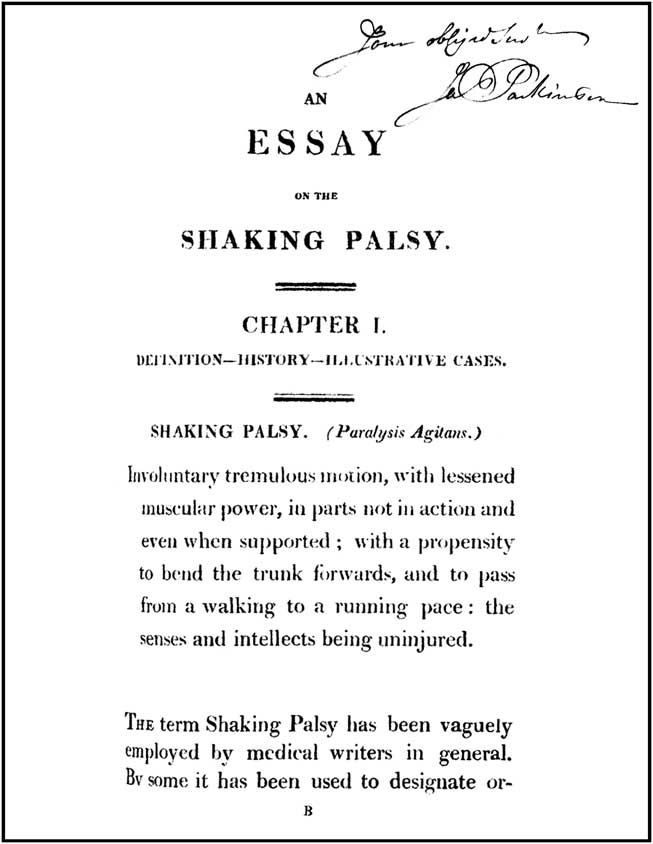
The London surgeon-apothecary James Parkinson is still remembered today essentially because of the short monograph entitled An Essay on the Shaking Palsy that he published in 1817.Reference Parkinson 1 This work, the only contribution that Parkinson made to neuroscience, became a classic of the medical literature because it describes, for the very first time, paralysis agitans as a distinct nosological entity. His remarkably precise description: “Involuntary tremulous motion, with lessened muscular power, in parts not in action and even when supported; with a propensity to bend the trunk forwards, and to pass from a walking to a running pace: the senses and intellects being uninjured,” which has stood the test of time, testifies to Parkinson’s keen sense of observation as well as to its power of merging various neurological symptoms into a single clinical entity (Figure 1). Despite some positive reports that appeared in the English medical literature shortly after the publication of Parkinson’s essay, the work remained relatively ignored until the celebrated French neurologist Jean-Martin Charcot (1825-1893), who worked at la Salpêtrière in Paris, rediscovered it some 50 years after its publication.Reference Gardner-Thorpe and James 2 Based on his clinical observations of the disease, Charcot proposed changing the terms shaking palsy/paralysis agitans for that of La maladie de Parkinson, but the English neurologists took a long time to accept the term Parkinson’s disease, which is more than familiar to all of us today.
A reproduction of the first page of James Parkinson’s An Essay on the Shaking Palsy,Reference Parkinson 1 with the famous introductory paragraph that summarizes the essential symptomatology of Paralysis agitans (Parkinson’s disease). James Parkinson’s signature, which originally appeared on a letter he wrote on February 21, 1809, was electronically imported onto the first page of the Essay. This letter was discovered by Dr. Christopher Gardner-Thorpe, who published part of it in his 1987 essay on James Parkinson.Reference Gardner-Thorpe and James 2 Parkinson’s signature is reproduced here with the kind permission of Dr. Gardner-Thorpe.
There exist many detailed historical reviews on James Parkinson, particularly in the context of his contribution to the disease named after him.Reference Critchley and James 3 - Reference Poirier and James 8 The present paper aims at underlining some of Parkinson’s key achievements in various domains of knowledge, which makes him one of the most singular figures of his time and place.
James Parkinson lived during the reign of George III (1738-1820), more specifically in the period that corresponds to the Industrial Revolution (1760-1820). His lifetime spanned the American Revolution, the French Revolution, and the Napoleonic Wars, three major historical moments that have played a role in the shaping of his multifaceted career.
Two other, much more minor, events are worth mentioning because they could have influenced his medical thinking. The first occurred when Parkinson was 31 years of age. It is the publication by Félix Vicq d’Azyr (1748-1794), the French anatomist and personal physician to Queen Marie-Antoinette (1755-1793), of a magnificent anatomical treatise that contains the first description of many brain structures, including the substantia nigra, which was to be later associated with Parkinson’s disease.Reference Vicq d’Azyr 9 In his celebrated essay, however, Parkinson advocated the idea that shaking palsy was the result of a upper spinal cord lesion that extended into the medulla oblongata as the disease progressed. We ignore if Parkinson ever looked at Vicq d’Azyr’s treatise, but we know that he was fluent in French and possessed a highly eclectic library. In 1805, Parkinson was avidly reading the work of Georges Cuvier (1769-1832), principally his Leçons d’Anatomie Comparée,Reference Cuvier 10 which, despite the war that was going on between France and England at that time, were sent to him by French scientists.
The second event happened when Parkinson was 49 years of age and pertains to the noisy London sojourn of the Italian physicist Giovanni Aldini (1762-1834), the nephew and collaborator of Luigi Galvani (1734-1819). While in London, Aldini undertook troubling experiments on cadavers of hanged criminals to demonstrate the utility of electricity as a reanimation tool.Reference Aldini 11 These galvanizing investigations were done on the body of a hanged criminal named George Foster in January 1803 at the Royal College of Surgeons of London, of which Parkinson was a member. Thomas Keate (1754-1846), who was then President of the Royal College of Surgeons, supervised the session; Aldini was assisted by the well-known anatomist and surgeon Joseph Contantine Carpue (1764-1846). Electrical treatment was the latest remedy at that time in London and Parkinson strongly recommended the use of resuscitative process in cases of drowning and suffocation in his popular writings (see later in this article). Parkinson does not allude to Aldini’s demonstrations in his writings, but he must have been aware of them because they were reported at length in the London newspaper The Time (January 22, 1803).
Who Was James Parkinson?
James Parkinson is a man without a face, as we do not have, as yet, any certified portrait of him. If one such figure ever emerges, it would have to be in the form of a painting or lithography because Parkinson died two years before the first daguerreotypes appeared. We do, however, have a copy of his signature, which lies at the bottom of a letter dated February 21, 1809. The English physician and historian Christopher Gardner-Thorpe first published this signature in 1987,Reference Gardner-Thorpe and James 2 and it is reproduced here on the illustration of the first page of Parkinson’s essay (Figure 1). We also possess a brief description of Parkinson’s appearance and personality that appeared in the writings of the English physician, geologist, and paleontologist, Gideon Algernon Mantell (1790-1852), who initiated the scientific study of dinosaurs. At age 21, Mantell visited Parkinson at his home for advice and support before embracing the field of paleontology. Mantell describes Parkinson, who was then age 56, as follows: “Mr. Parkinson was rather below middle stature, with an energetic intellect, and pleasing expression of countenance, and of mild and courteous manners; readily imparting information, either on his favorite science [paleontology], or on professional subjects.” This description is found in Mantell’s Pictorial Atlas of Fossil Remains, which was published in 1850 and offers a beautiful colored rendition of most of Parkinson’s fossil illustrations.Reference Mantell 12
James Parkinson was born on April 11, 1755, at No. 1 Hoxton Square in the parish of St. Leonard, Shoreditch, Middlesex, England. He was the son of John Parkinson (1725-1784), a well-known family doctor who practiced in Hoxton for many years and who was a member of the Corporation of Surgeons of London, and Mary Parkinson (1721-1811), of which little is known. During his apprenticeship as a surgeon and apothecary to his father, James Parkinson married Mary Dale (1757-1838), a young Shoreditch lady who was well versed in both medical and geological issues, in the nearby parish church of St. Leonard, where he was baptized 26 years earlier. Seven children were born of this marriage, three of whom died in infancy. Of the four children who reached adulthood, James’ second son, John William Keys Parkinson (1785-1838), became his father’s apprentice, first as an apothecary and then as a Fellow of the Royal College of Surgeons. He then joined his father in his medical practice so that, during many years, they both took care of the indigent and wealthy patients of Shoreditch from their comfortable Hoxton Square familial home located in a poor district of London.
Little is known of James Parkinson’s medical training, except that he studied at the London Hospital (now The Royal London Hospital) in the Mile End Road for 6 months when he was 20 and was then apprenticed to his father for 6 years, qualifying as a surgeon in 1784 when he was 29. We also know that, in 1785, he attended a series of lectures given by the celebrated Scottish surgeon and anatomist John Hunter (1728-1793) at his house in Leicester Square. James Parkinson took shorthand notes of these lectures, which were published in 1833 by his son J.W.K. Parkinson under the title Hunterian Reminiscences.Reference Parkinson 13 However, more than Hunter’s surgical and anatomical knowledge, it is perhaps his great enthusiasm for geology and fossil collection that fascinated James Parkinson. This encounter with Hunter might have triggered Parkinson’s fascination for geology and paleontology, a domain of natural sciences that was to occupy a major place in the last part of Parkinson’s polymorphous career.Reference Lewis 7
James Parkinson died at 69 of a stroke that left him mute and partly paralyzed on December 21, 1824, at No. 3 Pleasant Row, Kingsland Road, Hoxton. His son J.W.K. Parkinson carried on the medical practice at the familial home for 12 years, until he moved from Hoxton Square. In 1811, J.W.K. Parkinson married Diana Chapple (1787-1820) in St. Leonard Church. They had a son, James Keys Parkinson (1837-1900), who became apprentice to his father and joined the Hoxton medical practice up to the death of J.W.K. Parkinson in 1838. James Parkinson, his father, John, and his son John William Keys were all buried in the cemetery of St. Leonard Church. Parkinson’s accomplishments are commemorated with a stone tablet inside the church, as he was a member of the Church congregation. The exact site of his grave is unknown and his body may lie in the crypt or in the churchyard.
A Physician Deeply Involved in his Community
Besides his flourishing medical practice, Parkinson developed various fields of interest very early in his career that ranged from politic to geology. Influenced by the political and social turmoil of the French Revolution, he became a strong advocate for the underprivileged and an outspoken critic of the government of William Pitt the Younger (1759-1806), the Prime Minister. Parkinson fought particularly hard for a just representation of the people in the House of Commons, the institution of annual parliaments, and universal suffrage. From 1793 to 1795, a period corresponding to the reign of terror in France, Parkinson became a prolific pamphleteer, writing about a dozen virulent tracts published under his own name or under the pseudonym Old Hubert. He took the defense of the poor people of London, which he thought were not sufficiently protected or considered under the current government. These political and social writings made him popular with the people, but were very badly received by government and justice officials, including those from the Privy Council, which directly advised the King, and might have damaged his medical career.
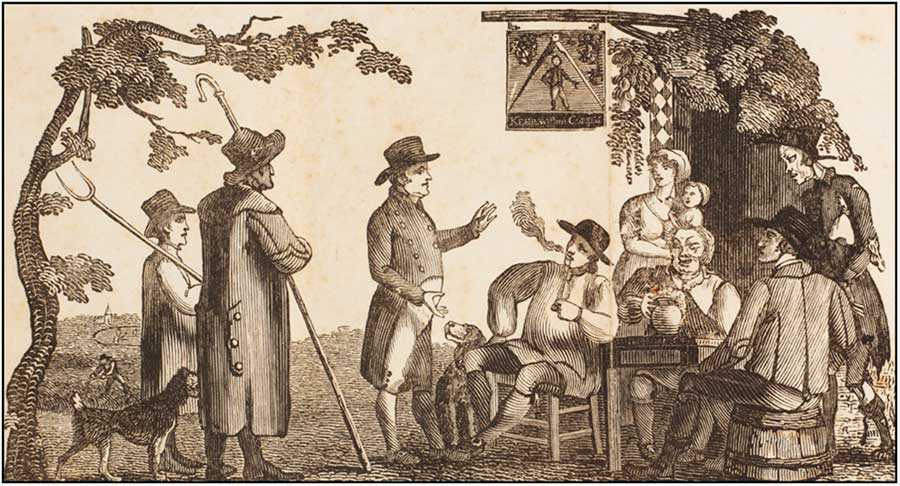
At the beginning of the 19th century, Parkinson progressively turned away from his stormy political career to concentrate his efforts on medical and social issues. The well-being of his fellow citizens, particularly those with little means, was a major concern to him. He therefore started to write medical booklets that provided to the general public essential information on various measures designed to preserve individual and social health. For example, he wrote Medical Admonitions addressed to families respecting the practice of domestic medicine and the prescription of health in 1799, The way to health in 1802, and The Villager’s Friend and Physician in 1804.Reference Gardner-Thorpe and James 14 The latter bookReference Parkinson 15 opens up on a fold-out frontispiece entitled The Alehouse Sermon, which depicts a physician, the man with a hat at the center of the picture, whom one likes to think is James Parkinson himself , providing advice on various health issues to the villagers (Figure 2). The tavern sign shows a man standing within a compass, a Masonic symbol that was then regarded as an emblem of virtue, restraint, and self-control. The motto at the bottom of the sign says: “Keep within compass” (and you shall be sure to avoid many troubles which others endure). In this booklet, Parkinson expresses strong warnings against excessive alcohol drinking, and he does not hesitate using vivid aphorisms, such as “Virtues may have bastards,” to be properly understood. Other similar texts deal with subjects as diverse as the reeducation of the poor, medical education, and the excessive indulgence of children. Parkinson’s popular medical booklets were in demand and some of them went through several editions.
Fold-out frontispiece of James Parkinson’s booklet “The Villager’s Friend and Physician” published in 1804.Reference Parkinson 15 The lithography entitled “The Alehouse Sermon” depicts a physician, the man with a hat at the center of the picture, whom one likes to think is James Parkinson himself, providing advice on various health issues to his fellow countrymen.
In 1777, the Royal Human Society awarded James Parkinson a silver medal for the resuscitation of a man that hanged himself. On several occasions during his medical career, Parkinson had to use the “resuscitative process” developed by the Royal Human Society, which included the administration of electricity, the latest remedy at the time, in cases of apparent death from drowning or suffocation. As early signs of Parkinson’s interest in general science and natural phenomena, one can note his detailed description on the effect of lightning on the human body published in 1789 in the Memoirs of the Medical Society of LondonReference Parkinson 16 and his Chemical Pocket-Book that first appeared 1800.Reference Parkinson 17 With this latter text, which went into several editions between 1800 and 1809, including one in Philadelphia in 1802, Parkinson hoped to convey to the layperson a general and correct idea of the major concepts of the chemical science that were being developed at that time in France and England. The book reveals that Parkinson was quite familiar with the newest chemical theories, including those recently elaborated by Antoine Lavoisier (1743-1794) in France and, above all, that he was able to easily convey these elaborate notions to any newcomer in the field.
James Parkinson also contributed significantly to the description of several medical and surgical cases of importance. Besides his celebrated Essay on the Shaking Palsy and the cases of resuscitation and lightning mentioned previously, Parkinson provided a detailed account of the symptomatology and treatment of gout, in which he discussed his own and his father’s gout.Reference Parkinson 18 Furthermore, in 1812, he read before the Medical and Chirurgical Society a paper entitled: A case of diseased vermiform appendix that was written by his son J.W.K. Parkinson and that is now recognized as the earliest reference to appendicitis in English medical literature.Reference Parkinson and Parkinson 19 Further collaborations with his son led to more papers on other medical issues, including trismus and hydrophobia (possibly cases of rabies, then known has hydrophobia from the fear of convulsions when tasting water).Reference Morris and James 5 Parkinson was much perturbed by epidemics of typhus fever in Hoxton that frightened the helpless populace. In 1815, James and his son John, who were then Parish Doctors of St. Leonard, convinced the Parish Board of Trustees to erect a building with separate fever wards to prevent the spreading of typhus epidemic throughout Shoreditch. The Parkinsons were right; the number of patients affected was markedly reduced after the building of these parochial fever wards. In 1824, James Parkinson summarized his view on this issue in an article published in the London Medical Repository Reference Parkinson and Parkinson 20 ; this was to be his last paper.
In addition to patients with somatic disorders, James Parkinson was also taking care of individuals suffering from mental diseases. For the past 30 years, he had been the visiting doctor of Holly House, one of the three Hoxton private insane asylums. In 1811, Parkinson wrote a tract in answer to the accusation of having confined Mrs. Mary Daintree in Holly House solely on the basis of plaints from relatives and not as the result of his own observation.Reference Parkinson 21 This pamphlet provides interesting comments on the confinement laws applied at that time, underlines their weaknesses, and suggests ways of remedying their shortcomings, but the incident was not without effect on Parkinson’s reputation as a madhouse doctor.Reference Rowntree 4
James Parkinson, the Oryctologist
James Parkinson became famous during his lifetime; however, celebrity came to him not from medicine, but from that branch of geology called paleontology, which was then known as oryctology, a term that derives from the Greek word Oryktos, meaning dug up, but that was progressively extended to mean the study of fossils, minerals, and rocks. Parkinson, as with many physicians of the 18th century, was an insatiable collector of fossils, minerals, and shells. The specimens he amassed himself in London districts and others that he exchanged or bought from various collectors around the world came to form the core of a highly popular museum, his “cabinet of coins and medals,” which he set out at his home in Hoxton Square. In 1811, Gideon Mantell, the young paleontologist and future Fellow of the Royal Society of London, visited Parkinson and was fascinated by both the personage and his fossil collection. About 40 years later, Mantell still vividly remembered this visit upon which he commented: “He [Parkinson] kindly showed and explained to me the principal objects in his cabinets and pointed out every source of information on fossil remains; a department of knowledge at that time but little cultivated in England, but which particular circumstances had contributed to render the engrossing object of my young and ardent mind. In after years Mr. Parkinson warmly encouraged my attempts to elucidate the nature of the strata and organic remains of my native county, Sussex, a district which was then supposed to be destitute of geological interest, and he revised my drawings, and favoured me with his remarks on many subjects treated in my first work The Fossils of the South Downs.”Reference Mantell 12
In 1804, James Parkinson was nearly age 50 and had collected fossils for about the past 20 years when he decided to publish Organic Remains of a Former World, Reference Parkinson 22 which was to be is magnum opus (Figure 3). Two subsequent volumes followed the first (1808, 1811) and, finally, Parkinson’s Organic Remains covered 1146 pages and was accompanied by some 42 plates comprising 700 figures, nearly all of which were drawn from specimens in Parkinson’s own collection.Reference Morris and James 5
(Left) A reproduction of the frontispiece of the first volume of James Parkinson’s Organic Remains of a Former World, a three-volume treatise published between 1804 and 1811.Reference Parkinson 22 (Right) A reproduction of a colored version of plate XIX of the third volume of the same treatise. This volume contains 18 figures engraved on a copper plate by Samuel Springsguth (1769-1844). Figures 2-18 depict fossil teeth, palates, and mandibular fragments of different fishes, principally sharks and rays, whereas the largest figure at the top, labeled figure 1, is described by Parkinson as “The head of the large fossil animal from Maestricht.” In fact, the drawing shows part of the skull (principally jaw fragments) of Mosasaurus hoffmannii discovered in 1764 in a subterranean gallery of a limestone quarry bordering the Meuse River, near the Dutch city of Maastricht. The name Mosasaurus, used to designate this group of large and ferocious marine reptiles that disappeared about 66 million years ago, derives from the Latin word Mosa for the Meuse River and the Greek term sauros for lizard or reptile. This specimen was named after Johann Leonard Hoffman (1710-1782), a Maastricht surgeon and fossil collector who made the specimen known worldwide. The discovery of Mosasaurus launched the search for large reptilian fossils, including dinosaurs, which were unknown during Parkinson’s time.
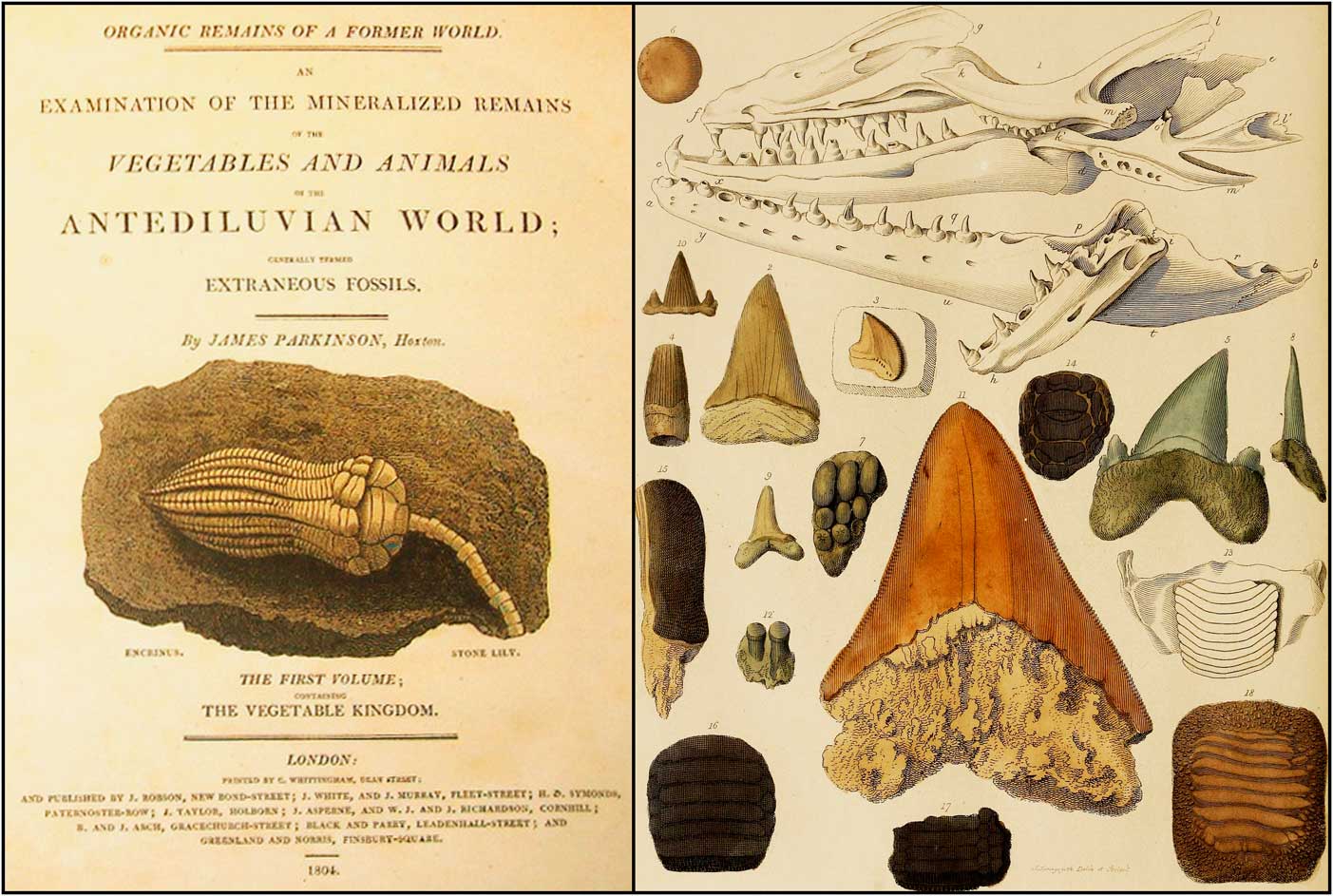
Parkinson’s Organic Remains became the standard textbook of paleontology in England. Its publication was considered a memorable event in the history of British paleontology because it was the first attempt to give a familiar and scientific account of the fossils relics of animals and plants, the “medals of creation,” accompanied by accurate figures of the specimens described.Reference Mantell 12 Parkinson wrote this treatise in the third person (“the writer”) and chose the epistolary form to facilitate the translation of complex scientific notions to the general reader, as well as in the hope of leading “those to the study of this part of Nature’s work, to whom, as yet, they might be unknown,” as explained in the preface of the first volume.Reference Parkinson 22 Although Parkinson is believed to have been a capable draftsman, he entrusted the entire iconography of his Organic Remains to the talented engraver Samuel Springsguth (1769-1844), whose copper plates engravings of Parkinson’s specimens were remarkable for their accuracy and realism (Figure 3). Springsguth was born in the Covent Garden district of Westminster, London, and trained by the printmaker Thomas Cook (ca. 1744-1818), best known for his reproductions of the works of Hogarth. Springsguth was active between 1790 and 1821, during which he engraved a variety of prints: portraits, landscapes, and the illustrations of numerous books, including one describing travels through the United States and Upper and Lower Canada in 1795-1797,Reference Weld 23 but he was particularly renowned for his depictions of ancient life forms. Springsguth must have spent long hours discussing with James Parkinson the illustration of his paleontological works, which is the entire iconography of the three volumes of Organic Remains, and the ten plates accompanying Outlines of Oryctology, a textbook intended for students interested in the study of fossils and their connection with the formation of the Earth that Parkinson published in 1722.Reference Parkinson 24 The engraver appears to have been quite familiar with Parkinson’s living quarters, as his wife Jane Maria Hadwen (1774-1863) was born in Shoreditch and baptized in St. Leonard church. Samuel Springsguth himself was living in Shoreditch when he died in 1844.
James Parkinson was a deeply religious person and, as the title of his paleontological treatise reveals (Organic Remains of a Former World), he initially considered fossils as belonging to an antediluvian world. However, after a careful reading of the last two volumes of Organic Remains and of Outlines of Oryctology, Cherry Lewis was able to demonstrate convincingly how Parkinson progressively reconciled his religious beliefs with his understanding of geology and paleontology.Reference Lewis 7 Although Parkinson was careful not to offend contemporary views of a young Earth according to biblical accounts, his understanding of the paleontological record forced him to adopt a rather liberal interpretation of scripture, then in vogue by radical thinkers, to support his emerging views of “successive creations.” His intellectual evolution eventually allowed him to move from a belief of the literal truth of the Mosaic accounts of the Creation and the Deluge, to an acceptance of the great age of the Earth and the fact of extinction, while simultaneously retaining his faith in a benevolent God.Reference Lewis 7
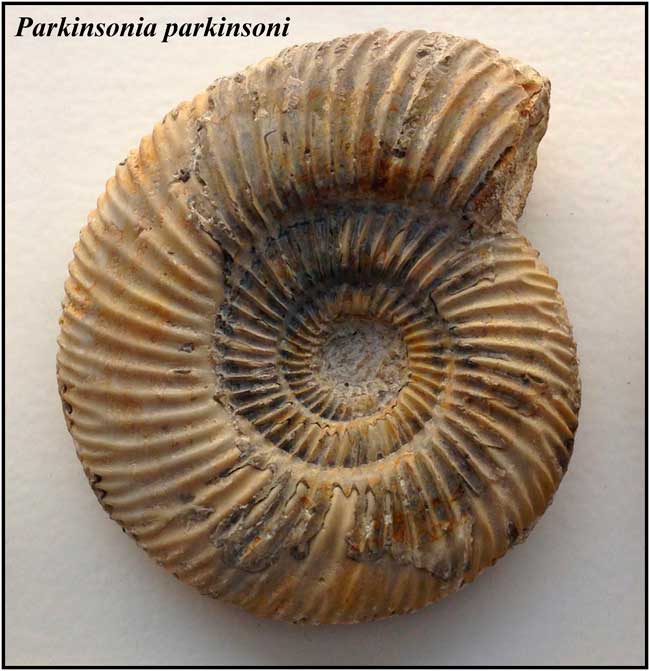
At the end of his life, James Parkinson was a celebrated geologist and paleontologist. In 1807, together with 12 other scientists, including four physicians, he founded the Geological Society of London, which is the oldest national geological society in the world. He was also a founding member of the Medical and Chirurgical Society of London along with Edward Jenner (1749-1823) and others. On his 68th birthday (April 11, 1823), James Parkinson became the first person to be awarded the honorary gold medal of the Royal College of Surgeons in consideration of “his useful Labors for the Promotion of Natural Knowledge, particularly expressed by his splendid work on Organic Remains – and of his liberal and valuable Information when called upon by the College, in its research for Facts relating to its Scientific Designs.”Reference Lewis 7 During the evening ceremony, his old friend Sir William Blizzard (1743-1835) delivered an oration in which he emphasized Parkinson’s achievement in the field of geology and paleontology and underlined the usefulness of his fossil collection, but did not allude to his extensive medical contribution. When Parkinson died the following year, his celebrated fossil collection was offered to the Royal College of Surgeons, but the amount requested for it by Parkinson’s wife was apparently too high; as a result, the collection went to auction and was dispersed throughout the world.Reference Lewis 7 Gideon Mantell commented on this issue: “After his [Parkinson’s] death his beautiful and choice collection was sold by auction. The fine series of silicified zoophytes was purchased by Mr. Featherstonhaugh, and taken to America; and some years afterwards, was destroyed by fire which consumed the museum in which it was placed.”Reference Mantell 12 However, some of Parkinson’s specimens are still on display in the geology section of the Museum of Natural History in London. Furthermore, in recognition of his contribution to the nascent field of paleontology, Parkinson’s name was given to many fossils, particularly those belonging to a group of fast-moving nektonic carnivores that lived about 170 million years ago and that are called ammonites (Figure 4).
Fossil of a Jurassic ammonite named Parkinsonia parkinsoni, a fast-moving nektonic carnivore that lived about 170 million years ago. It was found in Sherborne, Dorset, England, and is currently on display at the Natural History Museum, London. Wikimedia Commons (photograph by Kaldari).
Conclusion
James Parkinson was an archetypal figure of the long 18th century (1688-1815) in England. First a virulent political activist, then a popular medical writer, a scholarly medical contributor, a highly appreciated parish doctor, a prominent amateur chemist, a devoted madhouse doctor, and, finally, reaching fame during his lifetime as a paleontologist. There is no obvious link between petrified remains of a former life and Parkinson’s disease, except perhaps rigidity, which is the only major parkinsonian symptom that Parkinson overlooked and a feature shared by petrified specimens and Parkinsonian patients. What could be more rigid than a fossilized ammonite called Parkinsonia parkinoni? Thank you James Parkinson for your vast and multifaceted contribution to natural science and medicine.
Acknowledgement
The author expresses his deep gratitude to Martin Parent for his help with the illustrations.
Disclosures
None.



