


Introduction
Conflict arising from real and perceived threats to people’s lives and livelihoods predominates the discourse around human–carnivore interactions (Lozano et al., Reference Lozano, Olszańska, Morales-Reyes, Castro, Malo and Moleón2019). Implicated as a major driver behind the decline of large carnivores worldwide (Wolf & Ripple, Reference Wolf and Ripple2017), significant conservation efforts have been invested in managing human–carnivore conflicts. Most management approaches employ techno-administrative solutions to reduce or mitigate carnivore-related damage, such as monetary compensation schemes, livestock and pasture regulations, physical barriers and alternative income opportunities for local communities (Venumière-Lefebvre et al., Reference Venumière-Lefebvre, Breck and Crooks2022). The core assumption in most such solutions is that reducing or compensating material damages will increase people’s tolerance of carnivores that are perceived as problematic. However, the success of such measures remains ambiguous (Eklund et al., Reference Eklund, López-Bao, Tourani, Chapron and Frank2017). People’s interactions with carnivores, including responses and adaptations to material damages, are influenced by values, value orientations, attitudes, norms and emotions (Vaske & Manfredo, Reference Vaske, Manfredo, Decker, Riley and Siemer2012). Examining human–carnivore relationships solely through the narrow lens of material damage may simplify a dynamic and complex relationship, resulting in suboptimal conflict resolution and conservation management.
Perceptions and attitudes can significantly influence people’s willingness to coexist with wildlife, particularly carnivores (Kellert et al., Reference Kellert, Black, Rush and Bath1996; Mir et al., Reference Mir, Noor, Habib and Veeraswami2015). Conversely, sharing space with carnivores can also shape these perceptions. Whilst high costs of material damages can diminish tolerance, some communities have developed a certain acceptance of carnivores through long-term cohabitation (Zimmermann et al., Reference Zimmermann, Wabakken and Dötterer2001; Dhee et al., Reference Dhee, Linnell, Shivakumar and Dhiman2019). Living alongside carnivores allows communities to observe their behaviour and gain insights into their biology and ecology, enriching their traditional ecological knowledge (Berkes, Reference Berkes and Inglis1993). Such knowledge has often been used to accurately assess the risks of coexisting with wildlife and devise mitigation strategies (Kikvidze & Tevzadze, Reference Kikvidze and Tevzadze2014; Miller et al., Reference Miller, Jhala and Schmitz2016). Species-specific biological knowledge possessed and perpetuated by communities often aligns with ecological knowledge generated through conventional science-based approaches, but it may be inadequately developed for elusive species that infrequently interact with humans (Caruso et al., Reference Caruso, Luengos Vidal, Guerisoli and Lucherini2016). For instance, Lescureux et al. (Reference Lescureux, Linnell, Mustafa, Melovski, Stojanov and Ivanov2011) found that people’s knowledge of the biology of elusive and locally rare Balkan lynx Lynx lynx was poor, and misconceptions about its behaviour were common. These misconceptions heightened the perceived risk from the lynx, engendering fear and negative attitudes towards it.
Beyond empirical observations of behaviour, traditional ecological knowledge pertaining to carnivores may also encompass various cultural and/or spiritual beliefs (Berkes, Reference Berkes and Inglis1993). Studies of Indigenous and local communities across the globe often reveal unique conceptualizations of wild animals, notably large carnivores and mega-herbivores, that go beyond their ecological identity (Jalais, Reference Jalais2014; Thekaekara et al., Reference Thekaekara, Bhagwat and Thornton2021). We define ecological identity as biological traits and functional role of species within the ecosystem. Such species may be assigned the status of other-than-human persons with whom sharing of resources can be negotiated (Baynes-Rock, Reference Baynes-Rock2013; Dhee et al., Reference Dhee, Linnell, Shivakumar and Dhiman2019). Some cultures view carnivores as relatives or kin and consider hunting them as taboo (Aiyadurai, Reference Aiyadurai2016), and some revere them as deities who take livestock and human lives as part of divine retribution (Nair et al., Reference Nair, Dhee, Surve, Andheria and Linnell2021). Positive cultural symbolism can build tolerance and safeguard carnivores against lethal retaliation, even in the face of material damage (Baynes-Rock, Reference Baynes-Rock2013; Nair et al., Reference Nair, Dhee, Surve, Andheria and Linnell2021). Alternatively, negative cultural conceptualizations can increase the intensity of threats to carnivores, as has been observed with herpetofauna and nocturnal species such as owls and small primates (Glaw et al., Reference Glaw, Vences and Randrianiaina2008; Ceríaco, Reference Ceríaco2012; Nigam, Reference Nigam2019).
Academic literature on the social dimensions of human–carnivore interactions remains biased towards large, charismatic species, with little attention given to smaller, lesser-known carnivores with low conflict risk (Marneweck et al., Reference Marneweck, Butler, Gigliotti, Harris, Jensen and Muthersbaugh2021) such as the striped hyaena Hyaena hyaena. Solitary, elusive and nocturnal, the striped hyaena prefers semi-arid, rocky and scrub ecosystems with low human populations (Srivathsa et al., Reference Srivathsa, Majgaonkar, Sharma, Singh, Punjabi and Chawla2020). Its range spans from Africa to the Indian subcontinent and includes the Arabian Peninsula and the Middle East (AbiSaid & Dloniak, Reference AbiSaid and Dloniak2015). Subsisting largely through scavenging, the striped hyaena sometimes occurs in peri-rural areas, causing little to no reported economic loss (Srivathsa et al., Reference Srivathsa, Puri, Karanth, Patel and Kumar2019). However, it is often implicated in livestock depredation and crop damage (Mills & Hofer, Reference Mills and Hofer1998), motivating lethal retaliation (Mitra, Reference Mitra2020). Additionally, it is a victim of negative perceptions and superstitious beliefs (Frembgen, Reference Frembgen1998). Its reputation as a ‘grave robber’ often leads to its persecution. In the Middle East, it is heavily hunted because hyaena meat is considered an aphrodisiac and its genitalia are thought to have spiritual powers (Tourani et al., Reference Tourani, Moqanaki and Kiabi2012; Von Jaffa, Reference Jaffa2020). Other threats include road mortality and habitat loss (AbiSaid & Dloniak, Reference AbiSaid and Dloniak2015; Srivathsa et al., Reference Srivathsa, Majgaonkar, Sharma, Singh, Punjabi and Chawla2020). Consequently, striped hyaenas have become extirpated in many locations (Mills & Hofer, Reference Mills and Hofer1998; Khorozyan et al., Reference Khorozyan, Malkhasyan and Murtskhvaladze2011; Akash et al., Reference Akash, Dheer, Dloniak and Jacobson2021).
The striped hyaena is an understudied carnivore in India, where it is widely distributed (Srivathsa et al., Reference Srivathsa, Majgaonkar, Sharma, Singh, Punjabi and Chawla2020). The species has only been assessed twice for the IUCN Red List (Mills & Hofer, Reference Mills and Hofer1998; AbiSaid & Dloniak, Reference AbiSaid and Dloniak2015). The hyaena population in the state of West Bengal, India, is a remnant of a much wider distribution that once extended further eastwards into the neighbouring nation of Bangladesh (Akash et al., Reference Akash, Dheer, Dloniak and Jacobson2021). Being excluded from the previous IUCN assessments and scientific research, the hyaenas of West Bengal have only gained prominence owing to chance negative interactions with humans (Mitra, Reference Mitra2020). In this study, we examined the local community’s knowledge and perceptions of the striped hyaena in Purulia district, West Bengal, using a mixed-methods approach. The results may be used to build locally tailored conservation programmes that integrate community knowledge to facilitate coexistence of people and hyaenas.
Study area
Purulia is the western-most district of West Bengal, with a population of 2,930,115 people (52% male) at a density of 468 people/km2 (Census of India, 2011). The district consists of 20 administrative blocks, two of which form our study area: Baghmundi and Jhalda I (Fig. 1), with a combined area of 743.04 km2. Both possess contiguous forest tracts and a diverse wildlife assemblage (Mukherjee et al., Reference Mukherjee, Chongder, Ghosh, Dutta, Singh and Dutta2021). The two blocks are divided into 286 block sub-divisions, locally known as mouzas (Supplementary Figs 1, 2). The land cover includes Reserved Forests (legally protected forests with strict control over grazing, hunting and timber use), unprotected forest patches, plantations, rocky outcrops, croplands and human settlements. Apart from the striped hyaena, carnivore species in the area include the leopard Panthera pardus, sloth bear Melursus ursinus, golden jackal Canis aureus, Bengal fox Vulpes bengalensis, Indian grey wolf Canis lupus pallipes, jungle cat Felis chaus, Indian grey mongoose Urva edwardsii, ruddy mongoose Urva smithii, common palm civet Paradoxurus hermaphroditus and small Indian civet Viverricula indica (Biswas et al., Reference Biswas, Saren and Basu2008).
Location of the study sites Jhalda I and Baghmundi blocks in Purulia district of West Bengal state, India. The map also depicts the point locations of the 104 interviews analysed during the study, and the cultural species identity ascribed to the photograph of the striped hyaena Hyaena hyaena during the selected interview in each location. The cultural species identity Gaadha denotes a scavenger associated with riversides and cremation grounds, and Kuia refers to a highly aggressive creature believed to attack humans. Jargo mouza is the location where a striped hyaena attack incident occurred in 2020.

The Indian constitution recognizes certain socially deprived communities occupying the lowest level of the orthodox Hindu society as Scheduled Castes, and designates certain Indigenous communities as tribal and categorizes them under Scheduled Tribes. The human population in Purulia district mainly comprises local Scheduled Castes, Scheduled Tribes and migrants from the neighbouring states. Residents engage in marginal farming, livestock rearing, industrial/household work and other services.
Methods
Data collection
We conducted interviews with 397 respondents, using an opportunistic sampling approach, resulting in typically 2–6 interview locations per mouza. To ensure even spatial coverage and representation of views from both blocks in our study area, we restricted the sample to one interview per mouza to be included in the final dataset for further analysis. After filtering in this manner, we retained 104 interviews, covering c. 50% of the total number of mouzas from both blocks.
Before initiating interviews or audio-recording any responses, we explained the study objectives and obtained verbal consent from potential participants. We conducted interviews in Bangla, with the help of local Bangla-speaking field assistants. The semi-structured interviews comprised open- and close-ended questions (Supplementary Material 1). Recorded oral testimonies were transcribed and translated into English in consultation with field assistants to ensure accuracy and preserve the social context of responses in the translated data. We conducted surveys during February 2021–July 2022. Interviewees’ responses were linked to the mouza in which they resided.
To reduce exaggerated reporting of negative interactions with the striped hyaena or misattribution arising from incorrect species identification, we showed interviewees photographs of the striped hyaena and four co-occurring carnivores, in the following order: Bengal fox, golden jackal, Indian grey wolf, striped hyaena and leopard (Supplementary Fig. 3). We asked respondents to identify each species and provide information on its ecological traits. Initially broad in scope, our enquiry about ecological traits became more targeted if we found that respondents were unable to provide information on certain carnivores or mentioned local species names that we were not familiar with. These questions were followed by open-ended conversations to gather data on participants’ perceptions and opinions of each carnivore, with a focus on the striped hyaena and its scavenging behaviour.
Quantitative analysis
To assess how respondents’ ecological knowledge of wildlife aligns with information gained from conventional scientific approaches and how this alignment varies across species, we analysed the information they provided about the ecological traits of the five carnivores. For consistency, we focused on four ecological traits that interviewees commonly mentioned for all five carnivores: description of physical appearance, diet, habitat and behaviour. In each interview, the participant’s responses about these traits were classified as either congruent with scientifically gathered facts, incongruent with these facts, or not addressed, coded as 2, 1 or 0, respectively. We then calculated the proportion of interviews with congruent responses for a given trait out of the subset of interviews in which that trait was discussed (Supplementary Table 1). This provided a measure of the alignment of respondents’ species-specific ecological knowledge with scientifically generated knowledge. We then compared alignment across carnivore species to assess respondents’ familiarity with their biological and ecological characteristics.
Qualitative analysis
For the qualitative analyses, we only focused on the responses pertaining to the striped hyaena. Taking an ethnozoological approach, we examined the characteristics of various cultural species identities of the striped hyaena. We define cultural species identity as the symbolic, spiritual or social meaning ascribed to a species, usually accompanied by a local name and associated beliefs, myths and folklores. We documented the descriptions of physical appearance, habitat, diet and behavioural traits associated with two specific cultural species identities ascribed to the hyaena. Delving deeper into the myths, omens and folklore associated with these cultural species identities, we examined the difference in people’s perceptions of the hyaena depending on which of these two cultural species was ascribed by the respondent. We also examined the community’s perceptions of the striped hyaena’s scavenging behaviour and the nature of people’s reported interactions with the species.
Results
Interviews generally lasted c. 35 minutes; some were shorter (c. 15 minutes) when respondents were reluctant to answer certain questions or abandoned the interview. The interviewees still provided interesting insights justifying inclusion of the short interviews in the final set for analysis. Most respondents were men (96%) aged between 30 and 50 years, with agriculture as their main occupation. Secondary occupations included livestock herding, daily wage labour and Beedi (cigarette) making. Approximately 31% of the respondents belonged to the Scheduled Castes and c. 4% of the respondents identified themselves as members of Scheduled Tribes.
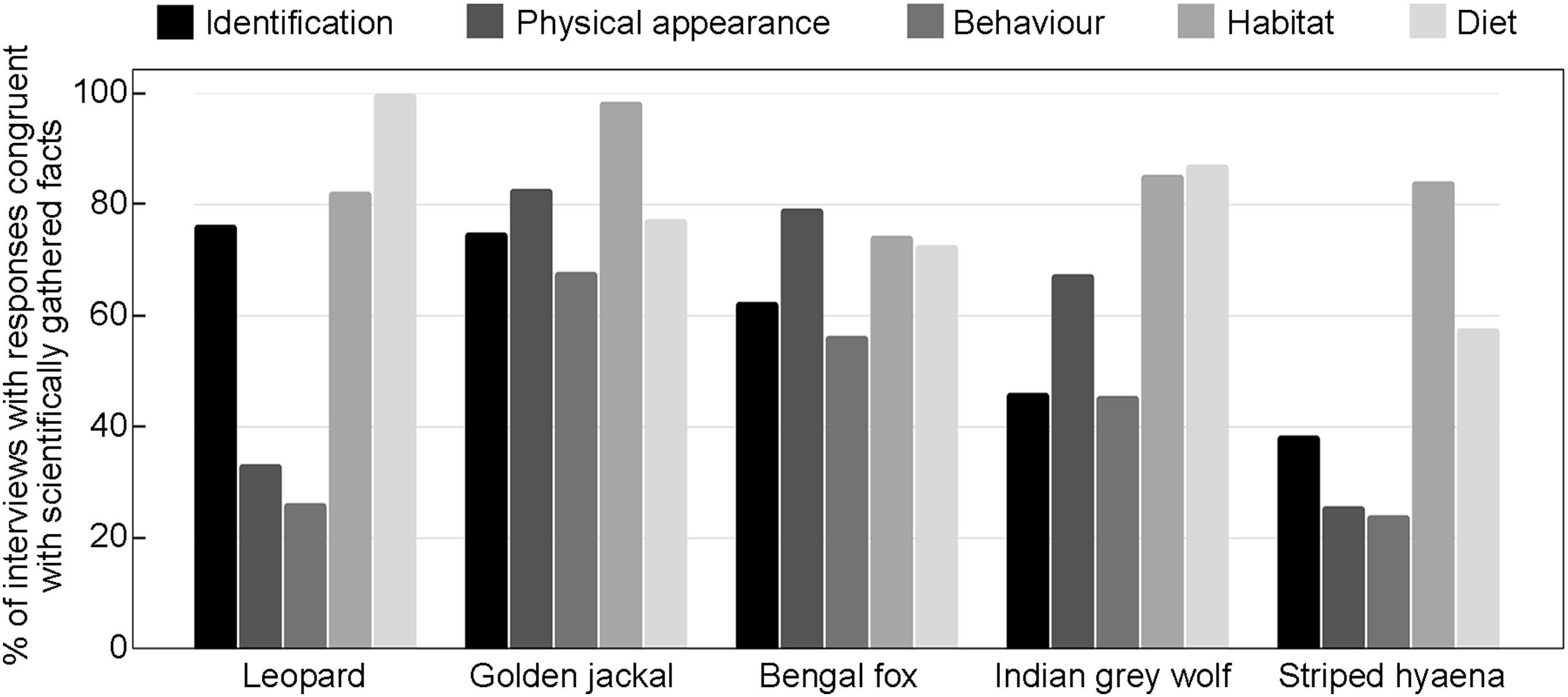
Most respondents could correctly identify leopard, golden jackal and Bengal fox from the photographs presented to them (76%, 75% and 63% respectively); respondents appeared to be less familiar with the Indian grey wolf (46%) and striped hyaena (39%). There was lower awareness of most ecological traits related to the striped hyaena compared with those of the other carnivores. We identified the diet of the striped hyaena as the species’ most widely known and consistently recognized trait, followed by knowledge about its primary habitat (Fig. 2).
Alignment between interview respondents’ species-specific ecological knowledge and scientifically gathered knowledge for five co-occurring carnivores within the study area: leopard Panthera pardus, golden jackal Canis aureus, Bengal fox Vulpes bengalensis, Indian grey wolf Canis lupus pallipes and striped hyaena. Level of alignment is quantified as the per cent of interviews in which respondents’ descriptions of the ecological traits of the species were congruent with scientifically gathered facts.

Identification of striped hyaena
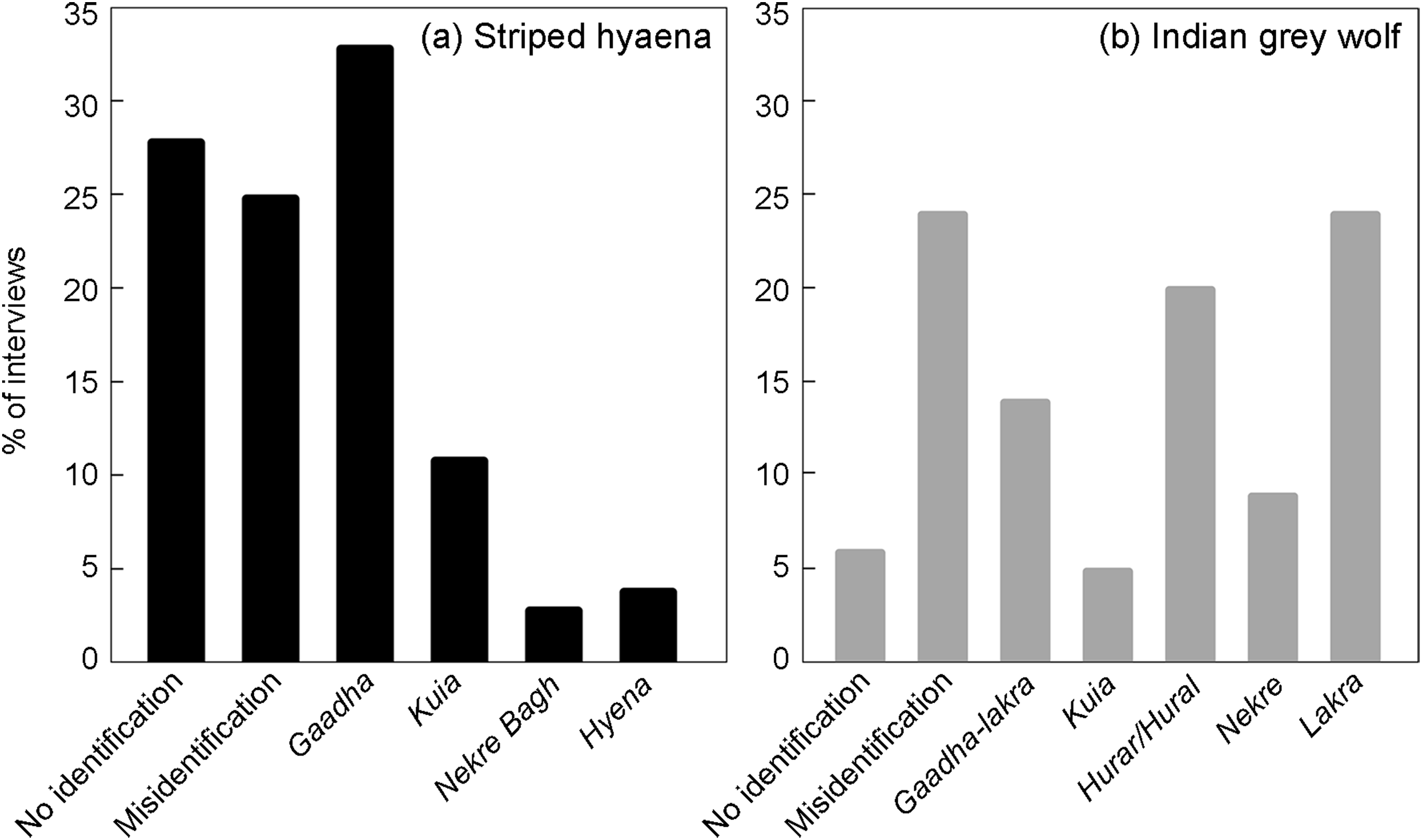
Out of our final sample of 104 interviews, 28 participants could not provide any local names upon seeing a picture of a striped hyaena, reporting that they had never seen it in their area. In 25 interviews, participants misidentified the hyaena as another species. In the remaining 51 interviews, respondents used various local names to identify the picture of the striped hyaena (Fig. 3). The two most commonly used names were Gaadha (n = 33) and Kuia (n = 11). Descriptions of ecological and behavioural traits associated with Gaadha aligned closely with scientifically recognized traits of the striped hyaena, whereas those associated with Kuia showed less congruence with these facts. Interviewees who identified and perceived the striped hyaena as Gaadha were distributed across the study site, whereas those who ascribed the identity of Kuia were clustered in and around Jargo mouza (Fig. 1), the location of an attack incident in 2020.
Responses given by 104 interviewees when presented with pictures of (a) the striped hyaena and (b) the Indian grey wolf and asked to identify the species. In addition to cases of misidentification or failure to identify the species, respondents also attributed various cultural species identities to these two carnivores. These identities align with the concept of folk generic names in folk taxonomic classification (Berlin et al., Reference Berlin, Breedlove and Raven1973), which extend beyond morphological distinctions to incorporate perceived behaviours and ecological roles. Gaadha and its variation Gaadha-lakra denote a scavenger associated with riversides and cremation grounds, and Kuia refers to a highly aggressive creature believed to attack humans. Notably, the term Kuia was frequently associated with the striped hyaena in mouzas around Jargo, where a hyaena attacked a local farmer in 2020. The term Hyena refers to hyaenas as displayed in global media and international wildlife documentaries (e.g. Discovery Channel).

Gaadha as a descriptor of striped hyaena
Culturally, Gaadha referred to a nocturnal, forest-dwelling scavenger, sighted either singly or in pairs, but never in a pack. Participants reported seeing it near riversides and graveyards. Most (61%) said that it no longer occurred in their area although some said numbers were declining. Gaadha was described as the one that eats the dead, digs up the dead and/or feeds on dead humans. Some also believed that in the past the species used to enter villages to ‘take away dogs and pups’ and occasionally prey on young livestock.
The Gaadha was thought to be larger than most carnivores, except for the leopard, with a Boro Matha (big head), a large, striped body and long hair on its back and neck. Few found it to be beautiful; others thought it was scary and smelled unpleasantly. According to some respondents, carrying corpses gave Gaadha a hunched back and possibly also inspired its name from the Hindi word for donkey, Gadha. According to respondents from Digardi mouza, ‘While all other animals eat living things, it [Gaadha] does the opposite and eats dead things. That is why we call it Gaadha’ (laughing).
Perceptions of striped hyaena as Gaadha
Respondents generally thought that Gaadha did not cause damage, unlike the golden jackal or grey wolf, which preyed on livestock, or the leopard and Asian elephant Elephas maximus, which caused human fatalities. These traits of Gaadha led some to view the striped hyaena somewhat positively. Despite the prevalent belief that Gaadha was harmless, many respondents expressed indifference towards striped hyaenas, and some were fearful of it. Gaadha was believed to block commuters in their path at night, a behaviour called teka-teki, by refusing to move whilst slapping its tail, either standing or sitting. It was believed to often bare its teeth and growl at people ‘like a dog’, reportedly frightening many respondents. Interviewees stated that this behaviour contrasted with that of golden jackals and Bengal foxes, which typically flee at the sight of humans.
The Gaadha’s perceived bold behaviour led to striped hyaenas being viewed as a threat, although this varied among interviewees. Some respondents reported moving in groups at night, some believed throwing stones would scare the hyaena away, and some believed that standing one’s ground would cause the hyaena to lose interest and leave; running away may provoke a chase. All these examples were defence or adaptive mechanisms adopted by interviewees who were more familiar with striped hyaenas. Those who had only experienced a single encounter, or who had only heard about this behaviour through stories about the Gaadha, expressed fear of striped hyaenas. For example, a respondent from Tanasi mouza stated ‘It [striped hyaena] is a very aggressive animal. I don’t know but I feel scared when I see it [in the picture]. It blocks people’s path by sitting in the middle of the road and beating its tail against the ground. It frightens and scares people this way. It is not scared of living humans’.
Perceptions of Gaadha’s scavenging behaviour
The study area is inhabited mostly by Hindus who typically cremate the dead. However, financial hardships compelled some residents to bury corpses by the riverside because cremation is too expensive. Respondents who identified the striped hyaena as Gaadha believed it unearthed and fed on the buried corpses at night. This behaviour was perceived as disturbing, especially for the deceased’s family, and many expressed their disapproval of such ‘grave-robbing’ behaviour. People widely believe that a deceased person will fail to attain peace if their body is consumed by a hyaena instead of decomposing naturally and ‘uniting with the earth’. A respondent from Paprahurum mouza considered striped hyaenas inauspicious: ‘We believe, after death, if a person gets eaten by a Gaadha, it is implied that the person must have done something bad in his lifetime. This brings a bad name to the family. The family members consider it inauspicious and will go to an exorcist to treat the evil in exchange for some money. That is why it is a little bad in our eyes’.
To prevent such incidents and deter hyaenas from burial sites, respondents claimed that villagers covered graves with large boulders. Some interviewees also mentioned that in the past, people formed large groups to carry the deceased for cremation, anticipating hyaena attacks. They believed hyaenas could jump into funeral pyres to seize the corpse. Surprisingly, some interviewees did not object to hyaenas consuming human corpses so long as it was not visible to them. Others believed that such grave-digging by hyaenas no longer occurred and were not concerned about this behaviour.
Residents in the study region either buried dead livestock near the village or discarded it by riversides and forest edges. Respondents viewed scavenging on openly disposed of livestock carcasses positively when it occurred away from the village, as it helped eliminate foul odours. In contrast, digging up and scavenging on carcasses near the village was viewed negatively because of the resulting mess. This perception was influenced by respondents’ observation of dogs inefficiently scavenging dead livestock and offal. One interviewee from Betad mouza mentioned they did not allow any animal to consume dead livestock, fearing this might cause attraction to live domestic animals. Further, feeding on carcasses was believed to adversely affect carnivores’ sanity and turn them overly aggressive towards humans. This belief caused scavenging to be perceived as a potential hazard for humans as well as livestock: ‘There is a chance that if any animal eats the dead carcasses and goes mad then it could harm humans. Every animal’s body contains some kind of poison, doesn’t it? Dogs also have poison; man, also has poison. Now, we eat meat but we cook it, otherwise we could get sick. Cooking kills the poison. These things are not cooked and when we throw dead livestock it has an even greater number of microbes. It becomes very poisonous and if consumed, it can make an animal go crazy’.
Kuia as a descriptor of striped hyaena
Kuia was discussed during 57 interviews, but it was ascribed to the image of striped hyaena in 11 interviews, the grey wolf in five, and the golden jackal and Bengal fox in one interview each. In the remaining 39 interviews, it was not used as an identifier for any species photograph. Respondents believed Kuia was either rare or absent in their area. Most claimed to have never seen one; their knowledge of it came from elders or other community members. Participants described Kuia as resembling a cat, dog or golden jackal in size, with a long narrow muzzle, slender black body, straight back and long, sharp claws. Pelage markings were not reported on Kuia’s body. Whilst some considered Kuia a pack hunter, others believed it to be solitary, differing from other carnivores in its ferocity as a hunter. ‘Kuia is capable of killing cattle. Hurar (wolf) does not hunt cattle; it only takes goats and sheep’, said a respondent from Ichatu mouza.
Kuia reportedly attacked prey from the rear to fatally injure it, or killed multiple animals in a single instance out of anger. Some believed it hunted livestock not for meat but to ‘suck the blood and leave the body’. Besides a savage temperament, Kuia was said to possess exceptional strength and agility, allowing it to tackle much larger prey such as leopards and even elephants. Locals believed it could easily ‘rip an elephant apart’ and thus posed a potential threat to humans. An interviewee from Ichatu cautioned, ‘It [Kuia] kills sheep by smashing it on the ground. Nothing can be done when it does that. At that time, it can attack humans, too, when it gets angry’. A participant from Chandai mouza mentioned that Kuia was a cuss word used for people when they behave miserly and elaborated on its usage for the animal as follows: ‘[Kuia is] someone who always takes but never gives. If something gets in the hands of a Kuia, you will never get it back. Goats, sheep; a Kuia will attack a cow also. If three Kuia are together, then if there’s a man or a cow, they can kill it’.
Perceptions of striped hyaena as Kuia
In the 11 interviews where the striped hyaena was identified as Kuia, perceptions of it were predominantly negative. These respondents tended to associate striped hyaenas with negative interactions, although very few had first-hand experiences. Amongst them was the victim of an incident in Jargo mouza during August/September 2020, when a local farmer was attacked by a striped hyaena. The incident was covered by several local news outlets (Abhik, 2020). According to reports, the victim, accompanied by his wife, was returning home after forest-grazing his cattle when the attack occurred. Supposedly, it was the first reported encounter with a striped hyaena in the area and the incident sparked intense fear and panic amongst the villagers of Jargo and other nearby mouzas. The victim and other respondents who had identified the striped hyaena as Kuia reported it had never been seen in Jargo before the incident. The victim recounted how his wife saved him by ‘pushing the animal into the water’. The hyaena reportedly lingered in the area for a few more days, causing minor attacks. When asked about seeing a striped hyaena again, the victim expressed fear not just of hyaenas but of all carnivores, ‘Even a dog passing from a close distance frightens me’, he said.
This incident was well known in the mouzas near Jargo. Seven additional respondents referenced it, with slightly different versions: ‘A woman was working in the field when Kuia attacked her. People gathered and then killed the Kuia with a gun. That is when I saw Kuia’, said a respondent from Ilu mouza. After this incident, villagers began travelling in groups whilst on foot, and carrying sticks for protection, fearing a possible assault by Kuia.
An interviewee from Betad mouza recounted another incident involving the Kuia (ascribed to striped hyaena). He was at the riverside with some villagers, grazing his buffaloes, when a Kuia allegedly ‘started attacking people’. The villagers gathered around it and ‘out of fear, killed the Kuia’. This interviewee perceived jackals as better neighbours than striped hyaenas: ‘Whatever it [golden jackal] does, it never harms people [physically]. We have no anger towards Siyal [golden jackal]; but we do have anger towards the Kuia [striped hyaena]; it is not afraid of humans’.
Interestingly, respondents from Mathari mouza also identified the striped hyaena as Kuia but were aware of the scavenging Gaadha. ‘Kuia eats living things therefore it is not nice, unlike the Gaadha. If it is too late in the evening, then the Kuia will catch hold of you. It is not nice’.
In local knowledge, scavenging on dead, decaying matter and fatally attacking humans were recognized as behavioural traits of two distinct species, the former attributed to Gaadha and the latter to Kuia.
Other identities ascribed to striped hyaena
In four interviews, respondents identified the striped hyaena as the Hyena seen on the Discovery Channel on television. They mentioned that it hunted livestock and attacked humans. ‘If this animal causes a lot of nuisance, then we set traps for it. If it harms humans, humans will retaliate, right?’, said an interviewee from Mahakudar mouza. Interviewees reported attacks on humans by this Hyena in Bansa and Kotshila mouzas, but they could not be confirmed. Some believed Hyena attacked humans when ‘its brain stopped functioning properly’. The name Nekre Bagh was used to identify the striped hyaena in three interviews. In Bangla, Nekre denotes grey wolf, whilst Bagh implies a tiger Panthera tigris or a big cat. Thus, Nekre Bagh translates to ‘wolf with stripes’. A variant of Gaadha, namely Gaadha-lakra, a combination of Gaadha and Lakra (a local name for wolf in Baghmundi block), was used by many interviewees from Jhalda I block to identify the grey wolf as the grave-robbing animal. In some mouzas, grey wolf and striped hyaena were considered as members of the Bagh family, which also includes tigers and leopards.
Discussion
Interactions with nature and wildlife can foster in-depth community knowledge about ecological traits including morphology, behaviour, distribution and habitat use (Dhee et al., Reference Dhee, Linnell, Shivakumar and Dhiman2019). In our study, nearly all respondents routinely encountered and closely observed the golden jackal and Bengal fox because of their diurnal/crepuscular habits, social behaviour, frequent predation on poultry and regular presence near human settlements. This may have caused community-generated knowledge of these two carnivores to align most closely with that derived from conventional scientific studies (Fig. 2). In contrast, limited interactions with leopards, grey wolves and striped hyaenas, as a result of their nocturnal, rare and elusive nature, may have led to gaps in respondents’ knowledge of the ecology and biology of these carnivores (Fig. 2). Less detailed knowledge about the striped hyaena’s presence, distribution and ecological traits amongst the participants in our study could be attributed to limited interactions as a result of its solitary, elusive habits (Geptner, Reference Geptner1988) and sparse distribution (Akash et al., Reference Akash, Dheer, Dloniak and Jacobson2021). However, we found that prevalent spiritual beliefs, cultural narratives, sporadic encounters, shared experiences and media representations formed the basis of respondents’ knowledge about the striped hyaena and shaped their perceptions of the species.
Cultural species identities
The various cultural species identities used by respondents to identify the striped hyaena and grey wolf (Fig. 3) align with the concept of folk generic names within folk taxonomic classification (Berlin et al., Reference Berlin, Breedlove and Raven1973). Beyond morphological distinctions, such names may incorporate perceived behaviours and functional roles within the environment. For example, a carnivore that howls and hunts in groups was identified by respondents as Hural or Lakra, synonymous with Nekre, meaning wolf in Bangla. Meanwhile, respondents referred to a necrophagous carnivore, particularly one that fed on human corpses and animal carcasses, as Gaadha or Gaadha-lakra. The lore of Kuia represented a small yet powerful carnivore perceived as a significant threat to human life. The incorporation of the name Hyena in the folk nomenclature of the study area reflects the influence of global media and international wildlife documentaries on people’s local knowledge of rarely encountered carnivores. Bulmer (Reference Bulmer1967) describes how folk taxonomic classifications often rely on nuanced, culturally constructed distinctions that may diverge from scientific classifications. In our study area, the term Bagh carried strong cultural connotations of predation and fear. Consequently, some respondents considered Gaadha and Kuia members of the Bagh family, placing wolves and hyaenas alongside apex predators such as tigers and leopards, possibly because of their predatory nature or perceived ability to engender fear.
The Gaadha’s human-scavenging habits elicited deep cultural and spiritual unease in many respondents. Drawing from Douglas (Reference Douglas1966), the Gaadha’s disturbance of human graves blurred sacred boundaries between life and death, creating a potent sense of ritual pollution. Such acts were seen as defiling sacred death rites and disrupting the spiritual transition of the deceased. When identified as Gaadha, the striped hyaena took on a symbolic role beyond scavenging, becoming a supernatural disruptor and a source of impurity and shame. Conversely, the community viewed livestock scavenging pragmatically when it occurred at a distance from human dwellings. This reflects the concept of ‘matter out of place’, detailed by Douglas (Reference Douglas1966), where scavenging remains acceptable as long as it respects boundaries between wild and domestic spaces. Scavenging within human settlements was perceived as a breach of order and a source of contamination. Further, the associated misconceptions that scavenging itself might eventually lead to attacks on humans and livestock diverges from the scientific understanding of scavenging as a vital ecosystem service.
Repeated interactions with carnivores can help communities to accurately assess the level of risk they pose (Zimmermann et al., Reference Zimmermann, Wabakken and Dötterer2001; Dhee et al., Reference Dhee, Linnell, Shivakumar and Dhiman2019). Most respondents in our study had never seen a wild striped hyaena and were unaware of its presence in the landscape; these respondents expressed indifference. In contrast, limited first-hand interactions led to unfamiliarity with the hyaena’s typical bold behaviours, such as standing its ground when approached by humans, inducing fear during rare, unexpected encounters. Because humans are likely to react based on the emotions felt during interactions with carnivores, rather than gauge the actual threat they pose (Manfredo, Reference Manfredo2009; Vaske & Manfredo, Reference Vaske, Manfredo, Decker, Riley and Siemer2012), sudden fear-imbued experiences with hyaenas could have perpetuated a negative perception. On the other hand, some respondents who claimed to have sighted the hyaena more frequently viewed it as a manageable threat; this is probably a result of respondents being familiar with the species’ bold behaviour and having developed strategies to prevent negative interactions (Kleiven et al., Reference Kleiven, Bjerke and Kaltenborn2004).
Historically, rare or stressful encounters with carnivores have triggered intense fear and societal paranoia, often leading to targeted persecution of these animals, even when the actual risk they pose is relatively low (Knight, Reference Knight and Knight2000). Between March and September 2024, a series of attacks on children and adults in Bahraich (Uttar Pradesh, India), were attributed to wolves, an unusual behaviour for the species. Panic caused by a prevalent cultural belief that wolves are ‘child lifters’ and sensational media reporting led to the capture of six wolves by wildlife officers, as well as several jackals and feral dogs being injured or killed (Menon & Sahu, Reference Menon and Sahu2024; Singh, Reference Singh2024). Because a direct threat to human life is perceived as the highest risk from carnivores (Kleiven et al., Reference Kleiven, Bjerke and Kaltenborn2004; Goodale et al., Reference Goodale, Parsons and Sherren2015), such isolated, atypical encounters may significantly shape perceptions and diminish willingness for coexistence with these carnivores.
We expect social animosity and a heightened perceived threat from the striped hyaena amongst residents in places where the hyaena is believed to be a Kuia because of the mythical attributes ascribed to this figure in local lore. Similar patterns have been observed in the case of other carnivores. Lions Panthera leo in East African countries are often persecuted because they are associated with witchcraft (Dickman, Reference Dickman, Siegrist, Clivaz, Hunziker and Iten2006). Fostering social tolerance and coexistence with carnivores may require integration of positive cultural portrayals by popularizing the ecological and biological reality of the species (Jalais, Reference Jalais2008; Dhee et al., Reference Dhee, Linnell, Shivakumar and Dhiman2019; Nair et al., Reference Nair, Dhee, Surve, Andheria and Linnell2021). For example, wolves, often negatively portrayed in Western folklore because of the livestock damage they can cause, were persecuted in the 19th and early 20th centuries (Kellert et al., Reference Kellert, Black, Rush and Bath1996). To aid their recovery in the latter half of the 20th century, newer narratives were perpetuated portraying wolves as victims of unjust social evil and popularizing their ecological role (Mech, Reference Mech1995).
Traditional ecological knowledge
Our research demonstrates how non-charismatic and lesser-known species, which are often rare and elusive, may have ill-defined and flexible identities in traditional ecological knowledge systems. We caution against the common notion in conservation discourse that local residents living alongside various wild species always have adequate knowledge of their ecology. There may be a strong agreement between traditional ecological knowledge and scientific knowledge regarding carnivores that frequently interact with humans, but this may not be the case for elusive carnivores that communities encounter rarely (Kikvidze & Tevzadze, Reference Kikvidze and Tevzadze2014; Caruso et al., Reference Caruso, Luengos Vidal, Guerisoli and Lucherini2016). Further, the relationships with such carnivores are likely to be complex and beyond mere binaries of conflict or complete harmony. In fact, material damage to local residents was one of the least-reported negative interactions with hyaenas in our study area, which contrasts with previous findings of human–hyaena relationships from this landscape (Mukherjee et al., Reference Mukherjee, Chongder, Ghosh, Dutta, Singh and Dutta2021). We show how understanding the cultural fluidity of carnivore identities could lead to better comprehension of human–carnivore interactions.
The way people in Purulia perceive hyaenas may not necessarily translate into negative action against these carnivores. However, as shown by the 2020 attack incident in Jargo, isolated yet extreme events may build on negative perceptions perpetuated by cultural beliefs and could encourage misplaced retribution. As in other areas where people share space with wild carnivores, interactions between humans and hyaenas, as well as with other carnivores, are likely to increase in Purulia. Conservation programmes should be designed to not only address extreme conflict incidents through public engagement, but also to integrate varied local perceptions into information and communication initiatives for long-term tolerance building. We recommend extensive awareness and outreach programmes that use audio-visual media to promote awareness amongst the local population of the ecology of carnivores in the region. Novel methods integrating socio-psychological approaches with local advocacy tools can repudiate negative myths about scavenging and highlight it as a beneficial ecological service (waste removal, disease control).
Study limitations
A major limitation of our study was the predominance of male respondents. Most interviews were conducted in public spaces, where we primarily encountered men. Even where we visited households to interview women, most declined because of time constraints and/or cultural restrictions on women interacting with strangers. Despite our best efforts to ensure representation of women’s as well as men’s views, most women we approached requested that we interview the men of the households.
Conclusion
Carnivore conservation in human-dominated landscapes remains a serious challenge globally. Scholarly literature pertaining to this issue is skewed towards assessing material damages caused by carnivores, with little attention given to the socio-cultural and psycho-social factors that may be equally if not more important to coexistence. As demonstrated through our case study of the striped hyaena in West Bengal, such factors shape and are themselves shaped by interactions between species ecology and human society. Going beyond attributes such as age, gender and income, we show through a qualitative approach that the nature of interactions, myths, folklore and other social aspects creates a certain knowledge–attitude–behaviour complex towards the striped hyaena. Although an emic approach (that is, one that centres local understanding) would ideally capture these cultural intricacies, our survey design adopted an etic approach. Recognizing this limitation, we hope our work encourages scientists and conservation practitioners to explore emic approaches that would complement and augment our findings. Furthermore, although traditional ecological knowledge is valuable, it should not be uncritically idealized (Davis & Ruddle, Reference Davis and Ruddle2010). For species that interact infrequently with people, cultural predispositions can overshadow knowledge of species ecology derived from direct observations. Such traditional knowledge systems are not bound in space and time; community character and knowledge are amenable to change in tandem with other societal changes. Based on our work, we call for locally tailored, place-based conservation programmes as opposed to blanket, ubiquitous interventions that may yield limited conservation success.
Author contributions
Study design: TA, AS, SB; field work, data analysis: VM; writing: VM, TA, SB, AS; revision: TA, SB, AS.
Supplementary material
The supplementary material for this article is available at doi.org/10.1017/S003060532500033X
Acknowledgements
We thank the local residents of Jhalda I and Baghmundi for participating in this study and contributing their varied experiences; S. Chatterjee and HEAL for providing logistical support and moral encouragement; and P. Chowdhary, S. Das, S. Dawn, D.B. Kuiry and P.K. Ghosh for assisting with data collection. This research did not receive any grants from any funding agency. We thank our respective institutions for providing infrastructure and other in-kind support during the study. AS was supported by the Department of Science and Technology–Government of India’s Innovation in Science Pursuit for Inspired Research Faculty Award. We are also grateful to the reviewer and editor of Oryx, whose comments and constructive feedback substantially improved this article.
Conflicts of interest
None.
Ethical standards
This research abided by the Oryx guidelines on ethical standards. It was conducted as part of a master’s programme and did not require approval or oversight from an ethics board, but we ensured that the research adhered to the standards set by the British Sociological Association. All interview participants were informed about the project objectives and the intended use of their testimonies. Audio recordings of interviews were made only after obtaining participants’ informed verbal consent. All interview data were securely stored in password-protected systems. Anonymity and confidentiality of respondents were maintained throughout the stages of data collection, curation, analysis and manuscript preparation.
Data availability
The participants of this study did not give written consent for their data to be shared. Because of the sensitive nature of the research, the supporting data are not publicly available.



 Open access

