


Statement of Research Significance
Research Question(s) or Topic(s): Executive function refers to a constellation of abilities, including cognitive flexibility, planning, manipulating information in one’s mind, and inhibiting distracting information. Executive function declines with age. Here we examined how physical activity and different types of physical fitness were related to executive function and aging. Main Findings: Physical fitness, but not physical activity, was linked to executive function, regardless of one’s age. Physical activity was linked to cardiorespiratory fitness and grip strength, which in turn were associated with better executive function. The indirect link between physical activity, cardiorespiratory fitness, and executive function was significant in the older participants, but not the youngest participants, although the strength of the effect was not significantly different between the age groups. Study Contributions: Our study demonstrates that different fitness domains have different associations with executive function. Maintaining cardiorespiratory fitness and strength with physical activity is likely important to maintain executive function abilities.
Introduction
One domain of cognition susceptible to decline with age is executive function, which refers to effortful, higher-level processes involved in goal setting, information updating and monitoring, inhibition, and the top-down control of other cognitive abilities (Diamond, Reference Diamond2013; Miyake et al., Reference Miyake, Friedman, Emerson, Witzki, Howerter and Wager2000). Executive function serves a vital role in motivation, emotion regulation, inhibiting behavioral impulses or prepotent responses, and psychosocial functioning (Luszcz, Reference Luszcz, Schaie and Willis2011; Reuter-Lorenz et al., Reference Reuter-Lorenz, Festini, Jantz, Schaie and Willis2021). Executive function has been associated with health-related quality of life (Laera et al., Reference Laera, Joly-Burra, Zuber, Ballhausen, Künzi, Ihle, da Silva Coelho, Haas, Mikneviciute, Tinello, Kliegel and Hering2023) and instrumental activities of daily living among older adults (Brothers & Suchy, Reference Brothers and Suchy2022), highlighting the need to identify the extent to which modifiable lifestyle factors are associated with executive function in older adulthood.
One modifiable lifestyle factor associated with better cognitive function among older adults is physical activity. Physical activity describes any bodily movement produced by skeletal muscles that results in energy expenditure above basal levels (Vanhees et al., Reference Vanhees, Lefevre, Philippaerts, Martens, Huygens, Troosters and Beunen2005). Across adult age groups, higher physical activity levels have been associated with better cognitive performance cross-sectionally (Cox et al., Reference Cox, O’Dwyer, Cook, Vetter, Cheng, Rooney and O’Connor2016; Erickson et al., Reference Erickson, Hillman, Stillman, Ballard, Bloodgood, Conroy, Macko, Marquez, Petruzzello and Powell2019). Longitudinal observational research has shown that middle-aged and older adults who self-report engaging in greater amounts of physical activity are at a reduced risk of future cognitive decline and dementia (Blondell et al., Reference Blondell, Hammersley-Mather and Veerman2014). The most robust support for an association between moderate-to-vigorous intensities of physical activity and improvements in tasks of executive functions is typically observed in samples of older adults (Erickson et al., Reference Erickson, Hillman, Stillman, Ballard, Bloodgood, Conroy, Macko, Marquez, Petruzzello and Powell2019; O’Brien et al., Reference O’Brien, Kimmerly and Mekari2021). However, there is considerable heterogeneity in the magnitude of the association (Erickson et al., Reference Erickson, Hillman, Stillman, Ballard, Bloodgood, Conroy, Macko, Marquez, Petruzzello and Powell2019), and limited research has explored these relationships among middle-aged adults, but see Cox et al. (Reference Cox, O’Dwyer, Cook, Vetter, Cheng, Rooney and O’Connor2016) and Wang et al. (Reference Wang, Ekblom, Arvidsson, Fridolfsson, Börjesson and Ekblom2022). Moreover, additional research is needed to clarify the mechanisms contributing to the heterogeneity of the association of physical activity with cognitive performance across middle-aged and older adults.
One such mechanism is physical fitness, which refers to physical attributes that are influenced by engagement in physical activity and are associated with general health and reduced risk of chronic disease (Caspersen et al., Reference Caspersen, Powell and Christenson1985; Vanhees et al., Reference Vanhees, Lefevre, Philippaerts, Martens, Huygens, Troosters and Beunen2005). Aspects of physical fitness, such as cardiorespiratory fitness, have been positively associated with executive function performance among older adults (S. M. Hayes et al., Reference Hayes, Forman and Verfaellie2016; Kawagoe et al., Reference Kawagoe, Onoda and Yamaguchi2017; Predovan et al., Reference Predovan, Berryman, Lussier, Comte, Vu, Villalpando and Bherer2021), even when controlling for the effect of concurrent physical activity (Nilsson et al., Reference Nilsson, Ekblom and Lövdén2022). The benefits of cardiorespiratory fitness on fluid cognition have also been found in young adults (Won et al., Reference Won, Callow, Purcell and Smith2024), but samples including middle-aged adults are scarce. In a middle-aged to older-adult sample, Callow & Smith (Reference Callow and Smith2023) reported that cardiorespiratory fitness, but not self-reported total physical activity level, was associated with tasks of processing speed and fluid intelligence. However, physical fitness is a multidimensional construct, and other domains of physical fitness beyond cardiorespiratory fitness, such as muscular strength, have also been associated with cognitive performance. For instance, stronger grip strength has been associated with better performance in memory, processing speed/attention, and reasoning tasks (Sprague et al., Reference Sprague, Phillips and Ross2019). Speed is a skill-related component of fitness and refers to one’s ability to perform a movement within a short period of time (Caspersen et al., Reference Caspersen, Powell and Christenson1985; Vanhees et al., Reference Vanhees, Lefevre, Philippaerts, Martens, Huygens, Troosters and Beunen2005). Here, gait speed was considered a proxy for speed. Similar to health-related fitness components, such as cardiorespiratory fitness and strength, gait speed can be improved with physical activity (Van Abbema et al., Reference Van Abbema, De Greef, Crajé, Krijnen, Hobbelen and Van Der Schans2015). Slow gait speed and declines in gait speed over time have been associated longitudinally with health-related outcomes, such as cognitive decline (Mielke et al., Reference Mielke, Roberts, Savica, Cha, Drubach, Christianson, Pankratz, Geda, Machulda, Ivnik, Knopman, Boeve, Rocca and Petersen2013) and risk of dementia (Dumurgier et al., Reference Dumurgier, Artaud, Touraine, Rouaud, Tavernier, Dufouil, Singh-Manoux, Tzourio and Elbaz2017). Studies have found associations between gait speed and cognition amongst older adults (Stauder et al., Reference Stauder, Hiersche and Hayes2024), including cross-sectional and longitudinal relationships with a diverse set of executive function tasks (Kearney et al., Reference Kearney, Harwood, Gladman, Lincoln and Masud2013; Wu et al., Reference Wu, Woods, Chong, Orchard, Shah, Wolfe, Storey, Sheets, Murray, McNeil and Ryan2023).
Physical activity improves physical fitness (Ferreira et al., Reference Ferreira, Sherrington, Smith, Carswell, Bell, Bell, Nascimento, Máximo Pereira and Vardon2012; Liberman et al., Reference Liberman, Forti, Beyer and Bautmans2017), and multiple components of physical fitness have been associated with executive function performance (S. M. Hayes et al., Reference Hayes, Forman and Verfaellie2016; Sprague et al., Reference Sprague, Phillips and Ross2019; Wu et al., Reference Wu, Woods, Chong, Orchard, Shah, Wolfe, Storey, Sheets, Murray, McNeil and Ryan2023). Thus, physical fitness may be an important link in physical activity-cognition relationships. However, gaps in the literature remain regarding the relative contributions of multiple simultaneously assessed domains of physical fitness on cognition and whether these relationships differ across the lifespan, despite calls from authors to investigate the association between physical activity and cognitive ability in understudied groups such as middle-aged adults (Prakash et al., Reference Prakash, Voss, Erickson and Kramer2015). Few studies have examined physical activity and executive function relationships across middle age and older adulthood – but see Callow & Smith (Reference Callow and Smith2023) and Eppinger-Ruiz de Zarate et al. (Reference Eppinger-Ruiz de Zarate, Powell, Kühnhausen, Allan, Johnstone, Crabtree, Buosi, Fyfe, McMinn, McCavour, Gawrilow and Stadler2024) – and studied the role of physical fitness components as mediators in the relationship between engagement in physical activity and executive function performance – but see Castells Sánchez et al. (Reference Castells Sánchez, Roig Coll, Lamonja Vicente, Torán Monserrat, Pera, Montero, Dacosta Aguayo, Bermudo Gallaguet, Bherer, Erickson and Mataró Serrat2021). Moreover, although processing speed has been proposed as a single mechanism that may account for age-related performance differences across multiple cognitive domains (Albinet et al., Reference Albinet, Boucard, Bouquet and Audiffren2012; Salthouse, Reference Salthouse1996), few studies have controlled for processing speed when examining the relationship between fitness or physical activity and executive function. This approach allows for greater confidence that observed associations are related to the specific cognitive construct of interest (i.e., executive function) rather than processing speed.
The purpose of this study was to examine age as a boundary condition and physical fitness as a plausible link in the relationship between physical activity and executive function performance in a sample of community-dwelling, middle-aged to older adults from the Lifespan Human Connectome Project – Aging (HCP-A). This study had three aims: 1) to examine the relative importance and magnitude of the direct associations of physical activity and physical fitness on executive function performance compared to other variables known to be associated with executive function such as age and processing speed, 2) to investigate the interaction of physical activity and physical fitness with age on executive function performance, and 3) to explore the relative indirect relationship of physical activity on executive function performance via their associations with physical fitness metrics such as cardiorespiratory fitness, strength, and speed.
Method
Participants
Data for this project were obtained from the HCP-A Lifespan 2.0 Release database (https://www.humanconnectome.org/study/hcp-lifespan-aging/data-releases). HCP-A was launched in 2017 with the goal of developing a publicly available database of brain, cognitive, and biometric data in a large, representative sample of healthy American adults. The latest HCP-A data release contained cross-sectional data from 725 participants recruited from four acquisition sites across the United States. Study participants were adults who provided informed consent and were aged 36 years or older at time of enrollment. Descriptions of the recruitment strategy and full exclusion criteria for study participants are available elsewhere (Bookheimer et al., Reference Bookheimer, Salat, Terpstra, Ances, Barch, Buckner, Burgess, Curtiss, Diaz-Santos, Elam, Fischl, Greve, Hagy, Harms, Hatch, Hedden, Hodge, Japardi, Kuhn and Yacoub2019).
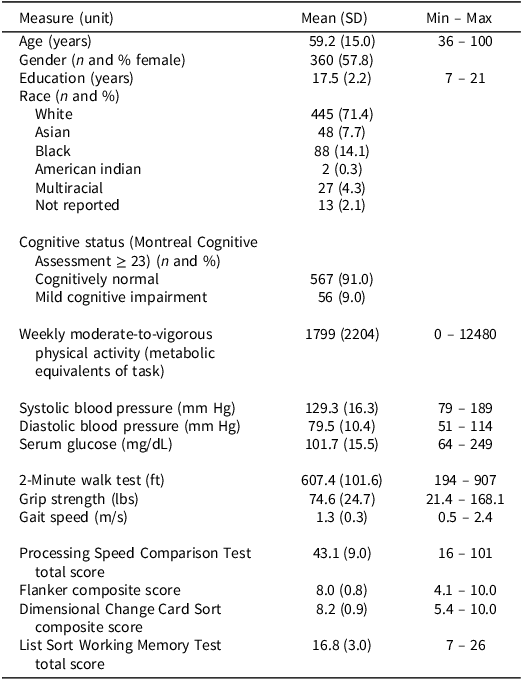
Of the 725 participants in the dataset, 633 had complete physical activity and cognitive data. Eight participants were excluded due to low accuracy scores on the Flanker or Dimensional Change Card Sort cognitive tasks; that is, accuracy was not ≥ 80% correct, which is required to generate the summary scores for Flanker and Dimensional Change Card Sort. One outlier was removed for low composite cognitive performance and one outlier was removed for high cardiometabolic risk (composite scores ≥ 3 standard deviations from sample mean). Therefore, the final sample included 623 adults aged 36 to 100 years. See Table 1 for participant characteristics.
Sample demographic and clinical characteristics (n = 623).

Demographics
Demographic information, including age, sex, race, and years of education, was self-reported during the intake interview.
Cardiometabolic risk
To control for cardiometabolic contributions to brain health, risk factors for the development of cerebrovascular disease were assessed via vital signs and blood samples. A modified cardiometabolic risk score was developed from available variables known to increase risk for cardiovascular disease, namely systolic and diastolic blood pressure and serum glucose levels (Smith, Reference Smith2007). Each variable was transformed into a z-score [(x – x̄)/sd] and then averaged to generate a composite measure of cardiovascular disease risk, with higher scores indicating greater risk.
Physical activity
Physical activity was assessed with the International Physical Activity Questionnaire – Short Form (IPAQ-SF; Craig et al., Reference Craig, Marshall, Sjöström, Bauman, Booth, Ainsworth, Pratt, Ekelund, Yngve, Sallis and Oja2003). Participants self-reported the number of days per week and average daily time spent performing moderate and vigorous intensity activities. Examples of moderate activities provided by the IPAQ included carrying light loads and bicycling at a regular pace. Examples of vigorous activities included aerobics, heavy lifting, or fast bicycling. Self-reported daily activities with a duration of greater than 180 minutes were truncated to 180 minutes according to recommended data processing methods (Sjostrom et al., Reference Sjostrom, Ainsworth, Bauman, Bull, Hamilton-Craig and Sallis2005). Weekly moderate and vigorous intensity physical activity minutes were multiplied by a corresponding Metabolic Equivalent of Tasks (MET) value: Moderate PA = 4.0 METs and Vigorous PA = 8.0 METs. Therefore, total weekly moderate and vigorous physical activity scoring in MET-minutes/week was calculated as follows:
 $${\rm{Moderate \;PA}} = 4{ .}0 \times {\rm{(days \;of \;moderate \;activity) }} \\\times {\rm{ (daily \;minutes \;of \;moderate \;activity)}}$$
 $${\rm{Vigorous \;PA}} = 8{.}0 \times {\rm{(days \;of \;vigorous \;activity)}} \\\times {\rm{(daily \;minutes \;of \;vigorous \;activity)}}$$
MET-minutes/week in each intensity domain were transformed into z-scores [(x – x̄)/sd] and averaged, creating a measure of total weekly moderate-to-vigorous physical activity (MVPA).
Physical fitness
Cardiorespiratory fitness
Sub-maximal cardiorespiratory fitness was assessed with the NIH Toolbox 2-minute walk test (Reuben et al., Reference Reuben, Magasi, McCreath, Bohannon, Wang, Bubela, Rymer, Beaumont, Rine, Lai and Gershon2013). Participants were asked to walk as fast as they could on a flat surface back and forth between two cones set 50 feet apart for two minutes. Greater distance in feet covered in two minutes indicated greater cardiovascular endurance, a proxy for cardiorespiratory fitness.
Muscular strength
Muscular strength was assessed with the NIH Toolbox grip strength dynamometry test (Reuben et al., Reference Reuben, Magasi, McCreath, Bohannon, Wang, Bubela, Rymer, Beaumont, Rine, Lai and Gershon2013). Participants were seated in a chair with their feet touching the ground. With their elbow bent at 90 degrees, arm near their trunk, and wrist in a neutral position, participants used their hand to squeeze a Jamar Plus Digital dynamometer as hard as possible for three seconds. After a sub-maximal practice trial, one test trial was completed on each hand, and the maximum value between the two trials was chosen.
Speed
Preferred gait speed was assessed with the NIH Toolbox 4-meter walk test (Reuben et al., Reference Reuben, Magasi, McCreath, Bohannon, Wang, Bubela, Rymer, Beaumont, Rine, Lai and Gershon2013). Participants were asked to walk between two markers set four meters apart at their usual pace. Participants completed one practice trial, followed by two timed trials. Gait speed was calculated by dividing 4 meters by the fastest time to complete the timed walk (meters/second), with higher values indicating faster gait speeds.
Cognitive function
Cognitive abilities were assessed with the original version of the NIH Toolbox Cognition Battery (Weintraub et al., Reference Weintraub, Dikmen, Heaton, Tulsky, Zelazo, Bauer, Carlozzi, Slotkin, Blitz, Wallner-Allen, Fox, Beaumont, Mungas, Nowinski, Richler, Deocampo, Anderson, Manly, Borosh and Gershon2013). We used raw scores from the cognitive tasks to minimize missing data and to avoid overcorrection for demographic variables in our models.
Inhibition
Inhibition was assessed with the Flanker Inhibitory Control and Attention Test (Flanker; Weintraub et al., Reference Weintraub, Dikmen, Heaton, Tulsky, Zelazo, Bauer, Carlozzi, Slotkin, Blitz, Wallner-Allen, Fox, Beaumont, Mungas, Nowinski, Richler, Deocampo, Anderson, Manly, Borosh and Gershon2013). Participants viewed a row of stimuli (directional arrows) and responded based on the direction of the central stimulus (arrow) while inhibiting attention to surrounding stimuli (other arrows), which may be congruent (← ← ← ← ←) or incongruent (← ← → ← ←) with the direction of the central arrow. The computed score for the Flanker subtest, which combines accuracy and response time performance, was selected as the outcome measure. Scores range from 4 to 10, with higher scores indicating greater inhibition ability.
Working memory
During the List Sorting Working Memory Test (Weintraub et al., Reference Weintraub, Dikmen, Heaton, Tulsky, Zelazo, Bauer, Carlozzi, Slotkin, Blitz, Wallner-Allen, Fox, Beaumont, Mungas, Nowinski, Richler, Deocampo, Anderson, Manly, Borosh and Gershon2013), pictures of different foods and animals were sequentially displayed with their name on the iPad, along with an accompanying audio recording that named the stimulus. After each trial, the participant was tasked with verbally repeating the items back in size order from smallest to largest, first within a single dimension (either foods or animals; 1-list) and then on two dimensions (mixed encoding list of foods and animals; 2-list). The total score, summing the total number of items correctly recalled and sequenced across the 1-list and 2-list tasks, was selected as the outcome measure. Scores range from 0 to 26, with higher scores indicating greater working memory ability.
Cognitive flexibility
During the Dimensional Change Card Sort Test (Weintraub et al., Reference Weintraub, Dikmen, Heaton, Tulsky, Zelazo, Bauer, Carlozzi, Slotkin, Blitz, Wallner-Allen, Fox, Beaumont, Mungas, Nowinski, Richler, Deocampo, Anderson, Manly, Borosh and Gershon2013), participants were presented with pictures that vary along two dimensions (shape and color) and were tasked with matching a series of bivalent test pictures to the target pictures based on the randomly switching dimensions. The computed score, combining response time and accuracy, was selected as the outcome measure. Scores ranged from 4 to 10, with higher scores indicating higher levels of cognitive flexibility.
Processing speed
During the Pattern Comparison Processing Speed Test (Weintraub et al., Reference Weintraub, Dikmen, Heaton, Tulsky, Zelazo, Bauer, Carlozzi, Slotkin, Blitz, Wallner-Allen, Fox, Beaumont, Mungas, Nowinski, Richler, Deocampo, Anderson, Manly, Borosh and Gershon2013), participants decided whether two pictures presented beside one another were the same or not as quickly as possible. The total number of patterns correctly discerned in the 85 seconds allotted was selected as the outcome measure. Higher scores indicate greater processing speed performance.
Cognitive status
Assessed with the Montreal Cognitive Assessment (MoCA; Nasreddine et al., Reference Nasreddine, Phillips, Bédirian, Charbonneau, Whitehead, Collin, Cummings and Chertkow2005), cognitive status was binarized using a cut-off score of ≥ 23 indicating cognitively normal as recommended by a systematic review and meta-analysis of diagnostic validity studies of MoCA cut scores (Carson et al., Reference Carson, Leach and Murphy2018) and included as a covariate.
Data analyses
All analyses were conducted using R Statistical Software (v4.1.1; R Core Team, 2021). Continuous covariates (age, education, cardiometabolic risk, processing speed) were transformed into z-scores using the mean and standard deviation from the final sample. Composite scores of physical fitness and executive function performance were calculated for each participant to increase the reliability of our results and generalizability to extant literature. Performance on each of the component tasks was z-scored [(x – x̄)/sd] and averaged to generate composite measures of physical fitness and executive function, with higher scores indicating better performance. Therefore, results from all models are presented as standardized beta coefficients, representing the β-value standard deviation change in executive function composite for every one standard deviation change in the predictor variable, to aid in the interpretation of effect sizes. We used a confirmatory factor analysis to verify that the three physical fitness components loaded onto a latent construct representing physical fitness. All three fitness variables had significant factor loadings, with the latent fitness variable explaining 81.2% of variance in cardiorespiratory fitness, 26.0% of variance in grip strength, and 17.6% of variance in gait speed. Similarly, we used a confirmatory factor analysis verifying that the three executive function components loaded onto a latent construct representing executive function. All three executive function tasks had significant factor loadings, with the latent executive function variable explaining 63.9% of variance in cognitive flexibility, 67.3% of variance in inhibition, and 19.8% of variance in working memory.
Complete data were necessary for the analyses. Therefore, missing data were imputed with multivariate imputation using predictive mean matching for continuous data with the Multivariate Imputation for Chained Equations (MICE) package in R (Buuren & Groothuis-Oudshoorn, Reference Buuren and Groothuis-Oudshoorn2011). MICE imputes incomplete data using fully conditional specification, whereby an iterative algorithm generates plausible values for an incomplete column using all other columns in the dataset as sets of predictors. Therefore, MICE attempts to maintain existing relationships in the dataset. Two participants had physiologically implausible values for their diastolic blood pressure (mmHg = 27) and serum glucose (mg/dL = 310); therefore, their values were omitted prior to imputation. Percent of missing data imputed by variable is presented in Supplemental Table 1. Overall, 1.9% of values in the dataset were missing prior to imputation and only one variable (serum glucose) was missing > 5% of data. Imputation did not alter sample means for any variable with imputed data (p’s = .49 – .99). Complete cases did not differ from those with imputed data on age, sex, education, cognitive status, or cardiometabolic risk, but completers had higher reported physical activity, cardiorespiratory fitness, and executive function performance and were trending as less racially diverse. Only participants with complete cognitive data were selected; therefore, no outcome measures were imputed.
Relative importance and independent relationships of age, physical activity, and physical fitness to executive function performance
Relative importance for linear regression (relaimpo)
Relative importance refers to the quantification of an individual regressor’s contribution to a multiple regression model by considering both its direct effect (correlation with outcome) and its effect when combined with other variables in the model (Groemping, Reference Groemping2007). We used analyses of relative importance to examine the relative strength of associations between physical activity, physical fitness, and covariates with executive function performance. Relative importance metrics – such as the Lindeman, Merenda, and Gold (lmg) analysis of partitioned variance – from the relaimpo R package (Groemping, Reference Groemping2007) quantify average regressor contributions to a multiple linear regression model outcome, controlling for collinearity and order of entry of variables into the model. The relaimpo analysis allowed for data-driven insight into those variables accounting for the most variance in executive function performance and minimizing the number of statistical models or reliance on arbitrary selection of which variables to examine as variables of interest.
Hierarchical multiple linear regression
We used multiple regression analyses to test the associations between physical activity and physical fitness with executive function performance controlling for covariates (age, sex, race, years of education, cardiometabolic risk, cognitive status, and processing speed performance). All covariates were included in the final model, as they were significantly correlated with the executive function composite prior to or after adjustment for other covariates. The full multiple regression model from the relaimpo analysis was used to explore the magnitude and significance of independent relationships between variables and executive function performance. To determine the independent contributions and amount of unique explained variance, two follow-up models included physical activity and physical fitness in separate final steps of the hierarchical multiple regression.
Relationship of physical activity and physical fitness with executive function performance across age
To assess if the associations between physical activity and physical fitness with executive function performance were dependent on age, two bootstrap moderation regression models were analyzed using the PROCESS macro in R (A. F. Hayes, Reference Hayes2023). Each model tested for an interaction between the variable of interest and age on executive function performance, controlling for all covariates. Conditional relationships were estimated using bootstrap confidence intervals from 5000 bootstraps. Bootstrap resampling was implemented as it provides more reliable estimates of standard errors and confidence intervals, it does not rely on assumptions about the population distribution of the interaction effect, and it is more robust to outliers than traditional regression (A. F. Hayes, Reference Hayes2023). Confidence intervals of the interaction term entirely above or below 0 indicated a significant moderating relationship. The interactions between physical activity and physical fitness with age were visualized by plotting the association of variable of interest on executive functions across the 16th (44.4 years), 50th (59.2 years), and 84th (74.1 years) percentiles of the sample’s age. These percentiles are implemented by PROCESS as they represent one standard deviation below the mean, the mean, and one standard deviation above the mean in a normal distribution but are less affected by any skew in the distribution.
Indirect relationships between physical activity and executive function performance through physical fitness
To investigate if physical activity related to executive function performance indirectly via composite physical fitness or its components, ordinary least squares regression mediation analyses were conducted using the PROCESS macro available in R (A. F. Hayes, Reference Hayes2023). We used a simple mediation model to test if there was an indirect association between physical activity and executive function via physical fitness and a multiple mediation model to test if there was an indirect association via any of the components of physical fitness, controlling for the other two. This approach does not require a preliminary establishment of a statistically significant total effect of an independent variable of interest on the outcome variable and is aligned with recommendations regarding the use of mediation analysis in psychological research (A. F. Hayes, Reference Hayes2023; Igartua & Hayes, Reference Igartua and Hayes2021). Indirect relationships were estimated using bootstrap confidence intervals from 5000 bootstraps. Confidence intervals of the indirect relationship entirely above or below 0 indicated a significant positive or negative indirect relationship, respectively. Follow-up conditional process analyses were used to test if any observed indirect relationships were dependent on age. These models examined the indirect relationships between physical activity and executive function via composite physical fitness, or physical fitness components, across the 16th (44.4 years), 50th (59.2 years), and 84th (74.1 years) percentiles of age.
Results
Relative contributions and independent relationships of age, physical activity, and physical fitness to executive function performance
Relative importance of independent variables (relaimpo)
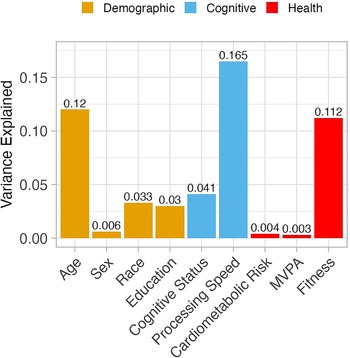
Metrics of relative importance for all variables to executive function performance are presented in Figure 1. Consistent with prior literature, age (.12 proportion of variance) and processing speed performance (.165) had relatively important relationships with executive function performance. Participant self-reported engagement in MVPA (.003) was not a relatively important contributor in the model, whereas composite physical fitness (.112) explained a roughly similar proportion of variance to age and processing speed. Cardiometabolic risk (.004) did not have a relatively important relationship with executive function.
Relative importance of demographic, cognitive, and health variables to executive function performance.

Multiple linear regression
Multiple linear regression output from the full model used for relaimpo analysis examined the strength and significance of independent variables with executive function performance. The overall model was significant (F(13, 609) = 49.47, p < .001), accounting for 51.4% of variance. Increased age (β = −.20, p < .001), identifying as Black or African American (β = −.37, p < .001), identifying as male (β = −.11, p = .04), and scoring < 23 on the MoCA (β = −.42, p < .001) were associated with lower executive function performance. Higher levels of educational attainment (β = .10, p < .001) and better processing speed performance (β = .24, p < .001) were associated with better executive function performance. There was not an independent relationship between reported MVPA and executive function (β = −.04, p = .16). However, higher levels of composite physical fitness were associated with better executive function performance (β = .28, p < .001). Using hierarchical regression, entering covariates (including physical fitness) in Step 1 (R2 = .512, F(12, 610) = 53.34, p < .001) and adding MVPA in Step 2 (R2 = .514, F(13, 609) = 49.47, p < .001) did not improve the model fit (ΔR2 = .002, F(1, 609) = 2.02, p = .16). In contrast, in a separate hierarchical regression including MVPA in Step 1 (R2 = .474, F(12, 610) = 45.77, p < .001), adding physical fitness in Step 2 (R2 = .514, F(13, 609) = 49.47, p < .001) explained significant additional variance in executive function performance (ΔR2 = .04, F(1, 609) = 49.92, p < .001). The effects were replicated in an analysis with cases with missing data excluded rather than imputed.
Relationships of physical activity and physical fitness with executive function performance across age
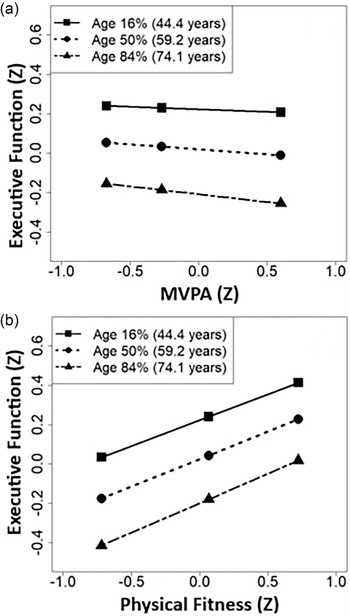
The relationships of physical activity and physical fitness with executive function performance are plotted across age values in Figure 2. Overall, there was not a relationship between self-reported MVPA and executive function, and that relationship was not conditional on participant age (ΔR2 = .0006, Bootstrap CI: -0.07 – 0.03, F(1, 612) = .70, p = .40). In contrast, there was a positive relationship between physical fitness and executive function, and the association did not interact with participant age (ΔR2 = .0003, Bootstrap CI: −0.04 – 0.07 F(1, 612) = .32, p = .57). The effects were replicated in an analysis with missing data excluded rather than imputed.
(a) Relationship between moderate-to-vigorous physical activity (MVPA) and executive function at different ages. (b) Relationship between physical fitness and executive function at different ages.

Indirect relationships between physical activity and executive function performance through physical fitness
Simple mediation with composite physical fitness
The indirect relationship of physical activity with executive function through composite physical fitness is displayed in Figure 3a. Across bootstrap samples, there was a small, positive indirect association of physical activity with executive function performance through higher composite physical fitness (ab = 0.022 (95% CI: 0.004 – 0.043), p = .01). The follow-up conditional process analysis indicated that there was not an indirect association of physical activity with executive function through physical fitness in those at the 16th percentile in age (44.4 years; ab = 0.015 (95% CI: -0.011 – 0.046)), whereas there was an indirect relationship for those at the 50th percentile (59.2 years; ab = 0.022 (95% CI: 0.005 – 0.043)) and a qualitatively larger indirect association for those at the 84th percentile (74.1 years; ab = 0.031 (95% CI: 0.003 – 0.066)). However, pairwise contrasts between the conditional indirect effects through the fitness composite score indicated the strength of the indirect effects were not significantly different across age bands (Supplemental Table 2). In a replication analysis with missing data excluded rather than imputed, the small, positive indirect association between physical activity and executive function through composite physical fitness was similar in magnitude but did not reach statistical significance (ab = 0.013 (95% CI: −0.004 – 0.03), p = .116). The absence of a significant indirect effect in this subsample was likely due to reduced sample size and changes in sample representativeness in the complete case dataset as described previously.
Statistical diagram of the indirect relationship of moderate-to-vigorous physical activity (MVPA) with executive function performance via components of physical fitness. (a) Simple mediation via composite physical fitness. (b) Parallel mediation via components of physical fitness.

Multiple mediation with components of physical fitness
The indirect association of physical activity with executive functions through the three components of physical fitness is displayed in Figure 3b. Across bootstrap samples, there was a positive indirect relationship of physical activity on executive function performance through cardiorespiratory fitness (ab = 0.014 (95% CI: 0.003 – 0.028)), and there was a trending relationship through grip strength (ab = 0.007 (95% CI: -0.001 – 0.018)), but not gait speed (ab = 0.002 (95% CI: −0.006 – 0.012)). The follow-up conditional process analysis indicated that the indirect relationships through grip strength and gait speed were not dependent on participant age. For cardiorespiratory fitness, there was not an indirect relationship of physical activity on executive functions through cardiorespiratory fitness in those at the 16th percentile in age (44.4 years; ab = 0.009 (95% CI: −0.007 – 0.03)), whereas there was an indirect relationship for those at the 50th (59.2 years; ab = 0.014 (95% CI: 0.003 – 0.028)) and 84th percentile (74.1 years; ab = 0.019 (95% CI: 0.001 – 0.048)). However, pairwise contrasts between the conditional indirect effects through cardiorespiratory fitness indicated the strength of the indirect effects were not significantly different across age bands (Supplemental Table 3).
Discussion
Few studies have examined the relative associations of physical activity and multiple components of physical fitness with executive function performance across middle age to older adulthood. The results of the present study revealed that physical fitness, but not self-reported moderate-to-vigorous physical activity, was robustly associated with executive function performance in middle-aged and older adults. Furthermore, physical fitness, predominantly related to cardiorespiratory fitness, accounted for a positive indirect association between moderate-to-vigorous physical activity and executive function performance. The indirect association of cardiorespiratory fitness with physical activity and executive function was significant in older study participants (mean age of 59 years or + 1 SD (74 years)), but not younger participants (-1 SD (44 years)), although between-group contrasts were not significant.
Our finding that self-reported moderate-to-vigorous physical activity was not associated with a composite measure of executive function performance was unexpected and not aligned with consensus from extant literature. Several systematic reviews of cross-sectional and longitudinal observational research have provided evidence that greater engagement in physical activity is generally associated with a small, positive effect on cognitive performance across the lifespan and across cognitive domains, including executive function (Cox et al., Reference Cox, O’Dwyer, Cook, Vetter, Cheng, Rooney and O’Connor2016; Engeroff et al., Reference Engeroff, Ingmann and Banzer2018). However, examples of null or negative associations between self-reported physical activity and executive functions among community-dwelling adults have been reported. For example, a cross-sectional study of cognitively normal older adults found two self-report questionnaires of physical activity to have null and negative associations with composite executive function assessed with the computerized NIH EXAMINER battery (VandeBunte et al., Reference VandeBunte, Gontrum, Goldberger, Fonseca, Djukic, You, Kramer and Casaletto2022). Additionally, a study of middle-aged adults reported a null association between survey-reported moderate-to-vigorous physical activity and performance on the Symbol Digit Modalities and Digit Span Backwards tasks (Quinlan et al., Reference Quinlan, Rattray, Pryor, Northey and Cherbuin2023). Finally, a previous study using the HCP-A sample described inverse trends of similar magnitude found in our study between self-reported total physical activity (including light physical activity) and performance on Trail Making Test A & B (Callow & Smith, Reference Callow and Smith2023). Self-reported physical activity, even on widely used assessments such as the IPAQ-SF, is prone to measurement bias, such as recall and social desirability biases, which may relate to participants’ executive function performance and confound observed relationships (Lee et al., Reference Lee, Macfarlane, Lam and Stewart2011). It is possible that adults with lower cognitive performance overreported their physical activity levels (Herbolsheimer et al., Reference Herbolsheimer, Riepe and Peter2018). There may be other subsamples within the study with variable relationships between physical activity and executive function, leading to the overall null physical activity-executive function association observed here.
The finding that participants with higher levels of composite physical fitness tended to perform better on the executive function composite regardless of age was consistent with extant literature, with an effect size comparable to those reported in previous studies examining the relationship between physical fitness and executive function (Callow & Smith, Reference Callow and Smith2023; Weinstein et al., Reference Weinstein, Voss, Prakash, Chaddock, Szabo, White, Wojcicki, Mailey, McAuley, Kramer and Erickson2012). Additionally, given the well-established negative association between age and executive function performance, it is noteworthy that physical fitness accounted for a similar amount of variance in the model (4%) compared to age (3%). This finding further extends the literature with the inclusion of a sample of middle-aged adults – an age group with little representation in available physical activity-cognition literature – and use of a multidimensional measure of physical fitness. Previous studies have found that higher levels of cardiorespiratory fitness are associated with better performance on diverse measures of executive functions among older adults (S. M. Hayes et al., Reference Hayes, Forman and Verfaellie2016; Kawagoe et al., Reference Kawagoe, Onoda and Yamaguchi2017; Predovan et al., Reference Predovan, Berryman, Lussier, Comte, Vu, Villalpando and Bherer2021), but not among young adults (S. M. Hayes et al., Reference Hayes, Forman and Verfaellie2016). One extant study assessed participants’ physical fitness via cycle ergometry and found their physical work capacity was related to performance on tests of sustained attention, working memory, verbal fluency, and inhibition among those aged 46 – 70 years, but not among those 45 years of age or younger (Gajewski et al., Reference Gajewski, Golka, Hengstler, Kadhum, Digutsch, Genç, Wascher and Getzmann2023). Additionally, performance on measures of strength (Ahmadi et al., Reference Ahmadi, Quirion, Faivre, Registe, O’Brien, Bray, Dupuy, Sénéchal, Bélanger and Mekari2024; Frith & Loprinzi, Reference Frith and Loprinzi2018) and gait speed (Kearney et al., Reference Kearney, Harwood, Gladman, Lincoln and Masud2013; Trapuzzano et al., Reference Trapuzzano, Chizmar, Wilda and Dawson2020) have also been associated with executive function performance specifically among older adult samples. There is a more limited number of studies that have included middle-aged adults. One study that included cognitively normal middle-aged to older adults with a similar mean age as our sample found that gait speed was selectively associated with a measure of sustained attention but not other executive functions (Park et al., Reference Park, Aul, DeGutis, Lo, Poole, McGlinchey, Bean, Leritz and Esterman2021), suggesting fitness-cognition associations may vary by sample age and cognitive task. To our knowledge, our study is one of the first to demonstrate a robust association between a multidimensional composite of physical fitness and a composite measure of executive function performance across middle age to older adulthood.
Another important aspect of our study was the statistical control for processing speed performance when considering the relationship between modifiable lifestyle variables and executive function. Salthouse (Reference Salthouse1996), among others, have reported that age-related variance on measures of processing speed account for a substantial amount of the age-related variance in performance on diverse tasks of fluid cognition, including executive function (Albinet et al., Reference Albinet, Boucard, Bouquet and Audiffren2012). When variance associated with processing speed is accounted for, one has more confidence that observed associations are attributable to the targeted cognitive domain of interest, rather than a more general effect of age-related decline in processing speed. Our finding that processing speed performance was the most robust correlate of executive function performance, explaining an average of 16.5% of the variance, is consistent with the notion of processing speed manifesting effects across multiple cognitive domains in aging. Yet, physical fitness remained significantly associated with executive function performance after controlling for processing speed. This finding emphasizes that physical fitness may have important relationships with components of executive function independent of processing speed, such as the inhibition of prepotent responses, updating of working memory, and ability to flexibly switch perspectives.
The modifiability of physical fitness across the lifespan is determined in part by engagement in physical activity (Liberman et al., Reference Liberman, Forti, Beyer and Bautmans2017). In this study, we demonstrated that engagement in MVPA was associated with higher levels of composite physical fitness and physical fitness in turn related to better executive function performance. This finding was consistent with interventional research suggesting that engagement in aerobic exercise and resistance training programs have beneficial effects on physical fitness that relate to improved cognitive performance, including executive-control processes (Colcombe & Kramer, Reference Colcombe and Kramer2003; Erickson et al., Reference Erickson, Voss, Prakash, Basak, Szabo, Chaddock, Kim, Heo, Alves, White, Wojcicki, Mailey, Vieira, Martin, Pence, Woods, McAuley and Kramer2011; Liu-Ambrose et al., Reference Liu-Ambrose, Nagamatsu, Graf, Beattie, Ashe and Handy2010). Additionally, combining aerobic exercise interventions with cognitive training can improve attention and processing speed, but does not seem to improve cardiorespiratory fitness or cognition above and beyond aerobic exercise alone (Roig-Coll et al., Reference Roig-Coll, Castells-Sánchez, Lamonja-Vicente, Torán-Monserrat, Pera, García-Molina, Tormos, Montero-Alía, Alzamora, Dacosta-Aguayo, Soriano-Raya, Cáceres, Erickson and Mataró2020). However, less is known about the potential variables connecting unstructured forms of physical activity with cognitive function. Here, we demonstrated that self-reported lifestyle-embedded MVPA related to executive function primarily via cardiorespiratory fitness, and marginally via muscular strength, but not through speed. One previous investigation among healthy adults aged 50 – 70 found that cardiorespiratory fitness, assessed via a 1-mile walk test, mediated an association between self-reported sport-related physical activity and executive function and attention-speed composites (Castells Sánchez et al., Reference Castells Sánchez, Roig Coll, Lamonja Vicente, Torán Monserrat, Pera, Montero, Dacosta Aguayo, Bermudo Gallaguet, Bherer, Erickson and Mataró Serrat2021). This indirect association through cardiorespiratory fitness was only significant in men and non-sportive forms of physical activity were not associated with cognition (Castells Sánchez et al., Reference Castells Sánchez, Roig Coll, Lamonja Vicente, Torán Monserrat, Pera, Montero, Dacosta Aguayo, Bermudo Gallaguet, Bherer, Erickson and Mataró Serrat2021). Another observational study suggested that hand grip strength and gait speed partially mediated the relationship between age and cognitive status assessed with the Mini-Mental State Examination among Columbian older adults (Pérez-Sousa et al., Reference Pérez-Sousa, del Pozo-Cruz, Olivares, Cano-Gutiérrez, Izquierdo and Ramírez-Vélez2021). Our study adds to this literature by illustrating the importance of cardiorespiratory fitness, above and beyond other fitness measures, along with MVPA for preserving executive function performance from middle age to older adulthood.
This study had limitations. The data were cross-sectional, which precludes any conclusion of causal relationships. Our data suggest that physical activity may relate to executive function through its joint association with physical fitness, but a longitudinal study design with measures repeated at different time points would provide stronger evidence for mediation following temporal ordering. Second, HCP used a self-reported measure of physical activity, which may be influenced by age, education, and cultural factors, and could be prone to recall and social desirability biases that interact with cognitive ability. However, to partially address this limitation, we analyzed moderate-to-vigorous forms of physical activity as they show stronger relationships with physical fitness and may be easier to recall than lighter incidental forms of activity, such as walking. Third, the total MVPA variable is an absolute measure of physical activity engagement and does not consider individual factors such as body weight, sex, and fitness level, which may influence the association between physical activity and cognition. We did not explore potentially relevant modifiers, such as participant sex, in the relationships between physical activity, physical fitness, and executive function. Fourth, we used a composite measure of executive function for statistical efficiency and to maximize generalizability to extant literature and therefore were not able to examine whether subdomains of executive function have differential associations with physical activity and physical fitness. Finally, the inclusion of gait speed, which is often considered a measure of physical function, as a measure of physical fitness was debatable. The authors acknowledge that assessment of preferred gait speed, rather than maximal gait speed, may not represent one’s maximal capacity. Nevertheless, when a data-driven approach (confirmatory factor analysis) was implemented, preferred gait speed loaded significantly on the latent fitness variable.
This study also had a few notable strengths. First, the HCP-A included a large, demographically diverse sample of middle-aged to older American adults. Middle-aged adults are an underrepresented age group in the physical activity-cognition literature, and the results of this study suggest that the benefits of physical activity and physical fitness on cognition may begin in later middle adulthood. Second, the HCP utilized widely used and validated assessments of executive function performance from the NIH Toolbox. We opted to average performance across the three canonical subcomponents of executive function to increase the reliability of our results and generalizability to extant literature. Additionally, statistical control for processing speed performance enhanced the rigor of the approach by ruling out a potential confound in the relationship between modifiable lifestyle variables and executive function. Moreover, when assessing the impact of physical fitness, we controlled for physical activity, which further improved the methodological rigor. Finally, we explored the multidimensional construct of physical fitness. The extant literature is weighted toward the assessment of individual components of fitness but emerging evidence suggests multiple aspects of fitness are related and may be important indicators of cognitive performance. Although cardiorespiratory fitness was most strongly associated with executive function, strength was also significantly associated with executive function, albeit to a lesser degree. Moreover, the composite measure of fitness accounted for more variance in executive function than any single fitness metric, highlighting the importance of evaluating multiple components of fitness. However, given the unequal contributions of the physical fitness components to executive function, further refinement of the construct of physical fitness and examination of the relative importance of fitness measures to cognition is warranted.
In conclusion, the current findings demonstrate that measures of physical fitness, primarily cardiorespiratory fitness, have significant direct relationships with executive function performance, and partly explain a relationship between self-reported moderate-to-vigorous physical activity and executive function performance. These findings suggest that maintained or improved physical fitness through engagement in physical activity may be an increasingly important contributor to cognitive maintenance.
Supplementary material
The supplementary material for this article can be found at https://doi.org/10.1017/S1355617725101446.
Data availability
The HCP-Aging 2.0 Release data used in this report came from https://doi.org/10.15154/1520707. Code used to generate the final dataset and perform analyses for this study are available upon reasonable request. The study reported within this manuscript was not preregistered.
Acknowledgements
The authors would like to thank Jessica Cloud, Annie Lee, and Sam Bassett for their roles in reviewing the manuscript and code for analysis.
Funding statement
This work was supported by the National Institute on Aging (NIA) of the National Institutes of Health (NIH) R01AG068882 (awarded to SMH) and The Ohio State University Chronic Brain Injury Program (SMH). These funding sources supported data download, data processing and analysis, and manuscript preparation. HCP-A data collection, data processing for distribution, and personnel support for collection of HCP-A was supported by the NIA of NIH U01AG052564 and by funds provided by the McDonnell Center for Systems Neuroscience at Washington University in St Louis.
Competing interests
The authors report that there are no competing interests to declare. The conducted research was not preregistered with an independent or institutional registry.


 Open access

