


School feeding programmes aim to provide nutritious food to children and adolescents at school( Reference Gelli and Daryanani 1 , Reference Aliyar, Gelli and Hamdani 2 ). Since children spend a considerable part of their day at school and have at least one meal at school, good-quality meals have the potential to improve children’s diet and health( Reference Greenhalgh, Kristjansson and Robinson 3 , Reference Lucas, Patterson and Sacks 4 ). Scientific evidence confirms this hypothesis and indicates a higher diet quality among children who regularly consume school meals( Reference Au, Rosen and Fenton 5 – Reference Vieux, Dubois and Dhuchêne 7 ).
In Brazil, the Brazilian School Feeding Program (Programa Nacional de Alimentação Escolar; PNAE) claims to contribute to the bio-psychosocial development and educational achievement of students by meeting their nutritional needs while in the school( 8 , Reference Sidaner, Balaban and Burlandy 9 ). PNAE legislation restricts products rich in Na, sugar and saturated and trans fats and prohibits the provision of low nutrition drinks. At least three portions of fruits and vegetables should be included weekly in school menus and 30 % of all funds have to be destined to procure products from local farms( 8 , Reference Soares, Davó-Blanes and Martinelli 10 ). These characteristics qualify the programme as a mechanism for local development and food security( Reference Sidaner, Balaban and Burlandy 9 ).
Socio-economic status is an important determinant of diet quality. Children with social vulnerability risk tend to consume more ultra-processed foods, such as sweets and soft drinks, and less fruits and vegetables than their non-vulnerable counterparts( Reference Iguacel and Fernández-Alvira 11 – Reference Manyanga, Tremblay and Chaput 14 ). This fact can be explained by food prices( Reference Darmon and Drewnovski 15 ) and food availability and accessibility in socially vulnerable areas( Reference Correa, Padez and Abreu 16 , Reference Assis, Leite and Carmo 17 ). In addition, parental education and employment status play a special role in children’s food consumption( Reference Iguacel and Fernández-Alvira 11 , Reference Manyanga, Tremblay and Chaput 14 ).
Since the PNAE serves all children studying at public schools( 8 ), it is interesting to understand how school meal consumption can impact children’s diets according to their social vulnerability risk. This investigation should consider the impact of the within-person variance in food intake distribution since uncorrected data can lead to unrealistic estimates of the proportion of children with inadequate nutrient and food intakes( Reference Dodd, Guenther and Freedman 18 – Reference Verly, Castro and Fisberg 20 ). We hypothesized that school meal consumption would have a more positive impact on the usual diets of children from the low socio-economic stratum because of higher adherence to the programme( Reference Valentim, Almeida and Taconeli 21 , Reference Cesar, Valentim and Almeida 22 ) and low diet quality( Reference Iguacel and Fernández-Alvira 11 – Reference Manyanga, Tremblay and Chaput 14 ).
Thus, our study aimed to estimate usual nutrient and food intakes (i.e. after correcting the distribution for within-person variance) among 8- to 12-year-old children from public schools in Brazil regarding the consumption of school meals, stratified by social vulnerability risk. Studying the impact of consuming school meals on children’s usual diet quality is very important, since adequate dietary intake in this life stage is essential for optimal growth and development, long-term health, cognitive function and school performance( Reference Ogata and Hayes 23 ). Identifying the impact of the PNAE on children’s usual diets can support the programme (e.g. justifying investments on nutrition education activities that stimulate school meal consumption adherence and financial and infrastructure support) and also provide evidence to other countries about the importance of providing high-quality school meals to students.
Methods
The present study was conducted with 8- to 12-year-old children from Belo Horizonte, the sixth most populous city in Brazil( 24 ). Eighteen public municipal schools (two from each regional municipality) were invited to participate in the study (total number of public municipal schools in the city in 2013: n 135). No exclusion criterion was applied to school selection. The number of school participants was defined according to the number of children in each regional municipality. All children in the fourth grade (n 1599) were invited to participate in the study. Of those children invited, 185 (11·6 %) were absent on the data collection days, fifty-three (3·3 %) presented difficulty reporting their food consumption and were not included in the analysis, and four (0·3 %) refused to participate in the study. Thus, our final sample was comprised of 1357 children. Children with mental impairment were excluded.
The study was conducted according to the guidelines of the Declaration of Helsinki and parents provided written consent for their children to participate in the study. All measures and procedures were approved by the ethics committee.
The estimated required sample size was 1067, adopting 5 % as the significance level (α = 0·05), 3 % as a maximum estimative error and the descriptive purpose formula, which assumes 50 % as outcome prevalence.
Data collection occurred between March 2013 and August 2015. School meal consumers were considered those children who reported consuming school meals ≥3 times/week. School meal menu proposal is the same for all schools in the city. In accordance with PNAE legislation, on average, meals should provide at least 20 % of the daily nutritional needs of students when one meal is offered and at least 30 % of the daily nutritional needs when two or more meals are offered; the amount goes up to 70 % for children enrolled in full-time education. In addition, the programme sets standards on menu composition: respect of traditional practices and local eating preferences; recommended maximum values for added sugar, fat, saturated fat and salt; mandatory inclusion of fruits and vegetables (at a minimum, three portions or 200 g per student per week); and restriction of processed foods with high levels of Na and saturated fats. Soft drinks are forbidden. All menus are proposed by a dietitian and 30 % of the financial resources are used to procure foods from family farmers and rural family enterprises, with a priority given to organic or ecological products( Reference Sidaner, Balaban and Burlandy 9 ).
In addition to school meal consumption, we consulted school records to obtain children’s sex, age and address. From children’s residence addresses we classified their social vulnerability risk using the health vulnerability index (Índice de Vulnerabilidade da Saúde; IVS)-2012, which combines census tract socio-economic characteristics and sanitation quality in a single synthetic indicator. According to IVS-2012, children’s social vulnerability risk was classified into low, medium, high and very high.
Dietary intake was evaluated by one 24 h dietary recall for the whole sample (n 1357); a second 24 h dietary recall on a non-consecutive day within the same week was administered in a randomly selected sub-sample of 524 individuals (38·6 %) in order to remove the effect of the within-person variance in the intake distribution( Reference Dodd, Guenther and Freedman 18 , Reference Tooze, Midthune and Dodd 19 ). We approximately assumed a 40 % replication rate, because this percentage is associated with lower loss of precision estimates( Reference Verly, Castro and Fisberg 20 ).
The interviews were conducted face-to-face in the school by trained dietitians. Children reported all foods and beverages consumed inside and outside school in quantities and preparation forms. Children referred composite foods and their ingredients. When children expressed doubt about a type of ingredient, food or beverage, they were shown images using a mobile phone. Food consumption was collected during the whole year and comprised weekdays and weekends. Cooking measures were used to help participants in reporting the amount of food consumed. We used a food composition table specifically compiled for Brazilian dietary surveys( 25 ) to analyse the nutrient content of children’s diet.
Although assessment of dietary habits among children is challenging because of their lack of literacy and writing skills, limited food recognition skills, memory constraints and short concentration span, methods such as the 24 h dietary recall are nevertheless useful in capturing important information on children’s individual intakes of foods and drinks. The consensus indicates that children below the age of 8 years are unlikely to be able to accurately report their dietary intake. Children older than 8 years, therefore, may be asked to respond to a dietary recall( Reference Foster and Bradley 26 – Reference Burrows, Martins and Collins 28 ). Most studies that have evaluated the accuracy of self-reported dietary intake information by children aged 8–12 years using direct observation, doubly labelled water or the double-portion method have reported a good concordance between the reference method and the child report( Reference Sharman, Skouteris and Powel 27 ).
Statistical analysis
The χ 2 test was applied to compare school meal consumption among sex and social vulnerability risk categories adopting 5 % as a significance level (P < 0·05).
The National Cancer Institute method was used to estimate children’s usual intake of Ca, Fe, Zn, Mg, thiamin, riboflavin, niacin, folate, vitamins B12, A and C, fibre, saturated fat and Na. In addition, we classified food into groups in accordance with the extent and purpose of food processing based on NOVA classification, proposed by Monteiro et al.( Reference Monteiro, Cannon and Levy 29 ). Then, we estimated the usual intake for unprocessed and minimally processed foods (total and subgroups: fruits and vegetables) and for processed and for ultra-processed food products (total and subgroups: beverages, candies and meats).
The National Cancer Institute method uses a two-part, mixed model in which the first part estimates the probability of consuming a food and the second part estimates the amount consumed (per day)( Reference Dodd, Guenther and Freedman 18 , Reference Tooze, Midthune and Dodd 19 ). Analyses were stratified by children’s social vulnerability risk (low/medium v. high/very high) and aimed to compare usual nutrient and food intakes among school meal consumers and school meal non-consumers at 5 % significance level (P < 0·05). For foods and nutrients which are consumed daily, we estimated children’s mean intake per day. For fruits and vegetables and for ultra-processed beverages, candies and meats, beyond the average consumption, we estimated the probability of consuming these food subgroups (since they are not consumed daily). The parameter estimates for probability are interpreted as an OR as in logistic regression. Analyses were conducted using MIXTRAN and DISTRIB macros version 2.1 (available at appliedresearch.cancer.gov) in the statistical software package SAS OnDemand for Academics.
Results
The sample was homogeneous regarding sex (male: n 691, 51 % and female: n 666, 49 %); 78·1 % (n 1060) were ≤10 years old and 52·3 % (n 710) of the children lived in low/medium social vulnerability risk areas. Almost one-quarter (n 379; 27·9 %) of the children reported not consuming school meals ≥3 times/week.
School meal consumption was not associated with sex, but school meal consumers more frequently lived in high/very high social vulnerability risk areas (76·2 %) than in low/medium risk areas (68·7 %; P < 0·001).
Associations between school meal consumption and usual nutrient and food intakes differed in accordance with children’s social vulnerability risk (Tables 1, 2 and 3).
Mean daily usual nutrient intakes among 8- to 12-year-old children according to school meal consumption and social vulnerability risk. Brazil, 2013–2015

NE, niacin equivalents; DFE, dietary folate equivalents; RAE, retinol activity equivalents.
Results are from the National Cancer Institute method for estimating usual intake of foods and nutrients.
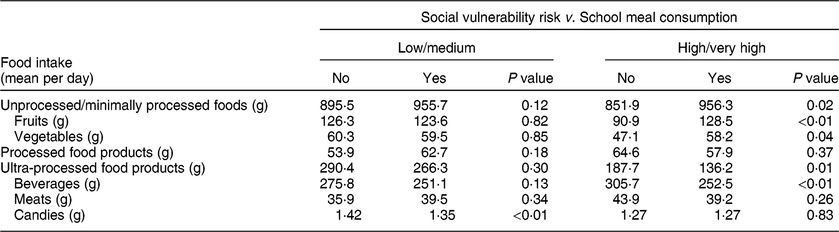
Mean daily usual food intakes among 8- to 12-year-old children according to school meal consumption and social vulnerability risk. Brazil, 2013–2015
Results are from the National Cancer Institute method for estimating usual intake of foods and nutrients.
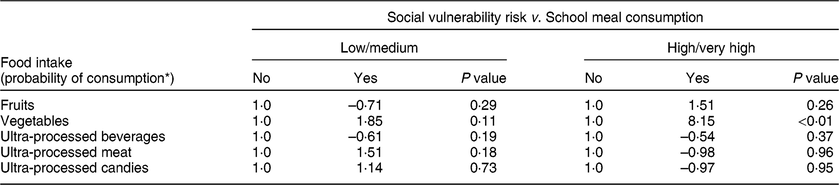
Probability of consuming food subgroups among 8- to 12-year-old children according to school meal consumption and social vulnerability risk. Brazil, 2013–2015
Results are from the National Cancer Institute method for estimating usual intake of foods and nutrients.
* Interpreted as OR as in logistic regression.
Children in the low or medium social vulnerability risk group consuming school meals ≥3 times/week were associated with a higher intake of thiamin (1·13 v. 1·04 mg in school meal non-consumers; P = 0·03). In addition, school meal consumers consumed less candy in comparison to school meal non-consumers (1·35 v. 1·42 g; P < 0·01; Tables 1 and 2).
Consumption of school meals among children living in high or very high social vulnerability risk areas, in turn, was associated with higher consumption of vitamin C (31·9 v. 24·1 mg; P = 0·02; Table 1). Regarding food group intake, school meal consumers ate more unprocessed and minimally processed foods in comparison to school meal non-consumers (956·3 v. 851·9 g; P = 0·02). In addition, consuming school meals was also associated with a higher mean intake of fruits (128·5 v. 90·9 g; P < 0·01) and vegetables (58·2 v. 47·1 g; P = 0·04). Ultra-processed food product consumption was lower among children who consumed school meals ≥3 times/week (136·2 v. 187·7 g; P = 0·01), especially ultra-processed beverages (252·5 v. 305·7 g; P < 0·01; Table 2).
Finally, analyses also revealed that the probability of consuming vegetables was 8·15 times greater (P < 0·01) among school meal consumers in relation to school meal non-consumers (Table 3).
Discussion
The present study demonstrated the impact of the PNAE on children’s usual nutrient and food intakes according to their social vulnerability risk. We identified a positive impact from consuming school meals on children’s diets, particularly among children living in high/very high social vulnerability risk areas, denoting the special role that the PNAE plays in alleviating dietary inadequacies related to social inequalities.
In our sample, the proportion of school meal consumption ≥3 times/week was greater than what had previously been indicated in Brazilian literature( Reference Valentim, Almeida and Taconeli 21 , Reference Cesar, Valentim and Almeida 22 ). Data from the National Adolescent School-Based Health Survey (PeNSE) comprised of 86 660 ninth-grade students showed that slightly more than one in five students (22·8 %) stated that they consume school meals ≥3 times/week( Reference Locatelli, Canella and Bandoni 6 ). A study conducted with adolescents (10–19 years old) from a Brazilian city located in the South showed that 57·7 % of the sample consumed school meals at least once per week and 18·8 % consumed school meals at least four times per week( Reference Valentim, Almeida and Taconeli 21 ). A review study showed adherence to school meal consumption is between 33·5 and 46·0 % in Brazil( Reference Cesar, Valentim and Almeida 22 ). Demographic and economic profiles may explain these differences.
Socio-economic conditions are one of the key determinants found to influence school meal consumption( Reference Valentim, Almeida and Taconeli 21 , Reference Cesar, Valentim and Almeida 22 ). Other factors include adolescents’ perception about school meal healthfulness and cafeteria ambience and the availability of other types of food inside and nearby schools( Reference Valentim, Almeida and Taconeli 21 , Reference Cesar, Valentim and Almeida 22 ). Although the PNAE has advanced in the last years and is universal to all students from public schools( Reference Sidaner, Balaban and Burlandy 9 ), the challenge of reaching all students remains.
Regarding the impact of school meal consumption on children’s diet, a study that used PeNSE data demonstrated lower odds of regular soft drink consumption among students who consumed school meals( Reference Azeredo, de Rezende and Canella 30 ). In addition, consuming school meals at least three times per week was positively associated with beans, vegetables and fruit consumption and negatively associated with salty snacks, processed meal, crackers, sweet biscuits and candy consumption( Reference Locatelli, Canella and Bandoni 6 ).
Our results corroborate this evidence and show that the positive impact of school meal consumption on children’s diets is more pronounced among children with higher social vulnerability risk. In fact, if we compare food and nutrient intakes of children living in low/medium v. high/very high social vulnerability risk areas who reported not consuming school meals regularly, we would see that children from socio-economic disadvantaged regions presented a lower mean intake for almost all protective nutrients and food groups and higher mean intake for harmful nutrients and food groups. This was expected since socio-economic condition is one of the most important determinants of food intake( Reference Darmon and Drewnovski 15 ). Interestingly, comparing food and nutrient intakes of children living in low/medium v. high/very high social vulnerability risk areas who reported consuming school meals regularly, we identified that the mean intakes of foods and nutrients are very similar in both groups. In other words, consuming school meals alleviated dietary discrepancies related to social inequalities. This is a very important finding that highlights the important role the PNAE plays in combating nutritional deficiencies related to social deprivation( Reference Sidaner, Balaban and Burlandy 9 ).
In spite of this, school meal consumers presented mean intakes of protective nutrients and foods below those expected for a diet of high quality( 31 , 32 ). Therefore, consuming school meals is not sufficient to overcome inadequacies in children’s diet. First, school feeding programmes aim to provide food that is supplemental to children’s diet and not the substance of their diet( Reference Sidaner, Balaban and Burlandy 9 ). Second, possibly food intake at home is not healthy. Consequently, implementing actions to promote healthy eating among children and their parents is also highly recommended, besides the continuing investment in school feeding.
Limitations should also be discussed in our results. Our sample does not represent the universe of children from all public schools from Brazil; rather, it represents the population of children from 8 to 12 years old from a large metropolis in the country. Similarly, menus proposed for different schools in the country vary, mainly in the types of foods included, considering regional preferences. However, the legislation that determines nutrient values in school menus is the same throughout the country( 8 ). Finally, social vulnerability risk was estimated indirectly by living area because individual information was not available. Children were not capable of reporting their socio-economic status. The IVS-2012 is used as a measure of social deprivation among individuals in other investigations( Reference Assis, Leite and Carmo 17 , Reference Mendes, Nogueira and Padez 33 ).
In summary, our study demonstrated that consuming school meals was associated with a better usual diet quality among all children in the study; however, the impact of school meal consumption on children’s intake was more pronounced among children under high/very high social vulnerability risk. The distribution correction for the within-person variance strengthens the results. The PNAE should invest in increasing its adherence in order to provide nutritional benefits for more children. Nutrition education (a subject that is now present in the Brazilian education curriculum) should focus on stimulating school meal consumption. Finally, continued investment in school feeding programmes (by increasing financial resources, hiring dietitians, monitoring, etc.) is necessary to achieve higher standards of diet quality, in addition to strategies aiming to improve children’s diet at home and other places besides school.
Acknowledgements
Financial support: This work was supported by the Fundação de Amparo à Pesquisa do Estado de Minas Gerais (FAPEMIG; grant number PPM-00258-14) and by Conselho Nacional de Desenvolvimento Científico (CNPq; grant number 472329/2013–8). FAPEMIG and CNPq had no role in the design, analysis or writing of this article. Conflict of interest: There are no conflicts of interest. Authorship: P.M.H. participated in project preparation, data analysis and manuscript writing. A.S.C., E.V.J. and L.C.S. participated in data analysis and manuscript writing revision. Ethics of human subject participation: This study was conducted according to the guidelines laid down in the Declaration of Helsinki and all procedures involving human subjects were approved by the Federal University of Minas Gerais Ethics Committee (approval number CAAE 00734412.0.0000.5149). Written informed consent was obtained from all subjects.
Author ORCIDs
Paula Martins Horta, 0000-0002-1848-6470. Ariene Silva do Carmo, 0000-0002-3421-9495. Eliseu Verly Junior, 0000-0002-1101-8746. Luana Caroline dos Santos, 0000-0001-9836-3704.



