



Sedentary behaviours, especially screen time activities, have been incriminated as important risk factors for overweight and obesity in children and adolescents( Reference Ekelund, Brage and Froberg 1 – Reference Chaput, Klingenberg and Astrup 3 ). Screen-based activities have been shown to induce a positive energy balance by generating low levels of energy expenditure (EE)( Reference Janz and Mahoney 4 ) and by promoting over-consumption of food in the current obesogenic environment( Reference Chaput, Klingenberg and Astrup 3 , Reference Chaput, Drapeau and Poirier 5 , Reference Chaput and Tremblay 6 ).
The new generation of active video games (requiring body motion to play) may hold promise as new intervention tools to increase youth’s physical activity and address obesity. Although some recent studies have underlined the potential of active video games to increase acute EE( Reference Graves, Stratton and Ridgers 7 , Reference O’Donovan, Roche and Hussey 8 ), their chronic effect on overall physical activity level and EE remains uncertain( Reference Maddison, Foley and Ni Mhurchu 9 – Reference LeBlanc, Chaput and McFarlane 12 ). Furthermore, both sides of the energy balance equation (energy in and energy out) need to be considered if one wants to relate active video gaming to any ‘anti-obesity’ strategy.
To our knowledge, only one study to date has investigated the energy intake (EI) response to active video gaming( Reference Lyons, Tate and Ward 13 ). In their study involving young adults, Lyons et al.( Reference Lyons, Tate and Ward 13 ) observed that active video gaming may be a healthier alternative to sedentary screen time because of a lower energy surplus, but playing these games still resulted in a positive energy balance. In youth, the EI responses to video games have been only evaluated among lean adolescents after passive video gaming. Chaput et al.( Reference Chaput, Visby and Nyby 14 ) found a significant increase in EI after 1 h of passive video gaming in normal weight adolescent boys, but data are missing comparing lean and obese youth and questioning the nutritional adaptations following active video gaming. As lean and obese children and adolescents have been shown to differently adapt their EI to physical exercise( Reference Nemet, Arieli and Meckel 15 , Reference Thivel, Metz and Julien 16 ), it would be interesting to question whether or not active video games also differently affect subsequent EI depending on weight status.
Accordingly, the objective of this study was to examine for the first time the influence of weight status (obese v. lean) on the nutritional responses (EI, food preferences and appetite sensations) to passive video gaming, active video gaming and physical exercise in male adolescents.
Methods
Participants
We recruited twelve obese and twelve normal weight( Reference Cole, Bellizzi and Flegal 17 ) adolescent boys aged between 12 and 15 years (Tanner stage 3–4). The obese sample was recruited through paediatric consultations (Clermont-Ferrand University Hospital and Romagnat Children Medical Center, France), whereas the lean group was recruited through advertisements. To be included in the study, participants had to be free of any medication that could interact with the protocol, could not present any contraindications to physical activity and had to take part in <2 h of physical activity/week. Only male adolescents were recruited for the present study, given the higher prevalence of boys playing video games and to avoid any impact of sexual hormones in the control of EI. All adolescents and their legal representatives received information sheets and signed up consent forms as requested by the ethical authorities (AU1033). All the participants also received vouchers for sport or multimedia shops to compensate for their participation in the present study. This protocol is registered as a clinical trial (clinicaltrials.gov: NCT01912300).
Overview of the study protocol
After a preliminary medical inclusion visit (made by a paediatrician) to control for the ability of adolescents to complete the study, they were asked to perform a submaximal aerobic test, and their body composition was assessed by dual-energy X-ray absorptiometry (DXA). The adolescents then visited the laboratory on four different occasions (separated by at least 7 d) to complete the 1-h experimental sessions (within-subjects cross-over design): (1) a control session consisting of quiet sitting (CON); (2) a passive video game session (PVG); (3) an active video game session (AVG); and (4) a cycling exercise session (EX). On the four occasions, the participants arrived at the laboratory at 08.00 hours, received a standardised breakfast (08.30 hours) and completed one of the four 1-h experimental conditions (10.30 hours). Heart rates were recorded during the four sessions (Polar technology monitors). After 30 min of the experimental conditions, participants were served an ad libitum buffet-style meal, and their appetite feelings were assessed at regular intervals through the day. In order to have isoenergetic AVG and EX (i.e. providing the same level of EE), the order of the sessions was half-randomised. To do so, the randomisation was repeated until the AVG session was placed before the EX session in order to calculate the EX duration and to make them elicit the same EE. EE was assessed during AVG using a portable indirect calorimeter (K4b2; Cosmed Inc.) and estimated – thanks to heart rate recordings during PVG, EX and CON – using the linear relationship between EE and FC, obtained during the submaximal aerobic capacity test. Ad libitum lunch time EI and food preferences were assessed, and appetite sensations were measured at regular intervals throughout the day.
Anthropometric and body composition measurements
A digital scale was used to measure body weight to the nearest 0·1 kg, and barefoot standing height was assessed to the nearest 0·1 cm using a wall-mounted stadiometer. BMI was calculated as body weight (kg) divided by height squared (m2). Fat mass and fat-free mass were assessed using DXA following standardised procedures (QDR 4500A scanner; Hologic). These measurements were obtained during the preliminary visit by a trained technician.
Submaximal aerobic capacity
The participants’ submaximal aerobic capacity was assessed during a graded cycling test performed at least 1 week before the experimental session (preliminary visit). The test was composed of four stages of 4 min each starting from 30 W with an increment of 15 W each. An electromagnetically braked cycle ergometer (Ergoline) was used to perform the test. VO2 and VCO2 were measured breath-by-breath through a mask connected to O2 and CO2 analyzers (Oxycon Pro-Delta; Jaeger). Calibration of gas analysers was performed using commercial gases of known concentration. Ventilatory parameters were averaged every 30 s. Electrocardiography was also used for the duration of tests. This test was performed under the supervision of an accredited medical doctor, and was performed in order to establish the individual relationship between heart rate and VO2 and then to match the exercise-induced EE to the one induced by AVG.
Description of the experimental sessions
Control session
For an hour (from 10.30 to 11.30 hours), the participants remained seated on a comfortable chair. They were not allowed to talk, read, watch television or to complete any intellectual tasks.
Passive video game
From 10.30 to 11.30 hours, the participants had to play a PVG on Xbox 360 (Microsoft). All the participants had to play a boxing game that was selected on the basis that the game is easy to learn, popular and can be played in an hour. Instructions on how to play the game were given to the participants earlier.
Active video game
From 10.30 to 11.30 hours, the adolescents had to play an AVG on Xbox Kinect 360 (Microsoft). A boxing game was selected (Kinect sport device) as it is an easy game to play, but also to provide the same kind of sport as in the PVG session. During this hour of AVG, the participants were equipped with a K4b2 portable indirect calorimeter to measure their O2 consumption. The K4b2 was used to measure VO2, EE and related cardiorespiratory parameters on a breath-by-breath basis. The K4b2 device has been used in similar populations during various kinds of physical activities( Reference Peyrot, Thivel and Isacco 18 ) as well as AVG( Reference Smallwood, Morris and Fallows 19 ) and provides reliable results.
Exercise session
From 10.30 hours, the adolescents were asked to complete a cycling exercise set at moderate intensity (about 65 % of their VO2max). The duration of the EX session was individually calculated so that the energy expended during the cycling bout was equivalent to the one measured during the AVG session. The intensity was controlled using heart rate records and the workload imposed to the ergocycle (using the results from the submaximal aerobic capacity testing).
Energy intake assessment
At 08.30 hours, a standardised breakfast was offered (same composition and energy content as previously detailed)( Reference Thivel, Metz and Julien 16 , Reference Thivel, Isacco and Rousset 20 ). After 30 min at the end of the experimental session, an ad libitum lunch was offered to the participants. The composition of the buffet meal was the same for all participants and conformed to the adolescents’ tastes as determined by a food questionnaire completed before the experimental sessions (i.e. during the preliminary visit). Top-rated items were avoided to limit over-consumption, as generally seen in ad libitum feeding experiments with teenagers. The buffet offered to the participants was identical for the four experimental sessions. Participants were asked to eat until they were satisfied; additional food was provided if desired. Food consumption was weighed and recorded by investigators (Bilnut 4.0; SCDA Nutrisoft software) to calculate total EI during lunch. The proportion of the total EI derived from fat, carbohydrate and protein was calculated using the same nutritional software used to assess EI. The ad libitum lunch meal methodology and spontaneous EI assessment have been previously detailed( Reference Thivel, Isacco and Rousset 20 ). Relative EI (REI) was then calculated as EI−EE for each group and condition.
Subjective appetite sensations
At regular intervals throughout the day from 08.00 hours, participants were asked to rate their hunger, fullness and prospective food consumption using visual analogue scales (VAS of 100 mm) whose reliability has been previously reported( Reference Flint, Raben and Blundell 21 ). Participants filled in the VAS before and after the first breakfast, before and after the experimental sessions, before and after lunch and 15, 30, 60, 90 and 120 min after lunch. This method has previously been used among obese adolescents to evaluate appetite feelings( Reference Thivel, Isacco and Rousset 20 , Reference Thivel, Isacco and Taillardat 22 , Reference Thivel, Isacco and Montaurier 23 ).
Perceived exertion
After the AVG and EX sessions, the adolescents were asked to rate their perceived exertion using the Children’s Effort Rating Table by Williams et al. ( Reference Williams, Eston and Furlog 24 ). This scale was elaborated using a range of items from 1 to 10, the number 1 corresponding to an extremely easy exercise, whereas an effort leading the subject to interrupt the test due to its difficult nature was indicated by 10.
Statistical analysis
All the statistical analyses were performed using Statview 5.0 (SAS Institute). Results are expressed as means and standard deviations. The distribution of the data was tested using the Smirnov–Kolmogorov test before analysis, and our data did not require any transformation before analysis. Unpaired t tests were used to compare anthropometric characteristics and body composition data between obese and non-obese participants. A two-way ANOVA with repeated measures (condition×group) was used to compare EI and macronutrient preferences, REI, EE, mean heart rate and appetite feelings AUC between experimental sessions. The level of significance was set at P<0·05.
Results
As shown in Table 1, the two groups (obese and lean) were matched for age (13·4 (sd 1·2) and 13·5 (sd 1·7) years old, respectively). As expected, the obese adolescents had a significantly higher body weight, BMI, fat mass percentage and fat-free mass compared with the lean adolescents (P<0·001).
Descriptive characteristics of the obese and lean groups (Mean values and standard deviations)
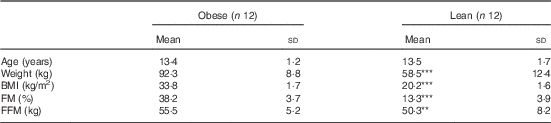
FM, fat mass; FFM, fat-free mass.
Mean value was significantly different from that of the obese group: ** P<0·01, *** P<0·001.
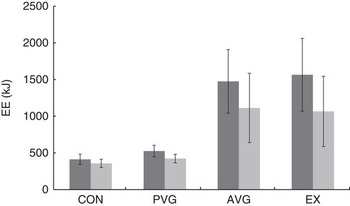
As illustrated in Fig. 1, the statistical analysis revealed a significant group and condition effect for EE (P<0·05). The EE induced by the 1-h AVG was significantly higher in obese (1565 (sd 496) kJ) compared with lean (1113 (sd 473) kJ) adolescents (P<0·05). Similarly, EX-EE was significantly higher in obese (1475 (sd 431) kJ) compared with lean (1067 (sd 479) kJ) participants (P<0·05). AVG and EX-EE were not different within groups. To match for this AVG-induced EE, the mean duration of the cycling exercise (during EX) was 44 (sd 5) min in obese and 47 (sd 3) min in lean adolescents. In both groups, EX- and AVG-induced EE were significantly higher compared with CON and PVG (P<0·01). EE induced by CON and PVG was not significantly different between groups and conditions (with obese: 413 (sd 70) and 526 (sd 79) kJ, respectively; and lean: 358 (sd 56) and 423 (sd 58) kJ, respectively).
Energy expenditure (EE) induced by the four different conditions (control (CON), passive video game (PVG), active video game (AVG), exercise (EX)) in both lean ( ) and obese (
 ) adolescents. Values are means, with standard deviations represented by vertical bars. The ANOVA revealed a significantly higher EE in obese compared with lean participants whatever the condition (P<0·05). EE-AVG and EE-EX are significantly higher than PVG- and CON-EE in both lean and obese participants (P<0·05).
A weight status effect was found in terms of perceived exertion in obese adolescents expressing higher relative perceived exertion during both AVG and EX compared with lean adolescents (P<0·01). AVG-induced relative perceived exertion was significantly lower (5·1 (sd 1·3)) compared with EX (6·8 (sd 1·1)) in obese subjects (P<0·01), whereas no difference appeared between the two conditions in lean adolescents (4·2 (sd 1·2) and 4·5 (sd 0·9), respectively).
A weight status effect was found for ad libitum EI in obese adolescents presenting a significantly higher energy consumption than lean adolescents, regardless of the experimental condition (P<0·001). As shown in Fig. 2(a), EI was not significantly different between conditions in obese adolescents (CON: 4910 (sd 1490) kJ; PVG: 4902 (sd 1307) kJ; AVG: 4728 (sd 1358) kJ; EX: 4643 (sd 1335) kJ). However, EI was significantly lower in lean adolescents after EX (2852 (sd 577) kJ) compared with PVG (3586 (sd 863 kJ)) and AVG (3485 (sd 643) kJ) (P<0·05). REI was significantly higher in obese compared with lean subjects in all conditions (P<0·05; Fig. 2(b)). In lean adolescents, REI was significantly lower during AVG (2378 (sd 677) kJ) compared with PVG (3160 (sd 832) kJ) (P<0·05). EX-REI (1839 (sd 654) kJ) was significantly reduced compared with the three other conditions in lean participants (P<0·05). Although REI was not statistically different between conditions in obese participants, it was lower by about 1200–1400 kJ after AVG and EX compared with PVG and CON, respectively (Fig. 2(b)).
(a) Lunch time energy intake (kJ) and (b) relative energy intake (REI) (kJ) after the control ( , CON), passive video game (
 , PVG), active video game (
 , AVG) and exercise (
 , EX) sessions in lean and obese adolescents. Values are means, with standard deviations represented by vertical bars. Absolute energy intake (a): the ANOVA revealed a group effect (P<0·001). No condition effect in obese participants. EX was significantly lower than PVG and AVG in lean adolescents (P<0·050). (b) The ANOVA revealed a group effect (P<0·05). REI-AVG was significantly lower compared with REI-PVG in lean adolescents (P<0·05) and REI-EX significantly lower than the three other condition (P<0·05). There was no significant difference between conditions in obese adolescents.

The energy consumed derived from each macronutrient (protein, fat and carbohydrate) was not significantly different between groups (obese v. lean) or experimental conditions (CON v. PVG v. AVG v. EX), as reported in Table 2.
Energy derived from macronutrients in lean and obese adolescents during the experimental sessionsFootnote * (Mean values and standard deviations)
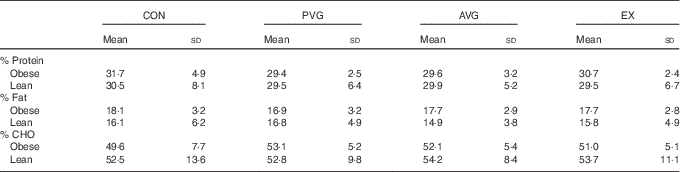
CON, control; PVG, passive video game; AVG, active video game; EX, exercise; CHO, carbohydrate
* Not significantly different between groups and experimental conditions.
A group effect (obese v. lean) was found for appetite sensations, with obese adolescents expressing a higher level of hunger and prospective food consumption (P<0·05) and a lower level of satiety (P<0·05) throughout the whole day. However, hunger, satiety and prospective food consumption ratings were not significantly different between conditions in both lean and obese adolescents.
Discussion
The present study provides the first evidence comparing the EI, food preference and appetite feeling responses to PVG, AVG and EX in lean and obese adolescent boys. Although obese adolescents did not significantly modify their nutritional habits after both video game sessions and EX compared with a control condition, lean adolescents decreased their absolute food intake after an acute bout of moderate-intensity exercise compared with both AVG and PVG and their REI compared with the three other conditions (AVG, PVG and CON). Although this is not statistically significant, it has to be noticed that REI was reduced by about 1200–1400 kJ after EX and AVG compared with PVG and CON in the obese sample, which remains clinically relevant. Although replication studies will be needed to confirm these findings, our results suggest that ‘authentic’ exercise may provide greater benefits on acute food intake control than PVG or AVG in lean adolescents.
Although the present results are the first to be reported in obese adolescents, they contradict those previously published by Chaput et al. in lean Danish adolescents. In their recent study, Chaput et al.( Reference Chaput, Visby and Nyby 14 ) investigated the impact of a 1-h PVG session on subsequent food consumption in lean adolescent boys and showed a 338 kJ (80 kcal) increase compared with a resting session. These contradictive results can be explained by the lack of EE difference observed in the present study between the CON and PVG sessions. Indeed, in their work, Chaput and collaborators found a significant increase in EE during their passive video game condition compared with their rest one, which could have led to a compensatory drive to eat and then higher subsequent EI. Subsequently, Lyons et al.( Reference Lyons, Tate and Ward 13 ) published the only available results regarding the impact of AVG on EI and showed that, in adults, AVG were able to induce a slight decrease in food consumption compared with both a PVG and a CON session. Our results do not show such an increased EI after the PVG session (that also lasted 1 h) and similarly indicate that in adolescents an hour of AVG does not affect EI. Instead, our results suggest that in lean adolescent boys, although AVG favour increased EE compared with passive ones without generating any EI compensation, they remain less effective in impacting energy balance than a classical moderate-intensity isoenergetic exercise. In other words, although AVG have been proposed as a new strategy to increase physical activity level and prevent weight gain in youth( Reference Mathieu and Kakinami 25 – Reference Simons, Chinapaw and van de Bovenkamp 27 ), data from the present study suggest that physical exercise may still remain a more powerful overweight- and obesity-prevention strategy.
Surprisingly, lean adolescents decreased their EI after the exercise bout, whereas the literature suggests that only obese youth modify their food intake after acute exercise( Reference Thivel, Metz and Julien 16 ). This could be explained by the moderate-intensity nature of the exercise proposed in this study, whereas in their study Thivel et al.( Reference Thivel, Metz and Julien 16 ) only asked lean adolescents to exercise at high intensity. Exercise intensity has been effectively proposed as the main parameter explaining subsequent EI modifications in both children and adults( Reference Thivel, Blundell and Duche 28 , Reference Ueda, Yoshikawa and Katsura 29 ).
Although our results did not find any EI differences between conditions in the obese sample, they significantly ate more than lean adolescents, and looking at the kcal ingested they tended to over-consume. This over-consumption might be due to the experimental setting, as laboratory-based experiments have been pointed out to favour such eating behaviours( Reference Thivel, Blundell and Duche 28 ). The lack of EI difference between conditions (and especially after exercise) may be due to the moderate intensity of the exercise session. Indeed, vigorous exercise (above 70 % VO2max) has been shown to have anorexigenic effects in obese adolescents( Reference Thivel, Metz and Julien 16 , Reference Thivel, Isacco and Rousset 20 , Reference Thivel, Isacco and Montaurier 23 ). It can then be hypothesised that an isoenergetic bout of intense exercise (same EE as AVG) can decrease food intake in obese adolescents. Accordingly, as in lean adolescents, high-intensity exercise seems to remain a better anti-obesity strategy than AVG, but further studies are needed to confirm this.
As previously shown after sedentary activities( Reference Chaput, Visby and Nyby 14 , Reference Saunders, Chaput and Goldfield 30 ) and physical exercise( Reference Thivel, Metz and Julien 16 , Reference Thivel, Isacco and Montaurier 23 ), the energy ingested derived from protein, fat and carbohydrate did not differ between conditions and groups. Similarly, despite significantly higher hunger and prospective food consumption and lower satiety in the obese sample, none of the appetite feelings differed between conditions, which is in agreement with most of the current literature( Reference Chaput, Visby and Nyby 14 , Reference Thivel, Metz and Julien 16 , Reference Dodd, Welsman and Armstrong 31 ). The lower EI observed in lean adolescents after EX is then not accompanied by any appetite sensation modification, which highlights once more the previously described uncoupled effect of exercise on appetite feelings and EI in children and adolescents( Reference Thivel and Chaput 32 ).
This study is also the first to compare the energy expended during active video gaming, passive video gaming and acute exercise between obese and lean adolescents. Previously, Gribbon et al.( Reference Gribbon, McNeil and Jay 33 ) found that an hour of active video gaming induced a higher EE compared with a passive session in lean adolescent boys. Our results are in agreement with previous findings, as we found higher EE during AVG and EX (that have been calibrated to isoenergetic) compared with PVG and CON in both lean and obese youth. Interestingly, AVG- and EX-EE were found to be higher in obese compared with lean adolescents, which corroborate later data from Chaput et al.( Reference Chaput, Genin and Le Moel 34 ) who showed that obese adolescent boys expend more energy during a 1-h AVG compared with their lean counterparts.
Although the present data are the first to compare obese and lean adolescents’ EI response to both AVG and PVG and an EX bout, further studies are now needed using, for instance, other kinds of video games. In this study, we chose to use a boxing game (for both passive and active conditions) and other activities may have different effects on EI due to the psychological stress induced that interacts with appetite control( Reference Rutters, Nieuwenhuizen and Lemmens 35 ). Similarly, in this study, the adolescents were asked to cycle at moderate intensity, but other exercise modalities or intensities may lead to different nutritional responses. Finally, the timing of food intake with regard to the gaming activity (e.g. while playing v. after) or context (e.g. alone v. with friends, easy access to food or not, etc.) may differently influence eating behaviours.
In conclusion, our results suggest that in lean adolescents a moderate-intensity EX has better effects on acute energy balance than an isoenergtic hour of AVG. In obese adolescents, however, EI remained unchanged. Future studies will be needed to confirm our findings and to help shape clearer messages for the population.
Acknowledgements
The authors would like to thank the participants for their engagement in this work.
This study was supported by a 2012 Danone Institute Research Award awarded to D. T.
J. P. C., A. T. and D. T. designed the study and elaborated the protocol. Y. B. and M. D. were medical investigators of the study. D. T., Y. B. and M. D. collected the data and managed the experimental sessions. D. T., J. P. C., B. P. and A. T. analysed the data. Y. B., M. D., A. T., J. P. C., B. P. and D. T. interpreted the data and wrote the manuscript.
The authors have no conflicts of interest to disclose.



