

This article explores the multifaceted interpretations of “Chinese dance” — “中国舞蹈” (zhōngguó wǔdǎo, Dance in China) and “中国舞” (zhōngguówǔ, China’s dance)— across historical periods and cultural contexts in Chinese dance criticism in mainland China. To understand and interpret the “Chineseness” embodied in what is referred to as “Chinese dance,” it is essential to recognize that the concept and characteristics of “Chinese dance” are not fixed, but rather dynamic and closely connected to history, aesthetics, and cultural contexts. The multiplicity and complexity of “Chinese dance” possess a generative quality, continually evolving among Chinese people, both collectively and individually, and their relationship with dance. This article aims to address the concepts of Chinese dance— “中国舞蹈” (“zhōngguó wǔdǎo”) and “中国舞” (zhōngguówǔ)—in Chinese-language dance studies. Both — “中国舞蹈” (“zhōngguó wǔdǎo”) and “中国舞” (zhōngguówǔ) are translated as “Chinese dance” in English, yet they hold distinct meanings in Chinese. This problem of the loss of meaning and generalization of culture in a cross-cultural context has not been addressed yet. This article shows how the plurality of “Chinese dance” as both “zhōngguó wǔdǎo” and “zhōngguówǔ” mobilizes the embodied coexistence of “traditional China,” “modern and contemporary China,” “red China,” and “global China” in contemporary “open China.” This nuanced coexistence highlights the complexities of Chinese identity within both global and national landscapes, offering audiences a dynamic and multidimensional experience.
“zhōngguó wǔdǎo (中国舞蹈, Dance in China)” and “zhōngguówǔ (中国舞, China’s dance)” are distinct yet interconnected concepts. The broader term “zhōngguó wǔdǎo” is deeply embedded in China’s cultural context, with roots tracing back to the first recorded use of “China” in the phrase “Here in ‘China’ I Dwell (zhái zī zhōng guó 宅兹中国)” (from the Western Zhou Dynasty/1046 BC to 771 BCFootnote 1). It encompasses not only the profound historical culture and the essence of Chinese civilization, as represented by the term “Zhōnghuá (中华),” but also spans the extensive historical continuum from ancient times to the present. As a subset of “zhōngguó wǔdǎo,” the term “zhōngguówǔ” inherits these broad connotations while placing a greater emphasis on highlighting the “endogenous” dance characteristics of “(new) traditional Chineseness.” Specifically, “zhōngguówǔ” can be understood as a specific term referring to concert dance genres in China since the 20th century. It was constructed by Chinese dance professionals rather than being directly inherited from ancient Chinese traditional dances. “zhōngguówǔ” is neither a dance genre nor a standardized academic term; rather, it functions as a collective term (a conceptual complex) with evolving meanings and interpretations. It can encompass various types of Chinese dances (including dance dramas that use traditional dance language as the core dance material), such as Chinese classical dance (中国古典舞), Chinese ethnic and folk dance/staged folk dance (中国民族民间舞), and may even include Chinese modern and contemporary dance (Wang Reference Wang2001/2017, 378). The collective genres of “zhōngguówǔ” have gradually strengthened both their “cultural subjectivity” and “individual subjectivity” through interactions with “Western” and “global” dance forms. In everyday informal conversations, “zhōngguówǔ” typically refers to a narrower sense, focusing on Chinese classical, national and ethnic dance genres and often excluding foreign styles. For example, Chinese ballet or national ballet, though embodying a Chinese style, is considered an important part of “zhōngguó wǔdǎo” but is not usually classified as “zhōngguówǔ.” This distinction is apparent in the frequent question, “Are you studying zhōngguówǔ or ballet?” However, when we shift our focus from dance genres to the individual dancers, the scope of “zhōngguówǔ” expands to encompass forms such as contemporary Chinese dance. This shift reflects a growing recognition among Chinese dance practitioners that the essence of “Chinese modern dance” lies not in the mere transplantation of Western modern dance models, but in the articulation of modern subjectivity from within—on an individual, experiential level. It highlights a vital endogenous dimension of China’s modernity.
The significance of this article lies in the following two aspects: First, it summarizes and interprets the understanding of “Chineseness” in “Chinese Dance” by Chinese dance critics and scholars across different historical periods and cultural contexts. This expands the research paradigm to encompass not only stage dance works or historical events, or the creators and participants behind the stage, but also historical dance criticism texts, highlighting the evolution of related concepts and their reception and interpretation among professional readers and audiences. Since the 20th century, Chinese dance scholars frequently assume multiple roles as “dance critics,” “theorists of dance” (researchers in fundamental dance theory), and “dance theorists” (researchers in applied dance theory) (Liu Reference Liu1975/2006,1,5). Second, this study proposes multiple theoretical models for the criticism of Chinese dance and explores their interrelations. It investigates the diverse understandings and interpretations of “Chineseness” in the context of Chinese dance, aiming to reveal its historical construction.
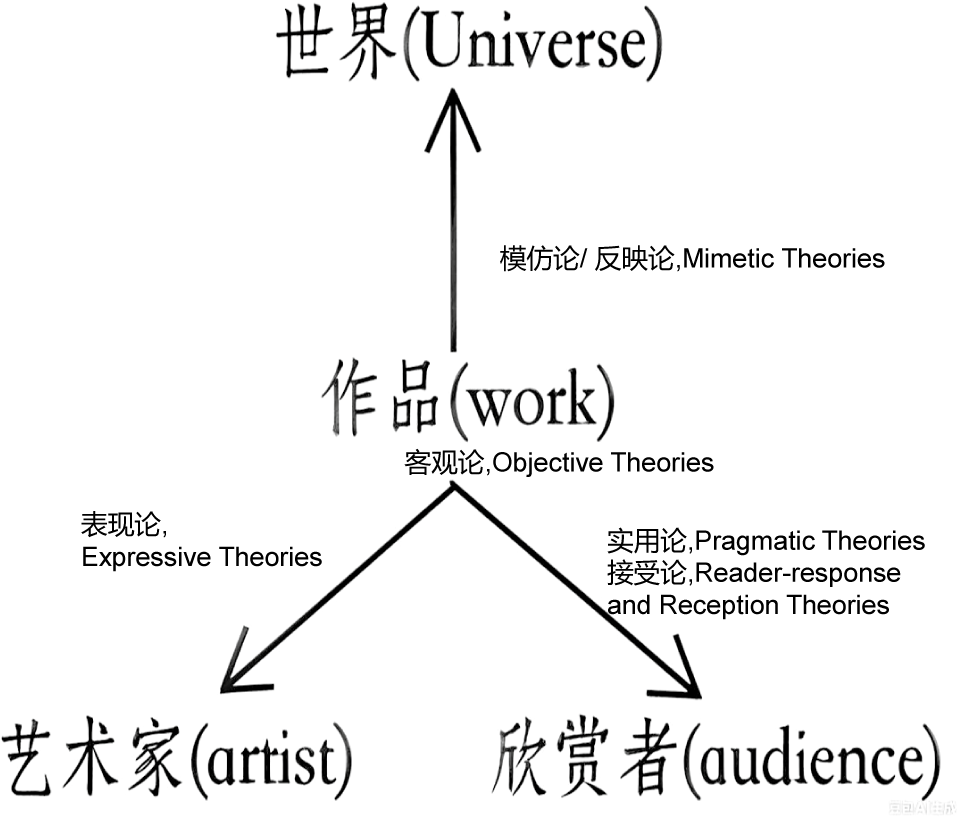
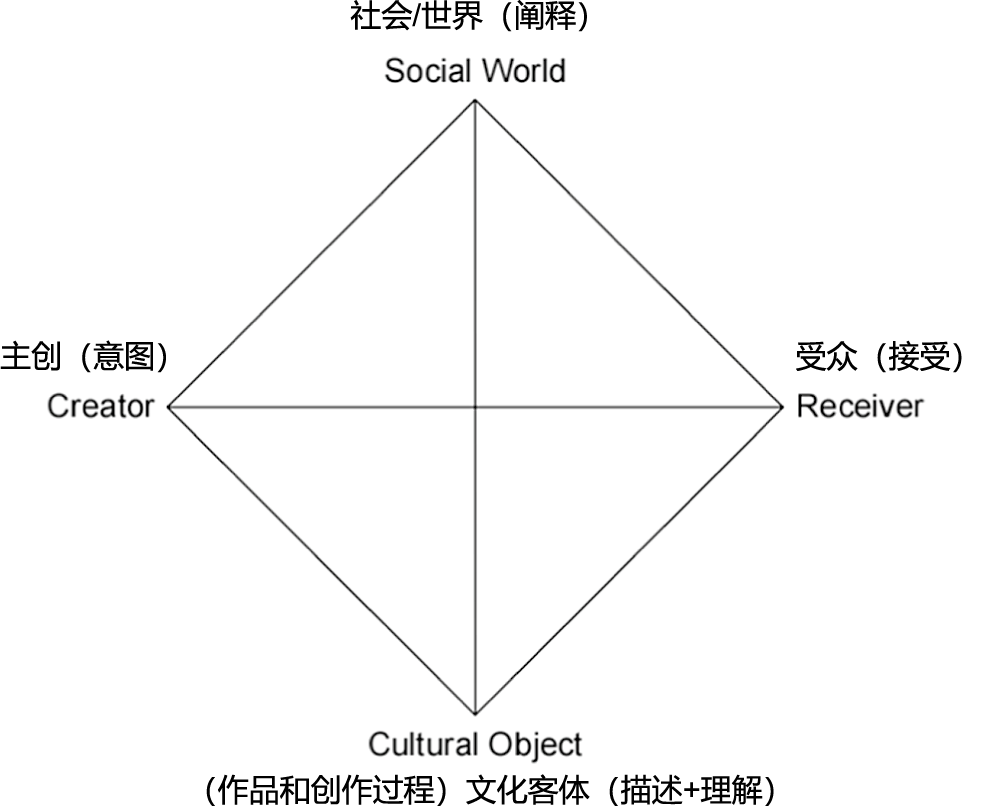
This article draws on foundational theories of literary and dance criticism to examine the evolution and underlying logic of Chinese dance criticism from antiquity to the present, with a focus on the past four decades of reform and opening up. Integrating perspectives from M.H. Abrams’s “Four Elements” model (Reference Abrams1953/2004, 1) (Figure 1), Wellek and Warren’s intrinsic–extrinsic distinction (Reference Wellek, Warren and Liu1956/2005,129), and the intercultural adaptations of scholars such as James J.Y. Liu, it argues that Chinese dance criticism embodies a dynamic interplay among the work, world, artist, and audience (Reference Liu1975, 13) (Figure 2)—reflecting both aesthetic and cultural paradigms. By further engaging Wendy Griswold’s “cultural diamond” as a sociological extension of this framework (Reference Griswold2013, 16) (Figure 3), the study situates Chinese dance criticism within a holistic system where aesthetic discourse, cultural identity, and social context continuously interact to shape the understanding of “Chineseness” in “Chinese Dance.”
Abrams’ triangle schema.

James J.Y. Liu’s circle schema.

Dance criticism form framework based on Wendy Griswold’s “cultural diamond” and related methods.
Comparison of “four element theory” : the underlying logical reference of dance criticism (as Shown in the Three Figures Above).

1. Historical Background of the Classification of Chinese Dance (zhōngguó wǔdǎo 中国舞蹈) Criticism Theoretical Models
The underlying logical concept of the Chinese dance criticism model has a “universal” aspect as well as a “unique to a particular tradition” aspect (Liu Reference Liu1975/2006, 3). Throughout various historical dynasties and periods, the structure and mode of Chinese dance criticism have evolved, sometimes displaying a complex interplay or coexistence of elements from different eras.
(1) Traditional Chinese Dance Criticism: Integrating “Literature, History, and Philosophy” and “象 (Xiàng), 气 (Qì), 道 (Dào)”
In ancient China, dance criticism that valued “contemporaneity” (Agamben Reference Agamben, Kishik and Pedatella2009) emerged long before the advent of modern print media. Approximately two thousand years ago during the Eastern Han Dynasty (AD 25–220), a distinctive form of dance criticism known as “Ode (Fù 赋)” appeared. Fu Yi 傅毅, a scholar from that era (circa 42–90), authored the work “Dance Fù (舞赋)”, which was included in volume 17 of the “Zhaoming Selected (昭明文选)” collection—a compendium covering poetry, music, and dance. This article is notably recognized as “the earliest dance review in the history of Chinese literature” (Su Reference Su2017, 244) by literary circles. Fu Yi meticulously described the popular “Plate and Drum Dance (盘鼓舞)” during the Eastern Han period and detailed the entire experience of watching the dance, emphasizing that Eastern Han dance possessed aesthetic value beyond its role in Confucian ritual and music culture education.
To explore the traditional Chinese dance criticism model, it is essential to harmonize it with both the artistic forms of ancient dance and traditional Chinese aesthetic thought. Rooted in China’s aesthetic spirit, this model could also align with the logical structure of modern critical forms. However, applying the Western “four elements theory” to traditional Chinese art criticism presents challenges. Unlike Western models, Chinese dance criticism lacks a clear structure of the two-by-two relationship in the “work-world-artist-audience.” Chinese traditional dance criticism intertwines with literature, reflecting an ancient Chinese literary theory that blurs the boundaries between literature, history, and philosophy. This holistic perspective allows scholars to explore human culture and the spiritual realm through interconnected lenses. A common thread lies in connecting “work-world-performers-audience” and integrating Xiàng (象, artistic realm), Qì (气, anthropological significance), and Dào (道, philosophical realm) (Wang Reference Wang2006). The richness of ancient Chinese vocabulary further complicates direct adaptation. This unique fusion constitutes a distinct “aesthetic cultural paradigm” in China. Moreover, it emphasizes intuition and experiential understanding, rooted in the spirit of Chinese aesthetics that embody “traditional Chineseness.” (Table 1)
The classic articles in ancient Chinese dance criticism contain insights into “Xiàng 象, Qì 气, Dào 道”. Each vertical column represents a deeper level of meaning.

Table 1. Long description
Starting from the leftmost column, Xiang Xiang is defined as artistic realm, mind-picture, and synaesthetic imagery. Its rows list form, feeling, image, the ‘dance image’; shape, shaping; and Yixiang, imagery, gestalt, including the great image which is hard to trace. Examples reference ‘Dance Fu’, describing performers soaring, gliding, leaning, and swaying, with movement that eludes imitation and visual representation. The middle column, Qi Qi, covers anthropological significance, energy, breath, vital force, or life force. Its rows include breathing and maintaining an open airway; power, effort, flow, and Dong Shi (dynamic momentum); and Qi Yun Sheng Dong, artistic appeal of vivid charm and vitality, rhythm and verve, aura. Examples from ‘Dance Fu’ describe breath floating like clouds, determination as autumn frost, and dance evolving with aspirations and vitality. The rightmost column, Dao Dao, represents philosophical realm, Tao, Way, natural principle, or fundamental law of the universe. Its rows detail perspectives on life outlook, world outlook, values; Yijing, aesthetic conception, spiritual field; and Shen Xin Ling, body, mind, and soul/spirit, with the theory that man is an integral part of nature and Tian Ren-He Yi, unity of Heaven and humanity. Examples from ‘Dance Fu’ describe gestures expressing aspirations, soaring thoughts, and connecting with the essence of existence. The final row spans all columns, stating '(Work-world-performer-audience) Dance (Hermeneutics)'.
(2) Chinese Dance “Social-Historical Criticism Model” in the Early 20th Century and the Socialist Construction Period
“Social Historical Criticism” emerged as the most influential methodological framework in Chinese dance discourse during the 20th century, shaping the field’s development in profound ways. The concepts of “national consciousness” (nationhood) and “ethnic consciousness” (ethnicity) converge in the Chinese term mínzú (民族), which carries the weight of both. As Chinese dance advanced through various trajectories of nationalization in form and content, this complex mínzú consciousness evolved in tandem, reinforcing its presence throughout the creative process.
In June 1941, a pivotal moment occurred when Dai Ailian (戴爱莲), Wu Xiaobang (吴晓邦), and Sheng Jie (盛婕) collaborated to present the “New Dance Performance” in Chongqing. This marked the first cooperative effort among Chinese dance pioneers in the 20th century. This event unfolded against the backdrop of Chongqing enduring prolonged Japanese bombings. Xinhua Daily (新华日报), the sole large-scale newspaper published by the Communist Party of China in the Kuomintang-controlled region, featured a dance review titled “On the xīnwǔyǒng (新舞踊) Performance - The 17th and 18th at Chongqing Anti-Japanese War Drama Hall.” This review introduced the term “mínzú dance”, signifying its significance. The categorization of “Chineseness” as “traditional Chineseness” (for instance, Dai Ailian’s Borderlands Dance 边疆舞, 1946–1949) may seem relatively straightforward; however, the value of this dance review lies in its exploration of “modern Chineseness”:
“Mínzú Dance 民族舞踊 (蹈)” is currently taking shape and gaining solidity through the dedicated efforts of several Chinese dance artists. Its contemporary understanding not only serves as a historical record of events during the Anti-Japanese War but also functions as fervent propaganda. We argue that this innovative dance grows through persistent effort and creative drive, and moves in step with the unfolding trajectory of new China. (Luo Reference Luo1941)
The term “mínzú Dance” reflects the fusion of “modern Chinese” and “traditional Chinese” characteristics, marking the emergence of 20th-century “zhōngguó wǔdǎo” and especially “zhōngguówǔ” as theatrical dance art forms. This shift fostered new forms of national dance that advanced the “national spirit” and cultivated a sense of “revolutionary consciousness.” In the memoir “My Dance Art Career,” Wu Xiaobang highlighted the significance of the dance review, expressing how inspiring it was to him and his colleagues (Reference Wu1982, 49). The term “Mínzú Dance” was rendered as “mínzú wǔyǒng (民族舞踊)”, reflecting the influence of Japanese terminology on China in the 1930s and 1940s (Fan Reference Fan2019). The Chinese dance community abandoned the term “wǔyǒng (舞踊) “subsequently, and it wasn’t until after 1949 that the terms” mínzú dance” and “new dance art” (新舞蹈艺术) became firmly established.
Following the founding of the People’s Republic of China (PRC), specialized dance criticism in dedicated dance media emerged later than general dance reviews in public newspapers, both of which began in the 1950s. Major publications such as People’s Daily and various dance-focused journals and magazines actively reported on dance-related issues throughout this period.
“The seventeen years” following the establishment of the PRC not only mark a specific period but also represent a crucial period in the development of socialist realism in literature and art. Scholars often describe this era as the “socialist construction period,” during which cultural developments laid the groundwork for both the Cultural Revolution and the later Reform and Opening-Up. Notably, in May 1942, Mao Zedong delivered his influential “Talks at the Yan’an Forum on Literature and Art,” which set the principles of social-historical criticism as the basis for the new Chinese literature and art.
During this time, two pivotal issues significantly impacted the dance community: first, the influence of “learning from the big brother of the Soviet Union,” and second, the quest for the “nationalization of dance,” with a central focus on establishing a distinct “self-identity” under Soviet guidance. These themes were already foreshadowed before the creation of the iconic dance drama “The Red Detachment of Women” (红色娘子军). In the late-1950s, dance dramas like “Lotus Lantern” (宝莲灯) began emphasizing the use of materials drawn from folklore and traditional Xiqu (戏曲). This approach was guided by Soviet experts such as Chaplin and aligned with the unique characteristics of Chinese culture. However, another ballet expert, Gusev, influenced the creation of “The Fish Beauty” (鱼美人), a production that leaned more toward a “ballet-like” or even “Swan Lake-like” style. This divergence sparked discussions about the “nationalization of ballet” (Long Reference Long1960). The question of whether “The Fish Beauty” represented a perspective of “self-othering” remained a subject of ongoing debate when the dance drama was revived in the 1990s (Liu Reference Liu1995).
Within the cultural context of the Seventeen Years, Chinese ballet—though strongly shaped by Soviet classical and dramatic traditions—has moved beyond the simple label of “Soviet” or “classical” ballet. While it may not fit the narrow definition of “zhōngguówǔ”, it has become a vital component of “zhōngguó wǔdǎo”, giving rise to what is now recognized as “Chinese mínzú ballet,” a form that also contributes significantly to the development of national dance dramas. The “Red and White dance dramas,” The Red Detachment of Women and The White-Haired Girl (白毛女) blending aesthetic elements of romanticism and realism, have long become representative ballet works within China’s new traditional narrative, establishing the new traditional cultural model for the creation of Chinese mínzú ballet.
(3) The Golden Age of Dance Criticism in China in the 1980s: The Beginning of Intrinsic and Extrinsic Integration
In the 1980s, dance criticism with “intrinsic and extrinsic” integration began to appear. At the Third Plenary Session of the 11th National Congress held in December 1978, Deng Xiaoping (邓小平) delivered a speech titled “Liberate Thought, Seek Truth from Facts, and Look Ahead in Unity”, marking the beginning of the “New Era.” Deng further emphasized the need to guide the arts based on the inherent principles in October 1979 (Deng Reference Deng1979/ 1998, 183). This period marked the emergence of a phase of “consciousness-raising” regarding the subjectivity of dance critics and choreographers within Chinese cultural criticism, ushering in the first golden age of Chinese dance criticism in the 20th century. During this period, dance critics examined how choreography could shift from serving “revolutionary culture” to engaging with “people’s culture.” While continuing to foreground the relationship between artistic practice and social reality, they also began to integrate aesthetic analysis into their critical frameworks.
First, the focus of criticism is on intrinsic integration. National-level dance events invigorated dance performances. The first national dance competition was considered to have “broken through the level of the past thirty years” (Wu Reference Wu1980). In a 1978 issue of Dance magazine, the phrase “gallop, dance image thinking” captured the essence of the debate: “dance has to be dance.” (Ye Reference Ye1978) Choreographers increasingly explored emotional dance that pursued artistic conception. Creative themes previously criticized as “feudalism, capitalism, revisionism” (封、资、修) regained prominence. Works emphasizing aesthetic beauty gained encouragement. Yang Liping (杨丽萍)’s solo “Spirit of the Peacock” (雀之灵) stood out at the second national dance competition in 1986. Rejecting the typical movement rhythm associated with the Dai people (傣族人), raised doubts about whether it still qualified as Dai dance (傣族舞蹈) (Liao Reference Liao1989). Some consider it can be seen as an artistic work resulting from the “individualization” and “spiritualization” of the Mínzú dance language (Zhao Reference Zhao1988). In other words, some dance critics regard “Spirit of the Peacock” as embodying the aesthetic cultural form of “modern Chinese dance (zhōngguówǔ).”
In 1987, newly appointed Beijing Dance Academy president Lv Yisheng (吕艺生) began a deep inquiry into the concept of dance ontology. This exploration sparked discussions within the Chinese dance community about fundamental questions: “What is dance?” and “What constitutes dance?” The relationship between “autonomy” and “heteronomy” in dance art became a focal point. In 1988, Dance magazine initiated the “Year of the Dragon Conversation by Writing,” inviting theoretical researchers to jointly explore dance’s self-awareness, formal laws, and aesthetic forms. Calls for multi-level, multi-model, and multi-channel development of dance grew louder. Esteemed dance writers like Long Yupei (隆荫培), along with emerging young critics, like Zhao Daming (赵大鸣), Zhang Hua (张华) and Yu Ping (于平) engaged in this dialogue. Zhao Daming succinctly captured the essence: “For choreographers who have experienced decades of creation, all issues once again return to the most primitive and basic question—what is dance?” (Reference Zhao1988). Beyond this, the more valuable inquiry emerged: “What is my (our) dance?” This dual awakening reflected historical dance cultural subjectivity and the individual subjectivity of choreographers and critics.
Second, the emphasis shifted to extrinsic integration. At the time, Chinese dance (zhōngguó wǔdǎo) entered what Peng (Reference Peng1985) described as “an era of inheritance, exploration, change, and turbulence.” Abstract expression, modernism, stream-of-consciousness techniques, rock music, disco, jazz dance, breaking, and other foreign art forms—once condemned as “bourgeois dross” —gained official legitimacy. Their entry, however, significantly disrupted traditional dance culture and challenged the foundational ethos of realism. As Guo Mingda (郭明达) pointed out, “In recent years, there have been debates over classical dance, folk dance, ballet, modern dance, and pop music and dance, as well as debates over economic benefits versus opting for less revenue to maintain tradition, and differences in tastes between leaders and the masses.” (Editor 1985). In response to the influx of Western cultural influences, dance practitioners engaged in what became known as the “great discussions of Chinese and Western dance.” Moreover,the old problem of “similarity and singleness” has reappeared in a different form. In addition to the need for choreographers to supplement their artistic cultivation, there were also institutional and conceptual reasons for the emergence of “singleness.” In a 1985 article, Lv Yisheng called for breaking free from the constraints of artistic uniformity, warning that “without liberating ourselves from the fetters of ‘sameness,’ we cannot truly achieve a hundred flowers blooming.” In this piece, he underscores the urgent need for diversity in creative expression and critiques the stifling effects of aesthetic conformity:
An invisible wind swept across the country—at times from the East, where mass performances dominated national events; from the South, where dance dramas flourished; and from the West, where ballroom and disco dancing captured the public imagination. This atmosphere promoted uniformity: one system, one genre, one form, one style, one mandate, one mission, and one standard.
Dance criticism in the 1980s integrated intrinsic and extrinsic perspectives, shaping the foundational logic that underpins contemporary theoretical models in China. This shift contributed to the “de-politicization” of dance, moving it away from extreme left-wing political influences. As a result, the landscape of “zhōngguó wǔdǎo” has become more diverse, with “traditional Chinese” and “contemporary Chinese” characteristics naturally emerging at the individual level of dancers. Notably, the endogenous transformations within “zhōngguówǔ” have played a significant role in this process. A more detailed analysis will follow.
2. “Integrated Diversity” : Classifying Dance Criticism Models and Their Influence on Interpreting “zhōngguówǔ (中国舞)”
Faced with the growing diversity of “zhōngguó wǔdǎo”, contemporary Chinese dance criticism predominantly falls within the framework of “social-historical criticism” (Yu Reference Yu2009), which incorporates principles from “new historicism”(Parker Reference Parker2008) and various levels of cultural studies It has been constructed by aesthetic principles (Marx Reference Marx1932/2000, 84). Over time, this approach has evolved from a primarily “work-world” relationship to a more unified and diversified contemporary social-historical criticism model. Within this framework, the core is a “new social-historical criticism” (emphasizing “new realism” aesthetics to analyze the “national character” and “state character” of Chinese dance), complemented by other models and fusion approaches. In addition to the enduring dominance of “socialist realism” dance criticism, the three subcategories—namely, the “historical-traditional,” “ethnic-national,” and “cultural-psychological” dance criticism models—enrich China’s dance criticism landscape. These modes do not operate in isolation; instead, each foregrounds a distinct dimension while collectively weaving together the complex interplay among the “work,” “world,” “choreographer,” and “audience.”
(1) Socialist Realism Mode of “Contemporary Chinese Dance Style”
In the 1980s, works initially labeled as modern dance later found their place as “Chinese contemporary dance,” with socialist realism at their core. How did this shift in perception occur? During the early years of reform and opening up, the “Modern Dance Experimental Squad” of the Nanjing Military Region Frontline Song and Dance Troupe produced pioneering works that laid the groundwork for “Chinese modern dance” in the 1980s (Hua Reference Hua1986). From pieces like Hope (希望), Goodbye, Mom! (再见吧! 妈妈), Fan Yi (蘩漪), and Deep in the Tian Mountain (天山深处) in 1980, to Red Flag Hymn (红旗颂) and Yellow River Soul (黄河魂) in 1982 and 1984, respectively, these works drew inspiration from Guo Mingda’s lecture on modern dance theory in 1979 and skillfully blended foreign influences with China’s unique context (Hu Reference Hu1986).
By the late 1980s, scholars began to view these works not as rejections of tradition but as extensions—and even renewals—of it. They referred to this emerging style as “modern Chinese dance,” noting a deepening tendency toward realism as its primary current (Yin Reference Yin1989). Zhao Daming underscored how Yellow River Soul introduced innovative movement vocabulary and modern stage techniques, drawing on the rhythmic qualities of local gestures and a broader aesthetic atmosphere—all firmly rooted in the cultural foundation of traditional Chinese dance (Zhao Reference Zhao1987). Yu Ping directly analyzed the creative transformation of the dance’s movements from the perspective of the growth background of the choreographer, pointing out that Su Shijin (苏时进) and others creatively fused elements from Shandong Province’s traditional Guzi Yangge dance (鼓子秧歌)—a combination of drum beating and oar rowing. Their transformation of stage imagery, oscillating between “boatmen on the Yellow River” and “waves on the Yellow River,” resonated with the national spirit and moved audiences (Yu Reference Yu1992).
At the beginning of the new century, some Chinese scholars introduced the concept of “New Realism Dance,” which was subsequently elaborated and debated in multiple professional journals and industry forums. Theyspecifically targeted works influenced by the context of reform and opening up and “Western dance culture,” which were initially created under the label of “Chinese modern dance”. At the third “Lotus Award” contemporary dance gala in 2002, a work Boys and Girls in the Smoke of War (踏着硝烟的男儿女儿) from the 1980s—formerly known as “modern dance” —identified itself as Chinese “contemporary dance.” Such works diverged from the method of creating based solely on national and folk dances, as specified by the government in the 1950s. Instead, they drew inspiration from various sources, emphasizing socialist ideological consciousness and the spirit of realism. This approach diverged from Western modern and contemporary dance, aligning instead with the evolving aesthetics of contemporary performing arts in China.
Contemporary dance in China develops amid ongoing cultural tensions between tradition and modernity, the self and the other (Zhou Reference Zhou2013). It represents a convergence of “pre-modernist,” “modernist,” and “post-modernist” creative approaches, culminating in a spiritual transformation from “realism” to “new realism.” In Reference Lv2013, Lv Yisheng highlighted how choreographers like Shu Qiao (舒巧), Men Wenjuan (门文元), Zhang Jigang (张继钢), Chen Weiya (陈维亚), and Zhao Ming (赵明) infused realism with fresh elements. The new generation of new realist choreographers, including Wang Ge (王舸),Tong Ruirui (佟睿睿) and Han Zhen & Zhou Liya (韩真&周莉亚), absorbed concepts and techniques from expressionist modern dance, excelling in using the spatial-temporal perspective of “dance thinking” to convey narratives (Lv Reference Lv2013, 65, 246). Professor Lv Yisheng aptly summarized this as the “contemporary Chinese dance style (当代中国舞风),” characterized by distinct themes, complete structures, advanced techniques, splendid design, eclectic language, and a propagandistic nature (Reference Lv2014). These characteristics echo across multiple genres of “zhōngguówǔ.” Chinese classical dance, ethnic and folk forms— grouped under the term “new traditional Chinese dance” (新传统的中国舞)—as well as Chinese modern and contemporary dance, each carry distinct traits. Yet together, they contribute to the broader category of “modern and contemporary Chinese dance” (现当代的中国舞). The following sections focus on how contemporary Chinese artists reinterpret and reshape the idea of “zhōngguówǔ,” rather than addressing the more generalized notion of “zhōngguó wǔdǎo.” For this reason, the discussion excludes examples such as Chinese ballet.
(2) Historical Traditional Mode of “Chinese Classical Dance”
Since the early 1950s, the term “Chinese classical dance” has been proposed and established, yet its interpretation and annotation remain subject to ongoing debate. The tension between “antiquity” and “present” (古今) lies at the heart of this issue, reflecting a clash of values regarding the historical versus contemporary orientation of new traditional Chinese dance. The Soviet ballet experience initially served as the readily available “present (今)” during the early years of New China. Although it was widely acknowledged that “ballet cannot be rigidly transplanted” (Ye Reference Ye1999, 323), practical efforts to blend traditional Qiqu (戏曲) with ballet swiftly ensued. However, the dance community gradually reevaluated its historical perspective after the era of reform and opening up, leading to reflections on the historical and cultural dimensions (that is, “traditional Chineseness”) of “Chinese classical dance,” alongside ongoing explorations of its contemporaneity (that is, “Contemporary Chineseness”). The debate between “antiquity” and “present” continues to resonate within the dance world.
The emergence of the “Rhythm of the Body/Shēn Yùn (身韵)” course has revitalized Chinese classical dance! (Li et al. Reference Li, Gao and Zhu2004, 130). Shēn Yùn reinforces the embodiment of traditional characteristics in dance. Before 1984, it was known as “Body Form/Shēn Duàn (身段),” heavily influenced by the gestural language of the Peking opera (Xiqu 戏曲). The term “Rhythm/Yun (韵)” signifies dancers’ deliberate return to the roots of Chinese culture, exploring historical and cultural awareness. While emphasizing “dance autonomy” and moving away from Peking opera style, this foundational training method has inadvertently reinforced the “contemporary dance style” in creative techniques.
Following the successful premiere of “Yellow River (黄河)” in 1988, which masterfully depicted the “Cloud and Water/Yun shui (云水)” imagery (Yìxiàng/意象) through “twist and tilt dynamics (拧倾动态),” the “contemporary Chinese dance style” under the banner of “Chinese classical dance” became more distinct. This work achieved “elementalization of dance language” and “symphonicization of choreography methods” according to Yu Ping (Reference Yu2000). In 1994, “Yellow River” received the Classic Work Award in the “Classics of Chinese Dance for the Twentieth Century” competition. This piece embodies the unwavering struggle and spirit of liberation of the Chinese nation against invaders in the 20th century, characterized by its temporal specificity and charged with the mission of “using classical dance to shape a fresh and contemporary aesthetic”. Shēn Yùn, evolving from Peking opera’s “Shēn Duàn,” emphasizes refining 20th-century national aesthetics through dance autonomy, transcending mere historical and cultural exploration. However, this prompts the question: Can it still be considered Chinese classical dance?
From the 1980s to the early 21st century, Sun Ying (孙颖) wrote numerous papers, including “Ten Discussions on Classical Chinese Dance (十论中国古典舞),” emphasizing the historical and cultural positioning of classical danceFootnote 3. His works also introduced a “new approach” to the creation of “Chinese Classical Dance” (Yu Reference Yu2000). This period witnessed the emergence of graceful and unadorned women’s group dances such as “Taking the Stride and Singing” (踏歌) from the Han Wei Dance School (汉魏舞派), which exude a simple and charming historical folk style. Simultaneously, the “spiritual personality” of Confucian scholars and Taoist meditation found expression in the men’s group dance “Xie Gongji (谢公屐).” Zhou Zhiqiang (周志强) from Nankai University’s School of Literature argues that many works within the Chinese dance community demonstrate a hierarchy of quality: ‘first-rate dancers, second-rate choreographers, and third-rate cultural expression.” He praises Sun Ying’s dance as initiating a “quiet revolution,” bridging ancient folk art with intellectual literati art. This transformation “promotes the transformation of dance from pantomime and subject-oriented specialization to a cultural expression,” providing “dance with the possibility of social extensive interpretation” (Sun and Zhou Reference Sun and Zhou2005).
Moreover, there are more radical “historical-ideological” dance culture scholars who pursue a more authentic “traditional Chinese essence.” They argue that the essence of “classical dance” lies in its status as “intangible cultural heritage.” They view it as a “living museum of historical dance paradigms,” accumulating intangible heritage across different periods (Liu and Zhang Reference Liu and Zhang2018). Some propose that performance reconstruction, styled after “intangible heritage,” combines authenticity with the historical and cultural context, resulting in a convincing and emotionally resonant experience (Wang Reference Wang2014). The narrow understanding of “Chinese classical dance” evolved within teaching systems and gradually coalesced into an “academic school,” epitomized by “Shēn Yùn.” The broader conception of “Chinese classical dance” encompasses a multifaceted journey through history and reality, spanning both antiquity and the contemporary era. This journey involves processes of inquiry, adaptation, and exploration. It involves cultural “genetic modification” (contemporary innovation), the “gene editing” (creation of historical styles), and the “gene sequencing” (reconstruction and replication of historical dance paradigms).
(3) Cultural-psychological Mode of “Chinese Concert Folk Dance”
Chinese dance professionals have consistently focused on understanding and comprehending ethnic and folk dance art as professional art since the founding of the PRC. The dance community advocated refining and sublimating original dance to meet the requirements of the new era and the new life from the early reform and opening-up period to the early 21st century. During this time, dance criticism articles primarily centered around themes related to “socialist realism” and the “ethnic nation.” However, as we entered the 21st century, a “cultural-psychological” approach gradually emerged, drawing insights from anthropology, cultural studies, and psychology. This approach emphasizes the authenticity of Chinese stage folk dance about folklore culture. To some extent, it has changed the general view that “Chineseness” is primarily seen as “nationality” and “Han ethnicity”. How did this process unfold?
In the early 1990s, Lv Yisheng introduced the influential “Two Categories and Three-Tier Theory (两类三层说)” (Reference Lv1993a, 119) of Chinese folk dance. This theory distinguishes two categories—self-entertainment and dance performance—and identifies three spaces: the square, the classroom, and the stage. The third tier, “staged folk dance,” is characterized by the personal style of professional choreographers and performers. After the 1990s, “Chinese folk dance” began to reflect a transition from “folk ceremony” to “high theatrical consciousness” (Yu Reference Yu2000) and “choreographer personal consciousness,” resulting in a multifaceted genre. Consequently, “Chinese folk dance” evolved into a form that freely encompasses traditional, modern, local, fashionable, communal, and individual expressions. This evolution is evident in the progression of works from “Dance Nostalgia (乡舞乡情)” (1990) to “Dedicated to My Parents (献给俺爹娘)” (1991), and from “Little Egret Night (小白鹭之夜)” (1994) to “We Walked Together (我们一同走过)” (1996). These works illustrate a journey from “seeking the essence of folk dance” to “departing from traditional roots to create contemporary folk dance” (Yu Reference Yu1998), highlighting the interplay between academic-school folk dance and folklore culture, with varying degrees of proximity. Ming Wenjun (明文军) introduced the concept of “macro folk dance (宏观民间舞)” in Reference Ming1999, which he later expanded to “Chinese national folk dance (中华民族民间舞),” focusing on the cultural issue of “the nationality of the Chinese nation” (Reference Ming2001).
However, with the adoption of the Convention on the Protection of Intangible Cultural Heritage by the United Nations in 2003, terms like “intangible culture” and “original ecology” have been thrown into the spotlight, significantly impacting social discourse. Lv Yisheng emphasized that “artists engaged in traditional art should prioritize strict preservation over innovation to safeguard our cultural heritage, otherwise our tradition will not exist” (Reference Lv2005). The inheritance and development of national and folk traditions, he argued, are not merely “individual endeavors” but should be treated as a “macro policy” implemented at all levels (Lv Reference Lv2004).
Yang Liping (杨丽萍) introduced her groundbreaking work, “Dynamic Yunnan (云南映象),” to the Shanghai stage in 2004. This performance, which seamlessly blended ethnic song and dance, not only earned the prestigious “Lotus Award” in the Chinese dance community but also ignited a spirited debate about “original ecology” within cultural circles. Zi Huayun (资华筠) warmly praised Yang Liping’s “profound inheritance and extraordinary creativity,” while also cautioning against blindly promoting the “original ecology” banner, emphasizing the need to recognize artistic creativity and avoid oversimplifying the concept of “cultural source” (Reference Zi2004).
At the same time, Zhao Tiechun (赵铁春) and Wang Xin (王昕) from Beijing Dance Academy argued for the importance of fieldwork in studying Chinese national folk dance through an anthropological lens (Reference Zhao and Wang2004). Their perspective signaled a shift in how academic circles approached the teaching and creation of folk dance, placing new emphasis on the value of authenticity. In the new century, the traditional practice of “folk style collection (采风)” has evolved into a participatory “field study” that respects cultural insiders (Yue Reference Yue2014, 248). This shift toward original ecological folk dance sparked major reforms in the development of academic-school national folk dance. By 2014, scholars had firmly embraced an academic approach to intangible cultural heritage, especially through the launch of the traditional folk dance series Chen Xiang (沉香). Within the ethnic and folk dance community, educators began emphasizing the importance of engaging in “relatively authentic learning from folk culture as outsiders.” This approach aimed not only to meet contemporary challenges but also to carve out a path for Chinese national arts in the era of cultural globalization (Li and Su Reference Li and Xuebing2015). This shift gave rise to a new academic-school cultural framework focused on exploring authenticity within minority dance traditions. Within this framework, “Chineseness” reflects both the political-cultural identity of a unified Chinese nation and the cultural identity of Han and minority ethnic groups—harmonious in coexistence, yet distinct in expression.
(4) Ethnic-National Mode of “Chinese Modern and Post-modern Dance”
The process of “nationalization (民族-国家化)” has been applied to imported dance forms like ballet and modern dance in China. An illustrative case is the “Chinese Dance Peach Blossom Cup Invitation Competition (中国舞桃李杯邀请赛)” held in the 1980s. The competition began by highlighting Chinese folk and classical dance, and in 1991, it added ballet to clearly distinguish between “zhōngguówǔ” and ballet categories. By the time organizers prepared for the fourth Peach Blossom Cup in 1993, however, new questions surfaced: Should Chinese modern dance performances fall under the umbrella of “Chinese dance/zhōngguówǔ” ?
Lv Yisheng raised the issue, noting that some dance works defied categorization and lacked a clear home. He pondered whether a new dance genre existed—one that didn’t neatly fit existing labels. How should such works be recognized? (Reference Lv1993b).
At that time, dancers advocated the recognition of “modern Chinese dance” while also grappling with the legitimacy of labeling another “Chinese modern dance.” Lv Yisheng emphasized that despite its growth, modern dance still lacked full recognition in China and couldn’t be directly associated with the banner of “Chinese modern dance” (Reference Lv1985).
Modern dance, with its emphasis on the individuality and independence of the artist, truly began to take root in China in the late 1980s. Concurrently, dance criticism increasingly focused on the individual subjectivity of the choreographer. Yu Ping observed that works like “The Monologue (独白)” in Shanghai and “Tide (潮汐)” in Guangzhou paved the way for China’s modern “barefoot dancers” (Reference Yu1991). The term “barefoot dancers” metaphorically refers to individuals akin to China’s Isadora Duncan. Among them were Hu Jialu (胡嘉禄) from Shanghai—an avant-garde urban experimenter(Liu Reference Liu2004—and Wang Mei (王玫) from the Experimental Program in Modern Dance at Guangdong Dance School (1987-1992). Hu Jialu’s creation, “The Monologue,” already reflected a strong modern dance consciousness. Set to Bach’s Mass in B Minor, the piece conveyed a patient observer’s world, rich with metaphors for reality. Meanwhile, Wang Mei’s work “Tide” moved beyond water imagery. It embodied Gestalt imagery (Yìxiàng/意象) related to the ebb and flow of the heart, resonating with societal changes in China. Wang Mei’s investigation of body movement and structure integrated emotional expression methods from Chinese ethnic dance with Western modern dance techniques and approaches to structuring a work of art, leading to a transformative approach. By transitioning from “observing objects from the perspective of the self (以我观物)” to “observing objects from their perspective, without distinguishing self from the object (以物观物,不知何者为我,不知何者为物),” Wang’s “Tide” achieves self-transcendence compared to her previous work (Pu Reference Pu1988).
A modern dance competition prompted practitioners and scholars to reflect on what defines Chinese modern dance. In 1994, China hosted its first modern dance competition in Dongguan, explicitly requiring participating works to draw from Western modern dance training methods, creative concepts, and techniques. Yu Ping observed that this move aimed to distinguish itself from the “new dance” that adhered to realism (referred to as Chinese contemporary dance or modern Chinese dance) (Reference Yu2016). During the same year, Yang Meiqi (杨美琦), founder of the Guangdong Modern Dance Company, wrote an article titled “Chinese Characteristics: The Creative Roots of Guangdong Experimental Modern Dance Company.” She emphasized that “modern Chinese dance” and “Chinese modern dance” represent distinct cultural concepts and aesthetic categories. Yang Meiqi framed Chinese modern dance as a form of modernist art. She urged choreographers to cultivate a distinctive language and artistic identity through borrowing and creative exploration. To present Chinese modern dance on the international stage, she emphasized the need to root its expression in the cultural character of the Chinese nation (Reference Yang1994).
There is a subtle difference between emphasizing the “individuality” of modern dance and the “individuality” of modern dancers themselves. In 1994, choreographer and activist Willy Cao (曹诚渊) actively organized and presented modern dance performances across China and on international stages. He observed that many Chinese dancers aimed to “develop modern dance with Chinese characteristics.” While they absorbed modern techniques in form, they maintained a deep connection with modern Chinese dance—a departure from the Western understanding of ‘modern dance’.”(Reference Cao1994) Zhao Guozheng (赵国政) echoed this sentiment in Reference Zhao1995, emphasizing that adding “China” before “modern” in the classification does not alter the nature of modern dance. He argued that discussions about Chinese characteristics should not overlook the essential features of modern dance. Zhao admired Lu Xun (鲁迅) and believed that Chinese-style modern dance should embrace diversity, akin to the form of Chinese modern satirical essays. Even from a contemporary perspective, ancient Chinese thinkers like Zhuangzi (庄子) and Qu Yuan (屈原) exhibit a modern sensibility.
When the “Chinese attribute” in modern Chinese dance stays at a superficial or stylistic level, it fails to engage with the deeper essence of modern dance. Modern dance transcends the linear evolution of culture. Lv Yisheng proposed in Reference Lv1995 that “the characteristics of modern dance are without characteristics.” Each modern dancer should forge their artistic code, emphasizing individualism. Wen Hui (文慧), who founded Living Dance Studio in 1994, emerged as a leading figure among the first generation of independent dancers in post-Reform-era China. As a graduate of the inaugural choreography program at Beijing Dance Academy, she has carved out a distinct dance theatre path that diverges from mainstream choreography. Influenced by Western postmodernist thought, her work remains deeply connected to the realities of Chinese life, which relates to the cultural context of “modern Chineseness.” In 2013, Lv initiated a discussion on “postmodern issues in Chinese dance,” noting that China was notably absent from both the first modernist dance revolution and the subsequent postmodern dance revolution of the 20th century. He posed a critical question: “What should we do after postmodernism?” In the 21st century, the scope of dance criticism has expanded, encompassing “border crossings” performance art, dance theater, new media dance, cross-cultural dance, and site-specific space art. New-generation scholars advocate a “global localization” perspective, particularly in exploring Chinese “independent dancers” and their works within cross-cultural contexts—a fusion model of dance culture criticism (e.g., Han Reference Han2016). Chinese state media officially recognize these dancers as the “New Artistic and Cultural Collective (新文艺群体)” within China’s contemporary cultural landscape. Today, the more relevant question shifts from “What defines Chinese modern dance or dance theater?” to “How does one become a modern or postmodern dancer in China?” In the works of these dancers, modernism and postmodernism often blend seamlessly rather than clash.
(5) Fusion Mode: Aesthetic and Cultural Perspective of “New mainstream” Chinese dance drama
Fusion models draw on various strands of social-historical criticism and push beyond them to form new conceptual syntheses. These approaches analyze the interplay between creators, audiences, and texts, while also engaging in close readings of the works themselves. The aesthetic-cultural fusion model offers a methodological bridge between internal and external critiques, combining insights from both humanistic and sociological frameworks. In China’s dance field, dance drama holds a prominent position. The following discussion examines a key example of critical engagement with Chinese dance drama.
For years, Chinese dance drama operated on the margins of mainstream performance culture, earning recognition in select circles for its refined form and modest scope. However, recent productions such as “The Eternal Wave (永不消逝的电波)” and “Poetic Dance: The Journey of a Legendary Landscape Painting ( Zhiciqinglv /只此青绿)” have garnered broader recognition, signaling that some Chinese dance dramas now have the potential to reach wider audiences in China. The trend has generated ongoing scholarly engagement, especially among senior researchers in aesthetics and the arts. Within the Chinese film industry, discourse exists regarding the distinction between “mainstream” and “new mainstream” (Yin and Liang Reference Yin and Liang2018). When applied to Chinese dance drama, “mainstream dance drama” involves dominant cultural (主导文化) integration with elite traditions (精英文化), exploring innovations while maintaining realism. By aligning with popular culture, new mainstream dance drama seeks to engage broader audiences through refined artistic strategies and draw them into theaters. Many academic articles acknowledge the inherent “cultural fusion” characteristic in such dance dramas. Wang Yichuan (王一川) provides a precise definition: the “blending aesthetic quality (交融性美质),” a unique aspect of artistic innovation in Chinese dance drama (Reference Wang2020).
The ingenuity of the contemporary lyrical dance drama “ Zhiciqinglv ” stands out for its poetic expression transcending time and space, “approaching dance through the visual arts’ thinking and aesthetic stance” (Zhang Reference Zhang2022a), where “space” shapes “time.” Dominant cultural observers have noted a transition from “imperial landscapes” to “people’s landscapes (Zhang Reference Zhang2022b)”, and perceive a sentiment akin to “Young China discourse (少年中国说),” praising the infectious creativity and transformative power of the artists. Elite cultural critics recognize the aesthetic and cultural significance of “Qinglvshanshui (青绿山水)” (Landscape Paintings in Blue and Green Hues), for instance, the way dancers negotiate the relationship between their bodies, personal space, and stage space can embody Su Dongpo (苏东坡)’s philosophical insight: “quietude encompasses movement, emptiness embraces myriad realms (静故了群动,空故纳万境)”. They also perceive the spirit described by Zong Baihua (宗白华) as appreciating the cosmos with a spirit of “contemplative self-enlightenment,” where one gazes upward and reflects inward, embodying a harmonious balance between observation and introspection (用 “俯仰自得” 的精神来欣赏宇宙), “where what is seen is not a focal point of perspective, and what is taken is not a fixed position,” but rather “a realm of rhythmic harmony akin to music” (Reference Zong1949/2020, 78, 79, 88). Interestingly, elite cultural criticisms of the work seem reminiscent of the integration of “literature, history, and philosophy” in traditional Chinese dance criticism. Amid this rich aesthetic terrain, scholars highlight the poetic imagination and humanistic depth that define Chinese dance.
When analyzing the group of women dancers in the dance drama, scholars in dance studies employed Movement Analysis to understand the interplay between “motion” and “stillness” (Ma Reference Ma2023). This analytical approach investigates how dancers exert themselves over time (Bartenieff and Lewis Reference Bartenieff and Lewis1980, 56), considering both sustained and sudden “time effort elements.” Instead of viewing “motion” and “stillness” as isolated concepts, scholars like Tang emphasize their interconnectedness (Reference Tang2010). At the seminars, scholars well-acquainted with the two choreographers explored the concept of the “Beauty Complex (丽人情结)” (Yu and Huang Reference Yu and Huang2022), while others questioned whether the Qinglv girls’ group dance reflected elements of a gendered gaze. Meanwhile, advocates of popular culture, who have propelled the dance drama into wider recognition, playfully mimic the “waist of Qinglv (青绿腰)” in short-form videos on social media, celebrating its delightful ancient style.
The “spectacle” effect of women’s group dance in this new mainstream dance drama, derived from the integration of dominant culture (promoting national culture), folk culture (local culture), and popular culture (pleasant and attractive traits of pop culture), surpasses the aesthetic aims of elite culture oriented towards serious theater. As Wang Yichuan (Reference Wang2010) notes, these cultural elements rely on mutual fusion, creating a form of heterogeneous interpenetration.
Conclusion: The History of Conceptualizing “Chinese” Dance
In dance criticism and research, interpretations of “Chinese dance” (zhōngguó wǔdǎo and zhōngguówǔ) and “Chineseness” have undergone continual transformation. When examining how “Chineseness” is articulated in contemporary Chinese dance, two central ideas merit attention. First, “Chineseness” must be understood in relation to “worldliness” – not as a fixed or isolated identity, but as one produced through global cultural exchanges. In the early twentieth century, China had not yet embarked on “dance reform” or “dance innovation” ; rather, the art of dance itself experienced a form of rebirth. Twentieth-century Chinese dance thus emerged under the influence of Western dance cultures. From limited awareness to increasing self-consciousness, Chinese dance has always existed within a worldly context, shaped by ongoing encounters between cultural “self” and “other.” Across different historical moments, China’s conception of the “world” has shifted dynamically: in the early years of the PRC, the Soviet Union served as its ideological “elder brother” ; after the Reform and Opening Up, attention turned toward the “West” ; and since the early twenty-first century, China has gradually cultivated a more expansive global perspective.
Second, “Chineseness” can be broadly categorized into “modern and contemporary Chineseness” (现当代中国性) and “traditional Chineseness” (传统中华性), in which national-state and historical-cultural significances intersect. Reconstructing both historical and contemporary discourses on zhōngguó wǔdǎo / zhōngguówǔ thus requires attention to multiple dimensions—history and reality, ethnicity and nationhood, culture and aesthetics, self and other, as well as collective and individual identities—all of which contribute to the formation of “Chineseness.”
A distinction yet interconnection exists between zhōngguó wǔdǎo and zhōngguówǔ. It is crucial to grasp the facets of “unity in diversity” within the contemporary construction of zhōngguówǔ, while acknowledging their shared foundations (Figure 4), particularly the “Chinese Contemporary Dance Style.” This invites further questions: Who inhabits the contemporary? Who defines it? “Modernization” should be viewed as a global, historical process that is not synonymous with “Westernization.” Such inquiries arise from the cultural conditions of the present, shaped through dynamic interplay between individuals and collectives.
Chinese Dance 中国舞蹈/中国舞 (Composition) Diagram.

Figure 4. Long description
At the center, the intersection labeled A equals B plus C plus D (including B C D) represents the fusion of traditional, new traditional, and contemporary Chinese dance styles. The left oval (B) is Great Tradition and Little Tradition dance, including court, religious, and folk dance, described as the fundamentals of aesthetic culture and an important cornerstone and source for other forms. The top oval (A) is Chinese Dance, encompassing all forms. The right oval (C) is New Traditional Chinese Dance, including classical and staged folk dance, emphasizing adherence to fundamentals and innovation. The lower oval (D) is Contemporary Chinese Dance, subdivided into D1 (modern and contemporary Chinese dance) and D2 (Chinese ballet, ballroom, hip-hop), with D influenced by A, B, C, and E. The largest oval at the bottom (E) is Western Dance, including ballet, modern, ballroom, and hip-hop. Overlapping regions specify how traditional, new traditional, and contemporary forms interact, with arrows and text noting influences and commitments to integrity and innovation.
This study has focused on the categorization and analysis of the “social-historical criticism” model in Chinese dance studies. While this paradigm once dominated the field, it no longer accounts for the complexity of current critical practices. Contemporary discourse increasingly engages with cross-cultural and media perspectives, reflecting shifts in both artistic production and scholarly thought. As Chinese artists navigate modern, contemporary, and globalized contexts, they do so while carrying their own traditions—balancing the legacies of ancient China with the formation of new identities (Tao Reference Tao1998). For scholars situated in an “Open China,” Ge Zhaoguang (葛兆光)’s call remains timely: to sustain a Chinese perspective without being constrained by it, and to engage dialogically with both global and Asian frameworks (Ge Reference Ge2011, 4, 31). When addressing cross-cultural dance involving Chinese artists, the discussion extends beyond identity politics. Such works, shaped through transnational dialogue, resist reduction to a single notion of “Chineseness.” Instead, they disclose a complex web of intercultural relationships that define the contours of contemporary performance on the global stage.