





Introduction
Narcissism is a personality trait characterized by a sense of being more important and entitled than others (Krizan & Herlache, Reference Krizan and Herlache2018). Narcissism declines gradually across the lifespan but is still high in adolescence (Foster et al., Reference Foster, Campbell and Twenge2003; Orth et al., Reference Orth, Krauss and Back2024). Adolescence is a developmental phase characterized by a heightened need for autonomy, increased self-consciousness, and an elevated concern about social status (Harter, Reference Harter2012; Hill & Roberts, Reference Hill, Roberts, Campbell and Miller2011; LaFontana & Cillessen, Reference LaFontana and Cillessen2010). These normative developmental trends may fuel certain narcissistic traits, such as a sense of grandiosity (e.g., illusions of invulnerability, omnipotence, and uniqueness; Thomaes et al., Reference Thomaes, Brummelman, Sedikides, Zeigler-Hill and Shackelford2018); a preoccupation with one’s social image (Grapsas et al., Reference Grapsas, Brummelman, Back and Denissen2020); and impulsive, assertive, and dominant behavior (Carlson & Gjerde, Reference Carlson and Gjerde2009). Although some level of narcissism could be considered normative, having higher narcissism levels than one’s peers puts adolescents at risk of psychopathology and problematic social relationships, including anxiety, depression, aggression, and violence (Thomaes & Brummelman, Reference Thomaes, Brummelman and Cicchetti2016). Unfortunately, little is known about the developmental processes that maintain narcissism in the critical phase of adolescence.
We posit that adolescents high in narcissism actively maintain their narcissism levels, in part, via downward social comparisons – comparing themselves favorably to others (Festinger, Reference Festinger1954). These comparisons portray the self as superior to others. Social comparison information is omnipresent in adolescents’ lives, from the normative grading and competition in secondary-school classrooms (Dijkstra et al., Reference Dijkstra, Kuyper, van der Werf, Buunk and van der Zee2008) to the visibility of others’ achievements and popularity on social media (Nesi & Prinstein, Reference Nesi and Prinstein2015). Compared to children and adults, adolescents might be especially sensitive to social comparison information. For example, while younger children broadly evaluate themselves positively, adolescents are more likely to adjust their self-evaluations based on social comparisons (Keil et al., Reference Keil, McClintock, Kramer and Platow1990; Lapan & Boseovski, Reference Lapan and Boseovski2017; van der Aar et al., Reference van der Aar, Peters and Crone2018).
In addition to our thesis about social comparisons, we posit that adolescents high in narcissism also engage in downward temporal comparisons – comparing their present self favorably to their past self (Wilson & Ross, Reference Wilson and Ross2000) – but that these temporal comparisons do not maintain their narcissism levels. Such comparisons shed a favorable light on the self, but they do not portray the self as superior to others.
We tested these novel hypotheses in a cross-sectional study (Study 1) and an intensive longitudinal study (Study 2) in adolescence, when individuals make frequent social and temporal comparisons (Gürel et al., Reference Gürel, Brummelman and Overbeek2022). To examine whether effects were unique to narcissism or generalized to other positive self-views, we measured adolescents’ self-esteem, which reflects a sense of worth rather than superiority (Brummelman et al., Reference Brummelman, Thomaes and Sedikides2016; Trzesniewski et al., Reference Trzesniewski, Donnellan, Robins and Zeigler-Hill2013).
More broadly, in this work, we adopted a developmental psychopathology approach – an integrative, interdisciplinary approach that seeks to elucidate both normal and abnormal narcissistic development (Thomaes & Brummelman, Reference Thomaes, Brummelman and Cicchetti2016). We bridged insights from developmental, clinical, social, and personality psychology to uncover a critical developmental mechanism that explains why narcissism is persistent in adolescence. Rather than studying narcissism as a personality disorder in adolescence (Bernstein et al., Reference Bernstein, Cohen, Velez, Schwab-Stone, Siever and Shinsato1993), we study normal variation on the subclinical personality trait of narcissism, allowing us to identify developmental mechanisms that are more or less universal (i.e., shared by a large number of individuals). In childhood and adolescence, narcissism can be assessed as a unitary construct (Thomaes et al., Reference Thomaes, Stegge, Bushman, Olthof and Denissen2008), with a variety of manifestations, both vulnerable (e.g., shame) and grandiose (e.g., pride), and both agentic (e.g., promoting oneself) and antagonistic (e.g., derogating others; Brummelman et al., Reference Brummelman, Nikolić and Bögels2018; Thomaes et al., Reference Thomaes, Bushman, Stegge and Olthof2008; Thomaes et al., Reference Thomaes, Stegge, Olthof, Bushman and Nezlek2011).
Adolescent narcissism and social comparisons
Adolescents often compare themselves with others (Gürel et al., Reference Gürel, Brummelman, Sedikides and Overbeek2020; Keil et al., Reference Keil, McClintock, Kramer and Platow1990). Social comparisons enable them to evaluate whether they are better than others (downward social comparison) or worse than others (upward social comparison; Festinger, Reference Festinger1954; Morina, Reference Morina2021). Adolescents frequently seek social comparison information, often subtly, to assess whether the self is superior or inferior to others in terms of valued characteristics (e.g., attractiveness, athletic ability, intellectual ability; e.g., Pomerantz et al., Reference Pomerantz, Ruble, Frey and Greulich1995). With the transition from primary to secondary school, adolescents become eager to assess their characteristics in comparison to their newly formed peer group (Midgley et al., Reference Midgley, Anderman and Hicks1995). Secondary school contexts are rich in social comparison information and introduce an emphasis on normative grading (e.g., standardized tests, academic ranking, and streams) and social competition (Cimpian, Reference Cimpian, Elliot, Dweck and Yeager2017). Overall, adolescents’ developmentally salient needs and secondary school contexts are likely to trigger social comparisons.
Several theories suggest that adolescents high in narcissism make more social comparisons than others, and that this could maintain their narcissism levels. The dynamic self-regulatory processing model posits that individuals high in narcissism levels engage in intra- and interpersonal strategies to maintain their grandiose self-views (Morf et al., Reference Morf, Horvath, Torchetti, Alicke and Sedikides2011). Although social comparison involves comparing oneself to another person, this happens within the privacy of one’s own thoughts, constituting an intrapersonal strategy that could maintain narcissism. Similarly, the extended agency model posits that individuals high in narcissism strive for narcissistic esteem (i.e., a sense of dominance and pride that gives an emotional rush; Campbell & Foster, Reference Campbell, Foster, Sedikides and Spencer2007; also see Baumeister & Vohs, Reference Baumeister and Vohs2001). This striving may lead them to engage in downward social comparisons. Also, the Status Pursuit In Narcissism (SPIN) model holds that individuals high in narcissism have a dominant desire for social status (Grapsas et al., Reference Grapsas, Brummelman, Back and Denissen2020; also see Zeigler-Hill et al., Reference Zeigler-Hill, Vrabel, McCabe, Cosby, Traeder, Hobbs and Southard2018). The pursuit of status is inherently uncertain (Hoff et al., Reference Hoff, Galinsky and Rucker2025), so individuals high in narcissism may engage in downward social comparisons to find new ways to elevate their status (e.g., when they discover through social comparison that they are smarter than another person, they may show off their smartness in their pursuit of status). More broadly, self-verification theory (Swann, Reference Swann, Van Lange, Kruglanski and Higgins2012) holds that individuals seek out and embrace information that is consistent with their self-views. For individuals high in narcissism, downward social comparison information is consistent with their self-views. Thus, various mechanisms might lead adolescents high in narcissism to make downward social comparisons.
Do adolescents higher in narcissism indeed make more frequent downward social comparisons than others? Although this has not been studied in adolescence, there is indirect evidence in adults. Adults with a Narcissistic Personality Disorder are often “condescending toward others,” firmly hold on “to the belief that [they are] better than others,” and excessively “reference to others for self-definition” (American Psychiatric Association, 2013, pp. 767–768). While most people are motivated to enhance the positivity of their self-views (e.g., most people see themselves as better than average), this self-enhancement tendency is stronger in those high in narcissism. In fact, narcissism has been called the “self-enhancer personality” (Morf et al., Reference Morf, Horvath, Torchetti, Alicke and Sedikides2011, p. 399). Compared to self-enhancement tendencies observed in the general population, however, narcissism reflects a more enduring pattern of self-enhancement that is focused predominantly on agentic characteristics (e.g., intelligence, achievement; Grijalva & Zhang, Reference Grijalva and Zhang2016), may be more rigid across contexts, and routinely involves comparisons with others, even close others (Campbell et al., Reference Campbell, Reeder, Sedikides and Elliot2000). Indeed, empirical studies show that adults higher in narcissism make more downward social comparisons. A set of correlational studies shows that adults high in narcissism often see themselves as above average in agentic domains (Campbell et al., Reference Campbell, Rudich and Sedikides2002). A correlational study shows that adults higher in narcissism make more downward social comparisons, even when comparing themselves to close others (e.g., partners, friends, or family members; Krizan & Bushman, Reference Krizan and Bushman2011). A daily diary study assessed adults’ social comparisons over a period of three days and found that adults higher in narcissism made more downward social comparisons (Bogart et al., Reference Bogart, Benotsch and Pavlovic2004).
Do these downward social comparisons, in turn, maintain narcissism? With maintenance, we refer to the rank-order stability of narcissism over time, rather than its mean-level stability. If a psychological process maintains narcissism, it should mediate the rank-order stability of narcissism, explaining why some individuals continue to be more or less narcissistic than their peers. Although no studies have examined the role of downward social comparison in the maintenance of narcissism, indirect evidence supports it. When adolescents make downward social comparisons, they notice a favorable gap between themselves and others. This may reinforce their grandiose self-views and put them in competition with others to maintain or increase the gap (Tesser, Reference Tesser1988). For example, a daily diary study (Gürel et al., 2022) shows that on days when adolescents make more downward social comparisons, they feel prouder. Similarly, an experimental study (Gürel et al., Reference Gürel, Brummelman, Sedikides and Overbeek2020) shows that downward social comparisons cause children and adolescents to feel proud and to desire superiority over others. A sense of pride and desire for superiority are key features of narcissism (Brummelman & Sedikides, Reference Brummelman and Sedikides2020). Thus, by engaging in downward social comparisons, adolescents high in narcissism might maintain their own narcissism levels over time. Our research is the first to examine this possibility.
Adolescent narcissism and temporal comparisons
Here, we also focus on a type of comparison that is often overlooked: temporal comparisons, which are frequent among adolescents (Gürel et al., Reference Gürel, Brummelman, Sedikides and Overbeek2020, Reference Gürel, Brummelman and Overbeek2022). Unlike social comparisons, temporal comparisons are with one’s own self across time rather than with others (Albert, Reference Albert1977; Morina, Reference Morina2021). Temporal comparisons enable individuals to evaluate whether their present self is better than their past self (downward temporal comparisons) or worse than their past self (upward temporal comparisons; Albert, Reference Albert1977; Gürel et al., Reference Gürel, Brummelman, Sedikides and Overbeek2020; Wilson & Ross, Reference Wilson and Ross2000). Temporal comparisons are frequent (Wayment & Taylor, Reference Wayment and Taylor1995; Wilson & Ross, Reference Wilson and Ross2000), also in adolescence (Gürel et al., Reference Gürel, Brummelman and Overbeek2022). Even when social comparison information is available, individuals frequently make temporal comparisons (Zell & Alicke, Reference Zell and Alicke2009).
We theorize that adolescents high in narcissism make frequent downward temporal comparisons. According to the dynamic self-regulatory processing model (Morf et al., Reference Morf, Horvath, Torchetti, Alicke and Sedikides2011), individuals high in narcissism might reconstruct their past self to see their present self more positively. Similarly, temporal self-appraisal theory (Wilson & Ross, Reference Wilson and Ross2000, Reference Wilson and Ross2001) posits that individuals sometimes derogate their past self to create a more positive present self. Research shows that downward temporal comparisons make adolescents feel proud (Gürel et al., Reference Gürel, Brummelman, Sedikides and Overbeek2020; also see Taylor et al., Reference Taylor, Wayment and Carrillo1996; Zell & Alicke, Reference Zell and Alicke2009). Thus, adolescents high in narcissism might make downward temporal comparisons in an attempt to self-enhance.
We also theorize that downward temporal comparisons, unlike downward social comparisons, are unlikely to maintain narcissism over time. Downward temporal comparisons involve comparisons with one’s own self over time, not with others (Albert, Reference Albert1977), so they are likely to trigger competition with one’s own self, not with others (Gürel et al., Reference Gürel, Brummelman, Sedikides and Overbeek2020). Downward temporal comparisons focus adolescents on how they can improve themselves over time, such as by helping them realize that their characteristics are malleable (Butler, Reference Butler2000; Gürel et al., Reference Gürel, Brummelman, Sedikides and Overbeek2020). Accordingly, an experimental study (Gürel et al., Reference Gürel, Brummelman, Sedikides and Overbeek2020) showed that downward temporal comparisons did not trigger superiority goals; instead, they made adolescents desire self-improvement over superiority, while giving them a sense of progress and insight. Similarly, a daily diary study (Gürel et al., Reference Gürel, Brummelman and Overbeek2022) showed that on days when adolescents made more downward temporal comparisons, they felt prouder, adopted more self-improvement goals over superiority goals, and felt more related to others. Hence, downward temporal comparisons may not foster the narcissistic tendency to see oneself as superior to others or to desire superiority over others.
Narcissism versus self-esteem
Narcissism and self-esteem are distinct. Psychologists often define narcissism as inflated, excessive, or exaggerated self-esteem, suggesting that narcissism is a form of high self-esteem (Brummelman et al., Reference Brummelman, Thomaes and Sedikides2016; Trzesniewski et al., Reference Trzesniewski, Donnellan, Robins and Zeigler-Hill2013). Although narcissism and self-esteem both involve favorable self-evaluations, they are conceptually and empirically distinct (Brummelman et al., Reference Brummelman, Thomaes and Sedikides2016), and they have unique nomological networks (Hyatt et al., Reference Hyatt, Sleep, Lamkin, Maples-Keller, Sedikides, Campbell, Miller and Tran2018). Narcissism and self-esteem are weakly positively related in adolescence (Thomaes & Brummelman, Reference Thomaes, Brummelman and Cicchetti2016). Most notably, adolescents high in narcissism see themselves as superior to others (but not necessarily as worthy), whereas those with high self-esteem see themselves as worthy (but not necessarily as superior to others; Brummelman et al., Reference Brummelman, Gürel, Thomaes, Sedikides, Hermann, Brunell and Foster2018).
What types of comparisons do adolescents with high self-esteem make? And what are the consequences of these comparisons for their subsequent self-esteem levels? Compared to adolescents high in narcissism, those with high self-esteem exhibit a weaker motivation to create grandiose self-views, gain narcissistic esteem, or pursue social status – more broadly, they have a weaker tendency to self-enhance (Brummelman et al., Reference Brummelman, Thomaes and Sedikides2016; Brummelman & Sedikides, Reference Brummelman and Sedikides2020). For this reason, adolescents with high self-esteem may not be inclined to make downward comparisons, regardless of whether these comparisons are social or temporal. Rather than making downward comparisons, they may simply refrain from making upward comparisons. Indeed, research shows that adults with higher self-esteem do not make more downward social comparisons, but they do make fewer upward social comparisons (Krizan & Bushman, Reference Krizan and Bushman2011; Taylor et al., Reference Taylor, Wayment and Carrillo1996; Wheeler & Miyake, Reference Wheeler and Miyake1992). This suggests a self-verification process (Swann, Reference Swann, Van Lange, Kruglanski and Higgins2012), where adolescents with lower self-esteem seek out and embrace information that verifies their negative self-views. These upward comparisons may, in turn, maintain lower levels of self-esteem over time. Experimental evidence in adolescents shows that upward comparisons reduce pride and trigger shame, regardless of whether these comparisons are social or temporal (Gürel et al., Reference Gürel, Brummelman, Sedikides and Overbeek2020). Taken together, upward comparisons could maintain low self-esteem over time.
The present study
This research investigated, for the first time, social and temporal comparisons as psychological mechanisms in the maintenance of narcissism and self-esteem in adolescence. This means that we investigated whether and how these comparisons explained the rank-order stability of narcissism and self-esteem. We conducted a cross-sectional study (Study 1) and an intensive longitudinal study (Study 2) in the key age of adolescence, ages 11–15. At this age, narcissism declines slightly but is still high (Foster et al., Reference Foster, Campbell and Twenge2003; Orth et al., Reference Orth, Krauss and Back2024), self-esteem falls (Robins & Trzesniewski, Reference Robins and Trzesniewski2005), and adolescents frequently engage in social and temporal comparisons (Gürel et al., Reference Gürel, Brummelman and Overbeek2022).
First, we hypothesized that adolescents higher in narcissism would engage in more downward social and temporal comparisons, and that downward social comparisons – but not downward temporal comparisons – would mediate the rank-order stability of narcissism. Second, we hypothesized that adolescents with higher self-esteem would engage in fewer upward social and temporal comparisons, and that these upward comparisons would mediate the rank-order stability of self-esteem.
In both studies, we assessed narcissism in age-appropriate ways. Clinical, social, and personality psychologists have invested in creating various measures of narcissism. Unfortunately, these measures cannot be used across development because (a) their content is often too complicated for children and adolescents and (b) key features of narcissism manifest differently across development (Thomaes & Brummelman, Reference Thomaes, Brummelman and Cicchetti2016). Developmental psychologists have therefore developed the Childhood Narcissism Scale (Thomaes et al., Reference Thomaes, Stegge, Bushman, Olthof and Denissen2008), which has become the most used and validated scale for assessing narcissism in children and adolescents. Factor analyses have demonstrated the scale’s single-factor structure (Brummelman et al., Reference Brummelman, Nikolić and Bögels2018; Thomaes et al., Reference Thomaes, Stegge, Bushman, Olthof and Denissen2008). The scale has demonstrated good test-retest reliability (rs = .76 and .69 across 2 and 6 months, respectively), convergent validity (e.g., positive correlations with a sense of superiority and self-perceived leadership abilities), discriminant validity (e.g., weak correlations with self-esteem), concurrent validity (e.g., positive correlations with provoked aggression), and predictive validity (e.g., predicting peer-group popularity and bullying over time; Brummelman et al., Reference Brummelman, Nevicka and O’Brien2021; Poorthuis et al., Reference Poorthuis, Slagt, van Aken, Denissen and Thomaes2021; Reijntjes et al., Reference Reijntjes, Vermande, Thomaes, Goossens, Olthof, Aleva and Van der Meulen2016; Thomaes et al., Reference Thomaes, Bushman, Stegge and Olthof2008). The scale predicts various manifestations of narcissism. Most notably, it predicts both grandiose manifestations (e.g., boasting, aggression) and vulnerable manifestations (e.g., blushing, depression; Brummelman et al., Reference Brummelman, Nevicka and O’Brien2021; Brummelman et al., Reference Brummelman, Nikolić and Bögels2018; Nelemans et al., Reference Nelemans, Thomaes, Bushman, Olthof, Aleva, Goossens and Marjolijn & Vermande2017; Thomaes et al., Reference Thomaes, Stegge, Olthof, Bushman and Nezlek2011), and both agentic manifestations (e.g., being seen as a true leader) and antagonistic manifestations (e.g., being seen as a bully; Brummelman et al., Reference Brummelman, Nevicka and O’Brien2021; Reijntjes et al., Reference Reijntjes, Vermande, Thomaes, Goossens, Olthof, Aleva and Van der Meulen2016). Following past research (Thomaes & Brummelman, Reference Thomaes, Brummelman and Cicchetti2016), we analyzed narcissism levels as a continuum, rather than classifying children as narcissistic or non-narcissistic.
Study 1
We first conducted a cross-sectional study to examine associations between adolescents’ narcissism, self-esteem, and social and temporal comparison tendencies.
Method
Participants
This study was conducted in the same sample as a prior study (Gürel et al., Reference Gürel, Brummelman, Sedikides and Overbeek2020). None of the data reported here have been published before. We selected 11–15-year-old participants (early-to-mid adolescence) who participated in a questionnaire study that was conducted several days before this prior study. The sample utilized here involved 382 adolescents (53.7% girls) aged 11–15 years (M age = 12.46 year, SD = 1.23; 97.1% of Dutch origin) residing in the Netherlands. All participants received active parental consent (parental consent rate = 67%). All procedures were approved by the Ethics Review Board of the Faculty of Social and Behavioral Sciences, University of Amsterdam. Data were collected between February and July 2017 from Dutch secondary schools serving lower-to-upper middle-class families.
Transparency and openness
We report how we determined our sample size, all data exclusions (if any), and all measures in the study. Based on a previous study (Krizan & Bushman, Reference Krizan and Bushman2011), a power analysis in G*power (effect size |ρ| = 0.18, α = 0.05, two-tailed, power = 0.80; Faul et al., Reference Faul, Erdfelder, Lang and Buchner2007) showed that the required sample size was 237 participants. We oversampled to ensure sufficient power, because we could not know in advance how many parents would provide consent. The study materials, study protocol, variable codebook, data, and analysis scripts are available on OSF at https://osf.io/tesby/ (Brummelman et al., Reference Brummelman, Lee, Overbeek and Gürel2025). The study was not preregistered. The study also included variables that are not relevant to our current research questions and are therefore not reported here (listed in the codebook available via OSF).
Procedure and measures
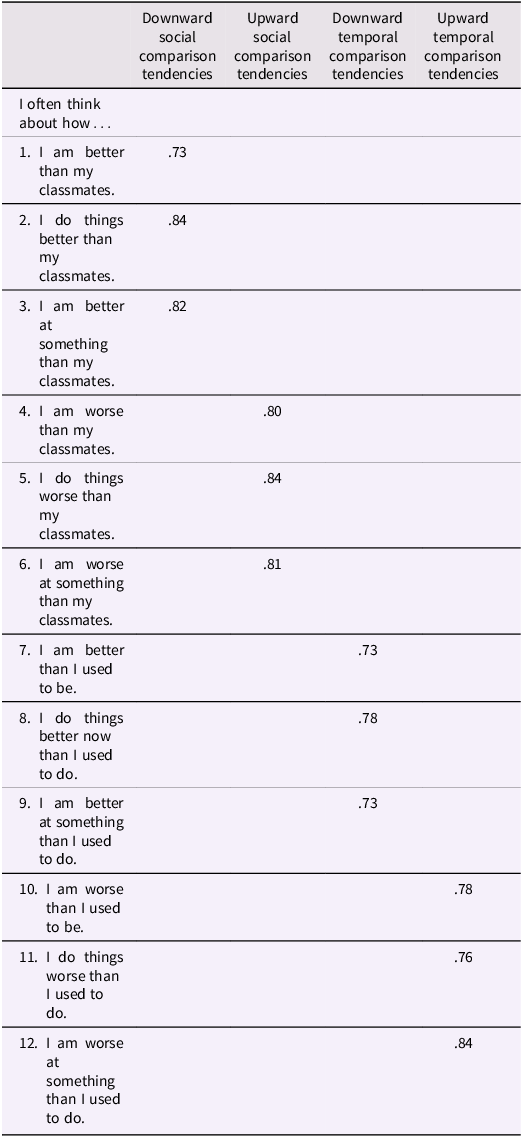
Participants completed questionnaires in their classrooms. All items were rated on four-point scales (0 = not at all true, 3 = completely true). For each scale, responses were averaged across items. We measured trait narcissism using the 10-item Childhood Narcissism Scale (Thomaes et al., Reference Thomaes, Stegge, Bushman, Olthof and Denissen2008). Sample items include: “I am a very special person” and “Kids like me deserve something extra” (M = 1.13, SD = 0.47, Cronbach’s α = .78). We measured self-esteem using the 10-item Rosenberg Self-esteem Scale (Rosenberg, Reference Rosenberg1965). Sample items include: “On the whole, I am satisfied with myself” and “I feel that I have a number of good qualities” (M = 2.73, SD = 0.46, Cronbach’s α = .81). The five negatively worded items (e.g., “I certainly feel useless at times”) were reverse coded. We measured comparison tendencies using the Social and Temporal Comparison Tendencies Scale, constructed for the purpose of this study (Table 1 reports all items and a factor analysis). Consistent with the aims of our research, the scale assessed the overall frequency of different comparison types. Thus, it did not examine two other parts of the comparison process: the perceived discrepancy (e.g., the distance participants perceived between themselves and the comparison target) and the engendered affective response (e.g., how participants felt when making certain comparisons; Morina, Reference Morina2021; Wood, Reference Wood1996). Three items assessed downward social comparisons (e.g., “I often think about how I am better than my classmates;” M = 0.82, SD = 0.65, Cronbach’s α = .84), three items assessed upward social comparisons (e.g., “I often think about how I am worse than my classmates,” M = 0.74, SD = 0.67, Cronbach’s α = .86), three items assessed downward temporal comparisons (e.g., “I often think about how I am better now than when I was younger;” M = 1.38, SD = 0.78, Cronbach’s α = .80),and three items assessed upward temporal comparisons (e.g., “I often think about how I am worse now than when I was younger,” M = 0.57, SD = 0.64, Cronbach’s α = .83).
Study 1 (N = 359) confirmatory factor analysis (CFA) for the Social and Temporal Comparison Tendencies Scale
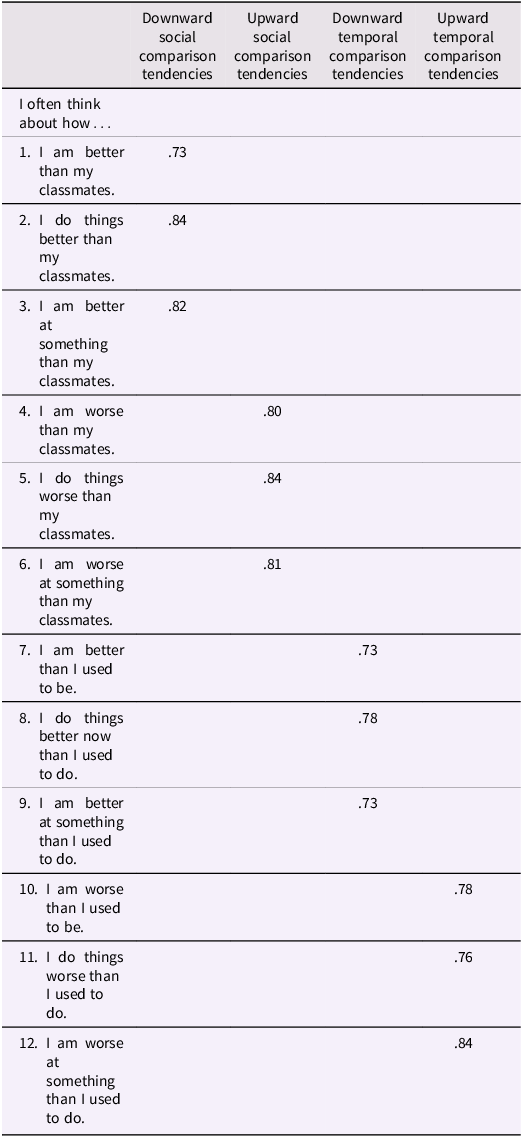
Note. Total N = 382. Twenty-three adolescents, who did not complete the Social and Temporal Comparison Tendencies Scale, were missing from the principal component analysis. CFA analysis was conducted using lavaan package in R. Covariance paths were specified among four latent factors. Model fit indices suggest a satisfactory model fit, χ 2(48) = 149.298, p < .001, RMSEA = .077, 90% CI [.063, .091], CFI = .948, TLI = .928, SRMR = .039.
We used two-tailed testing at α = .05.
Results
Preliminary analysis
There were four univariate outliers for downward social comparisons, six for upward social comparisons, four for upward temporal comparisons (z> 3.29), and two for self-esteem (z < −3.29). However, none of these outliers unduly influenced our results (Cook’s distances < 1) and excluding them did not change our pattern of findings. We therefore reported results including these outliers.
Main analyses
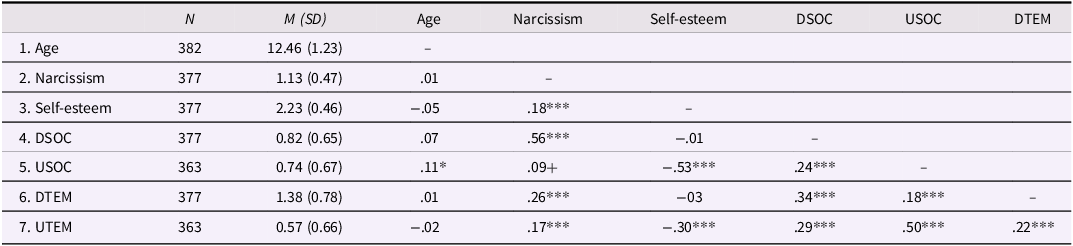
Table 2 provides descriptive statistics and zero-order correlations. Narcissism and self-esteem were weakly positively correlated, r(375) = .18, p = .001.
Study 1 (N = 382) descriptive statistics and Pearson correlations between self-views and comparison tendencies
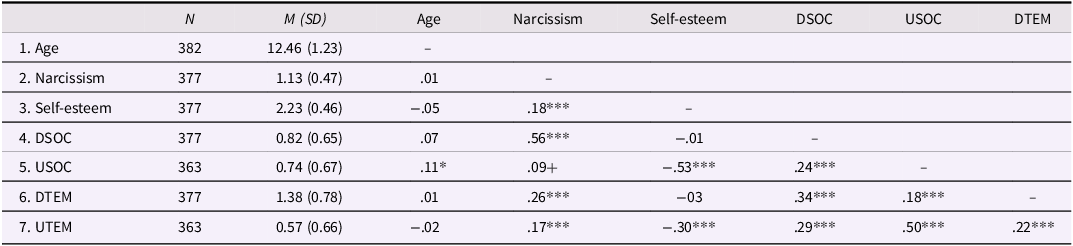
Note. Age is reported in years. DSOC refers to downward social comparisons; USOC refers to upward social comparisons; DTEM refers to downward temporal comparisons; UTEM refers to upward social comparisons. Five adolescents had completely missing data on the variables narcissism, self-esteem, downward social comparison tendencies, and downward temporal comparisons; 19 adolescents had completely missing data on the variables upward social comparisons and upward temporal comparisons. +p < .10, *p < .05, **p < .01 ***p < .001 (two-tailed).
As hypothesized, narcissism was positively related to downward social comparisons, r(375) = .56, p < .001, and to downward temporal comparisons, r(375) = .26, p < .001. By contrast, narcissism was not significantly related to upward social comparisons, r(361) = .09, p = .095. Unexpectedly, narcissism was positively related to upward temporal comparisons, r(361) = .17, p = .001.
As hypothesized, self-esteem was negatively related to upward social comparisons, r(361) = −.53, p < .001, and to upward temporal comparisons, r(361) = −.30, p < .001. By contrast, self-esteem was not significantly related to downward social comparisons, r(375) = −.01, p = .847, or to downward temporal comparisons, r(375) = −.03, p = .502.
In sum, adolescents higher in narcissism made more downward comparisons (both social and temporal), whereas adolescents with higher self-esteem made fewer upward comparisons (both social and temporal).
Robustness analyses
To examine the robustness of our findings, we reran the correlation analyses by simultaneously accounting for gender and age as covariates (Supplementary Material, Table S1). The results remained (i.e., no significant association became non-significant, and no non-significant association became significant), except that the association between narcissism and upward social comparisons became significant, r(362) = .11, p = .039.
Discussion
Study 1 provides initial evidence for our theoretical predictions. Replicating work with adults (Bogart et al., Reference Bogart, Benotsch and Pavlovic2004; Krizan & Bushman, Reference Krizan and Bushman2011), we found that adolescents higher in narcissism made more downward social comparisons, comparing themselves favorably to others. Extending prior work, we found that adolescents higher in narcissism also made more downward temporal comparisons. These findings were unique to adolescents higher in narcissism, as those with higher self-esteem did not make more downward comparisons. Rather, children with higher self-esteem made fewer upward comparisons, both social and temporal.
Study 2
Study 1 shows that adolescents higher in narcissism make more downward social comparisons. But do these comparisons constitute a developmental mechanism that maintains narcissism over time? We conducted Study 2 to examine this possibility, using a longitudinal design with daily diary assessments. We assessed adolescents’ narcissism and self-esteem levels at the beginning of the school year and at 3-month follow-up. In-between those assessments, we used daily diaries to index how often adolescents engaged in social and temporal comparisons in their everyday lives.
We used a 3-month follow-up, because it allowed us to establish whether social comparisons constitute a developmental mechanism that contributes to the maintenance of narcissism as an enduring trait. A shorter follow-up would not have allowed us to rule out the possibility that these effects are temporary (e.g., tied to a specific time or context).
Method
Participants
All students from first, second, and third grade of a public secondary school were eligible for participation. Data were collected as part of a larger longitudinal project: the Adolescents’ Social and Temporal Comparisons Study. A previous paper used the daily diary assessments to examine within-day associations between adolescents’ comparisons and emotional states (Gürel et al., Reference Gürel, Brummelman and Overbeek2022). Here, for the first time, we linked daily diary assessments of comparisons to longitudinal assessments of adolescents’ narcissism and self-esteem. All participants received active parental consent (parental consent rate = 58%). All procedures were approved by the Ethics Review Board of the Faculty of Social and Behavioral Sciences, University of Amsterdam. Data were collected on September 18, 2017 (baseline), between September 18 and 22, 2017 (daily diary), and between December 19, 2017, and January 1, 2018 (follow-up) at a secondary school in North Holland serving lower-to-upper middle-class families.
Transparency and openness
We report how we determined our sample size, all data exclusions (if any), all manipulations, and all measures in the study. We analyzed our data using structural equation models. A Monte Carlo power analysis for indirect effects (1,000 replications, random seed = 1234, confidence level = 95%, Monte Carlo draws per rep = 20,000; Schoemann et al., Reference Schoemann, Boulton and Short2017), based on the models displayed in Figures S1 and S2 (Supplementary Material) as well as on a sample size of 389, resulted in a statistical power of 1 for the main hypotheses. The study materials from the larger project, study protocol, variable codebook, data, and analysis scripts are available on OSF at https://osf.io/tesby/ (Brummelman et al., Reference Brummelman, Lee, Overbeek and Gürel2025). The study also included variables that are not relevant to our current research questions and are therefore not reported here (listed in the codebook available via OSF).
Procedure and measures
On a Monday, one week after the school year began, a total of 389 adolescents (ages 11–15, M age = 12.69 years, SD = 0.97; 41.4% girls; 98.9% of Dutch origin) completed narcissism and self-esteem questionnaires in their classrooms. Three months later, 201 of those adolescents (ages 11–15, M age = 12.79 years, SD = 0.97; 45.3% girls; 100% of Dutch origin) completed an online follow-up survey questionnaire. At each assessment, adolescents reported how they perceived themselves “the past three months.” We measured narcissism using the Childhood Narcissism Scale (Thomaes et al., Reference Thomaes, Bushman, Stegge and Olthof2008), rated on four-point scales (0 = not at all true, 3 = completely true). Responses were averaged across items (M baseline = 1.01, SD baseline = 0.44, Cronbach’s α baseline = .79; M follow-up = 1.02, SD follow-up = 0.50, Cronbach’s α follow-up = .84). We measured self-esteem using the 6-item Global Self-Worth subscale of the Self-Perception Profile for Children (e.g., “Some kids like the kind of person they are”; Harter, Reference Harter1985), rated on four-point scales (0 = I am not like these children at all, 3 = I am exactly like these children). After reverse scoring three negatively worded items (e.g., “Some kids are often unhappy with themselves”), responses were averaged across items (M baseline = 2.23, SD baseline = 0.51, Cronbach’s α baseline = .82; M follow-up = 2.18, SD follow-up = 0.59, Cronbach’s α follow-up = .84).
Immediately following the assessment, from Monday through Friday, adolescents completed online daily diary assessments at home after school hours, reporting the comparisons they engaged in that day. We measured social and temporal comparisons using one item per comparison type to reduce their burden on our adolescent participants. These single-item measures have been validated in previous work (Gürel et al., Reference Gürel, Brummelman and Overbeek2022). Like in Study 1, the items tapped the overall frequency of comparison types: “Today at school, I thought I was better than my classmates” (downward social comparison; M = 1.40, SD = 0.47, Cronbach’s α across 5 days = .82), “Today at school, I thought I was worse than my classmates” (upward social comparison; M = 1.34, SD = 0.43, Cronbach’s α across 5 days = .74), “Today at school, I thought I had become better compared to a while ago” (downward temporal comparison; M = 2.18, SD = 0.70, Cronbach’s α across 5 days = .84), and “Today at school, I thought I had become worse compared to a while ago” (upward temporal comparison; M = 1.28, SD = 0.39, Cronbach’s α across 5 days = .78). All items were rated on four-point scales (1 = not at all true to 4 = completely true). Following prior research (Becht et al., Reference Becht, Nelemans, van Dijk, Branje, Van Lier, Denissen and Meeus2017), responses averaged across five days to form a reliable score for each comparison type.
Statistical approach
We used structural equation modeling to examine whether social and temporal comparisons mediated the rank-order stability of narcissism and self-esteem. This statistical approach is often used in literature on the persistence or maintenance of developmental psychopathology. For example, it has been used to examine why some children and adolescents, compared to their peers, continue to be anxious and depressed (Blake et al., 2024), low in self-esteem (Brummelman et al., Reference Brummelman, Nelemans, Thomaes and Orobio de Castro2017), socially withdrawn (Nelson et al., Reference Nelson, Coyne, Howard and Clifford2016), victimized by peers (Cooley et al., Reference Cooley, Fite and Pederson2018), or in conflictual relationships (Van Lissa et al., Reference Van Lissa, Hawk, Koot, Branje and Meeus2017). What makes this approach unique is that it relies on two or more assessments of the same variable over time, while examining mechanisms (i.e., mediators) that can explain why an initial assessment of this variable predicts a subsequent assessment. Because this question pertains to rank-order stability (i.e., why some adolescents score higher or lower compared to their peers), rather than mean-level stability (i.e., why adolescents’ scores increase or decrease over time), we explicitly labeled our approach as examining mediation of rank-order stability (rather than simply referring to it as examining mediation of stability, as previous literature did; e.g., Cooley et al., Reference Cooley, Fite and Pederson2018; Nelson et al., Reference Nelson, Coyne, Howard and Clifford2016; Van Lissa et al., Reference Van Lissa, Hawk, Koot, Branje and Meeus2017).
We ran separate mediation models for narcissism and self-esteem. Adopting a conservative approach that estimated the unique effect of each comparison type, we included each comparison type simultaneously as candidate mediators. The models included self-views at baseline (narcissism, self-esteem) as the predictor, self-views at 3-month follow-up (narcissism, self-esteem) as the outcome, and comparisons (downward social, upward social, downward temporal, upward temporal) as the mediators. Each model tested (a) the direct effect of self-views (narcissism, self-esteem) at baseline on each comparison type; (b) the direct effect of each comparison type on self-views at follow-up, controlling for self-views at baseline; and (c) the direct effect of self-views at baseline on self-views at follow-up, controlling for each comparison type. The indirect effect, then, refers to the effect of the self-views at baseline on self-views at follow-up through comparison types. The total effect refers to the sum of the direct and indirect effects (Hayes, Reference Hayes2022). We used a bootstrapping approach with 1000 iterations to obtain more robust estimates of standard errors. We conducted the analyses in R v.3.6.2 with RStudio v1.2.5033 (R Core Team, 2019) using the lavaan package (Rosseel, Reference Rosseel2012). We used two-tailed testing at α =.05.
Adolescents who missed the 3-month follow-up assessment had higher baseline narcissism levels than did those who were retained at follow-up, t(384) = 3.84, p < .001, but their baseline self-esteem levels did not differ significantly, t(381) = 0.61, p = .541. For this reason, we dealt with missingness in two ways. First, we used full information maximum likelihood (FIML) to account for the pattern of missingness (Muthén & Satorra, Reference Muthén and Satorra1995). Second, we repeated the analyses excluding all participants who did not complete any of the daily diary assessments or had missing data at baseline or follow-up for narcissism or self-esteem. Because both strategies produced the same pattern of findings, we report analyses using FIML, as this maximizes statistical power and tends to result in less biased estimates for the structural mediation models than do conventional missing data methods (e.g., listwise or pairwise deletion; Enders & Bandalos, Reference Enders and Bandalos2001; Muthén et al., Reference Muthén, Kaplan and Hollis1987).
Results
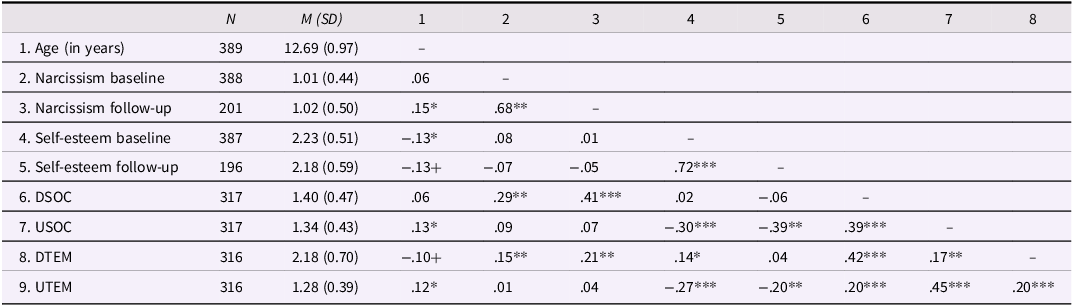
Table 3 displays descriptive statistics and zero-order correlations. At baseline, narcissism and self-esteem were not significantly correlated, r(384) = .08, p = .138.
Study 2 (N = 389) descriptive statistics and Pearson correlations between self-views and comparison tendencies
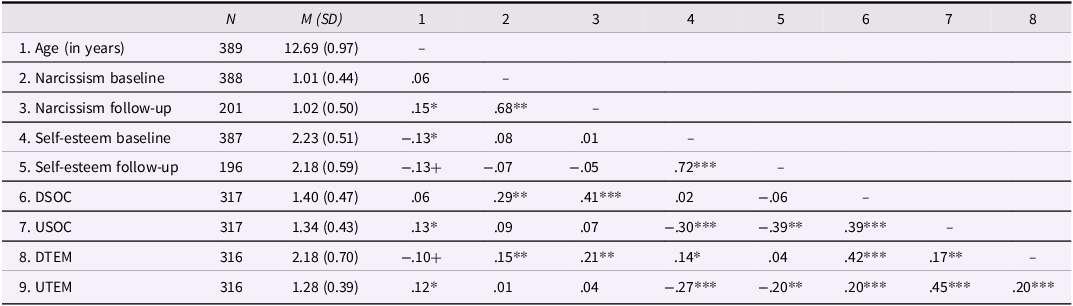
Note. DSOC refers to downward social comparisons; USOC refers to upward social comparisons; DTEM refers to downward temporal comparisons; UTEM refers to upward social comparisons. +p < .10, *p < .05, **p < .01, ***p < .001 (two-tailed).
Narcissism
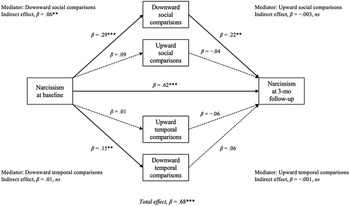
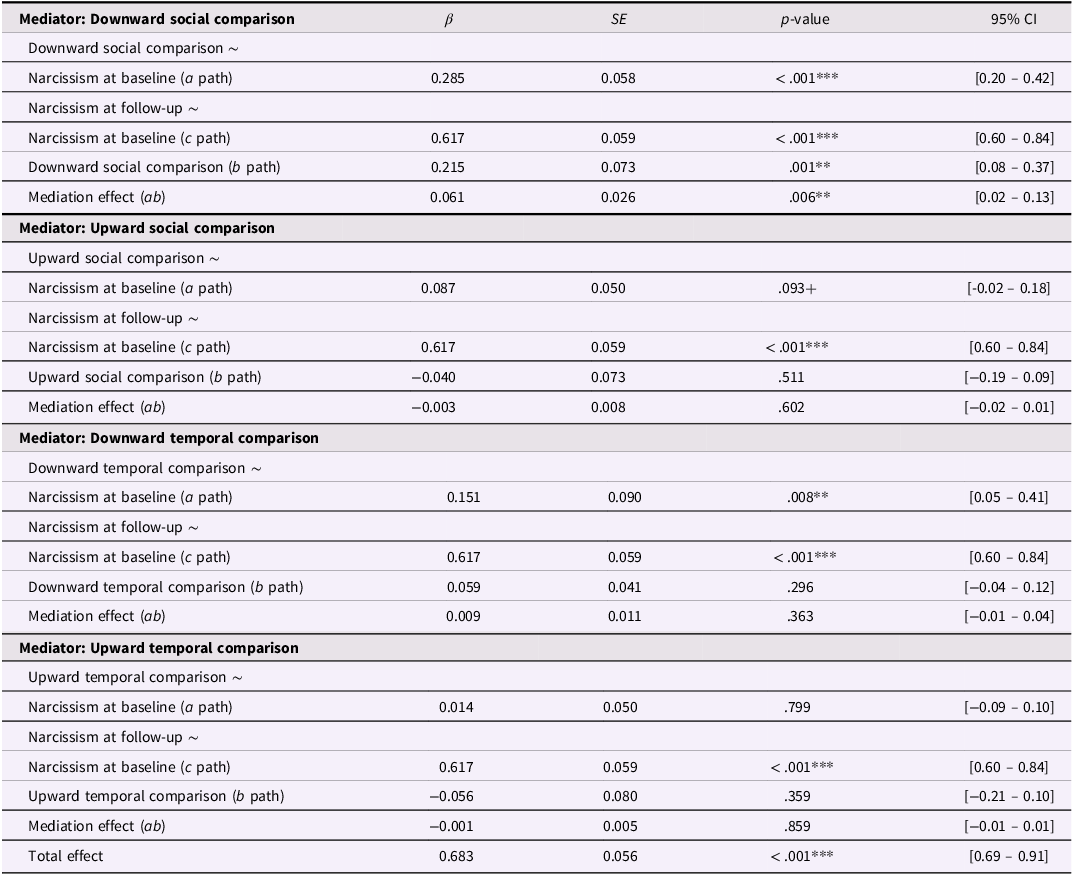
Figure 1 visualizes the mediational model and Table 4 presents its coefficients. The total effect of narcissism at baseline on narcissism at follow-up, including all indirect and direct effects, was significant, β = 0.683, SE = 0.056, p < .001, 95% CI [0.687, 0.905]. As a direct effect, narcissism at baseline positively predicted narcissism at 3-month follow-up, controlling for all comparisons, β = 0.617, SE = 0.059, p < .001, 95% CI [0.603, 0.836].
Mediational models for narcissism (Study 2). Note. N = 388. This is the mediational model for narcissism with all comparison strategies in a single model. Covariances between comparison strategies are not shown for simplicity. Covariance (downward social comparisons, upward social comparisons) = 0.381; covariance (downward social comparisons, downward temporal comparisons) = 0.401; covariance (downward social comparisons, upward temporal comparisons) = 0.200; covariance (upward social comparisons, downward temporal comparisons) = 0.160; covariance (upward social comparisons, upward temporal comparisons) = 0.441; covariance (downward temporal comparisons, upward temporal comparisons) = 0.195, all ps < .005. Total effect of narcissism at baseline on narcissism at follow-up was significant (β = 0.683, SE = 0.061, p < .001, 95% CI [0.677, 0.915]).*p < .05, **p < .01, *** < .001.
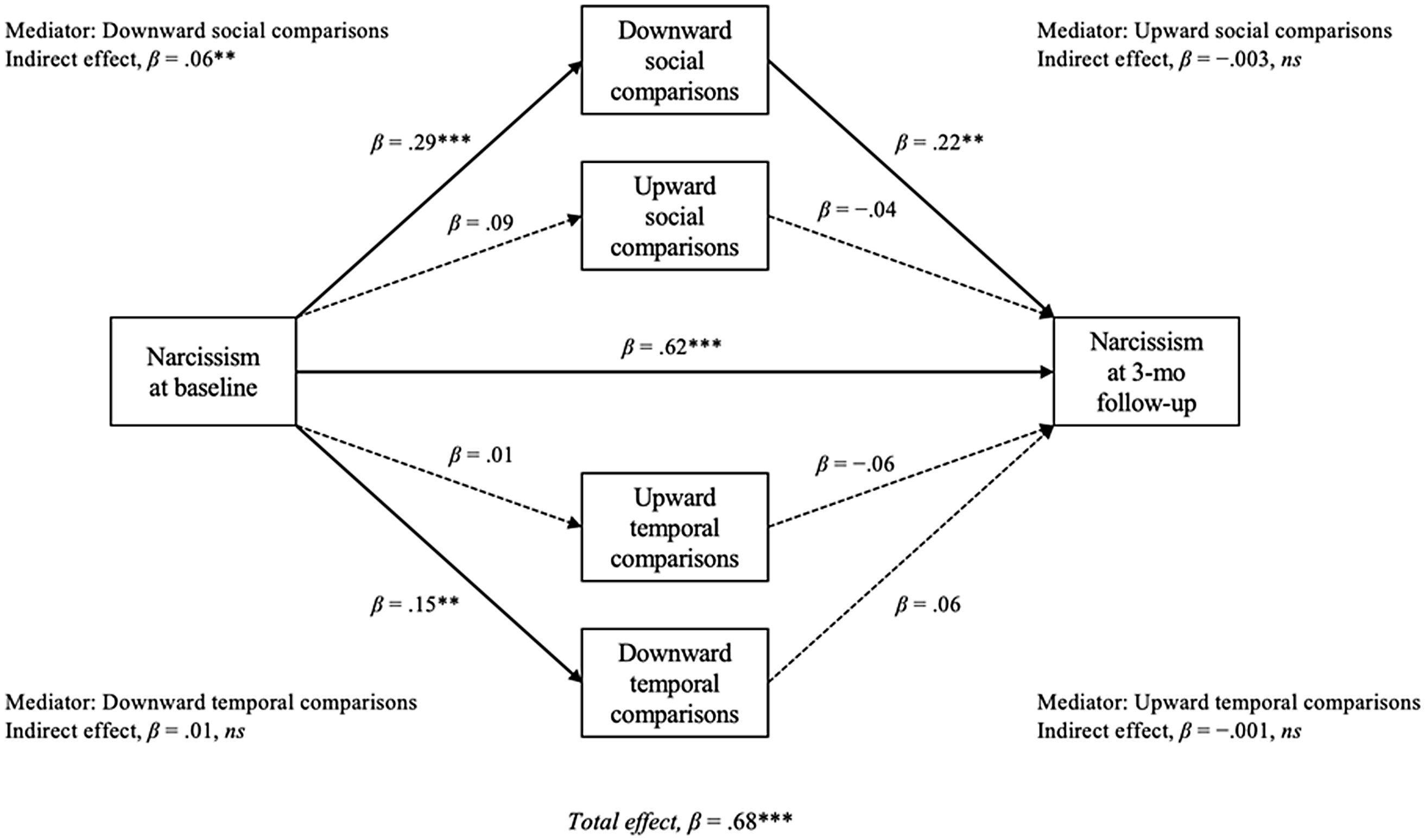
The mediator role of social and temporal comparisons in the maintenance of narcissism in Study 2
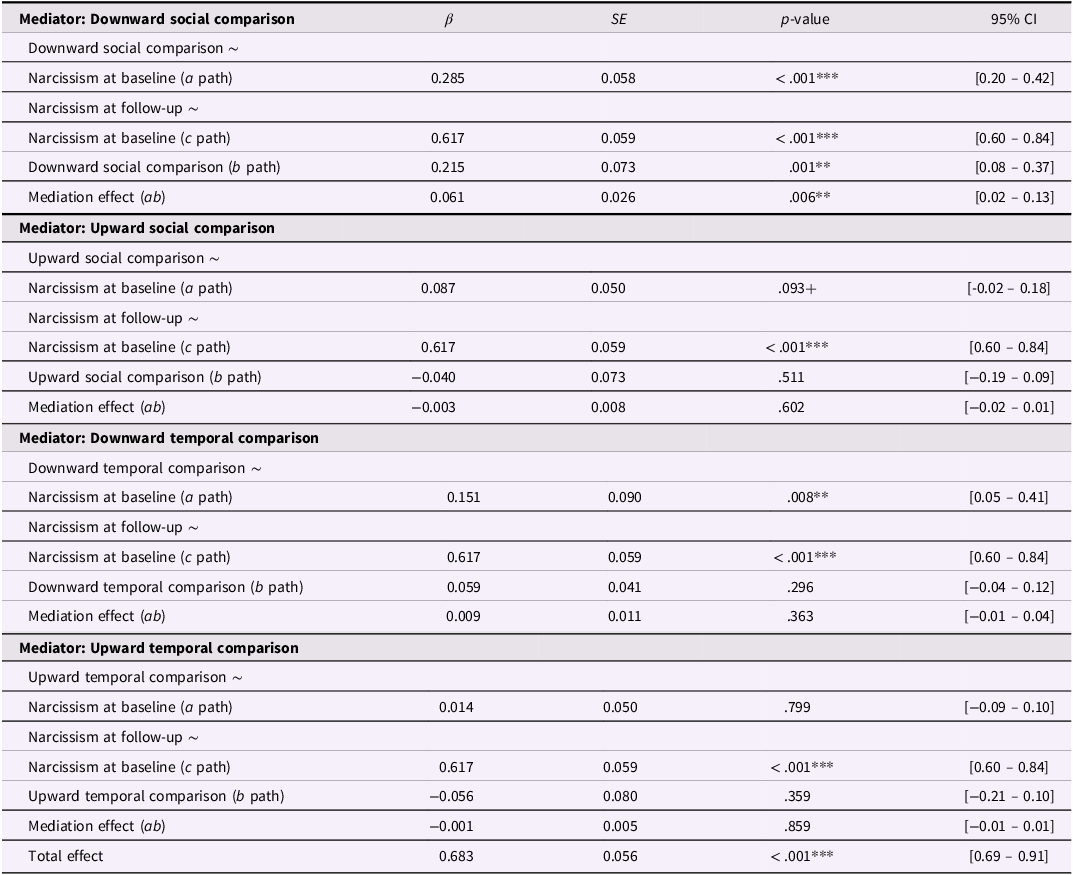
Note. Bootstrapping with n = 1,000 iterations; a path = direct effect of self-views at baseline on comparison types; b path = direct effect of comparison types on self-views at follow-up; c path = direct effect of self-views at baseline on self-views at follow-up.
Social comparisons
As hypothesized, narcissism at baseline positively predicted downward social comparisons across the subsequent 5-day school period. These comparisons, in turn, positively predicted narcissism at 3-month follow-up, controlling for narcissism at baseline. By contrast, narcissism at baseline was not significantly related to upward social comparisons across the subsequent 5-day school period. These comparisons, in turn, did not significantly predict narcissism at 3-month follow-up, controlling for narcissism at baseline. As hypothesized, downward social comparisons – but not upward social comparisons – partially mediated the association between narcissism at baseline and narcissism at 3-month follow-up.
Temporal comparisons
As hypothesized, narcissism at baseline positively predicted downward temporal comparisons across the subsequent 5-day school period. These comparisons, in turn, did not significantly predict narcissism at 3-month follow-up, controlling for narcissism at baseline. By contrast, narcissism at baseline was not significantly related to upward temporal comparisons across the subsequent 5-day school period. These comparisons, in turn, did not significantly predict narcissism at 3-month follow-up, controlling for narcissism at baseline. As hypothesized, neither downward nor upward temporal comparisons significantly mediated the association between narcissism at baseline and narcissism at follow-up.
Self-esteem
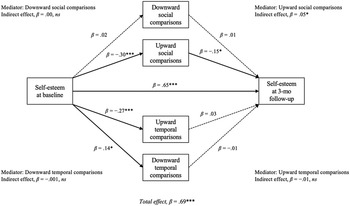
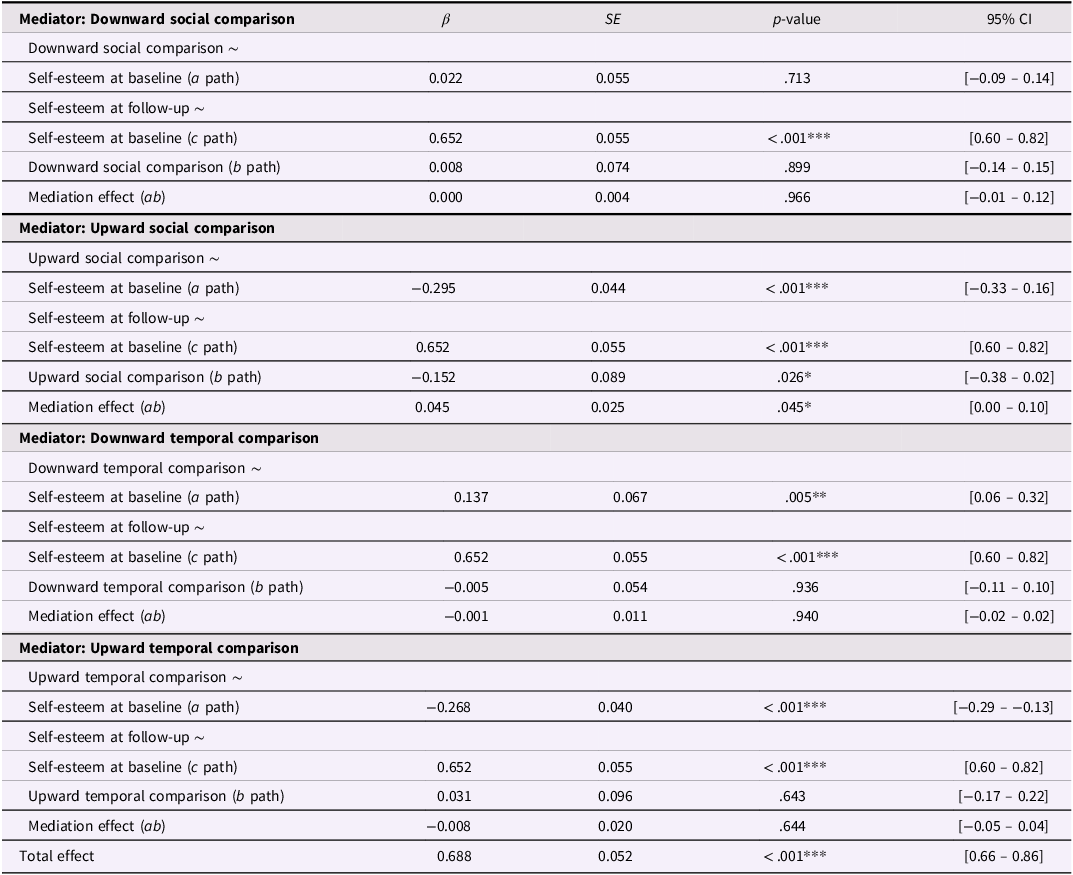
Figure 2 presents the mediational model and Table 5 presents its coefficients. The total effect of self-esteem at baseline on self-esteem at 3-month follow-up, including all indirect and direct effects, was significant, β = 0.688, SE = 0.052, p < .001, 95% CI [0.655, 0.860]. As a direct effect, self-esteem at baseline positively predicted self-esteem at 3-month follow-up, controlling for all comparisons, β = 0.652, SE = 0.055, p < .001, 95% CI [0.601, 0.824].
Mediational models for self-esteem (Study 2). Note. N = 387. This is the mediational model for self-esteem with all comparison strategies in a single model. Covariances between comparison strategies are not shown for simplicity. Covariance (downward social comparisons, upward social comparisons) = 0.423; covariance (downward social comparisons, downward temporal comparisons) = 0.426; covariance (downward social comparisons, upward temporal comparisons) = 0.218; covariance (upward social comparisons, downward temporal comparisons) = 0.237; covariance (upward social comparisons, upward temporal comparisons) = 0.405; covariance (downward temporal comparisons, upward temporal comparisons) = 0.247, all ps < .001. Total effect of self-esteem at baseline on self-esteem at follow-up was significant (β = 0.688, SE = 0.053, p < .001, 95% CI [0.658, 0.866]). *p < .05, **p < .01, *** < .001.
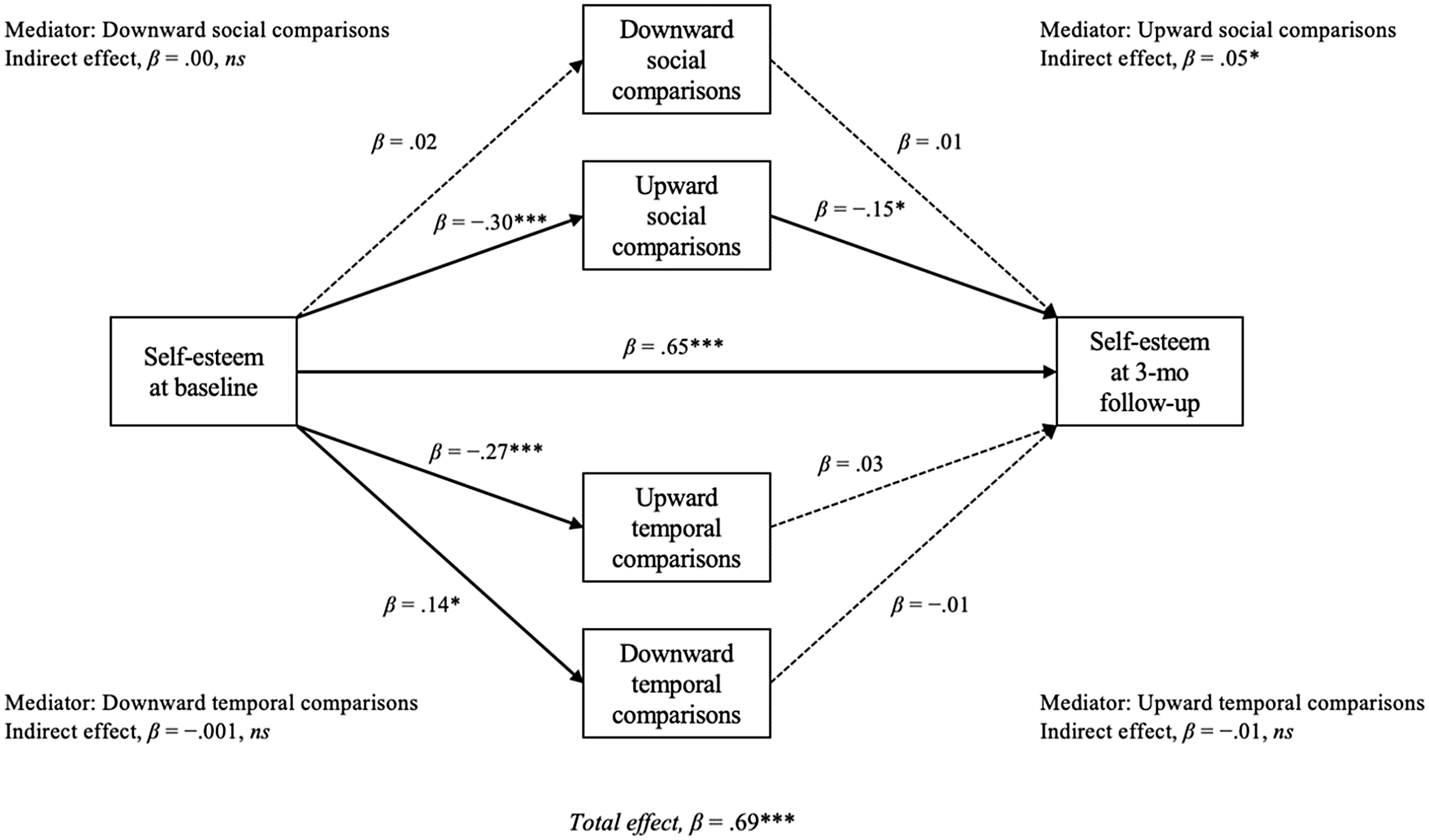
The mediator role of social and temporal comparisons in the maintenance of self-esteem in Study 2
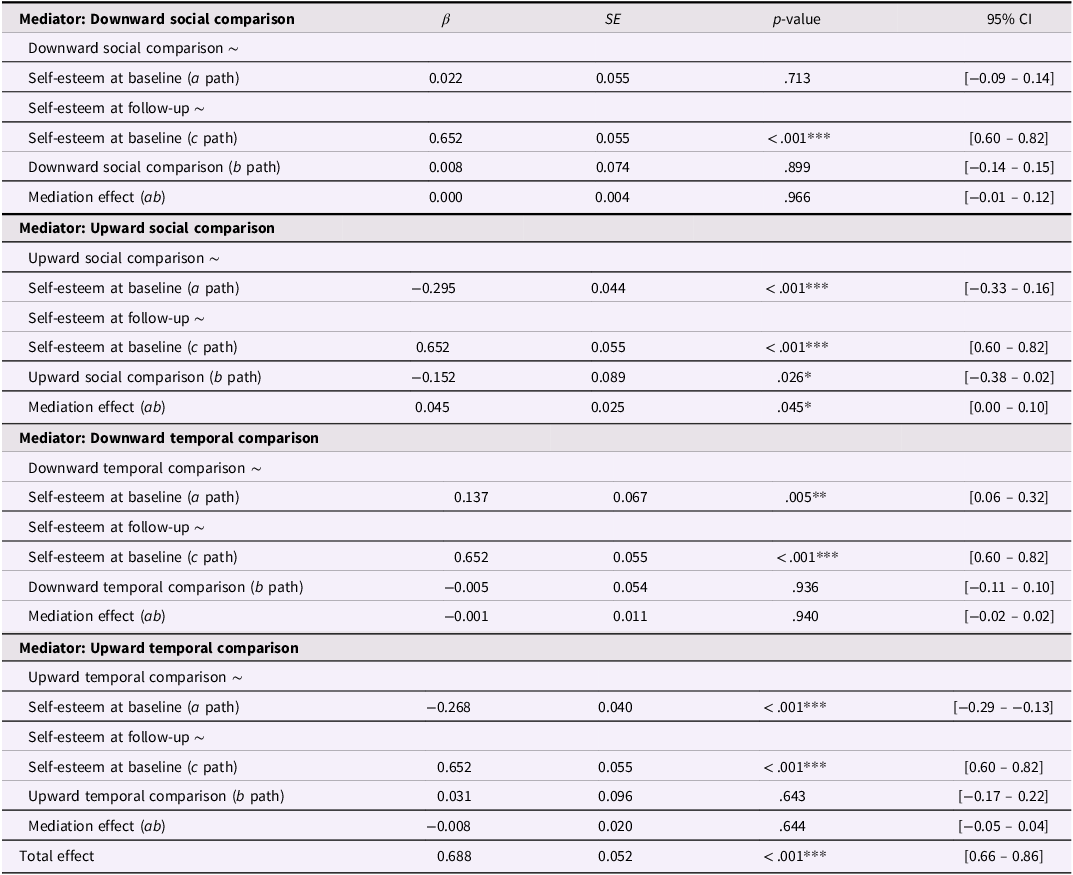
Note. Bootstrapping with n = 1,000 iterations; a path = direct effect of self-views at baseline on comparison types; b path = direct effect of comparison types on self-views at follow-up; c path = direct effect of self-views at baseline on self-views at follow-up.
Social comparisons
Self-esteem at baseline was not significantly related to downward social comparisons across the subsequent 5-day school period. These comparisons, in turn, did not significantly predict self-esteem at 3-month follow-up, controlling for self-esteem at baseline. By contrast, as hypothesized, self-esteem at baseline negatively predicted upward social comparisons across the subsequent 5-day school period. These comparisons, in turn, negatively predicted self-esteem at 3-month follow-up, controlling for self-esteem at baseline. As hypothesized, upward social comparisons – but not downward social comparisons – partially mediated the association between self-esteem at baseline and self-esteem at follow-up.
Temporal comparisons
Self-esteem at baseline positively predicted downward temporal comparisons across the subsequent 5-day school period. Downward temporal comparisons, in turn, did not significantly predict self-esteem at 3-month follow-up, controlling for self-esteem at baseline. As hypothesized, self-esteem at baseline negatively predicted upward temporal comparisons across the subsequent 5-day school period. These comparisons, in turn, did not significantly predict self-esteem at 3-month follow-up, controlling for self-esteem at baseline. Neither downward nor upward temporal comparisons significantly mediated the association between self-esteem at baseline and self-esteem at follow-up.
Robustness analyses
We examined the robustness of our findings in two ways.
First, we tested a series of individual mediation models (one per comparison type) in which we examined the indirect effects of comparisons separately for narcissism and self-esteem (Supplementary Material, Figure S1 and S2). The main conclusions remained the same.
Second, we reran our main mediation models (with all comparison types as mediators) with age and gender as covariates (Supplementary Material, Figures S3 and S4) and we ran individual mediation models (one per comparison type) with age and gender as covariates (Supplementary Material, Table S2). The results remained the same (i.e., no significant path became non-significant, and no non-significant path became significant), with two exceptions: (1) baseline narcissism significantly predicted upward social comparisons across the subsequent 5-day school period; (2) upward social comparisons across the 5-day school period only marginally significantly mediated the link between self-esteem at baseline and self-esteem at 3-month follow-up. Importantly, baseline self-esteem still significantly predicted upward social comparisons across the subsequent 5-day school period, and upward social comparisons still significantly predicted self-esteem at 3-month follow-up.
Discussion
As a first study of its kind, Study 2 shows that social comparisons can maintain narcissism and self-esteem over time in the critical phase of adolescence. Adolescents higher in narcissism made more downward social comparisons in daily life and doing so partially maintained their narcissism levels over 3 months. They also made more downward temporal comparisons in daily life, but doing so did not maintain their narcissism levels over 3 months. By contrast, adolescents with higher self-esteem made fewer upward social comparisons in daily life and doing so partially maintained their higher self-esteem over 3 months. They also made fewer upward temporal comparisons, but doing so did not maintain their self-esteem over 3 months.
General discussion
Bridging insights from developmental, clinical, social, and personality psychology, we examined how social and temporal comparison contribute to the maintenance of narcissism and self-esteem in the critical phase of adolescence. A cross-sectional study (Study 1) shows that adolescents higher in narcissism make more downward social and temporal comparisons. A longitudinal study with daily diary surveys (Study 2) replicates these findings and extends them by showing that downward social comparisons – but not downward temporal comparisons – partially maintain adolescents’ narcissism over a 3-month period. These findings suggest that social comparisons are a mechanism through which narcissism levels are maintained in development, and that temporal comparisons are not. Attesting to the specificity of these findings, self-esteem was not consistently related to downward social comparisons; in fact, low self-esteem was maintained through upward social comparisons. Our findings show that comparison strategies play an important role in the maintenance of self-views in adolescence.
Theoretical implications
Over the years, research has shed important light on the development of narcissism (Orth et al., Reference Orth, Krauss and Back2024; Thomaes & Brummelman, Reference Thomaes, Brummelman and Cicchetti2016). Yet, it is unknown how narcissism levels are maintained over time, which is of particular importance in the critical phase of adolescence, when self-views are sensitive to social information (Rodman et al., Reference Rodman, Powers and Somerville2017), including social comparisons (e.g., Lapan & Boseovski, Reference Lapan and Boseovski2017; van der Aar et al., Reference van der Aar, Peters and Crone2018). Since adolescents high in narcissism have unrealistically positive self-views, one may expect that narcissism simply disappears over time, as adolescents are increasingly faced with the undeniable realities of life, such as struggles, failures, exclusions, and rejections (Bianchi, Reference Bianchi, Hermann, Brunell and Foster2018). Challenging this view, our work suggests that adolescents high in narcissism actively maintain their narcissistic self-views by engaging in downward social comparisons. This is consistent with recent models of narcissism (Campbell & Foster, Reference Campbell, Foster, Sedikides and Spencer2007; Grapsas et al., Reference Grapsas, Brummelman, Back and Denissen2020; Morf et al., Reference Morf, Horvath, Torchetti, Alicke and Sedikides2011), which portray narcissism as self-regulatory process. Our work extends these models by showing that narcissistic self-regulatory strategies already take center stage in adolescence, help maintain narcissism over time, and are distinct from strategies used by individuals with high self-esteem. Also, our work shows that not all such strategies maintain narcissism over time, as temporal comparisons – viewing one’s present self as better than one’s past self – did not maintain narcissism over time.
Why do some adolescents engage in downward social comparisons? A cognitive perspective holds that adolescents engage in downward social comparisons primarily when they encounter objective cues that they are better than another person (e.g., getting a higher grade than a classmate). A motivational perspective holds that adolescents engage in downward social comparisons primarily when they are motivated to obtain certain information about themselves. Such motives often include self-enhancement (i.e., the desire to evaluate oneself positively), self-assessment (i.e., the desire to evaluate oneself accurately), and self-improvement (i.e., the desire to improve oneself; Corcoran et al., Reference Corcoran, Crusius, Mussweiler and Chadee2011; also see Gregg & Sedikides, Reference Gregg, Sedikides, van Zomeren and Dovidio2018; Sedikides & Strube, Reference Sedikides, Strube and Zanna1997). Of course, these perspectives are not mutually exclusive, because cognition and motivation interact (Braver et al., Reference Braver, Krug, Chiew, Kool, Westbrook, Clement, Adcock, Barch, Botvinick, Carver, Cools, Custers, Dickinson, Dweck, Fishbach, Gollwitzer, Hess, Isaacowitz and Mather2014). We provide preliminary evidence for the motivational perspective. In Study 1, for exploratory purposes, we assessed adolescents’ self-enhancement, self-assessment, and self-improvement motives. Controlling for the other motives, the self-enhancement motive most strongly predicted adolescents downward social comparisons (Supplementary Materials, Table S3). The comparisons, in turn, have affective consequences. Indeed, previous daily diary research in adolescence shows that on days when adolescents make more downward social comparisons, they feel more proud and less ashamed (Gürel et al., Reference Gürel, Brummelman and Overbeek2022). Thus, the desire to evaluate oneself positively may guide adolescents to engage in downward social comparisons.
How can downward social comparisons maintain narcissism in adolescence? When adolescents frequently make downward social comparisons, they may become more inclined to conclude that they are superior to others. Downward social comparisons are helpful in assessing one’s stable positive characteristics (Arnkelsson & Smith, Reference Arnkelsson and Smith2000; Ruble & Flett, Reference Ruble and Flett1988) and may trigger a desire for superiority over others (Gürel et al., Reference Gürel, Brummelman, Sedikides and Overbeek2020). Consequently, downward social comparisons may feed narcissistic beliefs (e.g., “I am better than others”) and motives (e.g., “I want to be better than others” and “I want to be seen as better than others”). These processes may be most consequential in adolescence, when individuals are sensitive to cues regarding their competence and social status (Yeager et al., Reference Yeager, Dahl and Dweck2018).
Notably, our findings uncover the importance of a lesser-known comparison strategy: temporal comparisons. Temporal comparisons have long been understudied (Gürel et al., Reference Gürel, Brummelman, Sedikides and Overbeek2020; Zell & Alicke, Reference Zell and Alicke2009), despite early research on their developmental emergence (Butler, Reference Butler1998; Ruble & Flett, Reference Ruble and Flett1988). Our study shows that adolescents high in narcissism make more downward temporal comparisons: They often think about how they have improved. This suggests that adolescents high in narcissism not only derogate others (Grapsas et al., Reference Grapsas, Brummelman, Back and Denissen2020) but also their past selves. This challenges the popular view that individuals high in narcissism see themselves as perfect, as those who are perfect should be unable to improve. In addition, our study also shows that downward temporal comparisons – unlike downward social comparisons – do not maintain narcissism over time. Previous experimental research shows that downward temporal comparisons make adolescents feel proud without teaching them that they are superior to others and without triggering a desire for superiority over others (Gürel et al., Reference Gürel, Brummelman, Sedikides and Overbeek2020, Reference Gürel, Brummelman and Overbeek2022). Importantly, our longitudinal analyses show that downward temporal comparisons do not predict increased self-esteem over a 3-month period. Thus, while these comparisons probably make adolescents feel good about themselves in the moment, they do not seem to contribute to long-term changes in their overall sense of worth.
Our findings extend the literature on narcissism and self-esteem. Consistent with past work, narcissism and self-esteem were only weakly related. Extending past work (Brummelman et al., Reference Brummelman, Thomaes and Sedikides2016; Campbell et al., Reference Campbell, Rudich and Sedikides2002), narcissism and self-esteem had distinct associations with comparisons: Adolescents higher in narcissism made more downward comparisons, whereas those with higher self-esteem made fewer upward comparisons. This may reflect different motives: the desire to evaluate oneself positively (i.e., self-enhancement) versus the desire to avoid evaluating oneself negatively (i.e., self-protection; Alicke & Sedikides, Reference Alicke and Sedikides2009). Our findings are consistent with the view that individuals high in narcissism are driven primarily by self-enhancement (Sedikides & Gregg, Reference Sedikides and Gregg2001), which may encourage downward comparisons. Our findings extend this view by suggesting that individuals with high self-esteem may be driven primarily by self-protection, which may discourage upward comparisons. More broadly, the narcissistic interest in downward social comparison may reflect a generalized view of social relationships as a zero-sum game – seeing the self as superior and others as inferior (Brummelman, Gürel, et al., 2018; Hyatt et al., Reference Hyatt, Sleep, Lamkin, Maples-Keller, Sedikides, Campbell, Miller and Tran2018; Zeigler-Hill et al., Reference Zeigler-Hill, Sauls and Malay2021).
To what extent are our findings generalizable? We identify to constraints. First, our studies focused on adolescence, a time when social and temporal comparisons are common (Gürel et al., Reference Gürel, Brummelman and Overbeek2022) and self-views are sensitive to social comparison information (Lapan & Boseovski, Reference Lapan and Boseovski2017; van der Aar et al., Reference van der Aar, Peters and Crone2018). The importance of social comparisons for the maintenance of narcissism and self-esteem may change across the lifespan. Second, our studies were conducted in the Netherlands, a Western society. In non-Western cultures, social comparisons are often seen as a tool for self-improvement rather than superiority over others (Watkins, Reference Watkins, Salili and Hoosain2007). In such cultures, social comparisons may be less central to narcissism. Thus, our findings cannot readily be generalized to other age groups and other cultures.
Implications for intervention
Despite several evidence-based interventions that raise self-esteem (O’Mara et al., Reference O’Mara, Marsh, Craven and Debus2006), little is known about how to curtail narcissism. Social comparison may constitute a potentially malleable developmental mechanisms to curtail narcissism. Because social comparisons serve an important purpose in adolescents’ everyday lives (e.g., informing adolescents about their social standing), we urge for caution in designing interventions that seek to reduce them maximally. Specifically, we call for research on tailored interventions that attempt to shift adolescents’ focus from social comparison to temporal comparison in domains in which they show excessive social comparisons. In the academic domain, for example, a shift toward temporal comparisons could be achieved by making improvement trajectories more salient to adolescents via report cards and feedback (Ames, Reference Ames1992; Corpus et al., Reference Corpus, Ogle and Love-Geiger2006; Gürel et al., Reference Gürel, Brummelman, Sedikides and Overbeek2020). Research should examine long-term effects of such intervention strategies on narcissism and self-esteem across individuals and contexts (Bryan et al., Reference Bryan, Tipton and Yeager2021). Such work would not only establish causality, but could also inform real-world intervention efforts (Brummelman & Walton, Reference Brummelman and Walton2015).
Strengths, limitations, and future directions
Strengths of our research include its multi-method design, its focus on adolescence, and its novel proposal that social and temporal comparisons have unique roles in the developmental maintenance of self-views. Our study also has limitations. First, we used cross-sectional and longitudinal methods, which are unable to demonstrate causality. Researcher should use experimental manipulations of comparisons and examine their long-term impact on narcissism and self-esteem. Second, our research focused on the overall frequency of social and temporal comparisons. Future research should examine whether comparisons in some domains (e.g., intelligence) are more consequential for the maintenance of narcissism than are comparisons in other domains (e.g., friendliness). Third, our study investigated a 3-month period. The effects of social comparisons may sustain, or even exacerbate, over time (Carlson Jones, Reference Carlson Jones2004). Research should track narcissism and self-esteem over multiple years. A recent meta-analysis shows that the rank-order stability of narcissism is stable across the lifespan, even across the transitions from childhood to adolescence and from adolescence to adulthood (Orth et al., Reference Orth, Krauss and Back2024). Are social comparisons as crucial for maintaining narcissism in adulthood as they are for maintaining narcissism in adolescence, or do adults develop alternative strategies, such as selecting partners and careers that align with their narcissistic motives?
Our findings also generate new research directions. Several theoretical accounts and clinical observations suggest that individuals high in narcissism are resistant to change and often quit therapy prematurely (Ellison et al., Reference Ellison, Levy, Cain, Ansell and Pincus2013). A popular explanation is that these individuals believe they are perfect as they are and that improving themselves is neither desirable nor possible. Temporal comparisons might help individuals high in narcissism realize that improvement is both desirable and enjoyable. Temporal comparisons trigger adolescents’ desire to improve themselves (Gürel et al., Reference Gürel, Brummelman, Sedikides and Overbeek2020) and are often used by those with a growth mindset, who believe they can improve their skills (Butler, Reference Butler2000). Research should examine, for example, whether temporal comparisons can make individuals high in narcissism less resistant to change.
Another important question is how individuals high in narcissism acquire their social-comparison tendency tendencies. One possibility is that some children are raised in environments that emphasize the importance of social comparisons. There is indeed evidence that parents of children high in narcissism want their children to get ahead and stand out (Grapsas et al., Reference Grapsas, Brummelman, Back and Denissen2020). They give their children uncommon first names, presumably in an attempt to make them stand out from others, and they frequently praise their children for their agentic achievements (Brummelman et al., Reference Brummelman, Thomaes, Nelemans, Orobio de Castro and Bushman2015). In addition, psychophysiological research demonstrates that these parents show quick, subtle, and automatic affective responses to their child’s status gains and losses – a physiological sensitivity that they presumably transfer to their children (Grapsas et al., Reference Grapsas, Denissen, Lee, Bos and Brummelman2021). Research should unravel these underlying socialization mechanisms.
Conclusion
Adolescence is a time when narcissism levels are high. Our work demonstrates that adolescents high in narcissism make more downward social and temporal comparisons in their everyday life. Downward social comparisons – but not downward temporal comparisons – may maintain narcissism levels over time. Considering the pervasiveness of social comparison opportunities in Western society, these findings highlight how cultural practices can shape adolescent development, with potential harmful consequences.
Supplementary material
The supplementary material for this article can be found at https://doi.org/10.1017/S0954579425000331.
Acknowledgements
Hae Yeon Lee and Çisem Gürel contributed equally to the work and share first authorship. The data were collected and processed by Çisem Gürel as part of her dissertation research. The funders had no role in designing the study; collecting, analyzing, or interpreting the data; writing the article; or the decision to submit the article for publication. The authors thank Stefanie Nelemans for her feedback on the manuscript.
Funding statement
This research was supported by a research priority area YIELD graduate program grant (022.006.013) to Çisem Gürel, Geertjan Overbeek, and Eddie Brummelman. During the preparation of the manuscript, Geertjan Overbeek was supported by a Dutch Research Council Talent Programme Vici grant (016.vici.185.063), and Eddie Brummelman was supported by a Jacobs Foundation Research Fellowship (2020-1362-02) and a Dutch Research Council Talent Programme Vidi grant (VI.Vidi.211.181).
Competing interests
The authors declare none.
Transparency and openness statement
For both Study 1 and Study 2, the study materials, protocols, codebooks, data, and code are available on OSF at https://osf.io/tesby/ (Brummelman et al., Reference Brummelman, Lee, Overbeek and Gürel2025). The studies were not preregistered.
In line with Cambridge University Press Preprint Policy, we posted an earlier version of the manuscript as a preprint on PsyArXiv: https://osf.io/preprints/psyarxiv/jvbsw.


 Open access

