





1 Introduction
High-brightness pulsed blue-green lasers, which balance high energy and excellent beam quality, are appealing light sources for long-distance underwater LiDAR, communication and pollution detection[ Reference Zhou, Chen, Zhao, Jamet, Dionisi, Chami, Di Girolamo, Churnside, Malinka, Zhao, Qiu, Cui, Liu, Chen, Phongphattarawat, Wang, Chen, Chen, Yao, Le, Tao, Xu, Wang, Wang, Chen, Ye, Zhang, Liu and Liu 1 – Reference Somekawa, Kurahashi, Matsuda, Yogo and Kuze 3 ], as wavelengths of 450–550 nm offer an underwater penetration depth of 50–200 m in pure water[ Reference Mason, Cone and Fry 4 ]. Compared with conventional pulsed green lasers that are the second-harmonic generation (SHG) of Nd or Yb lasers[ Reference Kan, Li and Liu 5 , Reference Zhang, Yu, Sun, Chen, Zhang, Fan, Han and Chen 6 ], high-energy pulsed lasers in the blue region (450–500 nm) have higher underwater topographic surveying and mapping accuracy for open ocean that covers 65% of global water[ Reference Chen, Xue, Zhang, Hu, Chen and Tang 7 – 9 ]. Moreover, shorter laser wavelengths enable higher submarine communication capacity[ Reference Lu, Li, Lin, Cai, Li, Xu, Wang, Zhou, Shen, Zhang and Chi 2 , Reference Zhou, Zhang, Wang and Ren 10 ].
To date, pulsed blue lasers are mainly realized by optical parameter oscillation (OPO) with a pulsed 355 nm laser[ Reference Ma, Lu, He, Jiang, Hou, Li, Liu, Zhu and Chen 11 , Reference Song, Yu, Li, Wang, Zhu, Liu, Hou and Chen 12 ], SHG of a 532 nm laser-pumped OPO[ Reference Wu, Chen, Yuan, Dong, Sun, Hu, Liu and Liu 13 ] or SHG of 0.9 μm Nd lasers[ Reference Lu, Ma, Zhu and Chen 14 ]. Risk and Lenth[ Reference Risk and Lenth 15 ] firstly proposed 473 nm blue laser operation via direct SHG of a diode side-pumped quasi-three-level 946 nm neodymium-doped yttrium aluminum garnet (Nd:YAG) laser, where the host media could be vanadate[ Reference Chen, Yu, Zhang, He, Zheng, Wang and Guo 16 ] and fluoride[ Reference Zhang, Ma, Lu and Zhu 17 ], as well. In 2019, pulse energy of 2 mJ at 473 nm was realized via SHG of an electro-optically (EO) Q-switched Nd:YAG laser, where beam qualities of M 2 x = 2.4 and M 2 y = 2.3 were obtained[ Reference Lu, Ma, Zhu and Chen 14 ]. For OPO-based blue lasers, they could be directly pumped with a third-harmonic generation (THG) 355 nm laser. Ma et al. [ Reference Ma, Lu, Zhu, Ma, Li, Zhou and Chen 18 ] demonstrated a 62 mJ blue laser at 486.1 nm from a barium borate (BBO)-based OPO under incident 355 nm laser energy of 190 mJ at 20 Hz, where poor beam quality with M 2 x ~ 15.5 and M 2 y ~ 9.7 occurs due to large Fresnel number of the short OPO cavity. Recently, Luo et al. [ Reference Luo, Ma, Huang, Lu, Zhang, Ma, Zhu and Chen 19 ] demonstrated a BBO-based OPO and optical parametric amplifier (OPA) scheme for 22 mJ nanosecond 486.1 nm operation at 200 Hz, where optimized beam quality with M 2 ~ 2.3 was realized by making the OPO stage under small 355 nm laser pump energy of 4.2 mJ the seed laser for the OPA.
Besides direct 355 nm laser pumping, using an SHG laser at 532 nm to drive the OPO laser at 9xx nm before SHG in the blue laser region has received research interest, and could avoid potential damage of the OPO cavity coating by the ultraviolet (UV) laser and enhance system stability[ Reference Wu, Chen, Yuan, Dong, Sun, Hu, Liu and Liu 13 ]. Wu et al. [ Reference Wu, Yuan, Dong, Chen, Hu, Chen, Chen, Ju, Liu and Liu 20 ] demonstrated a yellow-green-blue triple-wavelength pulsed laser based on a 532 nm laser-pumped potassium titanyl phosphate (KTP) OPO with pulse repetition frequency (PRF) of 25 Hz, where a 10.75 mJ yellow laser at 588 nm and a 14.93 mJ blue laser at 486 nm were obtained using the idler laser at 1176 nm and signal laser at 972 nm, respectively. Although OPO-based blue lasers are characterized with high pulse energy and resulting high peak power, originating from the well-developed master oscillator power amplifier (MOPA) at 1064 nm, poor beam quality in the fundamental stage occurs during amplification of its pulse energy via multi-stage amplification with the diode side-pumped gain structures[ Reference Lu, Ma, Zhu and Chen 14 , Reference Ma, Lu, Zhu, Ma, Li, Zhou and Chen 18 , Reference Li, Zhang, Ma, Yao, Liang, Zhou, Jia, Huang, Nie, Yao, He and Zhang 21 ]. In addition, these schemes involve cascaded nonlinear conversion processes, such as SHG-THG-OPO or SHG-OPO-SHG, where the OPO process for high-energy blue laser operation inevitably leads to deteriorated blue laser beam quality and hinders the achievable brightness (B = C P/λ 2 M 2 yM 2 x [ Reference Liu, Jia, Song, Yang, Liu, Liu, Yan and Wang 22 ]). Here, C = 1 denotes the typical Gaussian beam and P the average pulse power. Moreover, considering large heat deposition on each gain medium under high-power diode pumping, the fundamental laser could usually work at a low frequency of below 1 kHz and limit the high-PRF, high-brightness blue laser source for efficient underwater applications.
With the advance in 1.9 μm pulsed Tm lasers, quadruple-harmonic generation (QHG) of Tm lasers is another appealing scheme to realize a high beam quality and high-PRF blue laser and to address the above challenges. In 2013, Honea et al. [ Reference Honea, Savage-Leuchs, Bowers, Yilmaz and Mead 23 ] first demonstrated a QHG blue laser from a pulsed Tm fiber laser, where an up to 1.2 W 485 nm laser with a pulse duration of 65 ns at 10 kHz and a beam quality M 2 of 1.3 was obtained. Increasing the PRF to 1 MHz, a 0.78 W blue laser, with pulse duration of 2.1 ns and diffraction-limited beam quality (M 2 ~ 1.18), was obtained by Chen et al. [ Reference Chen, Yue, Kong, Huang, He and Shu 24 ] via QHG of a Tm fiber laser MOPA with cascade periodically poled magnesium-doped lithium niobate (PPMgLN) crystals. We could see this scheme is compact and flexible for underwater applications. However, nonlinearity of the Tm fiber limits the achievable pulse energy and peak power.
In comparison, Tm ion-doped crystals or ceramics, such as thulium-doped yttrium aluminum garnet (Tm:YAG), thulium-doped yttrium aluminum perovskite (Tm:YAP) and Tm:sesquioxides[ Reference Kratochvíl, Veselský, Popelová, Šulc, Jelínková, Nejezchleb and Uxa 25 – Reference Morova, Sımsek and Sennaroglu 27 ], have high damage thresholds and could support higher pulse energy of the nanosecond duration or below. Among them, Tm-doped fluorides such as thulium-doped yttrium lithium fluoride (Tm:YLF) and thulium-doped lutetium lithium fluoride (Tm:LLF) have been verified to be promising for high-energy 2 μm laser operation[ Reference Xu, Zhang, Lin, Yao and Chen 28 ], due to the high emission cross-section of 4×10–21 cm2 (more than three times higher than that of Tm:YAG[ Reference Eichhorn 29 ]) and the long upper-level lifetime of 15 ms for high-PRF operation[ Reference Tamer, Hubka, Kiani, Owens, Church, Batysta, Galvin, Willard, Yandow, Galbraith, Alessi, Harthcock, Hickman, Jackson, Nissen, Tardiff, Nguyen, Sistrunk, Spinka and Reagan 30 ]. Moreover, these crystals have characterized negative thermal expansion coefficients and the resulting weak thermal lenses are suitable for a high-beam-quality 1.9 μm laser as a Tm fiber laser[ Reference Huang, Hu, Deng, Li, Zhang, Zheng and Lin 31 ]. However, there is a lack of relevant references to demonstrate QHG of a nanosecond bulk Tm laser and a need for high-energy and high-beam-quality blue laser operation.
In this work, to address the limitations of OPO-based poor beam quality and Tm-fiber-based low pulse energy, we propose a synergistic scheme combining Tm:YLF crystals and lithium triborate (LBO) crystals (low walk-off angle, high optical uniformity) for cascaded SHG-QHG. This is the first time that a Tm:YLF bulk laser has been used for QHG, breaking the trade-off between pulse energy and beam quality in existing blue laser sources. Above 10.52 mJ, a 476.8 nm laser with pulse duration of 16.1 ns is obtained at 1 kHz, corresponding to a peak power of 0.65 MW. Excellent beam quality with M 2 of 1.46 and 1.27 is measured along the horizontal and vertical directions, respectively, at the maximum blue laser energy. The resulting high brightness of 2.49 GW·cm–2·Sr–1 facilitates a variety of marine scientific applications for longer ranging, detection and communication distance.
2 Experimental design and setup
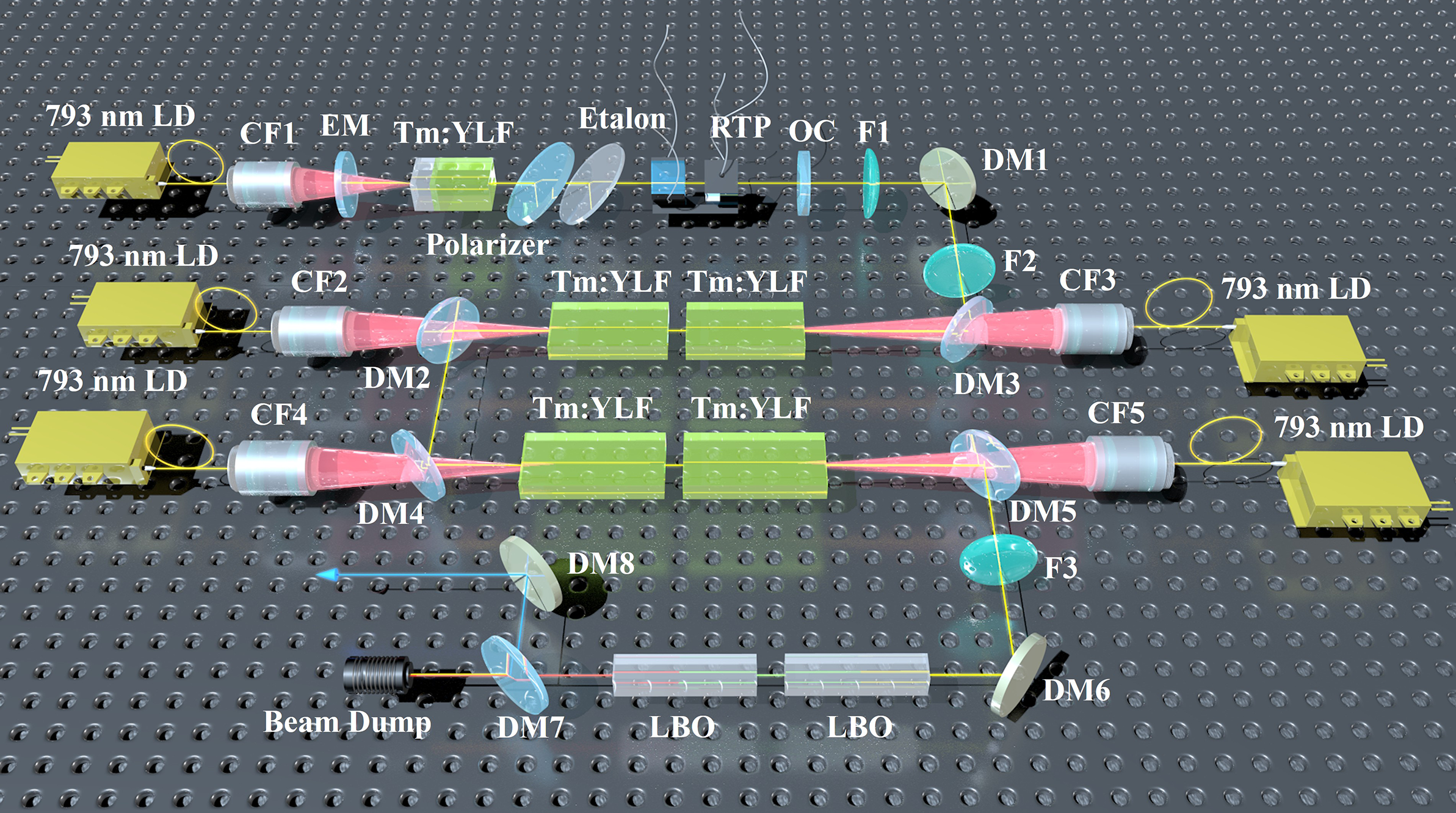
Figure 1 depicts the proposed laser system. The oscillator of the Tm:YLF MOPA is a rubidium titanyl phosphate (RTP) Q-switched Tm laser, which is pumped with a fiber-coupled 793 nm laser diode (LD) (numerical aperture (NA) 0.22, core size 200 μm) via a beam collimation and focusing lens group (CF) consisting of two plano-convex lenses with focal lengths of 30 and 60 mm, respectively. The gain crystal is a 3% (atomic fraction) Tm:YLF crystal with size of 3 mm × 3 mm × 8 mm, which is diffusion-bonded with an additional 3 mm long YLF section to alleviate the thermal effects of the oscillator. For the a-cut Tm:YLF crystal, the end faces of the Tm:YLF and undoped YLF sections must be precisely aligned prior to the bonding process, ensuring their c-axes and a-axes are mutually parallel. A pair of RTP crystals with identical size of 3 mm × 3 mm × 10 mm serves as the Pockels cell for electro-optical Q-switching, which are driven with a half-wave voltage of 1.2 kV at a repetition frequency of 1 kHz. A fused-silica etalon with thickness of 0.2 mm is applied to filter out a narrow-linewidth Tm:YLF laser from its broad lasing spectrum. EM denotes the end cavity mirror of the oscillator. The transmittance of the plano-concave output coupler (OC) is set to be 30% at 1.9 μm, and has a curvature radius of 700 mm to maintain excellent beam quality. Before seeding into the amplification stages, the Q-switched Tm laser is then collimated and enlarged with beam radius of 600 μm with two plano-convex lenses F1 and F2 with focal lengths of 50 and 75 mm, respectively.
Depicted layout of the high-brightness, high-energy pulsed blue laser system, which consists of the Tm:YLF MOPA and LBO crystal-based cascade SHG module.

The first amplification stage consists of a pair of Tm:YLF crystals with identical size of 1.5 mm × 6 mm × 20 mm and a doping concentration of 2.5% (atomic fraction). A pair of 792 nm LDs (NA 0.22, core size 200 μm) with maximum power of 50 W is applied for dual-end pumping. The amplified Tm laser is then passed through the second amplification stage, consisting of another pair of Tm:YLF crystals with identical size of 1.5 mm × 6 mm × 25 mm. The doping concentration of both crystals is decreased to be 2% to deal with thermal effects under high-power diode pumping. In this amplification stage, 792 nm LDs with a maximum output power of 50 W and a pump spot radius of 650 μm are applied. All the Tm:YLF crystals are wrapped with indium foil and mounted into separate copper heat sinks for water cooling maintained at 16°C. The MOPA laser is then focused with a plano-convex lens F3 before entering the SHG stage. Herein, LBO crystals with a peak damage threshold exceeding 15 GW·cm–2 under short nanosecond (10 ns) pulses in the blue-green laser region are employed[ Reference Wagner, Hildenbrand, Natoli and Commandré 32 ]. A 25-mm long LBO crystal (θ = 90°, φ = 24.8°) is used for SHG with type I phase matching and its temperature is controlled at 25°C. Another 25-mm long LBO crystal (θ = 90°, φ = 18.8°) is used for QHG with type I phase matching. Both crystals are anti-reflection (AR) coated at 1905 nm ± 5 nm, 952 nm ± 5 nm and 476 nm ± 5 nm, respectively (T > 99.5%). DM1 to DM6 are 45° dichroic mirrors AR coated at the LD pump wavelength and high-reflection (HR) coated at the 1.9 μm fundamental wavelength. DM7 and DM8 are dichroic mirrors AR coated at the fundamental 1.9 μm laser and SHG laser wavelengths, and HR coated at the QHG blue laser wavelength. The laser wavelength was measured using an optical spectrum analyzer (AQ6376, Yokogawa, Inc.), and the pulse properties were measured using an InGaAs detector (818-BB-51, Newport, Inc.) with a rising time of 28 ps and a bandwidth of 10 GHz, which is then connected to a digital oscilloscope (MS044 4-BW-1000, Tektronix, Inc). The beam quality was evaluated using a pyroelectric camera (PYIII, Ophir, Inc.) with a standard M 2 factor calculation software (beam square).
3 Results and discussion
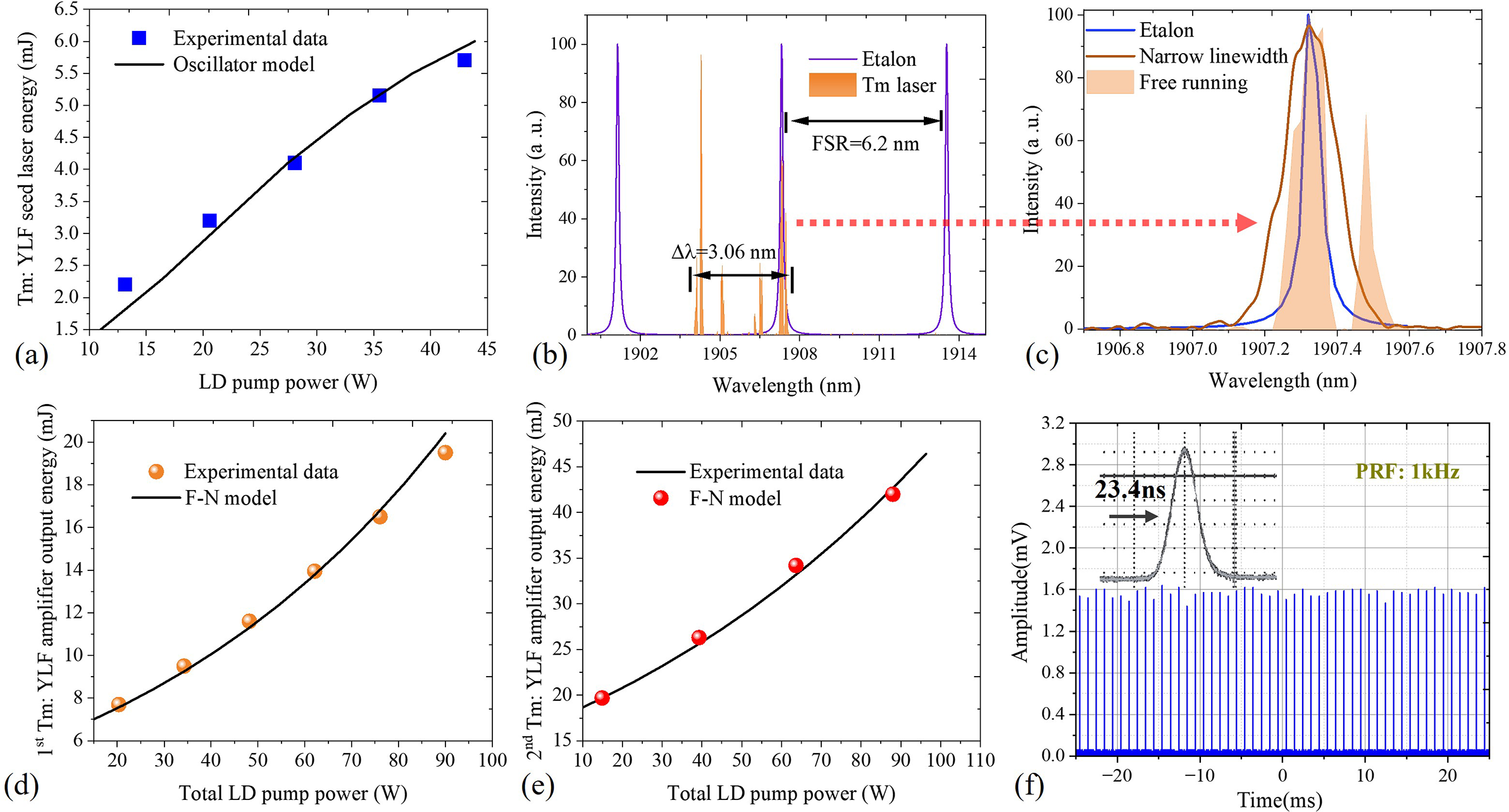
In the Tm:YLF oscillator, multi-longitudinal mode operation with a wide span above 3 nm was observed before electro-optical Q-switching. Hence, a fused-silica etalon with thickness of 0.2 mm and free spectral region of 6.2 nm was inserted to suppress the multi-longitudinal mode of the lasing spectrum. The PRF was set to be 1 kHz, where the maximum Tm laser energy of 5.7 mJ was obtained under diode pump power of 43.35 W, which matched well with the rate equation model for Tm:YLF lasers derived in Ref. [Reference Huang, Hu, Deng, Li, Zhang, Zheng and Lin31] (Figure 2(a)). With the inserted etalon, a narrow-linewidth Tm laser at 1907.32 nm was obtained with a linewidth of 0.19 nm (Figures 2(b) and 2(c)).
Main performances of the Tm:YLF MOPA: (a) oscillator energy curve with theoretical prediction; (b) free running Tm laser spectrum and free spectral range (FSR) of the etalon for spectral narrowing; (c) detailed profile of the etalon peak in (b) and the measured narrow-linewidth Tm laser spectrum (red curve); (d) output energy of the first amplifier with Frantz–Nodvik (F-N) theoretical prediction; (e) output energy of the second amplifier with the F-N theoretical model; (f) typical pulse train of the Tm:YLF MOPA at 42 mJ.

In each amplification stage, two Tm:YLF crystals with lower doping concentration and longer crystal length compared with those in the oscillator are placed in cascade for a smoother thermal profile and longer gain length under dual-end diode pumping. In the first amplification stage, maximum pulse energy of 19.5 mJ was obtained under total LD pump power of 93 W, complying with the Frantz–Nodvik (F-N) amplifier model described as follows:
 $$\begin{align}{E}_{\mathrm{out}}&={AF}_{\mathrm{S}}\ln \left\{1+\left[\exp \left(\frac{E_{\mathrm{in}}}{AF_{\mathrm{S}}}\right)-1\right]\exp \left(\frac{\eta_0{E}_{\mathrm{p}}}{AF_{\mathrm{S}}}\right)\right\}\nonumber\\ &\quad \times\exp \left(-{\alpha}_{\mathrm{Tm}}L\right),\end{align}$$
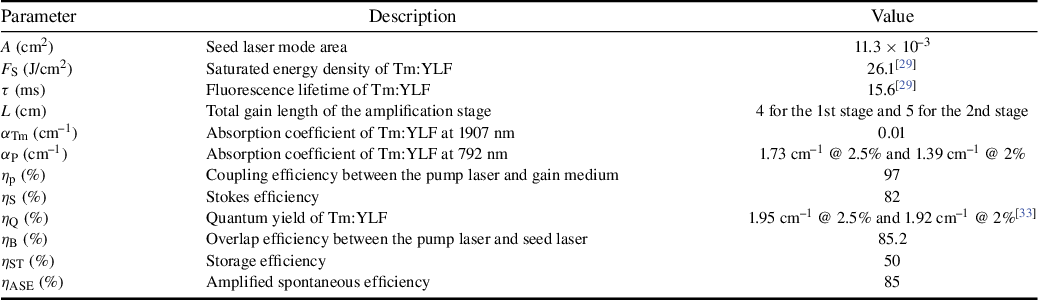
where A denotes the seed laser mode area, F S is the saturated energy density of Tm:YLF, E in is the seed energy and E p = P p·τ is the LD pump energy under continuous wave (CW) LD power of P p. Here, the fluorescence lifetime τ of Tm:YLF is approximately 15.6 ms[ Reference Eichhorn 29 ], L is the total length of the two Tm:YLF crystals in the first or second amplification stage, α Tm = 0.01 cm–1 denotes the absorption coefficient of the Tm:YLF crystal at 1907 nm and η 0 is the energy conversion efficiency from the pump laser to the amplified laser, which is as follows:
 $$\begin{align}{\eta}_0={\eta}_{\mathrm{p}}{\eta}_{\mathrm{a}}{\eta}_{\mathrm{S}}{\eta}_{\mathrm{Q}}{\eta}_{\mathrm{B}}{\eta}_{\mathrm{ST}}{\eta}_{\mathrm{ASE}}.\end{align}$$
Here, η p refers to the coupling efficiency between the pump laser and the gain medium, which depends on the propagation losses of the laser from the LD to the gain medium (including reflection, scattering and transmission losses in the optical path); η a = 1 – exp(–α a L) denotes the pump laser absorption efficiency, where α a denotes the pump absorption coefficient at 792 nm. Specifically, α a is 1.73 and 1.39 cm–1 for the 2.5% and 2% Tm:YLF crystals, respectively. Further η S = λ p/λ Tm is the Stokes efficiency, where λp is the pump wavelength and λTm is the fundamental laser wavelength; η Q is the quantum yield of Tm:YLF[ Reference Honea, Beach, Sutton, Speth, Mitchell, Skidmore, Emanuel and Payne 33 ], η B is the overlap efficiency between the pump spot and the seed laser spot; η ST is the storage efficiency with predicted value of 50%; and η ASE = 85% denotes the amplified spontaneous efficiency that is based on the accumulated experimental data for pulsed Tm laser amplification.
With the above model (see the detailed parameters in Table 1), we can also predict the potential output energy curve of the second amplifier, which complies well with the experimental results (Figure 2(e)). Finally, the maximum output energy of 42 mJ with pulse duration of 23.4 ns was obtained under total LD pump power of 89 W (Figure 2(e)), corresponding to an average power of 42 W and a peak power of 1.79 MW. A typical pulse train with PRF of 1 kHz and pulse duration of 23.4 ns is depicted in Figure 2(f).
Parameters for Frantz–Nodvik (F-N) amplifier model calculation.

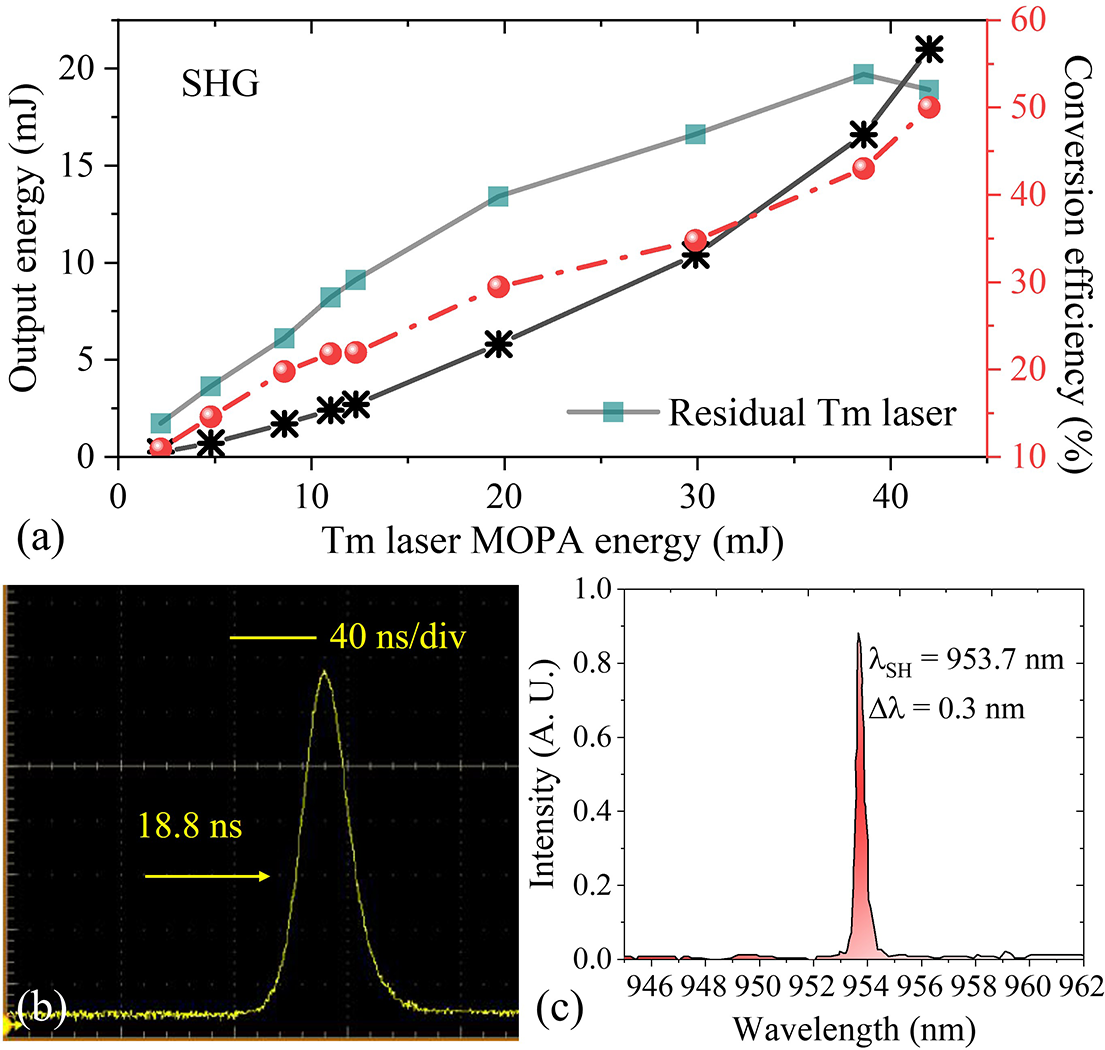
In the SHG stage the temperature of the LBO crystal is set at 25°C ± 0.1°C and the plano-convex lens F3 with focal length of 750 mm is applied to focus the fundamental Tm laser into the first LBO crystal with a waist diameter of 900 μm. Maximum SHG laser energy of 21 mJ is obtained under Tm:YLF laser driving energy of 42 mJ, corresponding to a high nonlinear conversion efficiency (NCE) of 50%. The maximum residual Tm laser energy, measured after the SHG stage, is 18.9 mJ (Figure 3(a)). The pulse duration shrank to 18.8 ns due to the remaining pulse energy at the edge being insufficient for SHG (Figure 3(b)). The resulting SHG laser wavelength is 953.7 nm with a linewidth of 0.34 nm (Figure 3(c)).
Main performances of the SHG laser: (a) SHG energy curve with corresponding nonlinear conversion efficiency and residual Tm laser energy; (b) typical pulse shape at the maximum SHG energy of 21 mJ; (c) the resulting SHG laser spectrum.

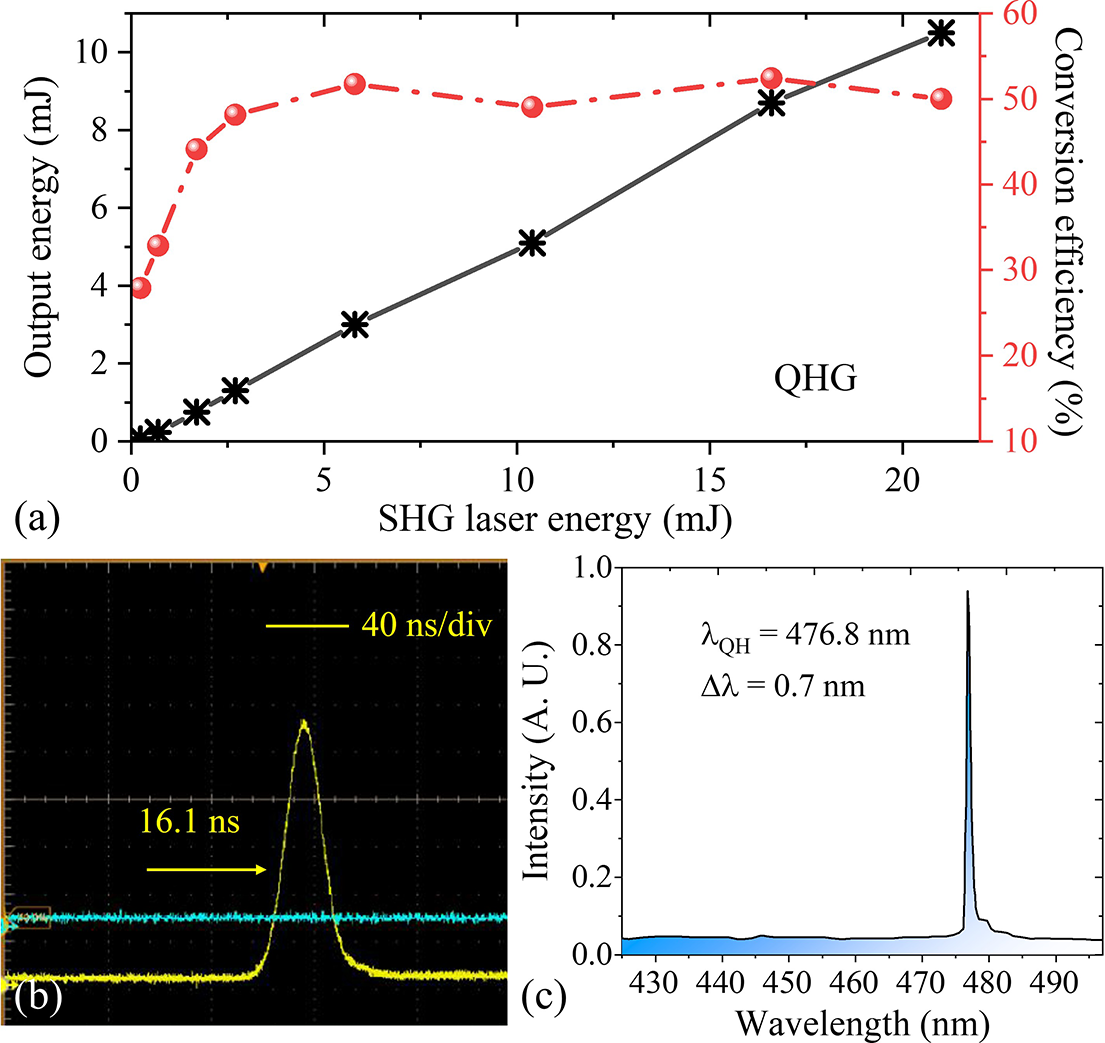
The SHG laser is then guided into the QHG stage with another LBO crystal placed close to the first LBO crystal before filtering out the residual Tm laser. In this stage, maximum blue laser energy of 10.52 mJ is obtained under incident SHG laser energy of 21 mJ, corresponding to a peak power of 0.65 MW, an NCE of 50% and an overall efficiency of 25% from the fundamental 1.9 μm laser to the blue laser (Figure 4(a)). The pulse duration further shrank to 16.1 ns (Figure 4(b)) and the resulting QHG laser wavelength is 476.8 nm with a linewidth of 0.7 nm (Figure 4(c)). Since an ultraviolet-visible (UV-VIS) spectrometer (SR2, Ocean Optics, Inc.) with resolution ranging from 0.4 to 2 nm (configuration dependent) was applied to characterize the SHG and QHG spectra, a narrower linewidth of the pulsed blue laser could be predicted.
Main performances of the QHG laser: (a) QHG energy curve with corresponding nonlinear conversion efficiency; (b) typical pulse shape at the maximum QHG energy of 10.5 mJ; (c) the resulting QHG laser spectrum.

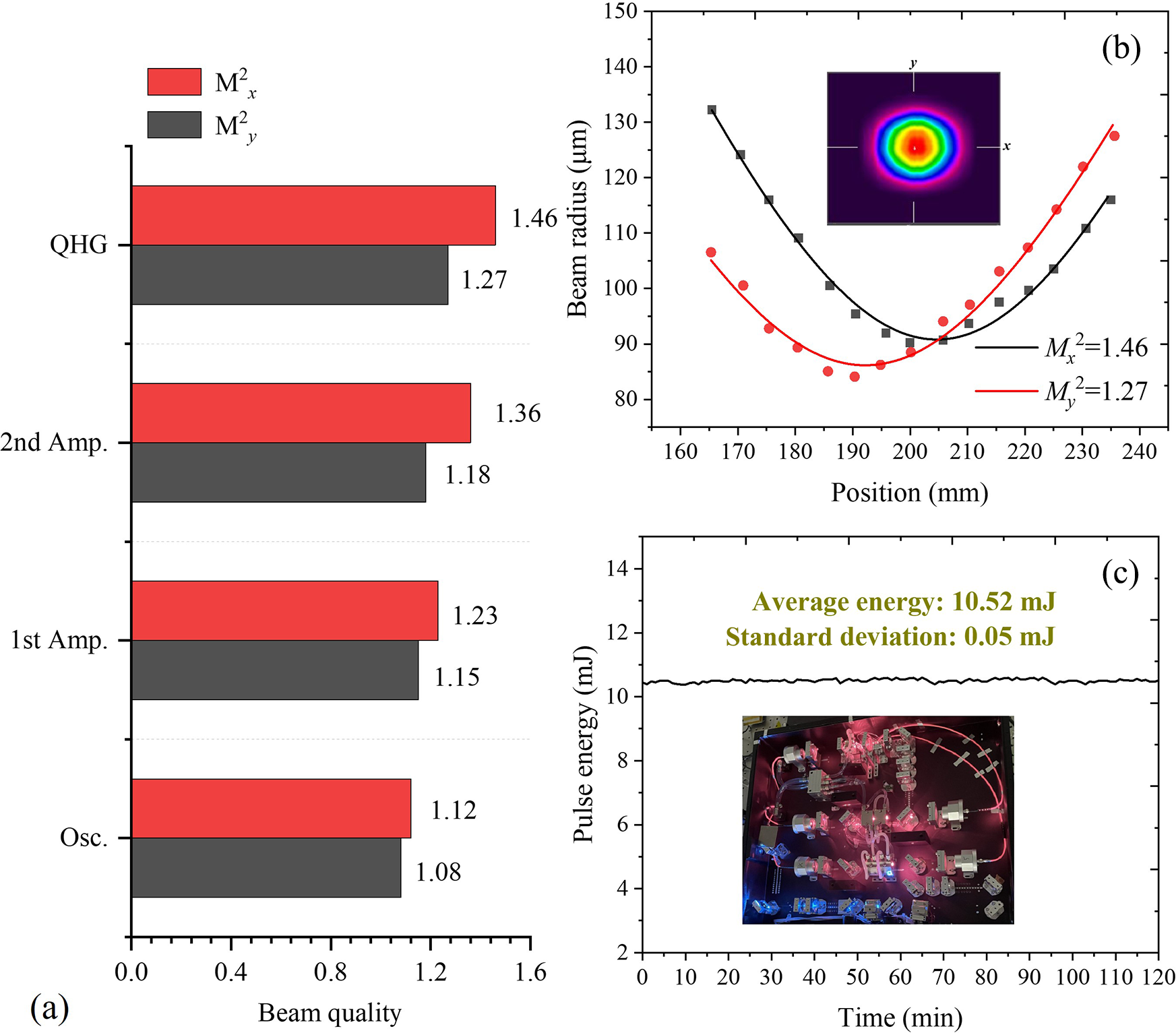
Furthermore, we characterize the energy stability of QHG blue laser within 2 h, where the maximum output energy has an average value of 10.52 mJ and a standard deviation of 0.05 mJ. Correspondingly, the energy instability is 0.47% and superior to most OPO-based blue lasers (typically >1%), indicating good engineering applicability.
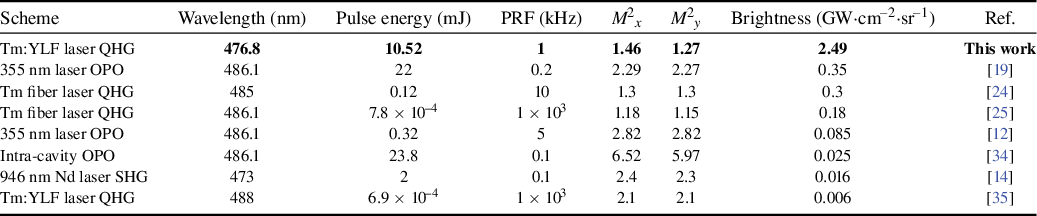
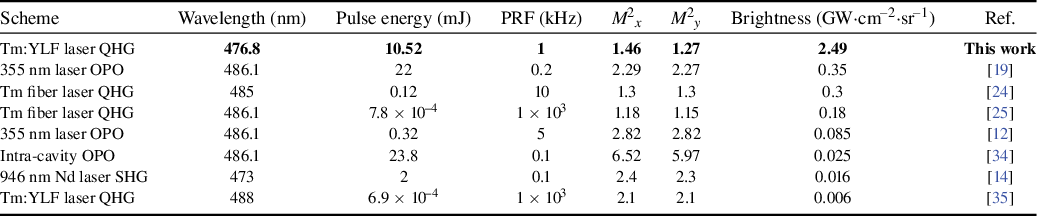
The evolution of beam quality throughout the entire laser chain is depicted in Figure 5(a). For the horizontal direction, the M 2 x value increases from 1.12 (measured at the maximum output energy of the oscillator) to 1.36 (at the maximum amplified energy of the second amplifier). In the vertical direction, the corresponding M 2 y value rises slowly from 1.08 to 1.18. Ultimately, at the maximum pulse energy of the blue laser, the M 2 x and M 2 y values are maintained at 1.46 and 1.27, respectively (Figure 5(b)). This indicates that the beam quality remains at a high level (M 2 < 1.5) across the entire laser chain, and the laser achieves a peak brightness of 2.49 GW·cm–2·sr–1, more than 7–415 times that of existing pulsed blue lasers (Table 1). Besides using Tm:YLF crystals with negative thermal-optics and weak thermal lenses, the maintained good beam quality from the fundamental 1.9 μm laser to the blue laser can be attributed to the QHG process using LBO crystals with a small walk-off angle and high optical uniformity (δn ≈ 1 × 10⁻⁶ cm–1). According to the critical phase-matching conditions, walk-off angles for the 953.7 nm SHG laser and 476.8 nm QHG laser are 13.2 and 23.5 mrad, respectively, which are relatively small compared to other nonlinear crystals, such as BBO (72.4 mrad for a 953.7 nm laser and 81.7 mrad for 476.8 nm, respectively).
Beam quality and stability of the QHG blue laser at its maximum pulse energy: (a) evolution of the beam quality from the oscillator (Osc.), 1st amplification stage (1st Amp.), 2nd amplification stage (2nd Amp.), to the QHG stage; (b) beam quality with near-field beam profile; (c) energy stability within 2 h and the system image.

Although OPA followed with an OPO stage as the seed source is another appealing scheme to maintain a good blue laser beam quality[ Reference Luo, Ma, Huang, Lu, Zhang, Ma, Zhu and Chen 19 ], the low PRF of the 355 nm driving source limited the blue laser power and the achievable laser brightness. In comparison, high PRF in the kHz region and diffraction-limited beam quality could be easily obtained in a Tm fiber MOPA via modulating PRF of its 1.9 μm distributed feedback laser (DFB) seed sources[ Reference Honea, Savage-Leuchs, Bowers, Yilmaz and Mead 23 , Reference Chen, Yue, Kong, Huang, He and Shu 24 ]. However, the pulse energy is limited by the nonlinear effects of the fiber structure (<1 mJ for nanosecond blue lasers) and also restricts the achievable brightness of the pulsed blue laser compared with that using the Tm:YLF bulk crystal (Table 2). To further scale the energy of current QHG blue laser system, microchannel heat sinks should be applied to replace the copper heat sinks, which can reduce thermal distortions of the Tm:YLF crystals under high-power diode pumping and thus achieve higher amplification efficiency while preserving excellent beam quality. On the premise of ensuring structural compactness, a third amplification stage will be integrated to significantly increase the fundamental laser energy and thus the blue laser energy.
Comparison in lasing performance among high-energy pulsed blue lasers.
4 Conclusion
In conclusion, we have demonstrated an efficient and compact approach to high-brightness pulsed blue laser generation through efficient QHG of a Tm:YLF MOPA. The system achieves a groundbreaking combination of 10.52 mJ pulse energy at 1 kHz, excellent beam quality and record-high brightness of 2.49 GW·cm–2·sr–1, which are performance metrics that collectively represent a significant advancement beyond the state-of-the-art. This breakthrough is enabled by the synergistic combination of Tm:YLF’s negative thermal optics and LBO’s low walk-off characteristics, which collectively maintain the beam quality through efficient cascade frequency doubling. The resulting laser source directly meets the core requirements of next-generation marine scientific applications, including long-range underwater LiDAR for ocean floor mapping, high-bandwidth underwater communication systems and sensitive pollution detection capabilities. With its robust operation and exceptional stability, the proposed Tm:YLF laser-LBO QHG scheme provides a practical pathway toward field-deployable systems that can significantly enhance our understanding and monitoring of marine environments.
Acknowledgement
This work was supported by the National Key Research and Development Program of China (Grant No. 2021YFB36025).

 Open access

