

1 Introduction
The grammatical status of OV/VO word order variation in the present-day and medieval varieties of the (West) Germanic languages has been vigorously debated for several decades. This is as true for larger issues of word order typology as for the variation that can be witnessed within one language variety and/or a given historical stage of a language, and the analysis thereof, see for instance see Blom (Reference Blom2002) on Middle Dutch, Walkden (Reference Walkden2014) on Old Saxon, Petrova (Reference Petrova2009, Reference Petrova, Nevalainen and Traugott2012) on Old High German and van Kemenade (Reference van Kemenade1987), Pintzuk (Reference Pintzuk2005) and Biberauer & Roberts (Reference Biberauer and Roberts2005) on Old English, among many others.
This article is specifically concerned with OV/VO word order variation in Old English (OE) from a pragmatic perspective. There have been numerous studies on the underlying or basic word order of historical English, with proposals ranging from basic OV (van Kemenade Reference van Kemenade1987; Pintzuk & Kroch Reference Pintzuk and Kroch1989) to basic VO (Biberauer & Roberts Reference Biberauer and Roberts2005; Elenbaas & van Kemenade Reference Elenbaas and van Kemenade2014). An intermediate line of research follows the Double Base Hypothesis, which assumes that OE must have had competing OV and VO grammars (Pintzuk Reference Pintzuk1999et seq.). More recently, however, the debate has shifted from discussing the structural implications of this word order variation to the variation itself, focusing on the influence of information structure (henceforth IS) and weight of the object (Taylor & Pintzuk Reference Taylor and Pintzuk2012a, Reference Taylor and Pintzukb).
The primary goal of this article is to (re)evaluate these triggers for the attested OE word orders and see how they play out against the various structural analyses. We will present quantitative evidence that much of the variation is governed by IS triggers and we will show that our data support an analysis in which OV word order is triggered by IS and is derived from a VO base.
The article is structured as follows. Section 2 will establish some basic facts concerning OV/VO variation in OE. Section 3 will lay out the factors that influence word order choices, including IS. These facts will serve as the basis for the discussion of the data and for the logistic regression analysis presented in sections 4 and 5. Section 6 will review the data in light of our hypothesis that OV is triggered by IS from a VO base.
2 OV/VO variation in Old English
Present-day English is a rigid SVO language (as in (1a) below), which allows little variation in the order of the object and the verb. However, the historical stages of the language did allow variation in the position of the object and the verb, so both the orders in (1a–b) occurred.
(1) (a) …. that John has read the book
(b) *… that John the book has read
The examples in (2) demonstrate this variation in OE. The OV example in (2a) shows the object (in bold) preceding the lexical verb (in italics); in (2b) the object follows the verb.
(2) (a) OV order in OE
We nu willaþ ure saulasmerian mid mildheortnesse ele
We now wish our souls anoint with mercy oil
‘We now wish to anoint our souls with oil of mercy.’
(coblick: HomS_21_[BlHom_6]:73.136.927)
(b) VO order in OE
… se wolde ofslean þone cyning Dauid
… who wanted kill that king David
‘… who wanted to kill that king David.’ (coaelhom: +AHom_23:39.3722)
This issue is further complicated by additional variation in the order of the auxiliary and the verb. Combining these two types of variation leads to no less than five attested word orders in OE. AuxV orders are illustrated in (3). Objects (in bold) could surface before the verb (in italics) and the auxiliary (underlined), as in (3a), between the auxiliary and the verb, as in (3b) or the object could follow both the auxiliary and the verb (3c).
(3) (a) OAuxV
and gif hi þone lofsangwillað æt þam wundrum singan
and if they that psalm want at that wonder sing
‘and if they sing that psalm for the miracles…’
(coaelive: ÆLS_[Swithun]:237.4375)
(b) AuxOV
þurh þa heo scealhyre scippendunderstandan
through which it must its creator understand
‘through which it must understand its creator’
(coaelive: ÆLS_[Christmas]:157.125)
(c) AuxVO
swa þæt heo biðforloren þam ecan life
so that it is lost the eternal life
‘so that it is lost to the eternal life’ (coaelive: ÆLS_[Christmas]:144.117)
VAux orders are illustrated in (4).Footnote 2 Objects can surface either before the verb, as in (4a), or after the verb and the auxiliary, as in (4b).
(4) (a) OVAux
gif heo þæt bysmorforberan wolde
if she that disgrace tolerate would
‘if she would tolerate that disgrace’ (coaelive: ÆLS_[Eugenia]:185.305)
(b)VAuxO
þæt he friðian woldeþa leasan wudewan
that he make-peace-with would the false widow
‘that he would make peace with the false widow’
(coaelive: ÆLS_[Eugenia]:209.315)
The first aim of this article is therefore to get a clear and detailed picture of the facts concerning the structure and use of OV/VO variation in OE. This will show what the nature and the extent of OV/VO variation was and, specifically, to what extent it was influenced by IS. We will then discuss the various proposals that have been put forward to account for word order variation and will critically evaluate them against our data.
The earlier proposals can be summarized as in (5):
(5)


OE is either a basic VO language, with leftward movement to derive OV word order, as in (5a), or it is a basic OV language, with rightward movement to derive VO word order, as in (5b). It has also been proposed that OE had both a basic OV and a basic VO grammar, with both movement options to derive the word order patterns in (3) and (4) above, so both (5a) and (5b) were an option.
If we assume IS to be the trigger for word order variation, we can make the following predictions; if OE is a VO language, as in (5a), we predict that objects in OV word order are moved as a result of an IS-trigger. This means we expect to find a homogeneous set of objects in OV order which correspond to this trigger. More specifically, we expect OV objects to be given. Similarly, if OE is an OV language, as in (5b), we predict that objects in VO are moved as the result of an IS-trigger, which in this case would be newness. Since all objects originate in some basic position, we expect to find a heterogeneous set of objects in VO in (5a), while we expect to find a heterogeneous set of objects in OV in (5b), as not all triggered objects will necessarily respond to the movement trigger.
3 OV/VO variation and information structure
Earlier approaches to OV/VO variation in OE focused on the relation between richness of inflection and word order freedom. Fries (Reference Fries1940) claims that word order placement is free in OE because objects and subjects are inflected for case and that word order became fixed because inflection was lost. Such a scenario cannot be the whole story; the history of English saw substantial losses in the inflectional domain and became rigidly SVO; Dutch likewise lost much of its case inflection and became more strictly SOV; German retained its inflections and became more rigidly SOV, like Dutch. Clearly, many more factors come into play in the processes of word order change; one such factor is IS.
From very early on, traditional grammarians have been aware of the IS properties that govern variation. Behaghel (Reference Behagel1909), for instance, already notes that given information precedes new information in various Germanic languages. Similarly, the given-before-new principle (Gundel Reference Gundel1988) is at the heart of much of the recent research on word order variation in the West Germanic language family (see Bech Reference Bech2001; van Kemenade & Los Reference van Kemenade and Los2006; Petrova Reference Petrova2009, Reference Petrova, Nevalainen and Traugott2012; Petrova & Speyer 2011; Biberauer & van Kemenade Reference Biberauer and van Kemenade2011; Taylor & Pintzuk Reference Taylor and Pintzuk2012b; van Kemenade & Milicev Reference van Kemenade and Milicev2011; Walkden Reference Walkden2014 among others). The hypothesis underlying work on OV/VO variation specifically is that OV is given and VO is new, but it is clear that this relation is not a straightforward one.
The influence of IS on OE OV/VO variation has been studied by Taylor & Pintzuk (Reference Taylor and Pintzuk2012a, Reference Taylor and Pintzuk2012b, Reference Taylor and Pintzuk2014) (henceforth T&P). They approach the data from the Double Base Hypothesis (see Pintzuk Reference Pintzuk1999, Reference Pintzuk2002, Reference Pintzuk2005), which means that they assume that OE could employ both movement possibilities (5a–b) above. They make an a priori distinction between AuxV and VAux clauses and assume that VAux clauses must be OV, as VOAux word order is ungrammatical. This means that VAuxO must be the result of rightward movement. AuxV clauses are ambiguous. They can be underlyingly OV or VO, while the surface order can also be the result of rightward or leftward movement. Their prediction is therefore that the effect of IS, weight and case – the predictors in their model – is stronger in VAux clauses and that VO in these clauses is the result of newness or heaviness. This means that for VAux clauses only the movement possibility outlined in (5b) is available, while word order in AuxV clauses can be derived by both (5a) and (5b).
T&P’s analysis includes only AuxOV, AuxVO, OVAux and VAuxO word orders; they do not include OAuxV orders in their investigation, claiming that these are the result of factors other than IS, without specifying any arguments.Footnote 3 They also exclude pronouns, because their syntax differs from that of non-pronominal objects (Pintzuk Reference Pintzuk1996; Wallenberg Reference Wallenberg2009) and quantified objects and negated objects, because of their special syntactic behaviour (Pintzuk & Taylor Reference Pintzuk and Taylor2006). Finally, T&P exclude non-referential objects, such as negative objects and semantically incorporated objects.
T&P also take weight and case into account, besides IS. They find that objects that are generally considered indirect objects, i.e. dative and genitive objects, are more frequently postverbal. This difference is only significant in VAux clauses. Weight also significantly influences the surface order of constituents; this effect is significant in both VAux and AuxV clauses. This corresponds to the cross-linguistic tendency for longer or heavier objects to occur later in the sentence (cf. Behagel’s (Reference Behagel1909) Gesetz der wachsenden Glieder and Hawkins (Reference Hawkins1994), who in fact argues that all word order variation is the result of syntactic weight).
T&P use a binary given–new distinction to annotate for IS. Their work is primarily based on insights from Birner (Reference Birner2006), building on Prince (Reference Prince1981) and Gundel, Hedberg & Zacharski (Reference Gundel, Hedberg and Zacharski1993). Their new-category includes referentially new objects: new discourse referents in the sense of Karttunen (Reference Karttunen1976) and bridging inferables, i.e. cases where inference cannot be made without an explicit link to an earlier referent (see Birner Reference Birner2006). The given category includes previously mentioned entities, shared/cultural knowledge, situationally evoked entities and elaborating inferables, i.e. cases which can be inferred from another closely related constituent (see Birner Reference Birner2006). T&P claim that once the object can be characterized as complex, clausal or heavy, IS can no longer influence the position of the object. However, when the object is simple, it is more likely to be VO when new, but this is only true in VAux clauses. The effect of IS is diluted in AuxV clauses. T&P take this difference between AuxV and VAux clauses as evidence for their Double Base Hypothesis, because AuxV can contain both basic VO word orders and also derived VO word orders. The basic VO word orders are not subject to IS constraints, because they are instances of a ‘new’ grammar in which IS does not play a role (i.e. the Present-day English grammar), while derived VO orders are cases of an older grammar, in which IS does play a role.
Combining T&P’s findings with our predictions based on the movement possibilities outlined in (5), we note that T&P can account for only a part of the data. They only explore the possibility that VO is derived by rightward movement from an OV base. We predicted that the derived VO orders would constitute a homogenous set of objects triggered by IS; T&P’s results indicate that approximately 20% of the new objects in VAux order are postverbal. Furthermore, there are around 10 per cent postverbal given objects. In AuxV clauses, the proportion of given VO orders is even higher: around 45 per cent. This means that objects in VO orders are far from a homogeneous set in terms of IS.
Taylor & Pintzuk (Reference Taylor and Pintzuk2012a: 42) conclude that the differences they observe between AuxV and VAux clauses cannot be reconciled with ‘a syntactic analysis in which all post-verbal objects are triggered by the same discourse/performance constraints’. However, they do not consider the possibility that givenness triggers OV word order, because this is not an option in their approach. Since we do not make any a priori assumptions about the structural analysis of OE word order, this allows us to explore the opposite hypothesis, i.e. OV word order is the result of givenness, which we will turn to now.
4 Methodology
Our aim is to study the extent to which OV word order can be predicted by IS triggers, where various types of OV orders are associated with given information objects. We started from the various word orders identified in (3) and (4) above and then collected and annotated the data as follows.
The data in our corpus were gathered from the York–Toronto–Helsinki Parsed Corpus of Old English Prose (henceforth YCOE; Taylor et al. Reference Taylor, Warner, Pintzuk and Beths2003). The dataset consists of referential direct objects in subclauses from the O3 and O23 periods (850–1050), with both a finite and a non-finite verb. Using subclauses with two verbs minimizes the chance that we find word orders which are the result of movement of the verb to the second position in the clause, rather than movement of the object.
We excluded indirect objects in our study, unlike T&P, because direct and indirect objects do not have the same function (or syntactic position) in the clause, so it is unclear whether they will behave the same in terms of IS. Dunbar (Reference Dunbar1979) notes that indirect objects are more likely to be postverbal, because they are less topical, which Dunbar and T&P directly relate to IS, because less topical means less likely to be given. However, since this correlation is never directly established, we see it as a confounding factor. Furthermore, T&P differentiate indirect and direct objects only by case, assuming that dative and genitive objects are indirect objects and accusative objects are direct objects. However, some direct objects are selected by a verb that requires genitive or dative case, such as gemyltsian ‘to pardon’ in (6)
(6) þæt he wolde þam wife gemyltsian for his þingunge
that he would that woman pardon for his intercession
‘that he would pardon the woman for his intercession’
(coaelive: +ALS_[Basil]:177.570)
To make sure that we are not treating two things as equal, while they are in fact different, we have excluded indirect objects from the analysis and leave those for future research.
We follow T&P in excluding negated and quantified objects, as these objects are not referential. Furthermore, it has been suggested that they show different syntactic behaviour compared to referential objects (see Pintzuk & Taylor Reference Pintzuk and Taylor2004, Reference Pintzuk and Taylor2006). We excluded pronouns because of their syntactic behaviour; pronouns are generally assumed to move a higher position in the clause, possibly as clitics (Pintzuk Reference Pintzuk1999; Wallenberg Reference Wallenberg2009).
To exclude translation effects, we included only original OE texts in the sample. Cichosz, Gaszewski & Pęzik (Reference Cichosz, Gaszewski and Pęzik2017) study the influence of Latin originals on element order in OE and Old High German (OHG) translations, devoting a significant number of pages to Latin influence on OV/VO variation. They show that the use of OV or VO in a Latin original influences the use of OV or VO in the OE translation and that Latin influence is ubiquitous, be it direct or indirect. Furthermore, OV/VO variation in Latin is itself quite an elusive and poorly understood phenomenon (but see Danckaert Reference Danckaert2015, Reference Danckaert2017 and the sources cited there), so it will be difficult to provide a motivation for why a translator decided to follow the original or deviate from it. This means that we have to tread carefully when using translated material to make claims about native OE syntax. Taylor & Pintzuk’s (Reference Taylor and Pintzuk2012b) database contains five texts that are (at least partially) translated from a Latin original, including Bede, which is a text heavily influenced by the original Latin word order according to Cichosz, Gaszewski & Pęzik (Reference Cichosz, Gaszewski and Pęzik2017). As a result, T&P’s data are possibly influenced by the Latin originals. In order to prevent this potential problem, we only include non-translated texts.
We used Cesax (Komen Reference Komen2011a) and CorpusStudio (Komen Reference Komen2011b) software to collect and annotate the data. CorpusStudio generates a database of syntactically annotated clauses with user-customized features by means of Xquery searches in XML versions of the relevant corpora. Cesax facilitates further semi-automatic and manual coding of IS and weight. The database thus created with Cesax forms the input for the statistical analysis. We will discuss the features included in the database in more detail below.
4.1 Information structure
We used a two-way coding scheme to annotate IS. The scheme is based on the Pentaset annotation guidelines (Komen Reference Komen2013). The Pentaset includes five possible reference categories: Identity, Inferred, Assumed, New and Inert. Taylor & Pintzuk (Reference Taylor and Pintzuk2014), in a study of the effect of using different annotation schemes, show that making a distinction between categories that are traditionally analysed as given (Identity, Inferred and Assumed in the Pentaset) does not yield significant differences. Considering the amount of data that is needed to do a reliable regression analysis, we feel it is justified to collate these three information status labels into one category, given, since we do not expect to find differences in the distribution of these three object types. Our given category thus contains objects that are labelled Identity, Inferred or Assumed. We will briefly illustrate each IS label below.
4.1.1 Identity
Identity refers to objects that have been mentioned before in the discourse, as in (7) below.
(7) Þæt anlipige Godes tempel wæs wundorlice gecræft. þurh gastlicum gerynum;
that single God’s temple was wondrously made through ghostly mysteries
Dauid se mæra cyning hæfde gemynt þæt he wolde þæt tempel aræran ðam
David the great king had designed that he would that temple raise that
ælmihtigan Gode to wurðmynte.
almighty God to honour
‘that single temple of God was wondrously contrived through ghostly mysteries. David, the great king, had designed that he would raise that temple to the honour of the almighty God.’
(cocathom2: +ACHom_II,_45:335.10.7522-23)
The example refers to a temple that was mysteriously built. This same temple is referred back to as þæt temple, which makes it identical to its antecedent.
4.1.2 Inferred
Inferred refers to elaborating inferables in the sense of Birner (Reference Birner2006), which means that a referent has not been mentioned before, but can be inferred from another, closely related constituent. This includes inferences of the type party–music, where music can be inferred from the fact that a party usually has music. The example in (8), where ure heortan is activated, illustrates an elaborating inferable in OE; the owners of the hearts have been mentioned before and since all humans need a heart in order to live, we can infer the existence of the hearts from the existence of the people. Inferred objects are often body parts or cases of inalienable possession. Note that while the example in (8) is anchored directly to a referent by means of possessive pronoun, anchoring is not necessary for successful inference, as in the case of party–music.
(8) We magan ongytan þæt he forþon us gesette þæt we hine biddan sceoldan, þy
We may perceive that he indeed us formed that we him pray should so
we sceolan þonne eac, in þa tid þæs gebedes, ure heortan geclænsian from
we should then also in that time of-that prayer our hearts cleanse from
oþrum geþohtum.
other thoughts
‘We may perceive that he has formed us that we should pray to him, so we must during our time of prayer cleanse our hearts from wayward desires.’
(coaelhom: HomS_8_[BlHom_2]:21106.266)
4.1.3 Assumed
Assumed objects are objects that are part of world/encyclopedic knowledge or are situationally evoked, as in (9).
(9) þæt se awergda gast ongan Godes bec trahtian
that that accursed spirit began God’s books expound
‘that the accursed spirit began to expound God’s books’
(coaelhom: HomS_10_[BlHom_3]:29.59.398)
Here we can assume that the reader will have been familiar with the Holy Scriptures, as Christianity was paramount in Anglo-Saxon society.
4.1.4 New
New objects are objects that have not been mentioned before and introduce a new referent. Bridging inferables in the sense of Birner (Reference Birner2006) were also annotated as new, because the inference cannot be made without the explicit link to an earlier referent (often in the form of a possessive), so the object itself is truly new. These are often cases of alienable possession such as (10) below. While his hut is linked to the leper because of the use of the possessive pronoun, the introduction of the hut itself cannot be inferred from the leper.
(10) … cwæð ðæt he wolde genealæcan his hulce gif he mihte.
… said that he would reach his hut if he might
‘… [the leper] said that he wished to reach his hut, if he could’
(cocathom1: +ACHom_I,_23:369.136.4634)
4.1.5 Inert
Inert objects do not participate in the discourse. They do not introduce a new referent, nor can they be referred back to, as the example in (11) illustrates.
(11) Gesælige hi wurdon geborene: þæt hi moston for his intingan deaðþrowian.
blessed they are born that they must for his sake death suffer
‘Blessed they were born that they might for his sake suffer death’
(cocathom2: +ACHom_II,_45:344.293.7705)
We have excluded Inert items from the regression analysis, because they are not referential.
4.2 Weight
Weight is measured as the log base 2 of the number of letters, and includes the relative clause as a part of the object. Using the binary logarithm incorporates the idea that the effect of a difference between, say, a 3-letter object and 4-letter object is greater than between a 25-letter word and 26-letter word, because the relative increase in weight in the latter is much smaller than in the former. Furthermore, the values were centered around 0, i.e. the mean was subtracted from all values. This is to prevent the regression model from considering 0 as the baseline, as 0 is a meaningless and non-occurring value in our sample, since we only look at overt objects; the values must be at least 1. Nothing hinges on this way of measuring constituent weight, however, as all continuous measures of weight are highly correlated (Szmrecsanyi Reference Szmrecsanyi2004).
4.3 Analysis
The results were analysed with a multinomial regression analysis within a Generalized Linear Mixed Model (GLMM) (Baayen Reference Baayen2008; Gries Reference Gries2015) with fixed and random effects in SPSS. This type of analysis compares possible outcomes against a user-defined reference category. The model takes word order as the dependent variable and breaks it down into a series of comparisons between two outcome categories. Our model has five possible outcomes: the word orders identified in (3) and (4). Since we assume that all word orders are derived from VO by IS-driven scrambling, we take AuxVO as our reference category, because this is the most frequent VO category. The model compares all other possible outcome categories against this reference category. The outcome of the regression analysis will thus tell us whether the fixed effects in the model (IS and weight) significantly predict AuxOV vs AuxVO, OVAux vs AuxVO, etc. It will not only return the significance value, but also the odds ratio (Exp(B)). The odds ratio is an indication of the effect size and indicates whether the objects in the sample will be more likely to appear in the reference category (AuxVO) or in the category it is compared with (any of the other orders). An odds ratio above 1 indicates that an object will be more likely to appear in the reference category, while a value below 1 indicates that it is more likely to appear in the predicted category. TextID was included as a random effect, in order to control for variation that is the result of individual texts.
5 Results
Our dataset consists of 768 subclauses with a referential direct object and two verbs. Figure 1 shows their distribution across the various word order patterns.
The distribution of objects across word order in OE
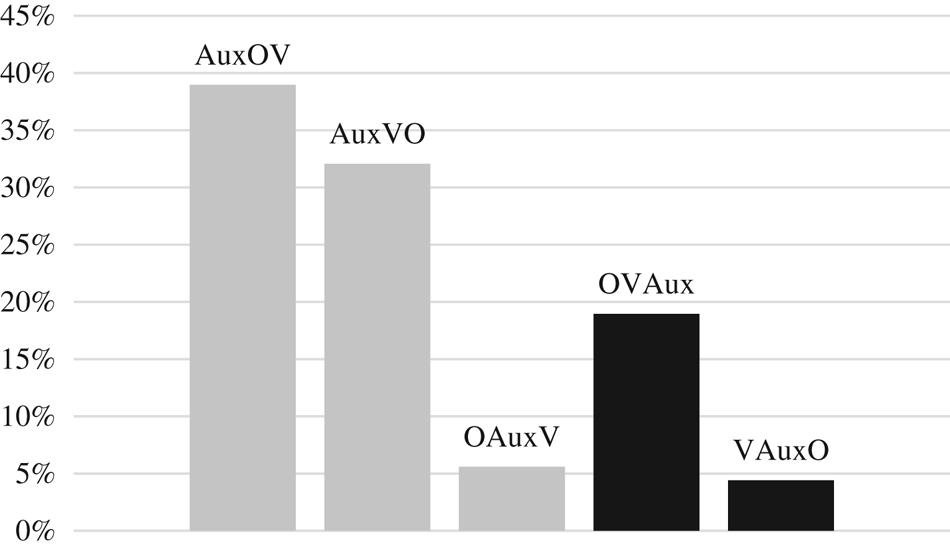
We first of all note the high occurrence of AuxV (in grey) compared to VAux (in black). Furthermore, there is more OV/VO variation in AuxV clauses than in VAux clauses, which are more predominantly OV.
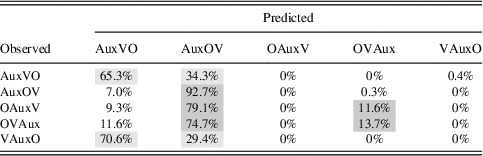
The overall correct classification percentage of the regression analysis is 59.6 per cent, which means that based on the predictors entered into the model (IS and weight) the model was able to correctly classify over half of the items. This seems a rather low number, but table 1 shows that the model is in fact able to correctly predict OV order as opposed to VO (marked in dark grey). The model, however, fails to make a distinction between the different OV patterns and predicts AuxOV in most of the cases. This suggests that the predictors in the model do not influence the choice for AuxV or VAux and that the model simply predicts the most frequent option. The classification of VO word orders is trickier. The model again does not make a distinction between VAux and AuxV clauses, but observed VO word orders are only correctly predicted in VO word order in around two-thirds of the cases (marked in light grey). This suggests that our predictors can account for preverbal word order, but less so for postverbal word order.
Percentage of correct predictions and observations by the model
Both IS and weight are significant predictors, p<.001 and p<.001 respectively,Footnote 4 which means that the overall effect of both factors on the model is significant, but these values do not tell us anything about the direction of the effects or on the effect between different word order patterns. We will discuss the effects of both predictors on the various word order patterns in more detail below.
5.1 Weight
Weight significantly predicts word order. The overall tendency is that an increase in the length of the object results in an increased likelihood of VO word order. The parameter estimates are summarized in table 2.
The effect of object length on word order
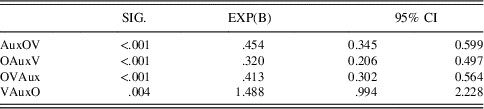
The odds ratios for all preverbal word orders are below 1, which indicates that an increase in the length of the objects increases the chance of AuxVO word order. The difference between VAuxO and AuxVO is marginally significant. The odds ratio is 1.488; thus, a one-unit increase in the length of the object increases the chance of it occurring in VAuxO order about 1.5 times.
The object length was measured in the log base 2 number of letters, including relative clauses.Footnote 5 This means that it is possible that the effect of object length is reducible to the presence of the relative clause, but this is not the case. A model without objects with a relative clause yields similar results; longer objects are still more likely to appear in a postverbal position. This observation is also confirmed by the data. While objects with a relative clause are most often postverbal as in (12), preverbal examples do exist, as is illustrated in (13).
(12) þæt he ofslean wolde þa geleaffullan Iudei, þe gelyfdon ða on God
that he kill wanted the believing Jews, who believed then in God
‘that he wanted to kill the faithful Jews, who believed in God’
(coaelive: +ALS_[Maccabees]:549.5191)
(13) and cwæð þæt he ne mihte swa hrædlice þone ealdan gewunan ðe
and said that he not could so hastily that old habit which
he mid Angelcynne heold forlætan.
he with English observed leave
‘And said that he could not so hastily forsake the old usage, which he with the English nation observed’ (cocathom2: +ACHom_II,_9:78.198.1576)
Similarly, we also find longer objects without a relative clause in postverbal position, as in (14):
(14) Eft ða þa God wolde wrecan mid fyre þa fulan forligeras
again then when God wanted wreak with fire that foul fornication
þæs fracodostan mennisces, Sodomitiscra ðeoda, þa sæde he hit Abrahame.
of-that vilest of-mankind, of-Sodom people, then said he it Abraham
‘Again when God desired to wreak fire on the foul fornication of the vilest race of men, the people of Sodom, then he told it to Abraham.’
(coaelive: +ALS[Pr_Moses]:190.2963)
5.2 Information structure
There is a significant effect of IS on all preverbal word orders compared to AuxVO. The parameter estimates are summarized in table 3.
The effect of IS on word order

The model calculates the odds that a given object appears in the outcome word order compared to when the object is new, so the odds ratios and significance values reflect the effects of a given object compared to a new object on the word order outcome. The odds ratios are all well above 1, which means that if an object is given, it is more likely to be OV. The very high odds ratios show that the effect of IS is very strong. The effect of AuxVO compared to VAuxO is not significant, which suggests that there are no IS differences between objects in these orders.
To get a more detailed picture of how given and new objects compare with regard to word order, let us look at the distribution of the data in more detail.
Table 4 shows that there are hardly any new objects in preverbal position. In fact, the percentage of preverbal new objects is around 2 per cent for all preverbal word orders, which explains the significant p-values and the very high odds ratios for IS. Given objects are much more evenly distributed across word order patterns and occur in both OV and VO orders. However, the proportion of given objects versus new objects is much higher in OV orders than in VO orders. At the same time, the VO word orders are more mixed in terms of IS. Around 43 per cent of the objects in AuxVO are given, while the percentage of given objects is higher than that of new objects in VAuxO orders. Even though we have not made an a priori distinction between AuxV and VAux, we see the same pattern for both word orders: preverbal word order is reserved for given information, while postverbal order is a mix of new objects and given objects which are postverbal for reasons of weight, as in the example in (15), where the object is given, but heavy.
(15) þæt he acwellan moste þa halgan cristenan menn mid mislicum witum.
that he kill must those holy Christian men with various torments
‘that he might kill the holy Christian men with various torments’
(coaelive: +ALS_[Vincent]:22.7818)
However, not all postverbal objects are heavy, as the examples in (16a–b) show. This type of object frequently occurs in preverbal position as well, so it is unlikely that the VO examples are the result of heaviness (see also footnote 4 on the interaction between weight and IS).
(16) (a) and hi nellað herian þone hælend mid sange and they not-want praise that lord with singing
Distribution of IS across word order patterns in OE

‘… and they will not praise the lord with chanting’
(coaelive: +ALS_[Swithun]:237.4374)
(b) þæt he feccan sceolde þæt feoh mid reaflace.
that he fetch should that goods with robbery
‘that he should steal the goods’ (coaelive: +ALS_[Maccabees]:760.5327)
Taylor & Pintzuk (Reference Taylor and Pintzuk2012a, Reference Taylor and Pintzuk2012b) find a clear difference between AuxV and VAux clauses, so it is also worth looking at the differences between AuxV and VAux in our sample in more detail. Table 5 below shows the distribution of objects divided by AuxV or VAux order.
The distribution of objects divided by AuxV and VAux clauses and IS

While under our approach the differences between AuxV and VAux are not correlated with the choice of OV or VO word order, T&P do correlate the two. Recall that T&P argue that we can only find an unambiguous IS effect in VAux clauses, because VAux clauses can only be OV. AuxV clauses are ambiguous, because they allow both underlying OV and VO. T&P indeed find that the effect of IS is stronger in VAux clauses, but this is not the case in our sample. The distribution in table 5 looks similar for AuxV and VAux clauses. In both orders given information prefers preverbal position, while new information surfaces postverbally. The differences are significant both for AuxV (χ2=182.6087, p <.001) and VAux clauses (χ2=35.294, p<.001). Since we observe similar patterns in both word orders, we can conclude that the variation works the same in both orders.
5.3 Overview
We have shown that both weight and IS significantly predict OE word order. The length of an object significantly determines its surface position, with longer objects surfacing more often in postverbal order. We have also shown that IS significantly predicts word order. By looking at the frequencies in the data, we found that this is because OV is dominated by given objects, while VO is much more mixed in terms of the information status of the object.
6 Discussion
The main aim of this article was to answer the question to what extent IS determines OV/VO variation in OE and what consequences this has for a syntactic analysis. We started with two movement possibilities, outlined in (5), repeated as (17) below.
(17)

We have shown that preverbal objects are almost always given, while VO orders are a mix of not only new and heavy objects, but also non-heavy given objects. We will now turn to the consequences for the derivation of OE word order and whether the data can be explained in terms of rightward or leftward movement.
6.1 Rightward movement
If objects are derived by rightward movement from an OV base, as in (17b), we expected to find a homogeneous set of object in VO orders, i.e. objects that are triggered. In the case of VO orders this could be new or heavy objects, but we did not expect to find non-heavy given objects.
T&P explored this hypothesis for a part of the data. Their analysis hinges on two crucial assumptions. First, they assume a structural difference between AuxV and VAux clauses. Second, they assume that OE had both an underlying OV and a VO grammar. The fact that VOAux orders are ungrammatical leads them to assume that in VAux clauses, OV order must be the basic word order.
(18)

This means that, under the Double Base Hypothesis, OE had three grammars, illustrated in (18). The AuxV grammars both allow basic OV and basic VO, as well as rightward and leftward movement to arrive at the AuxV word orders. Because of this optionality in basic position of the object and because both options allow movement from this basic position, T&P cannot make predictions about the IS and position of the objects. VAux orders, on the other hand, only allow basic OV orders. T&P predict that VAuxO orders are the result of rightward movement from OV order as the result of newness or heaviness of the object.
The data in this study cannot corroborate T&P’s findings; our data first of all do not support the AuxV and VAux distinction. In both AuxV and VAux clauses OV is reserved for given information, while VO allows both given and new objects. The pattern is similar and significant in both AuxV and VAux clauses. The mixed nature of VO reported here also does not support T&P’s analysis. If VAuxO is the result of rightward movement from OVAux grammar, we do not expect to find objects that are not triggered by a newness or heaviness trigger. While the average length of a given object is longer in VO order than in OV orders, we find that approximately half of the objects are modified by an adjective only, a configuration we also very frequently find in OV order. In fact, these objects are twice as frequent in OV word order (when given; 50 postverbal, 96 preverbal examples). This leaves us with less than half of the given objects which are unambiguously heavy, i.e. very long constituents, modified by a relative clause or a genitive + adverbial, for example. If we assume VO order is the result of rightward movement, triggered by heaviness or newness, there is a large number of given objects that are not accounted for by these factors.
The mix of IS in VO objects is unexpected in an account where VO is the result of rightward movement under the influence of newness or heaviness. This leads us to propose that OV orders are instead the result of leftward movement under the influence of givenness from a VO base, as in (17a).
6.2 Leftward movement
While we will not be concerned with the structural details of an analysis which derives OV word order by leftward movement (see Biberauer & Roberts Reference Biberauer and Roberts2005et seq. for a formal analysis of OE word order from an AuxVO base), we do argue that such an analysis fits well with the data we found. The OV examples in our sample are overwhelmingly given, which follows from our assumption that this is the result of leftward movement triggered by the IS-status of the object. However, new preverbal objects are not expected at all in our approach, but we do find 11 such examples. Let us address a few of these examples in turn.
Considering that heavy and new objects are least likely to move in a leftward movement approach, the first example is particularly interesting, because it features an object that is both new and heavy.
(19) forðæm þe he ne moste ane Godes fæmnan, þæt wæs an nunne, him to wife onfon
because he not must one God’s woman that was a nun him to wife take
‘He could not marry one woman of God, who was a nun, to him’
(comart3: Mart_5_[Kotzor]:Se21,A.14.1787)
The preceding passage (19) introduces the apostle Matthew, who, while he was preaching in front of God’s altar, was stabbed from behind by King Hirtacus, because he was upset that Matthew could not marry him to a nun. The object is presented as if it refers to the general impossibility of marrying a nun, but it is likely that the author referred to a specific nun. We need to dig deeper into the story of Matthew and Hirtacus to know that Hirtacus was interested in one specific nun: Eufenisse, the wife of the previous king. Eufenisse is mentioned in the preceding context, so the object is, at least contextually, linked to the previous discourse. The Pentaset-Identity label would not be appropriate in this context, because ane Godes fæmnan is not truly identical to Eufenisse, nor can it be inferred from Eufenisse. We have to contextually derive it. This might make it eligible for the category Assumed. However, Assumed objects are objects that are either world-knowledge or situationally evoked, neither of which applies to an nunne in this example, because we need specific knowledge about Eufenisse. An nunne is referential, so the object must be new in terms of the Pentaset. However, the contextual link to Eufenisse, which was of course obvious for the author, might have resulted in preverbal word order. A similar example comes from a passage about the establishment of Saint Michael’s church on mount Gargano:
(20) mid þy þe he wolde ðone fearr sceotan se stod on þæs scræfes dura
with that that he would that bull should which stood on that cave’s opening
‘with which he would shoot the bull which stood in the opening of the cave’
(comart3: Mart_5_[Kotzor]:My8,A.1.770)
This small passage in the Martyrology refers to the story of a man who lost one of his bulls. When he went to look for it, he found it in a deserted cave. He shot an arrow at it, which turned around and hit the man instead. This mysterious event led to the establishment of Saint Michael’s church. This particular bull was not mentioned before in the text, but the author might have assumed his audience to be familiar with the legend, which is why the object is OV. The object ðæs folces lof in (21) seems to be preverbal for stylistic reasons.
(21) Begann ða on mode. micclum smeagan. hu he ðæs folces lof.
began then on mind much consider how he of-that people’s praise
forfleon mihte. þy læs ðe he wurde. to hlisful on worulde. and þæs
flee might lest he became to famous on world and of-that
heofenlican lofes. fremde wære;
heavenly praise stranger were
‘He then began to devise in his mind how he might flee from the people’s
praise, lest he should be too famous in the world and a stranger to heavenly praise’ (cocathom2: +ACHom_II,_10:85.159.1721)
The excerpt is from the second instalment of the Catholic Homilies by Ælfric, who was very conscious about his writings. He is known for his alliterative prose writings and his use of stylistics, including parallelism (Clemoes Reference Clemoes1966; Sato Reference Sato2012). In this example, he contrasts the people’s (i.e. earthly) praise with heavenly praise by using parallel grammatical structures with the object in preverbal position.
There is only one example which cannot be readily explained:
(22) þa ða he wolde his fæder lic bebyrian.
then when he would his father body bury
‘when he would bury his father’s corpse’ (cocathom1: +ACHom_I,_33:460.46.6588)
The sentence is preceded by a passage in which Jesus and his apostles witness the funeral of a young man in the city of Nain. It is followed by a collection of quotes by Jesus about funeral rites. The sentence in (22) seems to recall a situation in which Jesus said something important to one of his apostles at his father’s funeral, but neither his father nor his death is specifically mentioned. While the possessive pronoun establishes a link to an already established referent, the actual referent, the dead body of the father, cannot be inferred from the apostle, so the label Inferred is not appropriate in this context. This object is thus truly new.Footnote 6His fæder lic might be preverbal because it fits the general context of talking about the dead, even though the specific referent of the object has not been mentioned.
The number of new preverbal objects is very low, 2 per cent, and most of the occurrences can be accounted for; they are preverbal because the author assumes extensive contextual knowledge, or because the author uses stylistic devices to add emphasis or contrast. This means that the new preverbal objects we find are not a problem for an analysis which derives word order from a VO base. We have to assume that the trigger for movement is not obligatory, because of the non-heavy given objects that are not moved to OV order. This means that the correlation between OV order and IS works one way: if an object is preverbal it is given, but this does not mean that a given object is necessarily preverbal. This fits the diachrony of the change from OV to VO. Elenbaas & van Kemenade (Reference Elenbaas and van Kemenade2014) clearly show that the referential objects that are still preverbal in the M1 period (1150–1250) are always given. This suggests that English used to move objects to mark givenness. This trigger gradually disappeared, possibly as the result of external influences, such as language contact.
7 Conclusion
The aim of this article was to (re)evaluate OV/VO variation in OE by testing the hypothesis that OV orders are the result of givenness and are moved leftward from VO word order, as opposed to the hypothesis that VO is the result of rightward movement triggered by newness and/or heaviness from an OV base. Our corpus analysis showed that the IS properties of the object play a crucial role determining its surface position. In fact, 98 per cent of the preverbal objects are given. Postverbal objects are more mixed in terms of IS; they include both new and non-heavy objects. Earlier studies (such as Bech Reference Bech2001 and Taylor & Pintzuk Reference Taylor and Pintzuk2012a, Reference Taylor and Pintzuk2012b) do show that the given-before-new hypothesis (Gundel Reference Gundel1988) to some extent applies to the observed variation, but none of these studies has been able to directly correlate one word order with one IS-category. The results presented here clearly indicate such a correlation, which supports an analysis which allows IS-driven movement from a VO base.


 Open access

