




1 Introduction
Ideals and filters of sets have been studied extensively from different points of view. Of particular interest for combinatorial set theory have been the concepts of selective ideal and Ramsey ideal (see, for example, [Reference Hrušák12, Reference Uzcátegui-Aylwin27]). The Ramsey property of sets of real numbers and its local version with respect to a selective ideal was studied by Mathias in [Reference Mathias19], and also by Ellentuck, Farah, Matet, and Todorcevic, among other authors (see [Reference Ellentuck6, Reference Farah8, Reference Matet16, Reference Todorcevic25, Reference Todorcevic26]). Ellentuck in [Reference Ellentuck6] gave a topological characterization of the Ramsey property that was later extended to the local Ramsey property with respect to a selective ideal. In this same vein, semiselective ideals were introduced in [Reference Farah8], where Farah showed not only that Ellentuck’s characterization can be extended to the Ramsey property localized on a semiselective ideal, but also that semiselectivity is exactly what is needed of the ideal to get this topological characterization of the Ramsey property localized at an ideal, bringing to light the importance of this concept.
We will present here several results about the combinatorial structure of semiselective ideals on the set of natural numbers. We extend to semiselective ideals some results that were first proved for the ideal of finite sets of natural numbers or for selective ideals.
This article is organized as follows. In Section 2 we review the notions of selective and semiselective ideals as well as the local Ramsey property with respect to an ideal. In Section 3 we propose an alternative proof of Ellentuck’s theorem localized on a semiselective ideal. This proof is inspired on the short proof of Ellentuck’s theorem given by Matet in [Reference Matet17] and avoids the use of the combinatorial forcing used in the proofs given in [Reference Farah8, Reference Todorcevic26]. Section 4 presents results related to the additivity of the ideal of sets that are Ramsey null with respect to a semiselective ideal, and also a characterization of semiselectivity is given in terms of closure under Suslin operation.
Other combinatorial properties of semiselective ideals are investigated in the final sections of the article; in particular, under which conditions semiselective coideals contain selective ultrafilters. Similar problems for different types of ideals and filters have been studied by Matet and Pawlikowski in [Reference Matet and Pawlikowski18]. It was shown by Mathias in [Reference Mathias19] that if the continuum hypothesis holds, then every selective coideal contains a selective ultrafilter. We show in Section 5 that if the continuum hypothesis holds and there is a Suslin tree, then there exists a semiselective ideal whose complement does not contain a selective ultrafilter. In Section 6 we show that it is consistent that every semiselective coideal contains a selective ultrafilter. We get this consistency result via an iterated forcing construction producing a model where the cardinality of the continuum is $\mathfrak {c} = \aleph _2$
. It remains open if it is possible to have that every semiselective coideal contains a selective ultrafilter together with
$\mathfrak {c} = \aleph _2$
. It remains open if it is possible to have that every semiselective coideal contains a selective ultrafilter together with $\mathfrak {c} = \aleph _1$
.
$\mathfrak {c} = \aleph _1$
.
We use standard set theoretic notation. Given any set X and any cardinal $\lambda $
, we denote by
$\lambda $
, we denote by $[X]^{\lambda }$
the set of subsets of X of cardinality
$[X]^{\lambda }$
the set of subsets of X of cardinality $\lambda $
; analogously, we denote by
$\lambda $
; analogously, we denote by $[X]^{<\lambda }$
the set of subsets of X of cardinality less than
$[X]^{<\lambda }$
the set of subsets of X of cardinality less than $\lambda $
; in particular,
$\lambda $
; in particular, $[X]^{\omega }$
is the set of countably infinite subsets of X, and
$[X]^{\omega }$
is the set of countably infinite subsets of X, and $[X]^{<\omega }$
is the set of finite subsets of X.
$[X]^{<\omega }$
is the set of finite subsets of X.
For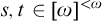 $s,t \in [\omega ]^{<\omega }$
and
$s,t \in [\omega ]^{<\omega }$
and $A\in [\omega ]^{\omega }$
, we write
$A\in [\omega ]^{\omega }$
, we write $s \sqsubset A$
if s is an initial segment of A in its increasing enumeration. Similarly, we write
$s \sqsubset A$
if s is an initial segment of A in its increasing enumeration. Similarly, we write $s \sqsubseteq t$
if s is an initial segment of t, and we put
$s \sqsubseteq t$
if s is an initial segment of t, and we put $s \sqsubset t$
whenever
$s \sqsubset t$
whenever $s \sqsubseteq t$
and
$s \sqsubseteq t$
and $s\neq t$
. For
$s\neq t$
. For $n\in \omega $
and
$n\in \omega $
and $s\in [\omega ]^{<\omega }$
, if
$s\in [\omega ]^{<\omega }$
, if $s \neq \emptyset $
and
$s \neq \emptyset $
and $\max s <n$
then we just write
$\max s <n$
then we just write $s<n$
, and we always put
$s<n$
, and we always put $\emptyset <n$
. Given a set
$\emptyset <n$
. Given a set $A\in [\omega ]^{\omega }$
, let
$A\in [\omega ]^{\omega }$
, let $A/n = \{ m\in A : n<m \}$
for each
$A/n = \{ m\in A : n<m \}$
for each $n\in \omega $
; likewise, let
$n\in \omega $
; likewise, let $A/s = \{ m\in A : s < m \}$
for each
$A/s = \{ m\in A : s < m \}$
for each $s\in [\omega ]^{<\omega }$
.
$s\in [\omega ]^{<\omega }$
.
For every $s\in [\omega ]^{<\omega }$
, let
$s\in [\omega ]^{<\omega }$
, let $[s] = \{ B\in [\omega ]^{\omega } : s \sqsubset B \}$
, and notice that the family
$[s] = \{ B\in [\omega ]^{\omega } : s \sqsubset B \}$
, and notice that the family $\left \{ [s] : s\in [\omega ]^{<\omega } \right \}$
forms a countable basis of closed–open sets for a Polish topology over
$\left \{ [s] : s\in [\omega ]^{<\omega } \right \}$
forms a countable basis of closed–open sets for a Polish topology over $[\omega ]^{\omega }$
, called the metrizable topology. Additionally, for every
$[\omega ]^{\omega }$
, called the metrizable topology. Additionally, for every $s\in [\omega ]^{<\omega }$
and every
$s\in [\omega ]^{<\omega }$
and every $A\in [\omega ]^{\omega }$
, we consider the set
$A\in [\omega ]^{\omega }$
, we consider the set $[s,A]$
defined by
$[s,A]$
defined by $[s,A] = \{ B\in [s] : B/s \subseteq A \} = \{ B\in [\omega ]^{\omega } : s \sqsubset B \subseteq s \cup A \}$
. The collection
$[s,A] = \{ B\in [s] : B/s \subseteq A \} = \{ B\in [\omega ]^{\omega } : s \sqsubset B \subseteq s \cup A \}$
. The collection $\mathsf {Exp} ([\omega ]^{\omega }) = \{ [s,A] : s\in [\omega ]^{<\omega } \wedge A\in [\omega ]^{\omega } \}$
forms an uncountable basis of closed–open sets for a non-metrizable topology over
$\mathsf {Exp} ([\omega ]^{\omega }) = \{ [s,A] : s\in [\omega ]^{<\omega } \wedge A\in [\omega ]^{\omega } \}$
forms an uncountable basis of closed–open sets for a non-metrizable topology over $[\omega ]^{\omega }$
, called the Ellentuck topology, which is finer than the metrizable topology.
$[\omega ]^{\omega }$
, called the Ellentuck topology, which is finer than the metrizable topology.
Ramsey’s theorem (see [Reference Ramsey21]) states that for all $n,k \in \omega $
with
$n,k \in \omega $
with $n,k\neq 0$
, if
$n,k\neq 0$
, if $[\omega ]^{n} = \bigcup _{i<k} G_{i}$
is any partition of
$[\omega ]^{n} = \bigcup _{i<k} G_{i}$
is any partition of $[\omega ]^{n}$
into k pieces, then there are
$[\omega ]^{n}$
into k pieces, then there are $H\in [\omega ]^{\omega }$
and
$H\in [\omega ]^{\omega }$
and $i<k$
such that
$i<k$
such that $[H]^{n} \subseteq G_{i}$
. In [Reference Ellentuck6], Ellentuck proved that if
$[H]^{n} \subseteq G_{i}$
. In [Reference Ellentuck6], Ellentuck proved that if $[\omega ]^{\omega } = \bigcup _{i<k} \mathcal {P}_{i}$
is any finite partition of
$[\omega ]^{\omega } = \bigcup _{i<k} \mathcal {P}_{i}$
is any finite partition of $[\omega ]^{\omega }$
, where each piece
$[\omega ]^{\omega }$
, where each piece $\mathcal {P}_{i}$
has the Baire property in the Ellentuck topology of
$\mathcal {P}_{i}$
has the Baire property in the Ellentuck topology of $[\omega ]^{\omega }$
, then there is
$[\omega ]^{\omega }$
, then there is $H\in [\omega ]^{\omega }$
such that
$H\in [\omega ]^{\omega }$
such that $[H]^{\omega } \subseteq \mathcal {P}_{i}$
for some
$[H]^{\omega } \subseteq \mathcal {P}_{i}$
for some $i<k$
.
$i<k$
.
We say that a set $\mathcal {A} \subseteq [\omega ]^{\omega }$
is Ramsey
Footnote
1
if for every
$\mathcal {A} \subseteq [\omega ]^{\omega }$
is Ramsey
Footnote
1
if for every $[s,C]$
there is some
$[s,C]$
there is some $B\in [s,C]$
such that either
$B\in [s,C]$
such that either $[s,B] \subseteq \mathcal {A}$
or
$[s,B] \subseteq \mathcal {A}$
or $[s,B] \cap \mathcal {A} = \emptyset $
; moreover, if the second option always holds, then we say that
$[s,B] \cap \mathcal {A} = \emptyset $
; moreover, if the second option always holds, then we say that $\mathcal {A}$
is Ramsey null. Erdős and Rado showed in [Reference Erdős and Rado7], using the axiom of choice, that there exist subsets of
$\mathcal {A}$
is Ramsey null. Erdős and Rado showed in [Reference Erdős and Rado7], using the axiom of choice, that there exist subsets of $[\omega ]^{\omega }$
which are not Ramsey. Also, Galvin and Prikry proved in [Reference Galvin and Prikry9] that the Borel sets in the metrizable topology of
$[\omega ]^{\omega }$
which are not Ramsey. Also, Galvin and Prikry proved in [Reference Galvin and Prikry9] that the Borel sets in the metrizable topology of $[\omega ]^{\omega }$
are Ramsey, and Silver in [Reference Silver24] extended this fact to analytic sets. Additionally, Ellentuck in [Reference Ellentuck6] characterized topologically Ramsey sets on
$[\omega ]^{\omega }$
are Ramsey, and Silver in [Reference Silver24] extended this fact to analytic sets. Additionally, Ellentuck in [Reference Ellentuck6] characterized topologically Ramsey sets on $[\omega ]^{\omega }$
as follows: let
$[\omega ]^{\omega }$
as follows: let $\mathcal {A} \subseteq [\omega ]^{\omega }$
be given, then
$\mathcal {A} \subseteq [\omega ]^{\omega }$
be given, then $\mathcal {A}$
is Ramsey if and only if it has the Baire property with respect to the Ellentuck topology, and
$\mathcal {A}$
is Ramsey if and only if it has the Baire property with respect to the Ellentuck topology, and $\mathcal {A}$
is Ramsey null if and only if it is meager with respect to the Ellentuck topology.
$\mathcal {A}$
is Ramsey null if and only if it is meager with respect to the Ellentuck topology.
2 Semiselective ideals and the local Ramsey property
This section provides a brief introduction to selective and semiselective ideals and their interaction with the local Ramsey property, concluding with an exposition of the local Ellentuck theorem. The background for this section is drawn primarily from [Reference Todorcevic26, Section 7.1].
A family $\mathcal {I}$
of subsets of an infinite set X is an ideal on X if
$\mathcal {I}$
of subsets of an infinite set X is an ideal on X if $X \notin \mathcal {I}$
,
$X \notin \mathcal {I}$
, $[X]^{<\omega } \subseteq \mathcal {I}$
, and
$[X]^{<\omega } \subseteq \mathcal {I}$
, and $\mathcal {I}$
is closed under taking subsets and finite unions of its elements. The complement of an ideal
$\mathcal {I}$
is closed under taking subsets and finite unions of its elements. The complement of an ideal $\mathcal {I}$
on X with respect to
$\mathcal {I}$
on X with respect to $\wp (X)$
is a coideal and is denoted by
$\wp (X)$
is a coideal and is denoted by $\mathcal {I}^{+}$
, hence
$\mathcal {I}^{+}$
, hence $\mathcal {I}^{+} = \wp (X) \setminus \mathcal {I}$
. Given
$\mathcal {I}^{+} = \wp (X) \setminus \mathcal {I}$
. Given $Y \in \mathcal {I}^{+}$
, we denote by
$Y \in \mathcal {I}^{+}$
, we denote by $\mathcal {I}^{+} \!\restriction \! Y$
the collection
$\mathcal {I}^{+} \!\restriction \! Y$
the collection $\{ Z\in \mathcal {I}^{+} : Z \subseteq Y \}$
. A non-principal ultrafilter
$\{ Z\in \mathcal {I}^{+} : Z \subseteq Y \}$
. A non-principal ultrafilter $\mathcal {U}$
on X is basically a maximal coideal.
$\mathcal {U}$
on X is basically a maximal coideal.
Fix an ideal $\mathcal {I}$
on
$\mathcal {I}$
on $\omega $
, and fix a quasi-orderFootnote
2
relation
$\omega $
, and fix a quasi-orderFootnote
2
relation $\preceq $
on
$\preceq $
on $\mathcal {I}^{+}$
; also, let
$\mathcal {I}^{+}$
; also, let $\mathcal {D} \subseteq \mathcal {I}^{+}$
be given. We say that
$\mathcal {D} \subseteq \mathcal {I}^{+}$
be given. We say that $\mathcal {D}$
is dense in
$\mathcal {D}$
is dense in $(\mathcal {I}^{+} , \preceq )$
whenever for every
$(\mathcal {I}^{+} , \preceq )$
whenever for every $N \in \mathcal {I}^{+}$
there is
$N \in \mathcal {I}^{+}$
there is $M \in \mathcal {D}$
such that
$M \in \mathcal {D}$
such that $M \preceq N$
. We say that
$M \preceq N$
. We say that $\mathcal {D}$
is open in
$\mathcal {D}$
is open in $(\mathcal {I}^{+} , \preceq )$
whenever for each
$(\mathcal {I}^{+} , \preceq )$
whenever for each $N \in \mathcal {I}^{+}$
and each
$N \in \mathcal {I}^{+}$
and each $M \in \mathcal {D}$
, if
$M \in \mathcal {D}$
, if $N \preceq M$
then
$N \preceq M$
then $N \in \mathcal {D}$
. We say that
$N \in \mathcal {D}$
. We say that $\mathcal {D}$
is dense–open in
$\mathcal {D}$
is dense–open in $(\mathcal {I}^{+} , \preceq )$
if
$(\mathcal {I}^{+} , \preceq )$
if $\mathcal {D}$
is both dense and open in
$\mathcal {D}$
is both dense and open in $(\mathcal {I}^{+} , \preceq )$
. For any ideal
$(\mathcal {I}^{+} , \preceq )$
. For any ideal $\mathcal {I}$
on
$\mathcal {I}$
on $\omega $
, we will only use the quasi-orders on
$\omega $
, we will only use the quasi-orders on $\mathcal {I}^{+}$
given by the inclusion relation
$\mathcal {I}^{+}$
given by the inclusion relation $\subseteq $
and the almost inclusion relation
$\subseteq $
and the almost inclusion relation $\subseteq ^{*}$
.
$\subseteq ^{*}$
.
The following is an interesting example of a dense–open set in $(\mathcal {I}^{+}, \subseteq )$
, which will be implicitly used in the proof of Lemma 3.1.
$(\mathcal {I}^{+}, \subseteq )$
, which will be implicitly used in the proof of Lemma 3.1.
Example 2.1. Let $\mathcal {I}$
be an ideal on
$\mathcal {I}$
be an ideal on $\omega $
. Given any
$\omega $
. Given any $t\in [\omega ]^{<\omega }$
and
$t\in [\omega ]^{<\omega }$
and $\mathcal {A}\subseteq [\omega ]^{\omega }$
, consider the set
$\mathcal {A}\subseteq [\omega ]^{\omega }$
, consider the set $\mathcal {S}_{t}^{\mathcal {A}} \subseteq [\omega ]^{\omega }$
defined by
$\mathcal {S}_{t}^{\mathcal {A}} \subseteq [\omega ]^{\omega }$
defined by $\mathcal {S}_{t}^{\mathcal {A}} = \{ D \in [\omega ]^{\omega } : [t, D] \subseteq \mathcal {A} \}$
. Then, the set
$\mathcal {S}_{t}^{\mathcal {A}} = \{ D \in [\omega ]^{\omega } : [t, D] \subseteq \mathcal {A} \}$
. Then, the set $\mathcal {E}_{t}^{\mathcal {A}} \subseteq \mathcal {I}^{+}$
defined by
$\mathcal {E}_{t}^{\mathcal {A}} \subseteq \mathcal {I}^{+}$
defined by $\mathcal {E}_{t}^{\mathcal {A}} = \{ N\in \mathcal {I}^{+} : \mathcal {I}^{+} \!\restriction \! N \subseteq \mathcal {S}_{t}^{\mathcal {A}} \, \vee \, \mathcal {I}^{+} \!\restriction \! N \cap \mathcal {S}_{t}^{\mathcal {A}} = \emptyset \}$
is dense–open in
$\mathcal {E}_{t}^{\mathcal {A}} = \{ N\in \mathcal {I}^{+} : \mathcal {I}^{+} \!\restriction \! N \subseteq \mathcal {S}_{t}^{\mathcal {A}} \, \vee \, \mathcal {I}^{+} \!\restriction \! N \cap \mathcal {S}_{t}^{\mathcal {A}} = \emptyset \}$
is dense–open in $(\mathcal {I}^{+}, \subseteq )$
.
$(\mathcal {I}^{+}, \subseteq )$
.
We now present the well-known concept of selectivity for ideals, which will play an essential role in the final two sections of this article.
Definition 2.2 [Reference Mathias19].
An ideal $\mathcal {I}$
on
$\mathcal {I}$
on $\omega $
is selective if for each
$\omega $
is selective if for each $A\in \mathcal {I}^{+}$
and for every decreasing sequence
$A\in \mathcal {I}^{+}$
and for every decreasing sequence $\{ {A}_{n} \}_{n\in \omega } \subseteq \mathcal {I}^{+} \!\restriction \! A$
, there exists some
$\{ {A}_{n} \}_{n\in \omega } \subseteq \mathcal {I}^{+} \!\restriction \! A$
, there exists some $A_{\infty } \in \mathcal {I}^{+} \!\restriction \! A$
such that
$A_{\infty } \in \mathcal {I}^{+} \!\restriction \! A$
such that $A_{\infty }/m \subseteq {A}_{m}$
for all
$A_{\infty }/m \subseteq {A}_{m}$
for all $m\in A_{\infty }$
. In this case
$m\in A_{\infty }$
. In this case $A_\infty $
is said to be a diagonalization of the sequence
$A_\infty $
is said to be a diagonalization of the sequence $\{ {A}_{n} \}_{n\in \omega }$
.
$\{ {A}_{n} \}_{n\in \omega }$
.
The prototypical example of a selective ideal on $\omega $
is the ideal
$\omega $
is the ideal $\mathcal {I}_{\mathcal {A}}$
generated by an almost disjoint familyFootnote
3
$\mathcal {I}_{\mathcal {A}}$
generated by an almost disjoint familyFootnote
3 $\mathcal {A}$
on
$\mathcal {A}$
on $\omega $
(see [Reference Todorcevic26, Example 7.1.2]), that is,
$\omega $
(see [Reference Todorcevic26, Example 7.1.2]), that is, $\mathcal {I}_{\mathcal {A}} = \{ X \subseteq \omega : (\exists \, \mathcal {F} \in [\mathcal {A}]^{<\omega }) (X \subseteq ^{*} \bigcup \mathcal {F}) \}$
. Selective coideals were introduced by Mathias in [Reference Mathias19] under the name of happy families. The following is a convenient characterization of selectivity (see [Reference Todorcevic25, Lemma 9.1] and [Reference Todorcevic26, Lemma 7.4]).
$\mathcal {I}_{\mathcal {A}} = \{ X \subseteq \omega : (\exists \, \mathcal {F} \in [\mathcal {A}]^{<\omega }) (X \subseteq ^{*} \bigcup \mathcal {F}) \}$
. Selective coideals were introduced by Mathias in [Reference Mathias19] under the name of happy families. The following is a convenient characterization of selectivity (see [Reference Todorcevic25, Lemma 9.1] and [Reference Todorcevic26, Lemma 7.4]).
Proposition 2.3 (Todorcevic [Reference Todorcevic25, Reference Todorcevic26]).
Let $\mathcal I$
be an ideal on
$\mathcal I$
be an ideal on $\omega $
. Then, the following statements are equivalent:
$\omega $
. Then, the following statements are equivalent:
-
(a) The ideal $\mathcal I$
is selective.
$\mathcal I$
is selective. -
(b) The ideal
$\mathcal I$
has the following two properties:-
(p) For every
$A\in \mathcal {I}^{+}$
and every decreasing sequence
$\{A_{n}\}_{n\in \omega } \subseteq \mathcal {I}^{+} \!\restriction \! A$
, there exists some
$B\in \mathcal {I}^{+} \!\restriction \! A$
such that
$B\subseteq ^{*} A_{n}$
for all
$n\in \omega $
. -
(q) For every
$A\in \mathcal {I}^{+}$
and every infinite partition
$A = \bigcup _{k\in \omega } f_{k}$
, where each
$f_{k}$
is finite, there exists some
$B\in \mathcal {I}^{+} \!\restriction \! A$
such that for each
$k\in \omega $
the set
$f_{k}\cap B$
has at most one element.
-








Next, we present the concept of semiselectivity for ideals, a combinatorial notion that is weaker than selectivity. We emphasize that all results in this article focus on semiselectivity for ideals.
Definition 2.4 [Reference Farah8].
An ideal $\mathcal {I}$
on
$\mathcal {I}$
on $\omega $
is semiselective if for each
$\omega $
is semiselective if for each $A\in \mathcal {I}^{+}$
and for every sequence
$A\in \mathcal {I}^{+}$
and for every sequence $\{ \mathcal {D}_{n} \}_{n\in \omega } \subseteq \wp (\mathcal {I}^{+})$
of dense–open sets in
$\{ \mathcal {D}_{n} \}_{n\in \omega } \subseteq \wp (\mathcal {I}^{+})$
of dense–open sets in $(\mathcal {I}^{+}, \subseteq )$
, there exists some
$(\mathcal {I}^{+}, \subseteq )$
, there exists some $D_{\infty } \in \mathcal {I}^{+} \!\restriction \! A$
such that
$D_{\infty } \in \mathcal {I}^{+} \!\restriction \! A$
such that $D_{\infty }/m \in \mathcal {D}_{m}$
for all
$D_{\infty }/m \in \mathcal {D}_{m}$
for all $m\in D_{\infty }$
. In this case
$m\in D_{\infty }$
. In this case $D_\infty $
is said to be a diagonalization of the sequence
$D_\infty $
is said to be a diagonalization of the sequence $\{\mathcal {D}_{n} \}_{n\in \omega }$
.
$\{\mathcal {D}_{n} \}_{n\in \omega }$
.
Equivalently, an ideal $\mathcal {I}$
on
$\mathcal {I}$
on $\omega $
is semiselective if for each
$\omega $
is semiselective if for each $A\in \mathcal {I}^{+}$
and for every sequence
$A\in \mathcal {I}^{+}$
and for every sequence $\{ \mathcal {D}_{s} \}_{s\in [\omega ]^{<\omega }} \subseteq \wp (\mathcal {I}^{+})$
of dense–open sets in
$\{ \mathcal {D}_{s} \}_{s\in [\omega ]^{<\omega }} \subseteq \wp (\mathcal {I}^{+})$
of dense–open sets in $(\mathcal {I}^{+}, \subseteq )$
, there exists some
$(\mathcal {I}^{+}, \subseteq )$
, there exists some $D_{\infty } \in \mathcal {I}^{+} \!\restriction \! A$
such that
$D_{\infty } \in \mathcal {I}^{+} \!\restriction \! A$
such that $D_{\infty }/t \in \mathcal {D}_{t}$
for all
$D_{\infty }/t \in \mathcal {D}_{t}$
for all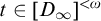 $t\in [D_{\infty }]^{<\omega }$
. In this case
$t\in [D_{\infty }]^{<\omega }$
. In this case $D_{\infty }$
is also said to be a diagonalization of the sequence
$D_{\infty }$
is also said to be a diagonalization of the sequence $\{ \mathcal {D}_{s} \}_{s\in [\omega ]^{<\omega }}$
.
$\{ \mathcal {D}_{s} \}_{s\in [\omega ]^{<\omega }}$
.
It is easy to show that every selective ideal is semiselective, but the converse implication is not true in general. The ideal $\emptyset \times [\omega ]^{<\omega }$
is a semiselective ideal which is not selective (see [Reference Farah8, Example 2.1]). In what follows, we will concentrate on combinatorial properties of semiselective ideals. The following proposition gives a useful characterization of semiselectivity (see [Reference Todorcevic26, Lemma 7.9]).
$\emptyset \times [\omega ]^{<\omega }$
is a semiselective ideal which is not selective (see [Reference Farah8, Example 2.1]). In what follows, we will concentrate on combinatorial properties of semiselective ideals. The following proposition gives a useful characterization of semiselectivity (see [Reference Todorcevic26, Lemma 7.9]).
Proposition 2.5 (Todorcevic [Reference Todorcevic26]).
Let $\mathcal I$
be an ideal on
$\mathcal I$
be an ideal on $\omega $
. Then, the following statements are equivalent:
$\omega $
. Then, the following statements are equivalent:
-
(a) The ideal
$\mathcal I$
is semiselective. -
(b) The ideal
$\mathcal I$
has the following two properties:-
(p w) For every
$A\in \mathcal {I}^{+}$
and every sequence
$\{ \mathcal {D}_{n} \}_{n\in \omega } \subseteq \wp (\mathcal {I}^{+})$
of dense–open sets in
$(\mathcal {I}^{+}, \subseteq )$
, there exists some
$B\in \mathcal {I}^{+} \!\restriction \! A$
with the property that for each
$n\in \omega $
there is
$A_{n}\in \mathcal {D}_{n}$
such that
$B \subseteq ^{*} A_{n}$
. -
(q) For every
$A\in \mathcal {I}^{+}$
and every infinite partition
$A = \bigcup _{k\in \omega } f_{k}$
, where each
$f_{k}$
is finite, there exists some
$B\in \mathcal {I}^{+} \!\restriction \! A$
such that for each
$k\in \omega $
the set
$f_{k}\cap B$
has at most one element.
-





Let $\mathcal {I}$
be an ideal on
$\mathcal {I}$
be an ideal on $\omega $
, and the corresponding coideal
$\omega $
, and the corresponding coideal $\mathcal {I}^{+} \subseteq [\omega ]^{\omega }$
. We consider the subcollection
$\mathcal {I}^{+} \subseteq [\omega ]^{\omega }$
. We consider the subcollection $\mathsf {Exp} (\mathcal {I}^{+}) \subseteq \mathsf {Exp}([\omega ]^{\omega })$
of basic open sets in the Ellentuck topology of
$\mathsf {Exp} (\mathcal {I}^{+}) \subseteq \mathsf {Exp}([\omega ]^{\omega })$
of basic open sets in the Ellentuck topology of $[\omega ]^{\omega }$
described by
$[\omega ]^{\omega }$
described by
 $$ \begin{align*} \mathsf{Exp} (\mathcal{I}^{+}) = \{ [s,A] : s\in [\omega]^{<\omega} \wedge A\in \mathcal{I}^{+} \}. \end{align*} $$
Although the family $\mathsf {Exp} (\mathcal {I}^{+})$
is not necessarily a basis for a topology on
$\mathsf {Exp} (\mathcal {I}^{+})$
is not necessarily a basis for a topology on $[\omega ]^{\omega }$
, it is still possible to work with some abstract topological notions defined from
$[\omega ]^{\omega }$
, it is still possible to work with some abstract topological notions defined from $\mathsf {Exp} (\mathcal {I}^{+})$
as follows:
$\mathsf {Exp} (\mathcal {I}^{+})$
as follows:
-
I. A set
$\mathcal {X} \subseteq [\omega ]^{\omega }$
is
$\mathsf {Exp}(\mathcal {I}^{+})$
-open if
$\mathcal {X}$
is the union of some arbitrary family of members of
$\mathsf {Exp}(\mathcal {I}^{+})$
. -
II. A set
$\mathcal {X} \subseteq [\omega ]^{\omega }$
is
$\mathsf {Exp}(\mathcal {I}^{+})$
-nowhere dense if for every
$[a,A] \in \mathsf {Exp}(\mathcal {I}^{+})$
there is some
$[b,B] \in \mathsf {Exp}(\mathcal {I}^{+})$
with
$[b,B] \subseteq [a,A]$
such that
$[b,B] \cap \mathcal {X} = \emptyset $
. -
III. A set
$\mathcal {X} \subseteq [\omega ]^{\omega }$
is
$\mathsf {Exp}(\mathcal {I}^{+})$
-meager if
$\mathcal {X}$
is the union of some countably family of
$\mathsf {Exp}(\mathcal {I}^{+})$
-nowhere dense sets. -
IV. A set
$\mathcal {X} \subseteq [\omega ]^{\omega }$
has the abstract
$\mathsf {Exp}(\mathcal {I}^{+})$
-Baire property if for every
$[a,A] \in \mathsf {Exp}(\mathcal {I}^{+})$
there is some
$[b,B] \in \mathsf {Exp}(\mathcal {I}^{+})$
with
$[b,B] \subseteq [a,A]$
such that either
$[b,B] \subseteq \mathcal {X}$
or
$[b,B] \cap \mathcal {X} = \emptyset $
. -
V. A set
$\mathcal {X} \subseteq [\omega ]^{\omega }$
has the
$\mathsf {Exp}(\mathcal {I}^{+})$
-Baire property if there exists some
$\mathsf {Exp}(\mathcal {I}^{+})$
-open set
$\mathcal {O}$
such that
$\mathcal {X} \triangle \mathcal {O}$
is
$\mathsf {Exp}(\mathcal {I}^{+})$
-meager.















These topological notions were originally studied by Marczewski in [Reference Marczewski15], and were later used by Farah in [Reference Farah8] to characterize the local Ramsey property for subsets of $[\omega ]^{\omega }$
with respect to the family
$[\omega ]^{\omega }$
with respect to the family $\mathsf {Exp} (\mathcal {I}^{+})$
where
$\mathsf {Exp} (\mathcal {I}^{+})$
where $\mathcal {I}$
is a semiselective ideal on
$\mathcal {I}$
is a semiselective ideal on $\omega $
. With those notions in mind, the following facts can be easily verified (see [Reference Farah8, Definition 3.1]).
$\omega $
. With those notions in mind, the following facts can be easily verified (see [Reference Farah8, Definition 3.1]).
Fact 2.6. Let $\mathcal {I}$
be an ideal on
$\mathcal {I}$
be an ideal on $\omega $
. Then, the following holds:
$\omega $
. Then, the following holds:
-
(1) The
$\mathsf {Exp}(\mathcal {I}^{+})$
-open sets have both the
$\mathsf {Exp}(\mathcal {I}^{+})$
-Baire property and the abstract
$\mathsf {Exp}(\mathcal {I}^{+})$
-Baire property. -
(2) Every
$\mathsf {Exp}(\mathcal {I}^{+})$
-nowhere dense set is an
$\mathsf {Exp}(\mathcal {I}^{+})$
-meager set, and also each
$\mathsf {Exp}(\mathcal {I}^{+})$
-meager set has the
$\mathsf {Exp}(\mathcal {I}^{+})$
-Baire property. -
(3) Every
$\mathsf {Exp}(\mathcal {I}^{+})$
-nowhere dense set has the abstract
$\mathsf {Exp}(\mathcal {I}^{+})$
-Baire property, and also each set with the abstract
$\mathsf {Exp}(\mathcal {I}^{+})$
-Baire property has the
$\mathsf {Exp}(\mathcal {I}^{+})$
-Baire property. -
(4) The collection of all
$\mathsf {Exp}(\mathcal {I}^{+})$
-nowhere dense sets is an ideal, and also the collection of all
$\mathsf {Exp}(\mathcal {I}^{+})$
-meager sets is a
$\sigma $
-ideal. -
(5) The sets with the abstract
$\mathsf {Exp}(\mathcal {I}^{+})$
-Baire property form an algebra, and also the sets with the
$\mathsf {Exp}(\mathcal {I}^{+})$
-Baire property form a
$\sigma $
-algebra.


The local Ramsey property relative to an ideal $\mathcal {I}$
on
$\mathcal {I}$
on $\omega $
is defined in terms of the collection
$\omega $
is defined in terms of the collection $\mathsf {Exp} (\mathcal {I}^{+})$
as follows (see [Reference Farah8, Reference Matet16, Reference Mathias19, Reference Todorcevic25, Reference Todorcevic26]).
$\mathsf {Exp} (\mathcal {I}^{+})$
as follows (see [Reference Farah8, Reference Matet16, Reference Mathias19, Reference Todorcevic25, Reference Todorcevic26]).
Definition 2.7 (Local Ramsey property).
Let $\mathcal {I}$
be an ideal on
$\mathcal {I}$
be an ideal on $\omega $
. We say that a set
$\omega $
. We say that a set $\mathcal {A} \subseteq [\omega ]^{\omega }$
is
$\mathcal {A} \subseteq [\omega ]^{\omega }$
is $\mathcal {I}^{+}$
-Ramsey if for each
$\mathcal {I}^{+}$
-Ramsey if for each $s\in [\omega ]^{<\omega }$
and each
$s\in [\omega ]^{<\omega }$
and each $C\in \mathcal {I}^{+}$
there is some
$C\in \mathcal {I}^{+}$
there is some $B\in \mathcal {I}^{+} \!\restriction \! C$
such that either
$B\in \mathcal {I}^{+} \!\restriction \! C$
such that either $[s,B] \subseteq \mathcal {A}$
or
$[s,B] \subseteq \mathcal {A}$
or $[s,B] \cap \mathcal {A} = \emptyset $
. If the second option always holds, then we say that
$[s,B] \cap \mathcal {A} = \emptyset $
. If the second option always holds, then we say that $\mathcal {A}$
is
$\mathcal {A}$
is $\mathcal {I}^{+}$
-Ramsey null.
$\mathcal {I}^{+}$
-Ramsey null.
It should be noted that for every ideal $\mathcal {I}$
on
$\mathcal {I}$
on $\omega $
, there are subsets of
$\omega $
, there are subsets of $[\omega ]^{\omega }$
that do not satisfy the local Ramsey property relative to
$[\omega ]^{\omega }$
that do not satisfy the local Ramsey property relative to $\mathcal {I}$
(see [Reference Matet16, Proposition 5.2]).
$\mathcal {I}$
(see [Reference Matet16, Proposition 5.2]).
Proposition 2.8 (Matet [Reference Matet16]).
Let $\mathcal {I}$
be an ideal on
$\mathcal {I}$
be an ideal on $\omega $
. For all
$\omega $
. For all $s\in [\omega ]^{<\omega }$
and
$s\in [\omega ]^{<\omega }$
and $B\in \mathcal {I}^{+}$
, there exists a set
$B\in \mathcal {I}^{+}$
, there exists a set $\mathcal {A} \subseteq [s,B]$
such that
$\mathcal {A} \subseteq [s,B]$
such that $\mathcal {A}$
is not
$\mathcal {A}$
is not $\mathcal {I}^{+}$
-Ramsey.
$\mathcal {I}^{+}$
-Ramsey.
We note the following property of $\mathcal {I}^{+}$
-Ramsey null sets with respect to a semiselective ideal
$\mathcal {I}^{+}$
-Ramsey null sets with respect to a semiselective ideal $\mathcal {I}$
, which will be used in the proof of Proposition 4.5.
$\mathcal {I}$
, which will be used in the proof of Proposition 4.5.
Lemma 2.9. Let $\mathcal {I}$
be a semiselective ideal on
$\mathcal {I}$
be a semiselective ideal on $\omega $
. If
$\omega $
. If $\mathcal {C} \subseteq [\omega ]^{\omega }$
is a
$\mathcal {C} \subseteq [\omega ]^{\omega }$
is a $\mathcal {I}^{+}$
-Ramsey null set, then for every
$\mathcal {I}^{+}$
-Ramsey null set, then for every $X\in \mathcal {I}^{+}$
there is some
$X\in \mathcal {I}^{+}$
there is some $Y \in \mathcal {I}^{+} \!\restriction \! X$
such that
$Y \in \mathcal {I}^{+} \!\restriction \! X$
such that $\{ Z\in [\omega ]^{\omega } : Z\subseteq ^{*}Y \} \cap \mathcal {C} = \emptyset $
.
$\{ Z\in [\omega ]^{\omega } : Z\subseteq ^{*}Y \} \cap \mathcal {C} = \emptyset $
.
Proof. Fix a semiselective ideal $\mathcal {I}$
on
$\mathcal {I}$
on $\omega $
, and let
$\omega $
, and let $\mathcal {C} \subseteq [\omega ]^{\omega }$
be a
$\mathcal {C} \subseteq [\omega ]^{\omega }$
be a $\mathcal {I}^{+}$
-Ramsey null set. Given any
$\mathcal {I}^{+}$
-Ramsey null set. Given any $X\in \mathcal {I}^{+}$
, we consider the sequence
$X\in \mathcal {I}^{+}$
, we consider the sequence $\{\mathcal {D}_{n}\}_{n\in \omega }$
of dense–open sets in
$\{\mathcal {D}_{n}\}_{n\in \omega }$
of dense–open sets in $(\mathcal {I}^{+} \!\restriction \! X, \subseteq )$
defined as follows:
$(\mathcal {I}^{+} \!\restriction \! X, \subseteq )$
defined as follows:
 $$ \begin{align*} \mathcal{D}_{n} = \{ N \in \mathcal{I}^{+} \!\restriction\! X : (\forall\, s<n+1)( [s,N]\cap \mathcal{C}=\emptyset ) \}. \end{align*} $$
Since the ideal $\mathcal {I}$
is semiselective, then we can find an infinite set
$\mathcal {I}$
is semiselective, then we can find an infinite set $Y\in \mathcal {I}^{+} \!\restriction \! X$
such that
$Y\in \mathcal {I}^{+} \!\restriction \! X$
such that $Y/n \in \mathcal {D}_{n}$
for all
$Y/n \in \mathcal {D}_{n}$
for all $n\in Y$
. Now, for every infinite set
$n\in Y$
. Now, for every infinite set $Z \subseteq ^{*} Y$
there is
$Z \subseteq ^{*} Y$
there is $n\in Y$
such that
$n\in Y$
such that $Z/n \subseteq Y$
; so, if we take the longest initial segment
$Z/n \subseteq Y$
; so, if we take the longest initial segment $s \sqsubset Z$
such that
$s \sqsubset Z$
such that $s < n+1$
, then
$s < n+1$
, then $Z\in [s,Y/n]$
and hence
$Z\in [s,Y/n]$
and hence $Z\notin \mathcal {C}$
. Thus, we conclude that
$Z\notin \mathcal {C}$
. Thus, we conclude that $\{ Z\in [\omega ]^{\omega } : Z\subseteq ^{*}Y \} \cap \mathcal {C} = \emptyset $
.
$\{ Z\in [\omega ]^{\omega } : Z\subseteq ^{*}Y \} \cap \mathcal {C} = \emptyset $
.
The connection between the local Ramsey property and semiselective ideals was extensively studied by Farah and Todorcevic in [Reference Farah8, Reference Todorcevic26]. The following result gives the most important characterization of semiselective ideals (see [Reference Farah8, Theorem 3.1] and [Reference Todorcevic26, Theorem 7.19]).
Theorem 2.10. [Local Ellentuck theorem]. (Farah [Reference Farah8]Todorcevic [Reference Todorcevic26]).
 Todorcevic [
 Let $\mathcal {I}$
be an ideal on
$\mathcal {I}$
be an ideal on $\omega $
. Then, the following statements are equivalent:
$\omega $
. Then, the following statements are equivalent:
-
(A) The ideal
$\mathcal {I}$
is semiselective. -
(B) The following three families of subsets of
$[\omega ]^{\omega }$
form
$\sigma $
-ideals and coincide:-
(a) The collection of all
$\mathcal {I}^{+}$
-Ramsey null sets. -
(b) The collection of all
$\mathsf {Exp}(\mathcal {I}^{+})$
-nowhere dense sets. -
(c) The collection of all
$\mathsf {Exp}(\mathcal {I}^{+})$
-meager sets.
And the following three families of subsets of
$[\omega ]^{\omega }$
form
$\sigma $
-algebras and coincide:-
(a) The collection of all
$\mathcal {I}^{+}$
-Ramsey sets. -
(b) The collection of all sets with the abstract
$\mathsf {Exp}(\mathcal {I}^{+})$
-Baire property. -
(c) The collection of all sets with the
$\mathsf {Exp}(\mathcal {I}^{+})$
-Baire property.
-


Proof. (A) implies (B) follows from Propositions 3.2 and 3.3 and Colollary 3.4 of the next section. (B) implies (A) follows from Proposition 2.5 (see [Reference Todorcevic26, Lemmas 7.5 and 7.8]).
3 A new proof of the local Ellentuck theorem
Motivated by [Reference Matet17, Lemma 1], we propose in this section an alternative proof of Theorem 2.10, in which we do not explicitly use the local notion of combinatorial forcing applied in [Reference Farah8, Section 2] and [Reference Todorcevic26, Section 7.1].
Lemma 3.1. Let $\mathcal {I}$
be an ideal on
$\mathcal {I}$
be an ideal on $\omega $
. Then, the following statements are equivalent:
$\omega $
. Then, the following statements are equivalent:
-
(a) The ideal
$\mathcal {I}$
is semiselective. -
(b) For every
$a\in [\omega ]^{<\omega }$
and every
$A\in \mathcal {I}^{+}$
, if
$\{\mathcal {Q}_{i}\}_{i\in \omega } \subseteq \wp ([\omega ]^{\omega })$
is any sequence of subsets of
$[\omega ]^{\omega }$
for which
$[a,B] \not \subseteq \bigcap _{i\in \omega } \mathcal {Q}_{i}$
for all
$B\in \mathcal {I^{+}} \!\restriction \! A$
, then there are
$i\in \omega $
,
$c\in [\omega ]^{<\omega }$
, and
$C\in \mathcal {I}^{+} \!\restriction \! A$
, with
$|a|\leq |c| \leq |a|+i$
and
$[c,C] \subseteq [a,A]$
, such that
$[d,D] \not \subseteq \mathcal {Q}_{i}$
for each
$d\in [\omega ]^{<\omega }$
and each
$D\in \mathcal {I^{+}} \!\restriction \! C$
satisfying
$[d,D] \subseteq [c,C]$
.









Proof. $[\text {(a)} \Longrightarrow \text {(b)}].$
Let
$[\text {(a)} \Longrightarrow \text {(b)}].$
Let $\mathcal {I}$
be a semiselective ideal on
$\mathcal {I}$
be a semiselective ideal on $\omega $
and let
$\omega $
and let $\{\mathcal {Q}_{i}\}_{i\in \omega }$
be a sequence of subsets of
$\{\mathcal {Q}_{i}\}_{i\in \omega }$
be a sequence of subsets of $[\omega ]^{\omega }$
such that
$[\omega ]^{\omega }$
such that $[a,B] \not \subseteq \bigcap _{i\in \omega } \mathcal {Q}_{i}$
for all
$[a,B] \not \subseteq \bigcap _{i\in \omega } \mathcal {Q}_{i}$
for all $B\in \mathcal {I}^{+} \!\restriction \! A$
, where
$B\in \mathcal {I}^{+} \!\restriction \! A$
, where $a\in [\omega ]^{<\omega }$
and
$a\in [\omega ]^{<\omega }$
and $A\in \mathcal {I}^{+}$
are fixed. We can assume without loss of generality that
$A\in \mathcal {I}^{+}$
are fixed. We can assume without loss of generality that $0\notin A$
and
$0\notin A$
and $a< \min A$
.
$a< \min A$
.
For each $i\in \omega $
and each
$i\in \omega $
and each $d\in [\omega ]^{<\omega }$
consider the set
$d\in [\omega ]^{<\omega }$
consider the set $\mathcal {S}_{a\cup d}^{\mathcal {Q}_{i}} = \{ D\in [\omega ]^{\omega } : [a\cup d, D] \subseteq \mathcal {Q}_{i} \}$
, and consider also the sequence
$\mathcal {S}_{a\cup d}^{\mathcal {Q}_{i}} = \{ D\in [\omega ]^{\omega } : [a\cup d, D] \subseteq \mathcal {Q}_{i} \}$
, and consider also the sequence $\{\mathcal {D}_{j}\}_{j\in \omega }$
of subsets of
$\{\mathcal {D}_{j}\}_{j\in \omega }$
of subsets of $\mathcal {I}^{+} \!\restriction \! A$
defined as follows:
$\mathcal {I}^{+} \!\restriction \! A$
defined as follows:
 $$ \begin{align*} \mathcal{D}_{j} = \left\{ N\in \mathcal{I}^{+} \!\restriction\! A : (\forall \, i\leq j ) (\forall \, d\subseteq \{0,\ldots,j\}) ( \mathcal{I}^{+} \!\restriction\! N \subseteq \mathcal{S}_{a\cup d}^{\mathcal{Q}_{i}} \, \vee \, \mathcal{I}^{+} \!\restriction\! N \cap \mathcal{S}_{a\cup d}^{\mathcal{Q}_{i}} = \emptyset ) \right\}. \end{align*} $$
The family $\{\mathcal {D}_{j}\}_{j\in \omega } \subseteq \wp (\mathcal {I}^{+} \!\restriction \! A)$
is a sequence of dense–open sets in
$\{\mathcal {D}_{j}\}_{j\in \omega } \subseteq \wp (\mathcal {I}^{+} \!\restriction \! A)$
is a sequence of dense–open sets in $(\mathcal {I}^{+} \!\restriction \! A, \subseteq )$
. Indeed, for each
$(\mathcal {I}^{+} \!\restriction \! A, \subseteq )$
. Indeed, for each $j\in \omega $
we take the finite set
$j\in \omega $
we take the finite set $P_{j} = \{(i,d) \in \omega \times [\omega ]^{<\omega } : i\leq j \, \wedge \, d\subseteq \{0,\ldots ,j\} \}$
, then we have that
$P_{j} = \{(i,d) \in \omega \times [\omega ]^{<\omega } : i\leq j \, \wedge \, d\subseteq \{0,\ldots ,j\} \}$
, then we have that $\mathcal {D}_{j} = [A]^{\omega } \cap \bigcap _{(i,d)\in P_{j}} \mathcal {E}_{a\cup d}^{\mathcal {Q}_{i}}$
, where
$\mathcal {D}_{j} = [A]^{\omega } \cap \bigcap _{(i,d)\in P_{j}} \mathcal {E}_{a\cup d}^{\mathcal {Q}_{i}}$
, where $\mathcal {E}_{a\cup d}^{\mathcal {Q}_{i}}$
is the dense–open set in
$\mathcal {E}_{a\cup d}^{\mathcal {Q}_{i}}$
is the dense–open set in $(\mathcal {I}^{+}, \subseteq )$
given by
$(\mathcal {I}^{+}, \subseteq )$
given by $\mathcal {E}_{a\cup d}^{\mathcal {Q}_{i}} = \{ N\in \mathcal {I}^{+} : \mathcal {I}^{+} \!\restriction \! N \subseteq \mathcal {S}_{a\cup d}^{\mathcal {Q}_{i}} \, \vee \, \mathcal {I}^{+} \!\restriction \! N \cap \mathcal {S}_{a\cup d}^{\mathcal {Q}_{i}} = \emptyset \}$
.
$\mathcal {E}_{a\cup d}^{\mathcal {Q}_{i}} = \{ N\in \mathcal {I}^{+} : \mathcal {I}^{+} \!\restriction \! N \subseteq \mathcal {S}_{a\cup d}^{\mathcal {Q}_{i}} \, \vee \, \mathcal {I}^{+} \!\restriction \! N \cap \mathcal {S}_{a\cup d}^{\mathcal {Q}_{i}} = \emptyset \}$
.
As $\mathcal {I}$
is a semiselective ideal on
$\mathcal {I}$
is a semiselective ideal on $\omega $
, then there exists a diagonalization
$\omega $
, then there exists a diagonalization $B\in \mathcal {I}^{+} \!\restriction \! A$
for the sequence
$B\in \mathcal {I}^{+} \!\restriction \! A$
for the sequence $\{\mathcal {D}_{j}\}_{j\in \omega }$
; thus, if
$\{\mathcal {D}_{j}\}_{j\in \omega }$
; thus, if $B=\{n_{k} : k\in \omega \}$
is the increasing enumeration of B, then
$B=\{n_{k} : k\in \omega \}$
is the increasing enumeration of B, then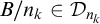 $B/n_{k} \in \mathcal {D}_{n_{k}}$
for all
$B/n_{k} \in \mathcal {D}_{n_{k}}$
for all $k\in \omega $
, so that for each
$k\in \omega $
, so that for each $i\leq n_{k}$
and each
$i\leq n_{k}$
and each $d\subseteq \{0,\ldots ,n_{k}\}$
either
$d\subseteq \{0,\ldots ,n_{k}\}$
either $\mathcal {I}^{+} \!\restriction \! (B/n_{k}) \subseteq \mathcal {S}_{a\cup d}^{\mathcal {Q}_{i}}$
or
$\mathcal {I}^{+} \!\restriction \! (B/n_{k}) \subseteq \mathcal {S}_{a\cup d}^{\mathcal {Q}_{i}}$
or $\mathcal {I}^{+} \!\restriction \! (B/n_{k}) \cap \mathcal {S}_{a\cup d}^{\mathcal {Q}_{i}} = \emptyset $
. Furthermore, to streamline the argument, it is convenient to set
$\mathcal {I}^{+} \!\restriction \! (B/n_{k}) \cap \mathcal {S}_{a\cup d}^{\mathcal {Q}_{i}} = \emptyset $
. Furthermore, to streamline the argument, it is convenient to set $n_{-1} = 0$
, in which case
$n_{-1} = 0$
, in which case $B/n_{-1} = B$
.
$B/n_{-1} = B$
.
Since B belongs to $\mathcal {I}^{+} \!\restriction \! A$
, then
$\mathcal {I}^{+} \!\restriction \! A$
, then $[a,B] \not \subseteq \bigcap _{i\in \omega } \mathcal {Q}_{i}$
, so there is some
$[a,B] \not \subseteq \bigcap _{i\in \omega } \mathcal {Q}_{i}$
, so there is some $i\in \omega $
such that
$i\in \omega $
such that $[a,B] \not \subseteq \mathcal {Q}_{i}$
, and hence
$[a,B] \not \subseteq \mathcal {Q}_{i}$
, and hence $[a,B] \setminus \mathcal {Q}_{i} \neq \emptyset $
; thus, we take
$[a,B] \setminus \mathcal {Q}_{i} \neq \emptyset $
; thus, we take $E\in [a,B] \setminus \mathcal {Q}_{i}$
and consider
$E\in [a,B] \setminus \mathcal {Q}_{i}$
and consider $c\in [\omega ]^{<\omega }$
given by
$c\in [\omega ]^{<\omega }$
given by $c=a\cup (\{n_{j} : j<i\} \cap E)$
. So, notice that
$c=a\cup (\{n_{j} : j<i\} \cap E)$
. So, notice that $|a|\leq |c| \leq |a|+i$
, and also that
$|a|\leq |c| \leq |a|+i$
, and also that $a \sqsubseteq c \sqsubset E$
and
$a \sqsubseteq c \sqsubset E$
and $E/c \in [B/n_{i-1}]^{\omega }$
, then
$E/c \in [B/n_{i-1}]^{\omega }$
, then $[c,B/n_{i-1}] \not \subseteq \mathcal {Q}_{i}$
because
$[c,B/n_{i-1}] \not \subseteq \mathcal {Q}_{i}$
because $E\in [c,B/n_{i-1}] \setminus \mathcal {Q}_{i}$
.
$E\in [c,B/n_{i-1}] \setminus \mathcal {Q}_{i}$
.
Now, taking into account that $B/n_{i-1} \in \mathcal {I}^{+} \!\restriction \! A$
, we define the sets
$B/n_{i-1} \in \mathcal {I}^{+} \!\restriction \! A$
, we define the sets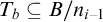 $T_{b} \subseteq B/n_{i-1}$
and
$T_{b} \subseteq B/n_{i-1}$
and $\mathcal {K}_{b} \subseteq \mathcal {I}^{+} \!\restriction \! (B/n_{i-1})$
for every
$\mathcal {K}_{b} \subseteq \mathcal {I}^{+} \!\restriction \! (B/n_{i-1})$
for every $b\in [B/n_{i-1}]^{<\omega }$
as follows:
$b\in [B/n_{i-1}]^{<\omega }$
as follows:
 $$ \begin{align*} & T_{b} = \{m\in B/n_{i-1} : c\cup b < m \,\wedge\, [c\cup b\cup \{m\}, B/n_{i-1}] \subseteq \mathcal{Q}_{i} \} \text{, and} \\ & \mathcal{K}_{b} = \{D\in \mathcal{I}^{+} \!\restriction\! (B/n_{i-1}) : [c\cup b, D] \subseteq \mathcal{Q}_{i} \} = \mathcal{S}_{c\cup b}^{\mathcal{Q}_{i}} \cap \mathcal{I}^{+} \!\restriction\! (B/n_{i-1}). \end{align*} $$
Claim 1. If $b\in [B/n_{i-1}]^{<\omega }$
and
$b\in [B/n_{i-1}]^{<\omega }$
and $D_{1}, D_{2} \in \mathcal {I}^{+} \!\restriction \! (B/n_{i-1})$
be such that
$D_{1}, D_{2} \in \mathcal {I}^{+} \!\restriction \! (B/n_{i-1})$
be such that $D_{1} \in \mathcal {K}_{b}$
and
$D_{1} \in \mathcal {K}_{b}$
and $D_{2} \subseteq D_{1}$
then
$D_{2} \subseteq D_{1}$
then $D_{2} \in \mathcal {K}_{b}$
.
$D_{2} \in \mathcal {K}_{b}$
.
Indeed, we have $[c\cup b, D_{2}] \subseteq [c\cup b, D_{1}] \subseteq \mathcal {Q}_{i}$
whenever
$[c\cup b, D_{2}] \subseteq [c\cup b, D_{1}] \subseteq \mathcal {Q}_{i}$
whenever $D_{1} \in \mathcal {K}_{b}$
and
$D_{1} \in \mathcal {K}_{b}$
and $D_{2} \subseteq D_{1}$
, hence
$D_{2} \subseteq D_{1}$
, hence $D_{2} \in \mathcal {K}_{b}$
.
$D_{2} \in \mathcal {K}_{b}$
.
Claim 2. For all $b\in [B/n_{i-1}]^{<\omega }$
it is true that either
$b\in [B/n_{i-1}]^{<\omega }$
it is true that either $\mathcal {K}_{b} = \mathcal {I}^{+} \!\restriction \! (B/n_{i-1})$
or
$\mathcal {K}_{b} = \mathcal {I}^{+} \!\restriction \! (B/n_{i-1})$
or $\mathcal {K}_{b}=\emptyset $
.
$\mathcal {K}_{b}=\emptyset $
.
Indeed, suppose that $\mathcal {K}_{b} \neq \emptyset $
and let
$\mathcal {K}_{b} \neq \emptyset $
and let $D\in \mathcal {I}^{+} \!\restriction \! (B/n_{i-1})$
be such that
$D\in \mathcal {I}^{+} \!\restriction \! (B/n_{i-1})$
be such that $D\in \mathcal {K}_{b}$
, hence
$D\in \mathcal {K}_{b}$
, hence $D/b \in \mathcal {K}_{b} \subseteq \mathcal {S}_{c\cup b}^{\mathcal {Q}_{i}}$
. Now, we consider
$D/b \in \mathcal {K}_{b} \subseteq \mathcal {S}_{c\cup b}^{\mathcal {Q}_{i}}$
. Now, we consider $p\in \omega $
such that
$p\in \omega $
such that $n_{p}= \min \{n_{j}\in B/n_{i-1} : c\cup b< n_{j}\}$
, so that
$n_{p}= \min \{n_{j}\in B/n_{i-1} : c\cup b< n_{j}\}$
, so that $[c\cup b, B/n_{p-1}] = [c\cup b, B/n_{i-1}]$
and
$[c\cup b, B/n_{p-1}] = [c\cup b, B/n_{i-1}]$
and $D/b=D/n_{p-1}$
, hence
$D/b=D/n_{p-1}$
, hence $D/b \in \mathcal {I}^{+} \!\restriction \! (B/n_{p-1})$
; moreover, since
$D/b \in \mathcal {I}^{+} \!\restriction \! (B/n_{p-1})$
; moreover, since $i-1<n_{i-1}\leq n_{p-1}$
and
$i-1<n_{i-1}\leq n_{p-1}$
and $a \sqsubseteq c\cup b < n_{p}$
, we infer that
$a \sqsubseteq c\cup b < n_{p}$
, we infer that $i\leq n_{p-1}$
and
$i\leq n_{p-1}$
and $a \subseteq c\cup b \subseteq \{0,\ldots , n_{p-1}\}$
. Therefore, by virtue of the fact that
$a \subseteq c\cup b \subseteq \{0,\ldots , n_{p-1}\}$
. Therefore, by virtue of the fact that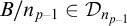 $B/n_{p-1} \in \mathcal {D}_{n_{p-1}}$
, then either
$B/n_{p-1} \in \mathcal {D}_{n_{p-1}}$
, then either $\mathcal {I}^{+} \!\restriction \! (B/n_{p-1}) \subseteq \mathcal {S}_{c\cup b}^{\mathcal {Q}_{i}}$
or
$\mathcal {I}^{+} \!\restriction \! (B/n_{p-1}) \subseteq \mathcal {S}_{c\cup b}^{\mathcal {Q}_{i}}$
or ${\mathcal {I}^{+} \!\restriction \! (B/n_{p-1}) \cap \mathcal {S}_{c\cup b}^{\mathcal {Q}_{i}} = \emptyset }$
; however,
${\mathcal {I}^{+} \!\restriction \! (B/n_{p-1}) \cap \mathcal {S}_{c\cup b}^{\mathcal {Q}_{i}} = \emptyset }$
; however, $D/b\in \mathcal {I}^{+} \!\restriction \! (B/n_{p-1}) \cap \mathcal {S}_{c\cup b}^{\mathcal {Q}_{i}}$
, so it must necessarily hold that
$D/b\in \mathcal {I}^{+} \!\restriction \! (B/n_{p-1}) \cap \mathcal {S}_{c\cup b}^{\mathcal {Q}_{i}}$
, so it must necessarily hold that $\mathcal {I}^{+} \!\restriction \! (B/n_{p-1}) \subseteq \mathcal {S}_{c\cup b}^{\mathcal {Q}_{i}}$
, consequently
$\mathcal {I}^{+} \!\restriction \! (B/n_{p-1}) \subseteq \mathcal {S}_{c\cup b}^{\mathcal {Q}_{i}}$
, consequently $[c\cup b, B/n_{p-1}] \subseteq \mathcal {Q}_{i}$
, so that
$[c\cup b, B/n_{p-1}] \subseteq \mathcal {Q}_{i}$
, so that $[c\cup b, B/n_{i-1}] \subseteq \mathcal {Q}_{i}$
and hence
$[c\cup b, B/n_{i-1}] \subseteq \mathcal {Q}_{i}$
and hence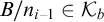 $B/n_{i-1}\in \mathcal {K}_{b}$
. Thus, applying Claim 1, we deduce that
$B/n_{i-1}\in \mathcal {K}_{b}$
. Thus, applying Claim 1, we deduce that $\mathcal {K}_{b} = \mathcal {I}^{+} \!\restriction \! (B/n_{i-1})$
.
$\mathcal {K}_{b} = \mathcal {I}^{+} \!\restriction \! (B/n_{i-1})$
.
Claim 3. For all $b\in [B/n_{i-1}]^{<\omega }$
it is true that
$b\in [B/n_{i-1}]^{<\omega }$
it is true that $\mathcal {K}_{b} \neq \emptyset $
if and only if
$\mathcal {K}_{b} \neq \emptyset $
if and only if $T_{b} \in \mathcal {I}^{+}$
.
$T_{b} \in \mathcal {I}^{+}$
.
Indeed, by Claim 2, if $\mathcal {K}_{b} \neq \emptyset $
then
$\mathcal {K}_{b} \neq \emptyset $
then $\mathcal {K}_{b} = \mathcal {I}^{+} \!\restriction \! (B/n_{i-1})$
, thus
$\mathcal {K}_{b} = \mathcal {I}^{+} \!\restriction \! (B/n_{i-1})$
, thus $B/n_{i-1} \in \mathcal {K}_{b}$
and hence
$B/n_{i-1} \in \mathcal {K}_{b}$
and hence $[c\cup b, B/n_{i-1}] \subseteq \mathcal {Q}_{i}$
, consequently
$[c\cup b, B/n_{i-1}] \subseteq \mathcal {Q}_{i}$
, consequently $[c\cup b\cup \{m\}, B/n_{i-1}] \subseteq [c\cup b, B/n_{i-1}] \subseteq \mathcal {Q}_{i}$
for each
$[c\cup b\cup \{m\}, B/n_{i-1}] \subseteq [c\cup b, B/n_{i-1}] \subseteq \mathcal {Q}_{i}$
for each $m\in B/n_{i-1}$
such that
$m\in B/n_{i-1}$
such that $c\cup b <m$
, therefore
$c\cup b <m$
, therefore ${T_{b}= \{ m\in B/n_{i-1} : c\cup b <m \}}$
, reason why we conclude that
${T_{b}= \{ m\in B/n_{i-1} : c\cup b <m \}}$
, reason why we conclude that $T_{b} \in \mathcal {I}^{+}$
. Conversely, if
$T_{b} \in \mathcal {I}^{+}$
. Conversely, if $T_{b}\in \mathcal {I}^{+}$
then we deduce that
$T_{b}\in \mathcal {I}^{+}$
then we deduce that $[c\cup b, T_{b}] \subseteq \bigcup _{m\in T_{b}} [c\cup b \cup \{m\}, T_{b}] \subseteq \bigcup _{m\in T_{b}} [c\cup b \cup \{m\}, B/n_{i-1}] \subseteq \mathcal {Q}_{i}$
, which means that
$[c\cup b, T_{b}] \subseteq \bigcup _{m\in T_{b}} [c\cup b \cup \{m\}, T_{b}] \subseteq \bigcup _{m\in T_{b}} [c\cup b \cup \{m\}, B/n_{i-1}] \subseteq \mathcal {Q}_{i}$
, which means that $T_{b} \in \mathcal {K}_{b}$
and hence
$T_{b} \in \mathcal {K}_{b}$
and hence $\mathcal {K}_{b} \neq \emptyset $
.
$\mathcal {K}_{b} \neq \emptyset $
.
Claim 4. If $b\in [B/n_{i-1}]^{<\omega }$
is such that
$b\in [B/n_{i-1}]^{<\omega }$
is such that $\mathcal {K}_{b} \neq \emptyset $
then
$\mathcal {K}_{b} \neq \emptyset $
then $b\neq \emptyset $
and
$b\neq \emptyset $
and $\max b \in T_{b-\{\max b\}}$
.
$\max b \in T_{b-\{\max b\}}$
.
Indeed, since $[c,B/n_{i-1}] \not \subseteq \mathcal {Q}_{i}$
then
$[c,B/n_{i-1}] \not \subseteq \mathcal {Q}_{i}$
then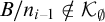 $B/n_{i-1} \notin \mathcal {K}_{\emptyset }$
, so that
$B/n_{i-1} \notin \mathcal {K}_{\emptyset }$
, so that $\mathcal {K}_{\emptyset } \neq \mathcal {I}^{+} \!\restriction \! (B/n_{i-1})$
and hence
$\mathcal {K}_{\emptyset } \neq \mathcal {I}^{+} \!\restriction \! (B/n_{i-1})$
and hence $\mathcal {K}_{\emptyset } = \emptyset $
, as follows from Claim 2. Therefore, if
$\mathcal {K}_{\emptyset } = \emptyset $
, as follows from Claim 2. Therefore, if $\mathcal {K}_{b} \neq \emptyset $
then
$\mathcal {K}_{b} \neq \emptyset $
then $b\neq \emptyset $
; moreover, by Claim 2, it follows that
$b\neq \emptyset $
; moreover, by Claim 2, it follows that $\mathcal {K}_{b} = \mathcal {I}^{+} \!\restriction \! (B/n_{i-1})$
, thus
$\mathcal {K}_{b} = \mathcal {I}^{+} \!\restriction \! (B/n_{i-1})$
, thus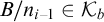 $B/n_{i-1} \in \mathcal {K}_{b}$
and hence
$B/n_{i-1} \in \mathcal {K}_{b}$
and hence $[c\cup b, B/n_{i-1}] \subseteq \mathcal {Q}_{i}$
, reason why we conclude that
$[c\cup b, B/n_{i-1}] \subseteq \mathcal {Q}_{i}$
, reason why we conclude that $\max b \in T_{b-\{\max b\}}$
.
$\max b \in T_{b-\{\max b\}}$
.
Now, let $\Gamma = \{ b\in [B/n_{i-1}]^{<\omega } : \mathcal {K}_{b} = \emptyset \}$
, then
$\Gamma = \{ b\in [B/n_{i-1}]^{<\omega } : \mathcal {K}_{b} = \emptyset \}$
, then $\Gamma \neq \emptyset $
because
$\Gamma \neq \emptyset $
because $\mathcal {K}_{\emptyset } = \emptyset $
and hence
$\mathcal {K}_{\emptyset } = \emptyset $
and hence $\emptyset \in \Gamma $
; so, we consider the sequence
$\emptyset \in \Gamma $
; so, we consider the sequence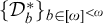 $\{\mathcal {D}_{b}^{*}\}_{b\in [\omega ]^{<\omega }}$
of subsets of
$\{\mathcal {D}_{b}^{*}\}_{b\in [\omega ]^{<\omega }}$
of subsets of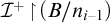 $\mathcal {I}^{+} \!\restriction \! (B/n_{i-1})$
given by
$\mathcal {I}^{+} \!\restriction \! (B/n_{i-1})$
given by $\mathcal {D}_{b}^{*} = \mathcal {I}^{+} \!\restriction \! (B/n_{i-1})$
, except for each
$\mathcal {D}_{b}^{*} = \mathcal {I}^{+} \!\restriction \! (B/n_{i-1})$
, except for each $b\in \Gamma $
for which we define
$b\in \Gamma $
for which we define $\mathcal {D}_{b}^{*}$
as follows:
$\mathcal {D}_{b}^{*}$
as follows:
 $$ \begin{align*} \mathcal{D}_{b}^{*} = \{ N\in \mathcal{I}^{+} \!\restriction\! (B/n_{i-1}) : N \cap T_{b} = \emptyset \}. \end{align*} $$
The family $\{\mathcal {D}_{b}^{*}\}_{b\in [\omega ]^{<\omega }} \subseteq \wp (\mathcal {I}^{+} \!\restriction \! (B/n_{i-1}))$
defined in this way is actually a sequence of dense–open sets in
$\{\mathcal {D}_{b}^{*}\}_{b\in [\omega ]^{<\omega }} \subseteq \wp (\mathcal {I}^{+} \!\restriction \! (B/n_{i-1}))$
defined in this way is actually a sequence of dense–open sets in $(\mathcal {I}^{+} \!\restriction \! (B/n_{i-1}), \subseteq )$
. Indeed, for each
$(\mathcal {I}^{+} \!\restriction \! (B/n_{i-1}), \subseteq )$
. Indeed, for each $b\in \Gamma $
we have the following two facts: On the one hand, if
$b\in \Gamma $
we have the following two facts: On the one hand, if $Y\in \mathcal {I}^{+} \!\restriction \! (B/n_{i-1})$
and
$Y\in \mathcal {I}^{+} \!\restriction \! (B/n_{i-1})$
and $X\in \mathcal {D}_{b}^{*}$
are such that
$X\in \mathcal {D}_{b}^{*}$
are such that $Y\subseteq X$
, then
$Y\subseteq X$
, then $X\cap T_{b} = \emptyset $
and hence
$X\cap T_{b} = \emptyset $
and hence $Y \cap T_{b} = \emptyset $
, which implies that
$Y \cap T_{b} = \emptyset $
, which implies that $Y\in \mathcal {D}_{b}^{*}$
. Thus,
$Y\in \mathcal {D}_{b}^{*}$
. Thus, $\mathcal {D}_{b}^{*}$
is an open set in
$\mathcal {D}_{b}^{*}$
is an open set in $(\mathcal {I}^{+} \!\restriction \! (B/n_{i-1}), \subseteq )$
. On the other hand, if
$(\mathcal {I}^{+} \!\restriction \! (B/n_{i-1}), \subseteq )$
. On the other hand, if $Y\in \mathcal {I}^{+} \!\restriction \! (B/n_{i-1})$
then
$Y\in \mathcal {I}^{+} \!\restriction \! (B/n_{i-1})$
then $Y\cap T_{b} \notin \mathcal {I}^{+}$
, since, by Claim 3, we get
$Y\cap T_{b} \notin \mathcal {I}^{+}$
, since, by Claim 3, we get $T_{b} \notin \mathcal {I}^{+}$
as a consequence of
$T_{b} \notin \mathcal {I}^{+}$
as a consequence of $\mathcal {K}_{b} = \emptyset $
; moreover, since
$\mathcal {K}_{b} = \emptyset $
; moreover, since $Y=(Y \setminus T_{b}) \cup (Y\cap T_{b})$
then necessarily
$Y=(Y \setminus T_{b}) \cup (Y\cap T_{b})$
then necessarily $Y \setminus T_{b} \in \mathcal {I}^{+} \!\restriction \! (B/n_{i-1})$
, and clearly the set
$Y \setminus T_{b} \in \mathcal {I}^{+} \!\restriction \! (B/n_{i-1})$
, and clearly the set $Y \setminus T_{b} \subseteq Y$
satisfies
$Y \setminus T_{b} \subseteq Y$
satisfies $(Y \setminus T_{b}) \cap T_{b} = \emptyset $
, reason why we deduce that
$(Y \setminus T_{b}) \cap T_{b} = \emptyset $
, reason why we deduce that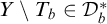 $Y \setminus T_{b} \in \mathcal {D}_{b}^{*}$
. Thus,
$Y \setminus T_{b} \in \mathcal {D}_{b}^{*}$
. Thus, $\mathcal {D}_{b}^{*}$
is a dense set in
$\mathcal {D}_{b}^{*}$
is a dense set in $(\mathcal {I}^{+} \!\restriction \! (B/n_{i-1}), \subseteq )$
.
$(\mathcal {I}^{+} \!\restriction \! (B/n_{i-1}), \subseteq )$
.
Since $\mathcal {I}$
is a semiselective ideal on
$\mathcal {I}$
is a semiselective ideal on $\omega $
, then there exists a diagonalization
$\omega $
, then there exists a diagonalization $C\in \mathcal {I}^{+} \!\restriction \! (B/n_{i-1}) \subseteq \mathcal {I}^{+} \!\restriction \! A$
for the sequence of dense–open sets
$C\in \mathcal {I}^{+} \!\restriction \! (B/n_{i-1}) \subseteq \mathcal {I}^{+} \!\restriction \! A$
for the sequence of dense–open sets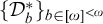 $\{ \mathcal {D}_{b}^{*} \}_{b\in [\omega ]^{<\omega }}$
, therefore
$\{ \mathcal {D}_{b}^{*} \}_{b\in [\omega ]^{<\omega }}$
, therefore $C/b \in \mathcal {D}_{b}^{*}$
for all
$C/b \in \mathcal {D}_{b}^{*}$
for all $b\in [C]^{<\omega }$
; in addition, note that
$b\in [C]^{<\omega }$
; in addition, note that $c< \min C$
and
$c< \min C$
and $[c,C] \subseteq [a,A]$
.
$[c,C] \subseteq [a,A]$
.
Let us verify that $[C]^{<\omega } \subseteq \Gamma $
. We use induction on the cardinality of b, where
$[C]^{<\omega } \subseteq \Gamma $
. We use induction on the cardinality of b, where $b\in [C]^{<\omega }$
. Suppose that
$b\in [C]^{<\omega }$
. Suppose that $[C]^{n} \subseteq \Gamma $
, and let
$[C]^{n} \subseteq \Gamma $
, and let $b\in [C]^{n+1}$
, then
$b\in [C]^{n+1}$
, then $b\neq \emptyset $
and
$b\neq \emptyset $
and $\max b \in C/(b-\{\max b\})$
. If
$\max b \in C/(b-\{\max b\})$
. If $b\notin \Gamma $
then
$b\notin \Gamma $
then $\mathcal {K}_{b} \neq \emptyset $
; thus, by Claim 4, we deduce that
$\mathcal {K}_{b} \neq \emptyset $
; thus, by Claim 4, we deduce that $\max b \in T_{b-\{\max b\}}$
, so that
$\max b \in T_{b-\{\max b\}}$
, so that $(C/(b-\{\max b\})) \cap T_{b-\{\max b\}} \neq \emptyset $
; nevertheless, since
$(C/(b-\{\max b\})) \cap T_{b-\{\max b\}} \neq \emptyset $
; nevertheless, since $b-\{\max b\} \in [C]^{n} \subseteq \Gamma $
and
$b-\{\max b\} \in [C]^{n} \subseteq \Gamma $
and $C/(b-\{\max b\}) \in \mathcal {D}_{b-\{\max b\}}^{*}$
then
$C/(b-\{\max b\}) \in \mathcal {D}_{b-\{\max b\}}^{*}$
then $(C/(b-\{\max b\})) \cap T_{b-\{\max b\}} = \emptyset $
, but this is contradictory. Therefore, we conclude that
$(C/(b-\{\max b\})) \cap T_{b-\{\max b\}} = \emptyset $
, but this is contradictory. Therefore, we conclude that $[C]^{n+1} \subseteq \Gamma $
.
$[C]^{n+1} \subseteq \Gamma $
.
Finally, notice that for each $d\in [\omega ]^{<\omega }$
and each
$d\in [\omega ]^{<\omega }$
and each $D\in \mathcal {I}^{+} \!\restriction \! C$
such that
$D\in \mathcal {I}^{+} \!\restriction \! C$
such that $[d,D]\subseteq [c,C]$
we have that
$[d,D]\subseteq [c,C]$
we have that $d=c\cup b,$
where
$d=c\cup b,$
where $b\in [C]^{<\omega }$
, then
$b\in [C]^{<\omega }$
, then $\mathcal {K}_{b} = \emptyset $
and hence
$\mathcal {K}_{b} = \emptyset $
and hence $D\notin \mathcal {K}_{b}$
, which means that
$D\notin \mathcal {K}_{b}$
, which means that $[c\cup b, D] \not \subseteq \mathcal {Q}_{i}$
. As a result, the set
$[c\cup b, D] \not \subseteq \mathcal {Q}_{i}$
. As a result, the set $C\in \mathcal {I}^{+} \!\restriction \! A$
satisfies that
$C\in \mathcal {I}^{+} \!\restriction \! A$
satisfies that $[c,C] \subseteq [a,A]$
and it has the property that
$[c,C] \subseteq [a,A]$
and it has the property that $[d,D] \not \subseteq \mathcal {Q}_{i}$
whenever
$[d,D] \not \subseteq \mathcal {Q}_{i}$
whenever $[d,D] \subseteq [c,C]$
with
$[d,D] \subseteq [c,C]$
with $D\in \mathcal {I}^{+} \!\restriction \! C$
.
$D\in \mathcal {I}^{+} \!\restriction \! C$
. $[\text {(b)} \Longrightarrow \text {(a)}].$
Suppose that the ideal
$[\text {(b)} \Longrightarrow \text {(a)}].$
Suppose that the ideal $\mathcal {I}$
is not semiselective; so, by Proposition 2.5, either
$\mathcal {I}$
is not semiselective; so, by Proposition 2.5, either $\mathcal {I}$
does not satisfy the property
$\mathcal {I}$
does not satisfy the property $(p^{w})$
or
$(p^{w})$
or $\mathcal {I}$
does not satisfy the property
$\mathcal {I}$
does not satisfy the property $(q)$
.
$(q)$
.
Suppose first that the ideal $\mathcal {I}$
does not have the property
$\mathcal {I}$
does not have the property $(p^{w})$
. Let
$(p^{w})$
. Let $A\in \mathcal {I}^{+}$
and let
$A\in \mathcal {I}^{+}$
and let $\{\mathcal {D}_{i}\}_{i\in \omega } \subseteq \wp (\mathcal {I}^{+})$
be a sequence of dense–open sets in
$\{\mathcal {D}_{i}\}_{i\in \omega } \subseteq \wp (\mathcal {I}^{+})$
be a sequence of dense–open sets in $(\mathcal {I}^{+}, \subseteq )$
such that for every
$(\mathcal {I}^{+}, \subseteq )$
such that for every $B\in \mathcal {I}^{+} \!\restriction \! A$
there is some
$B\in \mathcal {I}^{+} \!\restriction \! A$
there is some $i\in \omega $
for which
$i\in \omega $
for which $B \not \subseteq ^{*} D$
for each
$B \not \subseteq ^{*} D$
for each $D\in \mathcal {D}_{i}$
; so, if we consider the sequence
$D\in \mathcal {D}_{i}$
; so, if we consider the sequence $\{Q_{i}\}_{i\in \omega } \subseteq \wp ([\omega ]^{\omega })$
defined by
$\{Q_{i}\}_{i\in \omega } \subseteq \wp ([\omega ]^{\omega })$
defined by $\mathcal {Q}_{i} = \{ X\in [\omega ]^{\omega } : (\exists \, D\in \mathcal {D}_{i}) (X\subseteq ^{*} D)\}$
, then we deduce that
$\mathcal {Q}_{i} = \{ X\in [\omega ]^{\omega } : (\exists \, D\in \mathcal {D}_{i}) (X\subseteq ^{*} D)\}$
, then we deduce that $[\emptyset , B] \not \subseteq \bigcap _{i\in \omega } \mathcal {Q}_{i}$
for all
$[\emptyset , B] \not \subseteq \bigcap _{i\in \omega } \mathcal {Q}_{i}$
for all $B\in \mathcal {I}^{+} \!\restriction \! A$
. Now, given any
$B\in \mathcal {I}^{+} \!\restriction \! A$
. Now, given any $i\in \omega $
,
$i\in \omega $
, $c\in [\omega ]^{<\omega }$
, and
$c\in [\omega ]^{<\omega }$
, and $C\in \mathcal {I}^{+}\!\restriction \! A$
, with
$C\in \mathcal {I}^{+}\!\restriction \! A$
, with $|c|\leq i$
and
$|c|\leq i$
and $[c,C] \subseteq [\emptyset ,A]$
, we know that there exists some
$[c,C] \subseteq [\emptyset ,A]$
, we know that there exists some $D\in \mathcal {I}^{+} \!\restriction \! C$
such that
$D\in \mathcal {I}^{+} \!\restriction \! C$
such that $D\in \mathcal {D}_{i}$
; thus, we conclude that
$D\in \mathcal {D}_{i}$
; thus, we conclude that $[c,D] \subseteq [c,C]$
and
$[c,D] \subseteq [c,C]$
and $[c,D] \subseteq \mathcal {Q}_{i}$
.
$[c,D] \subseteq \mathcal {Q}_{i}$
.
Suppose now that the ideal $\mathcal {I}$
does not have the property
$\mathcal {I}$
does not have the property $(q)$
. Let
$(q)$
. Let $A\in \mathcal {I}^{+}$
and let
$A\in \mathcal {I}^{+}$
and let $A = \bigcup _{n\in \omega } f_{n}$
be an infinite partition of A, where each
$A = \bigcup _{n\in \omega } f_{n}$
be an infinite partition of A, where each $f_{n}$
is finite, such that for every
$f_{n}$
is finite, such that for every $C\in \mathcal {I}^{+} \!\restriction \! A$
there exists
$C\in \mathcal {I}^{+} \!\restriction \! A$
there exists $J\in [\omega ]^{\omega }$
for which
$J\in [\omega ]^{\omega }$
for which $|f_{n}\cap C| \geq 2$
for all
$|f_{n}\cap C| \geq 2$
for all $n\in J$
. Next, let
$n\in J$
. Next, let $\{Q_{i}\}_{i\in \omega } \subseteq \wp ([\omega ]^{\omega })$
be the sequence defined by
$\{Q_{i}\}_{i\in \omega } \subseteq \wp ([\omega ]^{\omega })$
be the sequence defined by $\mathcal {Q}_{i} = \{ X\in [\omega ]^{\omega } : (\exists \, j\geq i) (|f_{j}\cap X| \geq 2)\}$
, and notice that
$\mathcal {Q}_{i} = \{ X\in [\omega ]^{\omega } : (\exists \, j\geq i) (|f_{j}\cap X| \geq 2)\}$
, and notice that $[\emptyset , B] \not \subseteq \bigcap _{i\in \omega } \mathcal {Q}_{i}$
for all
$[\emptyset , B] \not \subseteq \bigcap _{i\in \omega } \mathcal {Q}_{i}$
for all $B\in \mathcal {I}^{+} \!\restriction \! A$
. Now, given any
$B\in \mathcal {I}^{+} \!\restriction \! A$
. Now, given any $i\in \omega $
,
$i\in \omega $
, $c\in [\omega ]^{<\omega }$
, and
$c\in [\omega ]^{<\omega }$
, and $C\in \mathcal {I}^{+}\!\restriction \! A$
, with
$C\in \mathcal {I}^{+}\!\restriction \! A$
, with $|c|\leq i$
and
$|c|\leq i$
and $[c,C] \subseteq [\emptyset ,A]$
, we can find some
$[c,C] \subseteq [\emptyset ,A]$
, we can find some $j\geq i$
such that
$j\geq i$
such that $c<\min f_{j}$
and
$c<\min f_{j}$
and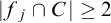 $|f_{j}\cap C|\geq 2$
; thus, if we take
$|f_{j}\cap C|\geq 2$
; thus, if we take $d\in [\omega ]^{<\omega }$
and
$d\in [\omega ]^{<\omega }$
and $D\in \mathcal {I}^{+} \!\restriction \! C$
given by
$D\in \mathcal {I}^{+} \!\restriction \! C$
given by $d= c \cup (f_{j}\cap C)$
and
$d= c \cup (f_{j}\cap C)$
and $D= C/ f_{j}$
, then we deduce that
$D= C/ f_{j}$
, then we deduce that $[d,D] \subseteq [c,C]$
and
$[d,D] \subseteq [c,C]$
and $[d,D] \subseteq \mathcal {Q}_{i}$
.
$[d,D] \subseteq \mathcal {Q}_{i}$
.
Proposition 3.2. Let $\mathcal {I}$
be a semiselective ideal on
$\mathcal {I}$
be a semiselective ideal on $\omega $
. Then, for any set
$\omega $
. Then, for any set $\mathcal {A} \subseteq [\omega ]^{\omega }$
, the following statements are equivalent:
$\mathcal {A} \subseteq [\omega ]^{\omega }$
, the following statements are equivalent:
-
(a)
$\mathcal {A}$
is
$\mathcal {I}^{+}$
-Ramsey null. -
(b)
$\mathcal {A}$
is
$\mathsf {Exp}(\mathcal {I}^{+})$
-nowhere dense. -
(c)
$\mathcal {A}$
is
$\mathsf {Exp}(\mathcal {I}^{+})$
-meager.


Proof. $[\text {(a)} \Longrightarrow \text {(b)} \Longrightarrow \text {(c)}].$
Straightforward.
$[\text {(a)} \Longrightarrow \text {(b)} \Longrightarrow \text {(c)}].$
Straightforward. $[\text {(c)} \Longrightarrow \text {(a)}].$
Fix a semiselective ideal
$[\text {(c)} \Longrightarrow \text {(a)}].$
Fix a semiselective ideal $\mathcal {I}$
on
$\mathcal {I}$
on $\omega $
, and let
$\omega $
, and let $\mathcal {A} \subseteq [\omega ]^{\omega }$
be an
$\mathcal {A} \subseteq [\omega ]^{\omega }$
be an $\mathsf {Exp}(\mathcal {I}^{+})$
-meager set, then
$\mathsf {Exp}(\mathcal {I}^{+})$
-meager set, then $\mathcal {A} = \bigcup _{i\in \omega } \mathcal {N}_{i}$
, where
$\mathcal {A} = \bigcup _{i\in \omega } \mathcal {N}_{i}$
, where $\mathcal {N}_{i} \subseteq [\omega ]^{\omega }$
is some
$\mathcal {N}_{i} \subseteq [\omega ]^{\omega }$
is some $\mathsf {Exp}(\mathcal {I}^{+})$
-nowhere dense set for each
$\mathsf {Exp}(\mathcal {I}^{+})$
-nowhere dense set for each $i\in \omega $
. Suppose that
$i\in \omega $
. Suppose that $\mathcal {A}$
is not an
$\mathcal {A}$
is not an $\mathcal {I}^{+}$
-Ramsey null set, then there are
$\mathcal {I}^{+}$
-Ramsey null set, then there are $a\in [\omega ]^{<\omega }$
and
$a\in [\omega ]^{<\omega }$
and $A\in \mathcal {I}^{+}$
such that
$A\in \mathcal {I}^{+}$
such that $[a,B] \not \subseteq \mathcal {A}^{\complement }$
for every
$[a,B] \not \subseteq \mathcal {A}^{\complement }$
for every $B\in \mathcal {I}^{+} \!\restriction \! A$
, so that
$B\in \mathcal {I}^{+} \!\restriction \! A$
, so that $[a,B] \not \subseteq \bigcap _{i\in \omega } \mathcal {N}_{i}^{\complement }$
for every
$[a,B] \not \subseteq \bigcap _{i\in \omega } \mathcal {N}_{i}^{\complement }$
for every $B\in \mathcal {I}^{+} \!\restriction \! A$
. Therefore, applying Lemma 3.1, there are
$B\in \mathcal {I}^{+} \!\restriction \! A$
. Therefore, applying Lemma 3.1, there are $i\in \omega $
,
$i\in \omega $
, $c\in [\omega ]^{<\omega }$
, and
$c\in [\omega ]^{<\omega }$
, and $C\in \mathcal {I}^{+} \!\restriction \! A$
, with
$C\in \mathcal {I}^{+} \!\restriction \! A$
, with $[c,C]\subseteq [a,A]$
, such that for each
$[c,C]\subseteq [a,A]$
, such that for each $d\in [\omega ]^{<\omega }$
and each
$d\in [\omega ]^{<\omega }$
and each $D\in \mathcal {I}^{+} \!\restriction \! C$
we have that
$D\in \mathcal {I}^{+} \!\restriction \! C$
we have that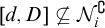 $[d,D] \not \subseteq \mathcal {N}_{i}^{\complement }$
whenever
$[d,D] \not \subseteq \mathcal {N}_{i}^{\complement }$
whenever $[d,D]\subseteq [c,C]$
, thus the set
$[d,D]\subseteq [c,C]$
, thus the set $\mathcal {N}_{i}$
is not
$\mathcal {N}_{i}$
is not $\mathsf {Exp}(\mathcal {I}^{+})$
-nowhere dense, which is contradictory.
$\mathsf {Exp}(\mathcal {I}^{+})$
-nowhere dense, which is contradictory.
Proposition 3.3. Let $\mathcal {I}$
be a semiselective ideal on
$\mathcal {I}$
be a semiselective ideal on $\omega $
. Then, for any set
$\omega $
. Then, for any set $\mathcal {A} \subseteq [\omega ]^{\omega }$
, the following statements are equivalent:
$\mathcal {A} \subseteq [\omega ]^{\omega }$
, the following statements are equivalent:
-
(a)
$\mathcal {A}$
is
$\mathcal {I}^{+}$
-Ramsey. -
(b)
$\mathcal {A}$
has the abstract
$\mathsf {Exp}(\mathcal {I}^{+})$
-Baire property. -
(c)
$\mathcal {A}$
has the
$\mathsf {Exp}(\mathcal {I}^{+})$
-Baire property.


Proof. $[\text {(a)} \Longrightarrow \text {(b)} \Longrightarrow \text {(c)}].$
Straightforward.
$[\text {(a)} \Longrightarrow \text {(b)} \Longrightarrow \text {(c)}].$
Straightforward. $[\text {(c)} \Longrightarrow \text {(b)}].$
This fact is easily deduced applying Proposition 3.2.
$[\text {(c)} \Longrightarrow \text {(b)}].$
This fact is easily deduced applying Proposition 3.2. $[\text {(b)} \Longrightarrow \text {(a)}].$
Fix a semiselective ideal
$[\text {(b)} \Longrightarrow \text {(a)}].$
Fix a semiselective ideal $\mathcal {I}$
on
$\mathcal {I}$
on $\omega $
, and let
$\omega $
, and let $\mathcal {A}\subseteq [\omega ]^{\omega }$
be a non
$\mathcal {A}\subseteq [\omega ]^{\omega }$
be a non $\mathcal {I}^{+}$
-Ramsey set, so that there are
$\mathcal {I}^{+}$
-Ramsey set, so that there are $a\in [\omega ]^{<\omega }$
and
$a\in [\omega ]^{<\omega }$
and $A\in \mathcal {I}^{+}$
such that both
$A\in \mathcal {I}^{+}$
such that both $[a,B] \not \subseteq \mathcal {A}$
and
$[a,B] \not \subseteq \mathcal {A}$
and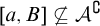 $[a,B] \not \subseteq \mathcal {A}^{\complement }$
for all
$[a,B] \not \subseteq \mathcal {A}^{\complement }$
for all $B\in \mathcal {I}^{+} \!\restriction \! A$
. Firstly, let
$B\in \mathcal {I}^{+} \!\restriction \! A$
. Firstly, let $\{\mathcal {Q}_{i}\}_{i\in \omega } \subseteq \wp ([\omega ]^{\omega })$
be the sequence given by
$\{\mathcal {Q}_{i}\}_{i\in \omega } \subseteq \wp ([\omega ]^{\omega })$
be the sequence given by $\mathcal {Q}_{0} = \mathcal {A}$
and
$\mathcal {Q}_{0} = \mathcal {A}$
and $\mathcal {Q}_{i} = [\omega ]^{\omega }$
for each
$\mathcal {Q}_{i} = [\omega ]^{\omega }$
for each $i>0$
, so that
$i>0$
, so that $[a,B] \not \subseteq \bigcap _{i\in \omega } \mathcal {Q}_{i}$
for all
$[a,B] \not \subseteq \bigcap _{i\in \omega } \mathcal {Q}_{i}$
for all $B\in \mathcal {I}^{+} \!\restriction \! A$
; thus, by Lemma 3.1, there is
$B\in \mathcal {I}^{+} \!\restriction \! A$
; thus, by Lemma 3.1, there is $C\in \mathcal I^{+} \!\restriction \! A$
such that
$C\in \mathcal I^{+} \!\restriction \! A$
such that $[d,D] \not \subseteq \mathcal {A}$
whenever
$[d,D] \not \subseteq \mathcal {A}$
whenever $[d,D] \subseteq [a,C] \subseteq [a,A]$
with
$[d,D] \subseteq [a,C] \subseteq [a,A]$
with $D\in \mathcal {I}^{+} \!\restriction \! C$
. Secondly, let
$D\in \mathcal {I}^{+} \!\restriction \! C$
. Secondly, let $\{\mathcal {Q}_{i}^{*}\}_{i\in \omega } \subseteq \wp ([\omega ]^{\omega })$
be the sequence given by
$\{\mathcal {Q}_{i}^{*}\}_{i\in \omega } \subseteq \wp ([\omega ]^{\omega })$
be the sequence given by $\mathcal {Q}_{i}^{*} = \mathcal {A}^{\complement }$
for each
$\mathcal {Q}_{i}^{*} = \mathcal {A}^{\complement }$
for each $i\in \omega $
, so that
$i\in \omega $
, so that $[a,B] \not \subseteq \bigcap _{i\in \omega } \mathcal {Q}_{i}^{*}$
for all
$[a,B] \not \subseteq \bigcap _{i\in \omega } \mathcal {Q}_{i}^{*}$
for all $B\in \mathcal {I}^{+} \!\restriction \! C$
; then, by Lemma 3.1, there are
$B\in \mathcal {I}^{+} \!\restriction \! C$
; then, by Lemma 3.1, there are $e\in [\omega ]^{<\omega }$
and
$e\in [\omega ]^{<\omega }$
and $E\in \mathcal {I}^{+} \!\restriction \! C$
, with
$E\in \mathcal {I}^{+} \!\restriction \! C$
, with $[e,E] \subseteq [a,C]$
, such that
$[e,E] \subseteq [a,C]$
, such that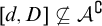 $[d,D] \not \subseteq \mathcal {A}^{\complement }$
whenever
$[d,D] \not \subseteq \mathcal {A}^{\complement }$
whenever $[d,D] \subseteq [e,E]$
with
$[d,D] \subseteq [e,E]$
with $D\in \mathcal {I}^{+} \!\restriction \! E$
. Taking this into account, we have that
$D\in \mathcal {I}^{+} \!\restriction \! E$
. Taking this into account, we have that $[e,E] \in \mathsf {Exp}(\mathcal {I}^{+})$
satisfies both
$[e,E] \in \mathsf {Exp}(\mathcal {I}^{+})$
satisfies both $[d,D] \not \subseteq \mathcal {A}$
and
$[d,D] \not \subseteq \mathcal {A}$
and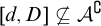 $[d,D] \not \subseteq \mathcal {A}^{\complement }$
for all
$[d,D] \not \subseteq \mathcal {A}^{\complement }$
for all $[d,D]\in \mathsf {Exp}(\mathcal {I}^{+})$
with
$[d,D]\in \mathsf {Exp}(\mathcal {I}^{+})$
with $[d,D]\subseteq [e,E]$
; therefore, we conclude that the set
$[d,D]\subseteq [e,E]$
; therefore, we conclude that the set $\mathcal {A}$
does not have the abstract
$\mathcal {A}$
does not have the abstract $\mathsf {Exp}(\mathcal {I}^{+})$
-Baire property.
$\mathsf {Exp}(\mathcal {I}^{+})$
-Baire property.
Corollary 3.4. Let $\mathcal {I}$
be a semiselective ideal on
$\mathcal {I}$
be a semiselective ideal on $\omega $
. Then, the following hold:
$\omega $
. Then, the following hold:
-
(1) The collection
$\mathcal {R}_{0}(\mathcal {I})$
of all
$\mathcal {I}^{+}$
-Ramsey null sets forms a
$\sigma $
-ideal on
$[\omega ]^{\omega }$
. -
(2) The collection
$\mathcal {R}(\mathcal {I})$
of all
$\mathcal {I}^{+}$
-Ramsey sets forms a
$\sigma $
-algebra on
$[\omega ]^{\omega }$
.


4 Additivity and the generalized Suslin operation
In this section, we present some results about the additivity of the ideal of Ramsey null sets with respect to a semiselective ideal $\mathcal I$
as well as the distributivity of the quasi-order
$\mathcal I$
as well as the distributivity of the quasi-order $(\mathcal I^+, \subseteq ^*)$
. We then use these results to characterize semiselectivity in terms of the Suslin operation
$(\mathcal I^+, \subseteq ^*)$
. We then use these results to characterize semiselectivity in terms of the Suslin operation $\mathcal A_\omega $
.
$\mathcal A_\omega $
.
4.1 On additivity and distributivity
Let $\mathcal {I}$
be an ideal on
$\mathcal {I}$
be an ideal on $\omega $
, and let
$\omega $
, and let $\kappa $
be an infinite cardinal. We say that
$\kappa $
be an infinite cardinal. We say that $(\mathcal {I}^{+}, \subseteq ^{*})$
is
$(\mathcal {I}^{+}, \subseteq ^{*})$
is $\kappa $
-distributive if the intersection of
$\kappa $
-distributive if the intersection of $\leq \kappa $
dense–open sets in
$\leq \kappa $
dense–open sets in $(\mathcal {I}^{+}, \subseteq ^{*})$
is also a dense–open set in
$(\mathcal {I}^{+}, \subseteq ^{*})$
is also a dense–open set in $(\mathcal {I}^{+}, \subseteq ^{*})$
.
$(\mathcal {I}^{+}, \subseteq ^{*})$
.
Definition 4.1. Let $\mathcal {I}$
be an ideal on
$\mathcal {I}$
be an ideal on $\omega $
. The cardinal
$\omega $
. The cardinal $\mathfrak {h}_{\mathcal {I}}$
is the smallest cardinal
$\mathfrak {h}_{\mathcal {I}}$
is the smallest cardinal $\kappa $
such that
$\kappa $
such that $(\mathcal {I}^{+}, \subseteq ^{*})$
is not
$(\mathcal {I}^{+}, \subseteq ^{*})$
is not $\kappa $
-distributive.
$\kappa $
-distributive.
Naturally, the cardinal $\mathfrak {h}_{\mathcal {I}}$
is always infinite for every ideal
$\mathfrak {h}_{\mathcal {I}}$
is always infinite for every ideal $\mathcal {I}$
on
$\mathcal {I}$
on $\omega $
. Moreover, for the ideal
$\omega $
. Moreover, for the ideal $ [\omega ]^{<\omega }$
we have
$ [\omega ]^{<\omega }$
we have $\mathfrak {h}_{[\omega ]^{<\omega }} = \mathfrak {h}$
, where
$\mathfrak {h}_{[\omega ]^{<\omega }} = \mathfrak {h}$
, where $\mathfrak {h}$
is the cardinal characteristic of the continuum known as distributive number or shattering number, introduced by Balcar, Pelant, and Simon in [Reference Balcar, Pelant and Simon2] (see also [Reference Halbeisen11, Chapter 9] and [Reference Blass, Foreman and Kanamori4, Section 6]).
$\mathfrak {h}$
is the cardinal characteristic of the continuum known as distributive number or shattering number, introduced by Balcar, Pelant, and Simon in [Reference Balcar, Pelant and Simon2] (see also [Reference Halbeisen11, Chapter 9] and [Reference Blass, Foreman and Kanamori4, Section 6]).
Given an ideal $\mathcal I$
on
$\mathcal I$
on $\omega $
, for every
$\omega $
, for every $A\in \mathcal I^+$
the set
$A\in \mathcal I^+$
the set $\mathcal {D}_A =\{ B\in \mathcal {I}^+ : (|B \setminus A|<\omega \wedge |A\setminus B|=\omega ) \vee (|B\cap A|<\omega ) \}$
is dense–open in
$\mathcal {D}_A =\{ B\in \mathcal {I}^+ : (|B \setminus A|<\omega \wedge |A\setminus B|=\omega ) \vee (|B\cap A|<\omega ) \}$
is dense–open in $(\mathcal {I}^{+}, \subseteq ^{*})$
. In words,
$(\mathcal {I}^{+}, \subseteq ^{*})$
. In words, $\mathcal {D}_A$
is the collection of all
$\mathcal {D}_A$
is the collection of all $B\in \mathcal {I}^+$
strictly almost contained in A or almost disjoint from A. The collection of dense–open sets
$B\in \mathcal {I}^+$
strictly almost contained in A or almost disjoint from A. The collection of dense–open sets $\{\mathcal {D}_A\}_{A\in \mathcal {I}^{+}}$
has size
$\{\mathcal {D}_A\}_{A\in \mathcal {I}^{+}}$
has size $\mathfrak {c}$
and its intersection is empty, since
$\mathfrak {c}$
and its intersection is empty, since $A\notin \mathcal {D}_A$
for every
$A\notin \mathcal {D}_A$
for every $A\in \mathcal {I}^+$
. This shows that
$A\in \mathcal {I}^+$
. This shows that $\mathfrak {h}_{\mathcal {I}} \leq \mathfrak {c}$
.
$\mathfrak {h}_{\mathcal {I}} \leq \mathfrak {c}$
.
The following fact provides useful combinatorial characterizations about the distributivity of $(\mathcal {I}^{+}, \subseteq ^{*})$
, which can be easily verified.
$(\mathcal {I}^{+}, \subseteq ^{*})$
, which can be easily verified.
Fact 4.2. Let $\mathcal {I}$
be an ideal on
$\mathcal {I}$
be an ideal on $\omega $
. Then, the following statements are equivalent:
$\omega $
. Then, the following statements are equivalent:
-
(a)
$\mathfrak {h}_{\mathcal {I}}> \omega $
. -
(b)
$(\mathcal {I}^{+}, \subseteq ^{*})$
is
$\omega $
-distributive. -
(c)
$\mathcal {I}$
is
$*$
-semiselective: for each
$A\in \mathcal {I}^{+}$
and for every sequence
$\{ \mathcal {D}_{n} \}_{n\in \omega } \subseteq \wp (\mathcal {I}^{+})$
of dense–open sets in
$(\mathcal {I}^{+}, \subseteq ^{*})$
, there is
$D_{\infty } \in \mathcal {I}^{+}$
such that
$D_{\infty } \subseteq ^{*} A$
and
$D_{\infty }/m \in \mathcal {D}_{m}$
for all
$m\in D_{\infty }$
. -
(d)
$\mathcal {I}$
has the property
$(p^{w})$
: for every
$A\in \mathcal {I}^{+}$
and every sequence
$\{ \mathcal {D}_{n} \}_{n\in \omega } \subseteq \wp (\mathcal {I}^{+})$
of dense–open sets in
$(\mathcal {I}^{+}, \subseteq )$
, there exists some
$B\in \mathcal {I}^{+} \!\restriction \! A$
with the property that for each
$n\in \omega $
there is
$A_{n}\in \mathcal {D}_{n}$
such that
$B \subseteq ^{*} A_{n}$
. -
(e)
$\mathcal I$
has the property
$*(p^{w})$
: for every
$A\in \mathcal {I}^{+}$
and every sequence
$\{ \mathcal {D}_{n} \}_{n\in \omega } \subseteq \wp (\mathcal {I}^{+})$
of dense–open sets in
$(\mathcal {I}^{+}, \subseteq ^* )$
, there exists some
$B\in \mathcal {I}^{+}$
with
$B \subseteq ^{*} A$
and with the property that for each
$n\in \omega $
there is
$A_{n}\in \mathcal {D}_{n}$
such that
$B \subseteq ^{*} A_{n}$
.











Proof. Straightforward.
For a given ideal $\mathcal {I}$
on
$\mathcal {I}$
on $\omega $
, the additivity of the ideal of Ramsey null sets relative to
$\omega $
, the additivity of the ideal of Ramsey null sets relative to $\mathcal {I}$
as well as the additivity of the algebra of Ramsey sets relative to
$\mathcal {I}$
as well as the additivity of the algebra of Ramsey sets relative to $\mathcal {I}$
are defined as follows.
$\mathcal {I}$
are defined as follows.
Definition 4.3. Let $\mathcal {I}$
be an ideal on
$\mathcal {I}$
be an ideal on $\omega $
, and let
$\omega $
, and let $\mathcal {R}_{0}(\mathcal {I})$
be the ideal on
$\mathcal {R}_{0}(\mathcal {I})$
be the ideal on $[\omega ]^{\omega }$
formed by the
$[\omega ]^{\omega }$
formed by the $\mathcal {I}^{+}$
-Ramsey null sets. The additivity of
$\mathcal {I}^{+}$
-Ramsey null sets. The additivity of $\mathcal {R}_{0}(\mathcal {I})$
is the cardinal
$\mathcal {R}_{0}(\mathcal {I})$
is the cardinal $\textsf {add} (\mathcal {R}_{0}(\mathcal {I})) = \min \{ |\mathcal {E}| : \mathcal {E} \subseteq \mathcal {R}_{0}(\mathcal {I}) \,\wedge \, \bigcup \mathcal {E} \notin \mathcal {R}_{0}(\mathcal {I}) \}$
.
$\textsf {add} (\mathcal {R}_{0}(\mathcal {I})) = \min \{ |\mathcal {E}| : \mathcal {E} \subseteq \mathcal {R}_{0}(\mathcal {I}) \,\wedge \, \bigcup \mathcal {E} \notin \mathcal {R}_{0}(\mathcal {I}) \}$
.
Definition 4.4. Let $\mathcal {I}$
be an ideal on
$\mathcal {I}$
be an ideal on $\omega $
, and let
$\omega $
, and let $\mathcal {R}(\mathcal {I})$
be the algebra on
$\mathcal {R}(\mathcal {I})$
be the algebra on $[\omega ]^{\omega }$
formed by the
$[\omega ]^{\omega }$
formed by the $\mathcal {I}^{+}$
-Ramsey sets. The additivity of
$\mathcal {I}^{+}$
-Ramsey sets. The additivity of $\mathcal {R}(\mathcal {I})$
is the cardinal
$\mathcal {R}(\mathcal {I})$
is the cardinal ${\textsf {add}} (\mathcal {R}(\mathcal {I})) = \min \{ |\mathcal {E}| : \mathcal {E} \subseteq \mathcal {R}(\mathcal {I}) \,\wedge \, \bigcup \mathcal {E} \notin \mathcal {R}(\mathcal {I}) \}$
.
${\textsf {add}} (\mathcal {R}(\mathcal {I})) = \min \{ |\mathcal {E}| : \mathcal {E} \subseteq \mathcal {R}(\mathcal {I}) \,\wedge \, \bigcup \mathcal {E} \notin \mathcal {R}(\mathcal {I}) \}$
.
Concerning the additivity of $\mathcal {R}_{0}(\mathcal {I})$
and
$\mathcal {R}_{0}(\mathcal {I})$
and $\mathcal {R}(\mathcal {I})$
, note that
$\mathcal {R}(\mathcal {I})$
, note that $\omega \leq \textsf {add} (\mathcal {R}_{0}(\mathcal {I})) \leq \mathfrak {c}$
and
$\omega \leq \textsf {add} (\mathcal {R}_{0}(\mathcal {I})) \leq \mathfrak {c}$
and $\omega \leq {\textsf {add}} (\mathcal {R}(\mathcal {I})) \leq \mathfrak {c}$
for every ideal
$\omega \leq {\textsf {add}} (\mathcal {R}(\mathcal {I})) \leq \mathfrak {c}$
for every ideal $\mathcal {I}$
on
$\mathcal {I}$
on $\omega $
.
$\omega $
.
The following result is due to Matet in [Reference Matet16, Proposition 9.5] for the class of selective ideals, extending a previous result of Plewik in [Reference Plewik20, Section 2] for the case $\mathcal {I} = [\omega ]^{<\omega }$
(see also [Reference Halbeisen11, Theorem 10.2]). We improve this result, completing the argument in Matet’s proof and generalizing it to any semiselective ideal
$\mathcal {I} = [\omega ]^{<\omega }$
(see also [Reference Halbeisen11, Theorem 10.2]). We improve this result, completing the argument in Matet’s proof and generalizing it to any semiselective ideal $\mathcal {I}$
on
$\mathcal {I}$
on $\omega $
.
$\omega $
.
Proposition 4.5. For every ideal $\mathcal {I}$
on
$\mathcal {I}$
on $\omega $
, it holds that
$\omega $
, it holds that
 $$ \begin{align*} \mathfrak{h}_{\mathcal{I}} \geq \textsf{add} (\mathcal{R}_{0}(\mathcal{I})) \geq {\textsf{add}} (\mathcal{R}(\mathcal{I})). \end{align*} $$
Moreover, if the ideal $\mathcal {I}$
is semiselective, then
$\mathcal {I}$
is semiselective, then
 $$ \begin{align*} \mathfrak{h}_{\mathcal{I}} = \textsf{add} (\mathcal{R}_{0}(\mathcal{I})) = {\textsf{add}} (\mathcal{R}(\mathcal{I})). \end{align*} $$
Proof. First we prove that ${\textsf {add}} (\mathcal {R}(\mathcal {I})) \leq \textsf {add} (\mathcal {R}_{0}(\mathcal {I}))$
for every ideal
${\textsf {add}} (\mathcal {R}(\mathcal {I})) \leq \textsf {add} (\mathcal {R}_{0}(\mathcal {I}))$
for every ideal $\mathcal {I}$
. Let
$\mathcal {I}$
. Let $\{ \mathcal {C}_{\xi } \}_{\xi \in \textsf {add} (\mathcal {R}_{0}(\mathcal {I}))} \subseteq \wp ([\omega ]^{\omega })$
be a collection of
$\{ \mathcal {C}_{\xi } \}_{\xi \in \textsf {add} (\mathcal {R}_{0}(\mathcal {I}))} \subseteq \wp ([\omega ]^{\omega })$
be a collection of $\mathcal {I}^{+}$
-Ramsey null sets such that its union
$\mathcal {I}^{+}$
-Ramsey null sets such that its union $\mathcal C =\bigcup _{\xi \in \textsf {add} (\mathcal {R}_{0}(\mathcal {I}))} \mathcal {C}_{\xi }$
is not
$\mathcal C =\bigcup _{\xi \in \textsf {add} (\mathcal {R}_{0}(\mathcal {I}))} \mathcal {C}_{\xi }$
is not $\mathcal {I}^{+}$
-Ramsey null. Clearly, if
$\mathcal {I}^{+}$
-Ramsey null. Clearly, if $\mathcal C$
is not
$\mathcal C$
is not $\mathcal {I}^{+}$
-Ramsey, we are done. Otherwise, if
$\mathcal {I}^{+}$
-Ramsey, we are done. Otherwise, if $\mathcal C$
is an
$\mathcal C$
is an $\mathcal {I}^{+}$
-Ramsey set, then there exists some basic set
$\mathcal {I}^{+}$
-Ramsey set, then there exists some basic set $[s,B] \subseteq \mathcal {C}$
with
$[s,B] \subseteq \mathcal {C}$
with $B\in \mathcal {I}^{+}$
, and thus, there is a set
$B\in \mathcal {I}^{+}$
, and thus, there is a set $\mathcal {A} \subseteq [s,B]$
such that
$\mathcal {A} \subseteq [s,B]$
such that $\mathcal {A}$
is not
$\mathcal {A}$
is not $\mathcal {I}^{+}$
-Ramsey, according to Proposition 2.8; therefore,
$\mathcal {I}^{+}$
-Ramsey, according to Proposition 2.8; therefore, $\mathcal {A} = \bigcup _{\xi \in \textsf {add} (\mathcal {R}_{0}(\mathcal {I}))} (\mathcal {A} \cap \mathcal {C}_{\xi }),$
where each set
$\mathcal {A} = \bigcup _{\xi \in \textsf {add} (\mathcal {R}_{0}(\mathcal {I}))} (\mathcal {A} \cap \mathcal {C}_{\xi }),$
where each set $\mathcal {A} \cap \mathcal {C}_{\xi }$
is
$\mathcal {A} \cap \mathcal {C}_{\xi }$
is $\mathcal {I}^{+}$
-Ramsey null.
$\mathcal {I}^{+}$
-Ramsey null.
Now, we show that $\textsf {add} (\mathcal {R}_{0}(\mathcal {I})) \leq \mathfrak {h}_{\mathcal {I}}$
for every ideal
$\textsf {add} (\mathcal {R}_{0}(\mathcal {I})) \leq \mathfrak {h}_{\mathcal {I}}$
for every ideal $\mathcal {I}$
. Let
$\mathcal {I}$
. Let $\{ \mathcal {D}_{\xi } \}_{\xi \in \mathfrak {h}_{\mathcal {I}}} \subseteq \wp (\mathcal {I}^{+})$
be a collection of dense–open sets in
$\{ \mathcal {D}_{\xi } \}_{\xi \in \mathfrak {h}_{\mathcal {I}}} \subseteq \wp (\mathcal {I}^{+})$
be a collection of dense–open sets in $(\mathcal {I}^{+}, \subseteq ^{*})$
such that
$(\mathcal {I}^{+}, \subseteq ^{*})$
such that $\bigcap _{\xi \in \mathfrak {h}_{\mathcal {I}}} \mathcal {D}_{\xi }$
is not dense in
$\bigcap _{\xi \in \mathfrak {h}_{\mathcal {I}}} \mathcal {D}_{\xi }$
is not dense in $(\mathcal {I}^{+}, \subseteq ^{*})$
. For every
$(\mathcal {I}^{+}, \subseteq ^{*})$
. For every $\xi \in \mathfrak {h}_{\mathcal {I}}$
we consider the set
$\xi \in \mathfrak {h}_{\mathcal {I}}$
we consider the set $\mathcal {A}_{\xi } \subseteq [\omega ]^{\omega }$
given by
$\mathcal {A}_{\xi } \subseteq [\omega ]^{\omega }$
given by $\mathcal {A}_{\xi } = \{ X\in [\omega ]^{\omega } : (\exists \, D\in \mathcal {D}_{\xi }) (X \subseteq ^{*} D) \}$
, and we note that each set
$\mathcal {A}_{\xi } = \{ X\in [\omega ]^{\omega } : (\exists \, D\in \mathcal {D}_{\xi }) (X \subseteq ^{*} D) \}$
, and we note that each set $\mathcal {A}_{\xi }^{\complement }$
is
$\mathcal {A}_{\xi }^{\complement }$
is $\mathcal {I}^{+}$
-Ramsey null, because for any basic set
$\mathcal {I}^{+}$
-Ramsey null, because for any basic set $[s,A]$
with
$[s,A]$
with $A\in \mathcal {I}^{+}$
, there is some
$A\in \mathcal {I}^{+}$
, there is some $B\in \mathcal {I}^{+}\!\restriction \! A$
such that
$B\in \mathcal {I}^{+}\!\restriction \! A$
such that $B\in \mathcal {D}_{\xi }$
, thus
$B\in \mathcal {D}_{\xi }$
, thus $[s,B] \subseteq \mathcal {A}_{\xi }$
and hence
$[s,B] \subseteq \mathcal {A}_{\xi }$
and hence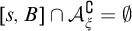 $[s,B] \cap \mathcal {A}_{\xi }^{\complement } = \emptyset $
. However, notice that the set
$[s,B] \cap \mathcal {A}_{\xi }^{\complement } = \emptyset $
. However, notice that the set $\bigcup _{\xi \in \mathfrak {h}_{\mathcal {I}}} \mathcal {A}_{\xi }^{\complement }$
is not
$\bigcup _{\xi \in \mathfrak {h}_{\mathcal {I}}} \mathcal {A}_{\xi }^{\complement }$
is not $\mathcal {I}^{+}$
-Ramsey null. Indeed, let
$\mathcal {I}^{+}$
-Ramsey null. Indeed, let $A\in \mathcal {I}^{+}$
be such that
$A\in \mathcal {I}^{+}$
be such that $\mathcal {I}^{+} \!\restriction \! A \cap \bigcap _{\xi \in \mathfrak {h}_{\mathcal {I}}} \mathcal {D}_{\xi } = \emptyset $
. Suppose, in search of a contradiction, that
$\mathcal {I}^{+} \!\restriction \! A \cap \bigcap _{\xi \in \mathfrak {h}_{\mathcal {I}}} \mathcal {D}_{\xi } = \emptyset $
. Suppose, in search of a contradiction, that $\bigcup _{\xi \in \mathfrak {h}_{\mathcal {I}}} \mathcal {A}_{\xi }^{\complement }$
is
$\bigcup _{\xi \in \mathfrak {h}_{\mathcal {I}}} \mathcal {A}_{\xi }^{\complement }$
is $\mathcal {I}^{+}$
-Ramsey null, then there is some
$\mathcal {I}^{+}$
-Ramsey null, then there is some $B \in \mathcal {I}^{+} \!\restriction \! A$
such that
$B \in \mathcal {I}^{+} \!\restriction \! A$
such that $[B]^{\omega } \cap \bigcup _{\xi \in \mathfrak {h}_{\mathcal {I}}} \mathcal {A}_{\xi }^{\complement } = \emptyset $
and hence
$[B]^{\omega } \cap \bigcup _{\xi \in \mathfrak {h}_{\mathcal {I}}} \mathcal {A}_{\xi }^{\complement } = \emptyset $
and hence $[B]^{\omega } \subseteq \bigcap _{\xi \in \mathfrak {h}_{\mathcal {I}}} \mathcal {A}_{\xi }$
, but this implies that
$[B]^{\omega } \subseteq \bigcap _{\xi \in \mathfrak {h}_{\mathcal {I}}} \mathcal {A}_{\xi }$
, but this implies that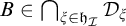 $B\in \bigcap _{\xi \in \mathfrak {h}_{\mathcal {I}}} \mathcal {D}_{\xi }$
, and this contradicts the choice of A.
$B\in \bigcap _{\xi \in \mathfrak {h}_{\mathcal {I}}} \mathcal {D}_{\xi }$
, and this contradicts the choice of A.
Let us now check that $\mathfrak {h}_{\mathcal {I}} \leq \textsf {add} (\mathcal {R}_{0}(\mathcal {I}))$
whenever the ideal
$\mathfrak {h}_{\mathcal {I}} \leq \textsf {add} (\mathcal {R}_{0}(\mathcal {I}))$
whenever the ideal $\mathcal {I}$
is semiselective. Let
$\mathcal {I}$
is semiselective. Let $\kappa < \mathfrak {h}_{\mathcal {I}}$
and let
$\kappa < \mathfrak {h}_{\mathcal {I}}$
and let $\{ \mathcal {C}_{\xi } \}_{\xi \in \kappa } \subseteq \wp ([\omega ]^{\omega })$
be any collection of
$\{ \mathcal {C}_{\xi } \}_{\xi \in \kappa } \subseteq \wp ([\omega ]^{\omega })$
be any collection of $\mathcal {I}^{+}$
-Ramsey null sets. Using Lemma 2.9, for each
$\mathcal {I}^{+}$
-Ramsey null sets. Using Lemma 2.9, for each $\xi \in \kappa $
we can consider the dense–open set
$\xi \in \kappa $
we can consider the dense–open set $\mathcal {D}_{\xi }$
in
$\mathcal {D}_{\xi }$
in $(\mathcal {I}^{+}, \subseteq ^{*})$
given by
$(\mathcal {I}^{+}, \subseteq ^{*})$
given by $\mathcal {D}_{\xi } = \{ X\in \mathcal {I}^{+} : (\forall \, Y \in [\omega ]^{\omega }) (Y\subseteq ^{*}X \rightarrow Y\notin \mathcal {C}_{\xi }) \}$
, then the set
$\mathcal {D}_{\xi } = \{ X\in \mathcal {I}^{+} : (\forall \, Y \in [\omega ]^{\omega }) (Y\subseteq ^{*}X \rightarrow Y\notin \mathcal {C}_{\xi }) \}$
, then the set $\bigcap _{\xi \in \kappa } \mathcal {D}_{\xi }$
is also dense–open in
$\bigcap _{\xi \in \kappa } \mathcal {D}_{\xi }$
is also dense–open in $(\mathcal {I}^{+}, \subseteq ^{*})$
because
$(\mathcal {I}^{+}, \subseteq ^{*})$
because $\kappa < \mathfrak {h}_{\mathcal {I}}$
. Therefore, for every basic set
$\kappa < \mathfrak {h}_{\mathcal {I}}$
. Therefore, for every basic set $[s,A]$
with
$[s,A]$
with $A\in \mathcal {I}^{+}$
, there is some
$A\in \mathcal {I}^{+}$
, there is some $B\in \mathcal {I}^{+} \!\restriction \! A$
such that
$B\in \mathcal {I}^{+} \!\restriction \! A$
such that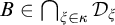 $B \in \bigcap _{\xi \in \kappa } \mathcal {D}_{\xi }$
, thus
$B \in \bigcap _{\xi \in \kappa } \mathcal {D}_{\xi }$
, thus $Y \notin \bigcup _{\xi \in \kappa } \mathcal {C}_{\xi }$
for each infinite set
$Y \notin \bigcup _{\xi \in \kappa } \mathcal {C}_{\xi }$
for each infinite set $Y \subseteq ^{*} B$
, and hence
$Y \subseteq ^{*} B$
, and hence $[s,B] \cap \bigcup _{\xi \in \kappa } \mathcal {C}_{\xi } = \emptyset $
. This shows that the set
$[s,B] \cap \bigcup _{\xi \in \kappa } \mathcal {C}_{\xi } = \emptyset $
. This shows that the set $\bigcup _{\xi \in \kappa } C_{\xi }$
is
$\bigcup _{\xi \in \kappa } C_{\xi }$
is $\mathcal {I}^{+}$
-Ramsey null, and so
$\mathcal {I}^{+}$
-Ramsey null, and so $\kappa < \textsf {add} (\mathcal {R}_{0}(\mathcal {I}))$
.
$\kappa < \textsf {add} (\mathcal {R}_{0}(\mathcal {I}))$
.
Finally, we prove that $\textsf {add} (\mathcal {R}_{0}(\mathcal {I})) \leq {\textsf {add}} (\mathcal {R}(\mathcal {I}))$
whenever the ideal
$\textsf {add} (\mathcal {R}_{0}(\mathcal {I})) \leq {\textsf {add}} (\mathcal {R}(\mathcal {I}))$
whenever the ideal $\mathcal {I}$
is semiselective. Let
$\mathcal {I}$
is semiselective. Let $\kappa < \textsf {add} (\mathcal {R}_{0}(\mathcal {I}))$
and let
$\kappa < \textsf {add} (\mathcal {R}_{0}(\mathcal {I}))$
and let $\{ \mathcal {X}_{\xi } \}_{\xi \in \kappa } \subseteq \wp ([\omega ]^{\omega })$
be any collection of
$\{ \mathcal {X}_{\xi } \}_{\xi \in \kappa } \subseteq \wp ([\omega ]^{\omega })$
be any collection of $\mathcal {I}^{+}$
-Ramsey sets. By virtue of both Propositions 3.2 and 3.3, we deduce that for each
$\mathcal {I}^{+}$
-Ramsey sets. By virtue of both Propositions 3.2 and 3.3, we deduce that for each $\xi \in \kappa $
there is some
$\xi \in \kappa $
there is some $\mathsf {Exp}(\mathcal {I}^{+})$
-open set
$\mathsf {Exp}(\mathcal {I}^{+})$
-open set $\mathcal {O}_{\xi }$
such that
$\mathcal {O}_{\xi }$
such that $\mathcal {X}_{\xi } \triangle \mathcal {O}_{\xi }$
is an
$\mathcal {X}_{\xi } \triangle \mathcal {O}_{\xi }$
is an $\mathcal {I}^{+}$
-Ramsey null set, and hence the set
$\mathcal {I}^{+}$
-Ramsey null set, and hence the set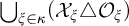 $\bigcup _{\xi \in \kappa } (\mathcal {X}_{\xi } \triangle \mathcal {O}_{\xi })$
is also
$\bigcup _{\xi \in \kappa } (\mathcal {X}_{\xi } \triangle \mathcal {O}_{\xi })$
is also $\mathcal {I}^{+}$
-Ramsey null since
$\mathcal {I}^{+}$
-Ramsey null since $\kappa < \textsf {add} (\mathcal {R}_{0}(\mathcal {I}))$
; additionally, notice that
$\kappa < \textsf {add} (\mathcal {R}_{0}(\mathcal {I}))$
; additionally, notice that $(\bigcup _{\xi \in \kappa } \mathcal {X}_{\xi }) \triangle (\bigcup _{\xi \in \kappa } \mathcal {O}_{\xi }) \subseteq \bigcup _{\xi \in \kappa } (\mathcal {X}_{\xi } \triangle \mathcal {O}_{\xi })$
; thus, we conclude that the set
$(\bigcup _{\xi \in \kappa } \mathcal {X}_{\xi }) \triangle (\bigcup _{\xi \in \kappa } \mathcal {O}_{\xi }) \subseteq \bigcup _{\xi \in \kappa } (\mathcal {X}_{\xi } \triangle \mathcal {O}_{\xi })$
; thus, we conclude that the set $\bigcup _{\xi \in \kappa } \mathcal {X}_{\xi }$
is
$\bigcup _{\xi \in \kappa } \mathcal {X}_{\xi }$
is $\mathcal {I}^{+}$
-Ramsey, and so
$\mathcal {I}^{+}$
-Ramsey, and so $\kappa < {\textsf {add}} (\mathcal {R}(\mathcal {I}))$
.
$\kappa < {\textsf {add}} (\mathcal {R}(\mathcal {I}))$
.
4.2 On the generalized Suslin operation
$\mathcal {A}_{\kappa }$

We prove that for any semiselective ideal $\mathcal I$
, the
$\mathcal I$
, the $\sigma $
-algebra
$\sigma $
-algebra $\mathcal R(\mathcal I)$
of all
$\mathcal R(\mathcal I)$
of all $\mathcal {I}^{+}$
-Ramsey sets is closed under the generalized Suslin operation
$\mathcal {I}^{+}$
-Ramsey sets is closed under the generalized Suslin operation $\mathcal A_\kappa $
whenever
$\mathcal A_\kappa $
whenever $\omega \leq \kappa <\mathfrak {h}_{\mathcal I}$
. To do this, we first present some notation and terminology that will be used in the proof of Proposition 4.6.
$\omega \leq \kappa <\mathfrak {h}_{\mathcal I}$
. To do this, we first present some notation and terminology that will be used in the proof of Proposition 4.6.
Let $\kappa $
be an infinite cardinal. If
$\kappa $
be an infinite cardinal. If $\sigma $
and
$\sigma $
and $\tau $
are elements of
$\tau $
are elements of $[\kappa ]^{<\omega }$
we write
$[\kappa ]^{<\omega }$
we write $\sigma \sqsubseteq \tau $
if
$\sigma \sqsubseteq \tau $
if $\sigma $
is an initial segment of
$\sigma $
is an initial segment of $\tau $
in their increasing enumerations. For each
$\tau $
in their increasing enumerations. For each $\sigma \in [\kappa ]^{<\omega }$
, as in the case of
$\sigma \in [\kappa ]^{<\omega }$
, as in the case of $[\omega ]^{\omega }$
, we denote by
$[\omega ]^{\omega }$
, we denote by $[\sigma ]$
the set of all members of
$[\sigma ]$
the set of all members of $[\kappa ]^{\omega }$
that have
$[\kappa ]^{\omega }$
that have $\sigma $
as initial segment. Also, for each
$\sigma $
as initial segment. Also, for each $n\in \omega $
and each
$n\in \omega $
and each $Z\in [\kappa ]^{\omega }$
, we denote by
$Z\in [\kappa ]^{\omega }$
, we denote by $r_{n}(Z)$
the initial segment of Z consisting of its first n elements.
$r_{n}(Z)$
the initial segment of Z consisting of its first n elements.
Let $\mathcal {I}$
be an ideal on
$\mathcal {I}$
be an ideal on $\omega $
and let
$\omega $
and let $\mathcal {G} = \{ \mathcal {X}_{\sigma } \}_{\sigma \in [\kappa ]^{<\omega }} \subseteq \wp ([\omega ]^{\omega })$
be a family of
$\mathcal {G} = \{ \mathcal {X}_{\sigma } \}_{\sigma \in [\kappa ]^{<\omega }} \subseteq \wp ([\omega ]^{\omega })$
be a family of $\mathcal {I}^{+}$
-Ramsey sets indexed by elements of
$\mathcal {I}^{+}$
-Ramsey sets indexed by elements of $[\kappa ]^{<\omega }$
, then the generalized Suslin operation
$[\kappa ]^{<\omega }$
, then the generalized Suslin operation $\mathcal {A}_{\kappa }$
applied to the family
$\mathcal {A}_{\kappa }$
applied to the family $\mathcal {G}$
is defined by
$\mathcal {G}$
is defined by
 $$ \begin{align*} \mathcal{A}_{\kappa} (\mathcal{G}) = \bigcup_{Z\in [\kappa]^{\omega}} \bigcap_{n\in\omega} \mathcal{X}_{r_{n}(Z)}. \end{align*} $$
In [Reference Farah8, Theorem 2.1], Farah shows that for every semiselective ideal $\mathcal {I}$
, the family of
$\mathcal {I}$
, the family of $\mathcal {I}^{+}$
-Ramsey sets is closed under the Suslin operation
$\mathcal {I}^{+}$
-Ramsey sets is closed under the Suslin operation $\mathcal {A}_{\omega }$
, improving previous similar facts due to Ellentuck in [Reference Ellentuck6] and Mathias in [Reference Mathias19] (see also [Reference Halbeisen11, Theorem 10.9] and [Reference Todorcevic25, Theorem 9.2]). Todorcevic proposes in [Reference Todorcevic26, Lemma 7.18] an alternative proof of this Farah’s result. Matet shows in [Reference Matet16, Proposition 9.8] that the family of
$\mathcal {A}_{\omega }$
, improving previous similar facts due to Ellentuck in [Reference Ellentuck6] and Mathias in [Reference Mathias19] (see also [Reference Halbeisen11, Theorem 10.9] and [Reference Todorcevic25, Theorem 9.2]). Todorcevic proposes in [Reference Todorcevic26, Lemma 7.18] an alternative proof of this Farah’s result. Matet shows in [Reference Matet16, Proposition 9.8] that the family of $\mathcal {I}^{+}$
-Ramsey sets is closed under the generalized Suslin operation
$\mathcal {I}^{+}$
-Ramsey sets is closed under the generalized Suslin operation $\mathcal {A}_{\kappa }$
whenever the ideal
$\mathcal {A}_{\kappa }$
whenever the ideal $\mathcal {I}$
is selective and
$\mathcal {I}$
is selective and $\kappa < \mathfrak {h}_{\mathcal {I}}$
. Inspired on [Reference Todorcevic26, Section 7.1], we extend the aforementioned results as follows.
$\kappa < \mathfrak {h}_{\mathcal {I}}$
. Inspired on [Reference Todorcevic26, Section 7.1], we extend the aforementioned results as follows.
Proposition 4.6. If $\mathcal {I}$
is a semiselective ideal on
$\mathcal {I}$
is a semiselective ideal on $\omega $
, then the collection
$\omega $
, then the collection $\mathcal {R}(\mathcal {I})$
of all
$\mathcal {R}(\mathcal {I})$
of all $\mathcal {I}^{+}$
-Ramsey sets is closed under the generalized Suslin operation
$\mathcal {I}^{+}$
-Ramsey sets is closed under the generalized Suslin operation $\mathcal {A}_{\kappa }$
for every infinite cardinal
$\mathcal {A}_{\kappa }$
for every infinite cardinal $\kappa <\mathfrak {h}_{\mathcal {I}}$
.
$\kappa <\mathfrak {h}_{\mathcal {I}}$
.
Proof. Fix a semiselective ideal $\mathcal {I}$
on
$\mathcal {I}$
on $\omega $
and an infinite cardinal
$\omega $
and an infinite cardinal $\kappa <\mathfrak {h}_{\mathcal {I}}$
, and let
$\kappa <\mathfrak {h}_{\mathcal {I}}$
, and let $\mathcal {G} = \{ \mathcal {X}_{\sigma } \}_{\sigma \in [\kappa ]^{<\omega }} \subseteq \wp ([\omega ]^{\omega })$
be a collection of
$\mathcal {G} = \{ \mathcal {X}_{\sigma } \}_{\sigma \in [\kappa ]^{<\omega }} \subseteq \wp ([\omega ]^{\omega })$
be a collection of $\mathcal {I}^{+}$
-Ramsey sets. We aim to prove that the set
$\mathcal {I}^{+}$
-Ramsey sets. We aim to prove that the set $\mathcal {A}_{\kappa } (\mathcal {G}) = \bigcup _{A\in [\kappa ]^{\omega }} \bigcap _{n\in \omega } \mathcal {X}_{r_{n}(A)}$
is also
$\mathcal {A}_{\kappa } (\mathcal {G}) = \bigcup _{A\in [\kappa ]^{\omega }} \bigcap _{n\in \omega } \mathcal {X}_{r_{n}(A)}$
is also $\mathcal {I}^{+}$
-Ramsey.
$\mathcal {I}^{+}$
-Ramsey.
For each $\sigma \in [\kappa ]^{<\omega }$
we consider the set
$\sigma \in [\kappa ]^{<\omega }$
we consider the set $\mathcal {X}_{\sigma }^{*} = \bigcup _{A\in [\sigma ]} \bigcap _{n\in \omega } \mathcal {X}_{r_{n}(A)} \subseteq \mathcal {A}_{\kappa } (\mathcal {G})$
, so, in particular
$\mathcal {X}_{\sigma }^{*} = \bigcup _{A\in [\sigma ]} \bigcap _{n\in \omega } \mathcal {X}_{r_{n}(A)} \subseteq \mathcal {A}_{\kappa } (\mathcal {G})$
, so, in particular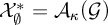 $\mathcal {X}_{\emptyset }^{*} = \mathcal {A}_{\kappa } (\mathcal {G})$
. Notice that if
$\mathcal {X}_{\emptyset }^{*} = \mathcal {A}_{\kappa } (\mathcal {G})$
. Notice that if $\tau \sqsubseteq \sigma $
then
$\tau \sqsubseteq \sigma $
then $[\sigma ] \subseteq [\tau ]$
and hence
$[\sigma ] \subseteq [\tau ]$
and hence $\mathcal {X}_{\sigma }^{*} \subseteq \mathcal {X}_{\tau }^{*}$
; on the other hand, since
$\mathcal {X}_{\sigma }^{*} \subseteq \mathcal {X}_{\tau }^{*}$
; on the other hand, since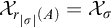 $\mathcal {X}_{r_{|\sigma |}(A)} = \mathcal {X}_{\sigma }$
whenever
$\mathcal {X}_{r_{|\sigma |}(A)} = \mathcal {X}_{\sigma }$
whenever $A\in [\sigma ]$
, then
$A\in [\sigma ]$
, then $\mathcal {X}_{\sigma }^{*} \subseteq \mathcal {X}_{\sigma }$
for every
$\mathcal {X}_{\sigma }^{*} \subseteq \mathcal {X}_{\sigma }$
for every $\sigma \in [\kappa ]^{<\omega }$
; additionally, since
$\sigma \in [\kappa ]^{<\omega }$
; additionally, since $[\sigma ]= \bigcup _{\sigma <\xi } [\sigma \cup \{\xi \}]$
, then for each
$[\sigma ]= \bigcup _{\sigma <\xi } [\sigma \cup \{\xi \}]$
, then for each $\sigma \in [\kappa ]^{<\omega }$
it is true that
$\sigma \in [\kappa ]^{<\omega }$
it is true that
 $$ \begin{align*} \mathcal{X}_{\sigma}^{*} = \bigcup_{A\in [\sigma]} \bigcap_{n\in \omega} \mathcal{X}_{r_{n}(A)} = \bigcup_{\sigma<\xi} \bigcup_{A\in [\sigma\cup \{\xi\}]} \bigcap_{n\in \omega} \mathcal{X}_{r_{n}(A)} = \bigcup_{\sigma<\xi} \mathcal{X}_{\sigma\cup\{\xi\}}^{*}. \end{align*} $$
Fix arbitrary $a\in [\omega ]^{<\omega }$
and
$a\in [\omega ]^{<\omega }$
and $M\in \mathcal {I}^{+}$
. We begin by considering the sequence
$M\in \mathcal {I}^{+}$
. We begin by considering the sequence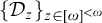 $\{ \mathcal {D}_{z} \}_{z\in [\omega ]^{<\omega }}$
of subsets of
$\{ \mathcal {D}_{z} \}_{z\in [\omega ]^{<\omega }}$
of subsets of $\mathcal {I}^{+} \!\restriction \! M$
given by
$\mathcal {I}^{+} \!\restriction \! M$
given by $\mathcal {D}_{z} = \mathcal {I}^{+} \!\restriction \! M$
, except for each
$\mathcal {D}_{z} = \mathcal {I}^{+} \!\restriction \! M$
, except for each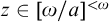 $z\in [\omega /a]^{<\omega }$
with
$z\in [\omega /a]^{<\omega }$
with $z\neq \emptyset ,$
where we define
$z\neq \emptyset ,$
where we define $\mathcal {D}_{z}$
as follows:
$\mathcal {D}_{z}$
as follows:
 $$ \begin{align*} \mathcal{D}_{z} = \left\{ N \in \mathcal{I}^{+} \!\restriction\! M \, : \, \forall \, \sigma\in [\kappa]^{< |z|} \begin{pmatrix} [a \cup z, N] \subseteq \mathcal{X}_{\sigma}^{*} \; \; \vee \; \; [a \cup z, N] \cap \mathcal{X}_{\sigma}^{*} = \emptyset \; \; \; \vee \\ (\forall \, P\in \mathcal{I}^{+} \!\restriction\! N) ( \, [a \cup z, P] \not\subseteq \mathcal{X}_{\sigma}^{*} \, \wedge \, [a \cup z, P] \cap \mathcal{X}_{\sigma}^{*} \neq \emptyset \, ) \end{pmatrix} \right\}. \end{align*} $$
It is easy to check that the family $\{ \mathcal {D}_{z} \}_{z\in [\omega ]^{<\omega }} \subseteq \wp (\mathcal {I}^{+} \!\restriction \! M)$
defined in this way is a sequence of dense–open sets in
$\{ \mathcal {D}_{z} \}_{z\in [\omega ]^{<\omega }} \subseteq \wp (\mathcal {I}^{+} \!\restriction \! M)$
defined in this way is a sequence of dense–open sets in $(\mathcal {I}^{+} \!\restriction \! M, \subseteq )$
.
$(\mathcal {I}^{+} \!\restriction \! M, \subseteq )$
.
Since $\mathcal {I}$
is a semiselective ideal on
$\mathcal {I}$
is a semiselective ideal on $\omega $
, there exists some set
$\omega $
, there exists some set $D_{\infty } \in \mathcal {I}^{+} \!\restriction \! M$
such that
$D_{\infty } \in \mathcal {I}^{+} \!\restriction \! M$
such that $D_{\infty }/b \in \mathcal {D}_{b}$
for all
$D_{\infty }/b \in \mathcal {D}_{b}$
for all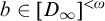 $b\in [D_{\infty }]^{<\omega }$
. For each
$b\in [D_{\infty }]^{<\omega }$
. For each $\sigma \in [\kappa ]^{<\omega }$
, let
$\sigma \in [\kappa ]^{<\omega }$
, let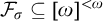 $\mathcal {F}_{\sigma } \subseteq [\omega ]^{<\omega }$
be the set described by
$\mathcal {F}_{\sigma } \subseteq [\omega ]^{<\omega }$
be the set described by $\mathcal {F}_{\sigma } = \{ b\in [D_{\infty }/a]^{<\omega } : \sigma \in [\kappa ]^{<|b|} \wedge [a\cup b, D_{\infty }] \cap \mathcal {X}_{\sigma }^{*} = \emptyset \}$
; so, for each
$\mathcal {F}_{\sigma } = \{ b\in [D_{\infty }/a]^{<\omega } : \sigma \in [\kappa ]^{<|b|} \wedge [a\cup b, D_{\infty }] \cap \mathcal {X}_{\sigma }^{*} = \emptyset \}$
; so, for each $\sigma \in [\kappa ]^{<\omega }$
we now consider the set
$\sigma \in [\kappa ]^{<\omega }$
we now consider the set $\Phi _{\sigma } \subseteq [\omega ]^{\omega }$
defined by
$\Phi _{\sigma } \subseteq [\omega ]^{\omega }$
defined by $\Phi _{\sigma } = [a,D_{\infty }] \setminus \bigcup _{b\in \mathcal {F}_{\sigma }} [a\cup b, D_{\infty }]$
, which visibly satisfies that
$\Phi _{\sigma } = [a,D_{\infty }] \setminus \bigcup _{b\in \mathcal {F}_{\sigma }} [a\cup b, D_{\infty }]$
, which visibly satisfies that $[a,D_{\infty }] \cap \mathcal {X}_{\sigma }^{*} \subseteq \Phi _{\sigma } \subseteq [a,D_{\infty }]$
.
$[a,D_{\infty }] \cap \mathcal {X}_{\sigma }^{*} \subseteq \Phi _{\sigma } \subseteq [a,D_{\infty }]$
.
Notice that for every $\sigma \in [\kappa ]^{<\omega }$
the set
$\sigma \in [\kappa ]^{<\omega }$
the set $\Phi _{\sigma }$
has the
$\Phi _{\sigma }$
has the $\mathsf {Exp}(\mathcal {I}^{+})$
-Baire property, by virtue of Fact 2.6; thus, applying Proposition 3.3, it follows that
$\mathsf {Exp}(\mathcal {I}^{+})$
-Baire property, by virtue of Fact 2.6; thus, applying Proposition 3.3, it follows that $\Phi _{\sigma }$
is an
$\Phi _{\sigma }$
is an $\mathcal {I}^{+}$
-Ramsey set. Now, for each
$\mathcal {I}^{+}$
-Ramsey set. Now, for each $\sigma \in [\kappa ]^{<\omega }$
we consider the
$\sigma \in [\kappa ]^{<\omega }$
we consider the $\mathcal {I}^{+}$
-Ramsey set
$\mathcal {I}^{+}$
-Ramsey set $\Psi _{\sigma } \subseteq [\omega ]^{\omega }$
given by
$\Psi _{\sigma } \subseteq [\omega ]^{\omega }$
given by $\Psi _{\sigma } = \mathcal {X}_{\sigma } \cap \Phi _{\sigma }$
, which clearly satisfies that
$\Psi _{\sigma } = \mathcal {X}_{\sigma } \cap \Phi _{\sigma }$
, which clearly satisfies that $[a,D_{\infty }] \cap \mathcal {X}_{\sigma }^{*} \subseteq \Psi _{\sigma } \subseteq \Phi _{\sigma } \subseteq [a,D_{\infty }]$
.
$[a,D_{\infty }] \cap \mathcal {X}_{\sigma }^{*} \subseteq \Psi _{\sigma } \subseteq \Phi _{\sigma } \subseteq [a,D_{\infty }]$
.
Next, for each $\sigma \in [\kappa ]^{<\omega }$
we define the set
$\sigma \in [\kappa ]^{<\omega }$
we define the set $\mathcal {M}_{\sigma } \subseteq [\omega ]^{\omega }$
by
$\mathcal {M}_{\sigma } \subseteq [\omega ]^{\omega }$
by $\mathcal {M}_{\sigma } = \Psi _{\sigma } \setminus \bigcup _{\sigma <\xi } \Psi _{\sigma \cup \{\xi \}}$
, which is an
$\mathcal {M}_{\sigma } = \Psi _{\sigma } \setminus \bigcup _{\sigma <\xi } \Psi _{\sigma \cup \{\xi \}}$
, which is an $\mathcal {I}^{+}$
-Ramsey set according to Proposition 4.5 and Corollary 3.4; thus, the set
$\mathcal {I}^{+}$
-Ramsey set according to Proposition 4.5 and Corollary 3.4; thus, the set $\mathcal {M}_{\sigma }$
has the abstract
$\mathcal {M}_{\sigma }$
has the abstract $\mathsf {Exp}(\mathcal {I}^{+})$
-Baire property by virtue of Proposition 3.3. Furthermore, since
$\mathsf {Exp}(\mathcal {I}^{+})$
-Baire property by virtue of Proposition 3.3. Furthermore, since $\mathcal {M}_{\sigma } \subseteq [a,D_{\infty }]$
and
$\mathcal {M}_{\sigma } \subseteq [a,D_{\infty }]$
and $[a,D_{\infty }] \cap \mathcal {X}_{\sigma }^{*} = [a,D_{\infty }] \cap \bigcup _{\sigma <\xi } \mathcal {X}_{\sigma \cup \{\xi \}}^{*} \subseteq \bigcup _{\sigma <\xi } \Psi _{\sigma \cup \{\xi \}}$
, then it follows that
$[a,D_{\infty }] \cap \mathcal {X}_{\sigma }^{*} = [a,D_{\infty }] \cap \bigcup _{\sigma <\xi } \mathcal {X}_{\sigma \cup \{\xi \}}^{*} \subseteq \bigcup _{\sigma <\xi } \Psi _{\sigma \cup \{\xi \}}$
, then it follows that $\mathcal {M}_{\sigma } \cap \mathcal {X}_{\sigma }^{*} = \emptyset $
, and hence we conclude that
$\mathcal {M}_{\sigma } \cap \mathcal {X}_{\sigma }^{*} = \emptyset $
, and hence we conclude that $\mathcal {M}_{\sigma } \subseteq \Psi _{\sigma } \setminus \mathcal {X}_{\sigma }^{*} \subseteq \Phi _{\sigma } \setminus \mathcal {X}_{\sigma }^{*}$
.
$\mathcal {M}_{\sigma } \subseteq \Psi _{\sigma } \setminus \mathcal {X}_{\sigma }^{*} \subseteq \Phi _{\sigma } \setminus \mathcal {X}_{\sigma }^{*}$
.
Let us check now that $\Psi _{\emptyset } \setminus \mathcal {A}_{\kappa } (\mathcal {G}) \subseteq \bigcup _{\sigma \in [\kappa ]^{<\omega }} \mathcal {M}_{\sigma }$
, which is naturally equivalent to verifying that
$\Psi _{\emptyset } \setminus \mathcal {A}_{\kappa } (\mathcal {G}) \subseteq \bigcup _{\sigma \in [\kappa ]^{<\omega }} \mathcal {M}_{\sigma }$
, which is naturally equivalent to verifying that $\Psi _{\emptyset } \setminus \bigcup _{\sigma \in [\kappa ]^{<\omega }} \mathcal {M}_{\sigma } \subseteq \mathcal {A}_{\kappa } (\mathcal {G})$
. Indeed, if
$\Psi _{\emptyset } \setminus \bigcup _{\sigma \in [\kappa ]^{<\omega }} \mathcal {M}_{\sigma } \subseteq \mathcal {A}_{\kappa } (\mathcal {G})$
. Indeed, if $E\in \Psi _{\emptyset } \setminus \bigcup _{\sigma \in [\kappa ]^{<\omega }} \mathcal {M}_{\sigma }$
then we can recursively construct a set
$E\in \Psi _{\emptyset } \setminus \bigcup _{\sigma \in [\kappa ]^{<\omega }} \mathcal {M}_{\sigma }$
then we can recursively construct a set $A\in [\kappa ]^{\omega }$
such that
$A\in [\kappa ]^{\omega }$
such that $E\in \Psi _{r_{n}(A)} \subseteq \mathcal {X}_{r_{n}(A)}$
for every
$E\in \Psi _{r_{n}(A)} \subseteq \mathcal {X}_{r_{n}(A)}$
for every $n\in \omega $
, thus
$n\in \omega $
, thus $E\in \bigcup _{A\in [\kappa ]^{\omega }} \bigcap _{n\in \omega } \mathcal {X}_{r_{n}(A)}$
and hence
$E\in \bigcup _{A\in [\kappa ]^{\omega }} \bigcap _{n\in \omega } \mathcal {X}_{r_{n}(A)}$
and hence $E\in \mathcal {A}_{\kappa } (\mathcal {G})$
.
$E\in \mathcal {A}_{\kappa } (\mathcal {G})$
.
Let us verify that for each $\sigma \in [\kappa ]^{<\omega }$
it is true that the set with the abstract
$\sigma \in [\kappa ]^{<\omega }$
it is true that the set with the abstract $\mathsf {Exp}(\mathcal {I}^{+})$
-Baire property
$\mathsf {Exp}(\mathcal {I}^{+})$
-Baire property $\mathcal {M}_{\sigma }$
is itself an
$\mathcal {M}_{\sigma }$
is itself an $\mathsf {Exp}(\mathcal {I}^{+})$
-nowhere dense set. Indeed, in order to reach a contradiction, suppose that for some
$\mathsf {Exp}(\mathcal {I}^{+})$
-nowhere dense set. Indeed, in order to reach a contradiction, suppose that for some $\sigma _{0}\in [\kappa ]^{<\omega }$
the set
$\sigma _{0}\in [\kappa ]^{<\omega }$
the set $\mathcal {M}_{\sigma _{0}} \subseteq [a,D_{\infty }]$
is not
$\mathcal {M}_{\sigma _{0}} \subseteq [a,D_{\infty }]$
is not $\mathsf {Exp}(\mathcal {I}^{+})$
-nowhere dense, then there are
$\mathsf {Exp}(\mathcal {I}^{+})$
-nowhere dense, then there are $c\in [\omega ]^{<\omega }$
and
$c\in [\omega ]^{<\omega }$
and $Q\in [a,D_{\infty }] \cap \mathcal {I}^{+}$
such that
$Q\in [a,D_{\infty }] \cap \mathcal {I}^{+}$
such that $[c,Q] \subseteq \mathcal {M}_{\sigma _{0}}$
and hence
$[c,Q] \subseteq \mathcal {M}_{\sigma _{0}}$
and hence $[c,Q] \subseteq [a,D_{\infty }]$
, so that
$[c,Q] \subseteq [a,D_{\infty }]$
, so that $a \sqsubseteq c$
, and for
$a \sqsubseteq c$
, and for $b = c/a = \{ n\in c : a<n \}$
we infer that
$b = c/a = \{ n\in c : a<n \}$
we infer that $c = a \cup b$
and
$c = a \cup b$
and $b \in [D_{\infty }/a]^{<\omega }$
; in fact, we can assume without loss of generality that
$b \in [D_{\infty }/a]^{<\omega }$
; in fact, we can assume without loss of generality that $\sigma _{0} \in [\kappa ]^{<|b|}$
. Now, since
$\sigma _{0} \in [\kappa ]^{<|b|}$
. Now, since $[a \cup b, Q] \subseteq \mathcal {M}_{\sigma _{0}} \subseteq \Phi _{\sigma _{0}} \setminus \mathcal {X}_{\sigma _{0}}^{*}$
, then clearly we have that
$[a \cup b, Q] \subseteq \mathcal {M}_{\sigma _{0}} \subseteq \Phi _{\sigma _{0}} \setminus \mathcal {X}_{\sigma _{0}}^{*}$
, then clearly we have that $[a \cup b, Q] \subseteq \Phi _{\sigma _{0}}$
and
$[a \cup b, Q] \subseteq \Phi _{\sigma _{0}}$
and $[a \cup b, Q] \cap \mathcal {X}_{\sigma _{0}}^{*} = \emptyset $
; on the other hand, since
$[a \cup b, Q] \cap \mathcal {X}_{\sigma _{0}}^{*} = \emptyset $
; on the other hand, since $[a \cup b, D_{\infty }/b] = [a \cup b, D_{\infty }]$
and
$[a \cup b, D_{\infty }/b] = [a \cup b, D_{\infty }]$
and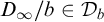 $D_{\infty }/b \in \mathcal {D}_{b}$
, then either
$D_{\infty }/b \in \mathcal {D}_{b}$
, then either $[a \cup b, D_{\infty }] \subseteq \mathcal {X}_{\sigma _{0}}^{*}$
, or
$[a \cup b, D_{\infty }] \subseteq \mathcal {X}_{\sigma _{0}}^{*}$
, or $[a \cup b, D_{\infty }] \cap \mathcal {X}_{\sigma _{0}}^{*} = \emptyset $
, or
$[a \cup b, D_{\infty }] \cap \mathcal {X}_{\sigma _{0}}^{*} = \emptyset $
, or $[a \cup b, P] \not \subseteq \mathcal {X}_{\sigma _{0}}^{*}$
and
$[a \cup b, P] \not \subseteq \mathcal {X}_{\sigma _{0}}^{*}$
and $[a \cup b, P] \cap \mathcal {X}_{\sigma _{0}}^{*} \neq \emptyset $
for all
$[a \cup b, P] \cap \mathcal {X}_{\sigma _{0}}^{*} \neq \emptyset $
for all $P \in \mathcal {I}^{+} \!\restriction \! (D_{\infty }/b)$
, however both the first and the last of these three options are impossible, because
$P \in \mathcal {I}^{+} \!\restriction \! (D_{\infty }/b)$
, however both the first and the last of these three options are impossible, because $Q\in [a,D_{\infty }] \cap \mathcal {I}^{+}$
satisfies that
$Q\in [a,D_{\infty }] \cap \mathcal {I}^{+}$
satisfies that $[a \cup b,Q/b] = [a \cup b, Q] \subseteq [a \cup b, D_{\infty }]$
and
$[a \cup b,Q/b] = [a \cup b, Q] \subseteq [a \cup b, D_{\infty }]$
and $[a \cup b, Q] \cap \mathcal {X}_{\sigma _{0}}^{*} = \emptyset $
. Therefore, we deduce that
$[a \cup b, Q] \cap \mathcal {X}_{\sigma _{0}}^{*} = \emptyset $
. Therefore, we deduce that $[a \cup b, D_{\infty }] \cap \mathcal {X}_{\sigma _{0}}^{*} = \emptyset $
and consequently
$[a \cup b, D_{\infty }] \cap \mathcal {X}_{\sigma _{0}}^{*} = \emptyset $
and consequently $b\in \mathcal {F}_{\sigma _{0}}$
, thus
$b\in \mathcal {F}_{\sigma _{0}}$
, thus $[a \cup b, D_{\infty }] \cap \Phi _{\sigma _{0}} = \emptyset $
and hence
$[a \cup b, D_{\infty }] \cap \Phi _{\sigma _{0}} = \emptyset $
and hence $[a \cup b, Q] \cap \Phi _{\sigma _{0}} = \emptyset $
, which is contradictory.
$[a \cup b, Q] \cap \Phi _{\sigma _{0}} = \emptyset $
, which is contradictory.
Finally, since the set $\mathcal {M}_{\sigma }$
is
$\mathcal {M}_{\sigma }$
is $\mathsf {Exp}(\mathcal {I}^{+})$
-nowhere dense for each
$\mathsf {Exp}(\mathcal {I}^{+})$
-nowhere dense for each $\sigma \in [\kappa ]^{<\omega }$
, then by Proposition 3.2 we have that for every
$\sigma \in [\kappa ]^{<\omega }$
, then by Proposition 3.2 we have that for every $\sigma \in [\kappa ]^{<\omega }$
the set
$\sigma \in [\kappa ]^{<\omega }$
the set $\mathcal {M}_{\sigma }$
is itself
$\mathcal {M}_{\sigma }$
is itself $\mathcal {I}^{+}$
-Ramsey null, so that
$\mathcal {I}^{+}$
-Ramsey null, so that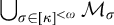 $\bigcup _{\sigma \in [\kappa ]^{<\omega }} \mathcal {M}_{\sigma }$
is also an
$\bigcup _{\sigma \in [\kappa ]^{<\omega }} \mathcal {M}_{\sigma }$
is also an $\mathcal {I}^{+}$
-Ramsey null set, according to Proposition 4.5. Therefore, there is some
$\mathcal {I}^{+}$
-Ramsey null set, according to Proposition 4.5. Therefore, there is some $S\in \mathcal {I}^{+} \!\restriction \! D_{\infty }$
such that
$S\in \mathcal {I}^{+} \!\restriction \! D_{\infty }$
such that $[a,S] \cap \bigcup _{\sigma \in [\kappa ]^{<\omega }} \mathcal {M}_{\sigma } = \emptyset $
, so that
$[a,S] \cap \bigcup _{\sigma \in [\kappa ]^{<\omega }} \mathcal {M}_{\sigma } = \emptyset $
, so that $[a,S] \cap ( \Psi _{\emptyset } \setminus \mathcal {A}_{\kappa } (\mathcal {G}) ) = \emptyset $
due to
$[a,S] \cap ( \Psi _{\emptyset } \setminus \mathcal {A}_{\kappa } (\mathcal {G}) ) = \emptyset $
due to $\Psi _{\emptyset } \setminus \mathcal {A}_{k} (\mathcal {G}) \subseteq \bigcup _{\sigma \in [\kappa ]^{<\omega }} \mathcal {M}_{\sigma }$
; moreover, considering that
$\Psi _{\emptyset } \setminus \mathcal {A}_{k} (\mathcal {G}) \subseteq \bigcup _{\sigma \in [\kappa ]^{<\omega }} \mathcal {M}_{\sigma }$
; moreover, considering that $[a,D_{\infty }] \cap \mathcal {A}_{\kappa } (\mathcal {G}) \subseteq \Psi _{\emptyset } \subseteq [a,D_{\infty }]$
, we deduce that
$[a,D_{\infty }] \cap \mathcal {A}_{\kappa } (\mathcal {G}) \subseteq \Psi _{\emptyset } \subseteq [a,D_{\infty }]$
, we deduce that $[a,S] \cap \Psi _{\emptyset } = [a,S] \cap \mathcal {A}_{\kappa } (\mathcal {G})$
. Thus, since the set
$[a,S] \cap \Psi _{\emptyset } = [a,S] \cap \mathcal {A}_{\kappa } (\mathcal {G})$
. Thus, since the set $\Psi _{\emptyset }$
is
$\Psi _{\emptyset }$
is $\mathcal {I}^{+}$
-Ramsey, then there exists some
$\mathcal {I}^{+}$
-Ramsey, then there exists some $R \in \mathcal {I}^{+} \!\restriction \! S \subseteq \mathcal {I}^{+} \!\restriction \! D_{\infty }$
such that either
$R \in \mathcal {I}^{+} \!\restriction \! S \subseteq \mathcal {I}^{+} \!\restriction \! D_{\infty }$
such that either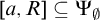 $[a,R] \subseteq \Psi _{\emptyset }$
or
$[a,R] \subseteq \Psi _{\emptyset }$
or $[a,R] \cap \Psi _{\emptyset } = \emptyset $
, which implies that either
$[a,R] \cap \Psi _{\emptyset } = \emptyset $
, which implies that either $[a,R] \subseteq \mathcal {A}_{\kappa } (\mathcal {G})$
or
$[a,R] \subseteq \mathcal {A}_{\kappa } (\mathcal {G})$
or $[a,R] \cap \mathcal {A}_{\kappa } (\mathcal {G}) = \emptyset $
. As a result, we conclude that the set
$[a,R] \cap \mathcal {A}_{\kappa } (\mathcal {G}) = \emptyset $
. As a result, we conclude that the set $\mathcal {A}_{\kappa } (\mathcal {G})$
is
$\mathcal {A}_{\kappa } (\mathcal {G})$
is $\mathcal {I}^{+}$
-Ramsey.
$\mathcal {I}^{+}$
-Ramsey.
We now present a characterization of semiselective ideals through the Suslin operation $\mathcal {A}_{\omega }$
on the algebra of all sets with the local Ramsey property.
$\mathcal {A}_{\omega }$
on the algebra of all sets with the local Ramsey property.
Proposition 4.7. Let $\mathcal {I}$
be an ideal on
$\mathcal {I}$
be an ideal on $\omega $
. Then, the following statements are equivalent:
$\omega $
. Then, the following statements are equivalent:
-
(a) The ideal
$\mathcal {I}$
is semiselective. -
(b) The collection
$\mathcal {R}(\mathcal {I})$
of all
$\mathcal {I}^{+}$
-Ramsey sets is closed under the Suslin operation
$\mathcal {A}_{\omega }$
.


Proof. $[\text {(a)} \Longrightarrow \text {(b)}].$
If the ideal
$[\text {(a)} \Longrightarrow \text {(b)}].$
If the ideal $\mathcal {I}$
is semiselective, then
$\mathcal {I}$
is semiselective, then $\mathfrak {h}_{\mathcal {I}}> \omega $
by virtue of Proposition 2.5 and Fact 4.2, hence the collection
$\mathfrak {h}_{\mathcal {I}}> \omega $
by virtue of Proposition 2.5 and Fact 4.2, hence the collection $\mathcal {R}(\mathcal {I})$
of all
$\mathcal {R}(\mathcal {I})$
of all $\mathcal {I}^{+}$
-Ramsey sets is closed under the Suslin operation
$\mathcal {I}^{+}$
-Ramsey sets is closed under the Suslin operation $\mathcal {A}_{\omega }$
, according to Proposition 4.6.
$\mathcal {A}_{\omega }$
, according to Proposition 4.6. $[\text {(b)} \Longrightarrow \text {(a)}].$
If the ideal
$[\text {(b)} \Longrightarrow \text {(a)}].$
If the ideal $\mathcal {I}$
is not semiselective, then either
$\mathcal {I}$
is not semiselective, then either $\mathcal {I}$
fails to satisfy the property
$\mathcal {I}$
fails to satisfy the property $(p^{w})$
or
$(p^{w})$
or $\mathcal {I}$
fails to satisfy the property
$\mathcal {I}$
fails to satisfy the property $(q)$
, according to Proposition 2.5.
$(q)$
, according to Proposition 2.5.
On the one hand, suppose that the ideal $\mathcal {I}$
does not have the property
$\mathcal {I}$
does not have the property $(p^{w})$
. By Fact 4.2, let
$(p^{w})$
. By Fact 4.2, let $A\in \mathcal {I}^{+}$
and let
$A\in \mathcal {I}^{+}$
and let $\{ \mathcal {D}_{n} \}_{n\in \omega } \subseteq \wp (\mathcal {I}^{+})$
be a sequence of dense–open sets in
$\{ \mathcal {D}_{n} \}_{n\in \omega } \subseteq \wp (\mathcal {I}^{+})$
be a sequence of dense–open sets in $(\mathcal {I}^{+}, \subseteq ^{*})$
such that for every
$(\mathcal {I}^{+}, \subseteq ^{*})$
such that for every $E\in \mathcal {I}^{+}$
, with
$E\in \mathcal {I}^{+}$
, with $E\subseteq ^{*} A$
, there is some
$E\subseteq ^{*} A$
, there is some $n\in E$
for which
$n\in E$
for which $E/n \notin \mathcal {D}_{n}$
. Now, for every
$E/n \notin \mathcal {D}_{n}$
. Now, for every $n\in \omega $
we consider the set
$n\in \omega $
we consider the set $\mathcal {C}_{n} \subseteq [\omega ]^{\omega }$
given by
$\mathcal {C}_{n} \subseteq [\omega ]^{\omega }$
given by $\mathcal {C}_{n} = \{ X\in [\omega ]^{\omega } : X/n \notin \mathcal {D}_{n}^{*} \}$
, where
$\mathcal {C}_{n} = \{ X\in [\omega ]^{\omega } : X/n \notin \mathcal {D}_{n}^{*} \}$
, where $\mathcal {D}_{n}^{*} = \{ X\in [\omega ]^{\omega } : (\exists \, D\in \mathcal {D}_{n}) (X \subseteq ^{*} D) \}$
, so that
$\mathcal {D}_{n}^{*} = \{ X\in [\omega ]^{\omega } : (\exists \, D\in \mathcal {D}_{n}) (X \subseteq ^{*} D) \}$
, so that $\mathcal {D}_{n} = \mathcal {I}^{+} \cap \mathcal {D}_{n}^{*}$
.
$\mathcal {D}_{n} = \mathcal {I}^{+} \cap \mathcal {D}_{n}^{*}$
.
Notice that $\{ \mathcal {C}_{n} \}_{n\in \omega } \subseteq \wp ([\omega ]^{\omega })$
is a collection of
$\{ \mathcal {C}_{n} \}_{n\in \omega } \subseteq \wp ([\omega ]^{\omega })$
is a collection of $\mathcal {I}^{+}$
-Ramsey null sets, because for every
$\mathcal {I}^{+}$
-Ramsey null sets, because for every $n\in \omega $
and every basic set
$n\in \omega $
and every basic set $[s,M]$
with
$[s,M]$
with $M\in \mathcal {I}^{+}$
, there exists
$M\in \mathcal {I}^{+}$
, there exists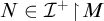 $N\in \mathcal {I}^{+} \!\restriction \! M$
such that
$N\in \mathcal {I}^{+} \!\restriction \! M$
such that $N \in \mathcal {D}_{n}$
and hence
$N \in \mathcal {D}_{n}$
and hence $\{ X\in [\omega ]^{\omega } : X\subseteq ^{*} N \} \subseteq \mathcal {D}_{n}^{*}$
, in particular
$\{ X\in [\omega ]^{\omega } : X\subseteq ^{*} N \} \subseteq \mathcal {D}_{n}^{*}$
, in particular $X/n \in \mathcal {D}_{n}^{*}$
for all infinite set
$X/n \in \mathcal {D}_{n}^{*}$
for all infinite set $X\subseteq ^{*} N$
, therefore
$X\subseteq ^{*} N$
, therefore $[s,N] \cap \mathcal {C}_{n} = \emptyset $
. Nevertheless, the set
$[s,N] \cap \mathcal {C}_{n} = \emptyset $
. Nevertheless, the set $\bigcup _{n\in \omega } \mathcal {C}_{n}$
is not
$\bigcup _{n\in \omega } \mathcal {C}_{n}$
is not $\mathcal {I}^{+}$
-Ramsey, since for every
$\mathcal {I}^{+}$
-Ramsey, since for every $B \in \mathcal {I}^{+} \!\restriction \! A$
there is
$B \in \mathcal {I}^{+} \!\restriction \! A$
there is $n\in B$
such that
$n\in B$
such that $B/n \notin \mathcal {D}_{n}$
, in fact
$B/n \notin \mathcal {D}_{n}$
, in fact $B/n \notin \mathcal {D}_{n}^{*}$
, so that
$B/n \notin \mathcal {D}_{n}^{*}$
, so that $B\in \mathcal {C}_{n}$
and hence
$B\in \mathcal {C}_{n}$
and hence $[B]^{\omega } \cap \bigcup _{n\in \omega } \mathcal {C}_{n} \neq \emptyset $
; moreover, for any sequence
$[B]^{\omega } \cap \bigcup _{n\in \omega } \mathcal {C}_{n} \neq \emptyset $
; moreover, for any sequence $\{B_{n}\}_{n\in \omega } \subseteq \mathcal {I}^{+} \!\restriction \! B$
satisfying
$\{B_{n}\}_{n\in \omega } \subseteq \mathcal {I}^{+} \!\restriction \! B$
satisfying $B_{n}\in \mathcal {D}_{n}$
and
$B_{n}\in \mathcal {D}_{n}$
and $B_{n+1} \subseteq ^{*} B_{n}$
for each
$B_{n+1} \subseteq ^{*} B_{n}$
for each $n\in \omega $
, there is
$n\in \omega $
, there is $E\in [B]^{\omega }$
such that for each
$E\in [B]^{\omega }$
such that for each $n\in \omega $
we have
$n\in \omega $
we have $E/n \subseteq ^{*} B_{n}$
and hence
$E/n \subseteq ^{*} B_{n}$
and hence $E/n \in \mathcal {D}_{n}^{*}$
, which implies that
$E/n \in \mathcal {D}_{n}^{*}$
, which implies that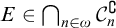 $E\in \bigcap _{n\in \omega } \mathcal {C}_{n}^{\complement }$
, and thus
$E\in \bigcap _{n\in \omega } \mathcal {C}_{n}^{\complement }$
, and thus $[B]^{\omega } \cap (\bigcup _{n\in \omega } \mathcal {C}_{n})^{\complement } \neq \emptyset $
.
$[B]^{\omega } \cap (\bigcup _{n\in \omega } \mathcal {C}_{n})^{\complement } \neq \emptyset $
.
Lastly, we consider the family of $\mathcal {I}^{+}$
-Ramsey sets
$\mathcal {I}^{+}$
-Ramsey sets $\mathcal {G} = \{ \mathcal {X}_{s} \}_{s\in [\omega ]^{<\omega }} \subseteq \wp ([\omega ]^{\omega })$
defined by
$\mathcal {G} = \{ \mathcal {X}_{s} \}_{s\in [\omega ]^{<\omega }} \subseteq \wp ([\omega ]^{\omega })$
defined by
 $$ \begin{align*} \mathcal{X}_{s} = \mathcal{C}_{n}^{\complement} \text{ whenever } s\in [\omega]^{n}. \end{align*} $$
Therefore, applying the Suslin operation $\mathcal {A}_{\omega }$
to the collection
$\mathcal {A}_{\omega }$
to the collection $\mathcal {G}$
, we deduce that
$\mathcal {G}$
, we deduce that $\mathcal {A}_{\omega } (\mathcal {G}) = \bigcup _{Z\in [\omega ]^{\omega }} \bigcap _{n\in \omega } \mathcal {X}_{r_{n}(Z)} = ( \bigcup _{n\in \omega } \mathcal {C}_{n} )^{\complement }$
is not an
$\mathcal {A}_{\omega } (\mathcal {G}) = \bigcup _{Z\in [\omega ]^{\omega }} \bigcap _{n\in \omega } \mathcal {X}_{r_{n}(Z)} = ( \bigcup _{n\in \omega } \mathcal {C}_{n} )^{\complement }$
is not an $\mathcal {I}^{+}$
-Ramsey set.
$\mathcal {I}^{+}$
-Ramsey set.
On the other hand, suppose that the ideal $\mathcal {I}$
does not have the property
$\mathcal {I}$
does not have the property $(q)$
. Let
$(q)$
. Let $A\in \mathcal {I}^{+}$
and let
$A\in \mathcal {I}^{+}$
and let $A = \bigcup _{n\in \omega } f_{n}$
be an infinite partition of A, where each
$A = \bigcup _{n\in \omega } f_{n}$
be an infinite partition of A, where each $f_{n}$
is finite, such that for every
$f_{n}$
is finite, such that for every $B\in \mathcal {I}^{+} \!\restriction \! A$
there is some
$B\in \mathcal {I}^{+} \!\restriction \! A$
there is some $n\in \omega $
such that
$n\in \omega $
such that $f_{n}\cap B$
has at least two elements.
$f_{n}\cap B$
has at least two elements.
Next, we consider the set $\mathcal {Q} \subseteq [\omega ]^{\omega }$
given by
$\mathcal {Q} \subseteq [\omega ]^{\omega }$
given by $\mathcal {Q} = \{ M\in [\omega ]^{\omega } : (\exists \, n\in \omega )( \{m_{0},m_{1}\} \subseteq f_{n} ) \}$
, where
$\mathcal {Q} = \{ M\in [\omega ]^{\omega } : (\exists \, n\in \omega )( \{m_{0},m_{1}\} \subseteq f_{n} ) \}$
, where $m_{0} = \min M$
and
$m_{0} = \min M$
and $m_{1} = \min (M/ \min M)$
. Now, notice that the set
$m_{1} = \min (M/ \min M)$
. Now, notice that the set $\mathcal {Q}$
is not
$\mathcal {Q}$
is not $\mathcal {I}^{+}$
-Ramsey, since for every
$\mathcal {I}^{+}$
-Ramsey, since for every $B\in \mathcal {I}^{+} \!\restriction \! A$
there are
$B\in \mathcal {I}^{+} \!\restriction \! A$
there are $n\in \omega $
and
$n\in \omega $
and $a,a^{\prime } \in A$
such that
$a,a^{\prime } \in A$
such that $a \neq a^{\prime }$
and
$a \neq a^{\prime }$
and $\{a,a^{\prime }\} \subseteq f_{n}\cap B$
; thus, if
$\{a,a^{\prime }\} \subseteq f_{n}\cap B$
; thus, if $\ell = \max (f_{n}\cap B)$
then
$\ell = \max (f_{n}\cap B)$
then $\{a,a^{\prime }\} \cup (B/\ell ) \in \mathcal {Q}$
and
$\{a,a^{\prime }\} \cup (B/\ell ) \in \mathcal {Q}$
and $\{\ell \}\cup (B/\ell ) \notin \mathcal {Q}$
, hence we have that
$\{\ell \}\cup (B/\ell ) \notin \mathcal {Q}$
, hence we have that $[B]^{\omega } \cap \mathcal {Q} \neq \emptyset $
and
$[B]^{\omega } \cap \mathcal {Q} \neq \emptyset $
and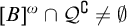 $[B]^{\omega } \cap \mathcal {Q}^{\complement } \neq \emptyset $
.
$[B]^{\omega } \cap \mathcal {Q}^{\complement } \neq \emptyset $
.
Finally, we consider the family of $\mathcal {I}^{+}$
-Ramsey sets
$\mathcal {I}^{+}$
-Ramsey sets $\mathcal {G} = \{ \mathcal {X}_{s} \}_{s\in [\omega ]^{<\omega }} \subseteq \wp ([\omega ]^{\omega })$
defined by
$\mathcal {G} = \{ \mathcal {X}_{s} \}_{s\in [\omega ]^{<\omega }} \subseteq \wp ([\omega ]^{\omega })$
defined by
 $$ \begin{align*} \mathcal{X}_{s} = \begin{cases} [\omega]^{\omega} & \text{ if } s \notin [\omega]^{2} \\ [s] & \text{ if } s \in [\omega]^{2} \text{ and } s\in \bigcup_{n\in\omega} [f_{n}]^{2} \\ \emptyset & \text{ if } s \in [\omega]^{2} \text{ and } s\notin \bigcup_{n\in\omega} [f_{n}]^{2}. \end{cases} \end{align*} $$
Therefore, applying the Suslin operation $\mathcal {A}_{\omega }$
to the collection
$\mathcal {A}_{\omega }$
to the collection $\mathcal {G}$
, we conclude that
$\mathcal {G}$
, we conclude that $\mathcal {A}_{\omega } (\mathcal {G}) = \bigcup _{Z\in [\omega ]^{\omega }} \bigcap _{n\in \omega } \mathcal {X}_{r_{n}(Z)} = \mathcal {Q}$
is not an
$\mathcal {A}_{\omega } (\mathcal {G}) = \bigcup _{Z\in [\omega ]^{\omega }} \bigcap _{n\in \omega } \mathcal {X}_{r_{n}(Z)} = \mathcal {Q}$
is not an $\mathcal {I}^{+}$
-Ramsey set.
$\mathcal {I}^{+}$
-Ramsey set.
5 A semiselective coideal containing no selective ultrafilter
Denote by $\mathrm {CH}$
the continuum hypothesis, and by
$\mathrm {CH}$
the continuum hypothesis, and by $\neg \mathrm {SH}$
the negation of the Suslin hypothesis; thus,
$\neg \mathrm {SH}$
the negation of the Suslin hypothesis; thus, $\mathrm {CH}$
is the statement “
$\mathrm {CH}$
is the statement “ $\mathfrak {c} = \aleph _{1}$
,” and
$\mathfrak {c} = \aleph _{1}$
,” and $\neg \mathrm {SH}$
is the statement “there is a Suslin tree.” With respect to the concepts and techniques used in this section, we suggest the reader to see, for example, [Reference Bartoszynski and Judah3, Reference Halbeisen11, Reference Jech13, Reference Kunen14].
$\neg \mathrm {SH}$
is the statement “there is a Suslin tree.” With respect to the concepts and techniques used in this section, we suggest the reader to see, for example, [Reference Bartoszynski and Judah3, Reference Halbeisen11, Reference Jech13, Reference Kunen14].
At this point, it is worth recalling that a non-principal ultrafilter $\mathcal {U}$
on
$\mathcal {U}$
on $\omega $
is selective if it is a maximal selective coideal. Equivalently,
$\omega $
is selective if it is a maximal selective coideal. Equivalently, $\mathcal {U}$
is selective if for every infinite partition
$\mathcal {U}$
is selective if for every infinite partition $\omega = \bigcup _{n\in \omega } P_{n}$
, with each
$\omega = \bigcup _{n\in \omega } P_{n}$
, with each $P_{n} \notin \mathcal {U}$
, there is
$P_{n} \notin \mathcal {U}$
, there is $X\in \mathcal {U}$
such that
$X\in \mathcal {U}$
such that $|X \cap P_{n}| \leq 1$
for each
$|X \cap P_{n}| \leq 1$
for each $n\in \omega $
.
$n\in \omega $
.
Similarly, it is useful to recall that a non-principal ultrafilter $\mathcal U$
on
$\mathcal U$
on $\omega $
is a p-point if it is a maximal coideal satisfying property
$\omega $
is a p-point if it is a maximal coideal satisfying property $(p)$
, that is,
$(p)$
, that is, $\mathcal U$
is a p-point if for every countable descending chain
$\mathcal U$
is a p-point if for every countable descending chain $\{A_n\}_{n\in \omega }$
of elements of
$\{A_n\}_{n\in \omega }$
of elements of $\mathcal U$
there is
$\mathcal U$
there is $A \in \mathcal U$
such that
$A \in \mathcal U$
such that $A\subseteq ^* A_n$
for each
$A\subseteq ^* A_n$
for each $n\in \omega $
. In particular, every selective ultrafilter is a p-point.
$n\in \omega $
. In particular, every selective ultrafilter is a p-point.
While any decreasing sequence of elements of a selective coideal has a diagonalization in the coideal, in the case of a semiselective coideal $\mathcal {I}^{+}$
, we only have that for any sequence
$\mathcal {I}^{+}$
, we only have that for any sequence $\{\mathcal {D}_{n}\}_{n\in \omega }$
of dense–open sets in
$\{\mathcal {D}_{n}\}_{n\in \omega }$
of dense–open sets in $(\mathcal {I}^{+}, \subseteq )$
, there is at least one decreasing sequence
$(\mathcal {I}^{+}, \subseteq )$
, there is at least one decreasing sequence $\{A_{n}\}_{n\in \omega }$
of elements of
$\{A_{n}\}_{n\in \omega }$
of elements of $\mathcal {I}^{+}$
, such that
$\mathcal {I}^{+}$
, such that $A_{n}\in \mathcal {D}_{n}$
for every
$A_{n}\in \mathcal {D}_{n}$
for every $n\in \omega $
, which has a diagonalization in the coideal
$n\in \omega $
, which has a diagonalization in the coideal $\mathcal {I}^{+}$
. This difference is important when investigating under which conditions semiselective coideals contain selective ultrafilters.
$\mathcal {I}^{+}$
. This difference is important when investigating under which conditions semiselective coideals contain selective ultrafilters.
In [Reference Mathias19, Proposition 0.11], Mathias proved that $\mathrm {CH}$
implies that every selective coideal contains a selective ultrafilter, and we include a proof of this fact to illustrate the difference between selectivity and semiselectivity for ideals.
$\mathrm {CH}$
implies that every selective coideal contains a selective ultrafilter, and we include a proof of this fact to illustrate the difference between selectivity and semiselectivity for ideals.
Proposition 5.1 (Mathias [Reference Mathias19]).
Suppose $\textrm {CH}$
holds. Then, every selective coideal on
$\textrm {CH}$
holds. Then, every selective coideal on $\omega $
contains a selective ultrafilter.
$\omega $
contains a selective ultrafilter.
Proof. Let $\mathcal {I}$
be a selective ideal on
$\mathcal {I}$
be a selective ideal on $\omega $
, so that
$\omega $
, so that $\mathcal {I}$
satisfies the properties
$\mathcal {I}$
satisfies the properties $(p)$
and
$(p)$
and $(q)$
stated in Proposition 2.3. Using
$(q)$
stated in Proposition 2.3. Using $\textrm {CH}$
, list all partitions of
$\textrm {CH}$
, list all partitions of $\omega $
as
$\omega $
as $\{\mathcal A_\alpha : \alpha \in \omega _1\}$
, and for each
$\{\mathcal A_\alpha : \alpha \in \omega _1\}$
, and for each $\alpha \in \omega _1$
, let
$\alpha \in \omega _1$
, let $\mathcal {A}_{\alpha } = \{ A^{\alpha }_{n} : n\in d_{\alpha } \}$
where
$\mathcal {A}_{\alpha } = \{ A^{\alpha }_{n} : n\in d_{\alpha } \}$
where $d_{\alpha }\leq \omega $
.
$d_{\alpha }\leq \omega $
.
We recursively construct an uncountable decreasing sequence $\{X_\alpha \}_{\alpha \in \omega _1}$
on
$\{X_\alpha \}_{\alpha \in \omega _1}$
on $(\mathcal I^+, \subseteq ^*)$
, putting initially
$(\mathcal I^+, \subseteq ^*)$
, putting initially $X_0=\omega $
. Now, let
$X_0=\omega $
. Now, let $\alpha \in \omega _1$
and suppose that we have defined
$\alpha \in \omega _1$
and suppose that we have defined $X_\alpha \in \mathcal {I}^{+}$
. If
$X_\alpha \in \mathcal {I}^{+}$
. If $X_\alpha \cap A^\alpha _n\in \mathcal I^+$
for some
$X_\alpha \cap A^\alpha _n\in \mathcal I^+$
for some $n\in d_{\alpha }$
, put
$n\in d_{\alpha }$
, put $X_{\alpha +1}= X_\alpha \cap A^\alpha _n$
. Otherwise,
$X_{\alpha +1}= X_\alpha \cap A^\alpha _n$
. Otherwise, $\mathcal A_{\alpha }$
must be a partition into infinitely many pieces and
$\mathcal A_{\alpha }$
must be a partition into infinitely many pieces and $X_\alpha \cap A^\alpha _n\in \mathcal {I}$
for all
$X_\alpha \cap A^\alpha _n\in \mathcal {I}$
for all $n\in \omega $
. Consequently, we have that
$n\in \omega $
. Consequently, we have that $\{ X_{\alpha } \setminus \bigcup _{k=0}^{n} A^{\alpha }_{k} \}_{n\in \omega }$
is a decreasing sequence of elements of
$\{ X_{\alpha } \setminus \bigcup _{k=0}^{n} A^{\alpha }_{k} \}_{n\in \omega }$
is a decreasing sequence of elements of $\mathcal {I}^{+} \!\restriction \! X_{\alpha }$
, then by property
$\mathcal {I}^{+} \!\restriction \! X_{\alpha }$
, then by property $(p)$
, there exists some
$(p)$
, there exists some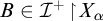 $B\in \mathcal I^+ \!\restriction \! X_{\alpha }$
such that
$B\in \mathcal I^+ \!\restriction \! X_{\alpha }$
such that $B \subseteq ^{*} X_{\alpha } \setminus \bigcup _{k=0}^{n} A^{\alpha }_{k}$
for each
$B \subseteq ^{*} X_{\alpha } \setminus \bigcup _{k=0}^{n} A^{\alpha }_{k}$
for each $n\in \omega $
; thus,
$n\in \omega $
; thus, $B \cap A^{\alpha }_{n}$
is a finite set for every
$B \cap A^{\alpha }_{n}$
is a finite set for every $n\in \omega $
. By property
$n\in \omega $
. By property $(q)$
, let
$(q)$
, let $X_{\alpha +1}\in \mathcal I^+ \!\restriction \! B \subseteq \mathcal I^+ \!\restriction \! X_{\alpha }$
be such that
$X_{\alpha +1}\in \mathcal I^+ \!\restriction \! B \subseteq \mathcal I^+ \!\restriction \! X_{\alpha }$
be such that $|X_{\alpha +1}\cap A^\alpha _n|\leq 1$
for each
$|X_{\alpha +1}\cap A^\alpha _n|\leq 1$
for each $n\in \omega $
. Finally, let
$n\in \omega $
. Finally, let $\lambda \in \omega _1 $
be a countable limit ordinal and suppose that the decreasing sequence
$\lambda \in \omega _1 $
be a countable limit ordinal and suppose that the decreasing sequence $\{X_\alpha \}_{\alpha \in \lambda }$
on
$\{X_\alpha \}_{\alpha \in \lambda }$
on $(\mathcal I^+, \subseteq ^*)$
has been defined. By property
$(\mathcal I^+, \subseteq ^*)$
has been defined. By property $(p)$
, let
$(p)$
, let $X_\lambda \in \mathcal {I}^{+}$
be such that
$X_\lambda \in \mathcal {I}^{+}$
be such that $X_\lambda \subseteq ^* X_\alpha $
for all
$X_\lambda \subseteq ^* X_\alpha $
for all $\alpha \in \lambda $
.
$\alpha \in \lambda $
.
Next, let $\mathcal {U}$
be the filter on
$\mathcal {U}$
be the filter on $\omega $
generated by the sequence
$\omega $
generated by the sequence $\{ X_{\alpha } \}_{\alpha \in \omega _{1}} \subseteq \mathcal {I}^{+}$
, so that
$\{ X_{\alpha } \}_{\alpha \in \omega _{1}} \subseteq \mathcal {I}^{+}$
, so that $\mathcal {U} = \{X\in [\omega ]^{\omega } : (\exists \, \alpha \in \omega _1) ( X_\alpha \subseteq ^{*} X)\}$
and hence
$\mathcal {U} = \{X\in [\omega ]^{\omega } : (\exists \, \alpha \in \omega _1) ( X_\alpha \subseteq ^{*} X)\}$
and hence $\mathcal {U} \subseteq \mathcal {I}^{+}$
. Notice that
$\mathcal {U} \subseteq \mathcal {I}^{+}$
. Notice that $\mathcal {U}$
is an ultrafilter, since for every
$\mathcal {U}$
is an ultrafilter, since for every $A\subseteq \omega $
the pair
$A\subseteq \omega $
the pair $\{A, \omega \setminus A\}$
is a partition
$\{A, \omega \setminus A\}$
is a partition $\mathcal {A}_{\alpha }$
of
$\mathcal {A}_{\alpha }$
of $\omega $
that was considered at some stage
$\omega $
that was considered at some stage $\alpha \in \omega _{1}$
of the construction, then either
$\alpha \in \omega _{1}$
of the construction, then either $X_{\alpha +1} \subseteq A$
or
$X_{\alpha +1} \subseteq A$
or $X_{\alpha +1} \subseteq \omega \setminus A$
. Additionally, the ultrafilter
$X_{\alpha +1} \subseteq \omega \setminus A$
. Additionally, the ultrafilter $\mathcal U$
is selective, since by construction every partition of
$\mathcal U$
is selective, since by construction every partition of $\omega $
into infinitely many pieces outside
$\omega $
into infinitely many pieces outside $\mathcal {U}$
is of the form
$\mathcal {U}$
is of the form $\mathcal A_\alpha $
for some
$\mathcal A_\alpha $
for some $\alpha \in \omega _{1}$
, thus
$\alpha \in \omega _{1}$
, thus $X_{\alpha } \cap A^\alpha _n \in \mathcal {I}$
for all
$X_{\alpha } \cap A^\alpha _n \in \mathcal {I}$
for all $n\in \omega $
, and hence
$n\in \omega $
, and hence $X_{\alpha +1}\in \mathcal U$
satisfies that
$X_{\alpha +1}\in \mathcal U$
satisfies that $|X_{\alpha +1}\cap A^\alpha _n|\leq 1$
for each
$|X_{\alpha +1}\cap A^\alpha _n|\leq 1$
for each $n\in \omega $
.
$n\in \omega $
.
Let us remember some concepts related to trees (see, for example, [Reference Kunen14, Chapter 3]). An $\omega _1$
-tree is a tree of height
$\omega _1$
-tree is a tree of height $\omega _1$
such that all of its levels are countable. A Suslin tree is an
$\omega _1$
such that all of its levels are countable. A Suslin tree is an $\omega _1$
-tree in which all chains and antichains are countable. A tree is rooted if it has a single element in its first level. Suslin’s Hypothesis
$\omega _1$
-tree in which all chains and antichains are countable. A tree is rooted if it has a single element in its first level. Suslin’s Hypothesis $\mathrm {SH}$
can be formulated as “there are no Suslin trees.” So,
$\mathrm {SH}$
can be formulated as “there are no Suslin trees.” So, $\neg \mathrm {SH}$
stands for “there is a Suslin tree.” A Suslin tree T is well pruned if it is rooted and for every
$\neg \mathrm {SH}$
stands for “there is a Suslin tree.” A Suslin tree T is well pruned if it is rooted and for every $t\in T$
the collection of all elements of the tree above t is uncountable. The existence of well pruned Suslin trees follows from
$t\in T$
the collection of all elements of the tree above t is uncountable. The existence of well pruned Suslin trees follows from $\neg \mathrm {SH}$
; thus, if there exists a Suslin tree then there is a well pruned one.
$\neg \mathrm {SH}$
; thus, if there exists a Suslin tree then there is a well pruned one.
We will now show that, under $\mathrm {CH}$
and
$\mathrm {CH}$
and $\neg \mathrm {SH}$
, there is a semiselective coideal that does not contain a p-point, and hence it does not contain a selective ultrafilter. Therefore, in L not every semiselective coideal contains a selective ultrafilter.
$\neg \mathrm {SH}$
, there is a semiselective coideal that does not contain a p-point, and hence it does not contain a selective ultrafilter. Therefore, in L not every semiselective coideal contains a selective ultrafilter.
Theorem 5.2. Suppose $\mathrm {CH}$
holds together with
$\mathrm {CH}$
holds together with $\neg \mathrm {SH}$
. Then, there exists a semiselective coideal on
$\neg \mathrm {SH}$
. Then, there exists a semiselective coideal on $\omega $
that does not contain a p-point.
$\omega $
that does not contain a p-point.
Proof. Assume $\mathrm {CH}$
and let
$\mathrm {CH}$
and let $(\mathcal {S}, \leq )$
be a well pruned Suslin tree. First of all, suppose there exists an order embedding
$(\mathcal {S}, \leq )$
be a well pruned Suslin tree. First of all, suppose there exists an order embedding
 $$ \begin{align*} \varphi: (\mathcal{S}, \leq) \longrightarrow ([\omega]^\omega, ^*\!\supseteq) \end{align*} $$
satisfying the following conditions:
-
(1) For every
$s\in \mathcal S$
and every finite partition
$\varphi (s) = X_0\cup X_1 $
, there is
$t\in \mathcal S$
such that
$t\geq s$
and
$\varphi (t) \subseteq ^* X_i$
for some
$i\in \{0,1\}$
. -
(2) For every
$s\in \mathcal S$
and every infinite partition
$\varphi (s) = \bigcup _{n\in \omega } f_n$
, with each
$f_n$
finite, there is
$t\in \mathcal S$
such that
$t\geq s $
and
$|\varphi (t) \cap f_n|\leq 1$
for each
$n\in \omega $
.









It is important to specify that by an order embedding $\varphi : (\mathcal {S}, \leq ) \rightarrow ([\omega ]^\omega , ^*\!\supseteq )$
we mean that
$\varphi : (\mathcal {S}, \leq ) \rightarrow ([\omega ]^\omega , ^*\!\supseteq )$
we mean that $\varphi $
is an injective function satisfying that
$\varphi $
is an injective function satisfying that $s\leq t$
if and only if
$s\leq t$
if and only if $\varphi (t) \subseteq ^{*} \varphi (s)$
for all
$\varphi (t) \subseteq ^{*} \varphi (s)$
for all $s,t \in \mathcal {S}$
.
$s,t \in \mathcal {S}$
.
Consider the collection $\mathcal {I} =\{ A\subseteq \omega : (\forall \, s\in \mathcal {S}) (\varphi (s) \not \subseteq ^{*} A) \}$
. We show that its complement
$\mathcal {I} =\{ A\subseteq \omega : (\forall \, s\in \mathcal {S}) (\varphi (s) \not \subseteq ^{*} A) \}$
. We show that its complement
 $$ \begin{align*} \mathcal{I}^{+} = \{ A \subseteq \omega : (\exists\, s \in \mathcal{S}) (\varphi(s)\subseteq^{*} A) \} \end{align*} $$
is a semiselective coideal on $\omega $
such that it does not contain a p-point.
$\omega $
such that it does not contain a p-point.
It is easy to verify that $\mathcal I^+$
is a coideal on
$\mathcal I^+$
is a coideal on $\omega $
. Clearly,
$\omega $
. Clearly, $\mathcal I^+$
is a non-empty family of infinite subsets of
$\mathcal I^+$
is a non-empty family of infinite subsets of $\omega $
such that it is closed under taking supersets. Moreover, by condition
$\omega $
such that it is closed under taking supersets. Moreover, by condition $(1)$
of
$(1)$
of $\varphi $
, we deduce that if
$\varphi $
, we deduce that if $A\cup B \in \mathcal {I}^{+}$
then either
$A\cup B \in \mathcal {I}^{+}$
then either $A\in \mathcal {I}^{+}$
or
$A\in \mathcal {I}^{+}$
or $B\in \mathcal {I}^{+}$
.
$B\in \mathcal {I}^{+}$
.
Let us check that the coideal $\mathcal I^+$
is semiselective using Proposition 2.5. Indeed, by condition
$\mathcal I^+$
is semiselective using Proposition 2.5. Indeed, by condition $(2)$
of
$(2)$
of $\varphi $
, clearly
$\varphi $
, clearly $\mathcal I^+$
satisfies property
$\mathcal I^+$
satisfies property $(q)$
. To show that it also satisfies property
$(q)$
. To show that it also satisfies property $(p^w)$
, or equivalently property
$(p^w)$
, or equivalently property $*(p^w)$
according to Fact 4.2, notice that the image under
$*(p^w)$
according to Fact 4.2, notice that the image under $\varphi $
of a maximal antichain of the tree
$\varphi $
of a maximal antichain of the tree $\mathcal S$
is also a maximal antichain in
$\mathcal S$
is also a maximal antichain in $\varphi [\mathcal S]$
, the image of
$\varphi [\mathcal S]$
, the image of $\mathcal S$
under
$\mathcal S$
under $\varphi $
. If
$\varphi $
. If $\mathcal A$
is a maximal antichain in
$\mathcal A$
is a maximal antichain in $\mathcal I^+$
, then the set
$\mathcal I^+$
, then the set $\{X\in \mathcal I^+ : (\exists \, A\in \mathcal A) (X\subseteq ^* A)\}$
is a dense–open subset of
$\{X\in \mathcal I^+ : (\exists \, A\in \mathcal A) (X\subseteq ^* A)\}$
is a dense–open subset of $\mathcal I^+$
, and thus, property
$\mathcal I^+$
, and thus, property $(p^w)$
can be formulated in terms of antichains in the obvious way. Now, given a countable collection
$(p^w)$
can be formulated in terms of antichains in the obvious way. Now, given a countable collection $\mathcal C$
of maximal antichains of the tree
$\mathcal C$
of maximal antichains of the tree $\mathcal S$
, since each antichain of
$\mathcal S$
, since each antichain of $\mathcal S$
is countable, there is a level of the tree
$\mathcal S$
is countable, there is a level of the tree $\mathcal S$
which is above all the antichains in
$\mathcal S$
which is above all the antichains in $\mathcal C$
. Let s be any element of
$\mathcal C$
. Let s be any element of $\mathcal S$
in this level, then for each antichain in the collection
$\mathcal S$
in this level, then for each antichain in the collection $\mathcal C$
we have that
$\mathcal C$
we have that $\varphi (s)$
is below
$\varphi (s)$
is below $\varphi (s')$
for a unique
$\varphi (s')$
for a unique $s'$
in this antichain. Therefore,
$s'$
in this antichain. Therefore, $\varphi (s)$
is a pseudo intersection of the collection of antichains of
$\varphi (s)$
is a pseudo intersection of the collection of antichains of $\varphi [\mathcal S]$
.
$\varphi [\mathcal S]$
.
Let us now show that the semiselective coideal $\mathcal I^+$
does not contain a p-point. Suppose, to reach a contradiction, that
$\mathcal I^+$
does not contain a p-point. Suppose, to reach a contradiction, that $\mathcal U$
is a p-point contained in
$\mathcal U$
is a p-point contained in $\mathcal I^+$
. Then
$\mathcal I^+$
. Then $\mathcal U$
has a filter base of sets of the form
$\mathcal U$
has a filter base of sets of the form $\varphi (s)$
with
$\varphi (s)$
with $s\in \mathcal S$
. If s and t are elements of
$s\in \mathcal S$
. If s and t are elements of $\mathcal S$
such that
$\mathcal S$
such that $\varphi (s)$
and
$\varphi (s)$
and $\varphi (t)$
are members of the filter base, then s and t are comparable in
$\varphi (t)$
are members of the filter base, then s and t are comparable in $\mathcal S$
, since otherwise there would be almost disjoint elements of
$\mathcal S$
, since otherwise there would be almost disjoint elements of $\mathcal U$
, which is impossible. Thus, the set
$\mathcal U$
, which is impossible. Thus, the set $\mathcal C=\{s\in \mathcal S : \varphi (s) \text { belongs to the filter base of } \mathcal U\}$
is a chain in
$\mathcal C=\{s\in \mathcal S : \varphi (s) \text { belongs to the filter base of } \mathcal U\}$
is a chain in $\mathcal S$
. Since
$\mathcal S$
. Since $\mathcal U$
is a p-point, any countable descending chain of elements of
$\mathcal U$
is a p-point, any countable descending chain of elements of $\mathcal {U}$
can be extended in
$\mathcal {U}$
can be extended in $\mathcal {U}$
. Therefore, the chain
$\mathcal {U}$
. Therefore, the chain $\mathcal C$
is not countable, but this contradicts that
$\mathcal C$
is not countable, but this contradicts that $\mathcal S$
is a Suslin tree.
$\mathcal S$
is a Suslin tree.
It remains to show how such an order embedding $\varphi : (\mathcal {S}, \leq ) \rightarrow ([\omega ]^\omega , ^*\!\supseteq )$
satisfying conditions
$\varphi : (\mathcal {S}, \leq ) \rightarrow ([\omega ]^\omega , ^*\!\supseteq )$
satisfying conditions $(1)$
and
$(1)$
and $(2)$
can be constructed. Using
$(2)$
can be constructed. Using $\mathrm {CH}$
, for every
$\mathrm {CH}$
, for every $A\in [\omega ]^\omega $
, let
$A\in [\omega ]^\omega $
, let $\{ A=A_{0,\xi } \cup A_{1,\xi } :\xi \in \omega _1 \}$
be an enumeration of all the finite partitions of A into two infinite subsets in which every such partition is listed uncountably many times; similarly, for every
$\{ A=A_{0,\xi } \cup A_{1,\xi } :\xi \in \omega _1 \}$
be an enumeration of all the finite partitions of A into two infinite subsets in which every such partition is listed uncountably many times; similarly, for every $A\in [\omega ]^\omega $
, let
$A\in [\omega ]^\omega $
, let $\{ A= \bigcup _{j\in \omega } f^{A}_{j, \xi } : \xi \in \omega _1\}$
list all the infinite partitions of A into finite pieces, each partition appearing uncountably many times in the list.
$\{ A= \bigcup _{j\in \omega } f^{A}_{j, \xi } : \xi \in \omega _1\}$
list all the infinite partitions of A into finite pieces, each partition appearing uncountably many times in the list.
The order embedding $\varphi : (\mathcal {S}, \leq ) \rightarrow ([\omega ]^\omega , ^*\!\supseteq )$
will be defined by induction on the levels of the Suslin tree
$\varphi : (\mathcal {S}, \leq ) \rightarrow ([\omega ]^\omega , ^*\!\supseteq )$
will be defined by induction on the levels of the Suslin tree $\mathcal S$
. We can assume that in
$\mathcal S$
. We can assume that in $\mathcal S$
each node has a countably infinite set of immediate successors; also, we will use that if
$\mathcal S$
each node has a countably infinite set of immediate successors; also, we will use that if $\alpha \in \beta \in \omega _1$
, for every node s at level
$\alpha \in \beta \in \omega _1$
, for every node s at level $\alpha $
of the tree
$\alpha $
of the tree $\mathcal S$
there is a node t at level
$\mathcal S$
there is a node t at level $\beta $
of
$\beta $
of $\mathcal {S}$
such that
$\mathcal {S}$
such that $s<t$
.
$s<t$
.
If r is the root of the tree $\mathcal S$
, then we put
$\mathcal S$
, then we put $\varphi (r)=\omega $
. Now, let
$\varphi (r)=\omega $
. Now, let $\alpha \in \omega _1$
and suppose
$\alpha \in \omega _1$
and suppose $\varphi (s)$
has been defined for all
$\varphi (s)$
has been defined for all $s\in \mathcal S$
of level
$s\in \mathcal S$
of level $\leq \alpha $
. List all the nodes belonging to the
$\leq \alpha $
. List all the nodes belonging to the $\alpha $
-th level of
$\alpha $
-th level of $\mathcal S$
as
$\mathcal S$
as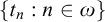 $\{t_n: n\in \omega \}$
, so we will define
$\{t_n: n\in \omega \}$
, so we will define $\varphi $
on the immediate successors of each node
$\varphi $
on the immediate successors of each node $t_n$
by induction on
$t_n$
by induction on $n\in \omega $
.
$n\in \omega $
.
To define $\varphi $
on the immediate successors of
$\varphi $
on the immediate successors of $t_0$
, we split
$t_0$
, we split $\varphi (t_0)$
into
$\varphi (t_0)$
into $\omega $
-many pairwise disjoint infinite subsets
$\omega $
-many pairwise disjoint infinite subsets $\{A_k : k\in \omega \}$
, so that the following holds: for each
$\{A_k : k\in \omega \}$
, so that the following holds: for each $s\in \mathcal S$
with
$s\in \mathcal S$
with $s \leq t_0$
, there are
$s \leq t_0$
, there are $k,k^\prime \in \omega $
, with
$k,k^\prime \in \omega $
, with $k\neq k^\prime $
, such that
$k\neq k^\prime $
, such that $A_k$
is contained in one of the parts of the partition
$A_k$
is contained in one of the parts of the partition $\varphi (s) = \varphi (s)_{0,\alpha } \cup \varphi (s) _{1,\alpha }$
, and
$\varphi (s) = \varphi (s)_{0,\alpha } \cup \varphi (s) _{1,\alpha }$
, and $A_{k^\prime }$
is a selector for the partition
$A_{k^\prime }$
is a selector for the partition $\varphi (s)= \bigcup _{j\in \omega } f^{\varphi (s)}_{j, \alpha }$
, that is,
$\varphi (s)= \bigcup _{j\in \omega } f^{\varphi (s)}_{j, \alpha }$
, that is,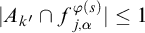 $|A_{k^\prime } \cap f^{\varphi (s)}_{j, \alpha }| \leq 1$
for each
$|A_{k^\prime } \cap f^{\varphi (s)}_{j, \alpha }| \leq 1$
for each $j\in \omega $
. This can be done as follows:
$j\in \omega $
. This can be done as follows:
List as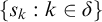 $\{s_k : k\in \delta \}$
, with
$\{s_k : k\in \delta \}$
, with $\delta \leq \omega $
, the collection of all the nodes
$\delta \leq \omega $
, the collection of all the nodes $s\in \mathcal S$
such that
$s\in \mathcal S$
such that ${s \leq t_0}$
; then, since
${s \leq t_0}$
; then, since $\varphi (t_0) \subseteq ^* \varphi (s_0)$
, there is an infinite set
$\varphi (t_0) \subseteq ^* \varphi (s_0)$
, there is an infinite set $A_0\subseteq \varphi (t_0)$
such that
$A_0\subseteq \varphi (t_0)$
such that ${\varphi (t_0)\setminus A_0}$
is also infinite and either
${\varphi (t_0)\setminus A_0}$
is also infinite and either $A_0\subseteq \varphi (s_0)_{0,\alpha }$
or
$A_0\subseteq \varphi (s_0)_{0,\alpha }$
or $A_0\subseteq \varphi (s_0)_{1,\alpha }$
; likewise, there is an infinite set
$A_0\subseteq \varphi (s_0)_{1,\alpha }$
; likewise, there is an infinite set $A_1\subseteq \varphi (t_0)\setminus A_0$
such that
$A_1\subseteq \varphi (t_0)\setminus A_0$
such that $\varphi (t_0)\setminus (A_0\cup A_1)$
is also infinite and
$\varphi (t_0)\setminus (A_0\cup A_1)$
is also infinite and $A_1$
is a selector for the partition
$A_1$
is a selector for the partition $\varphi (s_0)=\bigcup _{j\in \omega } f_{j, \alpha }^{\varphi (s_0)}$
. Now, repeat the process for
$\varphi (s_0)=\bigcup _{j\in \omega } f_{j, \alpha }^{\varphi (s_0)}$
. Now, repeat the process for $s_1$
and
$s_1$
and $\varphi (t_0)\setminus (A_0\cup A_1)$
to obtain infinite sets
$\varphi (t_0)\setminus (A_0\cup A_1)$
to obtain infinite sets $A_2$
and
$A_2$
and $A_3$
such that
$A_3$
such that $A_2\subseteq \varphi (t_0)\setminus (A_0\cup A_1)$
,
$A_2\subseteq \varphi (t_0)\setminus (A_0\cup A_1)$
, $\varphi (t_0)\setminus (A_0\cup A_1\cup A_2)$
is infinite, and
$\varphi (t_0)\setminus (A_0\cup A_1\cup A_2)$
is infinite, and $A_2\subseteq \varphi (s_1)_{0,\alpha }$
or
$A_2\subseteq \varphi (s_1)_{0,\alpha }$
or $A_2\subseteq \varphi (s_1)_{1,\alpha }$
; also,
$A_2\subseteq \varphi (s_1)_{1,\alpha }$
; also, $A_3\subseteq \varphi (t_0)\setminus (A_0\cup A_1\cup A_2)$
,
$A_3\subseteq \varphi (t_0)\setminus (A_0\cup A_1\cup A_2)$
, $\varphi (t_0)\setminus (A_0\cup A_1\cup A_2\cup A_3)$
is infinite, and
$\varphi (t_0)\setminus (A_0\cup A_1\cup A_2\cup A_3)$
is infinite, and $A_3$
is a selector for the partition
$A_3$
is a selector for the partition $\varphi (s_1)= \bigcup _{j\in \omega } f^{\varphi (s_1)}_{j,\alpha }$
. If the sequence
$\varphi (s_1)= \bigcup _{j\in \omega } f^{\varphi (s_1)}_{j,\alpha }$
. If the sequence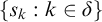 $\{s_k: k\in \delta \}$
is infinite, continuing this way we get a family
$\{s_k: k\in \delta \}$
is infinite, continuing this way we get a family $\{A_k : k\in \omega \}$
of pairwise disjoint subsets of
$\{A_k : k\in \omega \}$
of pairwise disjoint subsets of $\varphi (t_0)$
; so, the
$\varphi (t_0)$
; so, the $\omega $
-many immediate successors of
$\omega $
-many immediate successors of $t_0$
in the tree
$t_0$
in the tree $\mathcal S$
are then sent by
$\mathcal S$
are then sent by $\varphi $
to these
$\varphi $
to these $\omega $
-many subsets of
$\omega $
-many subsets of $\varphi (t_0)$
. If the sequence
$\varphi (t_0)$
. If the sequence $\{s_k: k\in \delta \}$
is finite, once we obtain the sets
$\{s_k: k\in \delta \}$
is finite, once we obtain the sets $A_i$
for
$A_i$
for $i\in 2\delta $
with
$i\in 2\delta $
with $\delta <\omega $
, partition the remaining infinite subset of
$\delta <\omega $
, partition the remaining infinite subset of $\varphi (t_0)$
into infinitely many infinite subsets to complete the collection
$\varphi (t_0)$
into infinitely many infinite subsets to complete the collection $\{A_k : k\in \omega \}$
.
$\{A_k : k\in \omega \}$
.
If $\varphi $
has been defined on the immediate successors of each node
$\varphi $
has been defined on the immediate successors of each node $t_0, \ldots , t_n$
, then to define
$t_0, \ldots , t_n$
, then to define $\varphi $
on the immediate successors of
$\varphi $
on the immediate successors of $t_{n+1}$
, we repeat the previous process with
$t_{n+1}$
, we repeat the previous process with $t_{n+1}$
and the list
$t_{n+1}$
and the list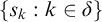 $\{s_k: k\in \delta \}$
, with
$\{s_k: k\in \delta \}$
, with $\delta \leq \omega $
, consisting of all the nodes
$\delta \leq \omega $
, consisting of all the nodes $s\in \mathcal S$
such that
$s\in \mathcal S$
such that $s \leq t_{n+1}$
and
$s \leq t_{n+1}$
and $s\not \leq t_m$
for any
$s\not \leq t_m$
for any $m\in \{0, \ldots , n\}$
.
$m\in \{0, \ldots , n\}$
.
Finally, let $\lambda \in \omega _1$
be a countable limit ordinal, and suppose
$\lambda \in \omega _1$
be a countable limit ordinal, and suppose $\varphi (s)$
has been defined for all
$\varphi (s)$
has been defined for all $s\in \mathcal S$
of level
$s\in \mathcal S$
of level $<\lambda $
. Then, if t is a node in the
$<\lambda $
. Then, if t is a node in the $\lambda $
-th level of
$\lambda $
-th level of $\mathcal S$
, define
$\mathcal S$
, define $\varphi (t)$
as a pseudo intersection of the countable collection
$\varphi (t)$
as a pseudo intersection of the countable collection $\{ \varphi (s) : s<t \}$
, that is,
$\{ \varphi (s) : s<t \}$
, that is, $\varphi (t) \subseteq ^{*} \varphi (s)$
for every
$\varphi (t) \subseteq ^{*} \varphi (s)$
for every $s<t$
. In this way, the induction on the levels of the Suslin tree
$s<t$
. In this way, the induction on the levels of the Suslin tree $\mathcal S$
is completed, and we have constructed an order embedding
$\mathcal S$
is completed, and we have constructed an order embedding $\varphi : (\mathcal {S}, \leq ) \rightarrow ([\omega ]^\omega , ^*\!\supseteq )$
satisfying conditions
$\varphi : (\mathcal {S}, \leq ) \rightarrow ([\omega ]^\omega , ^*\!\supseteq )$
satisfying conditions $(1)$
and
$(1)$
and $(2)$
.
$(2)$
.
Theorem 5.3. Suppose $\mathrm {CH}$
holds together with
$\mathrm {CH}$
holds together with $\neg \mathrm {SH}$
. Then, there exists a semiselective coideal on
$\neg \mathrm {SH}$
. Then, there exists a semiselective coideal on $\omega $
that does not contain a selective ultrafilter.
$\omega $
that does not contain a selective ultrafilter.
Proof. This result is a straightforward consequence of Theorem 5.2 together with the well-known fact that every selective ultrafilter is a p-point.
6 Every semiselective coideal contains a selective ultrafilter
In this section, we show that it is consistent with $\textrm {ZFC}$
that every semiselective coideal on
$\textrm {ZFC}$
that every semiselective coideal on $\omega $
contains a selective ultrafilter. For this section, some familiarity with the main concepts and ideas of forcing will be convenient, and we suggest the reader to see, for example, [Reference Bartoszynski and Judah3, Reference Halbeisen11, Reference Jech13, Reference Kunen14, Reference Shelah23].
$\omega $
contains a selective ultrafilter. For this section, some familiarity with the main concepts and ideas of forcing will be convenient, and we suggest the reader to see, for example, [Reference Bartoszynski and Judah3, Reference Halbeisen11, Reference Jech13, Reference Kunen14, Reference Shelah23].
Theorem 6.1. It is consistent with $\mathrm {ZFC}$
that for every semiselective ideal
$\mathrm {ZFC}$
that for every semiselective ideal $\mathcal I$
on
$\mathcal I$
on $\omega $
, the coideal
$\omega $
, the coideal $\mathcal I^+$
contains a selective ultrafilter.
$\mathcal I^+$
contains a selective ultrafilter.
The proof of this theorem is given in Section 6.2, and we only describe here the line of the argument. If $\mathcal I$
is a semiselective ideal, forcing with
$\mathcal I$
is a semiselective ideal, forcing with $(\mathcal I^+, \subseteq ^*)$
adds a selective ultrafilter contained in
$(\mathcal I^+, \subseteq ^*)$
adds a selective ultrafilter contained in $\mathcal I^+$
. Starting with
$\mathcal I^+$
. Starting with $V=L$
, we iterate forcing with semiselective coideals to reach a generic extension for which every semiselective coideal is used at some stage of the iteration to add a selective ultrafilter contained in it. We have to make sure that this selective ultrafilter remains a selective ultrafilter until the end of the iteration. In the next section, we present the preservation results that we will use for this purpose.
$V=L$
, we iterate forcing with semiselective coideals to reach a generic extension for which every semiselective coideal is used at some stage of the iteration to add a selective ultrafilter contained in it. We have to make sure that this selective ultrafilter remains a selective ultrafilter until the end of the iteration. In the next section, we present the preservation results that we will use for this purpose.
6.1 Some preservation results
The notion of proper forcing was introduced by Shelah in [Reference Shelah22], and its study was continued in [Reference Shelah23], where proofs of the preservation results stated below can be found. In particular that properness is preserved by countable support iterations, that is, if $\mathbb P_\alpha $
is a countable support iteration of
$\mathbb P_\alpha $
is a countable support iteration of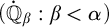 ${(\dot {\mathbb Q}_\beta : \beta <\alpha )}$
, and for each
${(\dot {\mathbb Q}_\beta : \beta <\alpha )}$
, and for each $\beta <\alpha $
we have
$\beta <\alpha $
we have $1_\beta \Vdash \dot {\mathbb Q}_{\beta }$
is proper, then
$1_\beta \Vdash \dot {\mathbb Q}_{\beta }$
is proper, then $\mathbb P_\alpha $
is proper (see [Reference Abraham, Foreman and Kanamori1, Theorem 2.7]). Also,
$\mathbb P_\alpha $
is proper (see [Reference Abraham, Foreman and Kanamori1, Theorem 2.7]). Also, $\omega ^\omega $
-boundedness is preserved (see [Reference Goldstern and Judah10, Application 6.1]) as well as p-points are preserved (see [Reference Blass and Shelah5, Theorem 4.1]).
$\omega ^\omega $
-boundedness is preserved (see [Reference Goldstern and Judah10, Application 6.1]) as well as p-points are preserved (see [Reference Blass and Shelah5, Theorem 4.1]).
Next, we present some preservation results leading to Corollary 6.5 that will be used in the proof of Theorem 6.1.
Proposition 6.2 (See Goldstern [Reference Goldstern and Judah10]).
If $\mathbb P_\alpha $
is a countable support iteration of
$\mathbb P_\alpha $
is a countable support iteration of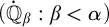 $(\dot {\mathbb Q}_\beta : \beta <\alpha )$
, and for each
$(\dot {\mathbb Q}_\beta : \beta <\alpha )$
, and for each $\beta <\alpha $
 $$ \begin{align*} 1_\beta\Vdash \dot{\mathbb Q}_\beta \text{ is proper and } \omega^\omega \text{-bounding}, \end{align*} $$
then $\mathbb P_\alpha $
is proper and
$\mathbb P_\alpha $
is proper and $\omega ^\omega $
-bounding.
$\omega ^\omega $
-bounding.
Proposition 6.3 (Blass–Shelah [Reference Blass and Shelah5]).
If $\mathbb P_\alpha $
is a countable support iteration of
$\mathbb P_\alpha $
is a countable support iteration of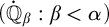 $(\dot {\mathbb Q}_\beta : \beta <\alpha )$
, and for each
$(\dot {\mathbb Q}_\beta : \beta <\alpha )$
, and for each $\beta <\alpha $
 $$ \begin{align*} 1_\beta \Vdash \dot{\mathbb Q }_\beta \text{ is proper and preserves p-points}, \end{align*} $$
then $\mathbb P_\alpha $
is proper and preserves p-points.
$\mathbb P_\alpha $
is proper and preserves p-points.
Let $\mathcal U$
be a selective ultrafilter in V and let
$\mathcal U$
be a selective ultrafilter in V and let $\mathbb P$
be a forcing notion, we say that
$\mathbb P$
be a forcing notion, we say that $\mathbb P$
preserves
$\mathbb P$
preserves $\mathcal U$
if
$\mathcal U$
if $\mathcal U$
generates a selective ultrafilter in any
$\mathcal U$
generates a selective ultrafilter in any $\mathbb P$
-generic extension
$\mathbb P$
-generic extension $V[G]$
. The following result is used to prove the preservation of selective ultrafilters (see [Reference Halbeisen11, Lemma 21.12]).
$V[G]$
. The following result is used to prove the preservation of selective ultrafilters (see [Reference Halbeisen11, Lemma 21.12]).
Proposition 6.4 (See Halbeisen [Reference Halbeisen11]).
If $\mathbb P$
is proper and
$\mathbb P$
is proper and $\omega ^\omega $
-bounding, and
$\omega ^\omega $
-bounding, and $\mathcal U$
is a selective ultrafilter in V which generates an ultrafilter
$\mathcal U$
is a selective ultrafilter in V which generates an ultrafilter $\hat {\mathcal U}$
in the
$\hat {\mathcal U}$
in the $\mathbb P$
-generic extension
$\mathbb P$
-generic extension $V[G]$
, then
$V[G]$
, then $\hat {\mathcal U}$
is selective in
$\hat {\mathcal U}$
is selective in $V[G]$
.
$V[G]$
.
As an immediate consequence of the preceding three propositions, the following preservation result can be deduced (see [Reference Halbeisen11, Corollary 21.13]).
Corollary 6.5 (See Halbeisen [Reference Halbeisen11]).
Let $\mathcal U$
be a selective ultrafilter in V, and let
$\mathcal U$
be a selective ultrafilter in V, and let $\mathbb P_\alpha $
be a countable support iteration of
$\mathbb P_\alpha $
be a countable support iteration of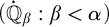 $(\dot {\mathbb Q}_\beta : \beta <\alpha )$
such that for each
$(\dot {\mathbb Q}_\beta : \beta <\alpha )$
such that for each $\beta <\alpha $
 $$ \begin{align*} 1_\beta \Vdash \dot{\mathbb Q}_\beta \text{ is proper, } \omega^\omega\text{-bounding, and preserves } \mathcal U, \end{align*} $$
then $\mathbb P_\alpha $
preserves
$\mathbb P_\alpha $
preserves $\mathcal U$
.
$\mathcal U$
.
Furthermore, in the proof of Theorem 6.1, we will also make use of the following preservation result (see [Reference Halbeisen11, Lemma 21.6]).
Lemma 6.6 (See Halbeisen [Reference Halbeisen11]).
Let $\mathbb P_{\omega _2}$
be a countable support iteration of
$\mathbb P_{\omega _2}$
be a countable support iteration of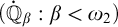 $(\dot {\mathbb Q}_\beta : \beta <\omega _2)$
such that for each
$(\dot {\mathbb Q}_\beta : \beta <\omega _2)$
such that for each $\beta <\omega _2$
 $$ \begin{align*} 1_\beta \Vdash \dot{\mathbb Q}_\beta \text{ is a proper forcing notion of size} \leq\mathfrak{c}. \end{align*} $$
If $\mathrm {CH}$
holds in the ground model, then
$\mathrm {CH}$
holds in the ground model, then $1_\beta \Vdash \mathrm {CH}$
for all
$1_\beta \Vdash \mathrm {CH}$
for all $\beta <\omega _ 2$
.
$\beta <\omega _ 2$
.
It is well-known that if $\mathcal I$
is a semiselective ideal, forcing with
$\mathcal I$
is a semiselective ideal, forcing with $(\mathcal I^+, \subseteq ^*)$
adds a selective ultrafilter contained in
$(\mathcal I^+, \subseteq ^*)$
adds a selective ultrafilter contained in $\mathcal I^+$
(see [Reference Farah8, Lemma 4.1]). The semiselectivity of
$\mathcal I^+$
(see [Reference Farah8, Lemma 4.1]). The semiselectivity of $\mathcal I$
implies that the forcing
$\mathcal I$
implies that the forcing $(\mathcal I^+, \subseteq ^*)$
is
$(\mathcal I^+, \subseteq ^*)$
is $\sigma $
-distributive, so it does not add new reals (see [Reference Jech13, Theorem 15.6]). The semiselectivity of
$\sigma $
-distributive, so it does not add new reals (see [Reference Jech13, Theorem 15.6]). The semiselectivity of $\mathcal I$
also gives that
$\mathcal I$
also gives that $(\mathcal I^+, \subseteq ^*)$
is proper. To see this, let
$(\mathcal I^+, \subseteq ^*)$
is proper. To see this, let $\theta $
be sufficiently large and
$\theta $
be sufficiently large and $(\mathcal I^+, \subseteq ^*)\in M \preccurlyeq H(\theta )$
with M countable. Let
$(\mathcal I^+, \subseteq ^*)\in M \preccurlyeq H(\theta )$
with M countable. Let $\{\mathcal {D}_n \}_{n\in \omega }$
list all the dense–open subsets of
$\{\mathcal {D}_n \}_{n\in \omega }$
list all the dense–open subsets of $\mathcal I^+$
. For
$\mathcal I^+$
. For $A\in \mathcal I^+$
in M there is a diagonalization
$A\in \mathcal I^+$
in M there is a diagonalization $B\in \mathcal I^+\!\restriction \! A$
of
$B\in \mathcal I^+\!\restriction \! A$
of $\{\mathcal {D}_n\}_{n\in \omega }$
, then the condition B is
$\{\mathcal {D}_n\}_{n\in \omega }$
, then the condition B is $(M,(\mathcal I^+, \subseteq ^*))$
-generic. Hence
$(M,(\mathcal I^+, \subseteq ^*))$
-generic. Hence $(\mathcal I^+, \subseteq ^*)$
is
$(\mathcal I^+, \subseteq ^*)$
is $\omega ^\omega $
-bounding and preserves p-points.
$\omega ^\omega $
-bounding and preserves p-points.
6.2 The consistency result
What we are mainly concerned with here is the proof of Theorem 6.1. First of all, we present some essential preliminaries related to a diamond principle (see, for example, [Reference Kunen14, Chapter 7]).
Let $S^2_1=\{\alpha \in \omega _2 : \mathrm {cof}(\alpha ) =\omega _1\}$
the stationary subset of all ordinals below
$S^2_1=\{\alpha \in \omega _2 : \mathrm {cof}(\alpha ) =\omega _1\}$
the stationary subset of all ordinals below $\omega _2$
of cofinality
$\omega _2$
of cofinality $\omega _1$
. A sequence
$\omega _1$
. A sequence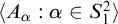 $\langle A_\alpha : \alpha \in S^2_1 \rangle $
of subsets of
$\langle A_\alpha : \alpha \in S^2_1 \rangle $
of subsets of $\omega _2$
is a
$\omega _2$
is a $\diamondsuit (S^2_1)$
-sequence if
$\diamondsuit (S^2_1)$
-sequence if $A_\alpha \subseteq \alpha $
for each
$A_\alpha \subseteq \alpha $
for each $\alpha \in S^2_1$
and for every
$\alpha \in S^2_1$
and for every $A\subseteq \omega _2$
the set
$A\subseteq \omega _2$
the set $\{\alpha \in S^2_1 : A\cap \alpha = A_\alpha \}$
is stationary. Denote by
$\{\alpha \in S^2_1 : A\cap \alpha = A_\alpha \}$
is stationary. Denote by $\diamondsuit (S^2_1)$
the statement that a
$\diamondsuit (S^2_1)$
the statement that a $\diamondsuit (S^2_1)$
-sequence exists, and recall that
$\diamondsuit (S^2_1)$
-sequence exists, and recall that $L\models \diamondsuit (S^2_1)$
.
$L\models \diamondsuit (S^2_1)$
.
Without further ado, we now proceed with the proof of Theorem 6.1, which states the consistency with $\mathrm {ZFC}$
that every semiselective coideal contains a selective ultrafilter.
$\mathrm {ZFC}$
that every semiselective coideal contains a selective ultrafilter.
Proof of Theorem 6.1.
We work under $V=L$
. We set up a countable support iteration
$V=L$
. We set up a countable support iteration $\mathbb P_{\omega _2}=(\mathbb P_\alpha , \dot {\mathbb Q}_\alpha : \alpha <\omega _2)$
such that for each
$\mathbb P_{\omega _2}=(\mathbb P_\alpha , \dot {\mathbb Q}_\alpha : \alpha <\omega _2)$
such that for each $\beta \in S^2_1$
 $$ \begin{align*} {1}_\beta \Vdash \dot{\mathbb Q}_\beta \text{ is the forcing by a semiselective coideal}, \end{align*} $$
so at stage $\beta \in S^2_1$
, a selective ultrafilter contained in the semiselective coideal named by
$\beta \in S^2_1$
, a selective ultrafilter contained in the semiselective coideal named by $\dot {\mathbb Q}_\beta $
is added.
$\dot {\mathbb Q}_\beta $
is added.
At each step of the iteration we have a model satisfying $\textrm {CH}$
, but
$\textrm {CH}$
, but $\textrm {CH}$
might not hold in the final model. For reasons related to the analysis of certain names for objects in the final model it will be convenient to have that
$\textrm {CH}$
might not hold in the final model. For reasons related to the analysis of certain names for objects in the final model it will be convenient to have that $\mathfrak {c} = \omega _2$
in the final model, and we can get this by cofinally iterating with Sacks forcing, which is proper,
$\mathfrak {c} = \omega _2$
in the final model, and we can get this by cofinally iterating with Sacks forcing, which is proper, $\omega ^\omega \text {-bounding}$
, adds reals, and preserves
$\omega ^\omega \text {-bounding}$
, adds reals, and preserves $\textrm {CH}$
(see [Reference Halbeisen11, Chapter 23]).
$\textrm {CH}$
(see [Reference Halbeisen11, Chapter 23]).
For every ordinal $\beta <\omega _2$
of countable cofinality, that is,
$\beta <\omega _2$
of countable cofinality, that is,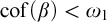 $\mathrm {cof}(\beta )<\omega _1$
, we use Sacks forcing,
$\mathrm {cof}(\beta )<\omega _1$
, we use Sacks forcing,
 $$ \begin{align*} {1}_\beta \Vdash \dot{\mathbb Q}_\beta \text{ is Sacks forcing}, \end{align*} $$
and for other ordinals $\alpha $
, let
$\alpha $
, let $\dot {\mathbb Q}_\alpha $
be a name for the trivial partial order
$\dot {\mathbb Q}_\alpha $
be a name for the trivial partial order $\{\emptyset \}$
.
$\{\emptyset \}$
.
We use the diamond principle $\diamondsuit (S^2_1)$
to get that every semiselective coideal in the
$\diamondsuit (S^2_1)$
to get that every semiselective coideal in the $\mathbb P_{\omega _2}$
-generic extension is used at some stage of the iteration at which a selective ultrafilter contained in it is added. Corollary 6.5 can be applied to prove that this ultrafilter remains a selective ultrafilter until the iteration is completed. At each step of the iteration, by Lemma 6.6 we have that
$\mathbb P_{\omega _2}$
-generic extension is used at some stage of the iteration at which a selective ultrafilter contained in it is added. Corollary 6.5 can be applied to prove that this ultrafilter remains a selective ultrafilter until the iteration is completed. At each step of the iteration, by Lemma 6.6 we have that $\textrm {CH}$
is preserved, and since reals are added in cofinally many steps, we get
$\textrm {CH}$
is preserved, and since reals are added in cofinally many steps, we get $\mathfrak {c} = \omega _2$
in the final generic extension.
$\mathfrak {c} = \omega _2$
in the final generic extension.
We want to show that if G is $\mathbb P_{\omega _2}$
-generic over V, in the generic extension
$\mathbb P_{\omega _2}$
-generic over V, in the generic extension $V[G]$
we have that every semiselective coideal contains a selective ultrafilter. For this we first need to analyze names for coideals in
$V[G]$
we have that every semiselective coideal contains a selective ultrafilter. For this we first need to analyze names for coideals in $V[G]$
; in particular, we will see that names for coideals in
$V[G]$
; in particular, we will see that names for coideals in $V[G]$
can be coded by subsets of
$V[G]$
can be coded by subsets of $\omega _2$
.
$\omega _2$
.
A coideal in $V[G]$
, being a family of infinite subsets of
$V[G]$
, being a family of infinite subsets of $\omega $
, can be coded by a subset of
$\omega $
, can be coded by a subset of $\omega \times \omega _2$
. Therefore, via this coding, every coideal in
$\omega \times \omega _2$
. Therefore, via this coding, every coideal in $V[G]$
has a name that is a nice name for a subset of
$V[G]$
has a name that is a nice name for a subset of $\omega \times \omega _2$
. Fixing a bijection in the ground model between
$\omega \times \omega _2$
. Fixing a bijection in the ground model between $\omega \times \omega _2$
and
$\omega \times \omega _2$
and $\omega _2$
, we can think that every coideal in
$\omega _2$
, we can think that every coideal in $V[G]$
has a
$V[G]$
has a $\mathbb P_{\omega _2}$
-name which is a nice name for a subset of
$\mathbb P_{\omega _2}$
-name which is a nice name for a subset of $\omega _2$
; in other words, it is of the form
$\omega _2$
; in other words, it is of the form $\bigcup _{\beta <\omega _2} ( \{\beta \}\times C_\beta )$
, where each
$\bigcup _{\beta <\omega _2} ( \{\beta \}\times C_\beta )$
, where each $C_\beta $
is a maximal antichain of
$C_\beta $
is a maximal antichain of $\mathbb P_{\omega _2}$
.
$\mathbb P_{\omega _2}$
.
To see that such a name can be coded by a subset of $\omega _2$
, we analyze the sizes of maximal antichains in
$\omega _2$
, we analyze the sizes of maximal antichains in $\mathbb P_{\omega _2}$
. It is well-known that any countable support iteration of length
$\mathbb P_{\omega _2}$
. It is well-known that any countable support iteration of length $\leq \omega _2$
of proper forcings of size
$\leq \omega _2$
of proper forcings of size $\aleph _1$
has the
$\aleph _1$
has the $\aleph _2$
-cc (see [Reference Abraham, Foreman and Kanamori1, Theorem 2.10]).
$\aleph _2$
-cc (see [Reference Abraham, Foreman and Kanamori1, Theorem 2.10]).
We then have that a nice $\mathbb P_{\omega _2}$
-name for a subset of
$\mathbb P_{\omega _2}$
-name for a subset of $\omega _2$
uses at most
$\omega _2$
uses at most $\omega _2$
conditions, the same holds for a nice name for (the set coding) a coideal
$\omega _2$
conditions, the same holds for a nice name for (the set coding) a coideal $\mathcal H$
; so, it can be coded by a subset of
$\mathcal H$
; so, it can be coded by a subset of $\omega _2$
. Therefore, we can use a
$\omega _2$
. Therefore, we can use a $\diamondsuit (S^2_1)$
-sequence
$\diamondsuit (S^2_1)$
-sequence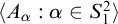 $\langle A_\alpha : \alpha \in S^2_1 \rangle $
to guess names for coideals in the generic extension
$\langle A_\alpha : \alpha \in S^2_1 \rangle $
to guess names for coideals in the generic extension $V[G]$
.
$V[G]$
.
Let $\mathcal H\in V[G]$
be a semiselective coideal, and let
$\mathcal H\in V[G]$
be a semiselective coideal, and let $\dot {\mathcal H}$
be a
$\dot {\mathcal H}$
be a $\mathbb P_{\omega _2}$
-name for
$\mathbb P_{\omega _2}$
-name for $\mathcal H$
, and let
$\mathcal H$
, and let $A\subseteq \omega _2$
be a set that codes
$A\subseteq \omega _2$
be a set that codes $\dot {\mathcal H}$
. Then, by
$\dot {\mathcal H}$
. Then, by $\diamondsuit (S^2_1)$
the set
$\diamondsuit (S^2_1)$
the set $S= \{\alpha \in S^2_1: A\cap \alpha =A_\alpha \}$
is stationary.
$S= \{\alpha \in S^2_1: A\cap \alpha =A_\alpha \}$
is stationary.
Take an ordinal $\theta $
large enough, for instance,
$\theta $
large enough, for instance, $\theta =\omega _3$
, so that
$\theta =\omega _3$
, so that $L_\theta $
contains all that is relevant for the argument, namely,
$L_\theta $
contains all that is relevant for the argument, namely, $\mathbb P_{\omega _2}$
,
$\mathbb P_{\omega _2}$
, $\dot {\mathcal H}$
, and A. Next, we consider a chain
$\dot {\mathcal H}$
, and A. Next, we consider a chain $\langle M_\alpha : \alpha <\omega _2\rangle $
such that:
$\langle M_\alpha : \alpha <\omega _2\rangle $
such that:
-
(1)
$M_0=\emptyset $
; -
(2) for every
$1<\alpha <\omega _2$
:
$M_\alpha \prec L_\theta $
;
$\mathbb P_{\omega _2}, \dot {\mathcal H}, A\in M_\alpha $
;
$|M_\alpha |=\omega _1$
; and
$[M_\alpha ]^\omega \subseteq M_\alpha $
(so
$\omega _1\subseteq M_\alpha $
); -
(3) if
$\alpha <\beta <\omega _2$
, then
$M_\alpha \in M_\beta $
and
$M_\alpha \subseteq M_\beta $
; -
(4) if
$\lambda <\omega _2$
is a limit ordinal, then
$M_\lambda =\bigcup _{\alpha <\lambda } M_\alpha $
.










For any such structure $N=M_\alpha $
with
$N=M_\alpha $
with $1<\alpha <\omega _2$
, all subsets of
$1<\alpha <\omega _2$
, all subsets of $\omega $
belong to N, and
$\omega $
belong to N, and $\omega _2\cap N$
is an ordinal less than
$\omega _2\cap N$
is an ordinal less than $\omega _2$
. By elementarity,
$\omega _2$
. By elementarity,
 $$ \begin{align*} N\models A \text{ codes } \dot{\mathcal H} \text{ and } \dot{\mathcal H} \text{ is a } \mathbb P_{\omega_2}\text{-name for a semiselective coideal}, \end{align*} $$
so $A\cap N$
codes a
$A\cap N$
codes a $\mathbb P_{N\cap \omega _2}$
-name for a semiselective coideal, namely,
$\mathbb P_{N\cap \omega _2}$
-name for a semiselective coideal, namely, $\dot {\mathcal H}\cap N$
. Additionally, the collection
$\dot {\mathcal H}\cap N$
. Additionally, the collection $C= \{ M_\alpha \cap \omega _2 : \alpha <\omega _2\}$
is a closed unbounded subset of
$C= \{ M_\alpha \cap \omega _2 : \alpha <\omega _2\}$
is a closed unbounded subset of $\omega _2$
.
$\omega _2$
.
Let $\alpha \in S\cap C$
, then
$\alpha \in S\cap C$
, then $A\cap \alpha =A_\alpha $
and
$A\cap \alpha =A_\alpha $
and $A\cap \alpha $
codes a name for a semiselective coideal, and this name is
$A\cap \alpha $
codes a name for a semiselective coideal, and this name is $\dot {\mathcal H}$
restricted to some ordinal of the form
$\dot {\mathcal H}$
restricted to some ordinal of the form $\omega _2\cap M_\beta $
. At stage
$\omega _2\cap M_\beta $
. At stage $\alpha $
of the iteration,
$\alpha $
of the iteration, $\dot {\mathbb Q}_\alpha $
is this name, and we forced with it adding a selective ultrafilter contained in
$\dot {\mathbb Q}_\alpha $
is this name, and we forced with it adding a selective ultrafilter contained in $\mathcal H\cap V[G_\alpha ]$
. By Corollary 6.5, this selective ultrafilter remains a selective ultrafilter until the end of the iteration; therefore, in
$\mathcal H\cap V[G_\alpha ]$
. By Corollary 6.5, this selective ultrafilter remains a selective ultrafilter until the end of the iteration; therefore, in $V[G]$
it is a selective ultrafilter contained in
$V[G]$
it is a selective ultrafilter contained in $\mathcal H$
. We have thus completed a proof of Theorem 6.1.
$\mathcal H$
. We have thus completed a proof of Theorem 6.1.
As a final comment, we mention that the following two questions about semiselective ideals containing selective ultrafilters remain open.
Question 6.7. Can the hypothesis $\neg \mathrm {SH}$
be eliminated in Theorem 5.3? In other words, does
$\neg \mathrm {SH}$
be eliminated in Theorem 5.3? In other words, does $\mathrm {CH}$
imply that there are semiselective coideals that do not contain a selective ultrafilter?
$\mathrm {CH}$
imply that there are semiselective coideals that do not contain a selective ultrafilter?
Question 6.8. In the iteration used to prove Theorem 6.1, although the iterands at stages of uncountable cofinality add no new reals, in the final model the continuum hypothesis does not hold, so the following question arises: Is it consistent with $\mathrm {CH}$
that every semiselective coideal contains a selective ultrafilter?
$\mathrm {CH}$
that every semiselective coideal contains a selective ultrafilter?
Acknowledgments
The authors thank the anonymous referee for his/her comments and suggestions, which improved the presentation of this article.
Funding
The first author was partially supported by the Fondo de Investigaciones de la Facultad de Ciencias de la Universidad de los Andes, grant INV-2021-127-2320. Also, this author thanks both the Fields Institute of the University of Toronto and the Centro de Ciencias Matemáticas of the Universidad Nacional Autónoma de México Campus Morelia for their hospitality and partial support during the preparation of this article.
The second author thanks Joan Bagaria and the Mathematics Institute of the University of Barcelona for their hospitality and interesting conversations during the preparation of this article.
The third author was partially supported by the CONACyT grant A1-S-16164 and a PAPIIT grant IN 101323.





 Open access

