




Introduction
An emerging trend in the study of Viking Age Scandinavia is the connectivity of towns and elite residences with outlands: that is, areas that lay outwith a settlement's associated arable land and pasture. During the ninth century AD, the upland landscapes of central and northern Scandinavia were exploited for natural resources such as iron, stone and the products of wild animals, which were transported south to the main Viking centres. While the sourcing of stone products (e.g. whetstones) from west Scandinavia has been recognised for some time (Resi Reference Resi1979; Resi et al. Reference Resi, Askvik, Moore and Schluter1990), more recently, attention has turned to the acquisition of a wider range of materials from arctic and upland areas of both Norway and Sweden, with a particular focus on establishing the antiquity of their exploitation. The result has been a profound transformation in our understanding of resource extraction prior to and during the early years of the Viking Age (Ashby et al. Reference Ashby, Coutu and Sindbæk2015; Baug et al. Reference Baug, Skre, Heldal and Jansen2018; Hennius Reference Hennius2018a, Reference Hennius2018b). Yet, the organisation and development of this trade remains to be explored: how did specific connections develop in the context of the raiding and economic instability of the ninth century? Might the study of previously unrecognised imports help illuminate the dynamics of regional connections previously visible primarily via stone products?
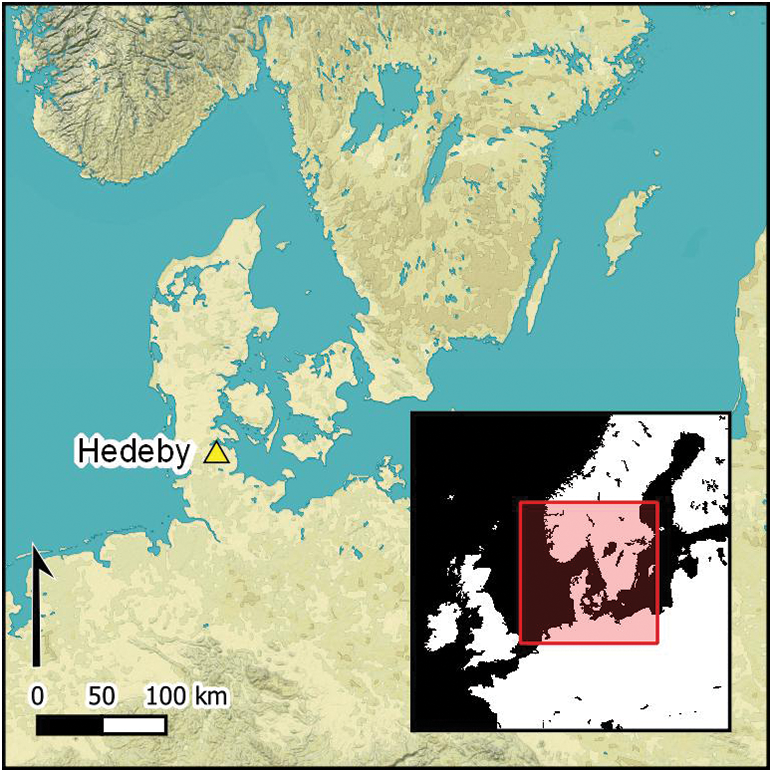
In this article, we address these questions through the targeted analysis of a selection of typologically well-dated artefacts: antler combs. By employing Zooarchaeology by Mass Spectrometry (ZooMS), we aim to differentiate objects made of red deer (Cervus elaphus) antler from reindeer (Rangifer tarandus) antler; in turn, the biogeographies of these species—with reindeer in central and northern Scandinavia and red deer in the south— allow us to interpret the results in terms of long-distance trade and communication. This approach has previously been tested at Viking Age sites in Denmark (Ashby et al. Reference Ashby, Coutu and Sindbæk2015), and the results presented here add nuance to, and geographically extend, that survey. Here, our research focus is the settlement of Hedeby (Haithabu), in the present-day German state of Schleswig-Holstein, at the base of the Jutland peninsula (Figure 1).
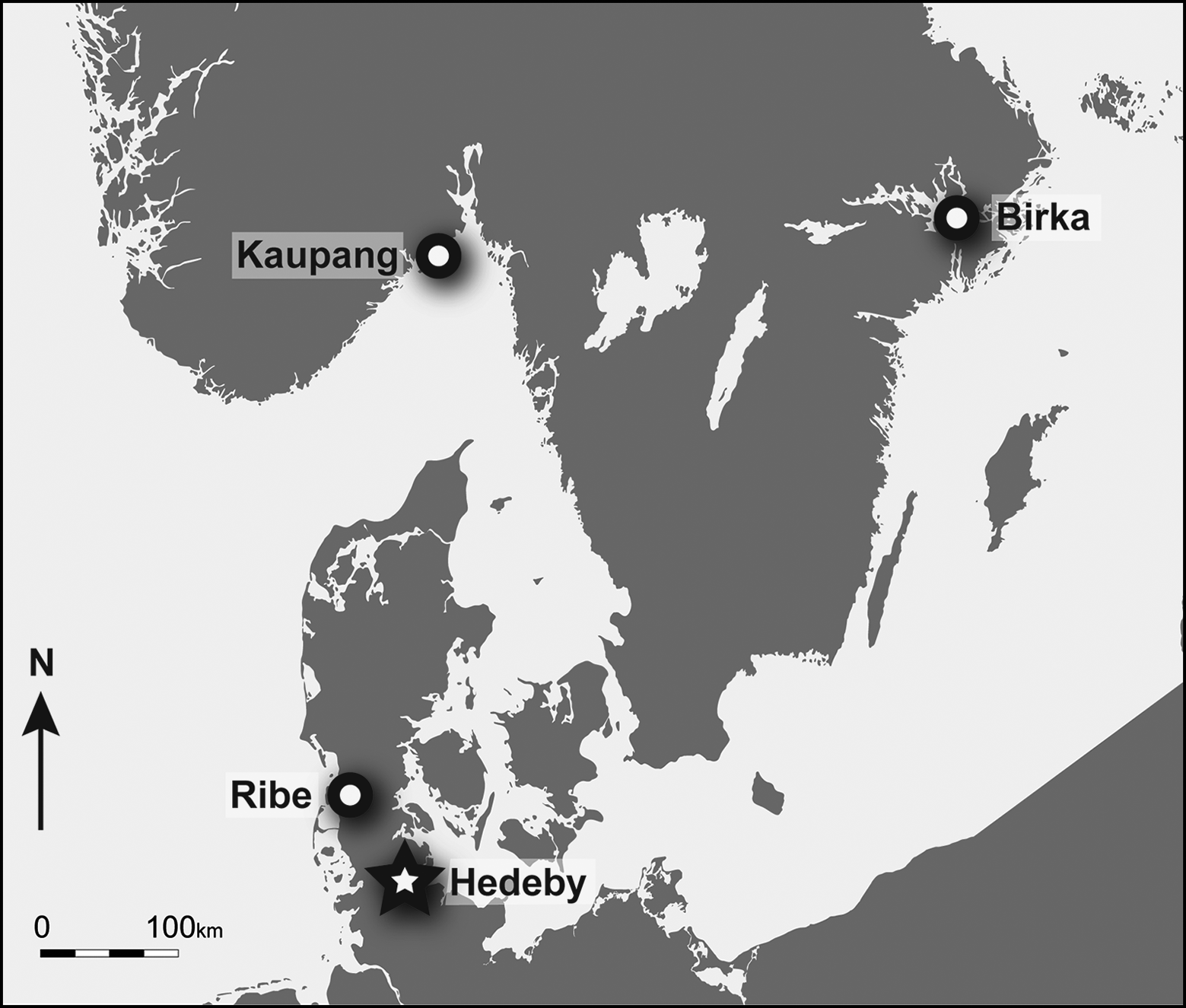
Location of Hedeby and other Viking towns referred to in this article (figure by Neil Gevaux).
As the largest urban settlement in Viking Age Scandinavia, and one of its most important trading centres, Hedeby is particularly well suited for addressing questions relating to the dynamics of exchange and the development of urban networks. Hedeby acted as a nexus between the worlds of the North and Baltic Seas, and was a centre for the economic activities of Frisians, Franks, Scandinavians and Slavs (von Carnap-Bornheim Reference von Carnap-Bornheim2007; Schietzel Reference Schietzel2018). The study of this town thus plays a vital role in our understanding of trade and economic development in early-medieval northern Europe.
Extensive archaeological investigations at Hedeby have revealed that the stratigraphic sequence across the site is characterised by the repeated collapse and rebuild of structures; consequently, occupation levels are disturbed and chronology is difficult to discern. The evaluation of the large-scale settlement excavations currently remains incomplete (cf. Schultze Reference Schultze2008) because the abundant dendrochronological data have not yet been integrated with the structural features and layers, and the precise contextual dating of the finds assemblage from the settlement area is yet to be undertaken. Therefore, although these excavations are remarkable in their extent and the quality of preservation, it is currently necessary to rely on the stylistic (formal and ornamental) dating of this material, which is inevitably variable depending on the class of artefact. One artefact type that does support classification and dating with some degree of precision is the hair comb (e.g. Tempel Reference Tempel1969; Ambrosiani Reference Ambrosiani1981; Ashby Reference Ashby2011; Callmer Reference Callmer, Ashby and Sindbaek2020).
Early-medieval hair combs are composite objects comprising several bone or (more commonly) antler components, fixed together using iron or copper-alloy rivets. In Scandinavia and northern continental Europe, the typological sequences of these combs are well studied, such that dating can be reliably estimated (e.g. Ashby Reference Ashby2011). Conversely, the provenance of these combs, or their constituent materials, remains the subject of debate. Identification to species of the bone or antler used to make combs of known typological date would therefore allow the provenance of these materials to be asserted on biogeographic grounds. In turn, this would potentially enable us to address the long-distance connectivity of Hedeby with other parts of Europe and, more generally, to improve the chronological resolution of our understanding of trading across the Baltic and North Seas.
Research context
Hedeby's connections into central and northern Scandinavia are well known. A late ninth-century text presented to Alfred of Wessex, and preserved in his Old English Orosius, relates Ohthere of Hålogaland's account of life in northern Scandinavia, and of his travels to Kaupang and Hedeby. Ohthere details the extraction of tribute from the Finnas (Saami) in the form of furs, feathers, whale bone and rope made of whale, seal or walrus hide (Bately Reference Bately, Bately and Englert2007: 46); these and other northern products would have been traded southward. He also discusses outland activities of relevance here: the hunting of whales and walrus, as well as his possession of over 600 reindeer (Bately Reference Bately, Bately and Englert2007: 45–6). While one might question what is meant by a Norse aristocrat ‘owning’ reindeer at this date, and what the ‘whales’ were that were being hunted (Storli Reference Storli, Bately and Englert2007), the claims are nonetheless evocative in the context of our increasing awareness of the character of outland exploitation (e.g. Heron et al. Reference Heron, Nilsen, Stern, Craig and Nordby2010).
Direct material evidence of connections between Hedeby and the north has proven elusive as many of Ohthere's traded goods were organic and therefore infrequently preserved in the archaeological record. Walrus ivory provides one exception but is rarely encountered in archaeological assemblages of this date (though see Hilberg & Kalmring Reference Hilberg, Kalmring, Zori and Byock2014: 230). The most important contribution to the identification of northern imports comes from the petrographic and geochemical analyses of artefacts; steatite vessels found at Hedeby seem to have been imported from both western and eastern Scandinavia (e.g. Resi Reference Resi1979), and hundreds of whetstones can be traced to two localities: the schist quarries of Eidsborg in Telemark, and a more northerly location in western Norway, recently identified as Mostadmarka, Trøndelag (Mitchell et al. Reference Mitchell, Askvik and Resi1984; Resi et al. Reference Resi, Askvik, Moore and Schluter1990; Baug et al. Reference Baug, Skre, Heldal and Jansen2018). Such objects, however, are rarely closely datable on typological grounds, so the dynamics of their trade are not well delineated.
A clearer understanding of chronology comes from Ribe, a Viking town on the west coast of central Jutland, where stratigraphic integrity is much clearer than at Hedeby. Here, it has been shown that the importation of west-Scandinavian stone products was already underway in the eighth century (Baug et al. Reference Baug, Skre, Heldal and Jansen2018: table 5). ZooMS analyses of finished combs and manufacturing waste from secure contexts have also provided us with a highly resolved chronology for Ribe's contact with the north. These analyses demonstrate that combs made of reindeer antler arrived at the settlement as early as AD 705–25. The earliest recorded evidence for the import of reindeer antler as a raw material appears in contexts dating to between AD 780 and 800: closely coincident with the traditional date for the start of the Viking Age in the 790s (Ashby et al. Reference Ashby, Coutu and Sindbæk2015).
Ribe was one of a small number of Viking towns that bound together northern Europe's Viking trading network (Sindbaek Reference Sindbaek2007a). Hedeby was Ribe's nearest neighbour (120km to the south-east), but while Ribe was active between the early-eighth and mid-ninth centuries, Hedeby—whose presence is historically documented from the start of the ninth century—came to dominate over the next 200 years (Sindbæk Reference Sindbaek2007b: 66–7; Kalmring Reference Kalmring, Hedenstierna-Jonsson, Holmquist and Kalmring2016; see Søvsø Reference Søvsø2020: 200–1). The study of material from Hedeby should thus fill the chronological lacuna between Ribe and the tenth-century floruit of Aarhus (see Ashby et al. Reference Ashby, Coutu and Sindbæk2015). By analysing combs found at the site, it should be possible to map the temporal dynamics of raw material use. In this article, we focus on ninth-century forms.
Classification and chronology
Early-medieval combs have been classified by a number of specialists (e.g. Wilde Reference Wilde1939; Tempel Reference Tempel1969; Ambrosiani Reference Ambrosiani1981; Ashby Reference Ashby2011; Callmer Reference Callmer, Ashby and Sindbaek2020), and no single scheme has been accepted for universal use across northern Europe. While these schemes tend to find general agreement on typological sequence and dating, each operates on a different level of precision, and best suits a particular geographical frame of reference. Here, we refer to four classifications: those by Tempel (Reference Tempel1969), Ambrosiani (Reference Ambrosiani1981), Ashby (Reference Ashby2011) and Callmer (Reference Callmer, Ashby and Sindbaek2020).
Although the most detailed typology for the Hedeby combs remains unpublished (Tempel Reference Tempel1969; see Tempel Reference Tempel1970 for a brief overview), this scheme has nonetheless proven influential on our understanding of wider Viking Age material (e.g. Ambrosiani Reference Ambrosiani1981: 23–32; Callmer Reference Callmer, Ashby and Sindbaek2020). Tempel divided the Hedeby corpus into 14 groups (Formengruppen) with numerous sub-types, though identification using this scheme is frequently dependent on the preservation of distinctive elements (e.g. terminals), which are often missing. In contrast, Ambrosiani's (Reference Ambrosiani1981) widely used typology divides ninth- and tenth-century combs into just two types (A and B), with three and seven sub-types respectively. Based on material from Birka, in Sweden, the scheme is calibrated against collections from Hedeby, Wolin (Poland), and Staraja Ladoga (Russia), and has been widely applied across the Viking world.
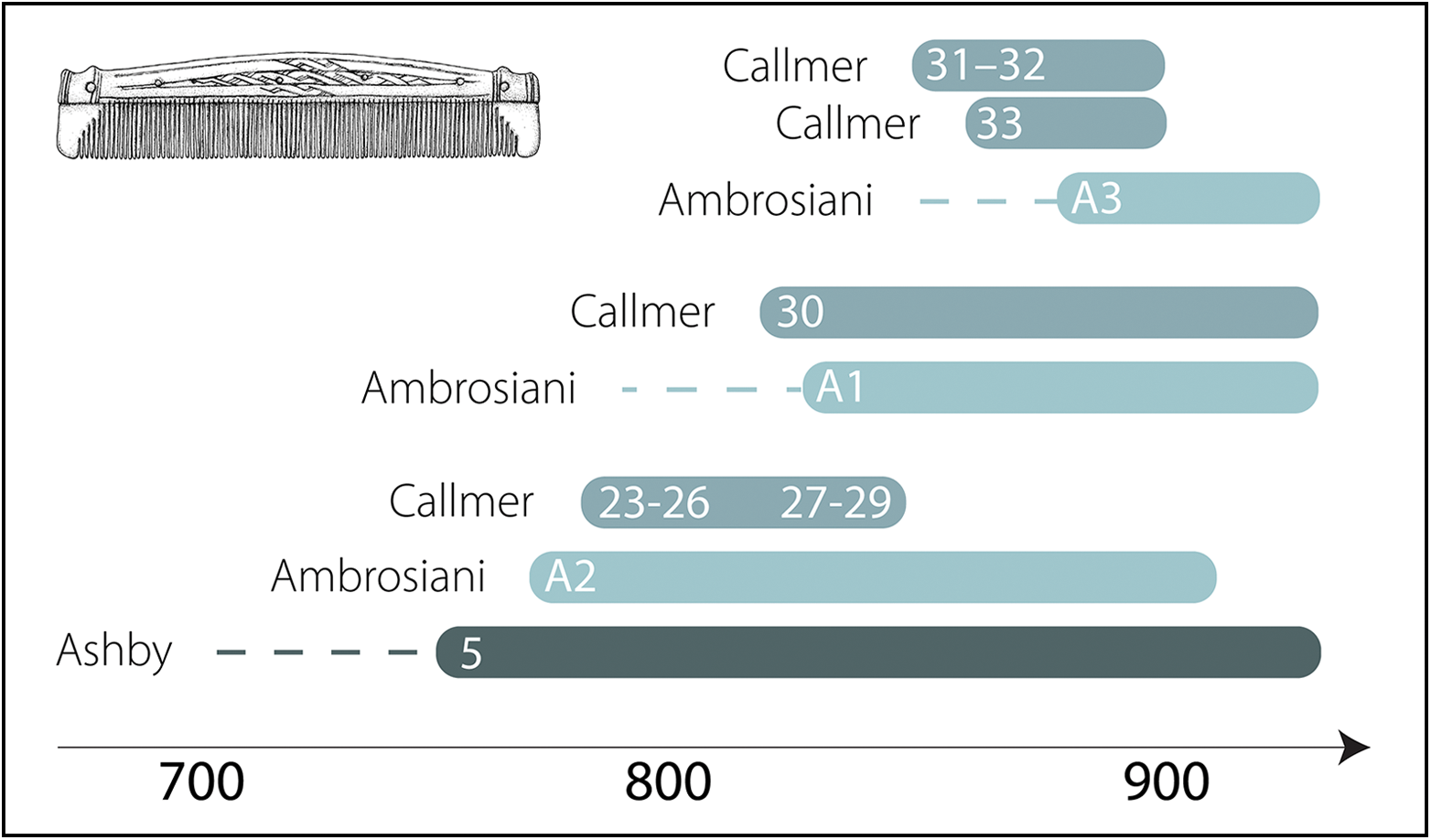
Ashby's (Reference Ashby2011) classification is more broadly resolved, to facilitate comparative study of material from across medieval northern Europe. It provides a general framework, alongside which more chronologically specific schemes may be applied. More recently, using grave finds and material from excavations at Åhus, Sweden, Callmer (Reference Callmer, Ashby and Sindbaek2020) has built upon Tempel's work to provide a 35-type typology for the period AD 700–900. Although not all forms are precisely dated, it is clear that the appearance of some examples pre-date the Viking Age (Types 1–5: c. AD 700–750; Types 6–22: c. AD 750–800) while others can be dated to either the first or second half of the ninth century (Types 23–30: c. AD 800–850; Types 31–35: c. AD 850–900).
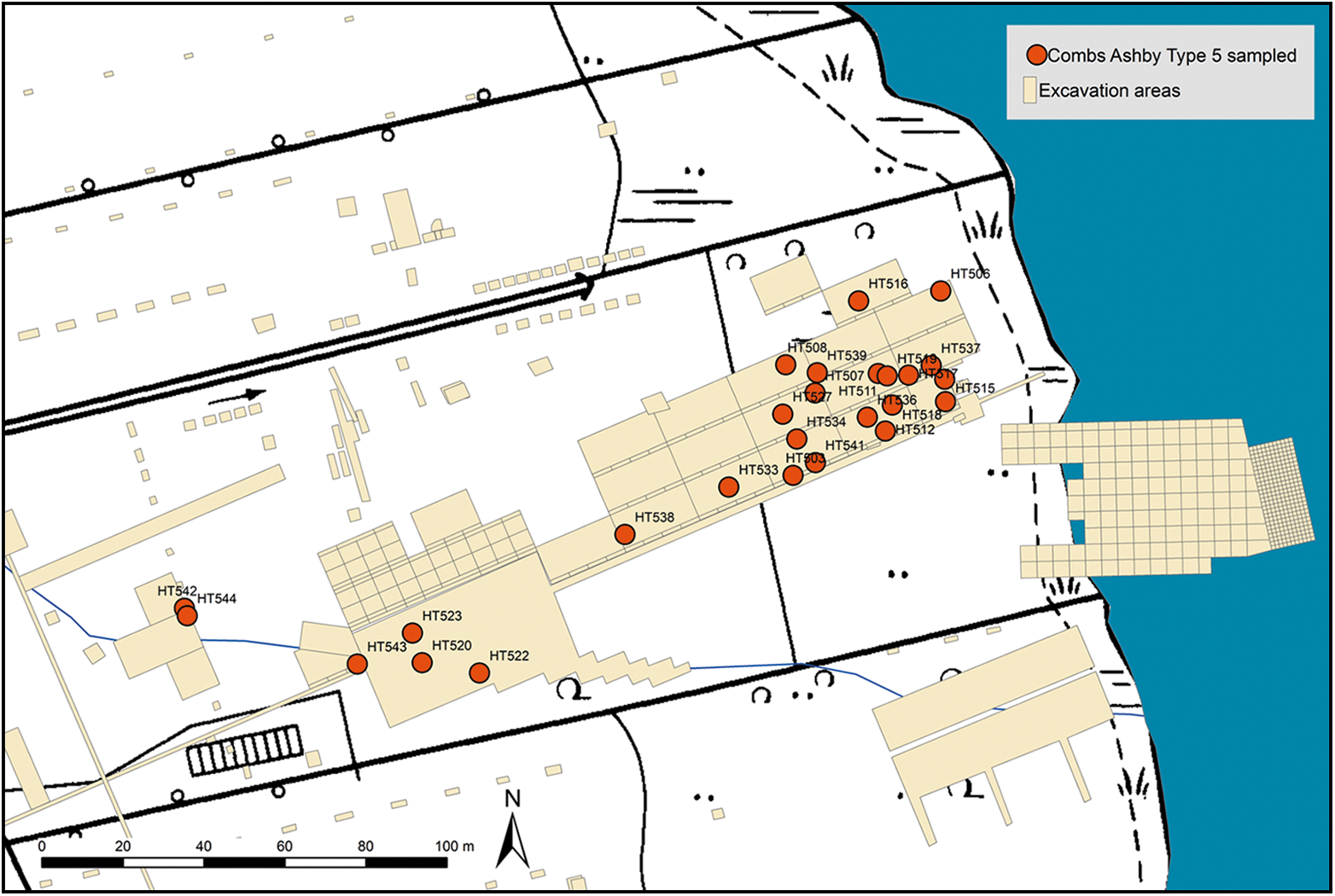
In the present study, we have used Ashby's (Reference Ashby2011) typology for our sampling strategy. Combs of several types were sampled with a view to answering specific chronological questions. For this article, we focus on Ashby's Type 5, recovered from numerous localities across the site (Figure 2). These combs are distinguished by their considerable length (usually more than 180mm), and by their use of connecting plates of plano-convex profile and shallow plano-convex section.
Known findspots of combs sampled in this study. Finds numbers and context details are provided in the online supplementary material (figure by Volker Hilberg).
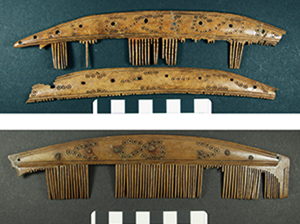
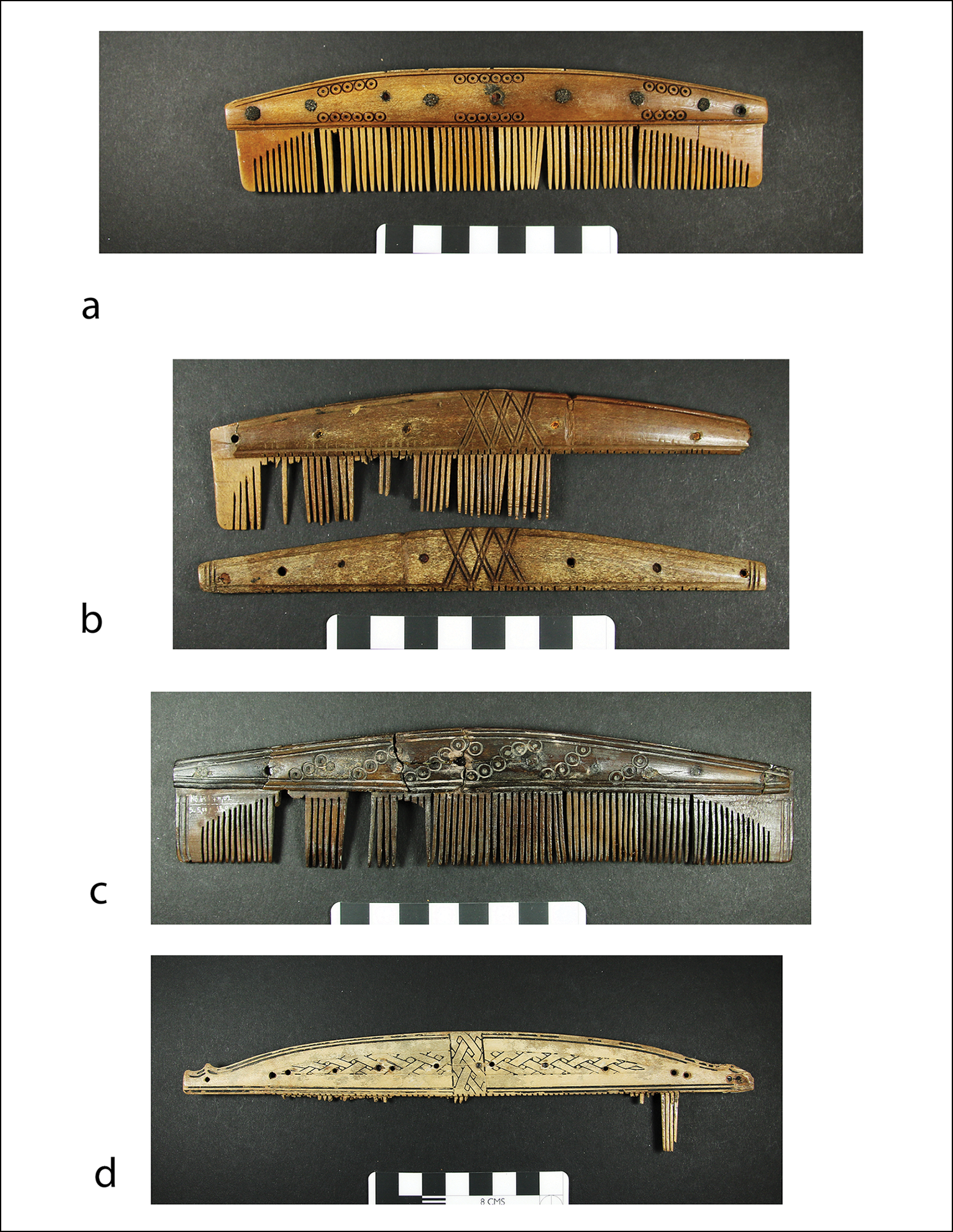
To tease out more detailed dynamics of raw-material use within this typology, we also apply both Ambrosiani's (Reference Ambrosiani1981) and Callmer's (Reference Callmer, Ashby and Sindbaek2020) schemes. Ambrosiani's classification allows us to divide forms into types A1 (incised-line decoration; c. AD 825–950), A2 (ring-and-dot motifs; c. AD 790–910) and A3 (interlace ornament; c. AD 875–925; Figure 3). Callmer's scheme adds still finer levels of chronological division, allowing us to consider variation over approximately 50-year blocks. The schemes are consistent (see Figure 4 for concordance), but each offers a unique perspective based on its level of chronological resolution. Together, they provide a grounding for this study; by tracing raw-material use across these comb forms, we can track the dynamics of long-distance contact through the early years of Hedeby's occupation.
Type 5 combs from Hedeby (a) ‘vorformen’ (antecedents to Ambrosiani A-combs) (b) Ambrosiani A1, (c) A2 and (d) A3 (images by Mariana Muñoz-Rodriguez).
Concordance of classifications applied in this article (figure by Niklas Hausmann).
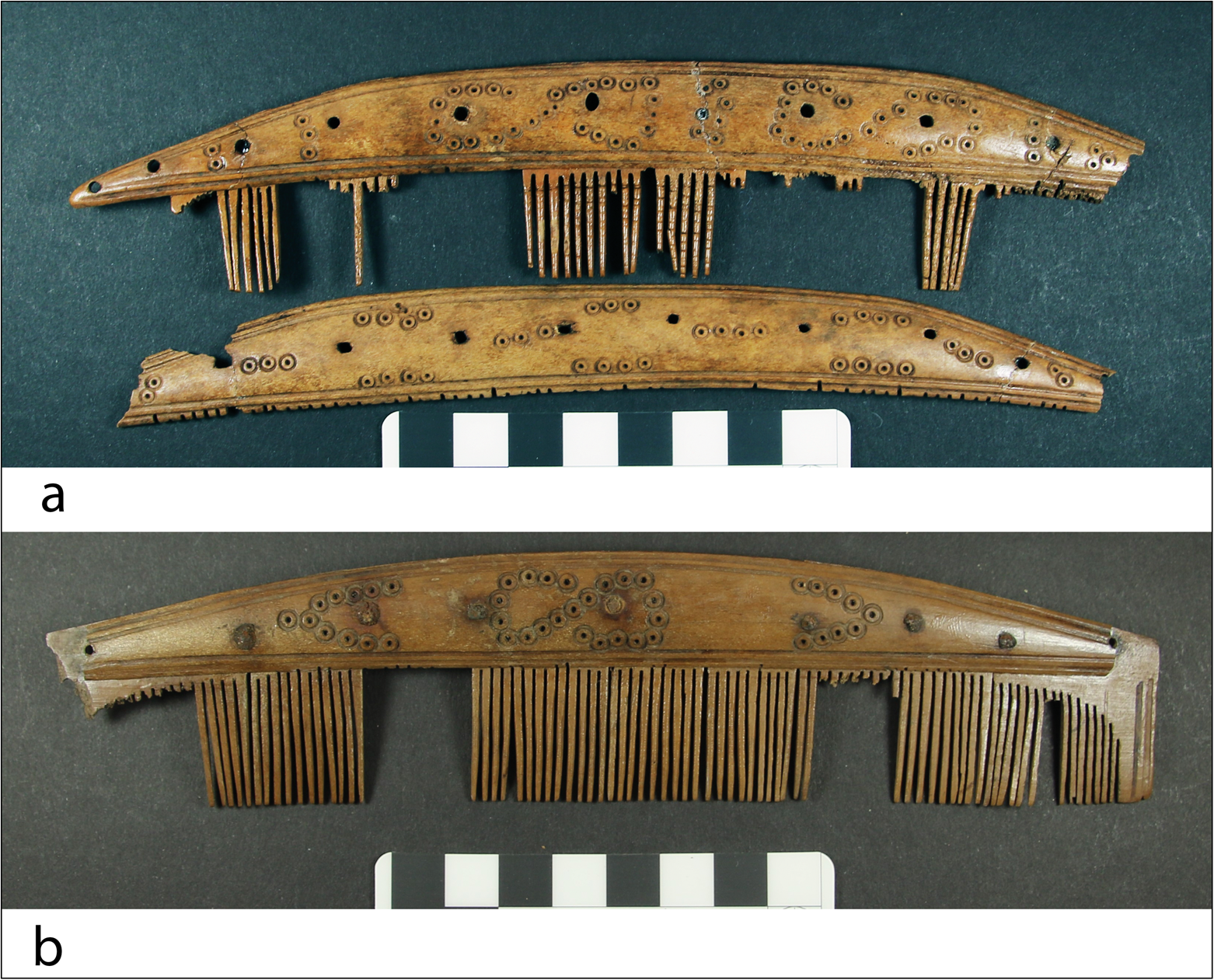
Of particular interest here are the A2 combs that Callmer classes as Types 23–26 (dated c. AD 790–850), and most notably Type 26C, which features recumbent-S or figure-of-eight ring-and-dot motifs (Figure 5). Based on their presence at Dorestad, in the Netherlands, these combs are frequently suggested to be Frisian products. Their subsequent distribution across the Viking world has been explained with reference to the movement of travelling Frisian craftworkers. In contrast, on grounds of typology and distribution, both Ambrosiani (Reference Ambrosiani1981) and Callmer (Reference Callmer and Wesse1998, Reference Callmer, Ashby and Sindbaek2020) have argued for a Scandinavian origin. ZooMS now makes it possible to resolve this question.
Ambrosiani A2 combs featuring recumbent-S decoration (Callmer type 26C) (a) HT506 (b) HT522 (images by Mariana Muñoz-Rodriguez).
Such is the scale of evidence for bone- and antler-working at Hedeby (Ulbricht Reference Ulbricht1978: 139 reports 288 000 antler finds), it might seem intuitive to believe that many of the combs found there were made onsite. On the basis, however, of morphological or metric differences between finished combs and semi-manufactured pieces, and the absence of production waste from the site's early phases, Ulbricht has suggested that earlier, long combs (Type 5) may have been imported, with onsite production commencing with tenth-century forms (Ulbricht Reference Ulbricht1978: 69–74, 132). The current study makes it possible to address such questions of materials provenance and production with precision for the first time.
Materials and methods
Our sampling targeted Ashby Type-5 combs, with a view to assessing their potential to help explain trade and contact in the early Viking Age. Analyses of later forms will be presented elsewhere (see Ashby Reference Ashby, Turner, Owen and Waugh2016 for a project overview). Forty-nine Type 5 combs were sampled, approximately 18 per cent of the combs published from Hedeby to date (269 complete combs are catalogued in Tempel Reference Tempel1969 and Ulbricht Reference Ulbricht1978), but it should be noted that in total approximately 1250 combs and comb fragments have been recovered from the site. Our sample, therefore, should not be taken as a representative cross-section of the entire Hedeby assemblage. In morphological and ornamental terms, however, it is representative of the corpus from the ninth century, a period during which the repertoire was remarkably limited.
Our selected combs were sampled for analysis using ZooMS, which is a cost-efficient and minimally destructive method that allows for the rapid analysis of large quantities of material using relatively small samples (van Doorn Reference van Doorn and Smith2014). The method employs peptide mass fingerprinting to analyse peptide fragments in Type I collagen, which are then compared against a database of reference sequences of known species to make an identification (Buckley et al. Reference Buckley, Collins, Thomas-Oates and Wilson2009, Reference Buckley, Kansa, Howard, Campbell, Thomas-Oates and Collins2010, Reference Buckley, Fraser, Herman, Melton, Mulville and Pálsdóttir2014; Buckley & Collins Reference Buckley and Collins2011; Kirby et al. Reference Kirby, Buckley, Promise, Trauger and Holdcraft2013; von Holstein et al. Reference von Holstein, Ashby, Doorn, Sachs, Buckley, Meirai, Barnes, Brundle and Collins2014). This approach is especially useful when working with osseous archaeological material that cannot be easily identified to species level using traditional zooarchaeological methods because it is highly fragmented or modified. Our analysis builds on work undertaken on early-medieval combs in Scotland (von Holstein et al. Reference von Holstein, Ashby, Doorn, Sachs, Buckley, Meirai, Barnes, Brundle and Collins2014) and Denmark (Ashby et al. Reference Ashby, Coutu and Sindbæk2015).
Samples of 10–30mg of material were taken from 49 combs of Ashby Type 5. Comb fragments and broken teeth were prioritised for sampling; if these were not available, sensitive use of a drill with a thin diamond-tip bit was applied. In most cases, the sampling site was externally invisible or was situated in a location that would not be visible should the artefact be displayed. In the case of loose comb components where the sampling site was visible, the surface area drilled was generally no greater than 10mm2, and in most cases it was half this size. All samples were collected into 1.5mL Eppendorf tubes for transport. Overall integrity of the combs was good, though many objects had undergone conservation work using Mowlith, a sheer, non-plasticised aqueous vinyl acetate polymer of low-viscous dispersion. Samples avoided areas with visible signs of the use of this polymer; the latter does not appear to have affected the quality of spectra produced.
ZooMS analysis followed a protocol based on von Holstein et al. (Reference von Holstein, Ashby, Doorn, Sachs, Buckley, Meirai, Barnes, Brundle and Collins2014). Comb fragments and drilled powders were processed using distinct initial procedures: powdered samples were soaked in 250μL of ammonium bicarbonate (50mM) for a total of 48 hours, and fragments were soaked in 250μL of ammonium bicarbonate (50mM) for seven days. All samples were then treated with the same experimental procedure. Samples were centrifuged for five minutes, and the ammonium bicarbonate buffer transferred to new 1.5mL Eppendorf tubes for separate processing. Each sample was rinsed in 250μL of sodium hydroxide (0.1M) and vortexed for 30 seconds. The samples were centrifuged once more for five minutes, and the sodium hydroxide discarded. Each sample was then rinsed three times with ultrapure water in the original tube, and 100μL of ammonium bicarbonate (50mM) was added. Samples were left to gelatinise on a heat block for one hour at 65°C. After gelatinisation, 1μL of trypsin (0.4μg/μL concentration) was added to each sample and left to incubate at 37°C overnight (14–18 hours).
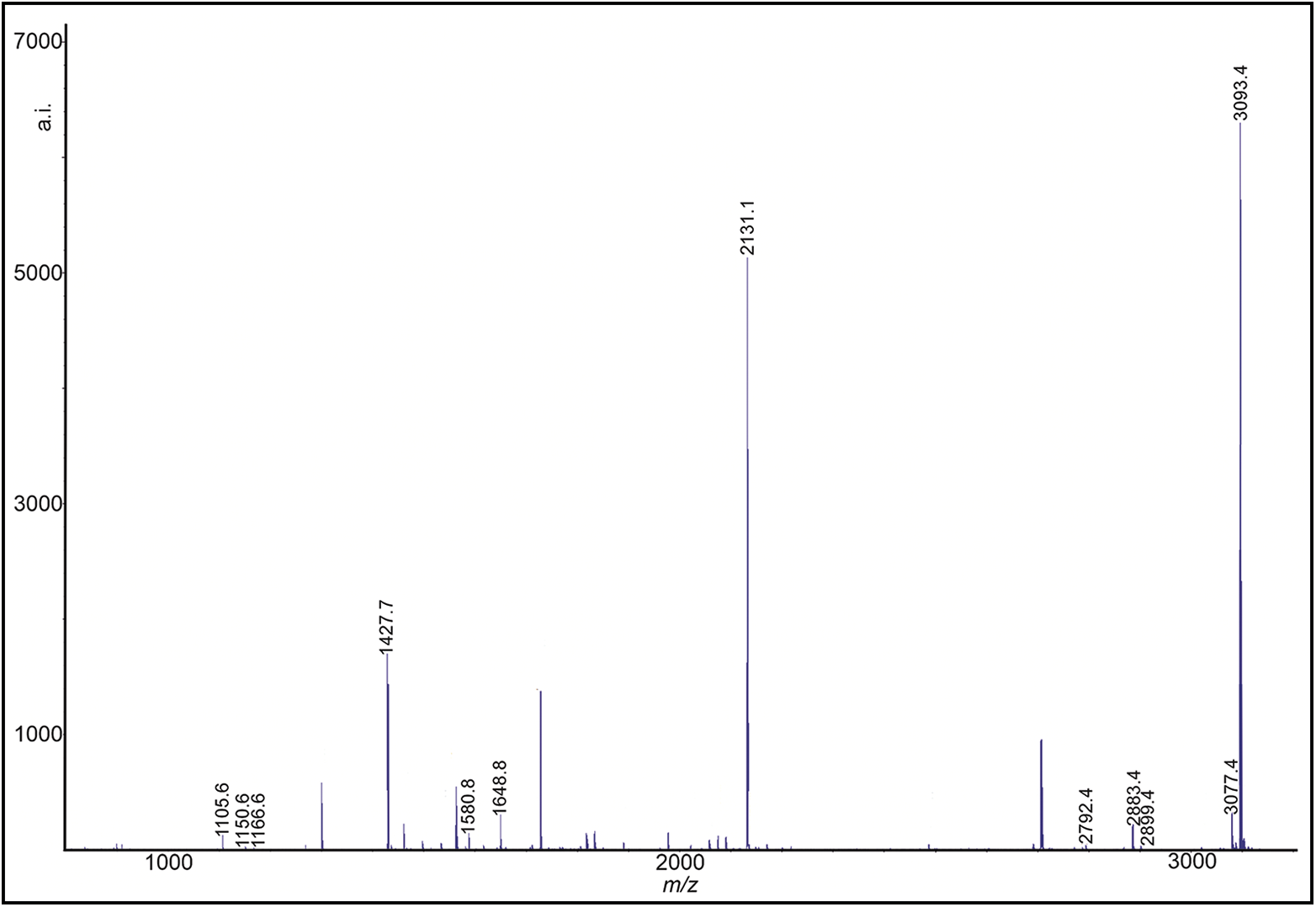
Next, 1μL of 5% trifluoroacetic acid (TFA) was added to stop trypsin digestion, and samples were then desalted using C18 ZipTips. Peptides were then eluted using a solution of 0.1% TFA and 50:50 (v/v) acetonitrile and ultrapure water. Peptide extracts were spotted onto a 384 spot MALDI (matrix-assisted laser desorption/ionisation) plate alongside calibrant reference standards. Both the samples and the calibrant standards were mixed with 1μL of α-cyano-4-hydroxycinnamic acid matrix solution (1% in 50% acetonitrile/0.1% trifluoroacetic acid (v/v/v)), when spotted onto the plate. The plate was then analysed using MALDI–Time of Flight Mass Spectrometry (MALDI-TOF-MS) using an Ultraflex III (Bruker Daltonics, Bremen, DE). The resulting spectra were analysed using mMass software (Strohalm et al. Reference Strohalm, Kavan, Novák, Volný and Havlícek2010) and compared with relevant published taxa (Buckley et al. Reference Buckley, Collins, Thomas-Oates and Wilson2009; Buckley & Collins Reference Buckley and Collins2011; Kirby et al. Reference Kirby, Buckley, Promise, Trauger and Holdcraft2013; Welker et al. Reference Welker, Soressi, Rendu, Hublin and Collins2016). Overall, 94 per cent of samples produced spectra of sufficient quality to enable accurate taxonomic identification (Figure 6).
Example of spectrum from a powdered subsample of comb HT501 (Callmer Type 30), indicating peaks at 3093m/z, 2883m/z and 2131m/z indicative of reindeer (graphic by Sam Presslee).
In some instances when using ZooMS, insufficient differences in the detected collagen sequences rendered taxonomic identification to species level impossible. In these cases, results are labelled to the highest-level identification possible, that of ‘bovidae/cervidae’ though the latter family is most likely, whether they be red deer (C. elaphus), elk (Alces alces) or fallow deer (Dama dama). These species are difficult to differentiate using ZooMS alone, but several can be excluded. For example, the morphology and internal structure of fallow deer antler (palmated structure consisting of a relatively thin area of compacta enclosing a thick, porous core that is unsuited to working) militate against its use in combs, such that an identification as red deer or elk would be the most probable interpretation. The issue could be conclusively resolved by using genetic or recently developed proteomic techniques (LC-MS/MS; Jensen et al. Reference Jensen2020), but this is unnecessary in the context of our research questions, as it is the simple distinction of reindeer and Cervidae antler that allows us to investigate contact with the north.
Results
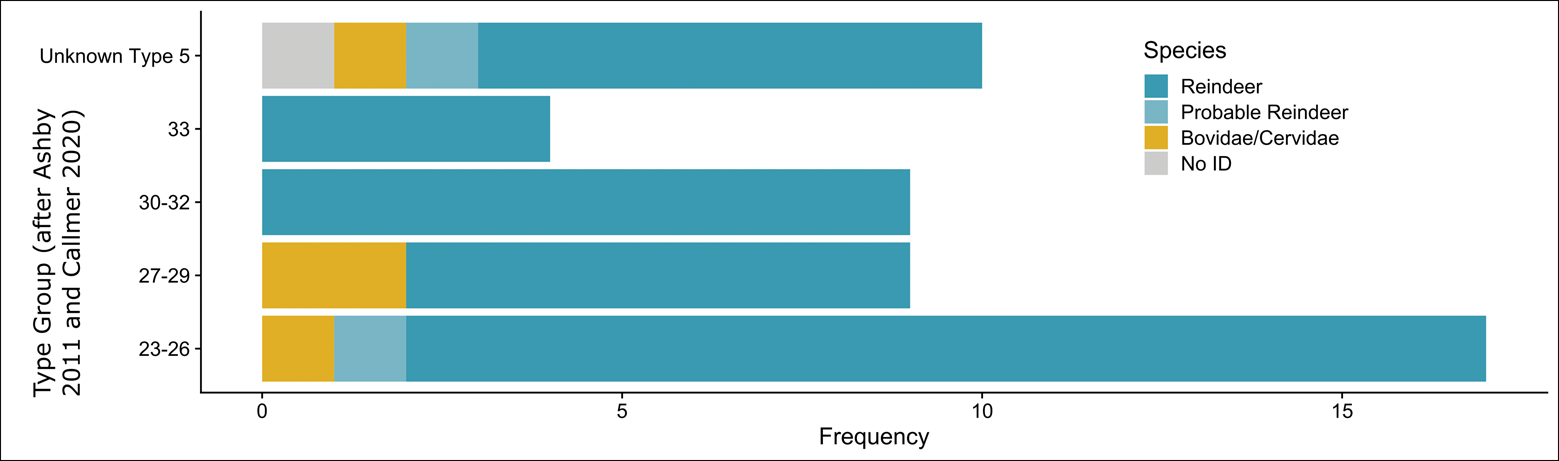
Of the 49 samples, 44 (90%) were identified as reindeer (R. tarandus), comprising 42 certain and two probable identifications; of the remaining samples, four were identified as ‘bovidae/cervidae’ and one sample could not be identified due to poor preservation. The clear identification of reindeer antler as the most frequently used material in the manufacture of these combs underlines the scale of contact between Hedeby and the Scandinavian North where reindeer herds were found. Based on Callmer's (Reference Callmer, Ashby and Sindbaek2020) typology, reindeer antler was the dominant material for combs throughout the ninth century. The earliest group studied (Types 23–26) contains 10 examples of the ostensibly ‘Frisian’ Type 26C, of which nine are here positively identified as being made of reindeer antler (the remaining sample provided poor spectra but was identified as probable reindeer; Figure 7).
Species identified in Callmer's type groups (graphic by Jessica Hendy).
Discussion
Biomolecular analysis of combs from Hedeby demonstrates that 85–90 per cent of Ashby Type-5 combs analysed were manufactured from reindeer antler, evidencing the extensive use of imported materials in early Viking Age combs. Classic research (Resi Reference Resi1979; Mitchell et al. Reference Mitchell, Askvik and Resi1984; Resi et al. Reference Resi, Askvik, Moore and Schluter1990) on whetstones and steatite vessels has previously highlighted Hedeby's connection with upland Scandinavia, and Star et al. (Reference Star2017) have recently used genetic analysis to identify the importation to the town of cod from arctic waters (Lofoten, Norway). The lack of reliable stratigraphic information from the site, however, has limited our understanding of the chronology of such connections. In contrast, here, the typochronology of combs allows us to confirm the existence of large-scale, frequent and consistent long-range maritime contact in Hedeby's earliest days.
This evidence for long-distance trade in the early Viking Age agrees with the analysis of antler material found in eighth-century phases at Ribe (see above; Ashby et al. Reference Ashby, Coutu and Sindbæk2015). Moreover, analysis of a small sample of whetstones recovered from secure contexts dating to the later eighth and ninth centuries at Ribe (Baug et al. Reference Baug, Skre, Heldal and Jansen2018) found more than 50 per cent to be the probable products of quarries at Eidsborg (Telemark) and Mostadmarka (Trøndelag). Previous studies also identified the presence of reindeer antler combs in ninth- and tenth-century phases at Aarhus (8 of 15 finished combs) and Aggersborg (12 of 53 samples, for a total of 8 reindeer combs; Ashby et al. Reference Ashby, Coutu and Sindbæk2015). Our findings here suggest that significant quantities of northern Scandinavian products found their way, directly or indirectly, as far south as Hedeby. This combination of antler and stone products seems to form a package of northern imports to southern Scandinavia.
While 85–90 per cent of combs identified in this study are made of reindeer antler, previous zooarchaeological analyses of Hedeby's faunal remains had not suggested that imported antler was used in significant quantity (Schietzel Reference Schietzel2018: 346). Ulbricht reports approximately 1300 pieces of reindeer material from the site, consisting primarily of antler fragments (Ulbricht Reference Ulbricht1978: 17, 141); reindeer therefore make up only a small proportion (approximately 0.5%) of readily identifiable waste material at the site. Consequently, it is likely that most combs manufactured at Hedeby were produced using red deer antler (supplemented to a lesser degree with elk antler). Much of this red deer (and elk) antler would probably have been locally collected, though even some of this may have been imported (Reichstein Reference Reichstein and Schietzel1969; Becker & Grupe Reference Becker and Grupe2012: fig. 9).
A note of caution is necessary, however. Ulbricht acknowledges that accurate visual identification was only possible for large, relatively unmodified pieces of antler waste, and it is possible that Ulbricht's figures underrepresent the reindeer remains present in the collections. Our study highlights the potential of ZooMS for the analysis of fragmentary and heavily worked assemblages, where morphological identifications can be challenging. In the present case, however, manufacturing deposits are not known in Hedeby's earliest phases (Ulbricht Reference Ulbricht1978: 132). It thus seems clear that the opening century of Hedeby's existence was characterised by the use of combs from northern Scandinavia—either imports or the property of travellers, migrants and visitors from overseas—prior to the manufacture onsite of new forms, largely using local materials, in the tenth century.
Our typological sampling strategy allows us to track the chronological dynamics of raw-material use, and it is striking that reindeer antler is present in combs of Callmer's Types 23–33 (i.e. all variants of Ashby Type 5). The identification of reindeer antler in such a large number of combs typologically spanning the ninth century is a significant finding. It adds support to Callmer's assertion that the Type 5 comb had a west Scandinavian—rather than Frisian—origin. It is particularly striking that none of the Type 26C (‘Frisian’) combs analysed could be demonstrated to be made of antler from deer native to continental Europe.
Hedeby was tightly integrated into long-range networks of travel and trade that stretched north of Jutland, ultimately reaching the upland areas of what is now central and northern Norway and Sweden. Whether such trade was direct or mediated via towns such as Ribe and Kaupang, is unclear. In either case, the findings reassert Ashby et al.'s (Reference Ashby2015) recognition that activities and individuals operating in upland areas of Scandinavia were tied into the urban networks that connected the likes of Ribe and Hedeby. These findings also support Baug et al.'s (Reference Baug, Skre, Heldal and Jansen2018) work on imported stone products, and provide a coda for Hennius et al.'s various lines of evidence that push organised engagement with both the outland and the sea further back into the years before the start of the Viking Age (Hennius Reference Hennius2018a, Reference Hennius2018b, Reference Hennius2020; Hennius et al. Reference Hennius, Gustavsson, Ljungkvist and Spindler2018). Through a well understood typological sequence, this study offers chronological resolution: something that has previously been difficult to achieve through the Hedeby material. It refocuses attention on this major emporium in discussion of North Sea trade dynamics, a topic which has latterly been dominated by Ribe with its unrivalled stratigraphic integrity (Feveile & Jensen Reference Feveile and Jensen2000; Ashby et al. Reference Ashby, Coutu and Sindbæk2015; Baug et al. Reference Baug, Skre, Heldal and Jansen2018).
Ashby et al.'s (Reference Ashby2015) work with combs and comb-making waste at Ribe has demonstrated that contact with the arctic and sub-arctic north was an important element of network urbanism from at least the start of the Viking Age. Having established the existence of such connections between urban southern Scandinavia and its northern peripheries, the present article elucidates the scale of this communication. At Hedeby, the southernmost of Scandinavia's Viking towns, most of the combs in circulation in the early Viking Age were manufactured elsewhere, if not actually in the northern uplands, then somewhere well-provisioned by them. The reach of products from the uplands of northern Scandinavia was extensive, and it is now clear not only that this region played an important role in the incipient urban networks of the eighth and early ninth centuries, but that its products—by travel or trade—reached at least as far as the gateway to continental Europe at Hedeby well into the second half of the ninth century.
Conclusion
This article demonstrates the power of a unified typological-biomolecular research approach and its potential to elucidate long-distance connectivity in the Viking world by focusing on a single type of artefact: the antler comb. It has presented new evidence for contact between Europe's largest Viking Age town, Hedeby, and the northern outlands in central and northern Scandinavia. While previous work on whetstones, steatite and fish remains has pointed to such long-distance provisioning, the well-studied morphology of antler combs provides chronological precision. Specifically, while evidence for some importation from the north was expected, the clarity of the pattern identified here is striking: the combs demonstrate that despite Hedeby having the most extensive collection of comb-making waste anywhere in the Viking world, the majority of combs from its earliest occupation phases were probably not made onsite and likely represent either imports or the possessions of mobile individuals. The combs were probably produced elsewhere, possibly hundreds of kilometres further north in upland Norway or Sweden. In reference to our previous work, it now seems likely that large numbers of early Viking Age combs were produced in northern Scandinavia (cf. Ambrosiani Reference Ambrosiani1981 on Birka). The study therefore makes an important contribution to debates surrounding the development of this artefact type, and around the organisation of urban craft production, and has significant implications for the chronology of connectivity and movement around the early-medieval North and Baltic Seas. Future work will analyse finished combs and stratified workshop waste in tandem, considering a range of sites dating across the Viking Age.
Data availability
ZooMS data are available via Zenodo under the following accession: DOI 10.5281/zenodo.5503871
Acknowledgements
We thank Stiftung Schleswig-Holsteinische Landesmuseen, Schloß Gottorf, for permission to sample the Hedeby combs, and the York Centre of Excellence in Mass Spectrometry at the University of York for the use of the Ultraflex III MALDI-ToF/ToF instrument. The centre was created thanks to a major capital investment through Science City York, supported by Yorkshire Forward with funds from the Northern Way Initiative, and subsequent support from EPSRC (EP/K039660/1; EP/M028127/1). We thank the anonymous reviewers for invaluable comments and feedback.
Funding statement
This project has received funding from the European Union's EU Framework Programme for Research and Innovation Horizon 2020 under Marie Curie Actions Grant Agreement No. 676154.
Supplementary material
To view supplementary material for this article, please visit http://dx.doi.org/10.15184/aqy.2023.118.


 Open access

