


In July 1898, J. E. McSorley carried five sacks of granulated sugar from Abbotsford, British Columbia, into Washington State. Short on money, he skipped past the customs post, avoiding the duties on his cargo. Five months later, he did it again. When customs agents confronted McSorley about his smuggling, he made no attempt to hide his transgressions. He pled guilty and paid the fifty-dollar fine. It was a cut-and-dry case. For as simple as the matter should have been, the case revealed the larger problems that plagued both countries’ border control efforts. Had McSorley wished to pay the customs duties, he would have had to voluntarily travel three-and-a-half miles out of his way to visit the nearest post at Sumas. Had he bothered to conceal his crimes in the slightest, including swapping the sugar bags he carried from ones that read “B.C. Sugar Refinery” to almost anything else, he would have escaped scrutiny. Even when he openly admitted his guilt, the customs agents still needed to travel to multiple locations, speak with half a dozen witnesses, and verify that no one had entered the cargo into a different set of customs ledgers. McSorley’s suspected accomplice, who refused to self-incriminate, walked free.Footnote 1 That was when cases went well. Most of the time, they did not.
If border control during the Gilded Age was a perpetual struggle, rebuilding its history in the years that followed has not become any easier.Footnote 2 Experiences differed across scale and context, making it hard to make broader claims about how the border behaved or when it became significant to daily life. The placement of labor, industry, transportation corridors, and economic resources all mattered. So too did race, class, gender, geography, religion, government policy, informal economies, public opinion, and the hundreds of other factors that shaped migration and economic integration.Footnote 3 What has emerged has been a mosaic of historical experiences, each defined by local conditions.
The complexity of the sources surviving from the nineteenth century has only added to the challenge. The American census underreported the wealth holdings of “members of [even] the most prominent groups (e.g., state legislators, voters, and adult native-born white males)” by an average of 15 percent between 1850 and 1870.Footnote 4 Into the 1880s, census officials edited out the occupational information for women, older workers, youth, and visible minorities in reaching their final tabulations.Footnote 5 Tax assessments missed large numbers of property holders, and were particularly bad about recording small landowners, visible minorities, and women. This situation makes some of the most intuitive sources for creating large-scale comparisons problematic. Personal and business records only add to the complexity.Footnote 6
Scholars of the Canada-United States border have adopted two major frameworks for rebuilding the border’s historic footprint. Economic, business, and administrative historians have studied commercial trade, labor movements, industrial efficiency, the uptake of products, the effectiveness of personnel deployment, and the differences in financial and legal regimes.Footnote 7 These scholars have tended to rely on broad record sets (censuses, tax returns, trade statistics, corporate records, and so forth) that lend themselves to quantitative methodologies. These studies have argued that Canadian trade policy was less protectionist and damaging than originally believed, that large urban industries successfully lobbied politicians to alter tariff rates selectively, and that the uneven impact of tariff policies across industries during the Gilded Age served as one of their defining features.Footnote 8 Borderlands historians, by contrast, have taken a more bottom-up approach—using personal accounts and local stories to highlight deficiencies in national narratives.Footnote 9 These historians have viewed the border as a co-created site “where national notions of race and citizenship were forged.”Footnote 10 Rather than assessing the border’s economic impact in isolation, they have tended to weave their assessment of economic and commercial activity into larger studies on race, immigration, the environment, and identity formation.Footnote 11 Drawing from personal accounts far more often than from business ledgers and administrative letterbooks, these histories prioritize personal accounts over quantitative or geospatial methodologies. In doing so, they have helped to demonstrate that the daily choices of individual people often mattered more to the practical shape of the border than did the decisions of administrators or politicians.Footnote 12
While borderland and economic history approaches both hold merit, each offers something the other does not. Borderland histories have been most successful at showing the impact of the border on migration and racialized control, but often gloss over the fact that for most of the Gilded Age, the Canada-United States border was intended to act as an economic barrier more than a demographic one. Prior to the 1880s, states like Michigan lacked a centralized way to count, much less control, the number of immigrants entering the state. The dichotomy of investment also shaped how each country resourced its border agencies. In 1895, the American Office of Immigration had only 249 employees. Five years earlier, the U.S. Customs Service had already surpassed 5,300 employees.Footnote 13 Expanding financial control over the border was easy because customs agents collected fees that not only paid for their own salaries but supported other branches of government as well. Prior to World War I, tariffs provided Canada and the United States with the bulk of their revenues, thus making financial control of the border vital to each nation’s operation. Policing the movement of people, by contrast, was harder to justify as it drew resources away from other government projects. When the United States did prioritize immigration control, such as with Chinese Exclusion policies, it relied on the well-developed Customs Service rather than the nascent Office of Immigration to do so. Whether measured in on-the-ground personnel, impact on other branches of government, or administrative reach, the Customs Service eclipsed other branches of border control throughout the late nineteenth century.Footnote 14 The focus on migration and racialized control, while important, misses the larger context in which it occurred.
Economic historians, by contrast, have been effective at showing the regional and national impacts of federal policy, but tend to underplay the challenges inherent in the quantitative record sets and the uneven impacts that national policies had on local life. Customs agents missed or ignored the flows of traffic. Consuls submitted misleading trade statistics, and each country published immigration statistics that disagreed with one another, at times, by more than an order of magnitude. Few personnel with on-the-ground experience in border control believed their agency was capable of monitoring, much less controlling, movement in any kind of nuanced way.Footnote 15 This article attempts to draw on the strengths of both approaches by applying a borderlands methodology to a source base—customs and consul records—utilized more traditionally by economic historians.
Border policy developed rapidly between 1870 and 1910. Swings in tariff policy, the creation of Chinese Exclusion laws, new border surveys, Canada’s increasing separation from Britain, and the transfer of immigration control from individual states to the U.S. federal government ensured that the challenges facing government agencies remained difficult to predict or address.Footnote 16 Categorizing goods never became easier. Neither country gained the ability to control the border unilaterally. Practical considerations variegated policy. Although Canada and the United States conceptualized their border as a thin unbroken line, financial considerations encouraged them to station almost all their customs personnel at major ports and transportation corridors along the East Coast and the St. Lawrence Seaway. This placement made financial sense but left the vast majority of the 49th parallel unmonitored and unguarded until after World War I.Footnote 17
Collectively, these decisions created an inconsistent barrier to transborder movement for both individual and corporate actors. For everyday people and businesses, the border appeared less as a barrier than as a surprise: an unexpected tax, an arrest, or a devalued currency. For businesses, complex policies, poor record keeping, and the local agent’s discretionary power created dozens of locally defined border zones, each with its own unique way of interpreting and applying customs policy. Worse still, the border had an unpredictable impact on training, markets, administration reporting, and intellectual property. Although Canada and the United States imagined the border as a federal project to create a uniform line, their decisions to prioritize revenue generation and low federal expenditures over consistency in policy ensured that regional and local solutions proliferated.
Borders at the Crossroads of Change
In the aftermath of the Civil War and Confederation, American and Canadian policy makers reimagined the 49th parallel. Boundary commissioners invested hundreds of thousands of days’ worth of labor surveying and marking the Canada-United States border along the Pacific West (1857–1868) and Prairies (1872–1876), which had languished unmarked for half a century.Footnote 18 Diplomats amended extradition treaties, changing the nature of transnational justice.Footnote 19 New customs and immigration policies filtered cross-border mobility through a racialized framework. These policies added new taxes and exclusions to Chinese immigrants in 1882 and 1888 (in the United States) and in 1885 and 1923 (in Canada).Footnote 20
For politicians in both countries, the border represented a way to generate income, clarify jurisdiction, impose sovereignty, and solve regional issues of governance. The asymmetry in populations, military, and administrative capacity, however, meant that each country became interested in the border for very different reasons. For Canada, whose National Policy centered around staking a claim to vast amounts of territory in the west and in reinforcing its domestic industries, the border presented a tangible way to blunt discussions of American influence and expansion.Footnote 21 For the United States, whose population and military strength left it no rivals on the continent, the border became more important as a tool for regional control. Both nations utilized the border to generate revenue and to clarify who belonged.Footnote 22
While British North America and the United States had enjoyed a period of low economic barriers during the 1850s, both adopted policies of economic protectionism in the decades that followed. American tariffs averaged 30 percent at the end of the nineteenth and the beginning of the twentieth centuries. In Canada, a similar set of restrictions existed. Tariffs, part of the Canadian Conservative Party’s National Policy implemented in 1879, grew by more than 50 percent. The National Policy created visible protections for key industries, but the rise of domestic competition and the money that businesses spent securing political concessions dissipated many of the benefits they had hoped to gain. Tariffs also served as a point of friction—both within each country and between them. Tariffs divided the Democratic and Republican Parties, served as the touchstone issue in the 1888 presidential election, and influenced many of the other presidential races between the Civil War and World War I.Footnote 23
Rapid revisions to tariff policies—including the Mackenzie Tariff (1874), Tupper Tariff (1887), McKinley Tariff (1890), Wilson-Gorman Tariff (1894), and Dingley Tariff (1897)—made transborder trade difficult to predict.Footnote 24 For all their variation, the tariffs had two important effects. First, they comprised the largest segment of federal revenue in Canada and the United States prior to World War I, making border policy an unavoidable part of governance.Footnote 25 Second, they often had cascading effects on transnational markets and labor pools that were difficult to predict or adjust for. The McKinley Tariff, for example, “blocked rural Ontario’s ability to export its agricultural surpluses to American markets, contributed to the movement of Canadians across the border while unwittingly also satisfying U.S. manufacturers’ need for labor.”Footnote 26 High tariff rates and the uncertainty surrounding them could have separated the two countries’ economic futures, but they remained on a common path.
Between 1850 and 1900, Canada grew economically and socially closer to the United States, while drifting further from Britain in the process. Historic accounts suggested that total trade (imports and exports combined) between the United States and British North America grew from $8,624,750 in 1841 to $19,543,469 in 1851, $51,245,224 in 1861, and $59,727,723 in 1871.Footnote 27 While British financiers initially contributed large amounts of capital to the development of Canadian industries, British North America remained a minor part of Britain’s overall economy.Footnote 28 Between 1856 and 1860, only 2.7 percent of British exports went to British North America, and Britain received only 3.3 percent of its imports from its North American possessions in return.Footnote 29 British North America supplied Britain with large amounts of lumber, but in terms of other raw materials such as wheat, Canada contributed only a fifth to an eighth of what Russia, Prussia, the United States, and France each supplied to Britain. More troubling, Canadians, on average, showed no more inclination for purchasing British goods than Americans did.Footnote 30
Canadian protectionism and a low uptake of British imports emphasized that Canadians valued a “commerce of convenience” more than they did a commerce of loyalty with Britain.Footnote 31 Confederation did little to stem that tide. According to historian E. A. Heaman, “Canadian imports of American merchandise marked a steady growth from $18.4 million in 1870 to $28.4 million in 1880, $40 million in 1890, and $95 million in 1900.”Footnote 32 In a literal sense, American coal fueled southern Ontario’s industries and homes.Footnote 33 Canadians at Wallaceburg, Ontario, sent their vessels to Detroit, Michigan, when they needed repairs.Footnote 34 Canadian merchants relied on American cities for markets and winter ports. At Fort Erie, Ontario, Canadians exported $680,596 worth of goods to the United States in the year leading up to September 1877. The traffic included 328,423 bushels of barley, 30,605 sheep, 17,361 pounds of cheese, and just over half a million eggs.Footnote 35
The relative importance of American trade grew alongside its aggregate increase. Canadians not only wanted what Americans sold, but their desires increased with each passing year.Footnote 36 American imports comprised 35 percent (1870), 41 percent (1880), 46 percent (1890), and 61 percent (1900) of all imports entering Canada. During the same time frame, the United Kingdom’s share of imports dropped from 54 percent to only 25 percent.Footnote 37 By 1910, “Canada exported $104.2 million of goods to the United States … (representing 37 percent of Canada’s total exports) and imported $239.1 million of goods from the United States that same year (representing 67 percent of Canada’s total imports).”Footnote 38 American capital flowed north, slowly displacing yet another area where Britain had once exercised control over the Canadian economy.Footnote 39 Consuls, economists, and pamphleteers all noticed the increasing economic integration between Canada and the United States.Footnote 40
Growing integration, however, did not imply comfort in the relationship. As Canada and the United States grew closer economically, foreign conflicts across the globe were encouraging Americans to reimagine their geographic footprint. Cuba, Alaska, Puerto Rico, the Philippines, Hawaii, and Panama all appeared as possibilities to add to the emerging U.S. empire. Was it possible, or even desirable, to annex Canada as well?Footnote 41 The question intrigued Canadians and Americans alike. In 1891, Goldwin Smith noted that thousands of Canadians migrated each year to the United States, reinforcing social, cultural, and economic bonds across the line. If war ever broke out, he mused, British warships would struggle to shell American cities for fear of “striking a Canadian home.”Footnote 42 For Smith, a British-born historian who had lived in Canada for more than twenty years, the border existed as an uncertain place. Daily life and commerce blurred the lines between nation states. In his eyes, an amalgamation between the two countries was not only possible, but desirable.Footnote 43 Most Canadians, though, disagreed with Smith’s assessment, believing that Canada’s future rested instead on its economic independence. Newspapers like the Hamilton Spectator, for example, lauded Canada’s high tariffs. The newspaper argued that Canada needed to double down on the duties it imposed on U.S. goods until they reached “the point of prohibition.”Footnote 44 When pressed on what would make economic integration more palatable to Canadians, the Spectator responded that “Uncle Sam has nothing that we want” that we “cannot get elsewhere.”Footnote 45
Territorial ambitions, anxieties, and a broader transformation in the scope and structure of state power intersected one another along the border.Footnote 46 As tariffs brought more revenue into each nation’s coffers, the size of government each country could support, and the stakes of border control grew with it. Defining the edges of national spaces required a commitment to enforcement. Between 1861 and 1891, the United States’ population doubled while “the number of people employed by the government quadrupled.”Footnote 47 In 1865, the United States had a little over 950 customs officers and no national organization for controlling immigration. By 1905, it boasted 6,826 customs and 1,214 immigration agents supported by the newly created Bureau of Immigration.Footnote 48 That same year, Canada boasted some 1,303 customs personnel of its own.Footnote 49 While numerous, customs employees initially operated within a narrow geography.
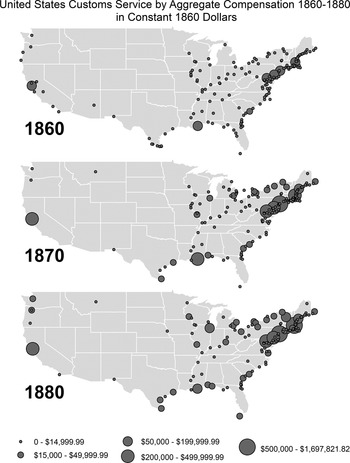
The absence of customs inspectors across vast swaths of territory created ample opportunities for regional economies, particularly west of the Great Lakes, to escape from view. The Department of the Treasury concentrated its operations around key port cities: New York, Boston, Philadelphia, Baltimore, San Francisco, and New Orleans. A host of secondary posts at Chicago, Niagara, Huron, Buffalo, and Detroit guarded the Great Lakes by the 1880s (Figure 1). The approach provided a way to impose tariffs while minimizing the risk of losing money, either by noncompliance or on customs officers guarding flows of traffic that could not justify their wages. Canada experienced a similar concentration of personnel along the St. Lawrence River, Great Lakes, and Atlantic Coast. Regardless of the time point, the Atlantic Coast, Gulf of Mexico, and Great Lakes loomed large. The west—aside from San Francisco and Victoria—remained an afterthought.
United States Customs Service by Aggregate Compensation, 1860–1880, in Constant 1860 Dollars. Maps created by Benjamin Hoy. The scarcity of information on retail prices has meant that prior to 1914 the Consumer Price Indexes (CPI) for the United States were inconsistent and should be interpreted with caution. This map relies on Ethel Hoover’s Consumer Price Index for 1851 to 1890. The index looked at fifty-eight commodities and used weighted averages based on the “distribution of major groups of family expenditures in 1875.” According to that index, consumer prices shifted heavily across the three time points (1860=100), 1860: 100, 1870: 141, 1880: 110. United States Congress, Joint Economic Committee, Employment, Growth, and Price Levels: Hearings Before the Joint Economic Committee Congress of the United States, Eighty-Sixth Congress First Session Pursuant to S. Con. Res. 13 Part 2—Historical and Comparative Rates of Production, Productivity, and Prices (Washington, DC: Government Printing Office, 1959), 401; Ethel D. Hoover, “Retail Prices after 1850,” in Trends in the American Economy in the Nineteenth Century, ed. The Conference on Research in Income and Wealth (Princeton, NJ: Princeton University Press, 1960), 141–142. The Customs Service stationed the bulk of its personnel around major port cities, particularly along the eastern seaboard and the St. Lawrence River. It paid far less attention to the trans-Mississippi West. Mapping compensation (rather than personnel) adjusts for the part-time status of employees who appeared on federal paylists and draws more attention to locations where high-ranking civil servants drew larger salaries. The digitized paylists from which this map was generated are available online. The website includes a detailed guide of the data cleaning and mapping process. The map below indicates the aggregate compensation paid at each post. It does not include the often-substantial bonuses that customs agents received. Benjamin Hoy, “Building Borders: Visual Representations of the Canada-United Border 1860–1915,” 2019, www.buildingborders.com. In addition, the data has been permanently hosted by the University of Saskatchewan: https://harvest.usask.ca/handle/10388/12153.

The growth of customs enforcement in the United States and Canada reflected a dual priority: raising revenue and defending domestic businesses. These goals required a careful balance. Providing domestic industries with a competitive advantage encouraged prohibitive tariffs. Enriching federal coffers, by contrast, required tariffs low enough that merchants still paid them. Prior to World War I, half of each government’s revenue came from the tariffs.Footnote 50 That made it easy to justify an ever-growing customs service. By 1929, a ring of customs ports, subports, and stations encircled both countries and extended into the interiors as well. The western regions of each country, which had received so little focus in the late nineteenth and early twentieth centuries, now possessed an array of installations designed to monitor and control the movement of goods across the line. Amidst such a large transition, it became difficult to separate changes in economic activity from an improved ability to monitor it (Figure 2).
Customs Posts in Canada and the United States by Type, 1929. Map created by Punya Suri, Himanshu Chauhan, and Benjamin Hoy. HGIS Lab, University of Saskatchewan. Information from U.S. Geological Survey, “U.S. Customs Service [Map],” August 1929, RG36. Bureau of Customs—Administrative Records. General Maps, National Archives and Records Administration, College Park; Michael P. McGoldrick, ed., Hand Book of the Canadian Customs Tariff and Excise Duties: Corrected June 1st 1929 (Montreal: McMullin Publishers, 1929), 916–926.

The growth of border control efforts also reflected the asymmetry of power between the two nations. In 1894, Canada agreed to allow American immigration agents to operate at Canadian ports. By 1910, the United States had forced Canadian companies like the Canadian Pacific Railway to assist American customs and immigration agents in keeping Chinese immigrants out of the United States. Canada achieved no similar concessions.Footnote 51 Still, the United States never gained the ability to create a meaningful border without Canada’s help. During Prohibition, for example, Ontario companies flooded alcohol across the border while the Canadian government collected an export tax on alcohol it knew directly undermined American policy efforts.Footnote 52 For all the power that the United States could wield, early experimentation in border control emphasized a common truth. Unilateral decisions worked poorly in transnational environments.
The Imprecision of Control
Despite outward signs of progress, the problems of border enforcement remained. Understaffing, regional variation, the ambiguity of categorization, and the prevalence of fraud prevented each government from gaining an accurate estimate of the value of goods crossing the line. Those closest to the operations made no attempt to hide their uncertainty. Andrew C. Philips remarked in 1880, for example, that while he could keep track of the movement of goods across the border, he could not help but overvalue it. Even with the privileged access to information afforded to him in his role as the American Consul at Fort Erie, Philips saw no clear way of separating the exports that passed through the United States for markets outside North America from those actually destined for American cities.Footnote 53
Inland customs houses added a second layer of frustration. Inland posts existed at cities in Ontario including Brantford, Paris, Stratford, London, Woodstock, Dundas, and Guelph, which had no navigable water, shared no border with a foreign country, and were not the first stops on major railway lines. Inland customs houses existed to make life easier for local communities by giving them flexibility on where they paid their fees. Such posts saved merchants’ trips to distant cities but created a bureaucratic nightmare for the consular agents tasked with tracking commerce.Footnote 54 Goods entering Canada posed little problem. Merchants paid duties on goods at the ports of entry or let them travel under bond to an inland customs post where they paid the duties there. In either case, the port at which the merchant paid duties recorded the goods in its books. The same, however, did not hold true for exports.
According to the U.S. Consul at Fort Erie, “each time a train crosses to the United States, the manifest exhibits the lading as exports,” comprised of “whatever and all merchandise on board. But these inland ports also claim and report exports shipped from the places of their location.” The practice created a problem with counting. Customs books recorded the same export as crossing the border twice—once from the inland customs house they originated from and once at the last Canadian port they visited. In this context, $2,500 worth of barley exported from Brantford became $5,000 in Canadian exports split between Brantford and Fort Erie. These kinds of inconsistencies ensured that “while in 1871 the exports from Fort Erie were thirty times larger than those of Brantford, the duties on imports at Brantford were seven times greater than those collected at Fort Erie.”Footnote 55 Inland ports made a mess of attempts to monitor commerce.
Even if both governments found a way to normalize how they counted, the broader logistics of the operation presented an imposing challenge. The size, value, and perishable nature of many cargos demanded that customs agents assess them with speed and precision.Footnote 56 In such a context, understaffing presented a perennial problem. A single night inspector, for instance, guarded the customs house at Port Townsend, Washington, from fire and robbery, while also handling the ships that arrived or departed at night.Footnote 57
Persistent challenges left national authority diffuse, with personal networks among businessmen, customs agents, and consumers being central to how the system functioned.Footnote 58 Fee-based forms of governance outsourced federal operations to private actors using “fees, bounties, subsidies, and contracts” to encourage “private individuals or corporations to enforce laws and implement public policy.”Footnote 59 Everyone from land office receivers to public prosecutors collected fees. This approach decentralized federal authority and tied it to the financial interests of outside parties.Footnote 60
Graft proliferated. Businesses employed legal and political experts to help them bend or break rules. Tanners processed hides only halfway before sending them across the line, in order to avoid a 30 percent duty.Footnote 61 When strategies like that failed, they turned to political donations and bribes. They did not have to look far to find politicians willing to play along.Footnote 62 During the 1870s, members of the Canadian Conservative Party rewarded “industrial groups that had supported them, such as textile makers, while ignoring the entreaties of those who, like the lumber barons, had failed to shift their political loyalties.”Footnote 63 Into the 1900s, journalists complained about the influence that manufacturers had on Canadian elections. Scandals and the dismissal of politicians in both countries only seemed to confirm broader concerns. Initial attempts by both countries to curb corruption and patronage had failed to eliminate the pay-to-play services that structured the political systems of either country.Footnote 64
Political corruption, however, was only one way to get rich. In other cases, merchants simply doctored their records to reduce the fees they paid. In 1886, customs officials became suspicious of Dixon Brothers, a wholesale fruit seller operating at 33 King Street East in Hamilton, Ontario, after discovering inconsistencies in the company’s invoices. A further investigation into the company’s books discovered that Dixon Brothers had undervalued its goods by half for years. The fruit retail store, Dixon and Morton, which the younger brother operated, appeared to have engaged in the same kind of deception.Footnote 65
As the Dixon Brothers’ story suggests, even if customs officers had managed to record and classify all of the legal trade that crossed the line, their eyes only fell on a portion of the overall commerce that linked Canada to the United States. Smugglers built storage facilities, colloquially known as “line houses,” adjacent to the border to make the illicit transit of goods easier.Footnote 66 Smuggling rings took advantage of the uneven application of scrutiny. On the Atlantic Coast, smugglers from Canada or other foreign ports transferred their cargos to American vessels before docking. The transfer, while laborious, moved the goods from foreign vessels to coastal ones, which passed with far fewer questions.Footnote 67 Amidst throngs of travelers, separating “those bent merely on pleasure or legitimate business” from those wishing to defraud the government never became an easy job.Footnote 68 The net result of all of this activity was that border control remained imprecise. It varied not only by time and location, but by industry as well.
Daily Life in the Border’s Shadow
The variability of customs enforcement made it difficult for individuals and families to predict the ways the border would shape their lives. In 1879, an Iowa newspaper editor took a trip into Manitoba. As revenue officers boarded the train at the border at Emerson, they informed the editor that his bags did not need to be examined. For the editor, the gesture stemmed from the Canadian government’s desire “to relieve us from the annoyance of an examination of our lunch baskets and dirty linen.”Footnote 69 It served as an extension of “the courtesies of a hospitable people.”Footnote 70 Yet in other places customs inspection was harder to ignore. In the early 1880s, customs agents at Fort Macleod, Alberta, opened all the packages arriving from the United States and charged appropriate duty on the goods contained within. For those living under such a regime, customs policy took on an oppressive tone. Frank Crosby, an employee of I. G. Baker, requested that his father send him nothing for the holidays in light of what he considered unacceptable customs and transportation costs.Footnote 71 Crosby and the Iowa newspaper editor interacted with the same national border, but their experiences were nothing alike. That variation only increased across regions.
As the lives of James A. Mathieu, Walter Ernest Dexter, Enos Wolverton, and Eugene Thibodeau suggest, the border impacted everyday life in hundreds of different ways. For some, it created opportunities. For others, the border appeared as a tax on clothing, a kind of petty annoyance, or, rarely, as a threat to an individual’s economic future. Federal maps depicted the border as if it were a thin line of universal impact. Local experience suggested otherwise.
James A. Mathieu was born on August 21, 1869, in Alma, Wisconsin. He began work in the lumber industry in 1885 before looking north of the border for opportunities. By 1905, he had built his first lumber mill at Rainy River, Ontario, a second one at Baudette, Minnesota, in 1906, and a third one at Fort Frances, Ontario.Footnote 72 For Mathieu, the border had little impact on his work. He described his movement across the line as “partly an accident. I sometimes say that I left Wisconsin because the trees were getting scarce and when they got pretty well cut out of Minnesota, I just moved across the boundary to Canada where there were lots of them.”Footnote 73 The geography of forests rather than of national borders prompted his relocations. The industry’s orientation entrenched these connections. National lumber associations worked across the border, and Mathieu saw few differences between the lumber industry’s relationship with either federal government. He believed that market integration between Canada and the United States enriched both countries. Canada led the world in newsprint production, and the United States was its largest market. Tariffs could interfere with transnational commerce, but for the most part Mathieu understood the border as having little impact on how the lumber industry operated.Footnote 74
Accounts by other men from the trade supported Mathieu’s assertions. Walter Ernest Dexter was born in Weymouth, Nova Scotia, in 1869, to parents who had been born in Maine. Dexter’s father worked selling lumber in Nova Scotia but retained his American citizenship and regularly voted in American elections. After his father’s lumber mill burned to the ground, Dexter moved to Minneapolis, Minnesota, and later to Rainy River, Ontario. At Rainy River, Dexter moved machinery between mills for the Shevlin-Mathew Lumber Company, which had both an American (Shevlin) and Canadian (Mathew) owner. For Dexter and Mathieu, the border seemed more like an afterthought than a cohesive barrier to movement or trade. Yet not everyone had such an experience.Footnote 75
Enos Wolverton moved from New York to Upper Canada at the age of sixteen. He settled in Oxford County, Ontario, where he ran a farm and milling business. His family made their living finding opportunities on both sides of the border. Despite Enos’s relocation to Canada, he sent his sons off to school in Ohio. When the Civil War broke out, Alonzo and Newton, two of Enos’s sons, took part. Money rather than loyalty motivated their actions. Newton served as a teamster for the Union Army before returning to Canada to join the 22nd Oxford Rifles. His new position saw him guarding the same border that his family’s movements regularly straddled. When opportunities in the lumber trade arose in Michigan, Newton considered relocating back across the line.Footnote 76 However, Newton Wolverton’s sister Rose Gobel had a very different experience. She remained far more stationary than the male members of her family, and so her relationship with the border shifted accordingly. For her, the border represented as much of a hassle as it did an opportunity. Her family’s economic success in Cleveland provided her with a remittance of $25. Still, Rose worried that she did not know what “we can do with U.S. money here.”Footnote 77 Perhaps she could trade it with the businessmen who traveled back and forth across the border. Perhaps not. Discounts on the value of the money as it changed countries, as well as the duties on Enos Wolverton’s belongings as he recrossed the border, ate into his savings and in turn what he could contribute to Rose’s well-being.Footnote 78
The question of currency was not unique to Rose Gobel. Multiple currencies swirled across the border. Canadian-chartered banks operated offices in New York, Chicago, and San Francisco. The General Manager of the Bank of Montreal boasted that American companies sometimes paid wages in Canadian currency to avoid the instability rife throughout the United States in the 1890s.Footnote 79 In Newfoundland, coins and dollars from Britain, the United States, Peru, Mexico, and Spain all circulated. While the rarer forms of currency fetched only eighty cents on the dollar so far from home, the mixture of currencies emphasized how little national borders curbed trade in North America.Footnote 80
If the border served as no barrier for James Mathieu and as both an opportunity and an irritant to the Wolverton family, it served as an unpredictable liability for others. For Eugene Thibodeau, the ambiguity of border policies threatened him with financial devastation. When Thibodeau emigrated from Chatham, Ontario, to the United States, he left his tools behind, believing he could forward them, duty-free, at a later date. He soon discovered his mistake. Forced to pay $38.60 in duties (roughly $1,300 in 2025) on items that would have passed freely had he accompanied them, Thibodeau found himself in a difficult financial situation. All parties believed Thibodeau had made an honest mistake or received faulty information from the consul to whom he had spoken. Nevertheless, the Department of the Treasury refused to refund the duties. Weeks later, Thibodeau continued to wait for a resolution, hoping that support from the consul at Chatham might help overturn the Treasury Department’s earlier decision.Footnote 81 In other cases, unexpected customs duties, particularly on Christmas gifts, raised the ire of families who struggled to predict how, when, and why customs duties were applied to some items but not others. Fear of unexpected costs stopped parcels before they were ever sent and shifted the ways families supported one another on both sides of the line.Footnote 82
While some individuals avoided tariffs by not shipping the items they desired across the border, others relied on illegal means to avoid the border’s implications. High duties, inconsistent laws, and overzealous customs inspectors created popular support for smuggling. Large smuggling rings and professional criminals made national headlines but were only part of the problem. Borderland residents often smuggled items for their personal consumption. Without investing in an enormous bureaucracy, neither country had the power to stop these practices outright. They settled instead for minor victories.Footnote 83
In July 1896, the U.S. District Court at Marquette, Michigan, sentenced George Kelsey to ninety days in the county jail. His crime was bringing twenty-four pairs of woolen socks valued at $15 into the country.Footnote 84 Kelsey was not alone. Petty smugglers carried jewelry, silk, velvet, baby carriages, embroidery, butter, and trinkets across the border undeclared.Footnote 85 At Marquette, the District Court made a regular habit of indicting individuals and merchants for failing to declare small amounts of merchandise: two sets of china ($50); six watches ($15); one case of whiskey ($30); two suits and an overcoat ($50).Footnote 86 Ignorance or need motivated some, but not all, of these petty crimes. With real estate holdings in Sault Ste. Marie worth upward of a thousand dollars, William J. Bell had more than enough money to pay the customs fees on the eighteen-dollar woolen suit (coat, vest, and trousers included) he brought into the United States. When he failed to do so, the district court of Marquette indicted him on charges of smuggling. Even millionaires avoided tariffs, however small, when possible.Footnote 87
The Business of Borders
Ordinary people experienced the border as a site of uncertainty and inconvenience. Corporations experienced it as an unpredictable set of legal and logistical challenges. In the late nineteenth and early twentieth centuries, a wave of corporate mergers consolidated power in North America.Footnote 88 It was a power that crisscrossed nations. By 1872, American railway companies controlled more land than any state other than Texas or Alaska (then still a territory).Footnote 89 By the end of the century, Standard Oil had control “over 90 percent of the US Market.”Footnote 90 Its acquisition of Canadian-based Imperial Oil in 1898 extended its influence over most of the remaining oil industry north of the Rio Grande.Footnote 91 Standard Oil integrated the Canadian subsidiary within its American network, choosing to run the operation, marketing, and distribution processes out of its offices in New York State.Footnote 92 Similar acquisitions and investments by other British and American financiers meant that by 1909, “11 of the top 30 non-financial corporation [in Canada] were wholly or partly foreign-owned.”Footnote 93
Small firms continued to play a significant role in manufacturing, and consolidation never became monolithic.Footnote 94 Still, the scale at which these new conglomerates could operate shifted the challenges they faced as their operations moved across international boundaries.Footnote 95 Borders added new sets of laws and regulations by which such entities needed to abide, and these regulations aggravated concerns regarding quality assurance, workflow, communication, and supervision. Salaried managers helped, but their utility depended on their ability to exploit technology and navigate a sensitive diplomatic environment.Footnote 96 While smaller businesses could develop ad hoc solutions to the problems that borders posed, multinational ones required scalable strategies.
The Sutherland Innes Company, for example, operated branch offices in Holland, Germany, France, England, the United States, and Canada. In North America, it ran lumber mills in Ontario and Quebec as well as in half a dozen U.S. states. Telephones allowed teams of administrators to handle paperwork and coordinate efforts. This approach made sense from a business point of view, but it ran afoul of consular regulations as goods moved across the line. According to Canadian law, each plant had to fill in its own invoices, limiting the ways the company could coordinate efforts across distances.Footnote 97 While the Sutherland Innes Company expressed its confidence in the overall abilities of its foremen, it noted that they were as “a general thing, very poor scholars.”Footnote 98 The company argued that forcing it to rely on these men to create consular invoices at each mill increased the likelihood of mistakes and delays. The U.S. Consul at Chatham agreed with the company’s assessment and passed the matter on to the Assistant Secretary of State. For the Sutherland Innes Company, the value of a positive resolution more than outweighed the time necessary to construct a petition. The fact that it had to do so over something as simple as who in the company filled out a form, however, emphasized the additional barriers the border presented to companies whose operations spanned national lines.
The training of a workforce created similar challenges. In 1909, the Dominion Telephone Company sent twenty-one of its employees to Chicago to receive training from the Swedish-American Telephone Company. Before the process could wind its way through the proper bureaucratic channels, nine of the men left for Chicago on their own accord. Arrested for illegal entry, each faced either deportation or a voluntary return to Canada. Measured in people trained or invoices filed, the border added hassle to even the most basic tasks.Footnote 99
Intellectual property added an additional wrinkle. In 1891, Sydney Ashdown visited the music shop owned by H. C. Wilson and Sons. On the shelves, he noticed books over which he maintained exclusive distribution rights. He sent Wilson and Sons a proposition. In exchange for Ashdown not pursuing the matter in the courts, Wilson and Sons would agree to purchase five copies of each of the offending publications from Ashdown as well as five copies of each of the “next 75 pieces published by us.”Footnote 100 The proposition unsettled Wilson. While Wilson hoped for an amicable settlement, he believed Ashdown offered an unfair deal. Wilson considered half the music on the required purchase list unsellable. He claimed he had unknowingly infringed on Ashdown’s rights and believed the punishment for his actions should remain as small as possible.Footnote 101 Wilson’s justification for the stock he carried, however, suggested a more complex situation. When describing why he carried the American music in the first place, Wilson noted that his store’s location near the border meant that his customers “naturally ask for the ‘cheap folios’ [and] if we do not keep them in stock they send to publishers and receive book by next mail.”Footnote 102 Borderland economies created a treacherous environment in which to work. If storeowners like Wilson failed to get customers what they wanted, his clients would find easy workarounds. If that happened, Wilson would find himself out of a job.
The problems Wilson faced came from a long tradition of intellectual disputes that stretched across borders. In the eighteenth and nineteenth centuries, American merchants smuggled technology out of Europe in order to patent it in the United States as their original work.Footnote 103 A century later, American businesses misleadingly named themselves after foreign companies. In doing so, they hoped that they could bolster their sales with false brand recognition. British, Canadian, and American treaties around trademarks created opportunities for redress, but not always clarity.Footnote 104
The Hudson’s Bay Company, for example, had operated across North America since the 1670s. By the nineteenth century, it had spawned a host of imposters. Businesses like the Hudson’s Bay Importing Company and the Hudson’s Bay Fur Trading Company operated in Dallas, Texas; San Francisco, California; New York City; Portland, Oregon; and Duluth, Minnesota. Despite possessing almost identical names, none of these newer businesses had any affiliation with the older Hudson’s Bay Company.Footnote 105 The emergence of imposters created a serious legal dilemma. Similarities in name might signal an intentional deception. They could also indicate a lack of originality. At least twenty-six fur companies in North America had Alaska as part of their name. Twelve used the term Arctic, and thirty-six companies had names referencing either Canada or the north. A lack of creativity created ample room for confusion and overlap. In such an environment, the legal system struggled to separate fraudsters from unintentional violators.Footnote 106
In Portland, Oregon, Milton and Isadora Gumbert operated a retail branch of their business known as the Hudson Bay Fur Company. When faced with litigation, they agreed to change their business’s name, but noted that the HBC did not operate in Portland or sell raw furs. They requested the right to advertise with both their new and old name for two years until their customers recognized the change. Their own large investment in advertising served as evidence that they had unknowingly infringed.Footnote 107 As the Gumbert case suggested, the Hudson’s Bay Company did not need to compete directly with a business before taking issue with its branding. It believed imposters, regardless of their location, undermined its ability to enter new markets. Imposters also threatened the HBC’s global reputation and its profits elsewhere in the world.Footnote 108
The law office of Shearman and Sterling offered a few possible remedies for businesses that found themselves in such a position. According to this firm, the HBC could take the cases before a court of Equity or attempt to revoke the offending companies’ charters. Pursuing the matter as a case of fraud under state or federal law offered another viable solution. If the HBC succeeded in having American courts classify the misdirection as fraud, the Postmaster General could cut off an offending company’s ability to use the mail system or to advertise in newspapers. Individual indictments might also follow.Footnote 109
The HBC’s reliance on American courts to protect its name abroad saw mild success. Court cases offered a means to shut down competitors or at least force them to include disclaimers about their lack of affiliation to the HBC. Tracking down all offending businesses, however, required time, expertise, and money. That investment, which the HBC bore, cut into the benefits it stood to gain even if it was victorious. More troubling, successful court cases often failed to change practice. Businesses placed disclaimers in obscure positions and used fonts that blended into the background. Even when the HBC’s legal action stopped the practice outright, it often took years to locate and prosecute offending businesses. In 1914, the Hudson Bay Importing Company in New York filed for bankruptcy. By that point, it had operated for twenty-four years.Footnote 110
Intellectual property rights across borders played a lot like whack-a-mole: beat down one competitor, and another popped up. In that sense, the absence of power wielded by Canada and the United States mattered as much to a company like the HBC as its presence. Without a reliable form of legal censure or redress, many of these companies had to expend large amounts of their own resources in order to protect their own names. Such expenditures increased the cost of doing business (Figure 3).
Henri Stadthagen’s Indian Curio Museum and Store. H. Stadthagen to Collector of Customs, November 17, 1902, RG 36, Washington Collection Correspondence, Puget Sound, Box 202a Misc. Letters Received 1902–1903, 1905, Folder P 1-49, National Archives and Records Administration at Seattle.

While training, administration, and intellectual property protections all became more complicated along the border, the most frustrating impact the border had on businesses came from customs inspectors themselves. Like individuals, businesses faced a bevy of unpredictable policies and unmanageably complex regulations. Such an environment created room for accusations of favoritism and fraud.
Henri Stadthagen’s Curio Museum and shop sat at 79 Johnson Street in Victoria, British Columbia. Stadthagen made his livelihood from creativity and opportunism. In 1906, he advertised the sale of 8.5-pound brass shell casings that the discerning customer could use as an umbrella stand or a flowerpot.Footnote 111 More often, he sold Indian curios as part of the growing trade in Indigenous artifact collecting that emerged on the Northwest Coast after 1875. One of five major shops in the city that engaged in the trade, Stadthagen’s business sold to British royalty as well as museums and tourists across Canada and the United States.Footnote 112 The geographic breadth of Stadthagen’s consumer base created logistical challenges. In 1908, he sold a sixty-nine-foot-tall totem pole (2,365 pounds) to a professor in England. Stadthagen’s crew cut the pole, believed to be the largest in the world, into three pieces. They used hay and burlap to prepare it for its journey.Footnote 113 For all the difficulties in acquiring and transporting such an item thousands of miles, the logistical problems that consumed Stadthagen’s time came from closer to home.
In 1902, Henri Stadthagen sent an order of twenty-seven Indigenous-made baskets and a pair of paddles to a client living in Washington State. Like many of his previous shipments, his most recent one hit a snag. Customs officers delayed Stadthagen’s goods at Port Townsend for weeks at a time. When his goods arrived, customs agents forced Stadthagen’s clients to sign declarations of their value before a notary public and charged a 35 percent duty on his cargo. By the time the client had paid all of the necessary fees, the amount exceeded the cost of the original purchase. Never having experienced these kinds of problems at any of the other locations to which he shipped, Stadthagen believed one of the customs officers in Port Townsend must have an economic interest in an American curio store. Nothing else he could think of would explain why his merchandise, and that of his Canadian competitors, had so much difficulty crossing the border at that location. To his further aggravation, Stadthagen watched as Indigenous people crossed the border themselves to sell their goods at Port Townsend, escaping the duty altogether.Footnote 114 Despite the aggravation, Stadthagen remained in the trade until 1911.Footnote 115
The border plagued Stadthagen’s exit from the industry much as it had plagued his participation therein. The cost of customs prohibited him from taking his remaining stock to Los Angeles after he retired. He left it instead with his sister-in-law while he figured out a way to sell it en masse. The absence of federal power frustrated the Hudson’s Bay Company, and its unevenness infuriated men like Stadthagen. By creating endless hassles in places like Port Townsend, customs officers redrew the practical distances between places. For Stadthagen’s customers, Victoria seemed far harder to reach from Port Townsend than its geographic distance would suggest.Footnote 116
Conclusion
Throughout the nineteenth and early twentieth centuries, the Canada-United States border provided an inconsistent barrier to movement. A desire to keep costs low contributed to this variability. So too did the actions of individuals and businesses. By encouraging commercial and personal self-interest in politics and enforcement, Canada and the United States linked local and regional interests to national policy. The end result was a myriad of conflicting approaches that differed across context and scale. Firms like the Hudson’s Bay Company advanced their own interests by spending large sums of money on corporate lawyers, bringing the border’s impact to bear on their competitors. Others aimed to convince authorities to loosen enforcement or found ways to avoid border policies altogether.
The variability of interests created a commercial environment that was difficult to manage. Customs agents found themselves policing everything from the largest corporations on the continent to individuals carrying woolen socks. Corruption, inconsistency in enforcement, and the influence of businesses on the political system undermined federal control in Canada and the United States. Local and commercial interests merged with those of distant administrators in Washington and Ottawa to structure the border’s practical shape. The result was a border that was necessary to the functioning of Canada and the United States, but which neither country fully controlled. Far from the uniform line depicted on national maps, the border functioned as a wall of uneven and unpredictable heights. Gaps in policy and enforcement were not unintended aberrations. They were formative parts of the border itself, set by national approaches that encouraged an uneven deployment of personnel, personal enrichment, and high levels of discretion. There was power to that approach. Unevenness created opportunities for profit. Unpredictability let the border cast a wider shadow. While the border’s efficacy has often been measured by customs revenue, patterns of trade, and arrests, its everyday effects were often subtler. The border wormed its way into the preparation of invoices, the stock that music stores kept, and businesses’ battles over naming practices. Built by local hands, the border created an ever-changing set of opportunities and liabilities that distant administrators struggled to predict, much less control.
Acknowledgments
I would like to thank Punya Suri, Himanshu Chauhan, Meagan Breault, and Erin Isaac for their research assistance.


 Open access

