





Introduction
Attention deficit hyperactivity disorder (ADHD) is a neurodevelopmental disorder characterized by symptoms of inattention (e.g., distractibility, difficulty focusing, and difficulty organizing and completing tasks) and/or hyperactivity-impulsivity (e.g., fidgeting, feeling restless, talking excessively, and interrupting others) that cause significant impairments in daily functioning (American Psychiatric Association, 2013). Approximately 3 to 6% of adults meet the diagnostic criteria for ADHD (Barkley, Reference Barkley2006; Kessler et al., Reference Kessler, Adler, Barkley, Biederman, Conners, Demler, Faraone, Greenhill, Howes, Secnik, Spencer, Ustun, Walters and Zaslavsky2006; Zhu et al., Reference Zhu, Liu, Li, Wang and Winterstein2018), with prevalence rates rising globally due, in part, to increased awareness. Although previously considered a disorder of childhood, ADHD is now viewed as a disorder that occurs across the lifespan (Kessler et al., Reference Kessler, Adler, Barkley, Biederman, Conners, Demler, Faraone, Greenhill, Howes, Secnik, Spencer, Ustun, Walters and Zaslavsky2006; Kooij, Reference Kooij2013), with an estimated 30–70% of children and adolescents with ADHD continuing to have impairing symptoms into adulthood (Barkley, Reference Barkley2006; Barkley et al., Reference Barkley, Fischer, Smallish and Fletcher2002; Weiss & Hechtman, Reference Weiss and Hechtman1993). Due to persistent difficulties with inattention and/or hyperactivity-impulsivity, individuals with ADHD often experience significant impairments in academic and vocational pursuits, as well as in interpersonal relationships (Jarrett, Reference Jarrett2016; Safren et al., Reference Safren, Sprich, Cooper-Vince, Knouse and Lerner2010). Additionally, ADHD is associated with an increased risk for other mental health problems such as anxiety, depression, and substance use (Biederman et al., Reference Biederman, Wilens, Mick, Milberger, Spencer and Faraone1995; Eakin et al., Reference Eakin, Minde, Hechtman, Ochs, Krane, Bouffard, Greenfield and Looper2004; Klassen et al., Reference Klassen, Katzman and Chokka2010; Skirrow et al., Reference Skirrow, McLoughlin, Kuntsi and Asherson2009). However, it is less clear how ADHD symptoms among parents are associated with their children’s developmental outcomes, especially among fathers, a group that has been vastly understudied in developmental research. Further, no studies have examined the impact of both parents exhibiting ADHD symptoms concurrently and child socioemotional outcomes.
Current research indicates that susceptibility to mental health problems is influenced by both genetic and environmental factors (Choi et al., Reference Choi, Wilson, Ge, Kandola, Patel, Lee and Smoller2022; Kendler, Reference Kendler2001). There is a strong heritable component to ADHD (Elia & Devoto, Reference Elia and Devoto2007; Faraone & Larsson, Reference Faraone and Larsson2019; Larsson et al., Reference Larsson, Chang, D’Onofrio and Lichtenstein2014; Thapar et al., Reference Thapar, Cooper, Jefferies and Stergiakouli2012), with approximately half of parents with ADHD having at least one child with ADHD (Minde et al., Reference Minde, Eakin, Hechtman, Ochs, Bouffard, Greenfield and Looper2003; Uchida et al., Reference Uchida, Driscoll, DiSalvo, Rajalakshmim, Maiello, Spera and Biederman2021). Beyond genetic transmission, the environment that children are raised in also plays an important role in healthy adjustment. The parent-child bond and parental behaviors such as warmth, sensitivity, and responsiveness are critical to children’s emotional well-being (Chaplin et al., Reference Chaplin, Cole and Zahn-Waxler2005; Gottman et al., Reference Gottman, Katz and Hooven1996; Landry et al., Reference Landry, Smith and Swank2006). In contrast, parenting behaviors characterized as harsh, inconsistent, overreactive, or uninvolved are associated with significant emotion regulation difficulties among children (Caspi et al., Reference Caspi, Moffitt, Morgan, Rutter, Taylor, Arseneault, Tully, Jacobs, Kim-Cohen and Polo-Tomas2004; Harvey et al., Reference Harvey, Metcalfe, Herbert and Fanton2011; Lunkenheimer et al., Reference Lunkenheimer, Shields and Cortina2007). Due to the difficulties with affective and cognitive regulation inherent to the disorder, parents with ADHD may have a reduced capacity to respond consistently and appropriately to their child’s behaviors and needs, which could have downstream effects on child socioemotional development, and the child’s later mental health and quality of life.
Most research in this area has focused on maternal ADHD, with very few studies examining ADHD symptoms in fathers, (Arnold et al., Reference Arnold, O’Leary and Edwards1997; Harvey et al., Reference Harvey, Danforth, McKee, Ulaszek and Friedman2003; Lowry et al., Reference Lowry, Schatz and Fabiano2018) who are an important part of childrearing and also uniquely contribute to children’s socioemotional development (Cabrera et al., Reference Cabrera, Shannon and Tamis-LeMonda2007; Jeynes, Reference Jeynes2016; Shewark & Blandon, Reference Shewark and Blandon2015). Only a few studies have examined dual-parental ADHD, where both parents exhibit symptoms (Breaux et al., Reference Breaux, Brown and Harvey2017; Williamson et al., Reference Williamson, Johnston, Noyes, Stewart and Weiss2017; Wymbs et al., Reference Wymbs, Dawson, Egan, Sacchetti, Tams and Wymbs2017). Existing literature, even that which has focused on the potential impacts of maternal ADHD, has been further limited by small sample sizes, a lack of assessment by sex of the child, and a lack of focus on early child development. For example, a recent meta-analysis found a significantly weaker association between negative parenting skills and parental ADHD symptoms in studies with more boys (Park et al., Reference Park, Hudec and Johnston2017), suggesting child sex may be an important factor contributing to differences in parenting behaviors among parents with ADHD, yet child sex has not been explicitly examined as a moderator of associations. Further, although the first three years are indispensable to the social, cognitive, and emotional development of children (Gabard-Durnam & McLaughlin, Reference Gabard-Durnam and McLaughlin2020), few studies have examined the link between parental ADHD and child outcomes in those under 3 years (Kittel-Schneider et al., Reference Kittel-Schneider, Quednow, Leutritz, McNeill and Reif2021). Most studies investigating parental ADHD focus on older children who themselves already have ADHD, oppositional defiant disorder (ODD), or other mental health diagnoses (Banks et al., Reference Banks, Ninowski, Mash and Semple2008; Johnston & Mash, Reference Johnston and Mash2001). Understanding more about early child socioemotional functioning in children exposed to paternal and/or maternal ADHD may help to develop interventions that could prevent the onset of or lessen the impact of mental health and behavioral problems in later in development.
The current study examined associations between paternal, maternal, and dual-parental ADHD symptoms in the early postpartum period and child socioemotional functioning between the ages of 6 and 24 months in a large sample of Canadian mothers and self-identified co-habiting fathers. It was hypothesized that increased levels of paternal and maternal ADHD symptoms would each be associated with increased child socioemotional problems and decreased socioemotional competence during a critical period in development. We further hypothesized the negative effect would be greater with dual-parental ADHD symptom exposure. We also examined the effects of parental ADHD symptoms on child socioemotional development separately in boys and girls, though without a significant prior literature to draw on, we did not make a priori hypotheses regarding sex-specific effects.
Methods
Study sample
This study is part of the IMPACT project, a prospective cohort study of self-identified postpartum women and their self-identified co-habiting male partners residing across Canada. Participants were recruited in the immediate period after obstetrical delivery from three hospital childbirth units in Toronto, using postpartum outreach, and via self-referral from social media advertisements (e.g., Twitter, Facebook). In-hospital recruitment occurred through trained research assistants who assessed parents for eligibility and obtained informed consent. Participants recruited through postpartum outreach and self-referral were telephoned by a trained research assistant who obtained informed consent and administered the baseline questionnaire. Those up to 2 weeks postpartum were eligible to participate if: (1) they had a singleton live birth at>33 weeks gestational age; (2) their co-habiting partner was a male who was also willing to participate; (3) both parents could read and understand English; and (4) both parents had access to a telephone or the internet. Women and their partners were excluded if they had: (1) schizophrenia, bipolar disorder, or active psychosis based on a self-reported clinical diagnosis; or (2) active thoughts of self-harm or suicide based on a positive response to item 10 on the Edinburgh Postnatal Depression Scale and confirmed through additional questions. Ethics approval for the study was granted by the University of Toronto Research Ethics Board (#29655) and the participating hospitals. The study followed the Strengthening the Reporting of Observational Studies in Epidemiology reporting guidelines.
Measures
Child socioemotional development
Child socioemotional outcomes were assessed at 6, 12, 18, and 24 months. The Ages and Stages Questionnaire: Social-Emotional (ASQ-SE) was used to measure social or emotional difficulties among infants at 6 months (Bricker & Squires, Reference Bricker and Squires2010). The questionnaire monitors child development in the areas of self-regulation, compliance, communication, adaptive behavior, autonomy, affect and interaction with people. For 6-month-old children, the questionnaire consists of 22 questions. For all the questions, “most of the time” responses received 0 points, “sometimes” = 5 points, “rarely or never” = 10 points, and “checked concern” = 5 additional points. The maximum number of points for each item is 15. Responses to all the questions are summed to calculate a total score. Lower scores indicate better social and emotional behaviors. A total score≥45 is considered clinically concerning (Squires et al., Reference Squires, Bricker and Twombly2002).
The Brief Infant-Toddler Social and Emotional Assessment (BITSEA) questionnaire was used to measure socioemotional problems and delays in socioemotional competence at 12, 18, and 24 months of age (Carter et al., Reference Carter, Briggs-Gowan, Jones and Little2003). The questionnaire contains 42 items: 31 items for assessing socioemotional problems and 11 items for assessing socioemotional competence. Items are rated on a scale of 0 to 2 where 0= “not true/rarely” and 2 = “very true/often.” Total scores range from 0 to 62 points for child socioemotional problems, where higher scores indicate higher severity of problems, and from 0 to 22 points for socioemotional competence, where lower scores indicate greater delays in competence. We used a mean value of maternal and paternal assessments and defined socioemotional problems using a cut-off of ≥13 for girls and ≥15 for boys at 12 months, a cut-off of ≥15 for both boys and girls aged 18 months, and a cut-off of ≥13 for girls and ≥14 for boys at 24 months. Socioemotional competence was defined using a cut-off of ≤ 11 for boys and girls at 12 months, a cut-off of ≤ 15 for girls and ≤ 13 for boys at 18 months, and a cut-off of ≤ 15 for girls and ≤ 14 for boys at 24 months. Only fathers or mothers (as opposed to both) completed BITSEA questionnaire in 478 families at 12 months, 436 families at 18 months, and 386 families at 24 months postpartum. For these families, the assessment of that individual parent was used to define child socioemotional problems or delays in socioemotional competence.
Parental attention-deficit/Hyperactivity disorder
Within two weeks of childbirth, women and their partners completed Part A of the Adult ADHD Self-Report Scale (ASRS), an 18-item self-report questionnaire designed to assess ADHD symptoms in adults. This scale is based on the World Health Organization Composite International Diagnostic Interview, and the questions are consistent with DSM criteria but reworded to better reflect symptom manifestation in adults. Part A contains six 5-point Likert items, where 0 = “never” and 5 = “very often,” which have been found to be most predictive of symptoms consistent with ADHD and are the basis for the ASRS screener (Kessler et al., Reference Kessler, Adler, Ames, Demler, Faraone, Hiripi, Howes, Jin, Secnik, Spencer, Ustun and Walters2005). Total paternal and maternal ADHD scores were classified into three groups: (1) “unlikely,” (2) “possible,” and (3) “likely” ADHD symptoms. Following the study by Kessler et al. (Reference Kessler, Adler, Ames, Demler, Faraone, Hiripi, Howes, Jin, Secnik, Spencer, Ustun and Walters2005) one point was assigned to the responses “sometimes,” “often,” and “very often” for items 1–3, and to the responses “often” and “very often” for items 4–6. The total paternal and maternal ADHD scores were classified into three groups: (1) ‘unlikely’ (score 0 to 2); (2) ‘possible’ (score 3); and (3) ‘likely’ (score 4 to 6) ADHD symptoms.
Covariates
The following covariates were collected at the baseline study interview and included in the analyses: paternal and maternal age, level of education, ethnicity, marital status, employment status, annual household income, difficulty in managing family on present income, number of adults living at home, number of children living at home, immigration status, body mass index before and after pregnancy, current smoking, substance abuse, alcohol consumption, adverse childhood experiences (ACEs, measured using the Adverse Childhood Experiences International Questionnaire (ACE-IQ) (World Health Organization, 2018)), physical and emotional intimate partner violence, marital dissatisfaction, depression (measured using The Edinburgh Postnatal Depression Scale (Eberhard-Gran et al., Reference Eberhard-Gran, Eskild, Tambs, Opjordsmoen and Ove Samuelsen2001), and anxiety (measured using State-Trait Anxiety Inventory (Marteau & Bekker, Reference Marteau and Bekker1992)). Child characteristics included as covariates included low birth weight (<2500 g), high birth weight (>4500 g), and admission to NICU.
Statistical analysis
Percentages (%) are reported for descriptive results. We used a logistic regression model to study the association between parental ADHD symptoms and child socioemotional problems (ASQ:SE) at 6 months, given that the ASQ:SE was administered only once. Generalized estimating equations (GEE) was used to study the associations of parental ADHD symptoms with child socioemotional problems and delays in competence (BITSEA) between 12 and 24 months of age given the BITSEA was administered at 12, 18, and 24 months. GEE is a statistical method for analyzing repeated measurements from the same participants over time that can estimate the population average of the effects of different factors on the outcome variable, while accounting for the correlation within each participant. We used a robust variance estimator and specified the link function as “logit,” family as “binomial” and correlation as “exchangeable.”
First, we ran a univariable model for parental ADHD symptoms according to four possible groupings: (1) neither father nor mother had ADHD symptoms, (2) father had ADHD symptoms but not mother (paternal-only group), (3) mother had ADHD symptoms but not father (maternal-only group), and (4) both father and mother had ADHD symptoms (dual-parental group). Due to a small number of dual-parental ADHD cases, we also ran additional models for paternal and maternal ADHD symptoms (two dichotomized variables). We then conducted two multivariable models for all outcomes: In Model I, the observed associations controlled for covariates shown in previous studies to be significantly related to socioemotional development: marital status, paternal unemployment, annual household income, difficulty in managing family on present income, paternal and maternal place of birth (Canada vs. other countries), obesity, smoking, substance abuse, ACEs, physical and emotional partner violence, marital dissatisfaction, low birth weight, high birth weight, and infant admitted to NICU. In Model II, associations were further adjusted to account for paternal and maternal depressive symptoms and anxiety at 3 months postpartum. We focus our description of the results on Model II of the multivariable model given that it is the most conservative. Stata v17 (StataCorp LLC, College Station, TX, USA) was used for the analyses.
Results
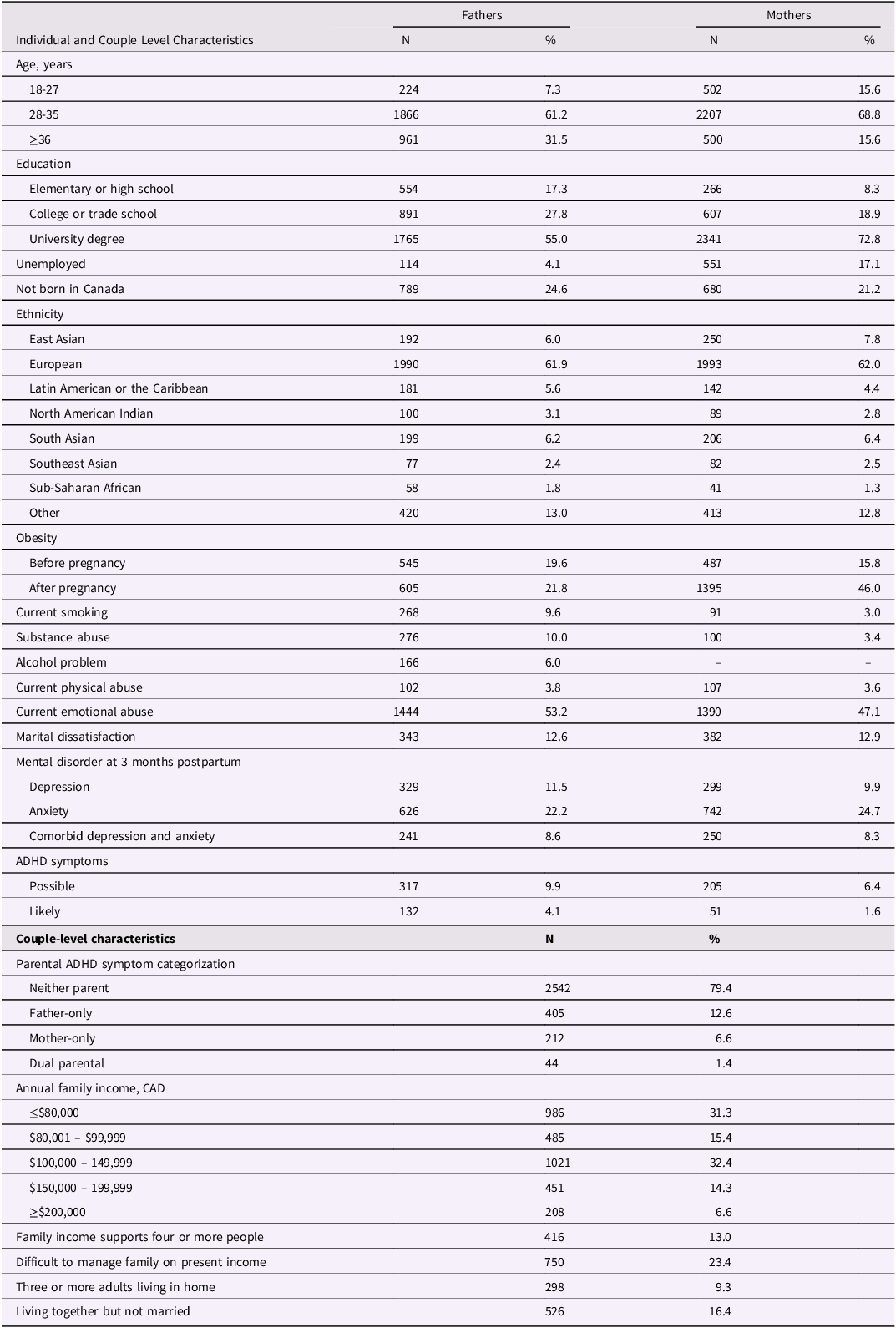
A total of 3,211 fathers and 3,207 mothers completed the questionnaire on ADHD symptoms within 2 weeks postpartum and 3,196 fathers and 3,198 mothers completed the questionnaire on child socioemotional difficulties at 6 months (ASQ-SE). At 12 months, 2,516 (78.4%) fathers and 2,824 (88.1%) mothers completed the questionnaire on socioemotional problems, while 2,511 fathers and 2,813 mothers completed the questionnaire on socioemotional competence (BITSEA). At 24 months, 2,437 (75.9%) fathers and 2,775 (86.5%) mothers completed the questionnaire on socioemotional problems, while 2,428 fathers and 2,763 mothers completed the questionnaire on socioemotional competence (BITSEA). At baseline, 449 (14%) of fathers and 256 (8%) of mothers had a positive screen for ADHD symptoms, including those with “possible” or “likely” ADHD symptoms. Table 1 presents sample demographic characteristics.
Table 1. Baseline participant characteristics – 3203 cohabiting parental couples

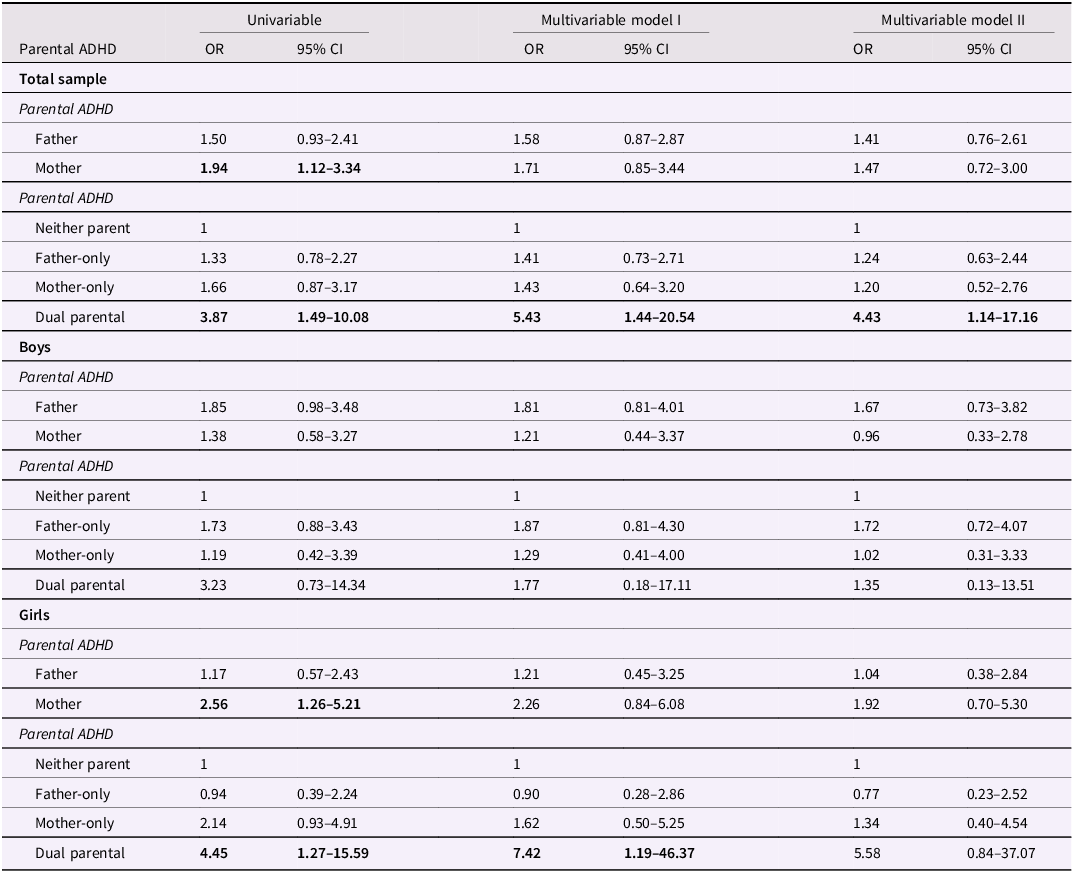
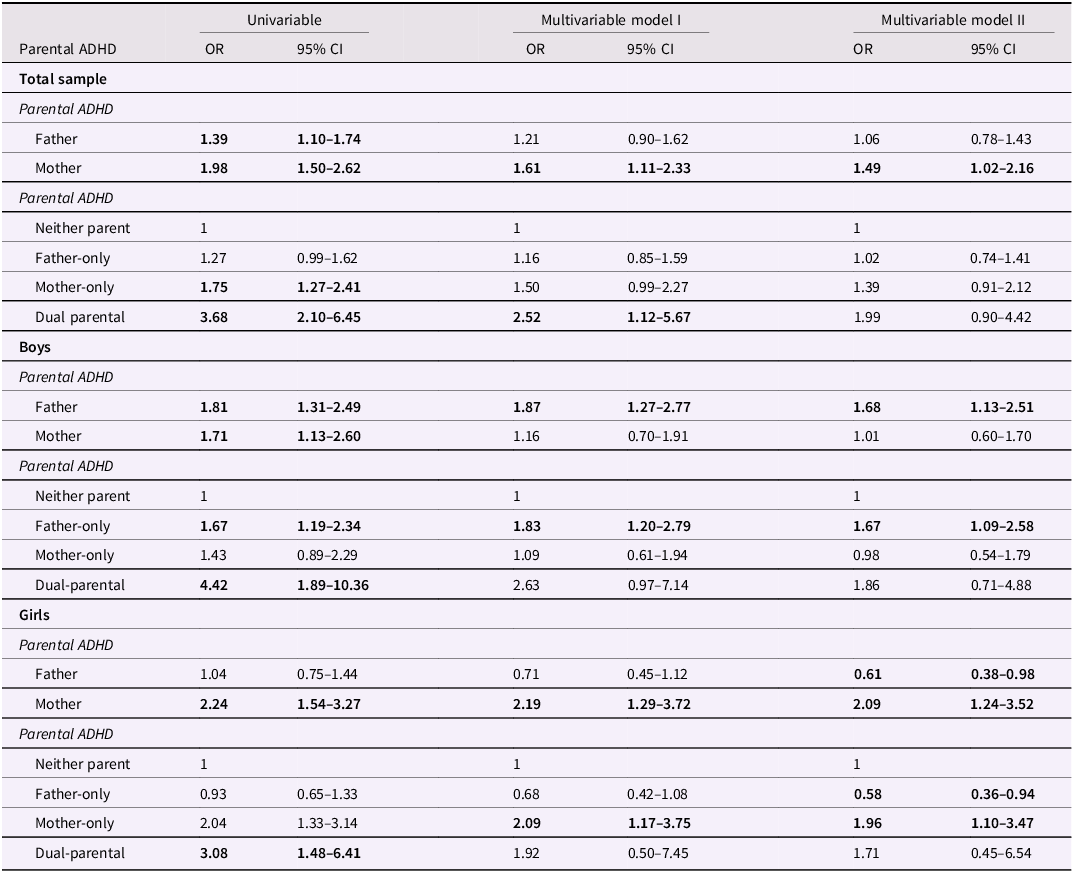
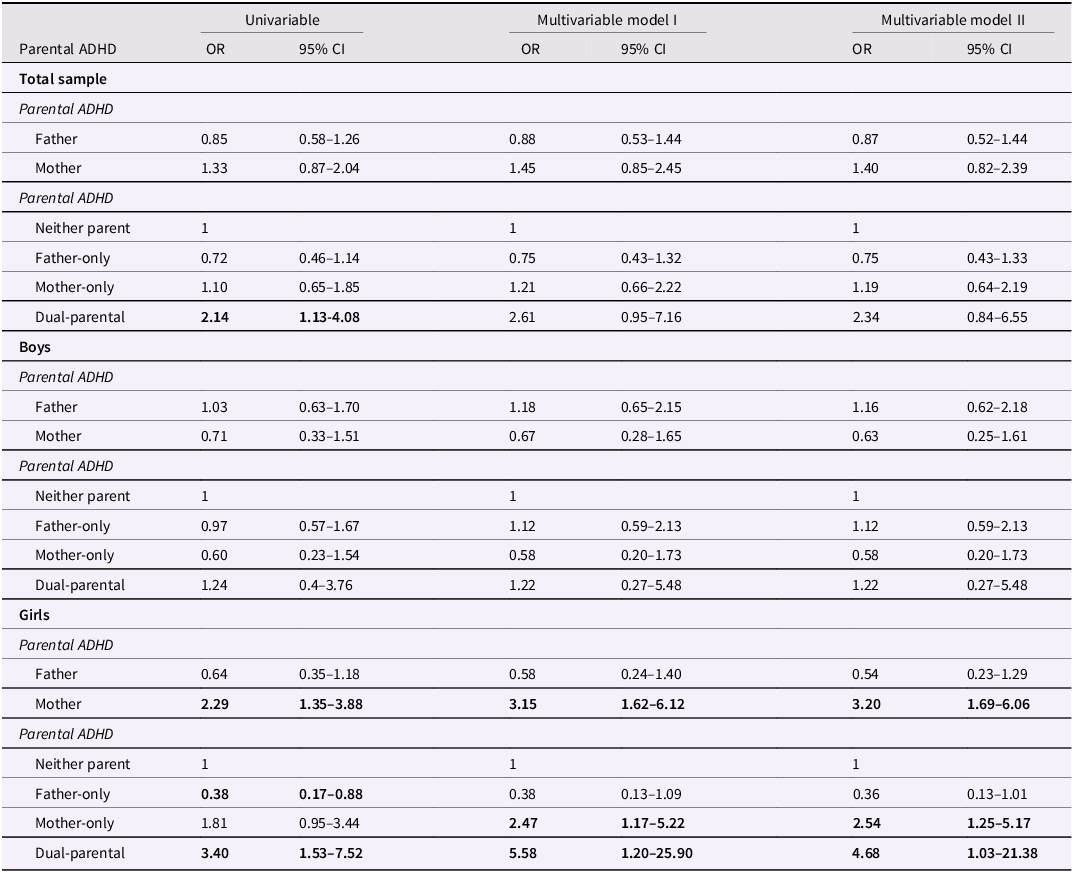
To improve statistical power, those with “possible” and “likely” ADHD symptoms were combined for the remainder of the analyses and compared to those who were “unlikely.” In the total sample, neither paternal-only nor maternal-only ADHD symptoms were associated with child socioemotional difficulties at 6 months on the ASQ-SE, compared to children where no parent had ADHD symptoms. Only dual-parental ADHD symptoms (OR 4.43, 95% CI 1.14–17.16) was associated with child socioemotional difficulties at 6 months after adjustment for confounding factors, including paternal and maternal depressive and anxiety symptoms at 3 months postpartum (Model II, Table 2). However, maternal-only ADHD was associated with increased risk of child socioemotional problems on the BITSEA from 12 to 24 months of age in the total sample (aOR 1.49, 95% CI 1.02–2.16) and among girls specifically (aOR 2.09, 95% CI 1.24–3.52, Table 3). Paternal-only ADHD was associated with increased risk of socioemotional problems in boys (aOR 1.68, 95% CI 1.13–2.51), but decreased risk in girls (aOR 0.61, 0.38–0.98), compared to families without ADHD symptoms. Maternal ADHD symptoms (sOR 3.20, 95% CI 1.69–6.06) and dual-parental ADHD symptoms (sOR 4.68, 95% CI 1.03–21.38) were associated with delays in socioemotional competence from 12 to 24 months in girls only (Table 4). Paternal ADHD symptoms were not significantly associated with delays in socioemotional competence overall, or in boys or girls specifically.
Table 2. Univariable and multivariable odds ratios (OR) for the associations of parental attention deficit hyperactivity disorder (ADHD) symptoms with child social-emotional difficulty (ASQ-SE) at 6 months

Model I, ORs were adjusted for the background characteristics as described in methods.
Model II, ORs were further adjusted for paternal and maternal depressive symptoms and anxiety at three months postpartum.
A separate model was run for each ADHD variable.
Table 3. Univariable and multivariable odds ratios (OR) for the associations of parental attention deficit hyperactivity disorder (ADHD) with child social-emotional problems from 12 to 24 months

Model I, ORs were adjusted for the background characteristics as described in methods.
Model II, ORs were further adjusted for paternal and maternal depressive symptoms and anxiety at three months postpartum.
A separate model was run for each ADHD variable.
Table 4. Univariable and multivariable odds ratios (OR) for the associations of parental attention deficit hyperactivity disorder (ADHD) symptoms with delays in child social-emotional competence from 12 to 24 months

Model I, ORs were adjusted for the background characteristics as described in methods.
Model II, ORs were further adjusted for paternal and maternal depressive symptoms and anxiety at three months postpartum.
A separate model was run for each ADHD variable.
Discussion
This is the largest nationwide study to investigate the relation between paternal and maternal ADHD symptoms and children’s socioemotional functioning over the first two years of life, and to do so both in a total sample and separated by child sex. It is also the first study to specifically examine the effect of early exposure to dual-parental ADHD symptoms and child socioemotional outcomes over the first two years of life. Results showed that parental ADHD symptoms were significantly associated with children’s overall socioemotional development over the first two years of life, with some differential patterns for boys versus girls. Further, dual-parental ADHD symptoms, but not maternal or paternal symptoms on their own, were significantly associated with children’s socioemotional problems at 6 months, after adjusting for parental anxiety, depression, and other potential confounds. Maternal ADHD symptoms were significantly associated with more socioemotional problems among girls and within the entire sample from 12 to 24 months. Conversely, paternal ADHD symptoms were significantly related to more socioemotional difficulties in boys and, surprisingly, fewer socioemotional difficulties in girls from 12 to 24 months. Finally, maternal and dual-parental ADHD symptoms were related to lower socioemotional competence in girls, but not in boys from 12 to 24 months of age.
Underlying genetic susceptibilities may partly explain the relation between parental symptoms of ADHD and socioemotional difficulties in their children. Family, twin, and adoption studies have consistently demonstrated the high heritability of ADHD, with heritability estimates ranging from 70 to 90% (Thapar et al., Reference Thapar, Cooper, Eyre and Langley2013; Faraone et al., Reference Faraone, Perlis, Doyle, Smoller, Goralnick, Holmgren and Sklar2005; Sprich et al., Reference Sprich, Biederman, Crawford, Mundy and Faraone2000). A recent systematic review found that the prevalence rate of ADHD in children of parents diagnosed with ADHD was between 40 to 57%, in contrast with a prevalence rate of 2 to 20% in comparison groups (Uchida et al., Reference Uchida, Driscoll, DiSalvo, Rajalakshmim, Maiello, Spera and Biederman2021). Further, genome-wide association studies have identified a number of common genetic factors, each with a small effect size, that are associated with ADHD traits (Gizer et al., Reference Gizer, Ficks and Waldman2009; Martin et al., Reference Martin, Hamshere, Stergiakouli, O’Donovan and Thapar2014; Faraone & Larsson, Reference Faraone and Larsson2019). Of note, the genetic variants related to the diagnosis of ADHD are also associated with many other psychiatric and neurodevelopmental disorders, including autism and disorders along the internalizing and externalizing spectra (Lahey et al., Reference Lahey, Van Hulle, Singh, Waldman and Rathouz2011; Pettersson et al., Reference Pettersson, Anckarsäter, Gillberg and Lichtenstein2013; Tistarelli et al., Reference Tistarelli, Fagnani, Troianiello, Stazi and Adriani2020; Waldman et al., Reference Waldman, Poore, van Hulle, Rathouz and Lahey2016). For instance, in a longitudinal study, children of parents with ADHD had significantly more mental health difficulties, including ADHD and impairments in functioning, compared to children of parents without ADHD (Uchida et al., Reference Uchida, DiSalvo, Walsh and Biederman2023). Accumulating evidence suggests that there is a latent genetic factor which represents an underlying liability for a broad range of mental health difficulties (Lahey et al., Reference Lahey, Van Hulle, Singh, Waldman and Rathouz2011). It is hypothesized that many risks, both genetic and environmental, and risk pathways lead from ADHD traits in parents to social emotional challenges in their children. More research is needed to elucidate and distinguish the unique and interactive contributions of each of these pathways.
In addition to the transmission of genetic factors, the associations documented in the present study may be explained by disruptions to the socialization processes that foster healthy development in the context of parental ADHD. Previous research clearly demonstrates that ADHD symptoms in parents are associated with undesirable parenting behaviors, which may contribute to differences in children’s socioemotional functioning. Parental ADHD symptoms have been linked to harsh (i.e., high control, low warmth) and lax (i.e., low control, irrespective of warmth) parenting styles (Johnston et al., Reference Johnston, Mash, Miller and Ninowski2012; Park et al., Reference Park, Hudec and Johnston2017). Higher levels of ADHD symptoms have also been correlated with negative parenting strategies, including inconsistent or overreactive responses to children’s misbehavior (e.g., arguing, quickly repeating or escalating commands) and less overall monitoring of children’s behavior (Chen & Johnston, Reference Chen and Johnston2007; Chronis-Tuscano et al., Reference Chronis-Tuscano, Raggi, Clarke, Rooney, Diaz and Pian2008; Johnston et al., Reference Johnston, Mash, Miller and Ninowski2012; Lowry et al., Reference Lowry, Schatz and Fabiano2018; Murray & Johnston, Reference Murray and Johnston2006; Woods et al., Reference Woods, Mazursky-Horowitz, Thomas, Dougherty and Chronis-Tuscano2021). Conversely, higher ADHD symptoms in parents are negatively associated with positive parenting techniques, including less use of positive reinforcement or praise, less involvement, and less scaffolding or appropriate problem-solving to address child needs (Chen & Johnston, Reference Chen and Johnston2007; Chronis-Tuscano et al., Reference Chronis-Tuscano, Raggi, Clarke, Rooney, Diaz and Pian2008; Johnston et al., Reference Johnston, Mash, Miller and Ninowski2012). For example, when observed during a free play task, mothers with ADHD provide more critical statements/demands and more negative physical responses with their child and, during a homework task, less positive parenting behaviors (e.g., positive praise, facial expressions, or physical touch) (Chronis-Tuscano et al., Reference Chronis-Tuscano, Raggi, Clarke, Rooney, Diaz and Pian2008). The core challenges underlying ADHD―for example, with planning, organization, and problem solving―may hinder parents’ ability to appropriately and sensitively respond to their child’s emotional or cognitive states. Additionally, parents who have difficulty focusing might be less likely to recognize situations necessitating increased parental monitoring and they may struggle to follow through with instructions or consequences. Furthermore, parents who experience hyperactivity-impulsivity may have difficulty regulating their own emotions in response to their child’s behaviors and may therefore react too quickly or harshly. Thus, the core symptoms of ADHD may contribute to more negative and less positive parenting behaviors and skills, which may provide a mechanism linking symptoms of ADHD among parents to more socioemotional difficulties in their children. While not tested in the current study, these mediation pathways constitute an important direction for future research.
In addition to general socioemotional difficulties, parental ADHD symptoms have been linked with their children’s own ADHD and Oppositional Defiant Disorder (ODD) symptoms (Ellis & Nigg, Reference Ellis and Nigg2009; Epstein et al., Reference Epstein, Conners, Erhardt, Arnold, Hechtman, Hinshaw, Hoza, Newcorn, Swanson and Vitiello2000; Humphreys et al., Reference Humphreys, Mehta and Lee2012; Zisser & Eyberg, Reference Zisser and Eyberg2012). In one study, both maternal and paternal ADHD symptoms were associated with children’s ADHD symptoms at age 3 years, but only maternal ADHD symptoms predicted child ADHD symptoms at age 6 years after adjusting for earlier ADHD symptoms (Breaux et al., Reference Breaux, Brown and Harvey2017). Interestingly, mothers of children with ADHD report higher levels of ADHD symptoms themselves (Efron et al., Reference Efron, Furley, Gulenc and Sciberras2018). This may be due to the strong heritability of ADHD, but it may also be reflective of the unique challenges caregivers face when parenting a child with behavioral and cognitive difficulties related to ADHD. Additionally, higher levels of parental ADHD symptoms have been linked to more ODD or conduct disorder symptoms in children (Breaux et al., Reference Breaux, Brown and Harvey2017; Ellis & Nigg, Reference Ellis and Nigg2009; Humphreys et al., Reference Humphreys, Mehta and Lee2012; Romirowsky & Chronis-Tuscano, Reference Romirowsky and Chronis-Tuscano2014; Zisser & Eyberg, Reference Zisser and Eyberg2012). It is interesting that children without ADHD whose mothers are reported to have ADHD experience more peer and emotion problems, as well as higher overall levels of social impairment (Efron et al., Reference Efron, Furley, Gulenc and Sciberras2018). Thus, children of parents with ADHD have been shown to experience a range of socioemotional challenges even in the absence of a formal diagnoses themselves. It is conceivable that these associations reflect a mechanism of genetic transmission, with genes linked to ADHD in parents conferring non-specific risk of undesirable developmental outcomes in children. However, studies also show that parenting practices mediate the relation between parental ADHD symptoms and child ADHD and ODD symptoms (Breaux et al., Reference Breaux, Brown and Harvey2017), as less consistent discipline and lower involvement by fathers was also associated with higher ADHD symptoms in children after controlling for ODD and CD symptoms (Ellis & Nigg, Reference Ellis and Nigg2009). While these studies cannot completely rule out gene-environment correlation effects, they suggest parenting behavior may mediate the relation between ADHD symptoms in parents and their children’s mental health. Future studies that can control for genetic confounding, either by using traditional twin designs or polygenic risk scores, are important to elucidate whether pathways of social transmission occur above and beyond genetic transmission from parents to their children. Indeed, despite its large sample and inclusion of multiple potential confounding factors, the current study cannot disentangle these two pathways. However, our study did find that adjusting for depression and anxiety attenuated the strength of the associations, as did adjusting for multiple social determinants of health. Additional research is warranted to examine how comorbidities and the broader social environment can play a role in the association between parental ADHD and child development to identify targetable modifiable variables for preventive interventions.
One strength of this study is that it examined the effects of maternal and paternal ADHD symptoms on child outcomes separately and together, an approach made possible by having a large community sample of mothers and fathers. An interesting finding from this study is that maternal ADHD symptoms were significantly associated with more socioemotional problems and less socioemotional competence in girls, while paternal ADHD symptoms were related to more socioemotional problems in boys (but unrelated to socioemotional competence in boys or girls). Although few studies have examined the sex of both parents and their children as moderators of the relation between parental ADHD and child outcomes, child sex has been shown to influence parenting behaviors more generally (Leaper & Farkas, Reference Leaper and Farkas2015). Additionally, meta-analyses have shown that child sex significantly moderates the association between parental ADHD symptoms and harsh parenting, such that studies with more boys had a weaker association between parental ADHD and harsh parenting (Park et al., Reference Park, Hudec and Johnston2017). As hypothesized by Park and colleagues, it is possible that parents view their children’s behavior differently based on their sex, perhaps being more lenient or understanding of boys’ hyperactive or impulsive behaviors compared to girls’. Furthermore, the findings on whether maternal and paternal ADHD are differentially associated with children’s socioemotional functioning is mixed. Some studies have found that paternal ADHD symptoms are more strongly associated with child ADHD symptoms (Macek et al., Reference Macek, Gosar and Tomori2012; Takeda et al., Reference Takeda, Stotesbery, Power, Ambrosini, Berrettini, Hakonarson and Elia2010), while other studies have shown stronger associations between maternal ADHD symptoms and child ADHD symptoms (Agha et al., Reference Agha, Zammit, Thapar and Langley2013; Goos et al., Reference Goos, Ezzatian and Schachar2007; Segenreich et al., Reference Segenreich, Paez, Regalla, Fortes, Faraone, Sergeant and Mattos2015). Further research is needed to uncover the contribution of maternal and paternal ADHD symptoms individually on child mental health, and of both parents together, and to ascertain whether there are sex-specific effects on the socioemotional development of boys and girls.
Although this study has many strengths, including the large sample, longitudinal design, and measurement of both maternal and paternal ADHD symptoms, there are some limitations. The present study focused only on mothers and their male partners, which limits generalizability to other family structures and caregiving dyads (e.g., single parents, same-sex partners). More research is needed with other such family structures and caregiving arrangements to understand similarities and differences in the effects of parental ADHD on children’s outcomes. Since the current study recruited participants after they delivered their child, information about parental ADHD and other mental health symptoms during pregnancy were not available and could not be accounted for in the present analyses. Although analyses controlled for symptoms of depression and anxiety, parental ADHD symptoms was assessed during a period of transition and heightened stress, which may have inflated the number of symptoms parents reported. Further, parental ADHD symptoms were measured using self-report assessments and did not include corroborative reports from a partner or other person, nor did it include clinical assessments of ADHD symptoms or diagnoses. However, parental self-reports and corroborative reports or diagnostic interviews have been shown to be highly correlated (Barkley et al., Reference Barkley, Knouse and Murphy2011; Belendiuk et al., Reference Belendiuk, Clarke, Chronis and Raggi2007), and are thus considered an accurate and reliable measure of parental symptoms. Moreover, parents also reported on their children’s socioemotional difficulties, which combined with their self-reports of ADHD symptoms, increases the risk of inflated estimates due to shared method variance. In future studies, observational or direct measures of children’s socioemotional competence would help minimize this risk. Future work examining parental ADHD should also focus on potential mechanisms through which parental ADHD is associated with child outcomes, such as disruptions in parenting behaviors, which are likely to be important mediators between parental ADHD symptoms and child outcomes. As noted above, studies that are able to control for genetic confounding while testing mechanisms of social transmission (e.g., via parenting practices or other aspects of the home environment) are also required. Finally, longitudinal studies testing whether early socioemotional difficulties are predictive of later diagnoses of ADHD or other mental health disorders in children of parents with ADHD symptoms are needed, especially as children make the transition to school where these difficulties often first emerge or are detected. Additionally, having established the overall association between parental ADHD symptoms and child socioemotional outcomes during early childhood, a potential next step is to map out longitudinal trajectories of child development and examine time-varying and time-invariant predictors of these trajectories.
Conclusion
This study contributes to our understanding of the relation between paternal, maternal, and dual-parental ADHD and children’s early socioemotional development. This is among the largest studies to investigate the relation between maternal and paternal ADHD symptoms children’s socioemotional functioning over the first two years of life, and the first to examine the effect of exposure to dual-parental ADHD symptoms on socioemotional development during this period. Further elucidation of the mechanisms by which ADHD impacts young children is critically important to the development of early prevention and intervention programs that can help to guard against poor outcomes in children by scaffolding effective parenting practices among those with ADHD. However, prior work has shown that, after parenting interventions, mothers with higher levels of ADHD symptoms report less improvement in their child’s difficult behaviors (Chronis-Tuscano et al., Reference Chronis-Tuscano, O’Brien, Johnston, Jones, Clarke, Raggi, Rooney, Diaz, Pian and Seymour2011; Sonuga-Barke et al., Reference Sonuga-Barke, Daley and Thompson2002). This suggests that direct treatment of parental ADHD in combination with parenting support may be an important avenue towards optimizing children’s outcomes (Chronis-Tuscano et al., Reference Chronis-Tuscano, Wang, Woods, Strickland and Stein2017; Geissler et al., Reference Geissler, Vloet, Strom, Jaite, Graf, Kappel, Warnke, Jacob, Hennighausen, Haack-Dees, Schneider-Momm, Matthies, Rösler, Retz, Hänig, von Gontard, Sobanski, Alm, Hohmann and Jans2020). Understanding the benefits of such interventions when provided to mothers, fathers, and the co-parenting dyad will further help to tailor resources and supports in a way that improves both parental well-being and the socioemotional development of children.
Funding statement
This study was funded by the Canadian Institutes of Health Research (Grant #MOP-130383). The sponsor had no role in the design, analysis, interpretation, or publication of this study.
Competing interests
None.

 Open access

