

Introduction
In the 1500s, Portugal established trading posts in Malabar India. Given the Gulf’s position in the Indian Ocean trade network,Footnote 1 it was natural for Portugal to enter the khalīj.Footnote 2 The Dutch, English, and Ottomans sought to break Portugal’s Indian Ocean trade monopoly.Footnote 3 By the 1600s, all extended operations to the Gulf. During these economic and political shifts, the seafaring oligopoly Arabs once enjoyed was lost permanently.Footnote 4 After the British, Persians, and ʿOmānis dislodged the Portuguese and Dutch from the khalīj, the Qawāsim (sing. Qāsimī) Gulf Arabs attempted to regain control over commercial routes to India but instead met a new master: Britain.
From the mid-1700s, the khalīj was thrown into anarchy. Maritime tribes and rising confederacies (ʾaḥlāf, sing. ḥlf) were moving away from a suzerain system towards independence. Power reconfigurations heightened rivalries, and rivalries gave rise to predation at sea.Footnote 5 In the Arab interior, 1744 marked the beginning of Wahhābī expansion (also known as the ‘Emirate of Diriyah’). Rising Wahhābis menaced the Ottoman, ʿOmānī, and Persian suzerains with influence on the Arab coast and threatened autonomy of coastal maritime sheikhs and their tribes on Arab shores.Footnote 6 On the Persian side, 1747 marked the beginning of turmoil in the heart of Persia. Nādir Shāh’s death created a power vacuum rippling to the coast, enabling Arab maritime tribes on the Persian littoral to limit Persian influence and increase control over coastal territories.Footnote 7
For the first two decades of the 1800s, tensions between the Qawāsim and the East India Company (EIC) intensified, with multiple claims of ‘piracy’ against British vessels.Footnote 8 While Britain viewed passage through the Gulf as its right, the Qawāsim and their allies considered it an infringement on their livelihood.Footnote 9 EIC animosity towards the Qawāsim was further aggravated when they offered British ships protection in exchange for tribute, a custom interpreted as impudent.Footnote 10 These macro- and meso-level shifts in power and authority among tribes, confederacies, and regional/extra-regional powers enabled Britain to enter the Gulf, freeze the political status quo through treaties, and rule for 150 years (1820–1971).
This paper challenges inaccuracies classifying the 19th- and 20th-century khalīj as a region of low-intensity indirect rule.Footnote 11 This logic assumes a de jure form of governance in which British policies had little or no effect on domestic politics. Events that unfolded over 150 years reflect imperial policy that turned direct over time. As one colonial administrator documented: ‘Bahrain had fallen under the influence of the British government to such an extent that the shaikh was accustomed to conform to their advice in external affairs and looked to them for protection against attack from without.’Footnote 12 Contrary to classical English School claims of a shift of legitimacy from dynasticism to popular sovereignty in 19th-century international society, this article demonstrates that 19th-century British intervention to ‘civilise’ Gulf ‘pirates’ gave way to dynastic state formation.Footnote 13 The Gulf offers an example in which dynasticism was the preferred institution in 19th- and 20th-century British colonialism. While the claim of transition from dynasticism to popular sovereignty may fit experiences of European states, the story of the colonised non-European other differed.
Applying Isaac Reed’s framework of rector, actor, and other to the Gulf,Footnote 14 I suggest British imposition of rules and norms via Anglo-Arab treaties forged three hierarchical levels: the highest authority was rector (Britain); residing as gatekeeper between Britain and his community was the actor (British-recognised sheikh); and finally, the subordinated and excluded other (‘pirates’/unrecognised sheikhs). This produced new ‘chains of power’Footnote 15 whereby ‘rector makes actor into rector’s agent in the world, and other is profaned and excluded from a given project’.Footnote 16 By rector co-opting actor in his ‘civilising’ anti-piracy project against the other, agency and power accrued through a rector–actor model.Footnote 17 While rector ruled over maritime tribes indirectly via actor, British political oversight and control was maintained through its Bushire political residency and network of native agents.Footnote 18 Rector had, ‘the greatest coercive power … British protection [of actor] was least likely to be violated’.Footnote 19 This weakened the ‘piratical’ other by restricting agency to alter political outcomes, letting power consolidate within the rector–actor relationship.
This article proceeds in three sections. First, it examines limitations of the classical English School international society thesis in the Gulf case and re-examines the Gulf’s position within the ‘Middle East’ as a region of English School analysis. Here, the paper adapts for International Relations (IR) and International Studies a useful turn proposed by historians to re-examine the Gulf through an Indian Ocean lens.Footnote 20
Second, by situating ‘piracy’ into the broader ‘standard of civilisation’ debate on international society expansion, the paper shows incongruence in British usage of the term ‘piracy’ with local practices, and sheds light into empirical problems it posed for colonial administrators to distinguish between lawful force as ‘war’ and unlawful force as ‘piracy’. Irrespective of these contradictions, suppressing any uses of force (justified or otherwise) by sheikhs and maritime tribes excluded from treaty-making created the necessary conditions for dynastic state formation.
Finally, to approximate the Gulf into a more ‘civilised’ interstate coexistence, the article identifies what I call mechanisms of ‘pacification’ deployed by Britain to restrict agency of ‘unruly’ maritime tribes to support political construction of sovereign indivisibility.Footnote 21 This will be done by examining implications of the Maritime Truce (1835), Restrictive Line (1836), and Perpetual Truce (1853) in controlling movement and regulating when and how force was deployed. By nesting the Restrictive Line (also called the ‘Hennell Line’) as a 19th-century institution of maritime boundary-making, the paper uncovers colonial foundations underpinning dynastic state formation on land. Scholarly fixation on land boundaries caused maritime implications of the Restrictive Line separating Gulf tribes to remain under-theorised.Footnote 22 For Gulf Arab maritime tribes, the sea was their metaphorical ‘land’. The Restrictive Line became a central ‘divide-and-rule’ policy governing the khalīj by restricting movement, limiting cross-coastal tribal connections, and curbing regional powers from soliciting support from maritime tribes to attack territories on opposite shores. This enabled the British rector and sheikhly actors to assert control, limiting non-recognised sheikhs and their tribes’ ability to affect political outcomes. This policy favoured accrual of domestic power under British-backed sheikhly actors at the expense of restricting agency of maritime sheikhs excluded from treaty-making. This gradually undermined non-signatory maritime sheikhs’ roles as vital agents in the politics of protection of a coastal polity and unsettled traditional structures of authority within maritime tribal confederacies from participation to compliance, all in the name of order and anti-piracy security imperatives.
The English School and the missing Gulf: A sea before land
Born in Europe in the 15th to 18th centuries, the modern international system of states is a legacy of Europe’s international society, which evolved to regulate interstate relations among members that are principal originators and subjects of its rules and norms.Footnote 23 At its core, the society was exclusive. It arose to address problems within Europe by regulating intra-European relations among a family of ‘civilised’ Christian nations. Expansion of Europe’s international society to the rest of the world varied. Colonialism was the primary instrument of European expansion, its practices justified by a moral-ethical ‘standard of civilisation’.Footnote 24 International lawyers in the 19th century deployed the ‘standard’ as a legal doctrine giving European powers the right to colonise, discriminate against, and control non-European societies unconditionally.Footnote 25 Edward Keene argues that 19th-century international relations were not merely a story of expansion of European ideals of equal independent states, nor one of acceptance of independent communities as equals within the ‘family of nations’, but rather a conscious process of ‘stratification’ between civilised nations of the West and the uncivilised rest in a socially bifurcated European-dominated international society.Footnote 26
Hedley Bull and Adam Watson define the intellectual framework of international society as a:
group of states (or, more generally, a group of independent political communities) which not merely form a system, in the sense that the behaviour of each is a necessary factor in the calculations of the others, but also have established by dialogue and consent common rules and institutions for the conduct of their relations, and recognize their common interest in maintaining these arrangements.Footnote 27
Based on this definition, international society applies to sovereign states.Footnote 28 The modus operandi of interstate relations forming a society involved integration of member states through what Bull described as common interests and values.Footnote 29 This goes beyond political realism, which the international system more accurately embodies.Footnote 30 While an international system can exist without international society, the latter posits rules and institutions provide a framework to minimise interstate violence.Footnote 31 This international order assumes a ‘society’ has a single set of rules and norms applied to all members equally irrespective of variations of domestic political systems or cultures. International order is about commitment to universal ‘coexistence’ and ‘cooperation’ among states.Footnote 32
In practice, however, European international legal order was conflictive. While ‘toleration’ was to promote ‘coexistence’ in inter-European relations, the principle did not apply to the uncivilised non-European rest.Footnote 33 As Shogo Suzuki observes, international society was closer to a space of European-dominated power-driven hierarchies, a phenomenon poorly addressed in classical English School studies.Footnote 34
For non-Europeans polities, membership in a European-dominated international society came with ‘social expectations’.Footnote 35 It required adherence to a ‘standard of civilisation’ to undergo what Yongjin Zhang calls a ‘socialisation or contractual process’, a systematic adoption of rules, norms, and identities of influential European members.Footnote 36 Coexistence and cooperation were not confined to the international level but included structural adjustments to reconfigure domestic political structures of authority of non-European polities to meet Western expectations of civility.Footnote 37
In the three-level topology of cultural systems, the Middle East and the Gulf were neither savage nor civilised. They were considered ‘barbarous’, and at best ‘semi-civilised’. Expansion, or as Fred Halliday puts it, ‘subjugation’, came through ‘violence, treachery … expropriation and mass murder’.Footnote 38 ‘Coercive diffusion’ of European norms and rules, more often, led to military modernisation ‘mania’ taking an overriding importance in state-building,Footnote 39 as civility often translated to the expression of military power as quick fixes to close the state-building gap with Europe and gain ‘civilised’ status.
Although Halliday is right to situate the Gulf under a continental ‘Middle East’ rubric in a post-1918 world of regional international relations analysis,Footnote 40 it has two shortcomings when applied in retrospect. First, while his assessment of increasingly militarised 19th-century Middle Eastern metropoles is valid, the Gulf was not a metropole of continental powers. It comprised borderless settlements with no modern standing armies or centralised bureaucracies. Militarisation was neither an objective nor an affordable endeavour.
Second, examining the Gulf through a terrestrial Middle East lens overlooks a rich seafaring/maritime culture in which the wealth and livelihood of Gulf people was tied to the sea.Footnote 41 As Fahad Bishara cogently argues, since the modern era (post 1500), the Gulf was ‘increasingly swept’ into an Indian Ocean world,Footnote 42 one described by Andrew Phillips and Jason Sharman as a ‘heterogeneous’ international system of order under political diversity,Footnote 43 composed of overlapping autonomous local/Indigenous actors interacting with various regional and extra-regional powers: Persian/Safavid, Ottoman, Moghul, ʿOmānī, Portuguese, Dutch, French, and British.Footnote 44 Like their Indian Ocean counterparts, conceptions of political power for khalījī (of the Gulf) coastal polities were ‘heteronomous’, ‘divisible’, and territorially ‘non-exclusive’.Footnote 45 Rather than militarised per se, security had to be negotiated between and among various power hierarchies.
In the Gulf, James Onley calls this feature of sheikhs negotiating for security as ‘protection-seeking’ habits.Footnote 46 To illustrate, Sheikh Muḥammed-ibn-Khalīfah Āl-Khalīfah, ruler of Bahrain, wrote to Captain Samuel Hennell, Gulf Political Resident (1838–52),Footnote 47 in Bushire on 9 February 1849:
I beg to inform you, I perceive that all the countries in this quarter are dependent upon one or other of the Sultans as for example the coast of Fars is dependent upon the Persians and likewise the people of Koweit and the Wahabee are dependent upon Turkey and I as I have a heart am dependent upon the Exalted British Government and subject to it and I am certain you will not consent to injury occurring to the dependencies of the SirkarFootnote 48 [Britain].Footnote 49
The above text not only reveals the political situation in Bahrain, Najd, and the Persian littoral but exposes how a tribal sheikh or ruler (ḥākim) would seek and negotiate security by placing himself under local, regional, or extra-regional powers.
Hitherto, relations of tribes/confederacies within the international system were based on a suzerain relationship with an imperial core.Footnote 50 In return for formal or tacit suzerain recognition,Footnote 51 tributary tribes or a polity’s ruler would secure protection and retain autonomy. A suzerain state system, writes Adam Watson, is a ‘shadowy overlordship’ amounting to little suzerain control in practice.Footnote 52 International lawyer Emer de Vattel in the 18th century explained a tributary system is based on ‘purchasing … an exemption from aggression’ or ‘securing … protection without ceasing to be sovereign’.Footnote 53 This Gulf order worked for four reasons. First, coastal khalījī society and its Arabian hinterlands were not wealthy, and the cost of directly controlling these territories outweighed the value colonists could extract. Second, the Gulf resided at the periphery of imperial cores, and thus, Watson observes, the power of imperial metropoles weakened the further they moved from the centre.Footnote 54 Third, maritime Arabs were not land-based societies easily subdued by conventional means. They were a sea-based society that understood the sea, and without strong naval power or knowledge of the Gulf’s hydrographic landscape, any power from the outside would face challenges. Finally, for regional and competing powers, subjugating maritime Arabs by force was costly and unattainable in the long run. It triggered anti-hegemonic behaviour, as divided tribes would set aside differences and unite against aggressors.Footnote 55
Like their domestic tribal and confederate political relations, loyalties to regional powers were fluid and mutable. Hegemony, however, was not always imposed, and often it was ‘consensual’.Footnote 56 It was consensual because, according to Ian Clark, hegemony is insufficient to explain how hierarchies ‘under’ or ‘in’ anarchy form in world politics.Footnote 57 Rather than accepting order as hegemonic de facto imposition, Clark links conditions of anarchy and hegemony through a prism of hierarchy as ‘consensual’ and ‘relational’ in social ordering between ruler and ruled. Authority being relational, according to David Lake, ‘rests on a bargain between the ruler and the ruled [i.e. social contract] premised on the former’s provision of a social order of value sufficient to offset the latter’s loss of freedom’.Footnote 58 The bargain between a suzerain and tributary tribes rested on acknowledging nominal allegiance to a local or regional power/suzerain in return for a suzerain not interfering in domestic tribal matters. If the suzerain violates autonomy, it triggers anti-hegemonic behaviour. Tribes could resist the suzerain through force or place themselves under a rival to play one suzerain against the other.Footnote 59
Lacking standing armies, negotiating for security, having non-exclusive conceptions of power, and playing one suzerain against the other were features of how Gulf polities interacted within an international system of diversity. This had a weakness. It predisposed them towards raids/incursions, territorial annexations, and interference in their internal affairs. Halliday describes this as an outcome of what he termed ‘low saliency sovereignty’ in Middle Eastern regional international relations.Footnote 60 This observation has merit when applied to the Gulf’s past. Here, I would suggest, with hindsight, ‘low saliency of sovereignty’ led to what Phillips and Sharman describe as a ‘clash’ between British notions of sovereign ‘exclusivity’ versus ‘heteronomy’,Footnote 61 a clash that allowed Britain to overrun the pre-existing international order of diversity to impose ‘standardization’ in the Indian Ocean,Footnote 62 and in the khalīj by extension.
The dominant actors and primary units in the political calculations of imperial powers in the Gulf were not sovereign ‘states’, but tribes and maritime confederacies. However, within a classical English School international society framework, tribes and confederacies reside outside European international law and were not viewed as sovereign states to join the ‘family of nations’.Footnote 63 The khalīj was reduced to a ‘primitive’ history of ‘piratical’ non-state tribal lawlessness, lacking European civilisational and territorial attributes of sovereignty, leaving the Gulf outside the classical English School international society expansion story.Footnote 64 Gulf maritime tribes, delegitimised as ‘pirates’, failed to meet standards of European state political communities whereby mutual interests were cemented, reciprocated, and institutionalised via procedures of international law and European-styled diplomatic institutions.
In the following section, I examine the British ‘piracy’ claim and argue that the Gulf maritime tribes Britain framed as ‘barbarian’ and ‘uncivilised pirates’ in 19th-century encounters became antagonist non-state agents mirroring Europe’s earlier experiences with Muslim ‘pirates’ in the Mediterranean.Footnote 65 The Gulf’s so-called Pirate Coast was not a one-to-one reflection of Muslim versus Christian ‘piracy’ in the Mediterranean, nor were Gulf tribes living by robbery at sea. Gulf maritime tribes remained the most important social agents to unpack how primary institutions of sovereignty, territoriality, and later nationalism emerge in the khalījī lexicon. By doing so, we understand how imposition of British laws at sea through treaty-making gave way to dynastic state formations on land to allow the emergence of the modern Gulf nation-state not as an outcome of the pre-eminence of ‘royal’ families over others as portrayed in scholarship,Footnote 66 but as a result of systematic British colonial policies aimed at narrowing sovereignty through suppression of ‘piratical’ maritime Arab tribes.
‘Pirates’: The antagonists in the expansion story
It may not be useless to mention, that among the hundreds of all ranks who have had access to my tent, where many articles very valuable in their opinion, were within their reach, not a solitary instance of theft has been attempted … With regard to their public faith, you know well, that I have been unarmed with their chiefs, among hundreds of their armed followers, without conceiving myself in the slightest personal danger, or receiving any of those injuries and insults which it has sometimes been my misfortune to witness among individuals calling themselves civilised.Footnote 67
Under Major-General William Keir Grant, three British warships and six EIC cruisers sailed to the Gulf.Footnote 68 Accompanying him were 3,000 soldiers, half European artillery and half Indian sepoy infantry.Footnote 69 The objective: destroy all ‘pirate’ nests. By 3 December 1819, the Qawāsim ‘pirates’ and their allies on both Gulf shores had been attacked.Footnote 70 In less than a week, approximately 184 dhows were destroyed, and many seized, with a staggeringly lopsided death toll.Footnote 71 On the British side, 5 were killed and 53 wounded.Footnote 72 On the ‘pirate’ front, the death toll was estimated at 400–1,000.Footnote 73 Britain’s campaign succeeded, its hegemony was confirmed.
Central to the dialectic tension between ‘civility’ and ‘barbarism’ in the construction of British colonial Gulf histography was the concept of ‘piracy’. As what Alejandro Colás calls ‘the dialectical twin to the “standard of civilisation”’,Footnote 74 ‘piracy’ as a category served British indirect rule to legitimate force under the pretext of free, open seas.Footnote 75 Eric Hobsbawm writes that groups ‘only became outlaws [“pirates”], and punishable as such, when they are judged by a criterion of public law and order which is not theirs’.Footnote 76 For British colonial administrators, civility entailed ‘pacification’ of ‘piratical’ maritime tribes to effect ‘a complete reformation in the piratical habits of the chiefs’,Footnote 77 and to cultivate them into productive semi-civilised agents under the Pax Britannica. British descriptions of ‘uncivilised’ Gulf ‘pirates’, or as Bombay Governor Jonathan Duncan put it, ‘enemies of all nations’, do not fully explain who these khalījī maritime tribes were and how they operated within their regional system.Footnote 78 Paul Rich explains that Britain ‘exaggerated’ the ‘piracy’ problem in its ‘sweeping historical generalisations’.Footnote 79
‘Piracy’ as an expression of non-state seaborne violence is not unique to the Gulf but remains poorly contextualised. Patricia Risso notes that ‘piracy’ as ‘qarṣanah’ was not part of 19th-century khalījī vocabulary before British intervention.Footnote 80 Words such as nahb and salb as ‘plunder/pillage’ and fasād as ‘ruin/corruption’ were used in Arabic-Gulf sources describing violence at sea.Footnote 81 Both described illegitimate activities falling outside legitimate war (ḥarb) – an institution not solely confined to sovereign states. While nahb, salb, and fasād carried negative connotations, ḥarb as a necessary evil did not. Irrespective of how just a ḥarb may be, more often it leads to conditions of nahb, salb, and fasād. We can expand on Risso by looking at a key source.
Although ‘nahb’ as plunder was used in the Arabic version of the 1820 Maritime Treaty,Footnote 82 the term ‘piracy’ as ‘qarṣanah’ was not mentioned. I claim that the British analogised the Arabic term ‘ghārat’ (sing. ghārah), meaning raids, to describe ‘piracy’.Footnote 83 While British use of the term ‘nahb’ in the treaty was understood by the maritime tribes to denote an illegitimate action, ‘ghārah’ was not, because ghārah had a legitimate purpose in war or for ‘self-help’, which cannot be reduced to banditry at sea as Britain understood it through its ‘piracy’ lens. Thus, ghārah as a concept was quite different from the ‘piracy’ label used to delegitimate all forms of force at sea by Gulf maritime tribes as non-state actors.
In Europe, expressions of seaborne violence were conceptually more developed and differentiated along three lines: piracy, privateering, and corsairing.Footnote 84 In the 1700s, while piracy was illegal, privateering was legal if authorised by a sovereign in time of war through ‘letters of marque’.Footnote 85 Corsairing was a Mediterranean particularity fuelled by Muslim–Christian rivalry.Footnote 86 While in theory these were separate expressions of seaborne violence, in practice distinctions were blurred.Footnote 87 Although ‘piracy’ resembled unlawful acts of ‘nahb/salb’, it remains conceptually inapplicable to the concept of ‘ghārah’. Accounts of piracy, privateering, and corsairing in relation to European state-building remain ‘under-theorised’ and ‘under-contextualised’ in IR, Bryan Mabee argues.Footnote 88 Economic plunder and piracy were practices European states (including the Ottomans) tolerated and often endorsed in the 1600s and 1700s, but with the rise of state navies, the dependence of states on pirates to obstruct enemy shipping diminished.Footnote 89 Although private violence was crucial in European mercantilist state-building, bands of ‘pirates’, like tribes, as socio-political constructs remain absent as social agents in accounts by English School exponents, as they neither meet prescribed attributes of sovereignty under international lawFootnote 90 nor fit into narrow state-centric international society.Footnote 91
Colás, however, addresses the blind spot in the international society expansion thesis, arguing convincingly that pirates, privateers, and corsairs remained important social agents to expand understandings of non-state actors’ role in the evolution of international law.Footnote 92 By leveraging Barry Buzan’s reinterpretation of the classical account of the expansion of international society, Colás expands on Buzan’s hierarchical taxonomy of ‘master’ and ‘derivative’ primary institutions of international society.Footnote 93 Both shape behaviours and expectations of sovereign states. ‘Master’ primary institutions are durable, fundamental, and constitutive, including sovereignty, territoriality, diplomacy, balance of power, trade, and nationalism, while ‘derivative’ primary institutions are procedural and regulatory, including international law, state boundaries, arbitration, war, and self-determination.Footnote 94 The former defines legitimate/illegitimate activities in international society, and the latter encompasses activities that transform customs into formal legal frameworks.Footnote 95 By nesting piracy, privateering, and corsairing as ‘derivative’ institutions antagonistic to ‘master’ institutions of international society, Colás not only challenges the hegemony of state-centric understandings of international relations but also argues that, in the process of eliminating ‘piracy’ in the late 19th century, it crystallised state-centric principles of international law, territoriality, and sovereignty in the expansion of European-dominated international society.Footnote 96
While Colás focuses on the 16th-century Barbary Coast to connect the evolution of international law and ‘piracy’ as primary institutions of international society, the Gulf case shows how European legal practices against ‘pirates’ moved along the lines of imperial spaces and were applied to colonised peripheries at the height of a 19th-century European age of empire. This appears in the Bounty Legislation of 1825, made retroactively applicable to any British engagement at sea after 1 January 1820. Alfred Rubin notes British encounters with ‘pirates’ led to revival of the Parliament Act of 1803, which rewarded navy men financially when enemy privateer vessels were destroyed. In its newer 1825 rendition, it incorporated the terms ‘piracy/pirates’ and increased the financial bounty:
There shall be paid by the Treasurer of His Majesty’s Navy … unto the Officers, Seamen, Marines, Soldiers and others, who shall have been actually on board any of His Majesty’s Ships or Vessels of War, or hired armed Ships, at the actual taking, sinking, burning or otherwise destroying of any Ship, Vessel or Boat, manned by Pirates or Persons engaged in Acts of Piracy … the Sum of Twenty Pounds for each and every such piratical Person, either taken and secured or killed during the Attack on such piratical Vessel, and the Sum of Five Pounds for each and every other Man of the Crew not taken or killed who shall have been alive on board such Pirate Vessel at the beginning of the Attack thereof.Footnote 97
For British agents, labelling any form of non-state seaborne violence ‘piratical’ made financial sense. Hence, reading the Gulf through the barbarian/civilised binary denies human agency in a complex Gulf story of entangled interests. British and khalījī agents alike engaged with ‘piracy’ in different ways depending on where they were situated in Britain’s expansion story.
For Britain, there was financial, commercial, and political incentive to call all sea predations ‘piracy’. It broadened the justifiability for EIC agents to intervene on behalf of Britain along the barbarism/civilisation dialectic to exert hegemony under the pretext of open seas. For British-recognised sheikhs, applying the ‘piracy’ label against sheikhs/tribes viewed as a threat from within their polities allowed consolidation of domestic power. For sheikhs and their tribes excluded from treaties, British expansion weakened them.
While European international piracy law shaped behaviours of the colonised, they clashed with pre-existing customary rules and norms in the khalīj. Unlike European experiences on the Barbary Coast, Britain entered the Gulf when European anti-piracy rules were mature. ‘Piracy’ was no longer tolerated under international law, and ‘pirates’ were antithetical to Western ‘civility’ standards. Yet reducing Gulf maritime tribes to mere lawless ‘pirates’ dehumanises their political struggle for tribal autonomy. If expansion of international society rests on the teleological portrayal of ‘civility’ and human progress through principles of diversity, pluralism, and toleration in classical English School thinking, experiences of non-European polities differed. In the Gulf, Britain was less interested in understanding nuances of private maritime violence or distinguishing between illegitimate uses of force such as ‘nahb’ versus legitimate force under ‘ghārah’. All forms of force at sea by non-state actors became unlawful.
In summary, suppressing Gulf ‘piracy’ under the pretext of progress and ‘civilisation’ produced a binary legacy in the evolution of sheikhly sovereignty along two axes: some ‘pirates’ were accepted by treaty as lawful sheikhs, while other sheikhs remained as unlawful ‘pirates’. This binary in the construction of the political narrowed sovereignty to create the beginnings of state-to-state relations. While Gulf states’ 20th-century entry into the international system as dynastic monarchies is portrayed as ‘fitting’ simply because it solves the problem of primordial contestations to allow the modern state to structurally endure,Footnote 98 it ignores history and marginalises political contests that came with British intervention. Despite the Westphalian myth,Footnote 99 the Euro-centric notions of sovereign indivisibility is a colonial/imperial legacy that imposes itself on non-European polities. The Gulf case exposes how colonialism as an overlooked primary institution in the expansion story reinforced political inequality to create dynasticism and absolute rule to allow continuity in colonial statecraft. As Barry Buzan and Richard Little explain: ‘More certainly needs to be said about the colonized parts of the world, which tend to drop out of the [expansion] story until decolonization brings everyone inside international society after 1945.’Footnote 100 The Gulf is no exception. Sovereignty that was traditionally overlapping, diffuse, and shared among sheikhs/tribes had to be territorialised, centralised, and lodged into a single sovereign representative as a prerequisite to entry into the international system. I next identify mechanisms of ‘pacification’ Britain deployed to ‘civilise’ Gulf polities by restricting agency of its ‘unruly’ maritime tribes and to support the political construction of sovereign indivisibility.
Suspending divisibility: Making lawful sheikhs and unlawful ‘pirates’
In a landscape of multiple maritime sheikhs who considered themselves independent actors, ruling indirectly required suspending the ontology of divisible authority to anchor the indivisible British-backed sheikh. Divisibility treats authority as relative and diffused among various maritime sheikhs/tribes within a maritime confederacy. Indivisibility treats domestic authority as absolute, undivided, and contained within one sovereign representative. Traditionally, while maritime sheikhs exercised authority among tribes, they remained tenuously controlled by a ruler under a maritime confederacy. Philip Khoury and Joseph Kostiner note: ‘Bonds between the chief and society are not necessarily institutionalized; they tend more often to be based on personal or ad hoc arrangements [to ensure] a considerable degree of political manoeuvrability and cultural and economic autonomy.’Footnote 101 Given the non-institutionalised bond between authority and society under a transcendent modern state framework, exit remained the guiding strategy enabling maritime sheikhs and their tribes to exercise agency, contest authority, and ensure autonomy.Footnote 102 Applying Albert Hirschman’s loyalty, voice, and exit framework to the khalīj,Footnote 103 Jill Crystal illustrates how groups in a collective would either: (1) show loyalty; (2) voice discontent; or (3) exit by moving to another coastal area.Footnote 104 Exit as a form of protest in the pre-oil, pre-statehood khalīj was ‘a powerful check on the rulers’.Footnote 105 Hence, exit as a way of life made the socio-political boundaries of the khalīj a society of people and ports, ‘elusive, porous and mobile’.Footnote 106
If scholars argue that ruling indirectly exerted ‘little or no effect on local state governments’Footnote 107 and in turn left relations between ruler and ruled ‘unaffected’,Footnote 108 then how was indirect rule possible in a region of porous societies and diffuse authorities? How did Britain individuate authority in a trans-territorial space of overlapping sheikhs, each claiming autonomy/independence within a multi-tribal confederacy? Echoing Thomas Hobbes,Footnote 109 Hans Morgenthau explains that ‘sovereignty over the same territory cannot reside simultaneously in two different authorities, that is, sovereignty is indivisible’ (emphasis added).Footnote 110 Here, the 1820 Maritime Treaty became the starting point in narrowing sovereignty by inscribing it in a group of British-recognised sheikhs as enforcers of domestic authority and heirs of unity in a fragmented political landscape.
British recognition of sheikhs via a Maritime Treaty, however, failed in addressing four issues: (1) ending maritime disturbances between rivals at pearl banks; (2) controlling exit as a form of tribal dissent; (3) limiting shifts in political alliances by closing the revolving doors of confederate tribal memberships; and (4) defining territorial boundaries of each signatory sheikh. We address the first three issues here,Footnote 111 in four ways.
First, Britain introduced the 1835 Maritime Truce to address inadequacies of the Maritime Treaty.Footnote 112 Prohibition of ‘piracy’ under the Maritime Treaty failed, as did barring ongoing hostilities between contending maritime sheikhs.Footnote 113 While such hostilities were rendered by colonial administrators a ‘natural’ state of ‘petty’ incivility needing civil inoculation,Footnote 114 such injudicious exaggerations overshadow conditions Britain itself created. Britain destroyed coastal fortifications and confiscated war vessels in 1819/20, unsettling the balance of power among coastal sheikhs. This intensified political rivalries between tribes and confederacies on the coastal stretch from Abu-Dhabi to Ras-Al-Khaima, involving different allied sheikhs/tribes on opposite shores. With growing episodes of skirmishes (‘piracy’), access to pearling fisheries and movement of commercial vessels across the Gulf were disturbed.Footnote 115
With British sheikhly actors unable to quell and contain skirmishes or ensure protection to neutrals at sea,Footnote 116 Britain found earlier strict non-interference untenable.Footnote 117 Terms under Article IV of the Maritime Treaty bound Britain to ‘prevent hostilities at sea, whatever their nature, among the pacificated Arabs’.Footnote 118 John Lorimer explained that ensuring dhows carry papers and port clearances under Article V, ‘had long been abandoned as impracticable … ambiguous … unworkable’.Footnote 119 Dependence of tribes on pearling was more important than securing port clearances to India. Pearling was the main source of sustenanceFootnote 120 and thus a strategic arena for asserting British influence.Footnote 121 Even if pearling dhows were registered, it did not guarantee tribes would not exit to friendlier ports. Complicating matters further, while Britain had superior naval power, its cruisers were not designed to hunt down dhows that skilfully evaded British ships by retreating towards hazardous, difficult-to-navigate waters, leaving pearl banks, the most important space of confrontations, unregulated.
To address these shortcomings, Captain Hennell introduced a Maritime Truce signed by British actors in Sharjah/Ras-Al-Khaima, Abu-Dhabi, Dubai, and Ajman – interestingly, these were the emirates that had to give up their war vessels and become pacified after 1820.Footnote 122 By 1836, Umm-Al-Quwain fell under the new terms, and thus, Ajman, Umm-Al-Quwain, and to a lesser extent Dubai ceased to be dependencies of local powers, with Britain their unofficial sheikh at sea. The truce impressed three principles. First, it forbade signatory sheikhs from maritime warfare during May-to-October pearling seasons.Footnote 123 To change behaviour and align economic maritime participants’ economic interests, Britain exercised power with actual or threatened deprivation of maritime tribes from access to pearl banks. This ensured pearl banks would not be a theatre of rivalries, leaving pearling operations unaffected. Second, it placed limits on signatory sheikhs and their subjects from sailing war vessels, ‘on the track of the trade of this Gulf, which lies between the Persian Coast and the islands of Surdy [Sirri] and Bomosa [Abu-Musa]’.Footnote 124 Finally, it formalised a rule-governed system for when force would be used. Here, use of force by signatory sheikhs at sea was not denied but regulated, scrutinised, and managed before commencement of hostilities after the end of the pearling season.Footnote 125 Signatory sheikhs had to lodge formal requests of intent to declare war with the Gulf Resident in Bushire. While the truce broadened Britain’s role, turning it into a tribal protector during pearling season, it did not extend the role to land. Hostilities on land were not criminalised, nor were they governed by the same anti-piracy rules,Footnote 126 effectively favouring sheikhs with stronger links over land, while gradually orienting signatory sheikhs towards the desert for domestic security. Any breach of Maritime Truce terms was criminalised as ‘piracy’. This new system, or ‘experiment’ as Onley puts it,Footnote 127 controlled rulers and subjects and enabled Britain to manage political outcomes.
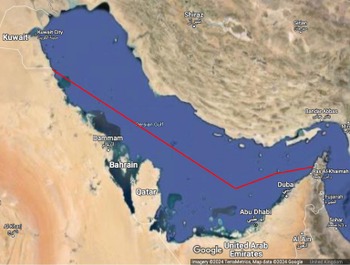
Second, the British Government of Bombay sanctioned Hennell’s Restrictive Line in 1836 (Figure 1).Footnote 128 It followed the geographic line introduced in the 1835 Maritime Truce, but was subsequently extended to insulate Qatar and Bahrainby blocking maritime tribes or regional and extra-regional powers from using Persian shores and islands as bases of operation against Bahrain. The line was prolonged from Halul Island, north of Ras-Rakan, the northernmost tip of the Qatar peninsula, to Ras-Al-Zour near the coast of Kuwait.Footnote 129
The 1836 Restrictive Line.a

The objective was not to formalise sovereign territorial claims over coastal territories and islands,Footnote 130 as the sovereign territoriality embedded in the European state system was still not formed in the Gulf. The objective of the maritime line was to set ‘war limits’.Footnote 131 The goal was to curb coordination of tribes in terms of movement of war vessels between the Persian and Arab coasts and put an end to tribal coastal movements.
As maritime tribes continued to view both Gulf shores as part and parcel of one coastal territorial continuum, the Restrictive Line intended to break cross-tribal connections while subjecting tribes on the Persian littoral to Persian laws. Gradually, this redefined Gulf socio-political self-conception around territoriality and nativism. This policy is evident in a Gulf Resident’s letter to Sheikh Sulṭān-ibn-Ṣaqr Al-Qāsimī in Sharjah requesting that he not aid his relatives and tribal allies on the Persian coast:
Inhabitants of Tawanah, Charrack and Lingeh are all subjects of Persia, and if they conceive that they are aggrieved by their neighbours, it is proper that they should refer their cases to their own Government for redress, as long as they should reside in the Persian territory, they must be subject to the laws of that country, nor can their friends on the Arabian side of the Gulf be permitted in any way to interfere in their intestine [internecine?] disputes … Sheikh Abdullah-bin-Roshid of Amulguvin wished to take troops to Charrack to assist the Chief of that place, he was not permitted to do so.Footnote 132
While in 1820 the Gulf remained whole, after 1836, use of force to change political outcomes from one side of the Gulf to the other turned into a breach of the Restrictive Line, holding tribes liable for ‘piracy’. The Restrictive Line partitioned the Gulf into antagonistic zones while subjecting people residing on opposite shores to British or Persian imperial power. With time, this imaginary line took an unimaginary twist to form the epistemological basis of a new ethnoracial interpretation of territorial sovereignty, birthing 20th-century ‘ethnonational’ identities.Footnote 133
Compared to the relative ease of movement prior to 1836, the Restrictive Line deprived rebellious tribes from freely exiting or employing force against British actors.Footnote 134 To guarantee tribal accountability, non-signatory Arab coastal sheikhs had to join a British sheikhly actor. A new term began appearing in letters, describing exiting tribes as ‘fugitives’ (hārbīyn, sing. hārib). They were considered criminals fleeing custody of a British sheikhly signatory, altering traditional socio-political relations by making non-signatory maritime sheikhs subordinate to the actor. Footnote 135 This left ‘fugitive’ sheikhs/tribes three options: (1) return and submit as ‘adherents’ to their former British signatory sheikh; (2) join another British-backed actor; or (3) relocate to Persian shores. Any uses of force by the ‘fugitives’ breaching the Maritime Truce and Restrictive Line against a British-backed actor was declared ‘piracy’.
Third, following the successes of the Maritime Truce, it was renewed repeatedly in the years 1839–42, and its duration extended from 6 to 8 to 12 months.Footnote 136 After a decade-long truce signed in 1843, a Perpetual Truce went into force on 4 May 1853.Footnote 137 This birthed the Trucial System, in which signatory sheikhs and their subjects could not employ force, abjuring maritime sovereignty in favour of Britain, making Britain ‘protector, mediator, arbiter, and guarantor of settlements [for khalīj agents]’.Footnote 138 This made Britain the ‘grand sheikh’ and suzerain of the khalīj waters: protector and arbiter of disputes not only for signatories, but for all Gulf peoples, including Arab coastal principalities not party to the truce.
By the 1860s, Britain’s Gulf hegemony was complete, captured in a complaint by an aggrieved khalījī agent to the British Gulf Resident. He stated: ‘We know that the Sirkar [Britain] has command of the sea, not the Ahl-Boo Somait.’Footnote 139 Attempting to adhere to British rules, he noted: ‘we can act just as the Boo Soomait have done, but it is not the part of any but the Sirkar [Britain] to afford us our rights’ (emphasis added).Footnote 140 Gulf waters were no longer a space governed by tribal norms or traditional maritime confederacies for collective security but were subject to the British rector’s laws and norms of a European-dominated international society.
The Maritime Truce, Restrictive Line, and Perpetual Truce reflect overt mechanisms of ‘pacification’ that prescribed a rule-governed framework for ‘civilised’ coexistence between the British rector, sheikhly actors, and excluded others. More specifically, they expressed in Andrew Linklater’s words ‘outrage at specific forms of violence’,Footnote 141 namely ‘piracy’. Conversely, to British colonial administrators, this was not ‘vengeance’ per se, but an act of altruism by a ‘civilized power’ to bring ‘peace and progress’.Footnote 142 The fourth layer was less overt. For Britain, this was a conscious effort to semantically narrow the pre-political structure of a traditional confederacy of various agents by individuating a British sheikhly actor ‘as the sole locus of political authority’.Footnote 143 To rule indirectly, a British-backed actor had to reside above his polity in a ‘ruling’ class, radically overturning rulership from a concern of all sheikhly-tribal factions to an exclusionary pursuit of ‘legitimate’ political centralisation. This arises not from customary rules and tribal traditions but from indirect rule seeking functional simplicity. I claim that narrowing authority within a confederacy by lodging it in a British actor enabled British administrators to address political disorder. This allowed the coloniser to simplify socio-political relations between a sheikhly signatory and his community, ‘in terms of conflict and harmony’.Footnote 144 Following Jens Bartelson’s logic on domestic authority, conflict appears through ‘subjugation’, while harmony is realised through ‘consent of other agents’.Footnote 145 While the effects of narrowing the meaning of a confederacy were negligible in the short term, over the long term it formed the foundations of dynastic royal authority. It transformed traditional shared authority within a confederacy from one based on participation in rulership (ḥūkm) to one based on compliance through dynastic ownership (mūlk).
Britain did not remove the concept of confederacies altogether. It reconfigured it. Britain took the role of protector to signatory sheikhs by becoming ‘head of the [new] naval confederacy’ in the Gulf,Footnote 146 comprising signatory actors working with British rector to suppress ‘piracy’.Footnote 147 In contrast to traditional maritime confederacies with fluid membership, the British confederacy was a closed club of rector and signatory actors. This formed the ideological basis for princely dynasticism and created conditions for the invention of the modern Gulf territorial state. Bartelson notes that ‘state identity appears to be conditioned by the presence of authority within a society from which it is thereby rendered distinct’ (emphasis in original).Footnote 148 To create this authority, tribes and families were removed from the political realm of a traditional confederacy, their relevance confined to economic spheres (pearling/seafaring). Rulership (ḥūkm) was no longer a concern of all members under traditional arbitration, nor was the ruler (ḥākim) subject to protection and support from traditional maritime allies within a confederacy. Ḥūkm was now confined and negotiated between the British rector and its sheikhly actor at the expense of excluded others (non-signatory/unrecognised sheikhs).
The narrowing of confederacies is evident in the evolution of who was ʿUtbī (pl. ʿUtūb) in British eyes. While earlier British reports framed the ʿUtūb tribal confederacy in Bahrain as one collective body pitted against the Bahrani Shiʿa as aboriginal inhabitants,Footnote 149 these binaries were further differentiated on ethnic and political grounds. Describing the people of Bahrain in 1839, Hennell called the Shiʿa ‘old Persian settlers’, rendering the Shiʿa ethnically Persian. Yet not all Bahrain Shiʿa were Persian; many were Arabs or both. Still, when pitting the Shiʿa against the ʿUtūb, Hennell wrote: ‘This class [Shiʿa] perhaps consists of about fifteen thousand individuals, while the Arab inhabitants, calling themselves Uttoobees, may be reckoned at an equal number, although those really belonging to the tribe [Āl-Khalīfah] do not exceed a thousand.’Footnote 150 The ʿUtūb were never a single patrilineal tribe, but a confederacy of maritime tribes and families.Footnote 151 Hennell’s view had political motivations. By decoupling the ʿUtūb from a confederacy of tribes into a smaller number, they became a separate ‘ruling’ class bounded to the rector for protection, displacing the actor’s historic need to negotiate his position as ruler through maintaining a wider ʿUtūb confederacy.
Hennell’s effort to narrow the traditional meaning of confederacy to ‘royal’ authority creates a socio-political centre to describe the landscape and nature of khalīj peoples and prescribe a pedagogical foundation of stratifications between higher and lower socio-political orders for subsequent British Gulf Residents. Referring to Hobbes, Carl Schmitt argues: ‘The rule of a higher order [sheikhly actor] is an empty phrase if it does not signify politically that certain men of this higher order rule over men of a lower order.’Footnote 152 While higher and lower orders were determined and the state between conflict and harmony in Bahrain was redefined, Bahrain was still not a signatory to the Maritime Truce, nor the Perpetual Truce, at their inceptions.Footnote 153 Britain neither dismantled Bahrain’s coastal fortifications nor confiscated and destroyed its war vessels, and thus Bahrain did not suffer the fate of other signatory sheikhs. Bahrain continued to retain what Britain described as an ‘imposing force at sea’.Footnote 154 Despite Bahrain being a non-signatory to the Maritime Truce, Britain did not allow the Bahrain sheikh to breach the new rules. Rules of the Maritime Truce were imposed, but extending full British protection over an island consumed by internal ʿUtbī strife and regional threats from Persia and Ottoman Egypt was a liability.
The Maritime Truce, Restrictive Line, Perpetual Truce, and semantic narrowing of the meaning of confederacy managed the gradual political transition to a more ‘civilised’ interstate coexistence from a state of divisible anarchy to one of indivisible hierarchy in authority. It turned sheikhly indivisibility into a political reality, a reality reinforced in the late 1800s by the British Protectorate System. While the Maritime Truce departed from Britain’s non-interference stance, it broadened Britain’s intrusiveness to secure actors as anchors fixing tribes in place. Contrary to scholarly claims, the centralisation of domestic authority under the indivisible British-recognised sheikh affected relations between ruler and ruled. Dividing the Gulf through a Restrictive Line strengthened Britain’s ability to control movement and fortify sheikhly indivisibility by insulating its Arab coast actors from rivals. While the Restrictive Line and ban on maritime warfare during pearling seasons applied to all maritime tribes on both Gulf coasts, Britain did not interfere with Persian policies towards Arab sheikhs on its shores. While rules were imposed to govern Gulf waters, it left the Persian coast as the frontier of choice for rebellious maritime tribes fleeing the Arab coast. Most important, narrowing the traditional meaning of a confederacy gradually removed maritime tribes from active participation in rulership (ḥūkm) that rested on arbitration in a space of political contestation. Sovereignty was no longer shared, diffuse, and contested among sheikhs in a maritime tribal confederacy, but dynastically anchored and ideologically frozen by the rector–actor relationship. It sidesteps alternative histories of political diversity and orients the Gulf socio-political past and present through the lens of the indivisible sheikhs.
Conclusion
By filling a Gulf gap in the classical English School ‘international society’ expansion thesis, this paper offers a more precise sense of how, when, and what political, structural, and ideational shifts in the Gulf allowed sovereignty to manifest in its present dynastic form. More specifically, it demystifies cultural and tribal logics of Gulf ‘dynastic’ exceptionalism. As the historian Roy Foster argued, ‘revisionism’ is necessary to challenge entrenched assumptions and to allow for a better political and historical analysis.Footnote 155
Approaching the Gulf as a region of analysis in International Studies requires three components. First, a scholarly turn from the desert to the sea. Historians such as Bishara in his reclassification of the Gulf from a terrestrial Middle East into an oceanic one opens five centuries of Gulf encounters, interactions, rivalries, and interconnectedness within an Indian Ocean world, thereby offering new insights into the Gulf’s transregional maritime history and bringing the Gulf into the fold of an international system Phillips and Sharman describe as order in diversity. This move challenges the region’s essentialist overused desert-centred paradigm of pre-oil tribal/regional isolationism. More importantly, it probes an essential political question: how ‘indirect’ was British indirect rule over people whose livelihood was interlaced with the sea? As the paper shows, it reconfigured inter-polity relations. Second, the Gulf as a region necessitates appropriate and flexible research frameworks. Buzan was right in his defence of the English School as a valuable IR resource.Footnote 156 Although the English School has been rightly criticised for its Eurocentrism and neglect of experiences of non-European polities, its value lies with its theoretical flexibility and methodological pluralism to accommodate historically informed research programmes. This flexibility is necessary to bridge a gap between Gulf historiography and IR theory. Third is creativity. For example, Colás’s creative approach in his convincing treatment of ‘piracy’ as a ‘derivative’ primary institution of international society gave the Gulf an entry point to join the rich English School debate. In doing these three things, this article offers five takeaways:
First, while the classical English School expansion thesis of international society centres around Europe’s success in socialising the non-European rest into the rules and norms of a European-dominated international society, its theoretical value falls short in seeing structures and social agents who did not meet the relationships and dominant ideas that classical English School exponents were trying to articulate through an ethnocentric European nation-state logic.Footnote 157 Inevitably, it leaves historical accounts of ‘piracy’ and the relationship between private violence and state-building outside the theoretical state-centric purview. ‘Pirates’ were everything lawless, uncivil, and unjust under the rules and norms of a European-dominated international society. As enemies of all nations, any use of force, irrespective of intent, by non-state actors was ‘piratical’. Pirates became the ‘political’ other unless civilised as ‘friends’. In the Gulf, suppressing ‘piracy’ via force and treaty-making was a ‘just’ cause to draw the Gulf into ‘civilised’ relations.Footnote 158 Notions of ‘justice’ for Gulf maritime tribes, however, differed. Use of force by non-signatory sheikhs and tribes was viewed as a right and legitimate ‘self-help’ against abuse of power.
Second, scholars need to consider tribes and confederacies as legitimate actors within the context their time and place. Approaching 19th-century British colonial/imperial Gulf expansion through a binary between a legitimate European state (Britain) or state-backed actor (EIC) and illegitimate non-state ‘pirates’ ignores the complex relationship between private violence in the form of treasure-seeking ‘plunder/robbery’ versus private violence as a legitimate system of ‘self-help’. By declaring all forms of non-state violence illegitimate and thus ‘piratical’, scholars have not properly interrogated implications of British anti-piracy intervention and its role in the socio-political engineering of Gulf dynasticism. British–Gulf encounters produced a struggle between old and new systems of order: a pre-colonial ‘self-help’ system, which Britain delegitimised as ‘piracy’, and a new rules-governed British system in which uses of force are regulated by European norms and rules of ‘civility’. This heightened tensions between rights bestowed by Britain on signatory sheikhs as representatives of their polity and enforcers of British anti-piracy rules versus rights of their people as active participatory agents in rulership within a coastal polity. This not only weakened the role of sheikhs of maritime tribes as agents in the politics of their polity but also reinforced the centrality of British-backed sheikhs as the loci of authority over their subjects. Order and security at sea for colonial administrators trumped justice on land, an emphasis that continues to hold for Western powers concerned with the Gulf today.
Third, diffusion of European rules and norms did not usher in popular sovereignty as a legitimate principle in classical English school thinking. Colonialism as an overlooked institution of European expansion rested on logics of political inequality. Hence, coastal khalījī dynastic state formation is not reducible to tribal ‘traditions’ per se but is a product of a longue durée process of interaction between coloniser and colonised. Treaty-making forged new power hierarchies and recognised British-backed actors as centres of domestic authority. In doing so, some agents were absorbed under Britain as lawful sheikhs over their polities, while others remained as illegitimate ‘pirates’ under international law. Lieutenant John MacLeod, British Gulf Resident (1822–3), wrote to Bombay, ‘better to have one head to look to than a number of independent pirates’.Footnote 159 Absorbing the Gulf under the Pax Britannica required transition from a state of divisible to indivisible sheikhly authority to approximate khalījī polities into Europe’s image and meet more ‘civilised’ centralised and hierarchical standards of authority. Restricting the agency of unrecognised sheikhs/tribes ensured power was consolidated in a British rector and sheikhly actor to reinforce sovereignty as a primary institution of international society.
Fourth, what gave way to the suspension of sovereign divisibility in the coastal khalīj were British colonial policies that began not over land, as often assumed, but through its sea. Here, I propose considering more seriously the implications of the Restrictive Line as a primary institution of boundary-making in the Gulf. As this paper illustrates, by imposing rules at sea to suppress so-called pirates and control their movements through a Restrictive Line, the traditional role maritime tribes played as vital agents in the politics of Gulf coastal polities was weakened, a weakness further compounded when oil was discovered, breaking traditional alliances between coastal sheikhs and maritime tribes. Gradual weakening of maritime tribes, coupled with oil’s discovery, turned the politics of protection of sheikhly actors in the Gulf inwards towards the desert as the new centre of power and security. This shift helps to explain why the desert became a central theme in the construction of new state-sponsored ‘national’ memories of desert tribal solidarity.
Finally, Gulf history matters in politics and international relations. It offers insights into the foreign policy decisions of contemporary Gulf states. As global order reconfigures to a rising East, so is the Gulf reconfiguring. While it remains committed in upholding pre-existing Anglo-American security arrangements, the Gulf is increasingly adopting policies of security diversification. Yet Gulf states today are not the poor, borderless settlements of the past. They have become increasingly a centre of regional influence in the Middle East and beyond. Although militarisation is now affordable, their moment of being and becoming in a world of ‘civilised’ nation-states remains connected to a colonial experience: close a military gap with the West and end a historic ‘salience’ in sovereignty. Still, the Gulf continues to adopt policies informed by its past, negotiating security in diversity, hardly a novel strategy if we look towards the sea.
Acknowledgements
I am indebted to Professor Yaacov Yadgar for his feedback, generosity, and care. I am thankful to Professor Ahmed Al-Shahi for his graciousness and counsel. I would like to extend my gratitude to the anonymous reviewers and the editorial team of the Review of International Studies for their time, constructive criticisms, and valuable suggestions. This paper is a culmination of their support.

 Open access

