


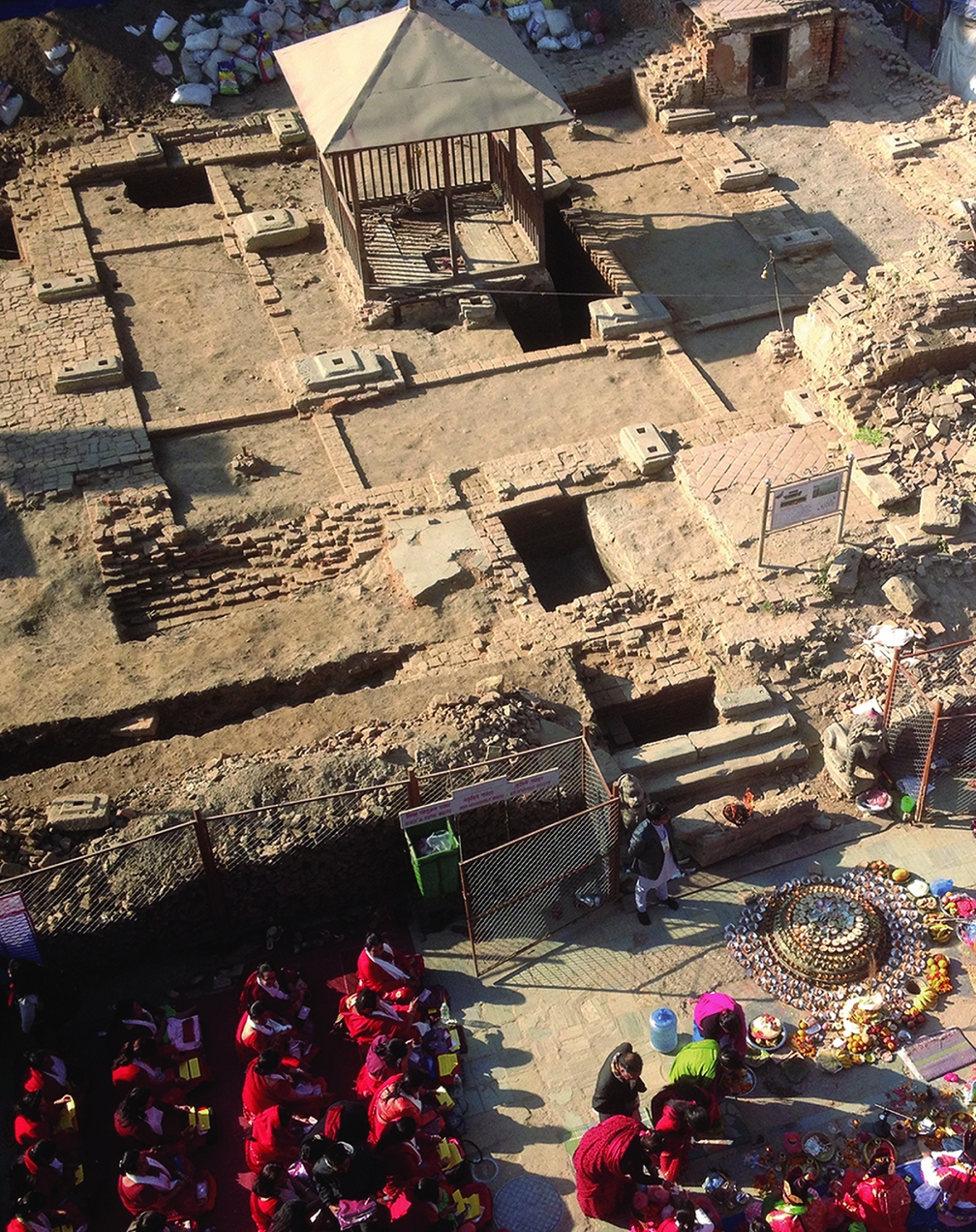
Monks, nuns and laity at the Saptabidhanotta Puja and prayer ceremony to reanimate the Kasthamandap (Nepal) following post-earthquake archaeological investigations within the Kathmandu Valley UNESCO World Heritage property. Hundreds of monuments, including the iconic Kasthamandap, the timber structure that gave Kathmandu its name, were damaged or destroyed during the Gorkha earthquake on 25 April 2015. A team, drawn from Durham's UNESCO Chair, the Department of Archaeology (Government of Nepal) and the University of Stirling, have discovered that the brick foundations of many monuments, including the Kasthamandap, were undamaged by the earthquake and that, in many cases, the collapse of the superstructures was due to poor conservation practices. The team's findings will be displayed in Kathmandu's new Earthquake Museum in the royal treasury Dukuti Building within Hanuman Dhoka and inaugurated on the third anniversary of the earthquake in April 2018. Photograph: UNESCO Chair on Archaeological Ethics and Practice in Cultural Heritage, Durham University.
A 3D-LiDAR image of Tikal, Guatemala, from the south-east. The modern paved road to the site runs through the image and connects with the old, abandoned airstrip. Winding to the north, the road then leads towards the modern village (and ancient ruins) of Uaxactun, off-image. Circular depressions are water reservoirs for drainage from the city, and elevated roads with masonry berms represent ritual processional routes within the city. Massive areas of levelling created surfaces for palaces, pyramids and a substantial market facility. Smaller quadrangles on local rises correspond to areas of more modest residences (Stephen Houston and Thomas Garrison; image credit: PACUNAM/Canuto and Auld-Thomas; initial capture and processing by the National Center for Airborne Laser Mapping).

Terracotta tourists
Thirty years ago on a London street, an excited young teenager stood in a queue the likes of which he had never previously seen. The wait, however, was worth it, for the reward was the opportunity to see a small detachment of warriors from the Terracotta Army on their first visit to the city. For this particular young archaeologist, it was a glimpse of a foreign civilisation that made the local Roman ruins look desperately provincial by comparison. But it was not just I who was impressed; public interest in the event was extraordinary. With hindsight, it is easy to overlook the novelty that the warriors represented at that time. Fewer than 15 years had passed between the discovery of an army guarding the tomb of the Emperor Qin Shi Huang, large-scale excavations at the mausoleum complex and its inscription as a World Heritage Site, and the arrival of the exhibition in London at the start of an endless global tour as the new face (or faces) of Chinese cultural heritage.
Three decades later, I am face to face with the warriors again. The world has changed immeasurably in the intervening years: the Berlin Wall has come down; China's economy has leapt up the global rankings; and digital technology has transformed how we communicate. The ambassadorial role of the Terracotta Army, however, remains constant.
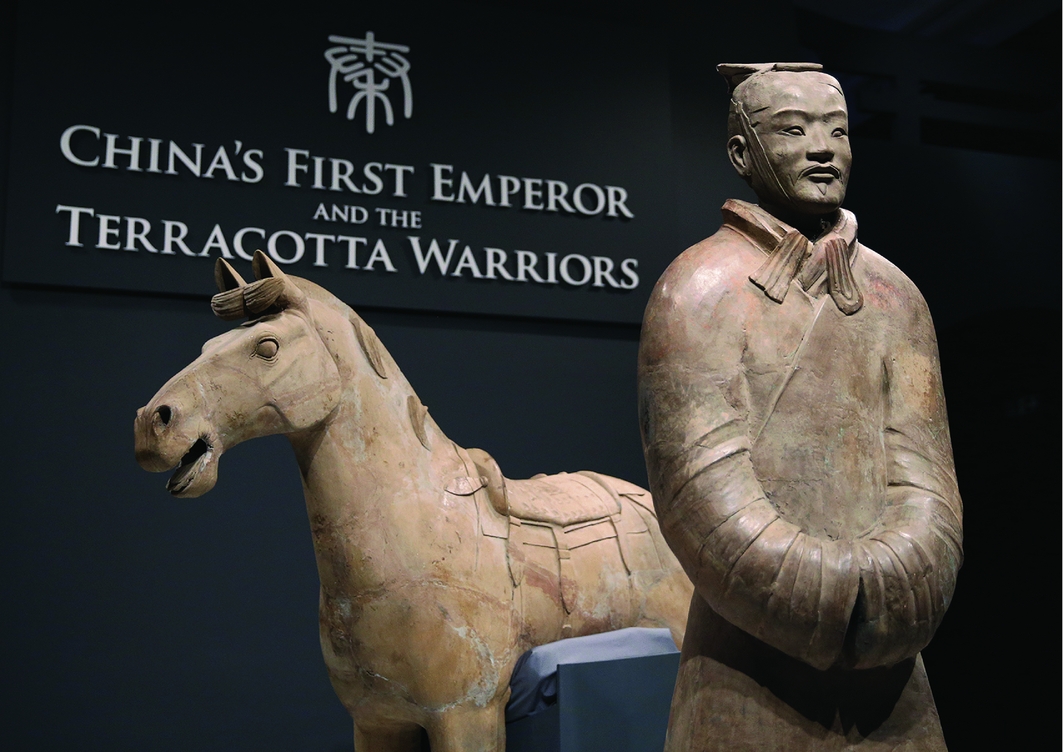
‘China's First Emperor and the Terracotta Warriors’ at the Liverpool World Museum features more than 120 exhibits, including eight of the life-sized warriors. The visit begins with a slick video, projected on a long, three-dimensional screen. It introduces the visitor not to the Terracotta Army, nor even to Chinese archaeology, but to China itself—to that country's rich and diverse landscapes, peoples, cultures and cities, playing on the contrast between long tradition and busy modernity. As this promotional message ends, the doors to the exhibition proper open, and hi-tech sensory overload is replaced by muted lighting, hushed tones and a simple colour palette of black, red and gold. The visitor is met, head on, by a single warrior and his horse. Back in China, the serried ranks lined up in the Emperor's mausoleum impress by their sheer numbers—power in aggregate. Here, instead, is a solitary figure and it is therefore all the more impressive how confidently he commands the visitor's attention, even awe.
‘China's First Emperor and the Terracotta Warriors’, which runs at Liverpool World Museum from 9 February to 28 October 2018. (Photograph © Gareth Jones.)
Having immediately reassured the visitor about what is to come, the exhibition tracks back in time to the Neolithic to explore the long-term development of funerary practices in China. Through a variety of well-displayed objects and panels, the visitor is then guided through the burial practices of the Shang and Zhou Dynasties, leading to the rise of the Qin Dynasty and the life of the first emperor. Highlights include musical instruments, jade shoe soles, limestone armour and replicas of two half-sized bronze chariots, complete, like the originals, in every minute detail. But the stars of the show, if the throng of visitors is any indication, remain the warriors. Lined up, moai style, seven individuals, ranging from a towering general to a kneeling archer, await inspection. If the single warrior at the start of the exhibition stands in for the whole army, here we are invited to focus on, and to compare, the details: the varied types of armour, top-knots and facial hair; the hands that once held weapons; the traces of colour; the squared-off shoes. While visitors hold up their phones to photograph the parade, the warriors gaze over the crowd to the opposite wall, where a series of models depict how the terracotta figures were produced; here also are examples of fittings from the weapons, such as crossbows, formerly wielded by the warriors.Footnote 1, Footnote 2
The exhibition then moves on to the Han period with objects including the largest jade disc, or bi, ever found in China (rather neglected in the exhibition narrative) and a collection of miniature terracotta warriors and animals from the tomb of Emperor Jing at Yangling. Overall, ‘China's First Emperor and the Terracotta Warriors’ offers a welcome opportunity not only to inspect the warriors themselves, but also to place Qin Shi Huang's mausoleum in wider context, both in the long-term history of burial practice and the wider cultural history of China.
By coincidence, the Terracotta Army arrives in Liverpool at the start of ‘EU-China Tourism Year’ (ECTY; https://ecty2018.org/), a strategy intended to promote the partners’ lesser-known travel destinations, to improve the tourist experience and to boost economic cooperation and growth; cultural heritage is inevitably integral to such initiatives. Although not linked directly to the ECTY, the Liverpool exhibition clearly fits within the same cultural and economic frame, and, in mirror image, as the Emperor's army heads west, the National Museum of Naples is sending an exhibition of Pompeian artefacts and frescoes east. Starting at the Jinsha Archaeology Museum in Chengdu, ‘Pompeii: The Infinite Life’ will then visit four other Chinese venues including, appropriately, the Qin Shi Huang Mausoleum Museum.
Third Shanghai Archaeology Forum
For three decades, the Terracotta Warriors have toured cities on every continent to promote China's rich cultural heritage to the outside world. A more recent Chinese initiative is the Shanghai Archaeology Forum (SAF). This meeting was first held in 2013 and has quickly established itself as a major periodic event in the archaeological calendar. In a way, it represents the very opposite of a touring exhibition that takes Chinese objects around the world, for the SAF brings together archaeologists from many different countries to showcase in China the diversity of world archaeology.
Organised under the auspices of the Chinese Academy for Social Sciences, meetings of the SAF feature an extensive programme of academic sessions, discussion panels and keynote papers. Central to the meeting is an awards scheme. The substantial and richly illustrated volume produced to accompany the third and latest meeting, held on the 8–11 December 2017, explains:
The SAF Awards program recognises individuals and organizations that have achieved distinction through innovative, creative, and rigorous work relating to our human past, and have generated new knowledge that has relevance to the contemporary world and our common future. It aims to promote excellence and innovation in archaeological research, advance public awareness and appreciation of archaeology, foster the protection and conservation of the world's archaeological heritage, and encourage international collaboration and partnership between scholars and others from different countries.
These surely are worthy ambitions to which we can all subscribe. The awards are based on an international nomination and evaluation process, with some 91 projects and individuals put forward for ‘Field Discovery’ and ‘Research’ awards, and 21 of them recognised at the December meeting. Field Discovery Awards included recognition of work at the Niah Caves in Borneo, the revised chronology of Homo floresiensis, the stalagmite circles constructed by Neanderthals in the Bruniquel Cave and newly discovered Maya hieroglyphic panels from Xunantunich, Belize. Research Awards included projects on the Milking Revolution in Neolithic Europe, Skrydstrup Woman as a focus for research on women in the European Bronze Age, and work at Amara West revealing the complexities of a Pharaonic colony in Bronze Age Nubia. Research on China was also well represented, with awards celebrating new discoveries around Neolithic Shijiahe in the Middle Yangzi and work on the development of early states in China.
A major theme running throughout the meeting focused on the connections between water, society and civilisation—a timely subject. As I write, Cape Town is confronting the possibility of ‘Day Zero’, the moment when the water supply from the city's reservoirs runs dry and the taps of South Africa's largest city are turned off. As water rationing takes effect, the authorities have postponed that day [first] from April to August [and, most recently, from August into next year], but the situation remains precarious. More generally, the crisis, precipitated by a combination of climate change, planning failures and unsustainable consumption by (parts of) the population, has crystallised concerns about the water security of other major cities from Bangalore to São Paulo, and from Moscow to Miami. But human societies have been here before. Hence, the SAF presentations and awards sought to highlight how archaeology can provide insights into the use and significance of water in the past, present and future, and, in particular, on what happens when access to this most fundamental of shared resources is threatened by growing demand, climate change or conflict. Keynote papers included considerations of the role of water at Angkor Wat, Petra and in the Indus Valley. SAF awards championing research on this theme included projects on the supply and use of water at the sites of Pueblo Bonito in Chaco Canyon and Masada in Israel, as well as a broad regional analysis of the link between drought and conflict in Mississippian societies across the Midwest and Southeast in the USA during the early second millennium AD.
In addition to Field Discovery and Research Awards, individuals were also commended for Distinguished Service. As announced in the last editorial, Chris Scarre was the recipient of one of these awards for his five-year stint as the editor of Antiquity. Alongside Chris, a second Distinguished Service award went to Maamoun Abdulkarim for his work protecting Syria's cultural heritage in the face of that country's brutal and ongoing civil war. Our congratulations to all those who received an award. We look forward with anticipation to the fourth meeting of the Forum.
In this issue
Although rather less famous than the mausoleum of the Emperor Qin Shi Huang, the tomb of Fu Hao at Yingxu is nonetheless well known within archaeological circles. Excavations at Yingxu, the last capital of the Shang dynasty, have revealed an immense ceremonial complex with dozens of pits containing animal and human sacrifices, and objects ranging from chariots and bronze vessels to jade artefacts and cowry shells. The tomb of Fu Hao, the wife of the Shang ruler Wu Ding, is notable as the only undisturbed royal burial at the site. In this issue of Antiquity, Rong Wang and colleagues present their analysis of one of the many finds that accompanied Fu Hao to the afterlife: a small jade parrot. Inscriptions on oracle bones describe a ritual known as the ‘Liao sacrifice’, the burning of offerings, including jade. Even though burnt jade objects have been found in many tombs in China—both before and after the Shang period—doubts have been raised about exactly when the burning took place; could it have been post-depositional and therefore not part of the original funerary ritual? In their paper, the authors deploy a battery of non-destructive techniques, including FTIR and XRF, to demonstrate that, in the case of Fu Hao's jade parrot at least, burning took place before deposition, providing the first scientific corroboration of the practice of Liao sacrifice. Yingxu is an immensely rich archaeological site and we will return to the city's royal cemetery of Xibeigang with another Antiquity paper later this year.
Away from China, this issue features our usual mix of research from diverse regions and periods. We return to the Chauvet Cave to consider the significance of charcoal, both as evidence of fire for lighting the cave and as a material for depicting the many different species of animals on its walls. Other fauna featuring in this issue include a newly discovered Kushite horse burial from the Sudan, long-term Sámi rituals involving reindeer in northern Fennoscandia and the presence of Trichuris trichiura, or whipworm, in the mummified remains of southern Siberian nomads. We also have papers presenting new evidence for a Migration-period massacre in southern Sweden and for an Early Christian monastic site on Inishark off the west coast of Ireland.
One of this issue's two frontispieces is an image of Tikal in northern Guatemala, showing some of the spectacular initial results of LiDAR reconnaissance. Such work demonstrates the extraordinary value of this still relatively recent methodological addition to the archaeologist's toolkit. But there also remains plenty of work to be done down at ground level as well, and here, Oswaldo Chincilla Mazariegos presents research on bridges at the site of Cotzumalhuapa in southern Guatemala. Bridges are surprisingly rare in the pre-Columbian New World; the presence of five at Cotzumalhuapa, built using a variety of techniques, suggests there was no technological barrier to their construction and that there may be other examples waiting to be found elsewhere.
As well as these and other research papers, and a varied reviews section, this issue also features a Debate article by Alfredo González-Ruibal, Pablo Alonso González and Felipe Criado-Boado who argue “Against reactionary populism: towards a new public archaeology”. The authors contend that archaeology's well-meant but uncritical embrace of ‘the People’ has left the discipline poorly equipped to respond to the rise of reactionary populism, that is, the alliance of anti-liberal identity politics and liberal economic policies that has surfaced across Europe, the Americas and beyond. To reposition archaeology as a critical and proactive social force, the authors argue that “we must stop flirting with progressive neoliberalism and go beyond issues of identity, ethics and narrative”. They urge us to provoke, engage and educate, and, in this spirit, we have a series of commentaries offering a variety of responses to the diagnosis of the challenges, and the solutions proposed, by González-Ruibal and his colleagues.
As all the contributors to this particular debate emphasise, these issues are far from esoteric. A timely reminder comes from Italy where the renowned Egyptian Museum in Turin was recently drawn into that country's heated general election campaign. The museum has pursued an innovative rolling programme of special efforts on tickets to attract more visitors and to appeal to new audiences. In the run-up to the election, one of these initiatives, a two-for-the-price-of-one entry offer for Arab-speaking visitors, was singled out as a focus for fierce anti-immigrant rhetoric by far-right politicians. Public defence of the museum was swift and robust, led by the Italian Culture Minister, Dario Franceschini, but the incident well illustrates the general problem perceived by González-Ruibal and colleagues, and emphasises their call for the need for more radical thinking about longer-term responses. We hope that this debate feature, and all of the other content in this issue, provides our readers with plenty of food for thought.
In signing off, a quick reminder that the Antiquity conference stand will be present, as ever, at some of the year's major archaeological meetings, including SAA in Washington D.C. (April) and EAA in Barcelona (September). Do come along to discuss ideas for potential papers or with suggestions for new topics that we might feature. Or just drop by to say hello. We look forward to meeting Antiquity contributors and readers, both old and new!



