





Introduction
Volunteer corn is a problem weed in corn-based cropping systems in the midwestern United States (Chahal and Jhala Reference Chahal and Jhala2015; Jhala et al. Reference Jhala, Beckie, Peters, Culpepper and Norsworthy2021). Volunteer corn is an overwintering F2 population of corn kernels/ears lost during the previous year or failed corn stands under a corn replanting scenario (Shauck and Smeda Reference Shauck and Smeda2012). Although grain losses can be limited to <5% with mechanical harvest (Shauck Reference Shauck2011), adverse weather such as the widespread freezing damage that occurred in spring 2007 in Tennessee (Steckel et al. Reference Steckel, Thompson and Hayes2009) or the widespread windstorm (Derecho) in August 2020 in Iowa (Jha et al. Reference Jha, Hartzler and Anderson2020) can lead to significant volunteer corn in the following growing season (Rees and Jhala Reference Rees and Jhala2018).
In Nebraska, on average, 4.0 million ha of corn is planted compared with 2.2 million ha of soybean, a difference of 1.8 million ha (USDA-NASS 2017a, 2018, 2019, 2020). In addition, the area of corn planted in Nebraska in recent years increased by 0.26 million ha, while soybean area decreased by 0.20 to 0.28 million ha (USDA-NASS 2017a, 2018, 2019, 2020). This suggests that growers are shifting toward corn-on-corn cropping systems, especially in south-central Nebraska, due to high-quality, productive soil and irrigation (Striegel et al. Reference Striegel, Lawrence, Knezevic, Krumm, Hein and Jhala2020). Managing volunteer corn in a corn-corn rotation is challenging due to the lack of selective postemergence (POST) herbicides for adequate control (Jhala et al. Reference Jhala, Beckie, Peters, Culpepper and Norsworthy2021). However, the recent commercialization of a multiple herbicide-resistant corn hybrid (i.e., Enlist™ corn) allows POST applications of quizalofop-p-ethyl (QPE) for control of glufosinate/glyphosate-resistant corn volunteers. Enlist corn is resistant to 2,4-D choline, glufosinate, glyphosate, and aryloxyphenoxypropionate herbicides (Striegel et al. Reference Striegel, Lawrence, Knezevic, Krumm, Hein and Jhala2020). As of October 2023, QPE (Assure® II; AMVAC, Newport Beach, CA) is the only herbicide labeled to control volunteer corn in Enlist corn. QPE is labeled at 41 to 93 g ai ha−1 in Enlist corn for control of volunteer corn (Anonymous 2018). Striegel et al. (Reference Striegel, Lawrence, Knezevic, Krumm, Hein and Jhala2020) reported 99% control of glufosinate/glyphosate-resistant corn volunteers in Enlist corn in Nebraska with QPE (31 g ai ha−1) when applied to volunteer corn at the V3 or V6 growth stages.
Infestations of volunteer corn have increased progressively with the adoption of glyphosate-resistant corn (Davis et al. Reference Davis, Marquardt and Johnson2008), causing insect resistance (Krupke et al. Reference Krupke, Marquardt, Johnson, Weller and Conley2009), disease survival (Chahal et al. Reference Chahal, Jha, Jackson-Ziems, Wright and Jhala2016), grain contamination (Marquardt et al. Reference Marquardt, Krupke and Johnson2012), and grain yield losses (Chahal and Jhala Reference Chahal and Jhala2015, Reference Chahal and Jhala2016). Volunteer corn is as competitive as common midwestern weed species such as barnyardgrass [Echinochloa crus-galli (L.) P. Beauv.], giant foxtail (Setaria faberi Herrm.), and waterhemp [Amaranthus tuberculatus (Moq.) J. D. Sauer] (Alms et al. Reference Alms, Moechnig, Vos and Clay2016). Volunteer corn at 8 plants m−2 can cause up to 23% grain yield loss of corn (Marquardt et al. Reference Marquardt, Krupke and Johnson2012). Clumps of volunteer corn are more competitive than individual volunteer corn plants and usually cause greater yield losses, as Piasecki and Rizzardi (Reference Piasecki and Rizzardi2019) reported that 0.5 to 12 clumps of volunteer corn per square meter (7 plants per clump) can reduce corn yield by 7% to 42% compared with 3% to 34% yield loss with 0.5 to 12 individual volunteer corn plants per square meter (Piasecki and Rizzardi Reference Piasecki and Rizzardi2019). Yield losses are greater under corn replant conditions; volunteer corn populations of 0.5 to 1, 2 to 4, and 4 to 8 plants m−2 can reduce yields by 7% to 20%, 44% to 58%, and 59% to 81%, respectively (Shauck and Smeda Reference Shauck and Smeda2014). Steckel et al. (Reference Steckel, Thompson and Hayes2009) documented that 27,000 volunteer corn plants per hectare can reduce replanted corn yields up to 2,200 kg ha−1.
Managing volunteer corn is a challenge due to the commercial cultivation of multiple herbicide-resistant corn hybrids. Earlier, nonselective herbicides such as glufosinate (Alms et al. Reference Alms, Moechnig, Vos and Clay2016) and glyphosate (Andersen et al. Reference Andersen, Ford and Lueschen1982; Beckett and Stoller Reference Beckett and Stoller1988) were applied to manage volunteer corn. Planning crop rotations around glufosinate- and glyphosate-resistant hybrids was a viable solution for controlling volunteer corn until stacked glufosinate- and glyphosate-resistant corn was commercialized in 2012. Because of the widespread adoption of glufosinate/glyphosate-resistant corn (Soltani et al. Reference Soltani, Shropshire and Sikkema2014), glufosinate and glyphosate are not effective options for controlling glufosinate/glyphosate-resistant corn volunteers. Although tillage practices, such as interrow cultivation, is effective for controlling volunteer corn, growers have widely adopted conservation tillage (USDA-NASS 2017b). As a result, growers primarily rely on selective POST herbicides with active ingredients other than the herbicide-resistant traits that were present in the corn hybrids from the previous year (Steckel et al. Reference Steckel, Thompson and Hayes2009).
To save time, labor, and money, growers prefer mixing herbicides for POST applications to achieve broad-spectrum weed control. When herbicides are mixed, their interactions can be additive, antagonistic, or synergistic (Colby Reference Colby1967; Zhang et al. Reference Zhang, Hamill and Weaver1995). However, when herbicides that kill grass and broadleaf weeds are mixed, antagonism occurs more frequently (Damalas Reference Damalas2004; Zhang et al. Reference Zhang, Hamill and Weaver1995). Synthetic auxins such as 2,4-D or dicamba have been reported to antagonize the efficacy of graminicide/acetyl-coA carboxylase (ACCase) inhibitors for grass weed control (Blackshaw et al. Reference Blackshaw, Harker, Clayton and O’Donovan2006; Gomes et al. Reference Gomes, Sambatti and Dalazen2020; Lancaster et al. Reference Lancaster, Norsworthy, Scott, Gbur and Norman2019; Minton et al. Reference Minton, Shaw and Kurtz1989; Mueller et al. Reference Mueller, Witt and Barrett1989; Underwood et al. Reference Underwood, Soltani, Hooker, Robinson, Vink, Swanton and Sikkema2016). Similarly, glufosinate, a nonselective broad-spectrum herbicide widely applied to foliage in glufosinate-resistant corn, may (Burke et al. Reference Burke, Askew, Corbett and Wilcut2005; Chahal and Jhala Reference Chahal and Jhala2015; Gardner et al. Reference Gardner, York, Jordan and Monks2006) or may not antagonize grass control when mixed with graminicide/ACCase inhibitor (Duenk Reference Duenk2022; Eytcheson and Reynolds Reference Eytcheson and Reynolds2019).
Growers have complained about the reduced efficacy of QPE for controlling volunteer corn when mixed with 2,4-D choline. Information is lacking on the interaction of QPE with 2,4-D choline and/or glufosinate for control of glufosinate/glyphosate-resistant corn volunteers in Enlist corn when applied at different growth stages. The objectives of this study were 1) to evaluate the efficacy of QPE applied alone at different rates and in mixtures with 2,4-D choline and/or glufosinate for control of glufosinate/glyphosate-resistant corn volunteers; and 2) to evaluate the effect of time of application (the V3 or V6 growth stage of volunteer corn) on interaction of QPE with 2,4-D choline and/or glufosinate for volunteer glufosinate/glyphosate-resistant corn control, injury, and yield of Enlist corn.
Materials and Methods
Site Description
Field studies were conducted in 2021 and 2022 at the University of Nebraska South Central Agricultural Laboratory, in Clay Center, NE (40.57°N, 98.13°W). The experimental site had Hastings silt loam soil (montmorillonitic, mesic, Pachic Argiustolls) with 6.5 pH, 3.0% organic matter, 17% sand, 58% silt, and 25% clay. The field had been under corn-soybean rotation for more than 6 yr and irrigated through a center-pivot irrigation system.
Field Experiment and Data Collection
Treatments were arranged in a split-plot design, with the growth stage of volunteer corn (V3 or V6) as the main factor and herbicides as the subplot factor. Herbicide treatments consisted of QPE, 2,4-D choline, and glufosinate applied alone or mixed at various rates and combinations (Table 1). Nontreated volunteer corn and weed-free plots were included for comparison. Nontreated volunteer corn plots had volunteer corn but no other weeds, while weed-free plots were free of volunteer corn and other weeds. A total of 16 herbicide treatments were evaluated and appropriate adjuvants were added following each herbicide label recommendation (Table 1). Treatments were replicated in three complete blocks. The size of an individual experimental unit was 27 m2; 3 m wide and 9 m long consisting of four corn rows spaced 0.76 m apart.
Herbicide treatments, rates, products, and adjuvants used for control of glufosinate/glyphosate-resistant corn volunteers in Enlist corn. a, b, c

a Abbreviatons: ae, acid equivalent; ai, active ingredient; AMS, ammonium sulfate; COC, crop oil concentrate; fb, followed by; NIS, nonionic surfactant.
b Field experiments were conducted at the University of Nebraska South Central Agricultural Laboratory in Clay Center, Nebraska, in 2021 and 2022.
c Herbicide and adjuvant suppliers: AMS (N-Pak® AMS Liquid; Winfield United, LLC, St. Paul, MN); atrazine (Aatrex® 4L; Syngenta Crop Protection, LLC, Greensboro, NC); atrazine/bicyclopyrone/mesotrione/S-metolachlor (Acuron®; Syngenta Crop Protection, LLC, Greensboro, NC); COC (Agri-Dex®; Helena Chemical Co., Collierville, TN); glyphosate (Roundup® PowerMAX; Monsanto Co., St. Louis, MO); dimethenamid-P/saflufenacil (Verdict®; BASF Co., Research Triangle Park, NC)
d Herbicide manufacturer locations: AMVAC, Newport Beach, CA; Bayer CropScience, St. Louis, MO; Corteva AgriScience LLC, Indianapolis, IN; BASF, Research Triangle Park, NC.
The experimental field was no-tilled in 2021 and roto-tilled before planting corn in 2022. To mimic volunteer corn, glufosinate/glyphosate-resistant corn seeds (‘DKC60-87RIB’; Dekalb, Dekalb, IL) harvested from 2020 and 2021 were planted 4.5 cm deep in rows perpendicular to the crop rows and spaced at 0.76 m at 50,000 seeds ha−1 on May 7, 2021, and June 22, 2022. Corn planting was delayed in 2022 due to hail and a windstorm on June 7 that resulted in significant plant stand loss and damage; therefore, the study was replanted. The Enlist corn (‘8097 SXE’; Hoegemeyer Hybrids, Fremont, NE) was planted 4.5 cm deep at 87,500 seeds ha−1 on May 11, 2021, and June 22, 2022. Both volunteer corn and Enlist corn hybrids had relative maturity of 110 d. For controlling broadleaf and grass weeds, atrazine/bicyclopyrone/mesotrione/S-metolachlor (Acuron®; Syngenta Crop Protection, LLC, Greensboro, NC) at 2.4 kg ai ha−1 plus glyphosate (Roundup® PowerMAX; Bayer CropScience, St. Louis, MO) at 1,260 g ae ha−1 was applied preemergence (PRE) to the experimental field on May 13, 2021, while for the 2022 season dimethenamid-P/saflufenacil (Verdict®; BASF Co., Research Triangle Park, NC) at 790 g ai ha−1 plus atrazine (Aatrex® 4L; Syngenta Crop Protection) at 1,134 g ai ha−1 was applied on June 24, 2022. The weed-free control received an additional POST application of glyphosate at 868 g ae ha−1 plus dicamba (DiFlexx®; Bayer CropScience) at 456 g ae ha−1 plus acetochlor (Warrant®; Bayer CropScience) at 839 g ai ha−1. Glyphosate at 868 g ae ha−1 was applied POST to the experimental field on May 26 and June 9, 2021, for control of grass and broadleaf weeds. For the V3 growth stage of volunteer corn, the QPE, 2,4-D choline, and glufosinate-based treatments were applied on June 16, 2021, and July 12, 2022. For the V6 growth stage, these treatments were applied on June 24, 2021, and July 26, 2022. Herbicide treatments were applied using a CO2-pressurized backpack sprayer fitted with five TeeJet AIXR 110015 flat-fan nozzles (Spraying Systems Co., Wheaton, IL) calibrated to apply 140 L ha−1 of spray solution at 276 kPa.
Control of volunteer corn was visually assessed at 14, 28, and 56 d after treatment (DAT) using a scale of 0% to 100%, where 0% represented no control and 100% represented complete plant death. A similar scale of 0% to 100% was used to assess Enlist corn injury at 14 and 28 DAT. At 28 DAT, volunteer corn density was determined by counting plants in a 3-m-length row. At 28 DAT, the aboveground shoot biomass of volunteer corn was collected by randomly placing two 0.5-m2 quadrats across the middle two corn rows and hand-harvesting the volunteer corn plants from this area. Biomass was oven-dried at 70 C to a constant weight and then weighed. Grain yield of Enlist corn was recorded by harvesting the middle two rows of each plot with a small-plot combine, then adjusting grain yield to 15.5% moisture content. Percent reduction (relative to nontreated volunteer corn control) in volunteer corn density and biomass was calculated using Equation 1 (Striegel et al. Reference Striegel, Lawrence, Knezevic, Krumm, Hein and Jhala2020): $Y = \left[ {{{C -B } \over C}} \right] \times 100$
where C denotes volunteer corn density or biomass from the nontreated volunteer corn control and B denotes volunteer corn density or biomass from the treated plots.
Statistical Analysis
Data were analyzed using R software (version 4.2.2; R Core Team 2019). Interactions of herbicide, volunteer corn growth stage, and year were analyzed, and if they were found to be significant, data for each year were analyzed separately. For individual year models, volunteer corn growth stage-by-herbicide interaction was considered as a fixed effect, while replication and replication-by-volunteer corn growth stage were considered as random effects.
The ANOVA assumptions of normality and equal variances were checked with Shapiro-Wilk and Bartlett’s test, respectively (Kniss and Streibig Reference Kniss and Streibig2019) using the performance package (Lüdecke et al. Reference Lüdecke, Makowski, Ben-Shachar, Patil, Waggoner, Wiernik, Arel-Bundock, Thériault and Jullum2022). The data for volunteer corn control, density, biomass reduction, and Enlist corn injury were non-normal, whereas data for Enlist corn yield were normal with homogeneity of variance. The non-normal data were analyzed with generalized linear mixed models with beta error distribution (link = “logit”) (Stroup Reference Stroup2015) using the glmmTMB package (Brooks et al. Reference Brooks, Bolker, Kristensen, Maechler, Magnusson, McGillycuddy, Skaug, Nielsen, Berg, van Bentham, Sadat, Lüdecke, Lenth, O’Brien, Geyer, Jagan, Wiernik and Stouffer2022). These models were checked for overdispersion using the dharma package (Hartig and Lohse Reference Hartig and Lohse2022). Nontreated volunteer corn and weed-free controls were excluded due to a lack of variance among replicates (Sarangi and Jhala Reference Sarangi and Jhala2018). The data fulfilling ANOVA assumptions were analyzed with a linear mixed-effects model using the lme4 package (Bates et al. Reference Bates, Maechler, Bolker, Walker, Christensen, Singmann, Dai, Scheipl, Grothendieck, Green, Fox, Bauer and Krivitsky2022). ANOVA table was calculated using the car package (Fox et al. Reference Fox, Weisberg, Price, Adler, Bates, Baud-Bovy, Bolker, Ellison, Firth, Friendly, Gorjanc, Graves, Heiberger, Krivitsky, Laboissiere, Maechler, Monette, Murdoch, Nilsson, Ogle, Ripley, Short, Venables, Walker, Winsemius and Zeileis2022). After performing ANOVA, the estimated marginal means for treatments were calculated using emmeans (Lenth et al. Reference Lenth, Buerkner, Giné-Vázquez, Herve, Jung, Love, Miguez, Riebl and Singmann2022) and multcomp package (Hothorn et al. Reference Hothorn, Bretz, Westfall, Heiberger, Schuetzenmeister and Scheibe2022). Treatment means were separated according to Tukey’s method for P-value adjustments, and back-transformed for presentation for glmmTMB models.
To evaluate herbicide interactions, expected values for volunteer corn control or density/biomass reduction of herbicide mixtures were calculated using Colby’s (Reference Colby1967) equations. Equations 2 and 3 were used to calculate expected values for two-way and three-way herbicide mixtures, respectively: $E = \left( {X + Y} \right) - \displaystyle\left( {{{XY} \over {100}}} \right)$
where E denotes expected volunteer corn control or density/biomass reduction for a two-way herbicide mixture (A + B), and X and Y denote observed volunteer corn control or density/biomass reduction with individual herbicide applications of A and B, respectively, and: $E = \left( {X + Y + Z} \right) - \left(\displaystyle{{{XY + XZ + YZ} \over {100}}} \right) + \displaystyle{{XYZ} \over {10,0000}}{\rm{\;}}$
where E denotes expected volunteer corn control or density/biomass reduction for a three-way herbicide mixture (A + B + C), and X, Y, and Z denote observed volunteer corn control or density/biomass reduction with individual herbicide application of A, B, and C, respectively (de Sanctis and Jhala Reference de Sanctis and Jhala2021).
A two-tailed t-test was used to compare observed and expected treatment means of herbicide mixtures (de Sanctis and Jhala Reference de Sanctis and Jhala2021). If observed control or density/biomass reduction was significantly more than expected, the interaction was considered synergistic; if observed control or density/biomass reduction was less than expected, the interaction was considered antagonistic; and if observed and expected treatment means had no statistical difference, the interaction was considered additive (Colby Reference Colby1967).
Results and Discussion
Volunteer Corn Control
Volunteer corn growth stage-by-herbicide interactions were observed for control assessments in both years; therefore, interaction means are reported separately for 2021 (Table 2) and 2022 (Table 3). In 2021, QPE applied at 46 and 93 g ai ha−1 to V3 volunteer corn provided 88% and 97% control, respectively, at 14 DAT (Table 2). These results are consistent with those reported by Chahal and Jhala (Reference Chahal and Jhala2015) that 95% control of glyphosate-resistant corn volunteers was achieved with QPE used at 40 g ai ha−1 15 DAT. As expected, glufosinate and 2,4-D choline did not provide any control, because volunteer corn was resistant to glufosinate and 2,4-D choline is selective for broadleaf weeds. Control ratings from 3% to 22% were assigned to glufosinate and 2,4-D choline, primarily due to lodging and volunteer corn damage that occurred due to an early-season windstorm in 2021. Compared to QPE alone, the mixture of QPE (46 or 93 g ai ha−1) with 2,4-D choline (800 or 1,060 g ae ha−1) applied to the V3 growth stage provided 48% to 57% control of volunteer corn (Figure 1). The Colby analysis further indicated antagonism in a mixture of QPE and 2,4-D choline because the observed control was significantly less (33% to 41% reduction) than the expected control (81% to 98%). Underwood et al. (Reference Underwood, Soltani, Hooker, Robinson, Vink, Swanton and Sikkema2016) reported a 20% reduction in volunteer corn control at 28 DAT when QPE (24 g ai ha−1) was mixed with dicamba (600 g ae ha−1). The QPE in a mixture with glufosinate had an additive effect (96% to 97%). Similarly, Duenk (Reference Duenk2022) reported additive interaction of QPE (24 g ai ha−1) and glufosinate (500 g ai ha−1) with 95% to 98% control of glufosinate/glyphosate-resistant corn volunteers.
Control of glufosinate/glyphosate-resistant corn volunteers with quizalofop-p-ethyl, 2, 4-D choline, and glufosinate interaction treatments applied at the V3 and V6 volunteer corn stage to Enlist corn in 2021. a – e

a Abbreviation: DAT, days after treatment.
b Field experiment was conducted at the University of Nebraska South Central Agricultural Laboratory in Clay Center, Nebraska.
c Treatment means with the same letters within the column are statistically similar according to Tukey’s method for P-value adjustments and Sidak confidence-level adjustments.
d Expected values for herbicide mixtures were calculated using Colby’s (1967) equations.
e Asterisks (*) indicate that observed and expected values are significantly different according to the t-test (P < 0.05), suggesting antagonistic interactions.
Control of glufosinate/glyphosate-resistant corn volunteers with quizalofop-p-ethyl, 2, 4-D choline, and glufosinate interaction treatments applied at the V3 and V6 volunteer corn stage to Enlist corn in 2022. a – e

a Abbreviation: DAT, days after treatment.
b Field experiment was conducted at the University of Nebraska South Central Agricultural Laboratory in Clay Center, Nebraska.
c Treatment means with the same letters within the column are statistically similar according to Tukey’s method for P-value adjustments and Sidak confidence-level adjustments.
d Expected values for herbicide mixtures were calculated using Colby’s (1967) equations.
e Asterisks (*) indicate that observed and expected values are significantly different according to the t-test (P < 0.05), suggesting antagonistic interactions.
Volunteer corn control 14 d after treatment: A) nontreated for volunteer corn, B) quizalofop at 93 g ai ha−1 + 2,4-D choline at 1,060 g ae ha−1, and C) quizalofop at 93 g ai ha−1 applied at the V3 growth stage of volunteer corn.

The three-way mixtures had the lowest control; mixing the lower rate of QPE (46 g ai ha−1) with the lower (880 + 656 g ha−1) and higher rates (1,060 + 880 g ha−1) of 2,4-D choline + glufosinate resulted in 7% and 12% control of volunteer corn, which was 74% and 69% less than expected, respectively, based on the Colby analysis. Duenk (Reference Duenk2022) also reported a 77% reduction in control of glufosinate/glyphosate-resistant corn volunteers with a mixture of QPE (24 g ai ha−1) and 2,4-D choline (817 g ae ha−1) compared to QPE applied alone (89%). Researchers have reported that reduced efficacy of graminicide herbicide mixed with broadleaf herbicides may be improved by increasing the rate of graminicide application. Underwood et al. (Reference Underwood, Soltani, Hooker, Robinson, Vink, Swanton and Sikkema2016) noted a 22% increase (90% vs. 68%) in control of volunteer corn when dicamba at 600 g ae ha−1 was mixed with quizalofop at 36 vs 24 g ai ha−1. In this current study, the QPE at 93 g ai ha−1 produced an increase in efficacy of the three-way mixtures for volunteer corn control from 7% to 12%, to 61% to 79%. Similarly, at 28 DAT, the higher rate of QPE in mixtures increased control up to 98%. Thus, higher rates of QPE can be used to improve volunteer corn control and overcome antagonism when used in mixtures with broadleaf herbicides. At 56 DAT, all the herbicide interactions were additive at both the V3 and V6 stages of volunteer corn.
In 2022, QPE controlled 95% to 98% of volunteer corn at 14 DAT irrespective of application time and rate (Table 3). This was consistent with the results by Striegel et al. (Reference Striegel, Lawrence, Knezevic, Krumm, Hein and Jhala2020), who noted 98% control of glufosinate/glyphosate-resistant corn volunteers with QPE at 31 g ai ha−1. The interaction of QPE with 2,4-D choline or glufosinate was additive for both the V3 and the V6 growth stages. Among the three-way mixtures, QPE at 93 g ai ha−1 applied to V6 volunteer corn in a mixture with the higher rates of 2,4-D choline and glufosinate did not improve control (77%) at 28 DAT compared with the lower rate of QPE (82%). This indicates that increasing the rate of graminicide may not be effective at improving grass control if the rates of broadleaf herbicides are also increased. In the current study, the rate of 2,4-D choline was not constant; therefore, future experiments should mix varying rates of quizalofop with a fixed rate of 2,4-D choline to reveal the actual contribution of the increased rate of quizalofop for eliminating or minimizing antagonism. At 56 DAT, control was similar among all herbicide interactions when applied to V6 volunteer corn.
Volunteer Corn Density and Biomass Reduction
Interaction means were presented for volunteer corn density and biomass reduction 28 DAT because volunteer corn growth stage-by-herbicide interaction was significant, except for biomass reduction in 2022 (Tables 4 and 5). In 2021, QPE applied to V3 volunteer corn reduced volunteer corn density and biomass by 99% compared with the nontreated volunteer corn control (5 plants m−2 and 90 g m−2; Table 4). Several researchers have previously reported similar results with ≥90% reduction in volunteer corn density and biomass with QPE at 24 to 36 g ai ha−1 (Duenk Reference Duenk2022; Soltani et al. Reference Soltani, Shropshire and Sikkema2006; Underwood et al. Reference Underwood, Soltani, Hooker, Robinson, Vink, Swanton and Sikkema2016). The observed density (71%) and biomass reduction (68%) were 28% and 31% lower than expected (99%) with a mixture of QPE (46 g ai ha−1) and 2,4-D choline (800 g ha−1). Similarly, Duenk (Reference Duenk2022) documented 30% and 58% less than expected reductions in volunteer corn density and biomass with a mixture of QPE with 2,4-D choline (24 + 817 g ha−1), respectively. The reasons/mechanisms for quizalofop antagonism from 2,4-D choline cannot be implied from our study. However, the literature suggests that antagonism of graminicides (ACCase inhibitors) by synthetic auxins might occur due to competitive binding by the anti-auxin activity of graminicides (Barnwell and Cobb Reference Barnwell and Cobb1993; Shimabukuro et al. Reference Shimabukuro, Shimabukuro, Nord and Hoerauf1978, Reference Shimabukuro, Shimabukuro and Walsh1982; Snipes et al. Reference Snipes, Street and Luthe1987), reduced uptake (Qureshi and Born Reference Qureshi and Born1979) or translocation (Olson and Nalewaja Reference Olson and Nalewaja1982), or enhanced metabolism of graminicides through upregulation of cytochrome P450s (Han et al. Reference Han, Yu, Cawthray and Powles2013).
Enlist corn injury, density, and biomass reduction of glufosinate/glyphosate-resistant corn volunteers 28 DAT with quizalofop-p-ethyl, 2, 4-D choline, and glufosinate interaction treatments applied at the V3 and V6 volunteer corn stage in 2021. a – e

a Abbreviation: DAT, days after treatment.
b Field experiment was conducted at the University of Nebraska South Central Agricultural Laboratory in Clay Center, Nebraska.
c Treatment means with the same letters within the column are statistically similar according to Tukey’s method for P-value adjustments and Sidak confidence-level adjustments.
d Expected values for herbicide mixtures were calculated using Colby’s (1967) equations.
e Asterisks (*) indicate that observed and expected values are significantly different according to the t-test (*P < 0.05, **P < 0.10), suggesting antagonistic interactions.
Density and biomass reduction of glufosinate/glyphosate-resistant corn volunteers 28 DAT with quizalofop-p-ethyl, 2, 4-D choline, and glufosinate interaction treatments applied at the V3 and V6 volunteer corn stage to Enlist corn in 2022. a – e

a Abbreviation: DAT, days after treatment.
b Field experiment was conducted at the University of Nebraska South Central Agricultural Laboratory in Clay Center, Nebraska.
c Treatment means with the same letters within the column are statistically similar according to Tukey’s method for P-value adjustments and Sidak confidence-level adjustments.
d Expected values for herbicide mixtures were calculated using Colby’s (1967) equations.
e Asterisks (*) indicate that observed and expected values are significantly different according to the t-test (P < 0.05), suggesting antagonistic interactions.
Among the three-way mixtures, QPE at 46 g ai ha−1 in a mixture with 2,4-D choline (1,060 g ha−1) and glufosinate (880 g ha−1) produced 13% to 49% less reduction in density (50% to 73%) and biomass (53% to 86%) of V3 or V6 volunteer corn than QPE alone (99%) in both 2021 and 2022 (Tables 4 and 5). However, increasing the QPE rate to 93 g ai ha−1 improved density and biomass reduction by 6% to 45%, providing the expected reduction of 99% in some cases. Underwood et al. (Reference Underwood, Soltani, Hooker, Robinson, Vink, Swanton and Sikkema2016) reported similar results where the higher rate of QPE (30 g ai ha−1) mixed with dicamba (300 g ai ha−1) produced a greater reduction in volunteer corn density (2 vs. 6 plants m−2) and biomass (21 vs. 72 g m−2) compared with the lower rate of QPE (24 g ai ha−1). Thus, increasing the rate of QPE when mixed with 2,4-D choline and glufosinate may minimize or avoid antagonism by providing an expected reduction in volunteer corn density and biomass.
Enlist Corn Injury
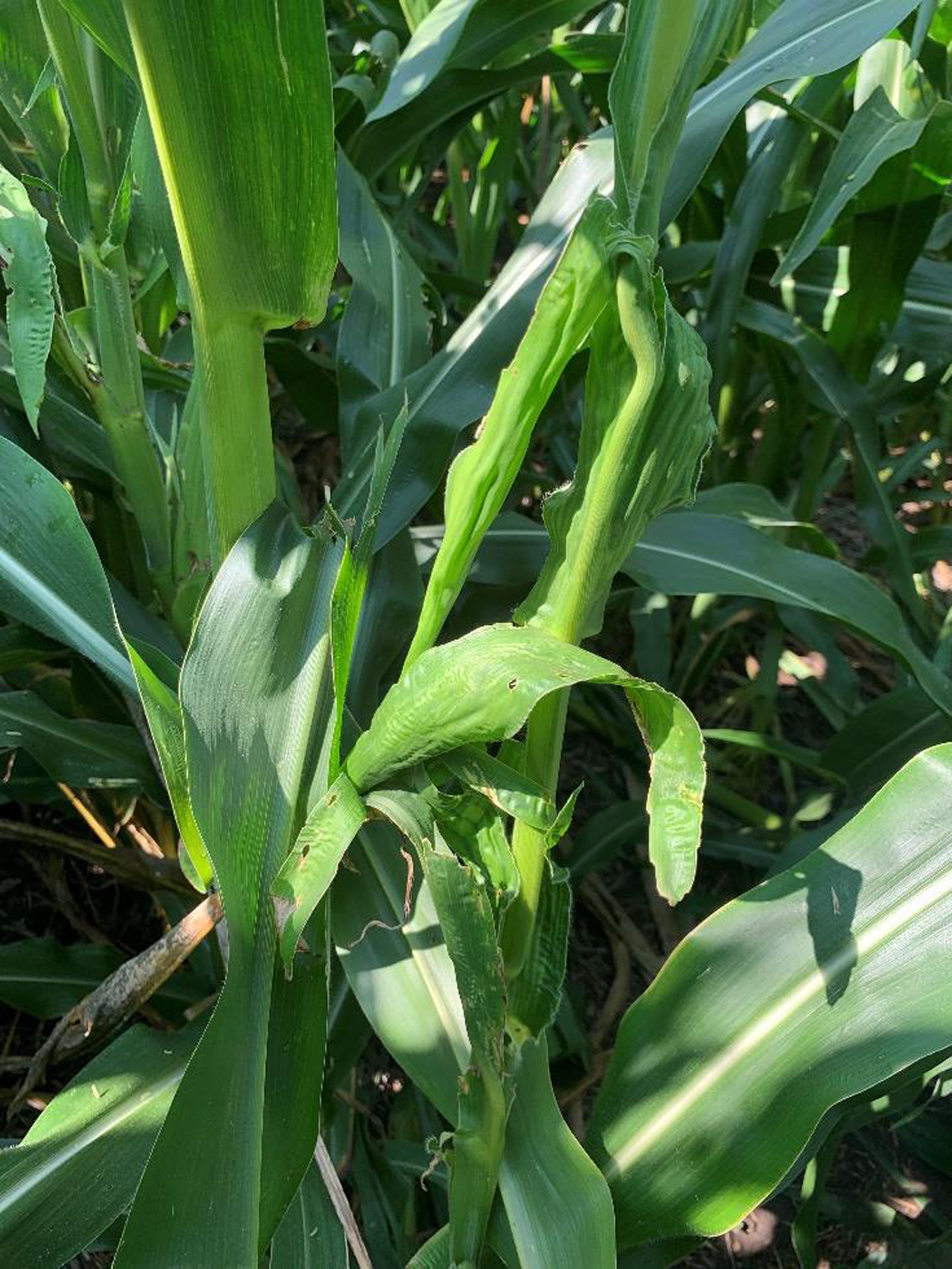
Little to no injury to Enlist corn was observed in 2022 (data not shown), though some injury was observed in treatments applied at the V6 growth stage of volunteer corn in 2021 (Table 4; Figure 2). At 28 DAT, the lowest corn injury of 3% was observed with glufosinate at 656 g ai ha−1 and the highest injury of 27% was observed with glufosinate at 880 g ai ha−1 mixed with QPE at 46 g ai ha−1 and 2,4-D choline at 1,060 g ae ha−1. In additional glufosinate-based treatments, 13% to 18% injury was observed on Enlist corn. Glufosinate injury likely occurred due to the late-season application at the V6 growth stage in 2021. Glufosinate is recommended up to the V6 growth stage of glufosinate-resistant corn (Anonymous 2019), but in 2021, the Enlist corn was about at the V8 growth stage at the time of the V6 stage of volunteer corn. In addition, relative humidity was high (86%) at the time of application, which has been found to increase glufosinate translocation that may result in injury (Anderson et al. Reference Anderson, Swanton, Hall and Mersey1993; Coetzer et al. Reference Coetzer, Al-Khatib and Loughin2001; Ramsey et al. Reference Ramsey, Stephenson and Hall2002).
Glufosinate injury symptoms in glufosinate-containing treatments applied when volunteer corn was at the V6 growth stage and Enlist corn was at the V8 growth stage (an off-label treatment, as glufosinate is labeled up to the V6 growth stage).
Corn Yield
Volunteer corn growth stage (V3 or V6)-by-herbicide interaction was significant for Enlist corn yield in 2021. Interaction means are presented in Table 6, and yield data for 2022 were combined for volunteer corn growth stages. In 2021, corn yield was similar across treatments when herbicides were applied to volunteer corn at the V3 growth stage. The nontreated volunteer corn control yielded 13,620 kg ha−1 of grain, whereas the weed-free control yielded 15,060 kg ha−1. The 2,4-D choline and glufosinate-alone treatments yields were similar, at 13,740 to 14,270 kg ha−1, respectively, probably because volunteer corn plants harvested alongside Enlist corn from the space between two middle rows of the plot may have added some additional yield to these treatments. For the V6 stage of volunteer corn, all treatments produced similar yields, except those containing glufosinate. Enlist corn injury due to glufosinate appears to be the most probable cause for yield loss in glufosinate-containing treatments (Tables 4 and 6). Similarly, injury in the weed-free control plots (Table 4) led to a similar yield (12,180 kg ha−1) as those of the glufosinate-containing treatments (9,890 to 12,910 kg ha−1; Table 6). In 2022, all treatments yielded similar amounts of corn as the weed-free control (11,680 kg ha−1). The reported antagonism of mixing 2,4-D choline with QPE might not be reflected in the yield because antagonism did not occur for longer than 14 or 28 DAT, and eventually, volunteer corn was completely killed.
Enlist corn yield as influenced by quizalofop-p-ethyl, 2, 4-D choline, and glufosinate interaction treatments applied at the V3 and V6 volunteer corn stages. a, b

a Field experiments were conducted at the University of Nebraska South Central Agricultural Laboratory in Clay Center, Nebraska, in 2021 and 2022.
b Treatment means with the same letters within the column are statistically similar according to Tukey’s method for P-value adjustments and Sidak confidence-level adjustments.
c The estimated marginal means for the main effects of volunteer corn stage in 2021 and 2022.
Practical Implications
The only herbicide labeled for selective control of glufosinate and/or glyphosate-resistant corn volunteers in Enlist corn is QPE (Striegel et al. Reference Striegel, Lawrence, Knezevic, Krumm, Hein and Jhala2020). Results of this study and previous findings suggest that QPE at 24 to 46 g ai ha−1 can provide ≥94% control of glufosinate/glyphosate-resistant corn volunteers at 28 DAT (Chahal and Jhala Reference Chahal and Jhala2015; Duenk Reference Duenk2022; Streigel et al. Reference Striegel, Lawrence, Knezevic, Krumm, Hein and Jhala2020). We observed in this study that 2,4-D choline can antagonize volunteer corn control for at least the first 2 wk when applied at the V3 or V6 growth stage of volunteer corn. Therefore, caution should be taken while applying QPE + 2,4-D choline. Results of this study indicate that increasing the rate of QPE (higher vs. lower labeled rate; 93 vs. 46 g ai ha−1) can overcome antagonism caused by 2,4-D choline. If volunteer corn control is unacceptable, a second application of QPE can be made more than 7 d after the first application (Anonymous 2018). It must be noted that a maximum of 93 g ai ha−1 QPE can be applied per year as a single- or two-split applications when Enlist corn is at the V2 to V6 growth stage (Anonymous 2018). For the best control of volunteer corn, QPE should be applied alone or sequentially with broadleaf herbicides (Anonymous 2018; Gomes et al. Reference Gomes, Sambatti and Dalazen2020; Underwood et al. Reference Underwood, Soltani, Hooker, Robinson, Vink, Swanton and Sikkema2016). Mixing glufosinate with QPE resulted in an additive effect for control of glufosinate/glyphosate-resistant corn volunteers regardless of application time (V3 or V6 volunteer corn growth stage). However, glufosinate should be applied before the V6 growth stage in glufosinate-resistant corn, or else drop nozzles should be used when corn is up to 86.4 cm (36 inches) to avoid corn injury (Anonymous 2019; Figure 2).
Acknowledgments
We thank Irvin Schleufer, Trey Stephens, Will Neels, Ramandeep Kaur, Jasmine Mausbach, Shawn McDonald, Adam Leise, Alex Chmielewski, Michael Schlick, and Shorooq Al Hikmani for their assistance. We thank Ian Rogers for editing the manuscript. This research received no specific grant from any funding agency, commercial or not-for-profit sectors. No competing interests have been declared.


 Open access

