Estimates of obesity among US children aged 6–11 years range from 14 to 24 %, depending upon racial/ethnic group, with the highest prevalence observed in minority children(Reference Ogden, Carroll and Kit1). Recent estimates of the prevalence of obesity among Northern Plains American-Indian (AI) children is 28 %(Reference Zephier, Himes and Story2); similar to that reported in other studies(Reference Janitz, Moore and Stephens3–Reference Caballero, Himes and Lohman5). The number of obese AI children is increasing despite an apparent levelling off among other racial/ethnic groups in the USA(Reference Ogden, Carroll and Kit1, Reference Zephier, Himes and Story2, Reference Madsen, Weedn and Crawford6). Obesity is a major risk factor in the development of chronic diseases such as type 2 diabetes (T2DM) and CVD(Reference Isomaa, Almgren and Tuomi7). The prevalence of T2DM in AI children is one of the highest in the country and continues to increase(Reference Dabelea, Hanson and Bennett8, Reference Fagot-Campagna, Burrows and Williamson9). Recent predictions estimate that, without a reduction in obesity, the prevalence of T2DM in AI/Alaska Native youth will increase by 129 %, from 0·56/1000 youths in 2010 to 1·28/1000 youths in 2050(Reference Imperatore, Boyle and Thompson10), and AI/Alaska Native adults have the highest prevalence of T2DM of all racial/ethnic groups in the USA(Reference Barnes, Adams and Powell-Griner11). Considering that obesity in childhood is likely to persist into adulthood(Reference Singh, Mulder and Twisk12), early prevention may be the only way to decrease the significant individual and societal burden of poor health in AI communities(Reference O'Connell, Wilson and Manson13–Reference O'Connell, Yi and Wilson16).
Excess energy intake and physical inactivity are risk factors for the development of obesity and obesity-related chronic diseases including CVD(Reference Xu, Eilat-Adar and Loria17–Reference Fogelholm20) and T2DM(Reference Costacou and Mayer-Davis21). Weight loss, improved diet and physical activity can prevent or delay the onset of obesity, and may even reverse T2DM(Reference Gregg, Chen and Wagenknecht22). Public health efforts to reduce the burden of chronic disease include federal dietary guidance. The Dietary Guidelines for Americans (DGA) are updated every five years and provide food-based recommendations for Americans of all racial and ethnic groups aged 2 years and over. The purpose of both the 2005 and the current 2010 DGA is to promote healthy eating to attain and maintain a healthy body weight and optimal health by offering specific advice to increase consumption of nutrient-dense foods and to decrease high-energy, nutrient-poor foods(23, 24). At the time of the present study, the focus was on the 2005 DGA. Key consumer-friendly food groups were highlighted in the US Department of Agriculture’s MyPyramid (2005)(25) icon. Since then, the 2010 DGA has released a slightly revised consumer education icon with subtle differences (i.e. the ‘milk’ group is now the ‘dairy’ group; ‘meat and beans’ is now ‘protein’), but the food groups are substantially the same. Regardless, the majority of Americans do not comply with the guidelines, particularly minority and low-income groups(Reference Krebs-Smith, Guenther and Subar26, Reference Kirkpatrick, Dodd and Reedy27). Information about the food intake of AI children is sparse and generally pertains to pre-school children(Reference LaRowe, Adams and Jobe28), but reports are largely consistent: inadequate intakes of fruit and vegetables(Reference Ricci, Brown and Noonan29), whole grains and low-fat dairy(Reference Stroehla, Malcoe and Velie30, Reference Gittelsohn, Toporoff and Story31). Dietary interventions may be most effective when tailored to specific race and ethnic groups; therefore we undertook the present study to provide valuable information for designing dietary interventions in this reservation community. The study’s objective was to identify barriers and facilitators to consuming recommended food groups from the 2005 DGA: grains, (specifically whole grains), vegetables, fruits, meat/beans and milk (specifically reduced-fat/non-fat), reported by AI children.
Experimental methods
We conducted the present study as an ancillary to the Healthy Eating and Lifestyle for Total Health (HEALTH) study. HEALTH was a multi-site study involving five Human Nutrition Research Centers and the Delta Obesity Prevention Research Unit supported by the US Department of Agriculture’s Agricultural Research Service. The goal of HEALTH was to identify barriers and facilitators to following the DGA in a national sample of fifth-grade children and unrelated caregivers of fifth-grade children. The methods used in the present study were based upon those employed in HEALTH(Reference Nicklas, Jahns and Bogle32).
Participants
Participants were enrolled members of a Northern Plains tribal community. Participants qualifying for the present study were children in the fifth grade. Recruitment methods included flyers placed in reservation schools and the local Boys and Girls Club, and word of mouth. Each child received a gift card for his/her participation. The study was conducted according to the guidelines laid down in the Declaration of Helsinki and all procedures involving human subjects were approved by tribal resolution and institutional review board. Verbal and written assent was obtained from all children. Data collection occurred from March through December of 2010.
Nominal group technique method
The nominal group technique (NGT) is a mixed method of data generation and interpretation that combines aspects of qualitative (free generation of responses by individuals) and quantitative (structured multi-step systematic ranking of responses) methodologies(Reference Van de Ven and Delbecq33). The NGT is a consumer-oriented formal ‘brainstorming’ or idea-generating approach effective in helping group members to articulate meaningful disclosures in response to a single, well-articulated question. The highly structured NGT process promotes even rates of participation and equally weights the input from all members, bypassing the effects of power differentials in the group(Reference Asmus and James34). The ordinal data generated by this process are assumed to provide valid and easily interpretable data that reflect the implicit prioritized views held by both individuals and the group(Reference Miller, Shewchuk and Elliot35). As this method has successfully been used with children, adults and other AI tribal communities, it is considered well suited to identify and prioritize salient barriers and facilitators to DGA adherence faced by both children and adults(Reference Vella, Goldfrad and Rowan36–Reference Jefferson, Zunker and Feucht38).
Most individuals have a personal conceptualization of a ‘healthy diet’(Reference Gittelsohn, Toporoff and Story31, Reference Croll, Neumark-Sztainer and Story39–Reference Yousefian, Leighton and Fox41). However, the low rates of DGA adherence indicate that most are unaware of the specifics of the DGA. To provide participants in NGT sessions with a cognitive referent for considering barriers and facilitators to DGA adherence, each NGT meeting began with a preamble. The preamble consisted of a brief slide presentation providing both verbal and visual descriptions of the MyPyramid recommendations for the food group addressed in the meeting; for instance, the recommendation to consume 3 cups of reduced-fat/non-fat milk products per day was presented to the milk group participants. NGT meetings were held in schools after classes had ended. Each session was conducted by two facilitators trained by an NGT expert and involved five to eight children. One facilitator acted as a moderator or leader and the other recorded responses on a flip-chart. The NGT method does not require extensive note-taking or audio recording. After viewing the preamble, children were provided a worksheet and asked to work silently to record, as concisely as possible, their responses to a single question: ‘What sorts of things make it hard [barriers groups] or easier [facilitators groups] for kids to follow MyPyramid recommendations for eating one of the following: grains; milk; meat & beans; vegetables; fruits?’. Each group was asked only a single question. Next, the children, one at a time, read aloud a single idea from their worksheets until all children had exhausted their list. Each response was recorded verbatim on a flip-chart. A brief clarification process followed in which the facilitator reviewed the written responses with the group to ensure that responses were understood by all. Next, children were given five index cards and asked to consider which five responses were most important to them personally, and to record one response on each index card. Still working privately, children were then led through a systematic voting process to prioritize their chosen responses. First, children were asked to choose which of the five responses was most important to them personally, and to write a number five on that card and turn it over. Next, children were asked to identify the response that was least important to them, and to write a number one on the card and turn it over. These steps were repeated with votes two and four; the final card was assigned a vote of three. The ranked votes for the selected responses were summed. In the present paper verbatim NGT responses for barriers and facilitators are presented by food group. The responses children nominated and assigned votes to on their five index cards are presented in descending order by the sum of the votes. Responses receiving no votes are not presented (Tables 1–5)(Reference Elliott and Shewchuk42). An expert in NGT methodology provided on-site, 2 d intensive training to all group moderators and recorders. Standardized scripts, protocols, procedures and worksheets were used to ensure standard implementation across all NGT sessions.
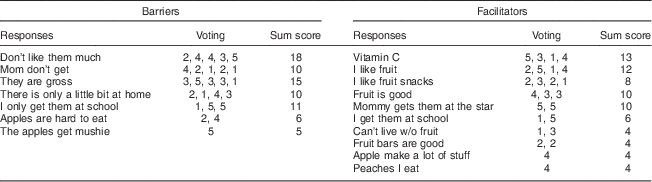
Barriers and facilitators to meeting fruit group recommendations reported by American-Indian children (responses ranked by vote) from a rural Northern Plains reservation, March–December 2010
Barriers and facilitators to meeting vegetable group recommendations reported by American-Indian children (responses ranked by vote) from a rural Northern Plains reservation, March–December 2010

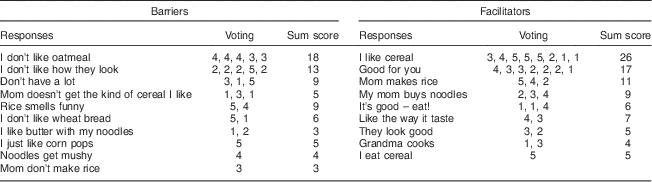
Barriers and facilitators to meeting grain group recommendations reported by American-Indian children (responses ranked by vote) from a rural Northern Plains reservation, March–December 2010
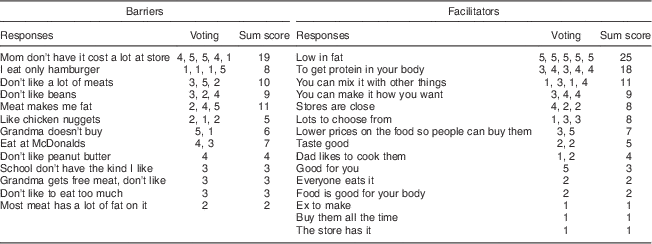
Barriers and facilitators to meeting meat/beans group recommendations reported by American-Indian children (responses ranked by vote) from a rural Northern Plains reservation, March–December 2010
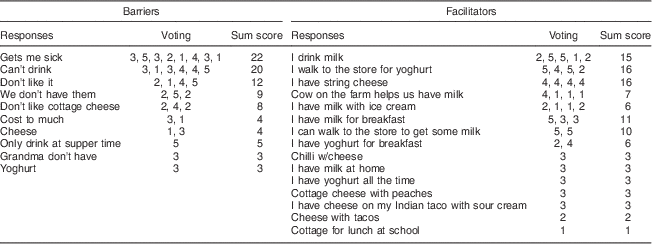
Barriers and facilitators to meeting milk group recommendations reported by American-Indian children (responses ranked by vote) from a rural Northern Plains reservation, March–December 2010
Results
Participant characteristics
Sixty-one fifth-grade children participated in the five barriers (n 31) and five facilitators (n 30) groups. NGT group sizes ranged between five and eight children, evenly split between boys and girls.
Summary of responses to barrier and facilitator questions
Question: ‘What kinds of things make it harder for kids to follow the DGA for…?
Children individually ranked a total of fifty-one barriers. The core barriers reported by children to meeting recommendations for each food group can be grouped into two recurring themes: (i) personal preference (disliking; 39 % of all barriers reported); and (ii) environmental barriers outside the child’s control (cost, transportation, none at home; 37 %). The milk group was the only group that also included physical complaints (‘gets me sick’; ‘can’t drink’).
Personal preference
Barriers relating to personal preference for the food groups included the following. Grain (specifically whole grains): ‘I don’t like oatmeal’; ‘I don’t like wheat bread’. Vegetables: ‘don’t like them’; ‘gross the taste’. Fruits: ‘don’t like them much’; ‘they are gross’. Meat/beans: ‘don’t like a lot of meat’; ‘don’t like beans’. Milk: ‘don’t like it’; ‘don’t like cottage cheese’.
Environmental barriers outside the child’s control
Environmental barriers included the following. Grain (specifically whole grains): ‘don’t have a lot’; ‘mom doesn’t get the kind of cereal I like’. Vegetables: ‘cost too much’; ‘store is too far to get them’. Fruits: ‘I only get them at school’; ‘mom don’t get’. Meat/beans: ‘mom don’t have it cost a lot at store’; ‘grandma gets free meat, don’t like it’. Milk: ‘cost too much’; ‘grandma don’t have’.
Question: ‘What kinds of things make it easier for kids to follow the DGA for…?
Children reported a total of sixty-one facilitators. The core facilitators to meeting recommendations for each food group can be grouped into three recurring themes: (i) suggestions (26 % of all facilitators reported); (ii) environmental (20 %); and (iii) personal preference (Reference O'Connell, Wilson and Manson13 %).
Suggestions
Suggestions for following the DGA included the following. Meat/beans: ‘you can make it how you want’. However, most suggestions were for the vegetable group: ‘put vegetables out for lunch’; ‘make a garden and plant vegetables’; ‘try the ones you don't like’.
Environmental
Facilitators related to the food environment included the following. Grain (specifically whole grains): ‘my mom buys noodles’. Fruits: ‘I get them at school’. Meat/beans: ‘lower prices on the food so people can buy them’. Milk: ‘I walk to the store for yoghurt’.
Personal preference
Few children ranked facilitator responses relating to personal preference for the food groups; the only taste responses were the following. Grain (specifically whole grains): ‘I like cereal’. Fruits: ‘I like fruit’. Meat/beans: ‘taste good’.
Discussion
In the present study, fifth-grade children reported barriers and facilitators to following the 2005 DGA recommendations for five food groups to encourage in the diet. One-third of ranked responses in barrier NGT groups reflected environmental factors, predominantly to following recommendations for vegetables, milk and meat/beans consumption. One-third of the ranked responses in facilitator groups, in particular the vegetable group, consisted of advice to kids for increasing consumption. Barriers and facilitators were dissimilar for individual food groups, suggesting that interventions should target reduction of barriers and promotion of facilitators for individual food groups recommended by the DGA. For instance, barriers to milk consumption were different from those for vegetables or fruits.
Results from the HEALTH study identified several key barriers to milk consumption reported by a national sample of fifth-grade children, including lactose intolerance, taste and lack of availability in the home. In the present study, children identified similar barriers to milk consumption, but also reported cost as one of the top ten barriers. Recently, the strength of the scientific evidence emphasizes health benefits of whole grain consumption, but consumers still struggle with disliking whole grains, knowledge of what a constitutes a whole grain food, how to cook and perceived cost(Reference McMackin, Dean and Woodside43). A recent study of correlates with whole grain intake in children reported that availability in the home was more strongly associated with intake than preference(Reference Rosen, Burgess-Champoux and Marquart44). However, AI children in the present study reported disliking grains (specifically whole grains) such as rice and wheat bread as the primary reason for not meeting the grain (specifically whole grains) recommendations. Facilitators however were mixed – including home access, liking the way grains (specifically whole grains) look and taste, and being good for you. Continued research to improve consumer acceptance and adoption of whole grain foods is warranted; particularly among children. As recently reviewed, a number of studies have identified barriers and facilitators to vegetable and fruit consumption in children(Reference Krølner, Rasmussen and Brug45); but none in AI children. Consistent with previous studies, the top barriers to vegetable consumption were dislike; but cost and access (home, school and store) were also ranked high in our responses. To our knowledge, no studies of determinants of healthy eating have also included the meat/beans group.
Children living in rural areas are 25 % more likely to be overweight or obese than children living in non-rural areas(Reference Lutfiyya, Lipsky and Wisdom-Behounek46) and have poorer diets than reported in the general population(Reference Stroehla, Malcoe and Velie30). Rural residency alone presents a unique set of barriers to healthy eating including high cost, long commutes and poor quality of fresh foods(Reference Yousefian, Leighton and Fox41). Formative research for Pathways, a large, multi-site obesity prevention initiative in tribal communities, found that caregivers of schoolchildren reported driving considerable distances to shop at grocery or discount stores to acquire food for the family, due to reported poor availability of fresh fruits, vegetables and low-fat dairy at local reservation stores(Reference Gittelsohn, Toporoff and Story31). In a recent study conducted in another rural Northern Plains reservation, 40 % of households reported low food security(Reference Brown, Noonan and Nord47), reinforcing the need for environmental interventions to increase affordable nutrient-rich food choices on or near the reservation as well as individual-level dietary interventions. In the present study, children’s reporting of cost and no availability in local stores as barriers indicates that children may be well aware of the difficulties their parents face in shopping for the family.
Obesity prevention efforts in AI communities have had limited success, despite careful attention to study design and community involvement(Reference Gittelsohn, Toporoff and Story31, Reference Caballero, Clay and Davis48, Reference Gittelsohn and Rowan49). AI tribal communities are heterogeneous; each faces unique geographic, cultural and economic situations. While research with AI communities has some generalizable import for all reservations, information is obviously most relevant to the community where the information was generated. Successful efforts to improve eating and physical activity behaviours may best be achieved by working hand-in-hand with each tribal community. On the reservation where the present study was conducted, chronic disease risk reduction is a priority of the tribe, but currently other, more basic needs such as substance abuse, lack of safe housing and physical and social recreation opportunities, employment and emergency response have been identified as most pressing(Reference McDonald50).
Difficulties in completing this type of face-to-face study on the reservation can be marked, even with monetary incentives and snack provision(Reference Gittelsohn, Evans and Helitzer51). The amount of coordination required to complete this effort was tremendous due to winter storms, flooding, school schedules, district and regional tournaments, transportation and frontier rurality. The above-mentioned barriers may also be significant barriers to the implementation and sustainability of local interventions.
Nevertheless, the results of the study will provide the tribe with means to specifically target interventions to improve recommended food group consumption. The present study is the first one to identify barriers and facilitators to healthy eating in AI children in the context of the DGA. To our knowledge, the only study of consumption of food groups recommended by the DGA by AI children was conducted with children of pre-school age(Reference LaRowe, Adams and Jobe28). Future studies are warranted to link barriers and facilitators to reported intake in older children, who may have more autonomy in food choices.
Limitations of the study include having only one group for each barrier and facilitator question. However, many qualitative studies report results from single groups. In addition, the NGT process minimizes the ‘group dynamic’ situation that can occur in less-structured groups. These results are not directly applicable to the general US population of fifth-graders, but their value lies precisely in that they reflect the barriers and facilitators to DGA adherence specific to AI children in this community.
While children reported not liking recommended foods, i.e. vegetables, nearly as many ranked responses referred to environmental factors specifically as a major barrier to consumption (39 % v. 37 %). Improving the acceptance of recommended food groups in children is difficult unless the foods are within the child’s reach. Efforts to reduce barriers to consumption of recommended food groups should include increased availability and accessibility of affordable food options such as reduced-fat/non-fat dairy, vegetables and fruits in schools, grocery stores and commodity distribution sites as a critical intermediate step to behaviour change. Promotion of facilitators include educational programmes specific to the community, the children and their families and should emphasize food-based recommendations, guidance on preparation of unfamiliar foods, and food tastings to expose children to low-fat dairy, meat/beans, vegetables, fruits and whole grains.
Conclusions
The findings of the present study resulted in two key accomplishments: first, identifying children’s self-reported barriers and facilitators to following the DGA recommendations; and second, increasing the intervention capacity of this tribal community. To our knowledge, the present study is the first to provide a child’s view of the problems, and opportunities, around complying with federal dietary guidance on a rural reservation. These results may benefit the community, and provide valuable information to support tribal community efforts to improve the health of children through the application, adoption and adherence to recommendations by the 2005 and 2010 DGA.
Acknowledgements
Acknowledgements: The authors would like to gratefully acknowledge Bonita Hoverson, Bonnie Thompson, Doreen Rolshoven, Doris Zidon, Mary Jo Peltier and Rebecca Stadstad at the Grand Forks Human Nutrition Research Center for their assistance in data collection; Angi Scheett for editorial assistance; and the children and caregivers who gave of their time and expertise to participate in the study. Financial support: This work was supported the US Department of Agriculture (USDA), Agricultural Research Service (grant number USDA 5450-51000-049-00D). The contents of this publication do not necessarily reflect the views or policies of the USDA or the Agricultural Research Service, nor does mention of trade names, commercial products or organizations imply endorsement from the US government. The USDA had no role in the design, analysis or writing of this article. Conflict of interest: None. Authorship: T.N. designed the parent HEALTH study, participated in data management and interpretation, and made substantial comments and revisions on the manuscript. L.J. and L.M. planned the study, oversaw training and project management and implementation, and obtained tribal and human subject approvals. L.M., C.M. and A.W. oversaw data collection. Y.L. analysed the data. L.J. drafted the manuscript and L.M., A.W., C.M., Y.L. and T.N. participated in data interpretation and reviewing, finalizing and approving the manuscript. Ethics of human subject participation: The study was reviewed and approved by the Institutional Review Board of the University of North Dakota.