





Introduction
Social biases are beliefs and opinions that people have about members of different groups. They derive from social categorization, a cognitive process by which we group individuals based on their supposedly shared characteristics, such as sex, age, ethnicity or religion. Social categorization is an adaptative process developed from childhood and which helps us understand the world’s complexity (e.g., Liberman et al., Reference Liberman, Woodward and Kinzler2017). The literature considers two types of biases: explicit and implicit. Explicit biases refer to our conscious attitudes toward members from different groups, whereas implicit biases refer to attitudes that are more automatically accessed. The presence of social biases can have negative consequences across many spheres of society, such as education (e.g., Leslie et al., Reference Leslie, Cimpian, Meyer and Freeland2015; McGee, Reference McGee2020), healthcare (e.g., Marcelin et al., Reference Marcelin, Siraj, Victor, Kotadia and Maldonado2019), work environment (e.g., Harris et al., Reference Harris, Krygsman, Waschenko and Laliberte Rudman2018; Hoover et al., Reference Hoover, Hack, Garcia, Goodfriend and Habashi2019) or the judiciary system (e.g., Hinton et al., Reference Hinton, Henderson and Reed2018). In this study, we explore the connection between different bilingual experiences and the expression of explicit social biases from an interdisciplinary perspective.
Individual differences in the expression of social biases
In the field of social cognition, there is abundant research on the role of individual differences in the expression of social biases, with a strong focus on the relevance of motivational, cognitive and cultural factors. The most well-known sources of motivation associated with differences in bias expression are internal and external motivation to respond without prejudice. Internal motivation refers to motivation that is guided by personal beliefs, whereas external motivation refers to motivation that is guided by external pressures or by social norms (Plant & Devine, Reference Plant and Devine1998). These two types of motivation are independent of each other, which imply that a person can be motivated by internal reasons, by external reasons, by a combination of both or by neither of them (Devine et al., Reference Devine, Plant, Amodio, Harmon-Jones and Vance2002). Previous research has shown that individuals with high internal motivation generally express fewer race biases, whereas individuals with high external motivation tend to express more race biases (e.g., Amodio et al., Reference Amodio, Devine and Harmon-Jones2008; Burns et al., Reference Burns, Monteith and Parker2017; Devine et al., Reference Devine, Plant, Amodio, Harmon-Jones and Vance2002; Ito et al., Reference Ito, Friedman, Bartholow, Correll, Loersch, Altamirano and Miyake2015; Plant & Devine, Reference Plant and Devine1998). While the majority of studies have analyzed the relationships between motivation to respond without prejudice and racism, similar patterns have been observed with other kinds of biases. For example, higher internal motivation has been related to lower gender bias (Klonis et al., Reference Klonis, Plant and Devine2005) and more positive attitudes toward homosexual men among heterosexual individuals (Lemm, Reference Lemm2006); higher external motivation has also been linked to higher gender bias (Klonis et al., Reference Klonis, Plant and Devine2005).
Different combinations of internal and external motivation also have a distinct impact on social biases. For instance, as observed in the seminal study conducted by Devine and collaborators in Reference Devine, Plant, Amodio, Harmon-Jones and Vance2002, individuals with high internal motivation but with different levels of external motivation differed in their implicit bias. More specifically, those who had high internal but low external motivation exhibited less implicit bias than those who had high internal and high external motivation. Following the self-determination theory (e.g., Ryan & Deci, Reference Ryan and Deci2000), Devine et al. (Reference Devine, Plant, Amodio, Harmon-Jones and Vance2002) suggested that individuals with high internal and low external motivation would have their motivations internalized in the self-concept, and, therefore, would regulate their behavior more effectively across settings. Other studies have suggested that individuals with high internal and high external motivation experience conflict between their egalitarian intentions and their automatic biases (Amodio et al., Reference Amodio, Devine and Harmon-Jones2008), which results in greater implicit bias. The combinations of internal and external motivation also relate to differences in explicit biases. For example, individuals who are motivated by external and internal reasons report fewer biases in public and private settings. However, those who are motivated only by external reasons express significantly fewer biases in public but not in private (for a review, see, e.g., Butz & Plant, Reference Butz and Plant2009).
In addition to motivation to respond without prejudice, researchers have also studied the role of individual differences in executive control (EC) for the expression of social biases. The results from these investigations showed that individuals with more efficient EC tend to express fewer social biases (e.g., Hoyo et al., Reference Hoyo, Rueda and Rodríguez-Bailón2019; Ito et al., Reference Ito, Friedman, Bartholow, Correll, Loersch, Altamirano and Miyake2015; Klauer et al., Reference Klauer, Schmitz, Teige-Mocigemba and Voss2010; Payne, Reference Payne2005). For example, Ito et al. (Reference Ito, Friedman, Bartholow, Correll, Loersch, Altamirano and Miyake2015) found that more efficient domain-general EC was associated with lower implicit bias, while enhanced shifting-specific and updating-specific EC abilities were associated with lower explicit bias. Interestingly, their results also showed that EC and motivation to respond without prejudice could interact. Specifically, participants with higher external motivation expressed more implicit bias, but the effect was stronger among those with lower overall EC abilities. The authors proposed that conforming the behavior to social expectations requires more cognitive resources and thus depends more heavily on EC.
Another line of research has focused on the relevance of multicultural experience on social biases. Sparkman et al. (Reference Sparkman, Eidelman and Blanchar2016) showed that individuals who reported more frequent multicultural experiences expressed fewer biases, and similar relationships were observed when multicultural experiences were experimentally induced. Similarly, across six experiments, Tadmor et al. (Reference Tadmor, Hong, Chao, Wiruchnipawan and Wang2012) found that exposure to different cultures leads to fewer biases and discriminatory behaviors. The authors replicated these results in another study (Tadmor et al., Reference Tadmor, Hong, Chao and Cohen2018), where they found relationships between multiculturalism and fewer social biases. Different mechanisms have been proposed to explain this association, such as increased openness to experience (Sparkman et al., Reference Sparkman, Eidelman and Blanchar2016); lower need for closure (i.e., larger tolerance for ambiguity, unpredictability and uncertainty, as well as greater open-mindedness; Tadmor et al., Reference Tadmor, Hong, Chao, Wiruchnipawan and Wang2012, Reference Tadmor, Hong, Chao and Cohen2018) or increased availability of mental resources (Tadmor et al., Reference Tadmor, Hong, Chao and Cohen2018). Importantly, multiculturalism is a life experience closely connected to bilingualism (e.g., Grosjean, Reference Grosjean2015). None of these studies, however, attempted to isolate multiculturalism from the experience of using more than one language.
Relationship between bilingualism and social biases
While the impact of motivation to respond without prejudice, EC and multicultural experiences has been extensively investigated, little is known about the role that individual differences in language experiences play in the expression of social biases. The existing research has focused on language-related biases, such as accent bias, or ingroup–outgroup preference, as in a preference for monolingual versus bilingual speakers (e.g., Byers-Heinlein et al., Reference Byers-Heinlein, Behrend, Said, Girgis and Poulin-Dubois2017; DeJesus et al., Reference DeJesus, Hwang, Dautel and Kinzler2017; Jarůšková & Chládková, Reference Jarůšková and Chládková2023; for a meta-analysis, see Spence et al., Reference Spence, Hornsey and Imuta2021). However, the relevance that language experiences can have for the development and expression of social biases that are not directly related to linguistic aspects requires further investigation, particularly because most of the available evidence comes from research comparing bilinguals and monolinguals.
One of the pioneer studies was conducted by Singh et al. (Reference Singh, Quinn, Xiao and Lee2019). The authors tested a group of infants exposed to one language (monolingual infants, hereafter) or two languages (bilingual infants, hereafter) using a gaze-following paradigm where same-race and different-race actors cued the presence of an event. The actors could be fully reliable, that is, their gaze always correctly signaled the presence of an event, or partially reliable, that is, their gaze did not always correctly signal the presence of an event. All infants trusted the fully reliable actors, regardless of their race. However, when the actor was partially reliable, monolingual infants showed selective trust for same-race actors, whereas bilingual infants did not show such a preference. In another study, Singh et al. (Reference Singh, Quinn, Qian and Lee2020) tested implicit and explicit race biases in a group of English–Mandarin bilingual children from Singapore and two groups of monolinguals (English monolinguals from Singapore and Mandarin monolinguals from China). Their results showed that monolingual children, regardless of their origin, showed greater implicit bias than bilingual children. In addition, the monolingual children from China also expressed greater explicit bias than the bilingual children, but no differences were observed between the bilingual and monolingual children from Singapore. In light of these findings, the authors concluded that the expression of implicit bias was influenced primarily by participants’ bilingualism. In contrast, explicit bias was impacted to a greater extent by the sociocultural characteristics of the environment, particularly by the greater multicultural exposure in Singapore versus China. Subsequently, Singh et al. (Reference Singh, Moh, Ding, Lee and Quinn2021) evaluated the relevance of various cognitive and sociocultural factors in the expression of social biases among bilingual preschool children. They found that greater cognitive flexibility, measured using the Dimensional Change Card Sorting Task, was associated with lower implicit bias, whereas higher parental education was associated with lower explicit bias.
Regarding research with adults, in a previous investigation, we found a connection between bilingualism and the expression of social biases (Reference Castro, Bukowski, Lupiáñez and WodnieckaCastro et al., under review). We tested a model where we hypothesized a relationship between bilingualism and social biases that are mediated by EC and moderated by motivation to respond without prejudice. In other words, the differences between bilinguals and monolinguals would be explained by individual differences in EC. At the same time, the strength of this relationship would vary depending on participants’ internal and external motivation. The model was supported by the results. Particularly, bilinguals expressed fewer social biases than monolinguals, and this difference was mediated by bilinguals’ greater self-reported cognitive flexibility. At the same time, differences between groups were observed only when comparing bilinguals and monolinguals with lower internal motivation to respond without prejudice. This study also supported the connections between bilingualism and multiculturalism that have been discussed in past research (e.g., Grosjean, Reference Grosjean2015; Ramírez-Esparza & García-Sierra, Reference Ramírez-Esparza, García-Sierra, Benet-Martínez and Hong2014), showing that bilingual participants had more multicultural experiences than monolingual participants. Importantly, exploratory analyses controlling for multicultural experiences indicated that multicultural experiences could not fully account for the reduced social biases observed in bilinguals. More specifically, bilinguals still reported less gender bias than monolinguals when individual differences in multicultural experiences were controlled for. In other words, the differences between bilinguals and monolinguals in gender bias were not explained by bilinguals’ increased multicultural experiences.
Relevance of bilingual experience in the expression of social biases
Although the studies summarized above provide valuable insights on how bilingualism and social biases relate to each other, the operationalization of bilingualism as a categorical variable has been criticized for not representing the heterogeneous nature of the bilingual experience (e.g., de Bruin, Reference de Bruin2019; Luk & Bialystok, Reference Luk and Bialystok2013). Bilingualism is not a zero-one phenomenon, as it entails enormous sociodemographic and linguistic diversity (e.g., Beatty-Martínez & Titone, Reference Beatty-Martínez and Titone2021; Gullifer & Titone, Reference Gullifer and Titone2019; Kałamała et al., Reference Kałamała, Chuderski, Szewczyk, Senderecka and Wodniecka2023; Leivada et al., Reference Leivada, Westergaard, Duñabeitia and Rothman2021; Marian & Hayakawa, Reference Marian and Hayakawa2021; Titone & Tiv, Reference Titone and Tiv2023). Bilinguals differ in aspects such as the number of languages they know, when they acquired each of them, their level of language proficiency, the frequency of use of each language or the frequency and patterns of language switching and mixing. Given the breadth of this diversity, recent research is moving beyond the simplistic binary classification of “bilingual versus monolingual” toward more nuanced investigations that acknowledge the diversity of bilingual experiences, primarily in studies assessing the consequences of bilingualism in EC (e.g., Champoux-Larsson & Dylman, Reference Champoux-Larsson and Dylman2021; Gallo et al., Reference Gallo, Novitskiy, Myachykov and Shtyrov2021). However, to the best of our knowledge, only one study has attempted at investigating the relevance of bilingual experiences for the expression of social biases (Mepham & Martinovic, Reference Mepham and Martinovic2018). The authors analyzed survey responses from a large group of Dutch participants who differed in the number of languages they spoke and found a positive relationship between the number of languages and the degree of out-group acceptance. The connection between bilingualism and out-group acceptance was mediated by cognitive flexibility, assessed using the same questionnaire as in Castro et al. (Reference Castro, Bukowski, Lupiáñez and Wodnieckaunder review), that is, the Cognitive Flexibility Scale (CFS; Martin & Rubin, Reference Martin and Rubin1995). Their results showed that speaking more languages was associated with increased self-reported cognitive flexibility; cognitive flexibility was related to increased deprovincialization, which translated onto increased out-group acceptance.
Taken together, these studies provide consistent support for the link between bilingualism and the expression of fewer social biases. Nonetheless, more research is needed to establish which aspect(s) of the bilingual experience may underlie this relationship. While the study by Mepham and Martinovic (Reference Mepham and Martinovic2018) assessed the role of language knowledge diversity, the complexity of the bilingual experience demands a more in-depth analysis of other factors, such as experiences related to language use or individual differences in language-learning history. Considering the ubiquity and diversity of bilingualism, investigating the relationship between multiple bilingual experiences and social biases could improve the understanding of which sources of individual differences are associated with fewer social biases. At the same time, research in this area must also consider other potential modulators that are not directly related to language experience, such as motivation to respond without prejudice, EC and multicultural experiences.
The present study
The goal of the analyses reported in this article was to determine which – if any – of the core dimensions of bilingual experience (i.e., proficiency, age of acquisition [AoA], language use) underlies the relationship between bilingualism and the expression of fewer explicit bias. While in Castro et al. (Reference Castro, Bukowski, Lupiáñez and Wodnieckaunder review), we assessed the differences between bilinguals and monolinguals in the expression of social biases, the analyses presented in this manuscript focus particularly on the heterogeneity of bilingualism, operationalized as a continuous and multivariate factor.
In addition to bilingualism-related variables, we considered the relevance of motivation to respond without prejudice and EC, as both have been shown to impact the expression of social biases (e.g., Amodio et al., Reference Amodio, Devine and Harmon-Jones2008; Amodio & Swencionis, Reference Amodio and Swencionis2018; Devine et al., Reference Devine, Plant, Amodio, Harmon-Jones and Vance2002; Ito et al., Reference Ito, Friedman, Bartholow, Correll, Loersch, Altamirano and Miyake2015; Klauer et al., Reference Klauer, Schmitz, Teige-Mocigemba and Voss2010). This approach was further motivated by the possibility that bilingualism may not relate to differences in the expression of social biases directly, but through its interactions with individual differences in motivational or cognitive abilities (Castro et al., Reference Castro, Bukowski, Lupiáñez and Wodnieckaunder review). Finally, we also explored the interconnections between bilingual and multicultural experiences and analyzed their combined and independent relevance for the expression of social biases. To this end, we reanalyzed self-reported data from our recent study (Castro et al., Reference Castro, Bukowski, Lupiáñez and Wodnieckaunder review), where 402 bilinguals completed a battery of questionnaires on bilingual and multicultural experiences, explicit bias, motivation to respond without prejudice and EC.
Given that there is no previous research on the role of individual differences in bilingual experience, motivation to respond without prejudice, EC, and multicultural experience, on the expression of explicit bias, we did not formulate specific hypotheses but instead took a fully exploratory approach. A multivariate approach along with a large and heterogeneous participant sample should allow us to delineate which aspects of the bilingual experience account for the relationships between bilingualism and explicit bias observed in our previous analyses conducted on the same dataset (Castro et al., Reference Castro, Bukowski, Lupiáñez and Wodnieckaunder review), in which reduced explicit bias was observed for bilinguals compared to monolinguals; it should also allow us to assess the extent to which these effects depend on individual differences in aspects such as motivation to respond without prejudice, self-reported EC or multicultural experience.
Methods
Participants
We reanalyzed a dataset that included 402 bilinguals. All participants were recruited via Prolific. From the initial sample of 402 bilinguals, a total of 13 participants were excluded due to data collection failures. Thus, 389 participants (M age = 32.99 years; SD = 11.12; 251 women) were included in the analysis. All participants were living in the UK at the time of testing and declared knowledge of more than one language before enrolling in the study. None of them reported having writing or reading disorders.
Table 1 presents the participants’ sociodemographic and linguistic data. Based on their prolific information, a total of 156 participants were born in the United Kingdom (40.10%), but other countries represented in this dataset included Italy (4.11%), Germany (3.60%), India (3.60%), Poland (3.08%) and Bulgaria (2.83%). In addition, most participants declared “White/Caucasian” or “Caucasian” as their ethnicity (56.30%). Other ethnicities reported were “South Asian” (12.10%), “East Asian” (6.68%) and “Mixed” (5.66%).
Sociodemographic and language proficiency characteristics

Note. AoA = age of acquisition.
a Self-ratings were 1 = no high school diploma, 2 = high school diploma, 3 = vocational qualification, 4 = A levels, 5 = Bachelor’s degree, 6 = Master’s degree, 7 = Doctorate. Higher scores indicate higher degree of education.
b Participants were asked to self-rate their social position in relation to other members of the society in terms of income, education and employment. They answered on a ladder-like scale from 1 to 10. Higher levels indicate higher self-perceived social position.
c Self-ratings were 1 = less than £10,000, 2 = £10,000–£15,999, 3 = £16,000–£19,999, 4 = £20,000–£29,999, 5 = £30,000–£39,999, 6 = £40,000–£49,999, 7 = £50,000–£59,999, 8 = £60,000–£69,999, 9 = £70,000–£79,999, 10 = £80,000–£89,999, 11 = £90,000–£99,999, 12 = £100,000–£149,999, 13 = more than £150,000. Higher levels indicate higher annual household income.
d Average language/dialect proficiency based on self-rated proficiency in reading, listening, writing and speaking. The self-rating range for proficiency went from 0 = no knowledge to 10 = native speaker. The languages/dialects are ordered by average proficiency. When Language 1 and Language 2 had the same proficiency, L1 was considered the one with the lower AoA. Higher scores indicate higher average proficiency in a given language.
To increase the heterogeneity of our sample, we did not limit participants’ language knowledge to specific languages. All participants were required to know English, although it did not need to be their first language. In addition to English, the languages most frequently known by participants were French (39.60% of participants), Spanish (30.30%), German (22.10%) and Italian (13.40%) (see Supplementary Material A, Table A1 for a list of languages). From the total of 389 participants, 88 reported knowledge of two languages, 133 reported knowledge of three languages and 168 indicated knowledge of four languages. Participants declared having a moderate-to-high proficiency in their second language (L2) and participants who knew a third (L3) and fourth language (L4) declared moderate-to-low proficiency in them. While L2 was usually acquired in primary school, L3 and L4 were primarily acquired during adolescence. On average, participants reported having higher education, a medium-to-high income, and ranked themselves at a medium level compared to other community members (for details, see Table 1). Collectively, these factors indicate a medium socioeconomic status among the participants. The study was approved by the Ethics Committee of Jagiellonian University in Kraków (Poland). Participants gave their informed consent prior to participating and received financial compensation in exchange for their participation (around 5 USD)
Measures and procedure
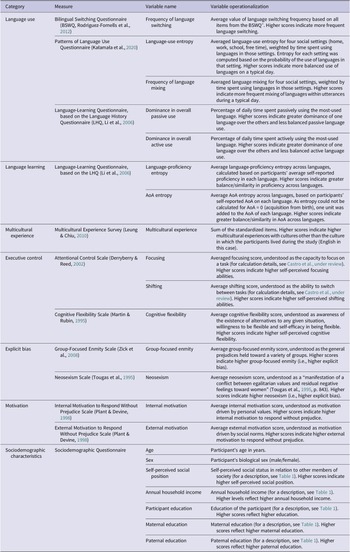
Participants completed a battery of questionnaires on language experience, explicit bias, motivation to respond without prejudice, EC, and multicultural experience. To evaluate their sociodemographic backgrounds, participants were additionally asked to report their age, sex, social position, annual income, education, maternal education and paternal education. An overview of the tools and measures included in the analyses, as well as the indices extracted from each questionnaire are available in Table 2; the survey is available in Supplementary Material B.
Overview of the analyzed variables

a Although the BSWQ allows for the computation of four different indices of switching (switching from L1 to L2, switching from L2 to L1, conscious switching and unconscious switching), we deliberately focused on the average switching frequency due to the heterogeneity of our sample, as not all participants completed the BSWQ with their L1 and L2.
As measures of language experience, participants completed the Patterns of Language Use Questionnaire (PLUQ, Kałamała et al., Reference Kałamała, Szewczyk, Chuderski, Senderecka and Wodniecka2020), the Bilingual Language Switching Questionnaire (BSWQ, Rodriguez-Fornells et al., Reference Rodriguez-Fornells, Kramer, Lorenzo-Seva, Festman and Münte2012) and a modified version of the Language History Questionnaire (LHQ, Li et al., Reference Li, Sepanski and Zhao2006). The PLUQ assesses the daily use of different languages and the patterns of language mixing. In this questionnaire, participants list all the languages they use on a typical day and report the number of hours they use each of them across four contexts: home, work, school and free time. When participants indicate the use of more than one language in a given context, they additionally assess how often they mix words of different languages within single utterances, on a scale from 1 (never) to 9 (always). If a participant does not spend time in a context, they do not complete the respective section. The division into contexts is applied to provide a more accurate and reliable representation of typical language use (Kałamała et al., Reference Kałamała, Szewczyk, Chuderski, Senderecka and Wodniecka2020).
The BSWQ assesses individual differences in various language-switching practices between two languages, on a scale from 1 (never) to 5 (always). As our sample included bilinguals who knew more than two languages, the BSWQ was adapted as follows: For participants who reported knowledge of English and another language, the statements targeted those two languages. For participants who reported knowledge of more than two languages, the statements targeted English and the language most frequently used together with English, as reported by the participant.
In the Language-Learning Questionnaire (LHQ), participants self-assessed their reading, listening, writing and speaking abilities for up to four languages, on a scale from 0 (no knowledge) to 10 (native speaker). They also indicated the AoA for each of the languages they reported. In addition, they were asked to report their general active and passive use of different languages on a daily basis. More specifically, they listed all the languages they used passively and actively, together with the percentage of time they use each of them. The sum had to add up to 100%.
As measures of explicit bias, participants completed the Neosexism Scale (Tougas et al., Reference Tougas, Brown, Beaton and Joly1995) and the Group-Focused Enmity Scale (Zick et al., Reference Zick, Wolf, Küpper, Davidov, Schmidt and Heitmeyer2008). The Neosexism Scale assesses the conflict between nonsexist values and negative feelings that still exist toward women, especially in regard to policies attempting to reduce gender inequality. Participants provide responses on a scale from 1 (strongly disagree) to 7 (strongly agree). The Group-Focused Enmity Scale measures prejudice toward multiple groups, particularly racism, antisemitism, sexism, xenophobia, islamophobia, devaluation of homosexuals, homeless people, newcomers and people with disabilities. Participants provide responses on a scale from 1 (fully disagree) to 4 (fully agree).
To assess motivation to respond without prejudice, we relied on the Internal and External Motivation to Respond Without Prejudice Scales (Plant & Devine, Reference Plant and Devine1998). These scales asses the motivations underlying individual efforts to control the expression of prejudice toward Black people on a scale from 1 (strongly disagree) to 9 (strongly agree). We adapted the scales to focus on motivation to respond without prejudice toward multiple groups in general.
As measures of EC, participants completed the Attentional Control Scale (ACS, Derryberry & Reed, Reference Derryberry and Reed2002) and the CFS (Martin & Rubin, Reference Martin and Rubin1995). The ACS measures individual beliefs about the ability to voluntarily exert EC, including focusing and shifting abilities, on a scale from 1 (almost never) to 4 (always). The CFS measures the degree of awareness regarding the availability of alternatives to a given situation, the willingness to adapt to different situations, and the beliefs regarding one’s flexibility capacity. Participants provide responses on a scale from 1 (strongly disagree) to 6 (strongly agree).
In regard to multicultural experiences, participants completed the Multicultural Experience Survey (Leung & Chiu, Reference Leung and Chiu2010), a questionnaire that measures the degree of multicultural experiences with cultures other than the culture in which the participants lived during the study (English in this case). Out of the eight items that this scale includes, we selected the four with the highest factor loadings (>.70), and all items were rescaled following Leung and Chiu (Reference Leung and Chiu2010). Particularly, participants indicated whether their father and their mother were born outside the United Kingdom (coded as 0 = no, 1 = yes), and their degree of exposure to cultures other than mainstream English culture (scale 0–10). In addition, they also made a list of their five closest friends and their nationalities (coded as 0 = United Kingdom, 1 = outside the United Kingdom).
Participants completed all questionnaires over the course of two sessions separated by a 1- to 5-day break. In the first session, participants completed all the bilingual experience questionnaires in the following order: Language-Learning Questionnaire (based on LHQ, Li et al., Reference Li, Sepanski and Zhao2006), PLUQ (Kałamała et al., Reference Kałamała, Szewczyk, Chuderski, Senderecka and Wodniecka2020) and BSWQ (Rodriguez-Fornells et al., Reference Rodriguez-Fornells, Kramer, Lorenzo-Seva, Festman and Münte2012)Footnote 1. In the second session, participants completed the other questionnaires in the following order: the Sociodemographic Questionnaire, the ACS (Derryberry & Reed, Reference Derryberry and Reed2002), the CFS (Martin & Rubin, Reference Martin and Rubin1995), the Multicultural Experience Survey (Leung & Chiu, Reference Leung and Chiu2010), the Group-Focused Enmity Scale (Zick et al., Reference Zick, Wolf, Küpper, Davidov, Schmidt and Heitmeyer2008), the Neosexism Scale (Tougas et al., Reference Tougas, Brown, Beaton and Joly1995) and the Internal and External Motivation to Respond Without Prejudice Scales (Plant & Devine, Reference Plant and Devine1998)Footnote 2. All questionnaires were filled out in English via Qualtrics.
Data preparation and analysis
Indices of bilingual experience
The self-report measures of bilingual experience allowed us to compute a variety of indices that tap into the three core aspects of the bilingual experience: language proficiency, AoA and language use. These three dimensions are considered key in order to understand the diversity of the bilingual experience and the multifaceted nature of bilingualism (e.g., Gullifer et al., Reference Gullifer, Kousaie, Gilbert, Grant, Giroud, Coulter, Klein, Baum, Phillips and Titone2021; Kałamała et al., Reference Kałamała, Senderecka and Wodniecka2021, Reference Kałamała, Chuderski, Szewczyk, Senderecka and Wodniecka2023; Marian & Hayakawa, Reference Marian and Hayakawa2021; Surrain & Luk, Reference Surrain and Luk2017). In addition, they have been investigated as potential modulators behind the effects of bilingualism in cognition, particularly in regard to the consequences of language use for EC efficiency (e.g., Champoux-Larsson & Dylman, Reference Champoux-Larsson and Dylman2021; Gullifer et al., Reference Gullifer, Pivneva, Whitford, Sheikh and Titone2023; Tiv et al., Reference Tiv, O’Regan and Titone2021; Yang et al., Reference Yang, Tng, Ng and Yang2024; for a review, see de Bruin, Reference de Bruin2019).
Following previous work (e.g., Gullifer et al., Reference Gullifer, Kousaie, Gilbert, Grant, Giroud, Coulter, Klein, Baum, Phillips and Titone2021; Kałamała et al., Reference Kałamała, Szewczyk, Chuderski, Senderecka and Wodniecka2020; Li et al., Reference Li, Sepanski and Zhao2006), language proficiency was computed based on participants’ self-assessment of reading, listening, writing, and speaking abilities. AoA was indexed as the age at which a given language was acquired.
To capture the richness of bilingual experiences within and across individuals, we utilized Shannon’s entropy (Shannon, Reference Shannon1948) as a metric of relative balance in terms of language use, proficiency, and AoA. To this end, we developed three entropy-based indices: (1) language-use entropy, reflecting the balance in the daily use of different languages; (2) language-proficiency entropy, reflecting the balance/similarity in linguistic competence across languages, and (3) AoA entropy, reflecting the balance/similarity in AoA across different languages. In the case of language-use entropy, higher scores reflect greater balance in the daily use of different languages. For example, a Spanish-English bilingual who uses both languages in perfect balance across all communicative contexts (i.e., 50% Spanish and 50% English) will have higher language-use entropy compared to a Spanish-English bilingual who communicates primarily in Spanish across all communicative contexts (e.g., 90% Spanish, 10% English). Similarly, for language-proficiency entropy and AoA entropy, higher scores reflect a more similar/balanced proficiency and AoA across all languages known by a participant. For example, a Spanish–English bilingual with native-like proficiency in both languages and who acquired both languages from birth will have higher language-proficiency entropy and AoA entropy compared to a bilingual with moderate English proficiency and native-like Spanish proficiency who acquired English at school and Spanish from birth. While language-use entropy has been used in previous studies (e.g., Gullifer & Titone, Reference Gullifer and Titone2019; Kałamała et al., Reference Kałamała, Szewczyk, Chuderski, Senderecka and Wodniecka2020, Reference Kałamała, Senderecka and Wodniecka2021), this work is the first to apply the entropy concept to study the balance of language competence and AoA. Relying on entropy not only to assess language use but also language proficiency and AoA allows for a more accurate and complete estimation of the diversity of participants’ bilingual experiences. Specifically, entropy reflects the relative balance across more than two input conditions; since 77.38% of participants knew more than two languages, traditional measures based on ratio (i.e., L2-L1 balance measures) would obscure their true bilingual profiles.
In addition to language-use entropy, other indices of language use that were computed were linguistic dominance in passive and active use, frequency of language switching, and frequency of language mixing. Passive and active language dominance was based on the percentage of time participants reported using their most frequently used language. Higher scores indicate greater passive or active dominance of a language over the others. For example, the passive language dominance value for a participant that uses English 60% of the time and Spanish 40% of the time would be 60. Frequency of language mixing was computed based on participants’ responses to the PLUQ (Kałamała et al., Reference Kałamała, Szewczyk, Chuderski, Senderecka and Wodniecka2020), with higher scores indicating more frequent language mixing on a daily basis. Frequency of language switching was computing by averaging all items from the BSWQ (Rodriguez-Fornells et al., Reference Rodriguez-Fornells, Kramer, Lorenzo-Seva, Festman and Münte2012). Higher scores indicated more frequent engagement in language switching. Further details on the extracted indices are available in Table 2.
Analytical approach
The data were analyzed in R (R Core Team, 2023) using the following packages: dplyr (Wickham et al., Reference Wickham, François, Henry and Müller2022), stats (R Core Team, 2023), psych (Revelle, Reference Revelle2022), EFAtools (Steiner et al., Reference Steiner, Grieder, Revelle, Auerswald, Moshagen, Ruscio, Roche, Lorenzo-Seva and Navarro-Gonzalez2022), lsr (Navarro, Reference Navarro2015), moments (Komsta & Novomestky, Reference Komsta and Novomestky2022) and BayesFactor (Morey et al., Reference Morey, Rouder, Jamil, Urbanek, Forner and Ly2022). There was no missing data and the distribution of each measure fell within an acceptable range (|skewness| < 1.29 for the most skewed variable; Kline, Reference Kline2016). Since all variables were ordinal, we computed the correlations between variables using Spearman’s rank (rho) correlation coefficient. All measures were centered and scaled to ensure a common measurement scale.
First, we reduced the multidimensionality of the data using Principal Component Analysis (PCA). We conducted two separate PCAs, one for the variables related to bilingual and multicultural experiences, and one for the variables related to the socio-cognitive characteristics of participants. The bilingualism-related PCA produced two oblimin-rotated components (language-use experience and language-learning experience), whereas the socio-cognitive PCA produced three oblimin-rotated components (EC, parental education and participant SES).
Subsequently, to determine whether the components of bilingual experience were related to individual variability in expressing explicit bias, we conducted multiple regressions with the two measures of explicit bias (i.e., neosexism and group-focused enmity) as dependent variables. Two models were tested against each dependent variable. As predictors, the basic model included internal and external motivation to respond without prejudice, the two PCA-extracted components of bilingual experience (i.e., language-use experience, language-learning experience), and the three PCA-extracted components of socio-cognitive characteristics (i.e., EC, parental education, participant SES). The interactive model additionally incorporated interactions between bilingual experience, EC, and motivation. To control for sex-related differences, all models included participants’ sex as a covariate. The χ2 test was used to determine whether the inclusion of the interactions improved the models’ fit.
Additionally, we conducted a series of regressions to differentiate multicultural experience from bilingual experience. Specifically, we excluded multicultural experience from the bilingualism-related PCA and included it as a covariate in the linear regressions. This approach helped us isolate the role of bilingual experience from that of multicultural experience.
Finally, to assess the extent to which the data supported the absence of effects, we calculated the Bayes Factor in favor of the null hypothesis (BF01 = 1/BF10). The null model (i.e., a model including an intercept only) served as reference. Following Kass and Raftery (Reference Kass and Raftery1995), a BF01 between 3 and 20 would be interpreted as positive evidence in favor of the null hypothesis (i.e., absence of an effect), a BF01 between 20 and 150 would be strong evidence and a BF01 larger than 150 would be very strong evidence.
Results
Descriptive statistics and correlations
Descriptive statistics, correlations and reliabilities (Cronbach’s αs) for all measures are available in Supplementary Material C, Table C1. Figure 1 presents the correlation matrix. Reliability could not be assessed for language-use entropy, language-proficiency entropy, AoA entropy, or the sociodemographic variables as they all consisted of single values. All other measures demonstrated satisfactory reliability (Cronbach’s α ranged between 0.73 and 0.90).
Visual representation of the correlation matrix.
Note. Darker colors reflect higher correlation coefficients. Positive correlations are depicted in blue; negative correlations are depicted in red. Prof = language-proficiency entropy; AoA = AoA entropy; LangUse = language-use entropy; Switch = language switching; Mix = language mixing; Passive = percentage of passive use of the language with the highest percentage of passive use; Active = percentage of active use of the language with the highest percentage of active use; Multicult = multicultural experience; Foc = focusing; Shift =, shifting; Flex = cognitive flexibility; Enmity = group-focused enmity; Neosex = neosexism; IntMot = internal motivation; ExtMot = external motivation; SocPos = self-perceived social position; Age = participants’ age; Income = household annual income; Edu = participant’s education; EduM = maternal education; EduF = paternal education.

Regarding the measures of bilingual experience, language-use entropy correlated positively with language switching and mixing. This pattern indicates that more balanced daily use of multiple languages is related to a higher frequency of language mixing and switching. The positive correlations between language switching and mixing followed the results of a previous study that included self-reported measures of switching and mixing (Kałamała et al., Reference Kałamała, Senderecka and Wodniecka2021). As expected, all these measures correlated negatively with self-reported passive and active dominance in general language use. This suggests that the greater the balance in language use and/or the higher the frequency of language switching/mixing, the smaller the dominance of one language over the others. In addition, multicultural experience was positively correlated with language-use entropy, language switching and language mixing; it was negatively correlated with passive and active language dominance. This finding indicated that language-use experiences and multiculturalism are interrelated. Finally, there was a positive correlation between language-proficiency entropy and AoA entropy. Thus, more balanced proficiency across languages was associated with more balanced (simultaneous) acquisition of these languages. Notably, language-proficiency entropy and AoA entropy did not correlate with any of the language-use variables or with multicultural experience, which suggests that (1) the balance in language proficiency and acquisition and the balance in language use constitute distinct aspects of the bilingual experience and (2) multiculturalism is related to language-use practices but not necessarily to an individual’s language learning background.
Regarding the socio-cognitive variables, there were positive correlations between all measures of EC (focusing, shifting and cognitive flexibility), suggesting that they all refer to a domain-general EC ability. Furthermore, there were positive correlations between the measures of explicit bias (group-focused enmity and neosexism), and, in line with past research (e.g., Devine et al., Reference Devine, Plant, Amodio, Harmon-Jones and Vance2002; Lemm, Reference Lemm2006; Plant & Devine, Reference Plant and Devine1998), there were negative correlations between internal and external motivation. Finally, we also observed significant correlations between the sociodemographic variables: self-perceived social position correlated positively with income, education and age; age correlated positively with participants’ education and negatively with maternal education; maternal and paternal education were positively correlated.
Dimension reduction
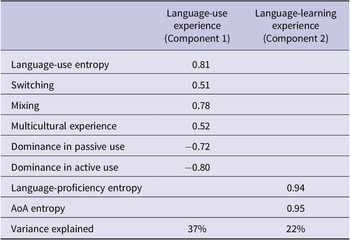
The bilingualism-related PCA produced two components that explained 59% of the total variance (see Table 3). Language-use entropy, switching frequency, mixing frequency, dominance in passive use, dominance in active use, and multicultural experience constituted Component 1 (language-use experience, hereafter). Language-proficiency entropy and AoA entropy constituted Component 2 (language-learning experience, hereafter). Participants with higher language-use experience had more balanced use of different languages throughout the day; they also engaged more frequently in language switching and mixing, demonstrated lower dominance of a single language both passively and actively, and reported having more multicultural experiences. Participants with higher language-learning experience acquired their languages more closely in time and had a more similar proficiency level across the languages they knew. The correlation between the PCA components was negligible (r = 0.12).
Loadings for the bilingualism-related principal component analysis

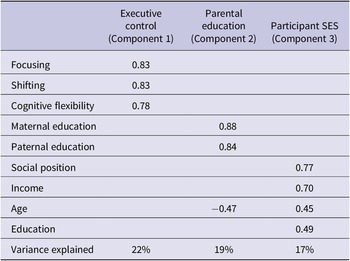
The socio-cognitive PCA produced three components that explained 59% of the total variance (see Table 4). Focusing, shifting and cognitive flexibility constituted Component 1 (EC, hereafter); maternal education and paternal education constituted Component 2 (parental education, hereafter); participants’ self-perceived social position, annual income, and education constituted Component 3 (participant SES, hereafter). Participants’ age had a comparable contribution to both parental education and participant SES components. Greater scores in these three components represented greater EC, higher parental education and higher participant SES, respectively. The correlations between components were negligible (ranging from .00 to .21).
Loadings for the socio-cognitive principal component analysis

Note. Only loadings > .40 are displayed.
Finally, the internal and external types of motivation were not reduced by PCA. As they were negatively correlated, combining them in a single principal component would result in information loss and obscure true individual variation in these motivational aspects.
Predictors of the expression of explicit bias
The basic model included the five PCA-extracted components as predictors, together with internal motivation, external motivation, and sex. The interactive model additionally included interactions of bilingual experience with motivation and EC. Model comparisons showed that the interactive model best represented the data for both neosexism, χ2(6) = 2.51, p = .021 and group-focused enmity, χ2(6) = 2.91, p = .009. Given the poorer fit of the basic models, only the results from the interactive models are presented. The detailed results are available in Table 5.
Model outputs for the interactive regression models that predict neosexism and group-focused enmity

Note. n = 389; L. use = language-use experience; L. learn = language-learning experience; EC = executive control; IM = internal motivation to respond without prejudice; EM = external motivation to respond without prejudice; SES = socioeconomic status; CI = confidence intervals. Sex coded as 0 = male and 1 = female.
* p < .05
** p < .01
*** p < .001.
In line with previous literature (e.g., Devine et al., Reference Devine, Plant, Amodio, Harmon-Jones and Vance2002), higher internal motivation, that is, the motivation driven by personal reasons, was associated with lower neosexism and group-focused enmity. In contrast, higher external motivation, that is, the motivation driven by social norms, was associated with higher neosexism and group-focused enmity. Women expressed less neosexism than men, but there were no sex differences in group-focused enmity. Additionally, participants’ SES was positively associated with group-focused enmity, but not neosexism. Language-use experience, language-learning experience, and EC themselves were not related to either of the two dependent variables. The Bayesian estimation revealed positive evidence in favor of an absence of language-use experience and language-learning experience effects (BF01 > 3).
Neither language-use experience nor language-learning experience were directly related to differences in the expression of neosexism or group-focused enmity. However, we found significant interactions between language-use experience and internal motivation – for both neosexism and group-focused enmity – as well as an interaction between language-learning experience and internal motivation for group-focused enmity. These interactions indicate a relationship between bilingual experiences and explicit bias that is moderated by internal motivation to respond without prejudice. More specifically, the importance of language-use experience and language-learning experience in the expression of explicit bias was more salient among bilinguals with lower internal motivation. This relevance decreased as internal motivation increased.
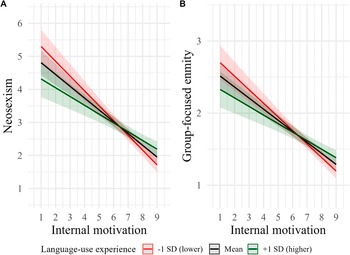
Regarding language-use experience, participants with lower internal motivation and higher language-use experience scores expressed less neosexism and group-focused enmity compared to participants with lower internal motivation and lower language-use experience scores (see Figure 2). However, the differences in explicit bias that resulted from language-use experience differences decreased when internal motivation was higher.
Predicted neosexism (Panel A) and group-focused enmity (Panel B) as a function of language-use experience and internal motivation
Note. Higher language-use experience (green line, +1SD in legend) reflects participants who had more balanced daily use of languages, who switched and mixed their languages more often, who had lower active and passive dominance of one language over the other, and who had more multicultural experience. Lower language-use experience (red line, −1SD in legend) reflects participants who had less balanced daily use of languages, who switched and mixed their languages less often, who had higher active and passive language dominance, and who had less multicultural experience. The average language-use experience (Mean in legend) is depicted by a black line. Higher values in the x-axis indicate higher internal motivation scores; higher values in the y-axis indicate higher neosexism (Panel A) and higher group-focused enmity (Panel B). Language-use experience refers to the PCA scores. Internal motivation, neosexism and group-focused enmity refer to the average internal motivation, neosexism and group-focused enmity of participants, respectively. Ribbons represent 95% confidence intervals.

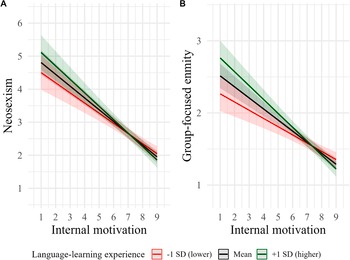
Regarding language-learning experience (see Figure 3), participants with lower internal motivation and lower language-learning experience scores expressed less group-focused enmity compared to participants with lower internal motivation and higher language-learning experience scores. Interestingly, although this interaction was not significant for neosexism (p = .086), the results followed the same pattern. Again, the differences in explicit bias related to participants’ language-learning experiences were smaller for individuals with higher internal motivation.
Predicted neosexism (Panel A) and group-focused enmity (Panel B) as a function of language-learning experience and internal motivation
Note. Lower language-learning experience (red line, −1SD) reflects participants with less balanced/more dissimilar proficiency and AoA across languages. Higher language-learning experience (green line, +1SD in legend) reflects participants with more balanced/similar proficiency and AoA across languages. The average language-learning experience (mean in legend) is depicted by a black line. Language-learning experience refers to the PCA scores. Internal motivation, neosexism and group-focused enmity refer to the average internal motivation, neosexism and group-focused enmity of participants, respectively. Higher values in the x-axis indicate higher internal motivation scores; higher values in the y-axis indicate higher neosexism (Panel A) and higher group-focused enmity (Panel B). Ribbons represent 95% confidence intervals.

Finally, the interactions between the bilingualism-related components and EC were not significant, and the absence of these effects was supported by the Bayesian estimation (BF01 > 3). The interactions between the bilingualism-related components and external motivation were also not significant. Bayesian estimation supported the absence of effects for the interactions language-learning experience × external motivation (model with neosexism as dependent variable) and language-use experience × external motivation (model with group-focused enmity as dependent variable; BF01 > 3). However, Bayesian estimation does not allow us to conclude that there is no effect for the other interactions involving external motivation (BF01 < 3).
The role of multicultural experience
In the analysis reported in the previous section, multicultural experience was considered as part of the bilingual experience. In other words, we included multicultural experience in the bilingualism-related PCA. To isolate bilingual language experience from multicultural experience, we re-analyzed the data excluding multicultural experience from the bilingualism-related PCA and including it in the linear regressions as a covariate. No other modifications were made in the analytical approach. The detailed results are available in Supplementary Material D.
The results from the bilingualism-related PCA were replicated. Particularly, all the variables related to language-use practices loaded into the language-use experience component, while language-proficiency entropy and AoA entropy loaded into the language-learning experience component. In addition, the pattern of results for the linear regressions did not change when multicultural experience was included as a covariate compared to when it was included as part of the language-use experience component. More specifically, we found a significant interaction between language-use experience and internal motivation, both for neosexism (b = .12, p = .006) and group-focused enmity (b = .11, p = .014), as well as a significant interaction between language-learning experience and internal motivation in the case of group-focused enmity (b = −.13, p = .004). In other words, when the individual differences in multicultural experience were controlled for, bilinguals with lower levels of internal motivation and more diverse language-use and language-learning experiences reported fewer social biases. Interestingly, individual differences in multicultural experience itself were unrelated to differences in the likelihood of expressing neosexism or group-focused enmity (ps > .05; BF01 > 3).
Discussion
The purpose of the presented analyses was to examine potential underlying factors behind the relationship between bilingualism and the expression of explicit social bias. By analyzing the effects of several factors related to bilingual experience, we aimed to understand better the mechanisms that may contribute to the likelihood of expressing explicit social biases in the bilingual population.
To this end, we reanalyzed questionnaire data from a previous study (Castro et al., Reference Castro, Bukowski, Lupiáñez and Wodnieckaunder review) in which a group of bilinguals completed a battery of questionnaires on language and multicultural experiences, explicit bias, motivation to respond without prejudice, and EC. Their sociodemographic characteristics were also taken into consideration. The analysis involved two stages: initially, we reduced the data’s multidimensionality using PCA, specifically focusing on bilingualism-related and socio-cognitive factors. Subsequently, we performed multiple regression analyses, using the components derived from the PCA along with internal and external motivation as predictors of individual differences in explicit bias. Additionally, we conducted further analyses to separate bilingual from multicultural experience by controlling for multicultural experience in the regressions. Taken together, these findings offer new insights into the circumstances under which bilingualism may relate to different tendencies in the expression of explicit bias.
Relationships between the measures of bilingual experience
The results from the bilingualism-related PCA showed evidence for two components: language-use experience and language-learning experience. Bilinguals with higher scores in the language-use experience component reported more balanced use of languages, they switched and mixed languages more often, and they had less passive and active language dominance and more multicultural experiences. Considering multicultural experience as part of the language-use experience component highlighted the existent interconnections between using multiple languages and experiencing a variety of cultures, thus supporting previous claims regarding the importance of taking culture into consideration in studies of bilingualism (Grosjean, Reference Grosjean2015; Marian & Hayakawa, Reference Marian and Hayakawa2021). Regarding language-learning experience, bilinguals with higher scores reported more comparable levels of proficiency and similar AoA across languages.
Bilingual experience and the expression of explicit bias
In line with previous literature (e.g., Devine et al., Reference Devine, Plant, Amodio, Harmon-Jones and Vance2002; Ito et al., Reference Ito, Friedman, Bartholow, Correll, Loersch, Altamirano and Miyake2015), we observed that internal motivation was related to less explicit bias, whereas external motivation was related to more explicit bias. Although language-use experience and language-learning experience were not directly related to explicit bias, the significant interactions with internal motivation indicated the existence of a relationship between bilingual experiences and explicit bias that was connected to participants’ internal motivation.
Specifically, at lower levels of internal motivation, bilinguals with higher language-use experience scores, that is, those who had more balanced use of languages, switched/mixed languages more often, had less active and passive language dominance, and had more multicultural experiences, expressed fewer biases. In addition, bilinguals with lower language-learning experience scores, that is, those who had more diverse proficiency and AoA across languages also expressed fewer biases. On the other hand, bilinguals who had high internal motivation expressed fewer biases, regardless of their bilingual experiences. The interaction between language-use experience and internal motivation was significant for neosexism and group-focused enmity, whereas the interaction between language-learning experience and internal motivation reached significance in the case of group-focused enmity. Nonetheless, the pattern of results for language-learning experience as predictor of neosexism followed the results for group-focused enmity. Finally, reports from the analyses including multicultural experience as a covariate in the models instead of as part of the bilingualism-related PCA suggested that the relationship between bilingual experiences and social biases could not be attributed to individual differences in multicultural experience.
Overall, the present findings suggest that having contact with different languages throughout life is related to less explicit bias, and this connection is observed in those who have low internal motivation. One interesting aspect of these results relates to the role of language-learning experiences. As shown above, individuals with higher language-learning experience acquired their languages closer in time and obtained a more similar degree of proficiency across all languages, whereas individuals with lower language-learning experience scores acquired their languages at different points in life and to less similar degrees of proficiency. Our results suggest that a reduced expression of social bias is not necessarily connected with growing up with more than one language but with the experience of learning more languages throughout one’s life. While further research is necessary to understand the origin of this association, individuals with more diverse language-learning experience may also have a stronger interest in connecting with people from diverse linguistic backgrounds. This interest in sociocultural diversity may contribute to a more flexible perception of other groups, which could, in turn, be relevant for the expression of less explicit bias. These findings indicate that the relationship between language-learning experience and social biases is complex and multidimensional and may be influenced by multiple factors related to language, culture, social identity, and motivation.
Although we observed relationships between bilingual experiences and internal motivation, there were no significant interactions between bilingual experiences and external motivation. In general, external motivation (vs. internal) is a weaker predictor of explicit bias (e.g., Devine et al., Reference Devine, Plant, Amodio, Harmon-Jones and Vance2002; Plant & Devine, Reference Plant and Devine1998). In line with this, the effect sizes of internal motivation were substantially larger (neosexism: ηp2 = .28; group-focused enmity: ηp2 = .26) compared to those of external motivation (neosexism: ηp2 = .02; group-focused enmity: ηp2 = .05). Therefore, although external motivation was related to differences in explicit bias, the effect may not have been strong enough to show interactive effects.
Limitations and future directions
The analyses reported in this manuscript provide evidence of the relationships between bilingual experiences and the expression of explicit biases among adult bilinguals. However, our approach had some limitations that should be taken into account in future research.
First, this study is correlational, meaning that no causal relationships can be drawn from the analyzed data. In other words, while we can observe a relationship between specific bilingual experiences and the expression of social biases, we cannot definitively conclude that one impacts the other. Second, although participants’ linguistic and sociodemographic characteristics were heterogeneous (see Table 1), more than 40% of participants were born in the same country (i.e., United Kingdom) and more than 55% declared their ethnicity as “White/Caucasian” or “Caucasian”. Therefore, caution should be applied when generalizing these results to other communities. Future studies could address this issue by testing a balanced sample in terms of, for example, country of origin or ethnicity. However, special attention should be devoted to the content of the biases evaluated, as some biases are culture dependent (e.g., race, religion; Fiske, Reference Fiske2017).
Third, as this is the first study on the conjoined relationship between bilingual experiences, self-reported EC, and social biases, replication studies and investigations with other types of measures are needed to verify whether the interconnections are limited to the tools included in this study or whether they extend to other measures of EC and social biases. Although self-report measures of EC have been suggested to be adequate for the study of individual differences (Hedge et al., Reference Hedge, Powell and Sumner2018) and potentially allow for the testing of a larger number of participants, future studies should assess EC using both self-report and experimental tools, and include measures of both explicit and implicit biases.
Fourth, while the relevance of multicultural experience was acknowledged in this study, the analyses reported in this manuscript were based on a single index of multicultural experience versus seven indices of bilingual language experience. Therefore, a more thorough investigation of the relationship between bilingualism and multiculturalism, as well as of the relevance of multicultural experiences in social biases is needed. For instance, although our results suggest that the relationship between bilingual experiences and the expression of social biases seems be driven by language experiences and not by multicultural experiences, the relevance of multiculturalism for social biases may be more salient in other populations where it is present at the societal level, or when multicultural experience is operationalized using a variety of tools. In those cases, the role of multiculturalism in social biases could be larger than the role of purely language-use characteristics. Hence, we acknowledge that the relationships between bilingualism, multiculturalism, and social biases require future testing.
Despite the limitations described above, the results reported indicate that some aspects of the bilingual experience are connected to differences in the expression of explicit bias. The extensive body of research on individual differences and social biases has carefully examined the importance of motivational and cognitive aspects (e.g., Amodio et al., Reference Amodio, Devine and Harmon-Jones2008; Amodio & Swencionis, Reference Amodio and Swencionis2018; Devine et al., Reference Devine, Plant, Amodio, Harmon-Jones and Vance2002; Ito et al., Reference Ito, Friedman, Bartholow, Correll, Loersch, Altamirano and Miyake2015), while some studies have also evaluated the role of multiculturalism (e.g., Sparkman et al., Reference Sparkman, Eidelman and Blanchar2016; Tadmor et al., Reference Tadmor, Hong, Chao, Wiruchnipawan and Wang2012, Reference Tadmor, Hong, Chao and Cohen2018). Yet, research on the interconnections between individual differences in bilingual experience and social biases is just starting to emerge (Mepham & Martinovic, Reference Mepham and Martinovic2018). Considering the global presence of bilingualismFootnote 3, studies on social biases should not overlook the potential connections between different bilingual experiences and the expression of social biases. Our findings highlight the importance of evaluating interindividual and intraindividual bilingual variability, thus opening the door to potential new lines of research on bilingual heterogeneity and social cognition.
Concluding remarks
This study shows important interconnections between bilingual experiences and the expression of social biases in adult bilinguals. In addition, it provides first evidence on the modulating role of motivation to respond without prejudice. Specifically, bilingual experiences related to more diverse language-use experiences and language-learning experiences were associated with less explicit bias among participants with lower internal motivation to respond without prejudice. In addition, the reported results suggest that the relationship between bilingual experience and social biases is not explained by the multicultural experiences of bilinguals. Although our investigation was exploratory and more research is needed, the results reported in this manuscript have several implications for studies on the relationship between bilingualism in social cognition: (1) the importance of considering individual differences in bilingual experience in the study of social biases, (2) the critical role of motivational aspects in the interrelations between bilingual experiences and social biases and (3) the need to take into account the multicultural experiences of participants in bilingualism studies and assess their potential role.
Supplementary material
To view supplementary material for this article, please visit http://doi.org/10.1017/S1366728924000543.
Data availability statement
The study materials, data and R scripts are freely available at https://osf.io/q6bfw/?view_only=2c941c6a11df4c978b6b35b11757ac64.
Acknowledgments
This project has been funded by the European Union’s Horizon 2020 research and innovation program under Marie Skłodowska Curie grant agreement No 765556 – The Multilingual Mind, and by a PRELUDIUM grant awarded by the National Science Centre Poland (2022/45/N/HS6/02094). The authors thank all the members of the Psychology of Language and Bilingualism Laboratory (LangUsta) for their contributions, Michał Remiszewski for administrative support and Michael Timberlake for proofreading.
Competing interest
The authors declare no competing interests.





 Open access

