


As America’s urban-rural political divide has experienced a resurgence both in terms of political significance and attention from political scientists (Cramer Reference Cramer2016; Gimpel et al. Reference Gimpel, Lovin, Moy and Reeves2020; Lunz Trujillo and Crowley Reference Lunz Trujillo and Crowley2022), the view of rurality and politics has broadened to the intersections of place and popular perceptions of other salient social identities such as race, class, and religion. For example, the demographic stereotype of a Donald Trump supporter is well-worn in commentaries of contemporary American politics: a white, evangelical man with a working-class background residing in a rural area is an image often conjured up in the portrayal of the modern Republican. In addition to this obviously reductive synthesis of a more complicated partisan coalition, this view obfuscates the distinctiveness of the unique identities that are associated with the conservative political base in the United States by conflating “Republican” with particular and independent identities such as “evangelical” or “rural.”
Notable examples of this association between rural identity and the Evangelical Christian identity have appeared in the coverage and discussion of recent Republican political campaigns, as elites, at times, present the rural identity and evangelical identity in a collective and virtually interchangeable way. For example, in his bid to become Governor of Illinois, Darren Bailey’s campaign was described as an “evangelical rural populist candidacy” (Pearson and Gorner Reference Pearson and Gorner2022). When competing in the Republican primary for Senate in Alabama, Mo Brooks was described as pitting his “rural, evangelical and socially conservative” wing of the Alabama Republican Party against Katie Britt’s more business-oriented approach (Booth Reference Booth2022).
In addition to media elites, politicians themselves, particularly Republicans, have made public connections between their rural and religious identities. Florida Governor and former 2024 presidential candidate Ron DeSantis has referenced his “cultural upbringing” tied to western Pennsylvania and northeast Ohio, which included “weekly church attendance,” which, in turn, made him “God-fearing” (Gomez Reference Gomez2023). DeSantis was, of course, raised in Florida. In 2015, Montana Senator Steve Daines proudly pointed out that he was sworn in to the United States Senate using his grandfather’s Bible from his time as a small-town pastor (Office of Senator Steve Daines, 2015). Among members of the U.S. House of Representatives, elites have linked their rurality and religious identity in public statements ranging from personal bios (Office of Representative Cliff Bentz, n.d.) to retirement announcements (Office of Representative Larry Bucshon, 2024).
However, beyond a number of salient and explicit examples of elite associations of rural identity and religious identity, what remains unclear is whether the American electorate, and in particular mass partisans, perceive these place-based and religious candidate identities in a similarly analogous manner. While the importance of mass-level place-based identity is the subject of much recent scholarship (Cramer Reference Cramer2016; Lunz Trujillo and Crowley Reference Lunz Trujillo and Crowley2022; Munis Reference Munis2021), we seek to disentangle geographic and religious candidate identities to better comprehend under what circumstances the mass public elects to support or reject a candidate when they own one or a combination of these identities.
To test how voters perceive place-based and religious identities, and under what conditions these affect their level of support for a candidate, we use a candidate vignette survey experiment to compare the response of white Democrats and Republicans to congressional candidates with various geographic (urban or rural) and religious identities (evangelical). We specifically focus on white Americans in our study because of the distinct ways in which America’s growing urban-rural divide is racialized (Nelsen and Petsko Reference Nelsen and Petsko2021; Dawkins et al. Reference Dawkins, Nemerever, Kal Munis and Verville2023) and concentrated largely (if not entirely) among white Americans (Brown et al. Reference Brown, Jauregui and Mettler2025).
We extract three important findings from the results. First, we find, counter to the at-times common perceptions, that evangelical and rural are synonymous with another—and are positied that way by many elites, particularly on the political right—Americans perceive rural and evangelical identities in politically distinctive ways. Our respondents perceive Evangelical Christian candidate cues as more overtly partisan (Republican), and Democrats issue an electoral punishment to overtly Christian candidates that is not equivalently directed at rural candidates. Our results present important implications for understanding the role of various major religious social identities within American politics.
Second, our findings show that neither Democrats nor Republicans associate a candidate who has a rural identity with as strong a partisan perception as the urban candidate. Our respondents do not give the rural candidate a significant boost or punishment in support despite Republican electoral success in rural communities and cases of elite political linkages between them. Notwithstanding elite associations between “rural,” “evangelical,” and “Republican,” we find this to be contrary to how voters perceive the rural identity. This null finding even holds for a subset of Americans who identify as rural. Even if small effects for the rural treatment relative to the control were statistically significant, we find statistically significant and substantively large differences between the rural treatment and the urban and evangelical treatments, which suggest that a rural candidate cue is less politicized in the minds of voters. This may present a positive finding for democracy, providing an example of a candidate identity that may not be politicized in the minds of the American electorate.
Third, we do find additional evidence that both “urban” and “evangelical” have clear partisan connotations, with the former being associated with the Democratic Party and the latter being associated with the Republican Party, a finding that reinforces the extant literature on religion and politics (Campbell, Layman, and Green Reference Campbell, Layman and Green2011; Patrikios Reference Patrikios2013; Rothschild et al., Reference Rothschild, Howat, Shafranek and Busby2019) and provides important new insights and evidence regarding the asymmetric nature of the urban-rural divide in the context of candidate identities in a campaign landscape. Finally, we also reveal that place can do little to soften the penalty evangelical candidates pay among Democratic voters or boost their prospects among Republicans.
Identity-Driven Politics
Social identities, and the perceived alignment of those social identities to voters, groups, and political parties, can shape the way that voters view their party alliances (Green, Palmquist, and Schickler Reference Green, Palmquist and Schickler2004). Public and scholarly debates over America’s political polarization have centered our understanding of partisan and social identities on the clear role that they have: fueling affective polarization. Affective polarization most simply means that Republicans continually show disdain for Democrats, and likewise, Democrats loathe Republicans (Iyengar, Sood, and Lelkes Reference Iyengar, Sood and Lelkes2012; Iyengar et al. Reference Iyengar, Yphtach Lelkes, Malhotra and Westwood2019). A critical factor in the reinforcement of this affective polarization is increased social sorting of Americans’ social identities as well as the reduction of moderating cross-cutting social cleavages (Mason Reference Mason2016; Mason and Wronski Reference Mason and Wronski2018).
Throughout much of American history, knowing someone’s religious identity (e.g. born-again Christian) or the geographic area where they grew up (e.g. rural) alone would not have been a clear indicator of their partisan identity; today, that is no longer true, as individuals’ social identities have begun to more clearly line up with partisan identities. As the identities with which Americans define themselves come into increased alignment with their partisan identities, this social sorting merges broad social characterizations into a psychological attachment that deepens partisanship as an in-group or out-group membership susceptible to emotions of heightened loyalty and perceived threat (Mason Reference Mason2016). Importantly, the perceptions of various social groups, relative to voter affect toward these groups and the groups’ perceived partisanship, play an important role in the partisan identity of Americans. Citizens are meaningfully influenced by their own sentiments toward social groups and their perceptions of group partisan alignment in the formation of their personal partisanship (Kane, Mason, and Wronski Reference Kane, Mason and Wronski2021).
In the case of the two intersecting social identities that we examine here, religious and geographic, both exhibit these significant patterns of social sorting. Americans are politically sorted both across and within religious and secular groups (Layman, Green, and Campbell Reference Layman, Campbell, Green and Gratias Sumaktoyo2021; Margolis Reference Margolis2018) and literally physically sorted into politically polarized urban and rural communities (Gimpel et al. Reference Gimpel, Lovin, Moy and Reeves2020; Scala and Johnson Reference Scala and Johnson2017). We further investigate the extensiveness of this social sorting, the influential power of religion and place, and how it informs our theoretical expectations for our study.
Religious Identity
Religion is a powerful social identity in American politics, particularly since the rise of the Religious Right and America’s often-referenced “culture wars” (Hunter Reference Hunter1991; Layman Reference Layman2001). It is so influential in the political arena that the causal relationship between religion and politics can be circular, with political attitudes now shaping religious identity (Campbell et al. Reference Campbell, Layman, Green and Sumaktoyo2018; Margolis Reference Margolis2018). Subsequently, religious (or non-religious) identity is an essential component of modern partisan coalitions as the current polarized divide could be characterized as a conservative religious bloc of voters pitted against an emerging liberal secular bloc (Campbell, Layman, and Green Reference Campbell, Layman and Green2020).
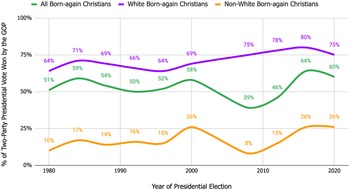
Few religious groups in American politics are more socially sorted and polarized than Evangelical Christians, particularly white evangelicals. Not always Republican historically, evangelicals have represented a core base of the Republican Party in recent decades (Campbell, Green, and Layman Reference Campbell, Green and Layman2011). A group found to be politically motivated in part by perceived out-group threat (Marsh Reference Marsh2021), evangelicals have persisted in their support of the Republican Party amidst the rise of Donald Trump (Campbell, Kirk, and Layman Reference Campbell, Kirk and Layman2021; Djupe and Claassen Reference Djupe and Claassen2018), a twice divorced New Yorker who has a tense relationship with religion, which reflected the strength of the alliance as evangelicals fervently supported him despite his moral indiscretions and ostensible lack of religious faith. Figure 1 displays the partisan trends among those who reported they identified as born-again Christians, beginning in 1980 when the born-again identity question was first asked on the American National Election Studies (ANES).
President support among born-again Christians.
Source: American National Election Studies, Time Series Cumulative Data File (1980-2020)Footnote 3
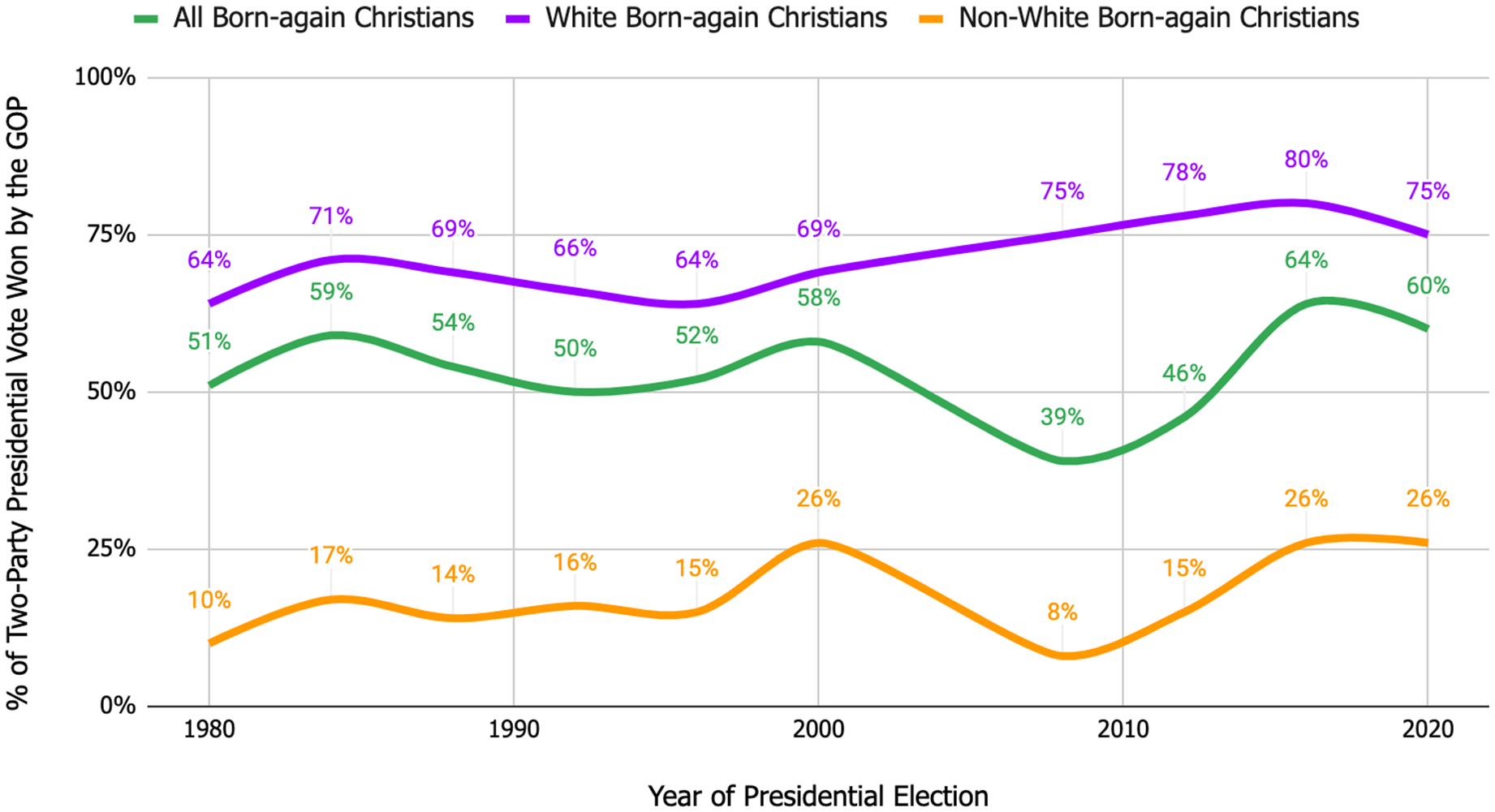
Throughout recent political history, evangelicals have been supportive of the Republican Party, with majorities supporting the “The Republican Party” save Barack Obama’s landslide victory in 2008. This steadfast increase in support is most profound among white evangelicals, as 80% supported Donald Trump in the 2016 Presidential Election. That number is even higher than the portion of white evangelicals (71%) that Ronald Reagan won in his 1984 rout of Walter Mondale. This support has also continued to grow, particularly among nonwhite evangelicals. In 2008, only 8% of evangelicals who did not identify as white supported the Republican candidate, John McCain, in the presidential election; that number ballooned to 26% in both of Donald Trump’s bids for the presidency. But even beyond being objectively among the core pillars of the Republican base, the evangelical identity is itself associated with a powerful partisan cue in the minds of voters.
To many Americans, the association between Evangelical Christians and the Republican Party is well-known as “evangelical” and “Republican” are connected together in the mass public’s mind’s eye (Campbell, Green, and Layman Reference Campbell, Green and Layman2011; Allen Reference Allen2024b). In the view of both evangelicals and non-evangelicals, the fused stereotype of the evangelical Republican is present (Patrikios Reference Patrikios2013). Not only do white Evangelical Christians empirically act as a core bloc of the GOP, but they occupy a symbolic place alongside it in the minds of voters. Therefore, we hypothesize, all else equal:
H1: Exposure to an evangelical candidate will be positively associated with overall support among Republicans.
H2: Exposure to an evangelical candidate will be negatively associated with overall support among Democrats.
Place-Based Identities
While the evangelical identity has been politically salient for decades, contemporary American politics has been characterized by a resurgence of scholarship focusing on the urban-rural divide. Although these political divisions have been recognized in various forms for decades (Key Reference Key1949), America’s current geographic divide has taken on greater attention in recent elections as geographic polarization has amplified as broader, traditionally dominant regional political divisions have realigned (Lang and Pearson-Merkowitz Reference Lang and Pearson-Merkowitz2015; Scala and Johnson Reference Scala and Johnson2017). Manifested in Donald Trump’s upset victory in the 2016 presidential election, the physical contours of American party politics increasingly reflect a literal sorting across liberal big cities, contested suburbs, and conservative small towns and rural areas that persist even when accounting for the different compositions of these types of communities (Gimpel et al. Reference Gimpel, Lovin, Moy and Reeves2020). State maps of the most recent presidential election often show deep blue urban counties surrounded by ruby red rural counties.
While geography itself is clearly a significant factor in American politics, recent research has expanded our understanding of these geographic divisions to recognize the importance of the identity associated with where one lives and how they conceive of themselves. Rather than conceptualizing urban and rural America as merely outlines on a map, the focus has shifted to what is called “place-based identity.” In other words, instead of focusing solely on where an individual resides, scholars now ask respondents to indicate, despite where they live, how they identify (e.g. as a rural/country person, as a city person, etc.)
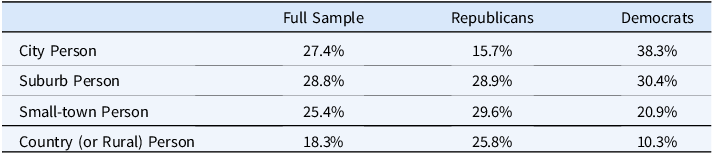
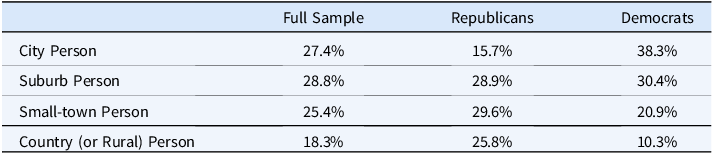
Undergirding a rural/country, or perhaps small town, place-based identity in many cases is “rural consciousness,” a social-psychological identity that shapes the political worldview of Americans regarding attitudes about political representation, government resource allocation, and cross-regional respect (Cramer Reference Cramer2016). Urban and rural now operate as social identities that can shape both political and social behaviors (Lyons and Utych Reference Lyons and Utych2023) and are associated with attitudes toward government (Kirk Reference Kirk2025), with the rural identity and more symbolic rural grievances being particularly associated with support for the Republican Party (Lunz Trujillo and Crowley Reference Lunz Trujillo and Crowley2022). Subsequently, place-based identity can also lead to in-group loyalty and out-group place-based resentment (Munis Reference Munis2022), which in turn is associated with voting behavior (Jacobs and Munis Reference Munis2022). To descriptively consider that state of geographic identity in the United States, Table 1 displays the responses to the question of place-based identity from the 2020 ANES survey disaggregated by partisan affiliation.
Republicans more often identify as rural than Democrats
Source: American National Election Studies, 2020 Data File
Across the full sample, approximately one quarter of the population identifies as either a city, suburb, or small-town person, with only 18% identifying as a rural or country person. But the partisan differences are stark: while a sizable portion of Democrats (38%) identify as living in an urban area, less than half that number—16%—of Republicans do. Conversely, the differences are drastic when examining who identifies as a rural person, as more than one-quarter—26%—of Republicans identify as such while only 10% of Democrats do. This can partly be attributed to Democrats more often living in urban areas and Republicans in rural areas, but in that American society is continuing to sort, partisan identities may be connected to place-based identities. In other words, when Americans think of rural areas, they may think of Republicans, not just because of partisan stereotypes but also because more than two-thirds of rural residents identify as Republicans.
In terms of urban and rural place-based candidate cues, cuing an urban or rural identity through campaign imagery can increase support from the geographic in-group or punishment from the geographic out-group (Jacobs and Munis Reference Jacobs and Kal Munis2019), and voters with stronger place-based identities are more moved by the geographic background roots of candidates that align with their geographic identity (Munis Reference Munis2021). Although results from previous studies are mixed, there is evidence that the most urban and most rural Americans respond to place-based campaign cues and specifically images tied to their particular region (Jacobs and Munis Reference Jacobs and Kal Munis2019). However, this broader regional effect has previously been found to be limited to co-partisan candidates (Fudge and Armaly Reference Fudge and Armaly2021). Considering this data, as well as the ostensible generalization and stereotypes of place-based identities, we hypothesize that, all else equal:
H3: Exposure to a rural candidate will be positively associated with overall support among Republicans.
H4: Exposure to a rural candidate will be negatively associated with overall support among Democrats.
H5: Exposure to an urban candidate will be negatively associated with overall support among Republicans.
H6: Exposure to an urban candidate will be positively associated with overall support among Democrats.
The Intersection of Religious and Place-Based Identities
While elite collective characterizations linking specific candidate regional and religious identities may have some merit, they nonetheless reinforce the conflation of two profoundly different types of identities—religious and geographic. These associations also present both practical and theoretical challenges in some cases, such as with Donald Trump, where the geographic and religious backgrounds of candidates differ significantly from the identities associated with their base (Dias Reference Dias2020). Most importantly, this particular association between place-based and religious identities may often be grounded in a linkage between rurality and religiosity that sociological research suggests may be overstated (Chalfant and Heller Reference Chalfant and Heller1991). Recently, political science scholarship on the urban-rural divide in American politics has increasingly debated the linkage between rural identity and resentment and Christian and evangelical identity and even Christian nationalism (Kirk Reference Kirk2024; Schaller and Waldman Reference Schaller and Waldman2024). Accordingly, these challenges presented by the synonymous association of rurality and evangelicalism, combined with the salience of their collective usage in politics, further cement the importance of understanding their impact in the minds of voters. Our question in this research is to what extent voters share the synonymous perceptions of conjoined place-based and faith-based candidate identities that have been demonstrated by elites in various campaign contexts.
We choose to focus specifically on the intersection of place-based and religious identities for several reasons. First, as shown above, these combinations of politically significant social identities are linked in important ways in modern politics, including in generalizations about party coalitions, candidate backgrounds, and complex partisan voting patterns (Perry, Meko, and Uhrmacher Reference Perry, Meko and Uhrmacher2023). Second, despite this association, there are important theoretical and practical distinctions between geographic and religious identities that should caution against using them synonymously. Adding context to this association is critical, as stereotypes related to partisanship are associated with heightened affective and ideological polarization (Ahler and Sood Reference Ahler and Sood2018; Rothschild et al. Reference Rothschild, Howat, Shafranek and Busby2019). Third, given the important applied connection between these identities, there has been relatively little work done in political science to empirically study their association. Specifically, we aim to examine this linkage of place-based and religious identities by political elites, and how these identities are individually and collectively perceived politically by the mass public.
Despite the importance and frequent association of the evangelical identity and rural identity with the Republican Party, limited research in political science has focused on the exact relative relationship between religious and place-based identities. Beyond the obvious partisan similarities between evangelicals and rural residents, there are additional reasons to expect close linkages: both white evangelicals and Americans with strong rural consciousness are politically motivated by perceived out-group threat (Lyons and Utych Reference Lyons and Utych2023; Marsh Reference Marsh2021; Munis Reference Munis2022) and both rural resentment and evangelical political conservatism are associated with racial resentment (Allen and Olson Reference Allen and Olson2022; Nelsen and Petsko Reference Nelsen and Petsko2021). Therefore, we hypothesize, all else equal:
H7: Exposure to a candidate who is rural and Evangelical will be positively associated with overall support among Republicans.
H8: Exposure to a candidate who is rural and Evangelical will be negatively associated with overall support among Democrats.
Although rural Americans are more Republican than their urban counterparts, it is not clear if the “rural” label carries the same partisan perception as the “evangelical” label in the minds of voters, or even how voters interpret the default partisanship of “urban” and “rural” candidate labels. As these identities and characterizations become more salient in American politics, understanding their meaning to voters is essential. Moreover, it is not evident what the effect of joint place-based and faith-based labels is in the context of candidate identity, although this is often the way in which they are presented to voters by the media and other elites (Booth Reference Booth2022; Pearson and Gorner Reference Pearson and Gorner2022). As social sorting magnifies within partisanship, understanding this particular intersection presents both an important substantive question about modern party coalitions and a useful case for the study of joint candidate identities.
Data and Methods
Given the importance of identity in American politics and the frequency with which these identities are blurred and assumed to overlap in the public eye, it is important to understand how the perceptions of various identities interact with one another. We endeavor to answer this question by leveraging an experiment, the treatment of which is a short newspaper story describing a candidate who has declared his candidacy for an upcoming congressional election. As visual reinforcement, the story includes a pull-out quote emphasizing the main point of the story. It also includes a stock photo of a white, middle-aged male.Footnote 1 All respondents received some introductory text about the candidate before being randomly exposed to one of the following six treatments:
Control: Asked about his priorities if elected, Williams said, “I will always put the district and my constituents first.”
Rural: Asked about his priorities if elected, Williams said, “I will always put the district and my constituents first. I grew up in a rural area and so helping and supporting rural communities is a top priority for me. For far too long, rural areas have been forgotten and left behind. I will always be the champion of rural communities.”
Urban: Asked about his priorities if elected, Williams said, “I will always put the district and my constituents first. I grew up in an urban area and so helping and supporting urban communities is a top priority for me. For far too long, urban areas have been forgotten and left behind. I will always be the champion of urban communities.”
Evangelical: Asked about his priorities if elected, Williams said, “I will always put the district and my constituents first. As a born-again Christian, I believe in The Bible and its commands to fight for what is right. For far too long, Christians have been forgotten and left behind. I will always be the champion of Christian values.”
Rural and Evangelical: Asked about his priorities if elected, Williams said, “I will always put the district and my constituents first. As a born-again Christian, I believe in The Bible and its commands to fight for what is right. For far too long, Christians have been forgotten and left behind. I also grew up in a rural area and so helping and supporting rural communities is a top priority for me. For far too long, Christians and people living in rural areas have been forgotten and left behind. I will always be a champion for Christian values and rural communities.”
Urban and Evangelical: Asked about his priorities if elected, Williams said, “I will always put the district and my constituents first. As a born-again Christian, I believe in The Bible and its commands to fight for what is right. For far too long, Christians have been forgotten and left behind. I also grew up in an urban area and so helping and supporting urban communities is a top priority for me. For far too long, Christians and people living in urban areas have been forgotten and left behind. I will always be a champion for Christian values and urban communities.”
Respondents were randomly assigned to one of these six treatment conditions. As a check of treatment compliance, Figure H1 in the appendix shows the percent of respondents for various treatments who answered a question about rural political influence by saying that rural areas have “too little” influence in government. We find that it is indeed the respondents who randomly received the rural treatment who were most likely to say that rural areas have too little political influence, indicating that respondents were attentive and responsive to the particular social identity cues in our treatments.
We test respondents on a series of four outcome variables. The first of these variables, Support for Williams, is a direct measure of how likely respondents are to support John Williams based upon the treatment condition they received relative to the innocuous control condition. The response options range on 5-point Likert Scale from “extremely likely” to “extremely unlikely.” The second outcome variable is the perceived partisanship of Williams. We are interested to see how voters connect these identities to the political parties, namely the rural and urban identity, of which there is great uncertainty despite an assumption that rural equals Republican and urban equals Democrat. Respondents are consequently asked if they believe Williams is a Republican, Democrat, or an Independent. If they select the latter, they are asked a follow-up question asking them if they believe he is closer to the Democratic Party, closer to the Republican Party, or if they still view him as an Independent.
The third outcome variable is a feeling thermometer rating of Williams. Long used by scholars to gauge affect (Liu and Wang Reference Liu and Wang2015; Gries et al. Reference Gries, Andrew Fox, Mader, Scotto and Reifler2020; Gidron, Sheffer, and Mor Reference Gidron, Sheffer and Mor2022), this is another way to measure how voters perceive the candidate. It differs from the first measure in that you could theoretically support a candidate you did not particularly like. Response options range on 101-point scale from 0 to 100. In short, this may give us a more nuanced test of affect beyond the “Support for Williams” variable.
The final dependent variable regards how respondents evaluate the leadership capabilities of Williams. We ask our subjects about three traits: trustworthiness, authenticity, and competence. It may be that individuals are unwilling to trust Williams when he does not share their identities, or perhaps they view him as less competent if he advocates for the place (e.g. rural) that is opposite to that of the respondent’s identity. Respondents are asked about these traits on a seven-point Likert Scale. In that these items load well togetherFootnote 2 , we create a singular variable.
To test our hypotheses, we employ an original dataset, containing the responses of 600 white Democrats and 600 white Republicans fielded on the Qualtrics platform by the survey firm Prolific from December 14-15, 2022. Prolific samples have been found to be attentive, providing meaningful answers to open-ended research questions, and move at an acceptable pace (Douglas, Ewell, and Brauer Reference Douglas, Ewell and Brauer2023), and Prolific has been systematically shown to be among the best survey providers for response quality (Stagnaro et al. Reference Stagnaro, Druckman, Berinsky, Arechar, Willer and Rand2024, 8). Information about survey response times and balance tests can be found in Appendix H.
To determine a sample size required for analysis of members of both parties across six experimental conditions (12 total groups), we conducted a power analysis to calculate our necessary sample size. With a significance criterion of α = 0.05 and power = 0.8, the minimum sample size needed to detect a medium effect size using Cohen’s (Reference Cohen1988) criteria (d = 0.5) is N = 768 (64 per group). Accordingly, we obtained a survey sample of N = 1,200 (approximately 100 per group). While we recognize ongoing debates across political science about statistical power and the tradeoffs between research accessibility, treatment balance, and power, we are confident in the specific statistical power of our sample. Specifically, both our full-sample and sub-sample statistical power and sample sizes are informed by, and consistent with, contemporary candidate-choice vignette experiments in religion and politics and American political behavior (see Clifford and Gaskins Reference Clifford and Gaskins2016; Campbell, Layman, and Marsh Reference Campbell, Layman and Marsh2024; Calfano and Djupe Reference Calfano and Djupe2009; Castle et al. Reference Castle, Layman, Campbell and Green2017; and Gershon and Lavariega Monforti Reference Gershon and Lavariega Monforti2021).
We restrict our analysis to white Americans specifically and intentionally in recognition that race can shape the way that individuals perceive both religious and place-based identities (Wong Reference Wong2018; Cramer Reference Cramer2016), and that America’s urban rural divide is both associated with racial attitudes (Nelsen and Petsko Reference Nelsen and Petsko2021; Dawkins et al. Reference Dawkins, Nemerever, Kal Munis and Verville2023) and concentrated among white Americans (Brown et al. Reference Brown, Jauregui and Mettler2025). We reflect in the conclusion on how this impacts the generalizability of our results.
We ask respondents a series of demographic variables, questions regarding their religious affiliation and religiosity, and survey items that ask about where they live and how they conceptualize their place-based reality. Respondents were randomly assigned one of the six treatment conditions. The dependent variables are the four variables above, with the independent variables being each of the treatment conditions, thus making the control condition the comparison group. All variables have been standardized on a 0–1 scale for ease of comparison. The complete question wording of the variables can be found in Appendix A.
Results
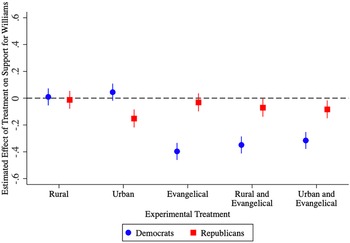
We bifurcate the sample into two partisan groups: Republicans and Democrats. Figure 2 displays the results of the Support for Williams variable for each party in our sample. The full regression tables from which the coefficient plots are derived can be found in Appendix B.
Candidate support.
Note: Points display the coefficient estimates for each variable. The 95% confidence intervals are denoted by the vertical lines extending from each point.
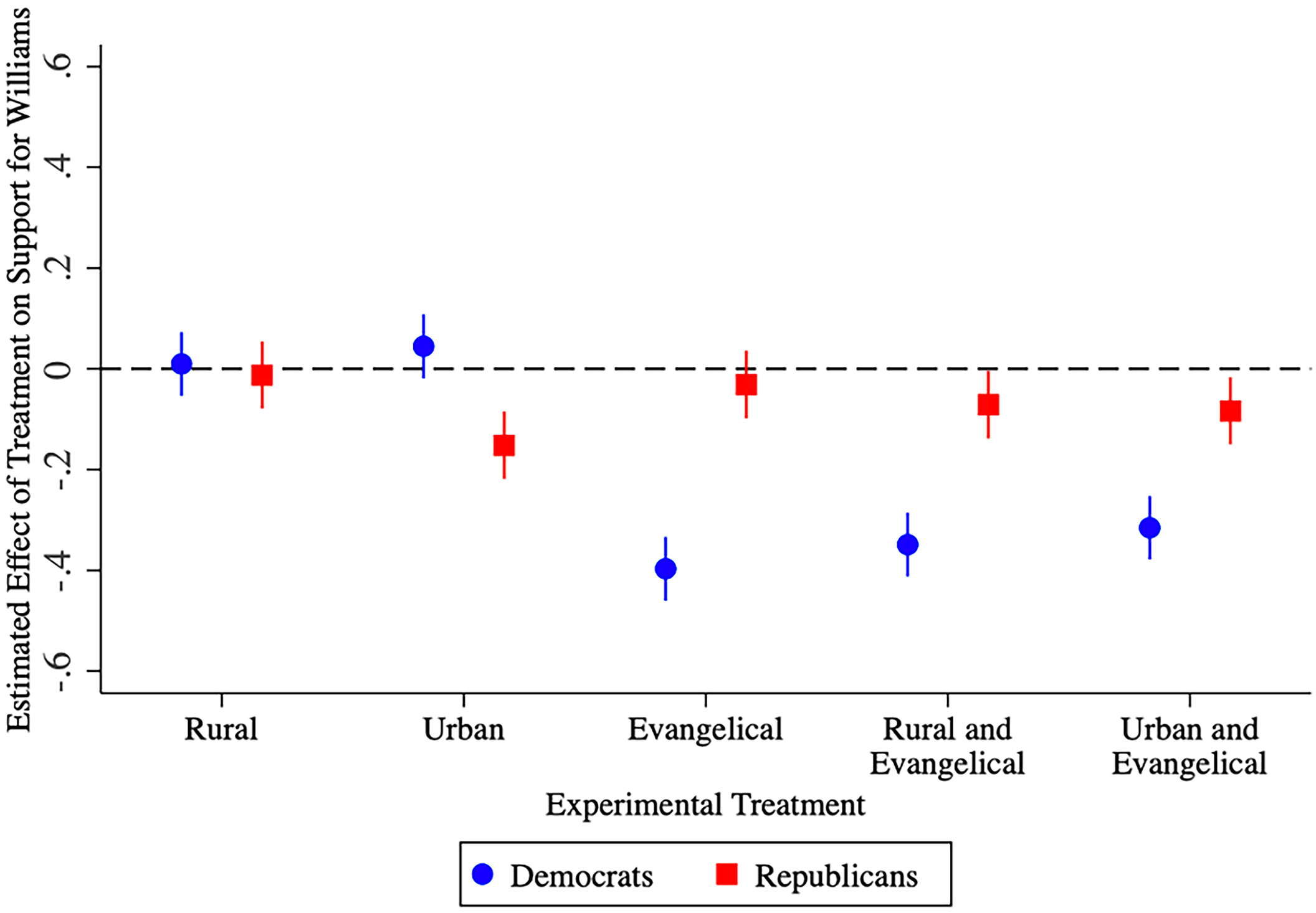
The baseline upon which each coefficient is evaluated against is the generic control, where Williams does not indicate his religious or place-based identity. The Democratic null result on both the rural and urban point estimates (p = .99 and p = .29, respectively) indicates that Democrats do not support Williams more, relative to the control, when he identifies as just from either a rural or urban area. However, when an evangelical religious identifier is added to the treatment, Williams is significantly punished by Democrats relative to the control (p < .001, in all three cases), revealing that Democrats react negatively to the overt religious language in a unique way that is clearly distinctive from their reaction to the rural label. Given the close association between the Evangelical identity and the Republican Party, this result is in line with our expectations and previous literature. Even beyond the null result for the rural treatment relative to the control, we also consider the rural treatment relative to the other treatment conditions (Bakker et al. Reference Bakker, Jinfa Cai, Kaiser, Mesa and Van Dooren2019), and note the large substantive difference and the statistically significant difference (p < 0.01) between the rural and evangelical treatments among Democrats, further confirming that these identities are not applied synonymously in electoral contexts (Appendix G).
Among Republicans, a null result also emerges for Williams when he identifies as rural. This absence of added support for Williams when he indicates that he is from a rural area means that neither Republicans nor Democrats provide an electoral boost when the candidate identifies as such. This is a meaningful result given the common association between rural residents and being Republican. However, a different story emerges when Williams indicates he is from an urban area, as Republicans exact a significant penalty (p < .001). This finding corroborates previous literature showing that “urban” is connected to the Democratic Party and, therefore, may be seen as a partisan out-group, one that is so strong in this case that it cannot be overcome by the candidate simultaneously identifying as an evangelical.
This finding may also be related to evidence from previous research that has shown the racialized nature of rural resentment, with respondents associating urban identity with nonwhite racial identity, which may further the perception of “urban” as a Democratic label (Nelsen and Petsko Reference Nelsen and Petsko2021). Republicans are also slightly less supportive of the urban evangelical candidate, which further shows the polarizing nature of the urban label and cross-cutting cleavages in candidate identity.
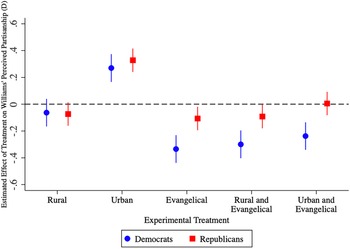
In addition to support, we also asked respondents about how they perceived Williams’s partisanship, measured in our dependent variable as the perception of being a Democrat. Figure 3 displays the results of this dependent variable, again for both Democrats and Republicans. Among Democrats, our results show a null result for the perceived partisanship of the rural candidate and a significant effect in perceiving the urban candidate as Democratic (p < .001). It further lends support that the rural identity is not one that is viewed in a partisan nature by the mass public, while urban carries a Democratic cue. Again, this Democratic association may be due to the longstanding Democratic electoral strength in urban area, or racialization (White and Laird Reference White and Laird2020). Meanwhile, all three of the religious treatments are viewed by Democrats as being Republican (p < .001) with even stronger substantive magnitude. This reveals further evidence that the evangelical identity is codified in the minds of Americans as being intimately connected to the Republican Party; the presence, or lack thereof, of a place-based identity does little to change this perception.
Candidate perceived partisanship.
Note: Points display the coefficient estimates for each variable. The 95% confidence intervals are denoted by the vertical lines extending from each point.
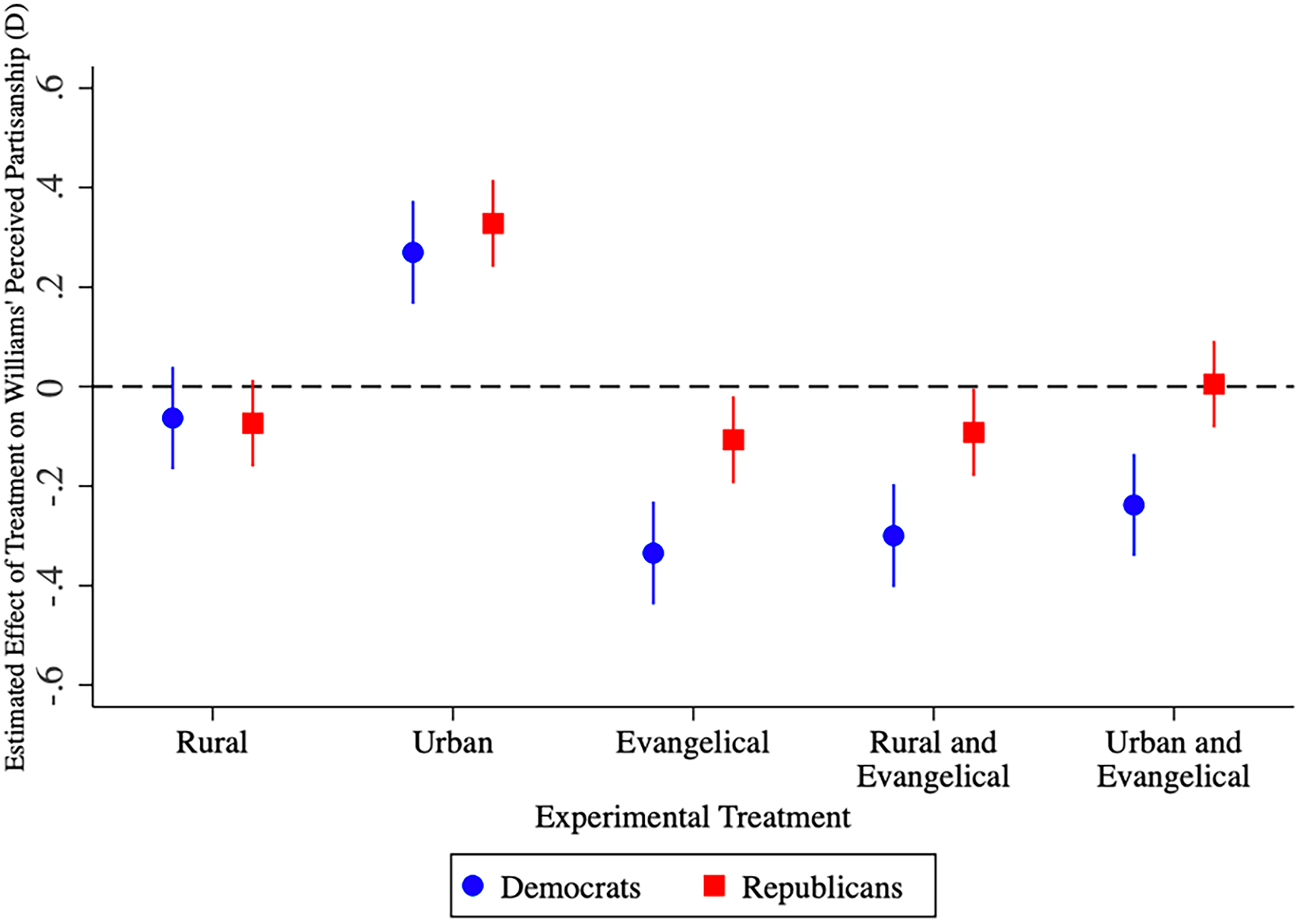
For Republicans, an insignificant result emerges for the rural treatment, indicating that Republicans also do not ascribe a partisan identity, relative to the control, when Williams hails from a rural area. The same cannot be said of the urban identity, which is also viewed by Republicans as being Democratic (p < .001). Republicans also viewed the evangelical treatment as Republican (p < .05), as well as the rural and evangelical treatment, but a null result emerges when an urban and evangelical identity are paired together, perhaps a result of cross-cutting cues. For both Democrats and Republicans, the substantive difference in the absolute value of perceived partisanship, relative to the control, between the rural and the urban treatment is noteworthy, with coefficient for the urban treatment being approximately four to five times that of the coefficient for the rural treatment (Appendix B). The rural treatment is statistically distinct (p < 0.01) from the urban treatment for both Democrats and Republicans (Appendix G), and is statistically distinct from the evangelical treatment for Democrats (Appendix G).
We also evaluated respondents’ attitudes toward Williams on two other variables: a feeling thermometer rating and a standard battery of leadership traits. We find the results to be almost identical to the support variable above and paint a consistent picture: Republicans are ambivalent when Williams owns a rural identity, and they punish him when he identifies as urban, while Democrats are ambivalent when Williams owns a rural identity and punish him when he identifies as an evangelical. These results can be found in their entirety in Appendix C. As a robustness check, we reran our analysis above by interacting partisanship with each treatment. These models, available in Appendix D, corroborate the picture above: the rural identity is not neatly connected to either political party, the urban identity is punished by Republicans, and the religious treatments are punished by Democrats.
Religious and Place-Based Sub-group models
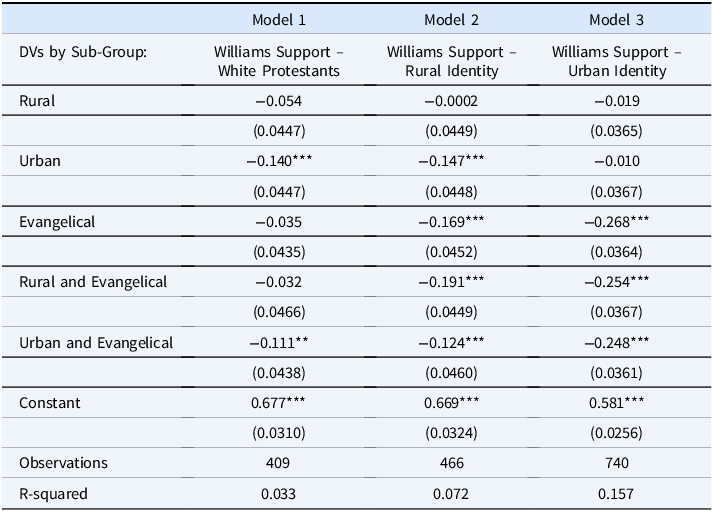
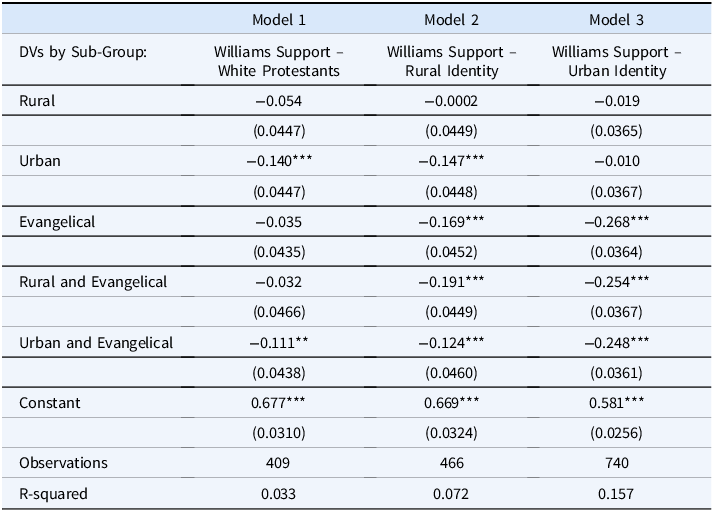
To better understand how individuals evaluate the varying combinations of social identities, we execute a series of subgroup analyses on three relevant groups: white Protestant Christians, people who identify as a rural person, and people who identify as an urban person. The dependent variable in this analysis is the Support for Williams variable. The results are presented in Table 2, with all three subgroups large enough to be sufficiently powered according to our power analysis. These models estimate the relative difference in candidate support between each candidate identity treatment and the control condition for the three subgroups. The same analysis presented using interactions can be found in Appendix E, and additional religious subgroup models can be found in Appendix F.
Sub-group models for social identity groups
Standard errors in parentheses
*** p<0.01, ** p<0.05, * p<0.1
The results for rural and urban candidate identity in this additional subgroup analysis follow a similar pattern to our earlier findings for Democrats and Republicans. None of the groups, including individuals who identify as rural, showed a statistically significant effect on support for Williams relative to the place-neutral control after receiving the rural treatment. This is consistent with our previous findings that the rural candidate label does not carry a significant partisan and political cue. The urban label, however, resulted in a reduction in support relative to the control for both the Protestant group and the rural group, confirming that these geographic identities are asymmetric in their political strength, with an urban identity generating a significant political response across groups that might perceive it as associated with a partisan out-group. While rural identity among respondents and the mass electorate is meaningful, rural candidate identity consistently shows no significance—particularly compared to an urban candidate identity.
These social identity groups also further demonstrate the complexity of the association between the rural and evangelical labels so often linked together as part of the Republican political coalition. While urban identifiers did not punish the rural candidate relative to the control, they did significantly punish each of the evangelical candidates, a further sign of the politicized nature of religious labels. However, rural identifiers also exhibited lower levels of support for the evangelical candidates relative to the control. While this electoral punishment is of a smaller substantive magnitude than that from the urban identifiers, it is statistically significant for all three evangelical treatments and subsequently shows the distinctiveness and political complexity of the relationship between rural and religious identity in the minds of voters. These results for rural and urban identifiers are robust to using rural or urban place of residence instead of place-based identity to group urban and rural members of the sample, and these full results can be found in Appendices D and E. As with the partisan analysis above, we find that rural identity is not clearly politicized among voters, urban identity is much more clearly politically charged, and rural and evangelical identities are complex and distinctive.
Discussion
This study sought to disentangle how Americans view an emerging salient identity (place) with religious identity, which has become even more polarized in recent years (Campbell, Green, and Layman Reference Campbell, Green and Layman2011; Campbell, Layman, and Green Reference Campbell, Layman and Green2020). Below, we detail the important findings of this research and the contributions that it makes to the literature, along with its implications for American democracy.
First, while we did not find support for our first hypothesis, we find confirmation of the powerful politicization of the Evangelical Christian label (Campbell, Green, and Layman Reference Campbell, Green and Layman2011; Campbell, Layman, and Green Reference Campbell, Layman and Green2020; Campbell Reference Campbell2020), lending support for Hypothesis 2. There is consistent evidence that when Williams identifies as an evangelical, he receives a harsh penalty from Democrats. The influence of his religious identity subsumes any effect that place-based identity may have. In other words, Democrats do not support Williams when he identifies as an evangelical relative to the control, regardless of whether his place-based identity is absent, he identifies as a rural person, or as an urban one.
Second, we receive little support for Hypotheses 3 and 4, finding that rural identity is not clearly connected to either major party in the minds of Americans, nor does it motivate a significant effect on candidate support in our sample. The rural condition receives no boost in support relative to the control among Republicans or Democrats on any of our dependent variables, nor among the three religious and geographic subgroups. Given the popular association between rurality, Republican partisanship, and evangelical identity that we sought to explore, this result presents a much more nuanced and complex potential picture of how rurality exists politically in the minds of voters. This is particularly meaningful in an era when the Republican Party has generally strengthened its support in rural America and may speak to the political diversity of rural communities that is still pronounced (Scala, Johnson, and Rogers Reference Scala, Johnson and Rogers2015). In other words, our respondents do not view the rural identity as either a Republican one or a Democratic one, painting a potentially positive picture for American democracy of an identity that may not (yet) be politically sorted.
We are the most cautious about this finding compared to the rest of our results, given the difficulty of attributing the exact explanation for a null experimental finding. On one hand, we cannot definitively rule out that the effects of the rural candidate identity are simply smaller than our particular survey can detect, although we are statistically powered at the conventional level for moderate effects. Moreover, null results in an experimental context such as this one may be the result of other factors, such as the treatment, sample, or design of the experiment. On the other hand, previous research on the asymmetry of American rural resentment (Munis Reference Munis2022), the racialization of urban place-based identity perceptions (Nelsen and Petsko Reference Nelsen and Petsko2021), and the political and social heterogeneity of rural America (Scala, Johnson, and Rogers Reference Scala, Johnson and Rogers2015) suggests that there are theoretical reasons to expect that “urban” is a more partisan and politicized place-based candidate cue than “rural.” This asymmetry between urban and rural place-based political labels is therefore an important area for future study.
Third, in evaluating Hypotheses 5 and 6, the urban identity is clearly connected to the Democratic Party, and both parties do agree on one thing: urban Williams is a Democrat. This corroborates what has been found in previous literature that argues that urbanites are stereotyped as Democrats (Cramer Reference Cramer2016). Although urban identity does little to increase support for the candidate among Democrats and urban identifiers, the urban identity is costly when considered by Republican, rural, and evangelical voters. Importantly, the urban label was even strong enough to result in a decrease in support for the urban evangelical candidate among Republicans. The findings that evangelicals punished an urban identity, but did not reward a rural one, further demonstrate the unequal polarization of these geographic identities. The recent Republican wave in presidential elections in rural America, compared to years of Democratic dominance in cities, may account for this effect, as well as the racialization of urban America (Nelsen and Petsko Reference Nelsen and Petsko2021).
Lastly, we present new evidence, for the first time, that there are clear and important distinctions between how voters perceive rural and evangelical identity. Despite the Republican electoral strength among both rural and evangelical voters and their notable association with political elites, our results show a clear divergence in both their perceived partisanship and their electoral effect. While the rural identity did little to impact the partisan perception and support for candidates relative to a place-neutral control, the evangelical labels, with or without geographic pairings, generated significant backlash compared to the non-religious control. Therefore, we confirm our expectations of Democrats’ opposition to a collective rural and evangelical identity, as outlined in Hypothesis 8, but the evidence suggests that the effects are driven by the religious identity, and not the place-based identities.
Conclusion
In a political landscape shaped by social identities, this research addresses the intersection of two interconnected but distinct identities: place-based identity and religious identity. Using the context of political campaigns, we find a clear political distinction between rural and evangelical identities. Broadly, this result provides critical context regarding both the particular political power of religious cues in America’s polarized electoral landscape and the meaningful differences between religious and social identities of voters who share a common partisan coalition. In addition to the scholarly contributions of our findings, there are also several practical implications for our findings.
First, the lack of a partisan perception of rural identity, despite the recent clear Republican success in rural America, may mean that the rural label in American politics is less polarized than others associated with partisan groups. While we have already expressed the need for future research on this topic, neither Democrats nor Republicans should assume that rural cues signal partisanship, or that rural cues should guarantee significant electoral benefits or backlash despite their recent connection to the Republican Party in presidential voting patterns and media descriptions of the Republican base. Subsequently, Democratic candidates appealing to rural voters should not feel obligated to avoid a rural identity, and Republican candidates should not expect that a rural label is a sufficient partisan signal alone. Democratic attempts to win back rural areas, even in an era of growing Republican strength among rural voters, may mean that voters still do not associate rurality with either party as Democratic candidates use traditional strategies to appeal to their districts using rural identity (Fenno Reference Fenno1978, Broadwater Reference Broadwater2023).
It may also be the case that the sorting along this identity is happening in the current moment and that our results are merely just a snapshot of another dimension by which Americans are politically realigning; in other words, the rural identity—and its association with the Republican Party—may still be crystallizing in the minds of voters. The less polarized nature of rurality may also present broader implications of how Americans view rural communities, the political diversity of rural areas, and the possible openness of political competition for rural voters. In short, an evangelical religious identity and urban place-based identity are meaningful cues for Democrats and Republicans, whereas rural identity is not.
Second, the highly partisan and polarizing nature of the urban political label is equally significant for politics. While in each of our vignettes the candidate is a white man, we are mindful of the possible association with urban identity and nonwhite racial and ethnic identity (Nelsen and Petsko Reference Nelsen and Petsko2021). While we cannot determine all of the possible underlying mechanisms, it is likely that assumptions of partisan groups associated with urban areas, the longstanding Democratic support in cities, and rural resentment toward urban elites all contribute to the strong partisan reaction to an urban candidate identity. Subsequently, urbanicity carries a significant electoral penalty among Republican, rural, and evangelical voters. More broadly, the asymmetry between the polarization of the rural and urban labels speaks to complexity of America’s urban-rural divide as an unbalanced division, one that is meaningful but not yet fully expanded and directed across the entire urban-rural spectrum.
Third, and perhaps most importantly, in addition to showing the partisan and political backlash associated with an evangelical Christian identity, our results on the clear political distinction between rural and religious identity have significant implications for politics. Despite recent Republican success among both Evangelicals and rural voters, which has led to a frequent association between these groups in the media and among pundits, voters perceive them in very different ways. The political diversity of white evangelicals themselves is meaningful (Swartz Reference Swartz2012; Allen Reference Allen2024a), and our results should caution against the assumption that evangelical and rural identities are politically synonymous in the minds of voters in modern American politics. When these place-based and religious identities are combined, there is no evidence of an additive effect of rural and evangelical identities reinforcing each other despite their frequent association in modern narratives about the political base of the Republican Party. Although often linked, it is the evangelical identity alone that causes a significant partisan backlash, a finding which represents an important context for understanding current party coalitions. We speculate that this is additional evidence of the polarized nature of the evangelical identity, which scholars have written about; a more generic descriptior, such as “Christian,” may not have engendered such backlash.
We began this article with a range of examples of candidates, media sources, and elected officials publicly linking religion and place in political contexts. Better understanding how these associations are perceived by voters is subsequently necessary for recognizing the role of religion in modern American politics and how religion relates to other increasingly politicized social identities, such as place. Our results suggest that religion remains a critical political identity, even when compared to place-based identities that have received a multitude of attention in recent election coverage (Nemerever and Rogers Reference Nemerever and Rogers2021). Religious political cues, specifically evangelical Christian ones, appear to still hold a unique association with the modern Republican Party. Practically, our specific results regarding the political distinction between evangelical Christianity and rurality suggest that even as more social identities become politically sorted in our polarized era of American politics, politicians, the media, elected officials, and other political elites should be mindful to appreciate the unique political role of various identities in connection to partisan coalitions.
While we believe that this study makes meaningful contributions to the study of American political geography and religion and politics, we note several opportunities for future research. While we focus in this specific study on white respondents because of the racialized nature of America’s political urban-rural divide (Nelsen and Petsko Reference Nelsen and Petsko2021; Dawkins et al. Reference Dawkins, Nemerever, Kal Munis and Verville2023; Brown et al. Reference Brown, Jauregui and Mettler2025), future work may consider expanding the range of respondents beyond white partisans. Our decision to focus on white partisans allows us to engage most clearly with the population driving America’s urban-rural divide (Brown et al. Reference Brown, Jauregui and Mettler2025), which we think is the appropriate and necessary starting point for this research, but we recognize that there may be benefits to further expanding this work to test our findings among a broader range of Americans, including nonwhite Americans and political independents. As is the case with any survey experiment, we note that an even larger sample size may lead to finding small treatment effects that are statistically significant, which were not in our study. While we are powered in line with conventional studies in this research area and confident that our overall substantive conclusions are robust, we note that an even larger study may yield more fine-grained and nuanced findings that can build on this work.
This study questions how geographic and religious political identities, frequently tied together in modern politics, are perceived in the minds of voters. We find new evidence about the contours of America’s urban-rural divide, the possible political asymmetry of rurality and urbanicity, the distinctiveness of rural and evangelical political labels, and the broader complexity of identities in American party politics. Our findings encourage future research on the intersection of geographic and religious identities and shed new light on the association between place and faith in a changing American political landscape.
Supplementary material
To view supplementary material for this article, please visit https://doi.org/10.1017/S175504832510014X


 Open access

