




Introduction
Runes are an early Germanic alphabetic script; their origin is debated but the older futhark (the oldest of the runic alphabets) was in use until around AD 700 (Knirk Reference Knirk, Bandle, Elmevik and Widmark2002; Düwel Reference Düwel2010; Barnes Reference Barnes2012: 9–15; Schulte Reference Schulte2015). Among the earliest certain runic finds are inscriptions on portable objects from Denmark such as a bone comb from Vimose, archaeologically dated to AD 160 (Ilkjær et al. Reference Ilkjær, Nielsen, Stoklund, Beck, Geuenich and Steuer2006; Pauli Jensen Reference Pauli Jensen, Abegg-Wigg and Rau2008), and an iron knife from the island of Funen, dated to AD 150 (Kayra Reference Kayra2024). Discoveries of rune-stones with inscriptions in older runes are rare; recently identified examples in Norway include the Hogganvik stone from Mandal (Knirk Reference Knirk2011) and the Øverby stone in Rakkestad (Iversen et al. Reference Iversen, Kjesrud, Bjorvand, Kimball and Gundersen2019).
In 2021–2023, the Museum of Cultural History, University of Oslo, excavated the grave field Svingerud in Hole, Norway (Figure 1). In a flat grave beneath one of the grave mounds, a sandstone fragment with runes from the older futhark was uncovered. Five radiocarbon dates and artefacts included in the burial suggest that the grave dates to the Roman Iron Age, between 50 BC and AD 275. Additional sandstone fragments with runes were discovered in other contexts during the excavations. Detailed examination confirms that the fragments are all from the same original slab while the inscriptions may represent different acts of carving.
The location of the Svingerud site (figure by Charlotte Nueva Finnebråten & John Asbjørn Munch Havstein).

In this first comprehensive archaeological and runological study of the Svingerud find, we piece together the finds made during different seasons of excavation and drawn from different dating contexts, and assess the multiple inscriptions found on the different fragments. Associated radiocarbon dates indicate that this is the earliest dated rune-stone found so far; runological analysis of the multiple thinly incised markings therefore provides important insights into early runic writing and inscriptional practices on stone.
Early rune-stones
The features and functions of rune-stones, including the earliest finds, were varied. Commemoration was a central concern, most evident in numerous late Viking Age (late tenth and eleventh century) inscriptions that contain standard phrases about X having raised the stone in memory of Y, their relative. As integrated verbal, visual and material media, linked to different environments and contexts, rune-stones could fulfil multiple purposes. A solely functional approach to defining the phenomenon is therefore insufficient, particularly in regard to the early material. Although limited in overall numbers, the rune-stones are made of diverse materials, differ in size, shape and physical properties, and exhibit varied epigraphic (inscriptional) features; their meanings, functions and contexts remain a matter of discussion. This study uses ‘rune-stone’ as an overarching term, related to both the material and the epigraphic features of the sandstone fragments under discussion. Emphasis is placed on the use of runes on stone, while individual epigraphic variations are also considered. These variations are key to understanding the fragments from Svingerud as surviving parts of a composite monument that unites multiple events and acts of inscription.
In present-day Norway and Sweden, around 50 stones with inscriptions in the older futhark are dated between the first centuries AD and the mid- or late sixth century (see Imer Reference Imer2011a for geographical distribution and suggested chronologies). The practice of inscribing stones is assumed to have emerged in the fourth/fifth centuries AD, corresponding with the earliest examples in Norway, but some stones could be from the second/third centuries (Knirk Reference Knirk and Knirk1987, Reference Knirk2011; Imer Reference Imer2011a, Reference Imer2015a & Reference Imerb). Establishing the age of inscriptions relies on runological, stylistic-typological, historical and archaeological dating methods. Runological criteria concern changes in rune forms, sound changes and other linguistic features, while stylistic-typological approaches outline relative chronologies of ornamentation styles and object types. Archaeological methods (stratigraphy, dendrochronology, radiocarbon dating) and occasional historical identifications in texts may provide absolute or relative dating. However, rune-stones are rarely found in datable contexts; chronologies based on rune-form developments, linguistic and stylistic features are used, but also have their limitations. It has therefore been difficult to establish the age of the oldest rune-stones. The find from Svingerud may provide novel insight into the matter.
The Svingerud grave field
The Svingerud grave field is located in Hole municipality, Buskerud County, about 40km north-west of Oslo. Prior to the excavation, three grave mounds were known at the site (Carrasco Reference Carrasco2018). During excavation, a fourth mound and two flat graves were discovered (Figure 2). The mounds had encircling ditches and contained cremation patches, consisting of sand, charcoal and cremated bones. Mounds A140 and A105 also had kerbs of stones. Grave goods typical of the Early Iron Age, such as pottery, brooches, belts, needles/pins and bone comb fragments, were recovered from different burials at the site (Figure S1 in Online supplementary material (OSM)). The flat graves (A1790, A4367), each containing a sandstone fragment, cremated bones, charcoal and grave goods, were marked by stones of different sizes and situated next to and underneath mound A140 (Figure 3).
Plan of the Svingerud site: A) all the structures at the site; B) the location in the modern landscape; C) the mounds during excavation (map by Charlotte Nueva Finnebråten, photographs by Museum of Cultural History).

Plan of gravemound A140 and graves A4367 (red) and A1790 (peach), showing the location of the rune-stone fragments (figure by Charlotte Nueva Finnebråten and John Asbjørn Munch Havstein).

The Hole fragments
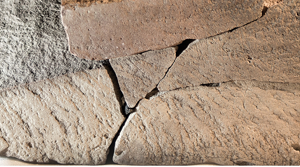
In 2021, the main runic fragment (Hole 2, in reference to the closest farm, Hole parsonage) was found in grave A4367. It is a slab of red-brown Ringerike sandstone. A larger slab of Ringerike sandstone (Hole 1), with a few incised marks, was also found in the possible grave A1790.
In 2022, additional fragments with traces of inscriptions were excavated to the north of grave A4367 (Figure 3). Three fragments had similar features to Hole 2; one piece had identifiable runes, and another had incised lines. These matched with two larger fragments found on top of the old ground surface near A1790 and A4367 in 2021, and jointly provided the start and end of another runic inscription (Hole 3). Further examination established that the slab from A1790 (Hole 1), the runic fragment from A4367 (Hole 2) and the four assembled fragments (Hole 3) were parts of the same slab of sandstone. Four pieces found in 2022 also matched with Hole 1 and 2, respectively.
Systematic sieving of excavated soil in 2023 led to the discovery of approximately 160 small sandstone fragments (<20mm). Two fragments provided missing parts to the inscription of Hole 3. Ongoing documentation and digital reconstruction may detect additional matching fragments. Figure 4 shows the 12 main fragments of Hole 1–3 (weighing 107kg) fitted together (details in OSM). Large portions of stone from Hole 2 and 3 are missing and may have been deposited elsewhere.
Assembled fragments of Hole 1, 2 and 3 (drawing by Kristel Zilmer, Museum of Cultural History).

Discovery contexts
The fragments were found in several contexts, creating a complex depositional narrative. The largest fragment, Hole 1, was found in grave A1790; it does not have runic inscriptions and is interpreted as the in situ base of an upright standing stone, indicated by its vertical placement and the presence of two supporting stones. Hole 2 was found at a depth of 60mm in the northern part of flat grave A4367 and was not visible until the grave was excavated (Figure 5; see OSM). The large surface with multiple inscriptions faced downwards in the grave. Hole 3 was not found in an archaeological structure but lying on top of the old ground surface between mounds A105 and A140. The fragments composing Hole 2 and 3 can be refitted to the top of Hole 1 and were probably intentionally removed, with Hole 2 subsequently deposited in grave A4367.
Photographs of different stages of the excavation from the top of the cremation layer in mound A140 (A) to when grave A4367 was identified (B) and uncovered (C & D), and during excavation and documentation of the grave (E). The runic stone is visible in the section shown in E. Notice the depth of A4367 compared to the cremation layer in A140 (photographs by the Museum of Cultural History).

Dating the site and grave A4367
The placement of grave A4367 is important for evaluating its absolute age and age relative to the other graves. The grave was partly exposed during the exploration of flat grave A1790. It was situated directly under the stone kerb and ring ditch of mound A140 (Figure 3), indicating its presence prior to the construction of the mound, and the full extent of the grave was not revealed until an additional 0.5–0.6m of sand was removed from beneath the kerb. Traces of disturbance in grave A1790, where Hole 1 was found, do not affect grave A4367. The stratigraphy therefore indicates that A1790 is older than A4367, which is in turn older than mound A140.
A total of 29 radiocarbon dated samples are available from both the flat graves and the mounds (see Table S2). The sum probability distribution of all dated samples indicates that the grave field dates to between 400 BC and AD 400 (Figure 6), with most samples dating between 50 BC and AD 250. The dated samples from grave A4367, containing Hole 2, are older than AD 310 (95.4% probability). Two samples from grave A1790, containing Hole 1, are older than AD 150 (95.4% probability). To estimate the age of grave A4367 more precisely and its relation to graves A140 and A1790, we constructed a chronological model using Bayesian statistics in OxCal v4.4 (Bronk Ramsey Reference Bronk Ramsey2009).
Calibrated probability distribution of all dates from the graves, including a sum probability distribution. Likelihood distributions in red are from grave A1790 and in blue are from A4367 (figure by Steinar Solheim).

The model's overall agreement index is 79.8 and the individual agreement index is 78.3, above the recommended minimum acceptable value at 60 per cent, indicating consistency between data and model (Bronk Ramsey Reference Bronk Ramsey2009). We use the 68% probability range to estimate the age of the graves. This narrows the date range but increases the chance of the date estimate lying outside the probability range. We hesitate to use the 95% probability range as this can push the date of the rune-stone in A4367 back to 190 BC and A1790 as far back as 955 BC, which is unlikely when looking at the single calibrated dates and the spread of the posterior density estimates from A1790.
The estimated start and end boundaries suggest that the graves are largely contemporaneous (Figure 7). Based on stratigraphic information, grave A140 is the youngest. The estimated start boundary for A140 is 160 BC–AD 215 (95.4%), probably AD 35–190 (68.3%); the estimated end boundary is AD 130–475 (94.5%), probably AD 165–295 (68.3%).
Chronological model showing the posterior density estimates of the radiocarbon dates. Likelihood distributions shown in red are samples of cremated human bones (figure by Steinar Solheim).

Grave A1790 is estimated to date to 955 BC–AD 110 (95.4%), probably 125 BC–AD 65 (68.3%), or at the latest to 40 BC–AD 850 (95.4%), probably 15 BC–AD 195 (68.3%). The long tail of the posterior density estimates is due to insufficient data to assess and counteract statistical scatter of the dates.
The model estimates that the burial in A4367 took place at the earliest between 190 BC and AD 125 (95.4%), probably 50 BC–AD 105 (68.3%), or at the latest between AD 125 and 415 (95.4%), probably AD 155–275 (68.3%). There is a minor difference in the start boundaries of the graves, but A4367 is modelled as older than A140, consistent with stratigraphic information and demonstrating that A4367 was established earlier than A140. The posterior density estimates indicate that graves A4367 and A1790 are of the same age, but stratigraphic information suggests that A1790 is older than A4367.
We suggest that grave A4367, containing Hole 2, dates between 50 BC and AD 275. Due to the stratigraphical and contextual relations among the graves and dated features at Svingerud, A4367 is, as detailed above, the most reliable context, providing the best radiocarbon dates to suggest the age of the rune-stone. The date frame is wide but suggests that the main fragment represents the oldest known radiocarbon-dated context containing a rune-stone. This claim calls for a critical review of the samples.
Our samples consist of charcoal and cremated human bones, and the dated bones have an older age than the charcoal from the same contexts. The carbonate in bones is a mix of biogenic carbonate laid down during the life of an individual and secondary carbonate derived from the carbon dioxide of the local atmosphere during combustion (Zazzo & Saliège Reference Zazzo and Saliège2011; Chatters et al. Reference Chatters, Brown, Hackenberger, McCutcheon and Adler2017; Rose et al. Reference Rose, Meadows and Henriksen2020). Cremated bone can have an age inconsistent with charcoal from the same context caused by contamination of secondary carbonates (van Strydonck et al. Reference van Strydonck, Boudin and Mulder2009) or by carbon exchange from firewood used in the burning process (Snoeck et al. Reference Snoeck, Brock and Schulting2014). To see if this affects our chronological models and estimated dates, we removed the bone samples from A4367 and A140, and a sample of Pinus charcoal from A4367 (a species known to have high inherent age) and analysed the remaining charcoal samples. By doing so, we estimate the youngest possible age of the contexts based on samples of short-lived species using a similar model as above.
The results support our first model (Figure S5). The difference is an earlier estimated start boundary in the model containing all samples. The estimated end boundary is almost identical to the first model (see OSM), which for A4367 is estimated to AD 125–440 (95.4%), probably AD 175–295 (68.3%) and for A140 to AD 130–525 (95.4%), probably AD 180–285 (68.3%). Radiocarbon dates therefore suggest that grave A1790, containing Hole 1, dates to between 15 BC and AD 195, while grave A4367, containing Hole 2, dates to between 50 BC and AD 275. These dates fit with current understanding of the flat grave type from Norway (Solberg Reference Solberg2000: 76; Gustafson Reference Gustafson2016) and with the typological dating of a bronze spur found in grave A4367 (Kontny & Natuniewicz-Sekula Reference Kontny and Natuniewicz-Sekuła2013; Figure S4). Combined, these dates suggest the dating of the runic fragments to between 50 BC and AD 275.
Runic fragments Hole 2 and Hole 3
Hole 2 fits together with Hole 3, and both match with Hole 1 along the side (Figure 4)—originally forming the upper part of the stone. Three smaller fragments with inscribed lines extend Hole 2, showing that its inscribed surface (A) was originally larger. Hole 1 bears incised marks, while Hole 2 and Hole 3 have runic inscriptions and other markings. The order in which the inscriptions were made is not known, but the runes along the narrow side (B) of Hole 2 post-date the splitting of the slab. Not all the marks represent (runic) writing and communicate lexically meaningful inscriptions. Some legible sequences reflect the early Ancient Nordic language—the conventional designation of the linguistic stage recorded in runic inscriptions of largely Scandinavian provenance from the mid-second to late seventh centuries AD (Bandle et al. Reference Bandle, Elmevik and Widmark2002; Nedoma Reference Nedoma, Klein, Joseph and Fritz2017; Schulte Reference Schulte and Nesse2018). As Hole 2 is dated between 50 BC and AD 275, we can possibly extend that periodisation earlier. In the following sections, we present the inscriptions for which the determination and interpretation of runes is possible to a greater or lesser extent (for detailed runological-linguistic assessments, see Zilmer & Vasshus Reference Zilmer and Vasshus2023). The transliterations (renderings of runes in Latin letters) are in bold type using conventional symbols (see OSM part 2).
Hole 2
The front side (A) has identifiable runic sequences alongside rune-like and stylised/ornamental signs, all thinly incised (Figure 8; see also https://3d.unimus.no/data/64d1dc4f-35da-470e-b47f-8c2db355fcb2/ for interactive three-dimensional model). Triangular and zigzag shapes are among repeated visual elements. Series of intersecting lines form a grid pattern. Some runes run partly across the grid. The clearest inscription (sequence 1) is near the lower-left corner, followed by a fainter sequence to the right (2). Two lines of runes (3, 4) are in the left mid-section and three large runic shapes appear to their right (5). One narrow side (B) bears a longer inscription (6). Some incisions are visible on two other sides.
Runic markings on Hole 2, side A (photograph by George Alexis Pantos; drawing by Kristel Zilmer).

Sequence 1
On side A, eight runes are broader and more distinct than the rest. They face right and read idiberug. There are no traces of damaged incisions preceding these runes. The eighth character ᚷ is given as g but could be a form of ᛅ n (on ambiguous rune-forms, see Düwel et al. Reference Düwel, Nedoma and Oehrl2020: 142) or fulfil some other function. Comparable forms appear on side B of Hole 2 and on Hole 3. The rune b has four pockets; versions of multi-pocket b are repeated elsewhere on side A. We know of no contemporary runic parallels, but samples of three-pocket b appear on two portable l objects from AD 700–900, found in the Netherlands and Denmark (Looijenga Reference Looijenga2003: 304; Kaiser Reference Kaiser2021: 171–82; Imer & Sindbæk Reference Imer and Sindbæk2021). The fifth rune ᛖ e has diagonal branches; combined with other instances on Hole 2 and 3 this provides the earliest attestation of this runic graph-type (on disputed runographical developments, see Odenstedt Reference Odenstedt1990; Williams Reference Williams1992; Imer Reference Imer2015a & Reference Imerb).
Idiberug may refer to the deceased, the benefactor or someone/something else. Multiple names and epithets survive in the early runic record (examples in Krause & Jankuhn Reference Krause and Jankuhn1966; Antonsen Reference Antonsen2002), although some evidence is contested. One possible interpretation is a compounded female name idibergu in the nominative case. The second element bergu may correspond to Proto-Germanic *-bergō, Ancient Nordic *-bergu (Old Norse -bjǫrg, feminine noun meaning ‘help, protection; relief; shelter’). Names with *-bergō belong to the Germanic name stock (Nedoma Reference Nedoma2004: 139). The switching of the u and g-runes at the end could be a carving mistake, yet potential contextual circumstances are unknown. The etymology and meaning of *idi-/*īdi- is unclear (cf. Peterson Reference Peterson2004: 30; Kroonen Reference Kroonen2013: 114). The name I/īdibergu would have parallels in the Old High German Iduberga/Idoberga or Idaberga/Itaberga (on the naming element Id(a/i-)/*īd(a/i-), see Nedoma Reference Nedoma2004: 340–43). In a compound designation, *idi-/*īdi- could have had an intensifying function (Zilmer & Vasshus Reference Zilmer and Vasshus2023: 245–50), referring to something as recurring or everlasting. It may be that the inscription related to the site, the stone or described a performative act. The repeated multi-pocket b and zigzag-motifs may visually reinforce a central (dedicatory) message.
Inflectional forms of other names are alternative interpretations, such as idiberu[n] g[…], and in combination with the first rune from sequence 2, idiberu[n]g[a]z or idiberunz for idibernuz (Zilmer & Vasshus Reference Zilmer and Vasshus2023). The latter is considered less likely due to the different style of carving in sequence 2. The ending with -g/n/? could indicate an abbreviated word or phrase, comparable to classical Roman epigraphy (e.g. Imer Reference Imer2011b; Mees Reference Mees2016), but this is difficult to determine. Based on our current understanding, idiberug is best explained as a name/designation on its own.
Sequence 2
Five or six runes or rune-like forms with surrounding lines stand to the right of sequence 1 (Figure 8). The first is ᛦ z. The second and third resemble the b in idiberug. The fourth is ambiguous (possibly ᚦ þ), the fifth may be ᛗ m. Then follows a triangular shape that connects to m, as its possible extension. The recorded z could arguably provide the nominative singular masculine ending to the preceding idiberug (e.g. a male (kin) name), the rest does not have any evident meaning. The faint incisions and layout suggest that the sequence may be a separate composition of runes and rune-like characters.
Sequences 3 and 4
Two rows of runes sit in the left mid-section (Figure 8). The upper row contains some five runes, the bottom contains (at least) nine runes. The runes blend with other markings next to a grid. It is challenging to determine what marks belong to the inscription(s), or where these start or end. For instance, by the start of the bottom row, one shape resembles a sideways-positioned rune (or the Roman capital W) but could be ornamental.
A possible reading is: m/m͡azabṭ (top) and ?izbh/iilaes (bottom). Both lines employ ᛘ z with upwards facing branches (cf. ᛦ z in sequence 2). The b-runes have (at least) three pockets (the one in the bottom line has a damaged lower part). We note the use of ᛖ e and ᛗ m; diagonal lines cutting across m on the right may be accidental or indicate a ligature of m and a. The sequences contain consonants and vowels and can be structured in different ways, but their meaning remains uncertain (Zilmer & Vasshus Reference Zilmer and Vasshus2023: 257–58).
Sequence 5
Three characters in the right mid-section appear more defined, resembling those of sequence 1. The forms resemble the first three runes of the futhark: ᚠ f, ᚢ u and ᚦ þ. The third character has an extra triangular shape on its pocket. Viewed separately, its identification may seem less evident but is supported by the joint sequence of forms. Read as fuþ, this may be an early rendering of the futhark.
Sequence 6
When Hole 2 has its inscribed face (A) upwards, the runes on side B stand upside down. Turned over—as found placed in the grave—the reading direction, determined from the orientation of runes goes from right to left (Figure 9; see also https://3d.unimus.no/data/bce7e1ea-9ea5-4aab-9538-38fa4f38b36d/). Some damage to the surface has impacted the outline of runes. Nineteen forms are fairly clear: s/behkḷgatfuṭþmdŋfiḍm??? The first rune, surrounded by irregular grooves, resembles s or b; a few others are uncertain. Unidentified incisions at the end of the line contain vertical strokes and angular shapes (Zilmer & Vasshus Reference Zilmer and Vasshus2023: 262–66).
Runic markings on Hole 2, side B. In the photograph, the stone is arranged with side A facing upwards so that the runes on side B (foreground) are inverted. Runes are shown in the correct orientation in the drawing (photograph by George Alexis Pantos; drawing by Kristel Zilmer).

The inscription contains numerous consonants, but few vowels. Consonant sequences feature in some early runic inscriptions; comparable epigraphic and scribal traditions make it relevant to consider abbreviated or concealed writing, while the intended linguistic form remains uncertain. This inscription may have had a meaning, but emendations with hypothetical (elided) vowels are speculative. This may be a sample record of runic shapes on stone; out of the 24 characters of the older futhark, at least 15 seem to be used here.
Hole 3
Hole 3 has 16 or 17 runes and at least two separator marks of multiple small dots. The incisions are shallow, in parts weathered. Some runes survive entirely on one fragment, others are divided between several fragments and a few are damaged (Figure 10; see also https://3d.unimus.no/data/d00125aa-3d3f-4e87-8b68-50986c4c4ad1/). They read from left to right: ek-g/wụlu:faḥido:runo. Faint traces between the second and third runes indicate an extra sign, possibly s, remnants of some other rune (if the incised lines reached higher on the part of the stone that has not survived) or a separator.
Reconstruction of the fragments of Hole 3 reveals a runic inscription (photograph and drawing by Kristel Zilmer).

The recorded rune-carver formula begins with ek ek (‘I’) and completes with runo rūnō (‘rune’, singular feminine noun in the accusative form). A comparable case is the Einang stone in Norway (approximately late fourth century) where the word rūnō is explained as referring to the inscription or its message. In parts, the identification of runes is challenging due to faint scratches and irregular and ambiguous shapes (Zilmer & Vasshus Reference Zilmer and Vasshus2023: 268–73). This concerns the name/epithet, which can have different readings and interpretations—possibly Gul(l)u/Wu(l)lu or Swul(l)u/Skul(l)u. The ending -u would show that the carver was female. The verb fahido fahidō (first person singular past tense, ‘painted/wrote’ of Ancient Nordic *faihijan) refers to the act of inscribing, with parallels in other early runic epigraphy (e.g. Schulte Reference Schulte and Nesse2018).
Discussion
The Hole rune-stone is distinctive due to its multiple runic sequences and other visual elements. Some ambiguous markings illustrate the challenging distinctions drawn between early writing and non-writing (Graf Reference Graf2010, Reference Graf2011; Bedos-Rezak & Hamburger Reference Bedos-Rezak and Hamburger2016). Some are identifiable as runes; others can be ornamental or imitate and stylise script. Hole 2 is complex, with possible focal points idiberug and fuþ, which have more defined runes. In addition to conveying meaningful messages—possibly a name/designation and a representation of the runic script—the sequences could serve as visual and material markers on a multi-layered surface. Repeated multi-pocket and zigzag shapes may recreate central elements of inscription and their underlying events as symbolic ornaments—or they may represent versions of rune-like forms, as practised by different hands.
Among rune-stones of the Roman Iron Age and the Migration Period (dating from around the second to late sixth century AD), some display accompanying ornamental and stylised markings (e.g. Opedal stone in Norway; for details on inscriptions, see Krause & Jankuhn Reference Krause and Jankuhn1966; Imer Reference Imer2015a & Reference Imerb), though comparisons across the rune-stone corpus remain broad and limited by uncertainties of dating, context and the dubious nature of some finds (see Imer Reference Imer2011b, Reference Imer2015a & Reference Imerb for traceable distributions in time and space). In some settings, runes and pictorial motifs indicate use over time—as with the Himmelstalund and Kårstad rock carvings in Östergötland, Sweden and in western Norway—and some images and inscriptions are likely contemporary expressions—as on the Krogsta and Möjbro stones in Uppland, Sweden. Sandstone fragments with runes found in graves at Tomteboda, Uppland (sixth century AD), show the presence of runic writing on early picture stones (cf. the Gotlandic Martebo picture stone). In comparison, Hole 2 creates the impression of multi-layered inscribing, possibly by different hands. The series of shallow incisions on the Hole fragments contrast with stones that feature deeply hewn rows of runes of a seemingly more enduring appearance.
The original Hole stone—now in multiple fragments—was of a rock type suitable for inscribing with a sharp tool, and once possibly stood in an upright position as indicated by the positioning of the in situ Hole 1. The site links the stone to burials, but it is unknown how and why its fragmentation occurred, and when and why the inscriptions were created. It is not clear whether there was a direct connection between the inscriptions of Hole 2 and 3. Some inscriptions may pre-date others; some may have been part of the original stone, in combination with Hole 1, although the shallow incisions would not have been particularly distinctive on a larger surface. Sections on Hole 2 also show layered markings, but further investigations are warranted, particularly regarding potential inspiration from contemporaneous epigraphy (on Roman objects, see Zilmer & Vasshus Reference Zilmer and Vasshus2023).
The lack of context for the fragments that constitute Hole 3 makes it difficult to relate the inscription to Hole 1 and 2, although it was part of the original slab. The inscription speaks of rune-carving and may identify a female inscriber—the earliest such record (on rune-carving women, see Düwel Reference Düwel and Bennewitz2002). While this may be significant in relation to Hole 2 and idiberug (if interpreted as a woman's name), such links remain hypothetical at this point. The dating of the Hole 3 inscription is uncertain, and the state of the fragments allows for different scenarios. Comparing the runes and their execution, there are similarities and differences with Hole 2. The inscription on the side of Hole 3 appears separate from visible incisions along the corresponding edge of Hole 2; parts of the inscription seemingly follow the contours of fragment 1, with runes of full size. Inscribed marks are also visible on fragment 2 of Hole 3 (on the opposite side to the runic inscription), which align with marks on the corresponding part of Hole 2. These marks are too sparse to identify as runes but may indicate that some inscribing was done when these pieces were still joined together, perhaps when the original slab was complete.
The use of the stone in what appear as separate graves may be significant. It could be that the whole stone or just the part identified as Hole 1 was intended to mark one grave (A1790). Hole 2—which possibly underwent further fragmentation in grave A4367—could have been intentionally chosen in connection with this subsequent burial. Few other early rune-stones, apart from the rock-face inscriptions, have been preserved in their presumed original settings, with established connections to burials or other structures. Based on descriptions that date to the late nineteenth/early twentieth century, or earlier, it is nevertheless apparent that more than half of the stones in Norway and Sweden may originally have been linked to grave constructions, burial mounds or stone settings, though many find circumstances are uncertain.
In terms of their content, several rune-stone inscriptions are comparable with the example from Hole in their use of names/epithets and mentions of rune-carving; there is also other recorded evidence of sequences that lack lexical interpretations (examples in Krause & Jankuhn Reference Krause and Jankuhn1966; Antonsen Reference Antonsen2002; Looijenga Reference Looijenga2003; Imer Reference Imer2015a & Reference Imerb). Yet, few other rune-stones combine the different inscriptions and markings united by the Hole fragments.
The commemorative nature of (early) rune-stones is customarily underlined (Antonsen Reference Antonsen2002: 222). The objects and inscriptions vary and not all were erected and (explicitly) commemorative stones. The inscriptions can highlight commissioners/dedicators, and the acts of dedication and inscribing (Knirk Reference Knirk2011; Mees Reference Mees2016). Some highlight affiliations between individuals. This evidence allows us to discuss both their ceremonial and practical intentions. The Hole fragments may have fulfilled multiple functions and undergone changes due to the division and reuse of the stone. The grave field and the original raised stone suggest a commemorative and dedicatory intent, while the features of Hole 2 illuminate additional pragmatic and symbolic expressions in connection with its subsequent use in a separate burial. The multiple runic markings of Hole 2 and the rune-carver formula of Hole 3 also emphasise acts of inscribing. Further work with the fragments may provide additional insights and help unravel their multiple meanings.
Conclusion
The runic fragments from the Svingerud grave field can be dated between 50 BC and AD 275 based on radiocarbon dates from grave A4367, which contained the inscribed fragment Hole 2. This is a rare example of finding several fragments of a rune-stone, with some of the fragments in well-preserved, datable archaeological contexts. The dating frame is relatively wide, but still makes the Hole fragments the earliest known archaeologically dated rune-stone. The early dates and the inscriptional features are new evidence on the use of runes on stone, prompting discussion on the meanings and functions of the fragments and early Scandinavian rune-stones. Particular rune-forms on the dated fragments—such as the multi-pocket ‘b’ and the multitude of zigzag-like marks—underpin the epigraphic importance of the find. The recorded forms may show some early variants of runes, used on stone. The established dating frame will necessitate new assessments of other early rune-stones and their relative chronologies in future research. The discovery may also have consequences for scholarly debates on the age and origin of runes, and developments in early runic epigraphy.
Acknowledgements
We thank the field staff for their great work during the excavation and Nye Veier AS for excellent co-operation throughout the project. We are grateful to colleagues at the Museum of Cultural History and elsewhere for valuable input while documenting and researching the Hole fragments. We also thank the anonymous reviewers of this article for their thorough and useful feedback.
Online supplementary material (OSM)
To view supplementary material for this article, please visit https://doi.org/10.15184/aqy.2024.225 and select the supplementary materials tab.
 ?
? 


 Open access

